
A complete issue · 18 pages · 1905
Judge — March 25, 1905
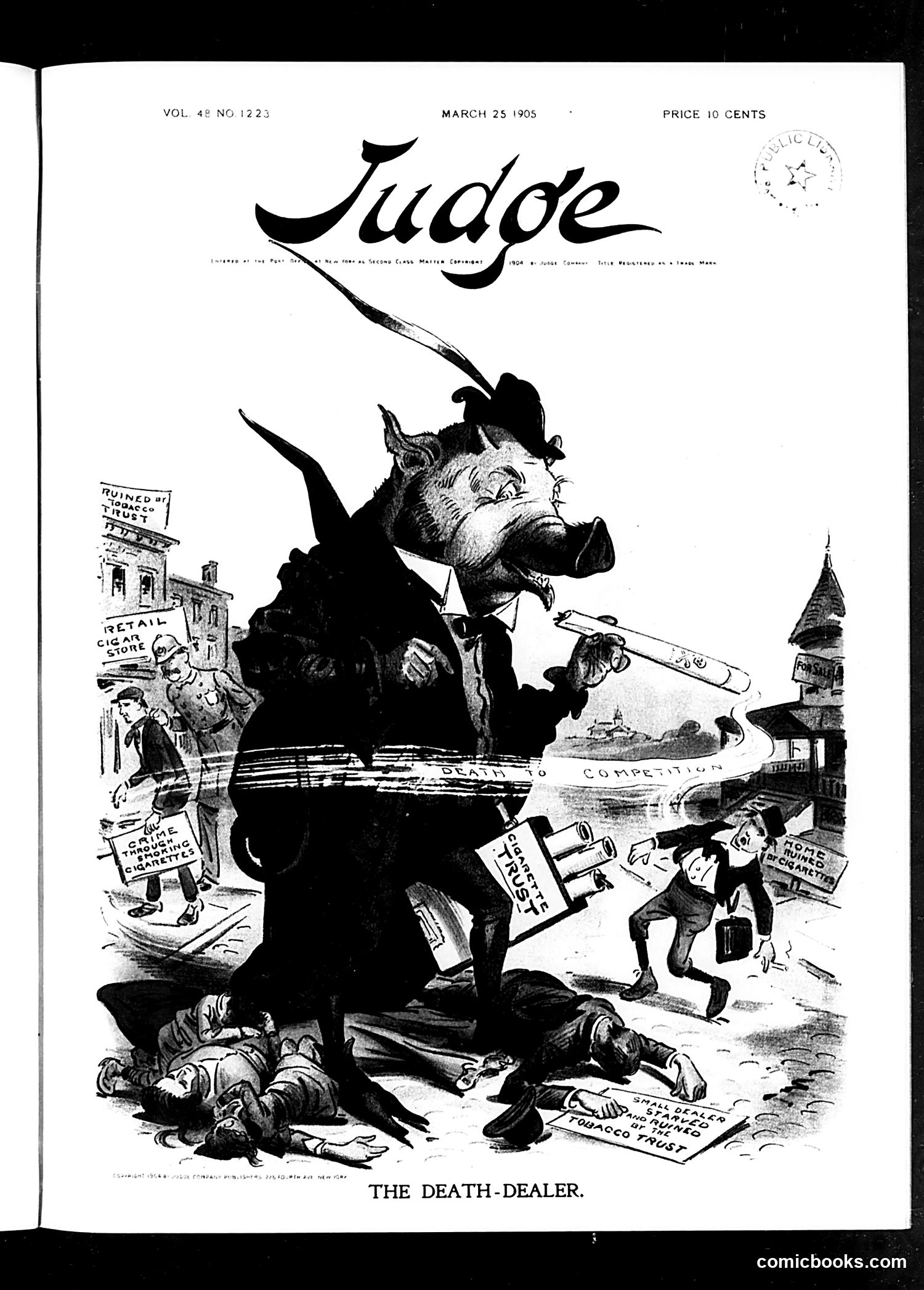
This political cartoon depicts a demonic figure labeled "DEATH-DEALER" wielding a scythe and cigarette, surrounded by corpses and distressed figures. The satire targets the tobacco industry and cigarette smoking as a deadly threat to public health. The central demon represents personified death profiting from cigarette sales. Around the figure are signs referencing retail stores, competitions, and trust monopolies—suggesting the industry's aggressive marketing and business practices. Small human figures appear to be victims or workers caught in the industry's grip. The cartoon advocates for regulation or prohibition of cigarettes, portraying smoking not as a personal choice but as an industry deliberately distributing poison. This reflects early-20th-century public health concerns about cigarettes, before tobacco's dangers were scientifically established.
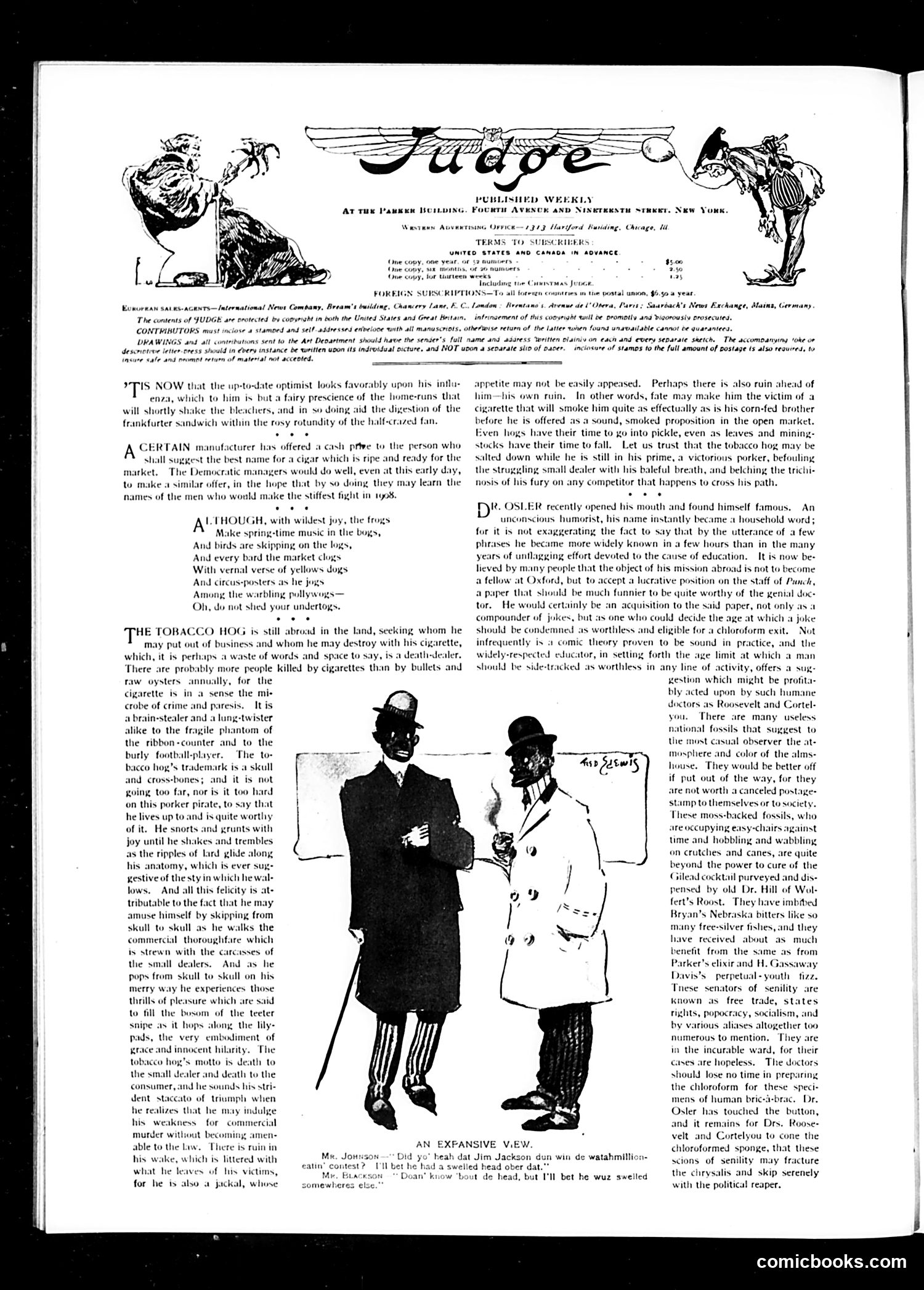
This page from *Judge* magazine contains satirical articles and a cartoon. The main cartoon shows two men in conversation, with a caption referencing "Jim Jackson" and a "watermelon" joke—a crude racial stereotype common in early 20th-century American humor. The left column discusses a cigar seller ("the tobacco hog") in derisive terms, while the right column features "Dr. Osler" discussing age limits for usefulness in society—likely referencing William Osler, a prominent physician whose views on aging and retirement sparked controversy. The cartoon and text together reflect the magazine's satirical approach to contemporary figures and social issues, though the racial humor is deeply offensive by modern standards and reflects the prejudices of the era.
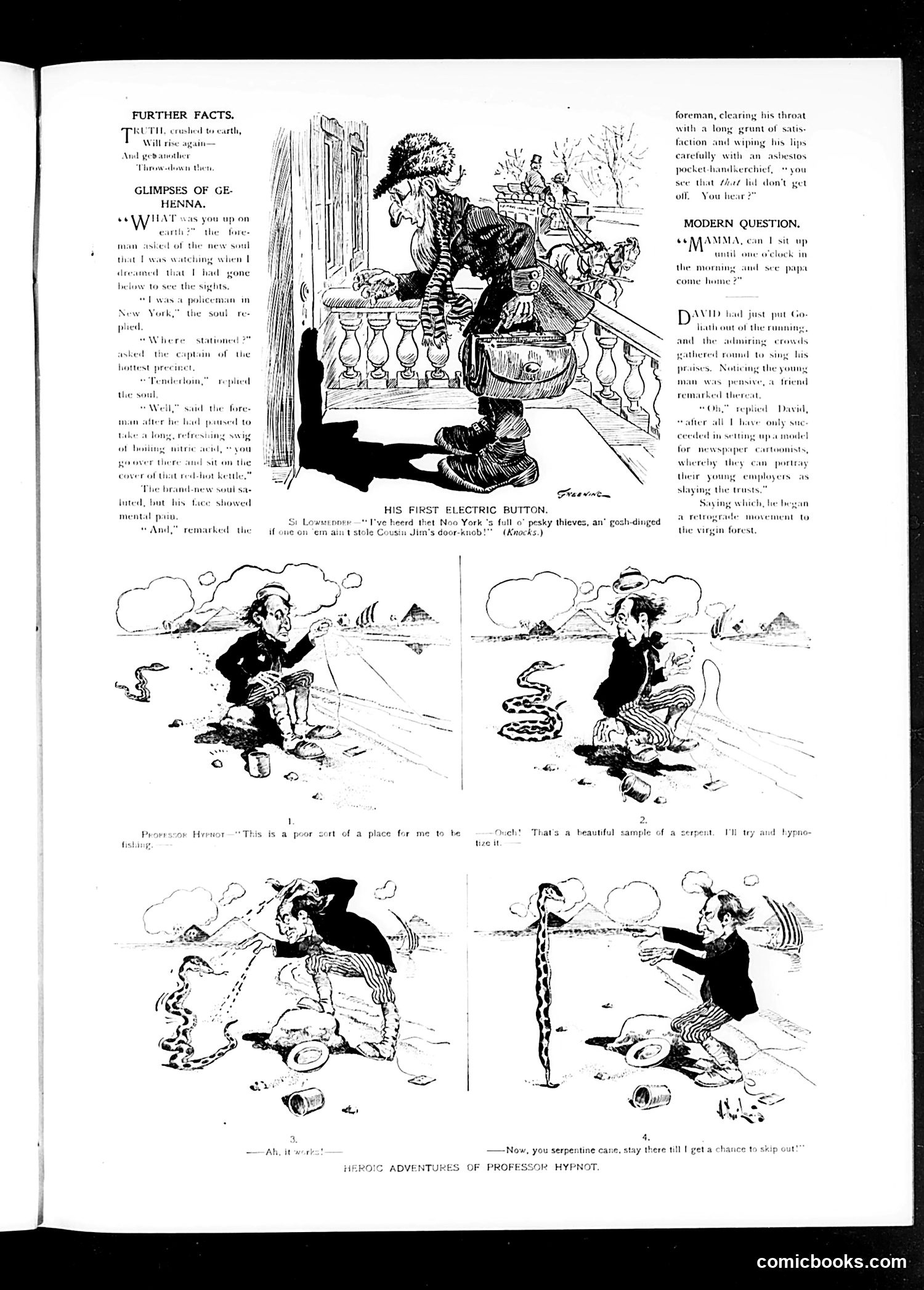
The page contains two distinct sections: **"His First Electric Button"** (top): A satirical cartoon about a naive New York politician discovering the electric doorbell at Uncle Cornelius Jim's residence. The joke mocks rural or unsophisticated newcomers unfamiliar with modern technology—a common theme in turn-of-century American humor. **"Heroic Adventures of Professor Hypnot"** (bottom): A four-panel comic strip featuring a charlatan hypnotist attempting to control a serpent, which instead wraps around him in increasingly chaotic ways. The final panel's caption jokes about the snake remaining "shy" despite hypnotic attempts. This satirizes fraudulent "professors" and pseudo-scientific practitioners popular in the era. Both reflect Judge's satirical approach to contemporary absurdities and social pretension.
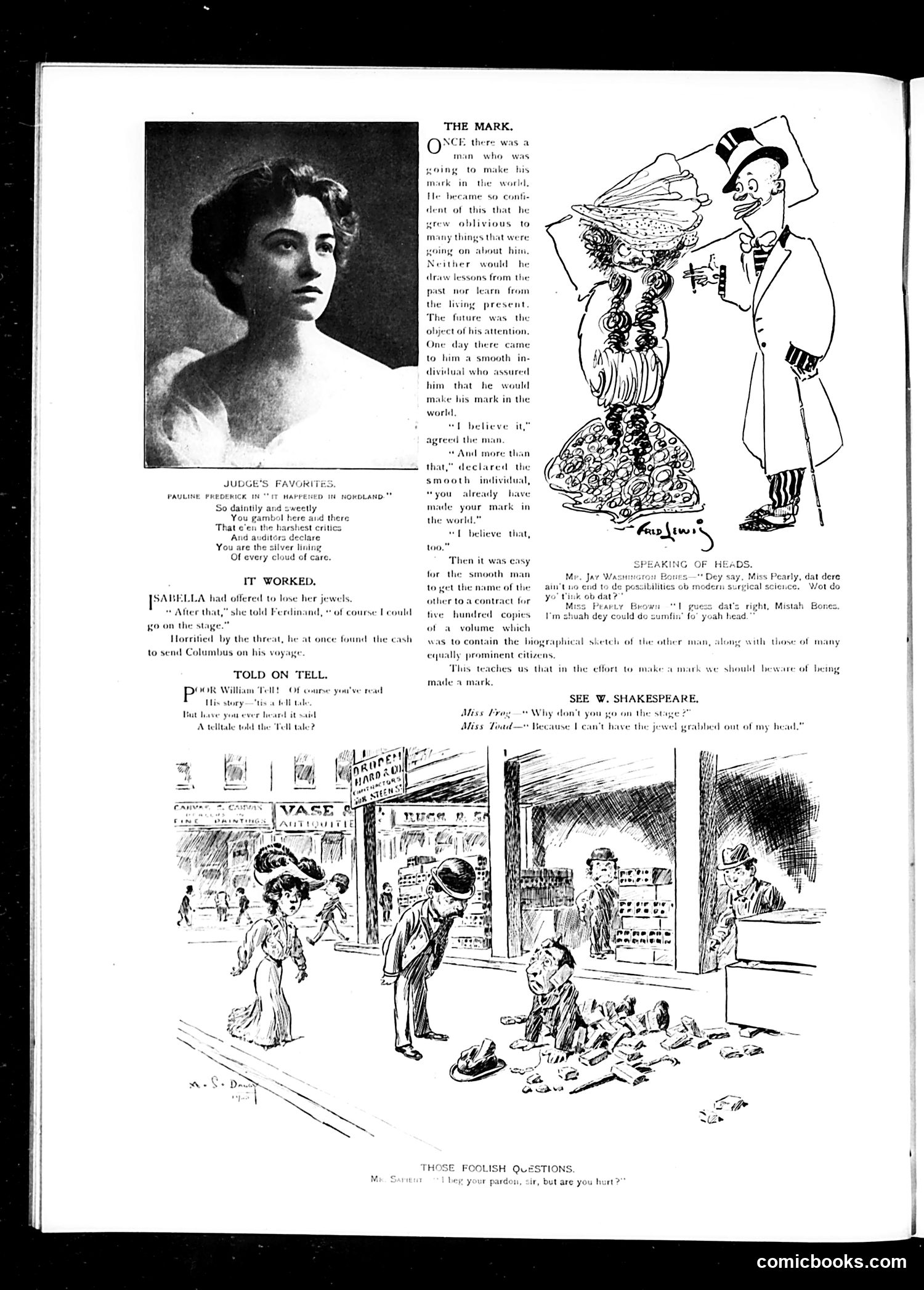
This page contains multiple satirical pieces. "The Mark" presents a parable about ambition—a man seeks to make his mark on the world and is approached by a smooth-talking individual promising he'll achieve it. The story's moral critiques naive confidence in get-rich-quick schemes. "Judge's Favorites" features a portrait of a woman (identity unclear from image alone) with a poem praising her. "Speaking of Heads" appears to be a joke about phrenology or physiognomy—pseudoscientific methods of judging character from physical features. "Those Foolish Questions" is a comic strip mocking absurd inquiries, showing a man creating chaos while asking ridiculous questions of passersby—satirizing people who ask obvious questions. The overall tone critiques vanity, gullibility, and foolishness.
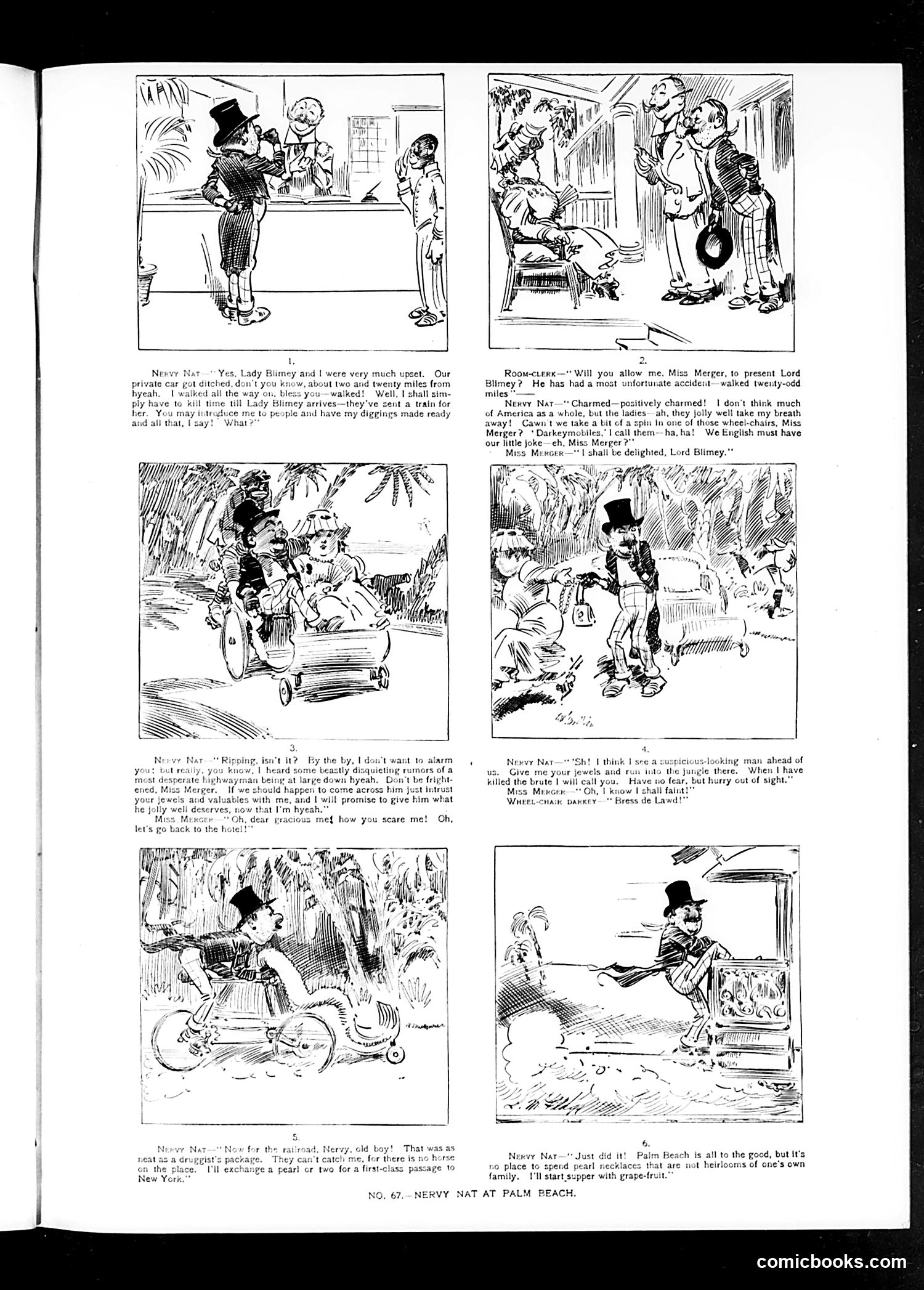
This satirical comic strip follows "Nervy Nat," an American character visiting wealthy Palm Beach, Florida, interacting with British aristocrats ("Lord Blimey," "Miss Merger"). The humor turns on class pretension and transatlantic social friction. Key satirical points: Nat affects sophistication while committing social blunders; wealthy characters discuss "pearl necklaces that are not heirlooms of one's own family"—suggesting nouveau-riche Americans flaunt borrowed or ill-gotten luxury goods rather than inherited wealth. The British condescend to American manners and lack of breeding. The strip mocks both American social climbers attempting to impress European elites and the snobbish British who judge them. The reference to "Darkeymobiles" (appears to be a period term for vehicles) remains unclear without fuller context, but the overall satire targets Gilded Age wealth, conspicuous consumption, and the anxiety of the American rich seeking European validation.
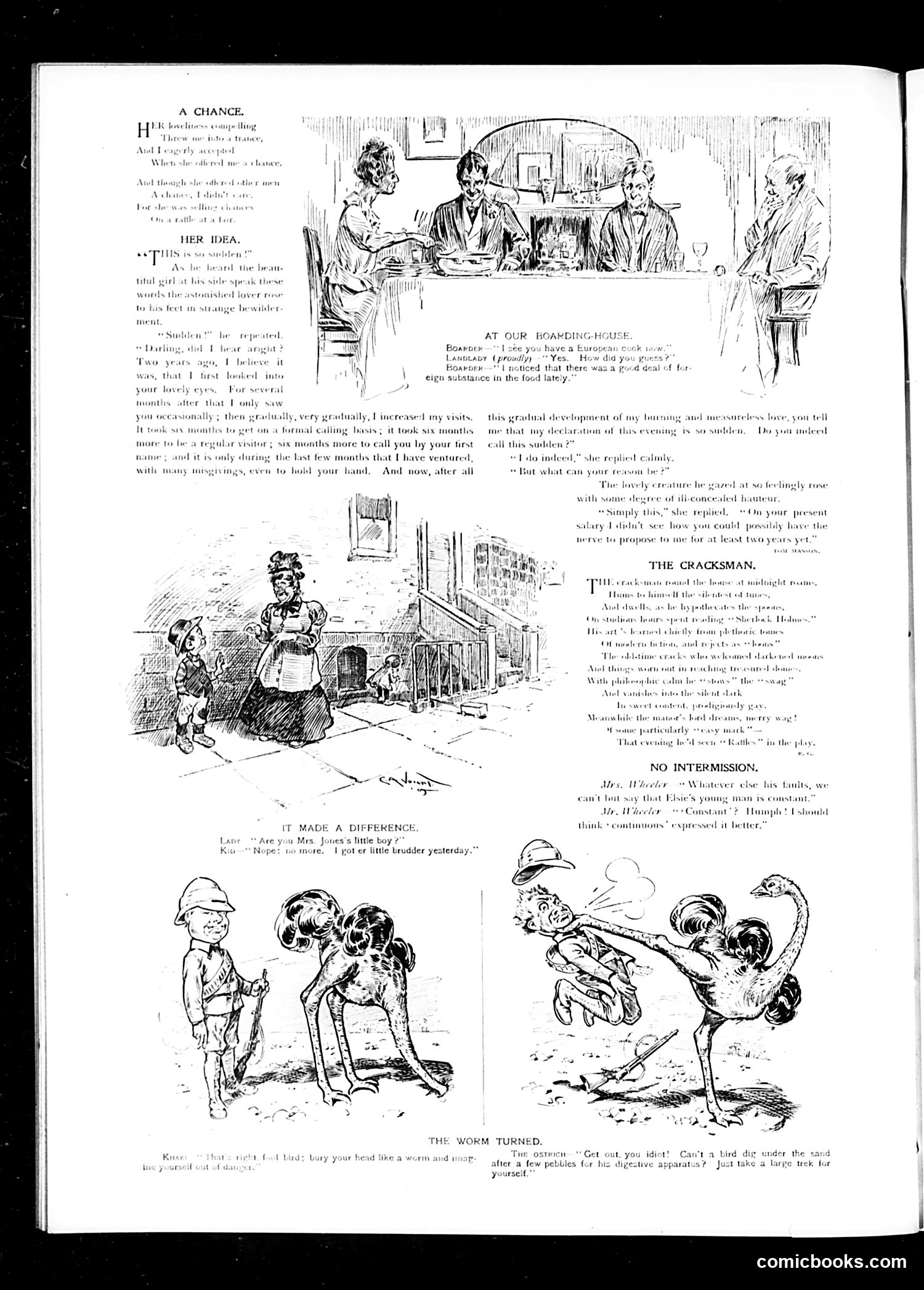
This page from *Judge* contains several satirical sketches with accompanying dialogue. "A Change" depicts a woman's sudden marriage proposal reversal—she initially rejected a suitor after months of courtship, but now proposes to him herself, suggesting female opportunism or changing social attitudes about women's romantic agency. "Her Idea" satirizes a woman's expectation that a man should propose after merely establishing financial security, mocking presumptuous female assumptions about marriage. "The Cracksman" appears to be a humorous poem about a burglar, likely satirizing crime narratives popular in Victorian literature. The lower sketches—"It Made a Difference" and "The Worm Turned"—show children in comedic situations, with the final caption suggesting a child's humorous retort about digestive discomfort. Overall, the page employs gender-based humor typical of early-20th-century American satire, mocking both female and male behavior regarding courtship and social pretense.
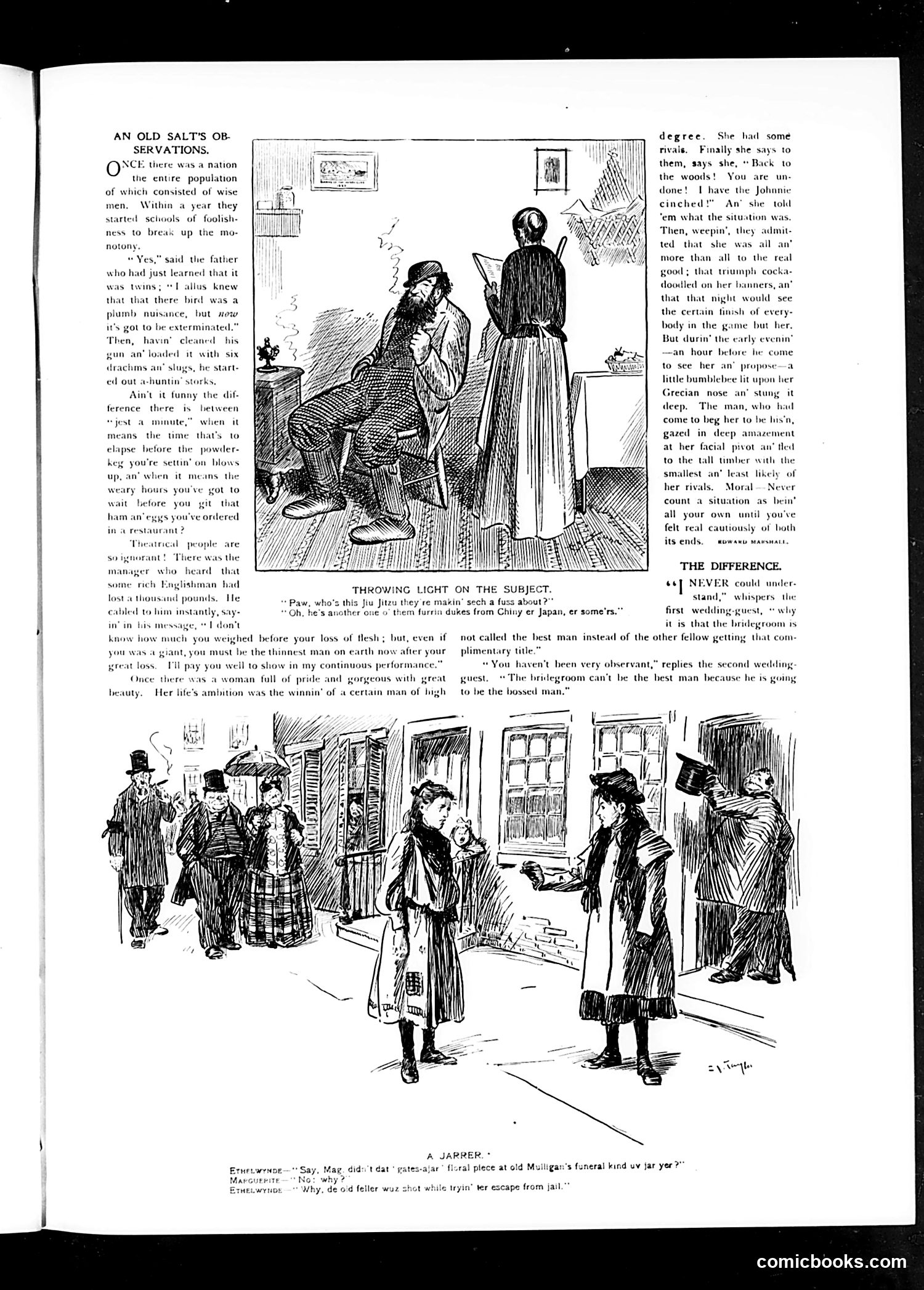
This page contains three separate humorous pieces typical of late 19th/early 20th-century American satire: **"An Old Salt's Observations"** (top): A folksy narrator shares absurdist anecdotes—including one where a man hunts storks after learning his wife is having twins (referencing the "stork delivers babies" myth), and another about a vain woman whose romantic triumph is undone when a bee stings her nose, causing her rival to win instead. The humor relies on rural dialect and ironic reversals of expectations. **"The Difference"** (bottom): A brief joke about wedding etiquette. Two guests debate why the bridegroom isn't called "the best man"—the punchline being he cannot be "the best man because he is going to be the bossed man," implying marriage means losing independence. The satire targets American pretension, romantic vanity, and marital dynamics common to the era's humor. The crude woodcut illustrations and heavy dialect are characteristic of Judge's style during this period.
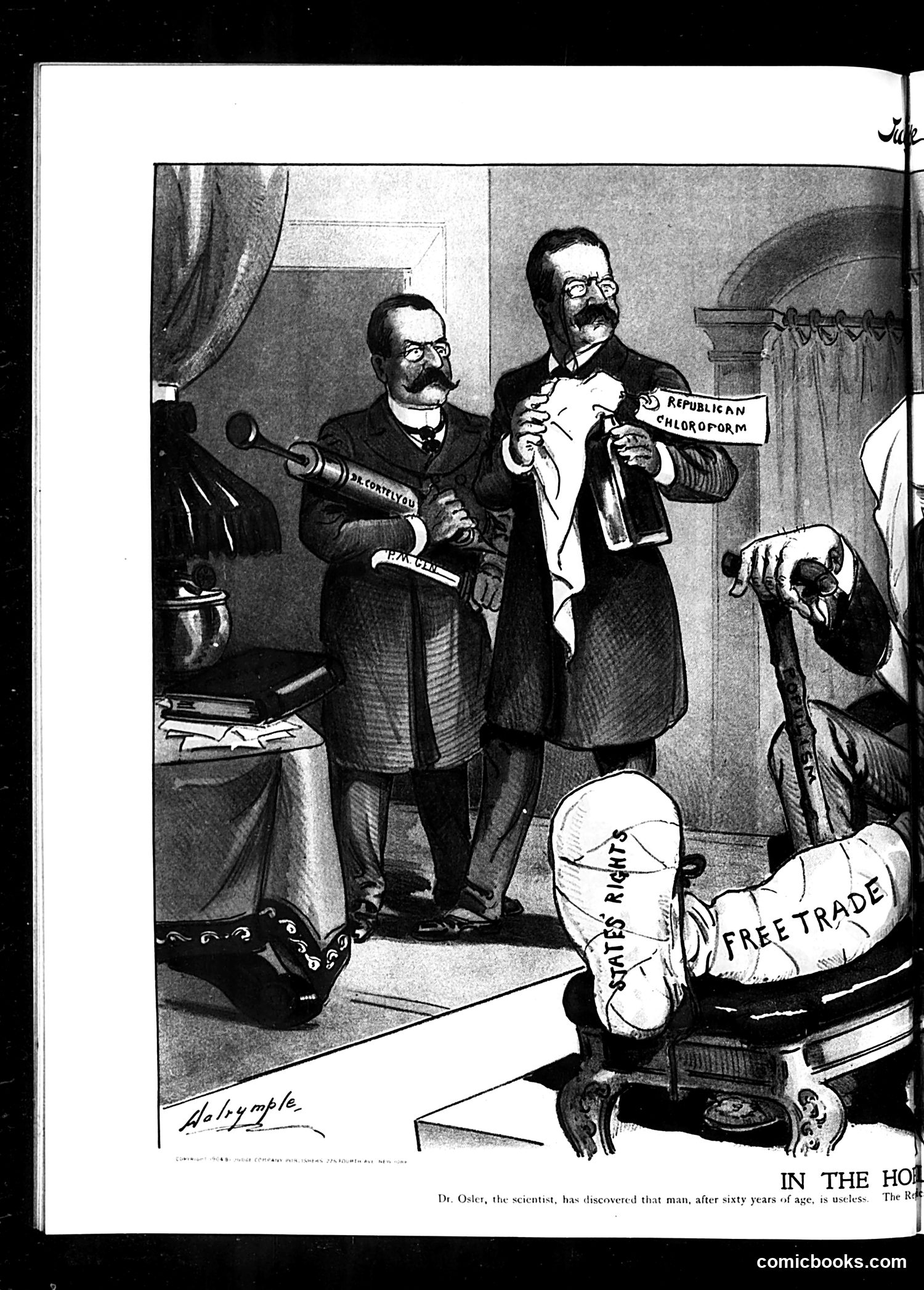
This Judge magazine cartoon satirizes late 19th-century Republican politics. Two mustachioed men examine scientific instruments labeled "REPUBLICAN CHLOROFORM" and hold a document labeled "REPUBLICAN CHLOROFORM." In the foreground, a bound figure labeled "FREE TRADE" appears unconscious or incapacitated, while another figure labeled "SMITH'S RIGHTS" lies defeated. The cartoon critiques Republican efforts to suppress or eliminate free trade policies through what the artist depicts as political "chloroform"—rendering opposition helpless. The reference to "Dr. Osler" in the partial caption suggests mockery of scientific or expert authority being misused for partisan purposes. The satire targets Republican trade protectionism as harmful anesthesia to legitimate economic and political rights, presenting the GOP's policies as a calculated sedation of opposing interests.
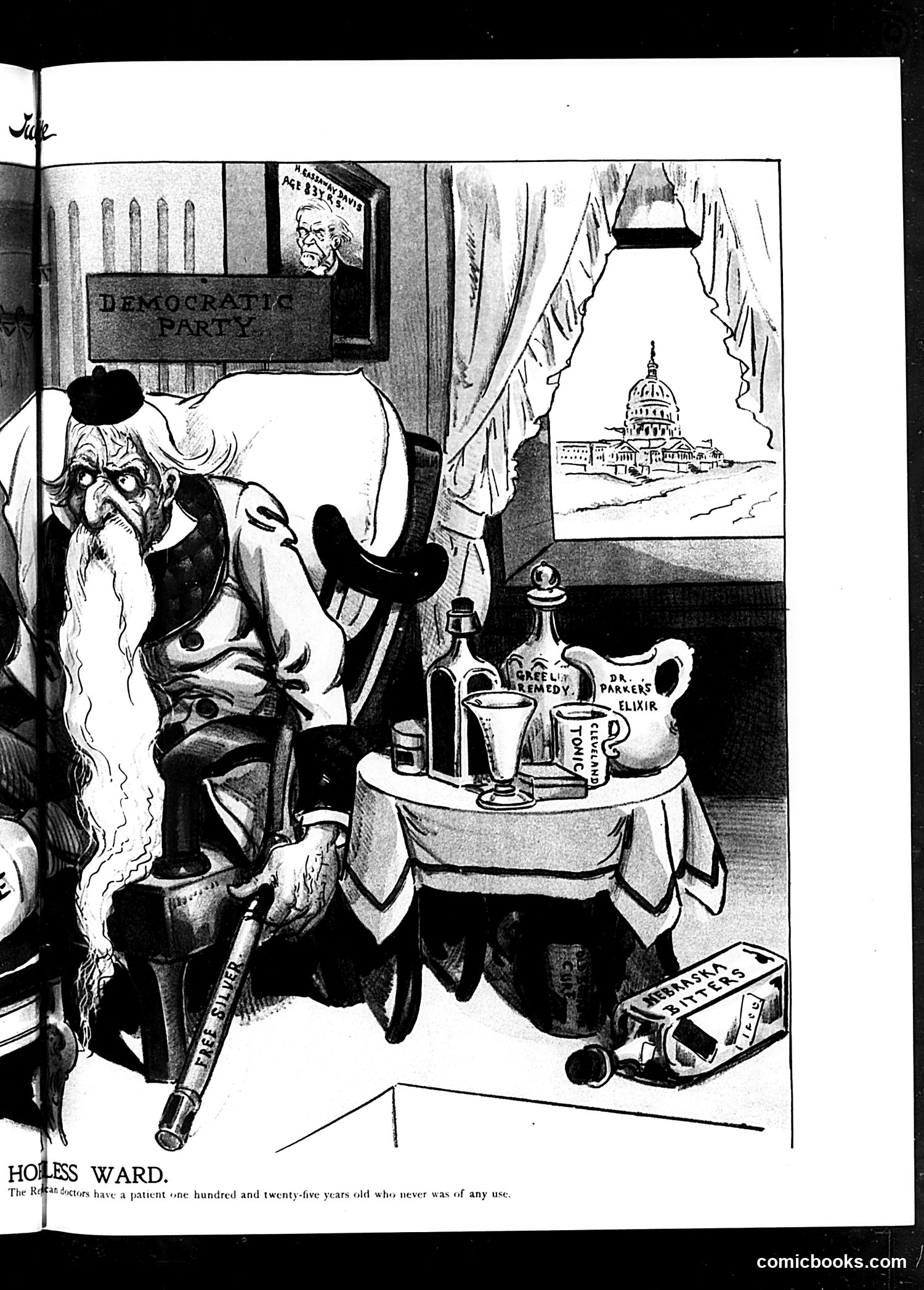
This cartoon depicts an elderly, bearded patient in a hospital bed labeled "Democratic Party." The title "Hopeless Ward" and caption suggest the Democrats are portrayed as a useless, decrepit patient beyond recovery. The cartoon appears to be Republican political satire, comparing the Democratic Party to a 125-year-old invalid requiring medical care (represented by bottles labeled "Remedy" and "Elixir"). The Capitol building visible through the window places this in a political context. The implication: the Republican cartoonist argues Democrats are an exhausted, antiquated political force requiring desperate remedies but fundamentally incurable. This is aggressive partisan mockery suggesting the opposing party is both old and worthless—a common early 20th-century *Judge* magazine trope attacking political opponents through medical metaphors.
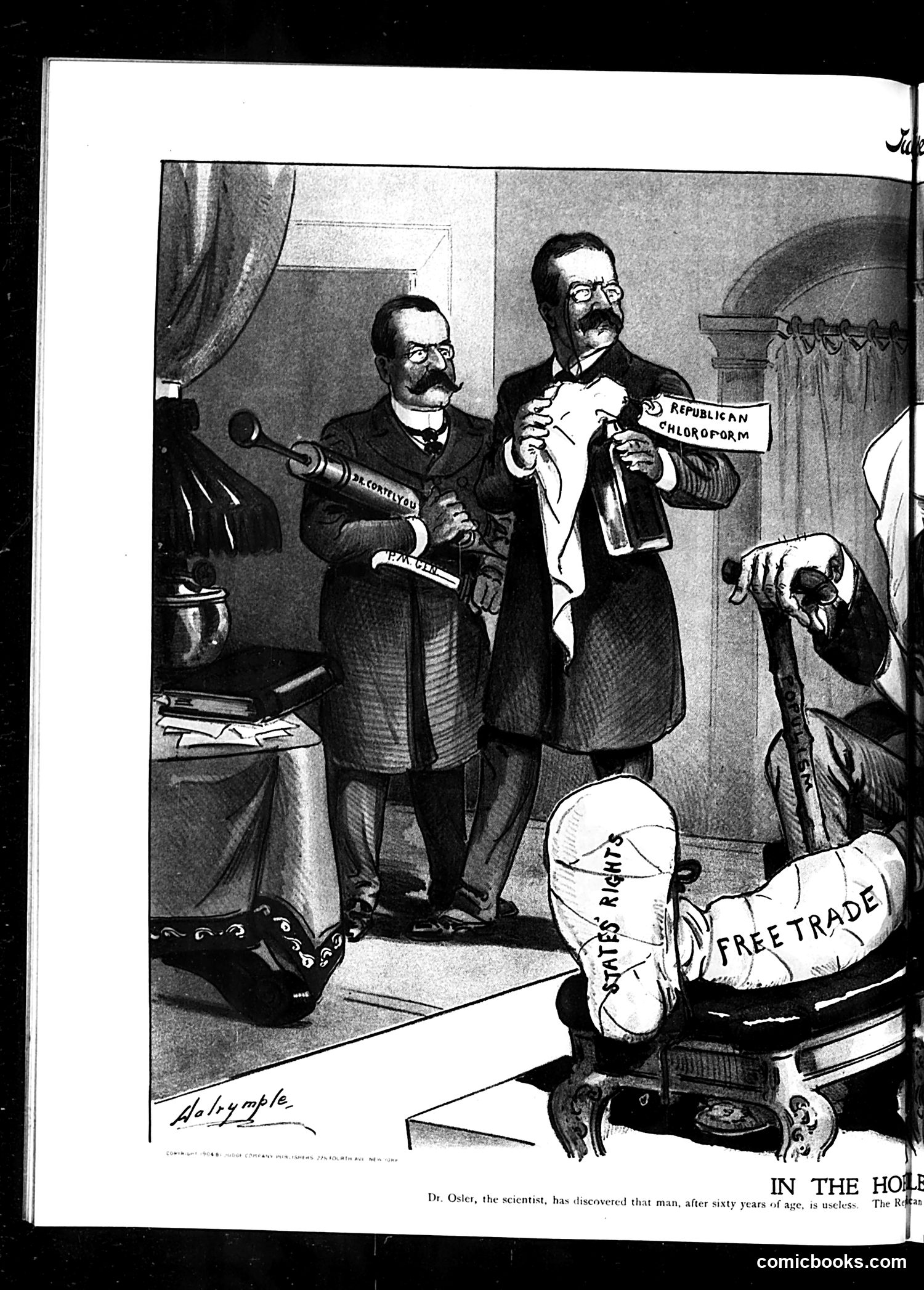
This Judge magazine cartoon satirizes Dr. William Osler, a prominent physician, who apparently made controversial statements suggesting men over sixty were economically and socially useless. The cartoon shows two well-dressed men in what appears to be a formal setting, holding documents labeled "Republican Chloroform" and discussing how to dispose of aging citizens. Below, a figure labeled "Free Trade" lies bound and gagged, labeled "Smith's Right" (unclear reference). The satire attacks both Osler's provocative statement AND Republican political policies—suggesting the GOP's economic policies ("chloroform") are effectively killing free trade and older workers. The cartoon uses dark humor to mock both the scientist's controversial idea and Republican economic positions the cartoonist opposes.
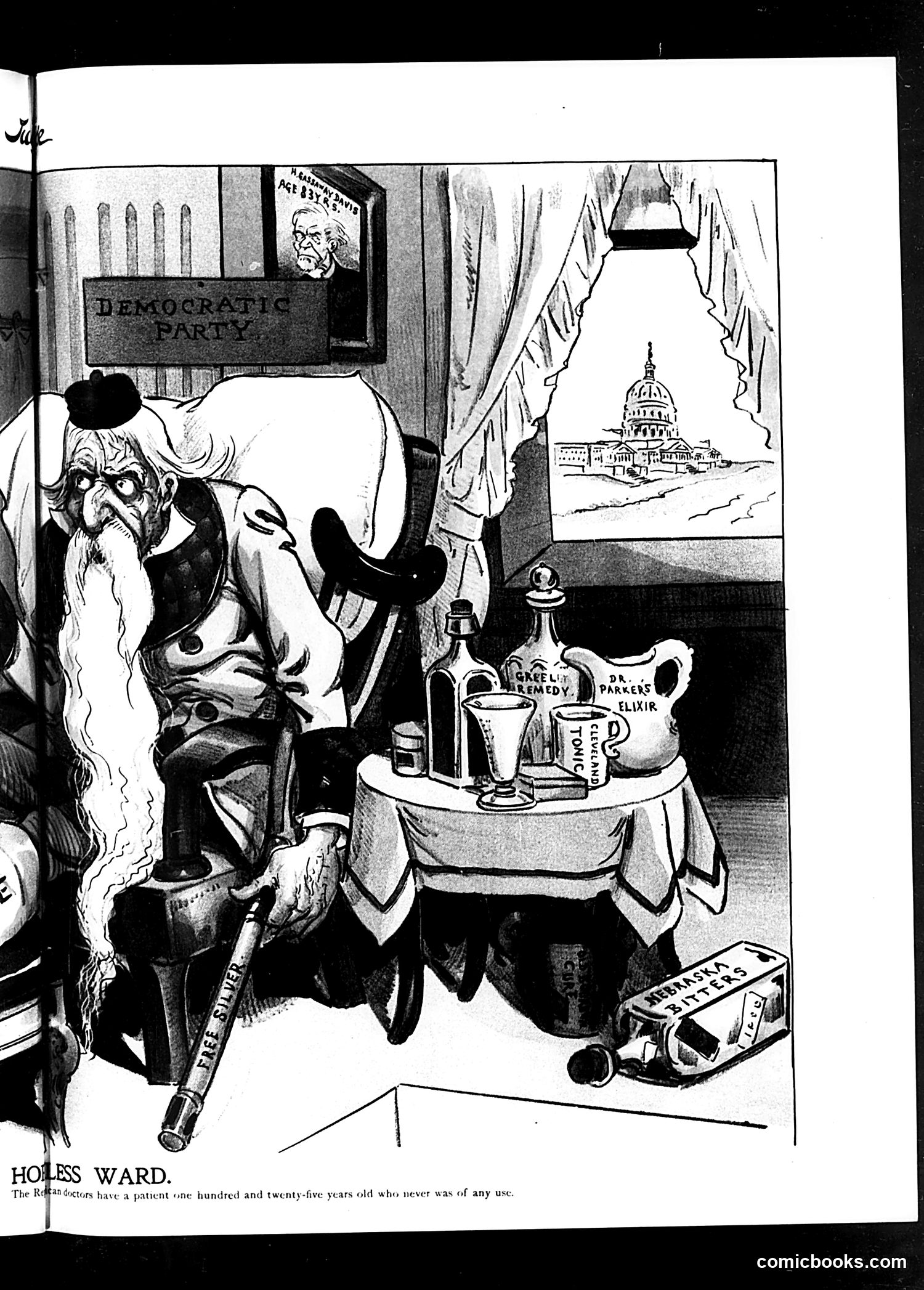
This political cartoon satirizes the Democratic Party as a terminally ill patient in a hospital bed. The figure represents the Democratic Party itself—depicted as an elderly, bearded man in distress. The "Democratic Party" sign hangs on the wall behind him, while bottles labeled with patent medicines and remedies crowd the bedside table, suggesting desperate attempts to revive a dying institution. The Capitol building visible through the window places this in Washington D.C. political context. The caption's reference to "a patient one hundred and twenty-five years old who never was of any use" is a sardonic joke—the Democratic Party, though old, is portrayed as fundamentally useless and beyond recovery. The cartoon mocks Democratic governance and suggests the party is essentially moribund and unable to function effectively in American politics.
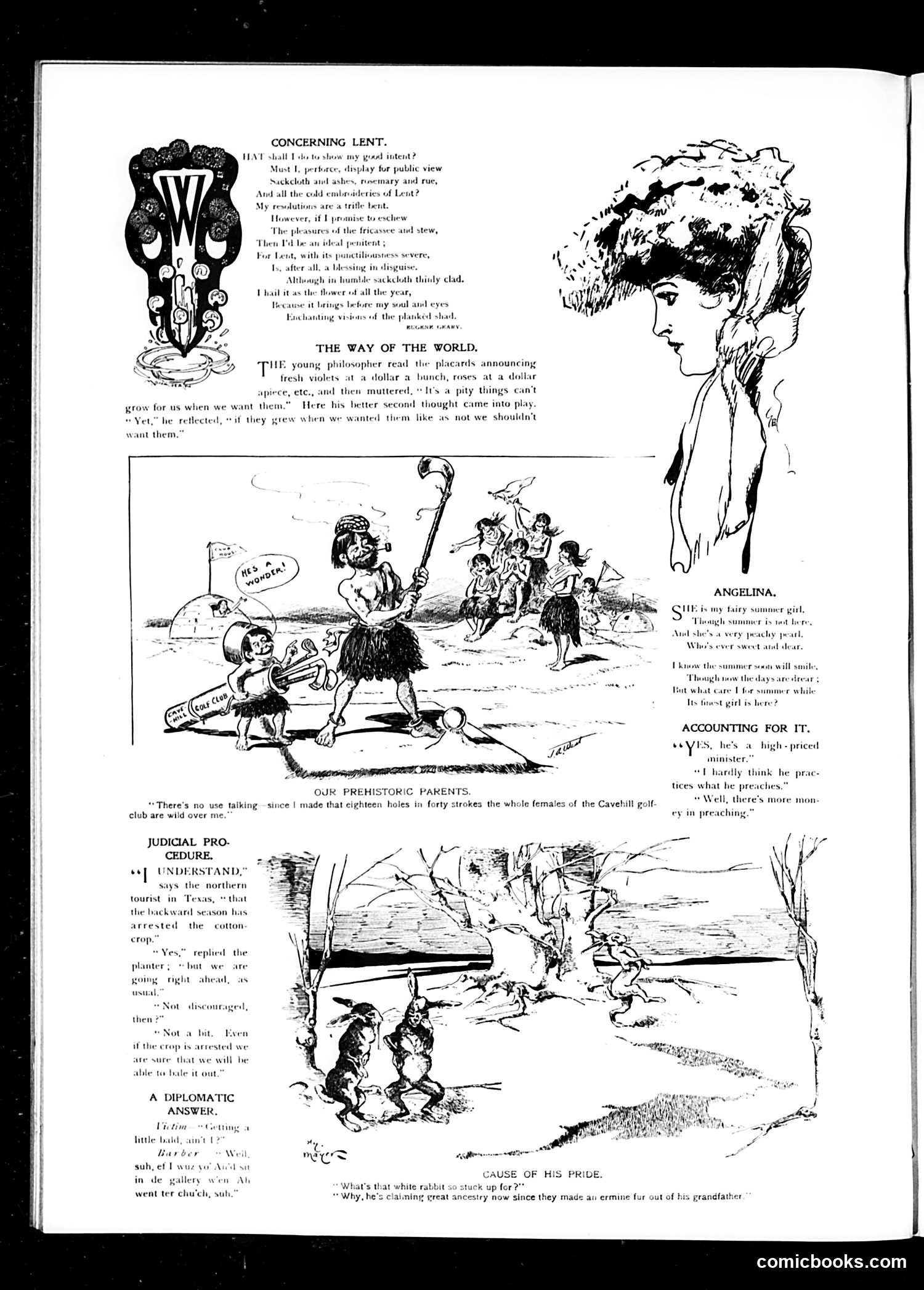
This page from **Judge** magazine contains several satirical pieces mocking human behavior and social pretension: **"Concerning Lent"** mocks religious hypocrisy—the speaker claims pious intent during Lent but admits his "resolutions are a trifle bent," ultimately reducing Lent to avoiding expensive foods rather than genuine spiritual reform. **"The Way of the World"** satirizes consumer desire: a philosopher observes expensive flowers and realizes we only want things *because* they're scarce and expensive. If they were abundant, we wouldn't desire them—commentary on artificial materialism. **"Accounting for It"** jokes about a high-priced minister who doesn't practice his preaching, with a punchline that "there's more money in preaching." **"Our Prehistoric Parents"** shows a caveman boasting about golf prowess to impress women—anachronistic humor. **"Cause of His Pride"** depicts a white rabbit proud his grandfather was made into ermine fur—dark humor about status anxiety and family vanity. The cartoons collectively ridicule human pretension, materialism, religious hypocrisy, and vanity across social classes.
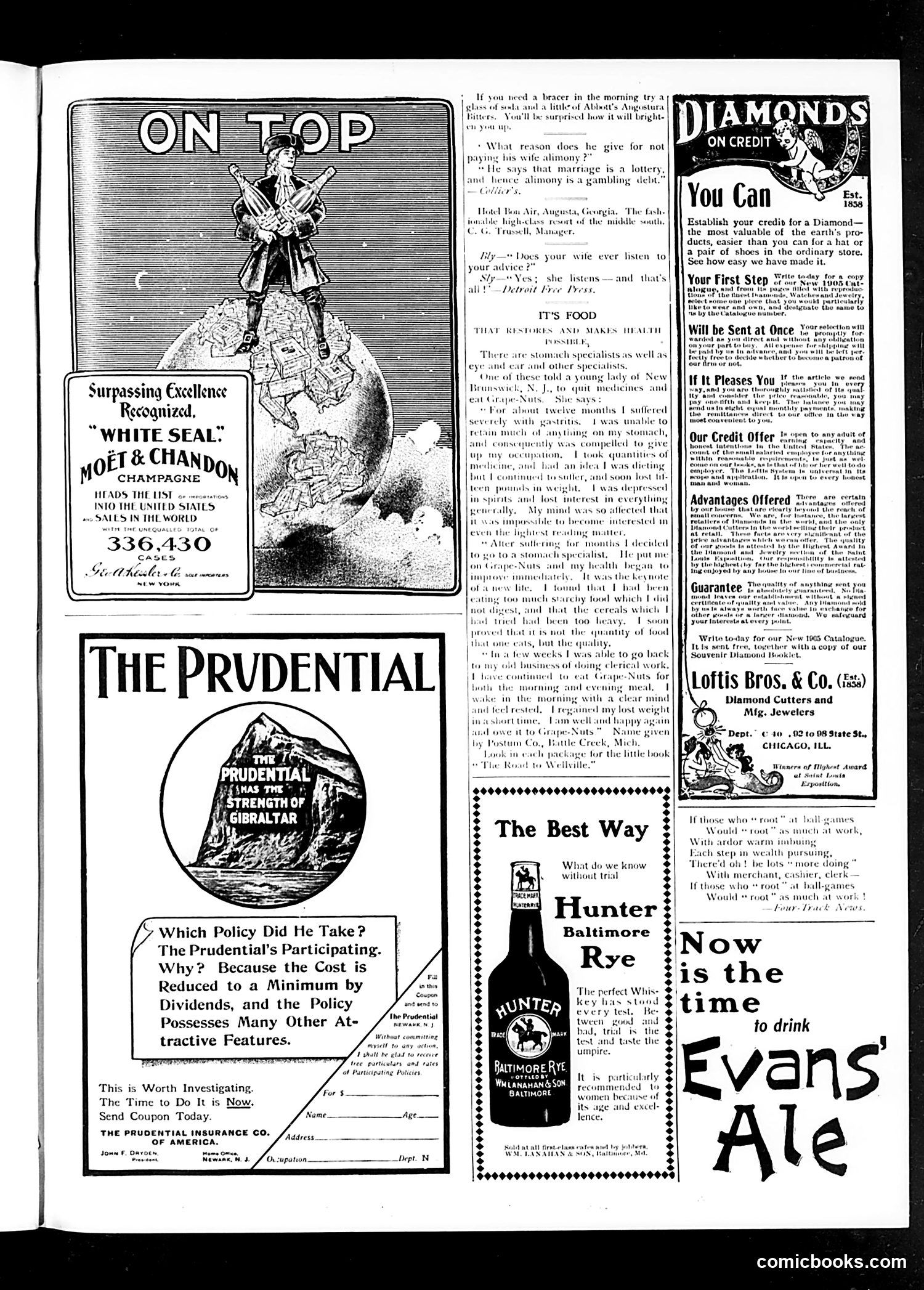
The main cartoon depicts a figure standing atop a globe, labeled "Surpassing Excellence Recognized." This appears to be a advertisement for Moët & Chandon champagne, which claims to be "the list" imported into the United States and "sells in the world" with sales totaling 336,430 cases. The satirical "On Top" section above contains brief comedic exchanges mocking marriage and relationships. One joke equates alimony to a "gambling debt" from the "lottery" of marriage—commentary on the then-growing phenomenon of alimony payments and marital discord. The page is predominantly **advertising**, featuring promotions for champagne, diamonds on credit, insurance, Grape-Nuts cereal (marketed as health food), whiskey, and ale. The Grape-Nuts ad includes a testimonial from a woman claiming the cereal cured her stomach ailments—typical early 1900s health product marketing making unsubstantiated medical claims. No clear political satire dominates this page; it functions primarily as a magazine advertisement section interspersed with light domestic humor.
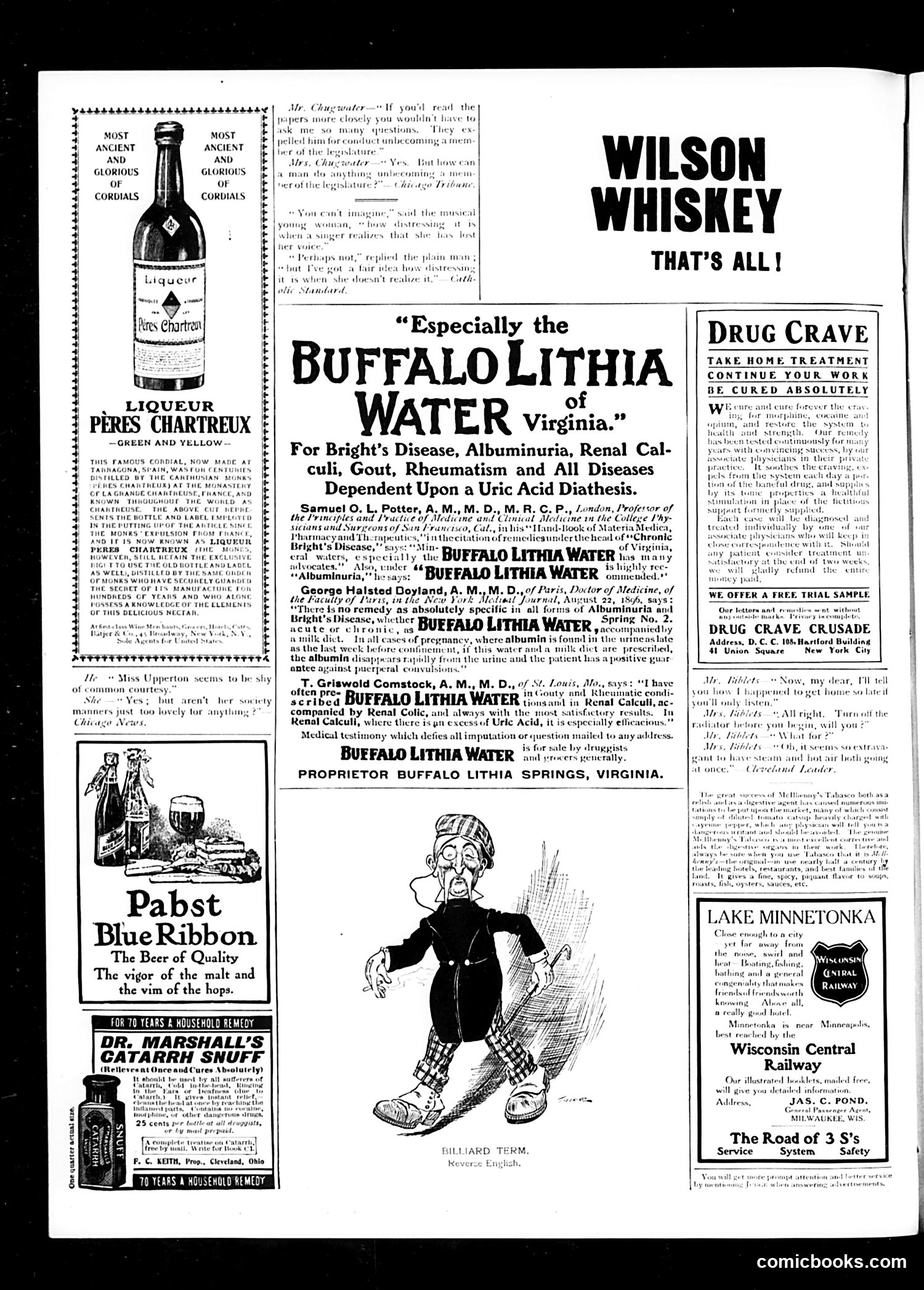
This page is primarily **advertising**, featuring various patent medicines and consumer products typical of early 20th-century America. The main content includes: **Buffalo Lithia Water** (center): A heavily promoted "cure-all" mineral water claiming to treat Bright's disease, kidney ailments, gout, and rheumatism. The ads cite physicians' testimonials to lend false medical credibility—a common deceptive practice of the era before FDA regulation. **Supporting advertisements** include Pabst Blue Ribbon beer, Dr. Marshall's Catarrh Snuff, Wilson Whiskey, and a "Drug Crave Crusade" treatment service—ironically advertising addiction treatment alongside other dubious remedies. **The small cartoon** ("Billiard Term: Reverse English") appears unrelated satirical content. The page exemplifies the **pre-regulation patent medicine industry**, where unsubstantiated health claims and fake doctor endorsements sold ineffective products to desperate patients. This advertising culture contributed to the eventual push for FDA oversight and truth-in-advertising laws.
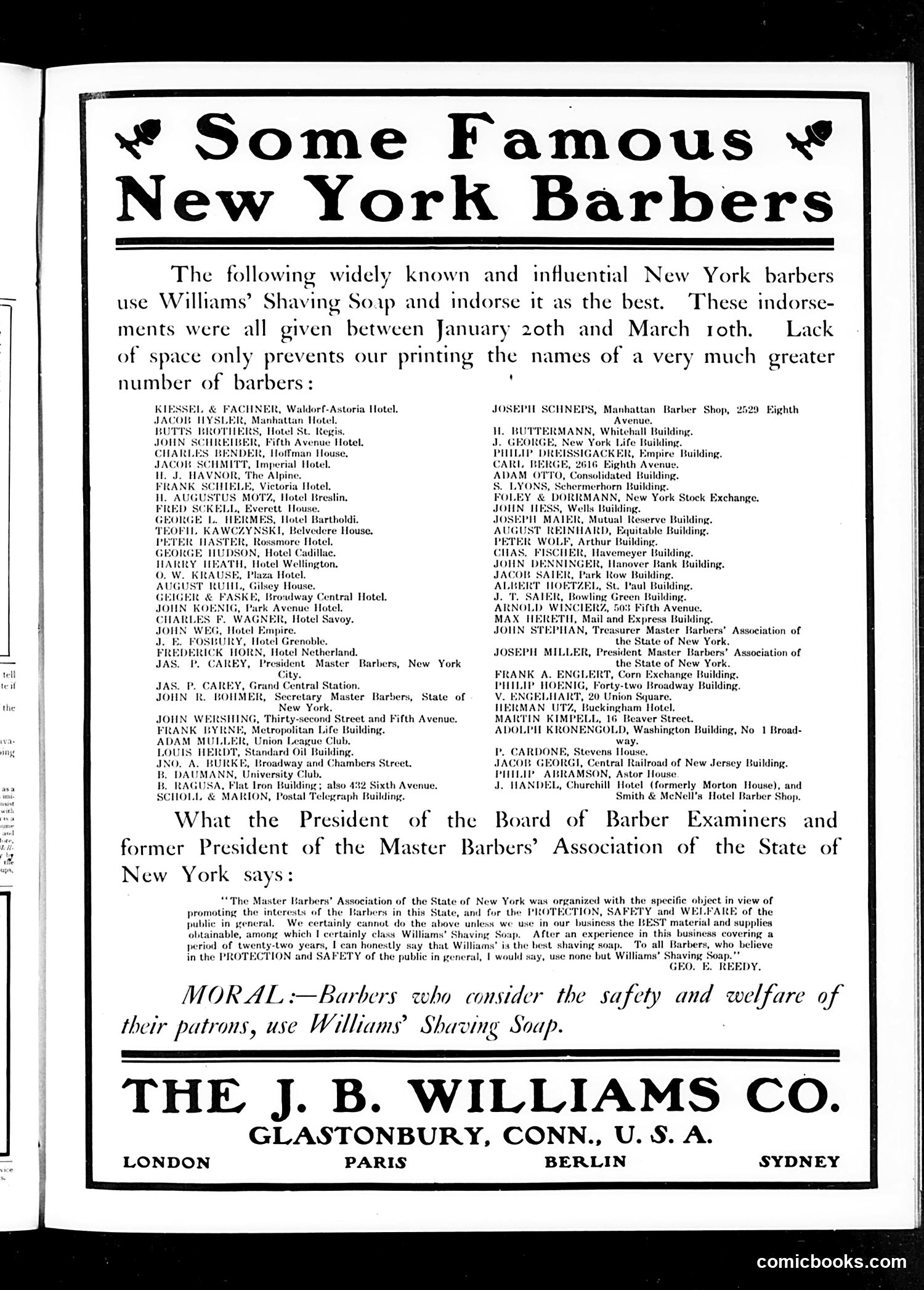
This is **not a cartoon or satire page**, but rather **a full-page advertisement** for J.B. Williams Shaving Soap, masquerading as editorial content in Judge magazine. The page lists dozens of prominent New York barbers who allegedly endorsed Williams' soap between January-March (year unclear from OCR). It includes testimonial quotes from the President of the Board of Barber Examiners and the President of the Master Barbers' Association of New York, both praising the product for safety and quality. **The satire, if any, is subtle**: Judge was a satirical magazine, yet this reads as straightforward advertising—which itself might be the joke: the absurdity of filling editorial space with celebrity endorsements from barbers at fancy hotels (Waldorf-Astoria, St. Regis, etc.), lending false prestige to a soap product. The moral ("Barbers who consider safety use Williams' Soap") is plainly commercial persuasion dressed in ethical language. This represents early 20th-century advertising practices where the line between editorial and advertisement was deliberately blurred.
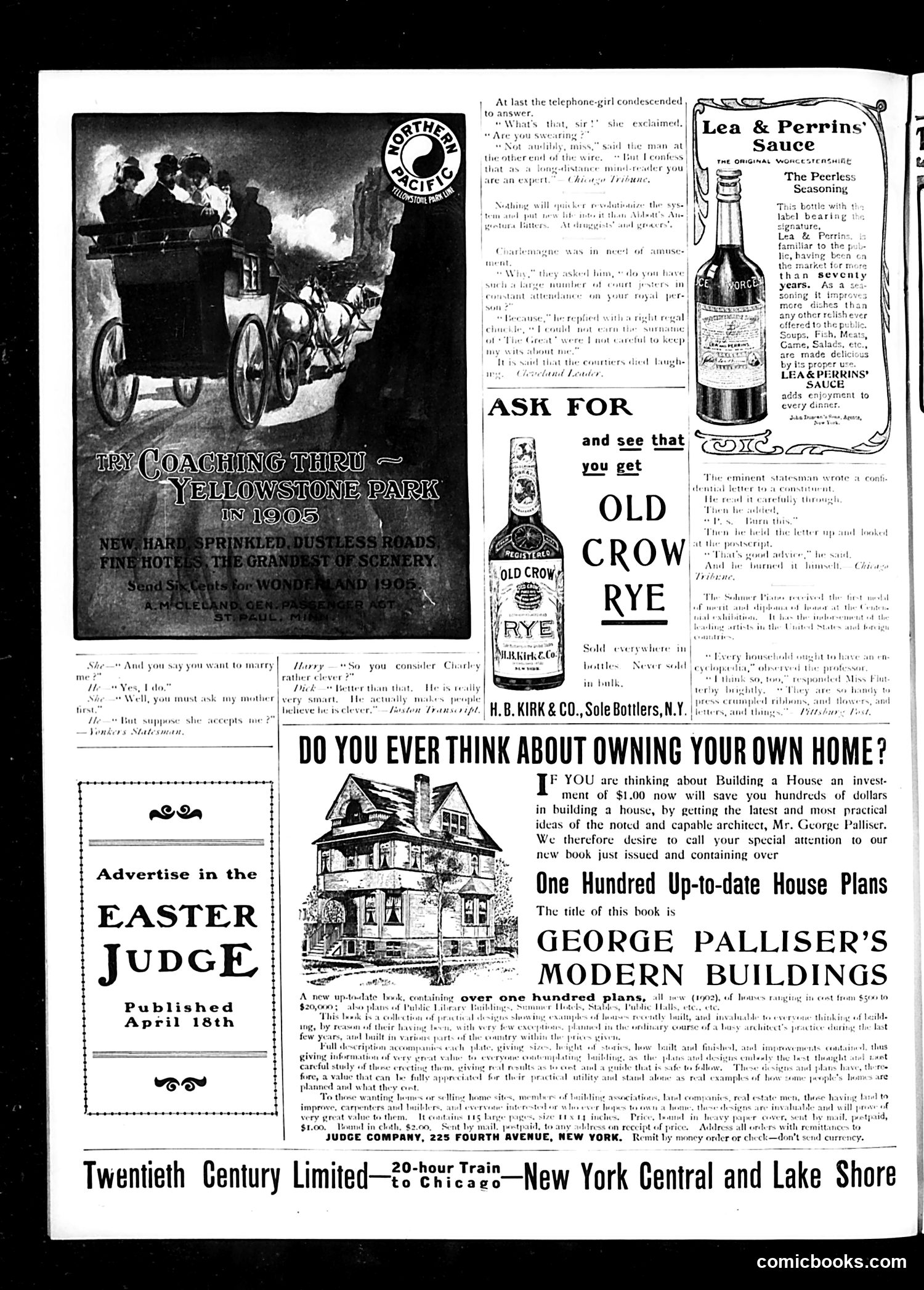
This page is **primarily advertising** with one small cartoon. The main cartoon shows a dialogue between two men about marriage: one asks if the other wants to marry, the second responds that he considers a man named Charley "rather clever," and the first replies that Charley is actually quite foolish—the joke being a misunderstanding about whom they're discussing. The bulk of the page contains **product advertisements** (Lea & Perrins Sauce, Old Crow Rye whiskey) and a major **real estate promotion** for architect George Palliser's book of house plans, marketed as a practical investment for homeowners. There's also an advertisement for the **"Easter Judge"** magazine issue (April 18th). The page reflects early 1900s consumer culture and the emerging middle-class aspiration to homeownership, alongside period product endorsements. No identifiable political figures or significant satire appears on this particular page.
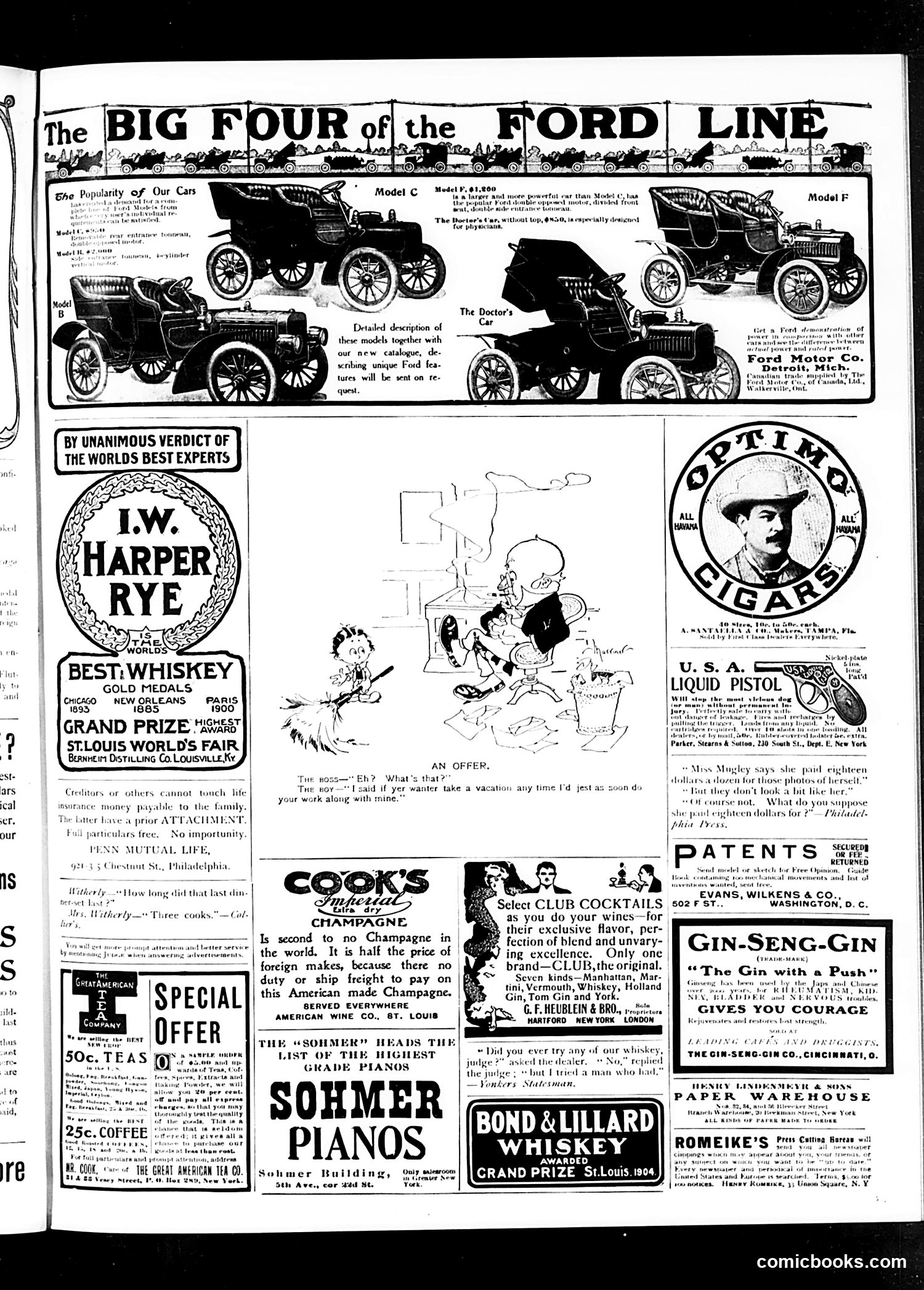
This page is primarily **advertising** rather than editorial content, featuring various products: Ford automobiles, whiskeys, champagne, pianos, cigars, and patent medicines. The one clear **cartoon** is titled "AN OFFER," showing a conversation between two men. The humor appears to be a working-class joke: one man offers to do the other's work while he takes a vacation, saying he'll "jesta your work along with mine"—suggesting the speaker is so lazy or inefficient that doing someone else's work would be no additional burden. The page also contains a brief **joke** about whiskey: a man claims he tried a whiskey brand, and when asked if he's tried their product, replies he "tried a man who had"—suggesting the whiskey's effects on the previous drinker were negative. Otherwise, this is a typical Judge issue filled with **period advertising** for luxury goods (pianos, fine spirits, cigars) aimed at affluent readers, interspersed with minor humorous content.
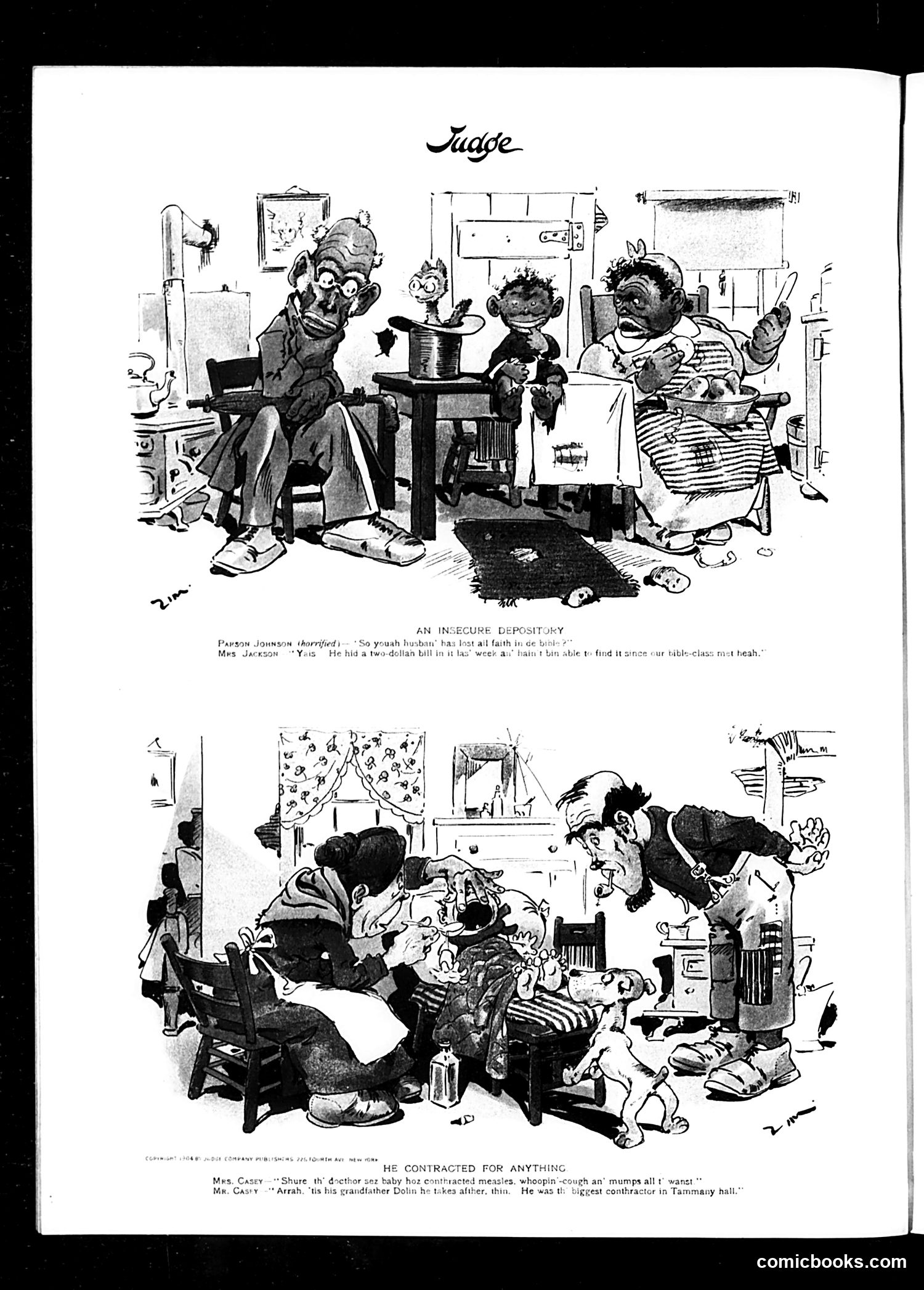
This page contains two satirical cartoons using racist caricatures typical of early 20th-century American humor. **Top cartoon ("An Insecure Depository"):** Shows caricatured Black figures in a domestic setting. The caption references "Parson Johnson" losing faith in a bank, with dialogue about a two-dollar bill. The joke appears to satirize distrust of banking institutions among working-class or poor communities. **Bottom cartoon ("He Contracted for Anything"):** Depicts a domestic scene with caricatured figures and children. The caption mentions Mrs. Casey and Mr. Casey, with reference to someone being "the biggest contractor in Tammany hall"—likely satirizing political patronage or corruption associated with Tammany Hall (New York City's Democratic political machine). Both cartoons employ dehumanizing visual stereotypes standard to the era's satirical publications, targeting immigrant and minority communities.