
A complete issue · 16 pages · 1904
Judge — December 24, 1904
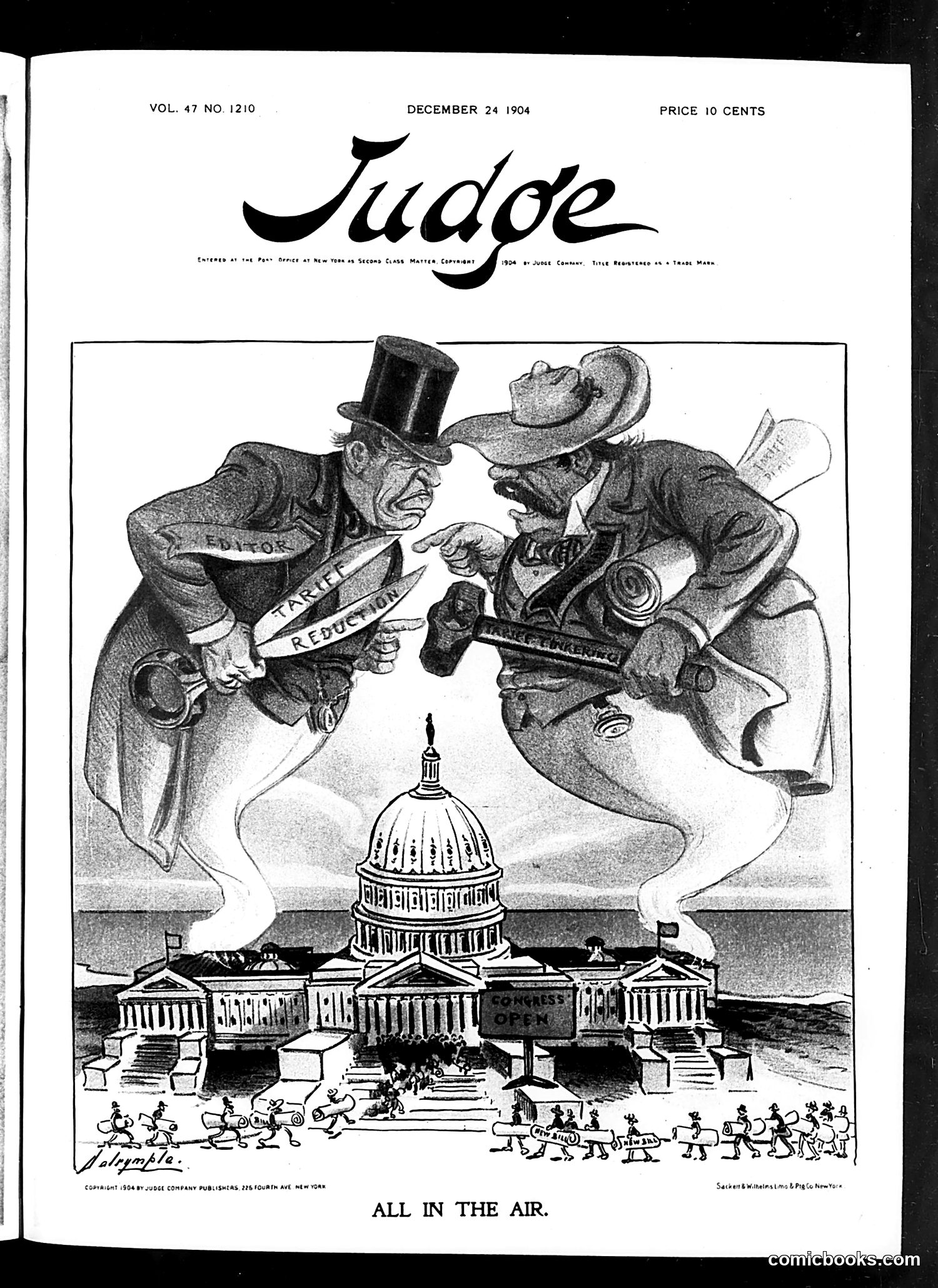
This political cartoon depicts two caricatured figures engaged in what appears to be a heated debate or confrontation above the U.S. Capitol building. One figure is labeled "EDITOR" and holds a "TARIFF REDUCTION" document; the other holds what appears to be trade-related materials. The title "All in the Air" suggests their dispute remains unresolved or uncertain. The small figures at the Capitol's base suggest public interest or concern about the outcome. This likely satirizes a contemporary tariff policy debate during Theodore Roosevelt's presidency (1901-1909), a major political issue dividing Democrats and Republicans. The cartoon criticizes how the controversy remains suspended without resolution, affecting the nation's capital and citizens below.
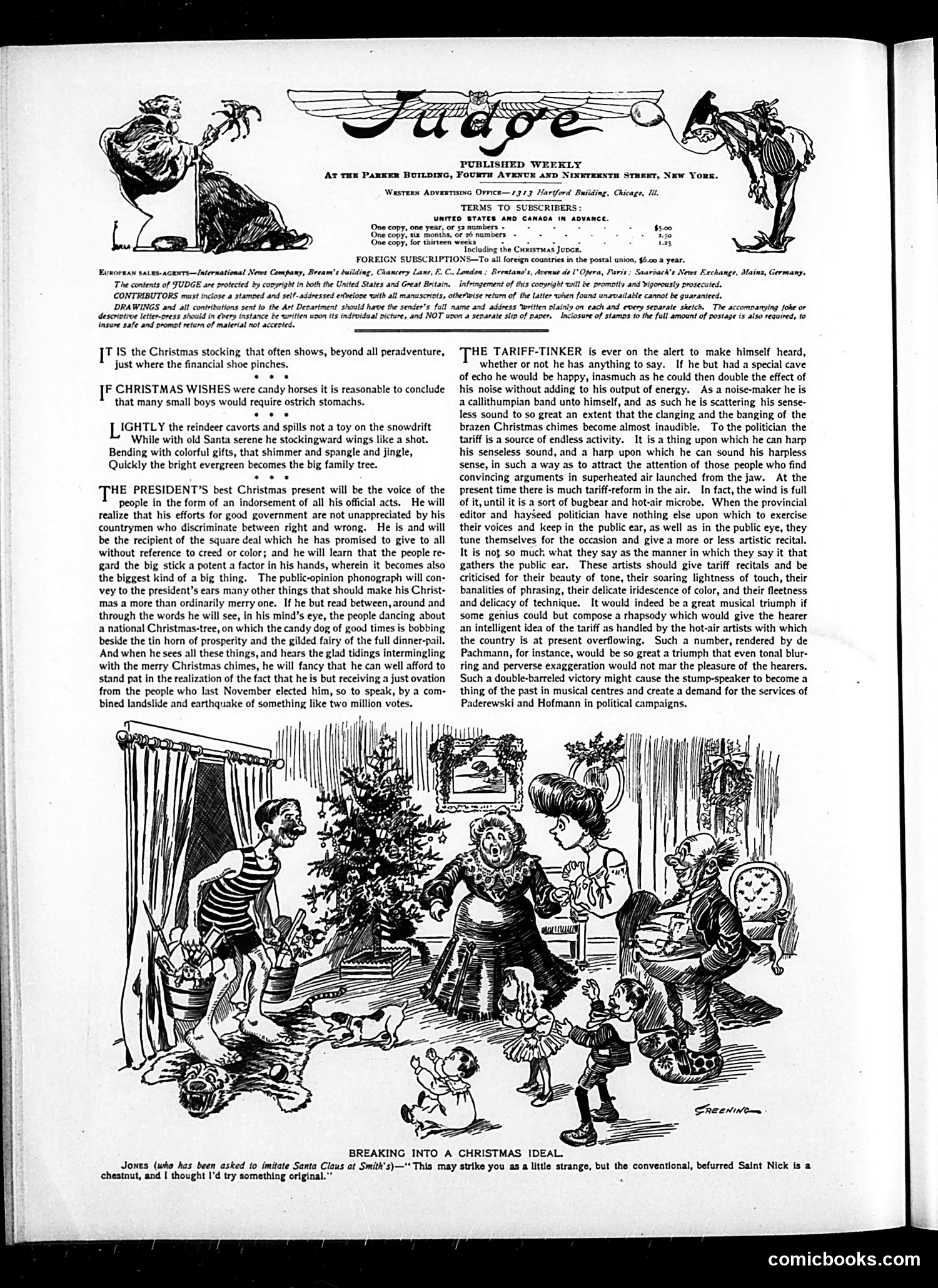
This cartoon satirizes attempts to create an unconventional Santa Claus. The caption quotes "Jones" proposing to replace the traditional Saint Nick with something original—apparently a skeletal figure (visible left), suggesting a grotesque or death-themed alternative. The scene shows a Victorian family's Christmas gathering disrupted by this macabre substitution. The satire mocks both the impulse toward radical reinvention and the absurdity of abandoning beloved traditions. The skeletal Santa represents the failure of overly clever modernization—replacing warmth and familiarity with something unsettling and unfit for children. The accompanying editorial text criticizes political activists (mentioning tariff reformers and politicians) for similarly destroying cherished institutions through misguided innovation, drawing a parallel between aesthetic and political disruption.
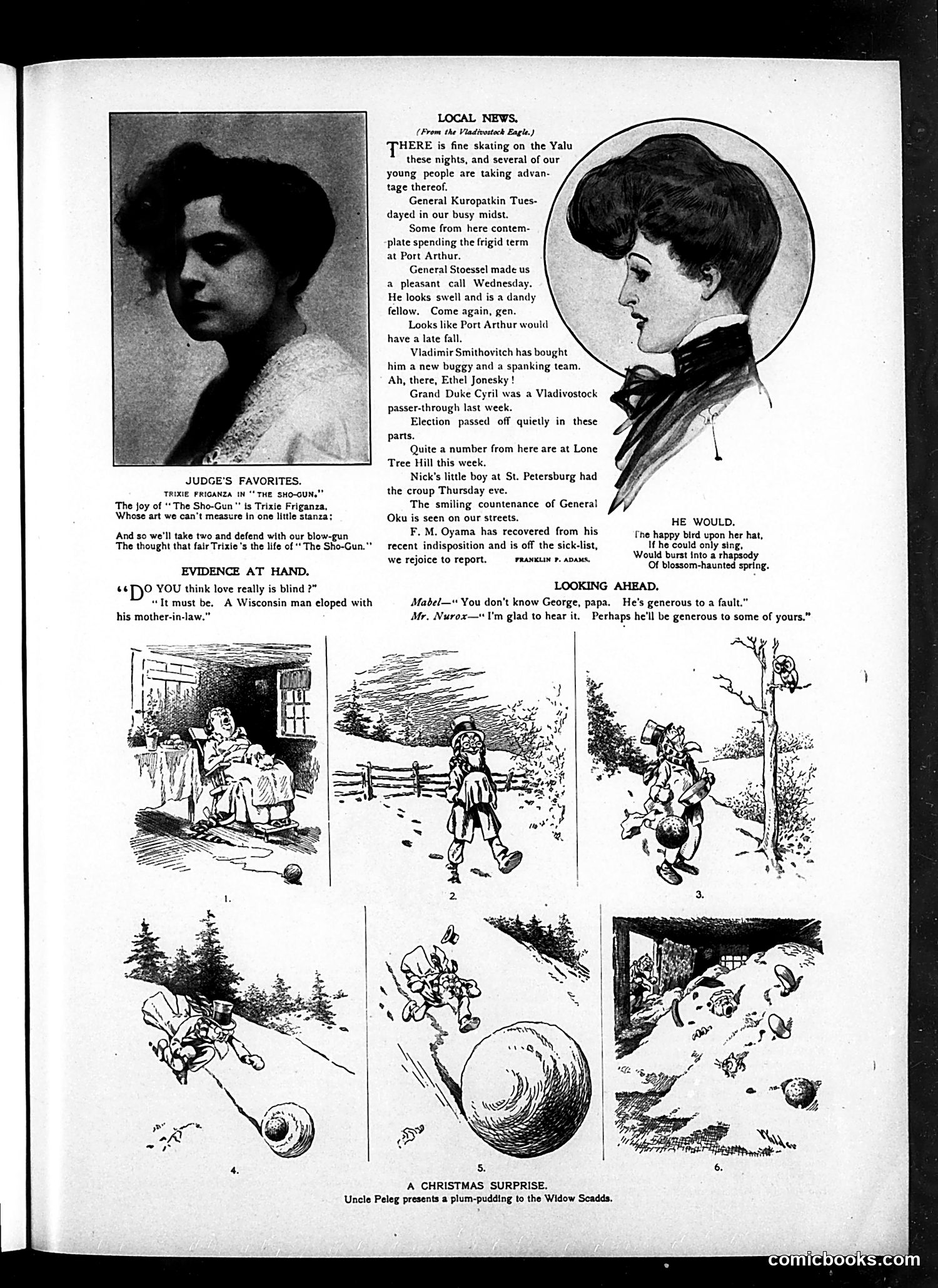
This page contains **local news items** and **unrelated satirical content** rather than cohesive political cartoons. The top section includes gossip about local figures (Generals Kuropatskin and Stoessel, Vladimir Smithkovich) and social notes about skating and elections—appearing to be from a Russian context, though specifics are unclear. The main illustrated section, "**Evidence at Hand**," is a joke about love and blindness, followed by "**Looking Ahead**" with dialogue about generosity. Below is "**A Christmas Surprise**," a six-panel sequential comic strip about "Uncle Peleg" presenting a plum-pudding to the Widow Scadda. The humor derives from slapstick mishaps as the pudding causes physical comedy and chaos. These appear to be filler content rather than sharp political satire, typical of Judge's mix of news, jokes, and entertainment.
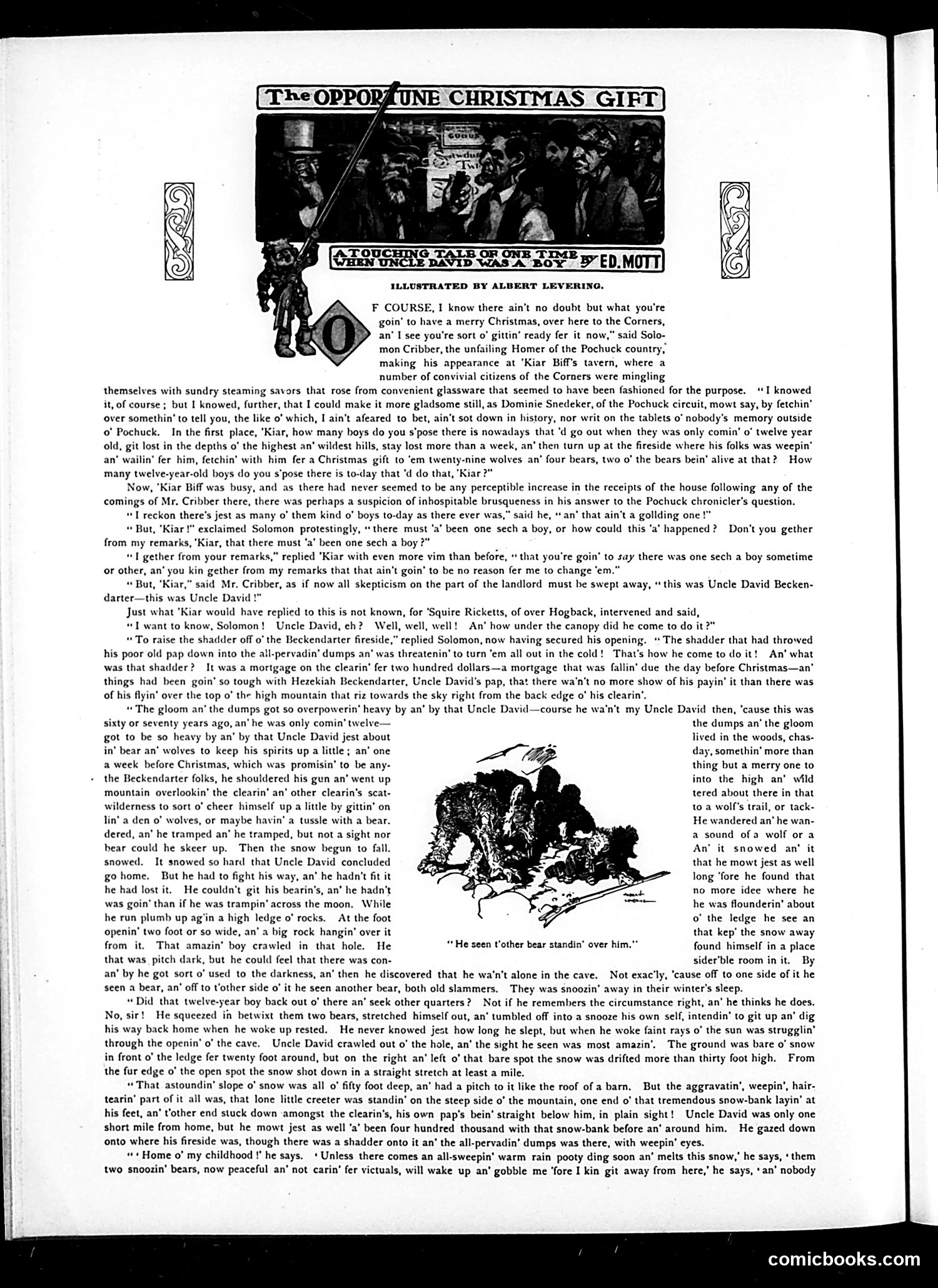
This page presents a illustrated short story by Ed. Mott titled "A Touching Tale of One Time When Uncle David Was a Boy." The narrative concerns Solomon Cribber, described as an "unfailing Homer of the Pochuck country," recounting a dramatic winter tale to his assembled listeners at Kiar Buff's tavern. The story describes young Uncle David's encounter with bears in snowy mountain wilderness—a frontier adventure tale typical of 19th-century American humor. The illustration shows a bear in a snowy landscape. This appears to be nostalgic humor celebrating rural/frontier storytelling traditions rather than political satire. The "opportune Christmas gift" likely refers to the entertaining story itself being offered as holiday entertainment for Judge's readers.
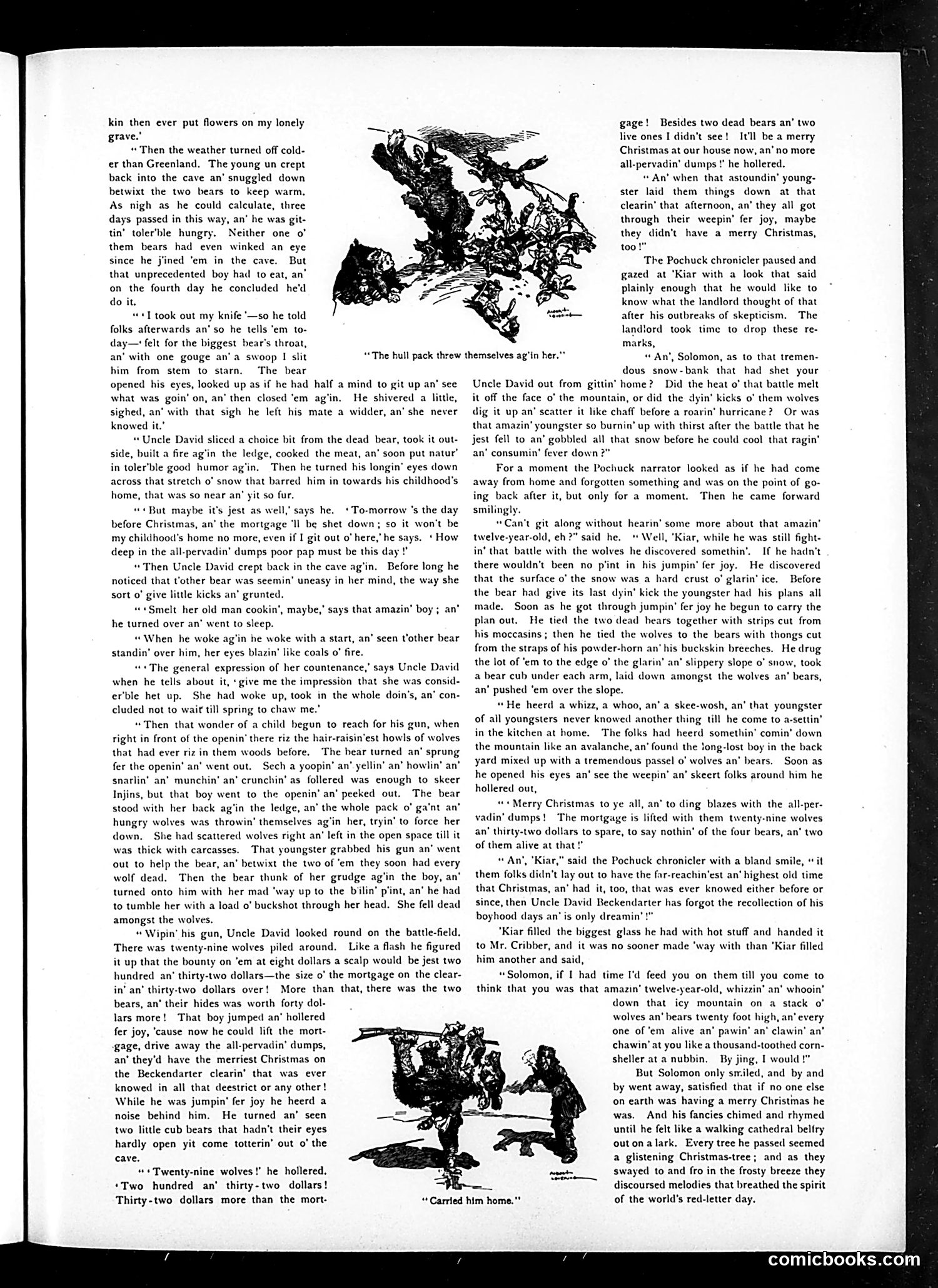
This page presents a tall tale rather than political satire—a frontier narrative about "Uncle David," a resourceful boy surviving in a cave with two bears during harsh winter weather. The story's implicit satire likely targets **Victorian sentimentality and economic anxiety**. The boy's predicament (trapped by weather, facing starvation, burdened by his family's mortgage) represents genuine hardship, yet the narrative transforms it into comic adventure. The humor emerges from the boy's practical ruthlessness: he kills the bears without moral qualm, then accidentally defeats a wolf pack, ultimately profiting from bounties and hides—turning disaster into financial gain. The underlying satire appears to mock both **sentimental notions of wilderness hardship** and suggest that **brutal pragmatism and luck** trump sentiment in actual survival. The mortgage's looming foreclosure grounds the fantasy in real economic pressures ordinary Americans faced, making the boy's mercenary calculations darkly humorous rather than heroic.
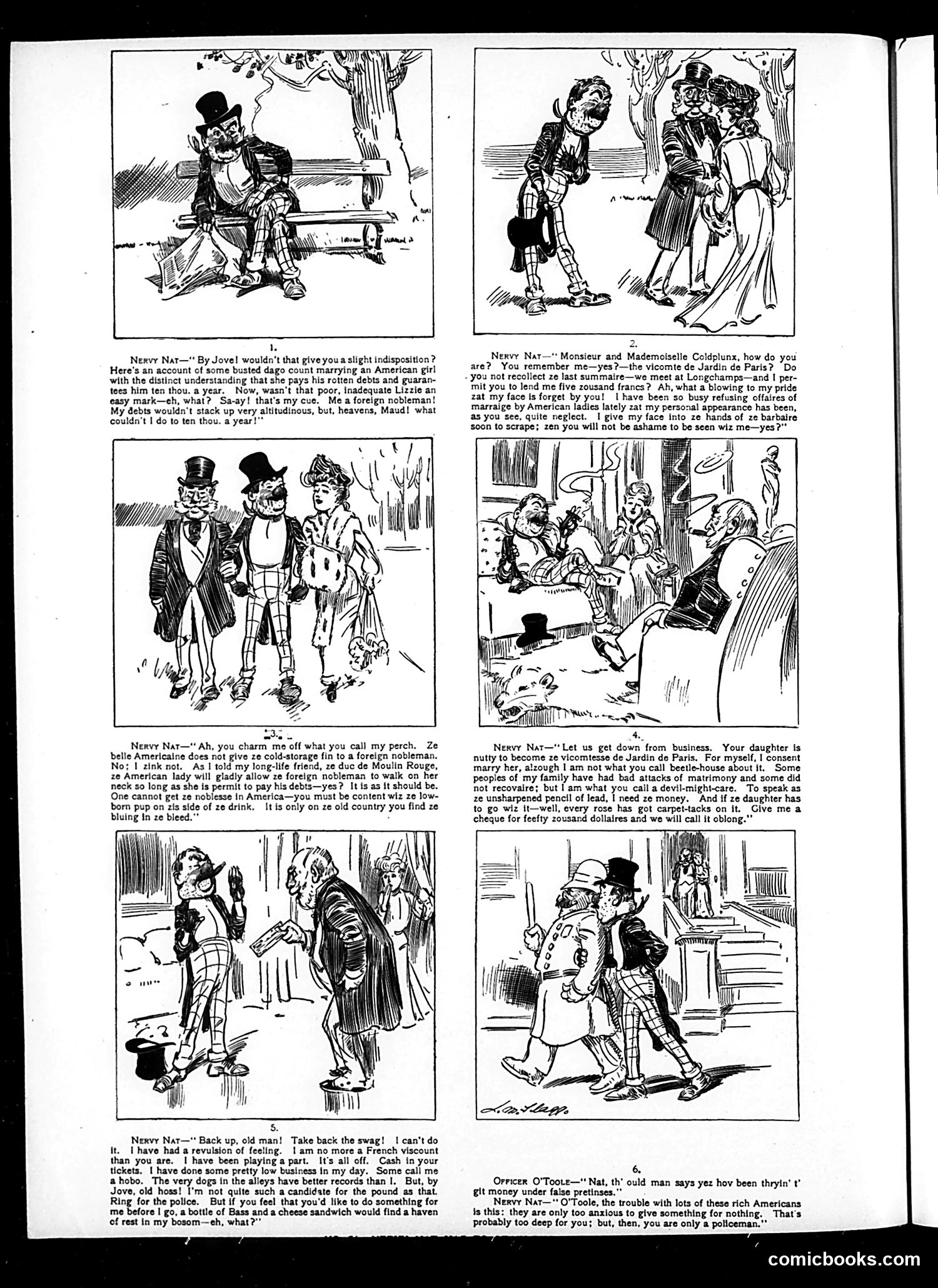
This six-panel comic strip mocks the era's epidemic of American heiresses marrying impoverished European aristocrats. "Nervy Nat" is a scheming con man posing as a French viscount to exploit wealthy Americans. The satire targets both the fraudulent nobleman (Nat exploits his fake title to secure marriage dowries and annual allowances) and American social climbing—the wealthy families' desperation to acquire foreign "nobility" for their daughters, even knowing these men are broke and disreputable. In panel 5, Nat temporarily develops a conscience, admitting he's a hobo with a criminal record. But by panel 6, arrested by Officer O'Toole, he reveals the scheme's core: rich Americans are so eager for status they'll bankroll obvious con artists. Judge uses this character to ridicule both European aristocratic pretension and American nouveau-riche gullibility during the Gilded Age.
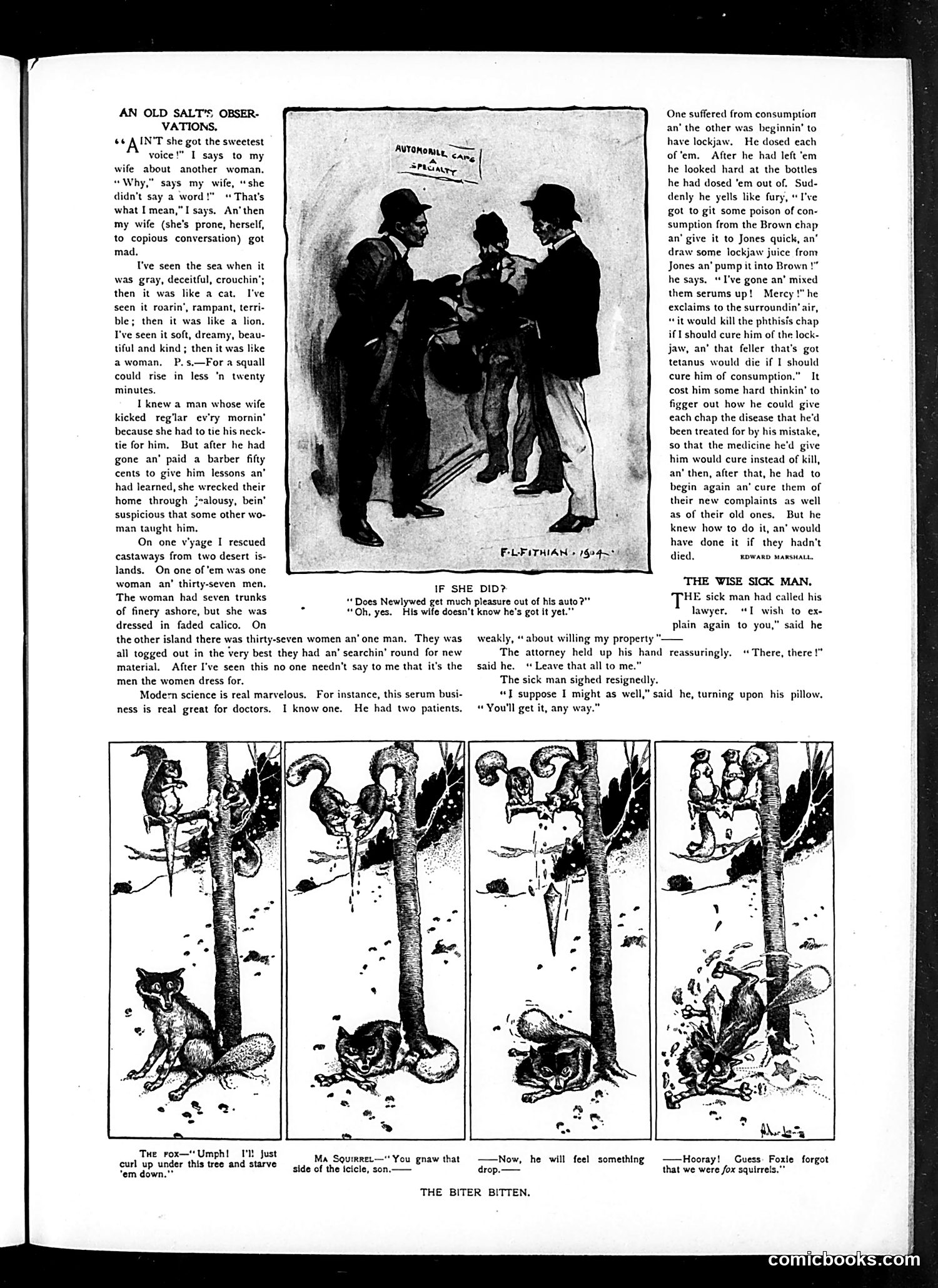
This Judge magazine page contains three distinct pieces: **"An Old Salt's Observations"**: A sailor's rambling monologue about life observations—women's silence being preferable to their talk, the sea's moods, and a cautionary tale about a doctor who accidentally swapped medicines between two patients (one with consumption, one with lockjaw). The humor relies on crude gender stereotyping and period medical ignorance. **"The Wise Sick Man"**: A brief comic exchange where a dying man tries explaining his will to his lawyer, who dismissively assures him he'll "get it"—a dark joke about inheritance and the lawyer's indifference. **"The Biter Bitten"**: A four-panel comic strip showing a fox attempting to trap and eat squirrels in a tree, but ultimately being attacked by them. The title's wordplay refers to the predator becoming the prey—a simple slapstick moral about comeuppance. The overall page reflects early 20th-century satirical humor: misogynistic observations, dark comedic scenarios, and slapstick animal comics typical of Judge's editorial approach.
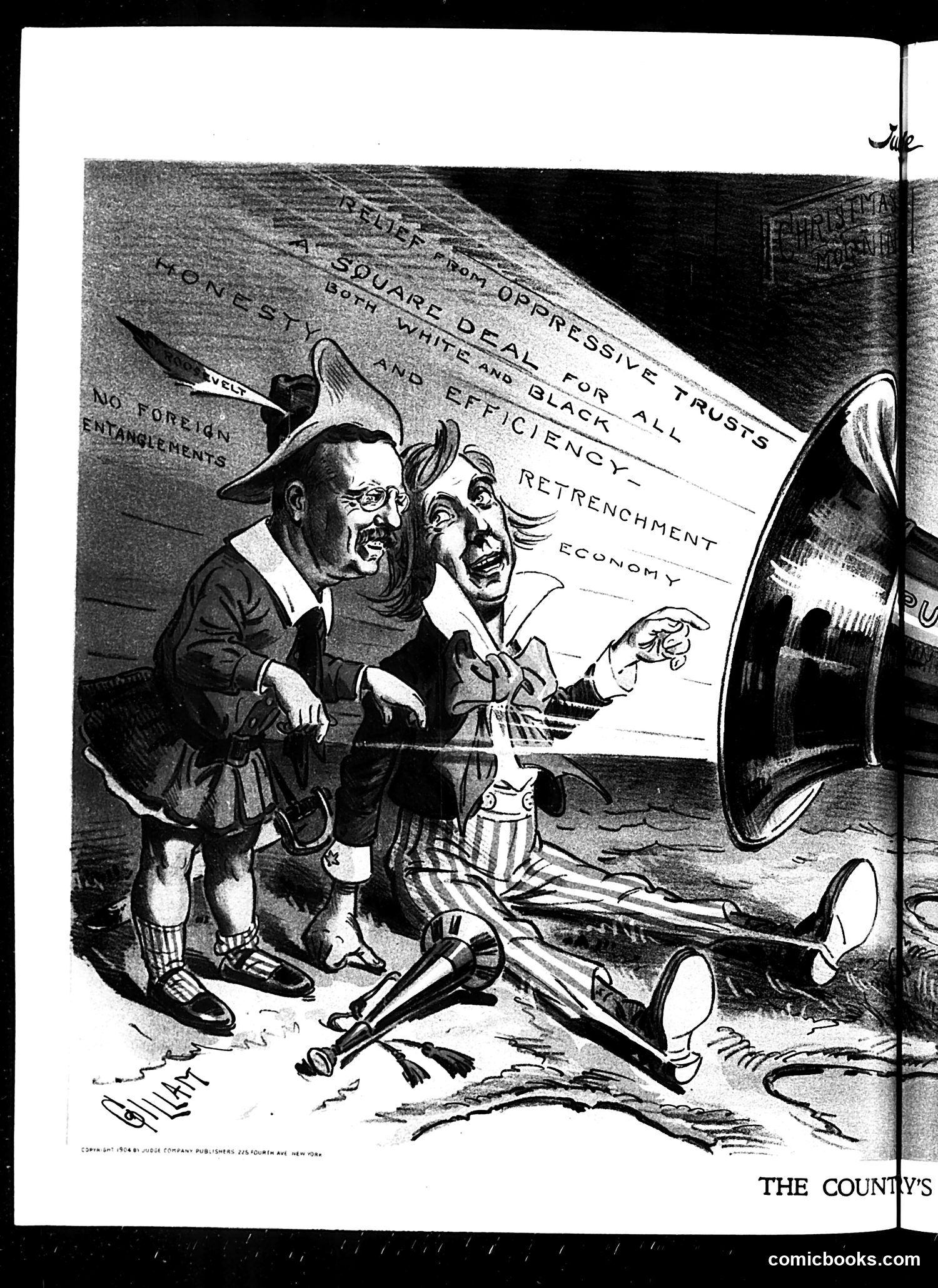
This Judge magazine cartoon satirizes financial mismanagement during what appears to be an economic crisis. Two caricatured figures—likely representing politicians or financial officials—stand before a large document listing remedies: "A BRIEF FOR OPPRESSIVE TRUSTS," "SQUARE DEAL FOR ALL BOTH WHITE AND BLACK," "EFFICIENCY," "RETRENCHMENT," and "ECONOMY." The cartoon's joke is one of contradiction: these officials present themselves as reform-minded, promising fair dealing and fiscal responsibility, while the document itself and their exaggerated, demonic expressions suggest duplicity. The scattered debris and theatrical poses imply these promised solutions are mere performance—empty rhetoric masking continued corruption or incompetence. The satire targets the gap between politicians' public promises and actual governance.
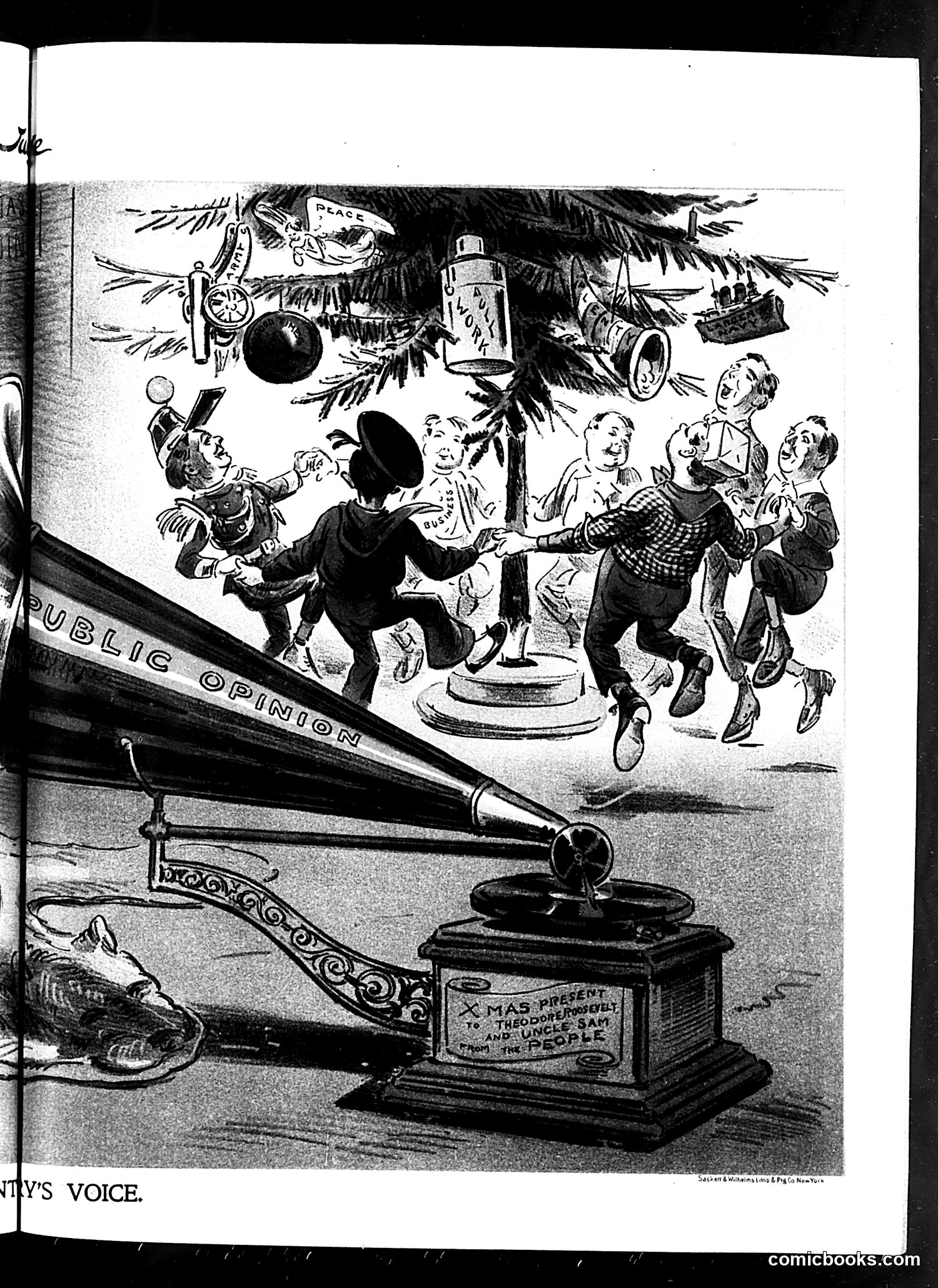
This political cartoon from *Judge* magazine depicts "Public Opinion" as a megaphone or phonograph broadcasting to a crowd of eager listeners gathered beneath a Christmas tree decorated with instruments of war—bombs, cannons, ships, and other military symbols labeled "Peace." The satire critiques how public opinion is being manipulated or shaped regarding military/warfare issues, presenting them deceptively as instruments of "peace." The cheerful crowd celebration under this wartime "peace tree" suggests ironic commentary on how propaganda or media messaging convinces the public to accept militarism as beneficial. The exact historical moment is unclear from visible text, but the cartoon likely addresses early 20th-century American debates about military spending, war preparedness, or interventionism—criticizing how official rhetoric disguises military buildups as peaceful measures.
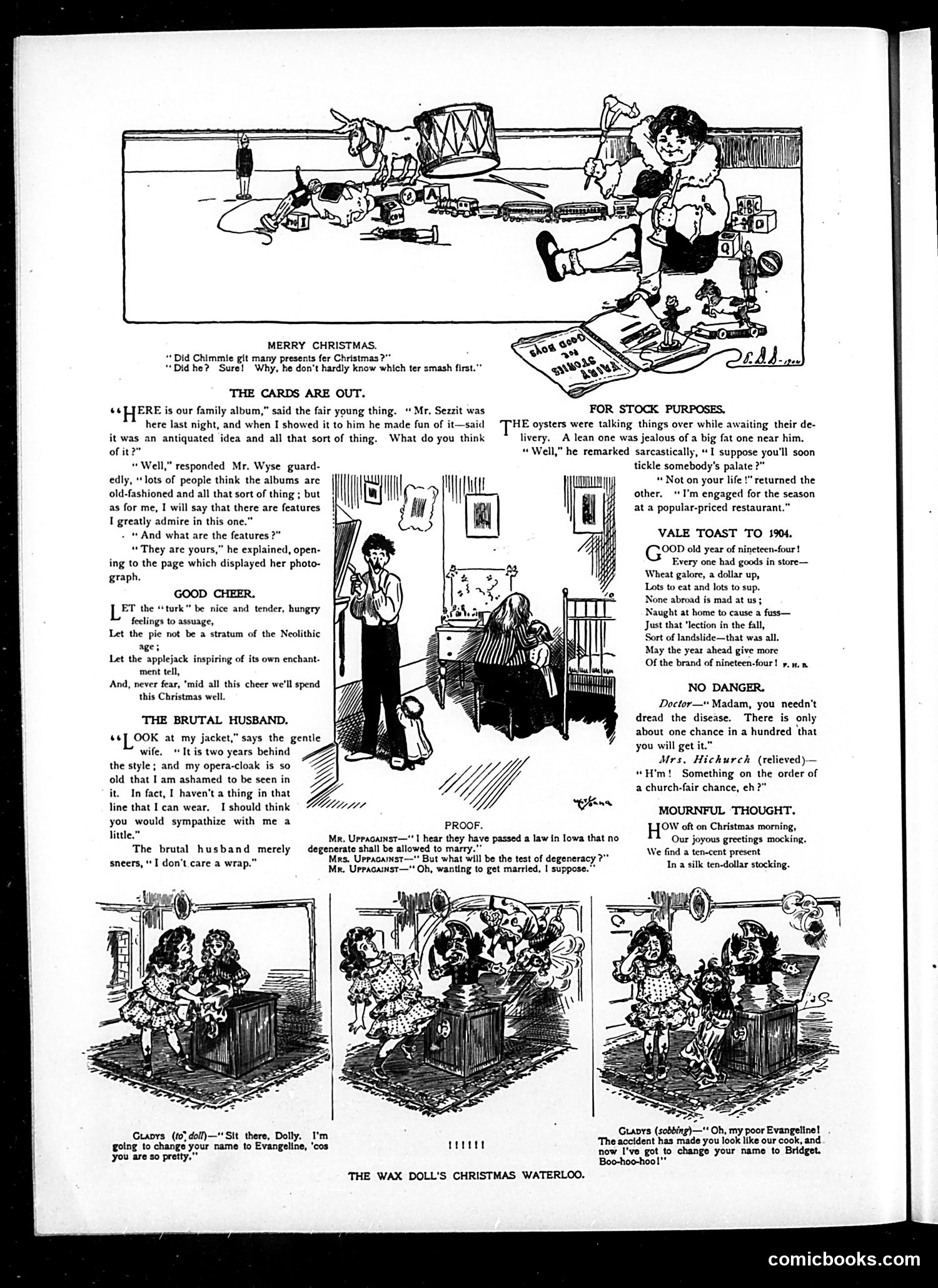
This is a miscellaneous humor page from Judge magazine (appears to be early 1900s based on the "Vale Toast to 1904" reference). The content consists of several unrelated short jokes and comic scenarios rather than political satire: **Key pieces:** - **"Merry Christmas" opener**: Working-class child receiving toys he'll destroy immediately—gentle social commentary on poverty - **"The Cards Are Out"**: Conventional courtship humor about a suitor flattering a woman by praising her photograph - **"The Brutal Husband"**: Wife complains about outdated clothing; husband avoids sympathy—domestic comedy - **Oyster dialogue**: Personified oysters joking about restaurant rankings - **"Vale Toast to 1904"**: Nostalgic verse celebrating the prosperous year just past - **"No Danger"**: Doctor reassures patient; she compares odds to "church-fair chance"—light medical humor - **"Wax Doll's Christmas Waterloo"**: Three-panel comic where a doll gets damaged, requiring name changes The page is largely domestic and social satire rather than political, reflecting Judge's general entertainment focus circa 1903-1904.
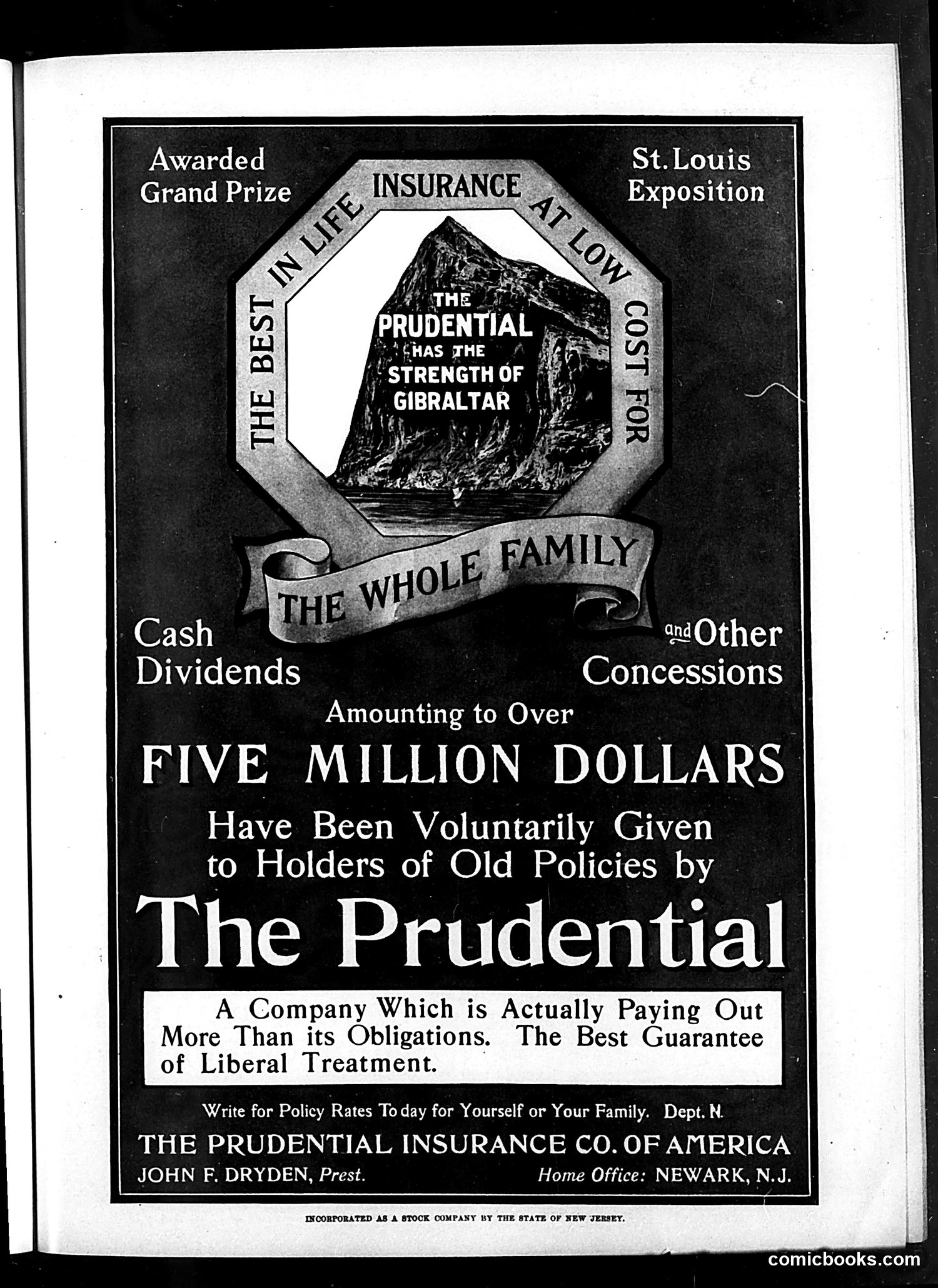
This is primarily a **corporate advertisement**, not satire. The Prudential Insurance Company uses patriotic and stability imagery to market life insurance. The central visual—the Rock of Gibraltar—symbolizes strength and permanence, reinforcing the company's reliability. The octagonal frame with text proclaiming "The Best in Life Insurance at Low Cost for the Whole Family" presents the company as comprehensive and affordable. The advertisement emphasizes that Prudential has voluntarily distributed **five million dollars** in cash dividends and concessions to policyholders—exceeding its obligations. This claim positions the company as exceptionally generous compared to competitors, suggesting moral integrity alongside financial soundness. The St. Louis Exposition award grants credibility through institutional recognition. The call to action directs readers to request policy rates, while the president's name and Newark headquarters provide legitimacy through personalization and specificity. This represents early 1900s corporate messaging: using symbolism and claims of ethical conduct to build consumer trust in a financial product.
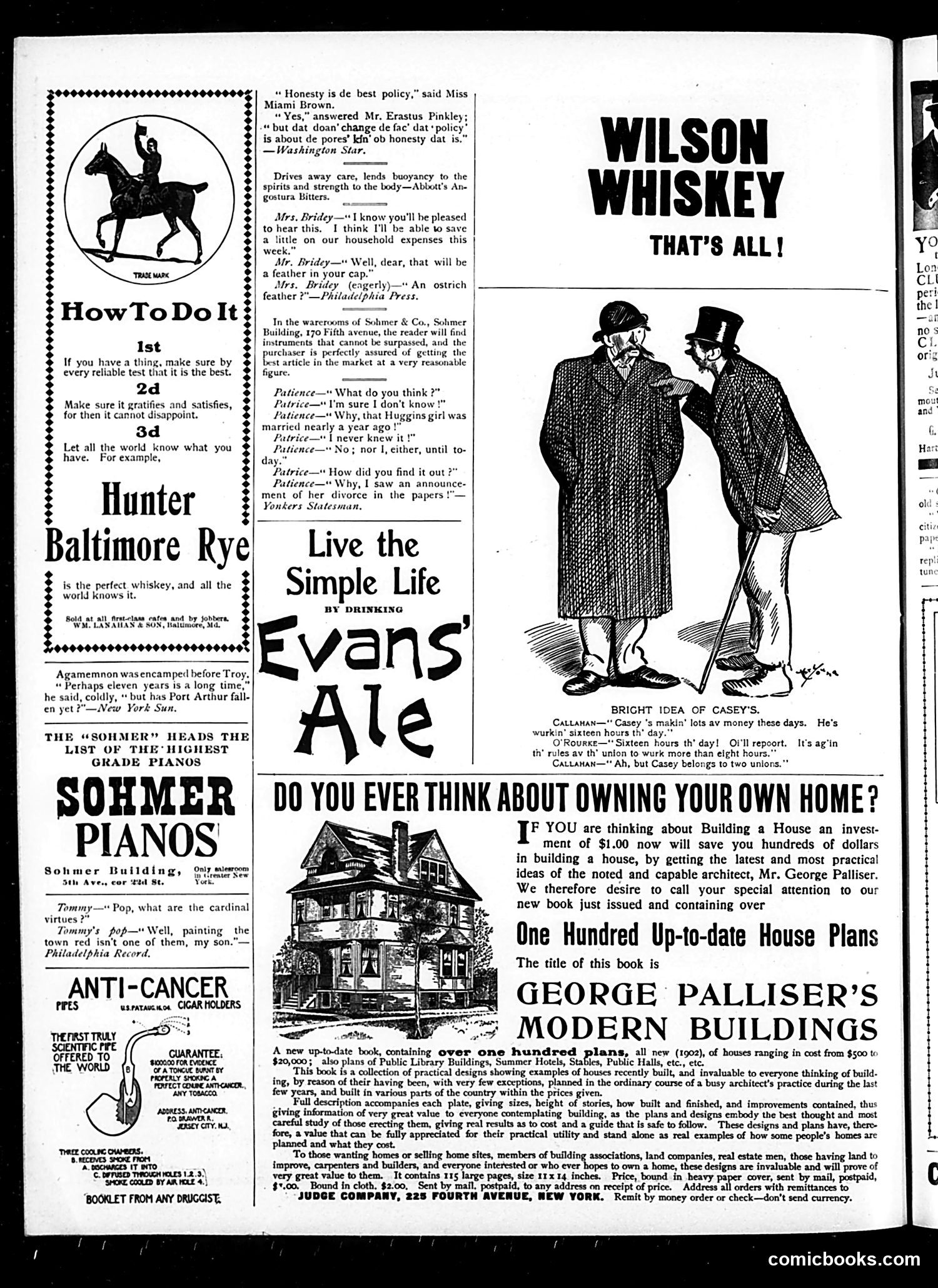
This page is primarily **advertising and humor**, not political satire. The content includes: **Main cartoon:** Two working-class Irish men (identifiable by dialect and dress) discuss Casey's work ethic. One notes Casey works 16-hour days for good pay; the other reveals Casey "belongs to two unions," implying he's evading labor rules limiting work hours. The joke satirizes union hypocrisy and immigrant workers' willingness to circumvent labor protections for extra income. **Dialogue jokes** use ethnic stereotypes (African American and Irish characters with heavy dialect) common to early 1900s humor, treating domestic life and marital economics as comedy subjects. **Bulk content:** Advertisements for Hunter Baltimore Rye whiskey, Sohmer pianos, Evans Ale, anti-cancer cigar holders, and George Palliser's house-plan book. The page reflects Judge's revenue model: satirical content interspersed with paid advertising. The humor reflects period attitudes toward labor, ethnicity, and consumer culture rather than addressing specific political events.
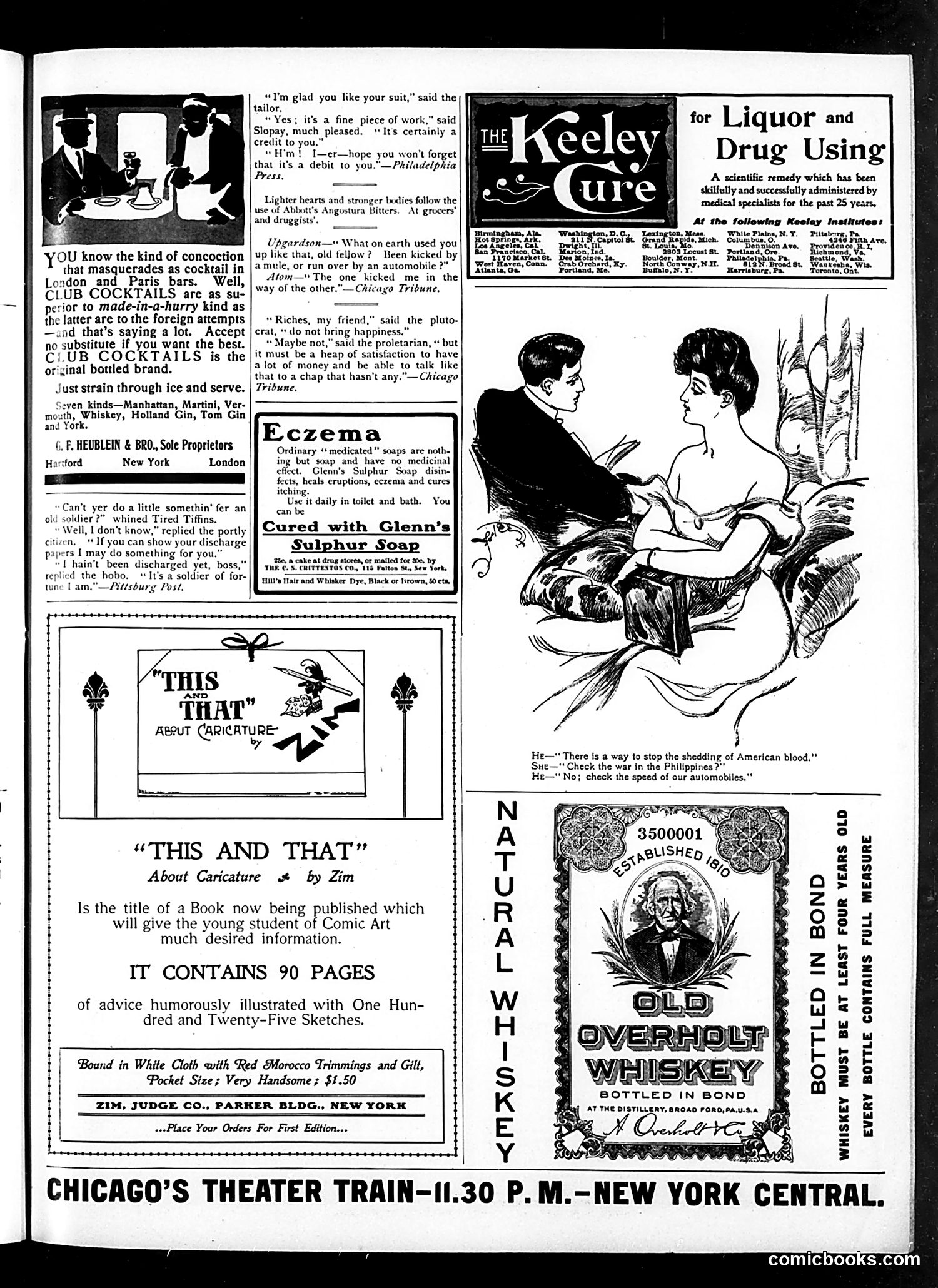
This is primarily an **advertising page** from Judge magazine, interspersed with short joke items typical of the era. The page contains **multiple advertisements** for products including Club Cocktails, Glenn's Sulphur Soap, the Keeley Cure (for alcohol and drug addiction), and Old Overholt Whiskey—notably ironic given the Keeley Institute ad promoting treatment for "liquor and drug using." The **cartoon illustrations** are brief comic strips featuring: - A tailor-customer exchange about payment - A soldier/hobo joke about military discharge - Dialogue between a wealthy "plutocrat" and a "proletarian" discussing whether riches bring happiness (reflecting class commentary typical of Judge's satirical stance) - A married couple's comedic exchange about Philippine War casualties versus automobile deaths The humor relies on wordplay, visual gags, and social observations common to early-1900s American satire. The **Zim book advertisement** promotes a guide to cartooning technique, reflecting Judge's focus on comic art. The page reflects **pre-WWI American concerns**: the Philippine-American War, emerging automobile culture, class tensions, and widespread alcohol/substance use.
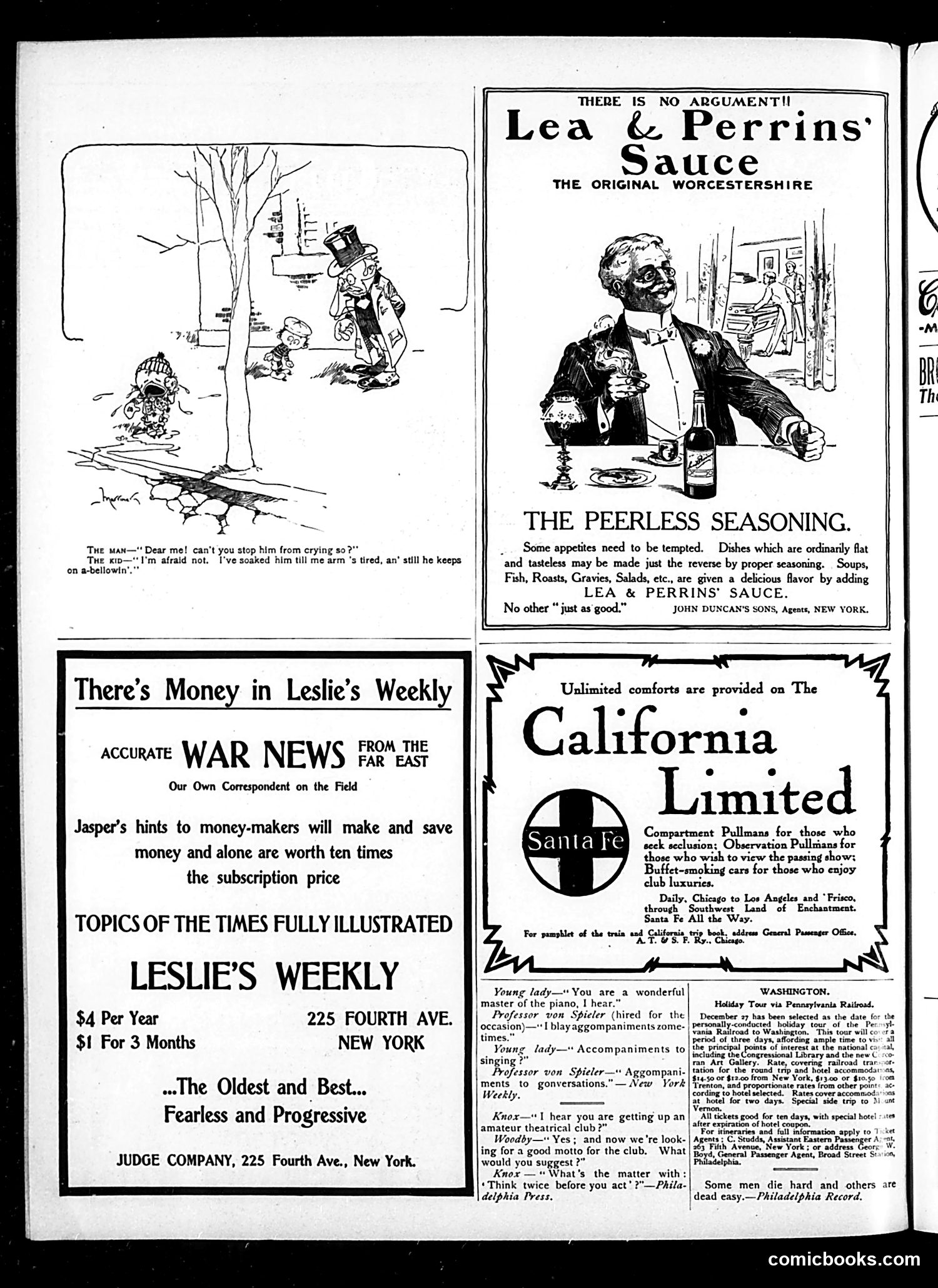
This page is primarily **advertising and fillers** rather than political satire. The main content consists of four advertisements and several brief humorous anecdotes. **Key elements:** 1. **Lea & Perrins' Sauce ad**: Features a well-dressed gentleman at dinner, promoting British Worcestershire sauce as a solution to bland food. The top cartoon depicts a frustrated parent unable to stop a crying child—the joke being the child "soaked" in sauce still won't quiet down, providing absurdist humor supporting the product. 2. **Leslie's Weekly promotion**: Advertises a competing publication, claiming war news from the "Far East" (likely the Russo-Japanese War era) is worth the subscription cost. 3. **California Limited railroad ad**: Promotes Santa Fe Railway's luxury train service with sleeping cars and dining accommodations. 4. **Brief jokes**: Include puns about piano accompaniments and theatrical club mottos. The page reflects early 1900s American consumer culture and transportation advertising rather than meaningful political commentary.
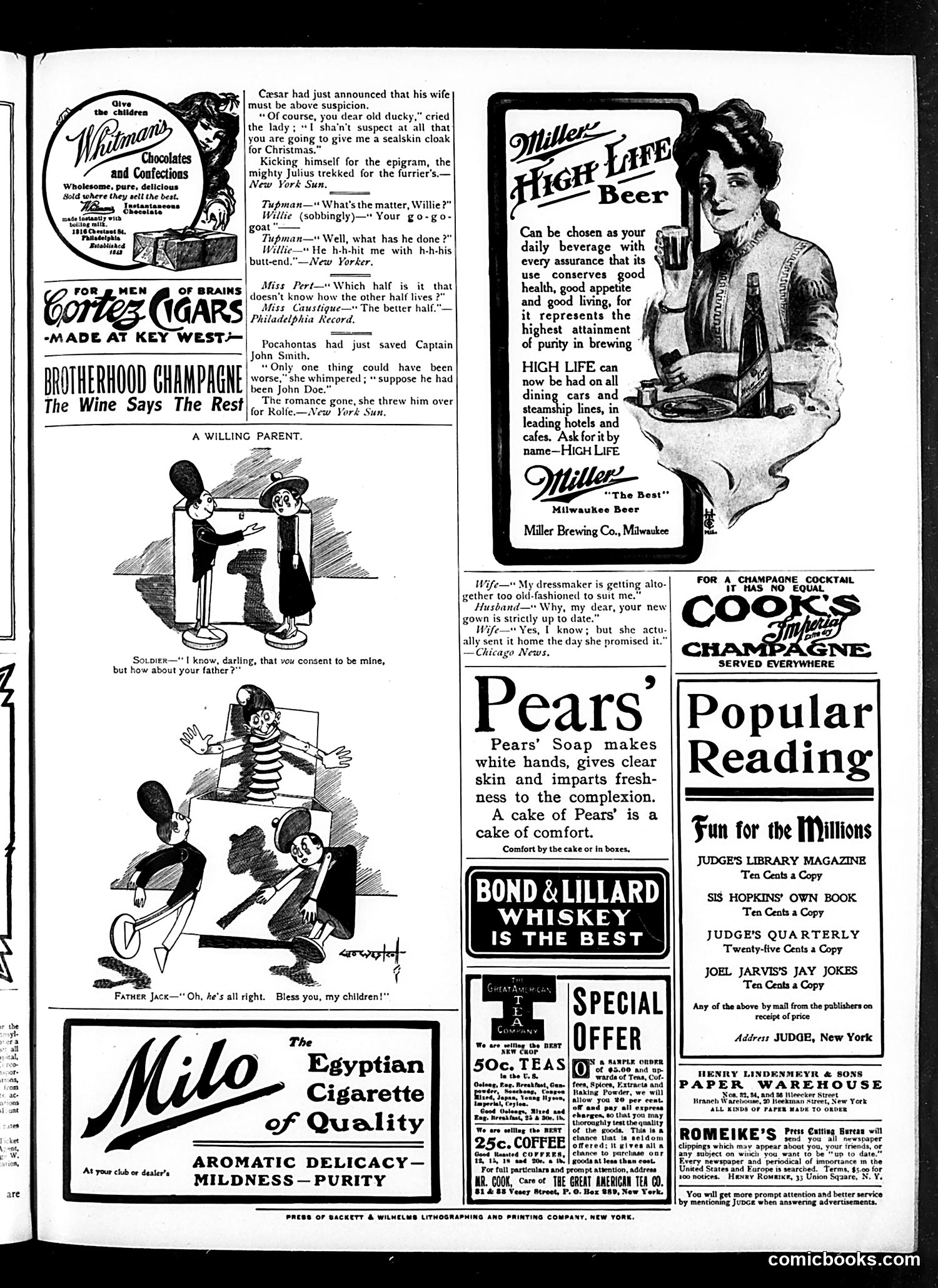
This page is primarily **advertising** interspersed with short humorous anecdotes typical of Judge's satirical format. The cartoons and jokes mock social conventions and domestic life: 1. **"A Willing Parent"** cartoon shows a father blessing his daughter's suitor—satirizing how parents eagerly marry off daughters, even to unsuitable matches. 2. **Caesar/sealskin cloak joke**: References the famous Roman saying "Caesar's wife must be above suspicion." The satire: Caesar announces his wife must be beyond reproach, then immediately reveals his hypocrisy by planning to buy her an expensive gift, suggesting ulterior motives. It mocks male double standards about morality. 3. **Pocahontas joke**: Dark humor about how a romantic rescue loses its charm when the man has an ordinary name (John Doe). Satirizes how women's romantic feelings depend on circumstance rather than genuine affection. 4. **Dressmaker joke**: Wife complains dressmaker is "old-fashioned," but husband notes the real problem—the dressmaker actually delivered on time, which is unfashionably prompt. The remainder is period advertising for beer, whiskey, soap, cigars, and publishing services.
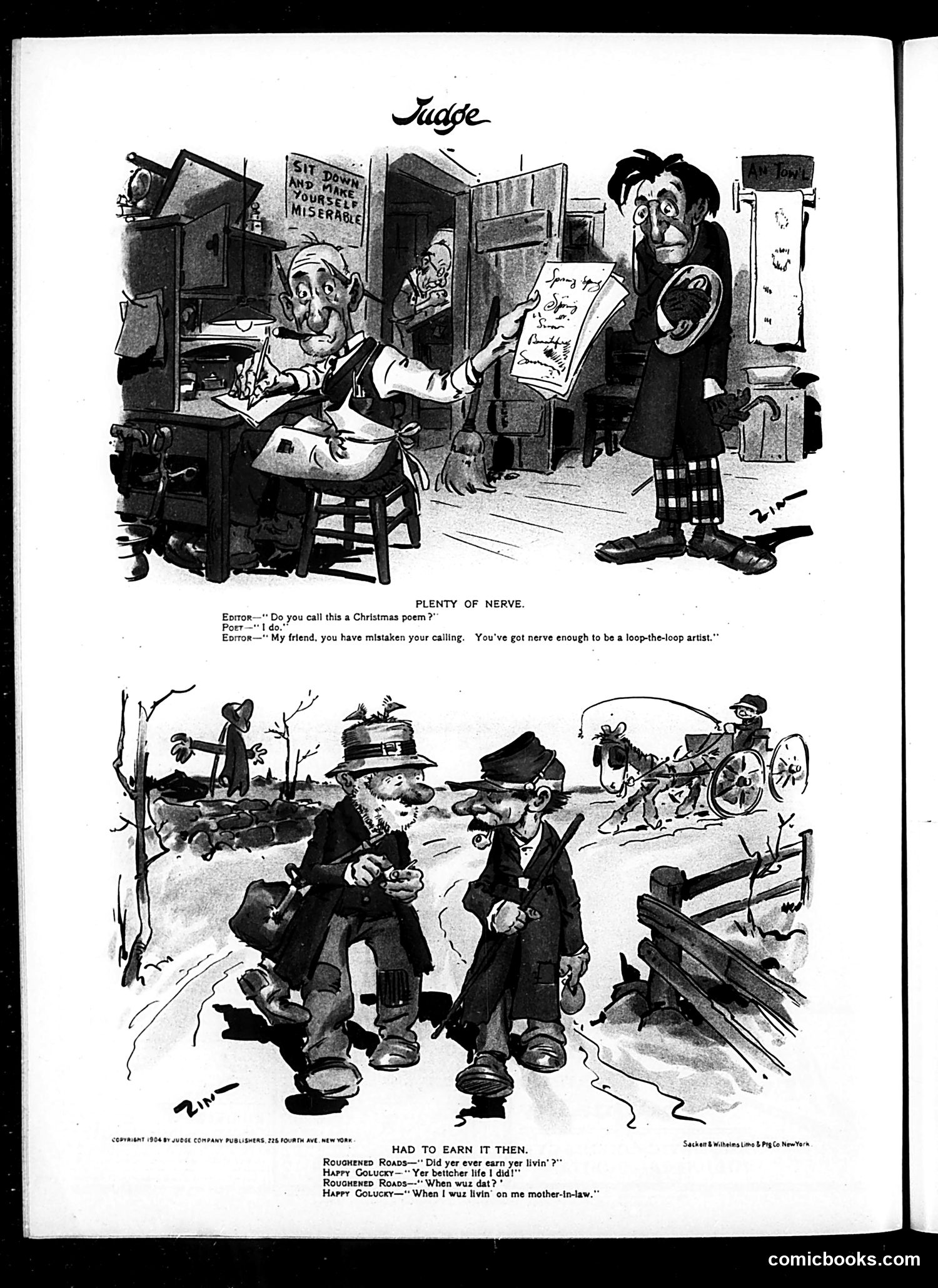
This 1904 page contains two separate satirical comics: **"Plenty of Nerve"** (top): An editor rejects a poet's Christmas submission, sarcastically suggesting the poet has enough audacity to perform as a "loop-the-loop artist" (a circus acrobat doing dangerous aerial loops). The joke: the poet's confidence in bad work is comparable to the fearlessness required for death-defying stunts. **"Had to Earn It Then"** (bottom): Two working-class men discuss employment. When asked if he ever earned a living, one boasts he did—specifically "when I wuz livin' on me mother-in-law." The humor exploits the period stereotype of sons-in-law as dependent, parasitic figures mooching off their wives' families. The dialogue's dialect marks these as working-class characters, making the joke target a recognizable social type of the era. Both comics mock human pretension and social dependency through exaggerated character types.