
A complete issue · 16 pages · 1904
Judge — November 5, 1904
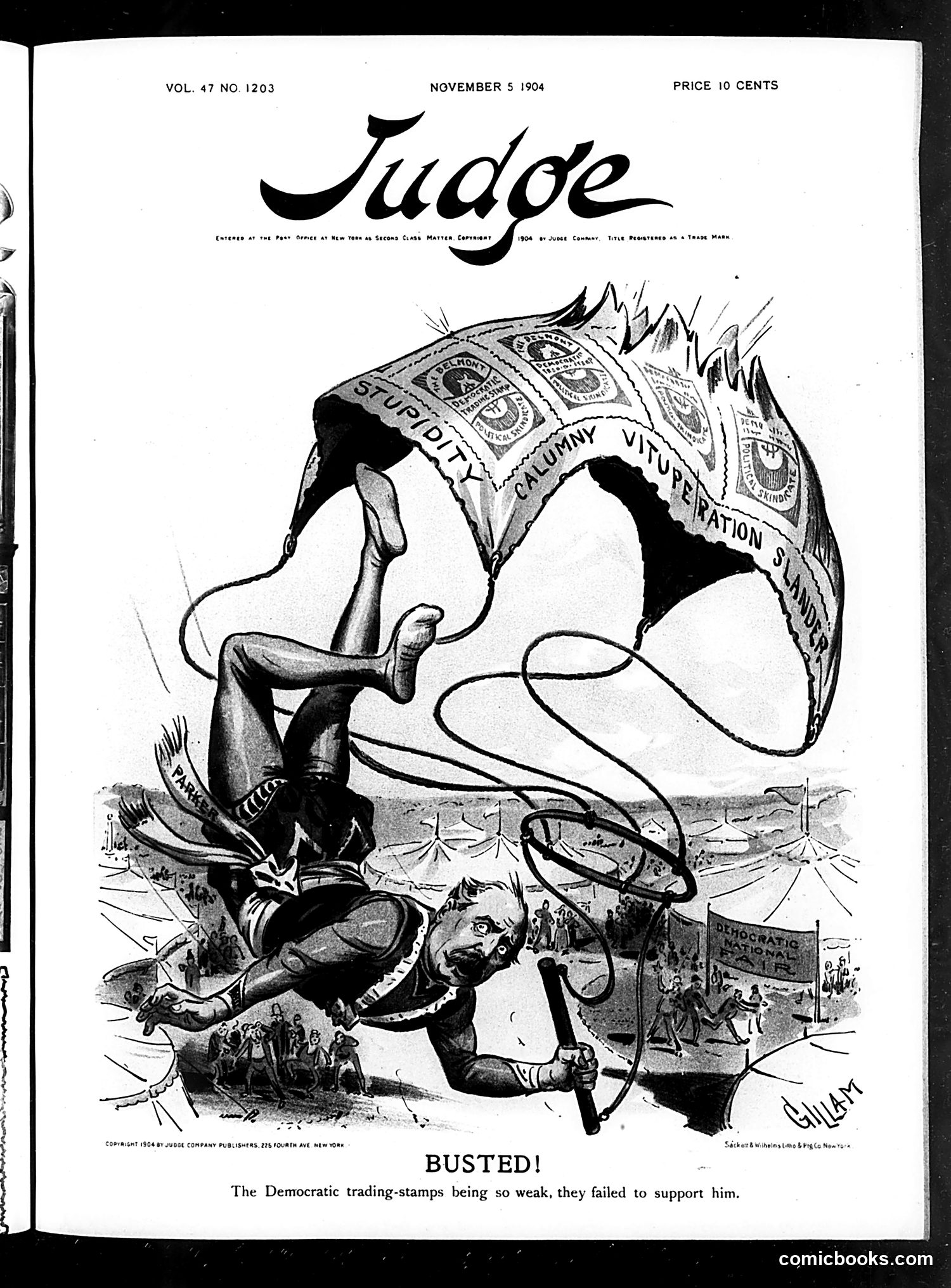
This political cartoon satirizes the 1904 U.S. presidential election. A figure—likely representing the Democratic Party candidate—is depicted as a circus performer falling from a trapeze while holding a balloon labeled with terms like "STUFFY," "CALUMNY," "VITUPERATION," and "SLANDER." The balloon is failing to support him. The caption "BUSTED! The Democratic trading-stamps being so weak, they failed to support him" suggests the Democratic campaign relied on negative attacks ("trading-stamps" of slander) rather than substantive support, which ultimately proved insufficient. The Democratic candidate appears to be falling toward defeat, while a sign reading "DEMOCRATIC NATIONAL CONVENTION" is visible below, indicating the party's institutional failure to provide adequate backing.
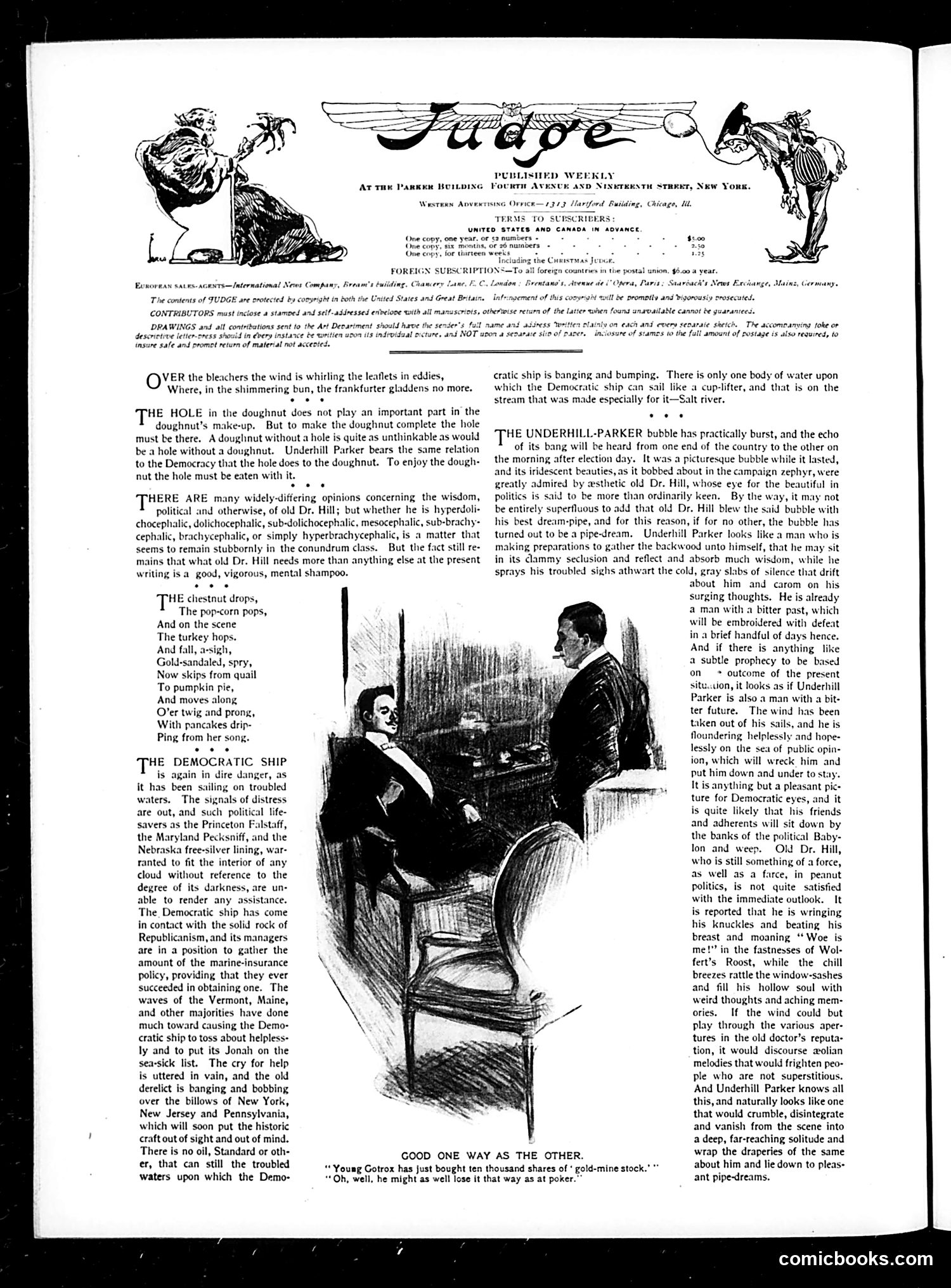
This page satirizes the Democratic Party's troubled political position through extended metaphor. The central cartoon depicts two figures aboard a sinking ship labeled "THE DEMOCRATIC SHIP," which is taking on water and losing control. The text describes the Democrats as unable to steer effectively, comparing their situation to a vessel in distress. References to "the Protection Fallacy," "Nebraska free-silver lining," and Republican dominance suggest this addresses late 19th-century political debates over currency policy and trade. The secondary cartoon, titled "GOOD ONE WAY AS THE OTHER," mocks a young coterie who lost money on gold-mine stock, joking he might "as well lose it that way as at poker"—suggesting Democratic politics are as unreliable as gambling. The overall message: the Democratic Party is directionless, sinking, and untrustworthy with power or resources.
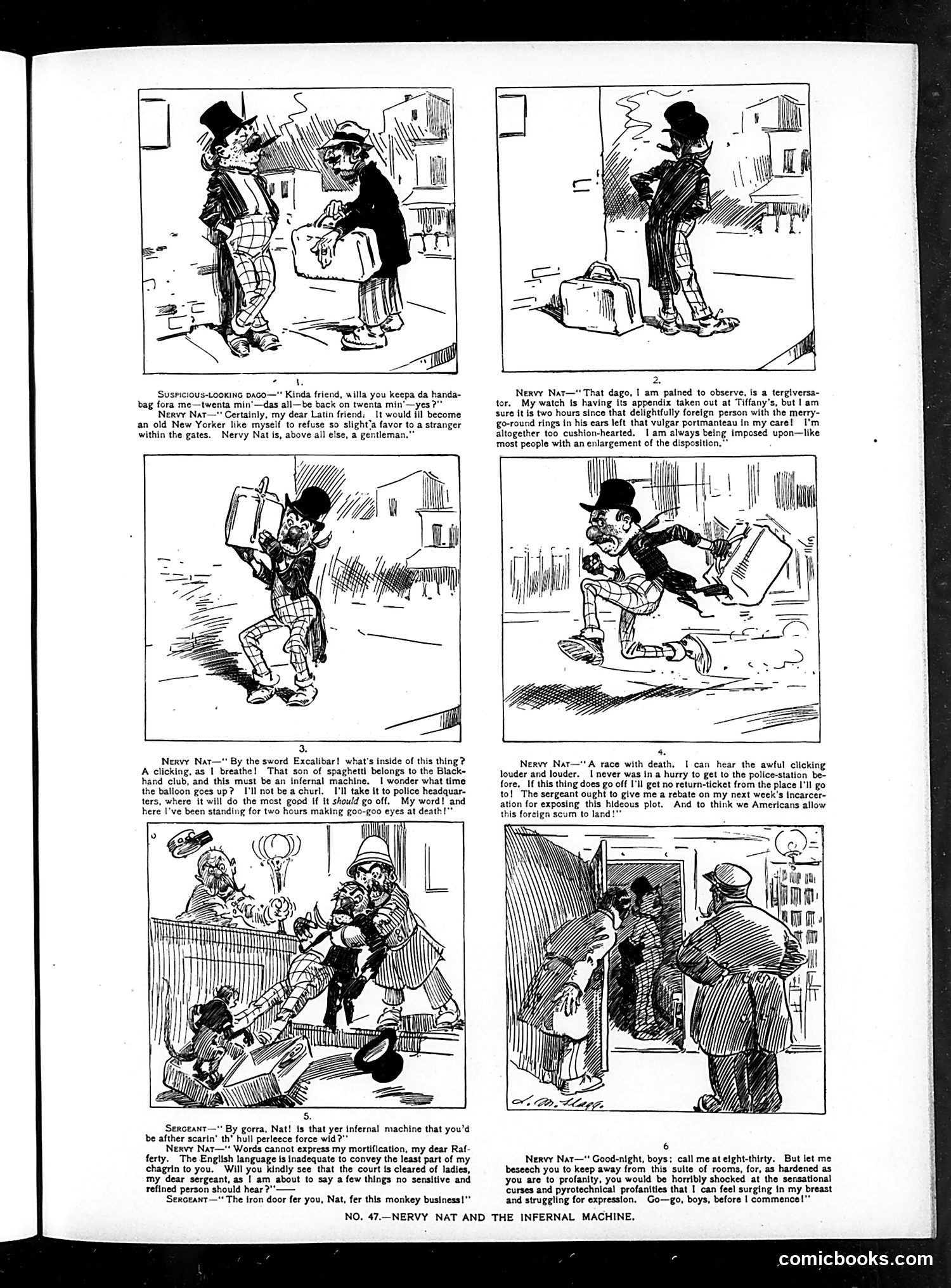
This comic strip satirizes early 20th-century anxieties about anarchist bomb plots. "Nervy Nat," a shady character with a suitcase, encounters various suspicious situations while traveling through the city. The humor relies on period fears: a suspicious suitcase is repeatedly mistaken for an anarchist's "infernal machine" (bomb). Each panel escalates the comedy—from a friend's curiosity, to police involvement, to military concern. The final panels show authority figures (police, military) increasingly panicked about the innocent luggage. The satire mocks both anarchist hysteria gripping America and the overreaction of officials to perceived threats. The "foreigner" appearance of Nat plays into contemporary xenophobic anxieties about immigrants and political violence.
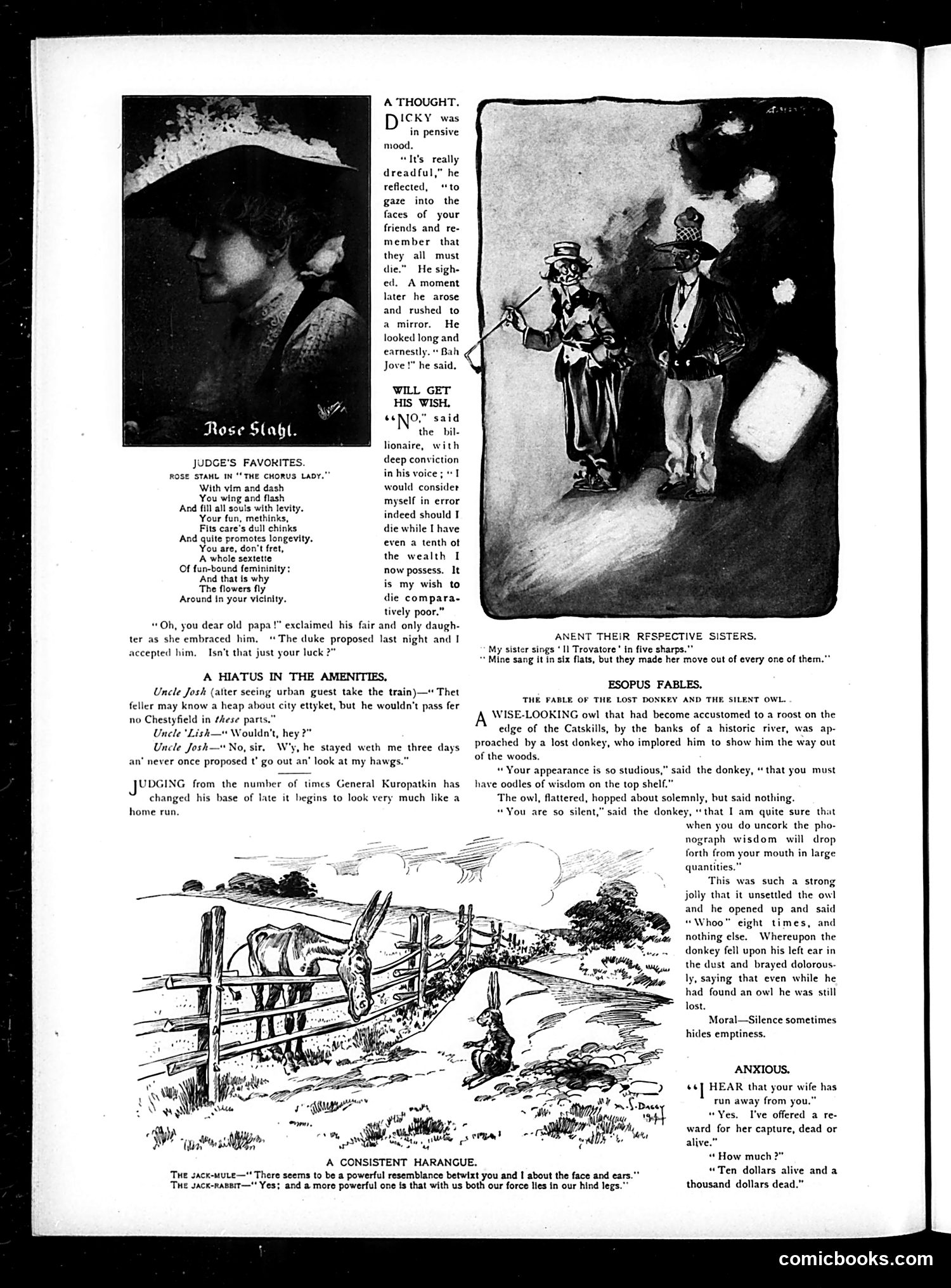
This page contains several unrelated satirical pieces and fables rather than a unified political cartoon. The content includes: **"Judge's Favorites"** - A poem attributed to Rose Stahl about living vigorously and dying "comparatively poor." **"Aesop's Fables"** - "The Fable of the Lost Donkey and the Silent Owl," a moral tale about silence hiding emptiness. **Social humor sections** titled "A Hiatus in the Amenities," "A Consistent Harangue," and "Anxious"—brief comedic exchanges about urban etiquette, domestic relationships, and marital disputes. **An illustration** of a rural scene with a donkey and rabbit, accompanying the fable. The page reflects Judge's typical format: mixing literary content, gentle domestic humor, and moral lessons rather than hard-hitting political satire. Without dates or specific figure identification, the exact historical references remain unclear.
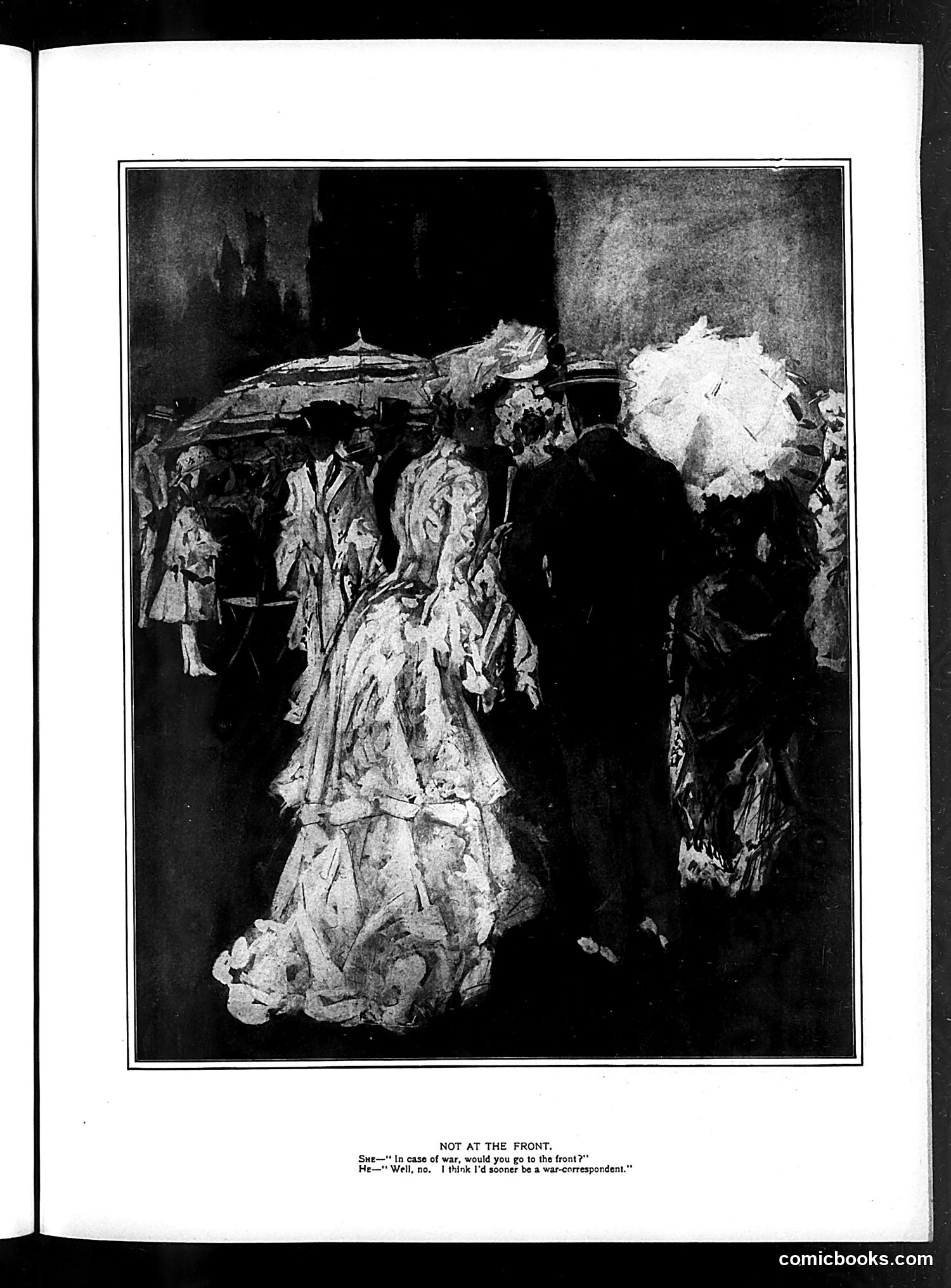
This satirical cartoon depicts a conversation between a woman and man about military service during wartime. The woman asks if he would enlist for combat at the front lines. The man's response—that he'd prefer to be a war correspondent instead—is the joke's target. The satire mocks men who avoid dangerous frontline duty by choosing safer, desk-bound roles like journalism. War correspondents reported from battlefields but faced less direct combat risk than soldiers. The cartoon suggests cowardice or self-interest masked by seemingly patriotic alternatives to fighting. The elaborate period dress and formal setting suggest this is from an era when military service was expected of able-bodied men. The cartoon ridicules those seeking to appear patriotic while avoiding actual combat danger.
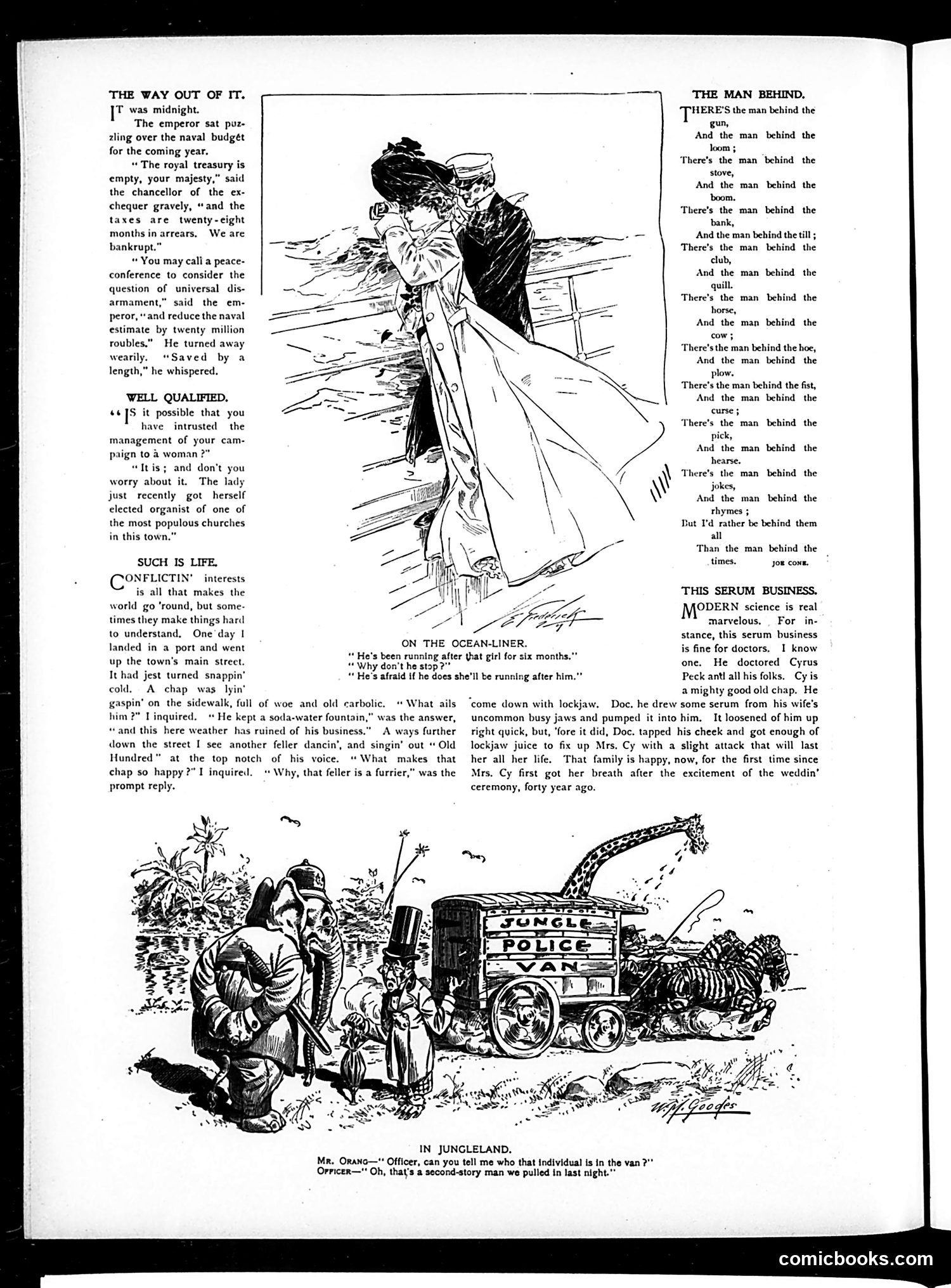
The page contains several satirical pieces targeting early 20th-century politics and society: **"The Way Out of It"** mocks imperial Russian finances—an emperor with an empty treasury and massive tax arrears "solves" bankruptcy by calling a peace conference to reduce naval spending, then smugly congratulates himself ("Saved by a length"). **"Well Qualified"** satirizes nepotism in campaign management: a woman organist, recently elected to a church position, is somehow entrusted managing a political campaign. **"The Man Behind"** is a poem celebrating the ordinary worker ("the man behind the gun," "loom," "plow") over the man who fails to keep pace with modern times. **"This Serum Business"** jokes about tetanus antitoxin treatments: a doctor treats lockjaw by drawing serum from the patient's wife's infected jaw, curing the husband but leaving the wife permanently afflicted—presented as comedic family happiness. **"In Jungleland"** shows a police van joke about a captured criminal. The cartoons use racist caricature conventions typical of the era.
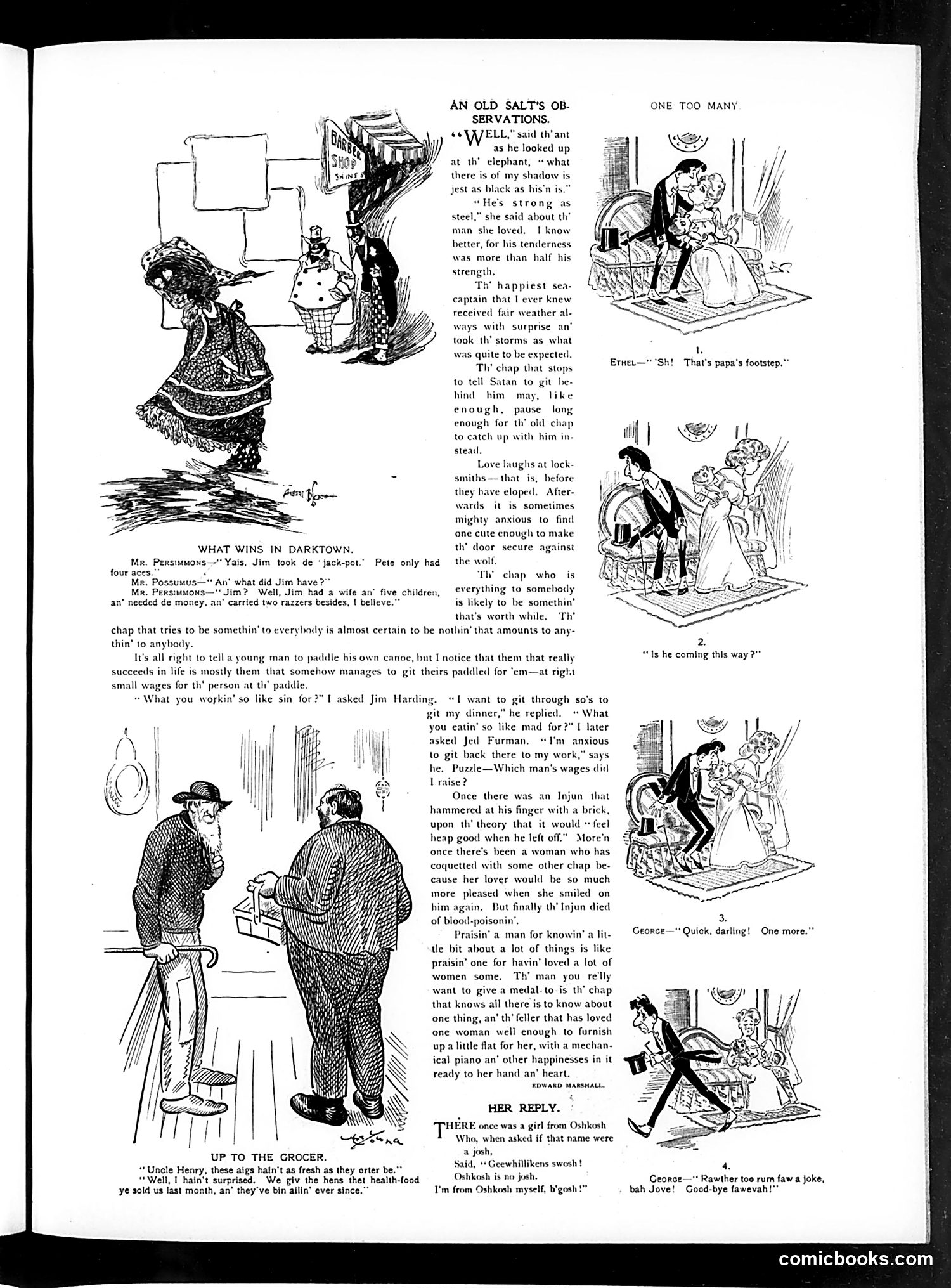
This page contains several humorous vignettes critiquing American social behavior and class dynamics: **"What Wins in Darktown"** uses racist caricature (the "darktown" stereotype common to era) to mock working-class gamblers. The joke: Jim lost at poker despite having a wife and five children—implying financial responsibility matters more than card skills. **"An Old Salt's Observations"** presents philosophical musings about strength, love, and human nature in folksy dialect, offering gentle wisdom rather than sharp satire. **"One Too Many"** shows a man visiting a woman repeatedly—the cartoon sequence suggests he's becoming an unwelcome nuisance. This satirizes excessive courtship or social overstaying. **"Up to the Grocer"** jokes about commercial health-food products causing illness rather than wellness—social commentary on dubious patent medicines and food fads. **"Her Reply"** is a light pun about an Oshkosh girl whose hometown name sounds like "josh" (joking). The British character adds mild xenophobic humor typical of the era. Overall: light social satire mocking gambling, class pretension, courtship excess, and commercial hucksterism.
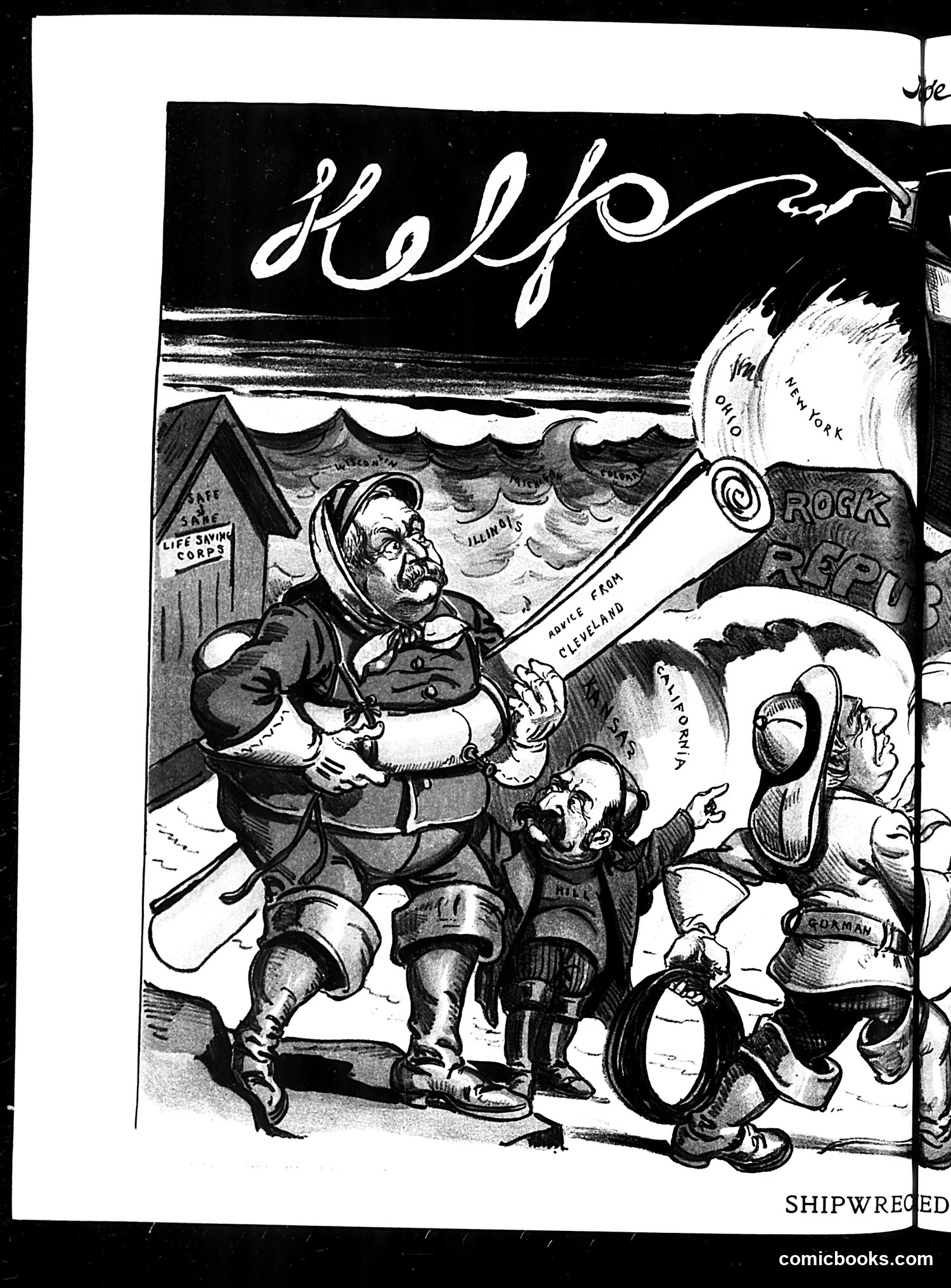
This political cartoon titled "Shipwrecked" depicts a large, well-fed figure in a life-saving uniform holding a rope, with smaller figures clinging to barrels labeled with U.S. cities (New York, Cleveland, Illinois) and "Rock Repository." The imagery satirizes a political figure's response to economic crisis or disaster—the "shipwreck" likely references a financial panic or recession. The cartoon criticizes how relief efforts or government assistance were being distributed or managed, with the oversized authority figure controlling access to resources while others struggle. The multiple labeled barrels suggest regional disparities in aid. The exaggerated physicality and caricature style typical of Judge magazine's social commentary indicates this mocks government incompetence or mismanagement during an economic emergency, though the specific crisis date remains unclear from the visible text alone.
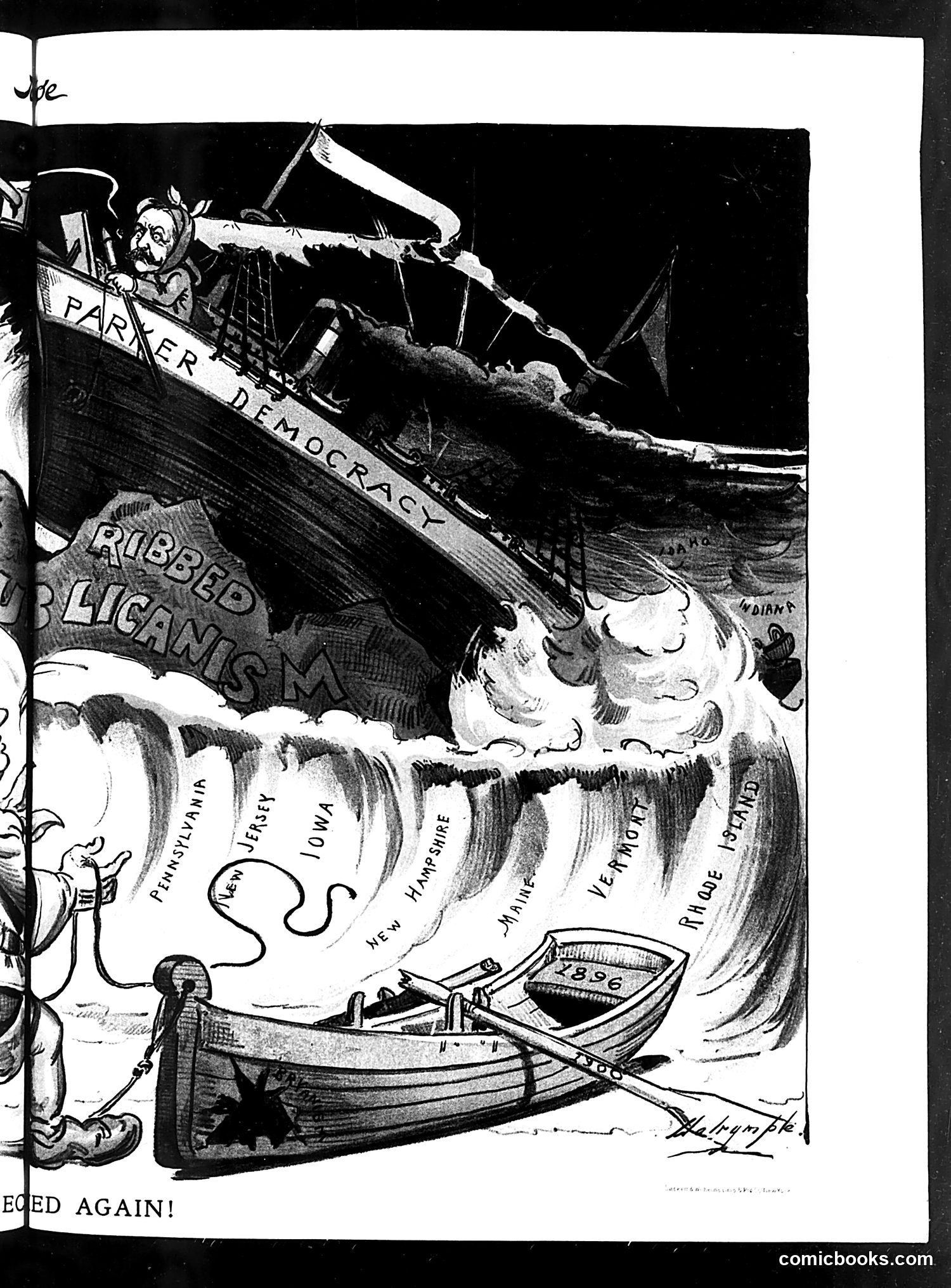
This cartoon satirizes threats to democracy, depicted as a ship labeled "Parker Democracy" that appears damaged or sinking. A figure (likely representing a political leader or threat) stands at the helm wielding what looks like a weapon or tool of destruction. Below the ship, barrels are labeled with various problems: "Prohibition," "Lost Party," "New Harmonies," "Jailsmiths," and "Rhode Island" — suggesting domestic political crises undermining democratic institutions. The phrase "Egged Again!" implies democracy has been repeatedly damaged or attacked. The cartoon criticizes how multiple domestic controversies and political failures threaten the stability of democratic governance. The chaotic composition emphasizes the precarious state of the nation's political system during this period of Judge magazine publication.
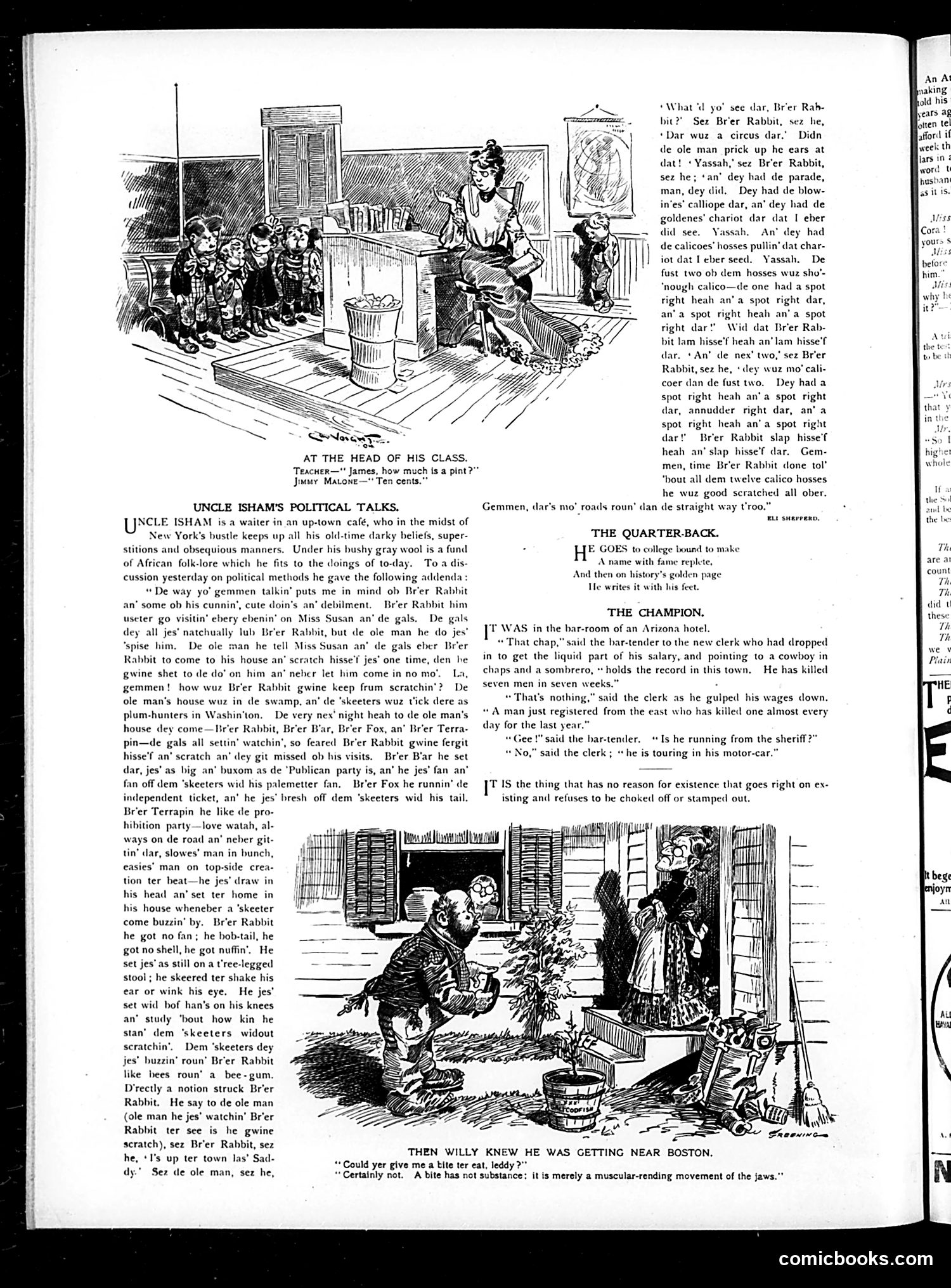
This page satirizes American political tactics through an extended folk-tale allegory narrated by "Uncle Isham," a waiter who speaks in exaggerated African American dialect (characteristic of Judge magazine's racial stereotyping). The Brer Rabbit fable compares political parties to animals trying to resist temptation. The Republican Party is the big bear fanning away mosquitoes; the Independent ticket is the fox brushing them away; the Prohibition Party is the slow terrapin hiding in its shell. Brer Rabbit—representing mainstream Democrats—has no defense against the "skeeters" (political attacks) except distraction through tall tales about circus horses. When he becomes absorbed in his own story, he forgets his discipline and scratches anyway—the moral being that politicians inevitably succumb to temptation regardless of their stated methods. The piece mocks how different political approaches all fail equally, suggesting American political discourse is fundamentally about self-interest disguised as principle.
This page is primarily **advertising and short humorous anecdotes** rather than political cartoons. The visible content includes: **Humor pieces** (brief, joke-like stories): - An Atchison Globe anecdote about a man losing five dollars and his wife's decades-long resentment - A domestic joke about a woman criticizing her partner's dancing - A store clerk claiming to be "highest-salaried" only because he's taller than others - A grocer mistakenly accepting a gold piece among pennies **Product advertisements**: - Evans Ale - Sohmer Pianos - Gold Seal Champagne - Red Top Rye Whiskey - Paegor Cough Medicine - Postum Food Coffee (with testimonial) - Penn Mutual Life Insurance **Notable**: The Postum ad includes a lengthy testimonial claiming coffee caused nervousness and that switching to Postum (caffeine-free) cured the author's headaches and improved her nursing ability—typical early 1900s health claims. The page reflects early 20th-century consumer culture and domestic humor typical of Judge magazine.
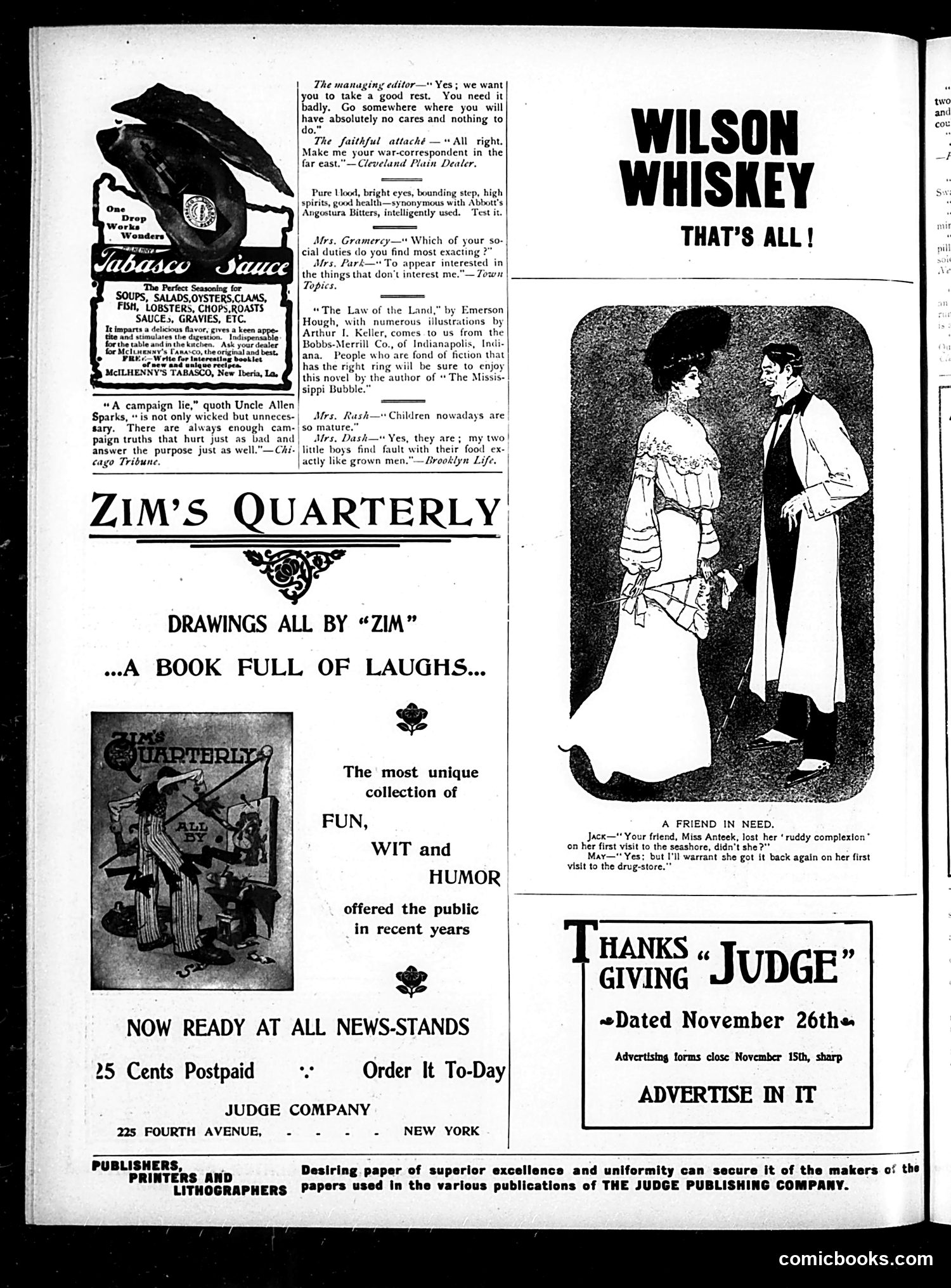
This is primarily an **advertising and announcements page** from Judge magazine, with several brief humorous quips rather than developed political cartoons. The jokes reflect early 20th-century upper-class concerns: a managing editor's ironic suggestion that a war correspondent position offers "rest"; social anxiety about maintaining polite interest in tedious obligations; and period humor about children's maturity and cosmetics (the "drug-store" reference suggests makeup as a solution to sun damage). **Key advertisement**: Zim's Quarterly, a humor collection by cartoonist "Zim," promoted as "a book full of laughs" for 25 cents. **Wilson Whiskey ad**: Features an illustration captioned "A Friend in Need"—a social scenario about a woman's complexion loss at the seashore and its restoration via drugstore products. This reflects period beauty standards and class-conscious social embarrassment. The page contains **no identifiable political figures or events**—it's social satire aimed at genteel audiences concerned with manners, propriety, and fashionable remedies.
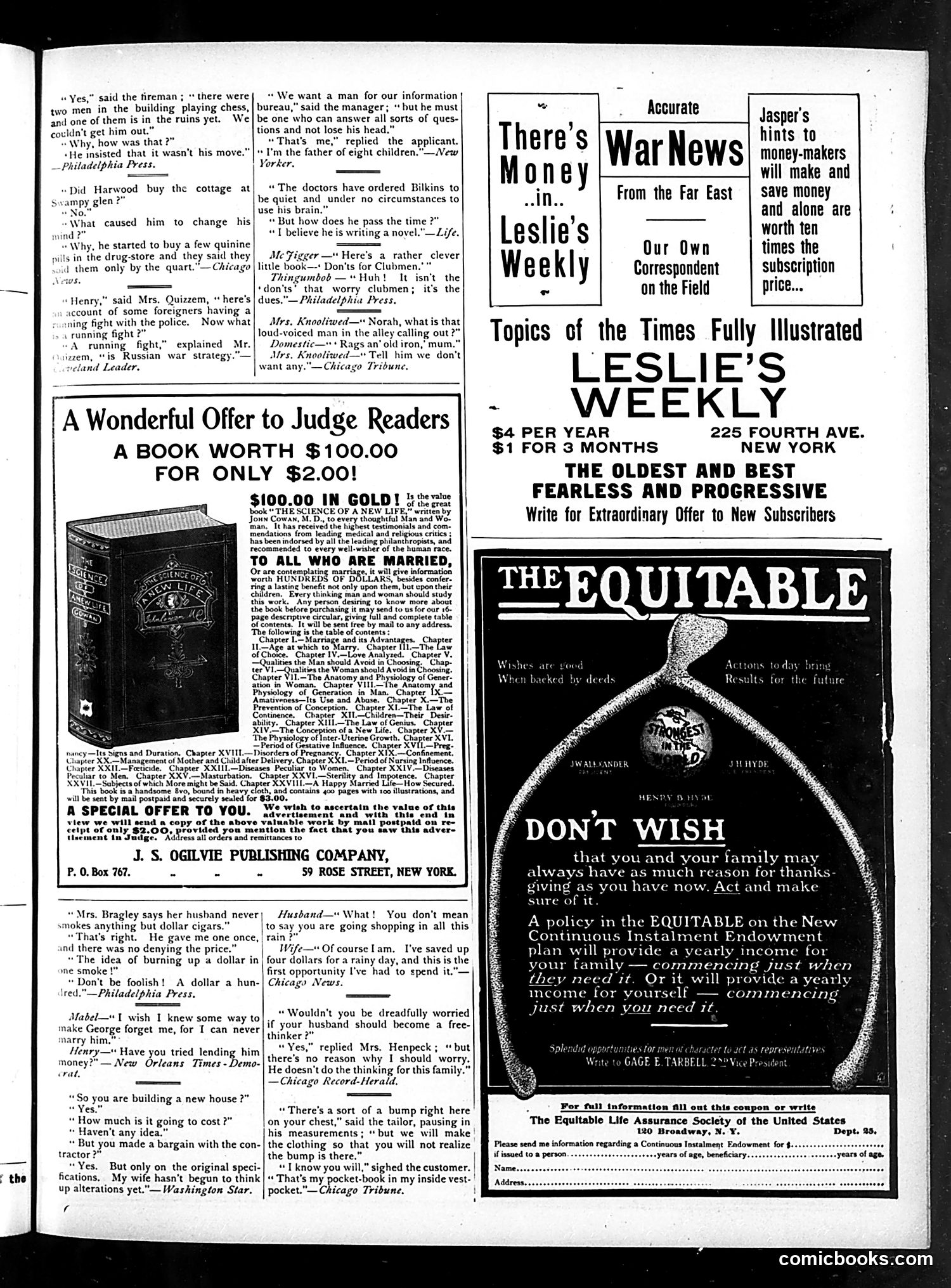
This page is primarily **advertisements and humor columns**, not political cartoons. The content consists of: **Short jokes** on topics like: - A fireman unable to rescue a chess player too stubborn to move - A man buying a cottage but changing his mind after learning quinine costs money - Medical advice to avoid using one's brain (humorously suggesting novel-writing as idle activity) **Major advertisement**: A mail-order book "The Science of a New Life" for $2.00 (marketed as worth $100), targeting married couples with medical/marital advice—typical of late 19th/early 20th-century self-help publishing. **Other ads**: Leslie's Weekly magazine and The Equitable Life Assurance Society. The humor reflects period concerns about marriage, money, and practicality. There are **no identifiable political figures or significant satire**—just light domestic and social comedy typical of Judge magazine's general-audience content.
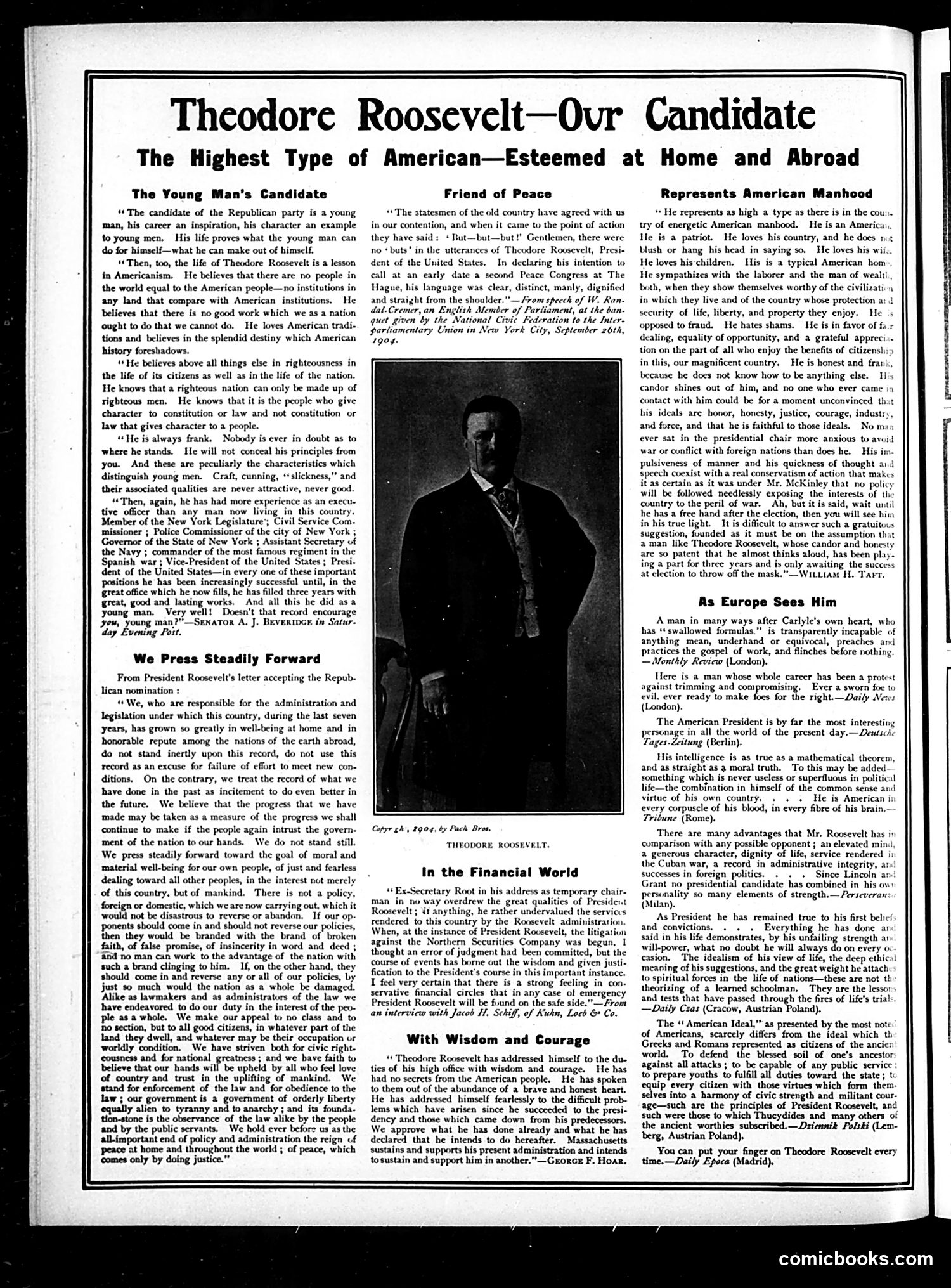
This is a **pro-Roosevelt campaign page** from Judge, promoting Theodore Roosevelt as the Republican presidential candidate. The central image is a formal portrait photograph of Roosevelt. The page reprints glowing testimonials about Roosevelt's qualifications, including: - **Senator Beveridge's praise** of Roosevelt as "the young man's candidate," emphasizing his inspirational career and American character - **Roosevelt's own letter** accepting the Republican nomination, defending his administration's record and warning that reversing their policies would constitute "broken faith" The rhetoric emphasizes Roosevelt's **executive experience** (legislator, Police Commissioner, Governor, Vice-President, President) and moral character as embodying American ideals. **For modern readers:** This represents standard campaign promotion of the era—presenting Roosevelt as proven, energetic, and morally superior to unstated opponents. The repeated invocation of "righteousness" and "American" values reflects early-20th-century Progressive-era political messaging that conflated national interest with moral virtue.
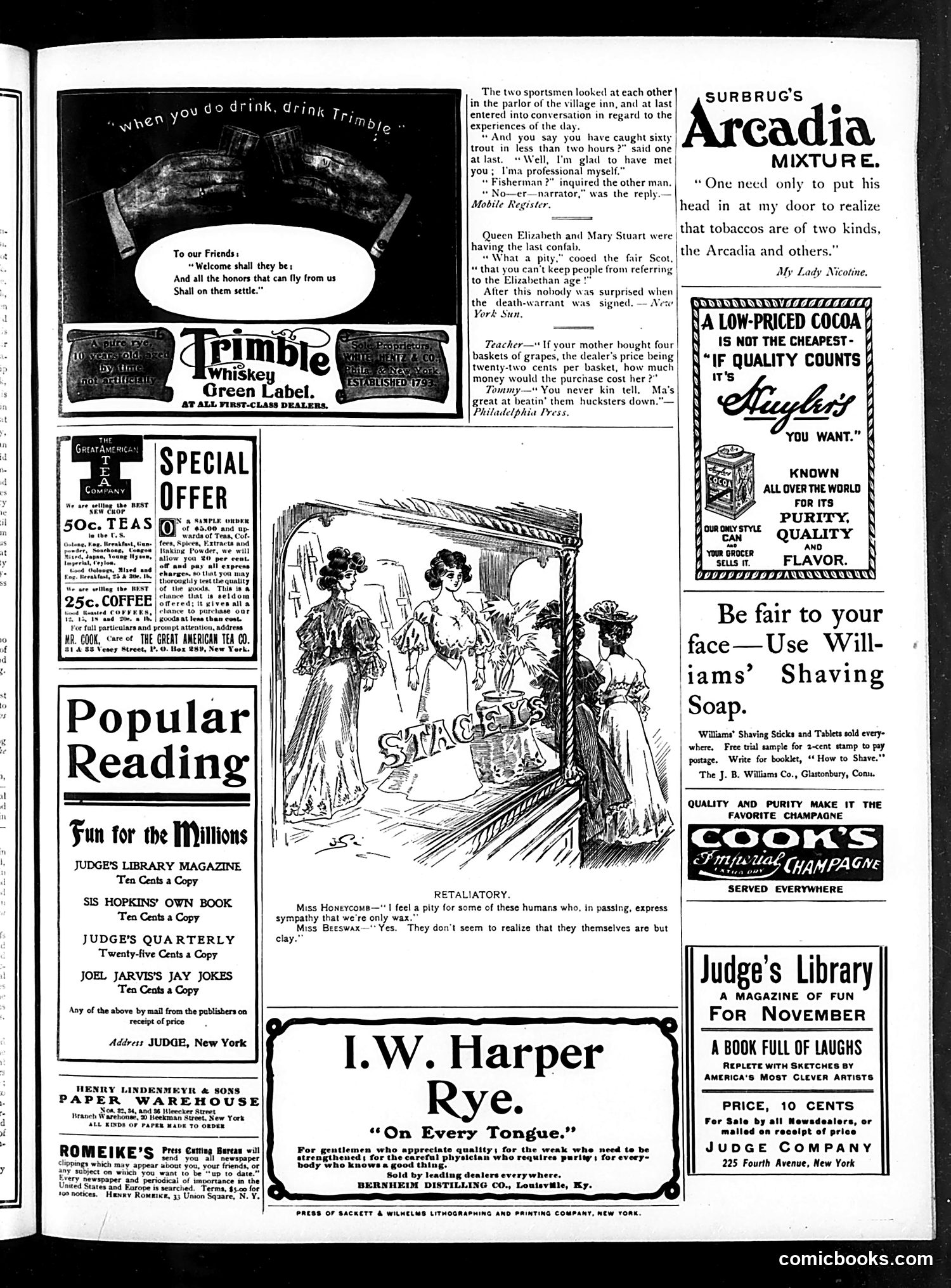
This page is primarily **advertising with brief satirical content**. The main elements are: **Satirical Humor Pieces:** - Three short jokes about exaggeration and human nature: a fisherman claiming 60 trout catches, Mary Stuart complaining about the "Elizabethan age" label, and a child noting mothers negotiate prices with vendors. - A "Retaliatory" cartoon shows wax figures expressing pity for humans, who are themselves artificial—turning sympathy back on the sympathizers. **Advertisements:** The page is dominated by period product ads (Trimble Whiskey, Stacey corsets, Arcadia tobacco, Stuyvesant cocoa, Williams' Shaving Soap, I.W. Harper Rye, Cooks Champagne) and **Judge Company's own publications** promoting "Judge's Library Magazine" and related humor anthologies. **Context for Modern Readers:** This represents late 19th/early 20th-century American humor—light, self-referential, and family-oriented. The page functions as both entertainment magazine and advertising vehicle, with humor used to sell products and subscriptions.
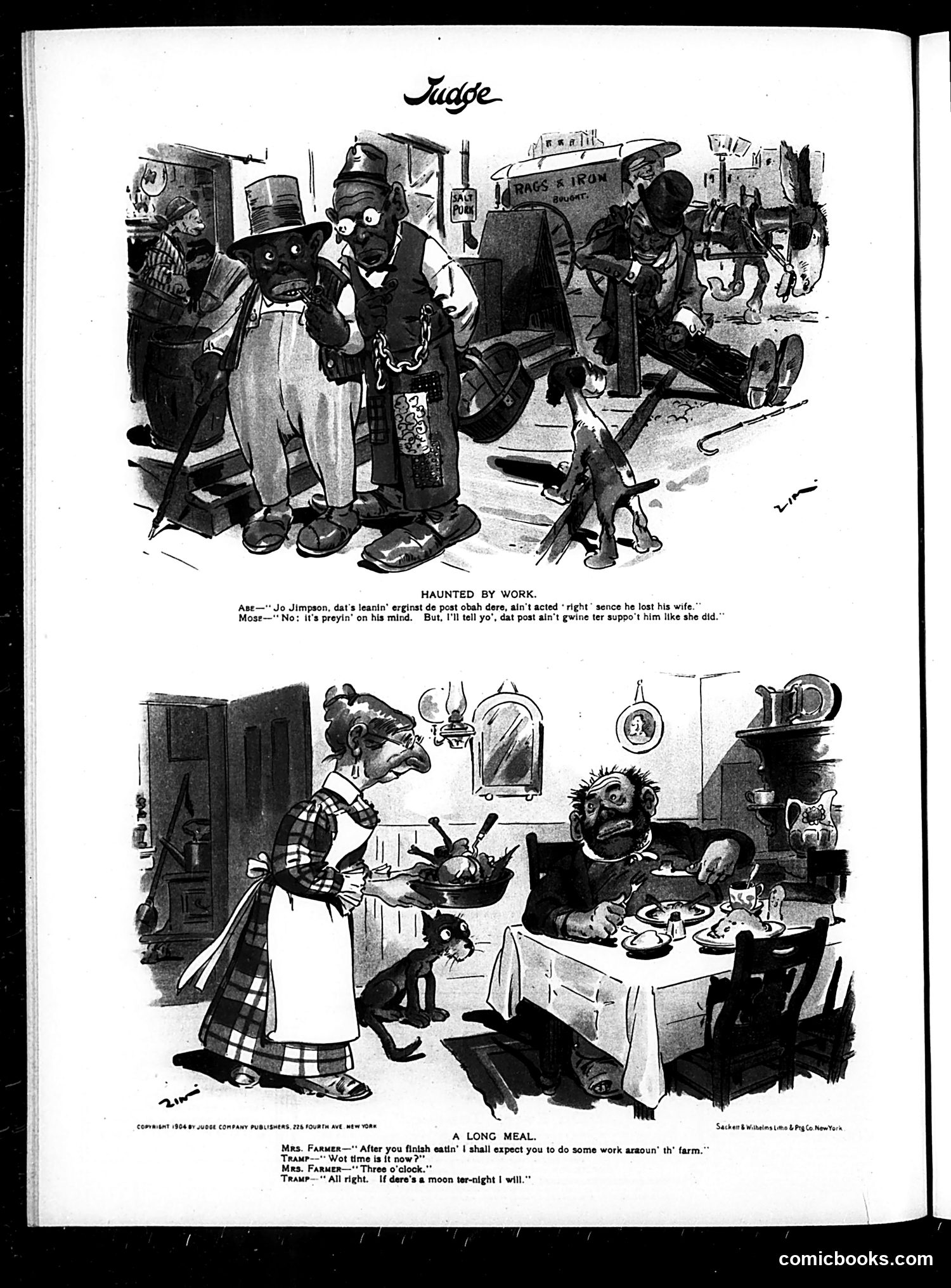
This page contains two racist cartoons using offensive dialect and caricature stereotypes prevalent in early 20th-century American humor. **"Haunted by Work"** depicts two Black men discussing a third who is troubled since his wife's death. The "joke" cruelly suggests the deceased wife's primary value was as manual labor support—the post cannot replace her physical strength. **"A Long Meal"** shows a white farmer's wife negotiating work from a Black farmhand, who repeatedly delays by asking the time, hoping darkness will excuse him from labor. The humor targets perceived laziness stereotyped onto Black workers. Both cartoons reflect era-typical racism: they mock Black speech patterns, reinforce degrading labor stereotypes, and present racist "humor" as entertainment. These cartoons exemplify how mainstream American publications normalized dehumanizing caricature and racist attitudes before the Civil Rights era.