
A complete issue · 16 pages · 1904
Judge — September 3, 1904
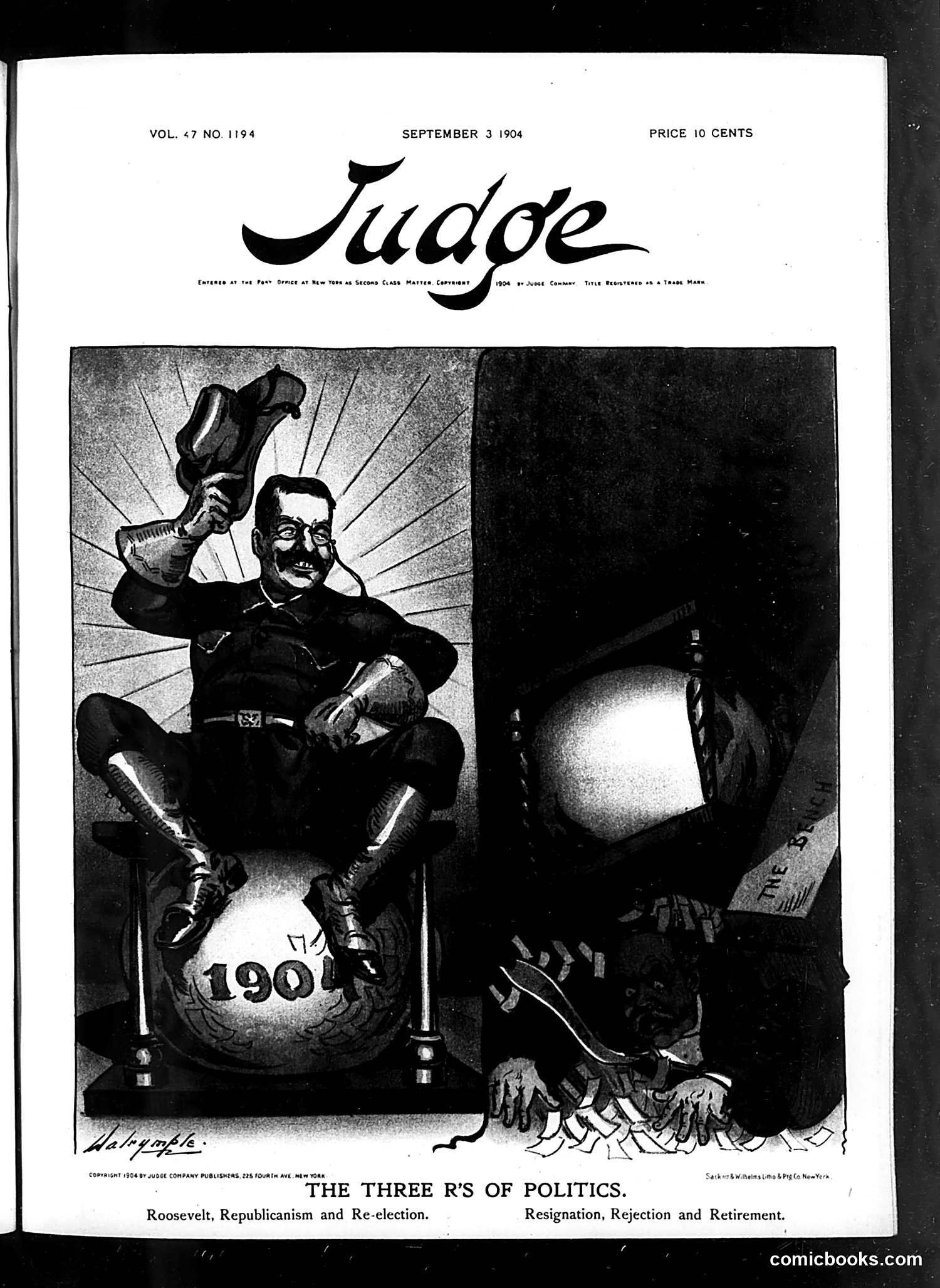
This September 1904 Judge magazine cartoon presents two contrasting political scenarios. **Left panel:** A jubilant figure (likely President Theodore Roosevelt, given the 1904 date and context) sits atop a globe marked "1904," triumphantly holding a shoe aloft with radiating lines suggesting victory. This represents the "Three R's" of Republican politics: **Roosevelt, Republicanism and Re-election** — celebrating Roosevelt's anticipated electoral success. **Right panel:** Shows the opposite fate — a figure upside-down and defeated, representing the Democratic alternative. This depicts the opposing "Three R's": **Resignation, Rejection and Retirement** — the predicted consequences of losing the 1904 election. The cartoon satirizes the stark political binary: Roosevelt's expected triumph versus the Democratic opposition's anticipated humiliation. The contrasting imagery emphasizes the magazine's Republican perspective on the coming election.
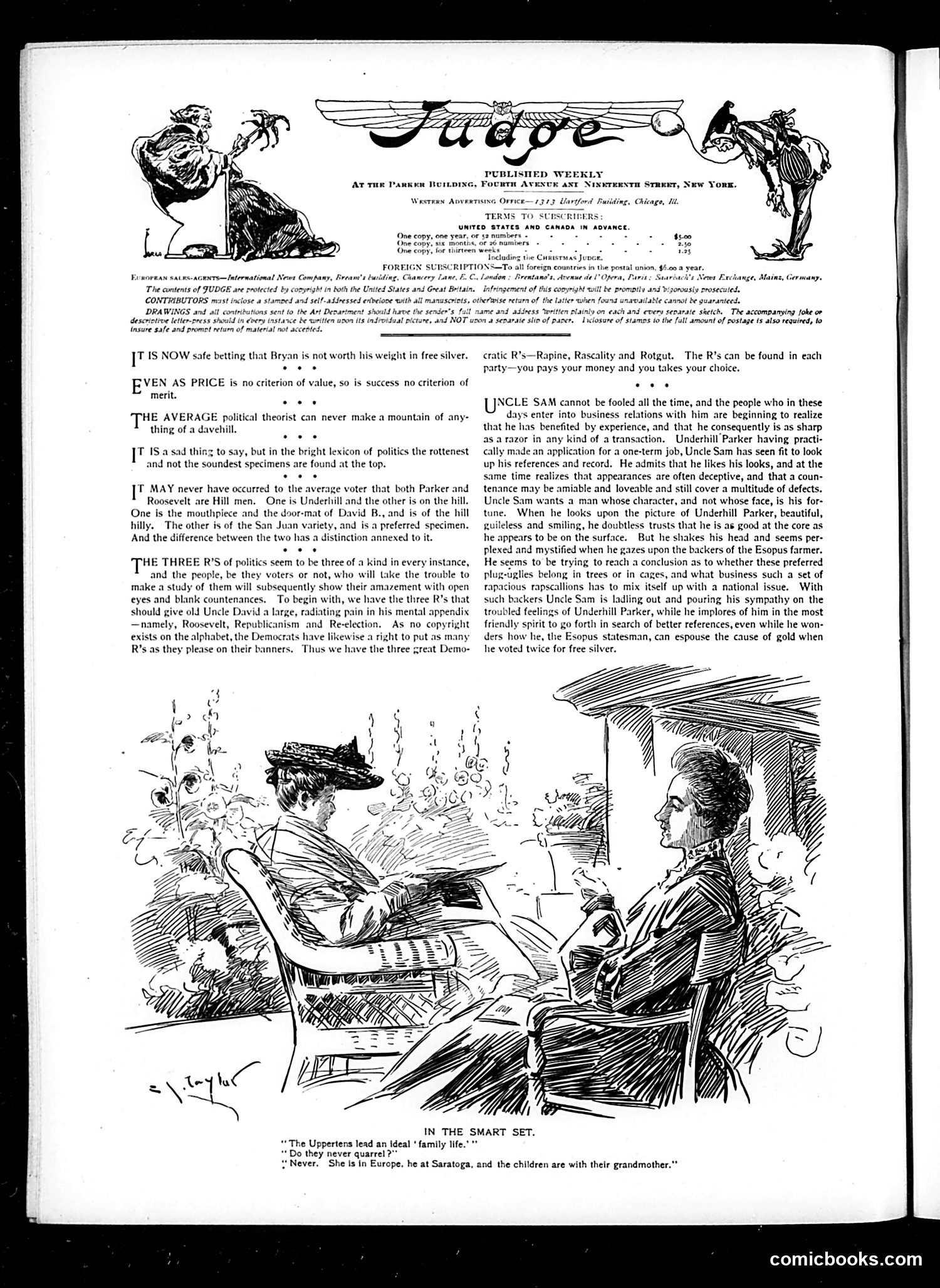
This page from *Judge* magazine contains political commentary rather than traditional cartoons. The main text discusses "the three R's of politics"—**Roosevelt, Republicanism and Reduction**—suggesting commentary on Theodore Roosevelt's political influence and economic policy debates of the early 1900s. The article criticizes political figures (likely Parker and Roosevelt, mentioned by name) while praising Uncle Sam's practical wisdom in business matters. The piece appears to defend Uncle Sam against being "fooled" by politicians, positioning practical experience over political rhetoric. The accompanying illustration labeled "In the Smart Set" depicts two well-dressed figures in conversation about family life and travel (one mentions Europe and Saratoga), representing upper-class social commentary typical of *Judge's* satirical focus on society and politics.
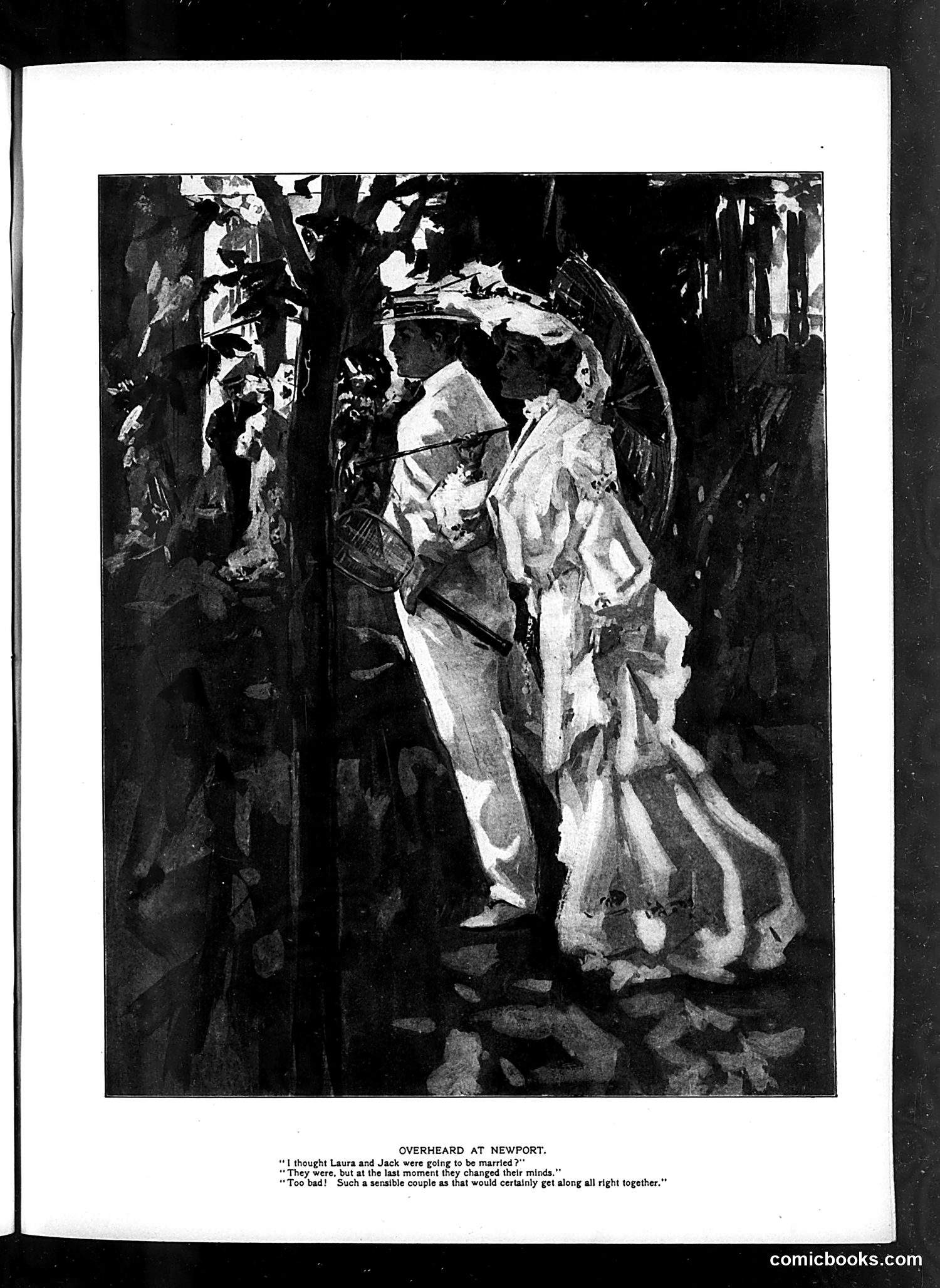
This Judge magazine cartoon depicts a social scene at Newport, Rhode Island—the fashionable seaside resort for wealthy Americans. The caption presents overheard gossip about an impending marriage between "Laura and Jack." The speaker expresses skepticism about their compatibility, describing them as an unsuitable couple who would "certainly get along all right together"—a sarcastic understatement. The remark appears to mock either the couple's personalities or their social positions. The illustration shows well-dressed figures in formal attire at what appears to be an elegant social gathering, capturing Newport's high-society setting. Without additional context identifying the specific individuals referenced, the cartoon's precise satirical target remains unclear, though it likely commented on a contemporary society marriage or the absurdities of wealthy elite matchmaking.
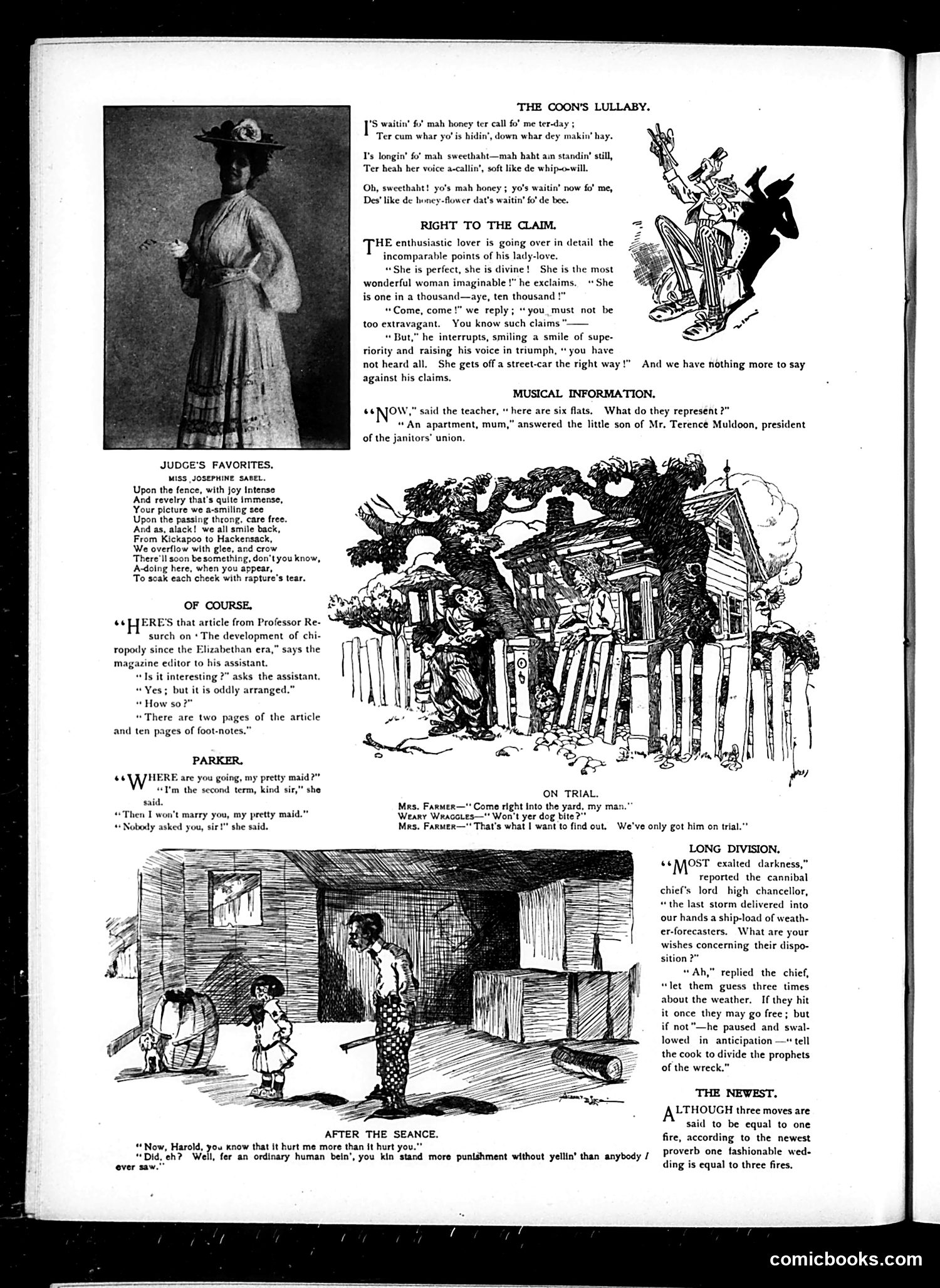
This page contains multiple short humorous pieces rather than a cohesive political cartoon. The sections include: **"The Coon's Lullaby"**: A dialectal poem, likely reflecting period racial stereotypes common to early 20th-century humor magazines. **"Right to the Claim"**: Satirizes overly enthusiastic romantic declarations, mocking men who exaggerate their partners' virtues with absurdly inflated praise. **"Judge's Favorites"** and other sections: Brief comic anecdotes about social situations—including jokes about teachers, professors, and domestic disputes. **"After the Séance"**: References spiritualism, a popular but often-mocked practice of the era, joking about séance participants and supernatural claims. The page lacks focused political satire, instead offering miscellaneous social humor typical of Judge's light satirical approach to everyday American life and contemporary fads.
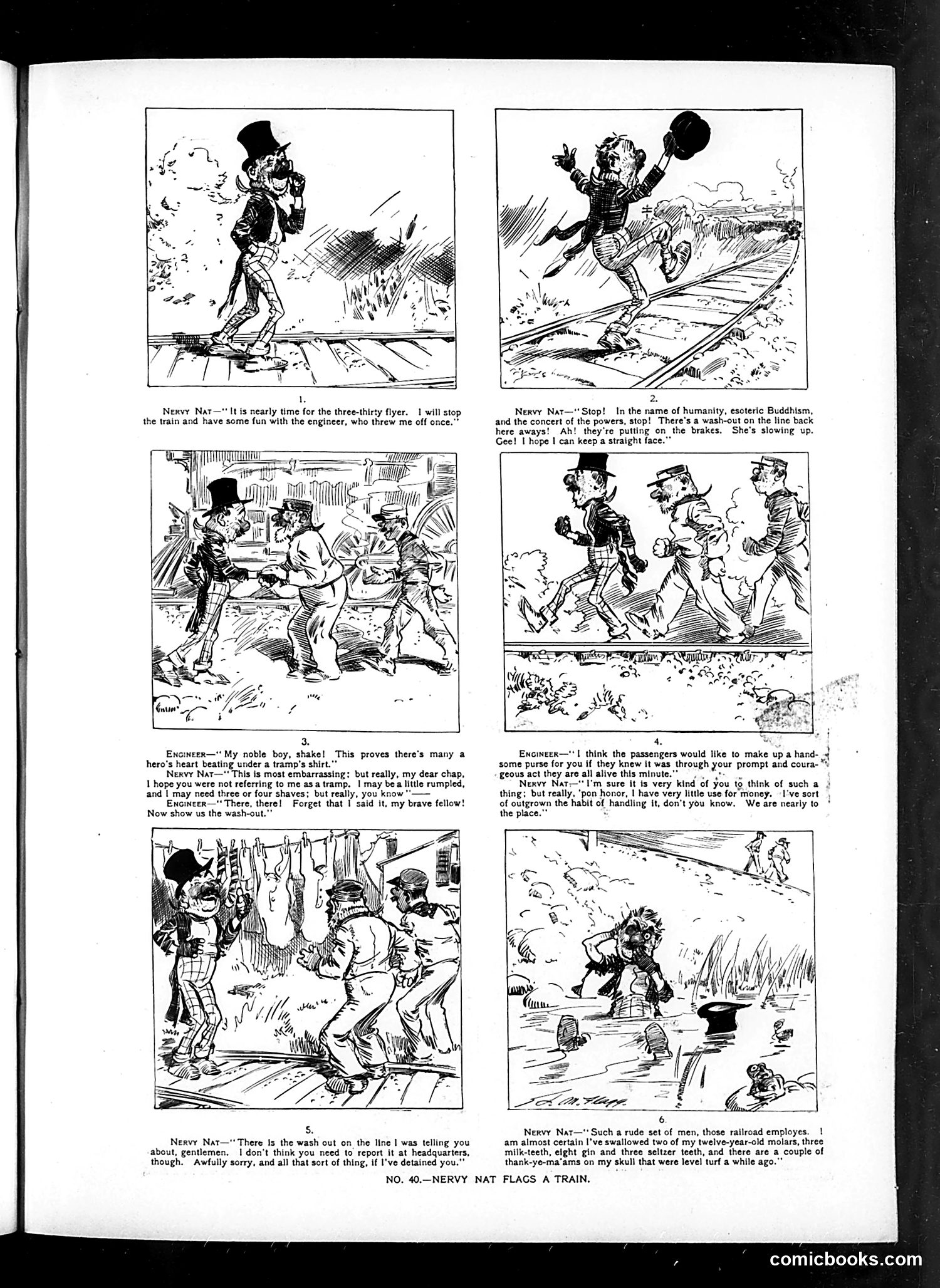
This comic strip depicts a recurring character, "Nervy Nat," a vagrant or tramp who claims to warn a train engineer about a dangerous wash-out (collapsed track section) ahead. The humor derives from Nat's deception and social pretense: despite being a disheveled hobo, he poses as a heroic savior to manipulate the engineer into gratitude. The satire targets class hypocrisy and opportunism. Nat exploits the engineer's belief in his own nobility ("hero's heart beating under a tramp's shirt") while maintaining genteel affectations ("I may need three or four shaves; but really, you know"). He declines a monetary reward with false modesty, then complains afterward about his injuries with absurd exaggeration ("swallowed two of my twelve-year-old molars"). The strip mocks both pretentious respectability and working-class gullibility—suggesting how easily con-artists manipulate genuine sentiment through false claims of heroism.
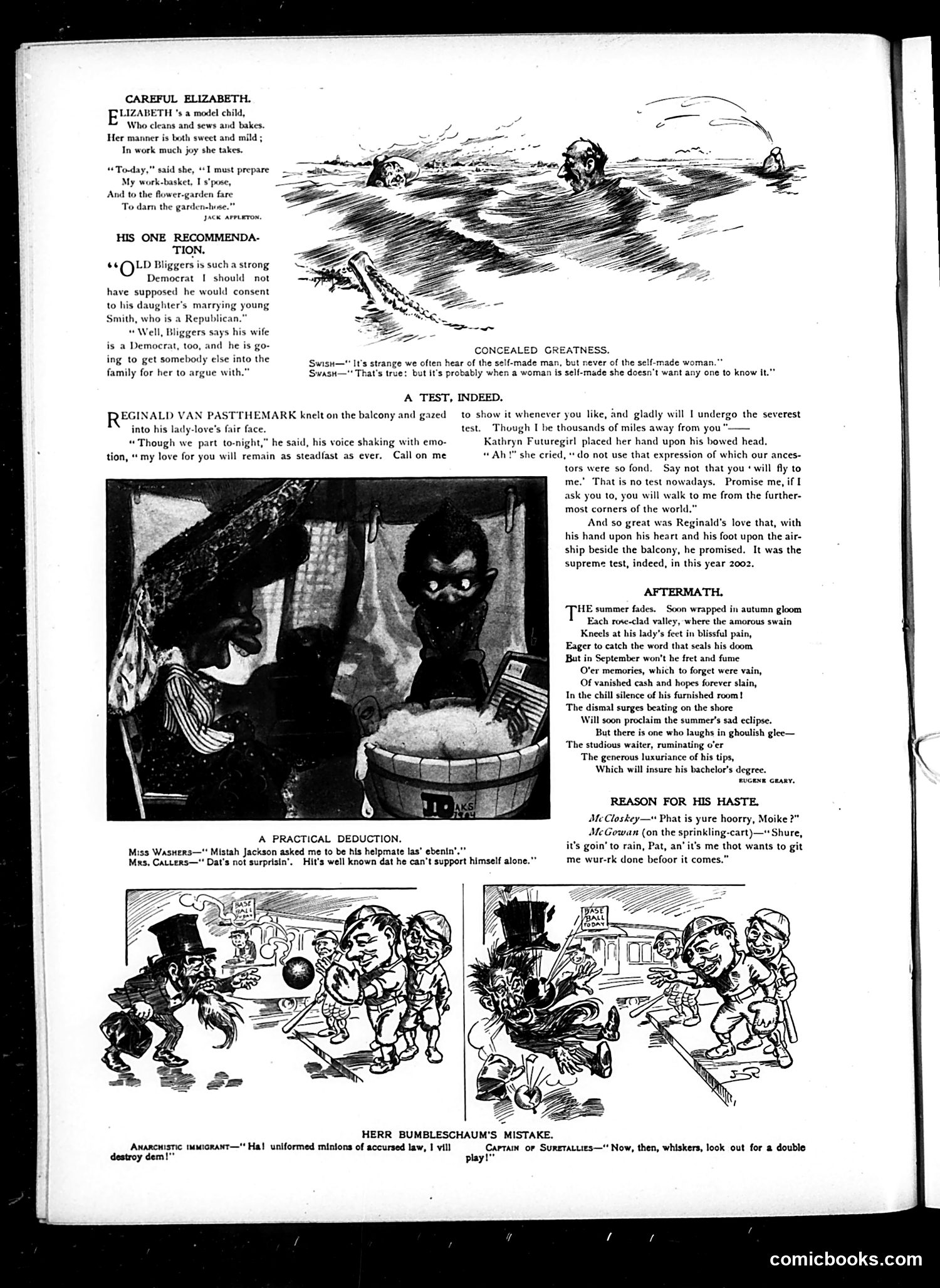
This page contains multiple satirical pieces reflecting early 1900s American social attitudes: **"His One Recommendation"** mocks political polarization—a Democrat father reluctantly accepts his daughter marrying a Republican solely because it brings another Democrat (the wife) into the household for marital arguments. **"A Test, Indeed"** is futuristic satire set in 2002. It ridicules romantic hyperbole: a suitor promises eternal love, but his lady demands a "modern" test—he must literally *walk* across the world to prove devotion, rather than use flowery language about "flying" to her. The joke: even in the imagined future with airships, women still extract maximum effort from romantic gestures. **"Concealed Greatness"** quips that self-made men are celebrated, but self-made women hide their accomplishments—suggesting women faced social pressure to appear naturally accomplished rather than self-created. The lower cartoons appear to be unrelated humor pieces about Irish immigrants and urban characters, using period dialect stereotypes common to Judge's humor style.
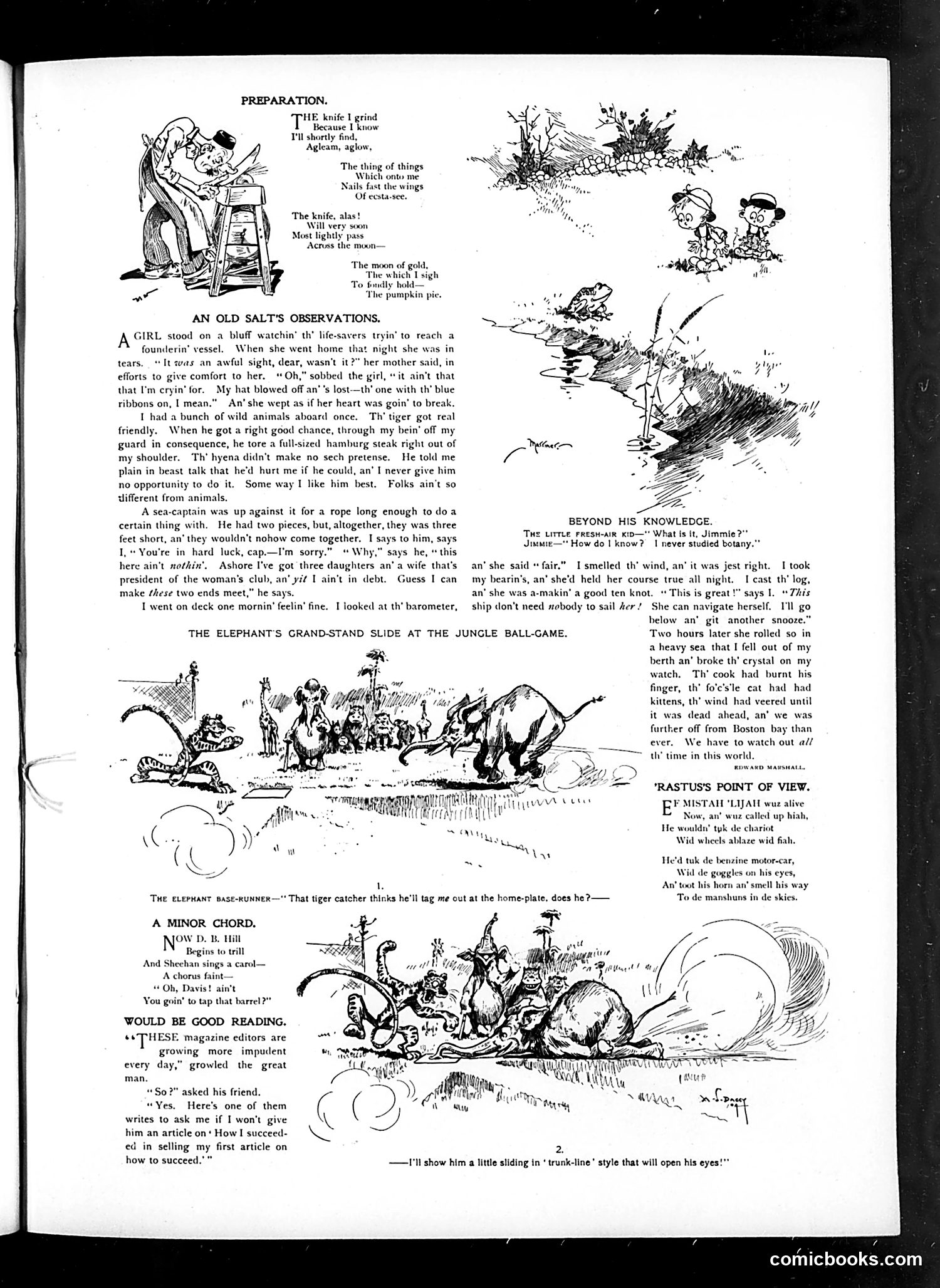
This page contains several unrelated humorous sketches typical of Judge's satirical format: **"Preparation"** is a light poem about sharpening a knife for cutting pumpkin pie, paired with whimsical illustrations. **"An Old Salt's Observations"** presents a sea captain telling anecdotes. The humor relies on exaggeration and unexpected twists—a girl mourning her lost hat during a shipwreck rescue, and a captain boasting that managing his wife and daughters is harder than any maritime challenge. These mock conventional sentimentality and male complaints about domesticity. **"Beyond His Knowledge"** depicts a young sailor who doesn't understand navigation, likely poking fun at inexperienced sailors. **"Rastus's Point of View"** uses dialect humor (African American vernacular) about how a deceased man would prefer modern motorcars to heavenly chariots—typical period satire mixing social commentary with racial stereotyping. **Minor sketches** about D.B. Hill (unclear reference), and magazine editors requesting self-help articles mock literary pretension. The cartoons use exaggeration and wordplay rather than topical political commentary.
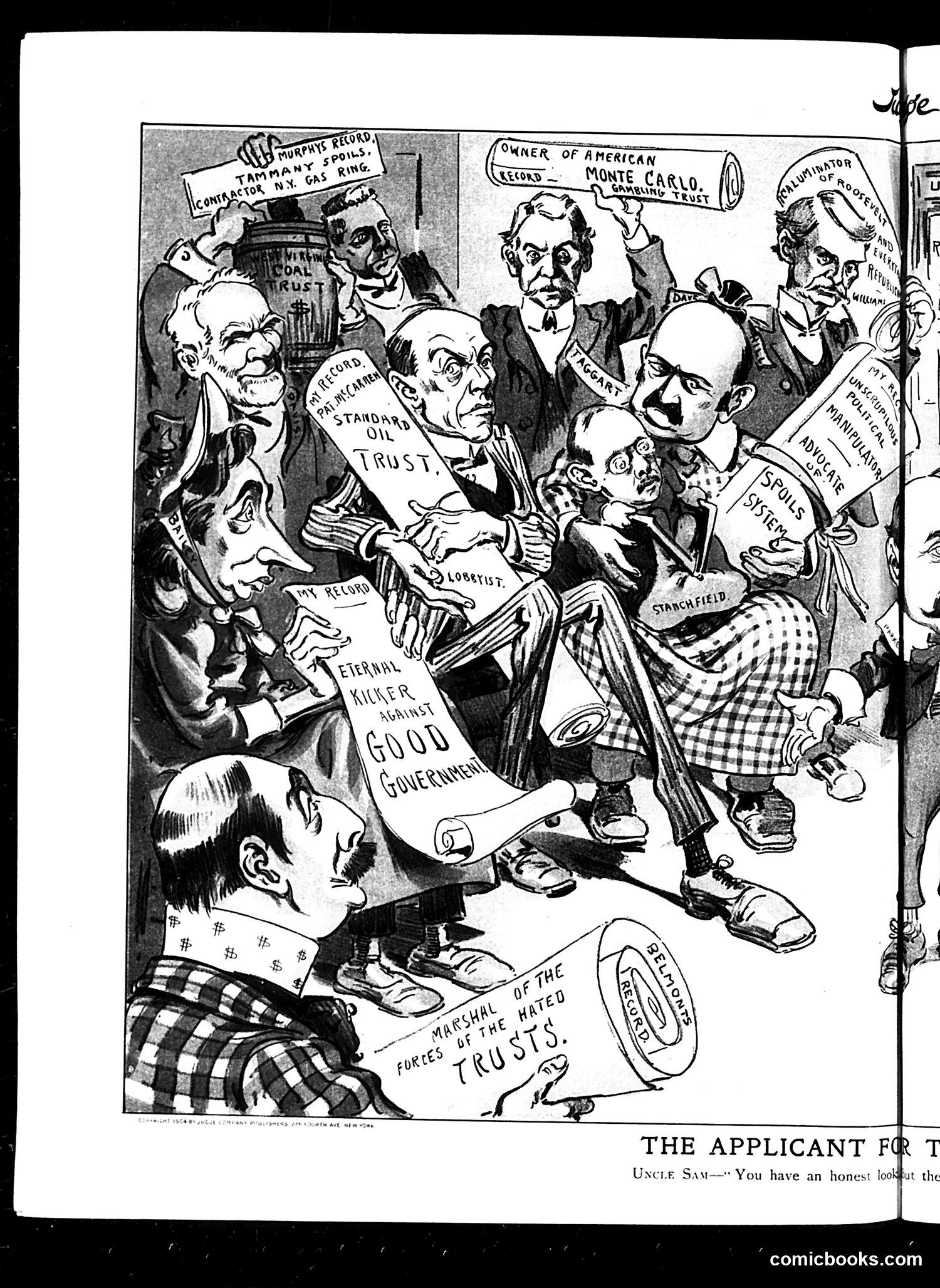
This Judge magazine cartoon satirizes corporate monopolies and trusts during the Progressive Era (early 1900s). Uncle Sam examines various figures labeled as trust owners and lobbyists—identifiable by records they hold for ventures like the gas ring, Standard Oil trust, and others. The cartoon critiques how these wealthy industrialists sought government positions or influence. The "applicant" appears to be seeking a role despite representing concentrated corporate power that the cartoon suggests corrupts good government. Labels reference specific industries (Monte Carlo gambling, oil, etc.), highlighting how monopolies infiltrated multiple sectors. The satire warns that entrenched corporate interests threaten democratic governance—a central Progressive-Era concern about whether business titans should hold public office.
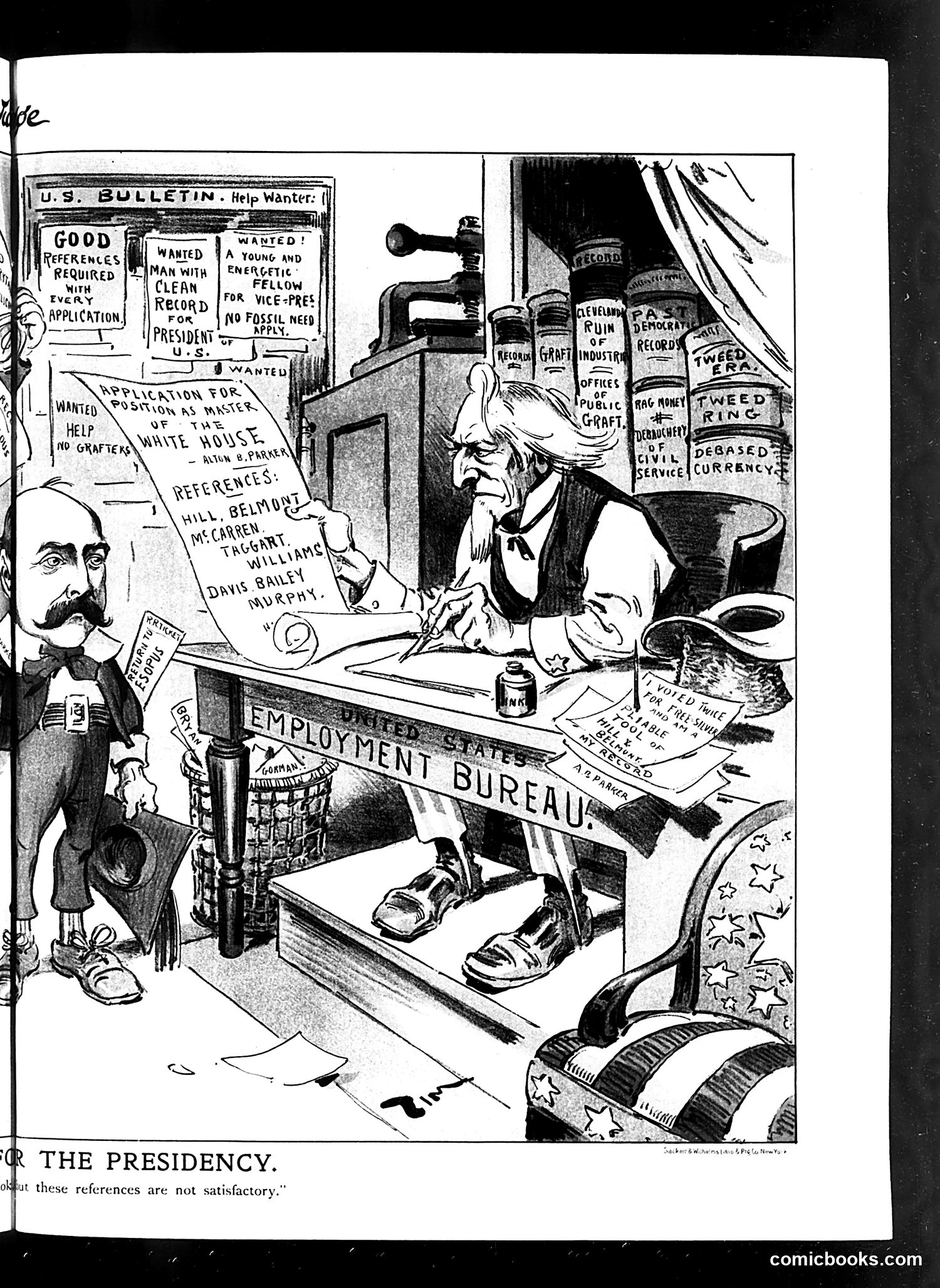
This Judge magazine cartoon satirizes the corruption and dysfunction of late 19th-century American government through a mock job-posting parody. On the left, a "U.S. Bulletin: Help Wanted" advertises positions for President and Vice President, requiring "good references" but listing absurd qualifications like "no fossil need apply." The figure at the desk—appearing to be a government official or hiring manager—sits surrounded by labeled bottles and files referencing scandals: "Record of Industry," "Ruin of Offices," "Civil Service," "Debased Currency," and "Tweed Era" (likely referencing Boss Tweed's Tammany Hall corruption). The cartoon mocks how government positions, particularly the presidency, had become corrupted by patronage, graft, and incompetence. The "references" joke suggests that qualified candidates were scarce because the system itself was rotten. The accumulated scandals and corrupt practices are literally stacked around the office, suggesting institutional decay rather than individual failings.
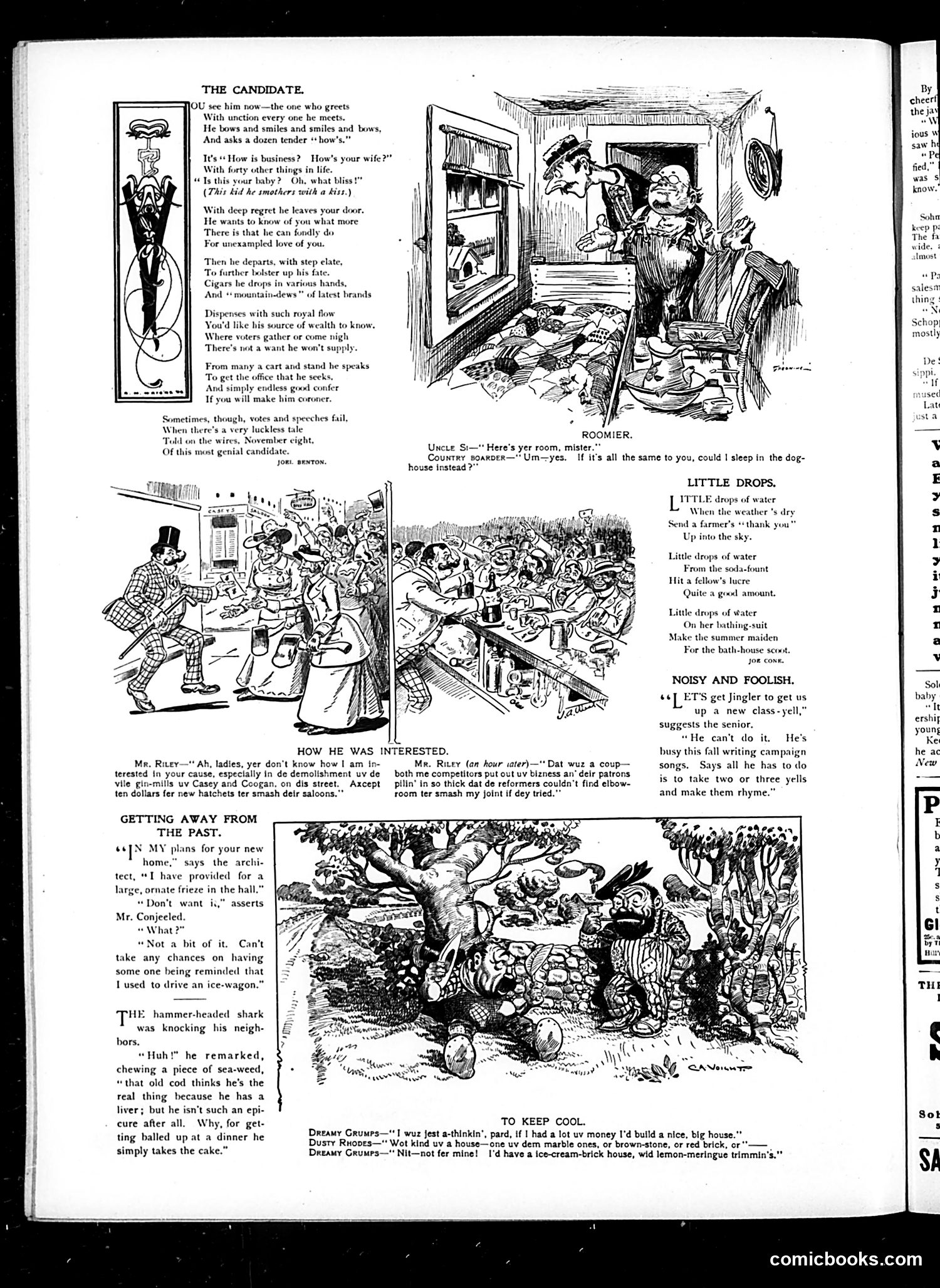
This page contains several satirical pieces mocking American political and social behavior: **"The Candidate"** depicts a politician shamelessly courting voters through exaggerated friendliness, false concern, and bribery (dispensing "mountain-dews"—likely whiskey). The satire targets the phoniness of electoral campaigns. **"How He Was Interested"** shows "Mr. Riley" claiming moral reform interest in closing saloons while simultaneously admitting he sabotaged competitors' businesses. It mocks self-righteous reformers whose actual motives are profit and self-interest. **"Getting Away from the Past"** satirizes social climbing: a nouveau riche man won't display classical ornamentation because it might remind people he once drove an ice wagon—he's embarrassed by his working-class origins. The remaining items are lighter humor about everyday topics (weather, romance, college pranks, working-class aspirations). Overall, the page reflects late-19th/early-20th century concerns about political corruption, hypocrisy in reform movements, and class anxiety in American society.
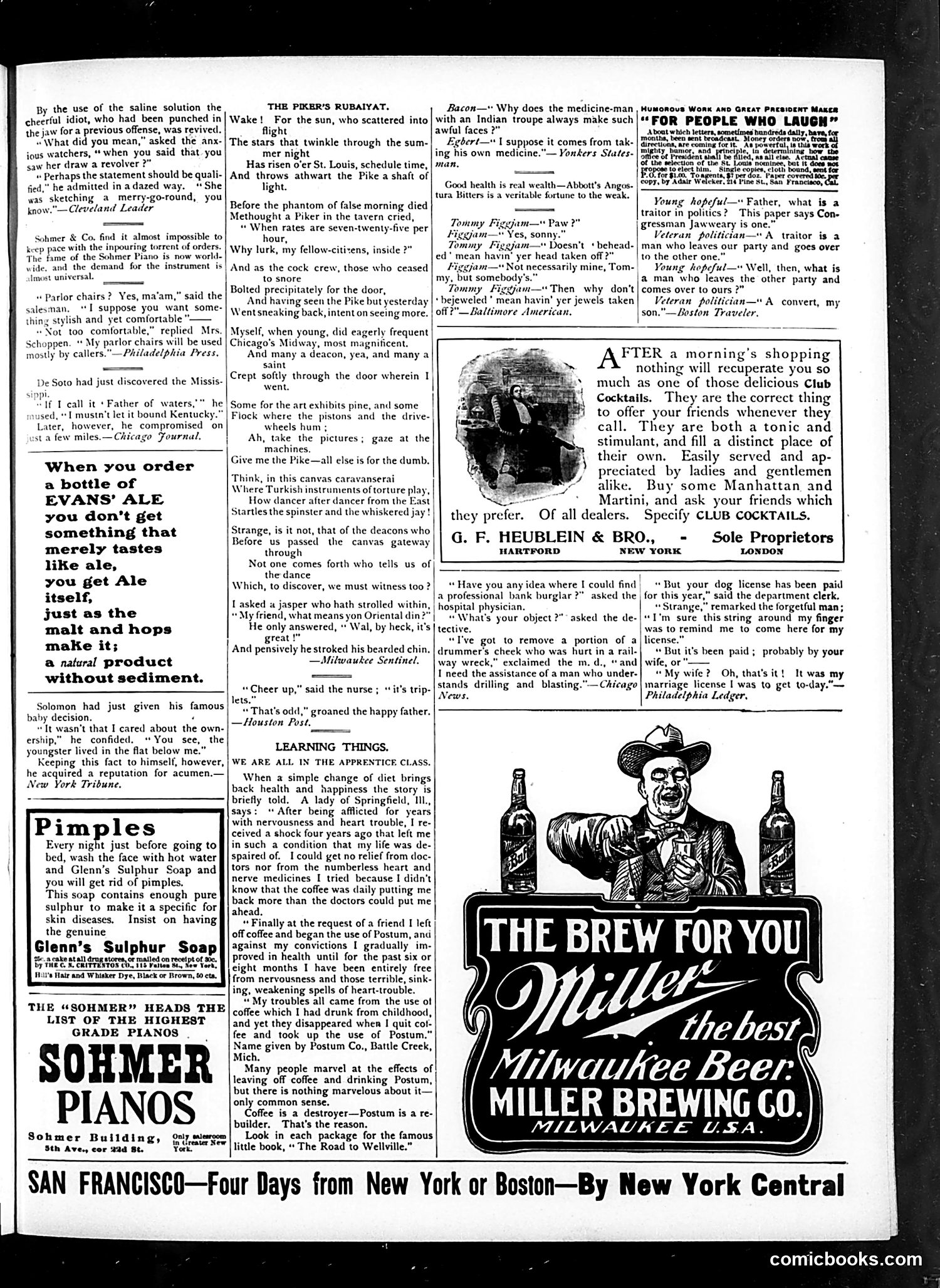
This page mixes short satirical jokes with advertisements, typical of Judge magazine's format. The humor includes crude anecdotes: a man punched in the jaw claiming to have seen a revolver (actually sketching a merry-go-round); a woman wanting parlor chairs specifically *uncomfortable* for callers; De Soto's discovery of the Mississippi. A notable longer piece is "The Piker's Rubaiyat," a satirical parody of Omar Khayyam's famous poem applied to visitors at the 1904 St. Louis World's Fair ("the Pike"), mocking both the fair's attractions and tourists' superficial engagement with them. The page also advertises pianos, soap, ale, and beer—typical products for the era. The overall tone reflects Judge's satirical approach to American life and consumer culture in the early 20th century.
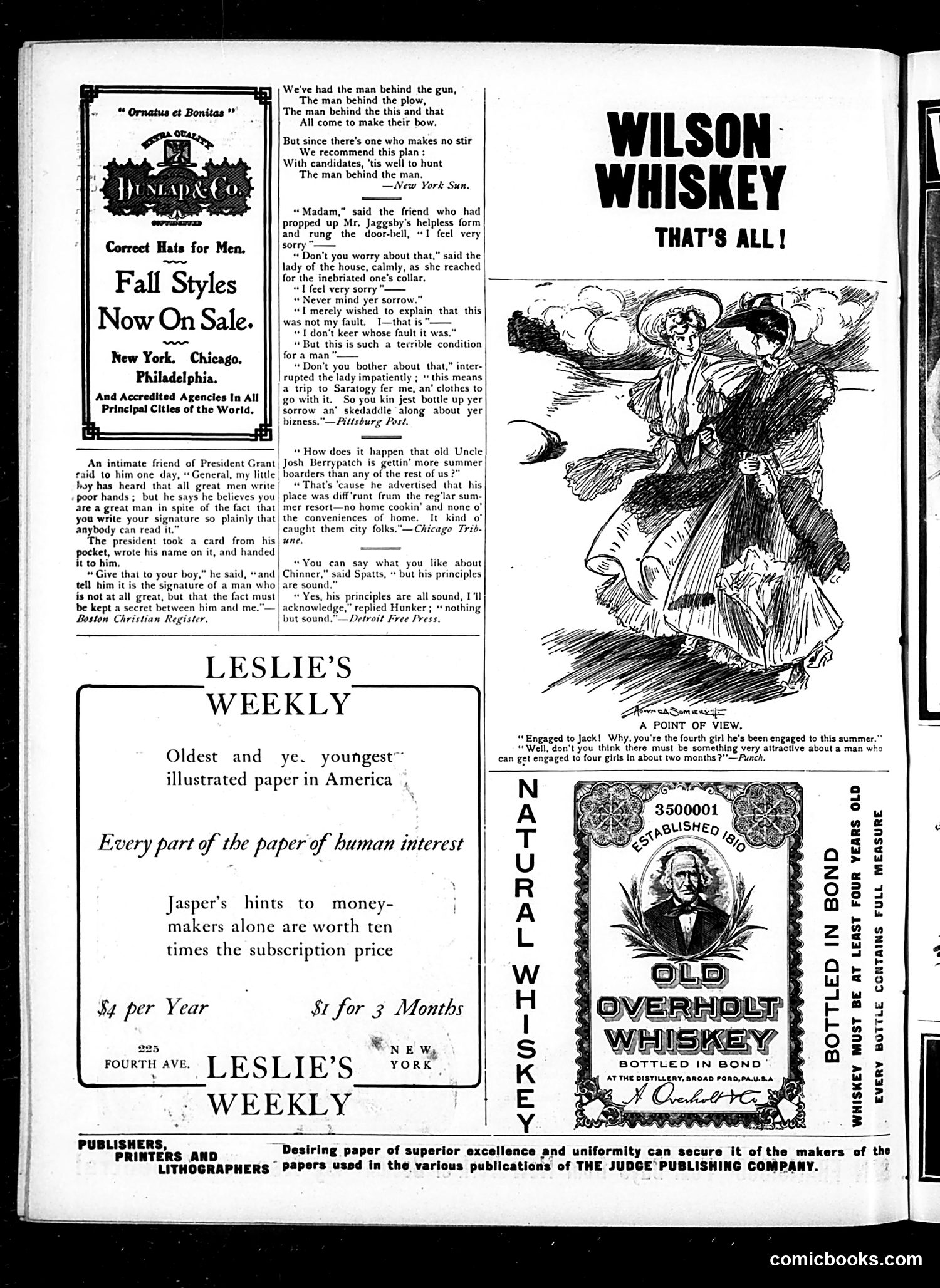
This page contains several distinct elements: **Main Cartoon**: A sketch shows a disheveled drunk man being supported by a woman at her doorstep. The accompanying anecdote reveals the satire: the woman isn't concerned about his condition—she's delighted because his arrival means her husband will take a trip to Saratoga (a resort town) and buy her new clothes as compensation. The joke satirizes marriages where wives exploit their husbands' embarrassing situations for personal gain. **Additional Humor Pieces**: Several short jokes mock rural characters and social pretense, including one about a farmer advertising "no home cooking" to attract city boarders, and another where a woman defends her fiancé's multiple engagements as proof of his attractiveness. **Advertisements**: The page includes ads for men's hats, Leslie's Weekly magazine, and Old Overholt whiskey—typical period advertising. The overall tone reflects Judge's satirical approach to marriage dynamics, social climbing, and rural-urban cultural differences common in early 20th-century American humor.
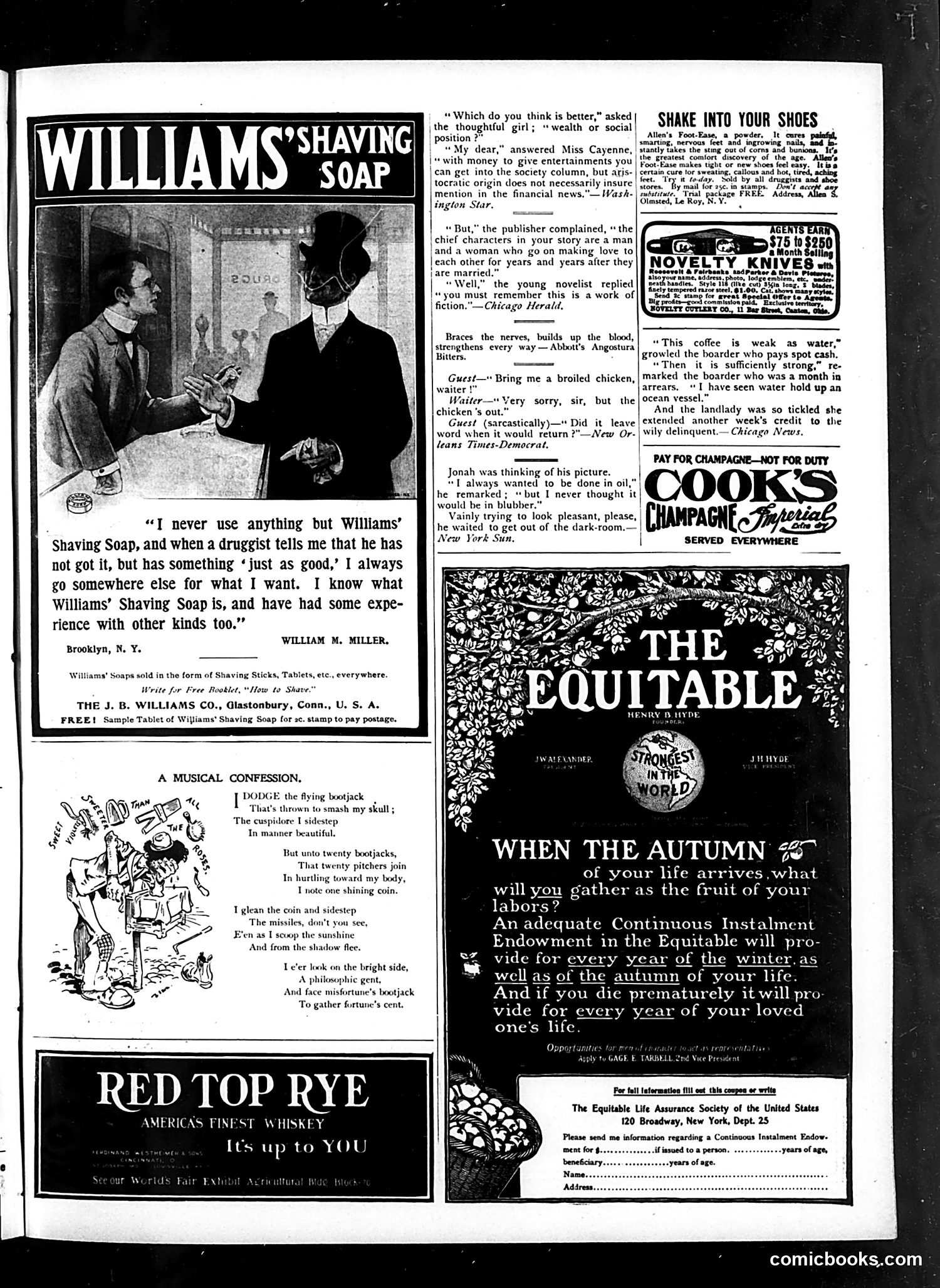
This page is primarily **advertising** with several brief humorous anecdotes interspersed. The main cartoon depicts two well-dressed men in conversation, illustrating a dialogue about writing fiction—likely satirizing the tension between literary realism and commercial success. The joke concerns whether romantic storylines should depict couples remaining in love after marriage, with the novelist defending such "fiction" as acceptable in literature. Other content includes: - Multiple product advertisements (Williams' Shaving Soap, Red Top Rye whiskey, novelty knives, Cook's Champagne, The Equitable Life Assurance) - Brief comedic anecdotes about restaurant service, boarding house life, and a painter's ambitions - A poem titled "A Musical Confession" about dodging violent objects in what appears to be a boarding house or tenement setting The page reflects early 20th-century concerns: social class aspirations, urban boarding house life, and commercial marketing through celebrity testimonials. The humor is largely situational rather than politically pointed.
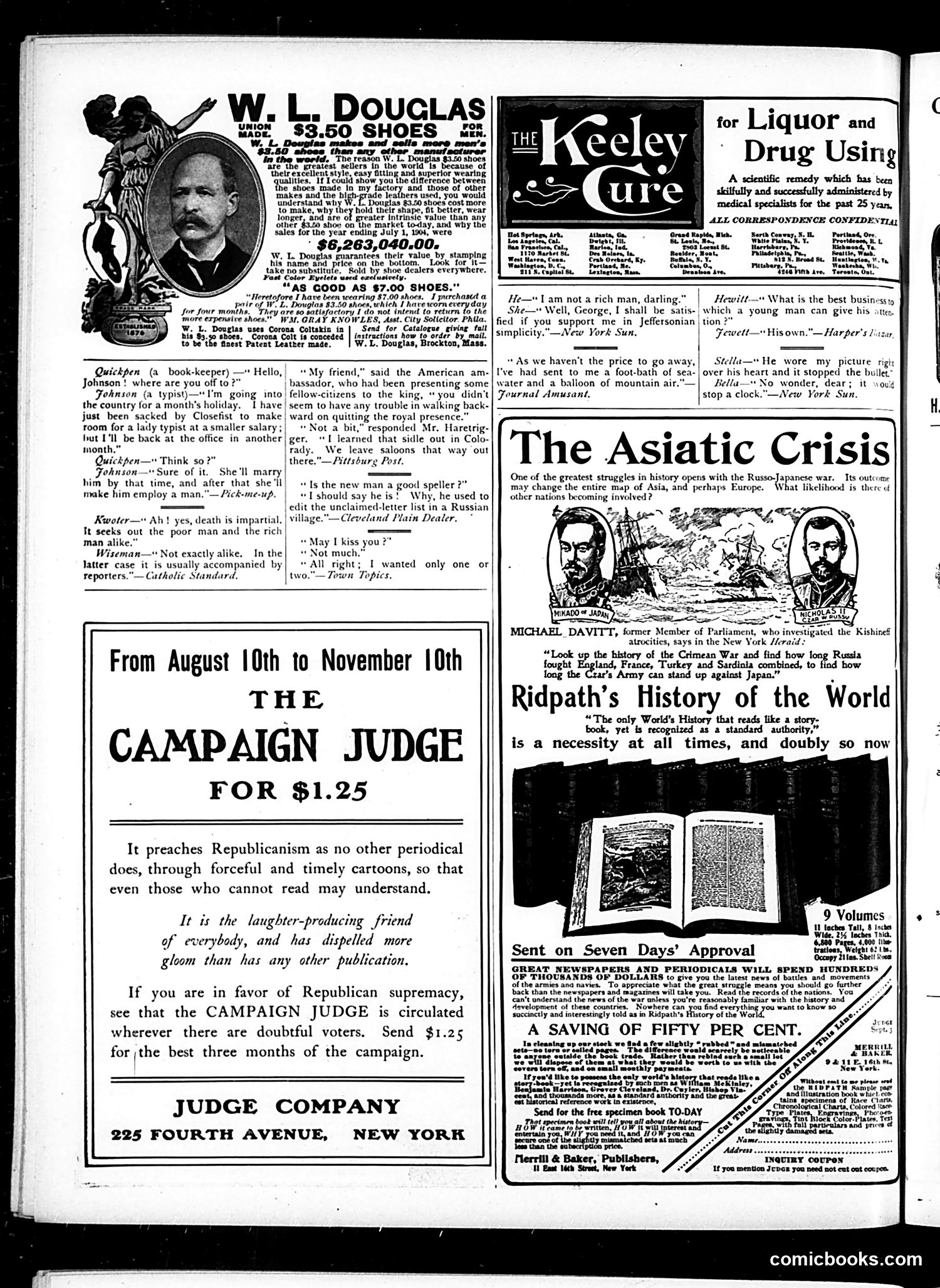
This page from Judge magazine (circa 1904) is primarily **advertising**, with several short humorous anecdotes interspersed. The main content includes: **W.L. Douglas Shoes advertisement**: A prominent shoe company ad featuring the founder's portrait, claiming superiority of their $3.50 shoes over competitors' higher-priced models. **Political advertisement**: "Campaign Judge for $1.25" promotes a Republican publication using cartoon satire to advocate for "Republican supremacy" during an election cycle. **Short comic dialogues** featuring workplace and social humor typical of the era—office workers, royal etiquette, and romantic banter. **Other advertisements**: Including "The Keeley Cure" (a treatment for alcohol/drug addiction) and Ridpath's History of the World. The page reflects early 1900s American consumer culture and Republican political messaging. The "Keeley Cure" ad is particularly notable as evidence of period attitudes toward substance abuse treatment. Most content is conventional period advertising with light comedic filler rather than sharp political satire.
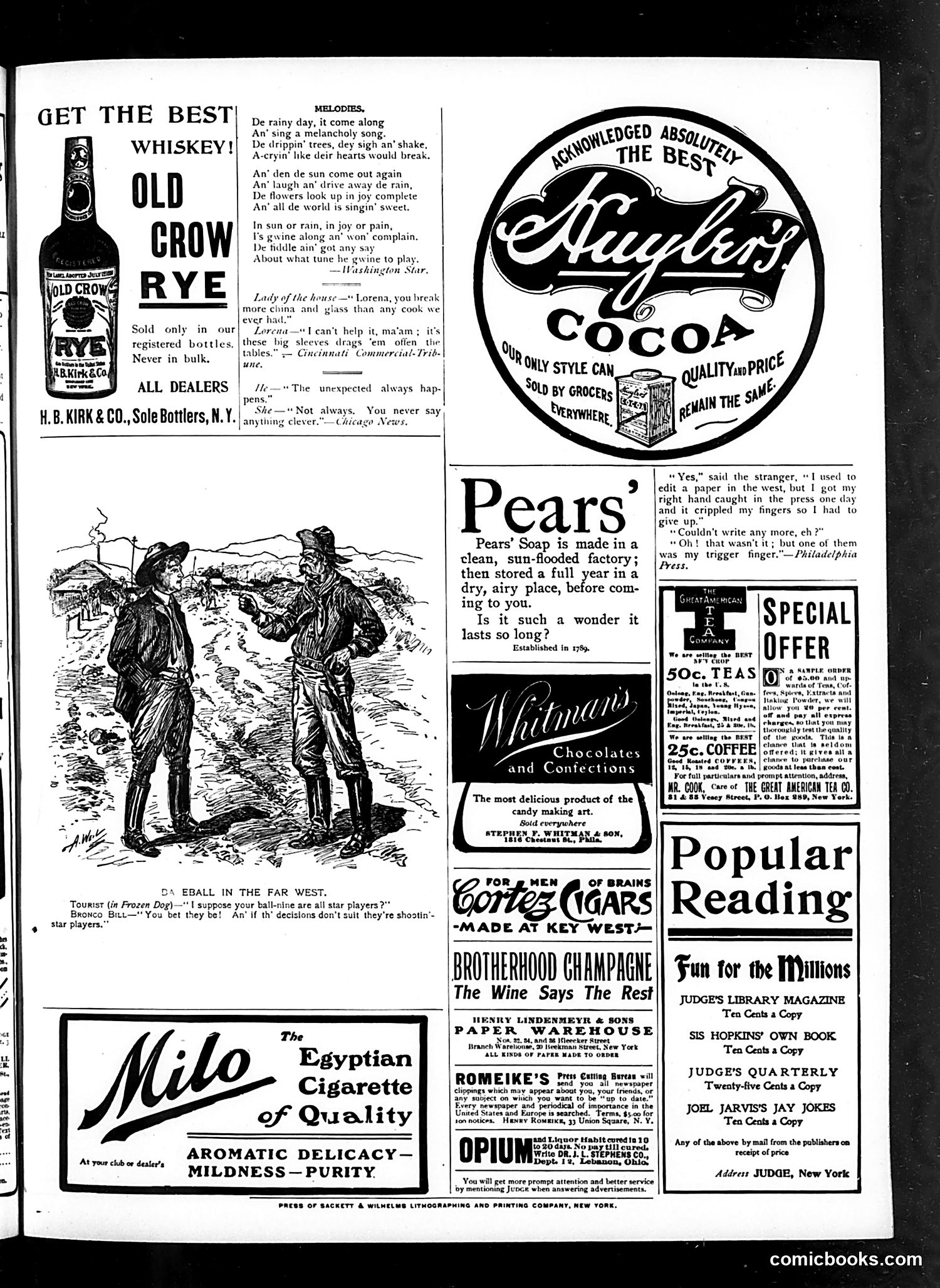
This is primarily an **advertising page** from Judge magazine, with one cartoon joke. **The cartoon** ("Baseball in the Far West") depicts a humorous exchange between a tourist and "Bronco Bill" about a baseball team. The joke plays on frontier violence: when Bill boasts his players are "star players," the tourist assumes disagreements about game decisions are settled by shooting rather than argument. It's a satirical jab at the American West's reputation for lawlessness and gun violence, contrasting civilized Eastern sports culture with rougher frontier customs. **The advertisements** reflect early 20th-century consumer products: whiskey, cocoa, soap, cigars, champagne, chocolates, and tea—typical luxury goods marketed in a satirical magazine aimed at educated, affluent readers. One ad includes a racist joke (the "crippled finger" anecdote) that reflects the casual bigotry of the era, now jarring to modern readers. The page serves primarily as a revenue source through advertising rather than editorial content.
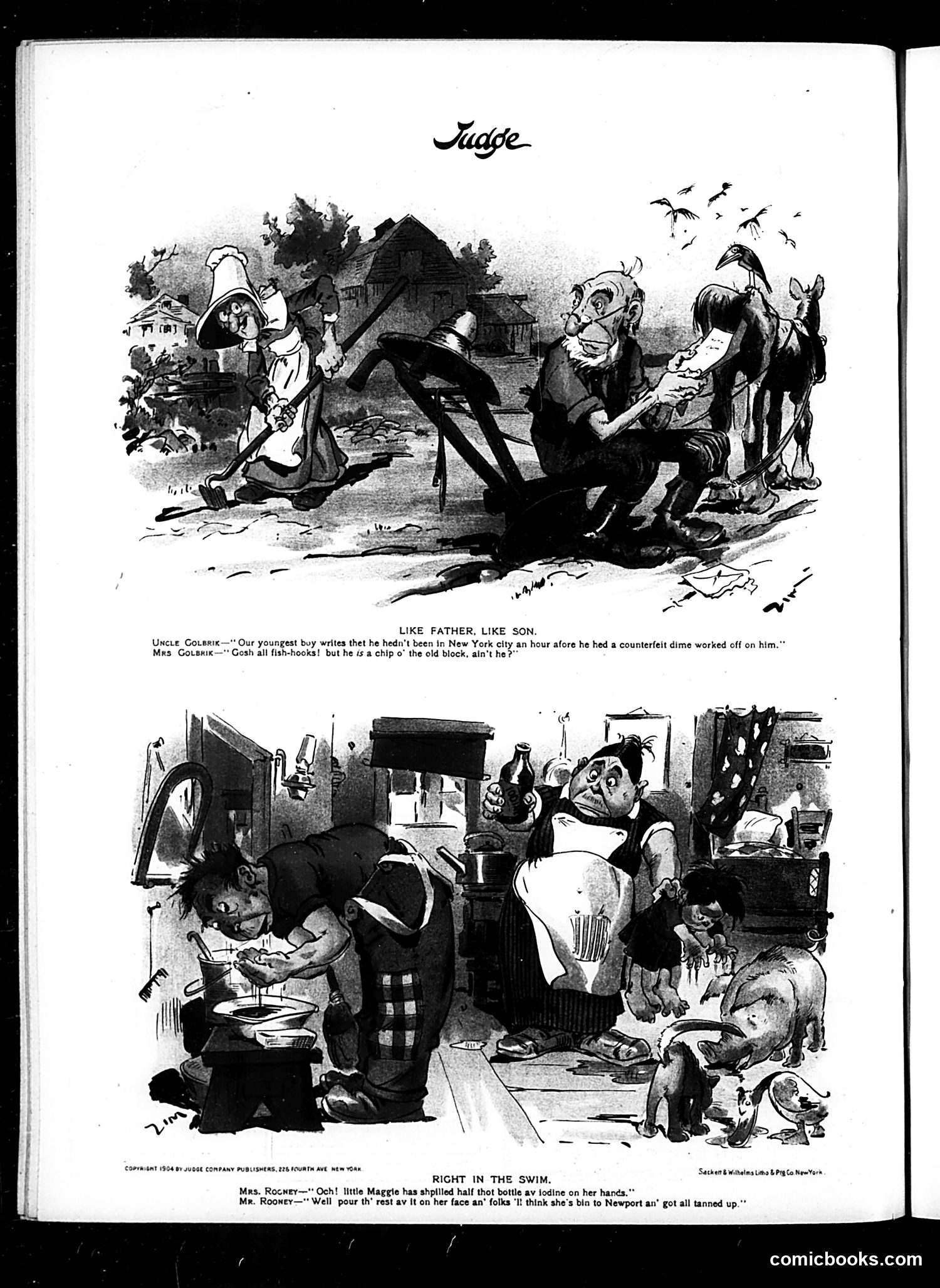
This 1904 satirical page contains two separate jokes targeting working-class Irish immigrants: **"Like Father, Like Son"** (top): Uncle and Mrs. Gorerik discuss their youngest son being swindled with counterfeit money within an hour of arriving in New York City. The joke's punchline—"chip o' the old block"—suggests the father has a history of similar criminal schemes, mocking Irish immigrants as dishonest. **"Right in the Swim"** (bottom): Mr. and Mrs. Rooney discuss their daughter Maggie spilling iodine on her hands. His solution: pour the rest on her face to fake a fashionable Newport tan (Newport being an exclusive wealthy resort). The joke satirizes working-class pretension and aspiration to wealthy appearance. Both cartoons use heavy Irish dialect and stereotypical names to mock Irish-American immigrants as crude, dishonest, and foolishly status-conscious. The illustrations exaggerate facial features in period-typical caricature style.