
A complete issue · 16 pages · 1904
Judge — July 30, 1904
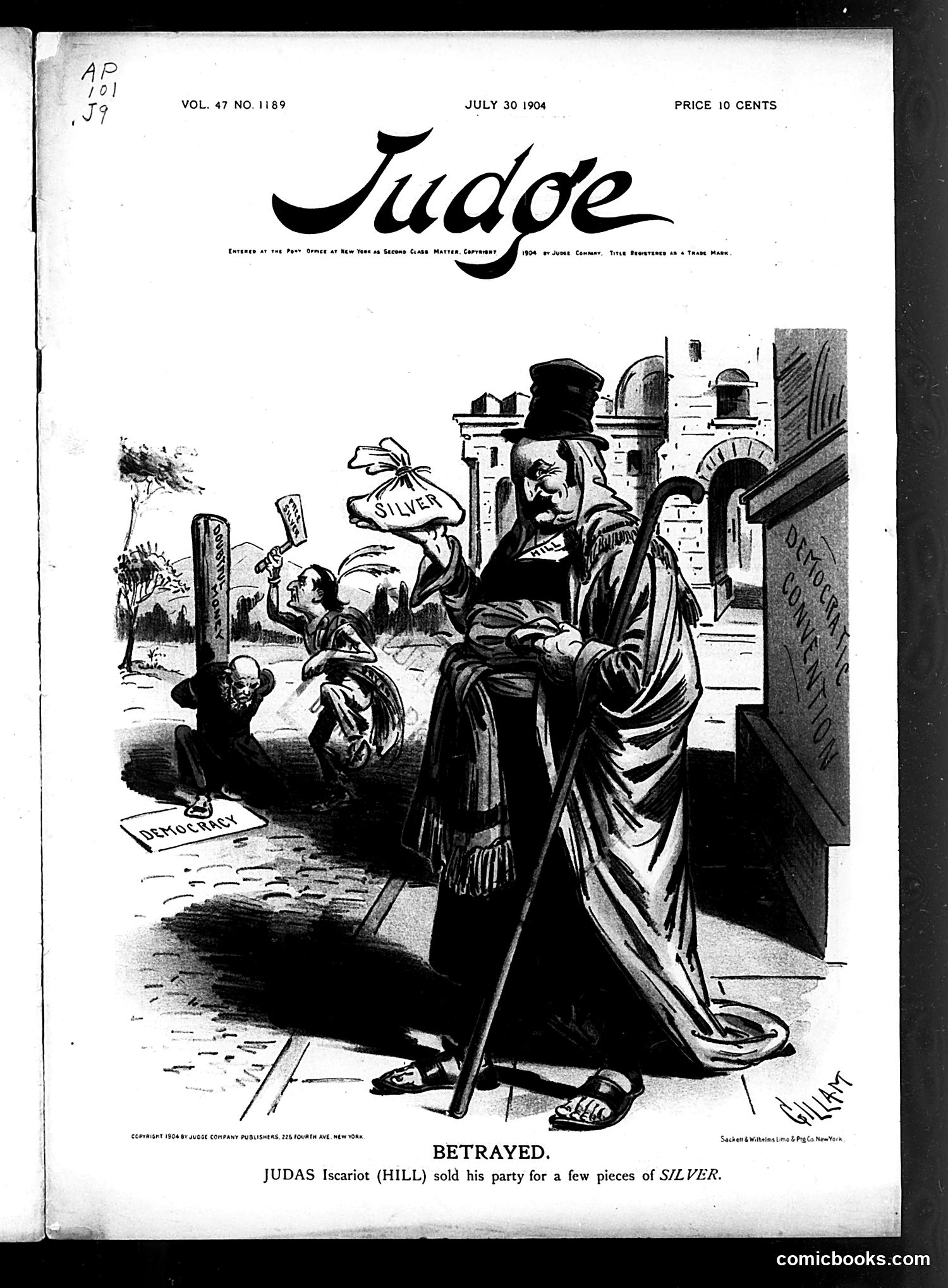
This cartoon employs biblical allegory to criticize a political figure identified as "Judas Iscariot (HILL)"—likely referring to a politician who betrayed his party or allies for financial gain, represented by the bag of silver. The composition mirrors the betrayal of Jesus by Judas for thirty pieces of silver, a loaded historical parallel suggesting profound treachery. The architectural setting and formal dress suggest high-stakes political dealings. The figure labeled "DEPENDENCY" appears ground-level, suggesting those dependent on the politician suffered from this betrayal. Judge magazine used such biblical references to convey moral condemnation of political corruption and disloyalty among the era's public figures.
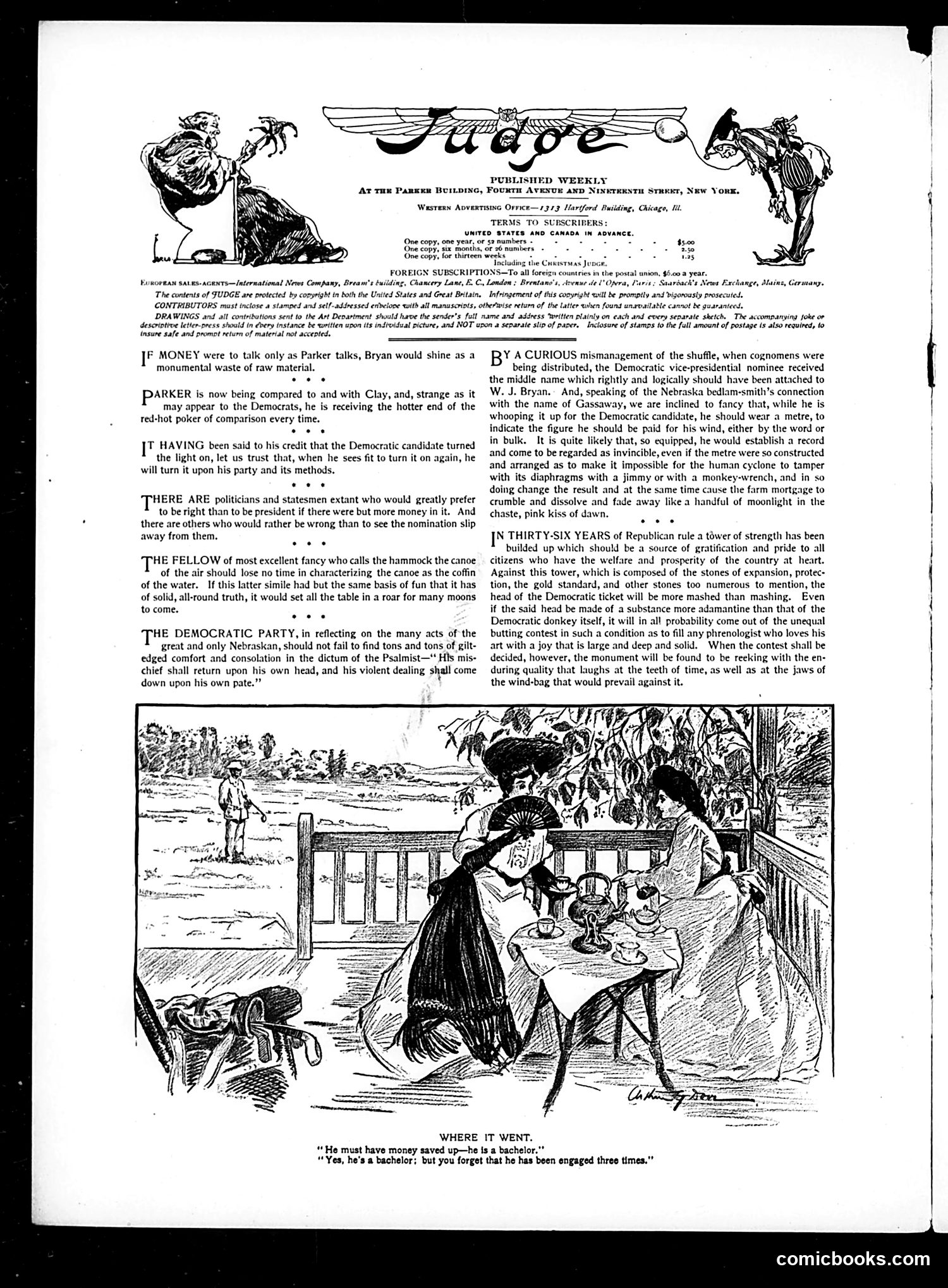
This page contains political commentary on the 1896 presidential election. The text critiques Parker (the Democratic candidate) and the Democratic Party's selection strategy, comparing Parker unfavorably to Clay while suggesting Bryan (the Nebraska candidate) would be preferable. The bottom illustration, titled "WHERE IT WENT," depicts a domestic scene with a caption about a bachelor who has been engaged three times. This appears to be social satire about marriage and a man's financial irresponsibility or commitment issues, unrelated to the political content above. The page's primary focus is mocking the Democratic Party's nomination process and their choice of candidate, suggesting internal party dysfunction and poor judgment in leadership selection.
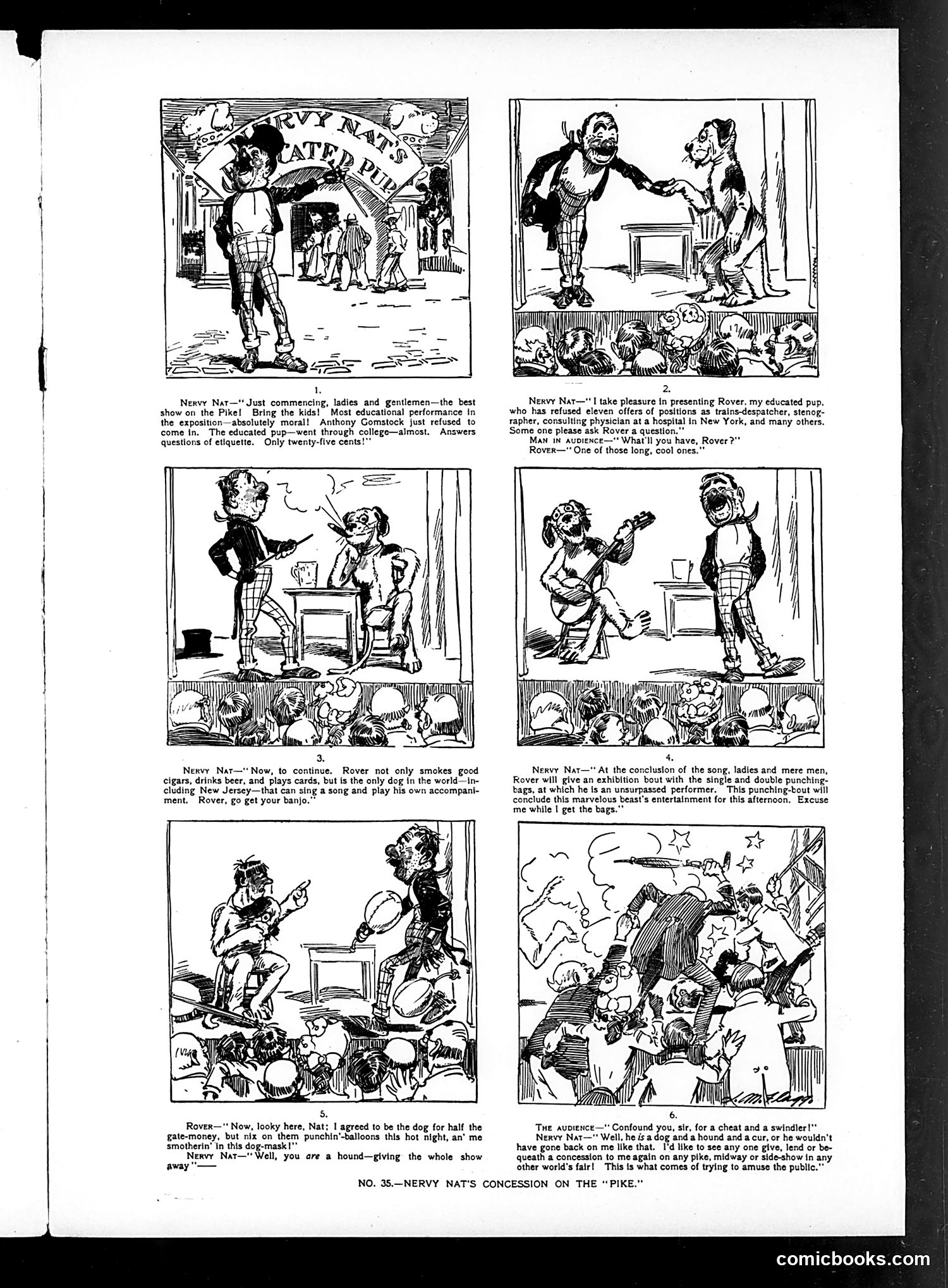
This comic strip satirizes a street performer's pitch for a traveling exposition (likely a circus or carnival "Pike"). The character "Nervy Nat" runs a concession featuring an educated dog named "Rover" who performs tricks—singing, playing banjo, and boxing with an audience member. The satire targets the exaggerated claims and dubious entertainment value of carnival attractions. Nat repeatedly boasts about Rover's abilities while the audience remains skeptical. The humor lies in the gap between the hype ("educated pup," "unmatched performer") and the modest reality of a dog's actual capabilities. This reflects early-20th-century American skepticism toward carnival hucksterism and inflated promotional claims—a recurring Judge theme mocking public gullibility.
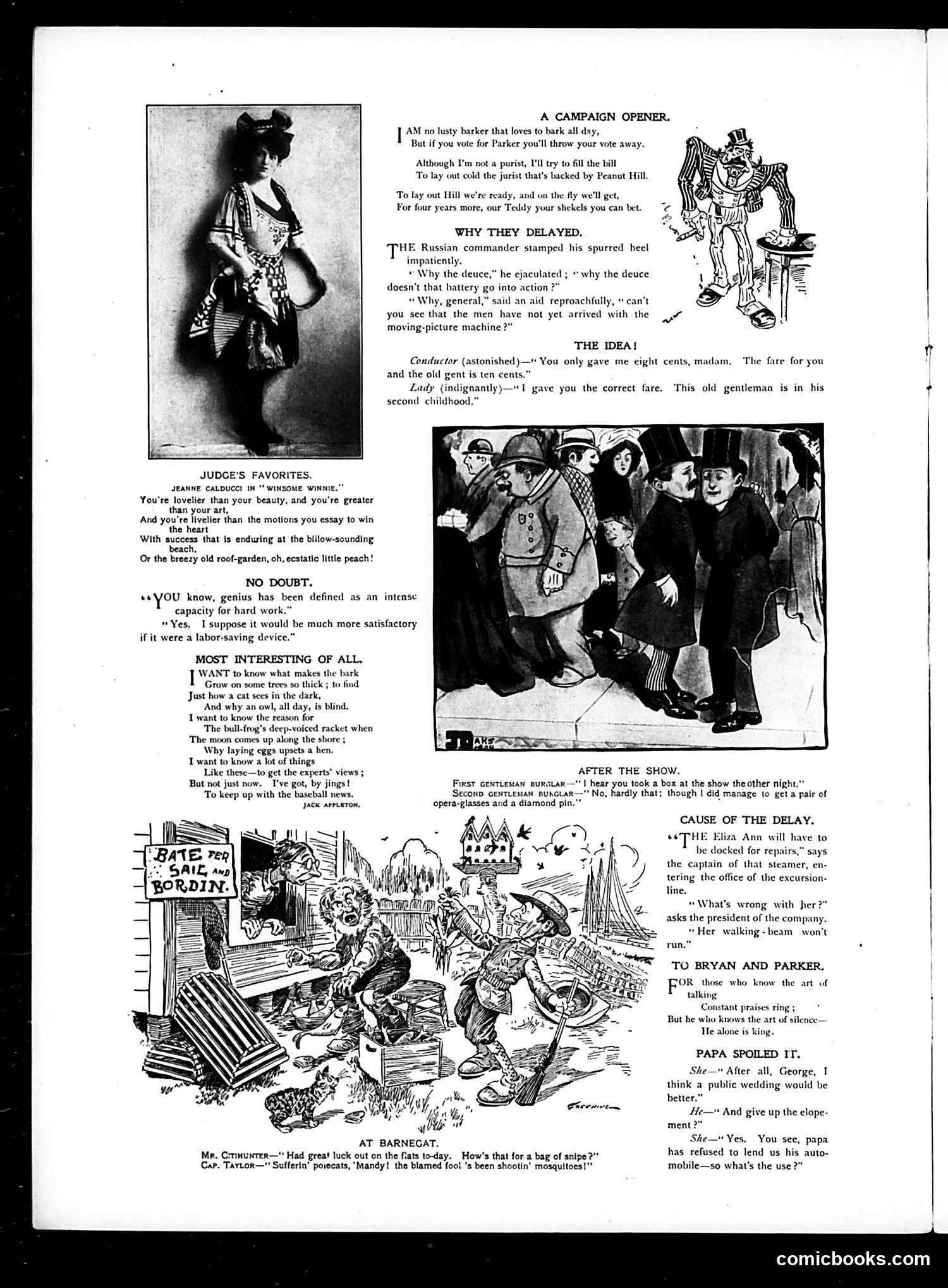
This page satirizes the 1912 presidential election, with references to candidates Parker and Bryan. "A Campaign Opener" mocks voters choosing Parker, suggesting they'll "throw your vote away." The section "To Bryan and Parker" contrasts silence with talking in politics. The central cartoon "At Barnegat" depicts working-class men at a fair or carnival, with dialogue about bad luck and blamed "mosquitoes"—likely satirizing how politicians blame external factors rather than addressing real problems. Other sections mock various political figures and social behaviors of the era. The page uses humor to critique campaign rhetoric and political evasion. Without clearer identification of specific individuals in the images, the exact targets remain somewhat unclear, though the general thrust targets political dishonesty and voter gullibility.
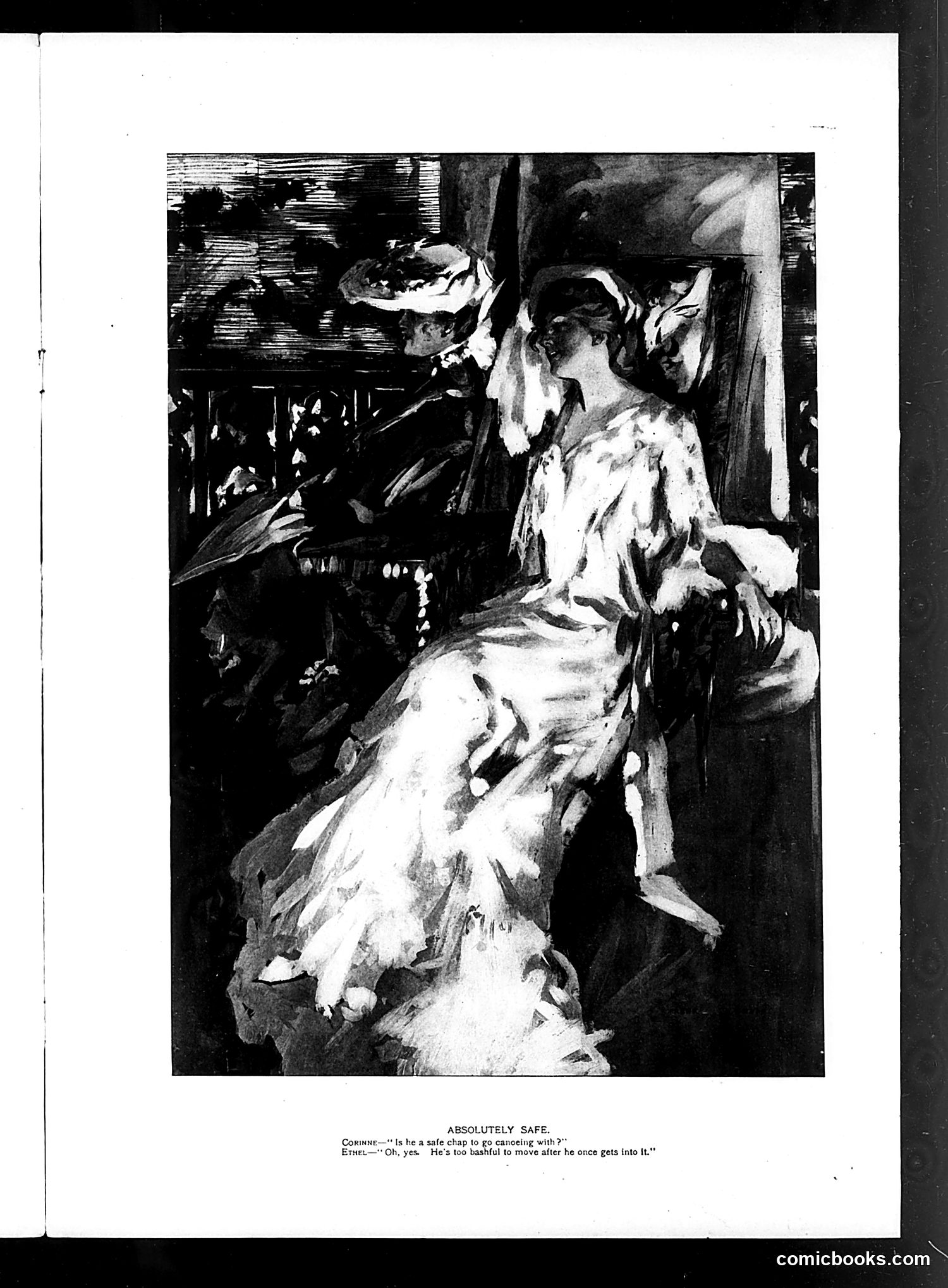
This cartoon satirizes Victorian-era social anxieties about unmarried couples and propriety. Two women discuss whether a man is "safe" for canoeing—a popular leisure activity that raised concerns about unsupervised male-female interaction. The joke plays on "safe" in two ways: Ethel reassures Corinne that the man won't behave improperly because he's too bashful and inhibited to move once seated in the canoe. This mocks both the extreme bashfulness expected of "respectable" men and the exaggerated propriety concerns of the period, where even innocent activities required character guarantees. The cartoon ridicules how social conventions constrained behavior so severely that complete paralysis by shyness was apparently considered a virtue and safety measure for dating.
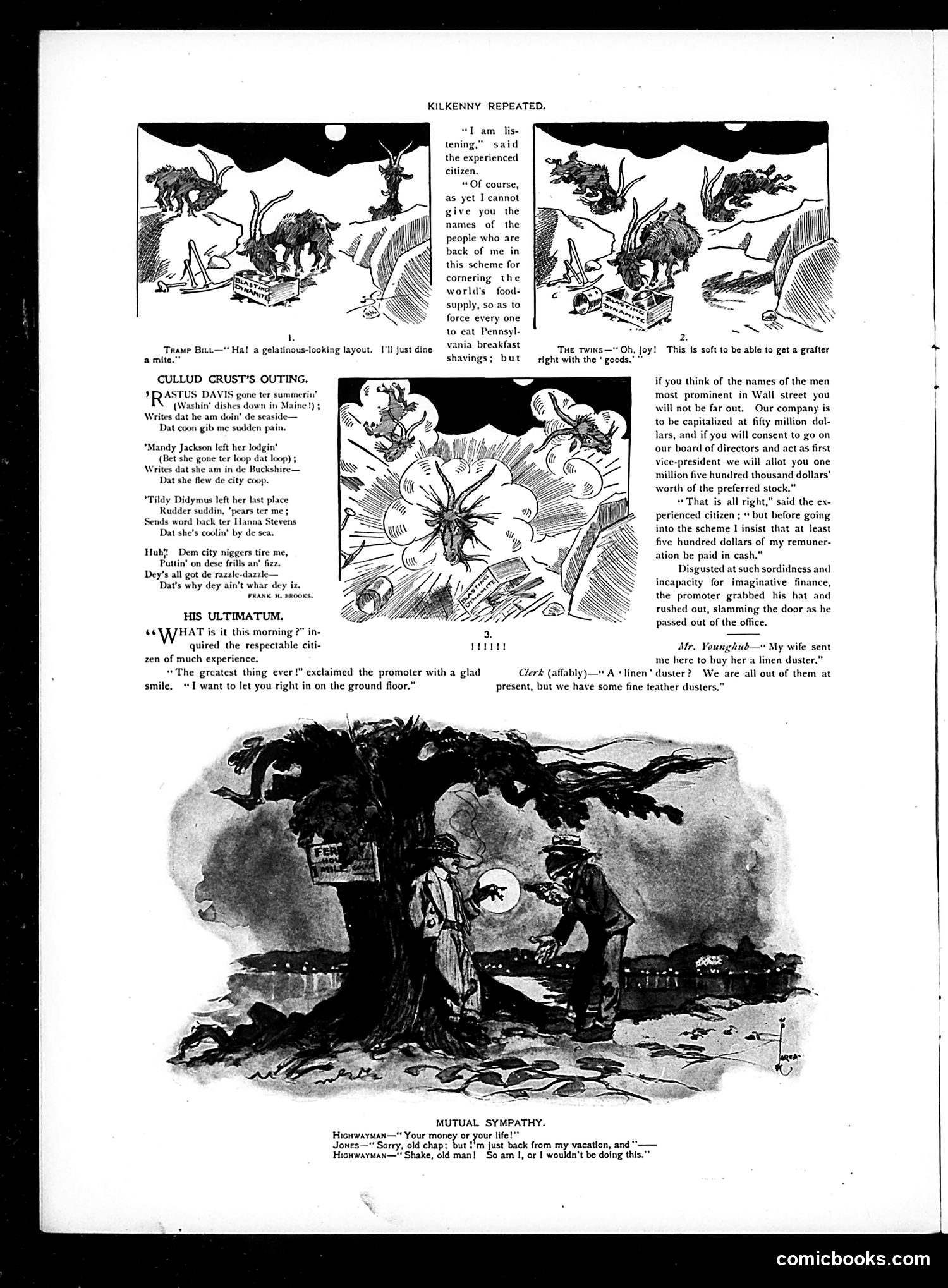
This page contains three distinct satirical pieces mocking early 1900s American schemes and social types: **"His Ultimatum"** ridicules stock market fraud. A shady "promoter" pitches a food-monopoly scheme to corner Pennsylvania's breakfast market, offering board positions and inflated stock to prominent Wall Street figures. The joke: when asked to guarantee even $500 in actual cash payment, the promoter furiously leaves—exposing the scam's worthlessness. The satire targets speculative finance where promised riches exist only on paper. **"Cullud Crust's Outing"** uses offensive racial dialect to mock Black domestic workers abandoning their jobs, attributed to city glamour and "razzle-dazzle." **"Mutual Sympathy"** is a brief joke: a highwayman robs a man just returned from vacation, who jokes he has no money—establishing comic "mutual sympathy" between criminal and victim both broke. The page satirizes financial corruption, labor instability, and petty crime as fixtures of contemporary urban life.
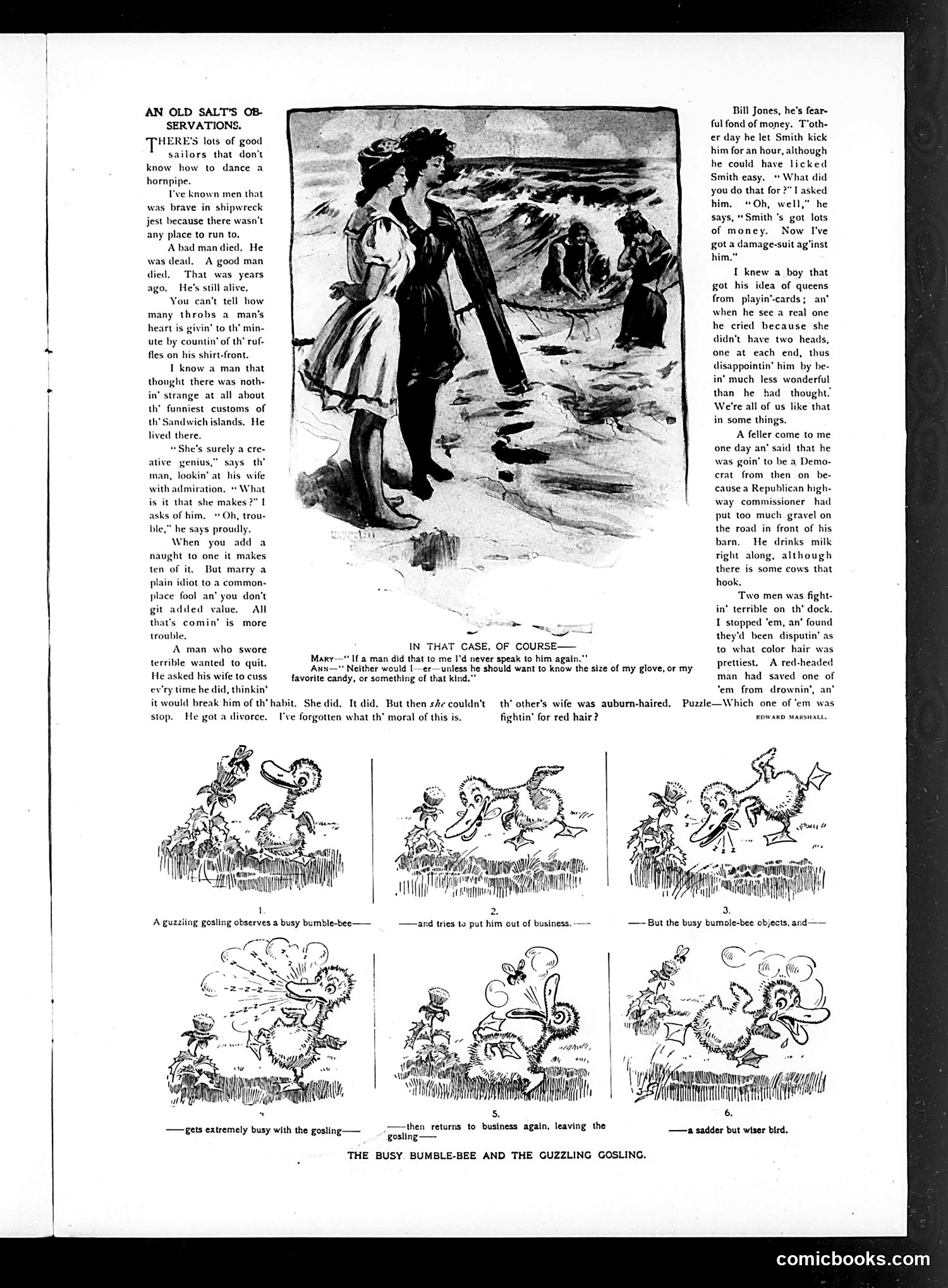
This page contains two distinct sections: **"An Old Salt's Observations"** (top): A collage of folksy anecdotes from an unnamed sailor character, touching on human nature, hypocrisy, and absurdity. Examples include a man switching political allegiances over road gravel, and two men fighting over the hair color of a woman one had saved—satirizing how trivial grievances motivate people. The humor targets general human irrationality rather than specific political figures. **"The Busy Bumble-Bee and the Guzzling Gosling"** (bottom): A six-panel comic strip showing a gosling (young goose) attempting to remove a busy bee from flowers, failing repeatedly, and eventually learning to coexist with it. This appears to be a moral fable about acceptance and persistence, though the specific allegorical meaning is unclear from the image alone. Neither section references identifiable public figures or datable events. The satire is broadly social rather than topical, typical of *Judge* magazine's general-interest humor approach.
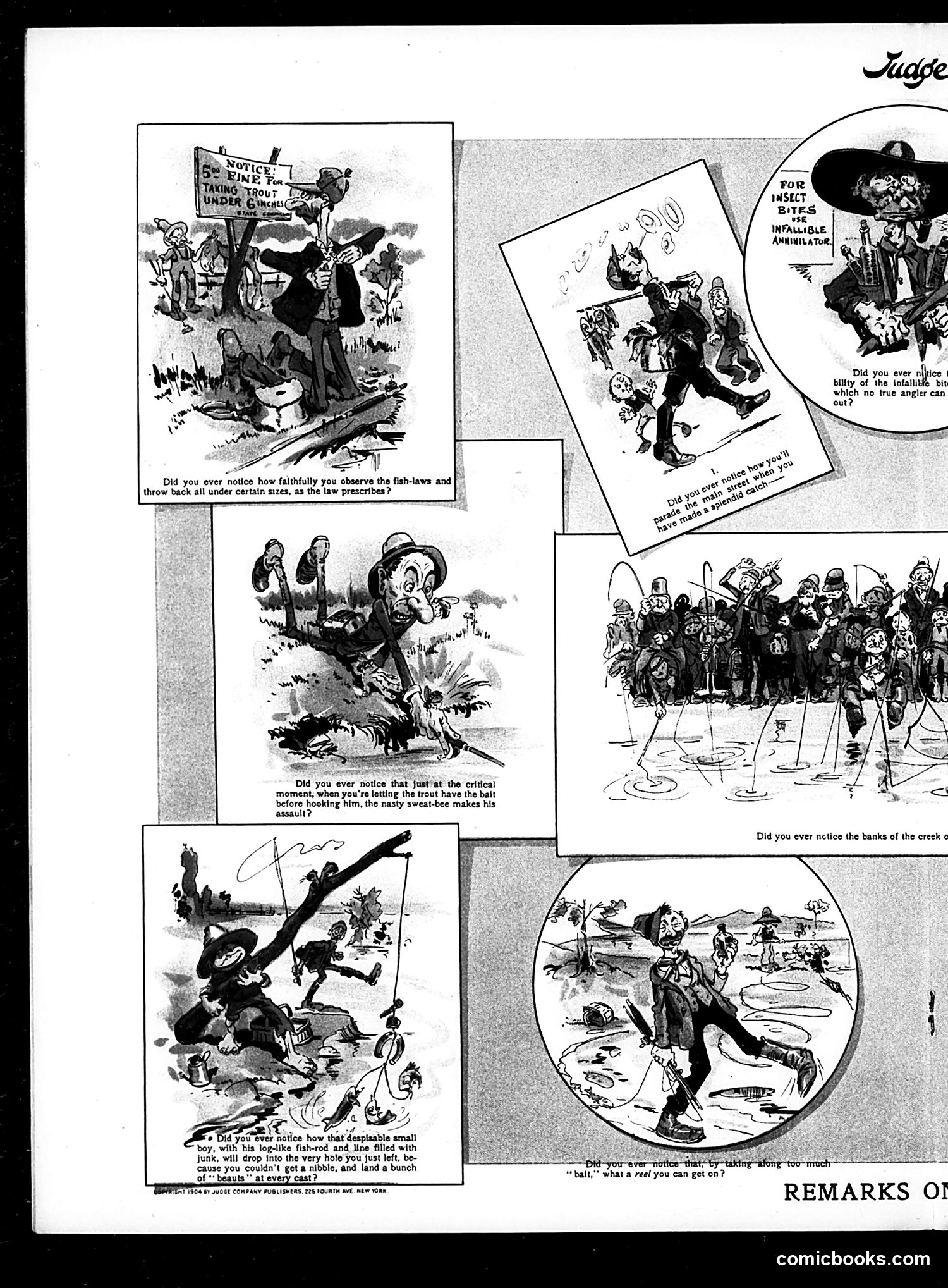
This page from Judge (1904) uses humorous observations about fishing to satirize human nature and social hypocrisy. The central conceit asks readers: "Did you ever notice..." various frustrating fishing scenarios—a rhetorical device that builds ironic commentary. The cartoons depict common fishing mishaps: fish escaping at critical moments, annoying insects interrupting concentration, and—most pointedly—an unkempt "despicable small boy" who succeeds effortlessly in spots where well-dressed, respectable anglers fail. This last image appears to mock class pretensions: despite following rules and employing proper technique, the gentleman is outfished by someone using crude methods. The "Infallible Animal-ator" advertisement (right panel) likely parodies patent medicines or dubious products marketed to solve fishing problems—another satirical jab at consumer gullibility. Overall, the page humorously suggests that despite our pretensions to civility and rule-following, nature remains indifferent to social status, and fortune favors the unexpected.
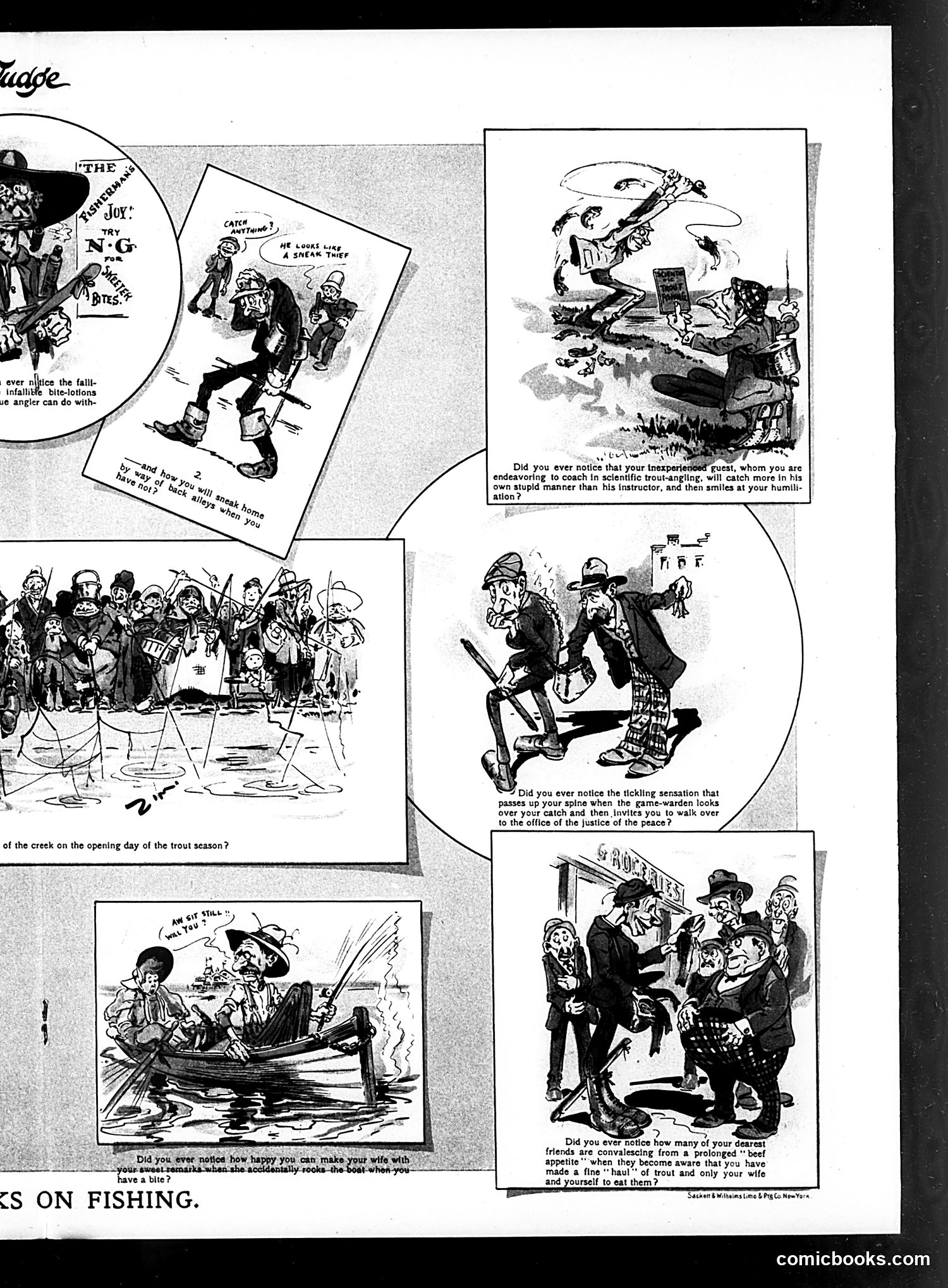
This page from Judge magazine presents humorous observations about fishing through multiple cartoon panels. The content satirizes common fishing scenarios and social dynamics: **The satire targets:** 1. **Amateur vs. expert anglers**: Beginners catch more fish despite lacking proper technique, humiliating experienced instructors. 2. **Game wardens**: Fishermen fear legal consequences when wardens inspect catches, potentially leading to justice-of-the-peace proceedings (suggesting illegal overfishing or violations). 3. **Social parasitism**: Friends suddenly become interested in the fisherman's catch, conveniently recovering from appetite loss when they learn about a good haul—expecting free fish while the angler is left with only his wife to share with. The cartoons use exaggerated character drawings typical of early 20th-century American satire. The humor relies on universal fishing frustrations: incompetence succeeding despite preparation, legal anxiety, and fair-weather friends. No specific political figures appear identifiable; this is general social commentary on fishing culture and human nature.
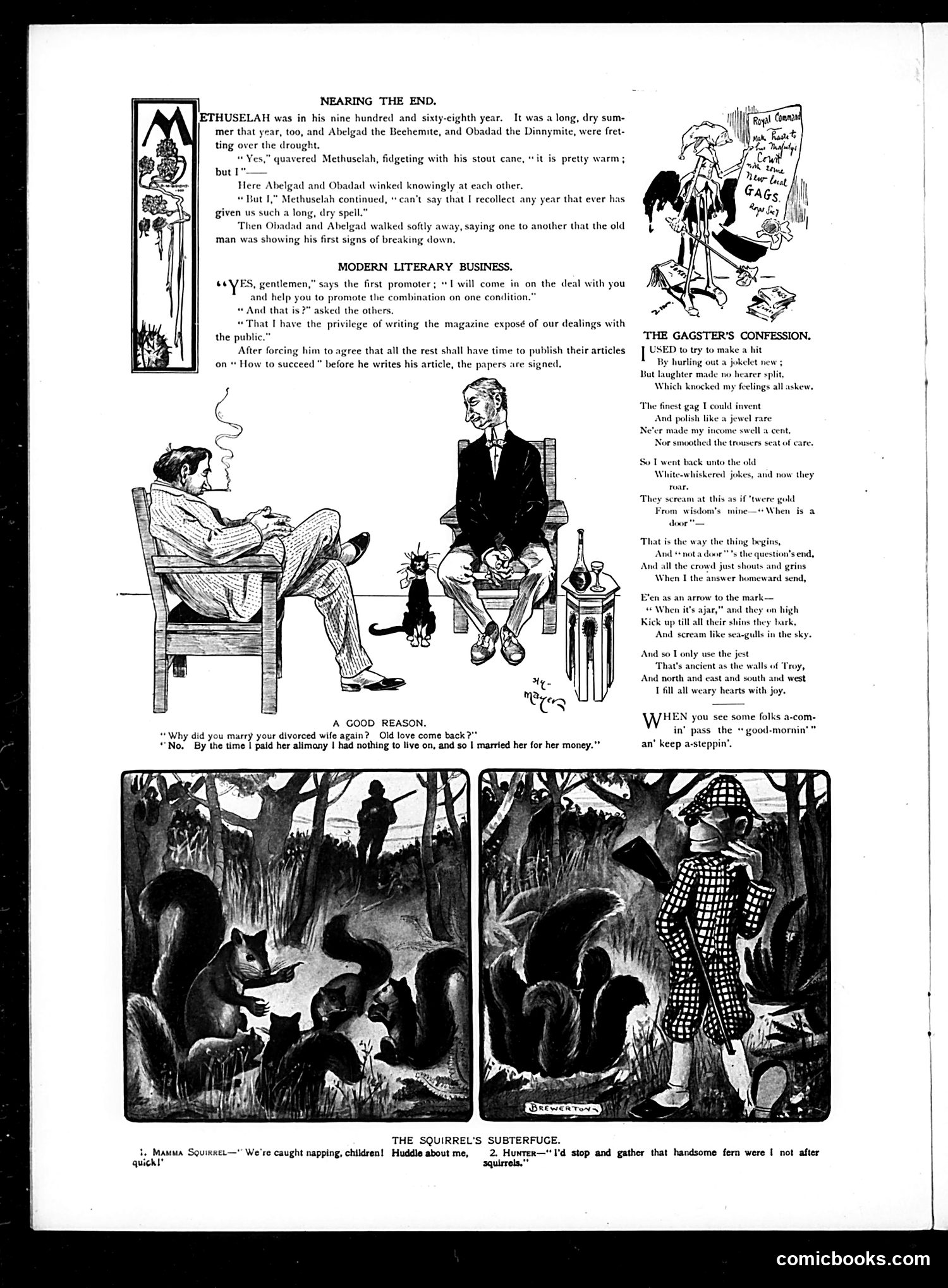
This page contains multiple unrelated satirical pieces typical of Judge's format: **"Nearing the End"** mocks elderly people's tendency to repeat themselves. Methuselah, the biblical figure known for extreme longevity, complains about drought while his companions exchange knowing looks, interpreting his forgetfulness as senility. **"Modern Literary Business"** satirizes publishing corruption. A promoter agrees to help publicize a business scheme *only if* he can write an exposé about it in a magazine—essentially extorting cooperation through threat of public exposure. The other businessmen foolishly accept and sign papers, not realizing they're being blackmailed. **"A Good Reason"** is a cynical joke about divorce economics: a man remarried his ex-wife because after paying alimony he had no money left, so he married her again to access her finances. **"The Gagster's Confession"** is a poem by a comedy writer lamenting that clever jokes don't pay bills, so he switched to old, tired material that audiences actually laugh at—a meta-commentary on commercial versus artistic comedy. **"The Squirrel's Subterfuge"** appears to be a nature illustration with minimal text. The page emphasizes greed, hypocrisy, and the compromises required by commercial society.
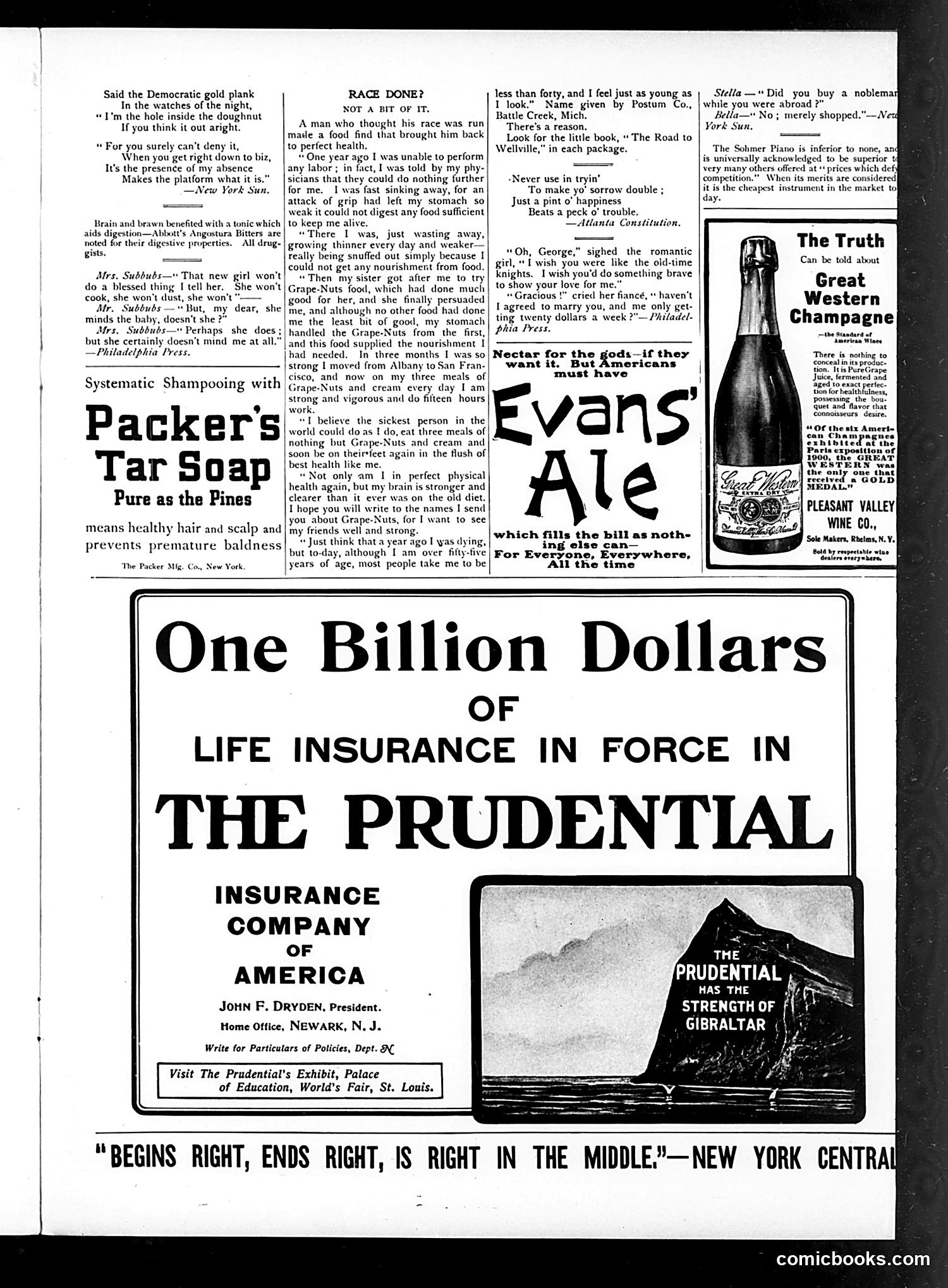
This page from *Judge* magazine contains primarily **advertisements and humorous filler content** rather than satirical cartoons. The political reference appears in the opening poem mocking the Democratic Party's "gold plank" (their monetary policy position)—presenting it as contradictory ("a hole inside the doughnut"). This reflects late-19th/early-20th century debates over the gold standard. The rest consists of: - **Advertisements** for Packer's Tar Soap, Grape-Nuts cereal, Evans' Ale, Prudential Insurance, and Sohmer Pianos - **Brief humorous anecdotes** about domestic life and romance, typical of *Judge's* humor content The Grape-Nuts ad is notable as a **testimonial advertisement**—a common format claiming curative powers (the man recovered from illness). Such ads were standard before modern FDA regulations. The magazine's tagline at bottom quotes the New York Central railroad, suggesting this is a general-interest satirical publication carrying mixed commercial and editorial content.
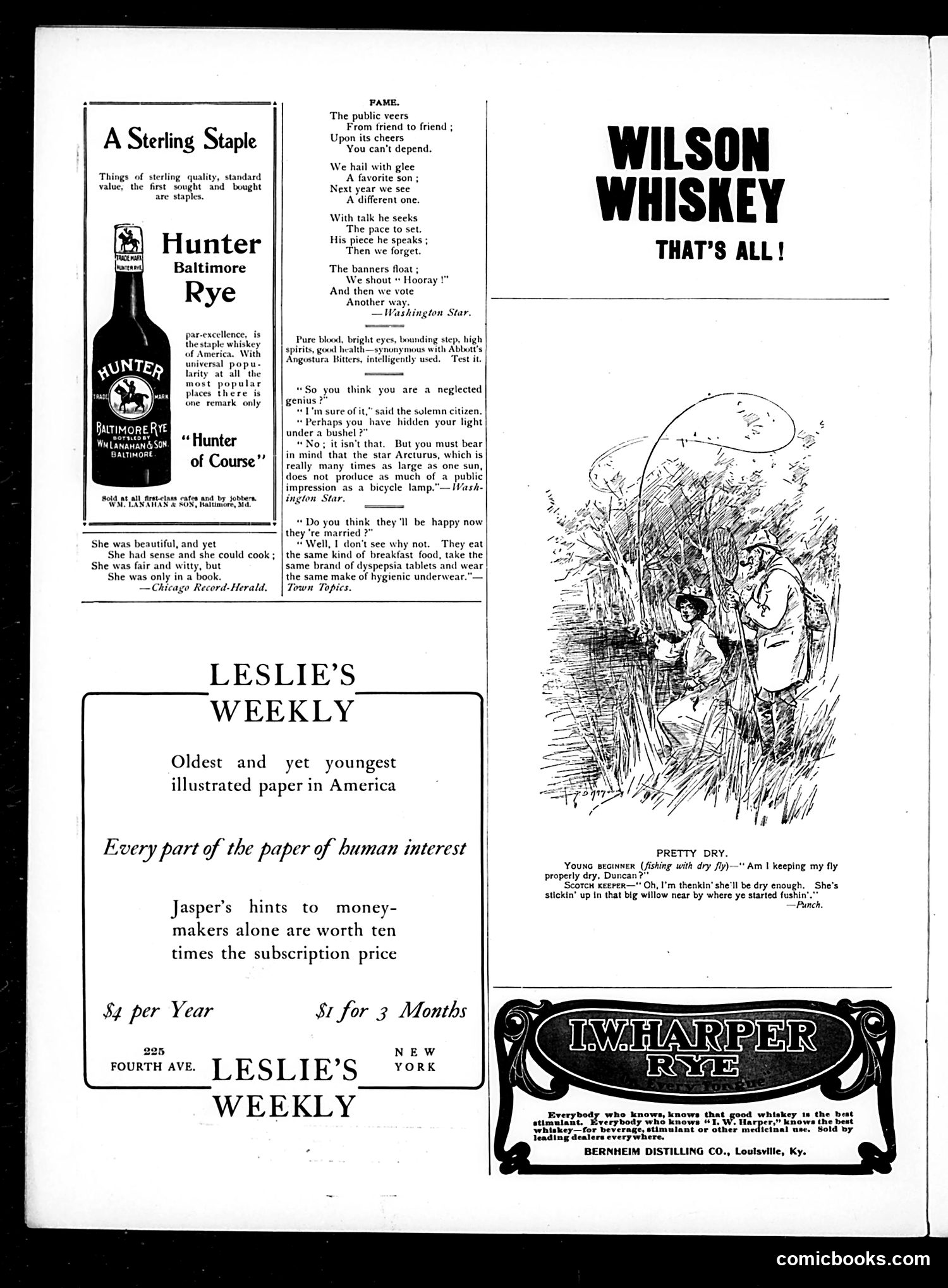
This page contains multiple advertisements and satirical content typical of early 20th-century American humor magazines. **The "Fame" poem and "Neglected Genius" cartoon** satirize American fickleness—how public opinion constantly shifts, elevating and abandoning figures unpredictably. The genius character compares himself to the star Arcturus, which despite being vastly larger than the sun, generates less public attention than a bicycle lamp, mocking society's shallow celebrity worship. **"Pretty Dry"** is a fishing joke: a young angler asks if he's keeping his fly dry, but the Scottish keeper responds that the fly is stuck in a willow tree where the fisherman started—implying careless fishing and lost equipment. **The marriage joke** satirizes modern consumer culture, suggesting newlyweds' happiness depends entirely on purchasing identical mass-produced goods (cereal, medicine, underwear) rather than genuine compatibility. **Multiple whiskey advertisements** promote Hunter Baltimore Rye and I.W. Harper Rye as reliable "staple" products, contrasting them with the fleeting nature of public opinion discussed above—establishing whiskey as dependable consumer goods.
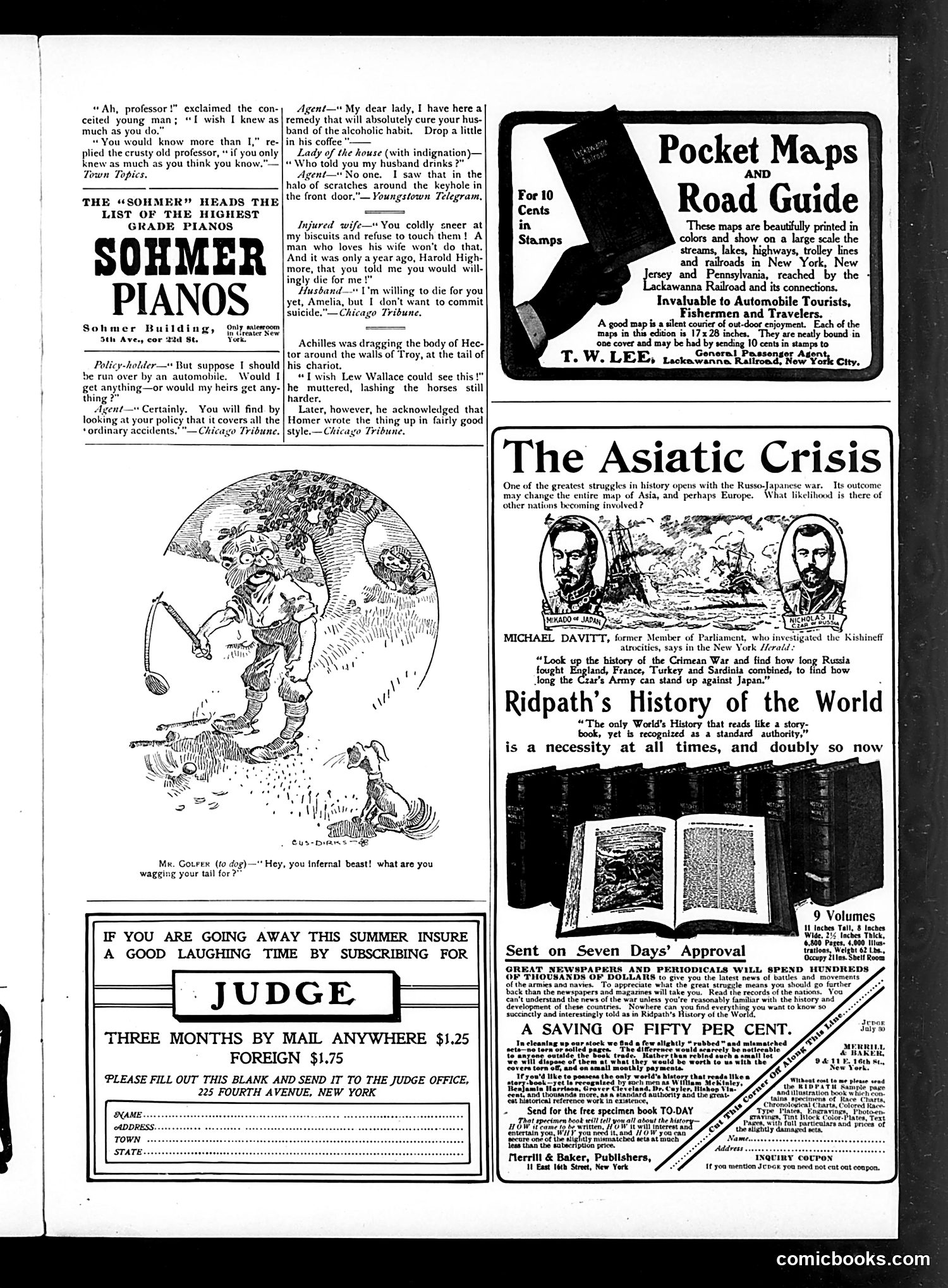
This page is primarily **advertising** with some satirical content interspersed. The main cartoon shows a figure (labeled "Mr. Gourex") speaking to a dog, asking why it wags its tail—a visual pun about meaningless behavior. Other brief jokes mock pompous intellectuals and unhappy marriages. One references "Lew Wallace" (likely Civil War general and novelist), joking that Homer should see modern horse-drawn chariot scenes. The substantial advertisements promote: - **Sohmer Pianos** (luxury goods) - **Judge magazine** subscriptions - **Pocket Maps and Road Guides** for automobiles and tourists - **Ridpath's History of the World** (9-volume encyclopedia), which discusses the Russo-Japanese War and "Asiatic Crisis" The **Ridpath's ad** is most historically contextual—it references the ongoing Russo-Japanese War (1904-1905) and quotes Michael Davitt questioning Russia's military capacity against Japan, positioning the encyclopedia as essential for understanding contemporary global events. Overall: a typical turn-of-century magazine page mixing light satire with commercial promotion, reflecting middle-class American interests in education, travel, and world affairs.
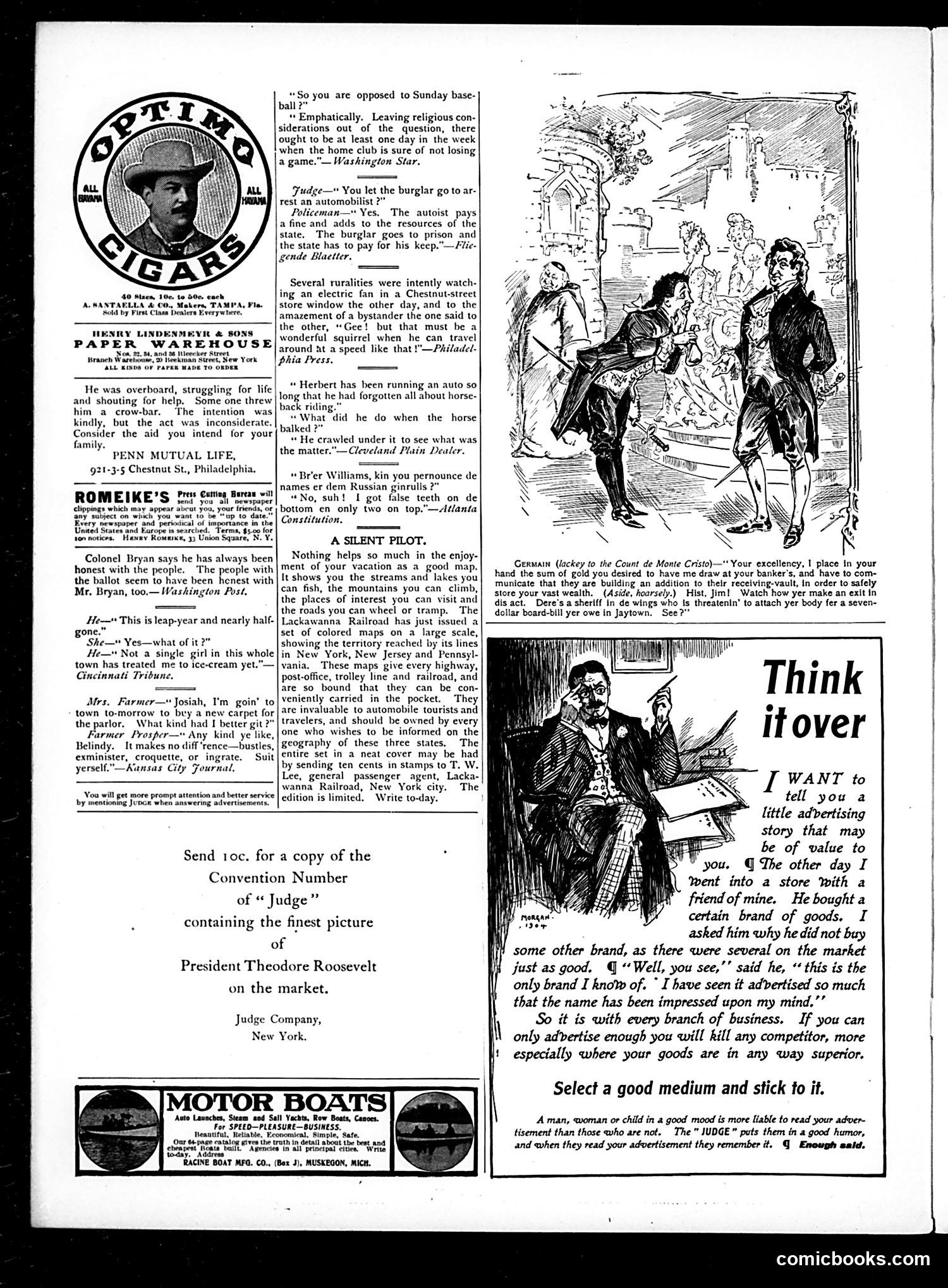
This page from the satirical magazine *Judge* contains several short jokes and advertisements reflecting early 20th-century American humor. **Key content:** The main cartoon (upper right) depicts a scene where someone appears to be presenting money to a wealthy nobleman, satirizing nouveau riche wealth and excess—the banker needs to *expand his vault* just to store this man's gold. **The humor relies on:** - **Automobiles as new technology**: Multiple jokes mock the automobile craze, including one where a policeman prioritizes arresting a reckless driver over a burglar (since the state profits from fines), and another where a man accustomed to cars forgets how to handle horses. - **Class commentary**: Rural characters misidentify an electric fan as a "squirrel," poking fun at rural unsophistication versus urban modernity. - **Political references**: A Colonel Bryan joke suggests he's been dishonest despite claims otherwise. The page is largely **humorous filler and advertisements**, reflecting *Judge's* mix of satirical commentary on contemporary American life—technological change, class differences, and political figures—aimed at educated, urban readers.
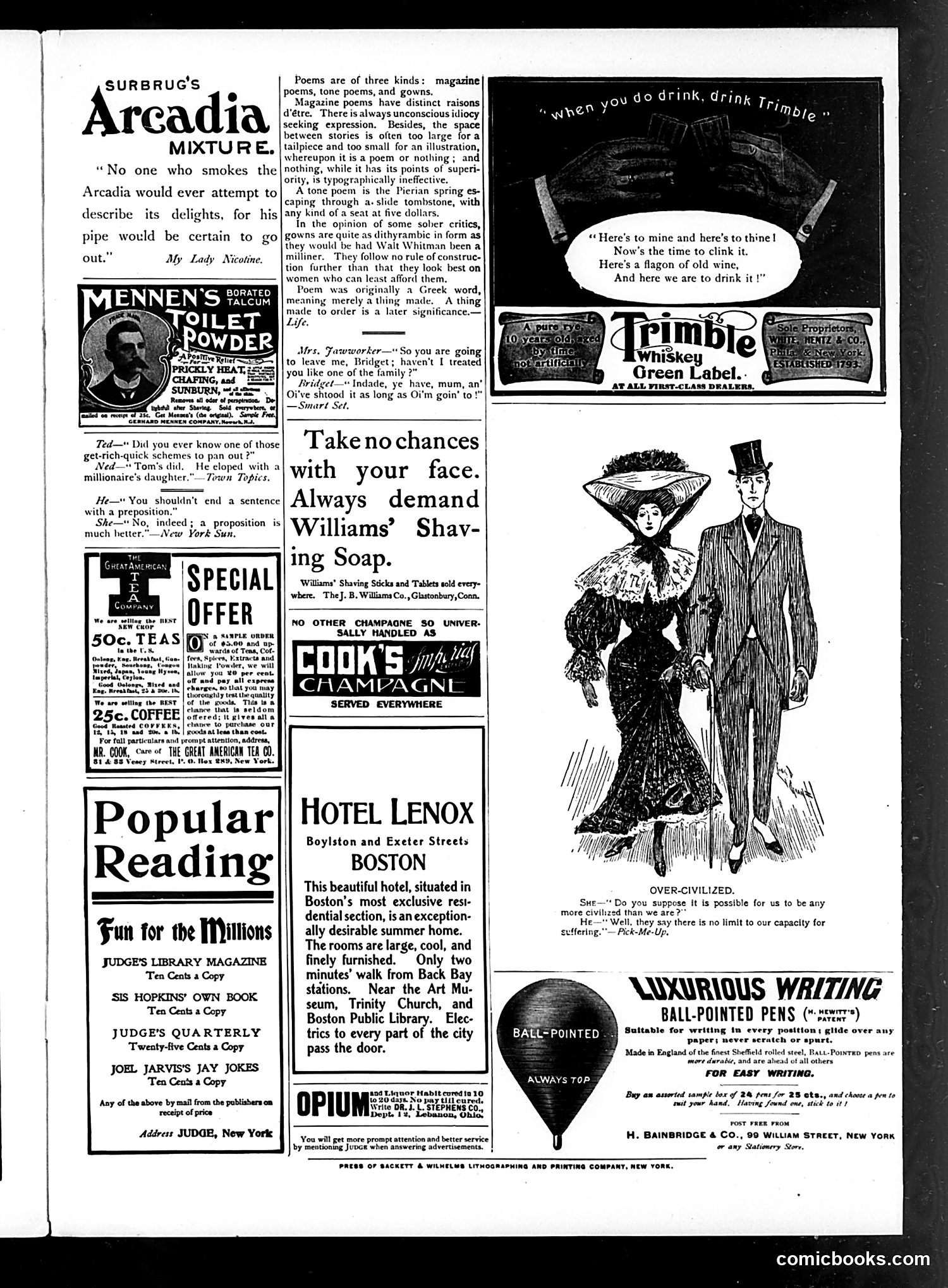
This page from Judge magazine (a satirical publication) contains primarily **advertisements and light humor** rather than political cartoons. The main cartoon labeled "OVER-CIVILIZED" depicts a couple in formal dress with satirical commentary: the woman asks if they can be "more civilized," and the man responds that "there is no limit to our capacity for suffering." This is social satire—mocking the constraints and pretensions of high society and "civilization," suggesting that excessive refinement actually increases human misery. The other content consists of brief jokes and advertisements typical of the era: a domestic servant leaving her employer, a man boasting about a get-rich-quick scheme, and jokes about grammatical pedantry. These represent everyday early-20th-century humor rather than political commentary. The bulk of the page features product advertisements (whiskey, soap, champagne, hotel, pens, talcum powder) reflecting Judge's primary function as a commercial publication targeting affluent readers.
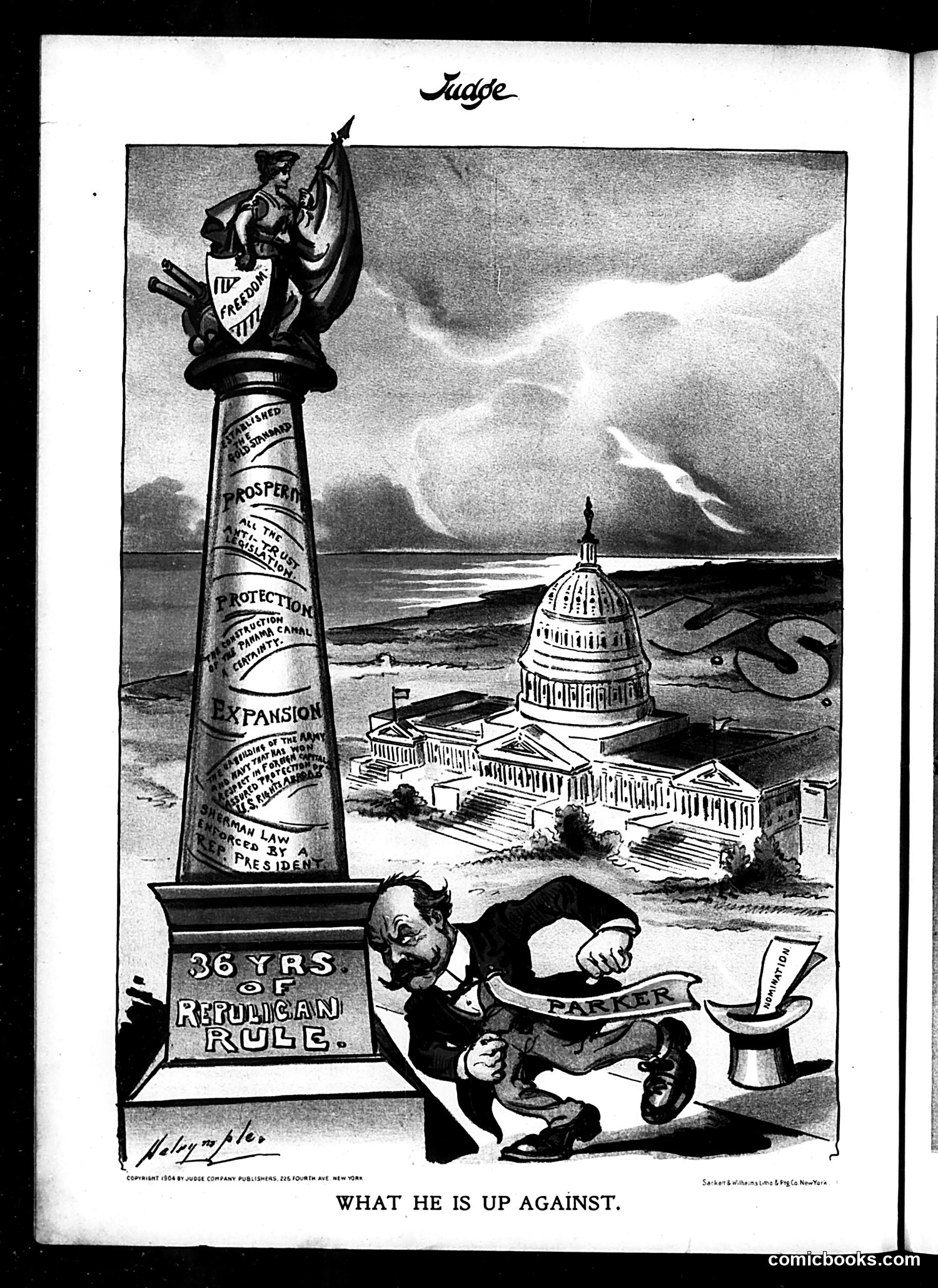
This 1904 Judge cartoon satirizes President Theodore Parker (labeled on his arm band) facing opposition to Republican policies. The towering monument labeled "36 Yrs of Republican Rule" represents the party's long dominance, while various inscriptions reference Republican achievements like expansion and protection. However, Parker appears diminished and struggling beneath this massive legacy, suggesting the cartoon criticizes how previous Republican administrations' weight constrains current leadership. The Capitol building in the background emphasizes the political establishment he must navigate. The satire likely critiques either the difficulty of governing under such expectations or tensions within Republican ranks—though the specific political moment and Parker's exact identity require additional context to confirm completely.