
A complete issue · 16 pages · 1904
Judge — July 2, 1904
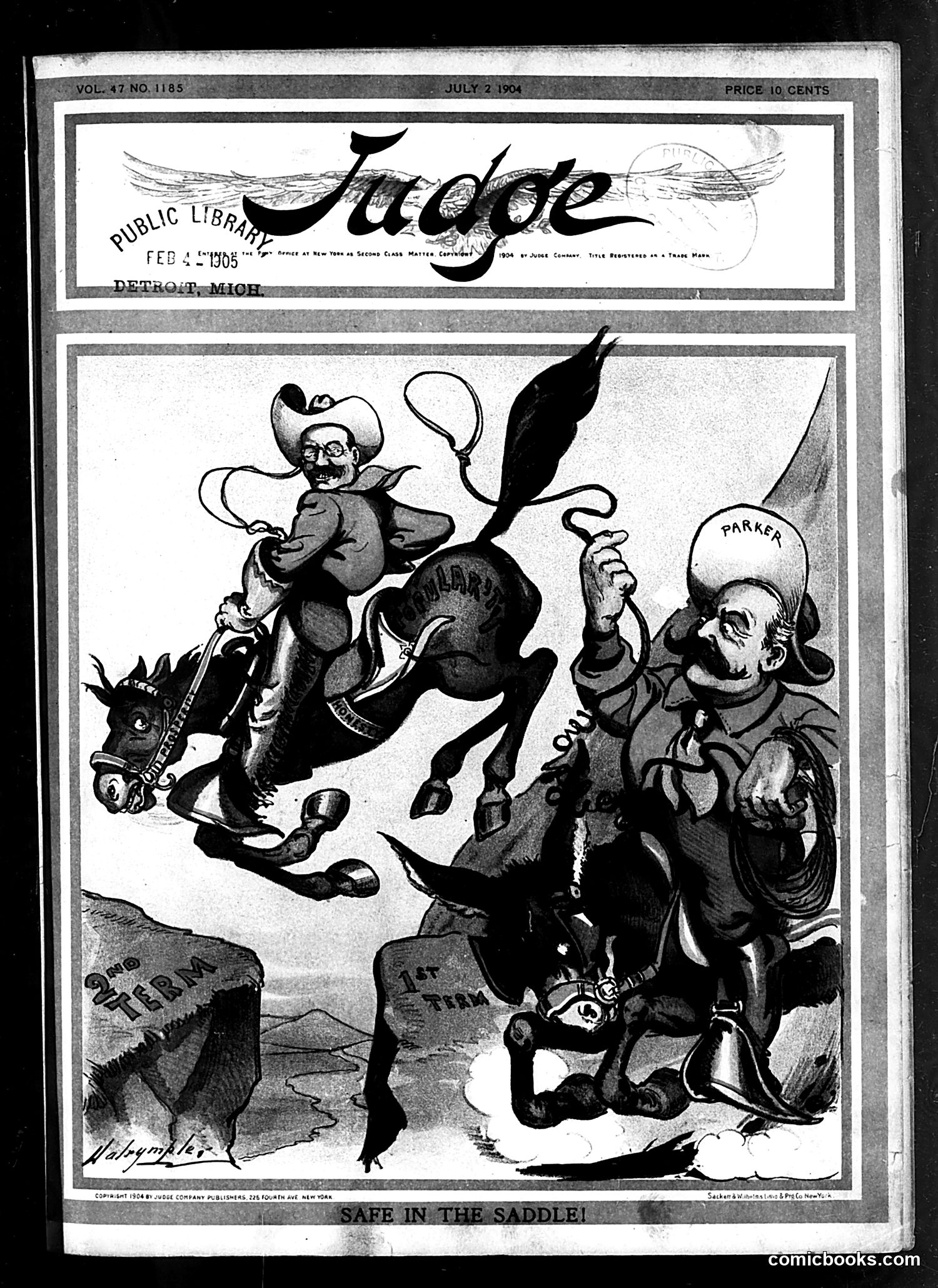
This Judge magazine cover from July 2, 1904 appears to depict a political figure (identifiable by the cowboy hat and western imagery) maintaining control despite challenges from opponents. The caption "Safe in the Saddle" suggests the subject has secured a firm political position. The figure labeled "Parker" (visible on a hat at right) likely refers to Alton B. Parker, the Democratic presidential candidate in 1904. The cartoon appears to satirize Parker's campaign efforts against the incumbent, suggesting he poses little real threat—the sitting politician remains securely in control despite Parker's attempts to unseat him. The western/frontier imagery was common in early 1900s American political satire, reflecting the era's cultural associations with strength and dominance.
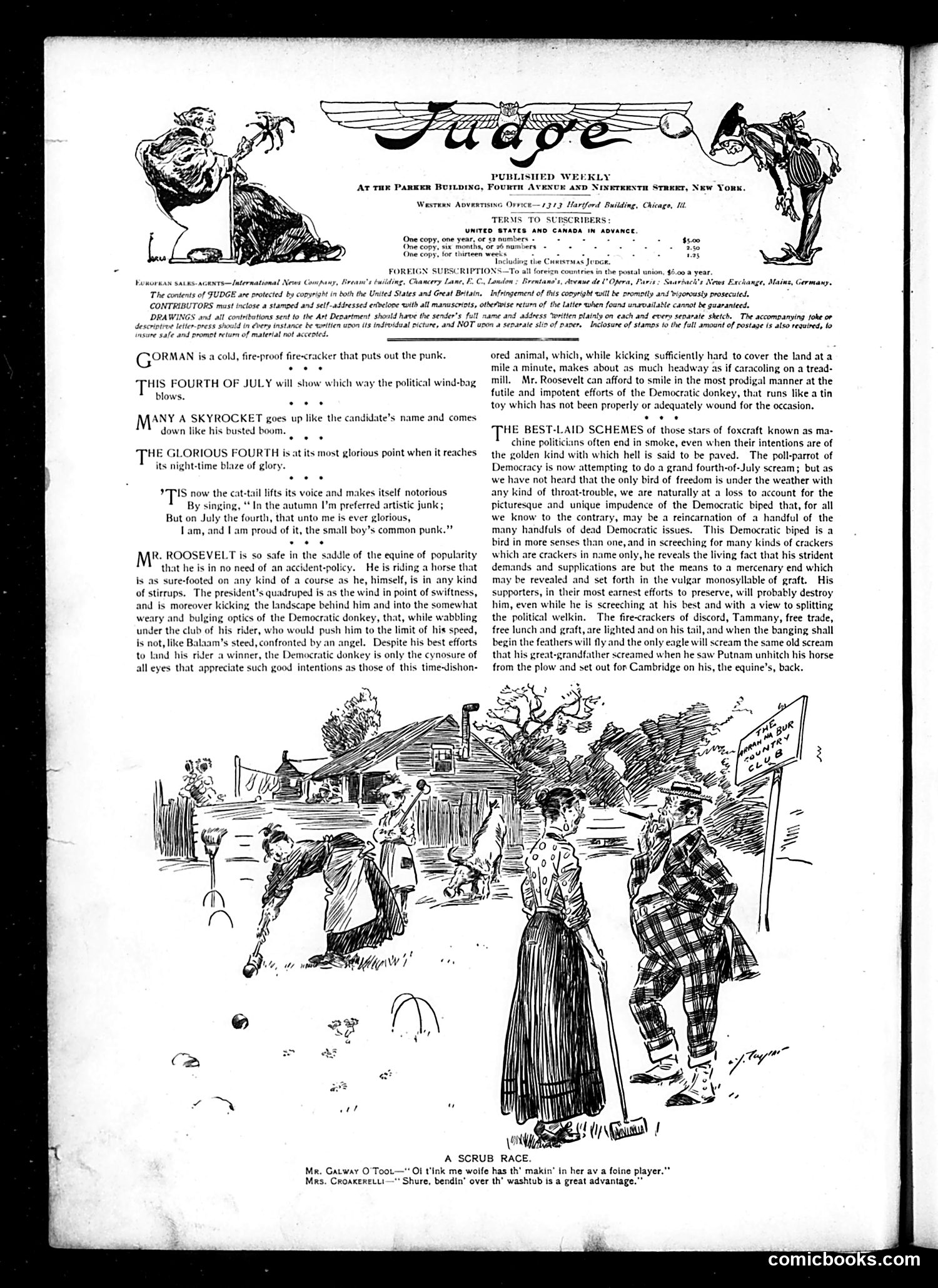
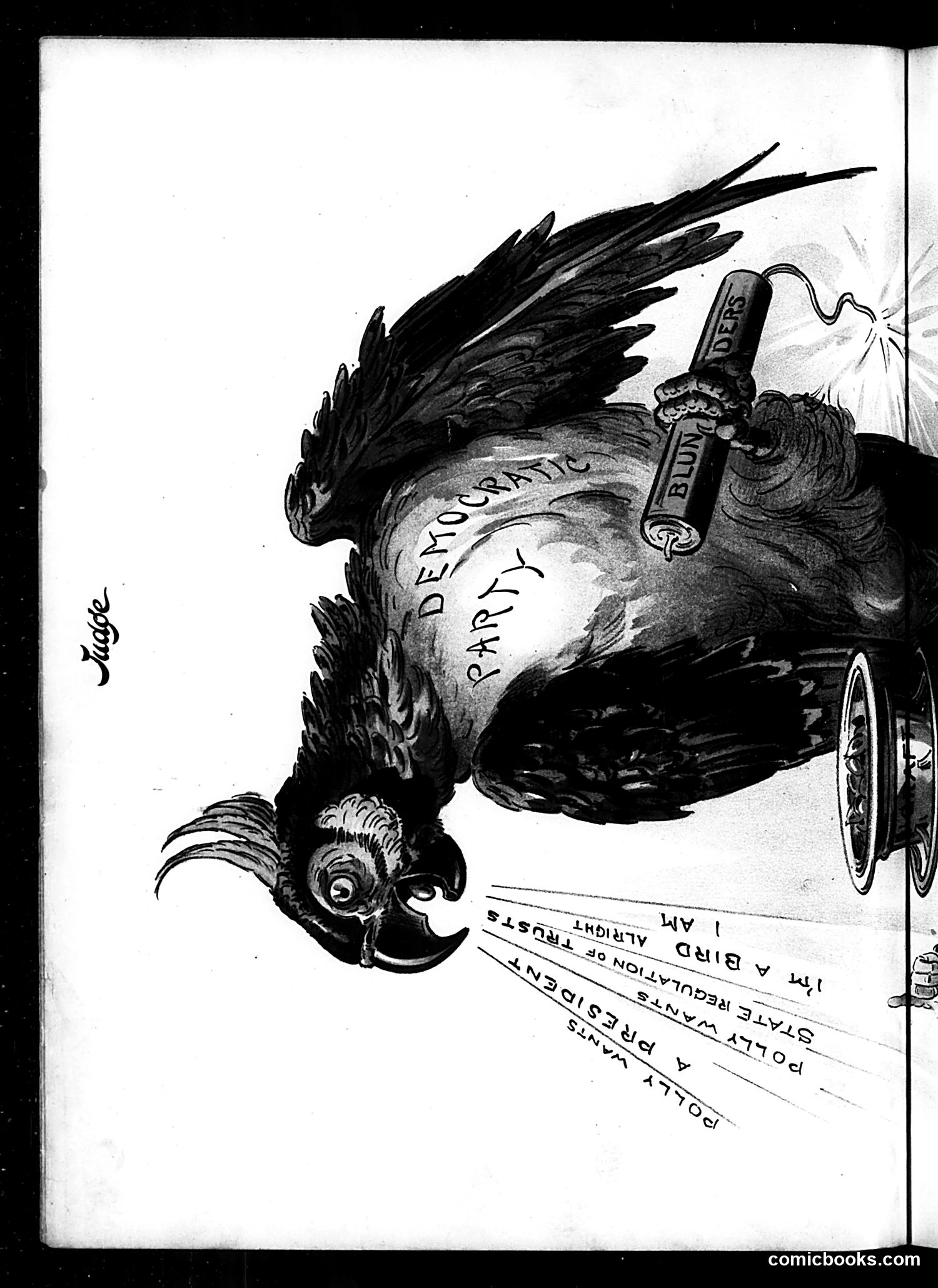
This page satirizes American politics around the Fourth of July, likely from the early 1900s based on style. The text attacks Democratic Party strategy and leadership, using the "Democratic donkey" as its central metaphor—a figure representing the party itself. The main article mocks Democratic attempts at political messaging, describing their efforts as ineffective and disorganized compared to Republican strategy. It suggests Democratic leaders are internally divided and self-destructive. The lower cartoon, "A Scrub Race," depicts a domestic scene where a woman boasts about her husband's athletic prowess, while he appears comically incompetent—likely extending the party critique to suggest Democratic leadership lacks competence despite claims otherwise. The satire assumes readers recognize the donkey as Democratic Party symbolism.
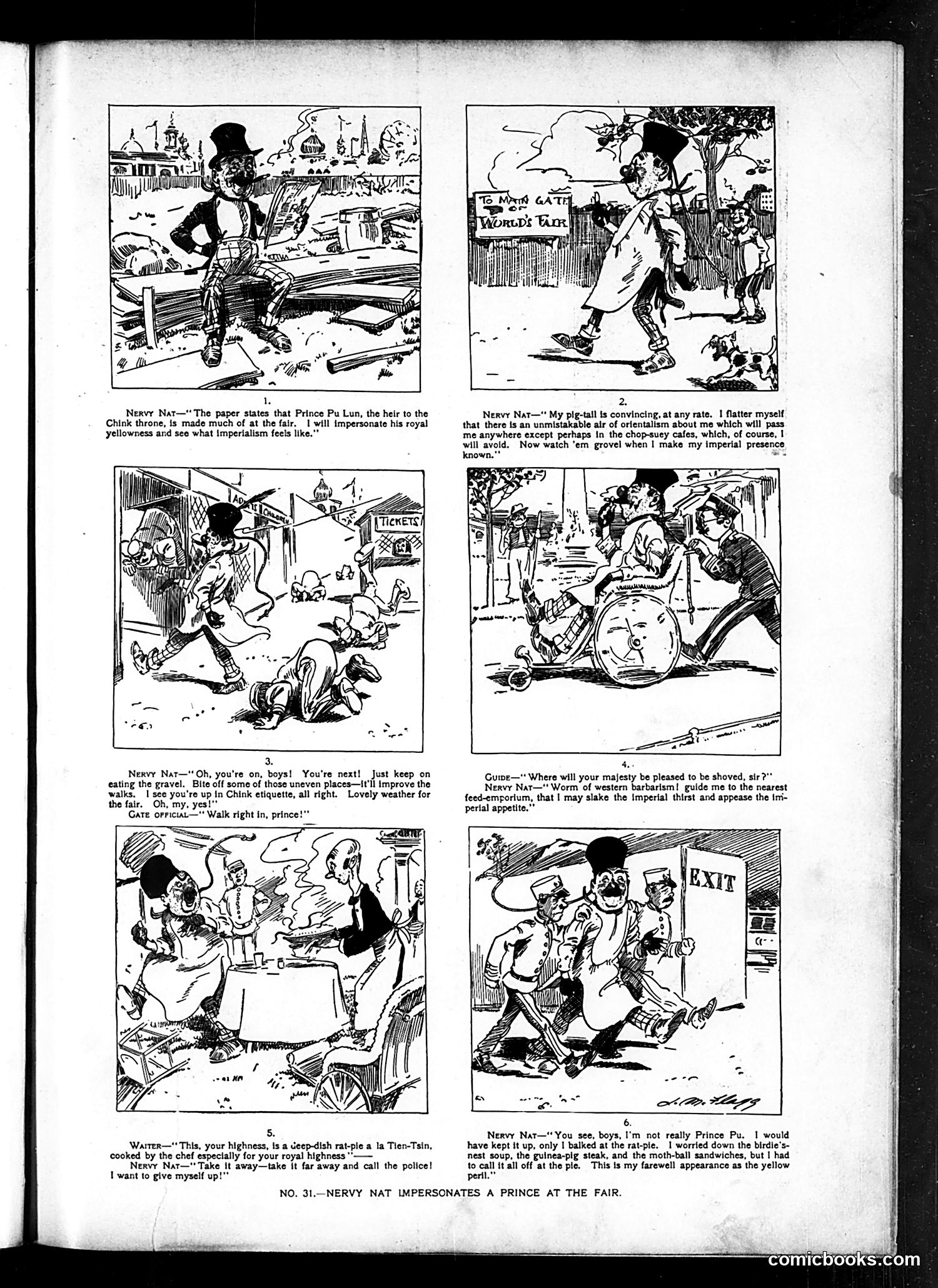
This comic strip satirizes a common early-20th-century entertainment: impersonation acts at world's fairs. "Nervous Nat" (the protagonist) disguises himself as Prince Pu Lun, heir to the Chinese throne, to experience imperial treatment at the fair. The satire targets two things: (1) the exotic appeal of Asian royalty to American audiences, and (2) the performative nature of fairs themselves, where identity could be fabricated for amusement. Nat's nervous behavior—attempting the deception while fearful of exposure—drives the humor. The strip mocks both gullible fair-goers willing to treat any costumed figure as royalty, and the era's fascination with "Oriental" spectacle as entertainment.
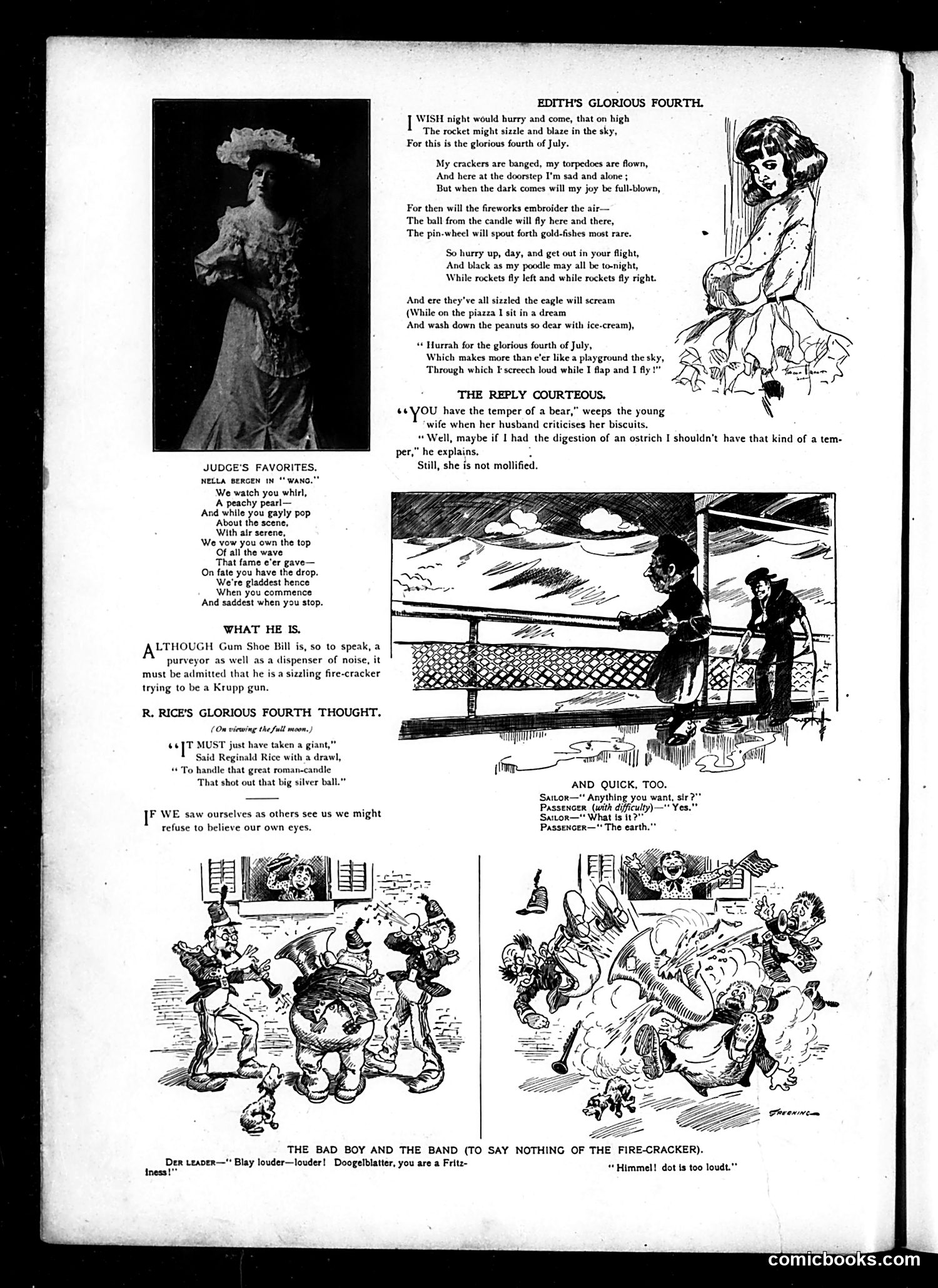
This page contains several humorous pieces about Fourth of July celebrations and domestic life, typical of Judge's satirical content. **"Edith's Glorious Fourth"** depicts a woman enthusiastically planning fireworks displays while her husband remains unenthusiastic—satirizing gender roles regarding holiday celebrations. **"Judge's Favorites"** praises actress Nella Bergen in a theatrical production, with a comedic poem about her performance. **"The Reply Courteous"** jokes about a wife's defensive response when criticized for her biscuit-making, poking fun at marital dynamics. **"The Bad Boy and the Band"** features rowdy children causing chaos during Fourth of July festivities—a common Judge theme mocking youthful misbehavior and noise pollution during holidays. The cartoons collectively reflect early-20th-century American attitudes toward domesticity, entertainment, and holiday traditions.
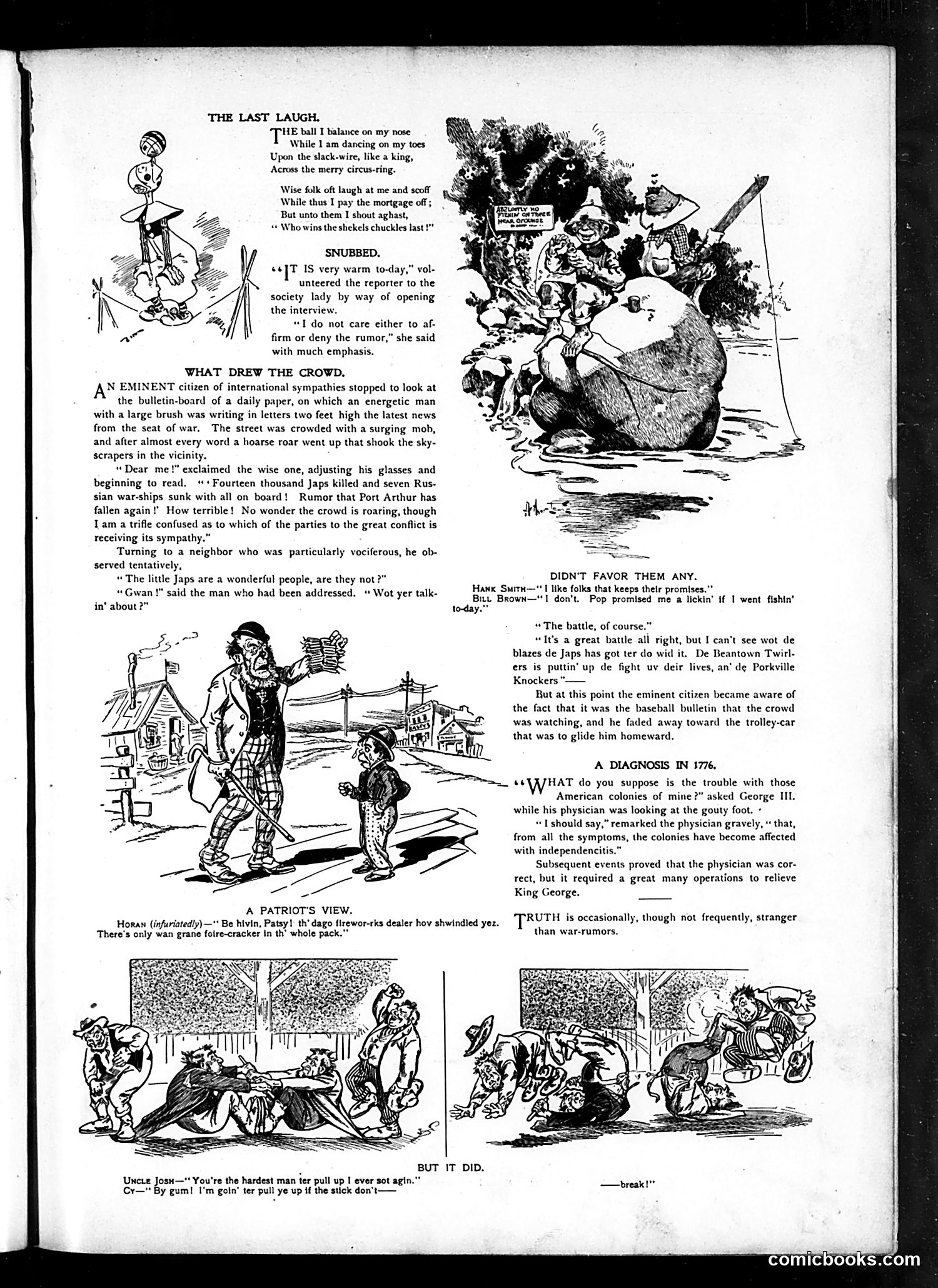
This Judge magazine page contains several satirical pieces from the early 1900s (likely around the Russo-Japanese War era, referenced in "What Drew the Crowd"): **"What Drew the Crowd"**: Satirizes American war enthusiasm. An intelligent observer reads newspaper bulletins about Japan-Russia war casualties, expecting crowds to be moved by the human tragedy. Instead, he discovers the crowd is actually watching **baseball scores**—specifically a game between Boston ("Beantown Twirlers") and Porkville teams. The joke mocks Americans' indifference to foreign war compared to sports obsession. **"A Diagnosis in 1776"**: A doctor tells King George III his American colonies suffer from "independencitis," a witty diagnosis of the Revolutionary War's cause. **"A Patriot's View"**: A character complains an Italian ("dago") fireworks seller cheated him—mild period stereotyping. The remaining pieces are short humor vignettes about social interactions. The cartoons employ typical early-20th-century caricature styles and focus on satirizing American priorities and social pretension.
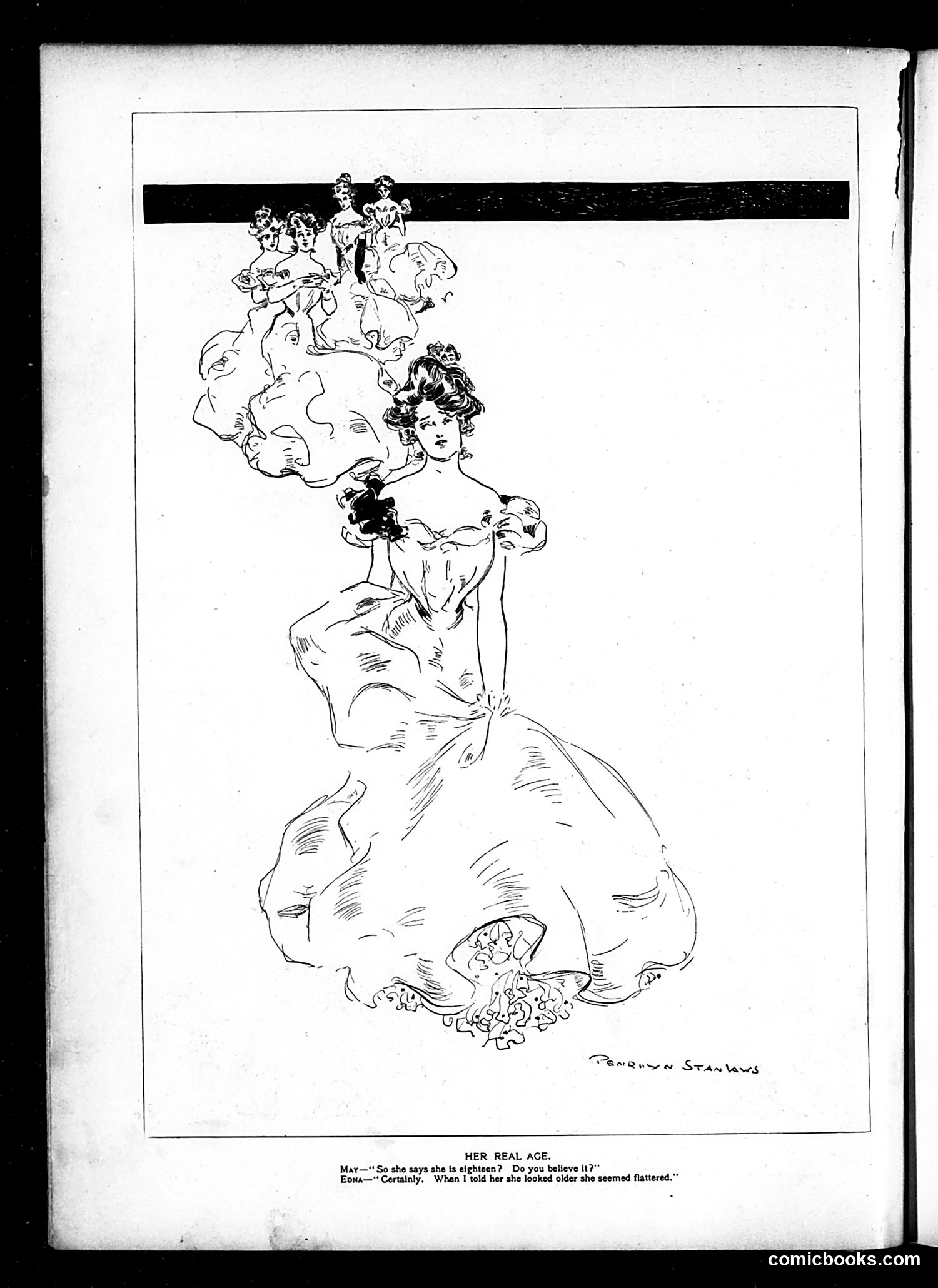
This is a single-panel satirical cartoon signed by Penrhyn Stanlaws. The joke concerns a woman's claimed age of eighteen. The humor works through a backhanded compliment: when one character (Eona) told the woman she looked *older* than eighteen, the woman was *pleased* rather than offended. This reversal suggests the woman is actually lying about her age—she's genuinely older but flattered to be perceived as even older than her false claim. The cartoon satirizes vanity and dishonesty about age, particularly among women in early-20th-century society. The elaborate illustration shows an elegantly dressed woman surrounded by cherubs, emphasizing the theme of youthful beauty and feminine vanity. The joke assumes readers will recognize that women typically want to appear younger, making the woman's pleasure at seeming older a humorous revelation of her actual advanced age.
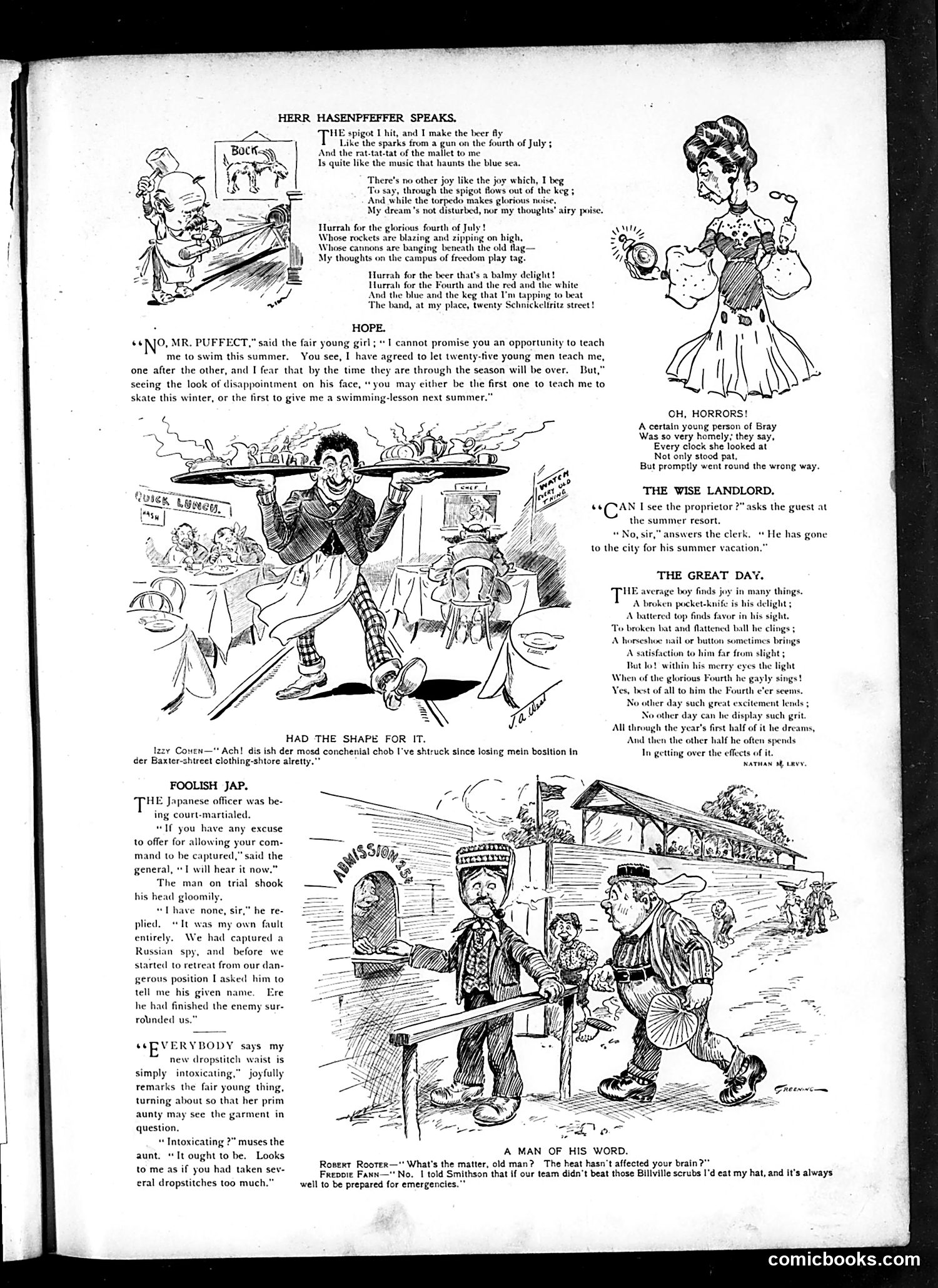
This page contains multiple satirical pieces typical of early 20th-century American humor: **"Herr Hasenpfeffer Speaks"** features a German immigrant character celebrating the Fourth of July through beer consumption—a stereotype-based joke about German-American culture and drinking traditions. **"Hope"** presents a young woman negotiating with a suitor about swimming lessons, playing on romantic expectations and gender dynamics of the era. **"The Great Day"** is a sentimental poem about boys' enthusiasm for Independence Day celebrations. **"Foolish Jap"** contains offensive racial stereotyping, depicting a Japanese officer in a court-martial scene—reflecting the xenophobic attitudes common in American publications of this period. The remaining sketches ("Had the Shape for It," "Wise Landlord," "Oh Horrors," "Man of His Word") are brief, pun-based humor pieces typical of Judge's format. The overall page reflects early 1900s American attitudes: ethnic caricature, gender stereotypes, and occasional xenophobia presented as light entertainment.
This appears to be a political cartoon from Judge magazine featuring a figure labeled "DEMOCRACY" being struck or attacked. The figure wears a scroll or document labeled "DEMOCRACY" and holds what appears to be a "BURY" implement or weapon. Large black wings or feathered elements surround the figure, suggesting an ominous or threatening tone. The text at the bottom is partially visible but difficult to read completely in the OCR. The cartoon's imagery—with the winged, aggressive figure threatening democracy—suggests this is satirizing a political force or movement perceived as threatening democratic principles. Without clearer text visibility or a specific date, I cannot definitively identify the exact historical event or political figure being criticized, though the symbolism indicates commentary on anti-democratic forces or authoritarian threats.
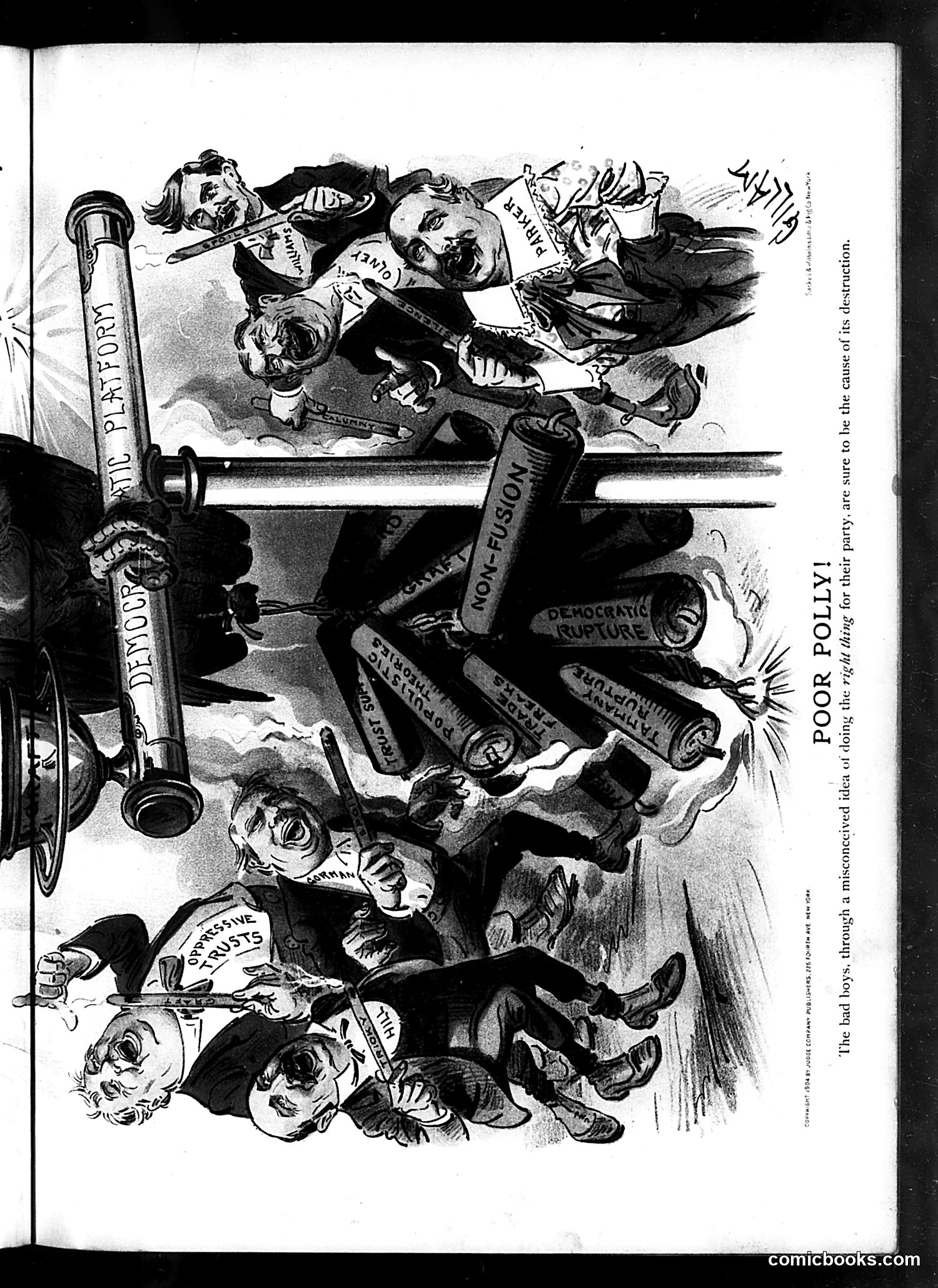
This political cartoon satirizes what appears to be late 19th or early 20th-century social policy failures. The image shows various labeled issues—including "TENEMENT EVIL," "VICE," "CORRUPTION," and others—depicted as destructive bombs or explosives aimed at impoverished citizens below. The cartoon's title, "Poor Policy," creates a pun: it critiques both policies affecting poor people and poorly-conceived policies generally. The illustration suggests that government neglect or misguided approaches are weaponized against vulnerable populations rather than protecting them. The figure operating the "DEMOCRATIC PLATFORM" device (visible on the left) indicates partisan critique of one party's ineffective responses to social problems. The satire argues that existing policies harm rather than help the poor.
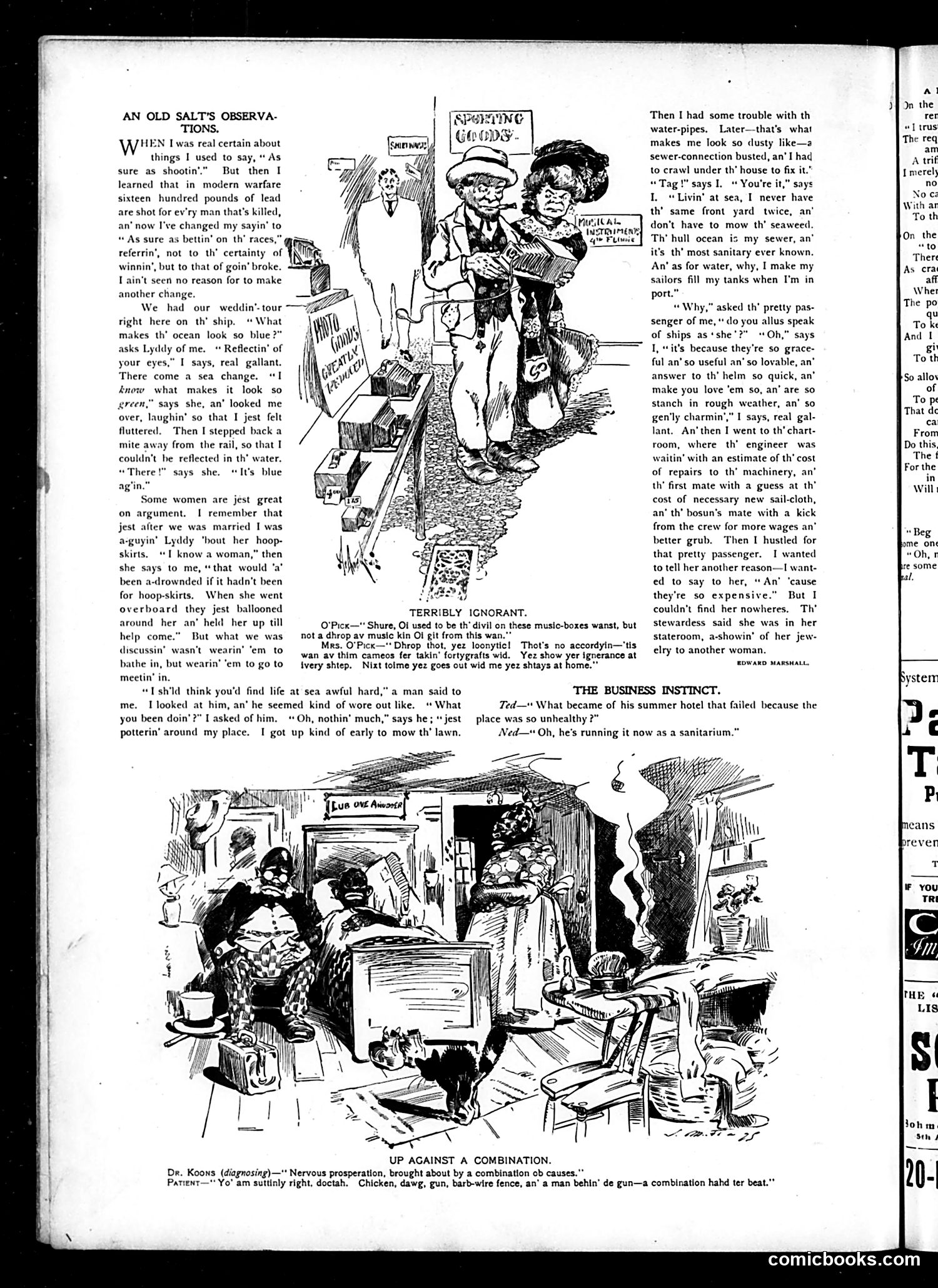
This page contains three distinct satirical pieces from Judge magazine: **"An Old Salt's Observations"** (top): A retired sailor reflects on modern life ashore through nautical comparisons. The humor relies on old-fashioned sailor dialect and observations about domestic inconveniences (water pipes, lawn mowing) versus sea life. The piece satirizes both the romanticization of nautical life and the bewilderment of aging seafarers encountering modern civilization. **"Terribly Ignorant"** (middle): A brief dialogue joke about an Irishman ("O'Pick") who once played music boxes well but now can't extract music from one. The satire appears directed at Irish immigrants and stereotypes about their mechanical incompetence. **"The Business Instinct"** (bottom): A quip about converting a failed unhealthy hotel into a sanitarium—satirizing how businesses rebrand failures as opportunities through marketing language rather than actual improvement. The cartoons use heavy dialect and ethnic stereotyping typical of early 20th-century American humor.
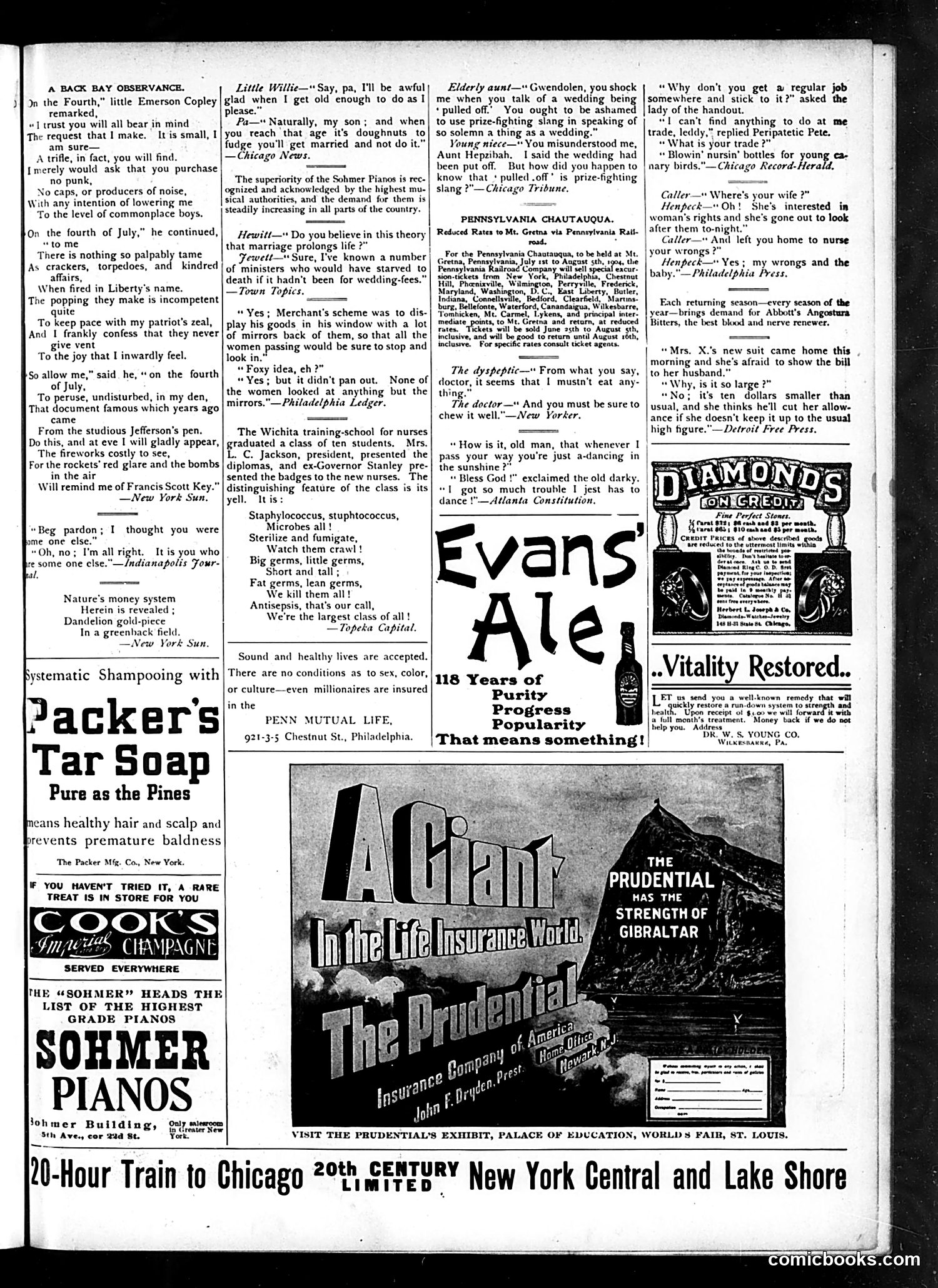
This page from *Judge* magazine contains primarily **short humorous dialogues and advertisements** rather than political cartoons. The main humor pieces mock **upper-class pretension and marital dynamics**: - "A Back Bay Observance" satirizes an snobbish Boston youth (Emerson Copley) who refuses common Fourth of July celebrations, preferring to read Jefferson's Declaration in solitude—a pretentious rejection of patriotic "commonness." - Multiple brief jokes target **marriage realities versus expectations**: a boy eager for freedom learns he'll lose it through marriage; a merchant's mirror display fails because women only admire themselves; an elderly aunt is caught knowing prize-fighting slang while condemning its use. The page is dominated by **period advertisements** for Sohmer Pianos, Parker's Tar Soap, Cook's Champagne, and insurance companies—typical of early 20th-century magazine content. The humor reflects *Judge's* focus on satirizing **bourgeois society, gender relations, and the gap between ideals and reality**—consistent with the magazine's satirical mission targeting educated, middle-class readers.
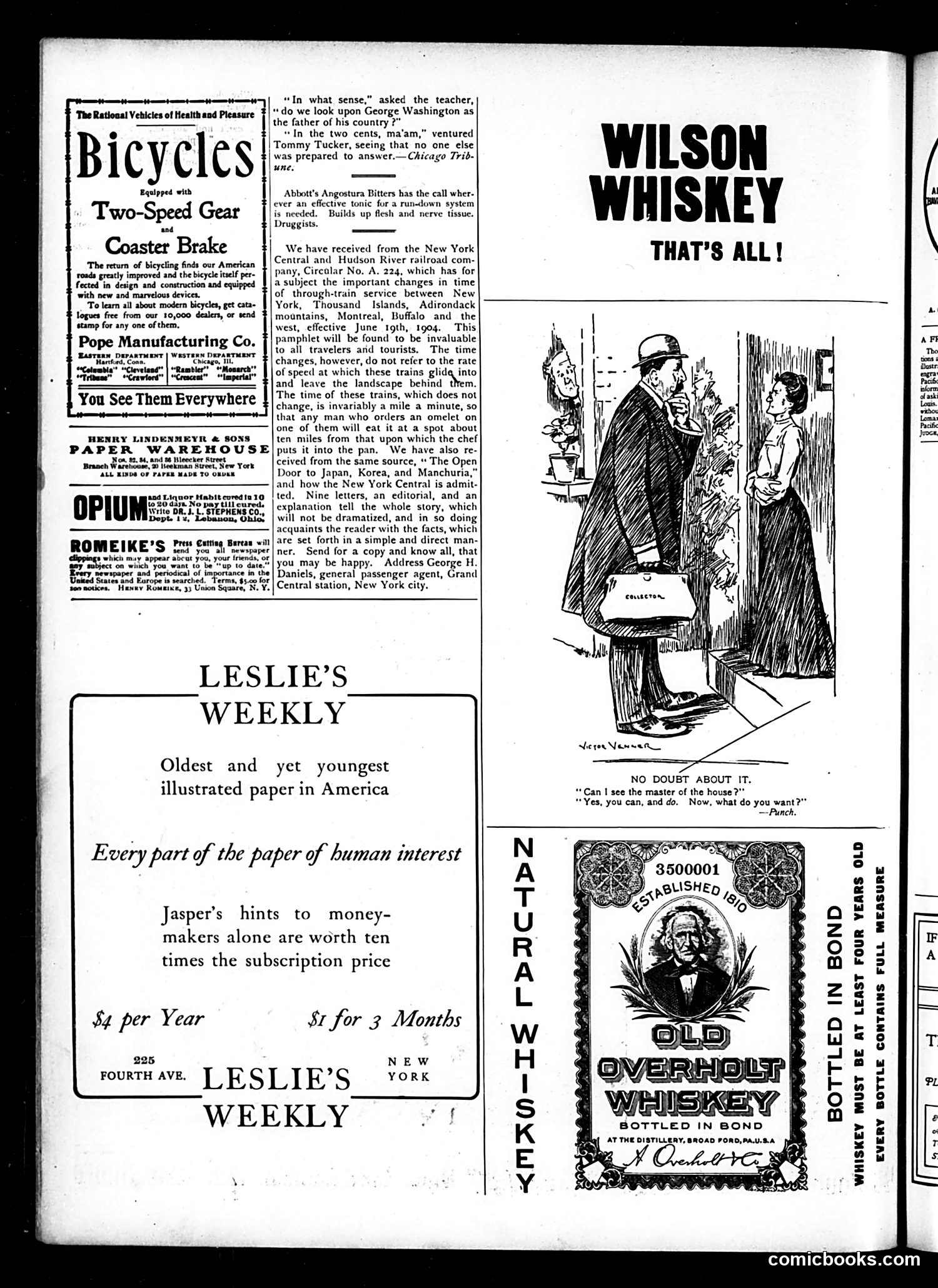
This cartoon satirizes domestic authority and gender dynamics in early 1900s America. A man (appearing to be the "master of the house") stands at his doorway confronting what seems to be a visitor or salesman. His response—"Yes, you can, and do. Now, what do you want?"—suggests ironic resignation about his supposed domestic authority. The joke plays on the contradiction between the husband's theoretical "mastery" of the household and the reality that he may not actually control much within it. The caption's title, "No Doubt About It," underscores this sarcasm: there's "no doubt" he's the master—in name only. This reflects period anxieties about shifting gender roles, as women increasingly gained economic and social independence in the Progressive Era. The cartoon mocks the fiction of unchallenged male household authority. The advertisement surrounding it (Wilson Whiskey) is incidental to the satirical content.
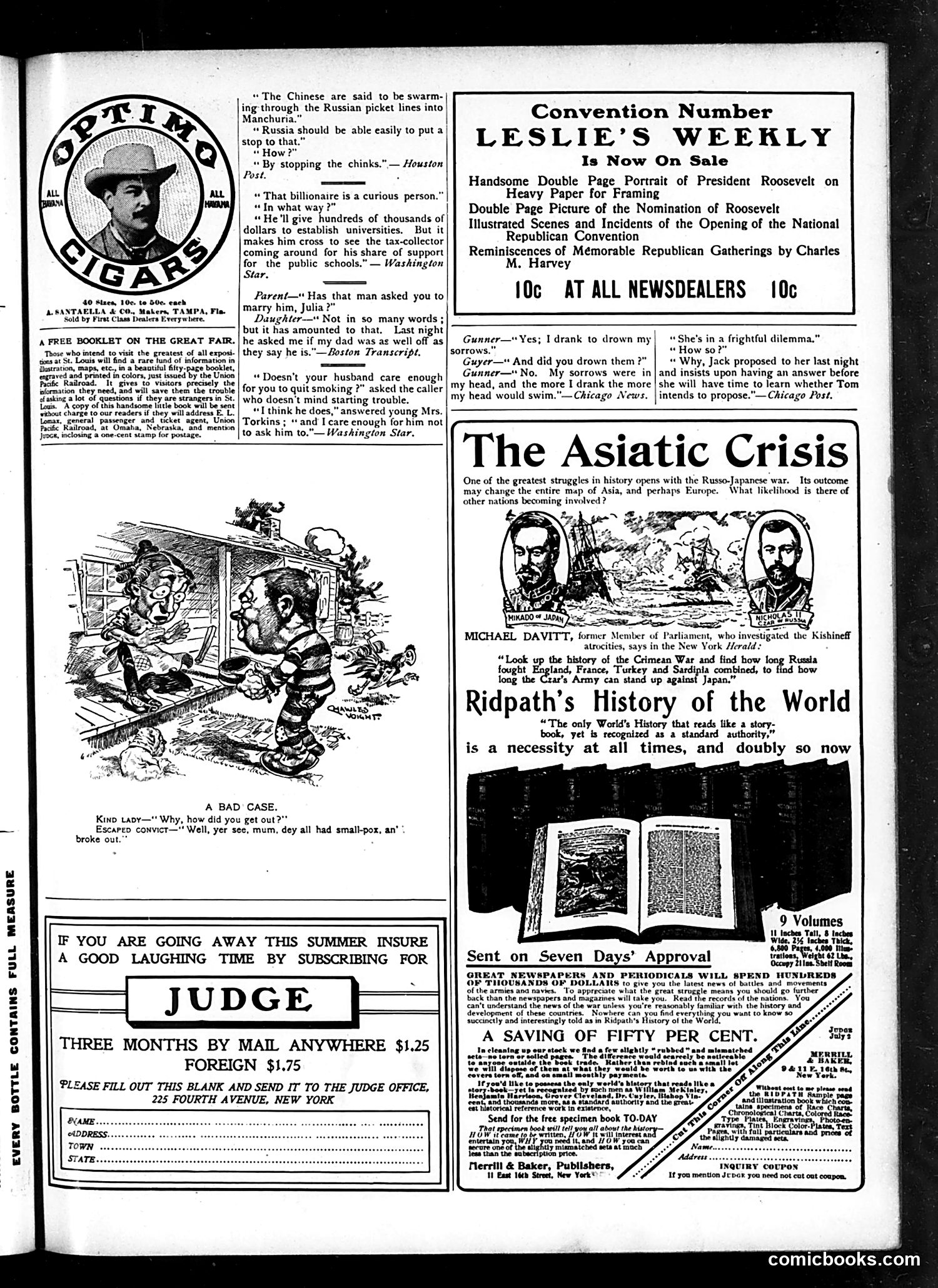
This page mixes advertisements with satirical content typical of Judge magazine. The main cartoons are brief joke panels with social commentary: **The Manchuria joke** satirizes Russian military incompetence during the Russo-Japanese War (1904-1905)—Russia's inability to stop Chinese civilians from crossing their lines became an embarrassing symbol of their weak position. **The billionaire cartoon** mocks wealthy philanthropists who donate to universities for prestige but resent paying taxes for public schools, exposing hypocrisy in "charitable" giving. **The marriage proposal joke** plays on gender dynamics—a woman caught between two suitors, needing time to learn the second man's intentions before committing. The page prominently advertises Leslie's Weekly's convention coverage featuring President Roosevelt, reflecting the 1904 Republican National Convention. A Ridpath's History advertisement capitalizes on readers' interest in the Russo-Japanese War's geopolitical implications. The humor throughout targets familiar targets: wealthy excess, military fumbling, and romantic uncertainty—accessible to Judge's educated, middle-class readership.
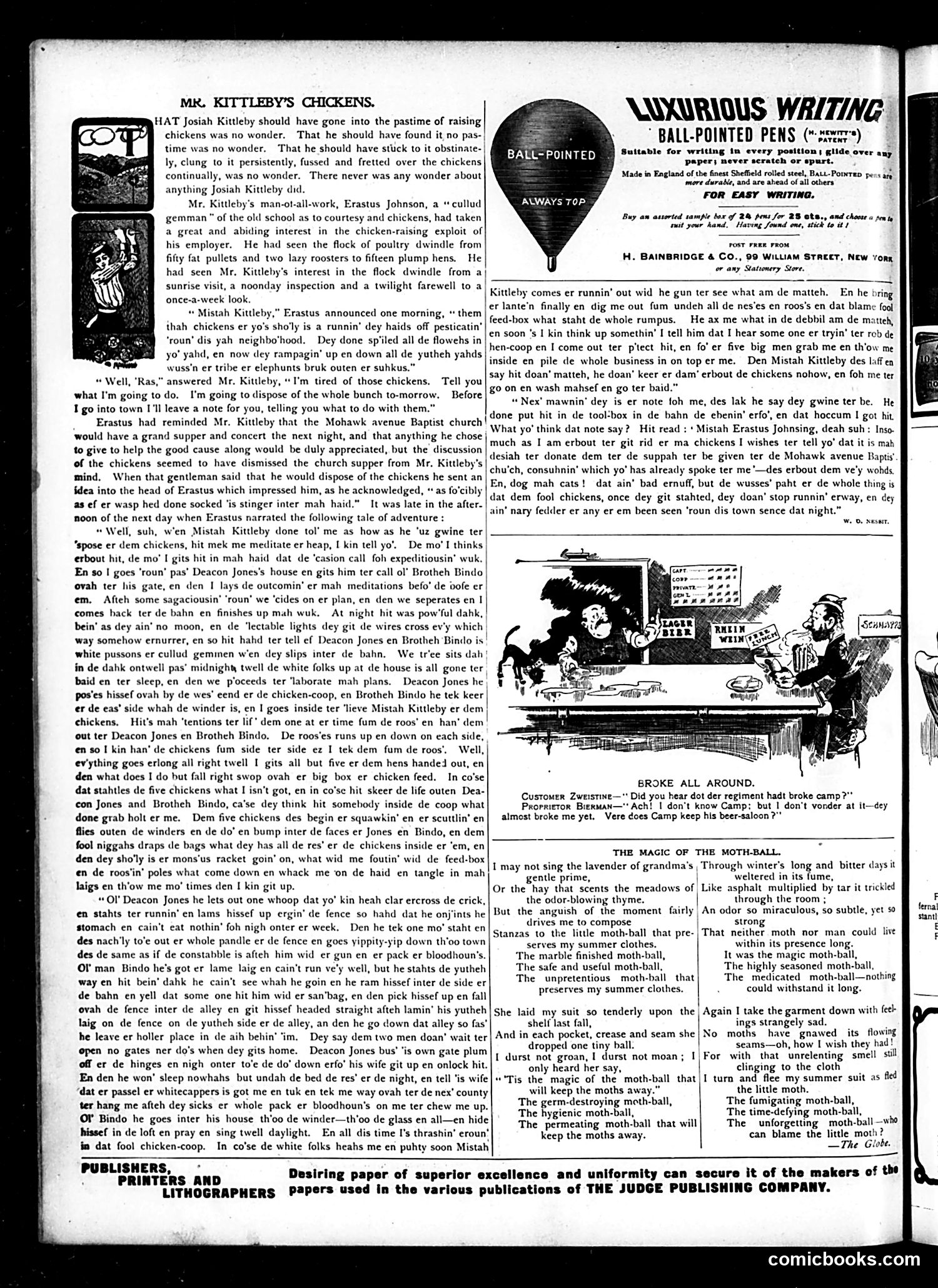
This is a humorous short story (not primarily a political cartoon) about a white farmer, Josiah Kittleby, who decides to dispose of his troublesome chickens. His Black employee, Erastus Johnson, devises an elaborate nighttime plan to steal them for a church fundraiser. The story is presented in dialect heavy enough to be considered offensive by modern standards. The satire mocks both the incompetent farmer and plays on racial stereotypes about Black characters—portraying Erastus as clever but also comedically bumbling (he falls into chicken feed). The humor relies on the mishaps during the midnight chicken-heist operation. The page also contains period advertisements, including one for "luxurious writing" ball-pointed pens—an anachronistically early reference to ballpoint pen technology. The accompanying cartoon illustration shows the physical comedy of the chicken-stealing scene.
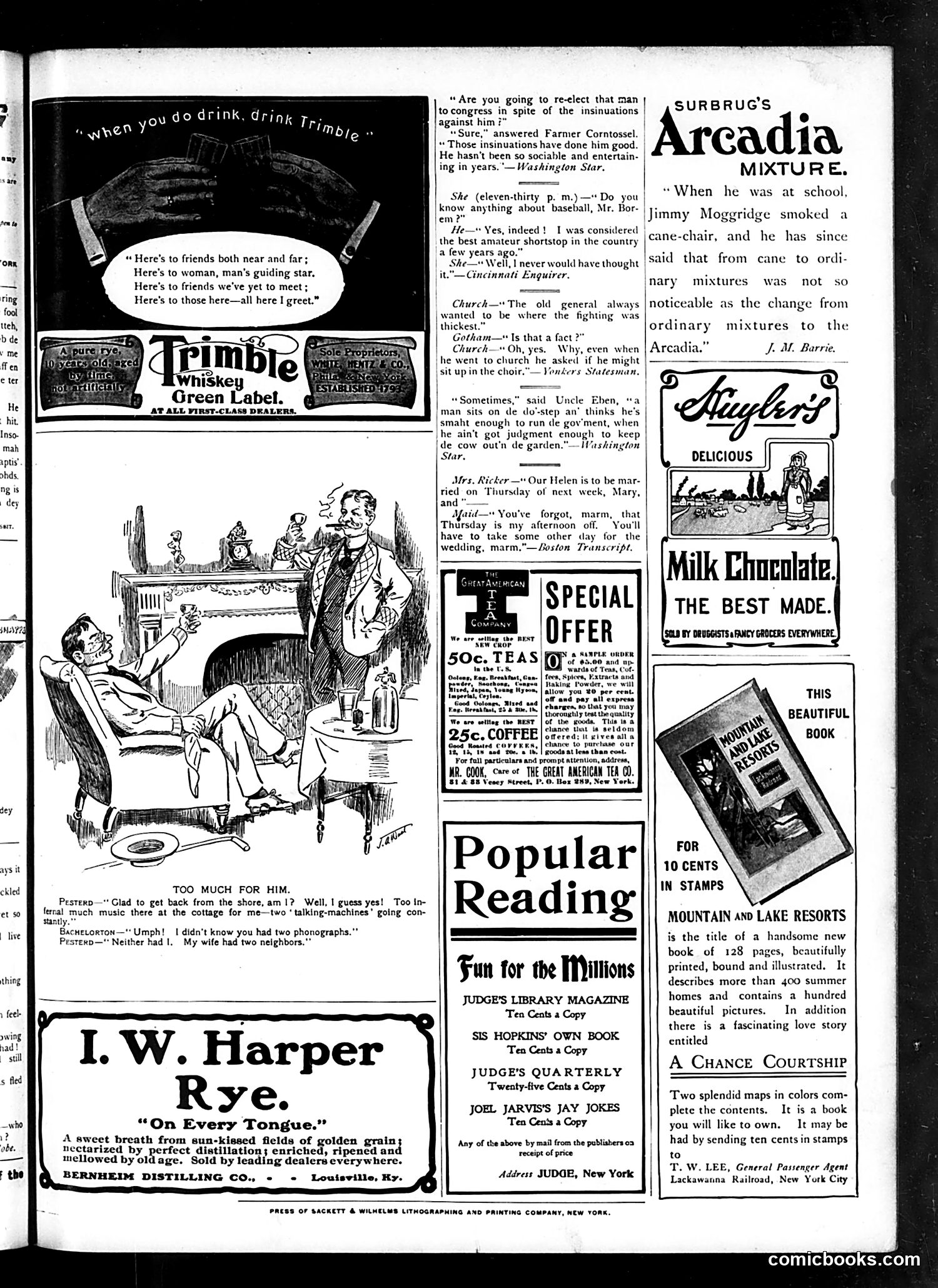
This page from *Judge* contains several short humorous anecdotes targeting common social situations of the era: **"Too Much for Him"** depicts a man complaining that his cottage stay was ruined by "two talking-machines"—which his host misunderstands as phonographs. The joke reveals the man meant his wife's two gossipy neighbors, satirizing domestic annoyance and the prevalence of female social chatter. **Other brief jokes** mock political corruption (a congressman's bad reputation paradoxically makes him more sociable), class pretension (a man bragging about past athletic prowess), military stereotypes (a general obsessed with action even in church), and servant insolence (a maid demanding her day off supersedes her employer's wedding plans). **"She" and "Mrs. Ricker"** target the emerging assertiveness of working-class women, a social anxiety of the period. The page is primarily **advertising**—for whiskeys, tea, coffee, and books—with humor serving to entertain readers between product pitches.
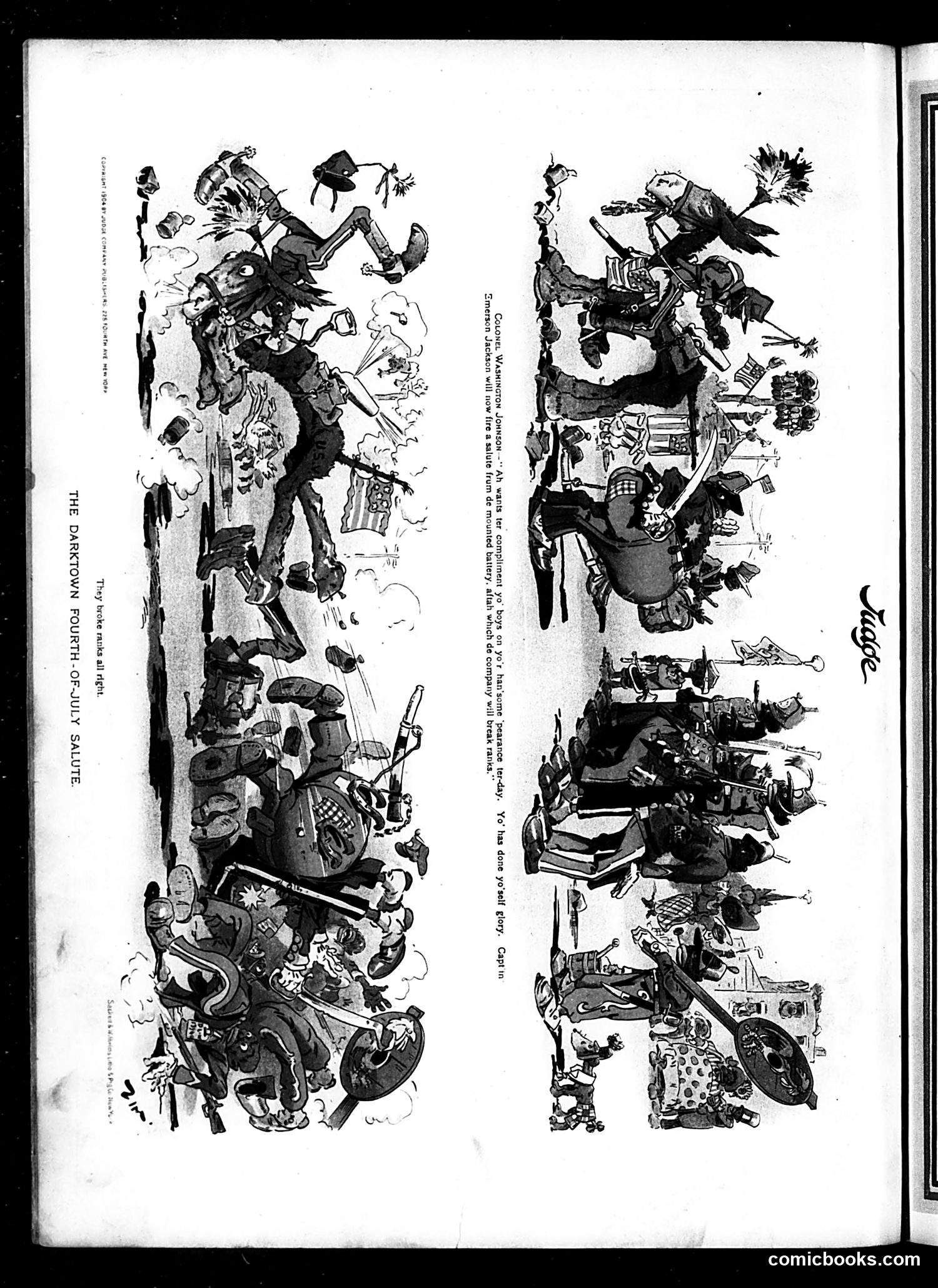
This page contains two political cartoons rendered upside-down, making detailed interpretation difficult. The OCR text is largely corrupted and unreadable, preventing identification of specific figures or events referenced. From the visible imagery, both cartoons appear to depict chaotic scenes with multiple human figures engaged in conflict or tumultuous activity—suggesting satire of political turmoil or social disorder. The style is characteristic of early-to-mid 20th century American editorial cartooning, with exaggerated caricatures and dynamic composition meant to criticize public figures or policies. **Without readable text or clearer orientation**, I cannot reliably identify which politicians or events are being satirized, the specific joke's point, or the historical context. To properly explain these cartoons to a modern reader would require either a legible, correctly-oriented version or additional documentation.