
A complete issue · 16 pages · 1904
Judge — May 21, 1904
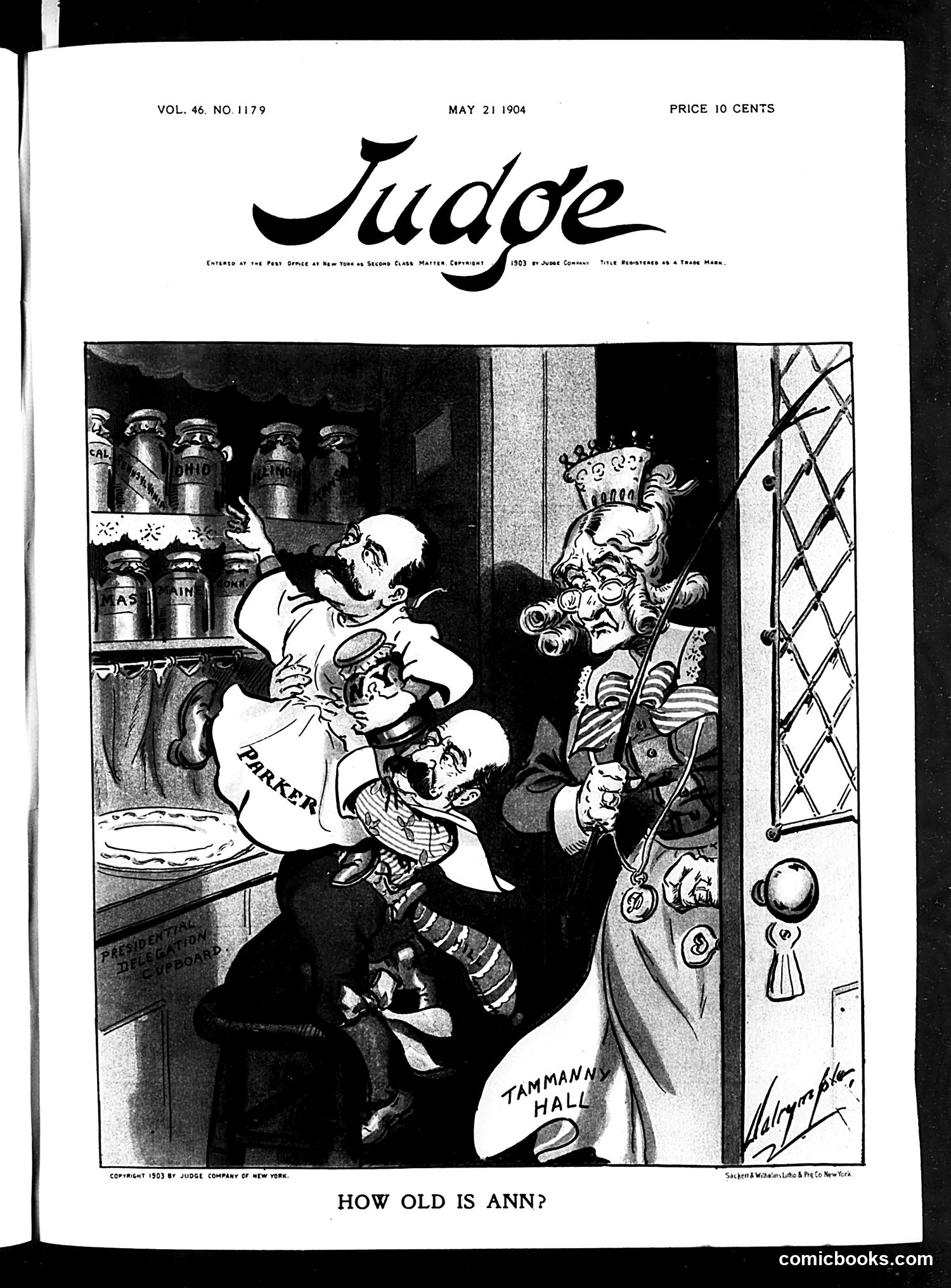
This political cartoon, titled "How Old Is Ann?", appears to satirize a legal or political controversy involving someone named "Ann" (possibly referencing a person or entity). The scene depicts figures in Tammany Hall (the infamous New York Democratic political machine, labeled on the figure's clothing) encountering what appears to be royalty or an authority figure at a door. Shelves of bottles labeled with names like "Parker" suggest references to alcholic products or political "ingredients." The cartoon likely mocks Tammany Hall's political maneuvering or corruption. However, without additional historical context about which specific "Ann" or controversy is referenced, the precise political meaning remains unclear. The satire appears to involve questions about legitimacy or age in some political matter.
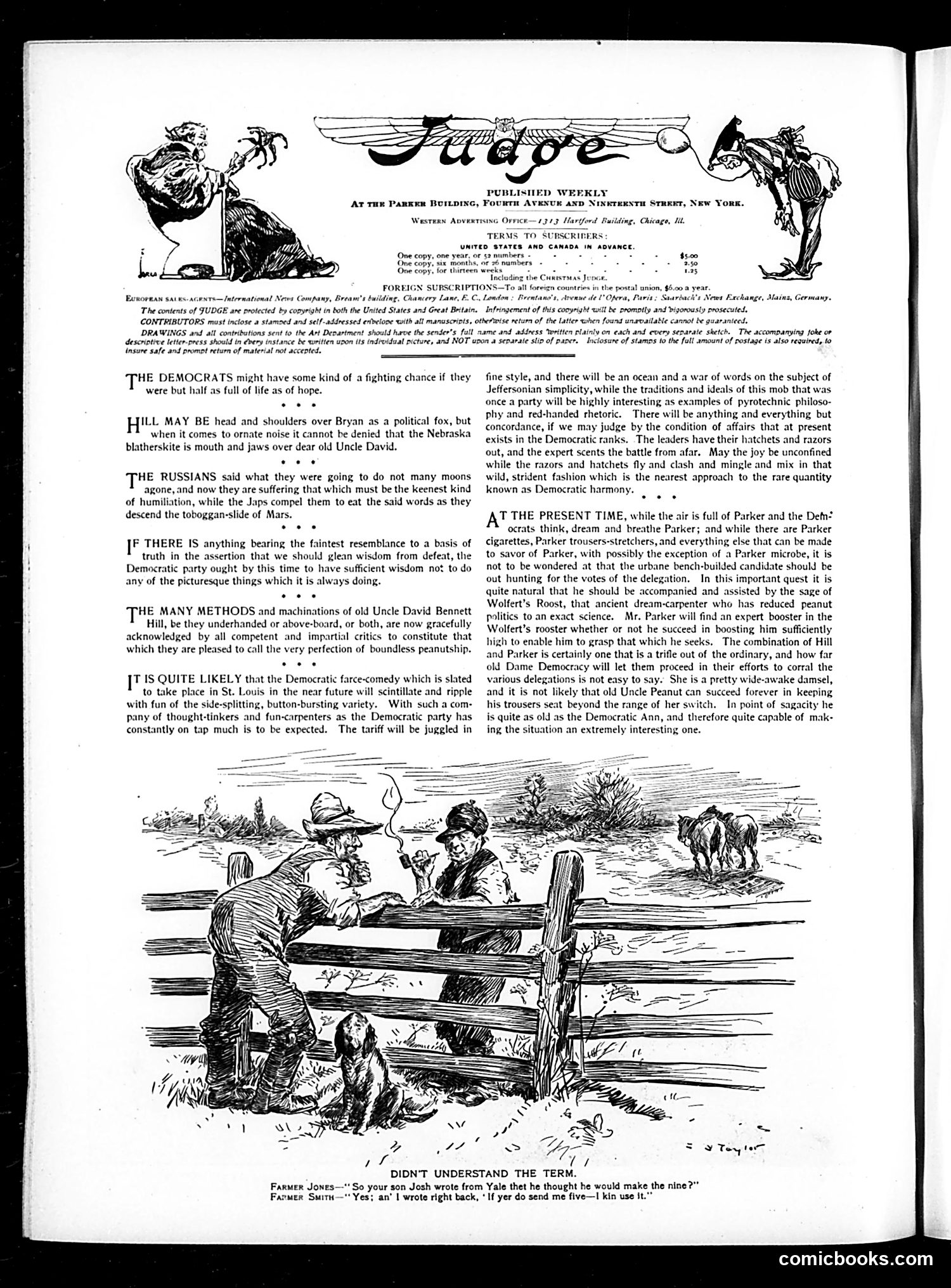
This page contains political commentary on the 1904 Democratic presidential contest. The text criticizes Democratic prospects, comparing Bryan (likely William Jennings Bryan, three-time failed candidate) unfavorably to Uncle David Bennett Hill as a political figure. The main focus is on **Alton B. Parker**, the Democratic nominee, described as hunting for votes while accompanied by "the age of Wolcott's Roost"—apparently mocking his elderly supporters and outdated political approach. The bottom cartoon depicts **two farmers discussing a son's Yale education**, with the joke hinging on the boy's inability to contribute meaningfully to farm work despite his expensive schooling—satirizing the perceived impracticality of elite education. The satire targets Democratic disarray and generational disconnect within the party.
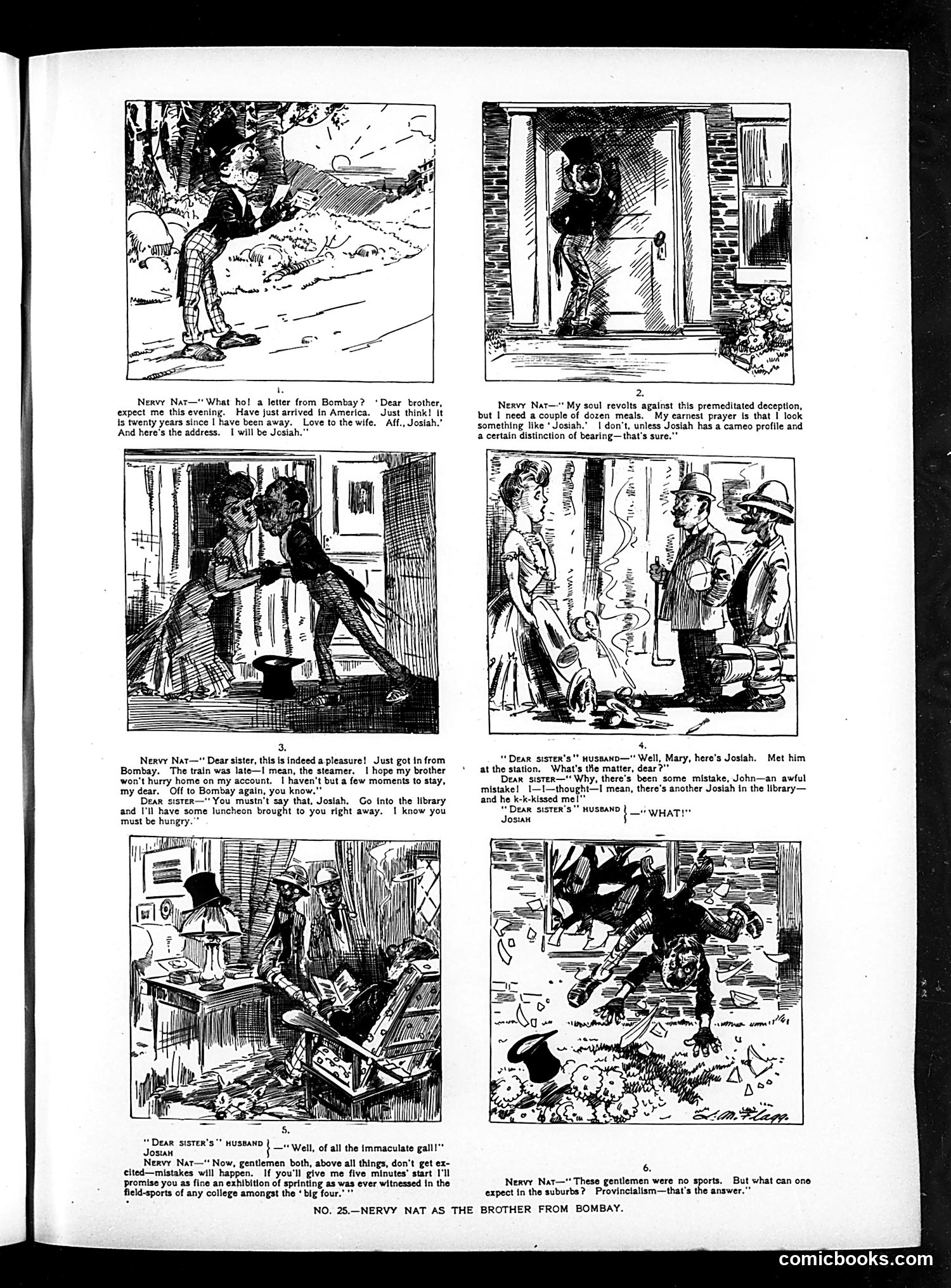
This comic series satirizes a common con-artist scheme of the era: an imposter claiming to be a long-lost relative from abroad (here, "Bombay") to extract money or favors from gullible victims. The protagonist "Nervy Nat" poses as someone's brother returning from India. Through six panels, we see him progressively manipulating his "sister," requesting increasingly audacious favors (funds, introductions, library access) while exhibiting crude behavior and poor manners that should expose the deception. The satire targets both the con man's brazen audacity and the victims' naive willingness to believe implausible stories about distant relatives. The title's emphasis on "Nervy" highlights the scheme's boldness—the sheer nerve required to carry off such an obvious fraud.
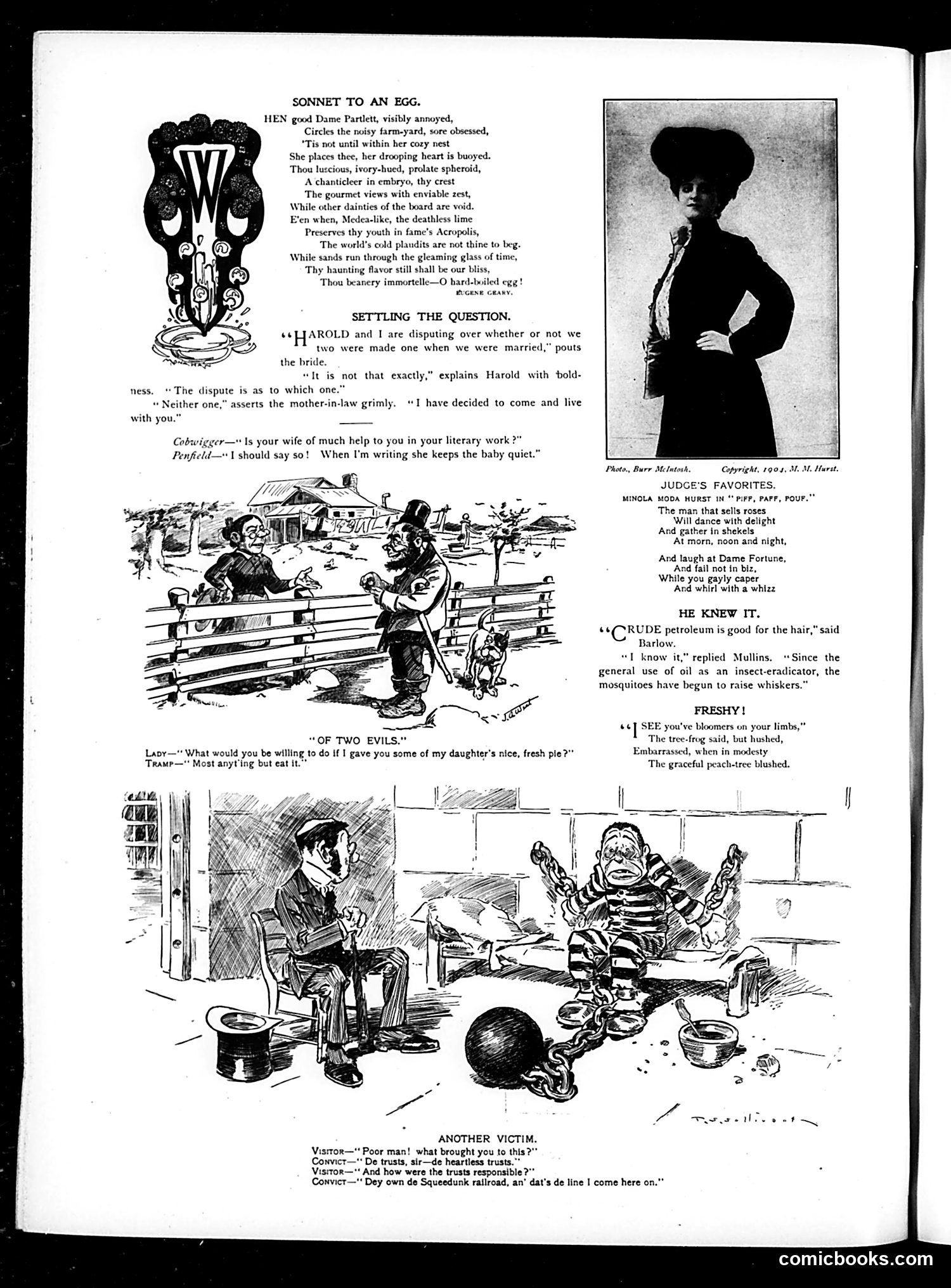
This Judge magazine page contains several unrelated humor pieces rather than connected political cartoons: 1. **"Sonnet to an Egg"** - A literary parody celebrating a hen's egg, accompanying decorative Art Nouveau imagery. 2. **"Settling the Question"** - A domestic comedy sketch about a married couple's dispute, with the husband claiming his wife helps by keeping the baby quiet while he writes. 3. **"Of Two Evils"** and **"Another Victim"** - Rural/farm-themed cartoons depicting interactions between country folk and presumably urban visitors, using class-based humor common to the era. 4. **"Judge's Favorites"** and **"Freshy!"** - Brief humorous verses on miscellaneous topics. The page primarily showcases **domestic and social humor** rather than political satire, typical of Judge's light entertainment content. The illustrations use period cartoon conventions to mock class differences and rural-urban tensions.
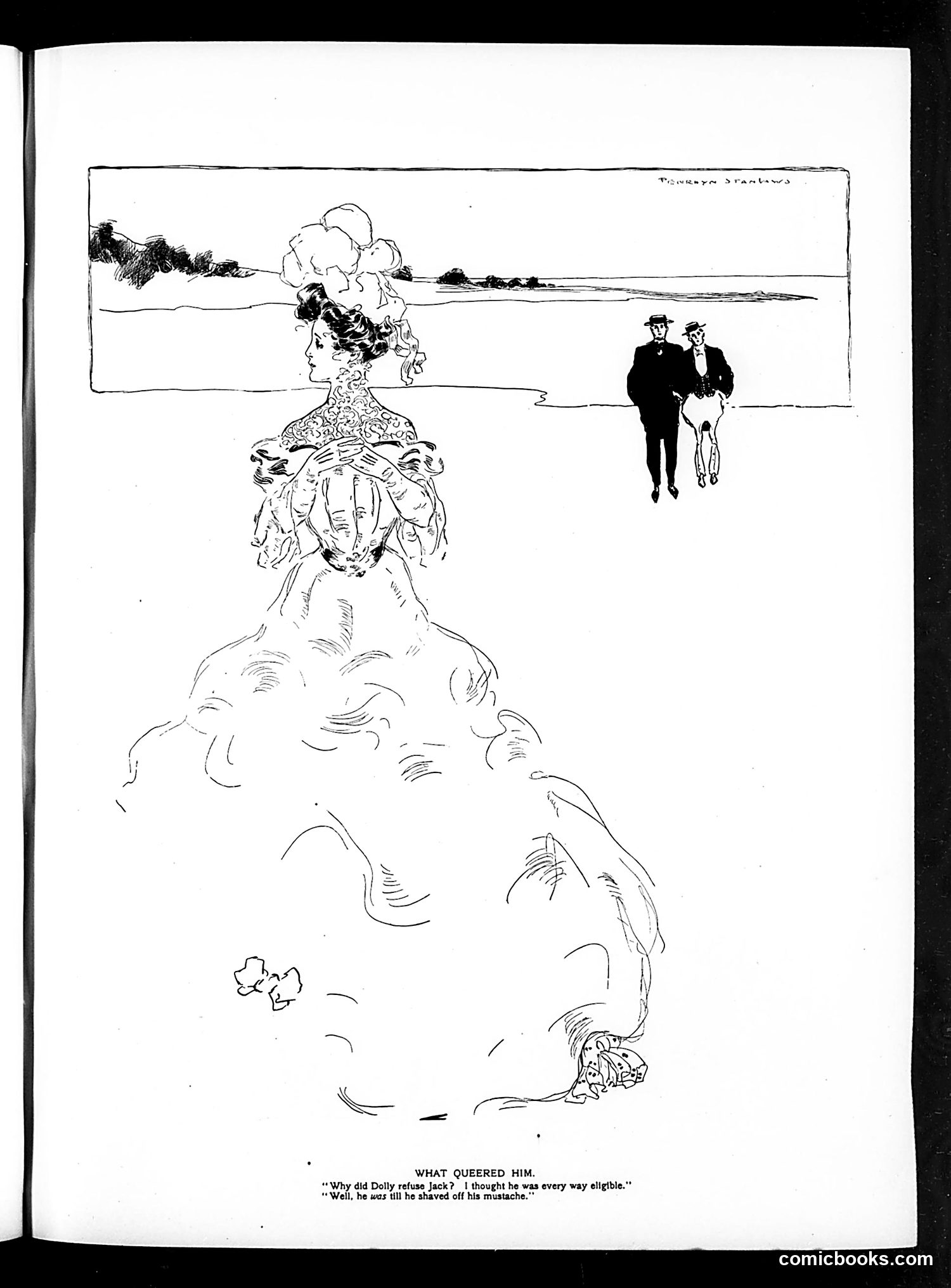
This cartoon satirizes changing standards of masculine attractiveness. The joke hinges on a woman ("Dolly") rejecting a suitor ("Jack") specifically because he shaved off his mustache—despite him being "every way eligible" in all other respects. The exaggerated illustration of an elaborately dressed woman with an enormous feathered hat contrasts with two small, formally-dressed men in the background, emphasizing the woman's dominant role in the decision. The satire mocks both the superficiality of romantic selection (one feature negates all other qualifications) and the period's cultural obsession with facial hair as a marker of masculinity and desirability. The cartoon reflects early 20th-century social anxieties about changing masculine ideals and women's increasing agency in courtship choices.
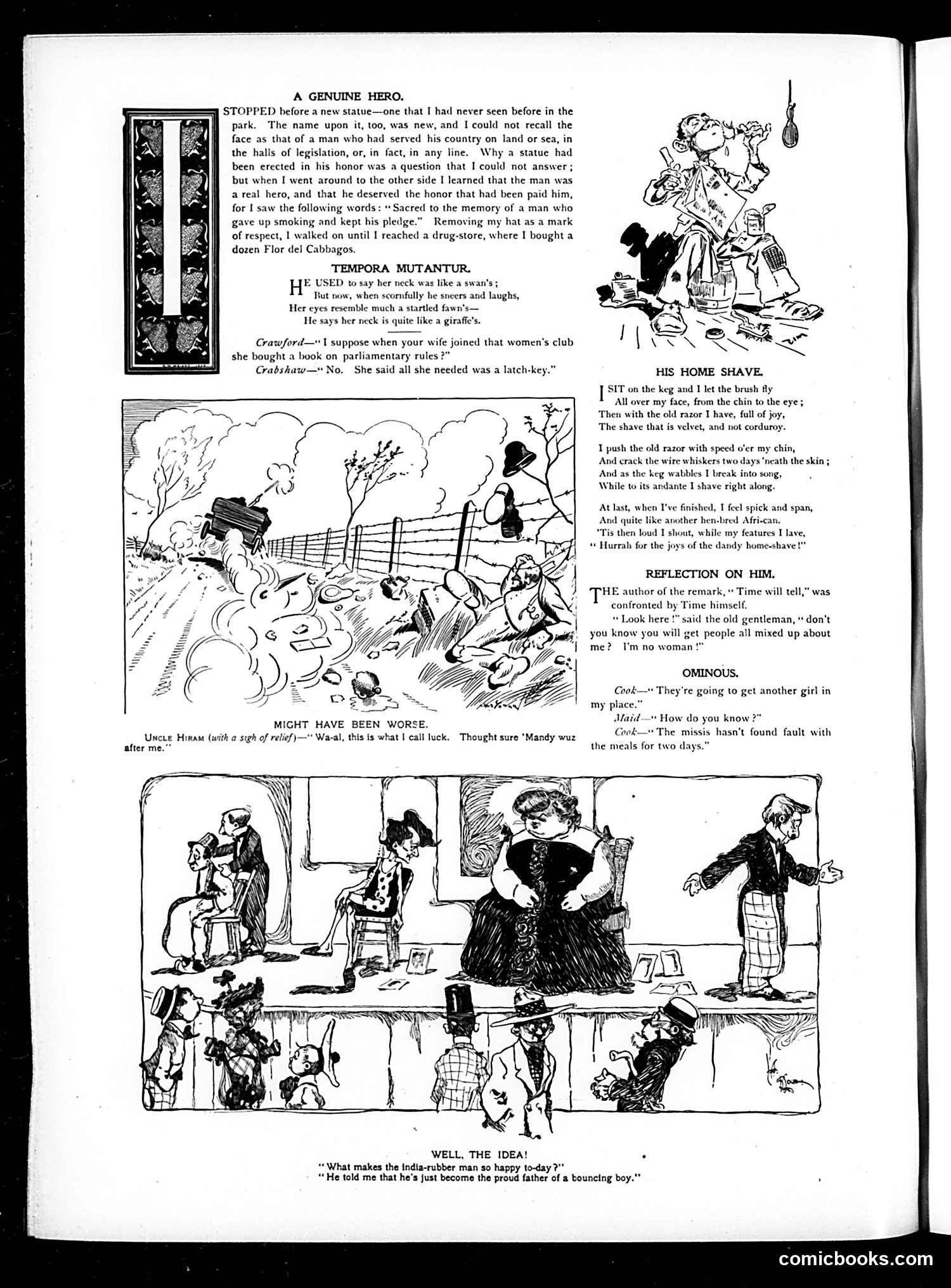
This page collects several satirical pieces mocking social conventions and modern changes: **"A Genuine Hero"** ridicules the trend of erecting public statues. The narrator discovers a monument honoring a man simply for quitting smoking—absurdly trivial compared to actual public service—yet treats this minor personal achievement as heroic. The joke satirizes both inflated commemoration and the era's temperance movement obsession. **"Tempora Mutantur"** (Latin: "times change") mocks how marriage erodes idealization. A husband once praised his wife's graceful neck; now he compares it unfavorably to a giraffe's, suggesting women's liberation (via women's clubs) somehow diminishes their appeal—a backhanded jab at feminist progress. **"His Home Shave"** celebrates simple domestic pleasure in humorous verse about a man shaving at home—likely contrasting with barber culture. The remaining pieces offer light humor about domestic life and parenthood. Overall, the page reflects Judge's conservative satirical stance on social change, particularly regarding women's increasing independence and public participation, rendered through gentle mockery rather than outright hostility.
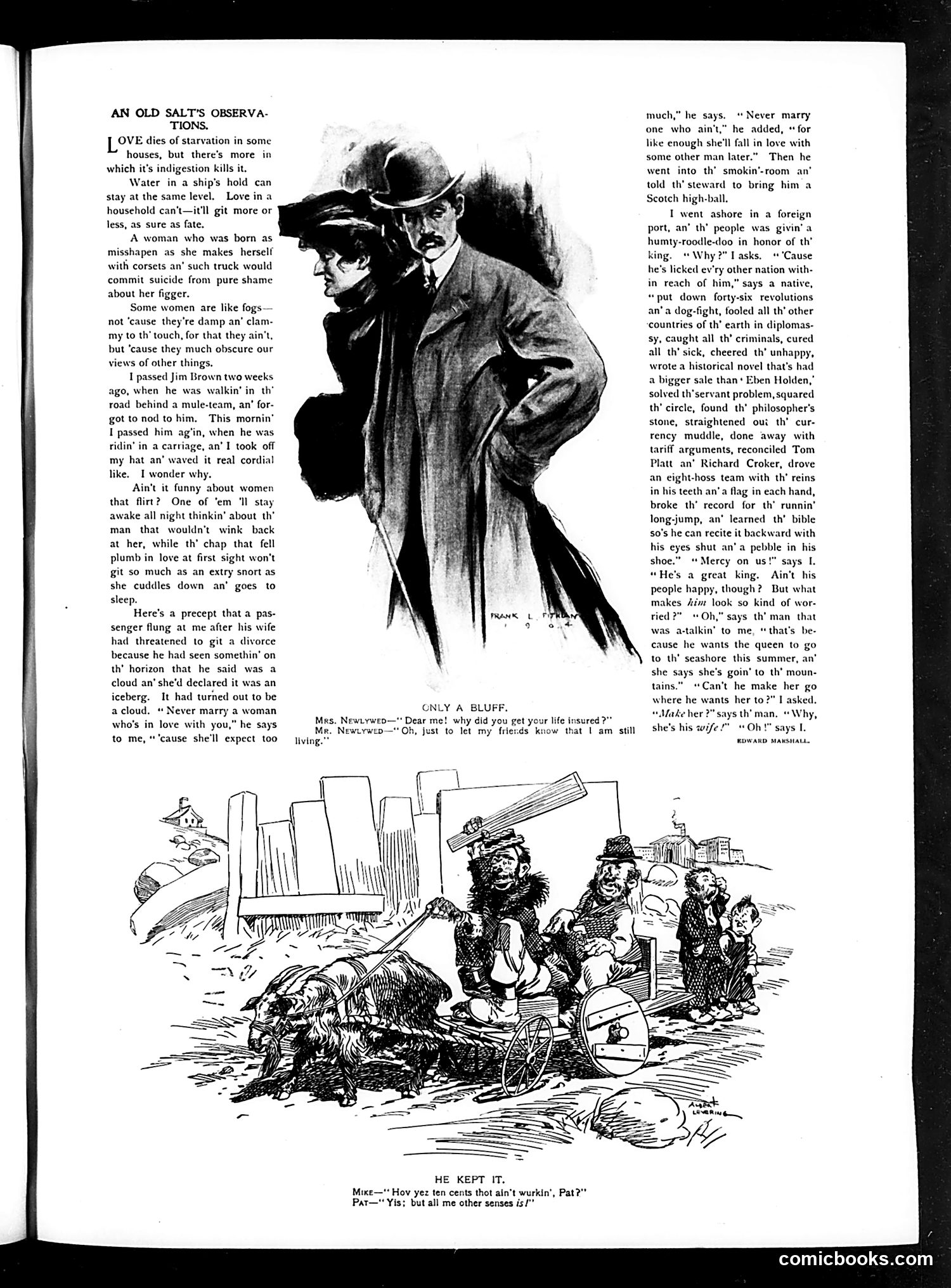
This page contains satirical commentary on marriage and relationships presented as advice from "an old salt" (seasoned sailor). The humor targets women's behavior, marital discord, and gender dynamics typical of early 20th-century American satirical magazines. The main text mocks women's inconsistency in romance, vanity, and marital complaints. A secondary anecdote satirizes political flattery—citizens celebrate a king whose accomplishments are absurdly inflated ("wrote a historical novel," "squared th' circle"), yet he remains anxious about his wife refusing to vacation where he wishes, exposing that even powerful men lack domestic control. The cartoon "Only a Bluff" depicts a couple where the wife exaggerates getting wet to impress friends about her husband's attentiveness—the satire being she's fabricating his devotion. The bottom cartoon shows Irish characters (suggested by dialect), with one claiming his ten cents isn't "workin'" because his other senses function instead—a pun on employment. These pieces reflect period attitudes about women as irrational, men as domestically powerless, and immigrant humor.
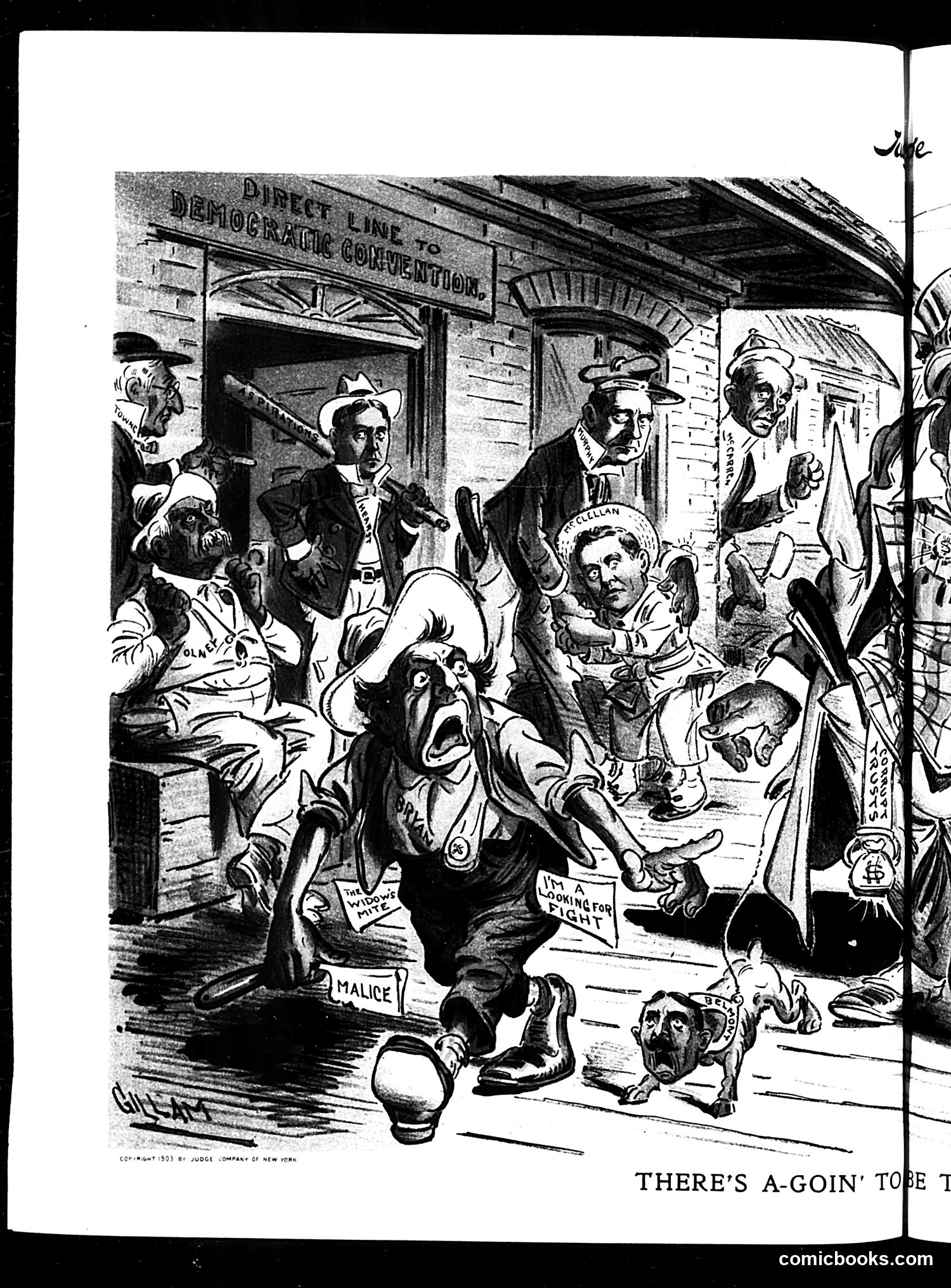
This is a satirical cartoon about Democratic Party internal conflict. The setting is a "Direct Line Democratic Convention" headquarters, where party figures appear to be in chaos or fighting. The central caricatured figure labeled "MALICE" (a donkey, the Democratic symbol) is depicted in an aggressive, chaotic state amid party representatives. Various labels visible include references to discord and division within the party. The cartoon's title, "THERE'S A-GOIN' TO BE," suggests impending turmoil or confrontation. This appears to satirize Democratic infighting, possibly during a convention period when factional disputes threatened party unity. Without clearer identification of specific individuals or the exact date, I cannot definitively name which Democratic figures or historical moment is being lampooned, though the imagery clearly critiques the party's internal strife and dysfunction.
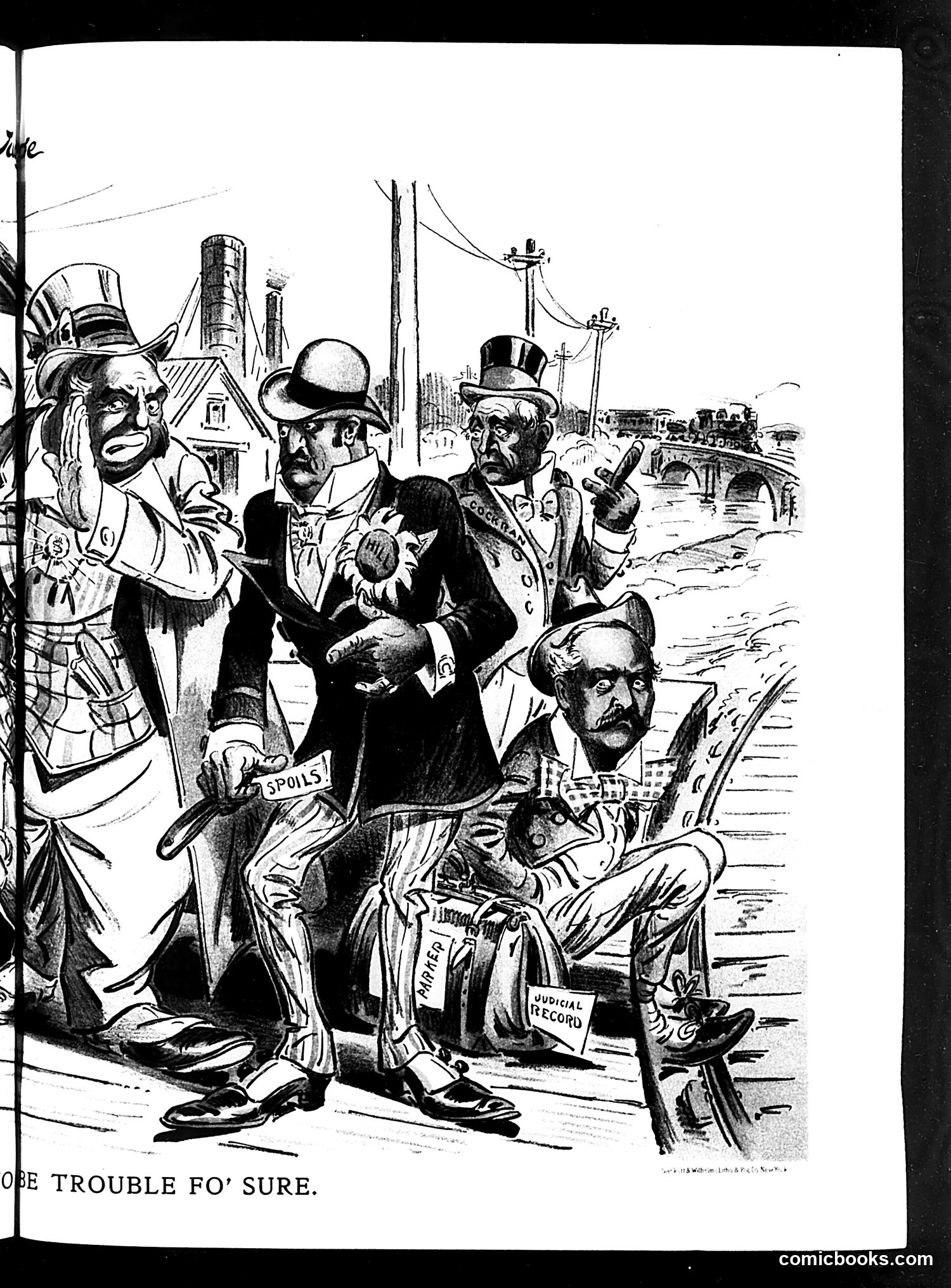
This Judge magazine cartoon titled "OBE TROUBLE FO' SURE" uses racist caricature to satirize political corruption or scandal. The figures appear to be well-dressed politicians or officials in top hats, with exaggerated features typical of late 19th/early 20th-century racist imagery. One figure prominently displays labels reading "SPOILS," "JUDICIAL RECORD," and what appears to be "IMPERIAL" or similar governmental references, suggesting commentary on patronage systems or judicial impropriety. The setting appears to be a waterfront or dock with industrial infrastructure, possibly indicating a specific location or jurisdiction involved in the scandal. Without clearer identification of the specific figures or historical context visible in the image alone, the precise political event being lampooned remains unclear, though the cartoon clearly critiques governmental corruption or mismanagement through its exaggerated characterization.
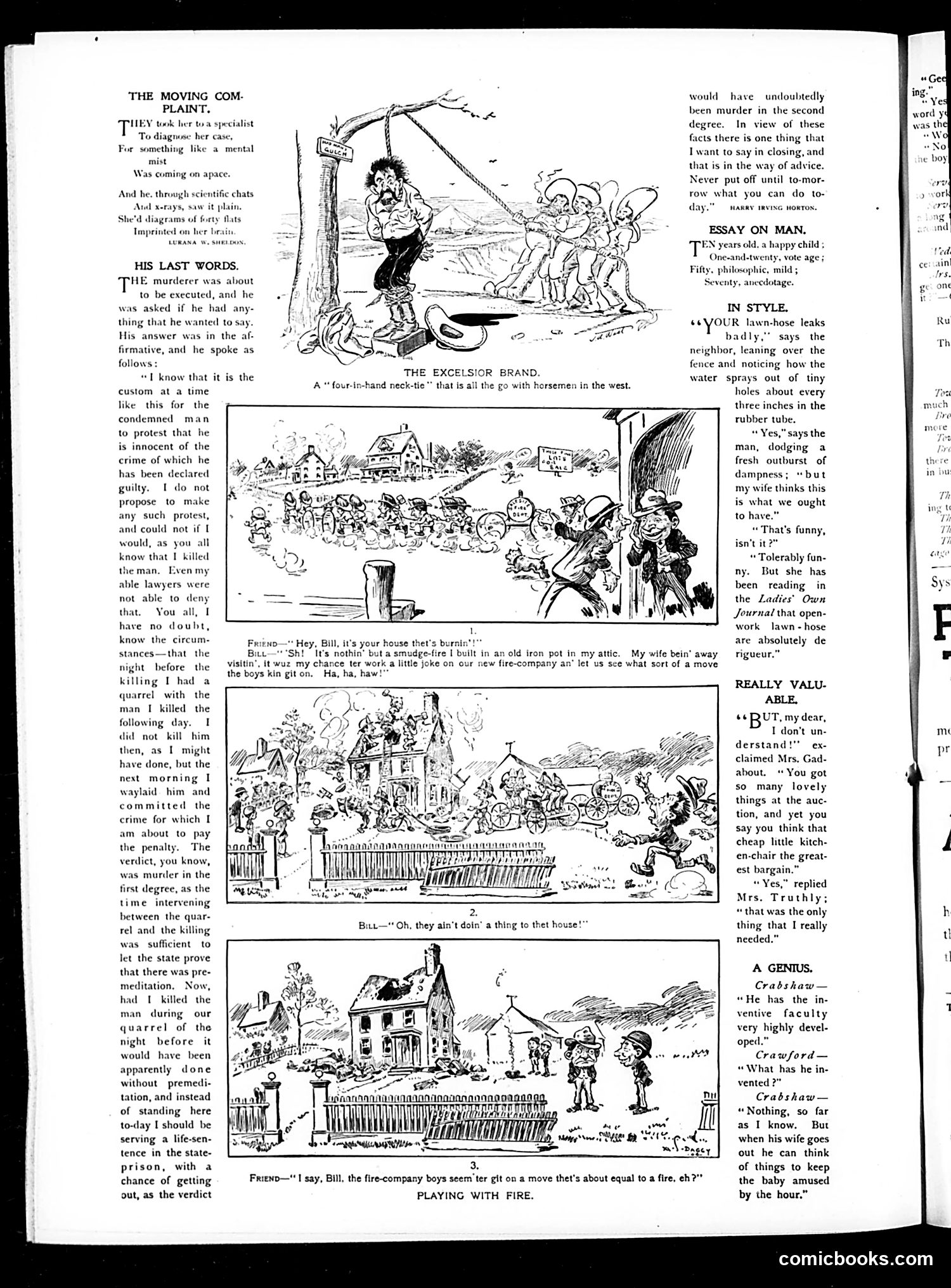
This page contains several unrelated satirical pieces typical of Judge magazine's humor: **"The Moving Complaint"** mocks hypochondria—a woman consults a specialist about vague mental ailments, and the doctor diagrams "forty flats" in her brain, suggesting her complaints are imaginary or trivial. **"His Last Words"** is a darkly comedic execution scene where the condemned man surprisingly admits his guilt (rather than protesting innocence as custom dictates). He then delivers advice about not procrastinating—a bathetic punchline that undercuts the gravity of his situation. **"The Excelsior Brand"** shows a Western scene advertising four-in-hand neckties. **"Playing with Fire"** depicts rural characters joking about a homemade fire-company prank. The remaining pieces humorously contrast pretension with practicality: a man's wife insists on fashionable "open-work" lawn hoses (from *Ladies' Own Journal*); a woman values a cheap kitchen chair as her only genuine purchase; and a "genius" is one whose inventiveness consists only of amusing babies. The satire targets fashion obsession, materialism, and middle-class affectation.
This page is primarily **advertising and short humor pieces** rather than political cartoons. The content consists of: **Humor Pieces**: Brief one-liner jokes about everyday situations—a father taking credit for his son's bad composition, servants observing their employers' habits, and a count marrying an American heiress without knowing her name. These satirize common social pretensions and class dynamics of the era. **Advertisements**: The page features ads for consumer products (Packer's Tar Soap, Sohmer Pianos, Evans' Ale, Prudential Insurance) typical of early 20th-century magazines. **Notable Content**: A testimonial about Postum coffee substitute attributing various ailments—insomnia, nervousness, indigestion—to regular coffee consumption, advocating switching to Postum as a health remedy. **No clear political satire** is present on this particular page. The humor is social commentary on American middle-class behavior rather than commentary on current events or political figures. The page reflects the magazine's mixed editorial/advertising format typical of the period.
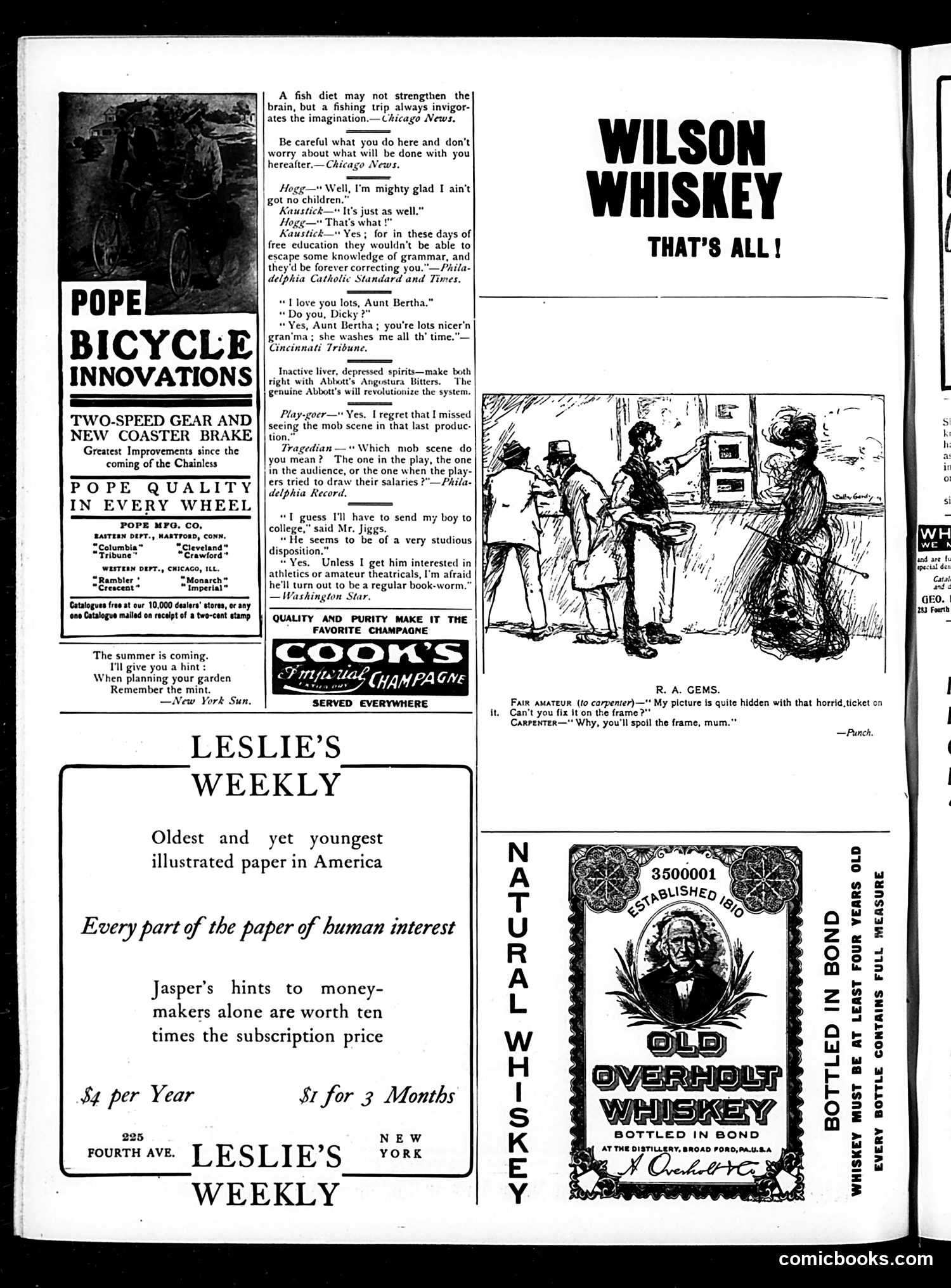
This page is primarily **advertisements and filler content** rather than political satire. The main elements are: **Advertisements:** Pope bicycles, Cooks champagne, Abbott's bitters, Wilson whiskey, and Leslie's Weekly magazine dominate the layout. **Comic Vignettes:** Several brief, disconnected jokes appear—about grammar-correcting children, a child's affection for "Aunt Bertha," theatrical salary disputes, and a boy becoming a "book-worm." These are gentle domestic humor rather than political commentary. **The Single Cartoon:** "R.A. Gems" (from Punch) shows an amateur painter complaining that a ticket obscures his picture on the frame—a mild visual joke about framing issues. **Overall Context:** This appears to be a typical early 20th-century magazine page mixing light humor with commercial advertisements. There is **no clear political satire or social commentary** visible—just period advertising and mild, family-oriented jokes that would have amused contemporary readers.
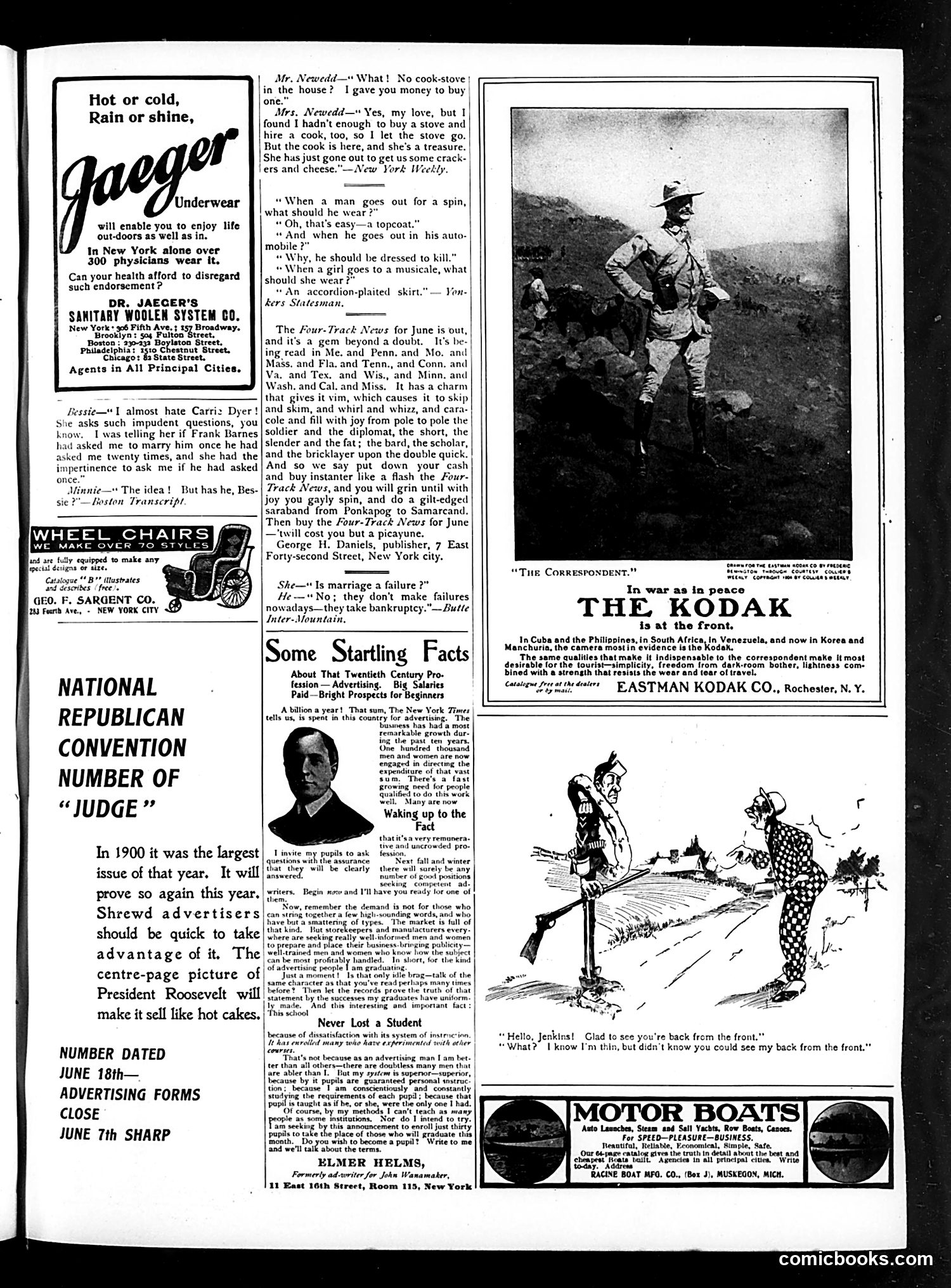
This page from Judge (circa 1900) primarily contains **advertisements and filler content** rather than satirical cartoons. The main cartoon visible shows two soldiers—one returning from the front, greeting another with "Hello, Jenkins! Glad to see you're back from the front." The second responds, "What? I hope I'm thin, but didn't know you could see my back from the front." This is a **visual gag about extreme thinness**, likely poking fun at soldiers' hardship conditions or inadequate supplies during the Spanish-American War (then recent). The page also includes a **Kodak advertisement** featuring a photographer at war, emphasizing the camera's presence in modern conflicts. Most content consists of **social humor** (jokes about marriage, courtship), **product advertisements** (Dr. Jaeger's wool underwear, wheelchairs, motor boats), and an announcement that this issue (June 18th) will feature President Theodore Roosevelt prominently and sell well. The page reflects early 1900s consumer culture and contemporary military references rather than sharp political satire.
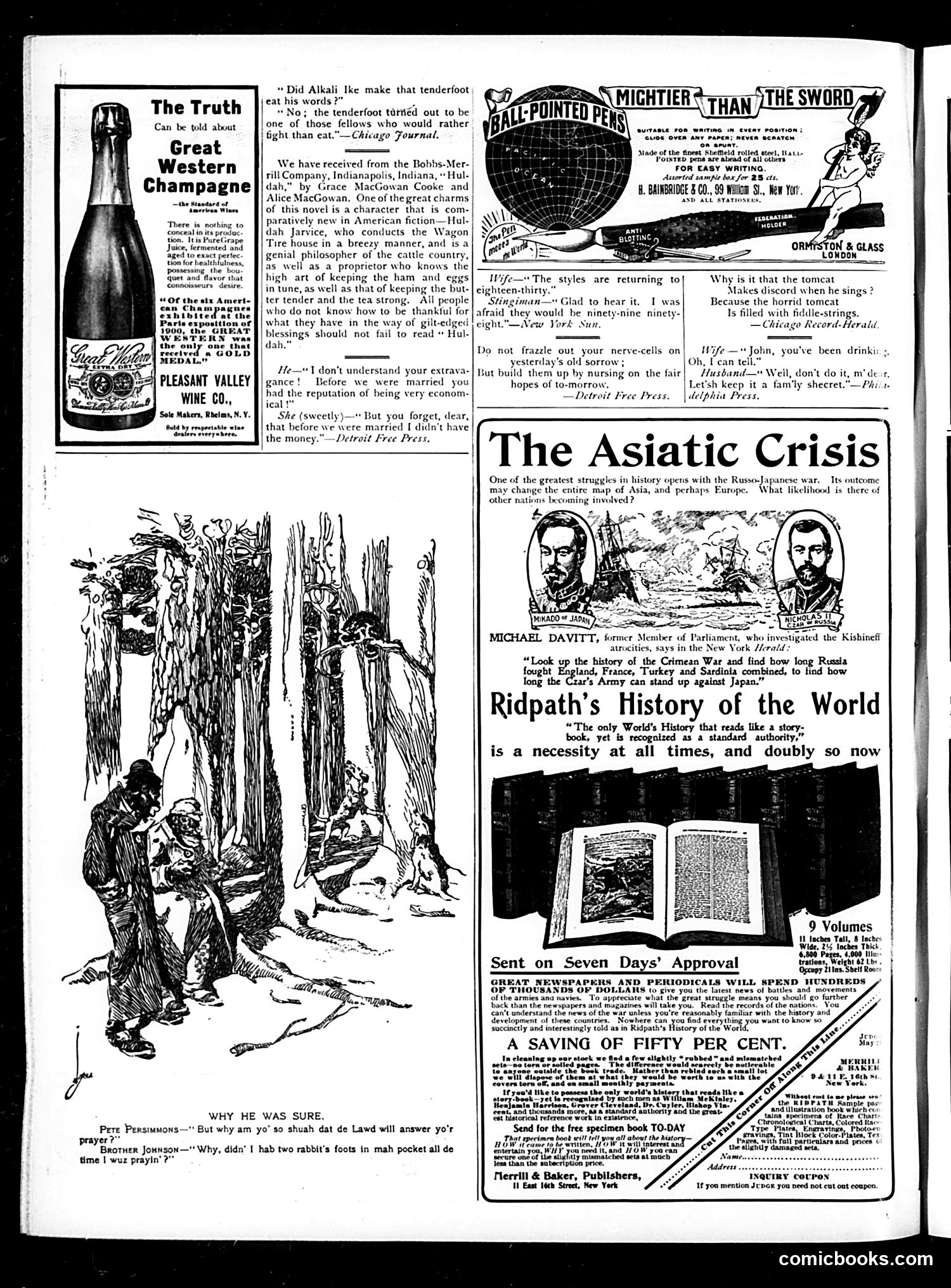
This page combines light humor with advertising typical of early 1900s magazines. **The Cartoons/Jokes:** - "Why He Was Sure": Rural dialect humor about two Black men discussing prayer efficacy, with one claiming his rabbit's feet guaranteed God would answer—a racist stereotype mixing folk superstition with prayer. - "Did Alkali Ike make that tenderfoot eat his words?": References a Western character (likely from popular fiction) who prefers fighting to eating. - Marriage/domestic humor: A wife's extravagance before vs. after marriage; a husband caught drinking; fashion cycles returning to "eighteen-thirty." **The Advertisements:** Most of the page comprises ads for Pleasant Valley Wine, Ridpath's History of the World (9-volume encyclopedia), and Bainbridge & Co. pens—typical products pitched through the magazine. **Historical Context:** This appears to be from around 1904-1905, given the "Asiatic Crisis" (Russo-Japanese War) headline. The racial stereotypes and casual drinking references reflect period attitudes unchallenged at the time.
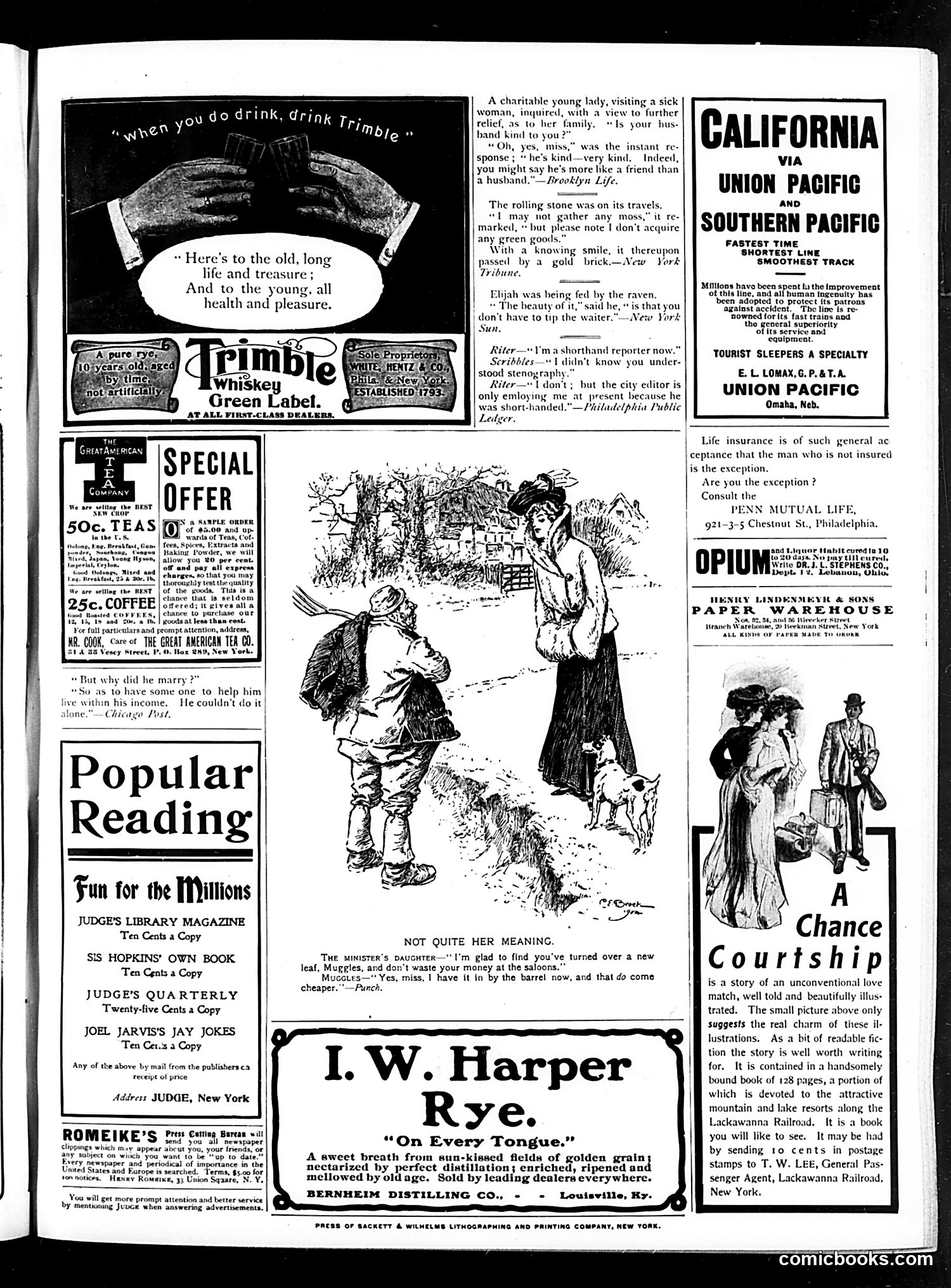
This is primarily an **advertising and humor page** from Judge magazine, not a political cartoon. The page contains: **Main Content:** - Several brief **humor items** (short jokes about marriage, charity, biblical references, stenography) typical of Judge's satirical format - A sketch titled "Not Quite Her Meaning" showing a minister's daughter discussing temperance with a woman who's actually buying alcohol "by the barrel"—a joke about prohibition-era hypocrisy **Advertisements:** The bulk of the page features ads for consumer products (Trimble Whiskey, I.W. Harper Rye, coffee, life insurance) and services (railroad companies, paper warehouses). These reflect early-20th-century American commerce. **Satire Point:** The humor relies on wordplay and ironic misunderstandings rather than political commentary. The "Not Quite Her Meaning" cartoon gently mocks moral pretense—the minister's daughter thinks she's advocating sobriety when her listener is already drinking heavily, suggesting the ineffectiveness of temperance messaging. The page itself is a **historical artifact** showing Judge's mixed editorial-advertising model rather than substantive satire.
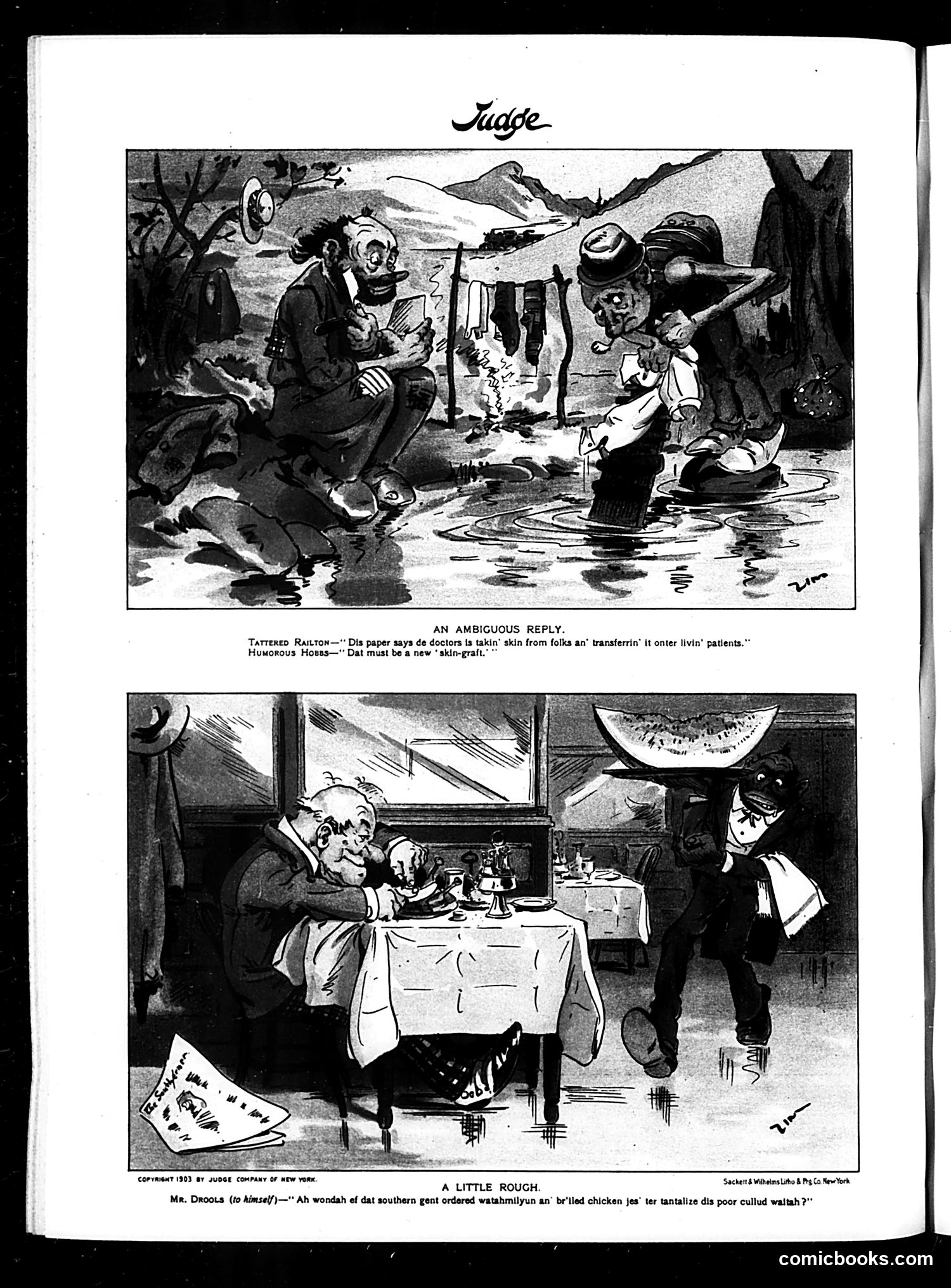
**Top Cartoon - "An Ambiguous Reply":** Two characters discuss a newspaper story about skin grafting (a genuine medical innovation of the era). The "Tattered Railton" misunderstands "transferring skin from folks" as literal theft, while the "Humorous Horse" makes a pun: the procedure is a new type of "skin-graft"—playing on "graft" as both medical grafting and petty corruption/theft. The joke relies on wordplay about the double meaning of graft. **Bottom Cartoon - "A Little Rough":** A Black waiter serves two white men at a restaurant. Mr. Droots (in dialect) wonders if the Southern gentleman deliberately ordered watermelon and fried chicken—foods stereotypically associated with Black servants—to torment or demean the waiter. The satire mocks Southern racism and the deliberate use of stereotypical food orders as a form of humiliation. Both cartoons employ heavy racial dialect typical of 1903 Judge magazine's casual racism.