
A complete issue · 20 pages · 1904
Judge — May 14, 1904
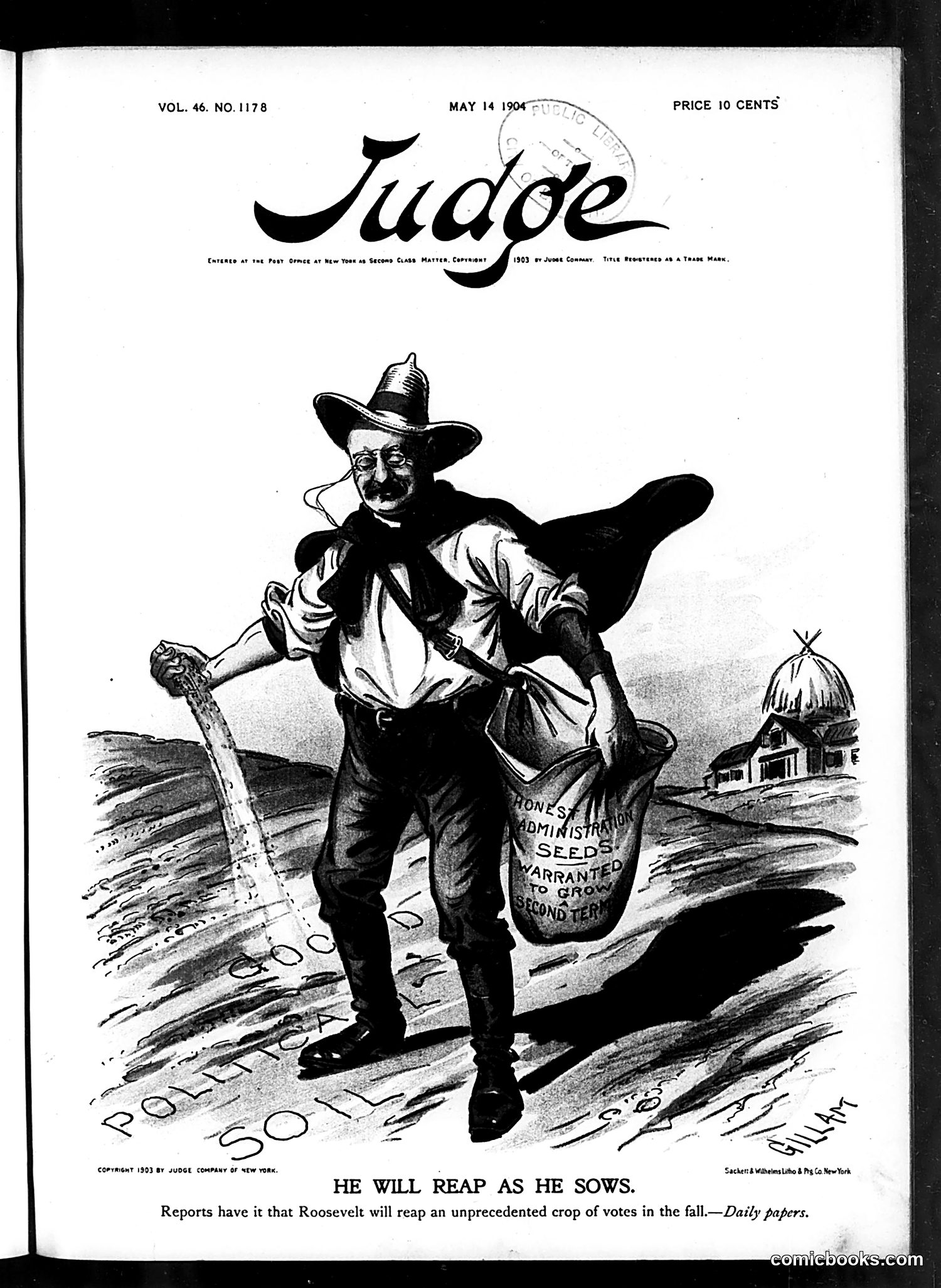
This political cartoon satirizes President Theodore Roosevelt's anticipated success in the 1904 election. The figure, dressed as a farmer in a wide-brimmed hat, represents Roosevelt "sowing seeds" labeled "ADMINISTRATION SEEDS WARRANTED TO SECOND TERM"—a reference to his policies and political machine. The caption "HE WILL REAP AS HE SOWS" plays on the biblical proverb, suggesting Roosevelt will harvest abundant votes in the fall election due to his political efforts. The accompanying newspaper quote confirms this interpretation: "Reports have it that Roosevelt will reap an unprecedented crop of votes in the fall." The cartoon expresses confidence—or ironic confidence—in Roosevelt's electoral prospects through agricultural metaphor, a common nineteenth-century political imagery.
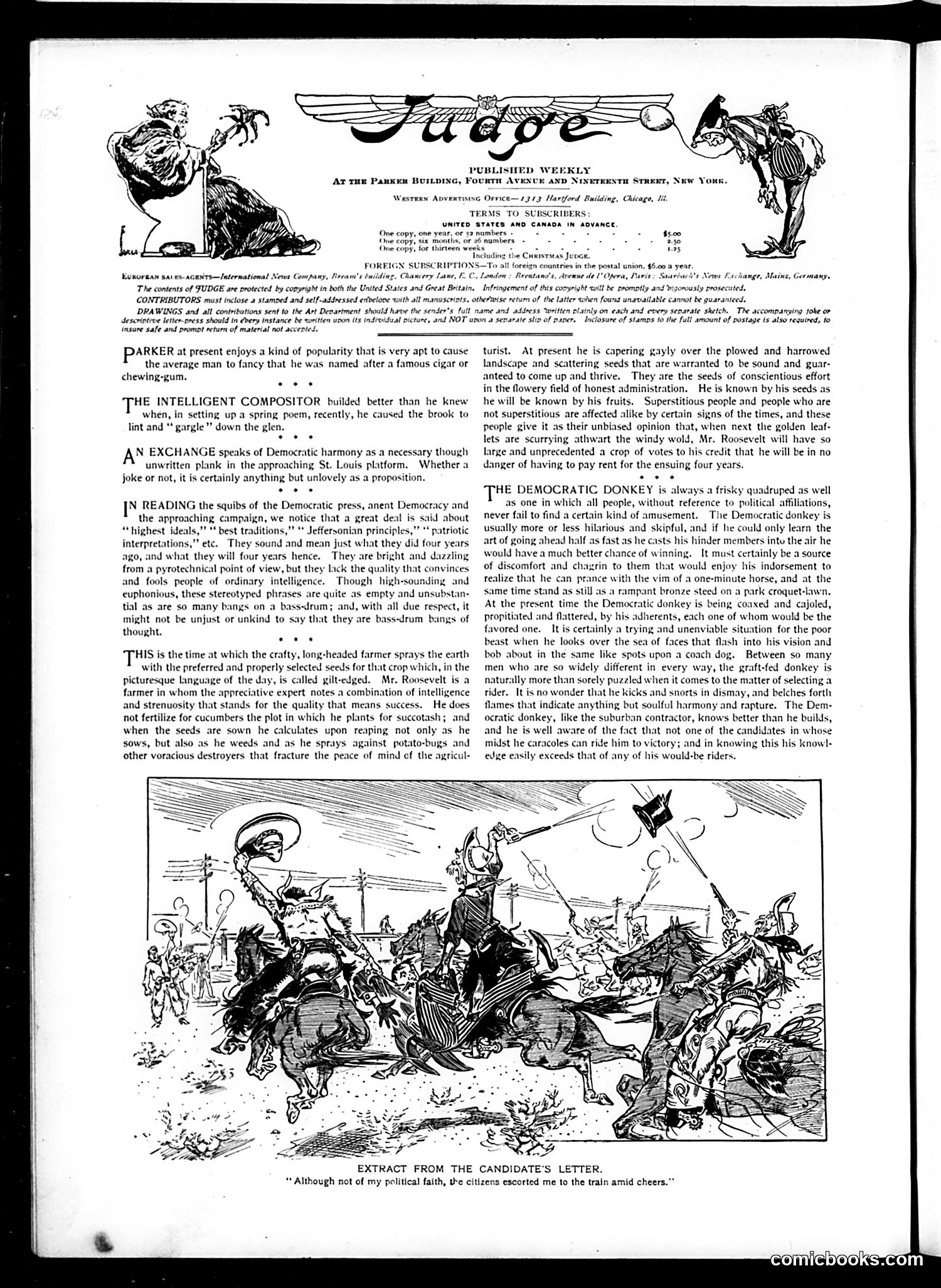
This page satirizes American political figures using animal metaphors common to Gilded Age editorial cartooning. The text columns mock various political topics through allegorical commentary—comparing politicians to a "Democratic Donkey" and discussing political strategy. The large illustration at bottom shows chaotic political activity, likely depicting election campaign turmoil or political infighting. The caption references "Extract from the Candidates' Letter," suggesting commentary on campaign rhetoric versus reality. The smaller decorative images at top appear to be Judge's masthead illustrations featuring anthropomorphic creatures, typical of the magazine's visual style. Without clearer identification of specific candidates or election dates from the OCR text, the exact political figures and events remain unclear, though the satire clearly targets Democratic politics and electoral processes of the era.
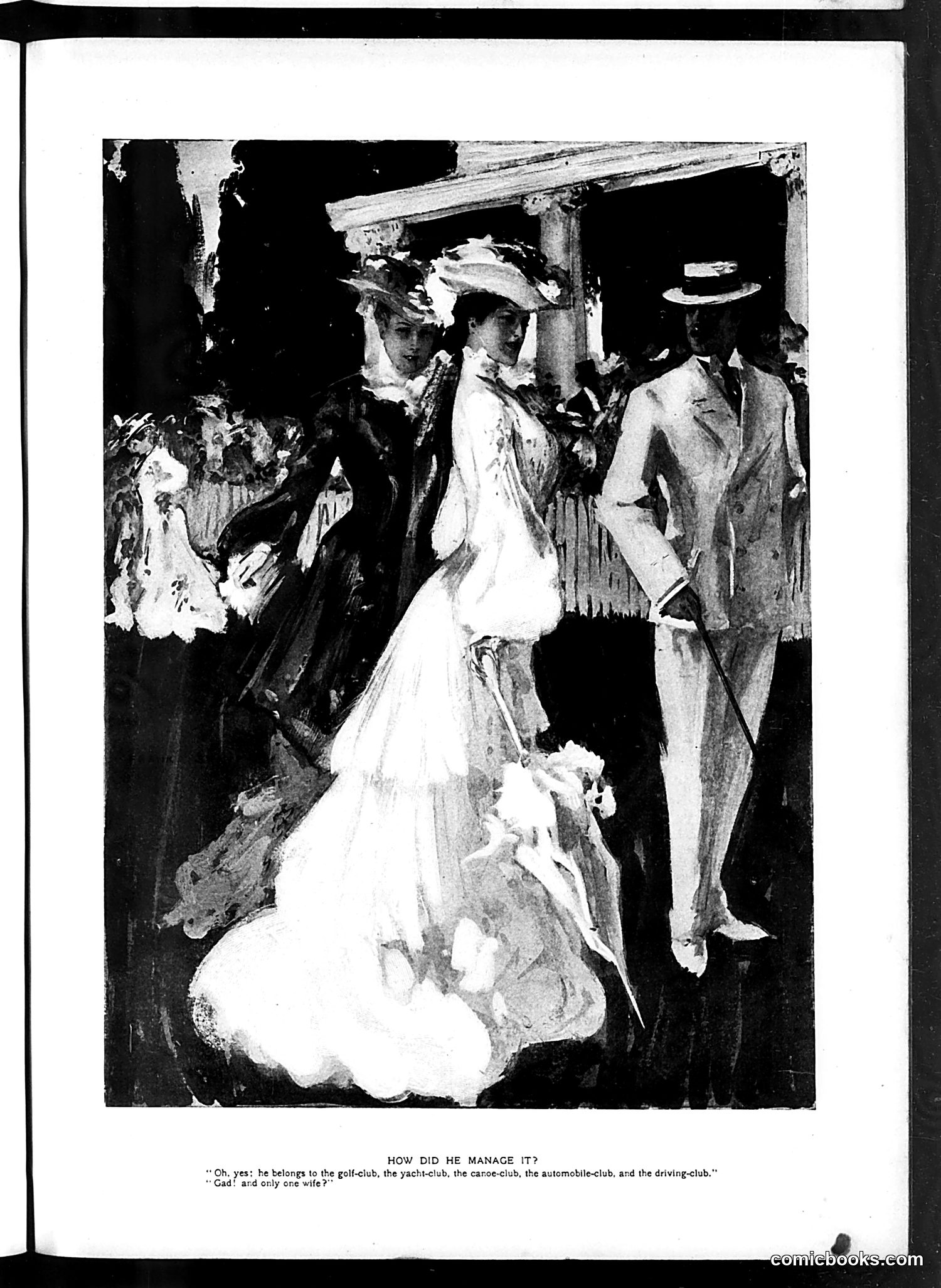
This illustration from *Judge* magazine satirizes a wealthy man's social climbing. The caption lists his memberships: "the golf-club, the yacht-club, the country-club, the automobile-club, and the driving-club," with the punchline "Gad! ard only one wife?" The joke targets Gilded Age excess and the proliferation of exclusive clubs for the rich. The image depicts a fashionable woman (likely the "one wife") surrounded by well-dressed men at what appears to be a social gathering. The satire suggests that maintaining membership in multiple expensive, exclusive organizations while supporting one wife is an achievement worthy of amazement—mocking both the absurdity of conspicuous consumption and the era's obsession with exclusive social memberships as status symbols.
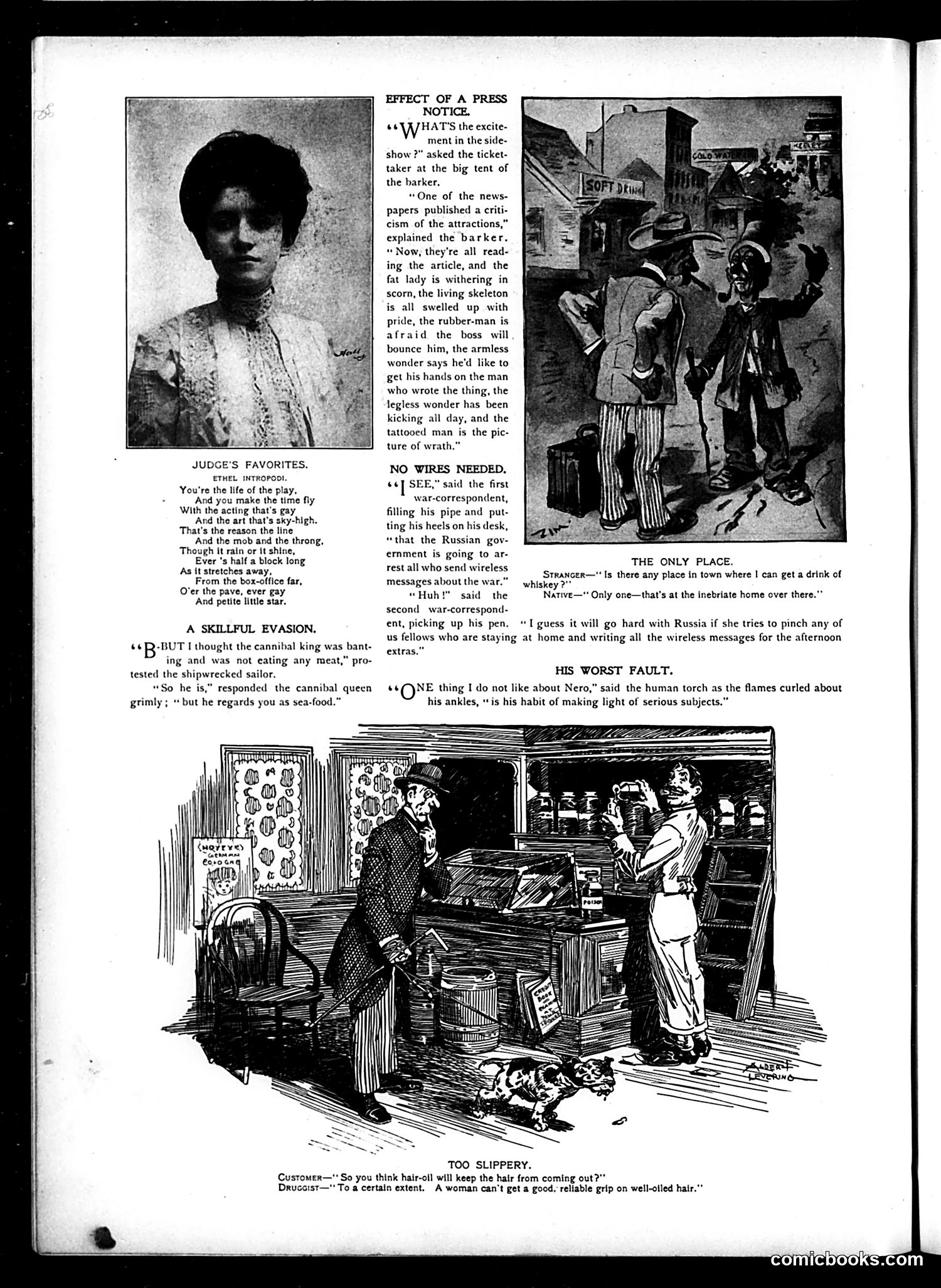
This page contains several satirical pieces and sketches from an early 20th-century American humor magazine: **"Effect of a Press Notice"** mocks how newspaper criticism affects circus performers' pride and confidence—the fat lady, skeleton man, and rubber-man all become self-conscious after negative reviews. **"Judge's Favorites"** is a poem about Ethel Intropodi, apparently a performer. **"A Skillful Evasion"** jokes about a cannibalistic king and an unprepared sailor. **"No Wires Needed"** features war correspondents discussing Russian wireless communications during what appears to be an early 20th-century conflict. **"Too Slippery"** is a barber-shop joke about hair-oil effectiveness. The cartoons use exaggerated character types and everyday scenarios typical of Judge's satirical approach—social commentary through humor rather than explicit political critique.
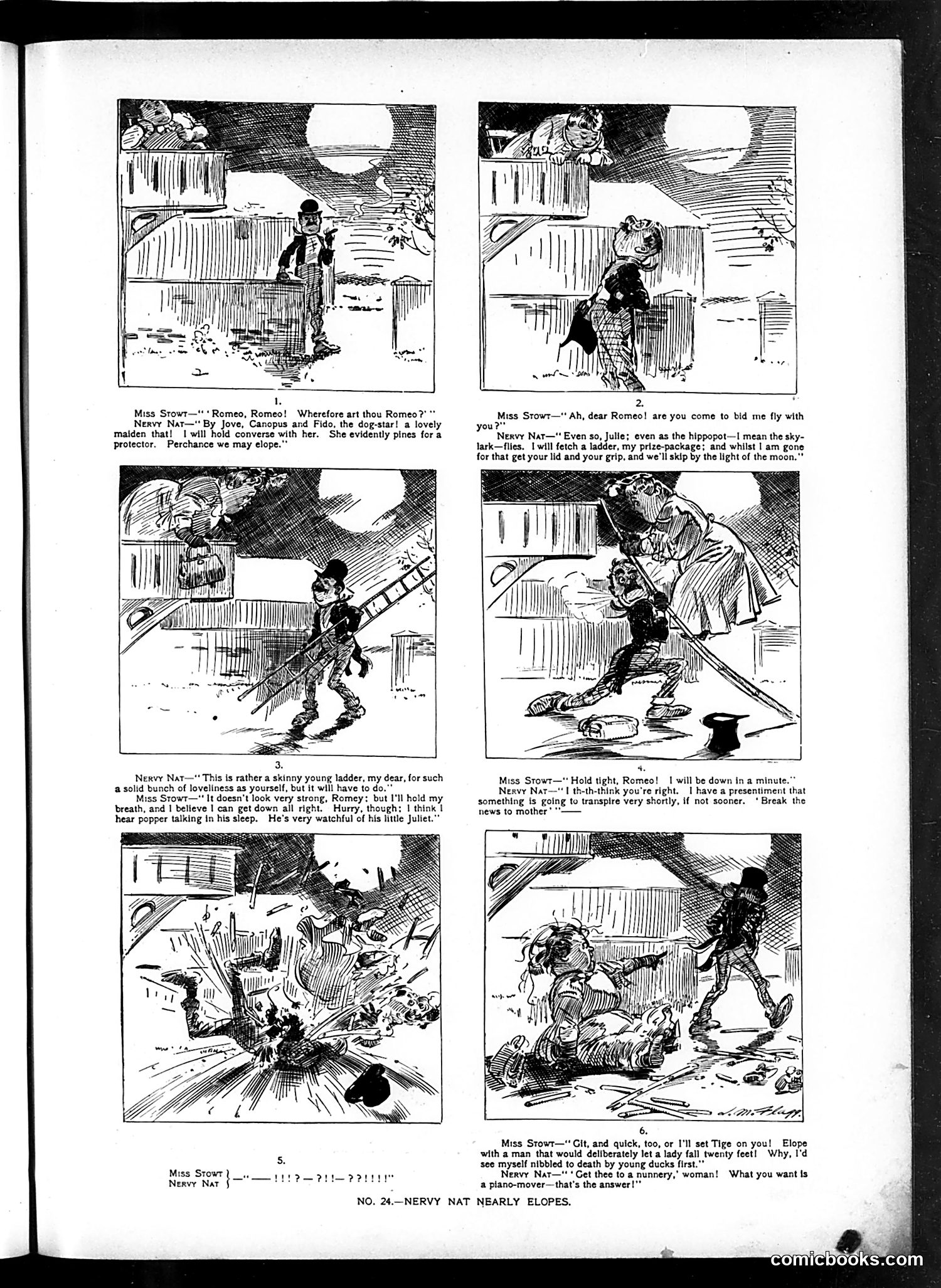
This is a slapstick comedy strip satirizing both romantic melodrama and the character "Nervy Nat," who appears to be a recurring comedic figure in *Judge* magazine. The humor centers on a botched elopement inspired by *Romeo and Juliet*: Nat attempts to romance "Miss Stowr" by quoting Shakespeare, but his incompetence undermines the romantic gesture. He provides a faulty ladder for her escape; she falls partway down, he panics and flees, and she indignantly calls him a coward—suggesting she'd prefer a "piano-mover" (a strong laborer) to such an unreliable suitor. The satire mocks both Nat's pretentious literary references and the absurdity of elopement scenarios generally. The joke relies on physical comedy and Nat's characteristic haplessness rather than political commentary.
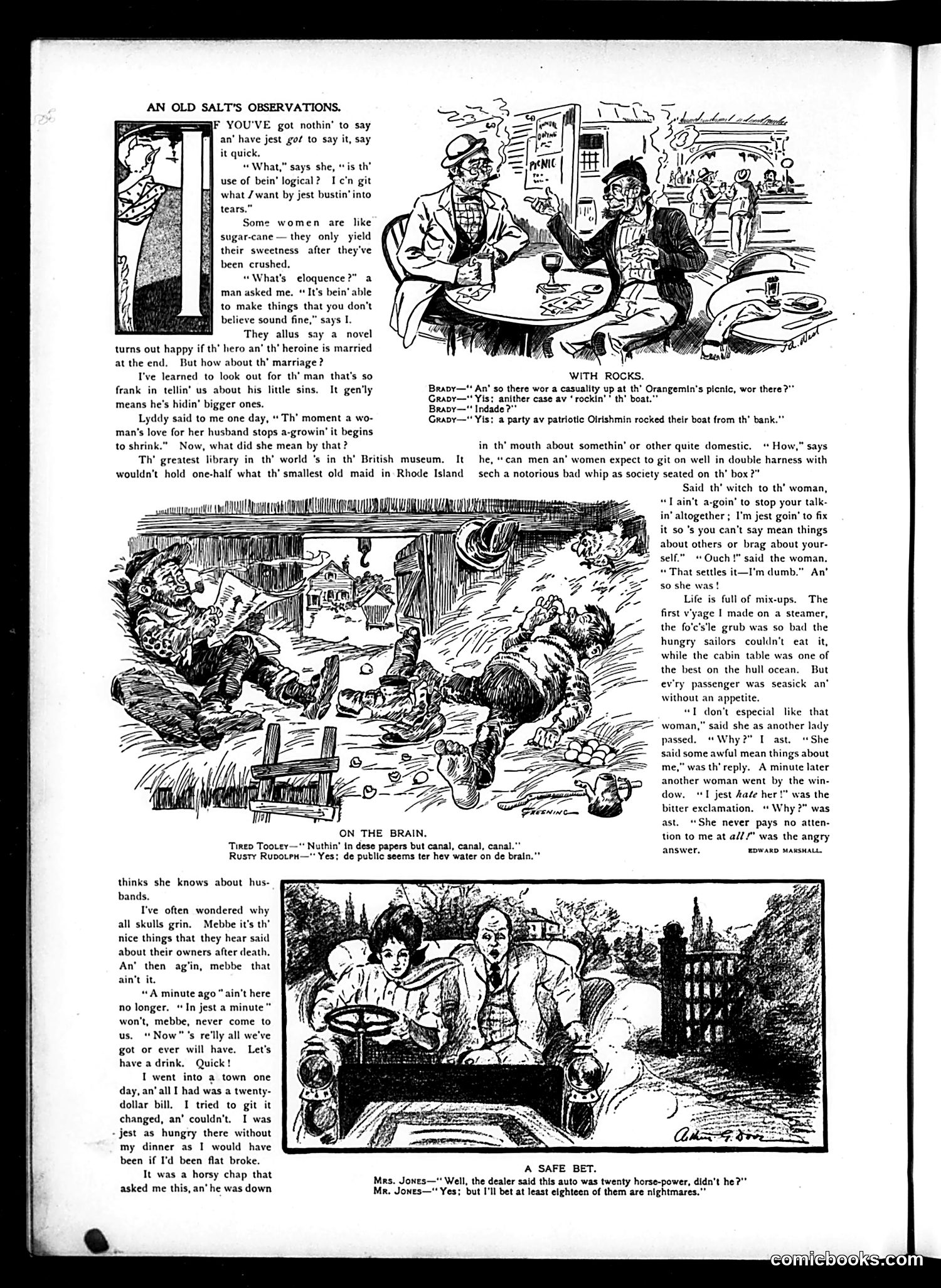
This page from *Judge* presents humorous observations attributed to a seasoned sailor character. The cartoons satirize everyday human behavior and contemporary concerns: **Top cartoon ("With Rocks")**: Irish immigrants at a picnic accidentally rock their boat, creating a "casualty"—satirizing ethnic stereotypes common to the era. **Middle cartoon ("On the Brain")**: Two working-class men obsess over canal news, with one saying the public has "water on de brain"—mocking sensationalist newspaper coverage and public fixation on a single topic. **Bottom cartoon ("A Safe Bet")**: A husband skeptically questions an auto salesman's claim of twenty horsepower, betting "eighteen of them are nightmares"—satirizing early automobile unreliability and sales deception. The "Old Salt" framing device allows cynical commentary on marriage, women's behavior, hypocrisy, and human nature generally. The humor relies on stereotypes and period attitudes that would be considered offensive today.
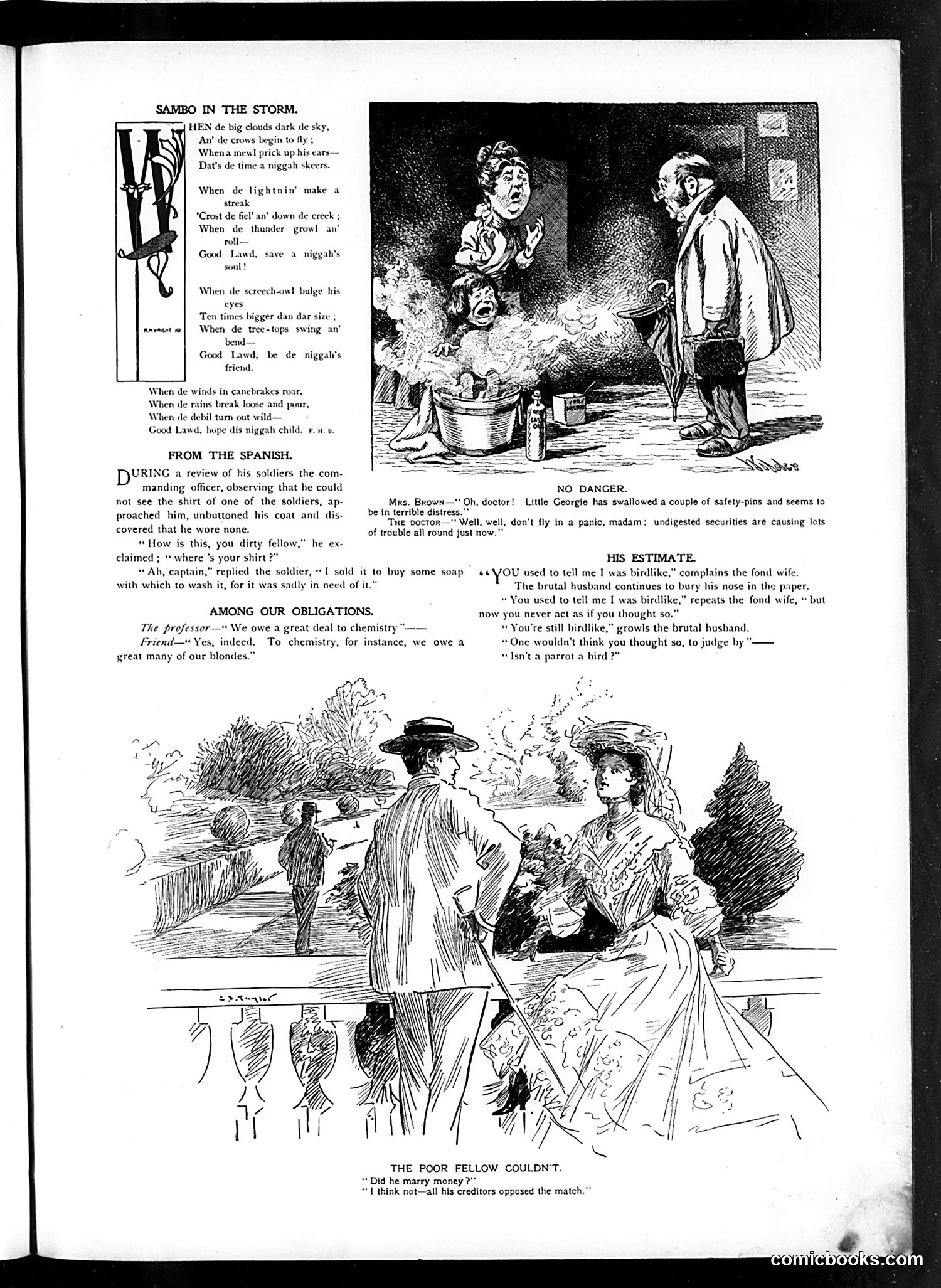
This page contains several unrelated satirical pieces typical of early Judge magazine: **"Sambo in the Storm"**: A dialect poem using offensive racial caricature (the term and stereotypical speech patterns were common in period humor). It depicts an enslaved or rural Black person frightened by a thunderstorm, appealing to God for protection. This represents the racist humor standard in late 19th/early 20th-century American publications. **"From the Spanish"**: A brief anecdote about a soldier selling his shirt for soap—mild satire on military discipline and practicality. **"No Danger" and "His Estimate"**: Quick joke vignettes. "No Danger" jokes darkly about financial securities during economic trouble. "His Estimate" satirizes a husband's indifference, playing on the wife calling herself "birdlike." **"Among Our Obligations"**: A two-liner crediting chemistry for blonde hair—typical period humor about cosmetics and artificiality. **"The Poor Fellow Couldn't"**: A brief quip about a man unable to marry due to creditor opposition—commentary on debt and financial instability. The page reflects Judge's mix of crude racial humor, financial satire, and domestic comedy typical of American satirical magazines of this era.
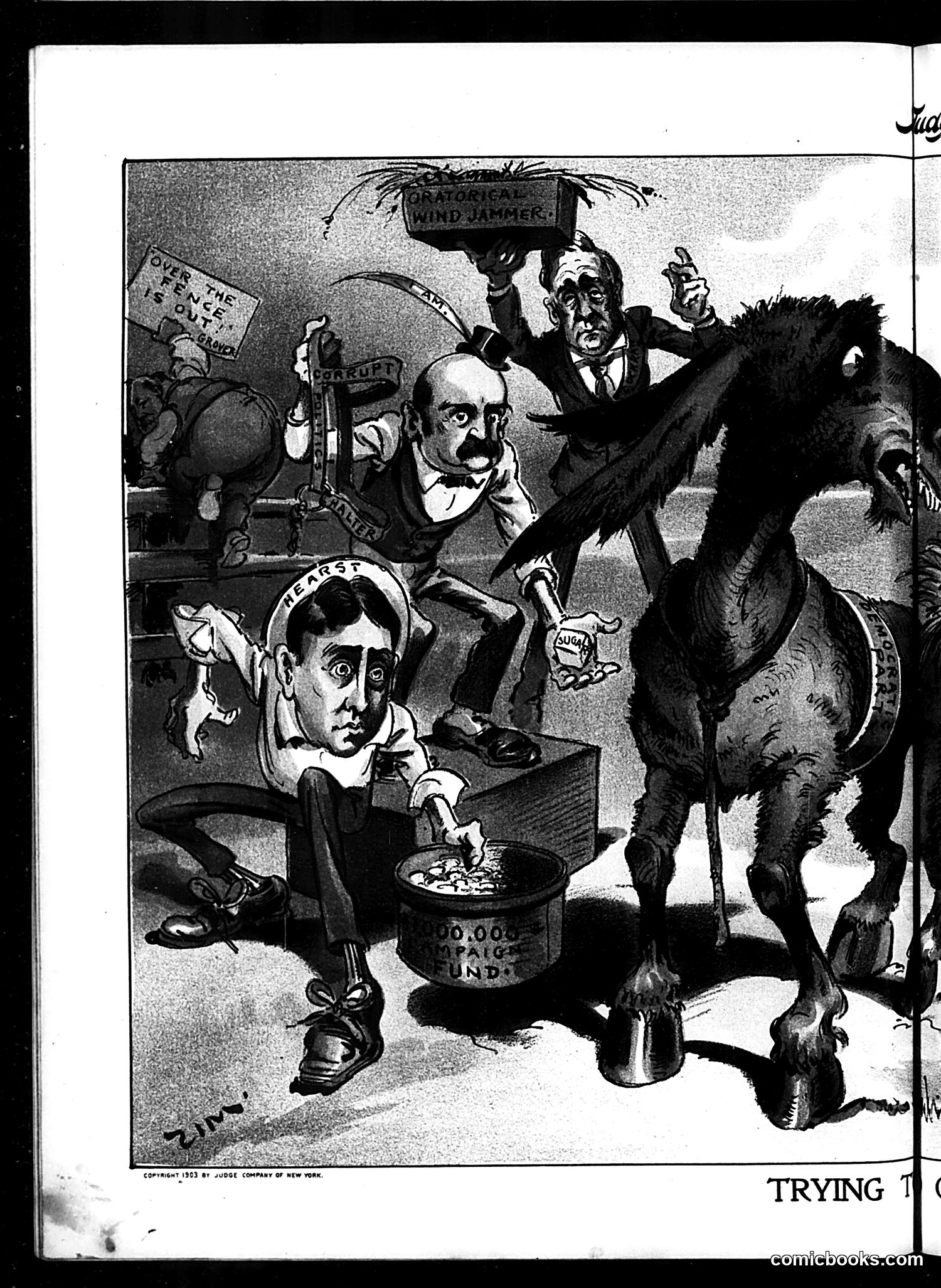
This political cartoon depicts a figure being force-fed or coerced into consuming something labeled "VOODOO" from a pot. The caricatured style and exaggerated features suggest this is attacking a political opponent or policy position through dehumanizing imagery common to late 19th/early 20th-century satire. Key elements visible: - A distressed central figure being force-fed - Multiple antagonistic figures surrounding and restraining him - Labels referencing "voodoo" and what appears to be corrupt political practices - A horse or animal figure, possibly representing political "machinery" - Signs referencing "over the line" or similar political violations The cartoon likely critiques forced acceptance of unpopular policies or corruption, though **without the magazine's date and full caption text, I cannot definitively identify which specific political figures or events are referenced**.
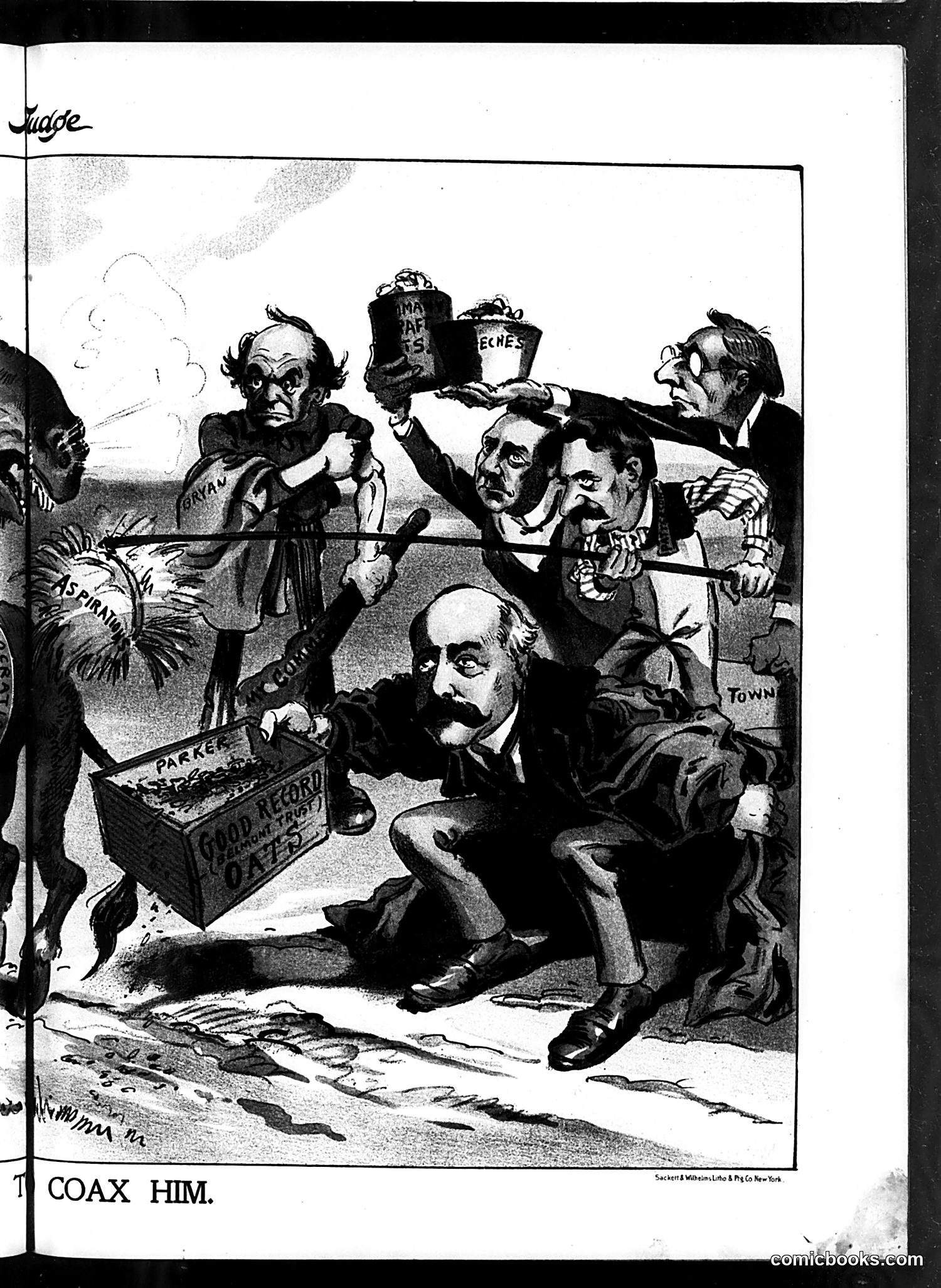
This Judge magazine cartoon depicts several caricatured men in formal dress attempting to persuade or manipulate a central figure holding a baseball bat. The men hold boxes labeled "PROMISES" and "SCHEMES," while signs reference "TOWN" and other locations. The style suggests late 19th or early 20th-century American political satire. The title "Coax Him" and the scene of multiple figures trying to influence someone through false promises suggests commentary on political persuasion or corruption—likely depicting politicians or power brokers attempting to sway a reluctant figure (possibly representing the electorate, a politician, or a business leader) through inducements. Without clearer identification of the specific individuals or dating the publication, the exact political situation remains unclear, though the satirical intent—mocking manipulative tactics—is evident.
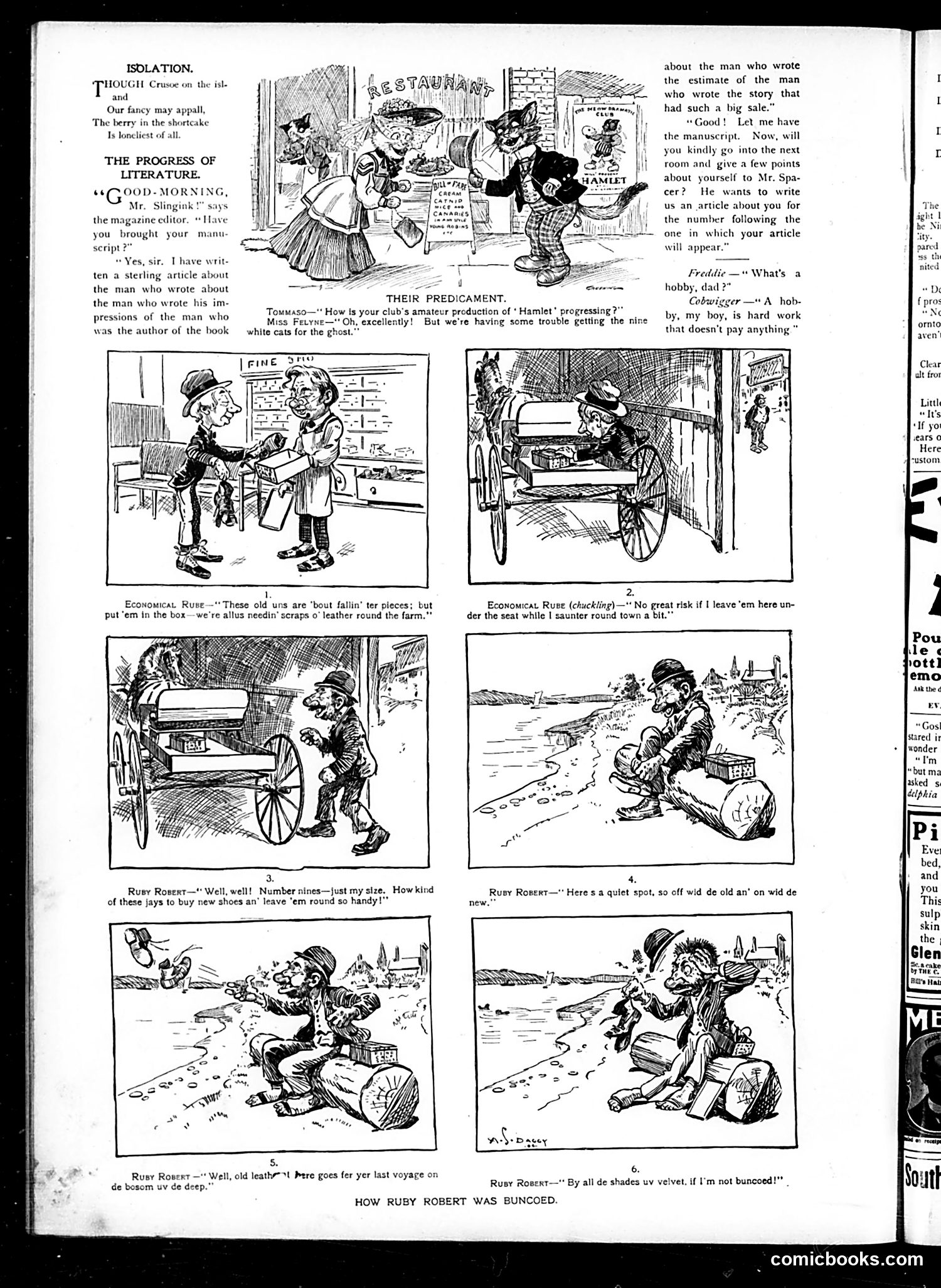
This page contains two separate satirical pieces: **"The Progress of Literature"** mocks the self-referential pretension of magazine writing—a writer pitches an article about "the man who wrote about the man who wrote" impressions, creating an absurd chain of literary navel-gazing. The satire targets overintellectualization and the magazine industry's focus on trivial content. **"How Ruby Robert Was Buncoed"** (the comic strip sequence) depicts a con: a character leaves old worn-out shoes in a cart while strolling through town, then returns to find them stolen. "Buncoed" means swindled. The irony—that worthless shoes get stolen—suggests thieves are fooled into taking valueless goods, turning the robbery itself into a con. The other fragments ("Economical Ruse," "Isolation") offer brief satirical observations about frugality and solitude. These are gentle humor pieces targeting urban life, literary pretension, and petty crime.
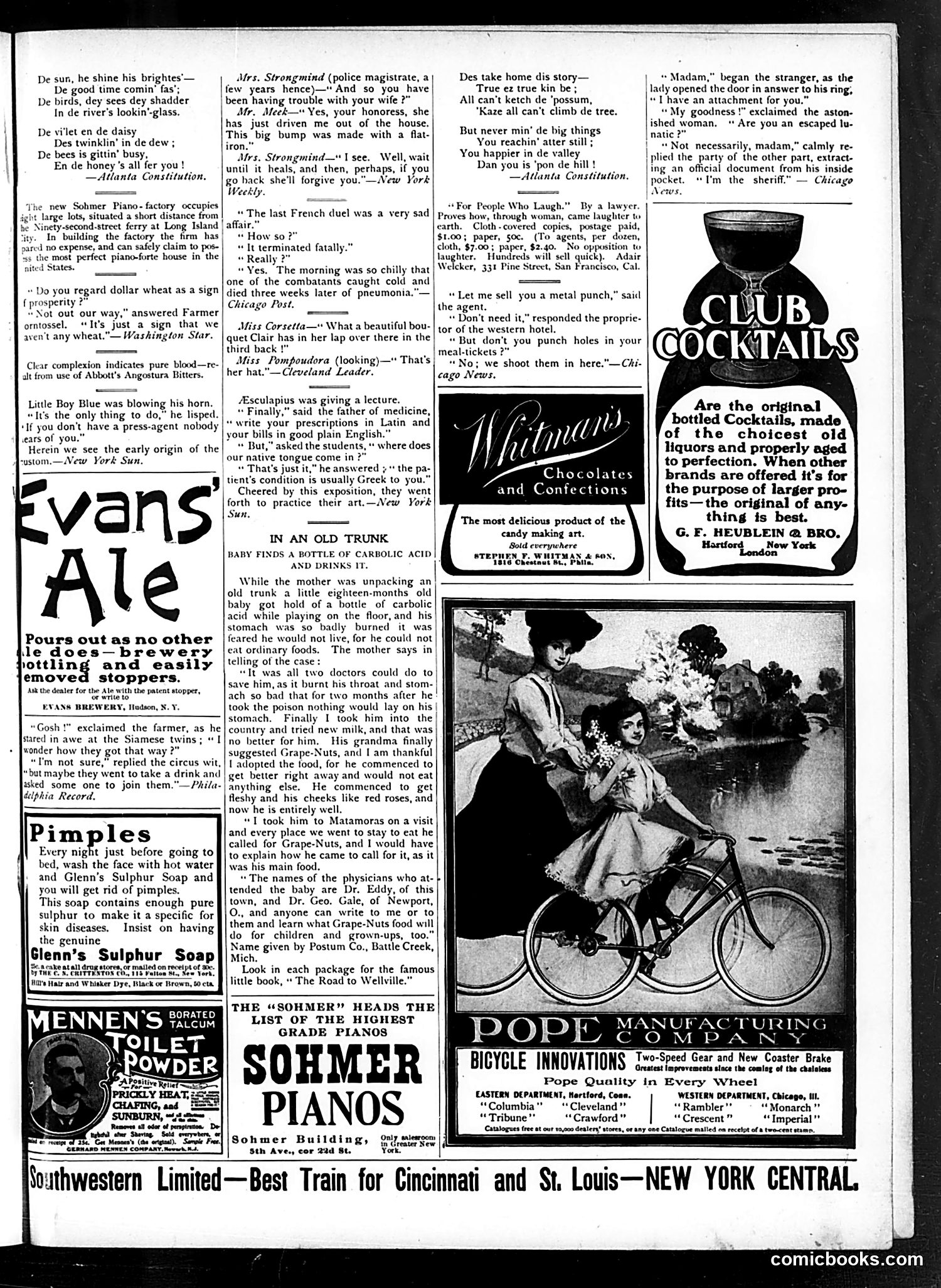
This page is primarily **advertisements and humorous anecdotes** rather than political cartoons. The content includes: **Satirical Items:** - A sketch imagining a future female police magistrate ("Mrs. Strongmind") dismissing a domestic abuse case with indifference, satirizing early women's suffrage debates - Various short jokes mocking French duels, circus press agents, and medical pretension **Advertisements:** The bulk of the page advertises consumer products (Evans Ale, Sohmer Pianos, Glenn's Sulphur Soap, Mennen's Talcum Powder) and a bicycle company. Notably, one ad features a cautionary narrative about a baby poisoned with carbolic acid, rescued by Grape-Nuts cereal—using medical crisis to sell breakfast food. **Social Context:** The magazine reflects early 1900s concerns: women's changing roles, domestic violence trivialized, and aggressive patent-medicine marketing exploiting parental fears. The page demonstrates Judge's mixed editorial-commercial model rather than sustained satirical commentary.
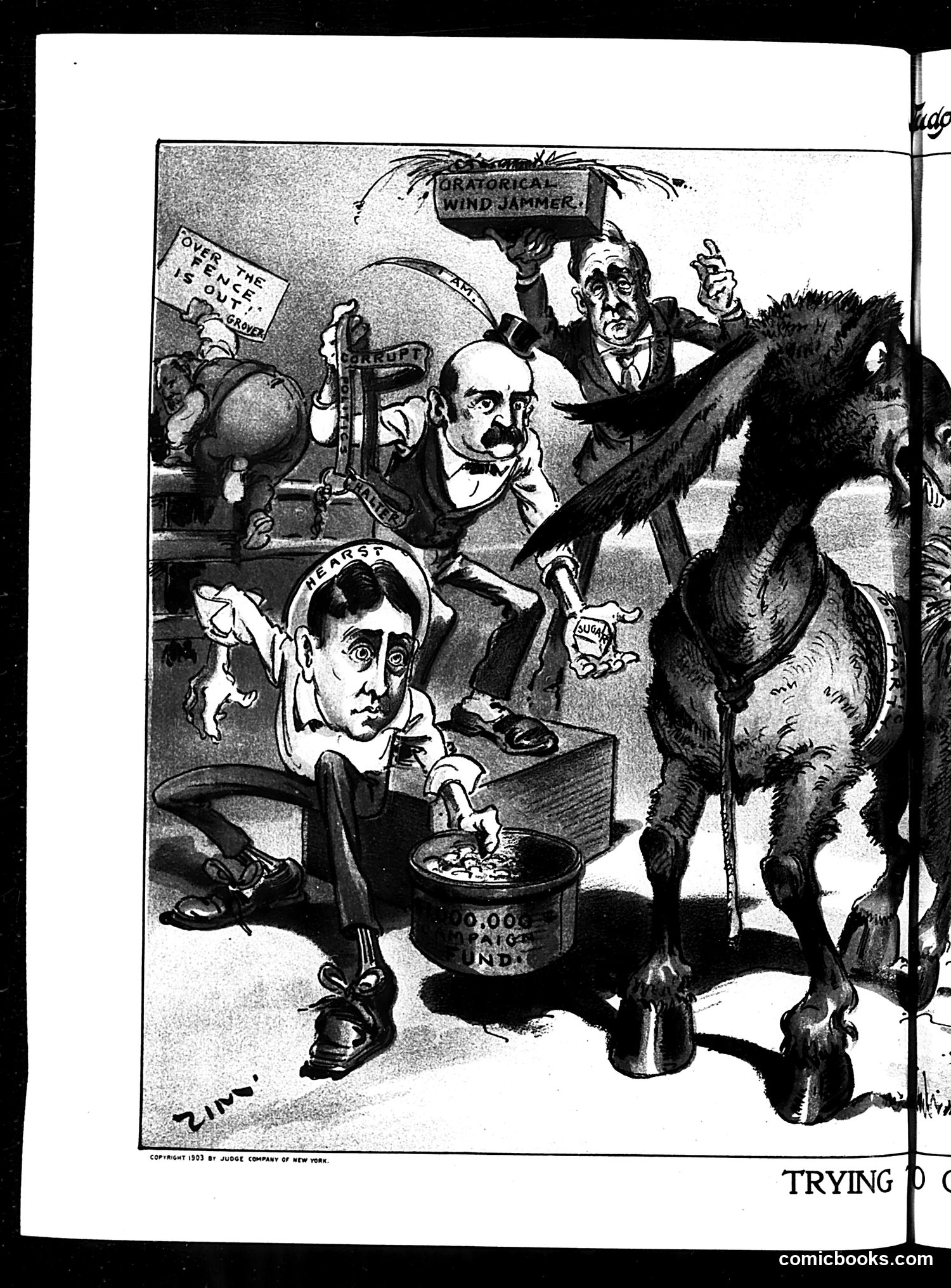
This appears to be a political cartoon titled "TRYING TO" (text cut off), copyright 1923 by Judge Company of New York. The cartoon depicts a chaotic laboratory or kitchen scene where a bald scientist or cook is stirring a pot labeled "GOOD INDIA" while being pelted with objects. The phrase "ORATORICAL WINDJAMMER" labels a figure above, suggesting political rhetoric. The sign reading "BYE BYE BRUCE" appears in the upper left. The satire likely critiques either British colonial policy in India or American political figures discussing India. The "laboratory" setting suggests experimentation or manipulation, while the barrage of objects implies resistance or failure. Without clearer identification of the specific figures or complete title, the precise political target remains unclear, though it appears to mock diplomatic or imperial pretensions circa 1923.
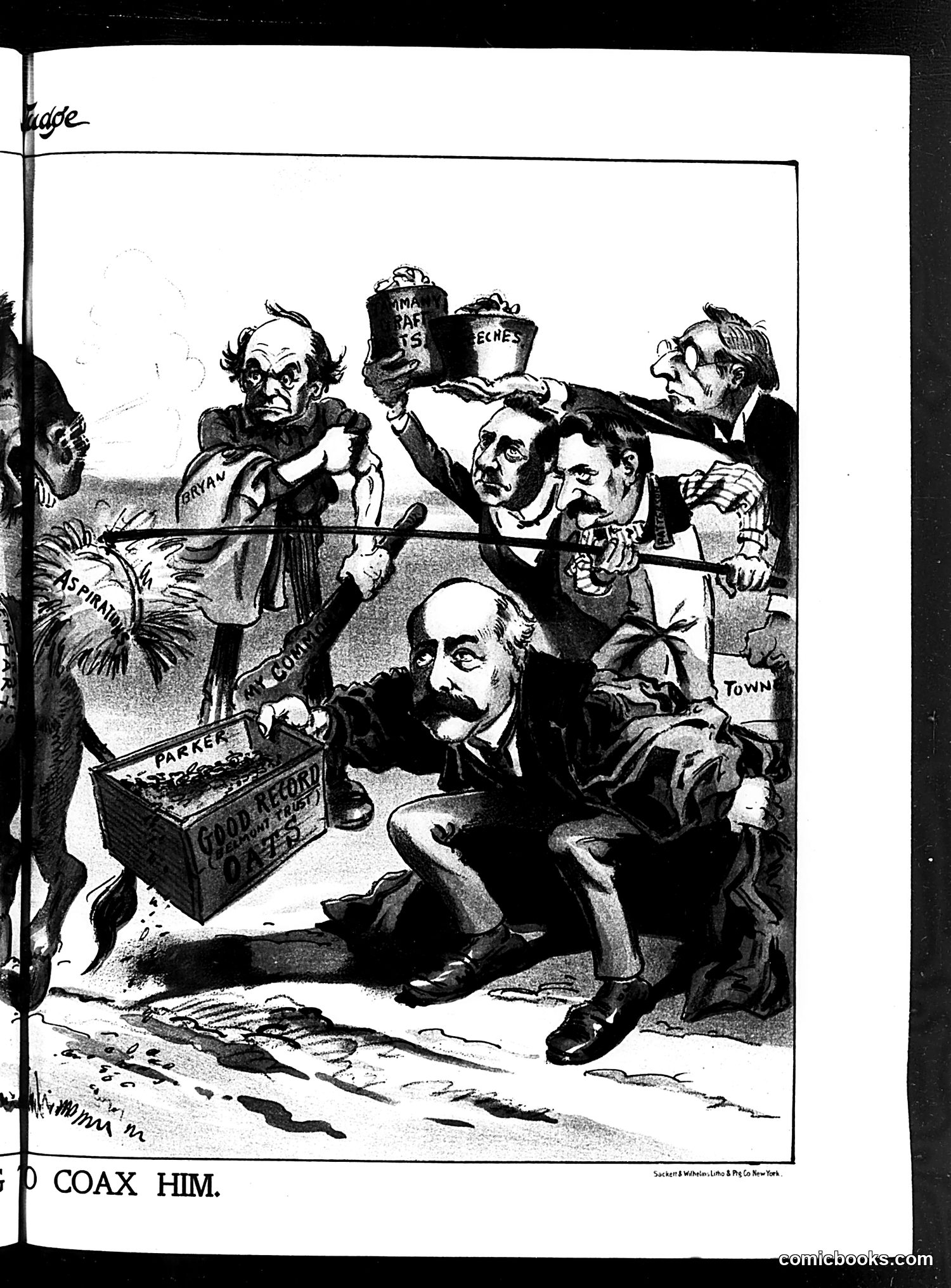
This **Judge magazine cartoon** titled "To Coax Him" depicts several men attempting to influence a central seated figure with a prominent mustache. The men hold various items labeled "PAR," "ECNES" (likely "SCENES"), "PYRAMID," "PACKER," and other text suggesting different inducements or bribes. The satire appears to criticize political corruption or persuasion tactics—multiple parties offering temptations to sway someone's decision or vote. The central figure's resistant posture suggests he's being pressured from multiple directions simultaneously. Without clearer date context or label visibility, the specific political figures and events referenced remain unclear, though the cartoon clearly mocks the underhanded methods used to manipulate political outcomes during the Gilded Age or Progressive Era.
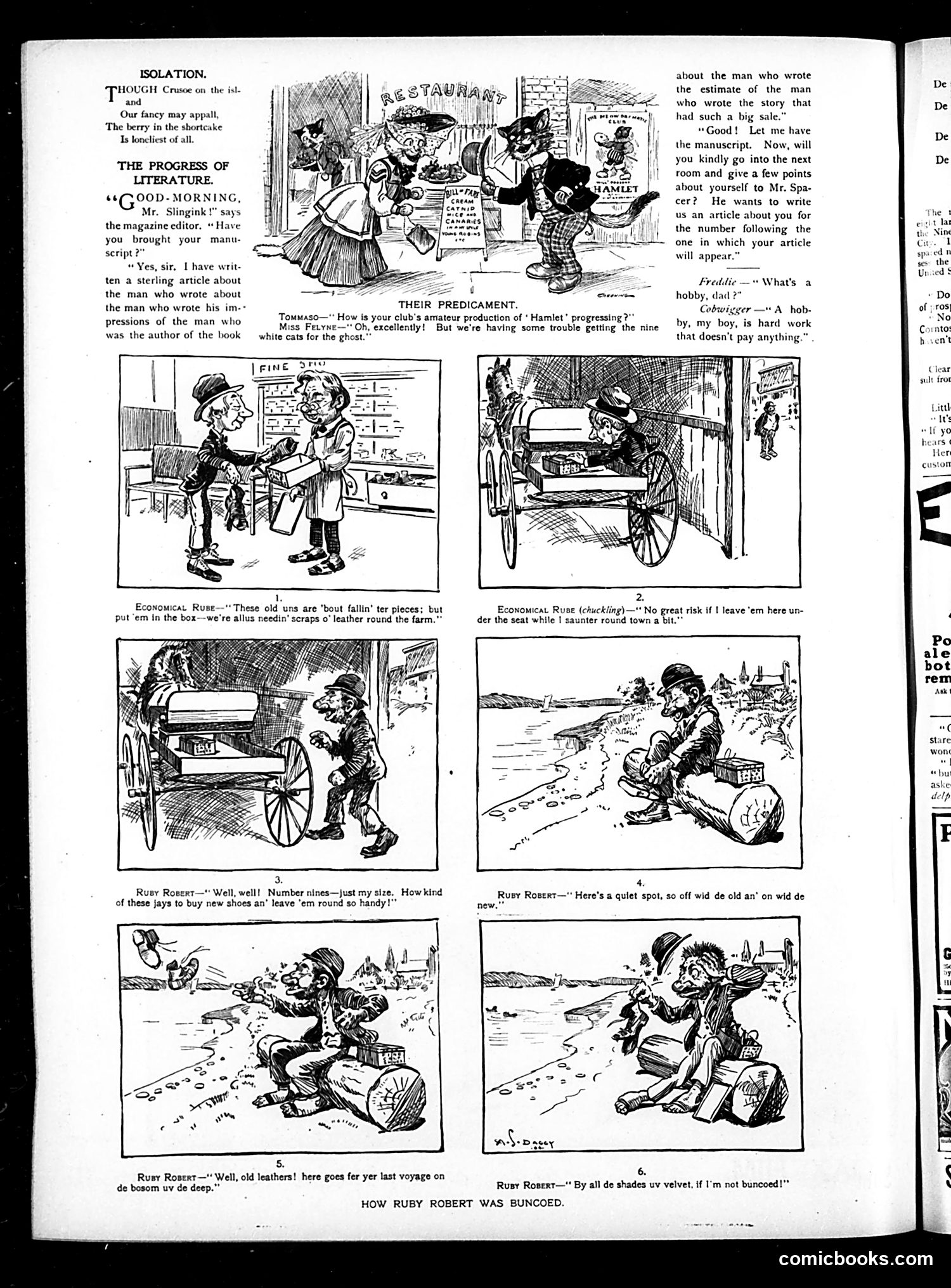
This page contains satirical humor about literary pretension and urban scams, circa early 1900s. **"The Progress of Literature"** mocks overwrought literary self-importance: a writer pitches an article about "the man who wrote about the man who wrote his impressions of the man who was the author of the book"—absurdly recursive meta-commentary. The editor's response (assigning him a bio article) satirizes how magazines inflate minor writers. **"How Ruby Robert Was Buncoed"** depicts a con scheme in six panels: a poor man ("Ruby Robert," appearing to be working-class or vagrant) finds discarded shoes, then is tricked into leaving them unattended. A con artist steals them, leaving the victim stranded. The title reveals he's been swindled. Both segments target contemporary targets: literary pretension among aspiring writers, and urban street scams targeting the poor. The crude, satirical caricatures and dialect suggest class-based humor typical of Judge's era.
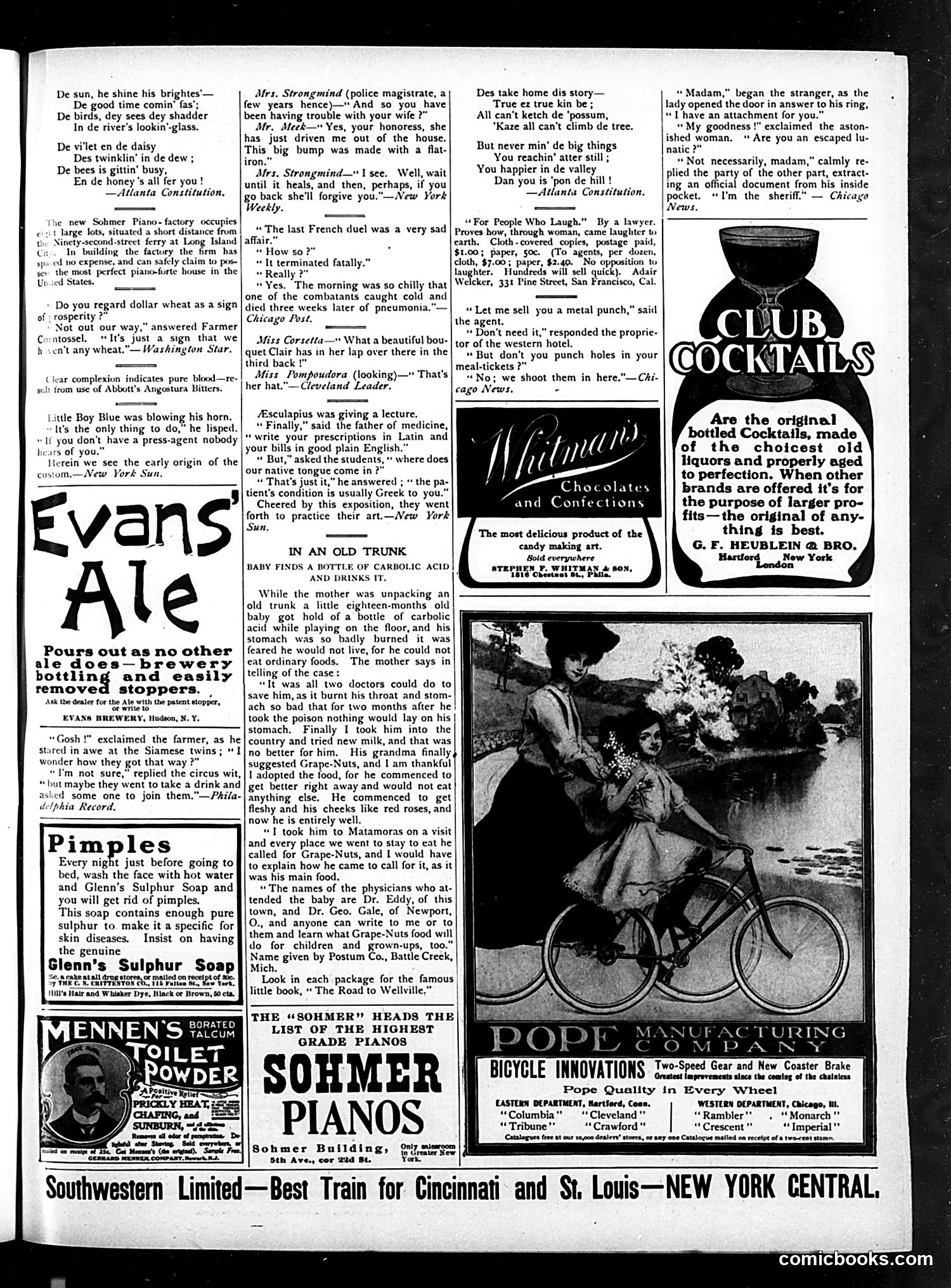
This page is primarily **advertising with humorous filler content** rather than political satire. The main elements include: **Cartoons/Humor Sections:** The brief jokes scattered throughout use period dialect and situational humor—a "Press Agent" joke about Press Agentry culture, a Siamese twins circus joke, and a medical school lecture—typical early 20th-century magazine filler with no clear political targets. **Notable Content:** A satirical sketch titled "Mrs. Strongmind (police magistrate)" depicts a female judge hearing a domestic violence case where the husband has been struck by his wife with a flat-iron. The humor relies on *role reversal*—inverting traditional gender expectations by showing a woman in judicial authority and a man as the abused spouse. This reflects contemporary anxieties about women's suffrage and changing social roles. **Advertisements:** The page is dominated by product ads: Evans Ale, Glenn's Sulphur Soap, Sohmer Pianos, Mennen's Talcum Powder, and Dodge Manufacturing Company bicycles—typical period commercial content. No specific political figures or dated events are referenced.
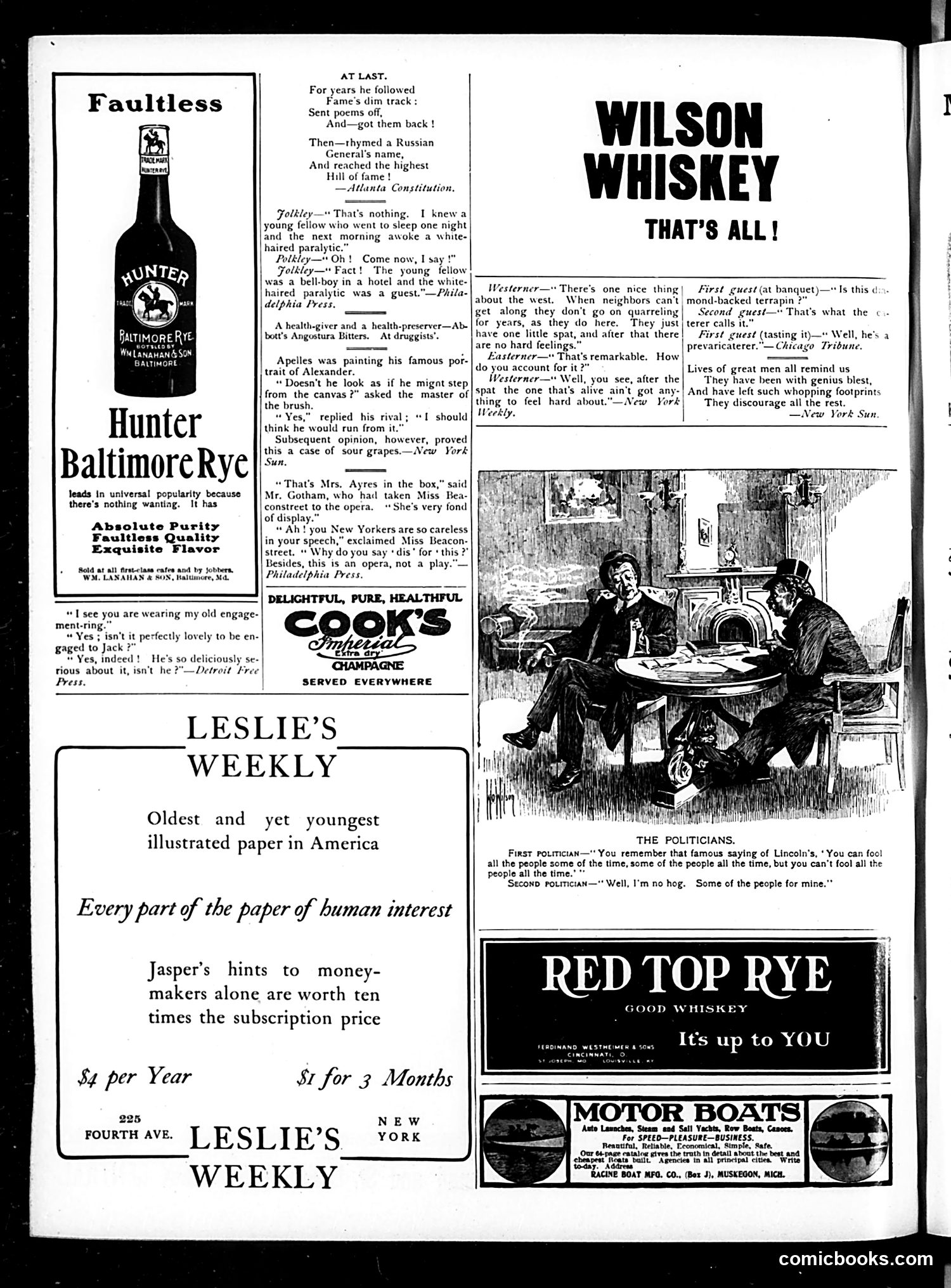
This page is primarily **advertising**, with small satirical content interspersed. The main humor piece is "THE POLITICIANS" cartoon at bottom right, showing two politicians discussing Lincoln's famous quote about fooling people. The second politician cynically responds he doesn't need to fool *everyone*—just "some of the people for mine," implying political success requires only partial public deception. This satirizes the moral flexibility of politicians. The page otherwise contains vintage whiskey and spirits advertisements (Hunter Baltimore Rye, Wilson Whiskey, Red Top Rye, Cook's Champagne) typical of early 1900s Judge magazine, plus subscription promotions for Leslie's Weekly. Small joke fillers appear throughout—anecdotes about engagement rings, poets, hotel bellboys, and opera etiquette—offering light social satire on contemporary manners rather than political commentary. The cartoon's cynicism about political dishonesty appears to be the only substantive satirical content on this advertising-heavy page.
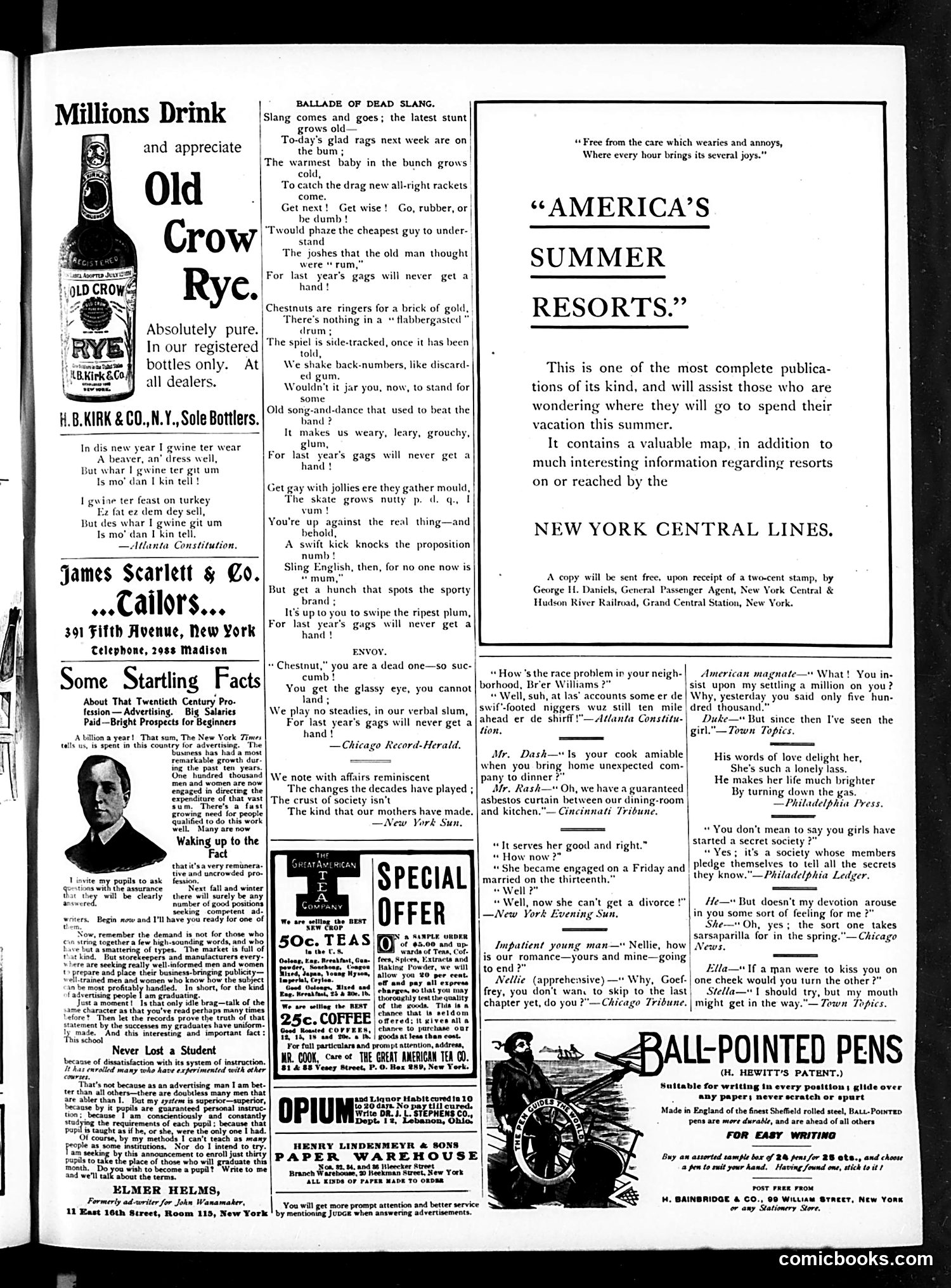
This page is primarily **advertising and filler content** from Judge magazine, not political satire. The main elements are: **"Ballade of Dead Slang"** — A poem mocking outdated slang expressions ("glad rags," "get wise," "flabbergasted"). It's satirizing how quickly fashionable speech becomes stale and ridiculous—a timeless humor device about generational language gaps. **The advertisements** dominate: Old Crow Rye whiskey, a tailor shop, coffee, tea, and ball-point pens fill the space. **Scattered humor snippets** include brief joke exchanges about race relations (using period-offensive dialect), marriage, and social awkwardness—typical Judge fare of the era. **The one substantive piece** is an advertisement for New York Central Lines' resort guide, positioned as a public service. Overall, this is a **typical early 20th-century magazine page**: mostly advertising revenue mixed with light humor and social commentary that reflects the period's casual racism and gender stereotypes, now jarring to modern readers.
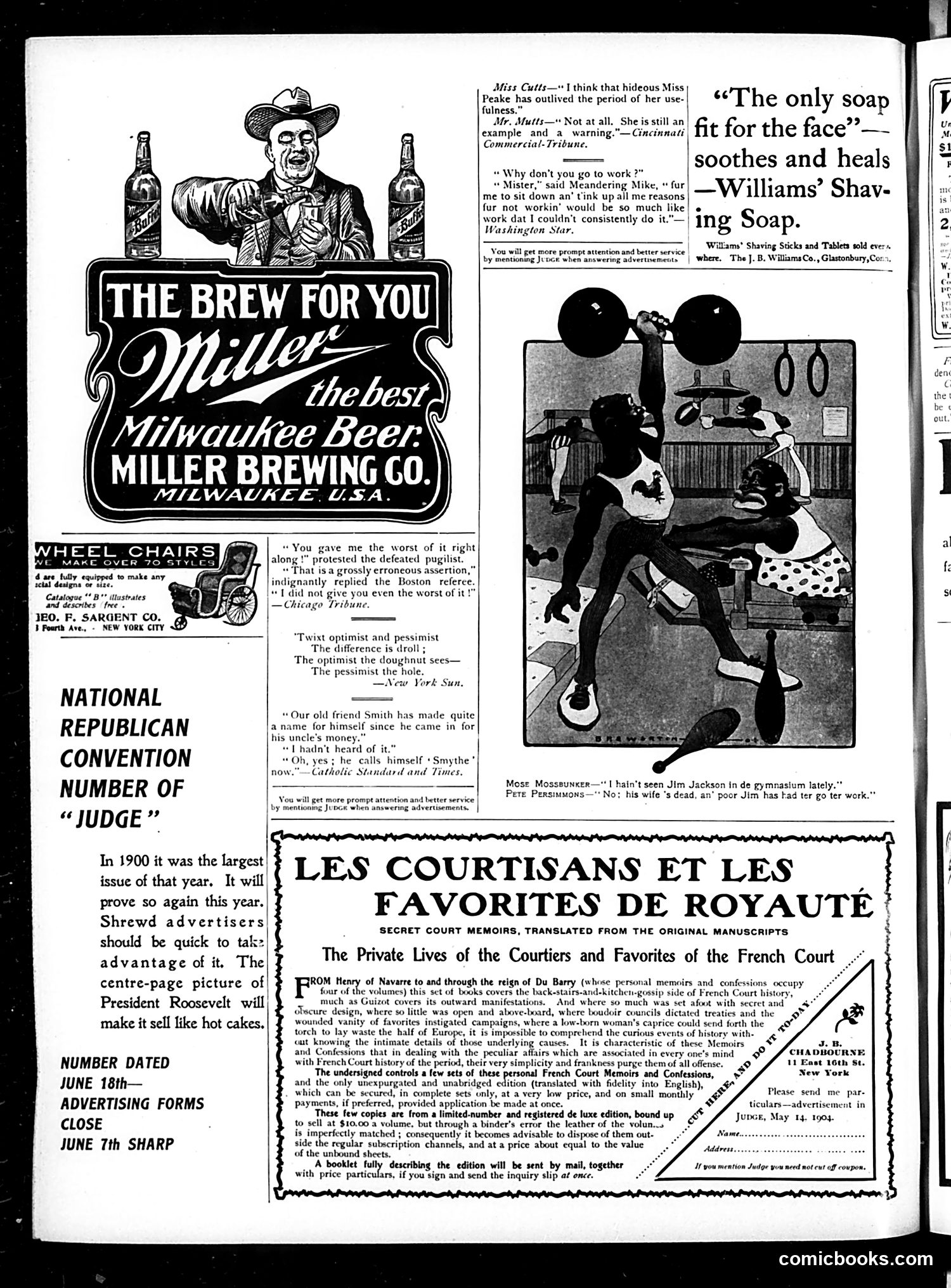
This page is primarily **advertising and notices**, with minimal satire content. **Main Content:** - **Miller Beer ad**: Features a cowboy figure promoting Milwaukee beer as "the best" - **Williams' Shaving Soap ad**: Claims to be "the only soap fit for the face" - **Wheel Chairs ad**: For disabled accessibility - **Four brief joke excerpts** from newspapers (Cincinnati Commercial-Tribune, Washington Star, Boston and Catholic publications) covering tired themes: aging women, unemployment, boxing, and social climbers changing their names to sound more genteel **Notable Advertisement:** A significant notice for "Les Courtisans et les Favorites de Royauté"—French court memoirs promising salacious "back-stairs" gossip about Henry of Navarre and Madame Du Barry. This exploits period fascination with scandalous European court history. **Conclusion:** This is a typical Judge page mixing ads with brief, mild satirical quips. The humor relies on contemporary social anxieties (work, aging, class pretension) now largely opaque without historical context.
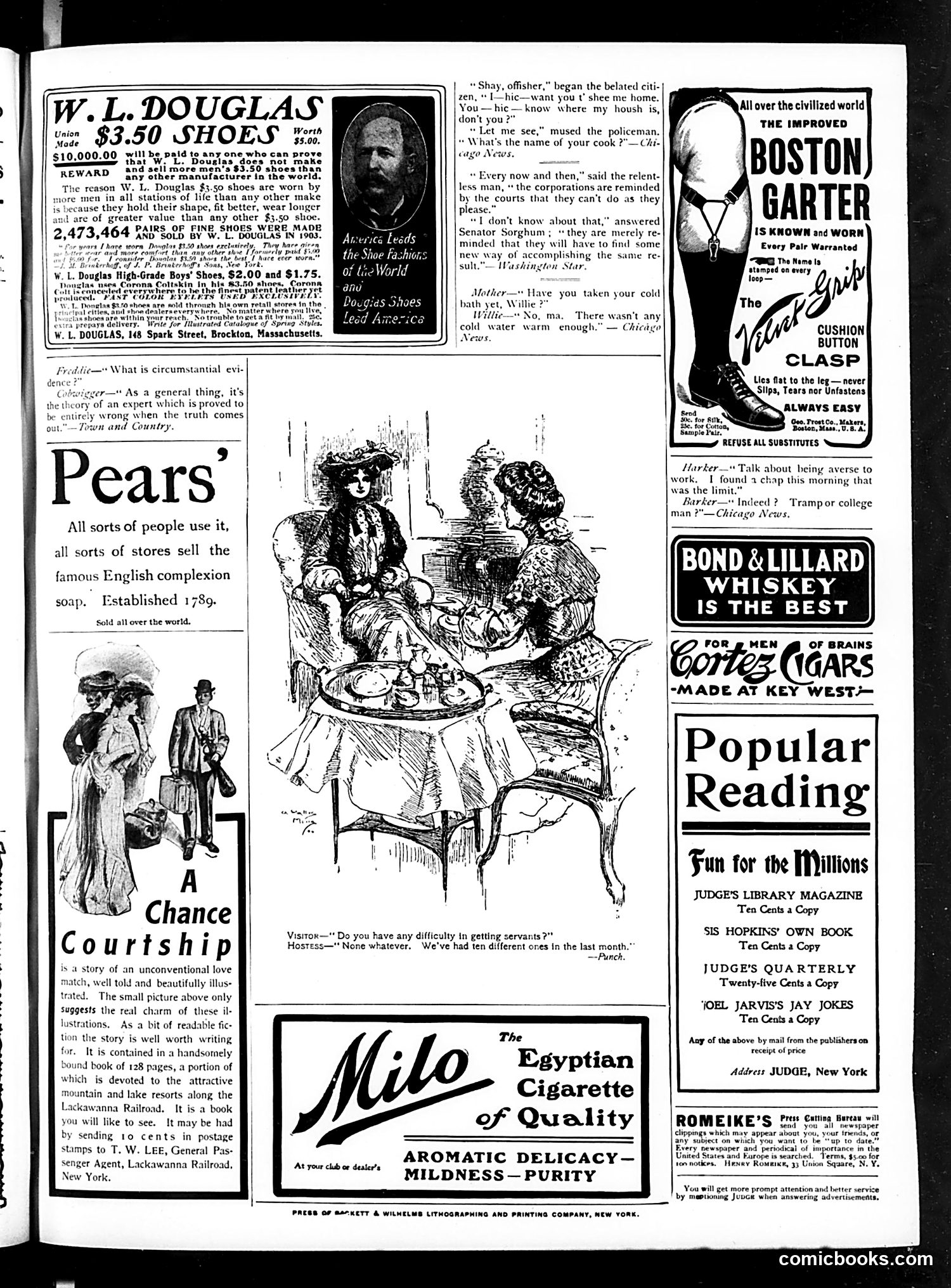
This page is primarily **advertising with light humor**, not political satire. The main content consists of product advertisements interspersed with brief comedic dialogue. The humor pieces are genteel, conversational jokes typical of early 1900s periodicals: - A drunk man asks a policeman for directions home, identifiable only by his cook's name (absurdist humor about urban domesticity) - A senator discusses how corporations merely find new ways to break rules after court reminders (light political commentary on corporate behavior) - A hostess complains of servant turnover—a common domestic concern for wealthy households of the era - A man describes another as averse to work, calling him "the limit" The advertisements dominate: W.L. Douglas shoes, Pears soap, Boston garters, Bond & Lillard whiskey, Milo cigarettes, and various Judge magazine publications. **For modern readers**: This reflects Edwardian-era middle/upper-class anxieties (servant problems, corporate accountability) and consumer culture, presented as genteel amusement rather than pointed satire. The page mirrors the magazine's hybrid nature—satirical organ with significant advertising revenue.
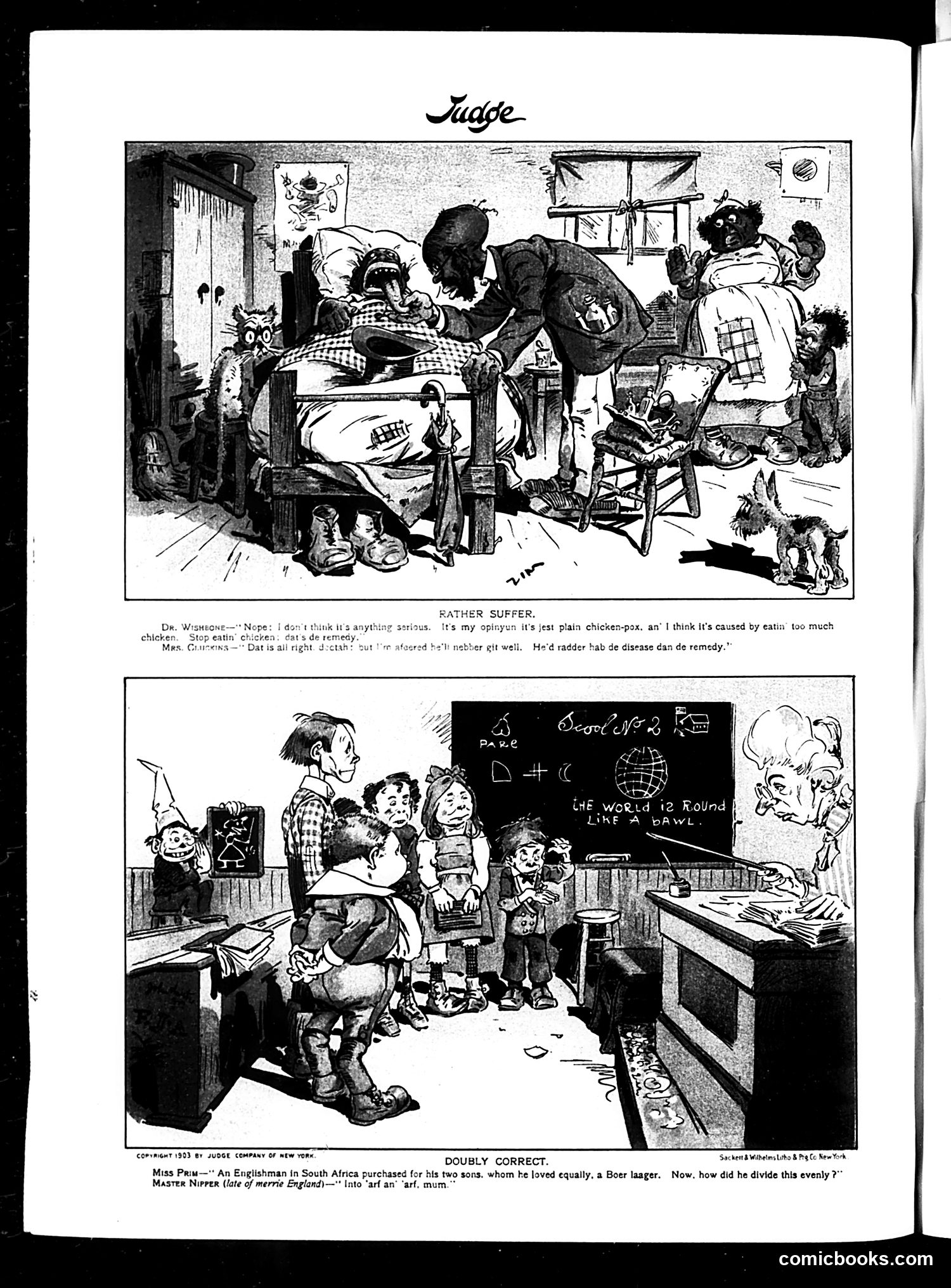
This page contains two satirical cartoons from Judge magazine (copyright 1903). **"Rather Suffer"** (top) depicts a sick child refusing medical treatment, preferring the disease itself. The humor relies on child dialect and stubbornness—the parents' exasperation that the patient would rather suffer than accept the doctor's remedy. **"Doubly Correct"** (bottom) is a riddle joke about the Boer War in South Africa. A British father owns a "Boer laager" (a fortified camp used by Boer fighters) and must divide it equally between two sons. The punchline—dividing it "arf an' arf" (half and half)—works as both a solution to the riddle and satire: it mocks British colonial attitudes toward South Africa by reducing a genuine military conflict to a children's wordplay joke. The "Master Nipper" character's English accent emphasizes the British perspective. Both cartoons use dialect and children's voices for comedic effect typical of early 1900s American humor.