
A complete issue · 16 pages · 1904
Judge — April 2, 1904
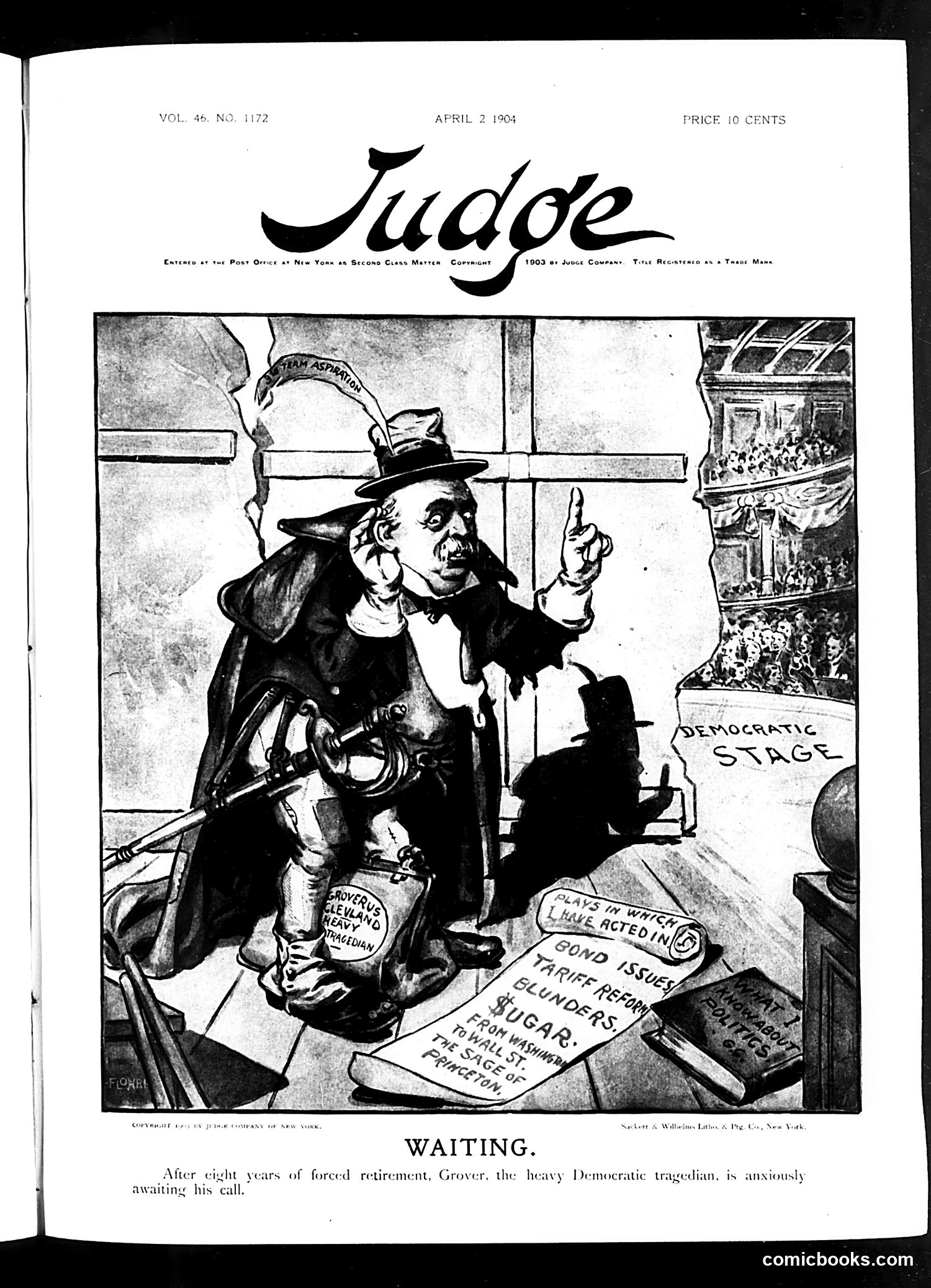
This cartoon satirizes **Grover Cleveland**, the only U.S. president to serve non-consecutive terms (1885-1889, 1893-1897). The caption notes he's been in "forced retirement" for eight years, anxiously awaiting a political comeback. The caricatured figure, dressed formally with a cane, stands before the "Democratic Stage," surrounded by documents labeled with Democratic Party controversies: "Bond Issue," "Tariff Reform," "Blunders," and "Failures of the last Administration." The satire suggests Cleveland—depicted as an aging, worn politician—desperately hopes to return to power despite the Democratic Party's recent troubles. The image mocks both his ambitions and the party's baggage, questioning whether Cleveland remains relevant or welcome.
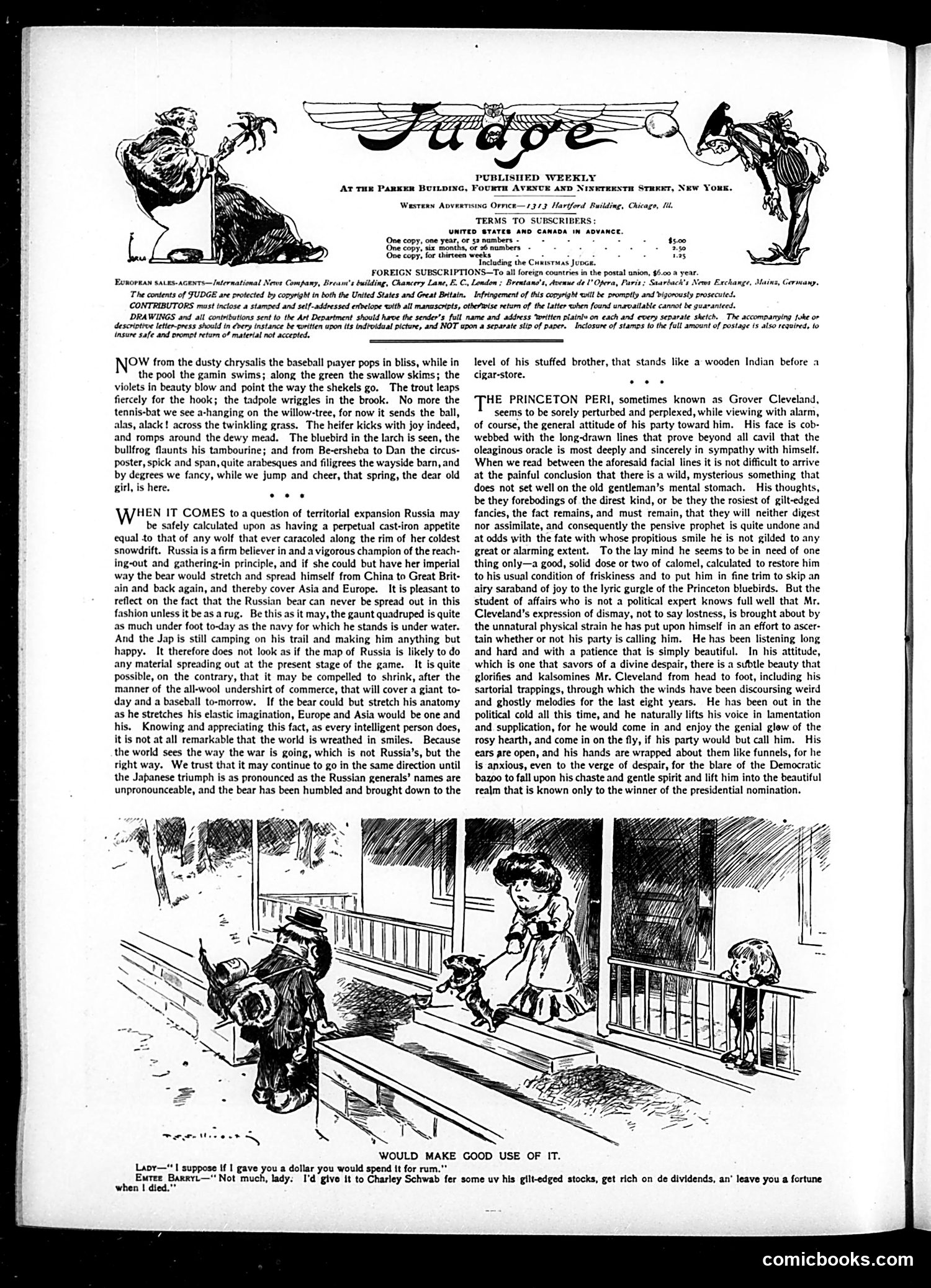
The page contains two distinct sections: **Upper articles**: Political commentary on Russian territorial expansion and discussion of Grover Cleveland (identified as "The Princeton Peri"). The Cleveland piece praises his sympathetic nature and Democratic principles, suggesting he represents integrity amid political corruption—though it's unclear what specific event prompted this analysis. **Lower cartoon** ("Would Make Good Use of It"): A street scene where a woman gives a street urchin a dollar. The boy's response reveals the satirical point: he plans to invest it in stock tips from "Charley Schwab" to get rich, rather than use it charitably. This mocks both the era's get-rich-quick mentality and the notion that poverty could be solved through speculation rather than genuine aid. The overall tone critiques Gilded Age financial schemes and questionable morality.
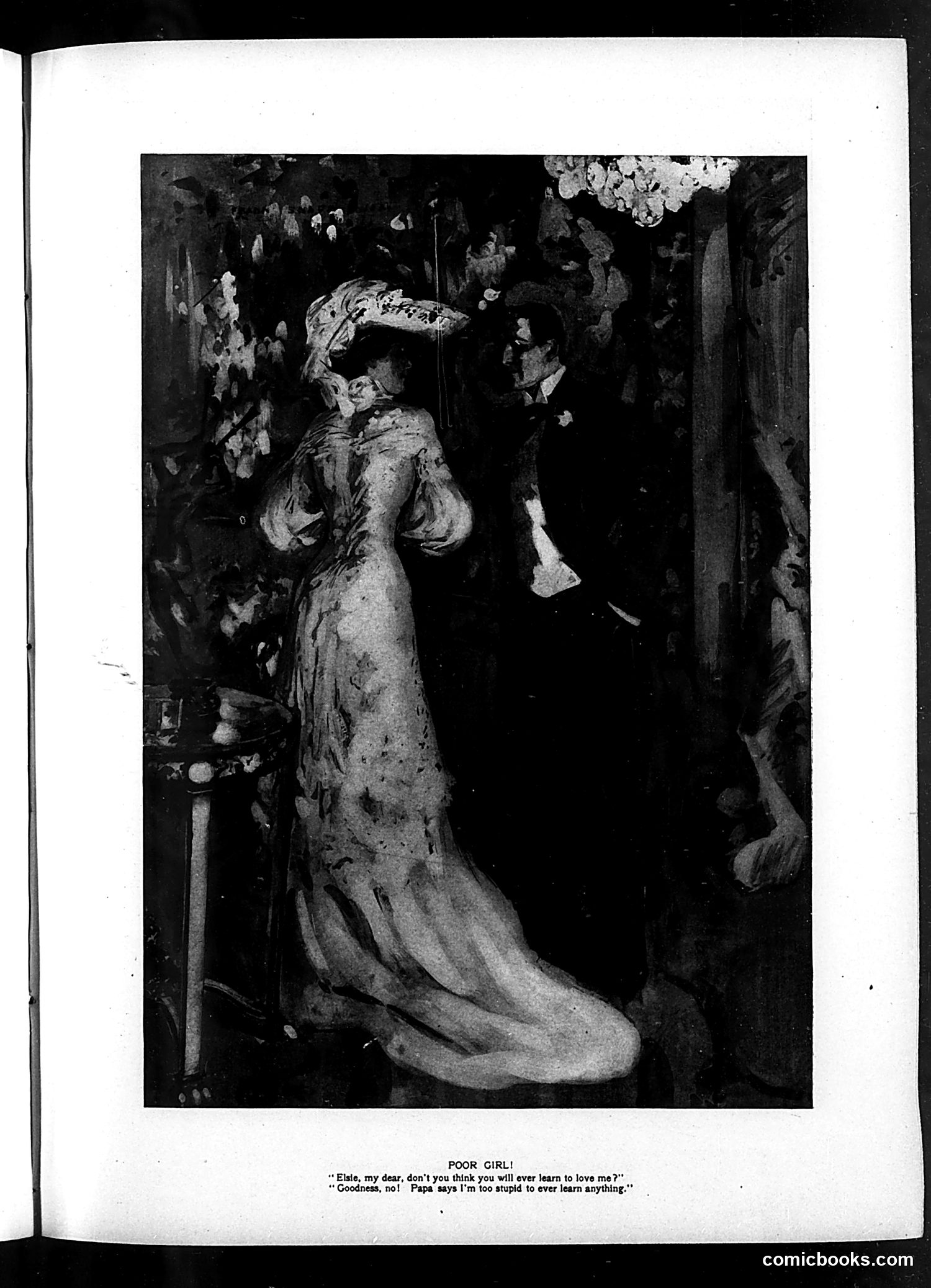
This illustration depicts a romantic or dramatic scene with a young woman in an elegant gown addressing a man in formal attire. The caption reads: "Elate, my dear, don't you think you will ever learn to love me?" / "Goodness, no! Papa says I'm too stupid to ever learn anything." The satire appears to target class dynamics and gender stereotypes of the era. The "poor girl" is portrayed as emotionally vulnerable, seeking romantic validation from someone (likely of higher social standing, given the formal setting). The man's response—claiming paternal authority and stupidity as reasons for refusing her affections—mocks both paternal control over women's lives and the casual cruelty of dismissing someone as unteachable. The joke satirizes romantic desperation and the intersection of class, gender, and familial power structures.
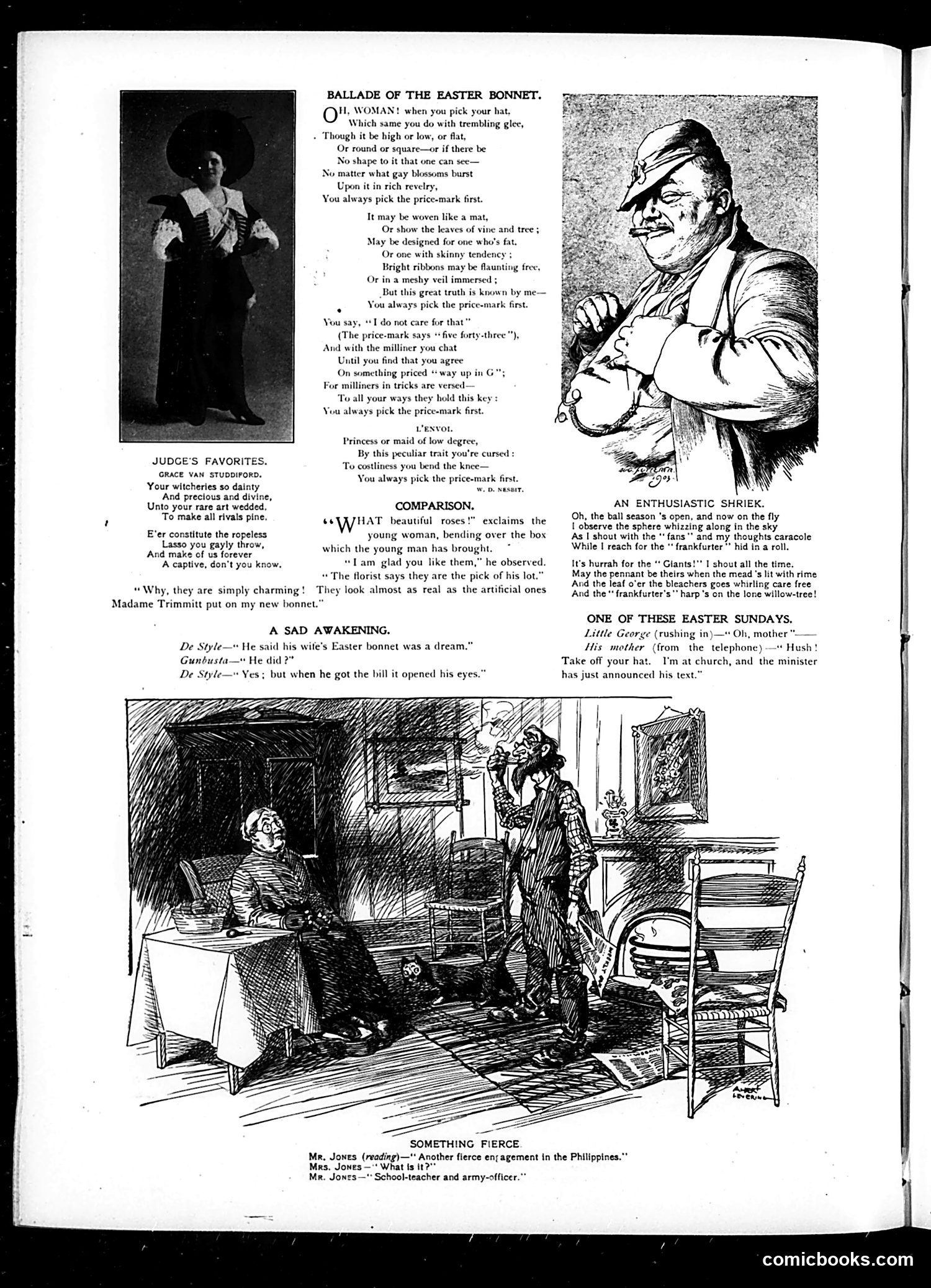
This page contains several distinct pieces of Easter-themed humor. The "Ballade of the Easter Bonnet" satirizes women's obsession with expensive, fashionable hats—a major social concern of the era. The poem repeatedly emphasizes that regardless of hat style, women "always pick the price-mark first," mocking materialism disguised as aesthetic choice. "Judge's Favorites" and "Comparison" are brief satirical verses about women's vanity and charm. "A Sad Awakening" jokes about Easter bonnets disappointing husbands with their cost. The sketch titled "Something Fierce" depicts a domestic scene where Mr. Jones reads about military conflict in the Philippines while his wife interrupts—likely satirizing how Easter celebrations distract from serious news, or marital tension over competing interests. The overall theme critiques consumer culture and women's fashion priorities.
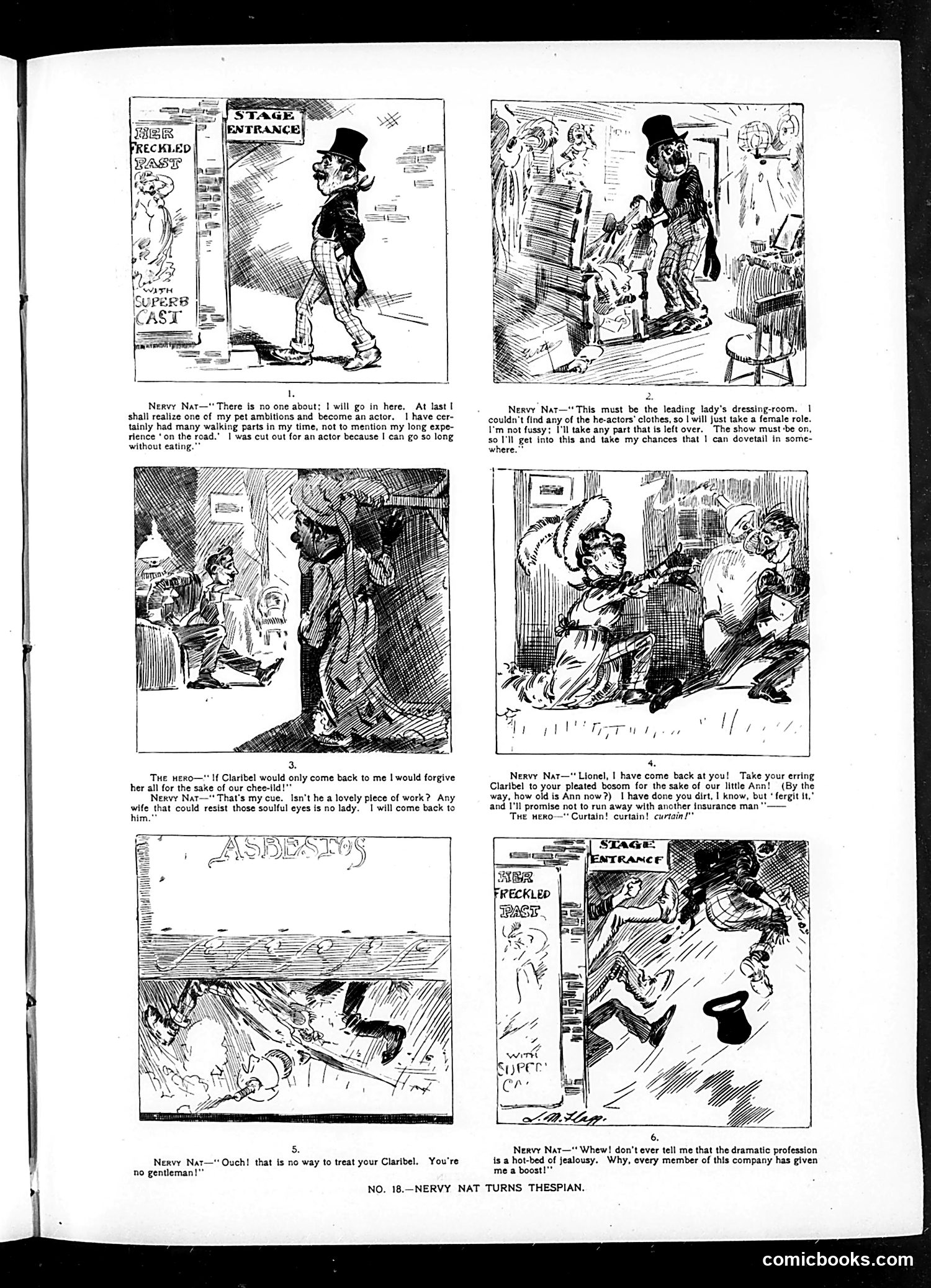
This is a slapstick comic strip following a recurring character, "Nervy Nat," as he infiltrates a theatrical production. Unable to find male costumes, Nat dresses as the leading lady and improvises his way through a melodramatic scene, delivering absurdly inappropriate lines about infidelity and insurance fraud. The humor relies on: - **Cross-dressing farce**: Nat's bumbling impersonation of an actress - **Theatrical clichés**: Overwrought dialogue about forgiveness and "our chee-ild" - **Physical comedy**: Nat being thrown about during the performance - **Ironic contrast**: His final boast about company solidarity immediately after being violently attacked by castmates The satire gently mocks both the pretensions of stage acting and the chaos of theater production. "Thespian" (actor) is used as a dignified term to contrast with Nat's undignified fakery. This appears to be a Judge magazine humor strip, likely from the early 1900s.
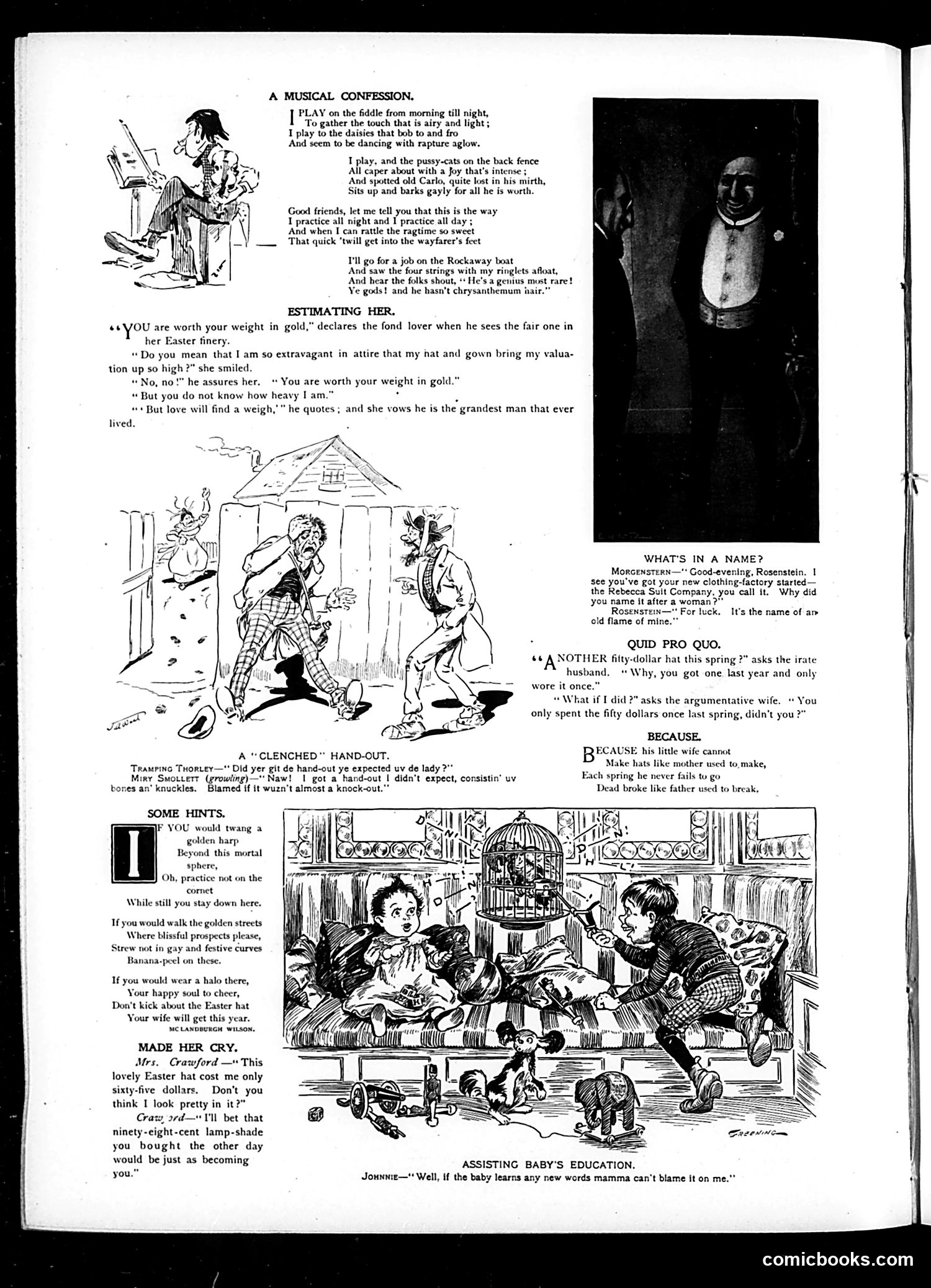
This page contains early 20th-century humor targeting domestic life and gender relations. **"A Musical Confession"** depicts a mediocre violinist who practices obsessively, imagining himself a genius—satirizing amateur musicians and delusional aspiration. **"Estimating Her"** plays on the phrase "worth your weight in gold." A woman interprets her lover's compliment as criticism of her expense, then he recovers with a sentimental quote. The satire mocks both romantic clichés and women's financial anxiety about fashion. **"Quid Pro Quo"** presents marital bickering: a husband objects to his wife buying another expensive hat; she retorts that he spent money once too. It satirizes domestic arguments about spending and hypocrisy. **"Because"** shows cyclical family poverty—the father is "dead broke like father used to break"—suggesting generational failure. **"Some Hints"** and other pieces humorously advise readers on morality, often targeting wives' Easter hat expenses. The recurring Easter hat theme suggests this was published near Easter, with women's fashion consumption being a common satirical target. The overall tone reflects period anxieties about marriage, spending, and gender roles.
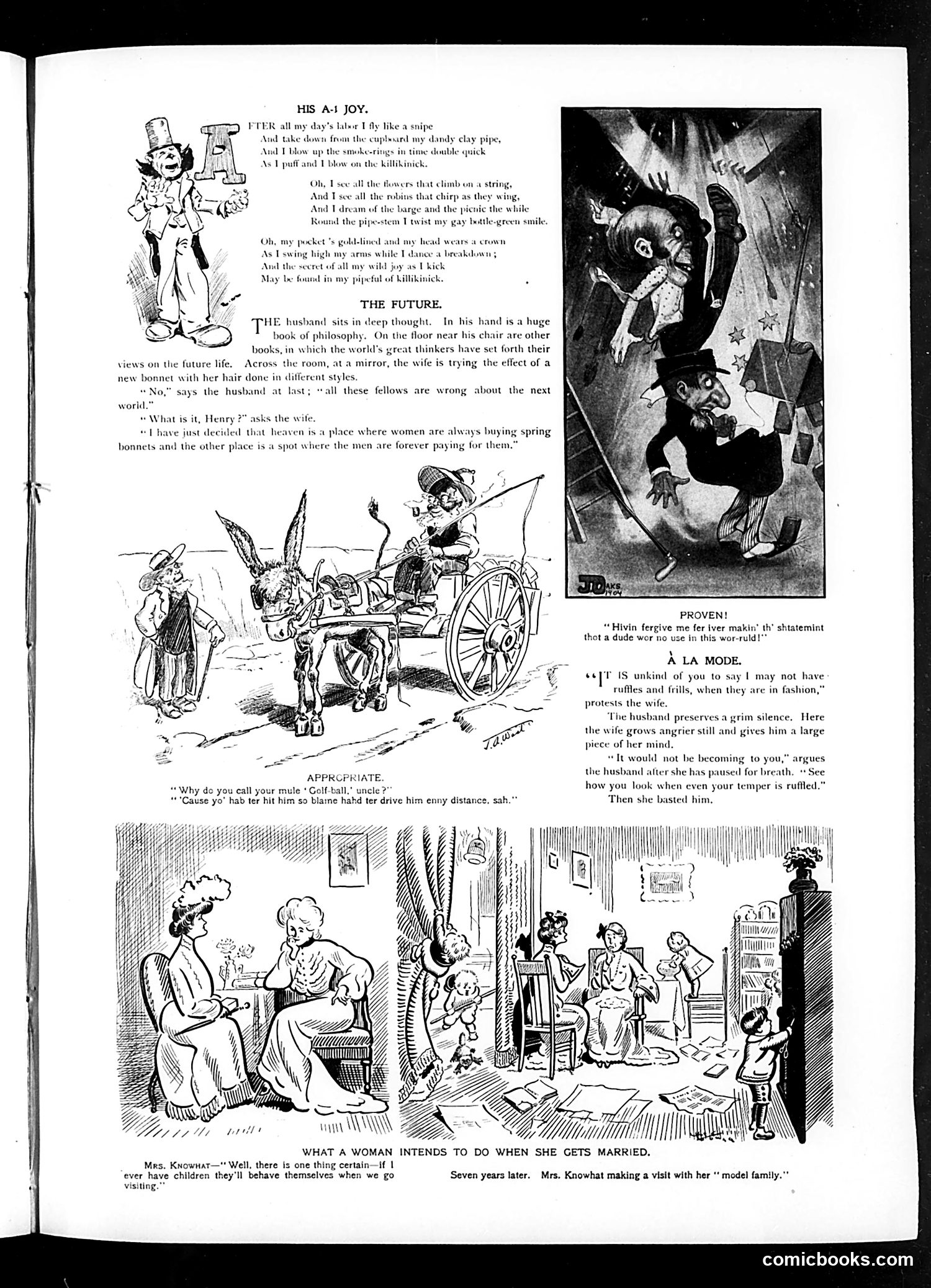
This page contains multiple satirical cartoons mocking marriage and gender relations, typical of late 19th/early 20th-century American humor. **"His A-1 Joy"** celebrates a man's simple pleasure smoking a clay pipe—innocent escapism from domestic life. **"The Future"** presents a husband's philosophical joke: heaven is where women eternally shop for bonnets; hell is where men eternally pay for them. This reflects period anxieties about women's consumer spending and male financial responsibility. **"A La Mode"** depicts marital conflict over fashion—the wife demands ruffles; the husband criticizes her temper. She "basted him" (verbally attacked him) for the insult. **"What a Woman Intends to Do"** shows the disconnect between premarital promises and reality: Mrs. Knowhat vows her future children will behave properly when visiting; seven years later, her actual children are chaotic during visits. The humor relies on stereotypes: frivolous women obsessed with shopping and fashion, nagging wives, and harried husbands. These cartoons satirize domestic friction by exaggerating gender role expectations and marital disappointments.
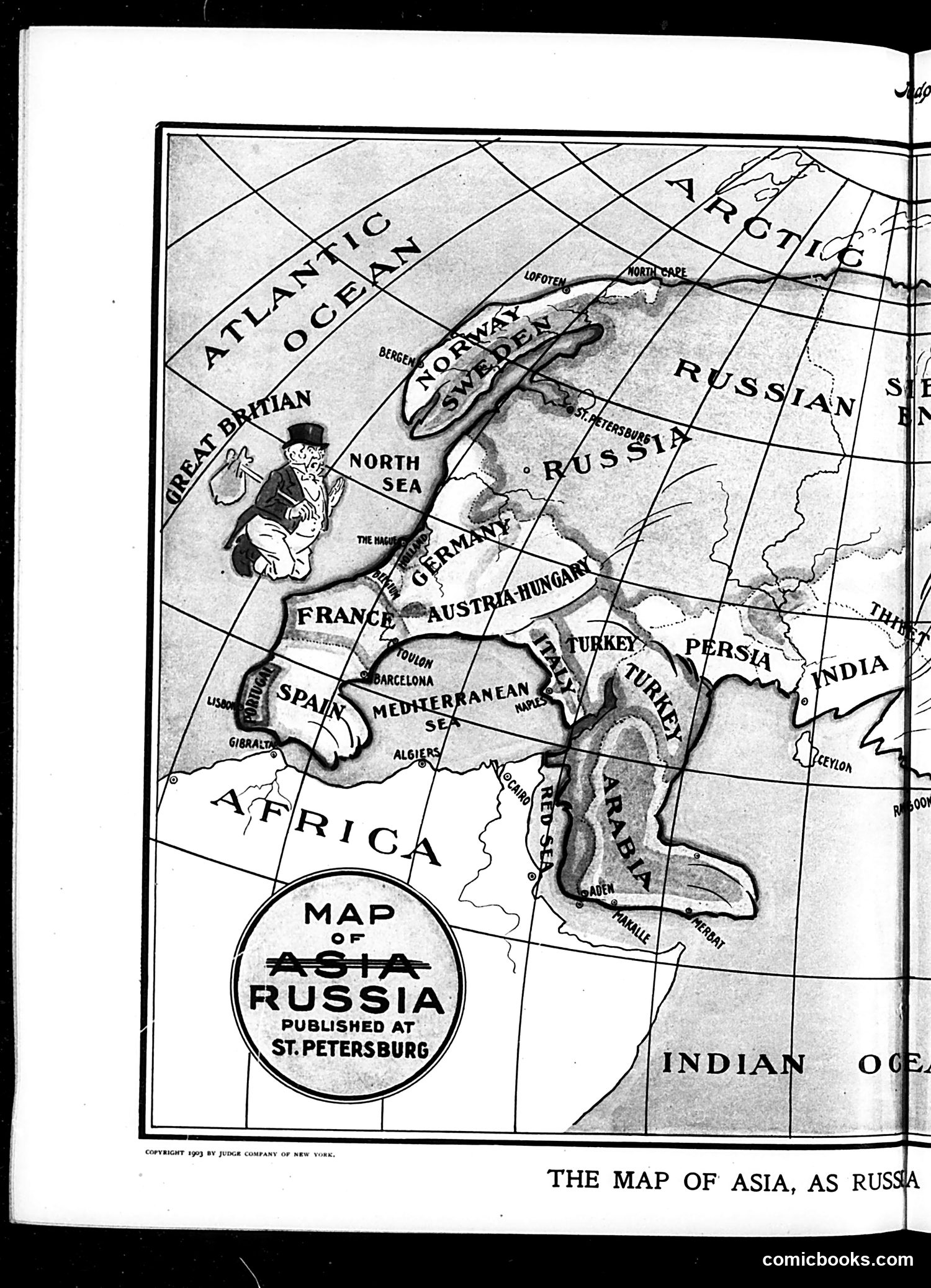
This is a political cartoon from *Judge* magazine titled "The Map of Asia, as Russia." The image shows a caricatured figure (likely representing Russia or a Russian expansionist policy) superimposed over a map of Asia, with the figure's body stretched across territories including Norway, the Ottoman Empire, and Central Asia. The satire mocks Russian imperial ambitions and territorial expansion across Asia during the late 19th or early 20th century. The exaggerated human figure replacing geographical boundaries suggests Russia's attempted domination and reshaping of the continent according to its imperial interests. The cartoon criticizes what contemporaries viewed as aggressive Russian imperialism threatening multiple regions and peoples across Asia and Eastern Europe.
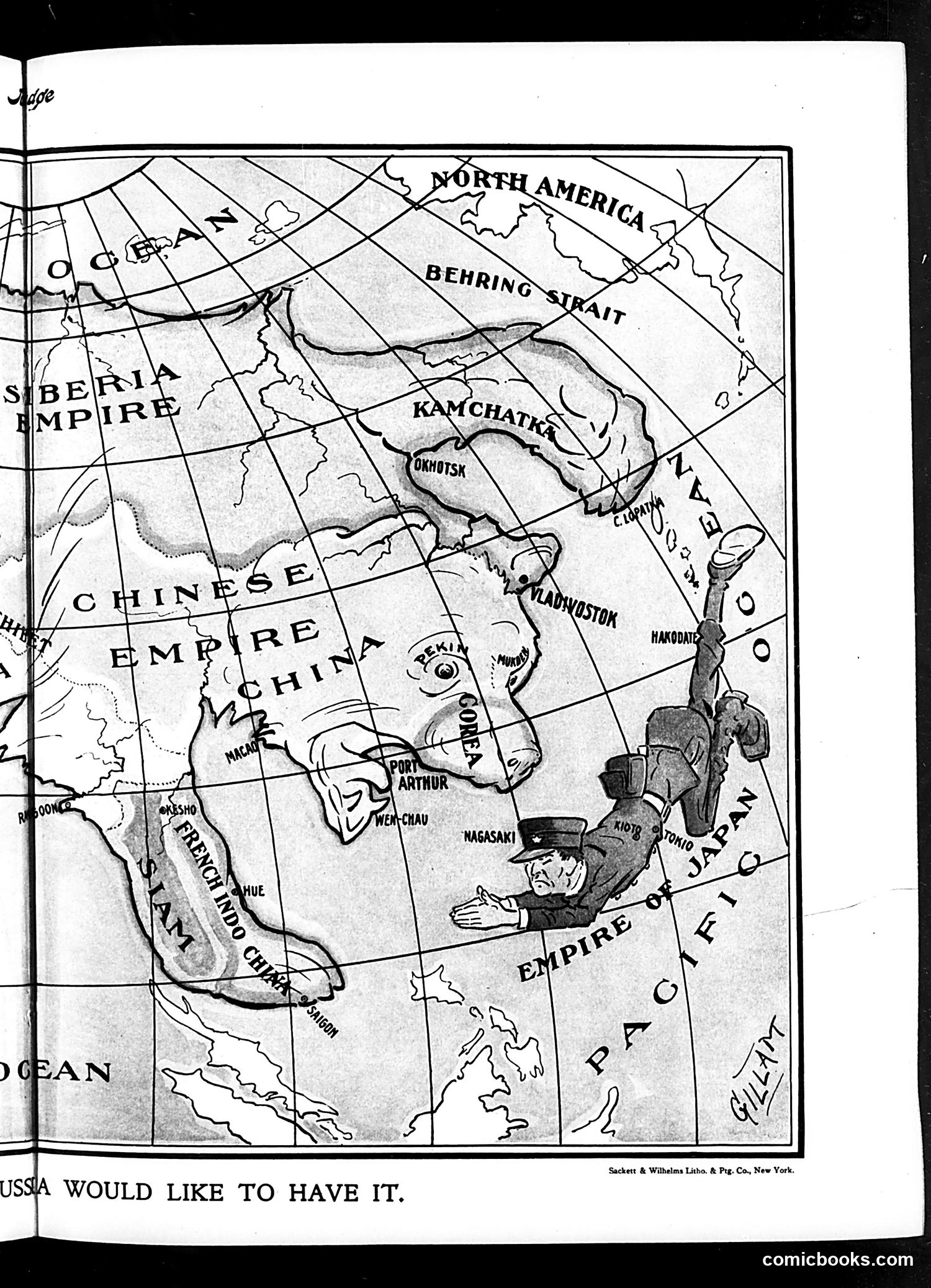
This is a political cartoon titled "Russia Would Like to Have It," published by Judge magazine (Sackert & Wilhelms Litho, New York). The map shows Far East Asia with territorial boundaries marked as "Chinese Empire," "Siberian Empire," and "Japanese Empire." A caricatured Russian figure with exaggerated features appears to be eyeing or reaching toward the region, particularly toward territories including Vladivostok and other Pacific areas. The satire comments on Russian imperial ambitions in the early 20th century, suggesting Russia's desire to expand into East Asia at the expense of China and Japan. This likely references the Russo-Japanese War period (1904-1905) or tensions preceding it, when Russia sought Pacific territorial expansion. The cartoon mocks Russian territorial appetite while portraying the region's other powers.
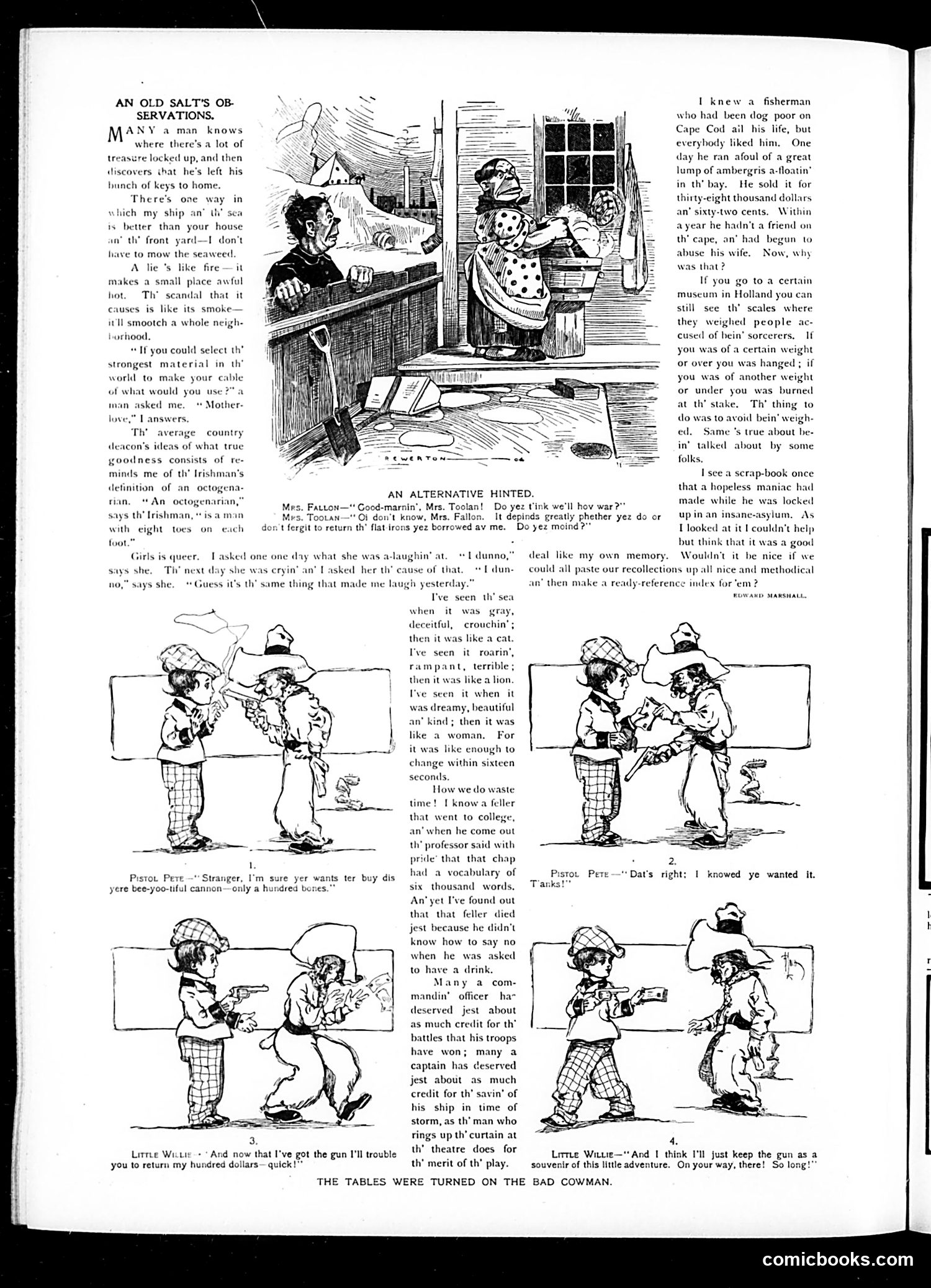
This page contains three distinct pieces: **Upper Section - "An Old Salt's Observations":** An elderly sailor dispenses folk wisdom through homespun observations about life, the sea, human nature, and relationships. The humor relies on rustic Irish-American dialect and shrewd, cynical observations (e.g., a man gains wealth from ambergris but loses his friends; education doesn't teach practical sense like saying "no" to drinks). This is gentle, character-based humor rather than political satire. **Middle Section - "An Alternative Hinted":** A brief comic showing two working-class Irish women (indicated by dialect) discussing potential war, with one suggesting the real problem is unreturned borrowed flat-irons—deflating grand political concerns with domestic practicality. **Lower Section - "Pistol Pete" Comic Strip:** A four-panel sequence where a young con artist sells a "cannon" (toy gun) to a rube for a hundred dollars, then demands its return, reversing the swindle. It's a straightforward trick-reversal joke. The page emphasizes working-class, immigrant perspectives (Irish-American characters) and humorous cynicism about human nature rather than contemporary politics.
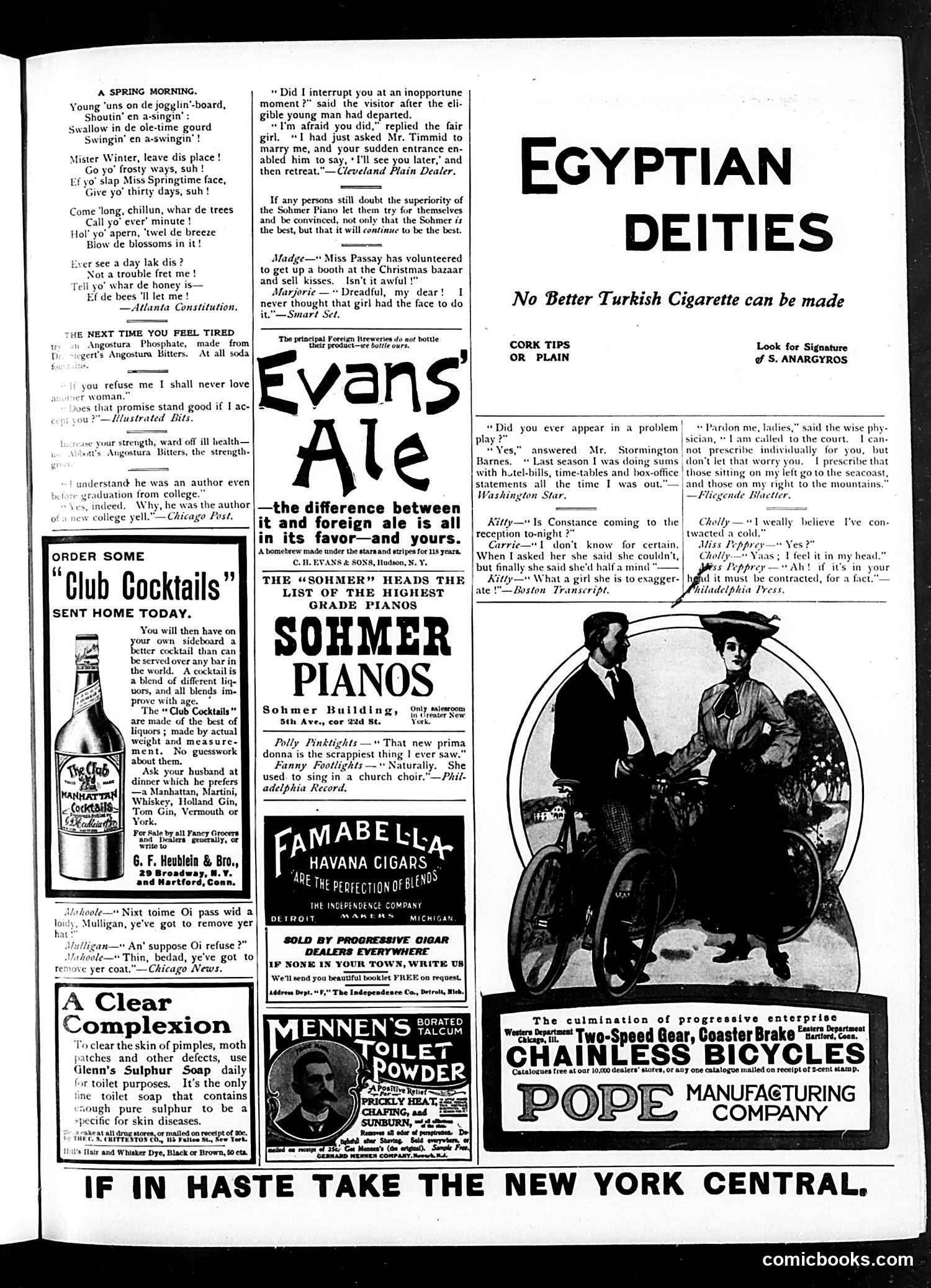
This page is primarily **advertising with scattered short humor pieces** rather than political cartoons. The main content consists of: 1. **Advertisements** for commercial products (Evans Ale, Club Cocktails, Sohmer Pianos, Egyptian Deities cigarettes, Famabella cigars, Glenn's Sulphur Soap, Mennen's Toilet Powder, and a Pope Manufacturing Company automobile) 2. **Brief humor columns** featuring romantic misunderstandings and social observations—typical light magazine fare of the era. For example, a woman proposes to a man; his sudden interruption allows him to escape by saying "I'll see you later." 3. **A automobile advertisement** prominently featuring a two-speed coaster-brake vehicle, reflecting early automotive enthusiasm. The page reflects **early 20th-century consumer culture** and courtship humor conventions. There is no significant political satire—the magazine's satirical edge appears limited to gentle social comedy about contemporary life (romance, social pretension, theater-world gossip).
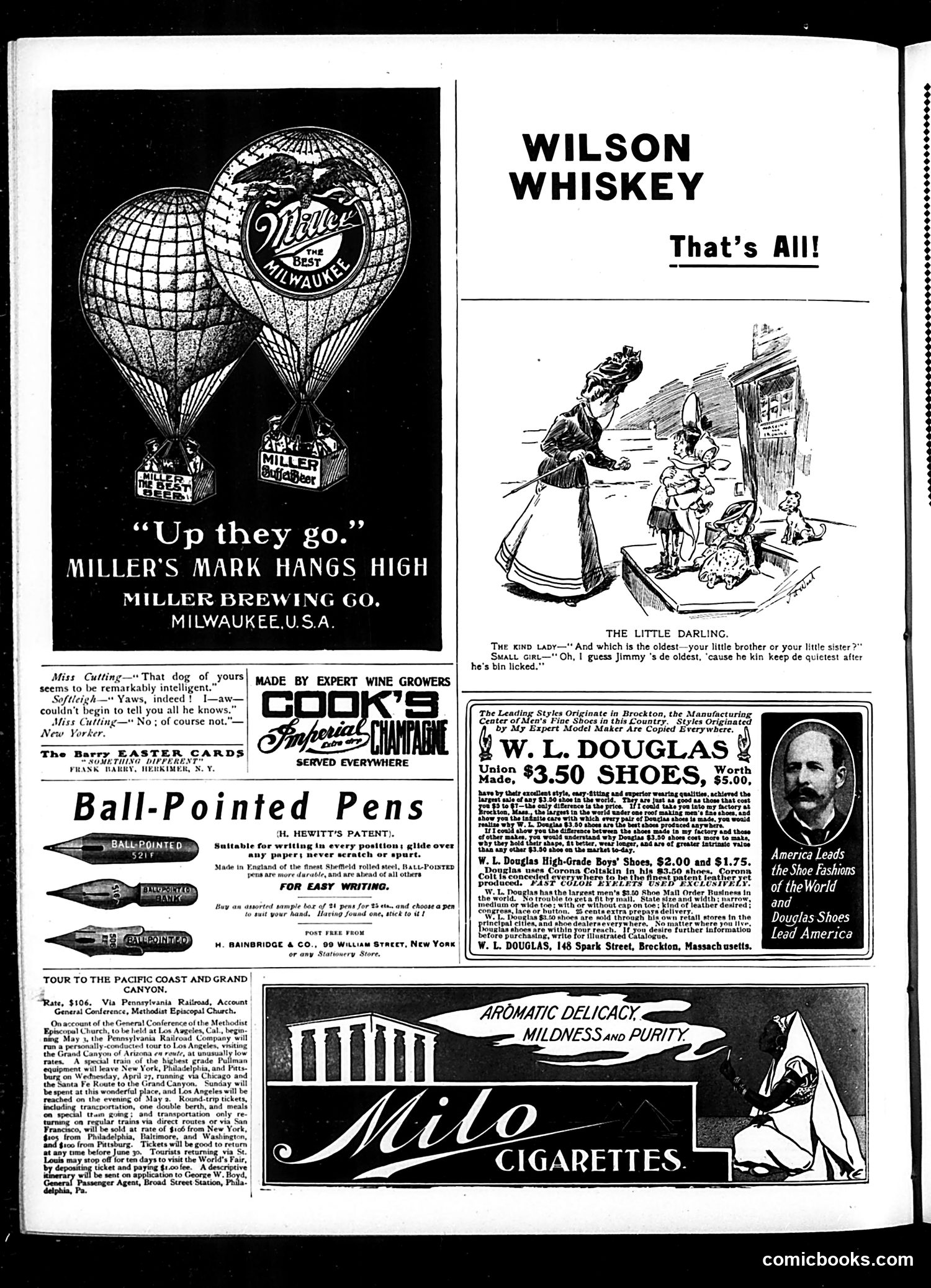
This page is primarily **advertising**, not political satire. It features multiple commercial advertisements from the early 20th century: **Main advertisements visible:** - **Wilson Whiskey** (top left): Shows hot air balloons with "Miller's Mark" branding, emphasizing the product's high status - **Cook's Imperial wine** (center): Marketed as made by expert growers - **W.L. Douglas Shoes** (right): Advertises $3.50 shoes as "America Leads the Shoe Fashions" - **Ball-Pointed Pens** (left): Promotes writing instruments by Rainbridge & Co. - **Milo Cigarettes** (bottom): Emphasizes "Aromatic Delicacy, Mildness and Purity" A small illustration titled "The Little Darling" appears to be lifestyle/family-oriented content, typical of period magazines. The page reflects early 1900s consumer culture and product marketing strategies, with no apparent political messaging or satire.
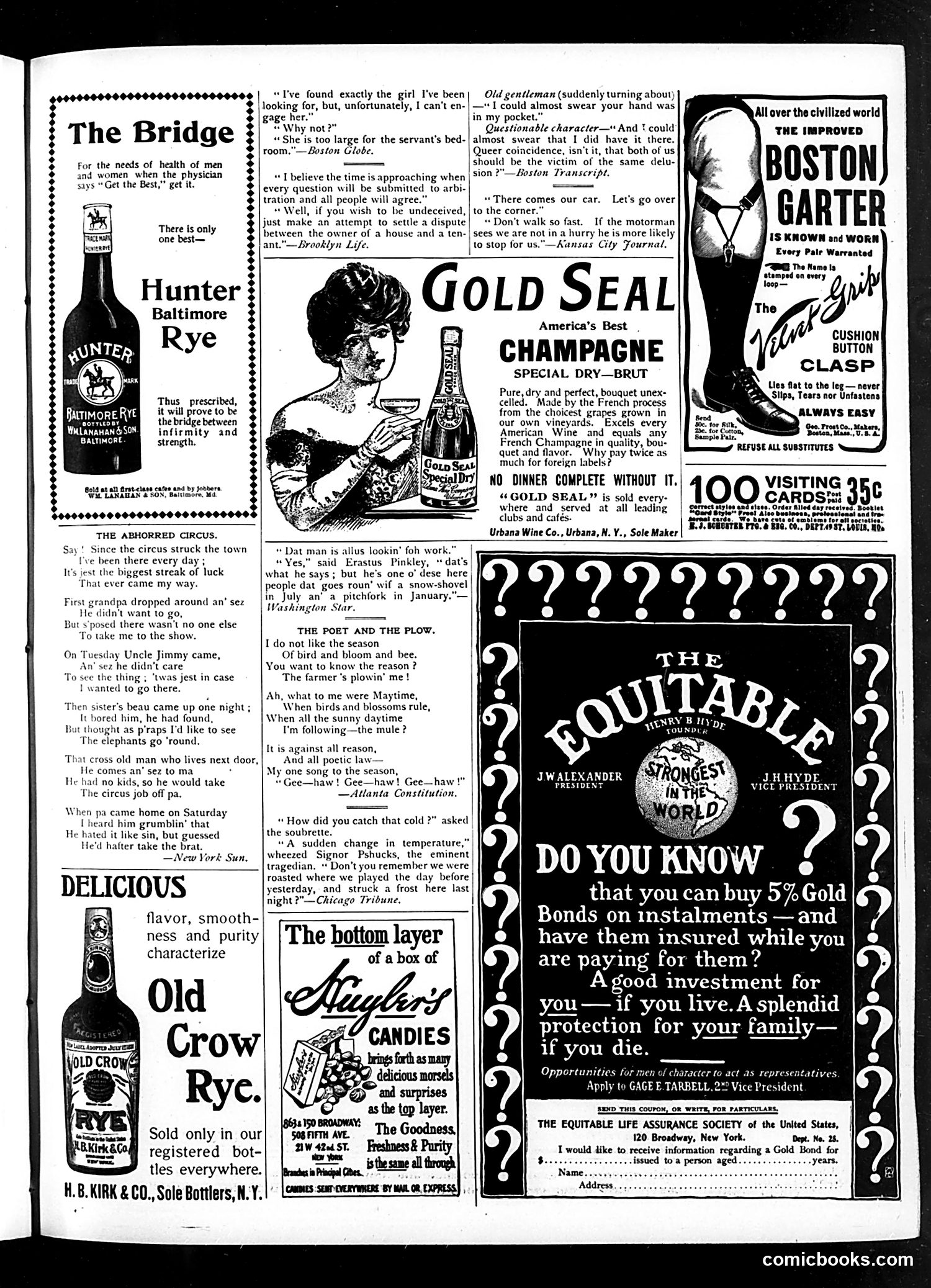
This page is primarily **advertisements** interspersed with light humor and poetry, typical of early 20th-century magazines. The main content includes: - **"The Bridge"** and **"The Abhorred Circus"** — brief comedic anecdotes about everyday situations (a man seeking a wife too large for servant's quarters; a boy dragged to the circus by various reluctant relatives) - **"The Poet and the Plow"** — sentimental verse from a farmer's perspective, contrasting romantic Maytime with harsh labor The advertisements dominate: **Hunter Baltimore Rye** whiskey, **Gold Seal Champagne**, **Boston Garter** (hosiery with "Cushion Button Clasp"), **Old Crow Rye**, **Stuyler's Candies**, and **The Equitable Life Assurance Society** (promoting gold bonds). The humor is gentle domestic comedy—no clear political satire. The page reflects early 1900s consumer culture and genteel entertainment rather than sharp social criticism.
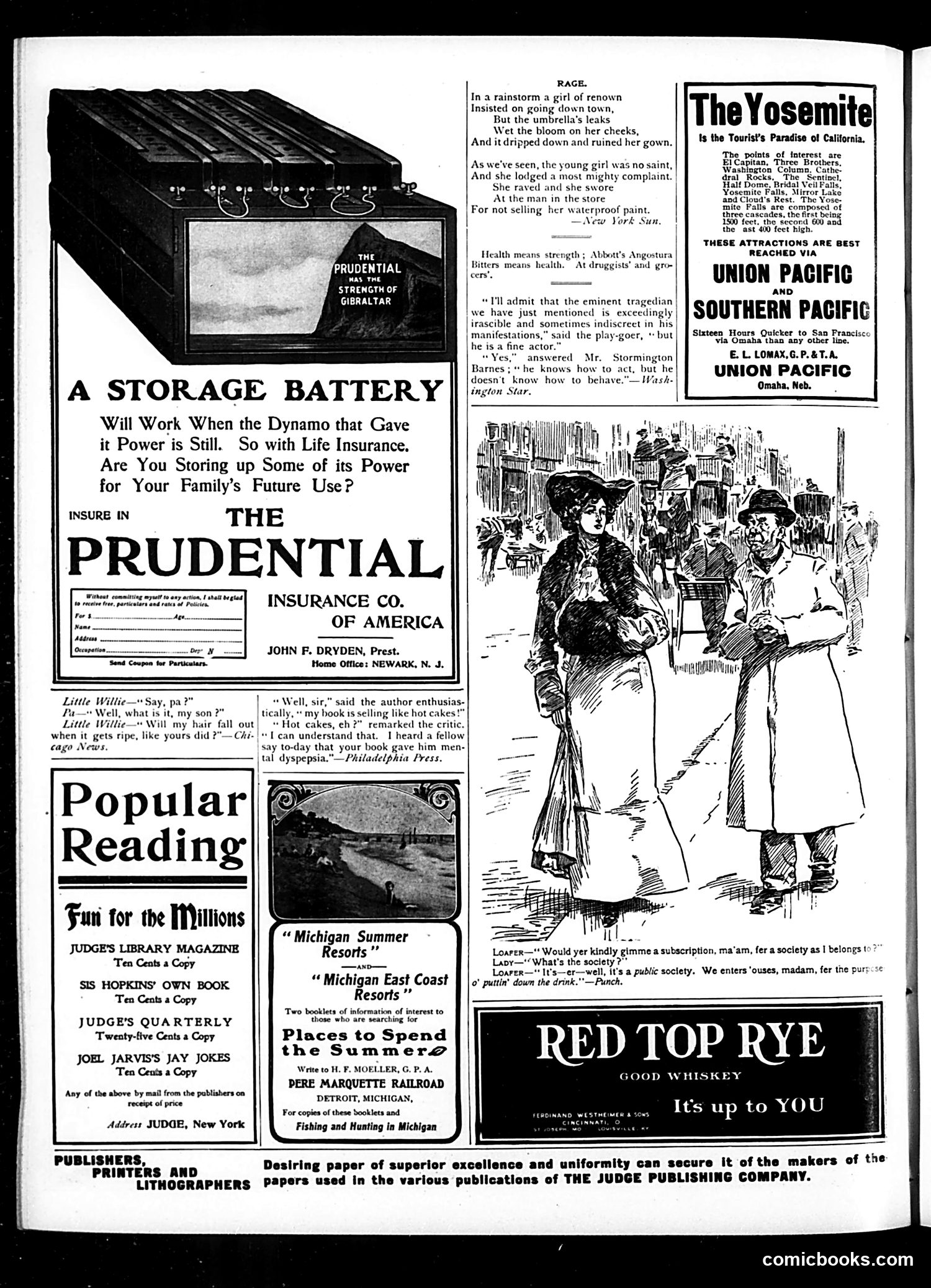
This page consists primarily of **advertisements and light humor** rather than political satire. The content includes: **Main Items:** 1. **"Rage" poem** (top): A lighthearted verse about a woman whose umbrella leaks during rain, ruining her appearance and gown. She complains to a store clerk for not selling waterproof paint—a simple joke about vanity and consumerism. 2. **Small comic snippets**: Brief jokes about a child asking if his hair will fall out like his father's, and exchanges about book sales and temperance societies—typical period humor. 3. **Heavy advertising**: Prudential Insurance, Union Pacific Railway (promoting Yosemite travel), Popular Reading magazines, Red Top Rye whiskey, and Michigan resort booklets dominate the page. **The satire, if present, is mild**: The poem gently mocks a vain woman's complaint; the critic's joke suggests the author's book causes "mental dyspepsia" (indigestion)—standard era wordplay. This appears to be a standard Judge issue blending light humor with commercial advertising rather than sharp political commentary.
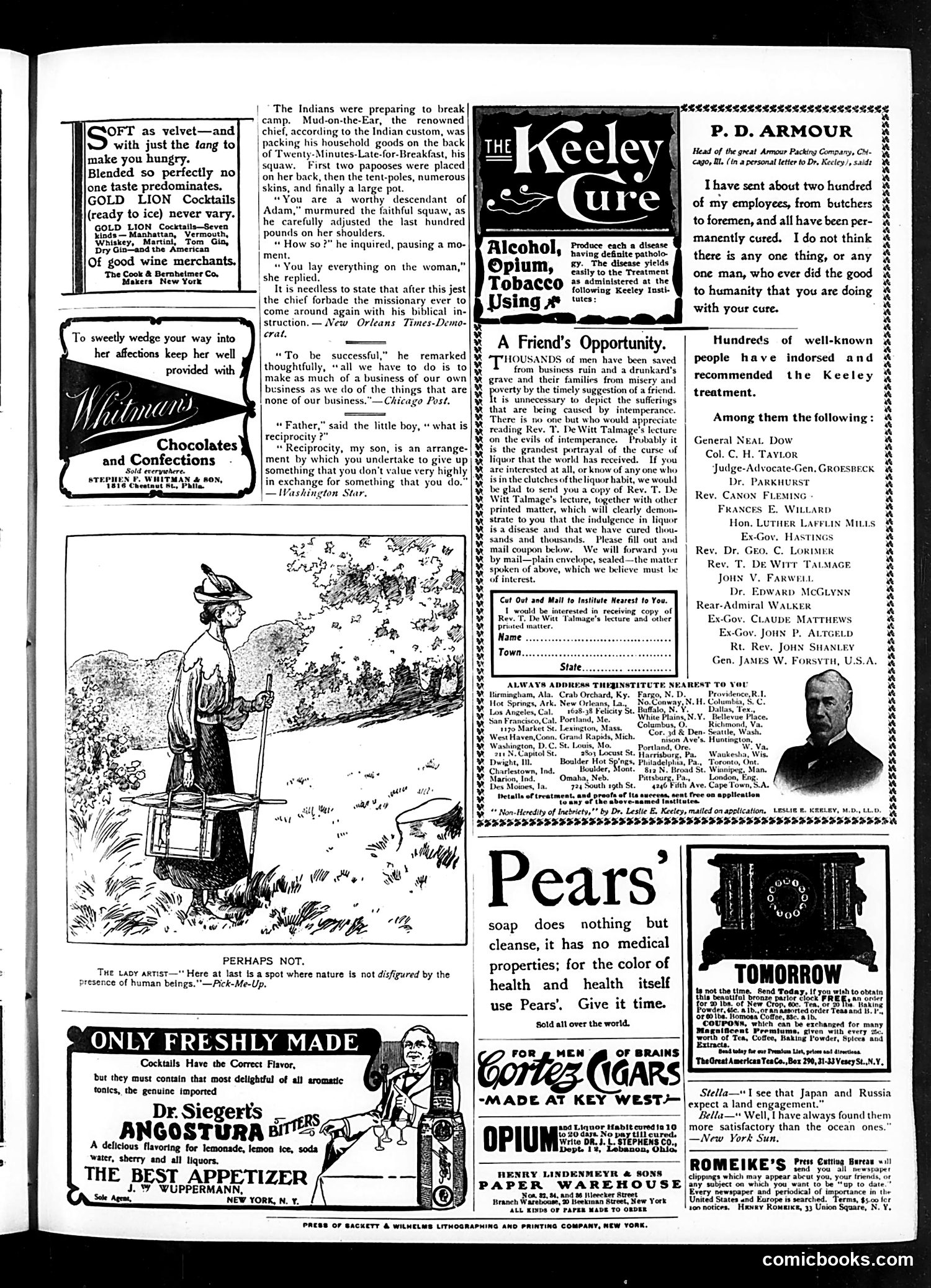
This page is primarily **advertising**, not political satire. It features multiple ads for alcohol and patent medicines, typical of early 20th-century magazines. The only satirical content is a brief **cartoon joke** titled "Perhaps Not," depicting a female artist claiming to have found landscape untouched by human presence—the joke being that she herself, as a human, disproves her statement. This is gentle, not political. The substantive ads include: - **Gold Lion Cocktails** and Dr. Siegert's Angostura Bitters (alcoholic beverages) - **The Keeley Institute** testimonial from P.D. Armour (meatpacking magnate) promoting their "cure" for alcoholism/intemperance - **Pears' Soap** and **Cortes Cigars** The Keeley ad is notable: it advertises treatment for alcohol addiction while the page simultaneously advertises alcohol—reflecting the era's contradictory attitudes toward drinking and the profitable "cure" industry. The prominent testimonial from a wealthy industrialist lent credibility to dubious treatments.
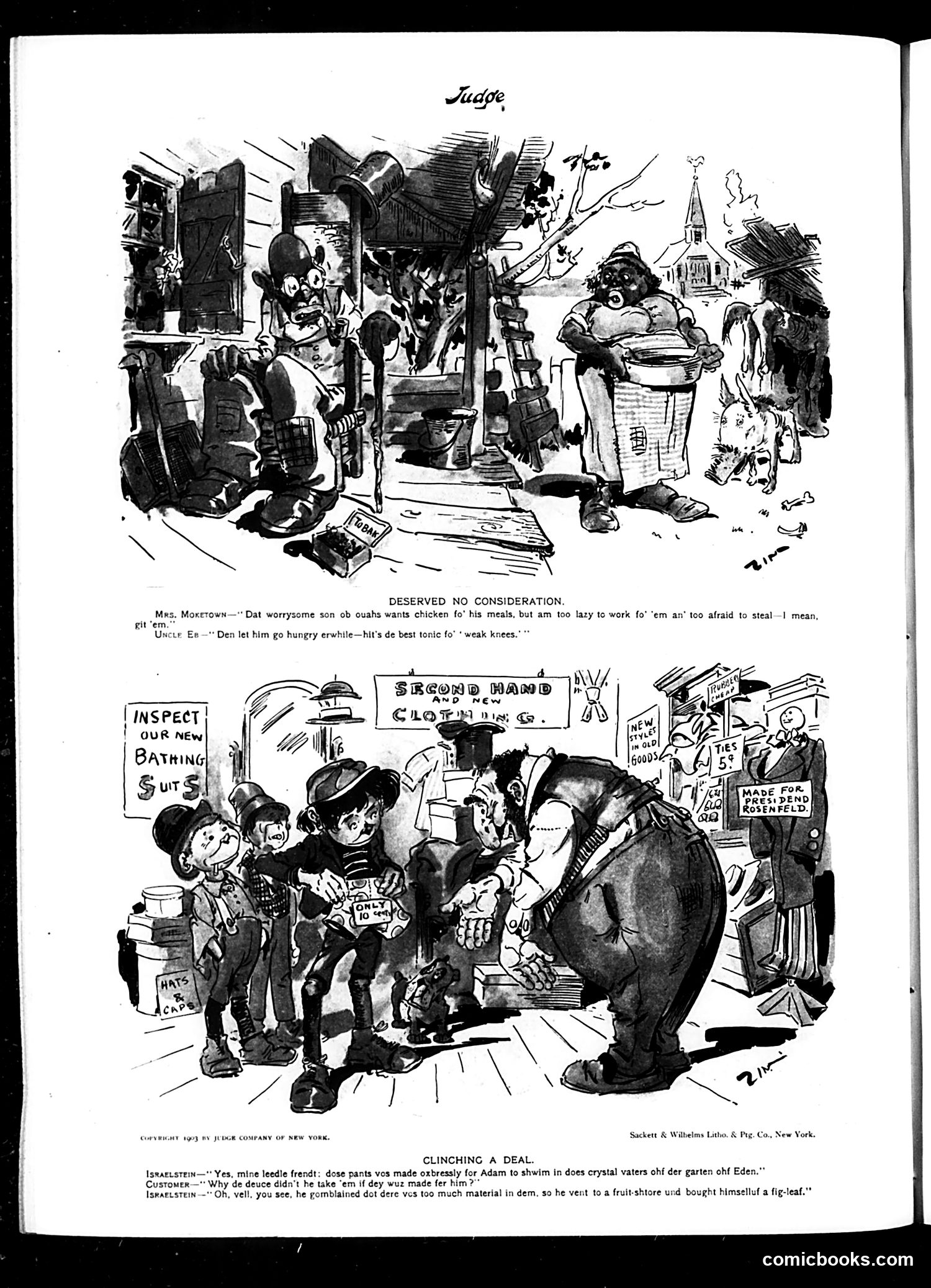
This page contains two satirical cartoons employing ethnic stereotypes common to early 20th-century American humor. **Top cartoon ("Deserved No Consideration")**: Features caricatured Black figures using heavy dialect. A lazy son refuses work and stealing to earn chicken; his father suggests starvation will cure his "weak knees." The satire targets laziness and criminality stereotypes. **Bottom cartoon ("Clinching a Deal")**: Depicts a Jewish shopkeeper (Isrealstein) selling pants by claiming they were made for Adam in the Garden of Eden. When challenged why Adam didn't keep them, he explains Adam found them too voluminous and bought a fig-leaf instead. The joke plays on Jewish merchant stereotypes, exaggerated accent, and biblical irony—the tailor's absurd sales pitch and the fig-leaf reference mock both deceptive salesmanship and religious narrative. Both cartoons rely on ethnic caricature and dialect humor typical of the era, reflecting now-offensive period attitudes toward marginalized communities.