
A complete issue · 16 pages · 1904
Judge — March 12, 1904
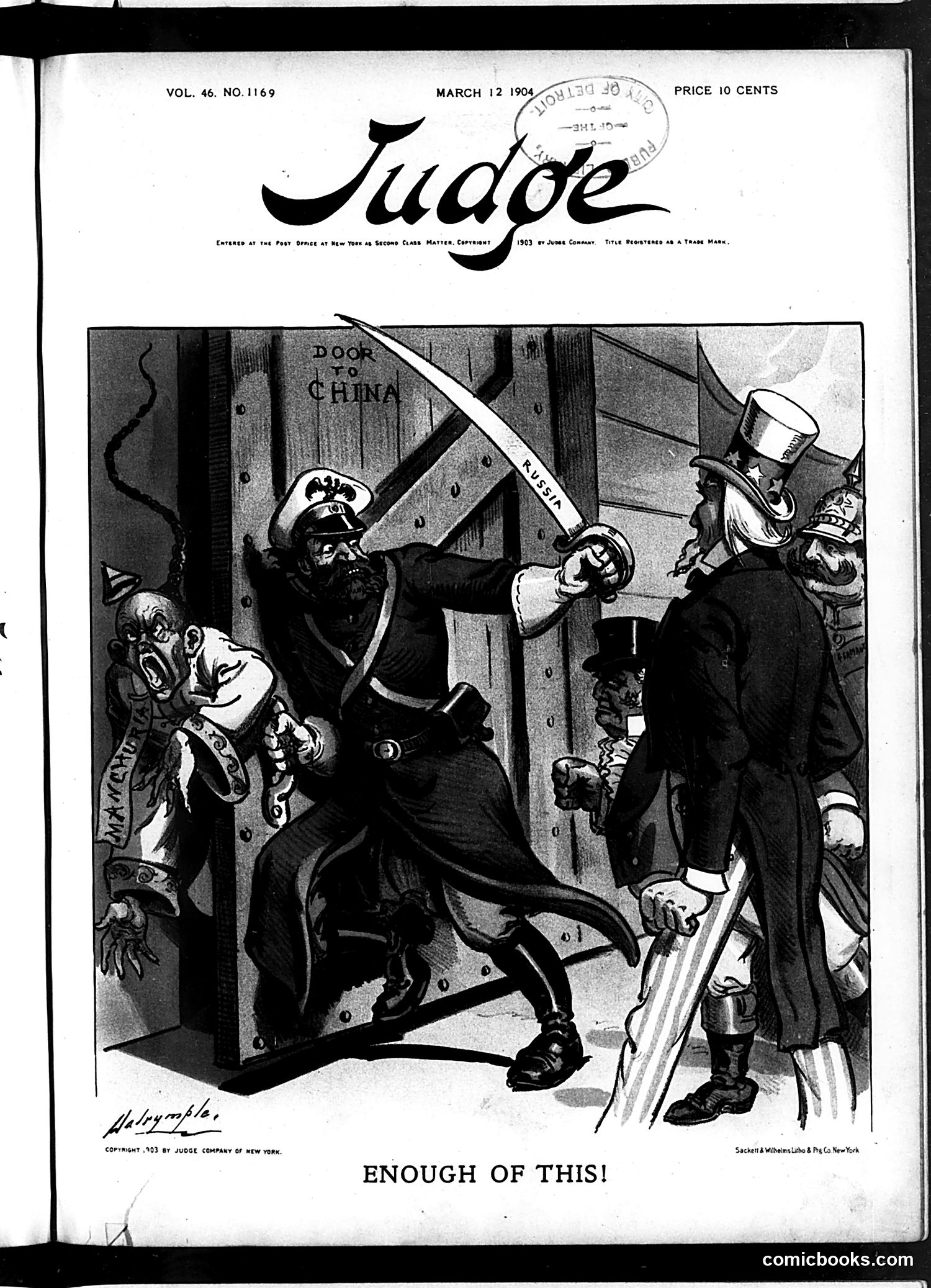
This political cartoon satirizes Western powers' intervention in China during the Boxer Rebellion aftermath. The door labeled "Door to China" shows Western diplomats and military figures (identifiable by their formal dress and top hats) forcibly breaking down barriers, while a caricatured Chinese figure on the left expresses alarm or distress. The title "Enough of This!" suggests the cartoon criticizes excessive foreign interference and military pressure on China. The exaggerated, aggressive postures of the Western representatives—wielding what appears to be a battering ram—mock imperialist tactics of the era. The artwork appears to criticize Western colonial ambitions in East Asia during this period of gunboat diplomacy and foreign domination of Chinese affairs.
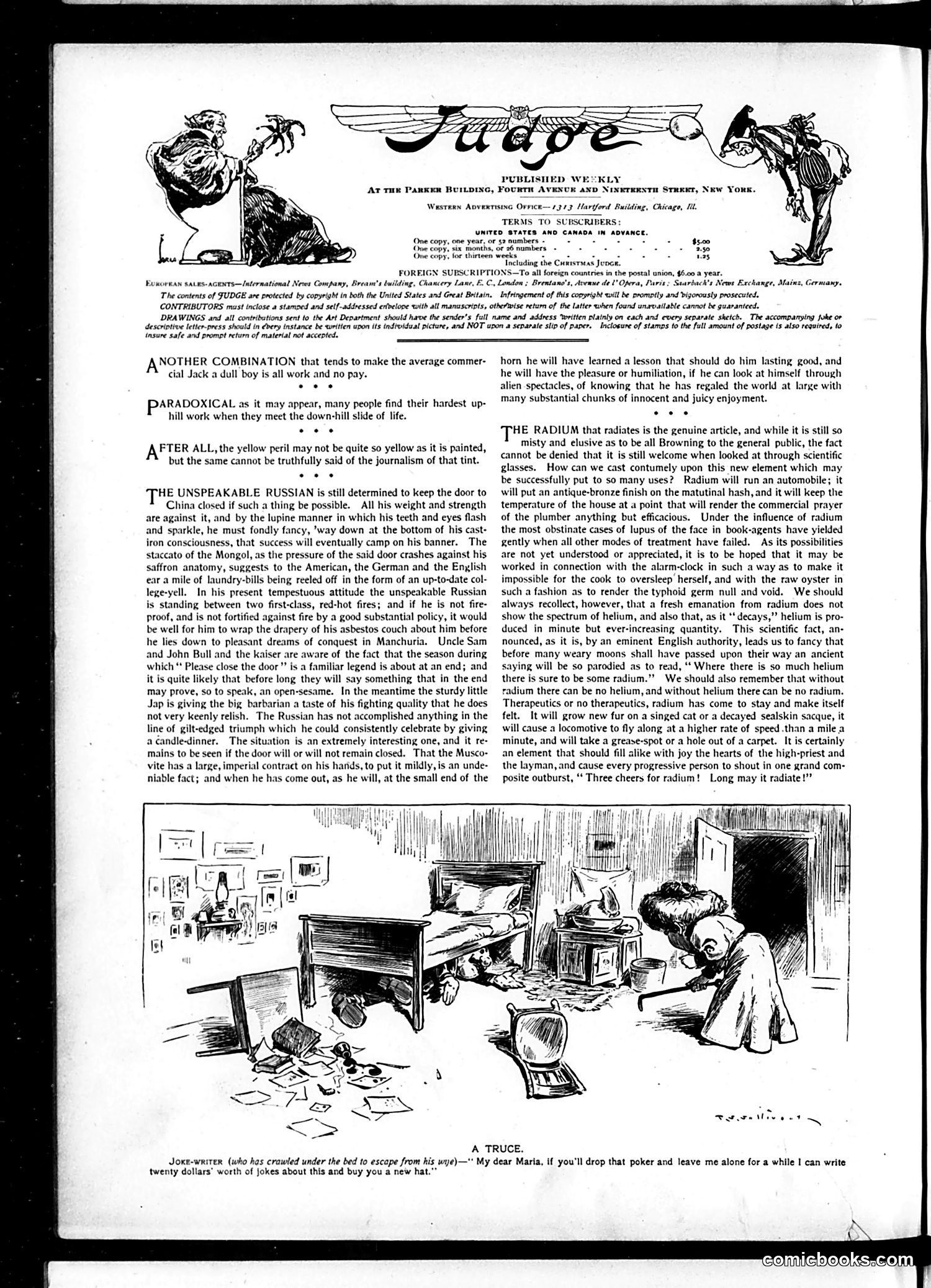
This page from Judge magazine contains three editorial pieces satirizing contemporary issues: 1. **"Another Combination"** - Brief commentary on commercialism and labor, suggesting average workers must accept low pay. 2. **"Paradoxical"** - Appears to critique wealthy individuals avoiding work. 3. **"The Unspeakable Russian"** and **"The Radium"** - Extended pieces discussing Russian diplomacy and radium's scientific/commercial applications. The radium article mocks excessive enthusiasm for the element's purported medicinal uses, warning against overpromising its therapeutic benefits. The bottom illustration titled **"A Truce"** depicts a messy domestic scene with a humorous caption about a joke-writer negotiating with his wife (Maria) for writing time by offering payment—satirizing marital conflict over work and household management. These pieces reflect early 20th-century concerns: labor conditions, scientific wonder, and domestic gender relations.
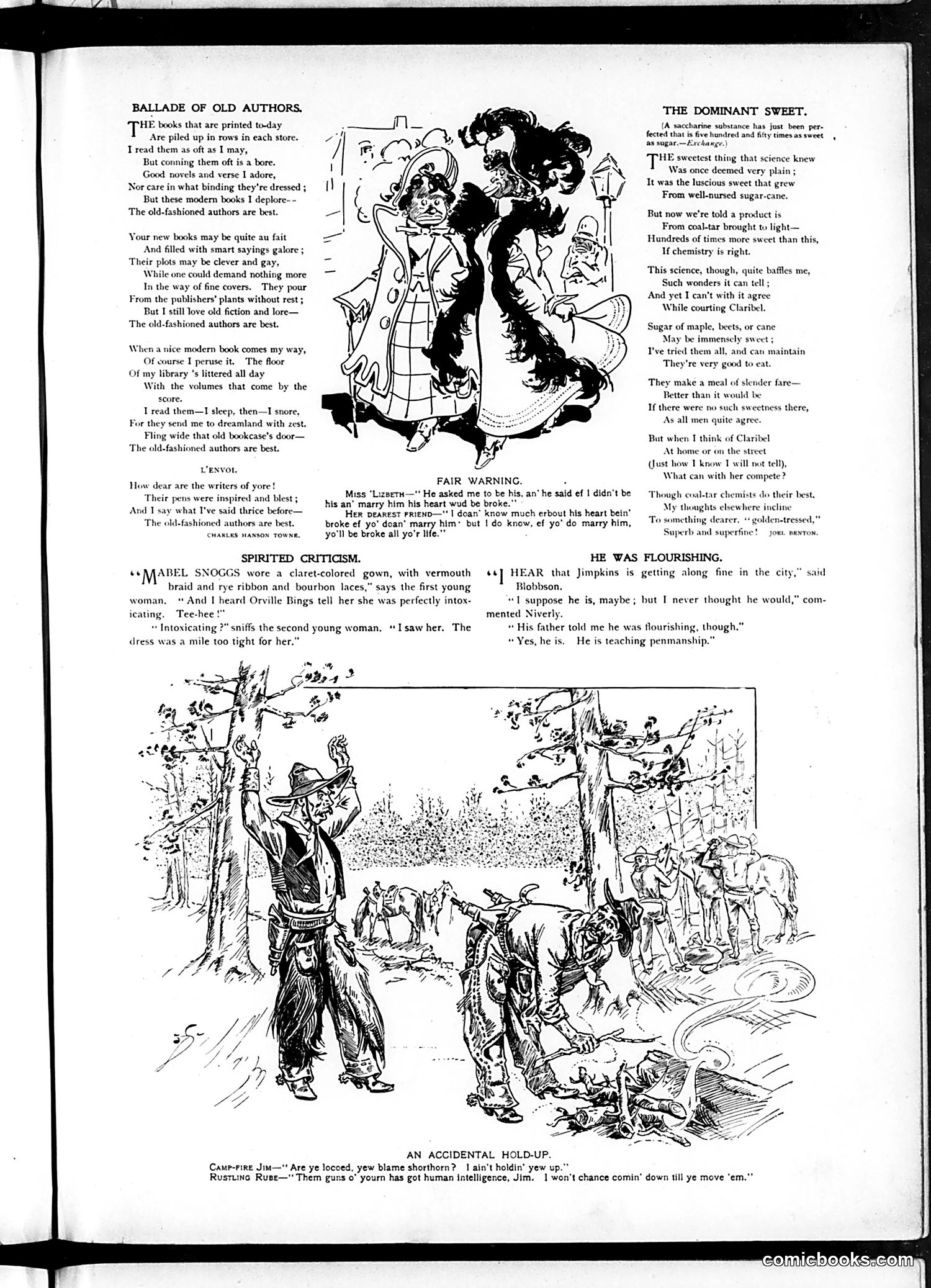
This page contains literary and social humor rather than political cartoons. "Ballade of Old Authors" mocks how modern publishers prefer new books over classics, despite their superior quality. "The Dominant Sweet" satirizes scientific claims about sugar production—likely referencing contemporary debates about coal-tar chemistry versus traditional sugar-cane cultivation. The "Fair Warning" and "Spirited Criticism" sections are brief gossip items about socialites (Mabel Snoggs, Lizeth) and their romantic entanglements, typical of Judge's society-page humor. The large bottom illustration titled "An Accidental Hold-up" appears to be a Western frontier scene with cowboys and rustlers, featuring dialogue between "Camp-fire Jim" and "Rustling Rube"—humorous stereotypes common to period humor publications. The overall page emphasizes literary, social, and frontier-themed comedy.
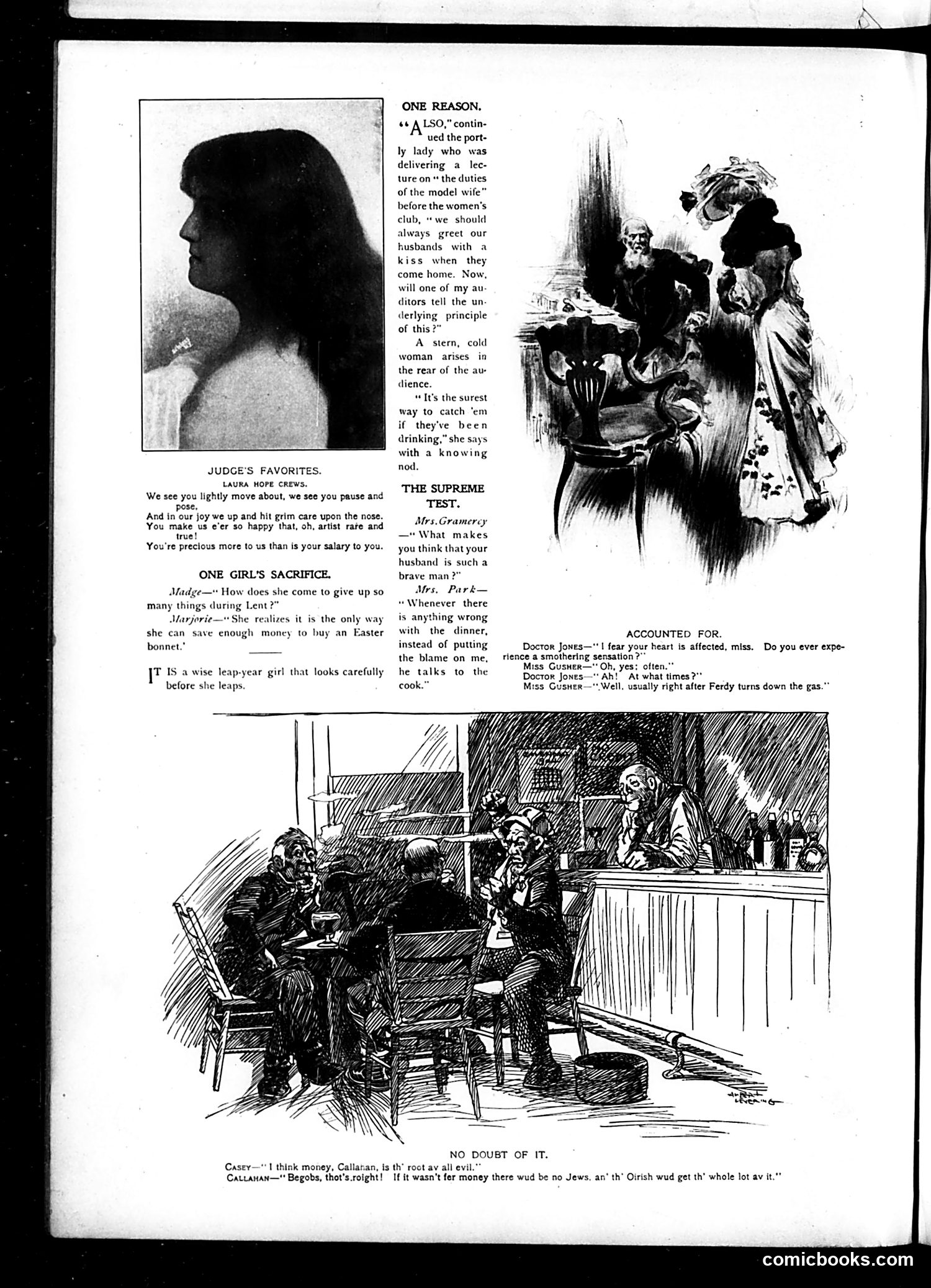
This Judge magazine page contains several satirical pieces: **"Judge's Favorites"** features Laura Hope Crews, a theatrical actress, with light verse praising her. **"One Girl's Sacrifice"** satirizes women's wartime economy during Lent, suggesting a girl sacrifices luxuries to afford an Easter bonnet—mocking both consumer materialism and religious observance. **"The Supreme Test"** presents a domestic dialogue where Mrs. Gramercy questions her husband's bravery. Mrs. Park responds that she judges his courage by how he handles dinner problems—a satirical commentary on masculine vanity and the unglamorous realities of married life. **"No Doubt of It"** depicts a courtroom scene with antisemitic stereotyping, presenting Jewish characters as money-obsessed. This represents deeply problematic period attitudes reflected in mainstream publications.
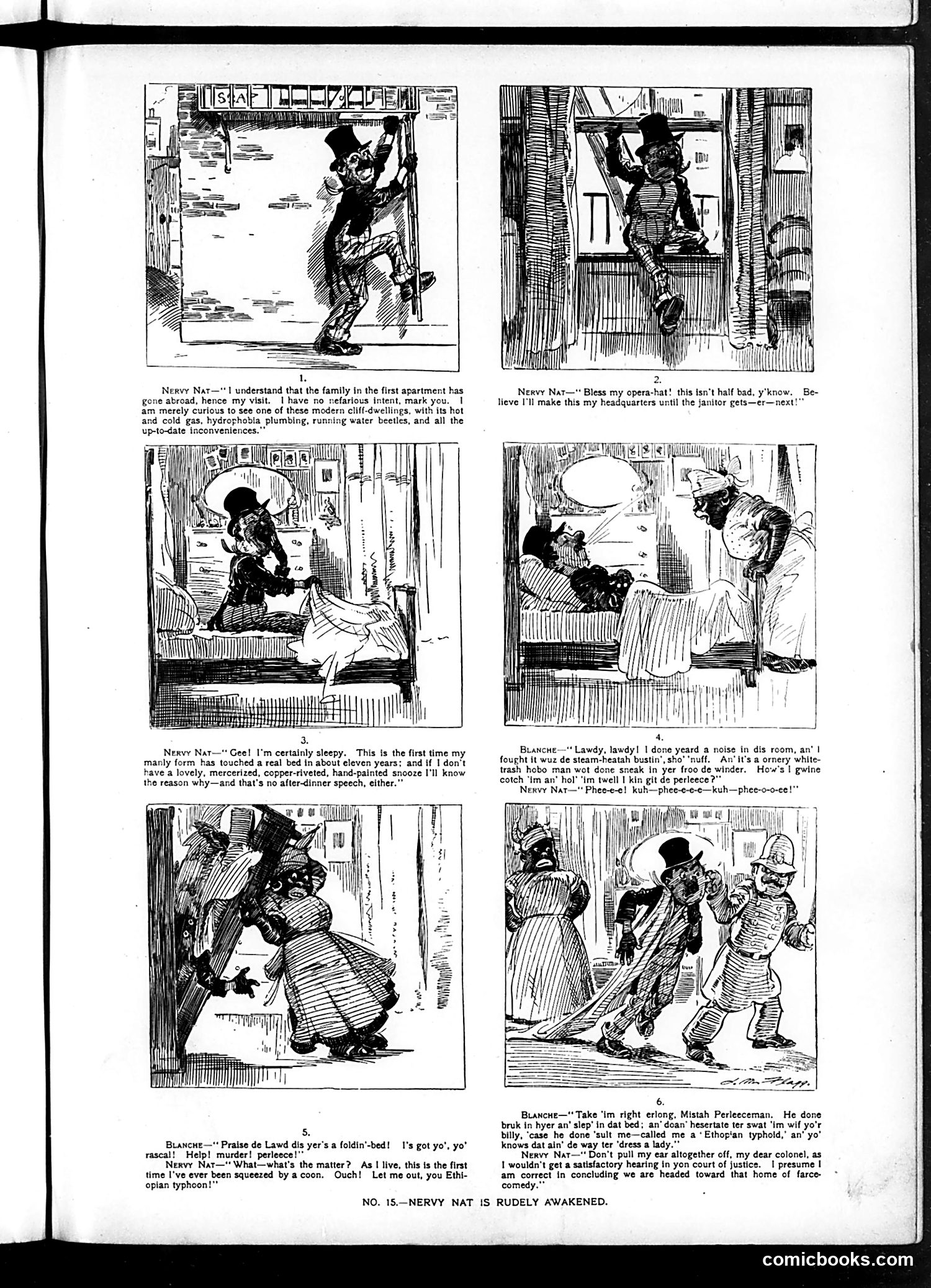
This comic strip satirizes a vagrant character ("Nervy Nat") who breaks into an apartment while the family is abroad. Nat euphemistically claims curiosity about modern "cliff-dwellings" (apartment buildings) while actually intending to squat. The humor relies on period stereotypes: a Black maid ("Blanche") discovers him in bed and, speaking in exaggerated dialect, calls police. A "folding bed" traps Nat, leading to physical comedy as he's hauled away. The satire targets urban vagrancy and class anxieties about apartment living—the joke assumes readers will find both the vagrant's audacity and the maid's dialect amusing. The final panel's reference to "home of farce-comedy" (jail) is Nat's rueful acknowledgment of his fate. The racial caricature and dialect humor reflect early 20th-century Judge magazine's casual use of offensive stereotypes for comedic effect.
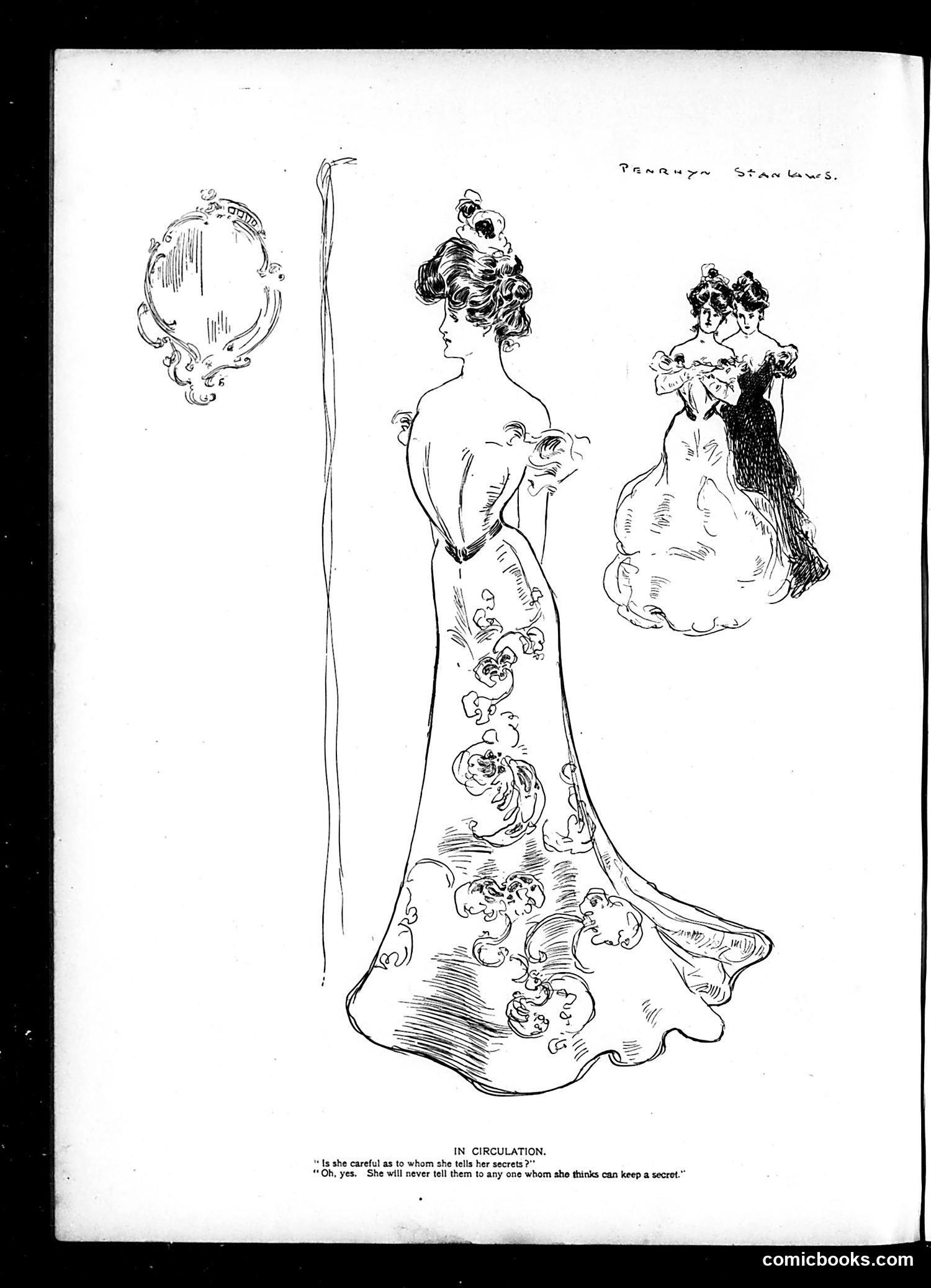
This is a satirical illustration about women's gossip and social circulation. The main figure shows an elegantly dressed woman in an elaborate gown with decorative floral patterns, depicted from behind. The dialogue below reveals the joke: when asked if she's careful about telling secrets, the response is paradoxical—she only tells secrets to people she believes *cannot* keep them silent. The cartoon mocks upper-class women's social behavior, suggesting they deliberately spread gossip by confiding in unreliable confidants. The decorative fashion sketches above (including a mirror frame and two other fashionable women) reinforce the focus on high society. The satire targets women's reputation for being unable to keep secrets and their complicity in spreading rumors through deliberate choice of listeners.
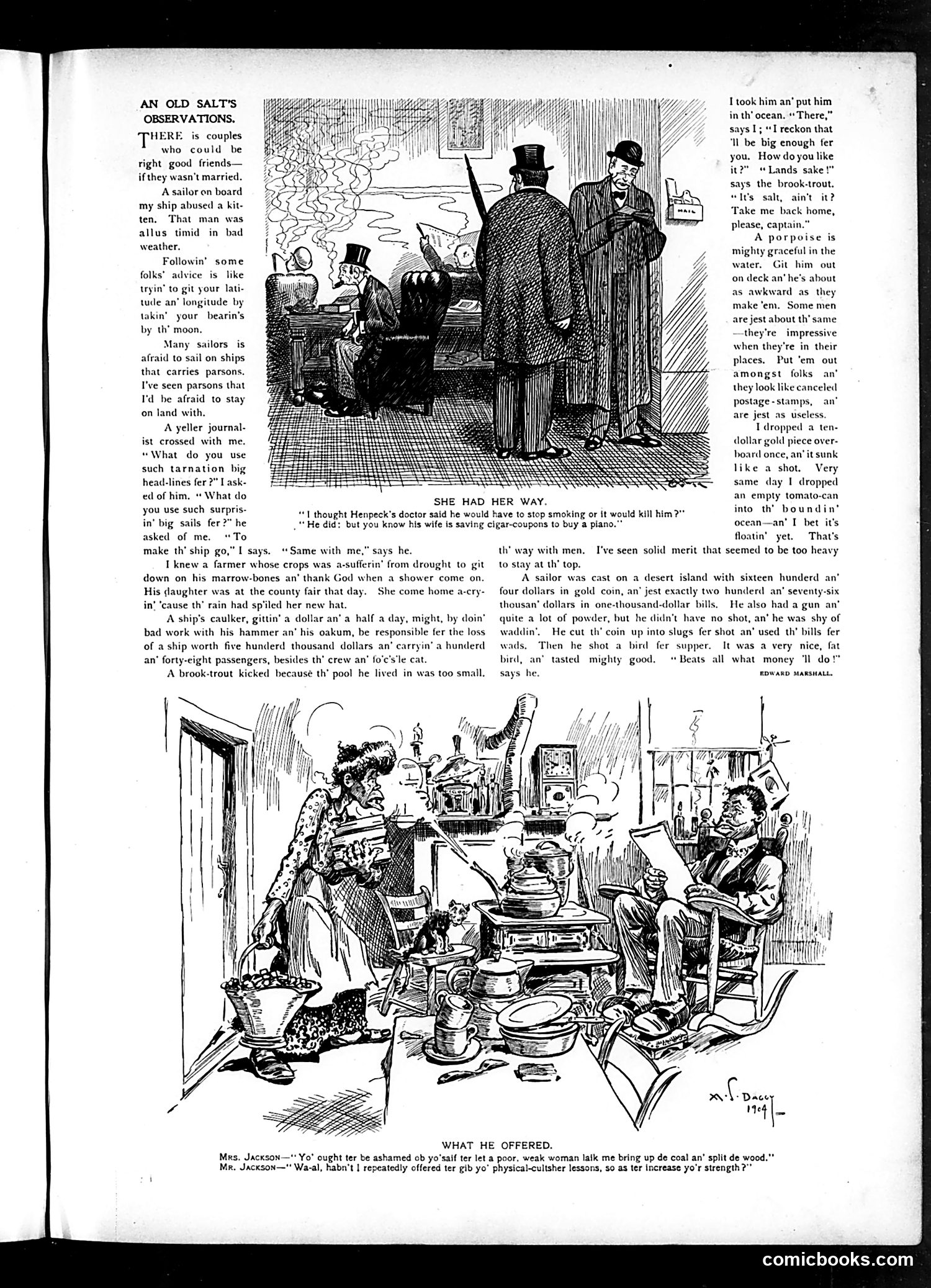
This page contains two distinct satirical cartoons from an American humor magazine, likely early 20th century. **Top cartoon ("She Had Her Way")**: Depicts a nagging wife manipulating her husband through frugality. The joke satirizes domestic power dynamics—the wife saves cigar coupons to buy a piano while the husband wants to smoke, inverting traditional household authority. The humor targets both henpecked husbands and wives' materialism. **Bottom cartoon ("What He Offered")**: Shows a Black couple where the wife complains about hard labor while the husband condescendingly offers "physical-culture lessons" (exercise training) instead of helping. This reflects racist stereotypes common to the era—depicting Black domestic life through crude caricature and dialect, with humor derived from the man's refusal of manual assistance. **"An Old Salt's Observations"**: A series of anecdotal jokes by a sailor narrator, offering folksy observations about human nature, naval life, and ironic reversals (the ten-dollar coin sinking while a tomato can floats). The cartoons reflect period attitudes toward gender, labor, and race that would be considered offensive today.
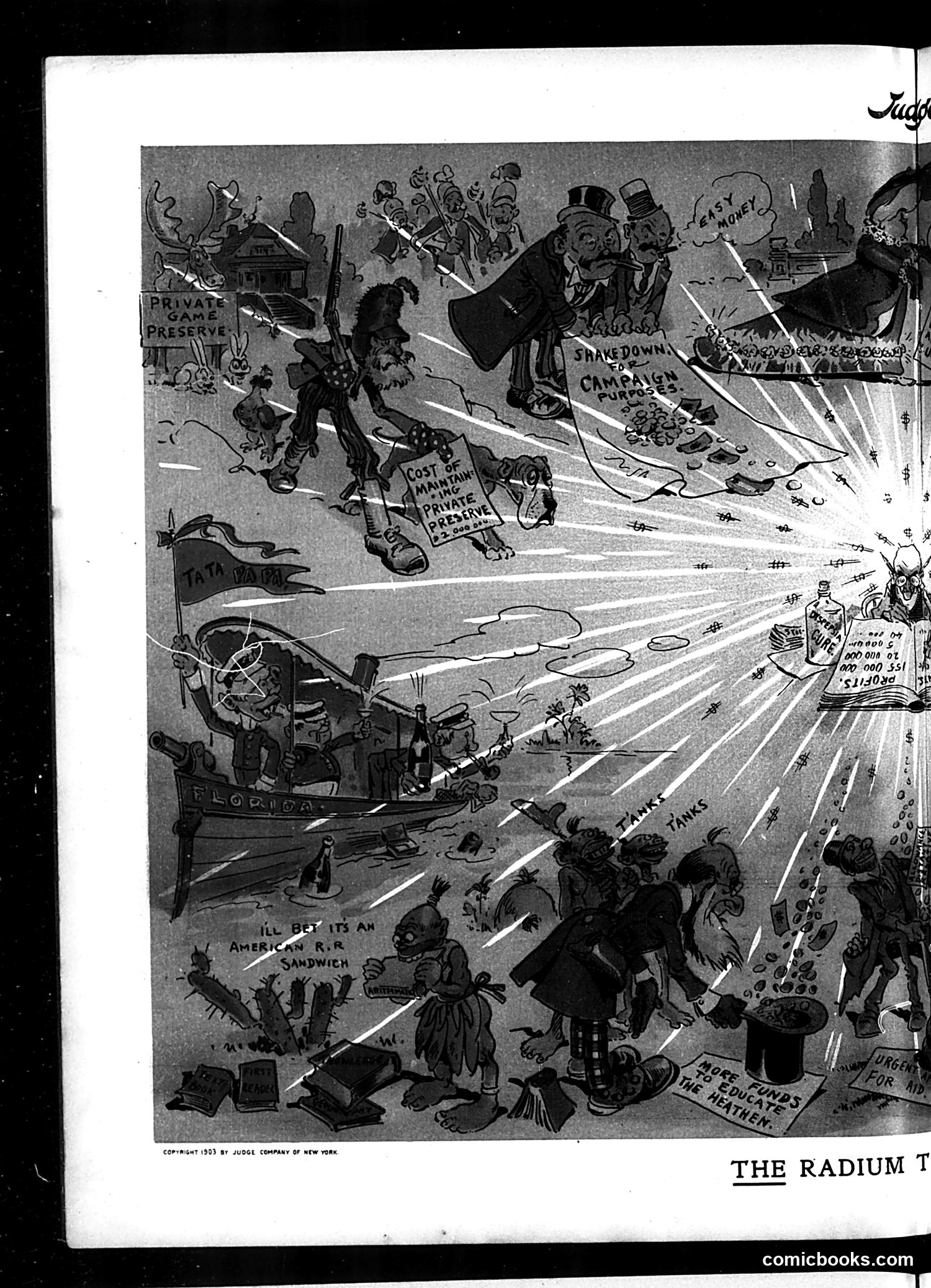
This satirical cartoon depicts radium as a destructive force spreading chaos. The image shows radium emanating rays that damage various elements: a "Game Preserve" sign, mountains labeled "Private Property," and Florida landscape. Wealthy figures at top appear alarmed as the radioactive element's effects spread downward to poorer communities below, where people suffer exposure. The satire critiques radium's uncontrolled use and the inequality of its dangers—wealthy landowners and businesses try to contain it, while working-class populations bear the actual harm. References to "Cost of Mountain Preserve" and property concerns suggest anxiety about industrial progress versus environmental/human safety. This reflects early-1900s concerns about radium's novelty and perceived dangers before its toxicity was fully understood.
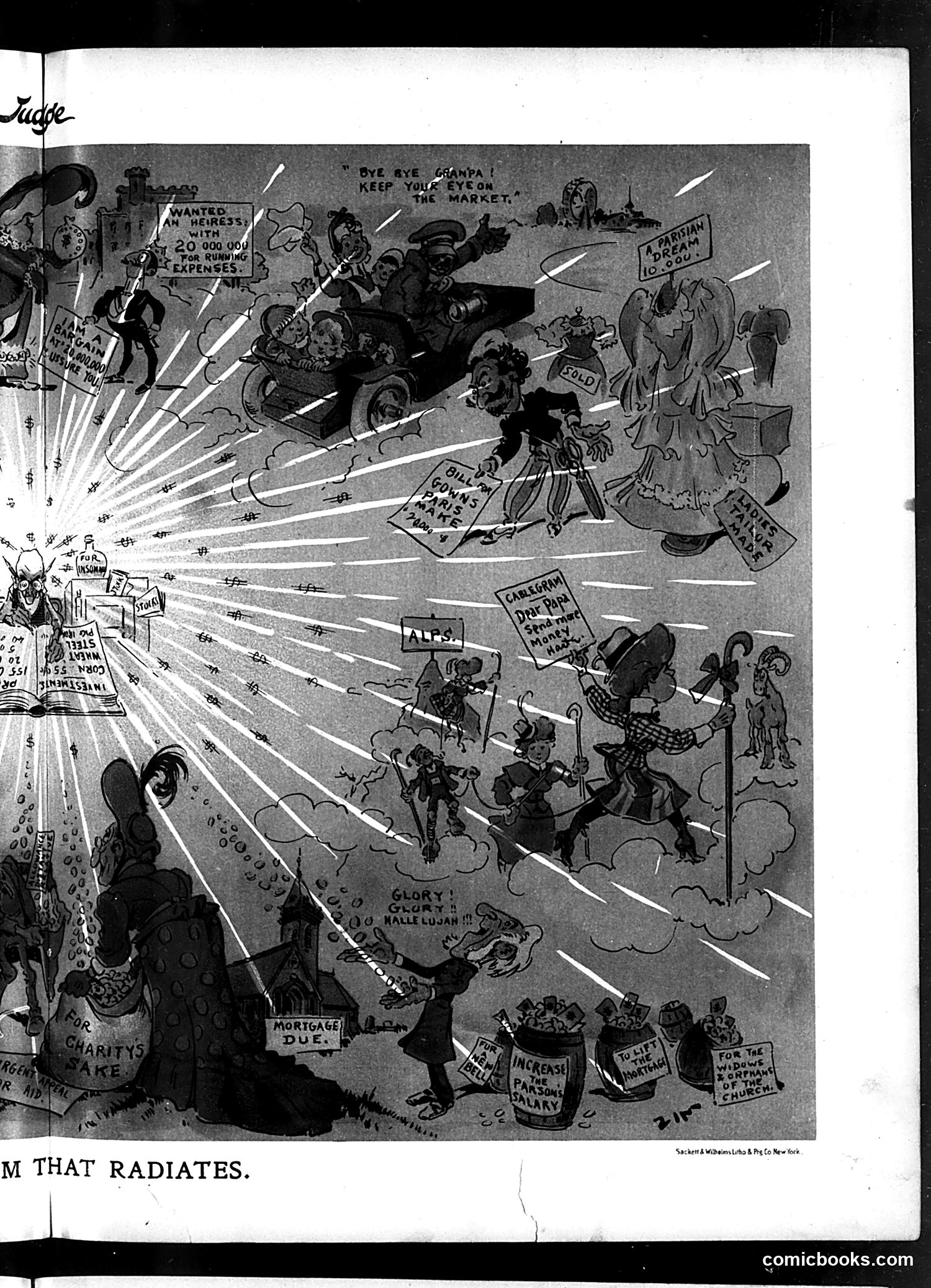
This Judge magazine cartoon depicts a central figure (appearing to be a wealthy or powerful person) radiating beams of light outward like a sun, with various social problems and demands flowing toward them. The beams scatter across different groups requesting aid: visible signs mention "charity," "mortgage due," "increase in salary," and various welfare demands. The satire criticizes how concentrated wealth or power creates radiating effects throughout society—generating demands and expectations from all directions. The figure at the center appears overwhelmed by these requests, suggesting the cartoon mocks either the burden placed on the wealthy or criticizes their responsibility to address social issues. The inclusion of "Grampa" and "market" references suggests commentary on economic inequality during what appears to be an early 20th-century period.
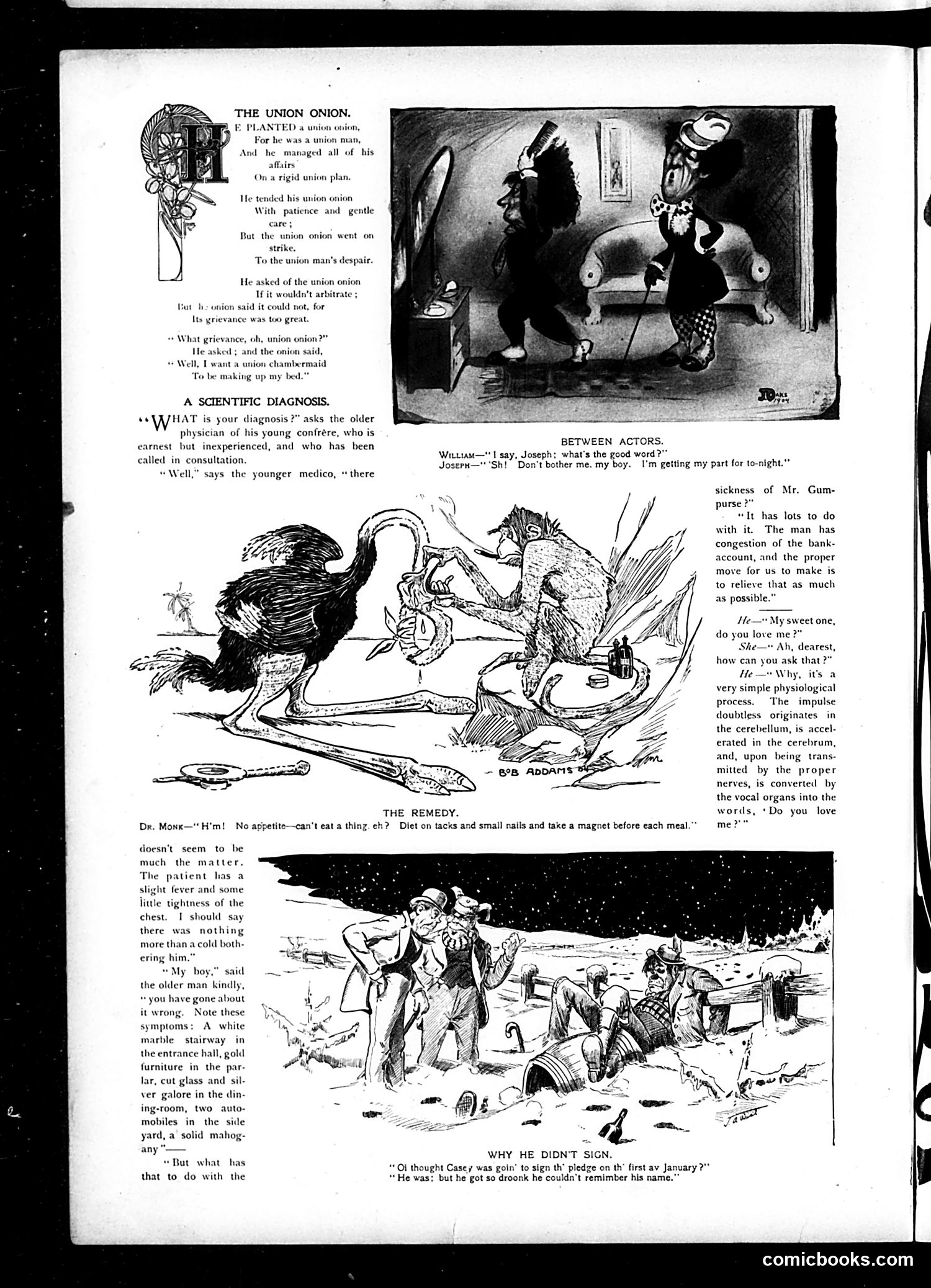
This page from *Judge* contains several humor pieces mocking early 20th-century American society: **"The Union Onion"** (top left): A poem satirizing labor unions by depicting a union organizer who manages his affairs "on a rigid union plan" but whose onion goes on strike anyway, refusing to work despite his efforts. The joke mocks unions as inflexible and absurd—even vegetables won't cooperate. **"A Scientific Diagnosis"**: Doctors discussing a patient with expensive possessions (marble stairway, gold furniture, automobiles) but minor symptoms. The younger doctor misses the point: the real ailment is "congestion of the bank-account"—satire on wealth-related anxiety among the affluent. **"Between Actors"**: Two actors discussing their roles, with an absurd romantic exchange below demonstrating how love declarations are merely mechanical physiological processes converted into words—mocking theatrical sentimentality. **"Why He Didn't Sign"**: A drunk Irishman (named Casey) intended to sign a temperance pledge on New Year's but got too drunk to remember his own name—satire on failed Prohibition-era pledges and Irish stereotypes.
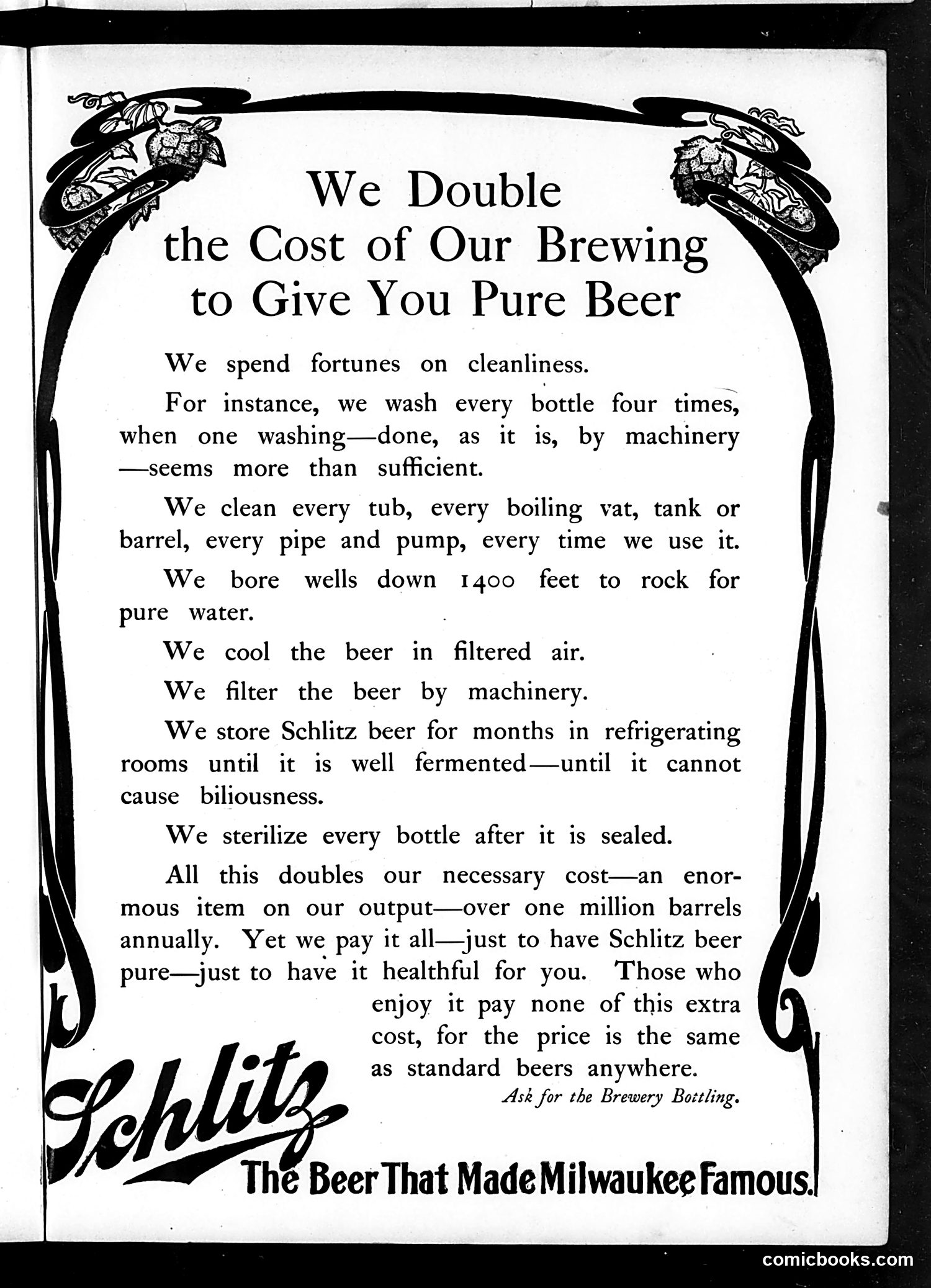
This is a **Schlitz beer advertisement**, not a political cartoon or satire. The page features a full-page ad from the Schlitz brewery promoting their product's purity and manufacturing standards. The ad's argument is straightforward: Schlitz claims to double production costs through extensive cleanliness measures—washing bottles four times, drilling 1,400-foot wells for pure water, filtering air, sterilizing after sealing, and lengthy fermentation—yet maintains the same price as competitors. The implied message: consumers get superior quality at no premium cost. The decorative border elements appear to be stylized hops (the plant used in brewing). This represents early **20th-century consumer marketing**, where breweries competed on claims of scientific purity and hygiene—appeals particularly important after contamination scandals and emerging germ-theory awareness. The phrase "The Beer That Made Milwaukee Famous" was Schlitz's actual historical slogan, establishing the brand's legitimacy as a major American brewer.
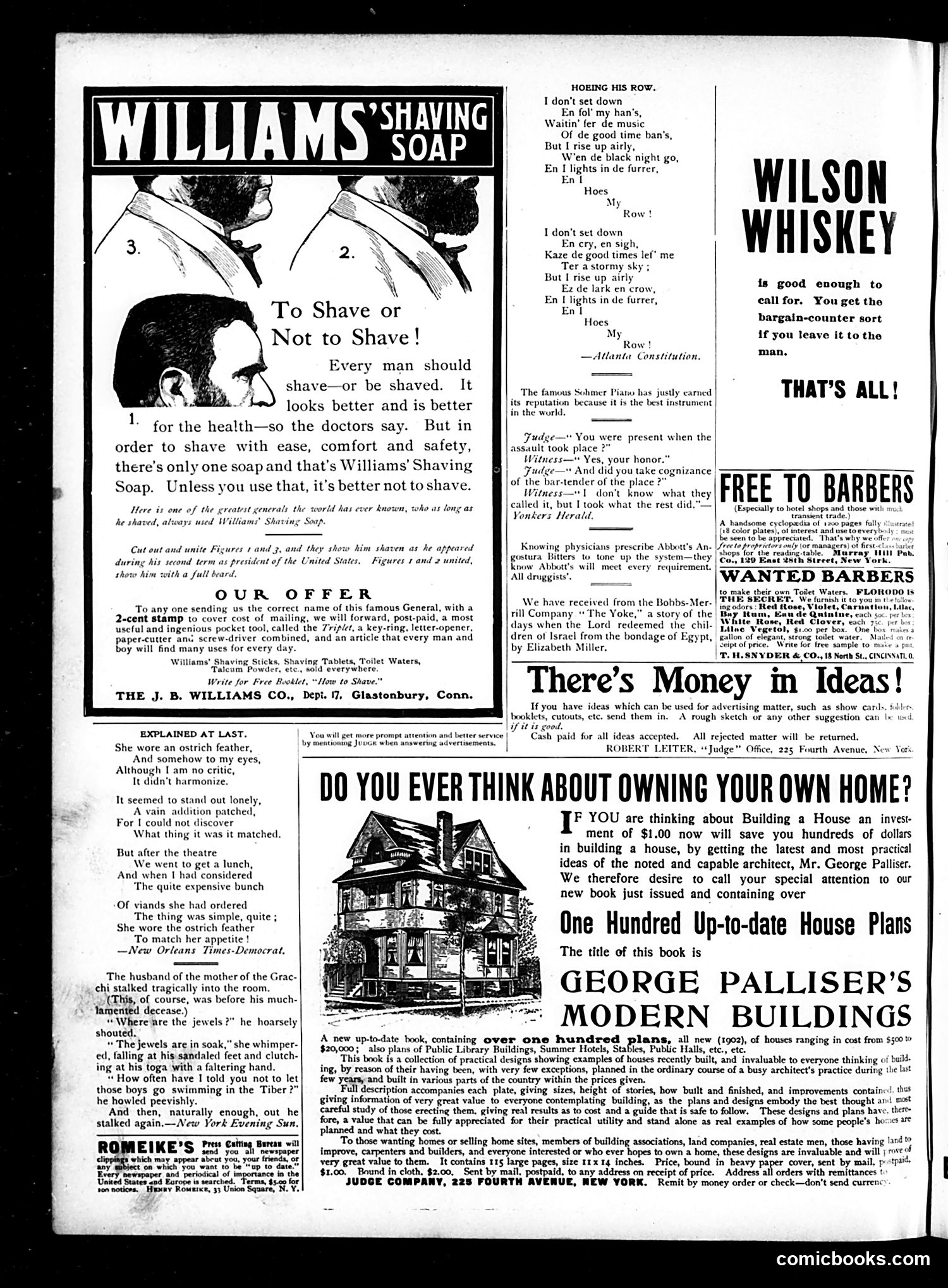
This page is primarily **advertising** rather than editorial content. The main cartoon features Williams' Shaving Soap, showing three numbered profile sketches of an unidentified bearded man who appears to be a "famous General" (the OCR'd text references him as such). The advertisement presents a puzzle: readers must identify the general to win a promotional "Triplet" tool. The page's actual satirical content is minimal—most space is devoted to product advertisements for shaving soap, whiskey, barber supplies, and notably, a book of house plans by architect George Palliser. The one clearly satirical piece is a brief courtroom joke about a witness misunderstanding legal terminology ("cognizance" of a "bar-tender"), typical of Judge magazine's light humor. The poem "Hoeing His Row" (at top) appears to be dialect verse about persistence through hardship, common in period publications but of unclear satirical intent here. This page demonstrates Judge's business model: mixing light satire with extensive paid advertising.
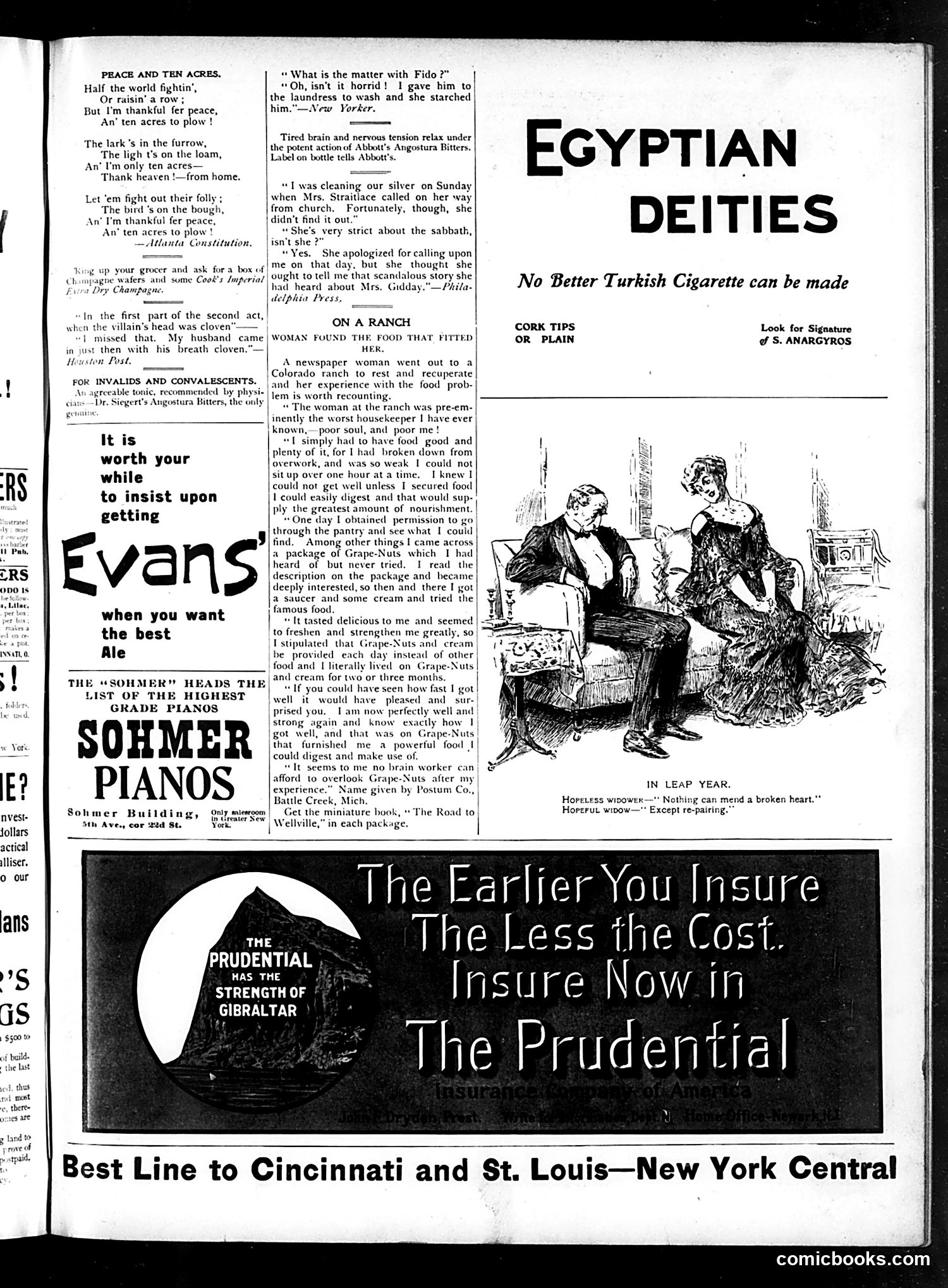
This page is primarily **advertising and filler content** rather than political satire. The main elements are: **"Peace and Ten Acres"** poem: A nostalgic rural verse celebrating agricultural simplicity and isolation from worldly conflict—likely resonating with pre-WWI anxieties about war and modernization. **"On a Ranch"** testimonial: A pseudo-journalistic advertisement for Grape-Nuts cereal, presenting a woman's recovery story through the product. This was typical early 1900s advertorial content. **Small humor items**: Brief jokes about laundry (starching a dog), sabbath hypocrisy, and leap-year romance—generic magazine filler with no specific political content. **Egyptian Deities cigarette ad**: A Turkish tobacco brand advertisement. The page contains **no identifiable political cartoons or caricatures**. Instead, it reflects the era's commercial culture: patent medicines, branded cereals, pianos, and insurance companies competing for readers' attention through Judge's pages. The tone is genteel, domestic, and consumer-focused rather than satirical.
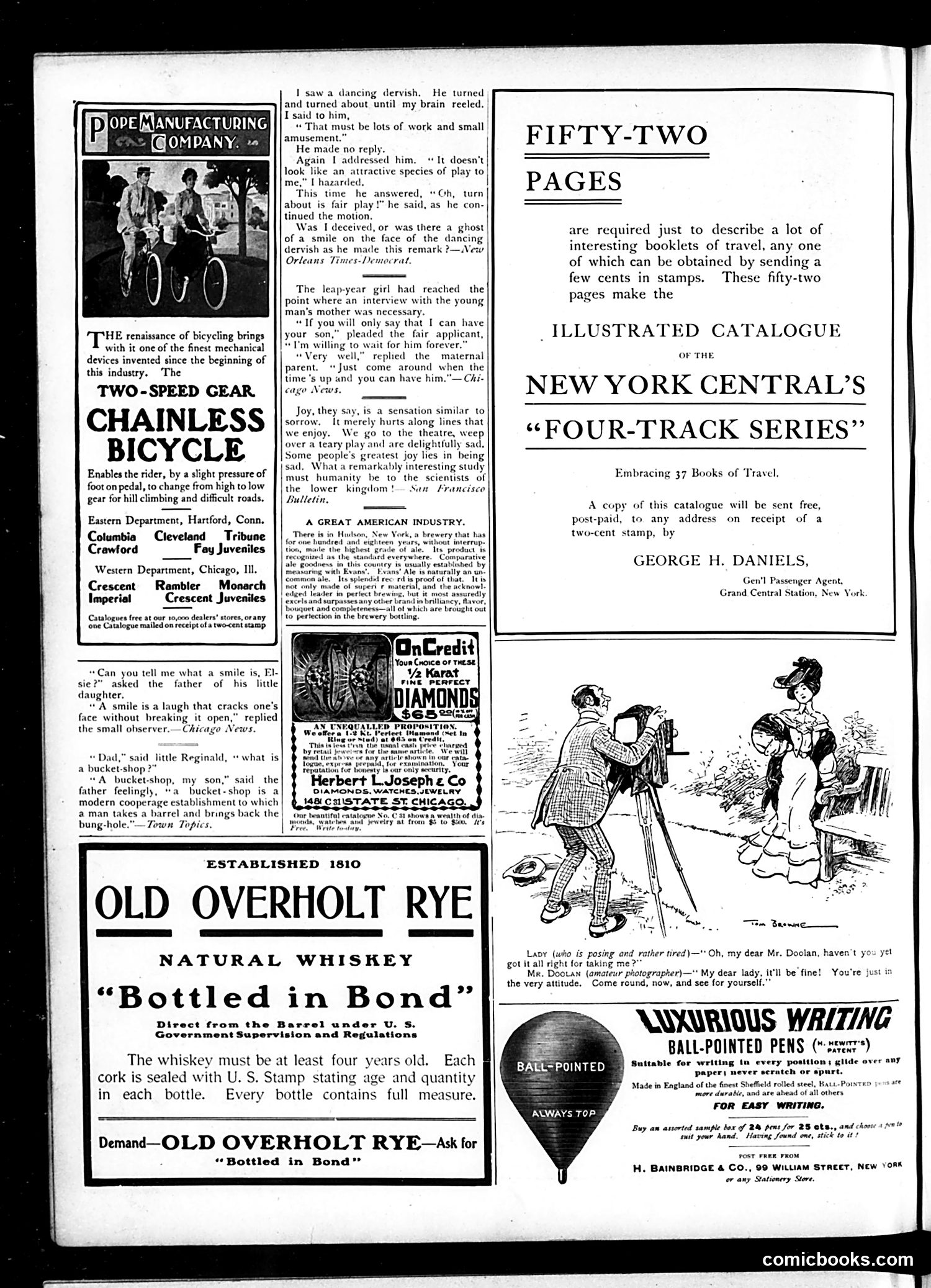
This page is primarily **advertisements and light humor pieces** rather than political satire. The content includes: **Main Elements:** - A bicycle advertisement (Pope Manufacturing's "chainless bicycle") - Several brief humorous anecdotes (a child's definition of "smile," a father explaining "bucket-shop," a leap-year girl's proposal) - Travel catalogue promotion for the New York Central railroad - Advertisements for Old Overholt Rye whiskey, diamonds/watches, and ball-pointed pens **The cartoon** (lower right) shows an amateur photographer with a young woman posing, making a joke about her "attitude" being perfect for a photograph—a mild double entendre typical of early 1900s humor. **Historical context:** This reflects turn-of-the-century consumer culture, with emphasis on newly popular technologies (bicycles, photography, railroads) and genteel humor aimed at middle-class readers. No specific political figures or major social satire appears on this page.
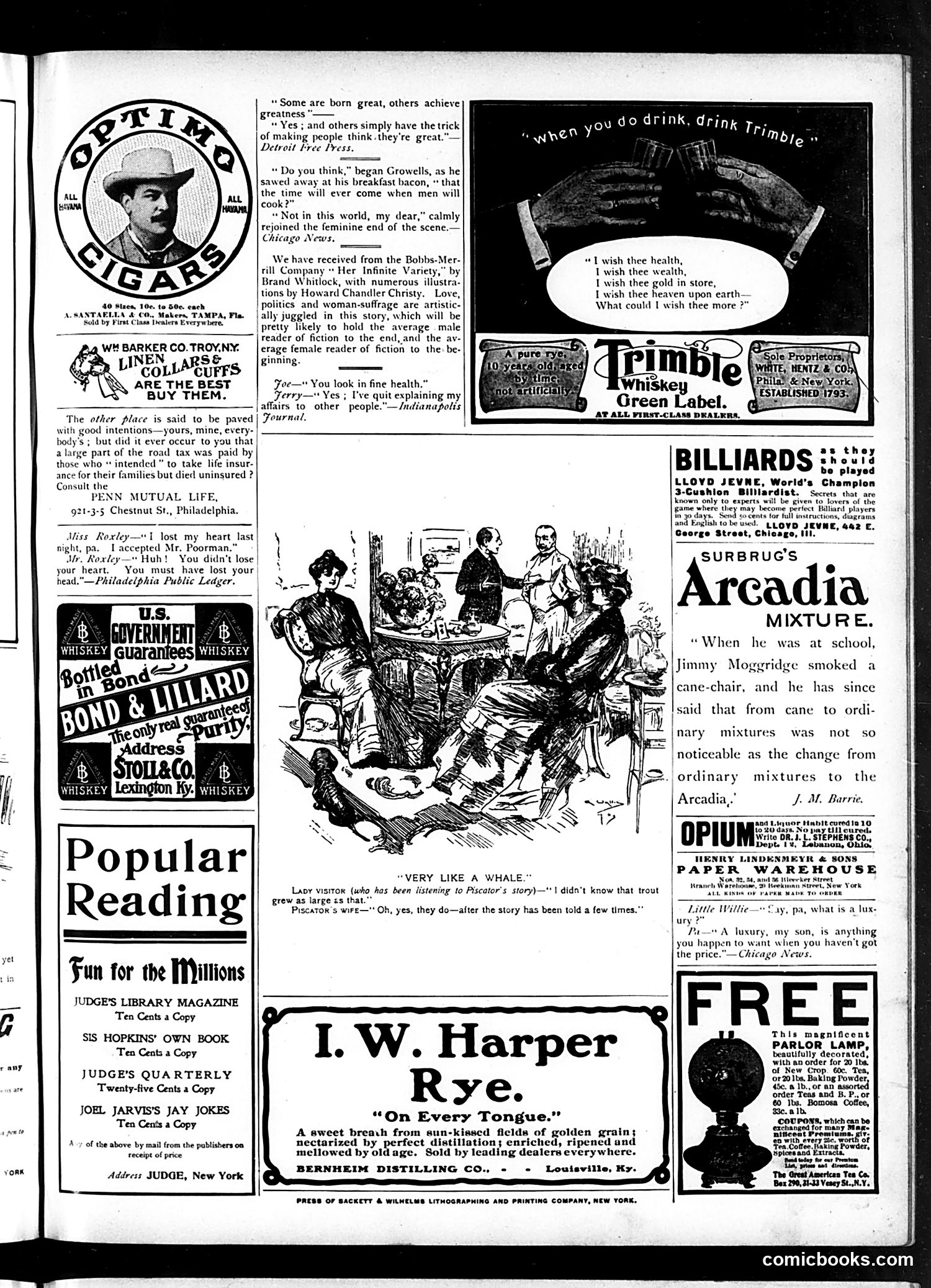
This page is primarily **advertisements and filler content** rather than political cartoons. The main cartoon—"Very Like a Whale"—is a fishing joke: a fisherman's wife suggests his catch grew larger with each retelling, a comment on exaggerated storytelling. The quoted exchanges are brief humor pieces addressing **gender roles and domesticity**. One jokes about men never cooking; another presents a courtship scenario. These reflect early-1900s social attitudes about separate spheres for men and women. The page includes **product advertisements** (whiskey, billiards equipment, cigars) and **literary promotions** typical of Judge magazine's format. References to Brand Whitlock's book touching on "woman-suffrage" indicate the suffrage debate was contemporary cultural content. The overall tone is light satire of everyday life—romantic mishaps, domestic dynamics, and tall tales—rather than pointed political commentary. This appears to be a standard issue mixing entertainment, social observation, and commercial content.
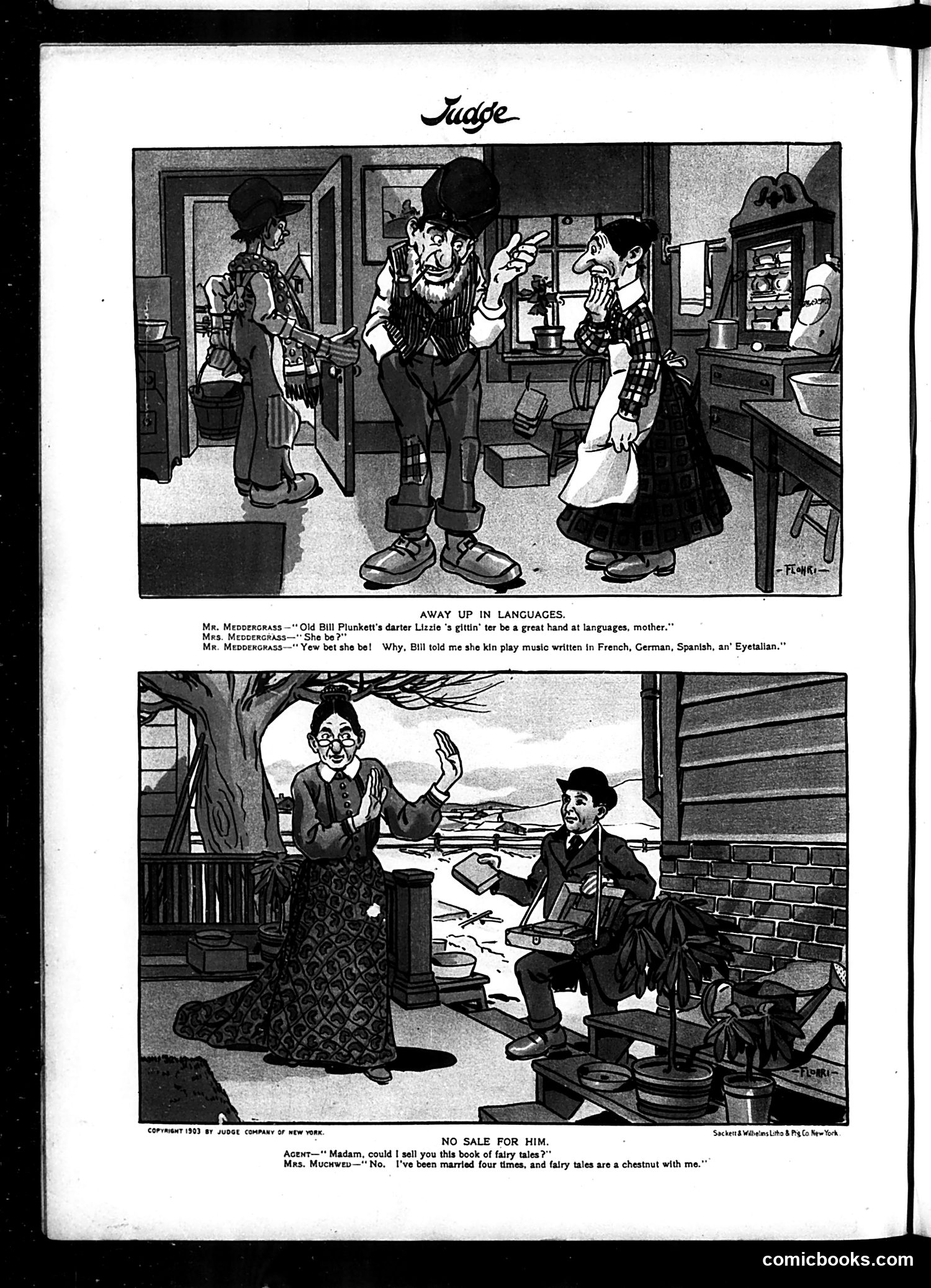
**Top Cartoon ("Away Up in Languages"):** Rural characters (Mr. and Mrs. Mepoercrass, depicted with exaggerated dialect spelling) discuss young Lizzie Plunkett's musical talents. The joke plays on class and education: the father proudly claims she can "play music written in French, German, Spanish, an' Eyetalian" — but he means she can read sheet music in different languages, not that she speaks them. The humor mocks rural/working-class misunderstanding of sophistication and education. **Bottom Cartoon ("No Sale for Him"):** A book salesman attempts to sell a woman a fairy tale collection. She declines, saying she's been married four times and "fairy tales are a chestnut with me." The joke: marriage has made her cynical about romantic fantasy — she's experienced enough reality to dismiss fairy tales as clichéd or unrealistic. The humor targets both women's marital disillusionment and sales-pitch futility.