
Judge, 1904-03-12 · page 3 of 16
Judge — March 12, 1904 — page 3: what you’re looking at
What you’re looking at
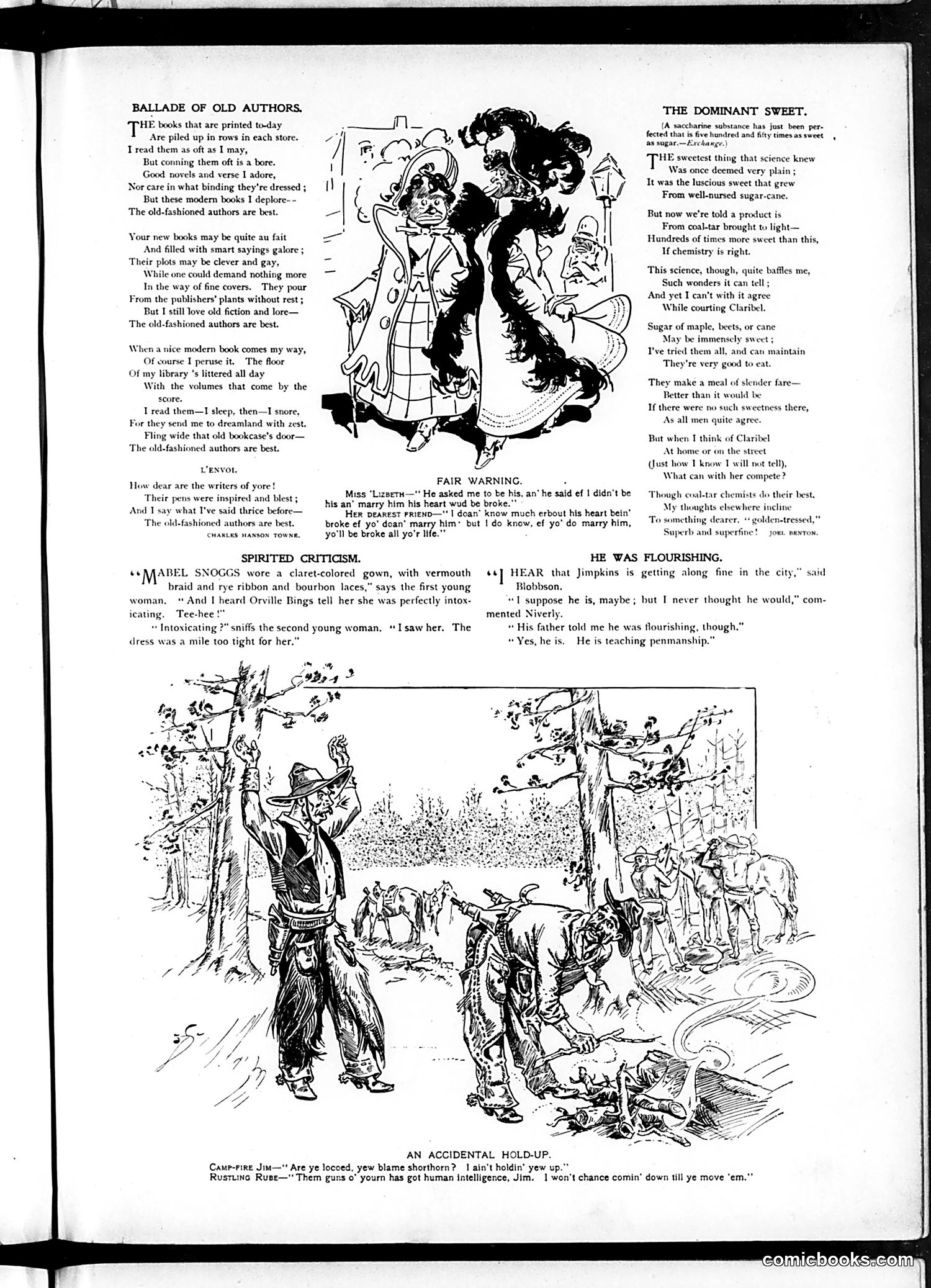
This page contains literary and social humor rather than political cartoons. "Ballade of Old Authors" mocks how modern publishers prefer new books over classics, despite their superior quality. "The Dominant Sweet" satirizes scientific claims about sugar production—likely referencing contemporary debates about coal-tar chemistry versus traditional sugar-cane cultivation. The "Fair Warning" and "Spirited Criticism" sections are brief gossip items about socialites (Mabel Snoggs, Lizeth) and their romantic entanglements, typical of Judge's society-page humor. The large bottom illustration titled "An Accidental Hold-up" appears to be a Western frontier scene with cowboys and rustlers, featuring dialogue between "Camp-fire Jim" and "Rustling Rube"—humorous stereotypes common to period humor publications. The overall page emphasizes literary, social, and frontier-themed comedy.
📄 Transcribed text from this page (OCR, searchable)
Machine-transcribed from the original scan — historical spelling and the odd misread are preserved.
BALLADE OF OLD AUTHORS. THE books that are printed to-day Are piled up in rows in each store. T read them as oft as I may, But conning them oft is a bore. Good novels and verse I adore, Nor care in what binding they're dressed ; But these modern books I deplore-~ The old-fashioned authors are best. Your new books may be quite au fait And filled with smart sayings galore ; ‘Their plots may be clever and gay, While one could demand nothing more In the way of fine covers. They pour From the publishers’ plants without rest ; But I still love old fiction and lore— The old-fashioned authors are best. When a nice modern book comes my way, Of course I peruse it, The floor Of my library 's littered all day With the volumes that come by the score. Tread them—I sleep, then—I snore, For they send me to dreamland with zest. ng wide that old bookcase’s door— \d-fashioned authors are best. LENVOL. How dear are the writers of yore! Their pens were inspired and blest ; And I say what I've said thrice before— The old-fashioned authors are best. CHARLES HANSON TOWNR. SPIRITED CRITICISM. ts MABEL SNOGGS wore a claret-colored gown, with vermouth braid and rye ribbon and bourbon laces,” says the first young “And [heard Orville Bings tell her she was perfectly intox- woman, ating. Tee-hee !" + Intoxicating 2" sniffs the second young woman, “Isaw her. The dress was a mile too tight for her.” FAIR WARNING. Miss ‘LizeetH—"* He asked me to be his, an‘ he said ef I didn't be his an’ marry him his heart wud be broke. Her Dearest PRIENO—"* | doan’ know much erbout his heart bein’ broke ef yo’ doan’ marry him: but | do know, ef yo" do marry him, yo'll be broke all yo'r life.” Blobbson. mented Niverly. “Yes, he is. « His father told me he was flourishing, THE DOMINANT SWEET. (A saccharine substance fected that is five hundred and as sugar.—Exchange.) just been pere times as sweet HE sweetest thing that science knew Was once deemed very plain; It was the luscious sweet that grew From well-nursed sugar-cane. But now we're told a product is From coal-tar brought to light— Hundreds of times more sweet than this, If chemistry is right. This science, though, quite baffles me, Such wonders it can tell ; And yet I can't with it agree While courting Claribel. Sugar of maple, beets, or cane May be immensely sweet ; I've tried them all, and can m They're very good to eat. They make a meal of slender fare— Retter than it would be If there were no such sweetness there, As all men quite agree. But when I think of Claribel At hor (Just how T know T will not tell), What can with her compete? © or on the street ‘Though coal-tar chemists do their best, My thoughts elsewhere incline To something dearer, * goldenetressed,” Superb and superfine! joe. nexrox HE WAS FLOURISHING. S4] HEAR that Jimpkins is getting along fine in the city,” “T suppose he is, maybe; but I never thought he would,” com- hough.” He is teaching penmanship.” Camp-rire Jim—"* Are ye locoed, yew blame shorthorn? Rustin Ruse—“ Them guns o* yourn has got human intelligence, Jim. AN ACCIDENTAL HOLD-UP. Tain't holdin’ yew up.”* I won't chance comin‘ down till ye move ‘em.""