
A complete issue · 16 pages · 1904
Judge — February 27, 1904
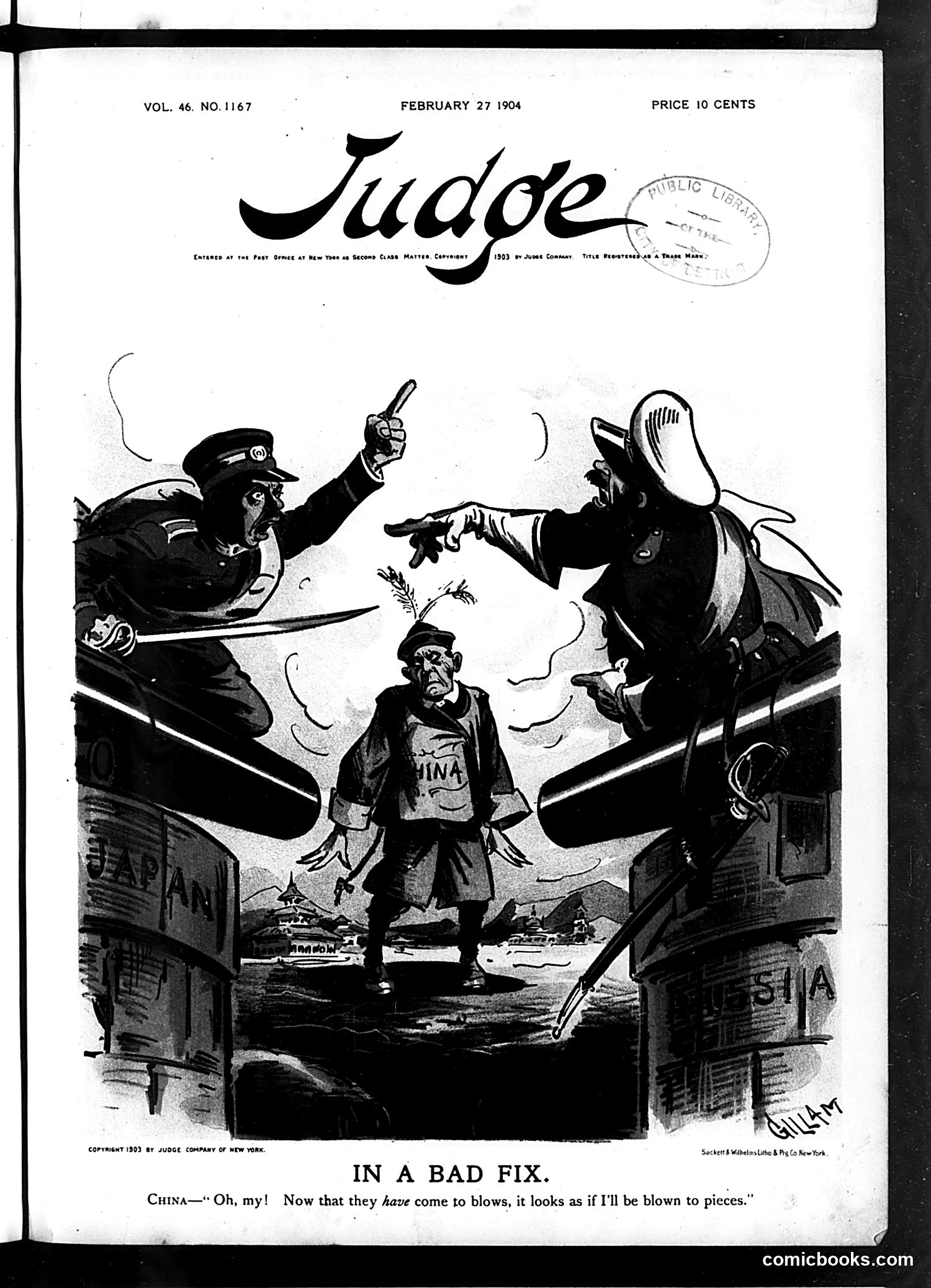
This political cartoon depicts **China** (labeled on his clothing, standing center) caught between two aggressive military powers represented as caricatured sailors or soldiers. The figure on the left appears to be **Japan**, while the one on the right is likely **Russia** — both countries were competing for dominance in East Asia during this period. China's caption — "Oh my! Now that they have come to blows, it looks as if I'll be blown to pieces" — expresses anxiety about being caught in the **Russo-Japanese War** (1904-1905), which threatened to devastate Chinese territory as a battlefield. The satire illustrates China's helplessness as a weak nation surrounded by imperial powers fighting over regional control.
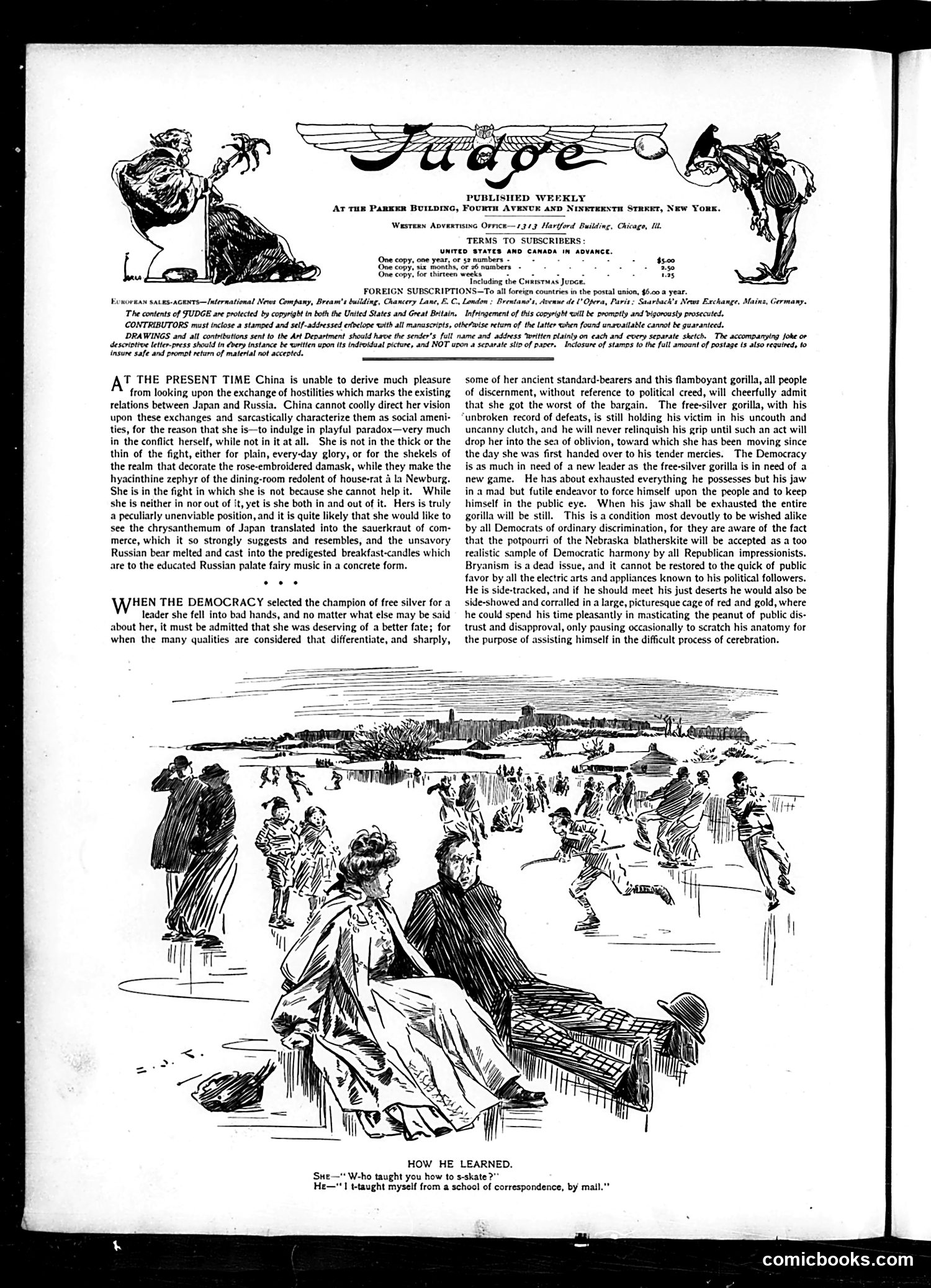
This page contains two distinct political articles. The first discusses China's inability to derive pleasure from exchanging hostilities with Russia, criticizing China's vision as clouded by ancient prejudices. The second section, introduced by "WHEN THE DEMOCRACY selected the champion of free silver," appears to critique the Democratic Party's selection of a free silver advocate as their champion—likely referencing William Jennings Bryan's 1896 presidential campaign. The accompanying illustration titled "HOW HE LEARNED" depicts a skating scene with the caption: "She—'Who taught you how to skate?' He—'I taught myself from a school of correspondence, by mail.'" This is a joke about self-teaching via mail correspondence courses, mocking the impracticality of learning physical skills remotely. The satire targets both political incompetence and the era's proliferation of mail-order education schemes.
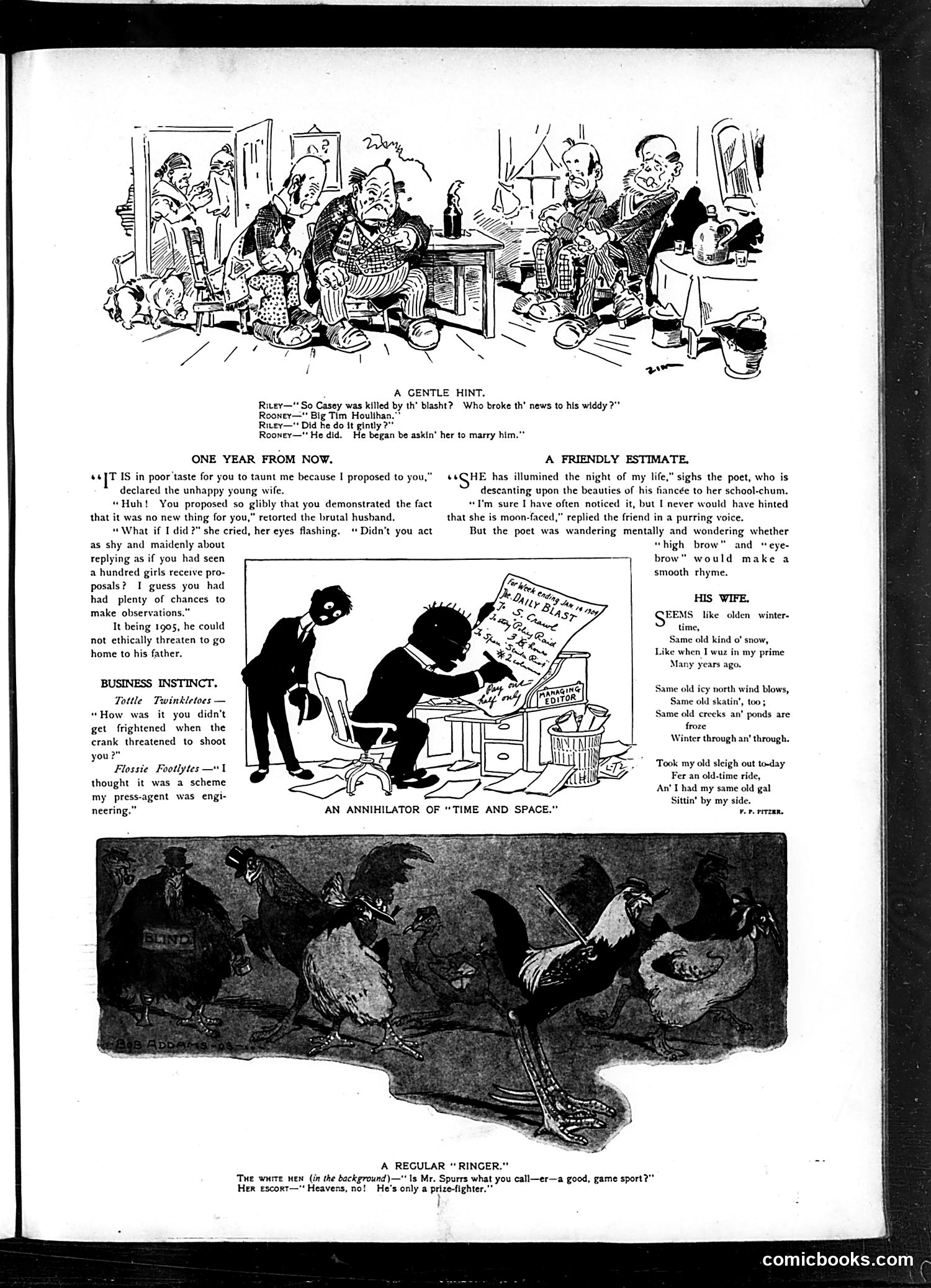
This page contains several satirical pieces from early 1900s American humor magazine Judge: **"A Gentle Hint"** mocks a broken engagement, with dialogue suggesting the man proposed glibly without genuine commitment—a social commentary on superficial courtship. **"One Year from Now"** presents a domestic dispute where a woman accuses her husband of proposing dishonestly, questioning whether he acted "slyly and modestly." **"An Annihilator of Time and Space"** shows two men amid chaos with papers, likely satirizing inefficient business practices or failed schemes. **"A Regular Ringer"** features a cockfight illustration with dialogue about "prize-fighters," appearing to mock both animal fighting and gentlemen's sporting pretensions. The cartoons collectively satirize marriage, business conduct, and working-class entertainment—typical Judge subjects targeting urban American society's hypocrisies and social pretensions.
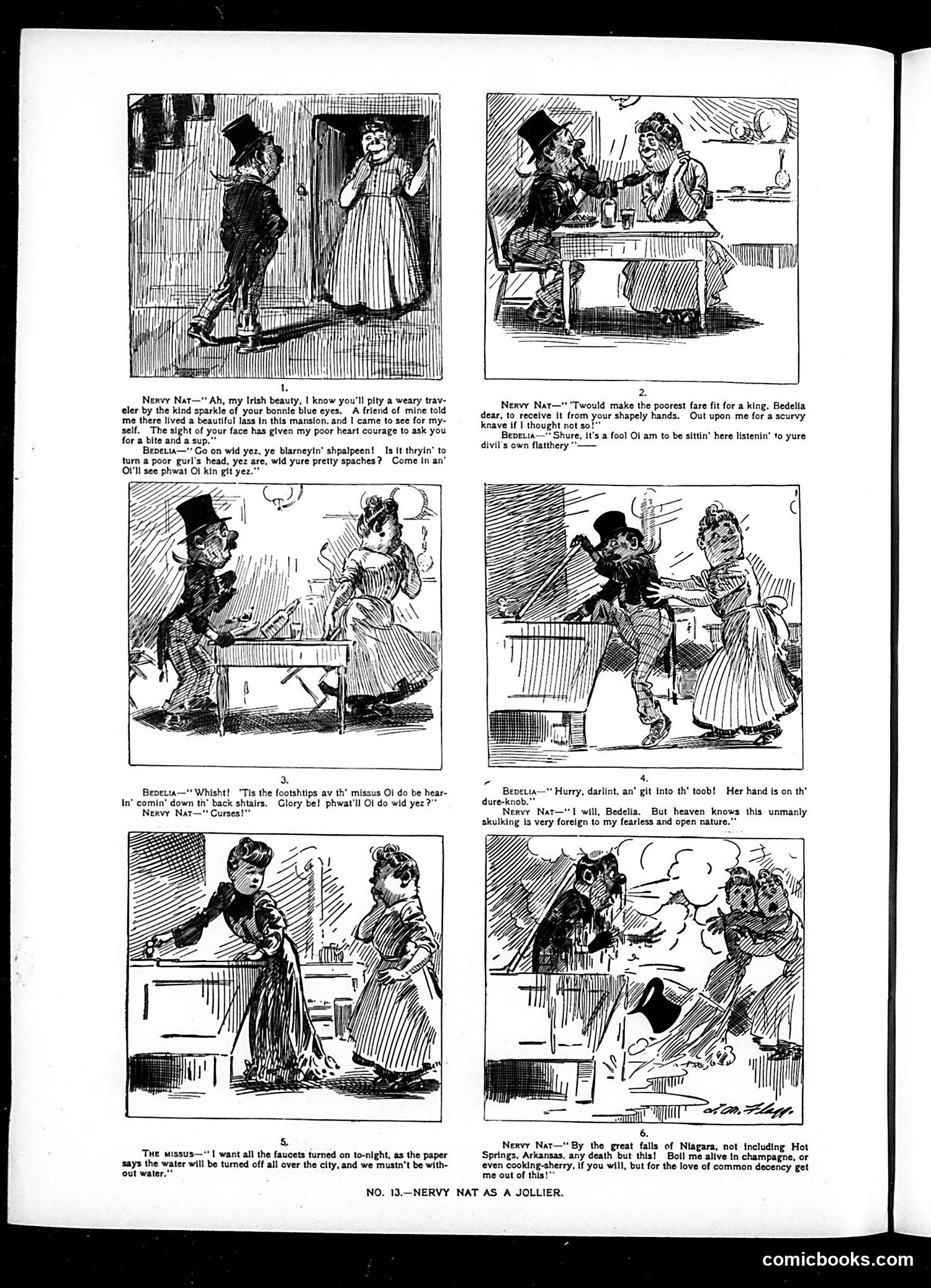
This six-panel comic strip depicts "Nervy Nat," a character portrayed with exaggerated Irish features (top hat, prominent nose), attempting to impress a woman named Bedelia through flattery and courtship. The humor relies on ethnic stereotyping common to early 20th-century American satire—presenting an Irish immigrant as bumbling, delusional, and socially awkward. The gag progresses from Nat's clumsy compliments ("Irish beauty") through escalating chaos: Bedelia rejects his advances, he becomes increasingly aggressive, culminating in physical violence where he's struck with what appears to be a frying pan. The satire targets working-class Irish-American stereotypes, presenting romantic failure through slapstick violence. The "jollier" reference (title) likely means a street laborer, reinforcing class-based mockery typical of Judge's satirical approach to immigrant communities.
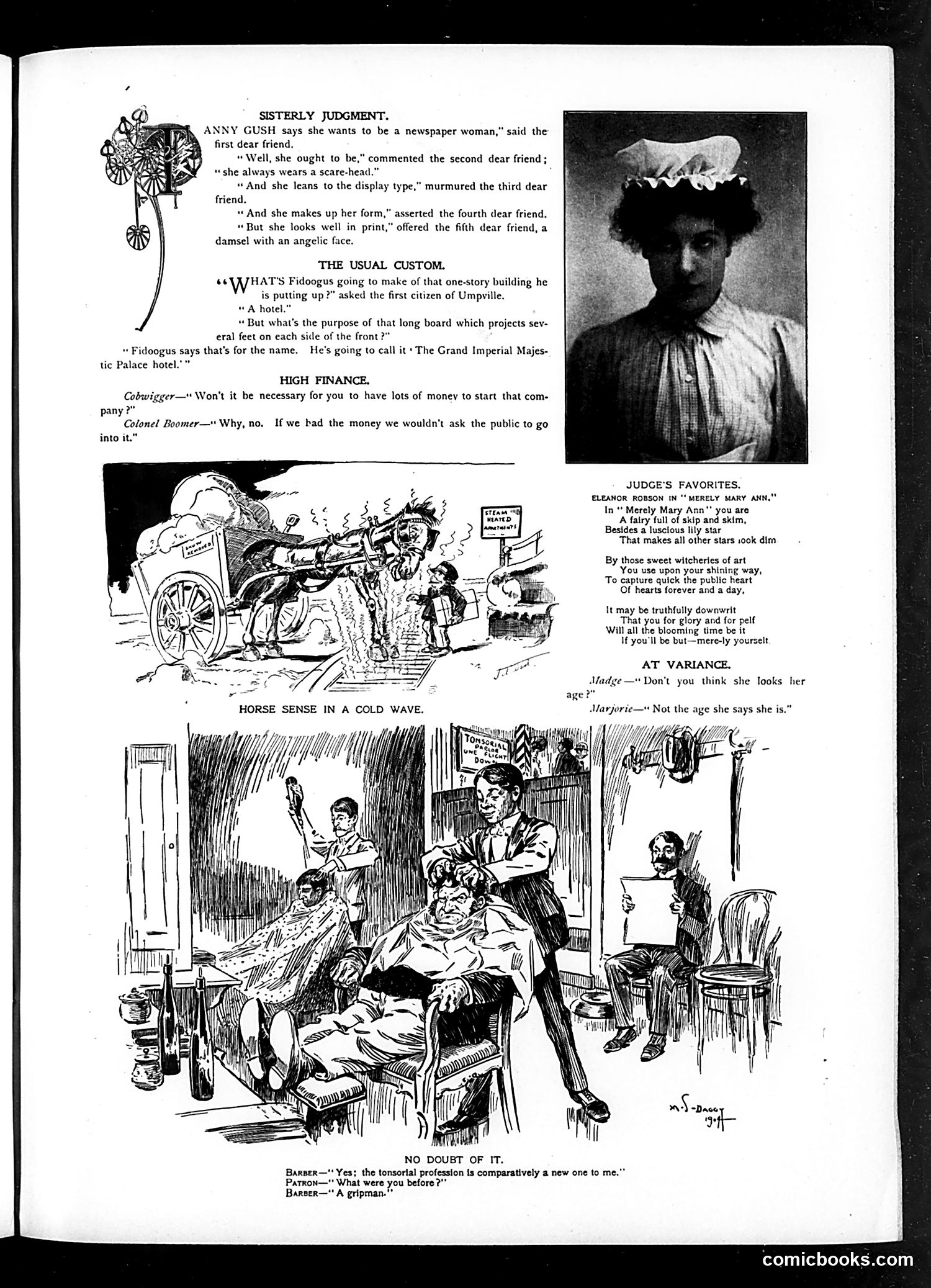
This Judge magazine page contains several satirical pieces mocking contemporary society: **"Sisterly Judgment"** jokes about a woman wanting to be a newspaper reporter—her friends use printing terminology ("scare-head," "display type," "form") as backhanded compliments, suggesting she has the superficial qualities but perhaps lacks substance. **"The Usual Custom"** satirizes small-town boosterism: a man plans an absurdly ornate hotel name ("Grand Imperial Majestic Palace Hotel") for a modest building, mocking pretentious local development. **"High Finance"** mocks fraudulent stock promotion: a con man explains his company needs *no* startup capital because they'll fleece the public instead of investing honestly. **"No Doubt of It"** makes a working-class joke: a barber reveals he was previously a "gripman" (streetcar operator), suggesting career mobility among manual laborers while implying barbering requires minimal skill elevation. The Eleanor Robson tribute is standard theatrical puffery for an actress.
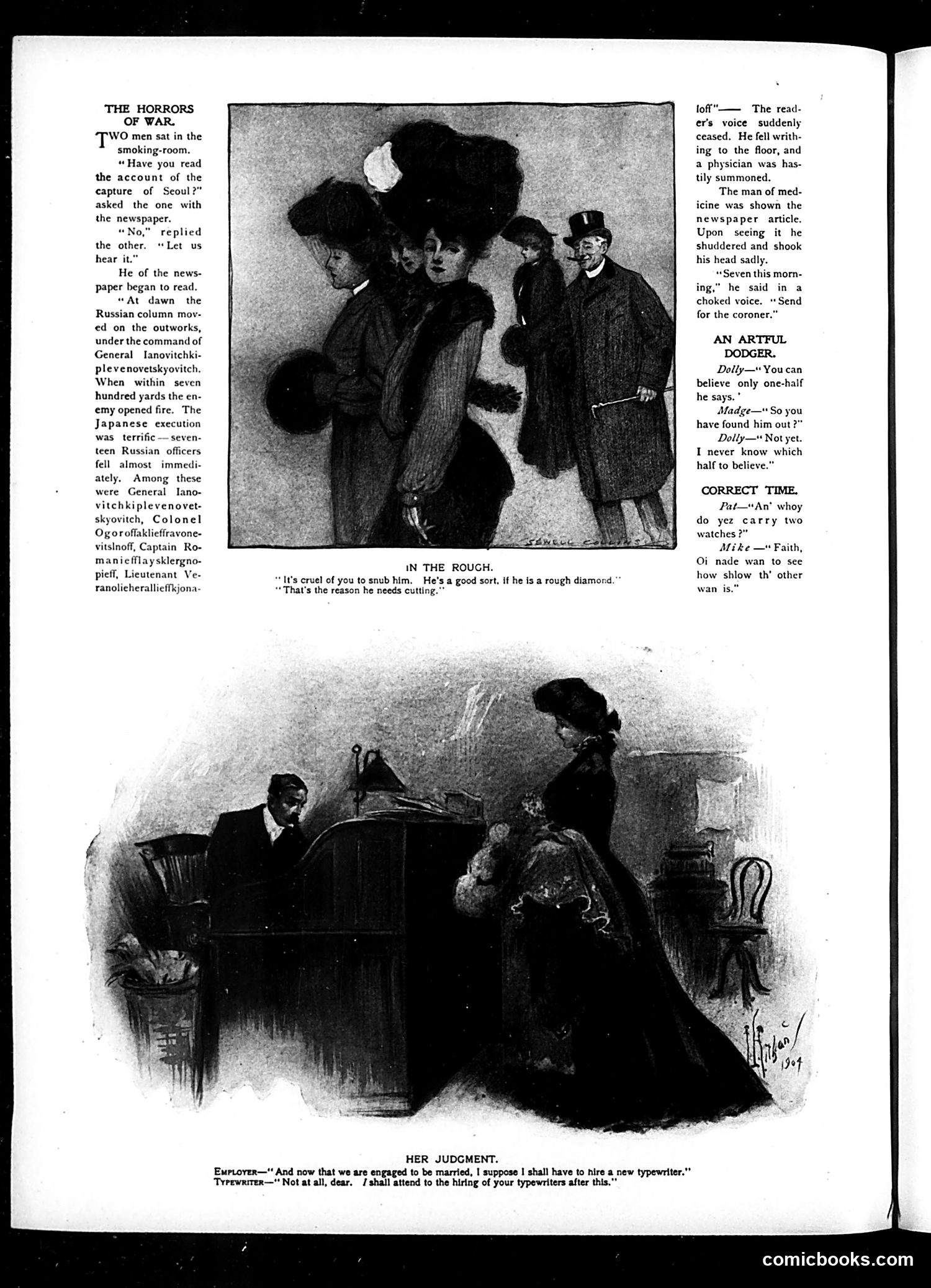
This page from *Judge* satirizes war reporting through exaggeration. The top cartoon mocks sensationalized newspaper coverage of the Russo-Japanese War (1904-1905), particularly the "capture of Seoul." A reader becomes so emotionally overwhelmed by the article's dramatic language and unpronounceable Russian officer names that he collapses—requiring a physician and coroner. The satire targets both overwrought war journalism and readers' gullible consumption of it. The accompanying short humorous pieces ("An Artful Dodger," "Correct Time," "Her Judgment") are unrelated comic vignettes about romantic deception, timekeeping confusion, and marital power dynamics—typical filler content in satirical magazines of the era. The bottom cartoon depicts an employer-typewriter relationship, likely satirizing workplace hierarchies and assumptions about gender roles in secretarial positions.
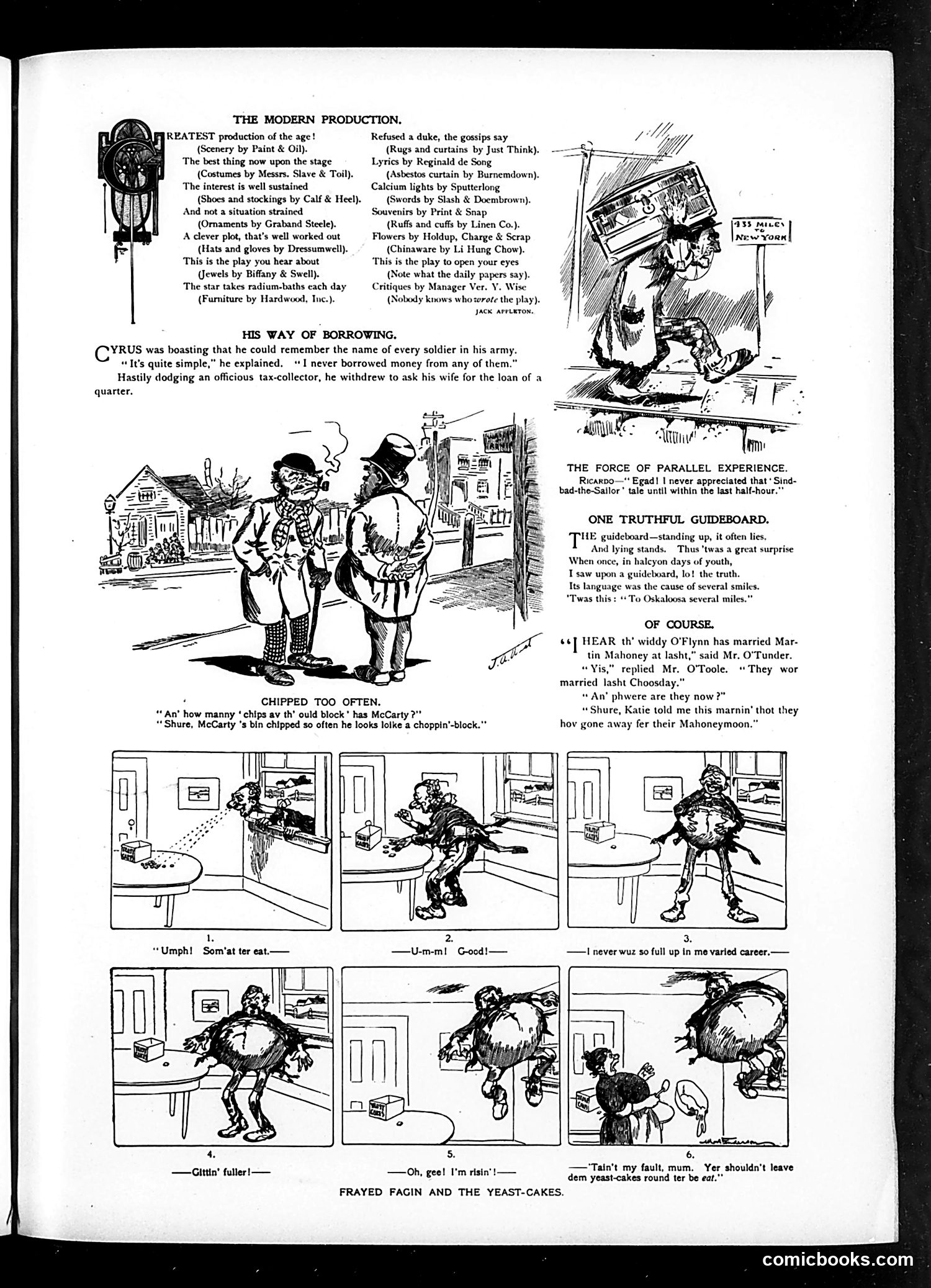
This page satirizes the commercialization of theater. The opening poem mockingly credits every production element to vendors and suppliers (costumes to "Slave & Toil," furniture to "Hardwood, Inc."), suggesting that modern plays are corporate assemblies rather than artistic creations. The punchline—"Nobody knows who wrote the play"—captures the satire's core: artistic authorship is obscured by commercial interests. The remaining items are unrelated humor pieces: a joke about a wealthy man named Cyrus who can't afford to loan money despite boasting of wealth; a poem about a rare truthful signpost; Irish-dialect jokes about weddings and character flaws. The bottom comic strip "Frayed Fagin and the Yeast-Cakes" appears to be slapstick humor involving someone expanding from yeast consumption. The overall page reflects Judge's satirical commentary on Gilded Age commercialism infiltrating cultural institutions.
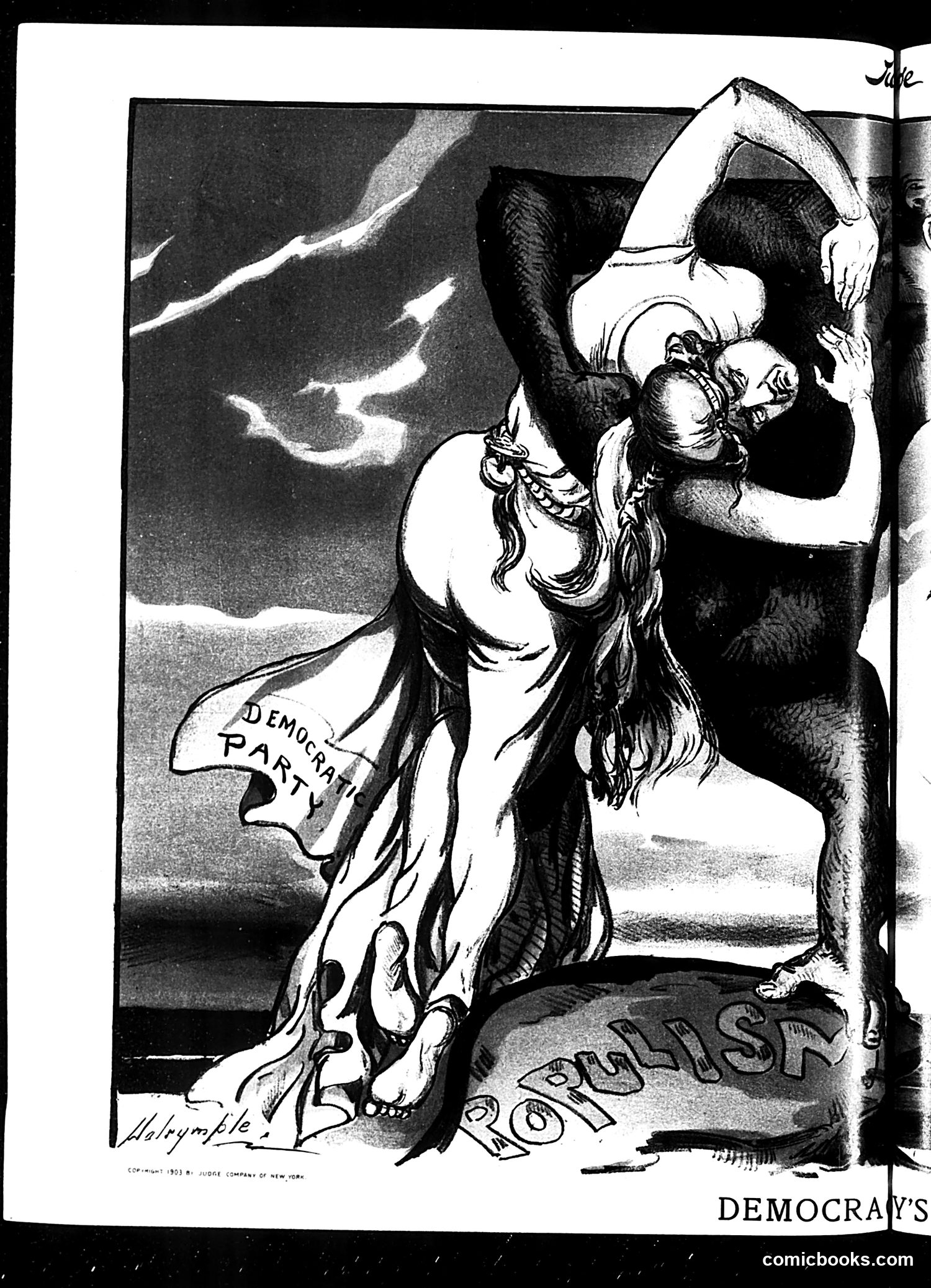
This appears to be a satirical illustration from *Judge* magazine critiquing the Democratic Party. The central figure represents "Democracy" (labeled on her garment as "DEMOCRATIC PARTY"), depicted as a woman being physically attacked or restrained by a dark, aggressive figure—likely representing either corruption, internal party conflict, or a political opponent. The figure's distressed pose and the violent imagery suggest the cartoonist is arguing that democracy or the Democratic Party is under threat or being damaged. The somewhat crude, exaggerated style is typical of early-to-mid 20th century American political satire. Without the date or additional context visible on this page, the specific historical event being referenced remains unclear, though the imagery conveys alarm about threats to democratic institutions or party integrity.
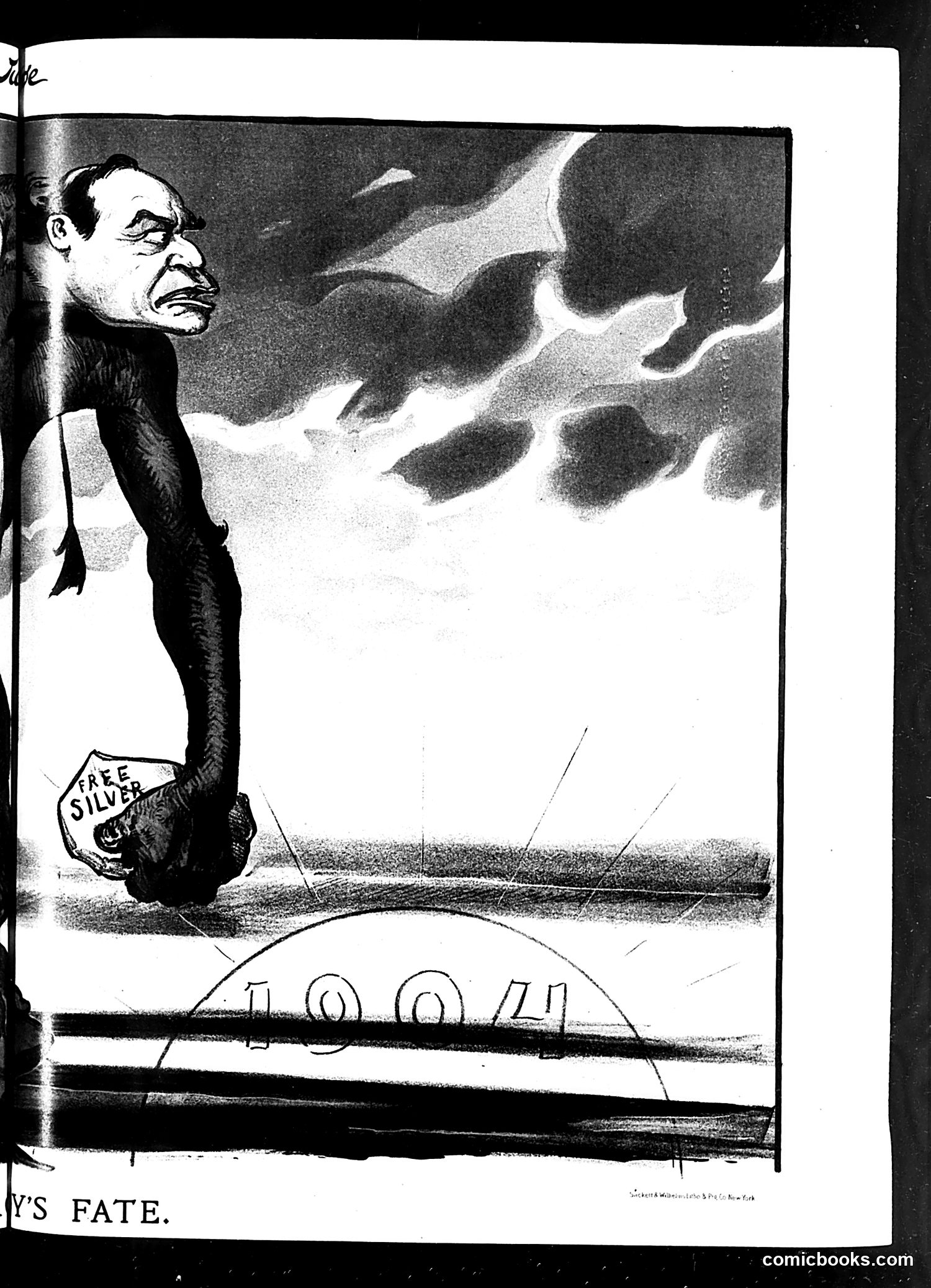
This political cartoon from *Judge* magazine depicts a caricatured man in formal dress looking upward with an expression of distress or resignation. He holds what appears to be a tag labeled "FREE SILVER" at his side. Dark storm clouds loom overhead, and the number "1904" is visible at the bottom, suggesting this references the 1904 presidential election. The "Free Silver" reference indicates this concerns the monetary debate that dominated American politics in the 1890s-early 1900s. The approaching storm clouds represent political danger or defeat for the free silver movement. The cartoon's title, partially visible as "Y'S FATE," likely completes to identify the specific political figure whose fate—the decline of free silver politics—is being illustrated.
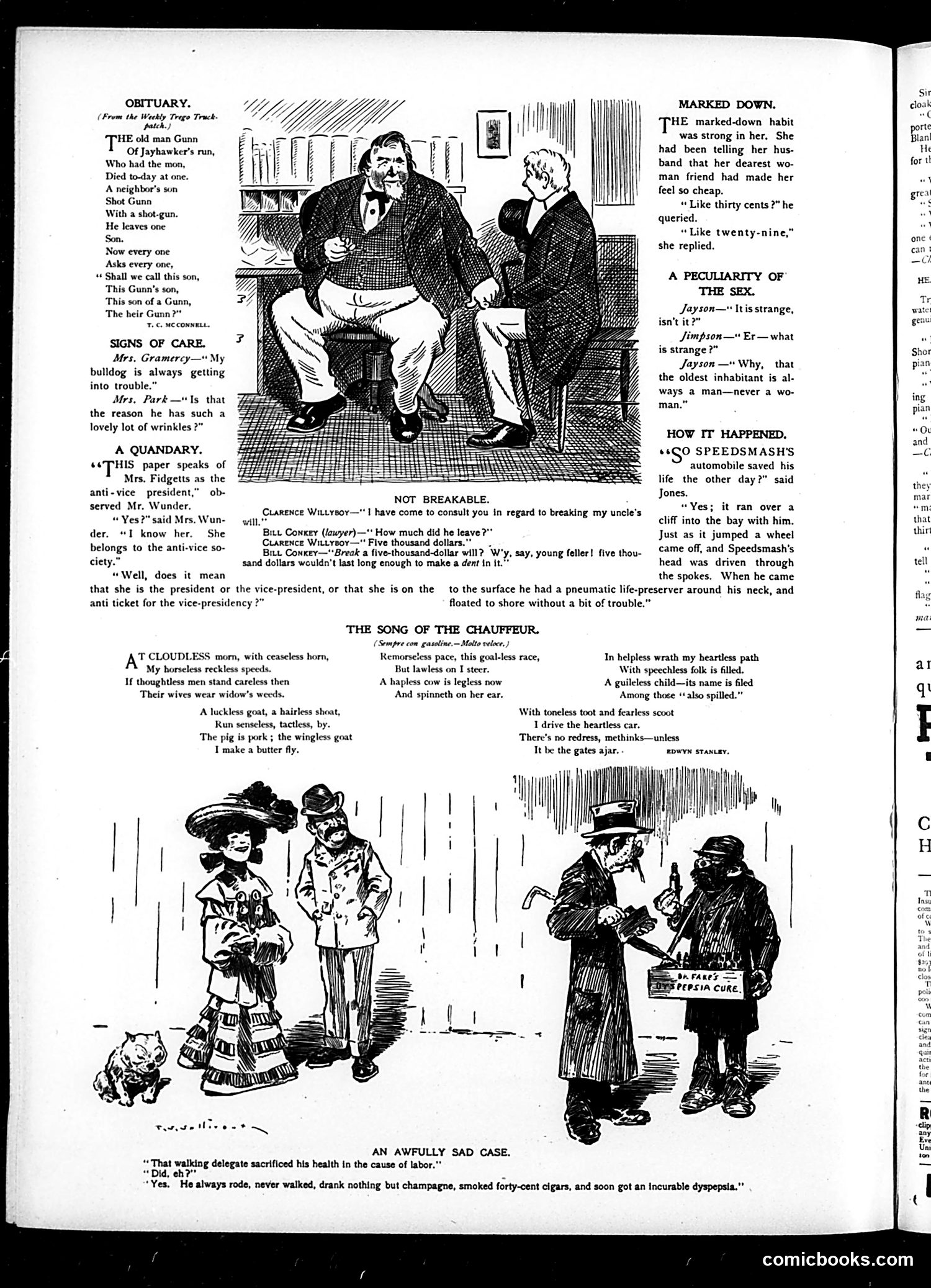
This page contains several satirical pieces typical of early 20th-century American humor: **"Marked Down"** mocks women's obsession with bargain-hunting by depicting a wife so focused on getting discounts that she's reduced her husband's affection from "thirty cents" to "twenty-nine." **"The Song of the Chauffeur"** is a musical parody satirizing reckless automobile drivers. Using absurdist wordplay (cloudless/ceaseless, horseless/reckless), it depicts a chauffeur indifferent to the destruction caused by speeding—dead animals, injured children—treating the automobile as an unstoppable force of chaos. **"How It Happened"** jokes about automobile safety, showing that Speedsmash's car crash paradoxically saved his life when a pneumatic life-preserver (presumably part of the car) protected him. The cartoons reflect anxieties about early automobiles as dangerous, uncontrollable technology, while the "Marked Down" piece targets contemporary gender stereotypes about female materialism. The overall tone is darkly comedic, treating serious social problems—traffic deaths, wage labor exploitation (the final item)—as sources of humor.
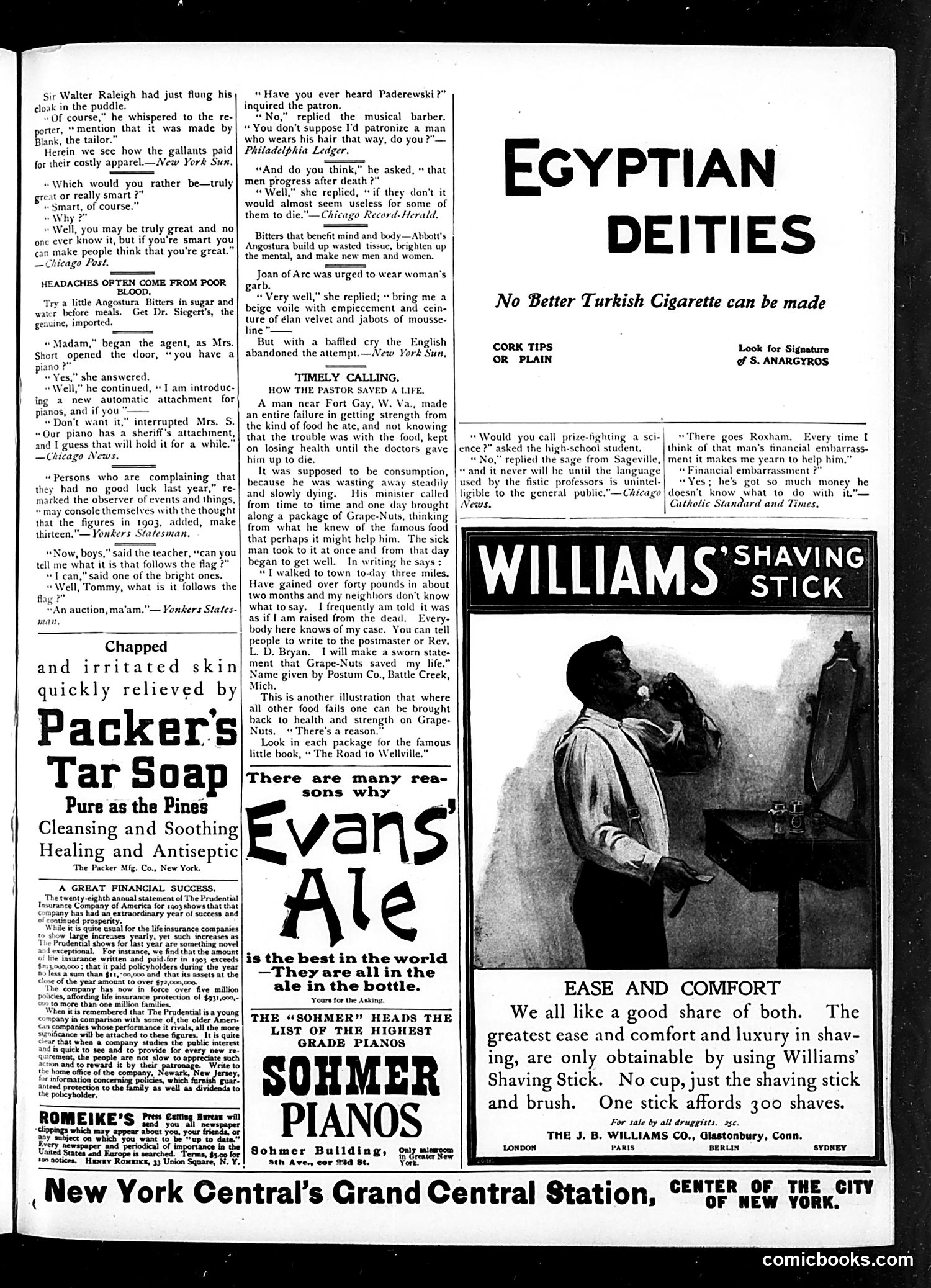
This page from *Judge* magazine is primarily **advertisements and humor snippets**, not political satire. The small jokes mock contemporary social pretensions and domestic situations: - **Sir Walter Raleigh anecdote**: Satirizes vanity—even historical romantic gestures were really just product placement for expensive tailors. - **Paderewski barber joke**: A pun on the famous pianist's notoriously long hair, which the barber considers so unfashionable he'd refuse his business. - **Joan of Arc fashion joke**: Absurdist humor where Joan, forced to wear women's clothing, responds with elaborate 1900s fashion terminology ("beige voile," "empiecement"), baffling her English captors. - **Piano attachment joke**: A woman jokes that a sheriff's lien on her piano will "hold it" better than any piano attachment could. The page is dominated by product ads (Packer's Tar Soap, Evans Ale, Williams' Shaving Stick, Sohmer Pianos) reflecting early 1900s consumer culture. These are light domestic and commercial satires, not political commentary.
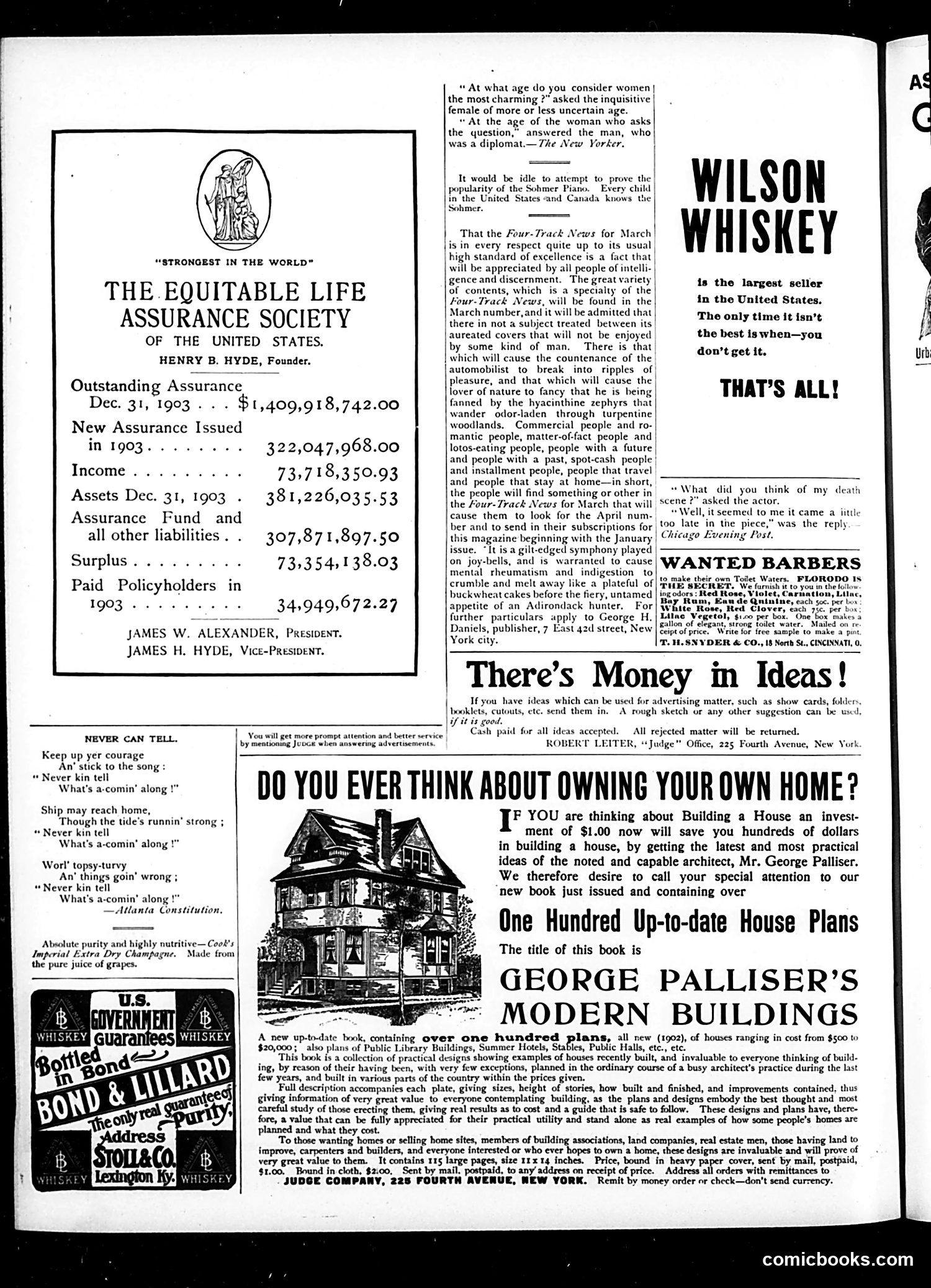
This page is primarily **advertising content** rather than political satire or editorial cartoons. It contains several commercial advertisements from early 1900s America: **Key advertisements:** - **The Equitable Life Assurance Society**: Financial statement showcasing the company's massive assets ($381 million+) and new policies issued in 1903 - **Wilson Whiskey**: Claims to be the largest seller in the United States - **House Plans**: George Palliser's architectural book offering 100+ home designs - **Sohmer Piano**, **Four-Track News** magazine, and **Barrett barber supplies** **The humor present** appears in small editorial pieces: a brief joke about a diplomat's response to a woman asking when women are most charming (he flatters her by saying "at your age"), and an actor's joke about his death scene coming "too late in the piece." The page reflects **early 20th-century consumer culture**, emphasizing life insurance, home ownership, and consumer products as markers of American success and modernity.
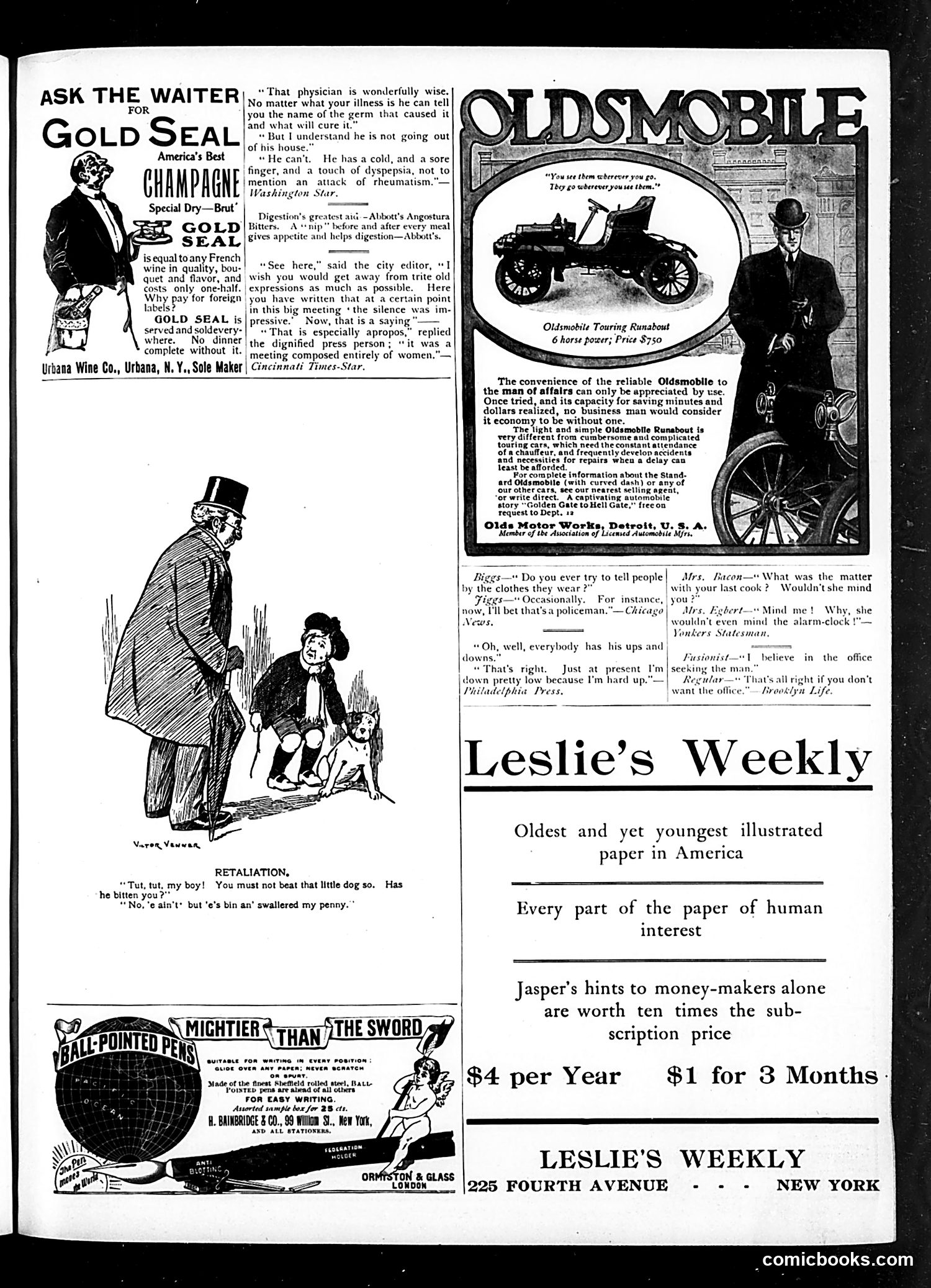
This page from Judge magazine (appears to be early 1900s) contains several distinct elements: **Left side**: Advertisements and short humor pieces, including one cartoon by Vosz Vauzan depicting a gentleman with children, captioned "RETALIATION"—a boy justifies beating a dog because it swallowed his penny. The joke relies on childish logic and revenge. **Center**: The "Ask the Waiter" Gold Seal Champagne ad features satire about a physician who claims diagnostic expertise but suffers ordinary ailments himself—ironic commentary on medical pretension. **Right side**: An Oldsmobile automobile advertisement showcasing their "Runabout" model ($750), emphasizing reliability and convenience for businessmen, contrasting it with complicated touring cars requiring chauffeurs. **Bottom**: Brief humor pieces mocking social conventions—a reporter criticized for clichéd writing, a cook who won't tolerate alarm clocks, and office politics jokes. The page is primarily **commercial advertising** disguised as editorial content, typical of early 1900s magazine publishing. The satire targets medical arrogance, journalistic clichés, and servant/domestic labor issues—reflecting period preoccupations.
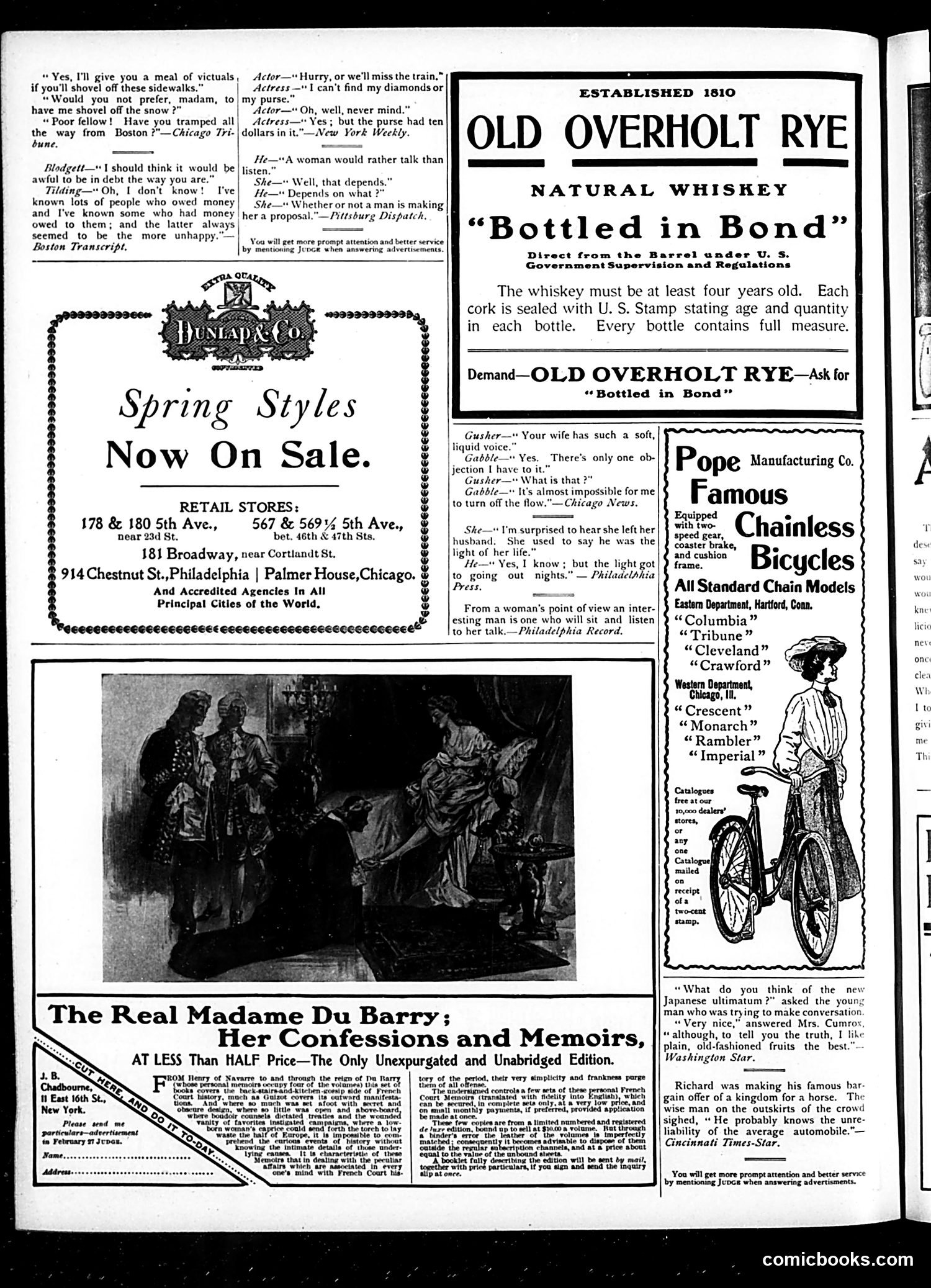
This page contains several short satirical jokes typical of Judge magazine's humor, along with period advertisements. The jokes mock gender relations and marital dynamics common to early 1900s comedy: 1. **Actor/Actress exchange**: Plays on vanity—an actress loses her diamonds and purse but only mentions the purse, suggesting materialism trumps sentiment. 2. **"Poor fellow" dialogue**: A tramp seeks food in exchange for shoveling snow; the woman prefers he remove snow instead, satirizing class assumptions and practical concerns. 3. **Debt commentary**: Jokes that people owed money are happier than creditors, reversing expected attitudes about debt. 4. **Gender stereotypes**: Multiple jokes about women's talkativeness versus listening ability, and how women's interest in men depends on whether they're being proposed to. The page also advertises Old Overholt Rye whiskey (federal oversight of quality), Pope bicycles ("chainless" models for women), and a salacious book about Madame du Barry. A final joke confuses a "Japanese ultimatum" with fruit, satirizing public ignorance of current events.
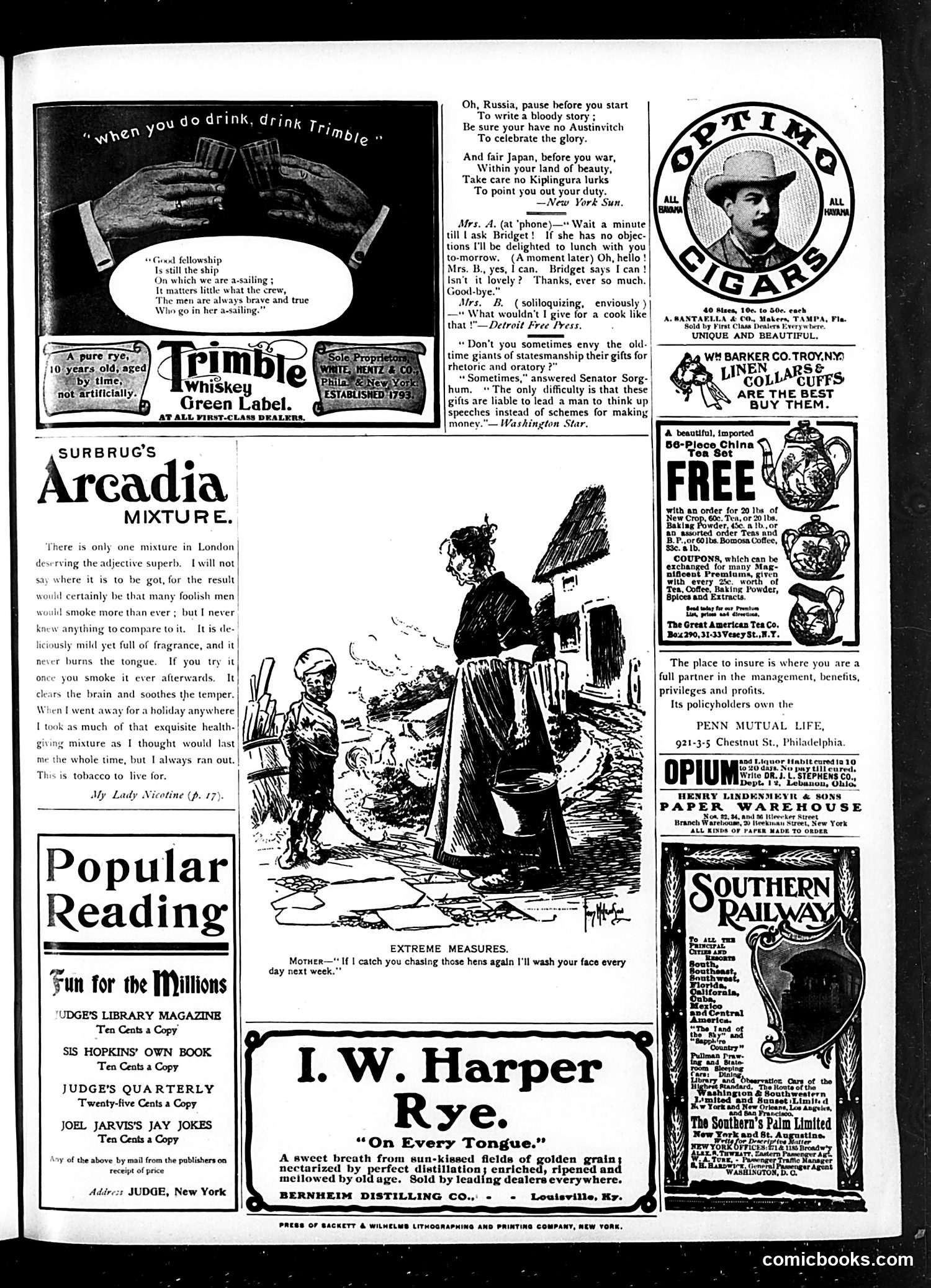
This page is primarily **advertisements interspersed with brief satirical commentary** typical of Judge's format. The main cartoon, "Extreme Measures," depicts a mother threatening to wash a child's face daily if caught chasing hens—a humorous domestic discipline scenario with no apparent political meaning. The political content appears in quoted commentary: references to **Russia and Japan** contemplating war are cautioned against creating "bloody stories" like those of "Austinvitch" (likely referencing Austro-Hungarian conflicts). The joke warns that war correspondents like Kipling might glorify their conflicts, turning real violence into romantic narratives. A separate quip mocks **Senator Sorg**, suggesting modern politicians are inferior to historical statesmen because they prioritize money-making "schemes" over eloquent speeches. The page is otherwise dominated by **period advertisements**—whiskey, cigars, tea, insurance, and other consumer products—reflecting Judge's revenue model rather than editorial content.
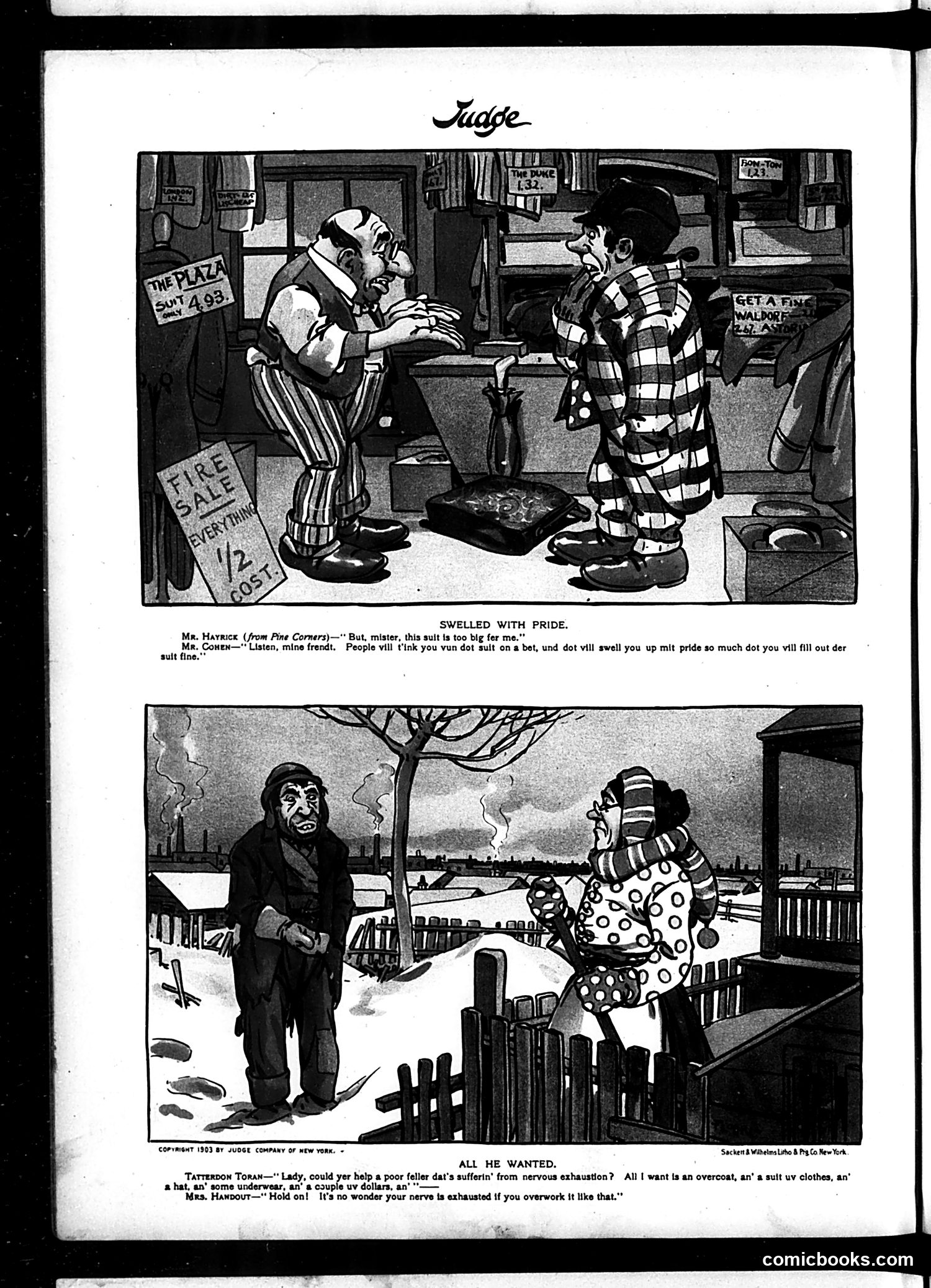
This page contains two separate comedic strips mocking immigrant accents and working-class characters. **"Swelled with Pride"** depicts a tailor (Cohen, identified by his Yiddish-inflected speech) convincing a customer (Hayrick from "Pine Corners") that an oversized suit will make him *feel* so proud he'll literally grow to fill it. The humor trades on both the tailor's ethnic stereotype and the absurd logic of psychological expansion. **"All He Wanted"** shows a beggar (Tarryvon Toran) claiming "nervous exhaustion" while requesting an overcoat, suit, hat, underwear, and money. Mrs. Harefoot's retort—that his nerve isn't exhausted at all, given his shameless demands—mocks both the beggar's transparent con and contemporary concerns about poverty and malingering. Both strips employ caricatured dialects and stereotypes typical of early-1900s American humor, targeting immigrants and the poor as objects of ridicule rather than sympathy.