
A complete issue · 16 pages · 1904
Judge — February 6, 1904
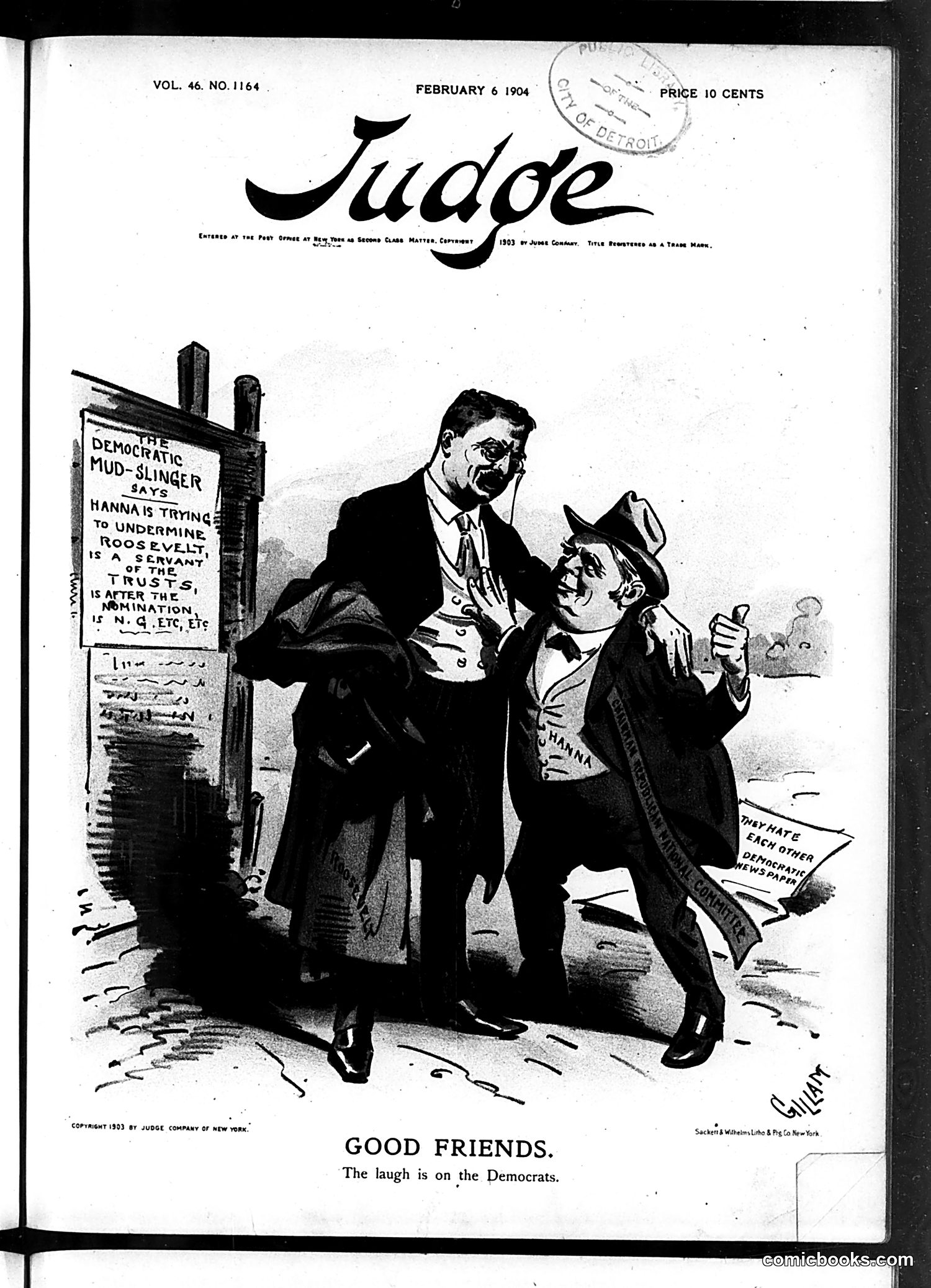
This political cartoon satirizes Democratic Party infighting. The sign posted on the left lists accusations from a "Democratic Mud-Slinger," claiming Mark Hanna (a Republican) is attempting to undermine Roosevelt and that Roosevelt is "a servant of the trusts." The cartoon depicts two men in apparent camaraderie, labeled "Good Friends" with the caption "The laugh is on the Democrats." The satire suggests that despite Democratic attacks on each other's positions—whether blaming Hanna, Roosevelt, or trusts—the Democrats themselves appear foolish and divided. The cartoon mocks internal Democratic conflict while the Republicans (represented by Roosevelt and Hanna) maintain unity, positioning GOP allies as the actual victors in political messaging.
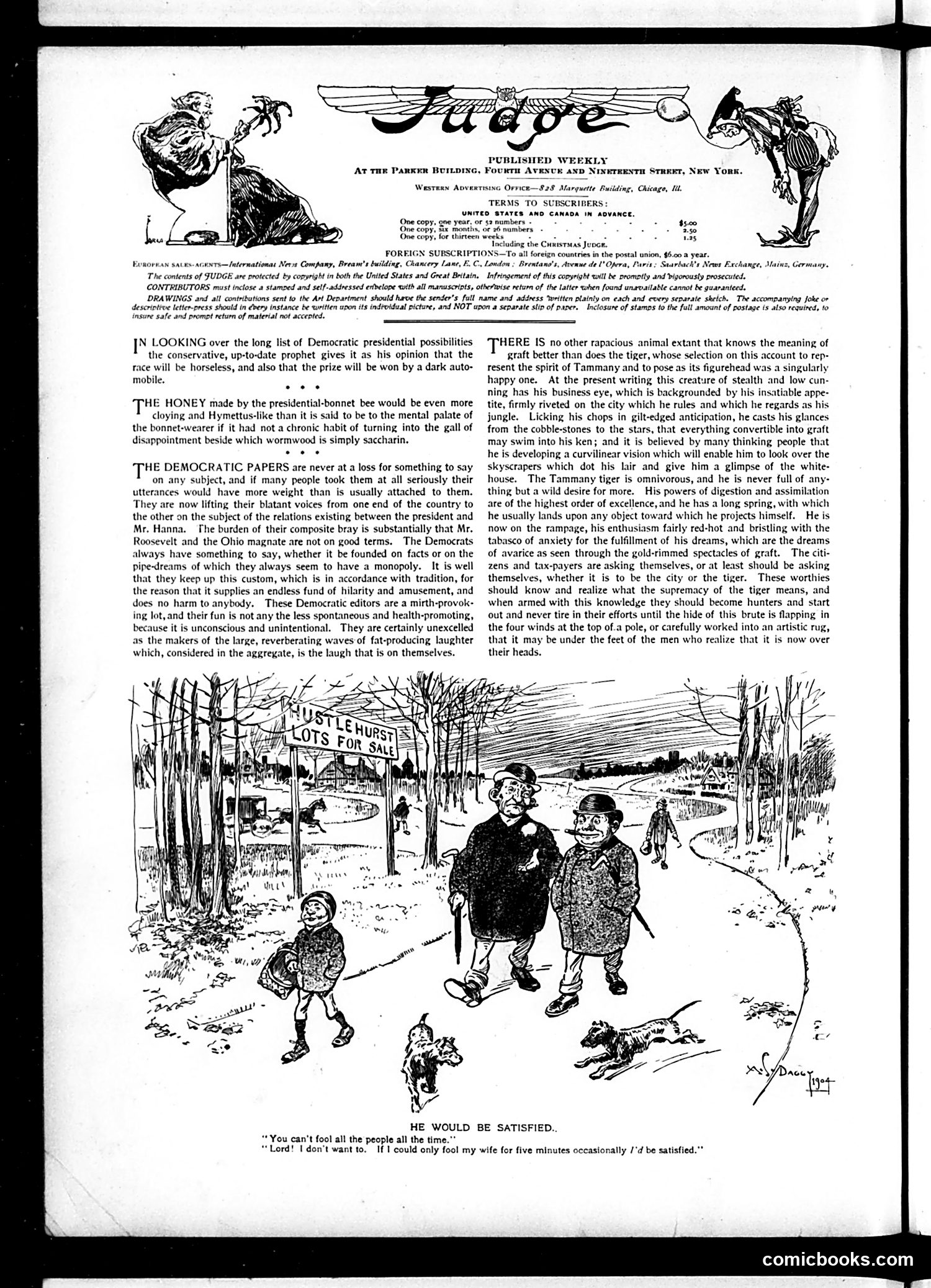
This page contains political commentary and a cartoon. The editorial text discusses Democratic presidential possibilities, criticizing Democratic papers for being indecisive and prone to endless debate. It praises the Republican approach as more decisive, suggesting Democrats lack clear direction. The cartoon titled "HE WOULD BE SATISFIED" depicts a man at what appears to be an amusement park or fair (sign reads "HURST LOTS FOR SALE"), with his wife and children. The caption suggests marital discord: the man claims he can't "fool all the people all the time" and wouldn't want to—he'd be satisfied if he could merely "fool my wife for five minutes occasionally." The joke plays on the tension between public deception and domestic life, likely satirizing a political figure's relationship with public opinion versus his family.
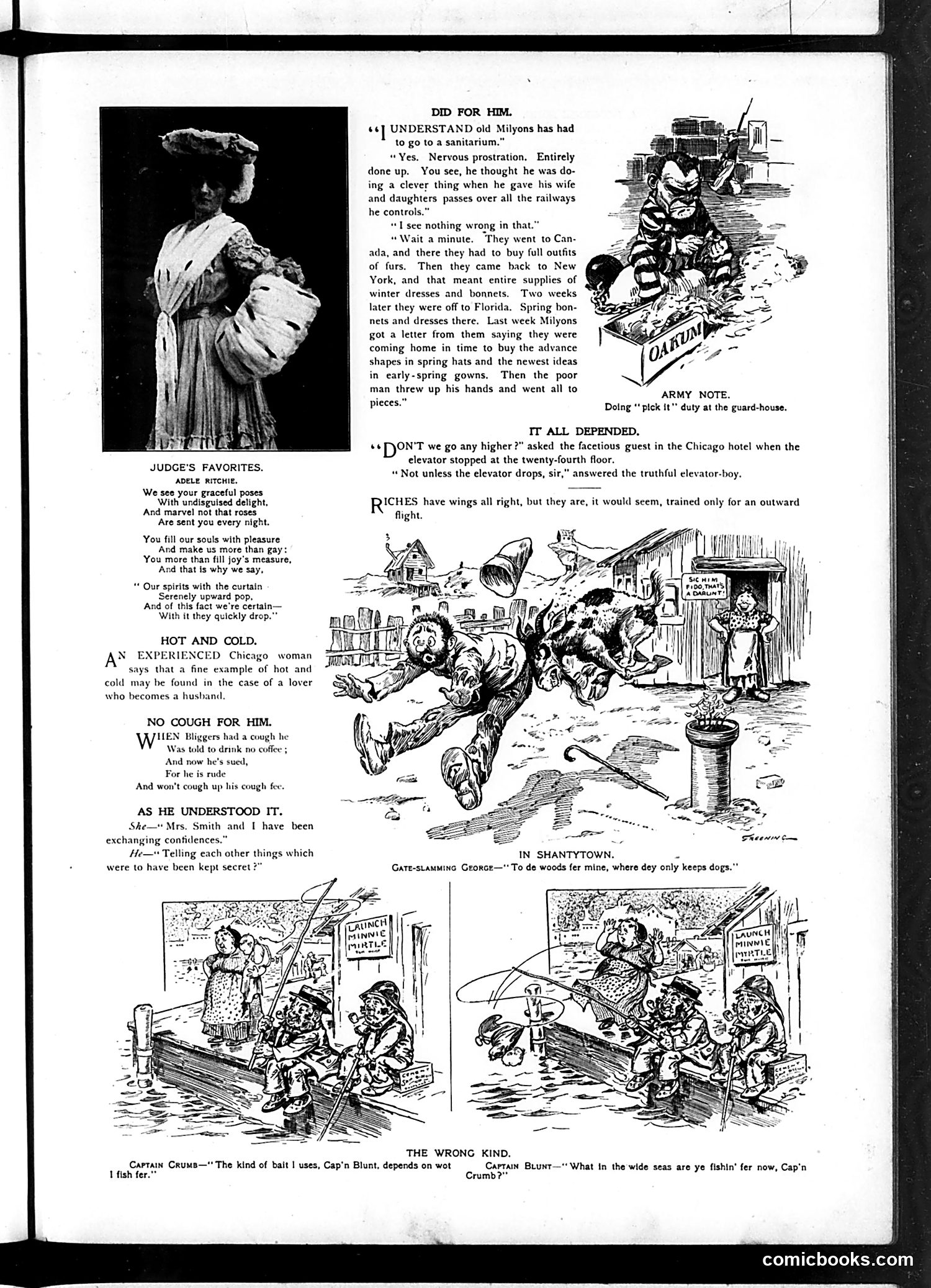
This page contains several satirical pieces and jokes typical of early 20th-century humor magazines: **"Judge's Favorites"** features a poem by Adele Ritchie praising roses, followed by short humorous anecdotes about Chicago life and social embarrassments. **"In Shantytown"** cartoon depicts working-class children fishing, with captions playing on dialect humor—common in period satire that mocked immigrant and lower-class speech patterns. **"The Wrong Kind"** shows fishermen named Captain Crumb and Captain Blunt, with wordplay about types of bait and fishing methods. The page uses standard Judge conventions: genteel poetry, slapstick illustrations of poor urban life, and dialect-based humor reflecting contemporary attitudes toward class and immigrants that would be considered offensive today.
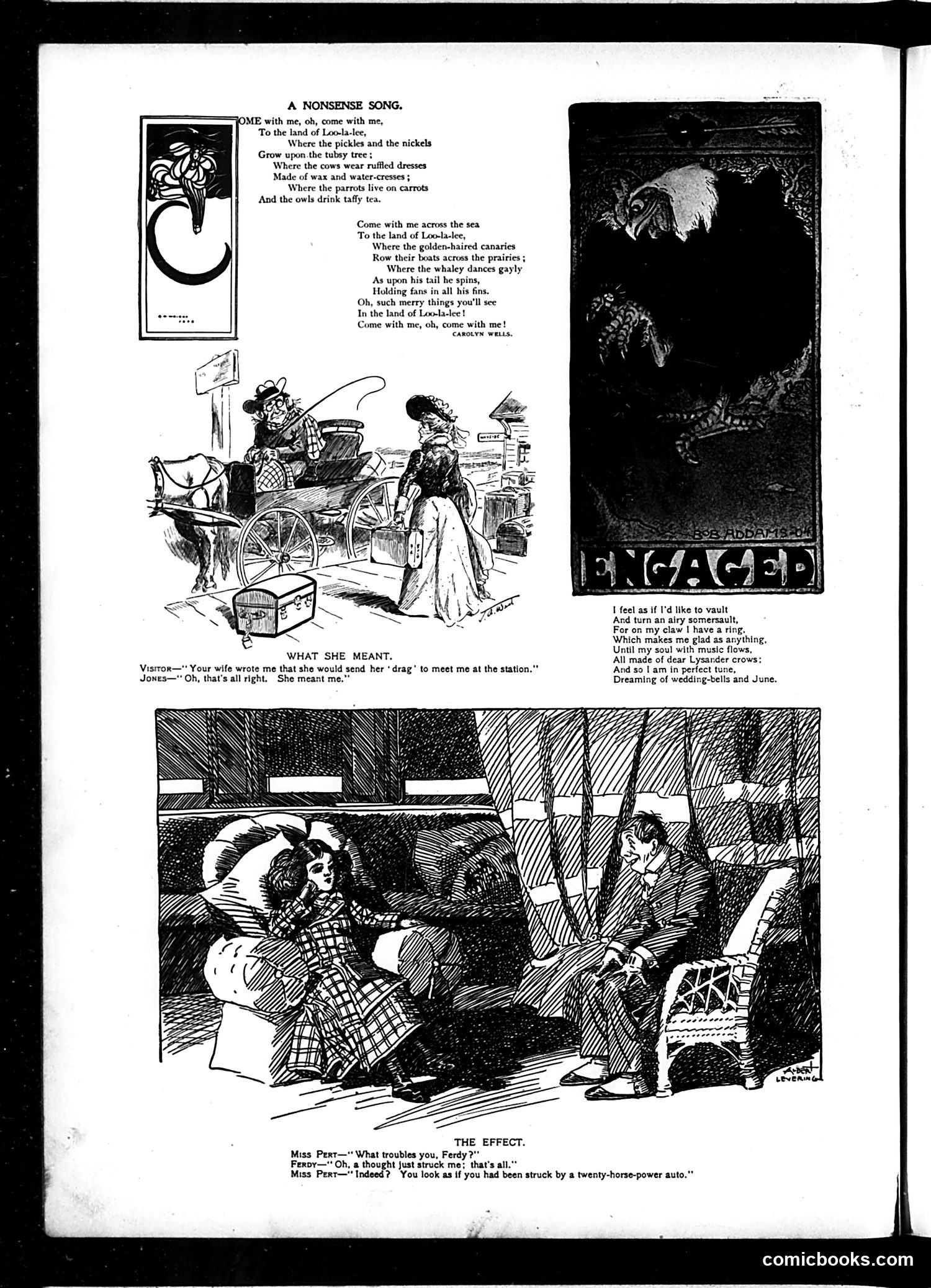
This page contains mixed content: a whimsical poem titled "A Nonsense Song" by Caroline Wells about an imaginary "Land of Lookalee" with absurd imagery (pickles, nickels, wax, water-cresses, parrots, owls drinking taffy tea). Below are two cartoon sequences with social humor: **"What She Meant"**: A man at a station misunderstands a woman's request to send her "drag" (carriage), interpreting it as something else—the joke playing on communication mishaps between genders. **"The Effect"**: Shows Miss Pest striking Ferdy with some force, leaving him appearing dazed. The humor relies on physical comedy and the unexpected consequences of Miss Pest's actions—typical early 20th-century magazine humor emphasizing slapstick and domestic/social awkwardness rather than specific political satire.
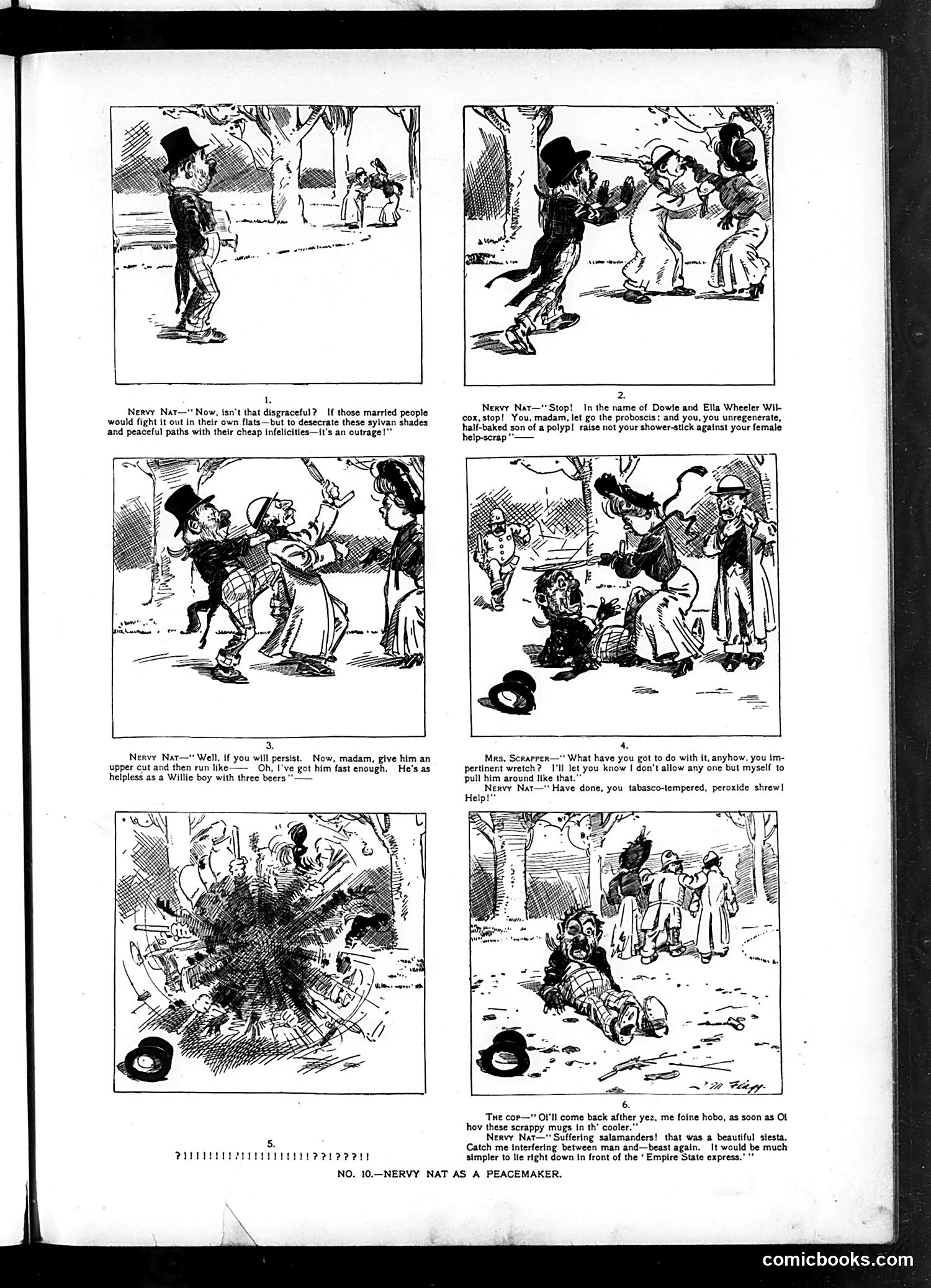
This comic strip satirizes a character named "Nervy Nat," depicting him as an incompetent troublemaker masquerading as a peacemaker. The narrative follows Nat's attempts to resolve conflicts between married couples and other disputants, but his interventions consistently backfire—escalating arguments into physical altercations and chaos. The satire appears to target naive or self-appointed mediators who lack judgment and diplomacy skills. Each panel shows Nat's well-intentioned but disastrous attempts at conflict resolution, culminating in violence and disorder. The title itself is ironic: rather than bringing peace, Nat's "nervous" interference creates pandemonium. The humor relies on slapstick consequences and the character's obliviousness to his failures—a common Judge magazine approach to social commentary through comedic exaggeration.
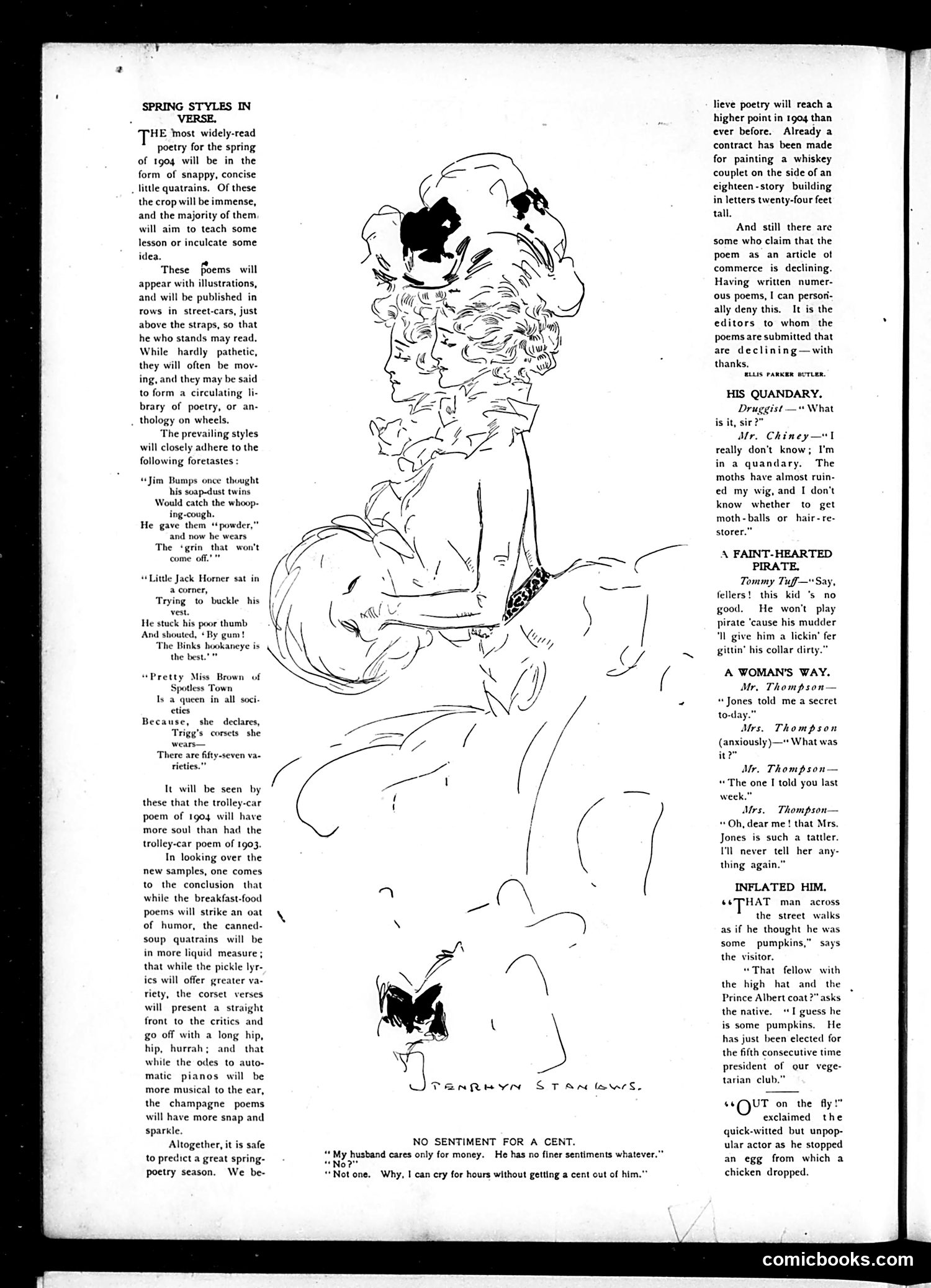
This page from *Judge* magazine showcases several satirical humor pieces typical of early 1900s American comedy: **"Spring Styles in Verse"** predicts that 1904 poetry will be snappy, concise quatrains—witty little poems published in streetcars above the handrails for commuters to read. The satire mocks commercialization of poetry and advertising's invasion of public space. **The illustrated figure** (labeled "Dorothy Stanlaws") appears to be a stylized caricature, possibly a contemporary public figure or type, rendered in the exaggerated line-drawing style typical of the era. **Individual jokes** include domestic humor ("His Quandary"—a man's wig ruined by moths), class commentary ("A Faint-Hearted Pirate"—a working-class child won't misbehave), marriage satire ("A Woman's Way"—wives gossip about secrets), and social observation ("Inflated Him"—a pretentious man). **"No Sentiment for a Cent"** mocks materialistic marriages—the wife complains her husband cares only for money and has no "finer sentiments." Overall, the page reflects *Judge*'s focus on urban middle-class anxieties and social pretension.
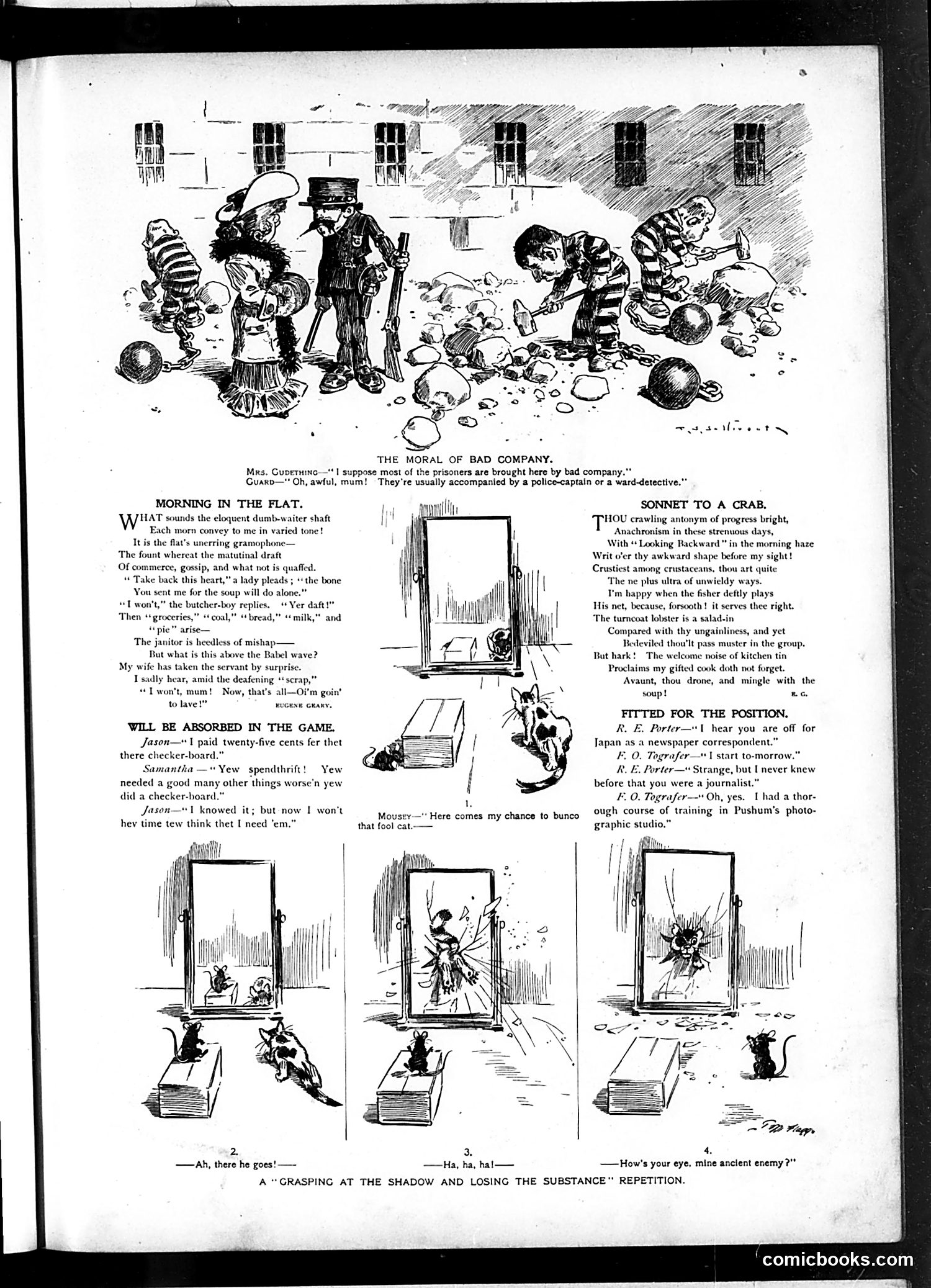
This page contains several satirical pieces typical of turn-of-the-century American humor: **"The Moral of Bad Company"** (top) depicts prisoners in striped uniforms, sardonically suggesting that most arrive via "bad company"—accompanied by police or detectives. The joke: blaming companions for incarceration is convenient excuse-making. **"Morning in the Flat"** mocks urban apartment living, where residents overhear neighbors' mundane complaints (butchers, groceries, servants) through a dumb-waiter shaft, treating it like entertainment. **"Will Be Absorbed in the Game"** shows a rural couple arguing over a checker-board purchase—the husband welcomes the distraction from life's worries. **"Grasping at the Shadow"** (bottom series) depicts a cat chasing its reflection in windows, unable to grasp the "substance" (the real cat) while pursuing the shadow—a metaphor for futile pursuits. Lesser pieces include a "Sonnet to a Crab" (nature poetry mockery) and "Fitted for the Position" (someone trained in photography becoming a newspaper correspondent—implying lowered standards for journalism).
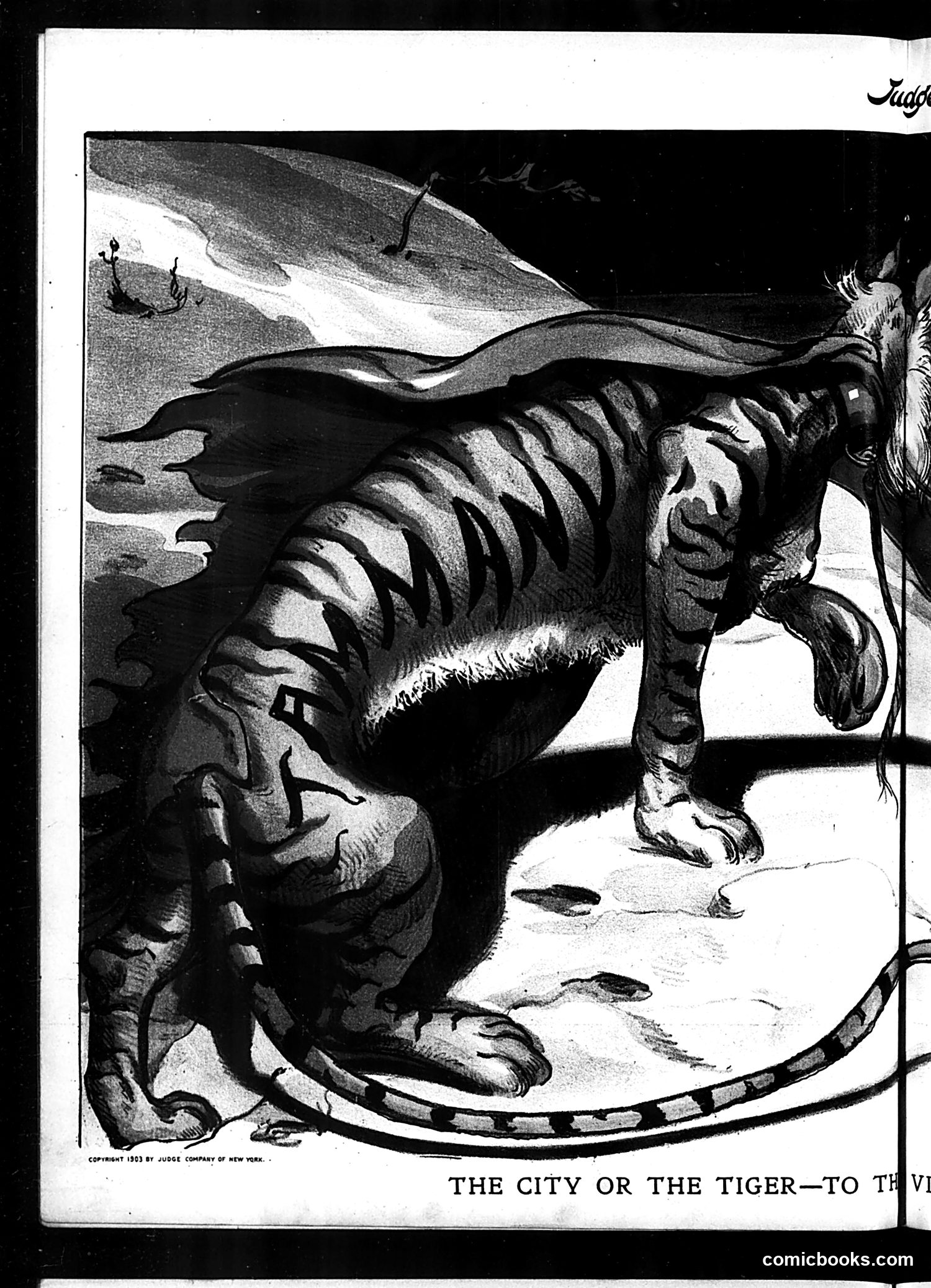
This political cartoon from Judge magazine (copyright 1893) presents an anthropomorphized tiger confronting a human figure in what appears to be a confrontational scene. The tiger, rendered with exaggerated musculature and an aggressive posture, likely represents a political threat or dangerous force—possibly corporate power, corruption, or a specific political adversary of the era. The human figure appears to be defending against or standing up to this threat. The serpent coiling around the base suggests danger or treachery. Without the complete caption or additional context, the specific political reference remains unclear, though the imagery suggests a commentary on power struggles or moral conflicts relevant to 1890s American politics.
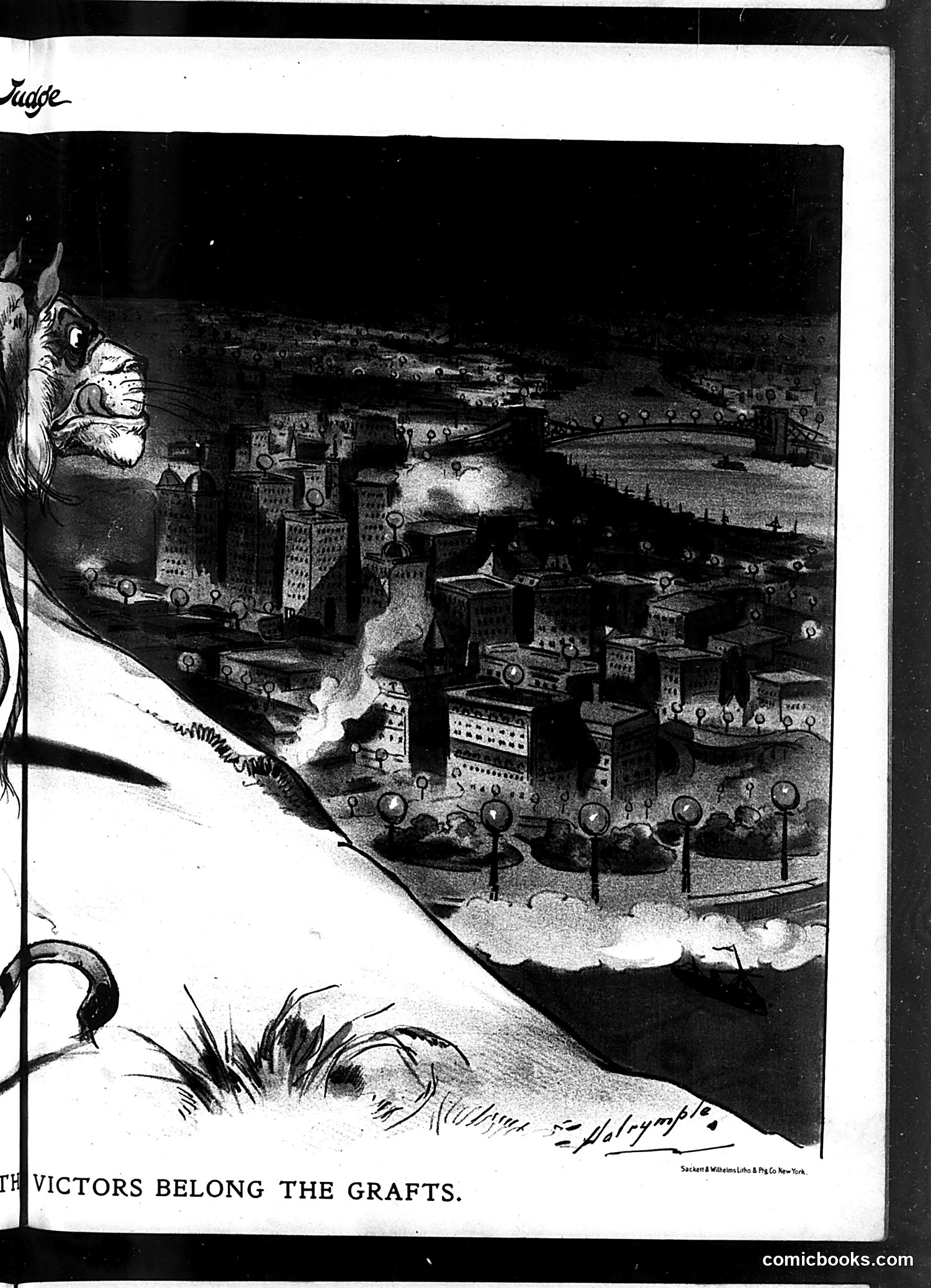
This political cartoon depicts a demonic or monstrous figure overlooking a cityscape dotted with buildings and what appear to be corrupt officials or "grafters" represented by circular symbols. The title "TO THE VICTORS BELONG THE GRAFTS" is a satirical twist on the phrase "To the victors belong the spoils," critiquing political corruption. The cartoon appears to be commentary on machine politics and patronage corruption in American cities—likely early 20th century, given *Judge* magazine's era. The demon-like figure suggests organized corruption or "the spoils system" personified as an evil force presiding over urban graft networks. The multiple circular symbols throughout the cityscape likely represent corrupt officials or bribery networks embedded throughout municipal government. The satire targets how political victors exploited public office for personal gain through systematic corruption.
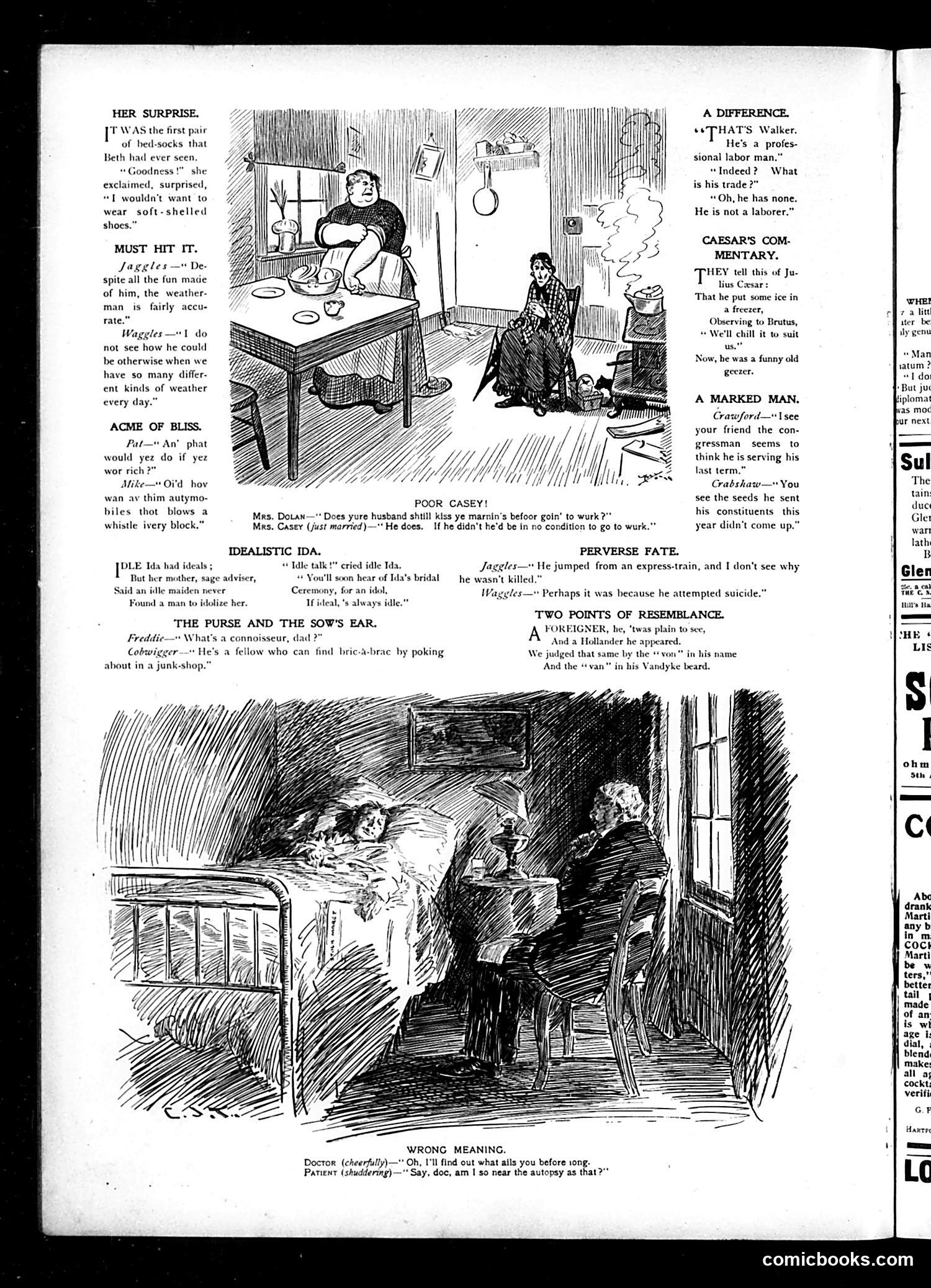
This page contains multiple brief humorous sketches typical of early-20th-century American comic magazines: **"Her Surprise"** mocks a newlywed's shock at soft socks—playing on Victorian propriety about undergarments. **"Must He"** features Irish-dialect humor (common stereotyping of the era) about a wealthy man's complaint regarding weather—satirizing the privileged's inability to appreciate simple pleasures. **"Wrong Meaning"** shows a doctor and patient with dark comedy: the patient fears the doctor will perform an autopsy before finding out what's wrong—playing on medical malpractice anxieties. **"Two Points of Resemblance"** appears to reference a foreigner and a Hollander sharing unclear visual similarities—likely ethnic or national stereotyping humor. Other sketches use puns and wordplay ("Idealistic Ida," "Caesar's Commentary") typical of the era's humor style. The page relies heavily on ethnic accents in dialogue and class-based comedy, reflecting Judge's satirical but often stereotypical approach to American society.
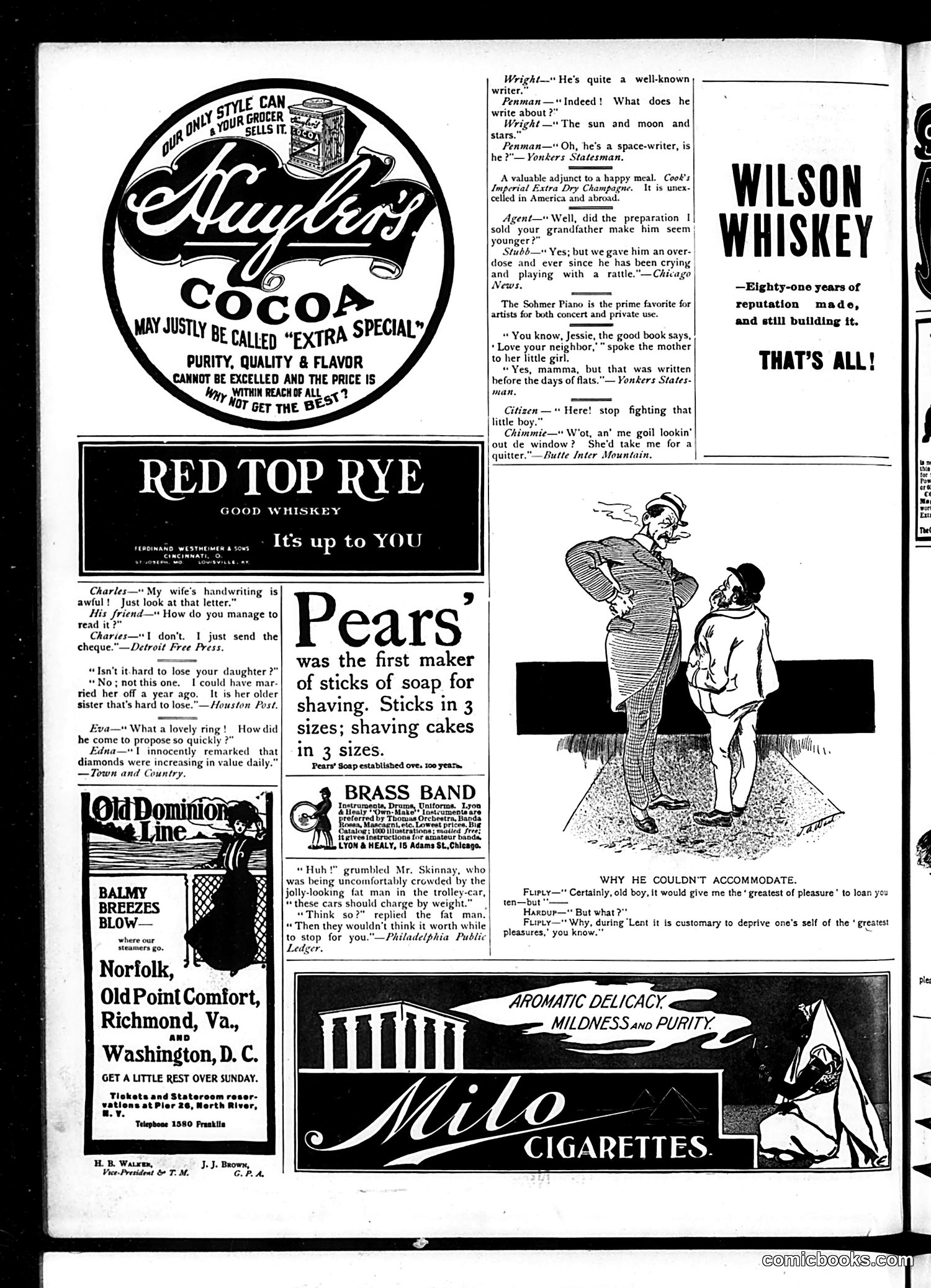
This page is primarily **vintage advertising** (Slayden's Cocoa, Wilson Whiskey, Red Top Rye, Pears' Soap, Old Dominion Line steamships, and Milo Cigarettes) interspersed with short comic joke-pieces typical of early 20th-century Judge magazine. The **main cartoon** shows two men—an older, well-dressed gentleman and a working-class boy—captioned "WHY HE COULDN'T ACCOMMODATE." The joke about lending money during Lent plays on religious self-denial: the wealthy man jokes that depriving himself of "the greatest pleasures" means refusing to loan money (suggesting greed is his greatest pleasure). The **surrounding jokes** employ light satire: puns about a "space-writer," an overdosed grandfather acting like an infant, marital humor about handwriting, and trolley-car humor about charging heavy passengers by weight. The page reflects turn-of-the-century American attitudes toward wealth, gender roles, and immigrant/working-class speech patterns (the "Chimmie" dialect joke).
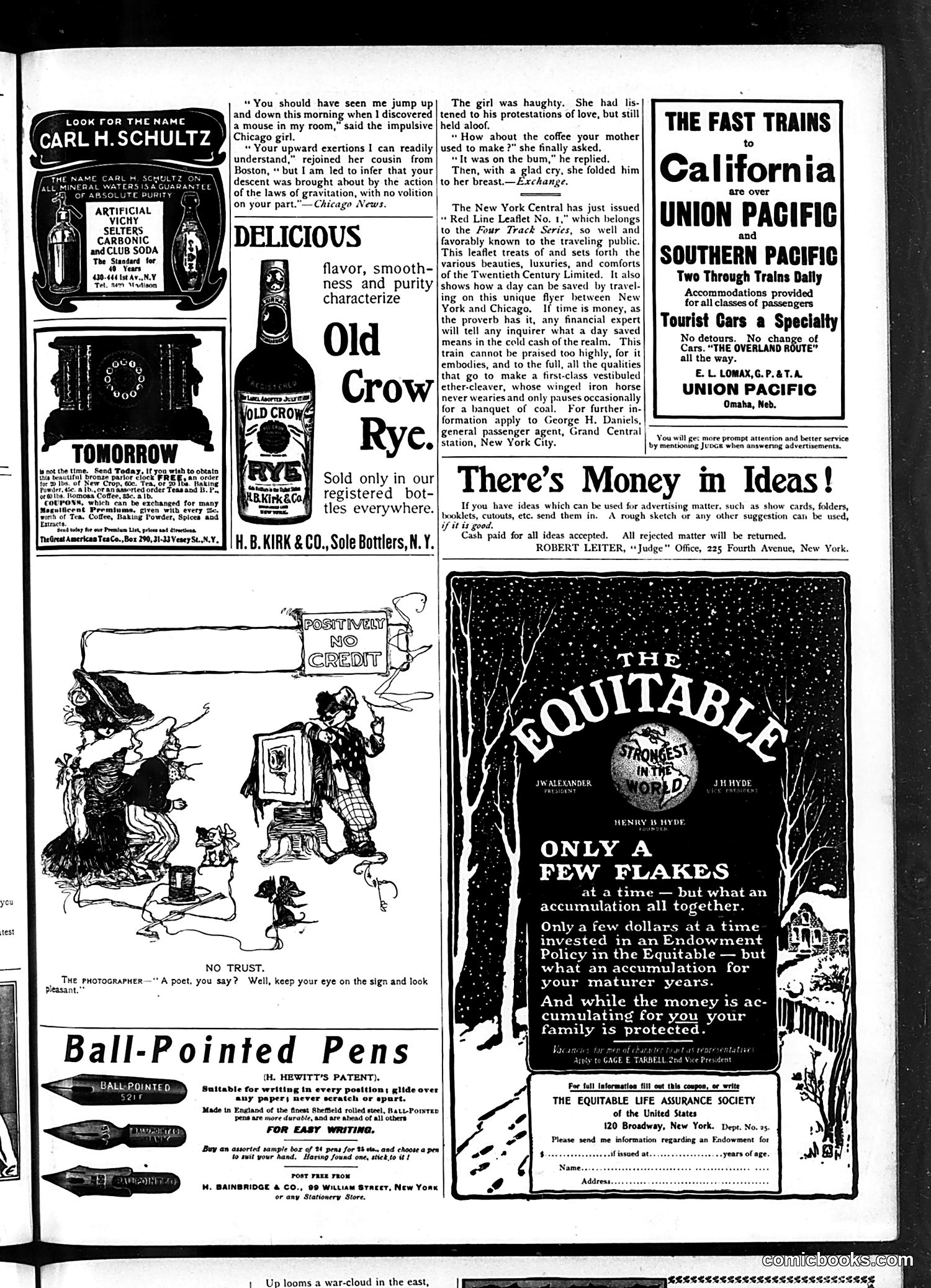
This is primarily an **advertising page** from Judge magazine, a major American satirical publication. The page contains multiple unrelated advertisements and brief comedic anecdotes typical of the era. The small cartoons and jokes are light humor: one depicts a Boston cousin's pedantic reaction to a Chicago girl's animated mouse-encounter story, mocking regional personality differences. Another shows a photographer's cynical caption about poets—suggesting distrust of artistic types. The main illustrated cartoon ("No Trust") depicts generic figures in comedic poses around a "Positively No Credit" sign, making a straightforward joke about merchants' wariness of customers who can't pay. The bulk of the page advertises products (Old Crow whiskey, ball-pointed pens, Selters soda) and services (railroad travel to California, life insurance, the magazine itself). There is no significant political or social satire—this appears to be a revenue-generating advertising section rather than editorial content, though it maintains Judge's light, humorous tone throughout.
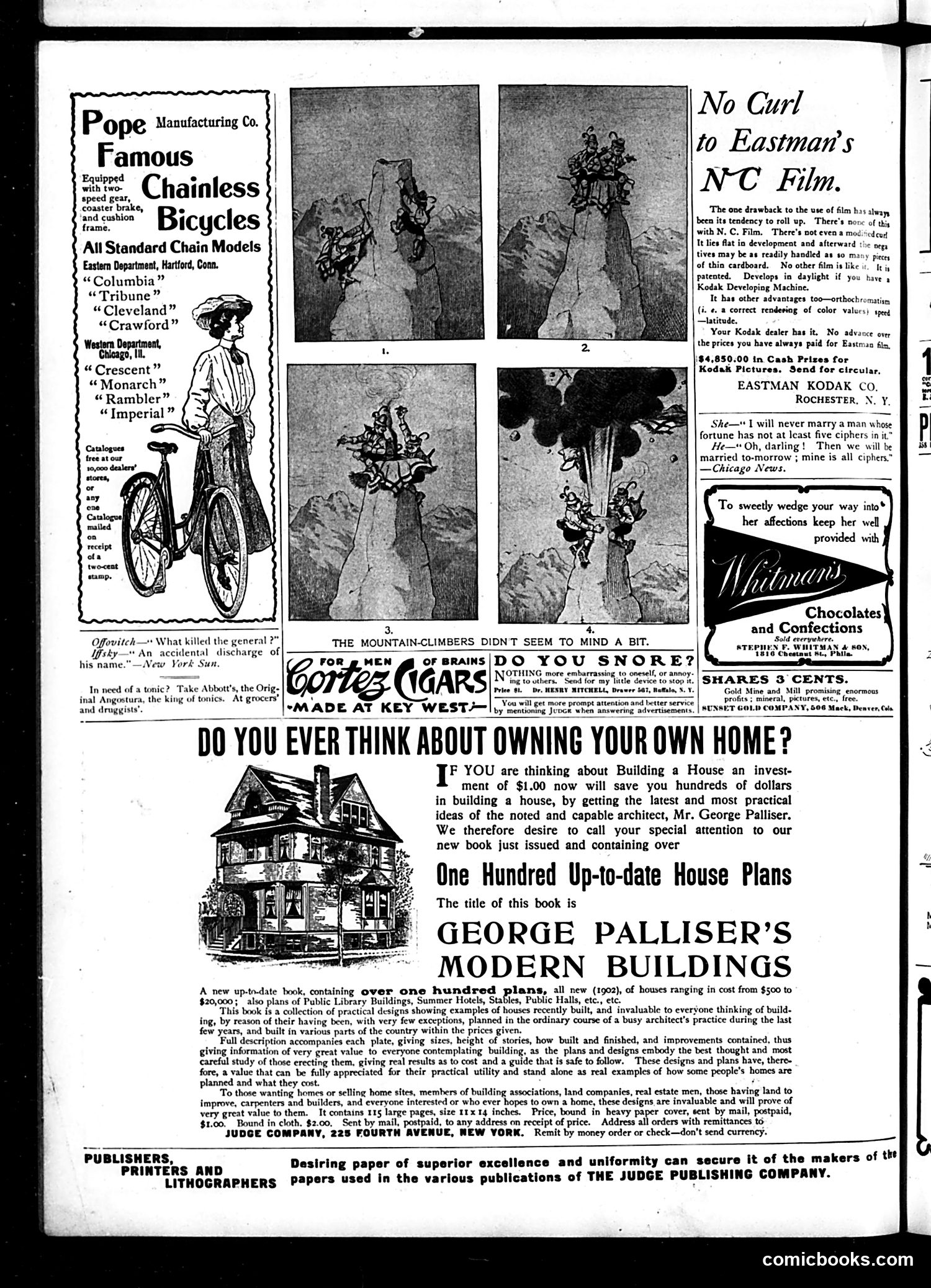
This page is primarily **advertising** with one small cartoon joke. ## The Cartoon: The image labeled "THE MOUNTAIN-CLIMBERS DIDN'T SEEM TO MIND A BIT" (images 3-4) shows climbers on a mountain who appear unbothered by danger. This accompanies a cigar advertisement—the joke appears to be that smoking these cigars provides such comfort/confidence that even perilous situations seem manageable. It's a typical early 1900s advertising exaggeration. ## Other Content: - A marriage joke about a man whose "fortune" has "all ciphers"—a pun suggesting his money is worthless (many zeros but no real value) - Advertisements for Pope bicycles, Kodak film, Whitman's chocolates, Abbott's tonic, and George Palliser's architecture book The page reflects early 1900s consumer culture and advertising conventions rather than political satire. Most space is devoted to commercial pitches typical of *Judge* magazine's revenue model.
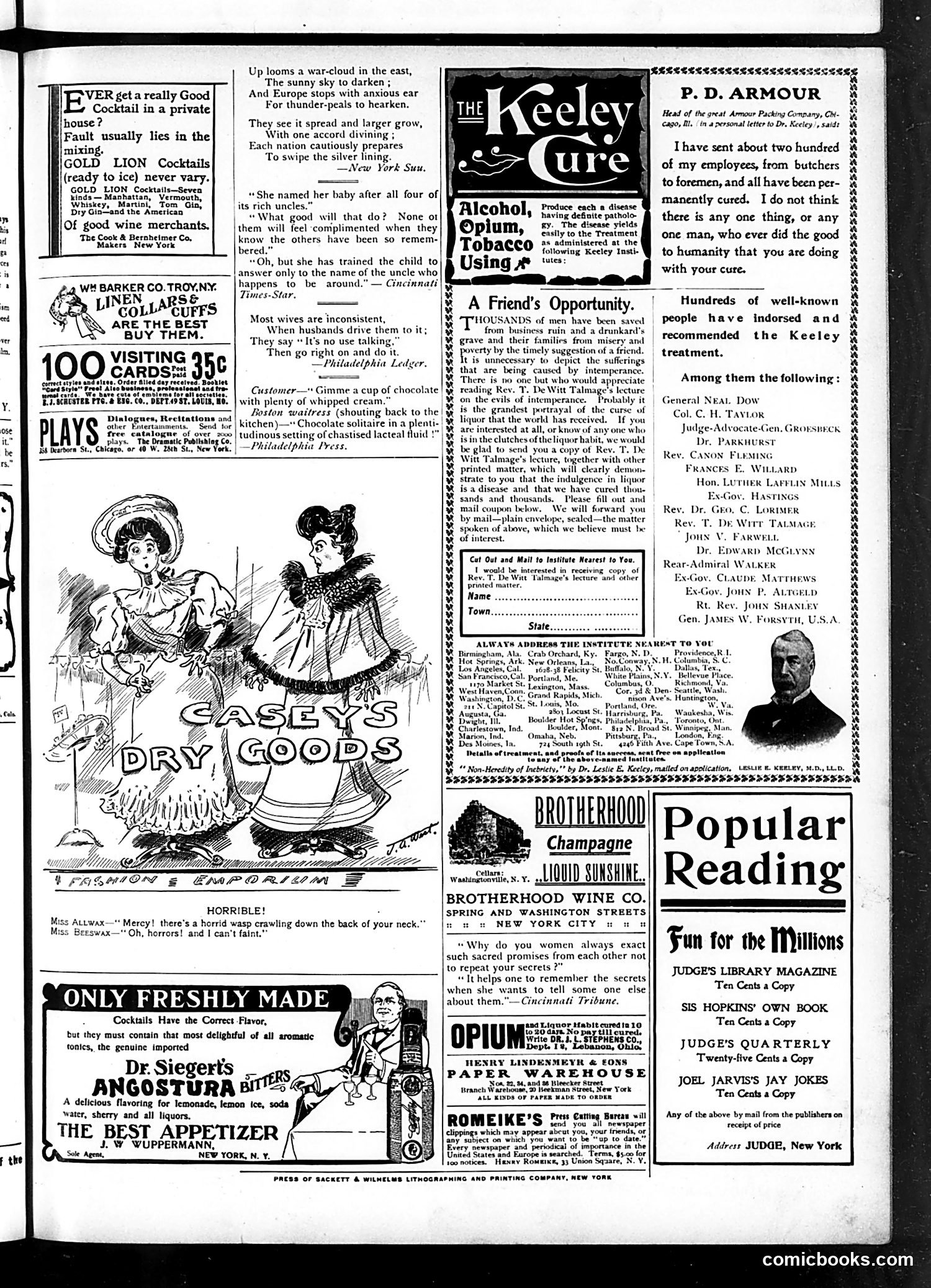
This Judge magazine page mixes humor with advertising, typical of early 1900s satirical publications. The political cartoon at top references European tensions before World War I—the "war-cloud in the east" and nations preparing to "swipe the silver lining." This satirizes how European powers viewed international conflicts as economic opportunities. The page contains multiple short jokes on marriage inconsistency, baby-naming, restaurant humor, and a "wasp on the neck" gag—standard mild domestic humor of the era. Significantly, the page features extensive advertising for the Keeley Institute, which treated alcoholism and drug addiction. The ad includes endorsements from prominent figures (P.D. Armour, General Neal Dow) claiming personal cures. This appears alongside advertisements for alcohol products (cocktails, champagne), creating an ironic juxtaposition typical of the period—substances promoted while "cures" for their abuse were simultaneously advertised to readers.
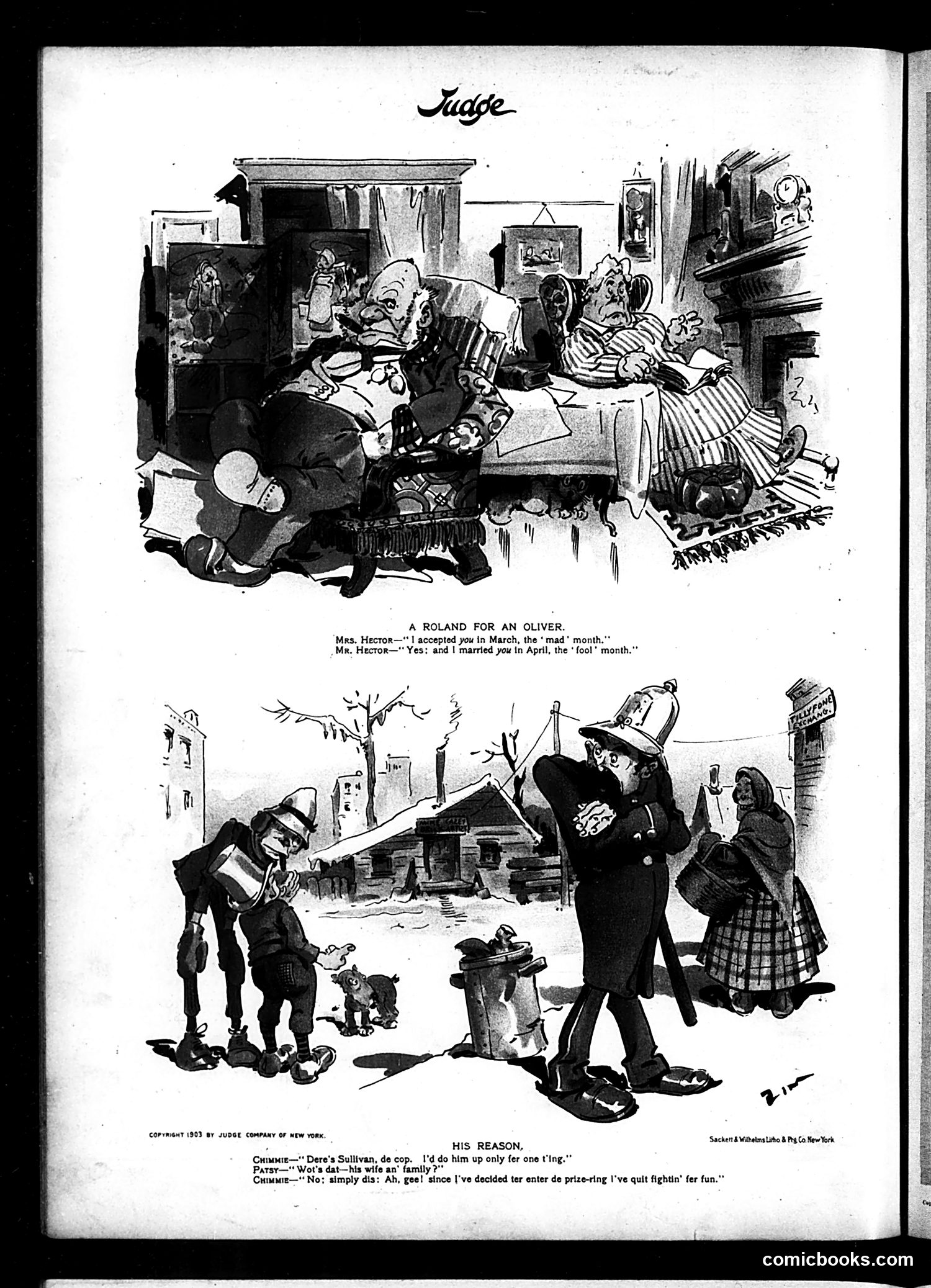
This page contains two separate satirical cartoons: **Top cartoon ("A Roland for an Oliver"):** A married couple trades insults about their wedding timing. The husband quips that marrying in April (the "fool's month") matches his wife accepting him in March (the "mad" month)—a play on seasonal associations with foolishness and madness. **Bottom cartoon ("His Reason"):** Two street toughs discuss avoiding a fight with "Sullivan, de cop." The speaker's punchline: he's now pursuing professional boxing, so he's stopped fighting for entertainment. The joke relies on ethnic-dialect humor (common in early 1900s Judge), treating street violence and prizefighting as equivalent pursuits. "His reason" for avoiding the cop isn't fear of arrest but rather that he's now serious about boxing—a darkly humorous commentary on working-class aspirations and street culture. Both cartoons use wordplay and situational humor typical of Judge's satirical style.