
A complete issue · 16 pages · 1904
Judge — January 16, 1904
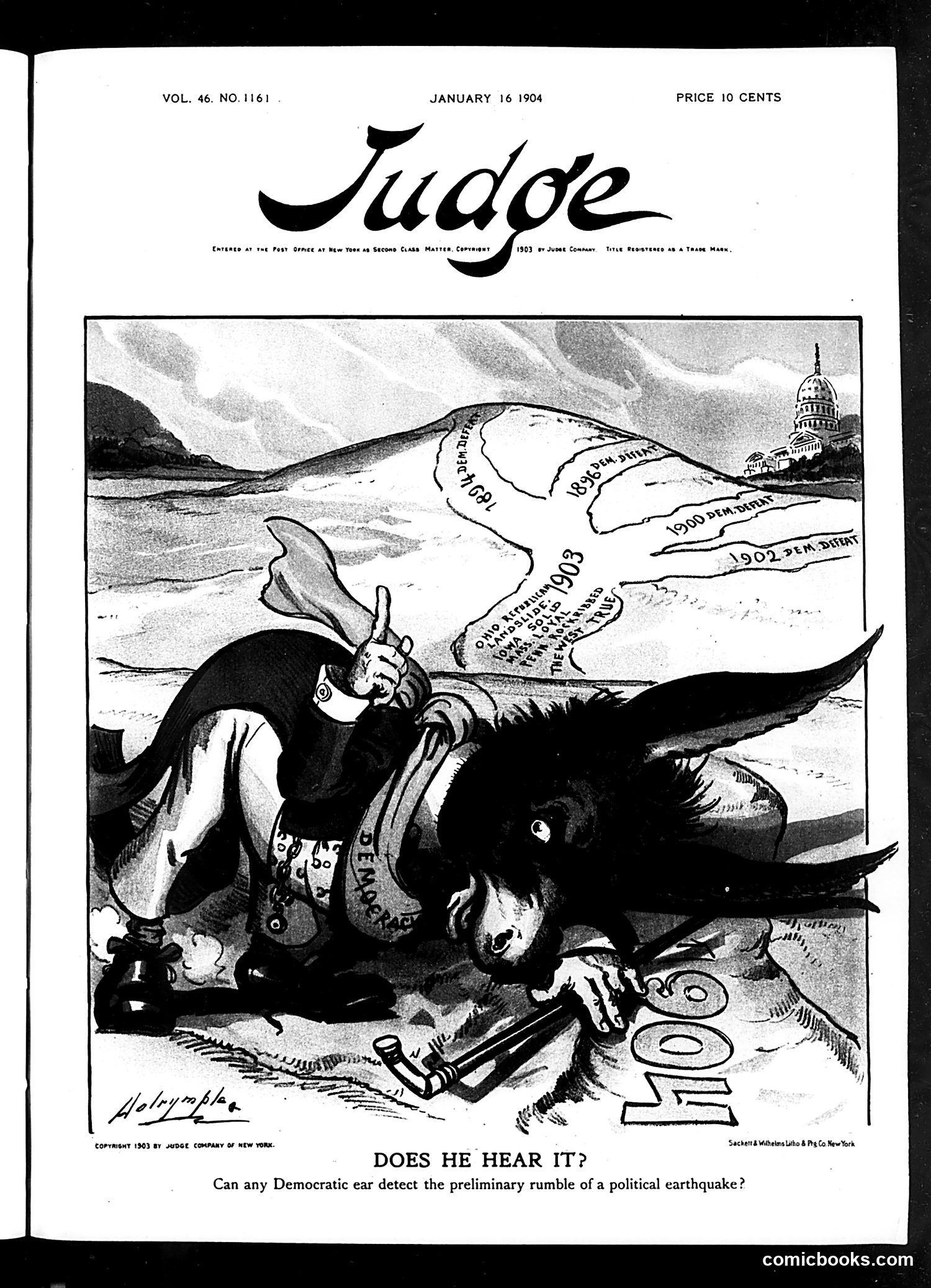
This political cartoon depicts a donkey (symbol of the Democratic Party) lying on the ground, seemingly oblivious or deaf. The donkey wears labels referencing past Democratic defeats: "1900 2ND DEFEAT," "1902 2ND DEFEAT," and what appears to be earlier electoral losses. In the background, a map shows disturbing terrain near the Capitol building, labeled to suggest political instability or upheaval ahead. The caption asks: "Can any Democratic ear detect the preliminary rumble of a political earthquake?" The satire mocks Democrats for failing to recognize warning signs of impending political disaster. The cartoon suggests the party is so weakened by repeated defeats that it cannot perceive approaching catastrophe—implying Republicans would dominate upcoming 1904 elections.
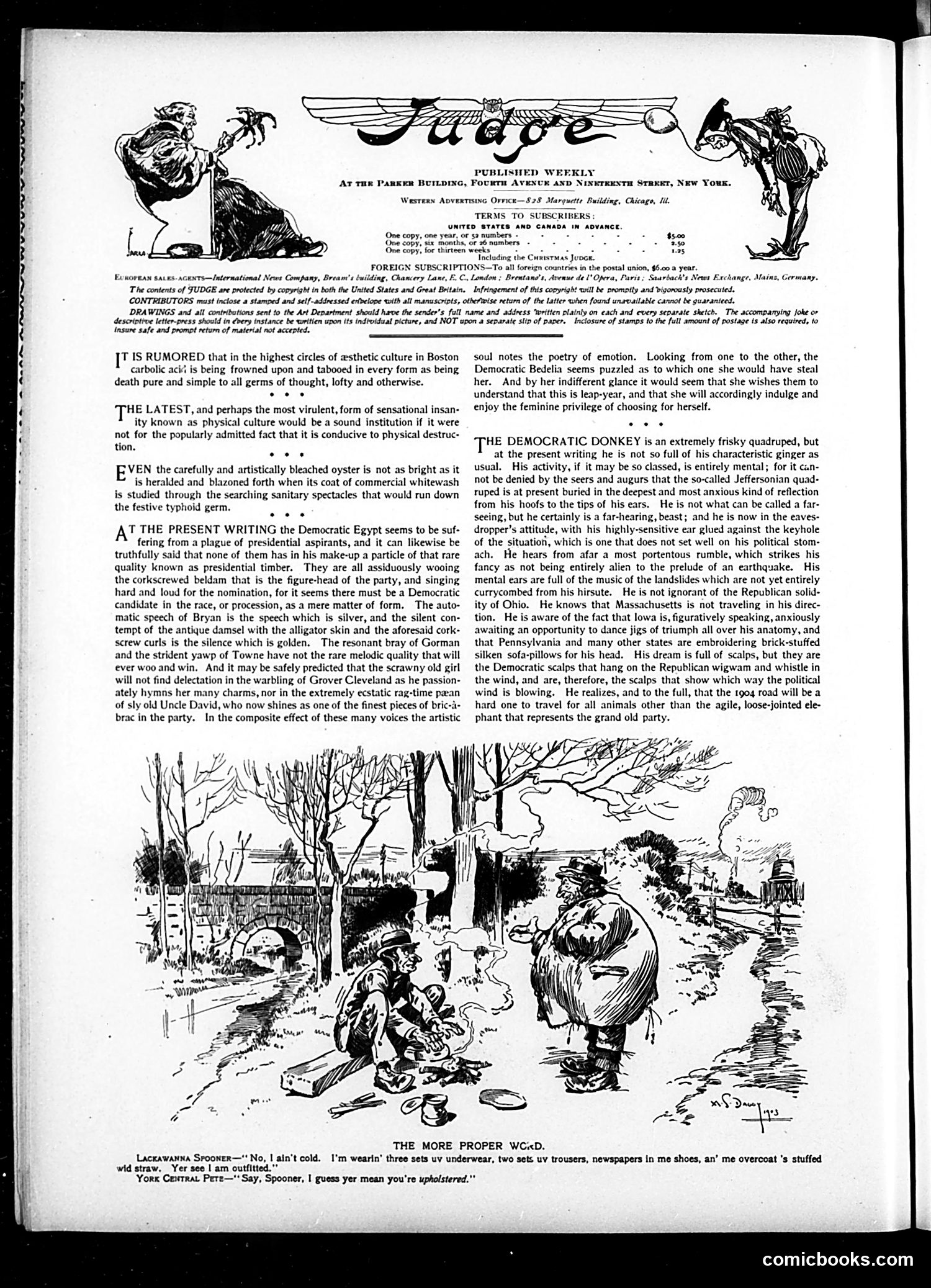
This page contains political commentary and satire typical of Judge magazine's satirical style. The main article criticizes Boston's "Catholic acid" and physical culture movements, suggesting aesthetic pretension masks shallow values. The central cartoon, titled "The More Proper Wad," depicts two working-class figures (a "Lackawanna Spooner" and "York Central Pete") discussing clothing. The dialogue about wearing "three sets uv underwear, two sets uv trousers, newspapers in me shoes, an' me overcoat's stuffed wid straw" satirizes either working-class poverty or perhaps vagrancy culture—the joke being that wearing excessive layers represents either extreme deprivation or absurd overcautiousness. The broader page mocks Democratic political figures, particularly references to Cleveland and Bryan, using animal metaphors (the "Democratic Donkey").
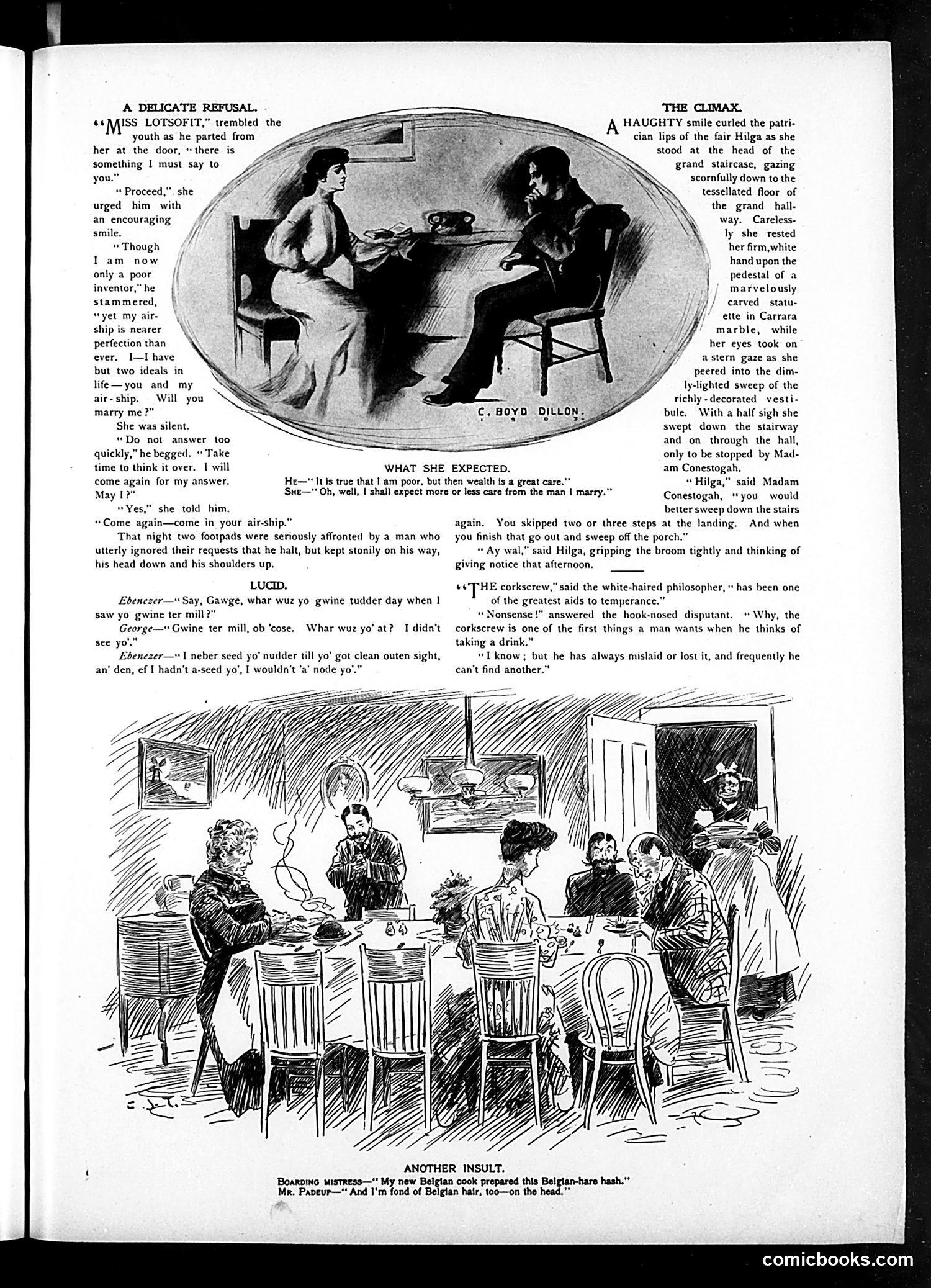
This page contains two distinct pieces from *Judge* magazine: **Top section ("A Delicate Refusal"):** A romantic narrative where Miss Lotsofit refuses a poor inventor's marriage proposal, insisting wealth matters. The inventor argues he has "two ideals in life—you and my air-ship," but she demands financial security. The satire mocks both materialistic women and impractical inventors of the era. **Bottom section ("Another Insult"):** A dinner scene where a boarding mistress proudly serves "Belgian-hare hash," while Mr. Parsup responds he's fond of "Belgian hair—on the head." This is a crude double-entendre joke about Belgian food/appearance, typical of period humor. The dialogue between Ebenezer and George above concerns similar working-class banter about wages and cleanliness. The page satirizes class pretensions, materialism, and features period-typical comedic vulgarity.
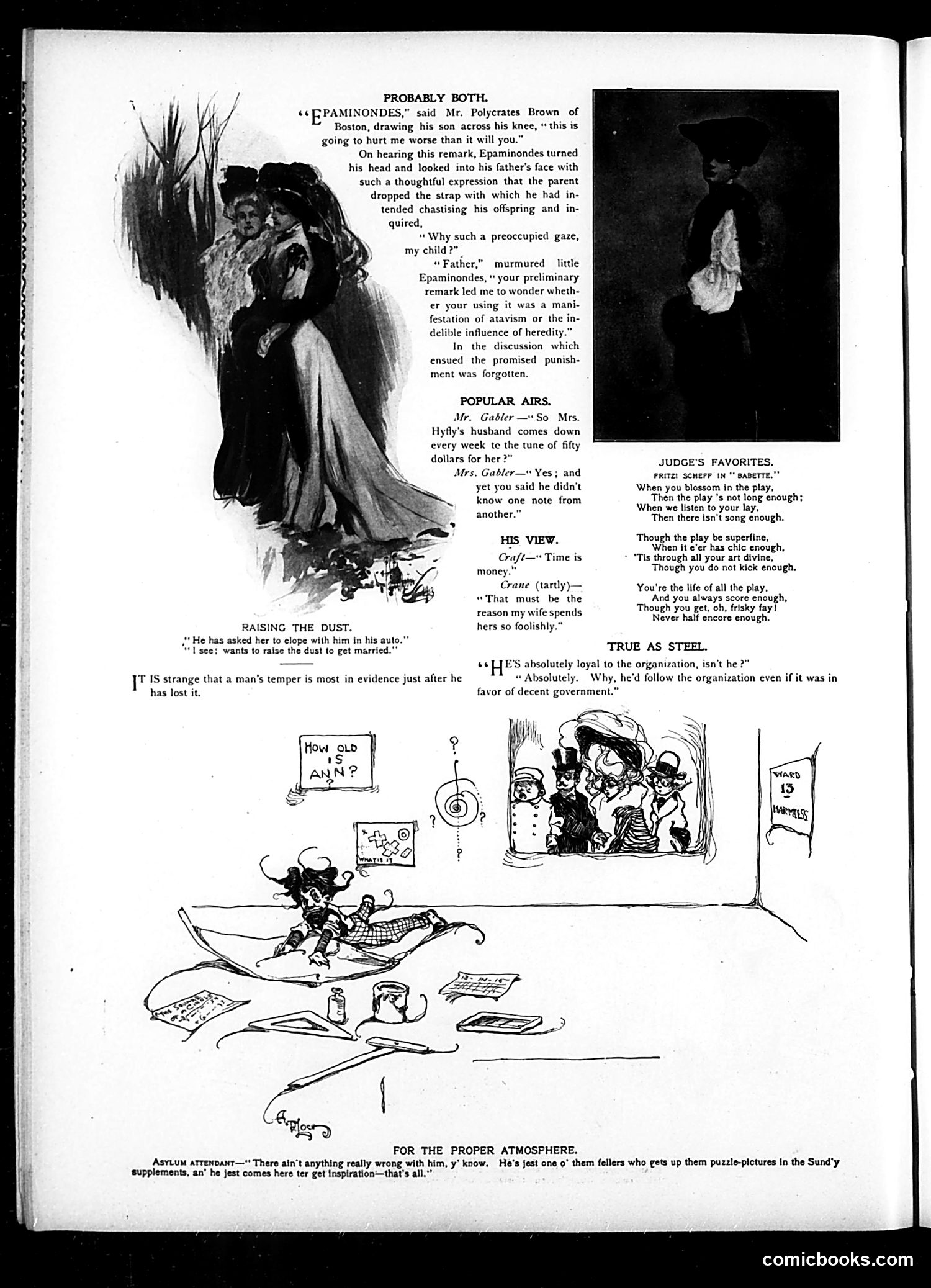
This page contains several humorous sketches and dialogues satirizing social behavior and domestic life. The main cartoon "Raising the Dust" depicts a woman wanting marriage to escape poverty, with a man's temper being most evident after losing money—commentary on class anxiety and marital discord among the working poor. The "Popular Airs" and "His View" sections mock the gap between romantic ideals and financial reality in marriage. "Judge's Favorites" appears to be theater criticism. The bottom cartoon "For the Proper Atmosphere" shows a cluttered room with puzzle-pictures, satirizing how people create artificial "inspirational" environments—likely mocking the period's self-improvement culture. The overall tone critiques superficiality in relationships and social pretension.
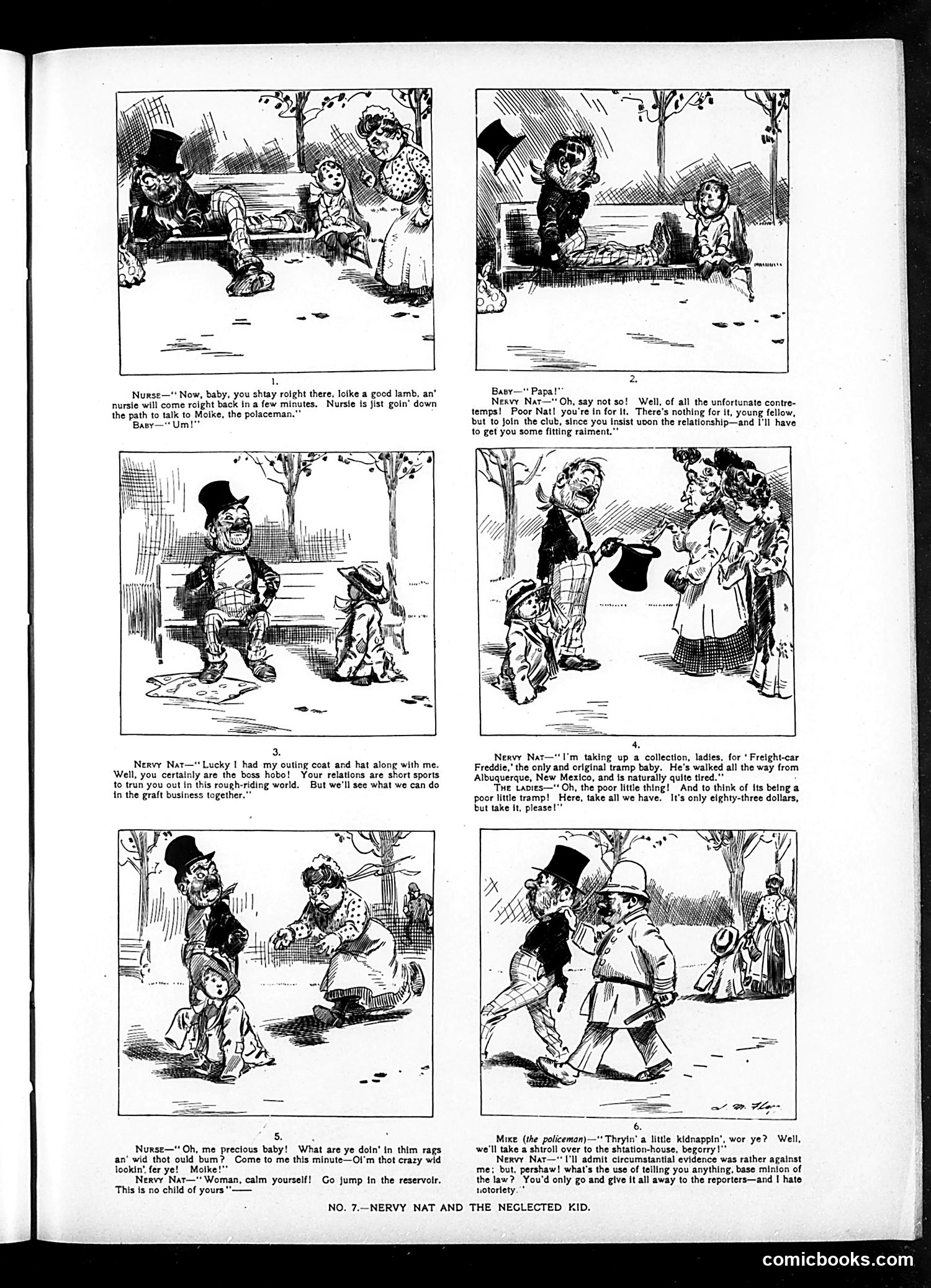
This comic strip satirizes a con artist ("Nervy Nat") who exploits public sentiment by posing as a vagrant with an abandoned child. The scheme unfolds across six panels: Nat encounters a neglected baby, adopts the child as a prop, and uses it to solicit charitable donations from sympathetic women ("eighty-three dollars"). The satire targets two things: wealthy ladies' gullibility and sentimentality toward the poor, and the prevalence of street scams in early 20th-century urban life. When the baby's actual nurse appears and a policeman arrives, Nat's con collapses—he's arrested for suspected kidnapping. The heavy dialect (Irish accents for nurse and police) reflects period stereotypes. The humor derives from exposing how easily public charity could be manipulated by clever fraudsters working the sympathies of the upper classes.
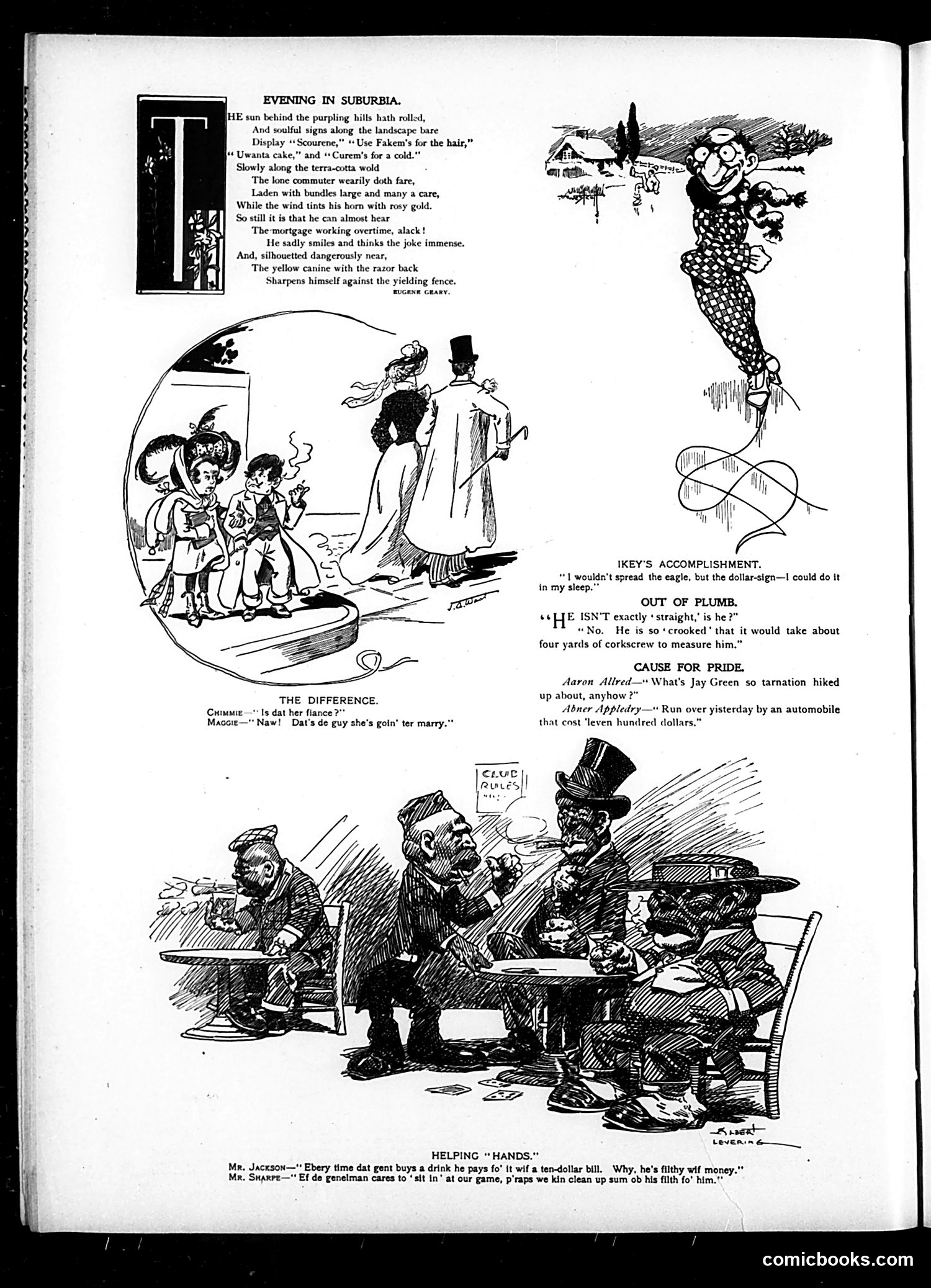
This page contains multiple satirical cartoons and humorous vignettes typical of early 20th-century American humor: **"Evening in Suburbia"** (top): A poetic lament about suburban commuter life—the exhausted worker burdened by mortgage debt and domestic responsibility, with a menacing dog as dark comic punctuation. **"The Difference"** (middle-left): A crude joke about marriage vs. courtship, using working-class dialect for comic effect. **"Out of Plumb"** and **"Cause for Pride"**: Short quips about dishonesty ("crooked") and automobile accidents (a new-technology mishap). **"Helping 'Hands'"** (bottom): Card-playing con artists spotting a wealthy drunk, planning to swindle him through poker. The dialectal speech ("fo'," "p'raps") marks them as working-class hustlers. The satire targets: suburban debt-burden anxiety, marital disillusionment, class stereotypes via dialect humor, and petty criminal opportunism. The tone is cynical, working-class-focused humor typical of Judge's editorial sensibility.
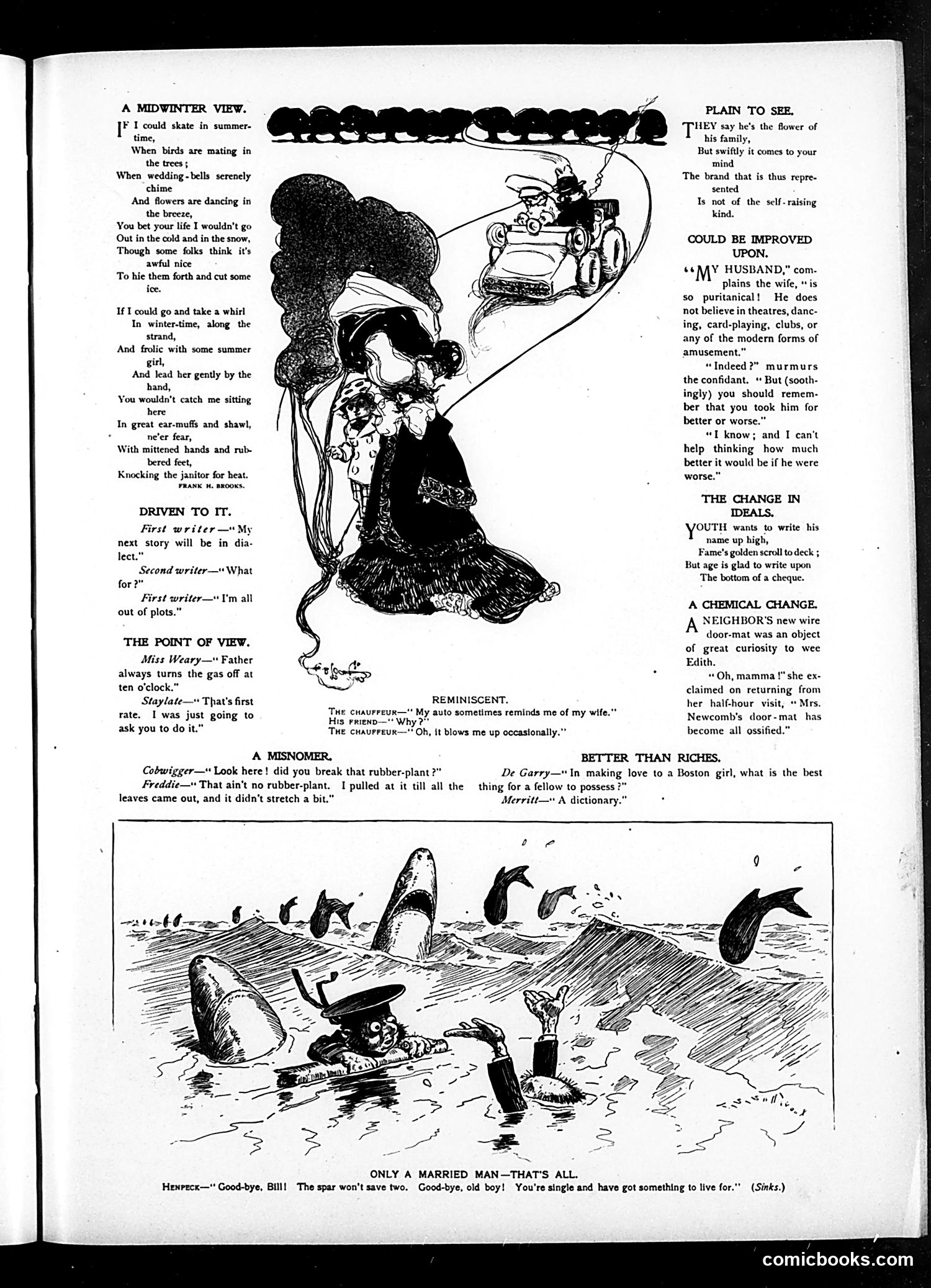
This page presents a collection of short humorous pieces typical of early 20th-century satirical magazines. The central cartoon depicts a chauffeur drowning while a married man abandons him, captioned "Only a Married Man—That's All." The dark joke suggests married men have "nothing to live for," reflecting contemporary cynicism about marriage. The surrounding text pieces mock various social conventions: a puritanical husband criticized for rejecting modern amusements; youth's ambitions versus age's reduced expectations (signing checks instead of fame); and a woman complaining her neighbor's new wire door-mat has "ossified" (become brittle/aged). Most pieces target middle-class anxieties—marital dissatisfaction, changing social values, domestic disappointments. The page uses brief dialogue and wordplay rather than political commentary, reflecting Judge's focus on lifestyle satire for affluent readers rather than broader social critique. The humor assumes readers recognize these domestic frustrations as universal.
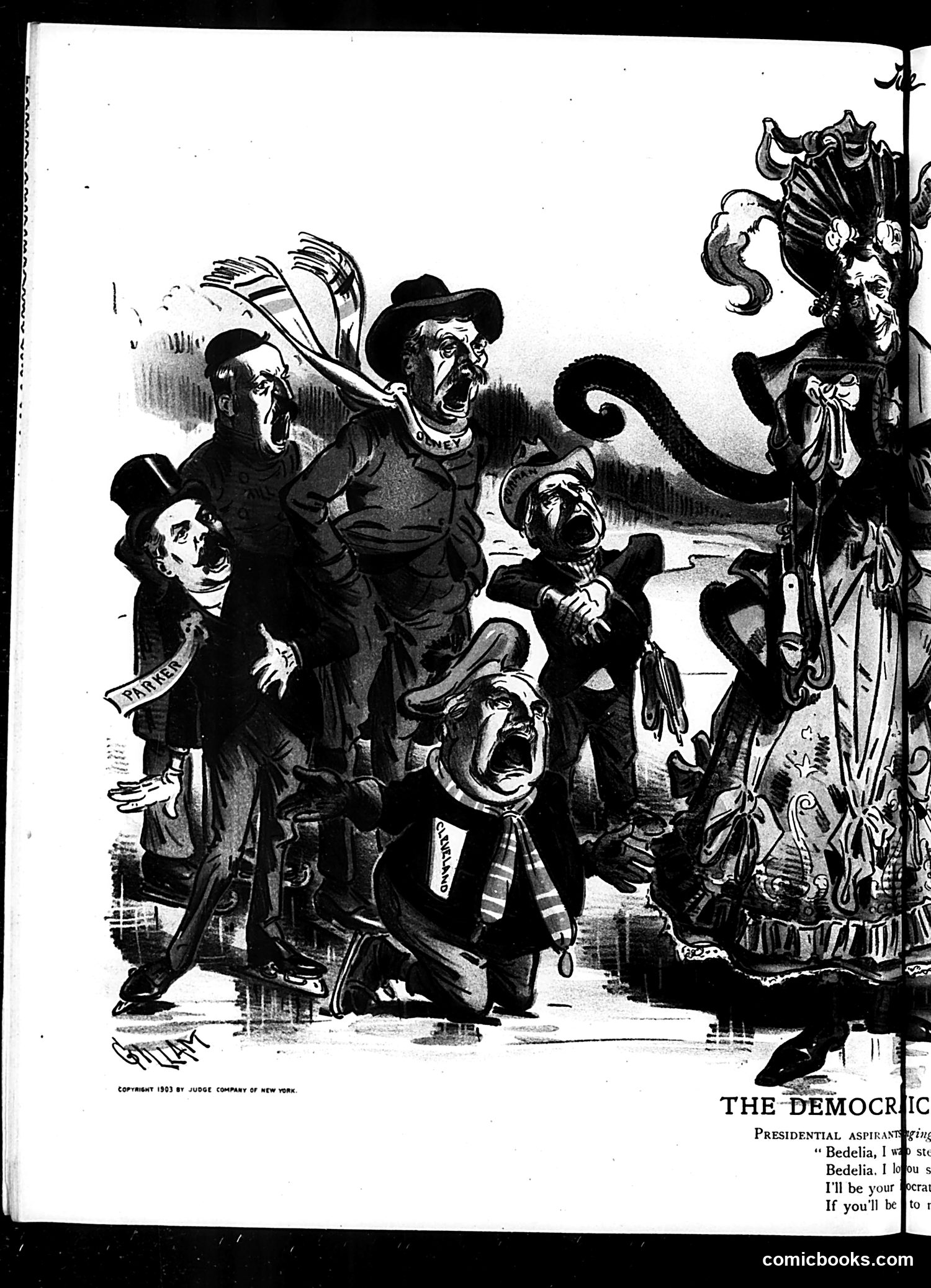
This is a satirical cartoon titled "The Democratic Presidential Aspirant," depicting multiple figures (likely Democratic politicians of the era) as desperate supplicants before a female allegorical figure representing "Bedelia" or possibly the Democratic Party itself. The cartoon mocks Democratic presidential hopefuls as scheming, disheveled men competing for favor through flattery and promises ("I'll be your secretary / If you'll be..."). The exaggerated caricatures and their supplicating poses suggest desperation and moral compromise. The OCR text appears incomplete, but the visible dialogue captures the satirical point: politicians making self-interested bargains rather than principled appeals. This reflects Judge magazine's typical conservative stance, ridiculing Democratic ambitions and internal party conflicts during a presidential election cycle (likely late 19th century, based on style). The allegorical female figure represents the party or electorate they must court.
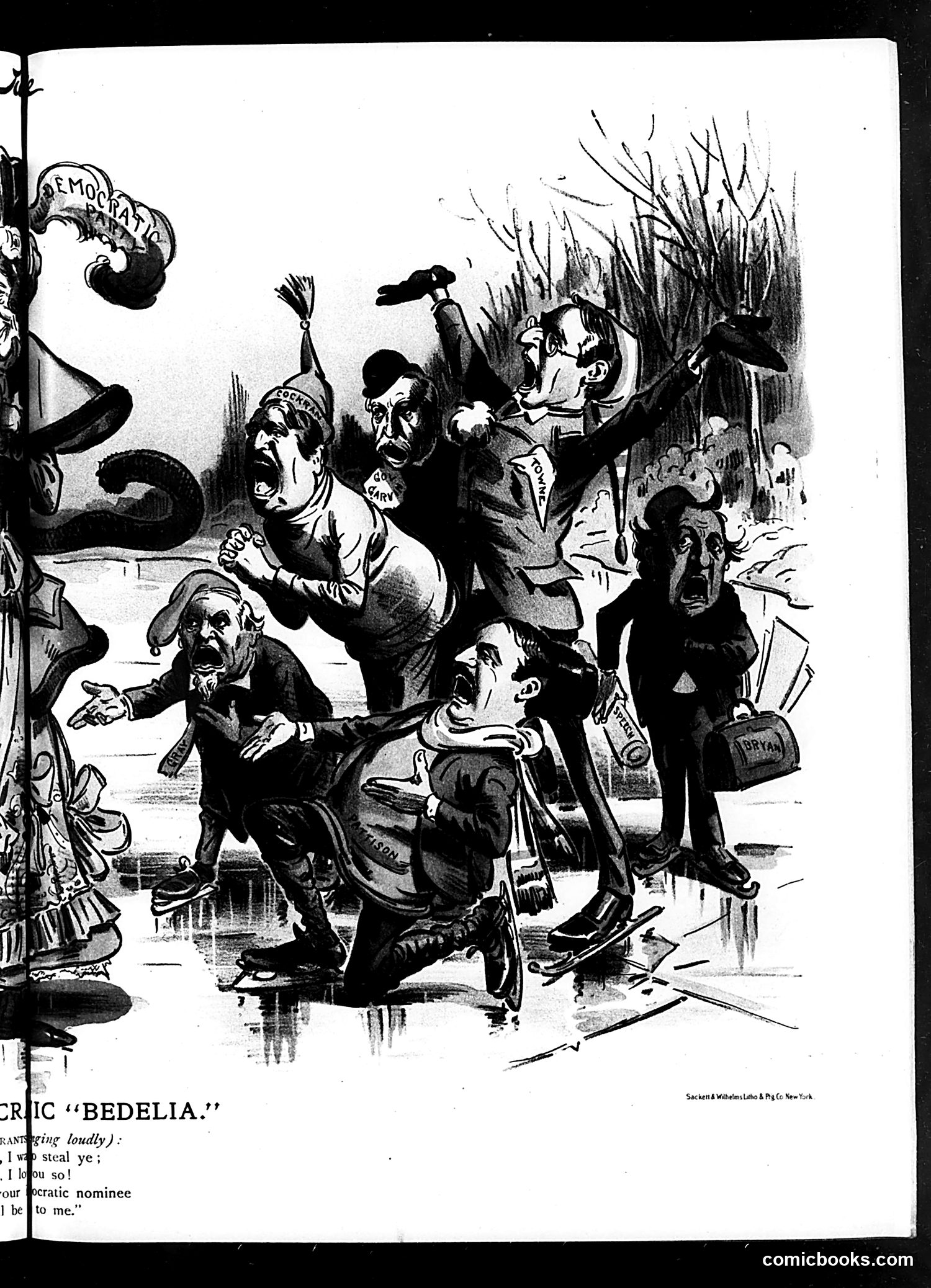
This appears to be a satirical cartoon titled "Bedelia" from Judge magazine, depicting a chaotic scene of distressed political figures. The crude caricatures and exaggerated expressions suggest mockery of Democratic political leadership. Based on the visible text mentioning "our Democratic nominee," this likely comments on a Democratic presidential election. The figures appear to be scrambling or in panic, possibly satirizing internal party conflict or a controversial candidate selection. The ornate imagery on the left (possibly a state symbol or emblem) and the general tumultuous composition suggest commentary on political disorder or mismanagement during a specific election cycle, though without clearer OCR text or visible dates, the exact historical moment remains unclear.
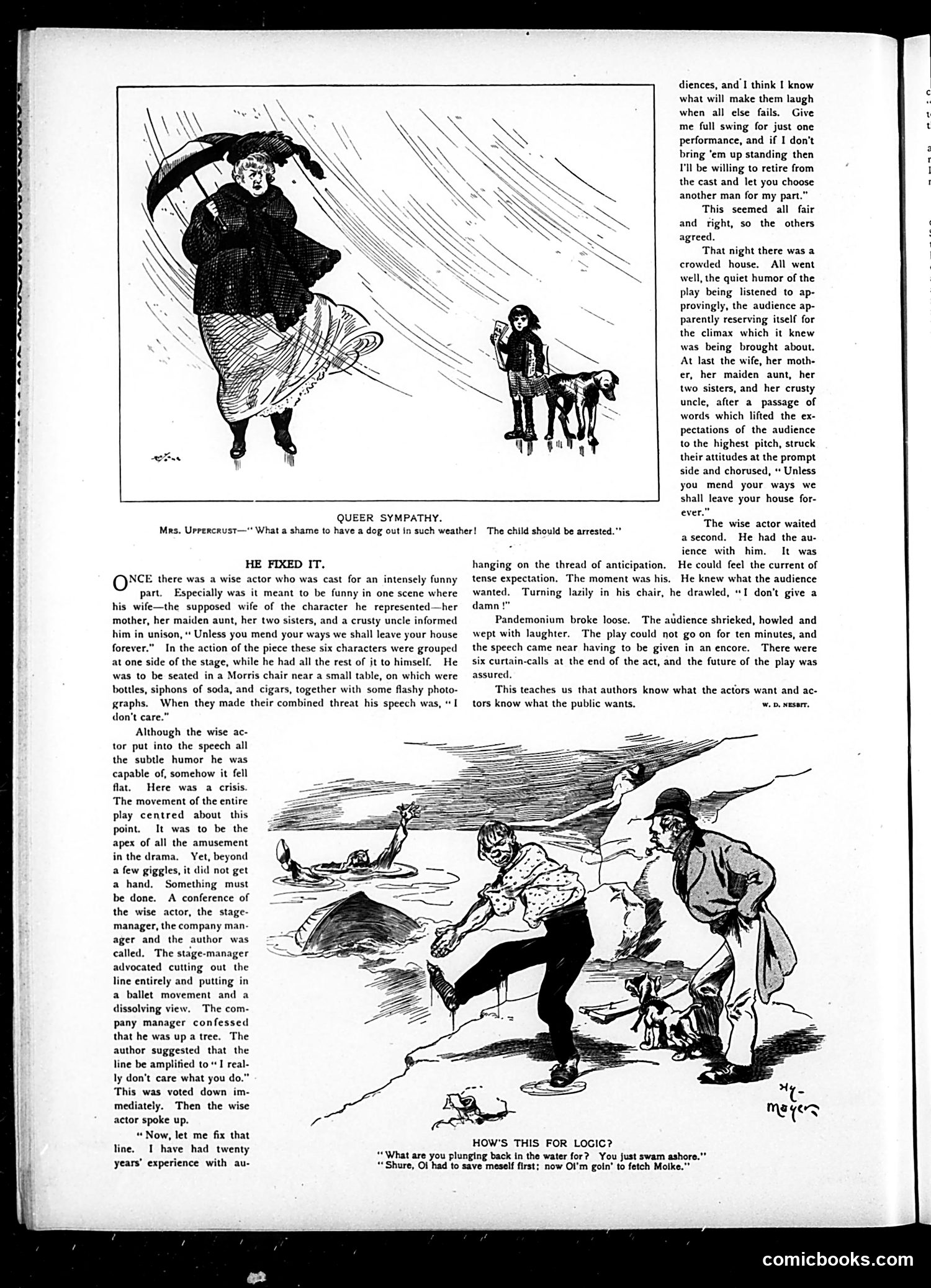
This page contains two separate pieces: **"Queer Sympathy"** (top cartoon): A wealthy woman criticizes a poor child for being outside in bad weather with a dog, while she herself sits comfortably sheltered. The satire mocks hypocritical concern—the woman lacks genuine sympathy, only performative outrage. **"He Fixed It"** (main story): A theater anecdote about an experienced actor who saves a failing comedy scene. Where others suggest cutting the line or elaborate stage tricks, he solves it by simply swearing—saying "I don't give a damn!" instead of "I don't care." The audience erupts. The moral: seasoned professionals understand what audiences actually want, better than authors or managers do. **"How's This for Logic?"** (bottom cartoon): An Irishman (indicated by dialect spelling "Shure," "Oi," "Moike") who swam ashore decides to go back into the water to rescue his friend. The humor comes from the illogical reasoning—he had to save himself first, *then* rescue another. All three pieces are lighthearted humor about human nature and social observation.
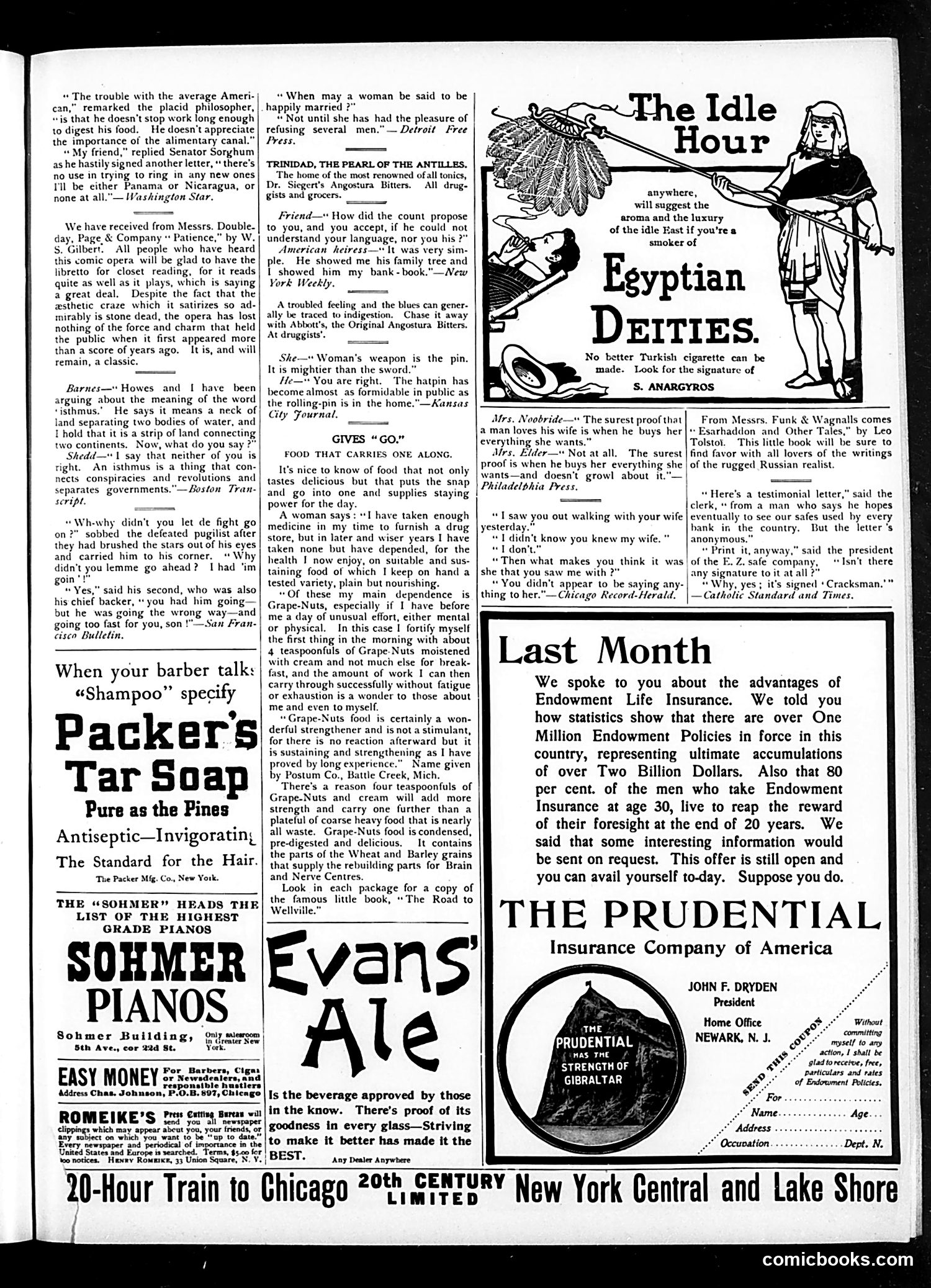
This page is primarily **advertising with satirical commentary**, typical of Judge magazine's format. **The cartoon element** is minimal—mainly illustrations accompanying ads (Egyptian cigarettes with a lounging figure, Sohmer pianos). **The satire** consists of brief joke columns mocking contemporary issues: - A senator dismissively equates philosophical discussion with geopolitical concerns (Panama/Nicaragua), suggesting political distraction from substantive matters - A joke about "isthmus" as political metaphor—connecting conspiracies while separating governments—critiques government dysfunction - A pugilist joke plays on a fighter losing while "going the wrong way," likely satirizing failed strategy or direction **Social references** include: - An "American heiress" marrying for status while showing her wealth (bank book), mocking transatlantic marriages and materialism - Women's "weapons" (hatpins, rolling pins), referencing anxieties about women's public assertiveness in the early 20th century - Endorsement product advertisements dominating the space The page reflects Judge's typical blend of light satire targeting politics, gender relations, and consumerism aimed at educated, affluent readers.
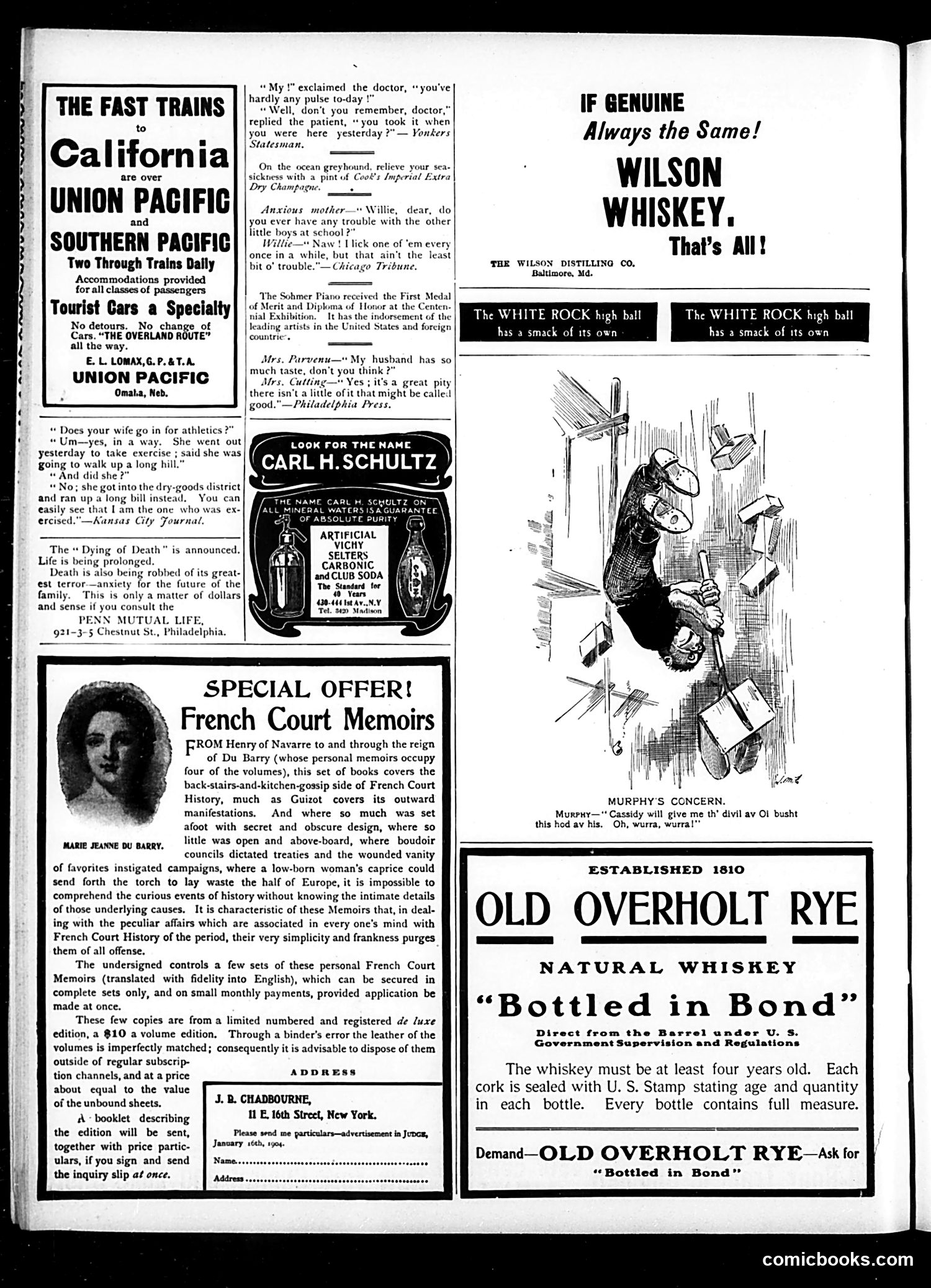
This page contains several brief satirical jokes and advertisements typical of early 20th-century Judge magazine: **The cartoons mock everyday absurdities:** A doctor joke plays on forgetfulness; a joke about a wife's "exercise" puns on spending money instead of exercising; Mrs. Parvenu is mocked for her husband's excessive "taste"; and "Murphy's Concern" (likely an Irish immigrant character, suggested by the dialect) fears his boss's anger over a broken hod (a construction tool). **The main cartoon illustration** shows a figure falling amid papers and debris—likely depicting workplace chaos or accident, though specifics are unclear from the visible text. **Advertising dominates the page:** promoting trains, whiskey brands (Wilson, Old Overholt Rye, White Rock), Carl H. Schultz mineral waters, French Court Memoirs, and insurance. The ads reflect 1910s consumer culture and leisure travel. The humor relies on class observations and light domestic/workplace comedy rather than political commentary. The overall tone is genteel satire for a middle-class readership.
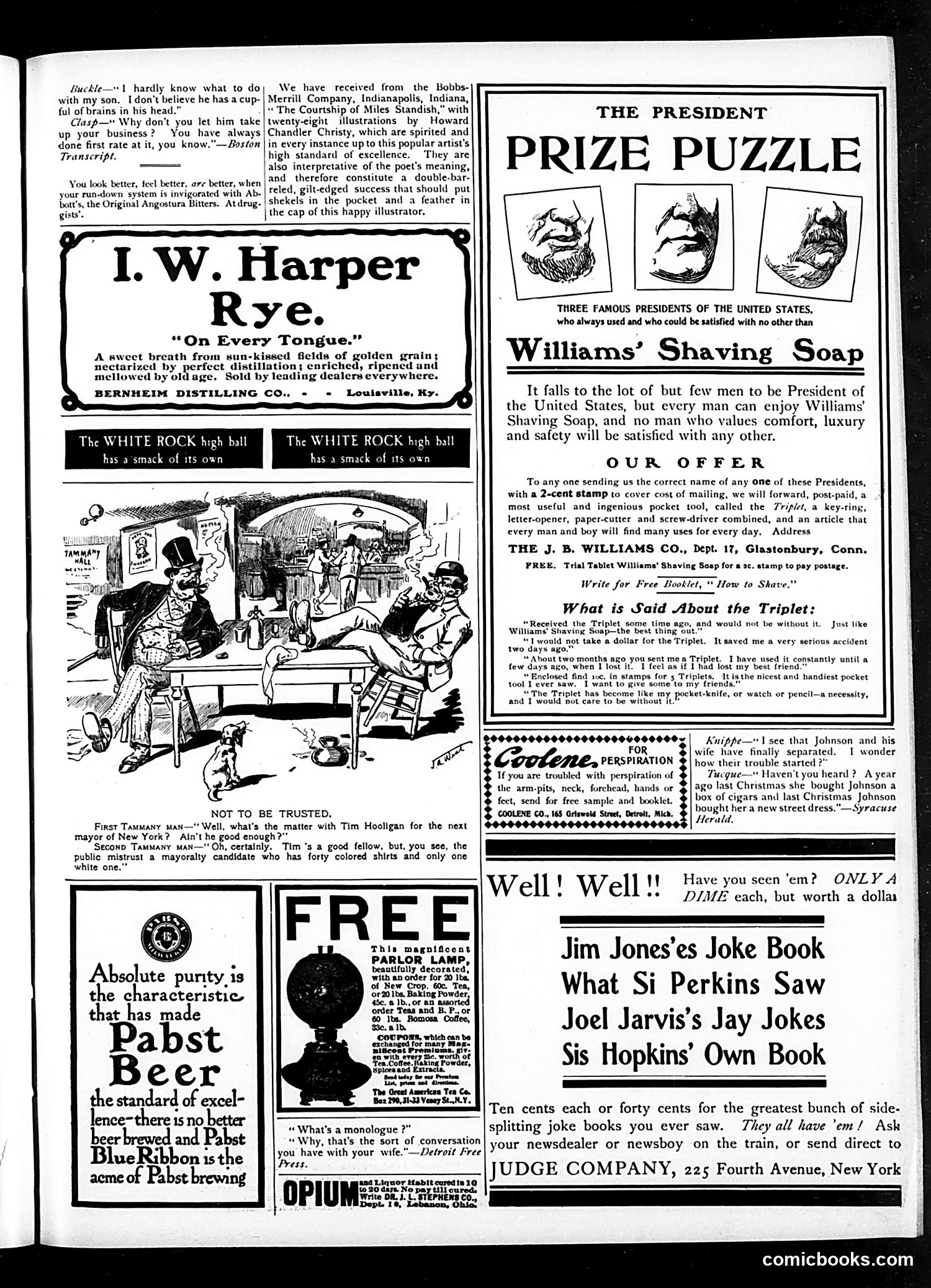
This page from *Judge* magazine contains primarily **advertisements and comic filler** rather than substantial political satire. The main item is "The President Prize Puzzle"—a Williams' Shaving Soap advertisement featuring three sketched beards, inviting readers to identify which U.S. Presidents used the product. This is a marketing gimmick, not satire. Below appears a brief Tammany Hall joke about a mayoral candidate named "Tim Hooligan" who is rejected despite being "a good fellow" because the public distrusts him for owning forty colored shirts but only one white one. This satirizes **Tammany Hall corruption** and suggests visual appearance/propriety concerns among New York's political machine. Other content includes period advertisements (I.W. Harper Rye, Pabst Beer, Opium patent medicine) and joke books for sale. The page lacks substantive political cartooning or commentary. Its humor is mild and commercial rather than incisive.
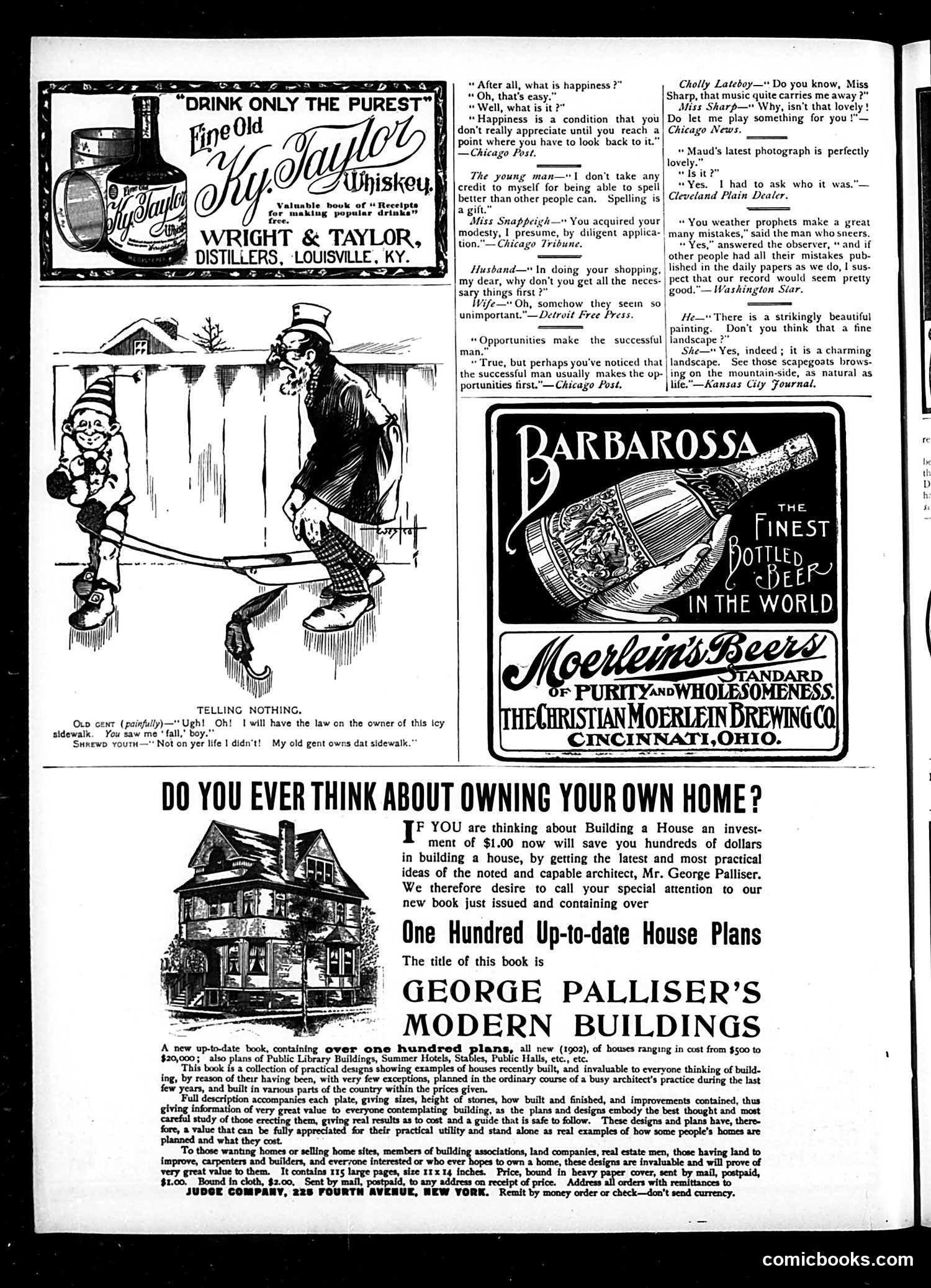
This is primarily an **advertising and humor page** from Judge magazine (circa 1902, based on the Palliser architecture book date). The page contains several short **humorous quips** about marriage, vanity, and social awkwardness—typical Judge fare. Notable examples: a wife ignoring practical shopping needs, a man taking undue credit for spelling ability, and a woman misidentifying landscape features in a painting (calling goats "scapegoats"). The **main cartoon** shows an old man and boy on an icy sidewalk: the boy has fallen, and the old man refuses to take legal responsibility, claiming his elderly friend owns the property—a joke about liability and witness evasion. The large advertisement is for **George Palliser's Modern Buildings** (house plans), Wright & Taylor whiskey, and Moerlein brewery beer. These ads reflect early 1900s consumer culture. The content is broadly **satirical of everyday social pretension and domestic life**, not politically topical. It's humor for middle-class readers about recognizable social situations.
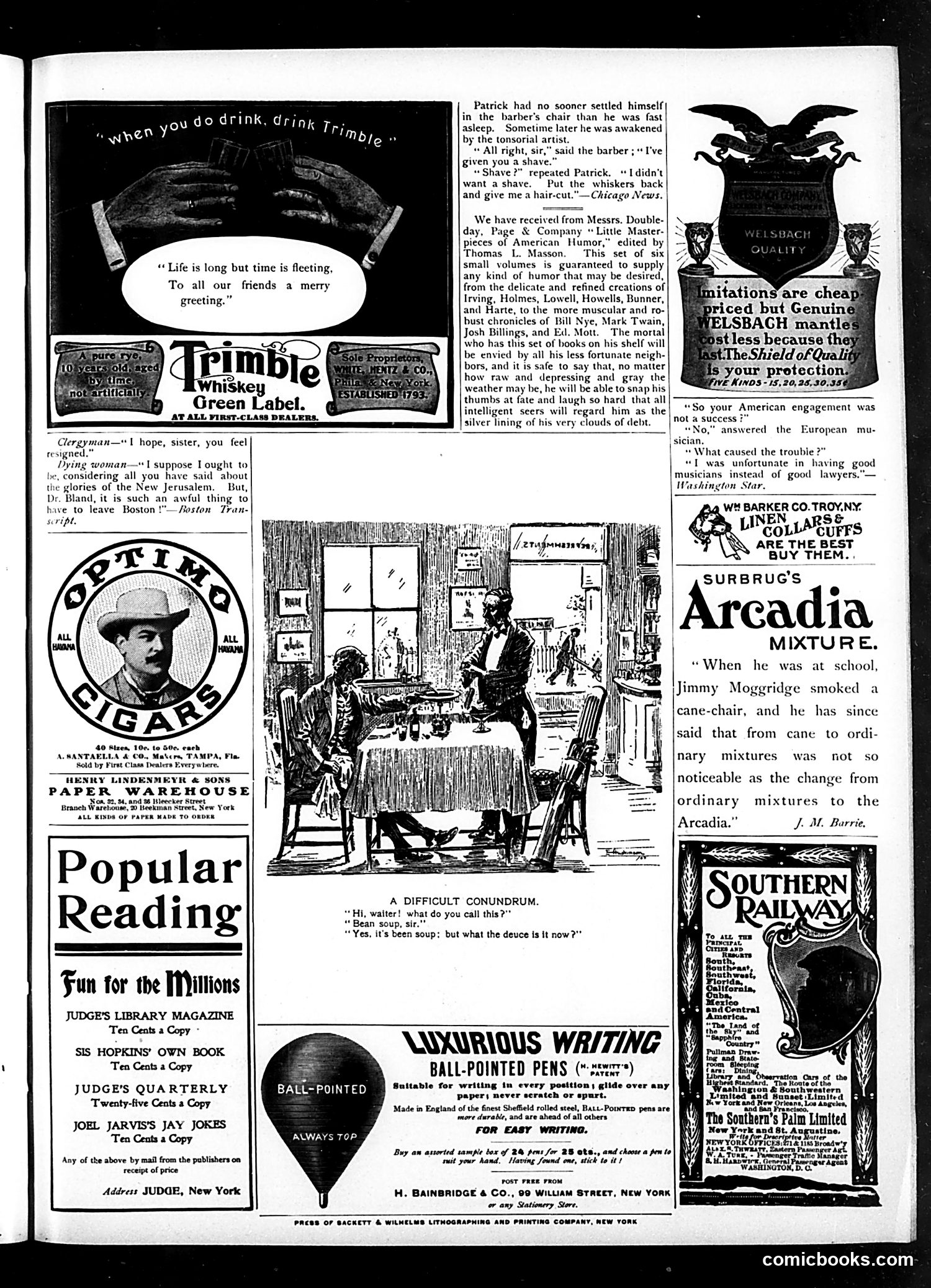
This page contains a single cartoon joke titled "A Difficult Conundrum." The humor depends on a play on the word "soup." A waiter serves a customer bean soup. The customer asks, "What do you call this?" The waiter replies, "Bean soup, sir." The customer then responds, "Yes, it's been soup; but what the deuce is it now?" The joke mocks the soup's poor quality or unappetizing appearance by suggesting it has deteriorated or transformed into something unrecognizable—no longer identifiable as actual soup. It's a jab at restaurant food quality, implying the dish looks so unpleasant that calling it "soup" at all is questionable. The pun on "been/bean" adds wordplay to the basic insult about the food's condition.
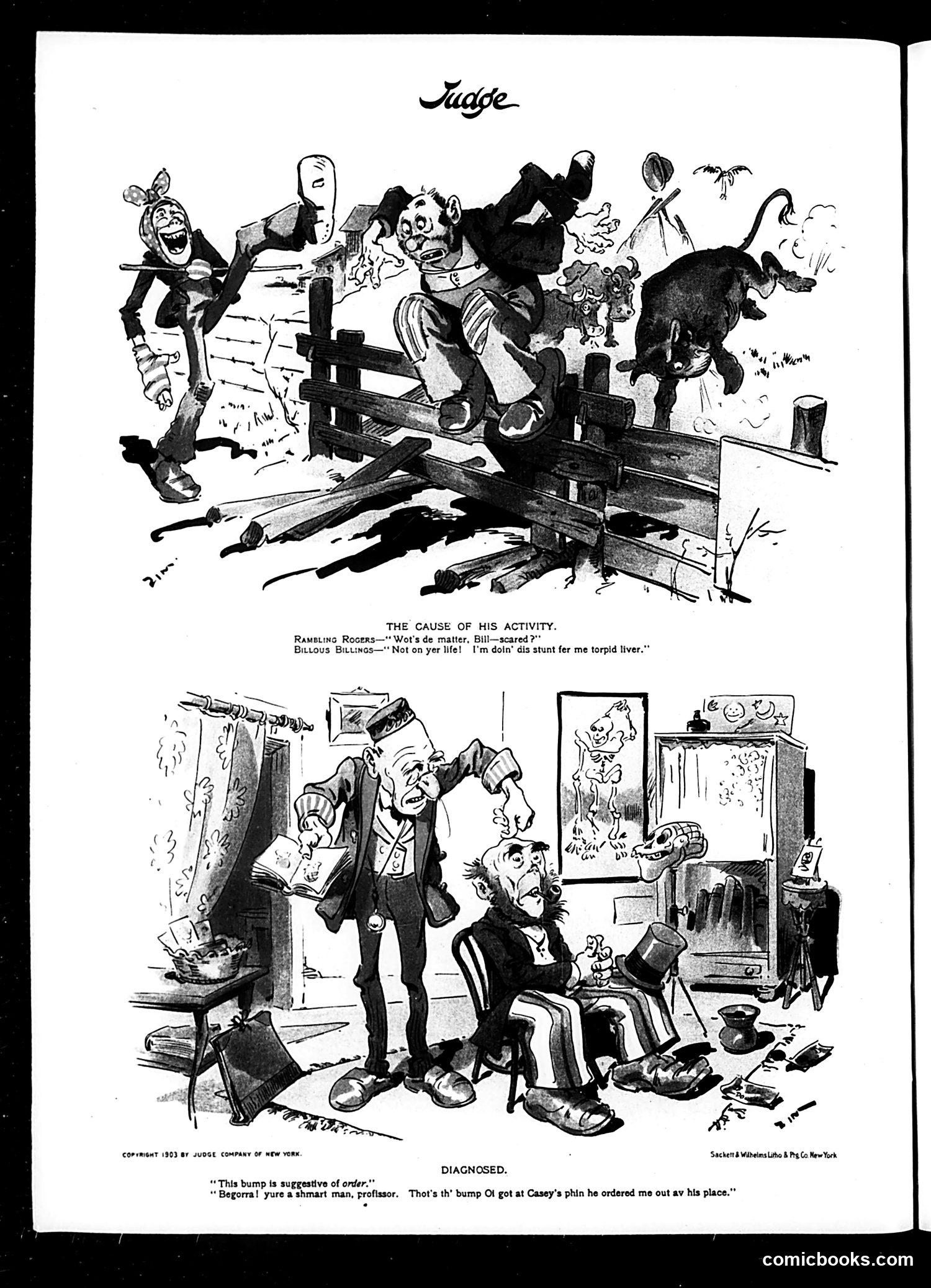
This page contains two separate satirical cartoons mocking Irish immigrants and pseudo-scientific phrenology. **Top cartoon ("The Cause of His Activity"):** Features caricatured Irish characters ("Rambling Rogers" and "Billous Billings") engaged in reckless behavior. The joke plays on the stereotype that Irish men are naturally rowdy and prone to fighting—one character claims his wild antics are a "stunt" to cure his "torpid liver," suggesting comic excuse-making. **Bottom cartoon ("Diagnosed"):** A phrenologist examines an Irish man's head, claiming a "bump" indicates orderliness. The patient reveals the bump actually came from being physically thrown out of Casey's establishment. The satire mocks both the pseudoscience of phrenology (reading character from head shape) and Irish working-class experiences of discrimination and violence. Both reinforce negative ethnic stereotypes common in early 1900s American humor.