
Judge, 1904-01-16 · page 10 of 16
Judge — January 16, 1904 — page 10: what you’re looking at
What you’re looking at
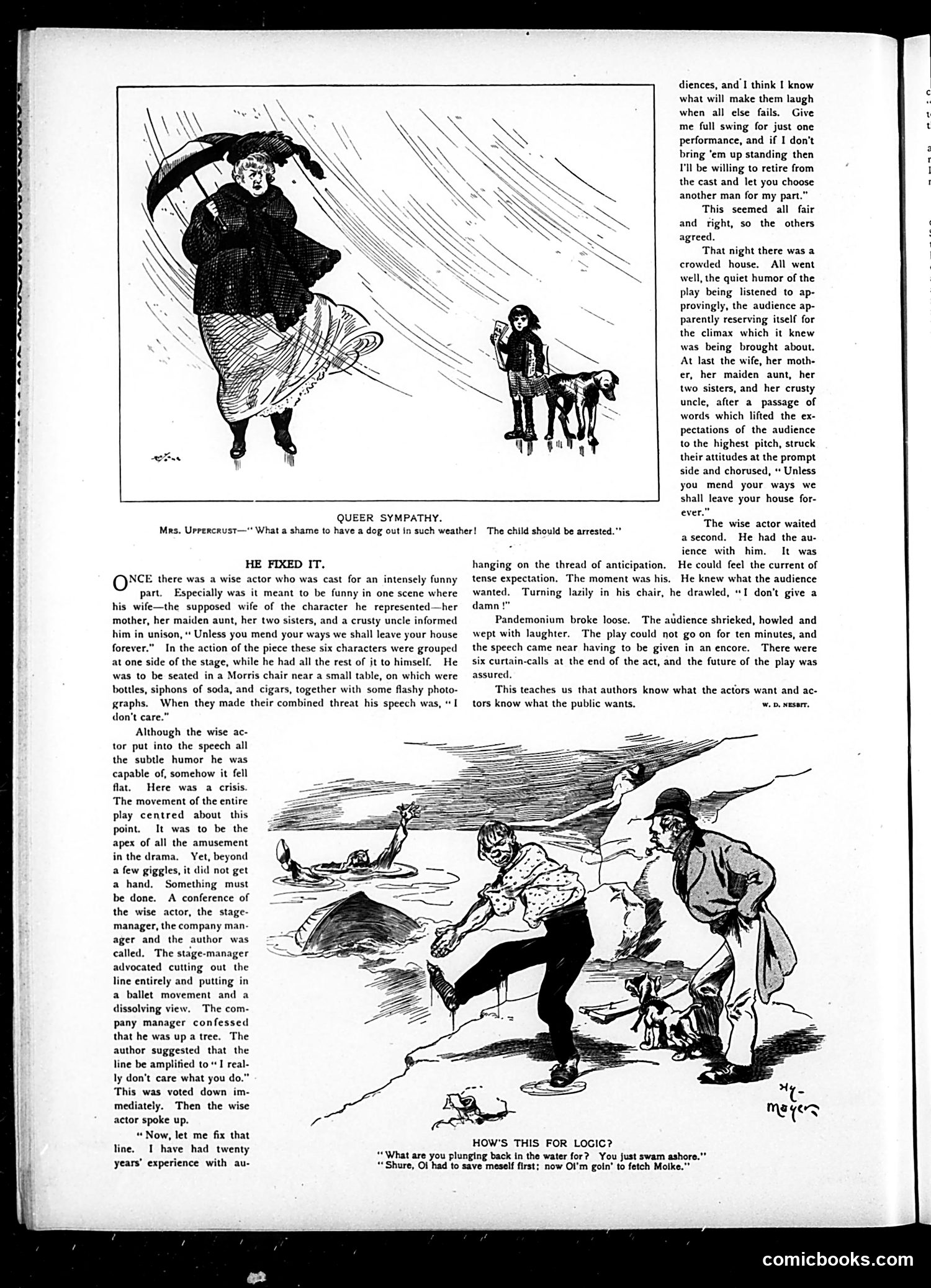
This page contains two separate pieces: **"Queer Sympathy"** (top cartoon): A wealthy woman criticizes a poor child for being outside in bad weather with a dog, while she herself sits comfortably sheltered. The satire mocks hypocritical concern—the woman lacks genuine sympathy, only performative outrage. **"He Fixed It"** (main story): A theater anecdote about an experienced actor who saves a failing comedy scene. Where others suggest cutting the line or elaborate stage tricks, he solves it by simply swearing—saying "I don't give a damn!" instead of "I don't care." The audience erupts. The moral: seasoned professionals understand what audiences actually want, better than authors or managers do. **"How's This for Logic?"** (bottom cartoon): An Irishman (indicated by dialect spelling "Shure," "Oi," "Moike") who swam ashore decides to go back into the water to rescue his friend. The humor comes from the illogical reasoning—he had to save himself first, *then* rescue another. All three pieces are lighthearted humor about human nature and social observation.
📄 Transcribed text from this page (OCR, searchable)
Machine-transcribed from the original scan — historical spelling and the odd misread are preserved.
diences, and'I think I know what will make them laugh when all else fails. Give me full swing for just one performance, and if I don't bring ‘em up standing then I'll be willing to retire from the cast and let you choose another man for my part.” This seemed all fair and right, so the others agreed. That night there was a crowded house. All went well, the quiet humor of the play being listened to ap- provingly, the audience ap- parently reserving itself for the climax which it knew was being brought about. At last the wife, her moth- er, her maiden aunt, her two sisters, and her crusty uncle, after a passage of words which lifted the ex- pectations of the audience to the highest pitch, struck their attitudes at the prompt side and chorused, “ Unless you mend your ways we QUEER SYMPATHY. Mrs. Urrercrust— What a shame to have a dog out in such weather! HE FIXED IT. NCE there was a wise actor who was cast for an intensely funny part. Especially was it meant to be funny in one scene where his wife—the supposed wife of the character he represented—her mother, her maiden aunt, her two sisters, and a crusty uncle informed him in unison, * Unless you mend your ways we shall leave your house forever.” In the action of the piece these six characters were grouped at one side of the stage, while he had all the rest of jt to himself. He was to be seated in a Morris chair near a small table, on which were bottles, siphons of soda, and cigars, together with some flashy photo- graphs. When they made their combined threat his speech was, “I don’t care.” Although the wise ac- tor put into the speech all the subtle humor he was capable of, somehow it fell flat. Here was a crisis. The movement of the entire play centred about this point. It was to be the apex of all the amusement in the drama. Yet, beyond a few giggles, it did not get a hand. Something must be done. A conference of the wise actor, the stage- manager, the company man- ager and the author was called, The stage-manager advocated cutting out the line entirely and putting in a ballet movement and a dissolving view. The com- pany manager confessed that he was up a tree. The author suggested that the line be amplitied to “I real ly don't care what you do. This was voted down im- mediately. Then the wise actor spoke up. “ Now, let me fix that line. 1 have had twenty years’ experience with au- shall leave your house for- ever.” The wise actor waited asecond. He had the au- jience with him. It was hanging on the thread of anticipation. He could feel the current of tense expectation, The moment was his. He knew what the audience wanted. Turning lazily in his chair, he drawled, “I don't give a damn !" Pandemonium broke loose. The audience shrieked, howled and wept with laughter. The play could not go on for ten minutes, and the speech came near having to be given in an encore. There were six curtain-calls at the end of the act, and the future of the play was assured. The child should be arrested.”* This teaches us that authors know what the actors want and ac- tors know what the public wants. we, D, wasarr, HOW'S THIS FOR LOGIC? ‘What are you plunging back in the water for? You just swam ashore.’ “Shure, Oi had to save meself first; now Ol'm goin’ to fetch Moike.”* comicbooks.com