
A complete issue · 17 pages · 1903
Judge — August 29, 1903
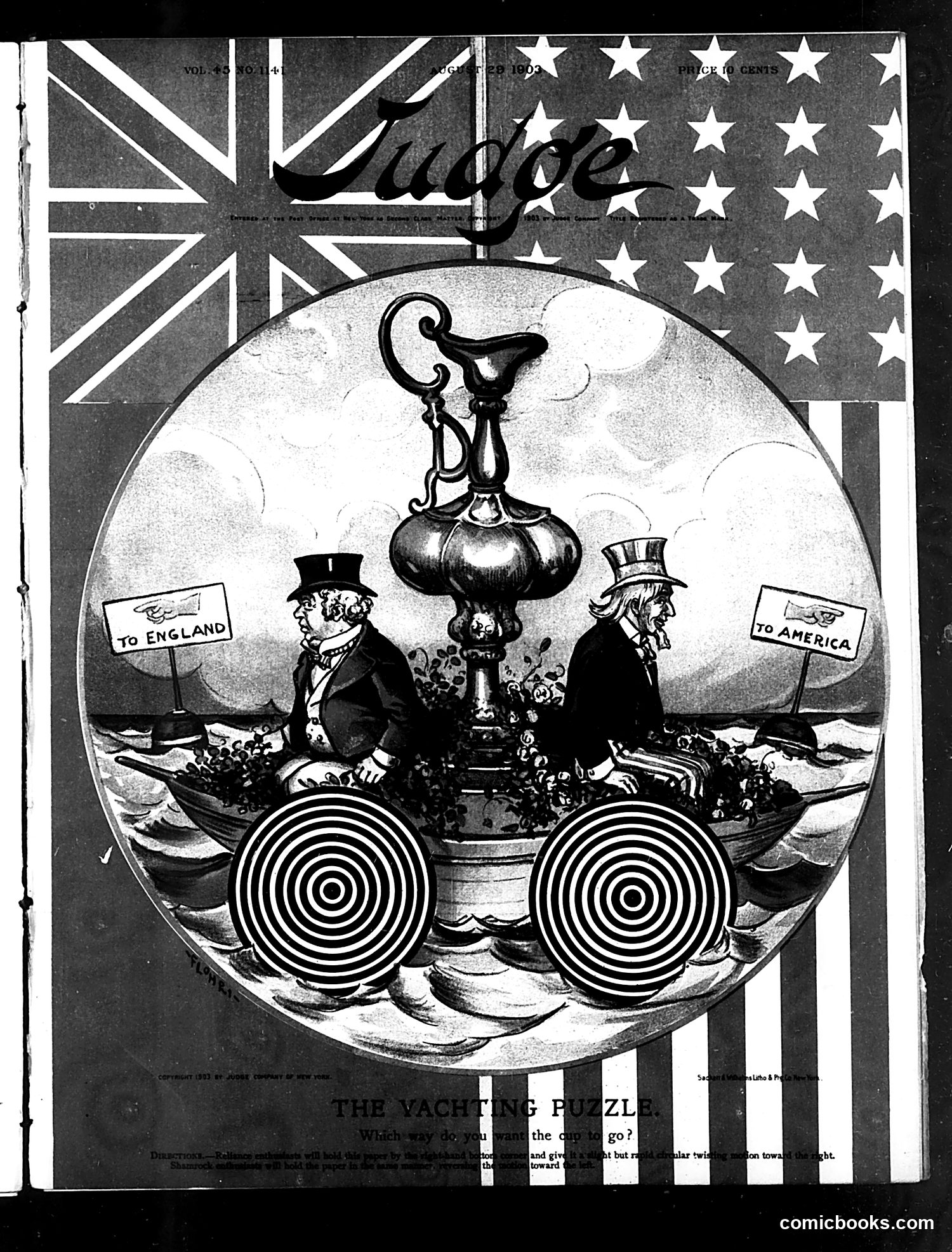
This political cartoon from Judge magazine satirizes Anglo-American relations through a sailing metaphor. Two gentlemen—likely representing Britain (left, marked "To England") and America (right, marked "To America")—stand beside a large decorative trophy or urn, presumably depicting the America's Cup yacht race. The caption asks "Which way do you want the cup to go?" The spinning circular targets beneath them suggest confusion or competing interests. The overlaid Union Jack and American flags reinforce the nations' rivalry. The puzzle presents their competing claims to the trophy as an unresolved diplomatic question, humorously portraying the famous international yacht racing competition as a matter of national pride and international tension requiring political negotiation rather than mere sporting competition.
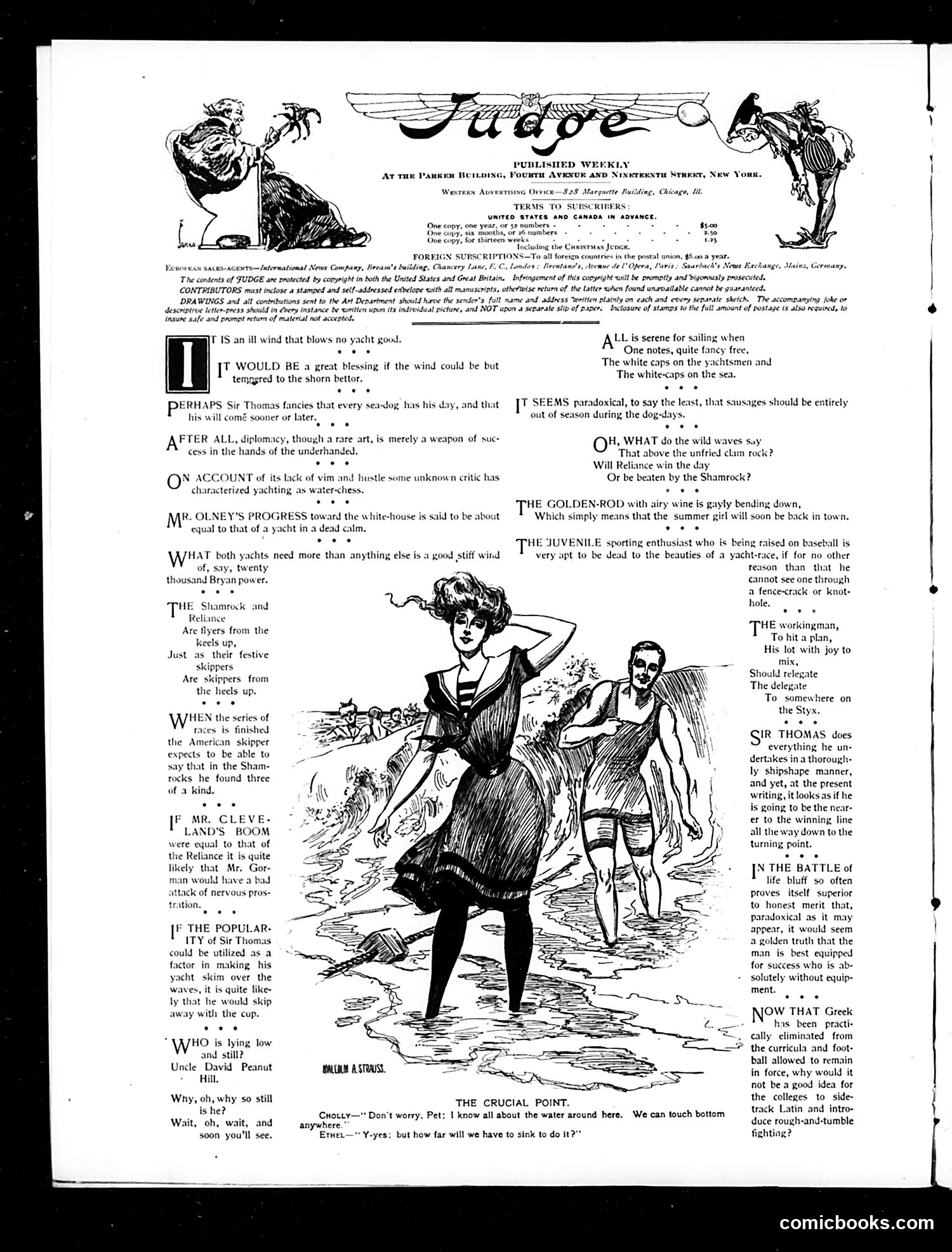
This page from Judge magazine (published weekly in New York) combines satirical verse with a central illustration titled "The Crucial Point." The cartoon depicts a woman and child at the beach, with the caption showing them discussing water depth—a domestic beach safety scene with mild humor. The surrounding text consists of various satirical poems and observations on contemporary topics, including references to Sir Thomas Lipton (appearing multiple times), the America's Cup yacht racing competition, wind conditions, and political figures like Mr. Cleveland and Mr. Olney. The commentary appears to mock various public figures and current events through verse rather than visual caricature. Without clearer context on specific dates and figures, the precise political references remain partially unclear to modern readers.
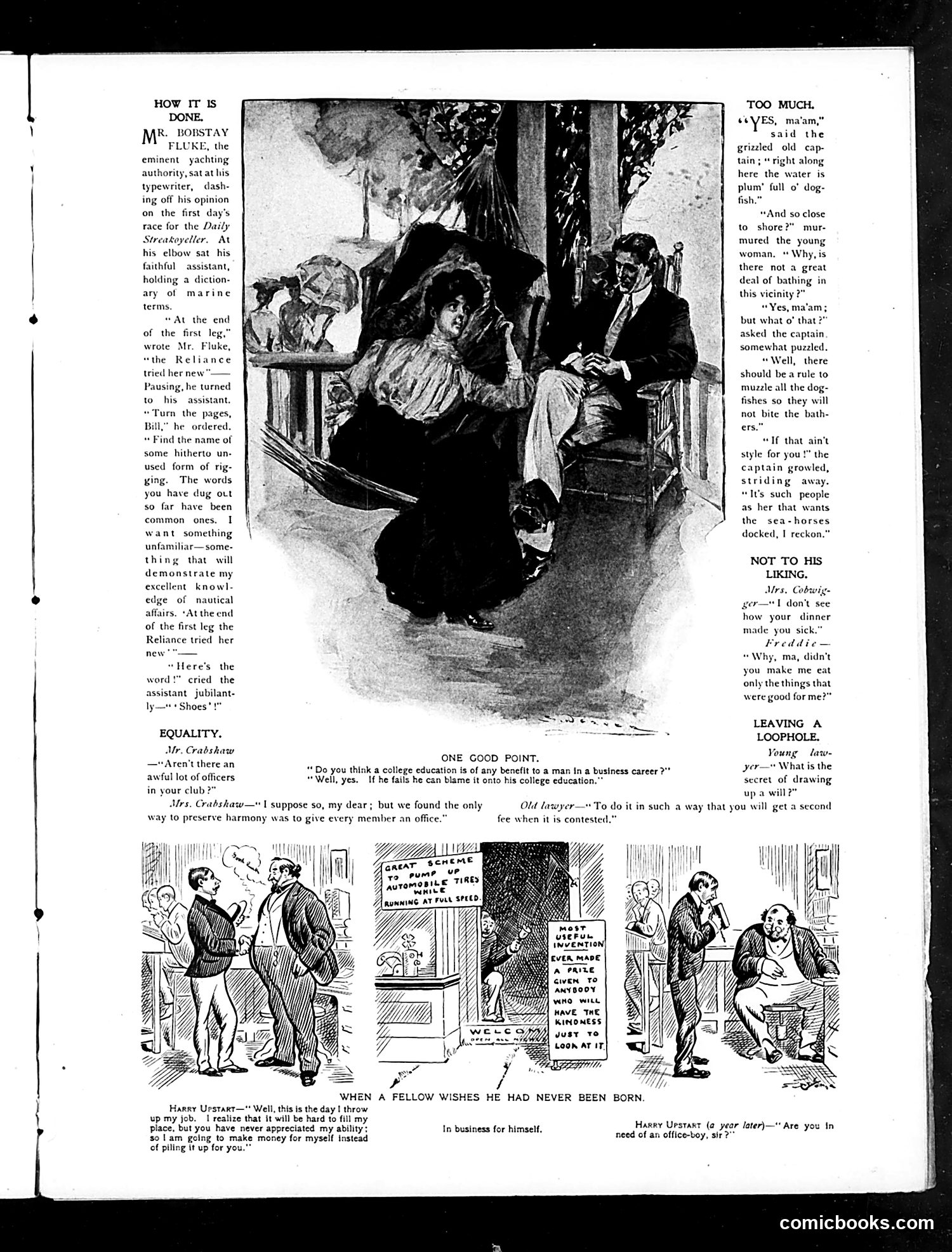
This page contains several satirical vignettes about workplace and social hierarchies in early 20th-century America. The main cartoon "WHEN A FELLOW WISHES HE HAD NEVER BEEN BORN" depicts Harry Upstart, a young businessman, experiencing regret after being told by his superior that despite his work, he lacks "ability" and won't advance. The satire targets the frustration of ambitious employees facing arbitrary gatekeeping by management. Other sections mock workplace dynamics: "EQUALITY" jokes about giving every employee an office; "NOT TO HIS LIKING" shows a servant complaining about dinner; "LEAVING A LOOPHOLE" references education's false promises of advancement. The humor relies on class-based social commentary typical of *Judge*'s era—critiquing both worker aspirations and employer indifference.
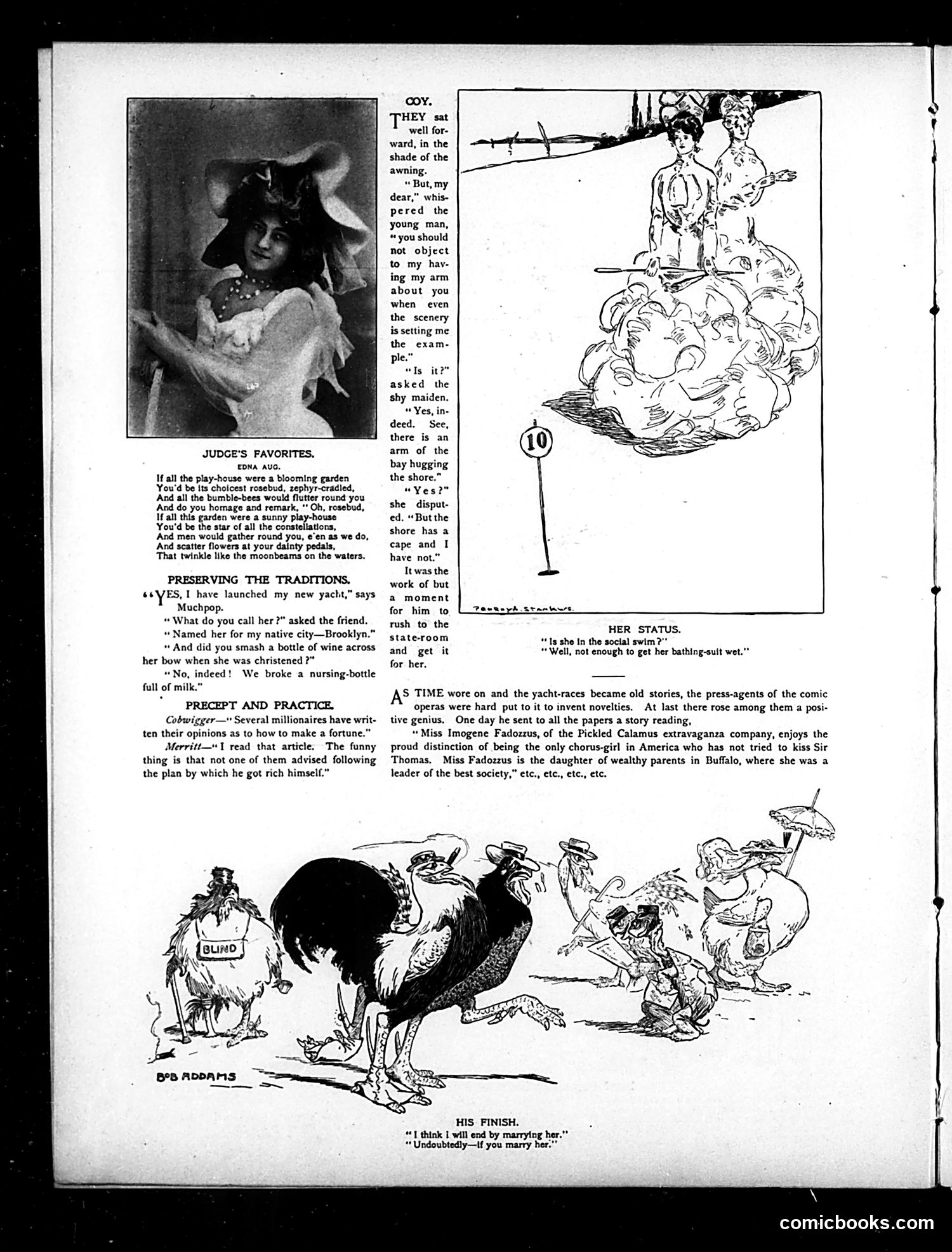
This page contains three distinct pieces of social satire from early 20th-century America: **"Judge's Favorites"** - A poem praising actress Edna Auge, romanticizing theater as a "blooming garden." **"Preserving the Traditions"** - A brief sketch mocking nouveau riche yacht owners. A man brags about his new yacht, revealing his ignorance by breaking a nursing bottle during the christening—satirizing vulgar wealth and lack of social refinement. **"Precept and Practice"** - A short dialogue between characters discussing getting rich, with commentary on following dubious financial advice. **"His Finish"** - A D.B. Adams cartoon depicting anthropomorphized birds/roosters in what appears to be a satirical scene about courtship or marriage, with the caption "I think I will end by marrying her" / "Undoubtedly—if you marry her." The cartoons mock social climbing, pretension, and courtship customs of the era.
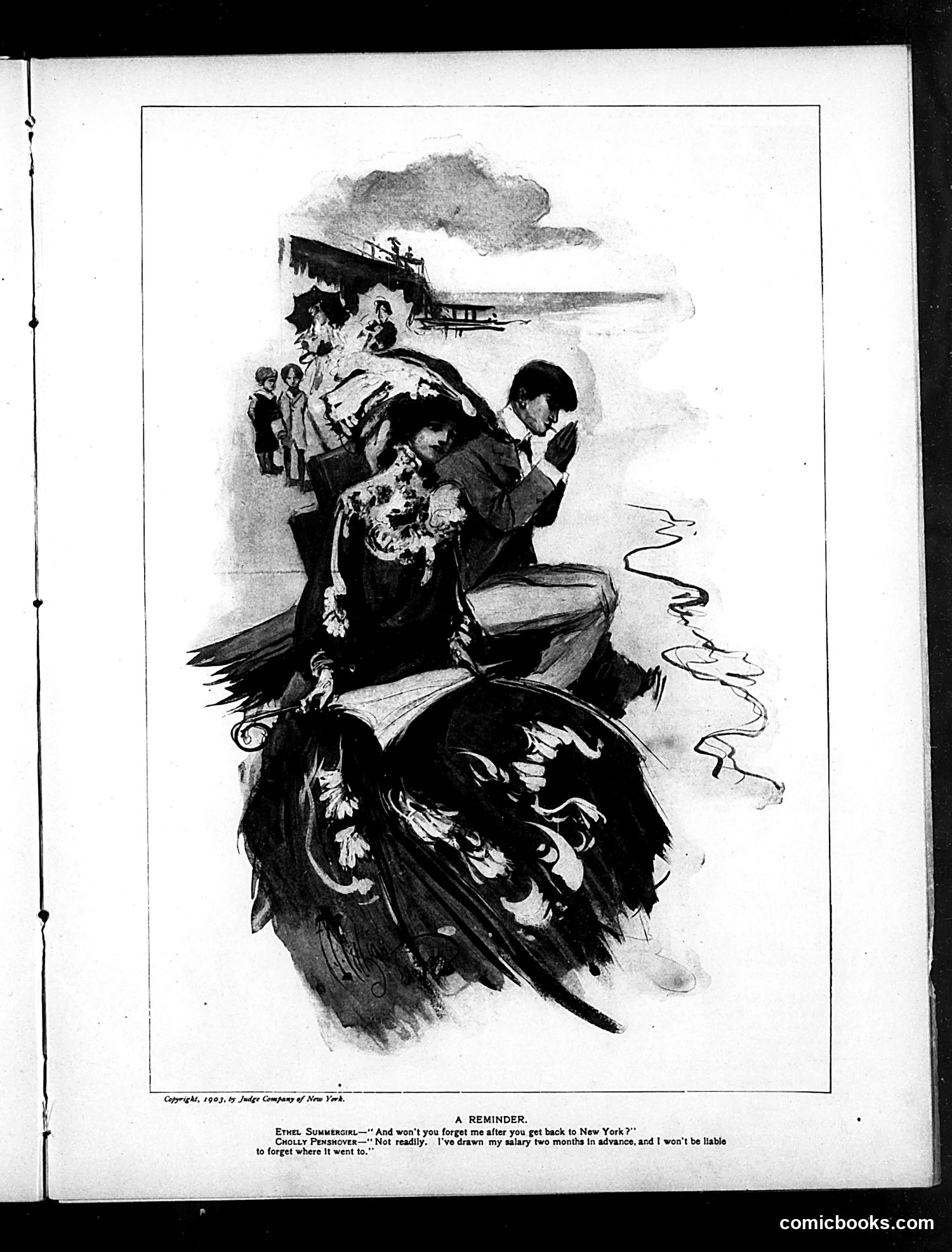
This 1903 Judge cartoon satirizes a romantic encounter between two characters during what appears to be a summer courtship. The titled figures—Ethel Summercirl and Cholly Pensnover—represent stock character types: a flirtatious young woman and a presumably wealthy suitor. The joke turns on financial pragmatism disguised as romance. When Cholly asks if Ethel will forget him after returning to New York, she replies that she won't—not from affection, but because he's already given her two months' advance salary. Her closing line about being "not liable to forget where it went" suggests she's spent the money and thus has a financial rather than emotional investment in remembering him. The satire targets both the opportunistic woman and the naive wealthy man, mocking their respective mercenary and foolish motivations beneath the veneer of romantic summer romance.
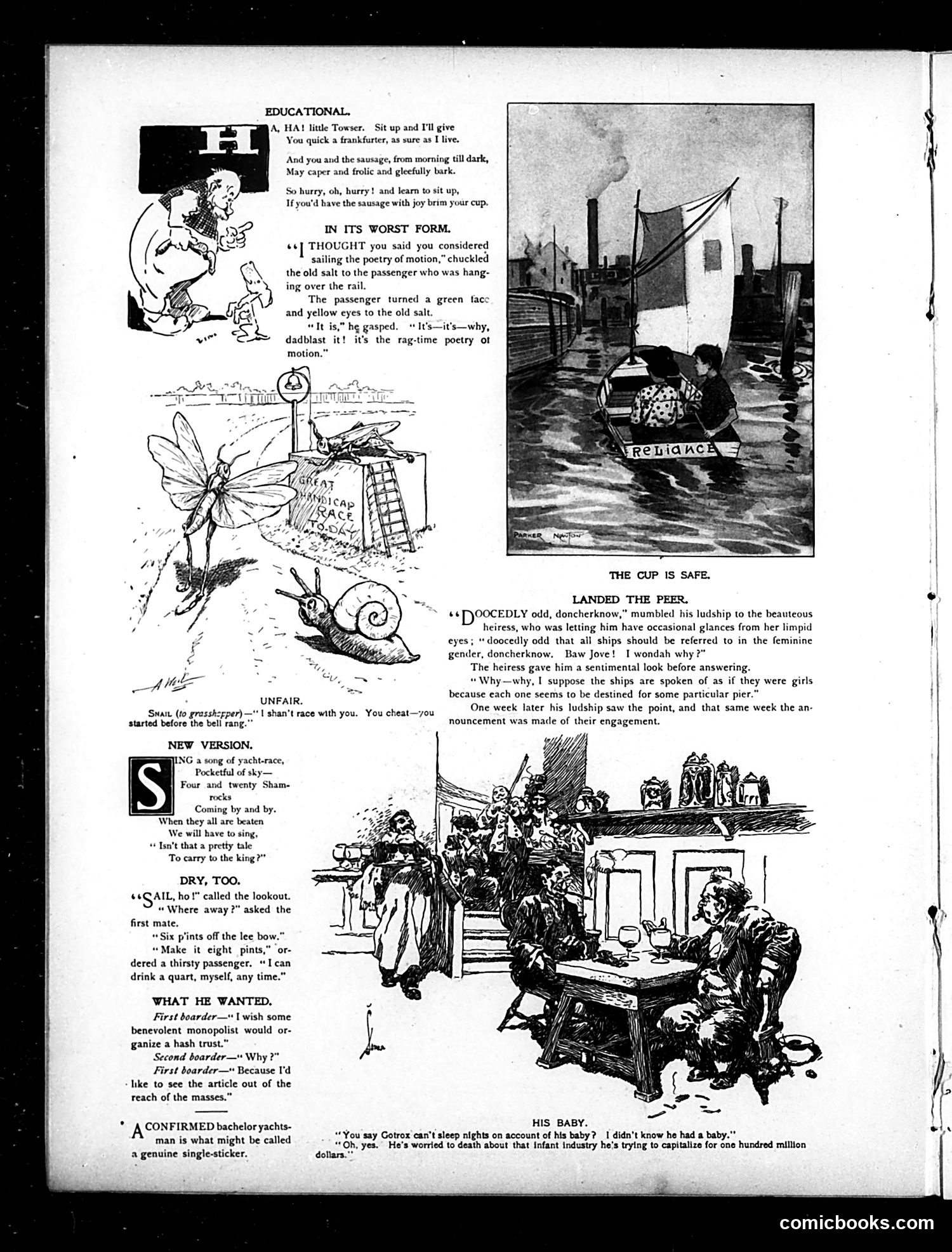
This page contains multiple unrelated satirical pieces typical of Judge magazine's format: **"Educational" cartoon**: A trainer teaches a dog to sit for a frankfurter sausage—likely satirizing the recent scandal over diseased meat in sausages, making the "education" darkly ironic. **"In Its Worst Form"**: A seasick passenger complains that ship motion isn't poetic but "rag-time poetry"—mocking both romantic notions of sea travel and the contemporary craze for ragtime music. **"The Cup Is Safe/Landed the Peer"**: A British nobleman ("ludship") proposes to an heiress after she makes a pun about ships being feminine because they're "destined for some particular pier"—satirizing upper-class courtship rituals and British affectation. **Minor pieces** include jokes about hash monopolies, drunken sailors, grasshoppers cheating at races, and bachelor yachtsmen—all social satire on contemporary concerns like trusts, labor, and wealth disparity. The overall tone mocks British pretension, food safety issues, and modern commercialism.
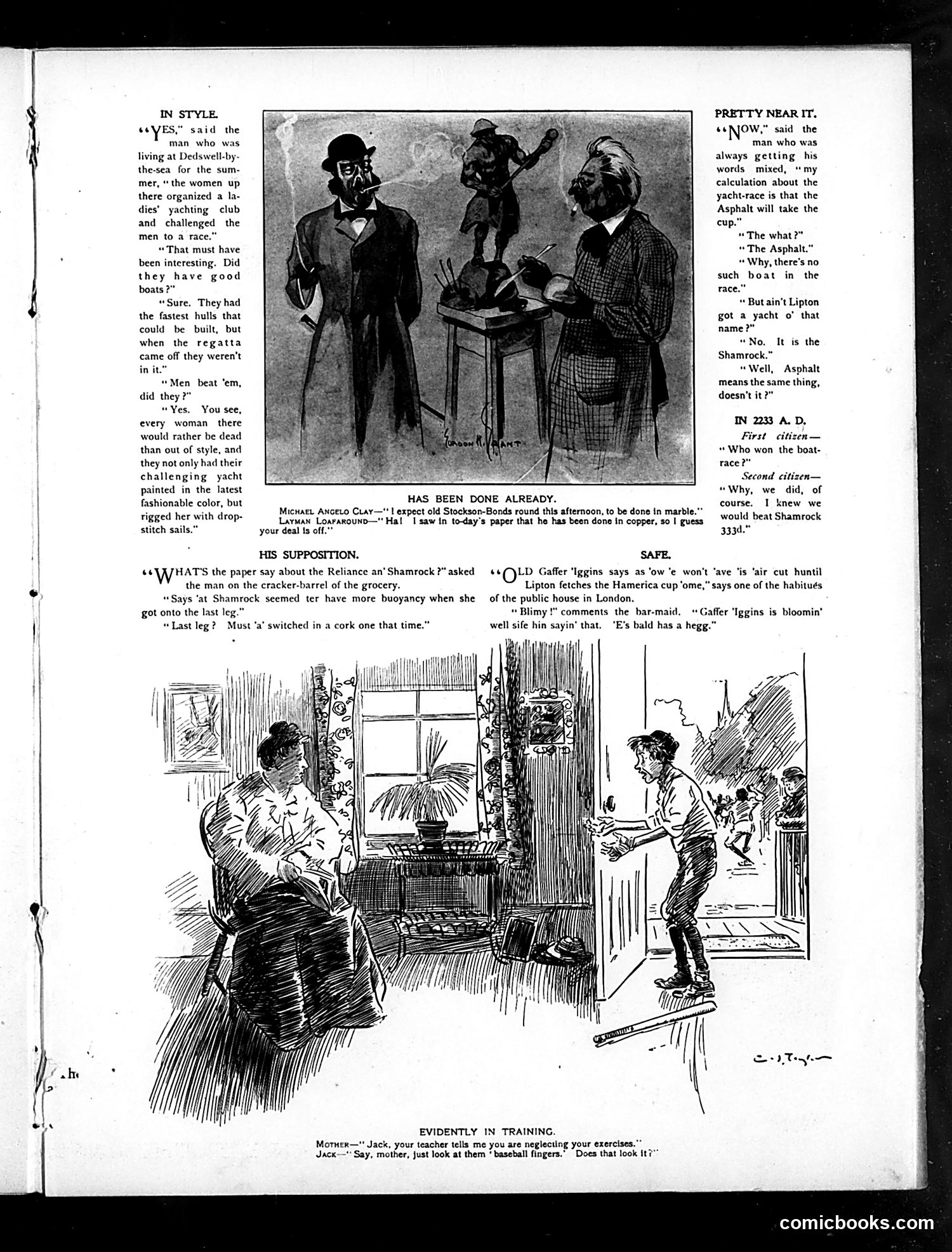
This page contains multiple brief satirical pieces typical of early 1900s humor magazines: **Top section ("In Style")**: Mocks women's fashion obsession. A man recounts that a ladies' yacht club challenged men to a race but lost because the women prioritized wearing the latest fashionable colors and fashionable rigging over competitive performance—satirizing the notion that style matters more to women than substance. **Middle sections**: Contain wordplay jokes about yacht racing (likely referencing the America's Cup competitions of that era, mentioning Lipton's "Shamrock" yacht) and a far-future prediction (2233 A.D.) that artistic masterpieces will be made from copper rather than marble. **Bottom cartoon ("Evidently in Training")**: A boy shows his mother his hands, claiming his "baseball fingers" prove he's exercising—a visual pun suggesting his fingers are shaped like baseball bats from playing, humorously misinterpreting the mother's request for exercise evidence. The page reflects period concerns: competitive women's sports, transatlantic yacht racing, and children's activities.
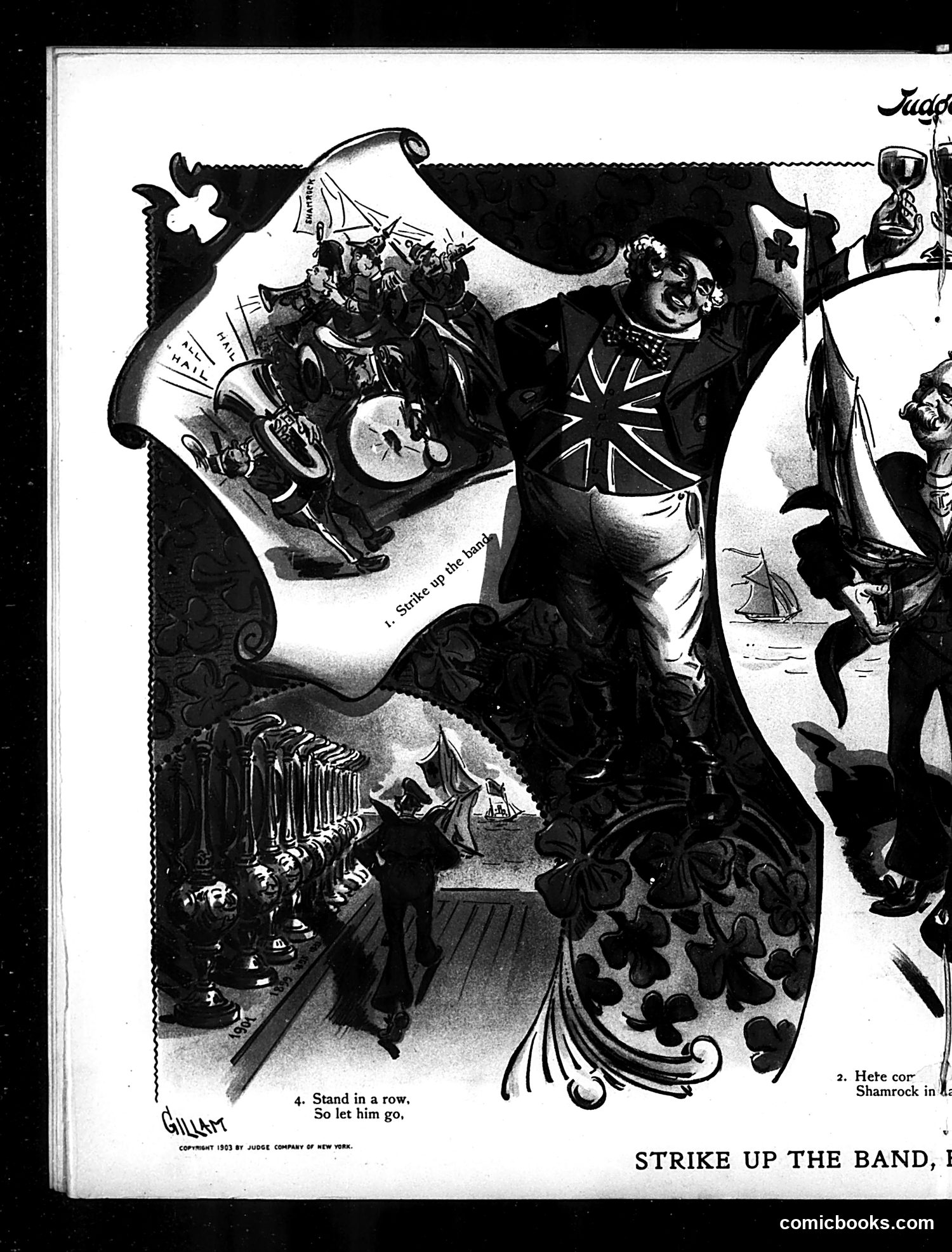
This appears to be a Judge magazine satirical cartoon titled "Strike Up the Band," signed by Gillam. The image depicts a large Irish figure (identifiable by the shamrock and Irish imagery) being celebrated or paraded by what appear to be political or military figures. The caption "Stand in a row, / So let him go" suggests mockery of political posturing around an Irish-American figure or issue. The cartoon likely satirizes American political manipulation of Irish-American voters or political support, possibly during a period of Irish immigration debate or political maneuvering. The "band" imagery and parade-like setting suggest public spectacle masking political opportunism. Without a visible date, the specific historical moment remains unclear, but the visual language clearly critiques the performative nature of political appeals to Irish-American constituencies.
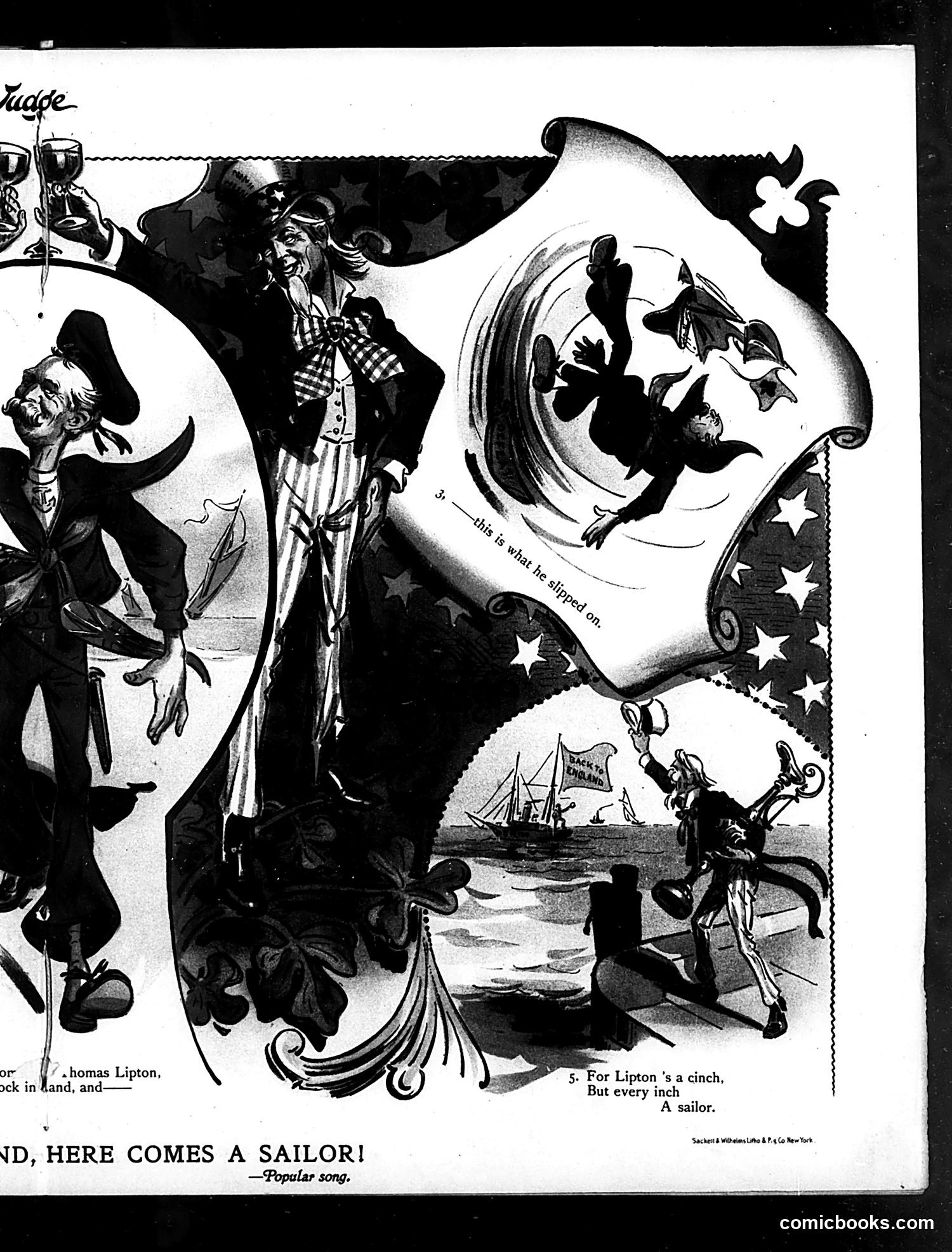
This Judge magazine page satirizes **Thomas Lipton**, the Irish-Scottish tea magnate and yacht racing enthusiast. The cartoon references Lipton's famous America's Cup challenges—he competed multiple times to win the trophy, becoming legendary for his sportsmanship despite repeated defeats. The satire plays on Lipton's identity: though a wealthy businessman and tea merchant, the cartoon portrays him as fundamentally a "sailor" at heart. The text "For Lipton's a cinch, But every inch A sailor" suggests that despite his business success, his true passion and character derive from maritime competition. The imagery—showing Lipton as a figure associated with seafaring, ships, and nautical adventure—mocks the romantic identity he cultivated through yacht racing, contrasting his public businessman persona with his obsessive sailor identity. This references the popular song "Here Comes a Sailor" in the heading.
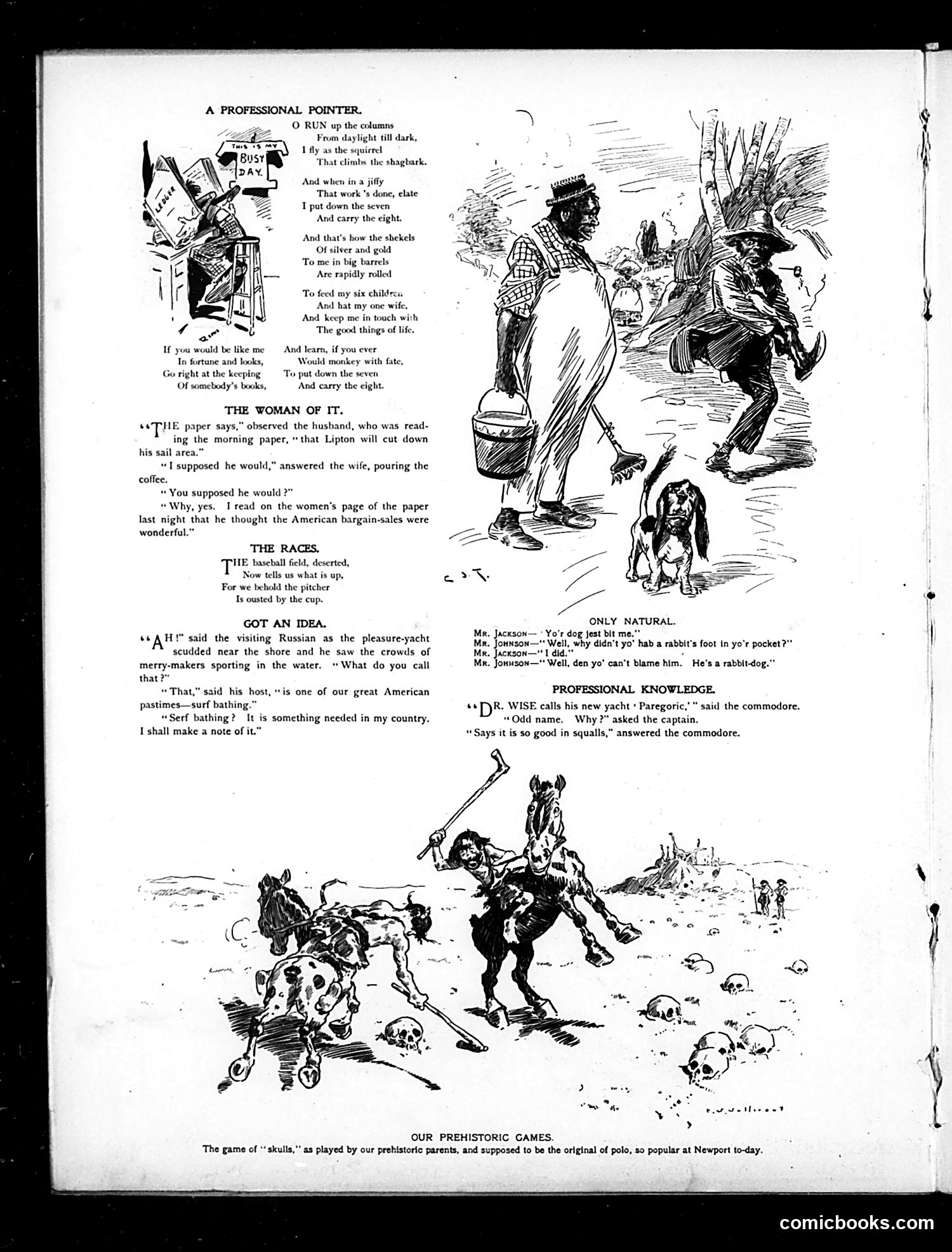
This page contains multiple short humorous pieces typical of Judge's satirical format: **"A Professional Pointer"** jokes about bookkeeping—"putting down the seven and carrying the eight" (arithmetic operations) as the path to wealth and supporting a family. **"The Woman of It"** plays on a wife's misreading: she confuses news about yachtsman Lipton cutting sail area with American bargain sales, conflating maritime and shopping terminology. **"The Races"** makes a pun: the baseball pitcher is replaced by a cup, suggesting horse racing (where cups are trophies). **"Got An Idea"** satirizes a Russian visitor misunderstanding "surf bathing" as "serf bathing"—implying Russia's feudal labor system needs importing. **"Only Natural"** presents a racist joke where a Black man's dog is called a "rabbit-dog" because it bit someone carrying a rabbit's foot. **"Professional Knowledge"** puns on "Paregoric" (a medicinal tincture) being "good in squalls" (both medical and nautical contexts). **"Our Prehistoric Games"** suggests polo descends from prehistoric skull-playing, mocking the sport's upper-class Newport association.
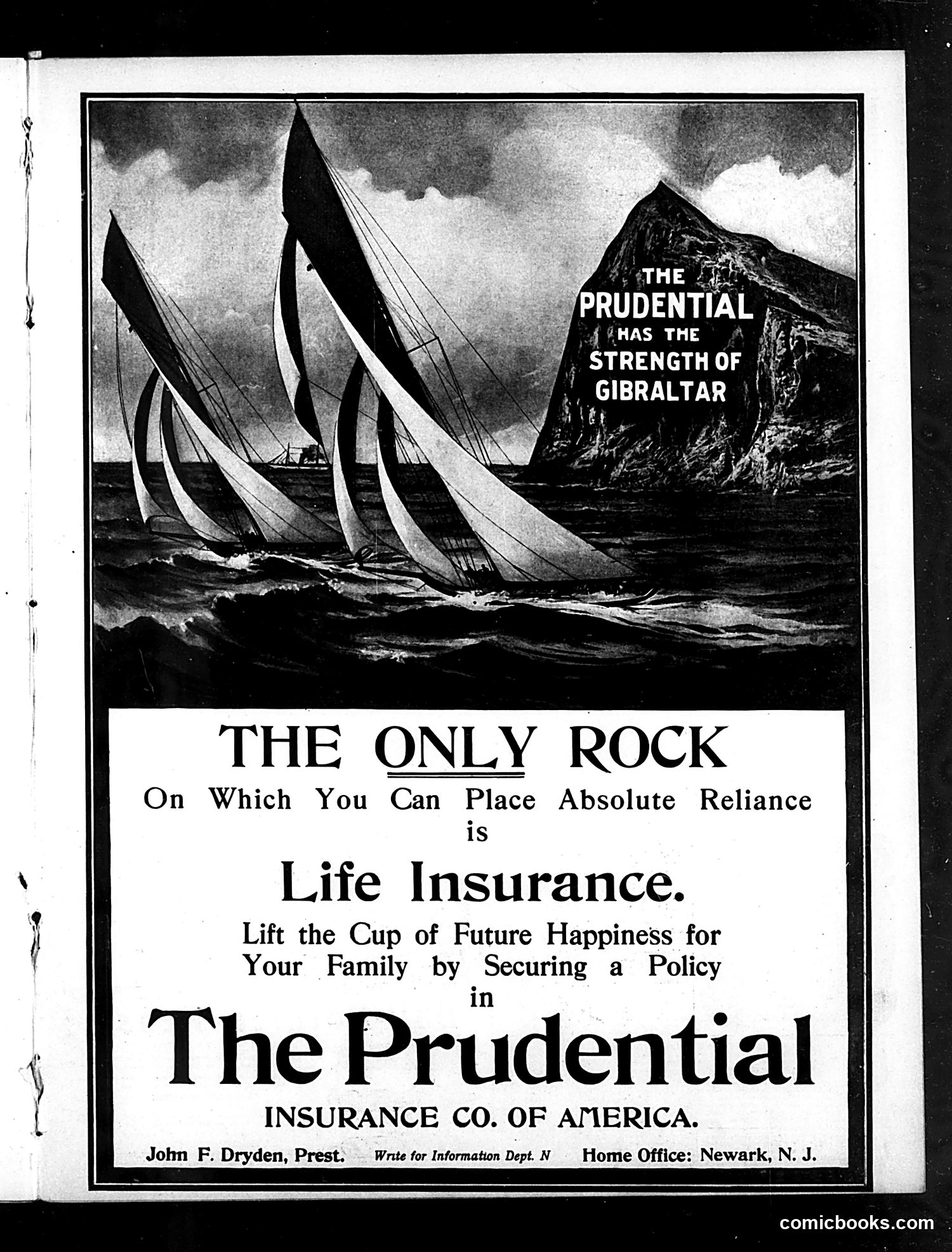
This is a **full-page advertisement**, not editorial satire. The Prudential Insurance Company uses dramatic maritime imagery—sailboats navigating rough seas near the Rock of Gibraltar—as a metaphor for financial security. The "rock" represents life insurance as an unchanging, dependable foundation amid life's uncertainties (the turbulent waves). The advertising copy employs emotional appeals common to early 20th-century insurance marketing: protecting family futures and "happiness." The tagline "The Prudential has the strength of Gibraltar" makes the metaphor explicit. This appears in *Judge*, a satirical magazine, likely as paid advertising. It's not itself satirical—rather, it's a genuine corporate advertisement using dramatic romantic imagery typical of the era's insurance industry marketing.
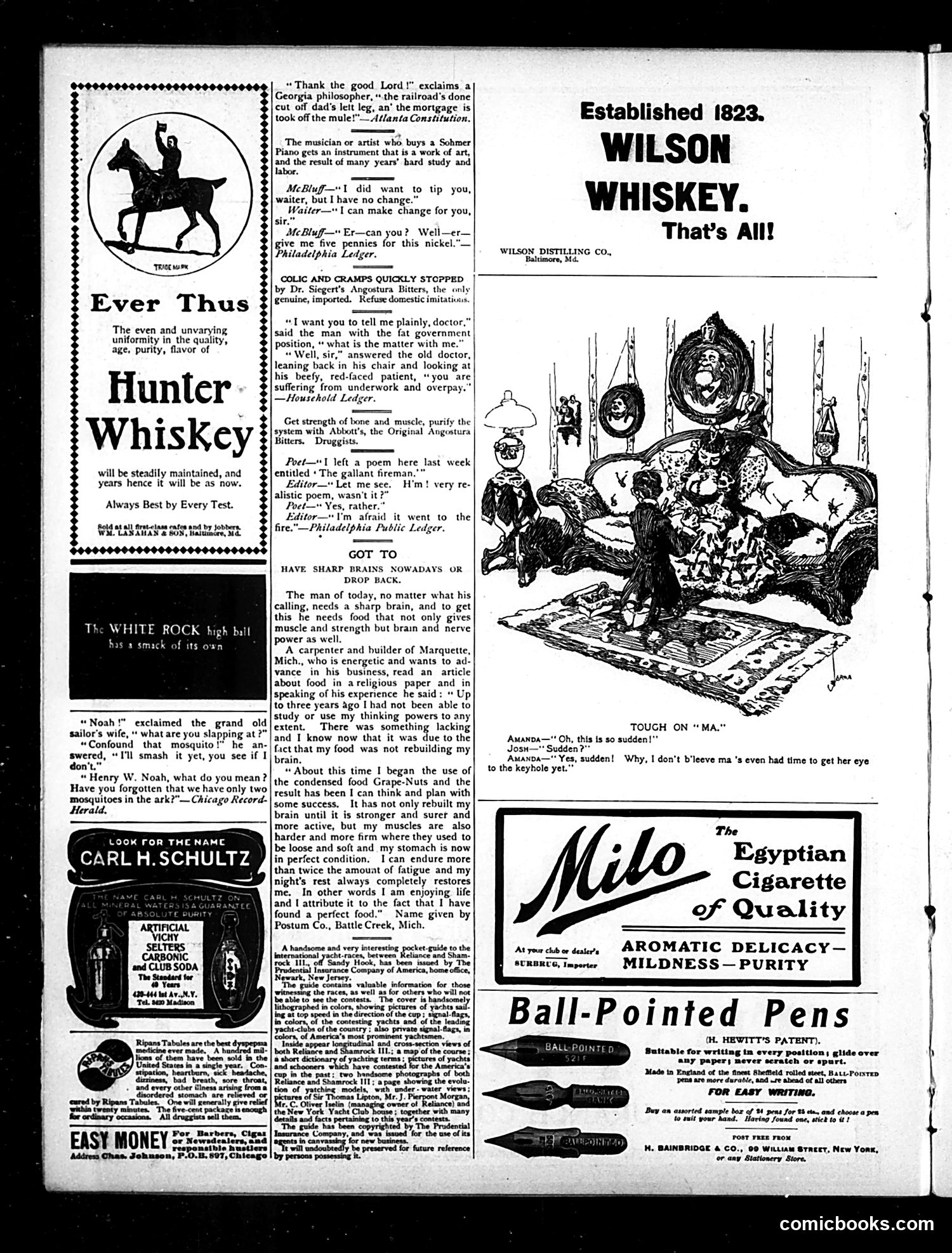
This page is primarily **advertisements and filler jokes**, typical of early-20th-century satirical magazines. The main cartoon (upper right) shows a domestic scene labeled "Such on 'Ma'" — a simple sight gag about a woman ("Amanda") suddenly discovering her husband has been unfaithful or dishonest, with the punchline playing on her shock. The surrounding content consists of **liquor and patent medicine ads** (Hunter Whiskey, Wilson Whiskey, Angostura Bitters), and short humor pieces: a Noah's Ark joke about mosquitoes, a waiter making change from a nickel, a doctor diagnosing a government official's "underwork and overpay," and a poet's overly realistic fireman poem. These are **lighthearted wordplay** rather than political satire. The ads for Grape-Nuts cereal use testimonials claiming brain-building properties — typical **dubious health claims** of the era. The page reflects Judge's mix of satirical humor and commercial content.
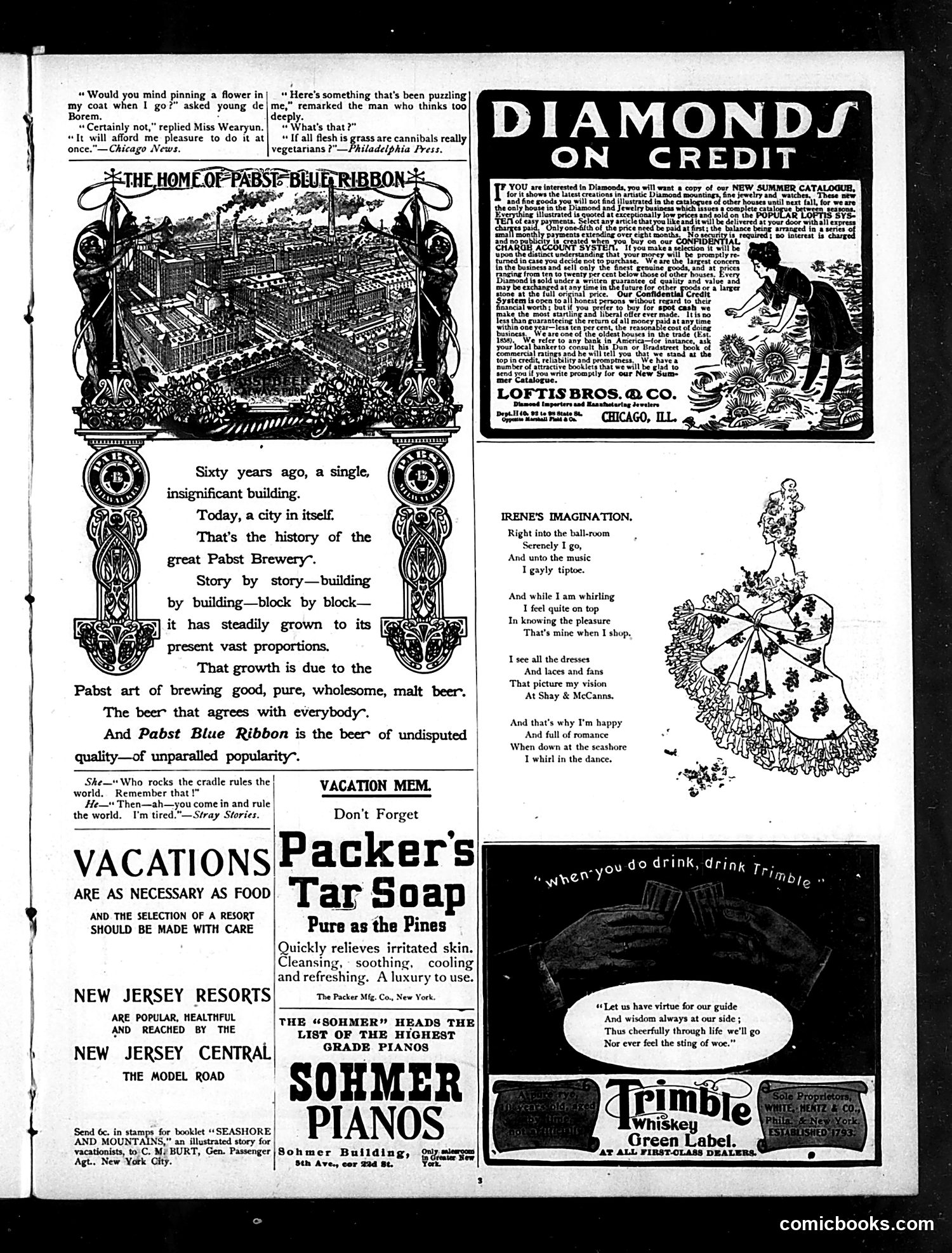
This page is primarily **advertisements** interspersed with brief comedic filler content typical of early 20th-century magazines. The small cartoons are simple joke-comics: one about a woman pinning a flower on a man's coat (mild romantic humor), another presenting a philosophical riddle about whether cannibals eating flesh are vegetarians (absurdist wordplay). The dominant content advertises consumer goods and services: **Pabst Blue Ribbon beer** celebrates brewery growth through metaphorical building language; **Packer's Tar Soap** promises skin relief; **Sohmer Pianos** claims highest grade; **New Jersey Central Railway** promotes resort vacations; **Loftis Bros. diamonds** offers credit purchasing—notably progressive for the era, allowing installment payments over months; **Trimble Whiskey** includes a morality verse. A poem, "Irene's Imagination," depicts a woman daydreaming about shopping and dancing, romanticizing commercial leisure. The page reflects early 1900s consumer capitalism: installment credit was emerging, vacation culture was growing, and advertisements normalized aspirational consumption through entertainment.
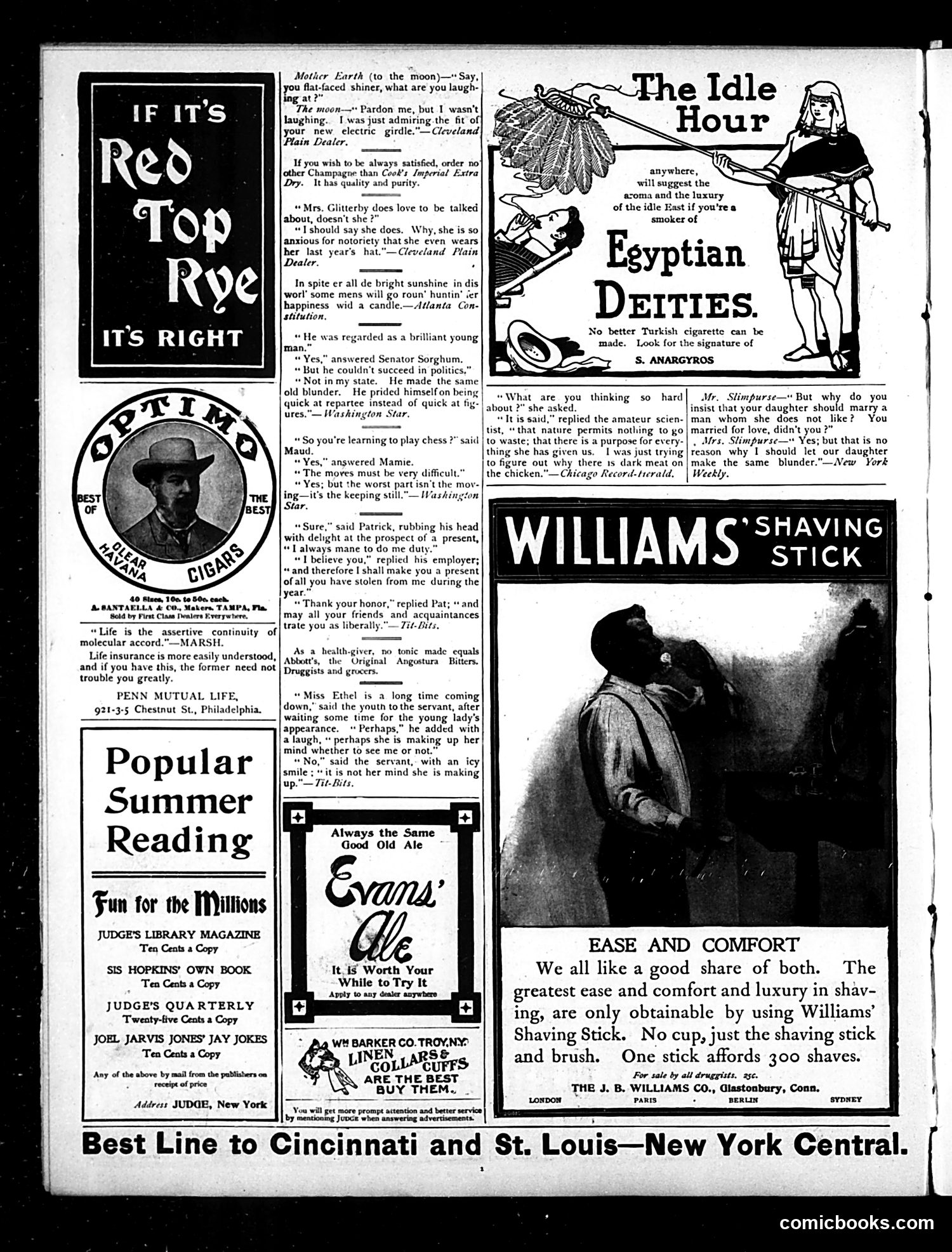
This page is primarily **advertising with scattered humor pieces**, typical of Judge magazine's format. The main content includes: **"The Idle Hour"** features Egyptian Deities cigarettes—an advertisement using orientalist imagery of a figure in Egyptian dress, appealing to early 1900s exoticism and luxury consumption. **Multiple short jokes** satirize everyday social behaviors: a woman obsessed with notoriety wearing last year's hat; a politician who fails because he's quick-witted rather than competent with numbers; a servant's dry observation that a young woman is "making up her mind" (playing coy) rather than her appearance. **Williams' Shaving Stick advertisement** emphasizes comfort and simplicity—no need for cups or brushes, just the stick itself. The humor is gentle domestic satire typical of the era: poking fun at vanity, political incompetence, gender relations, and courtship rituals. The overall tone reflects upper-middle-class concerns and assumes a readership familiar with servants, leisure time, and consumer goods.
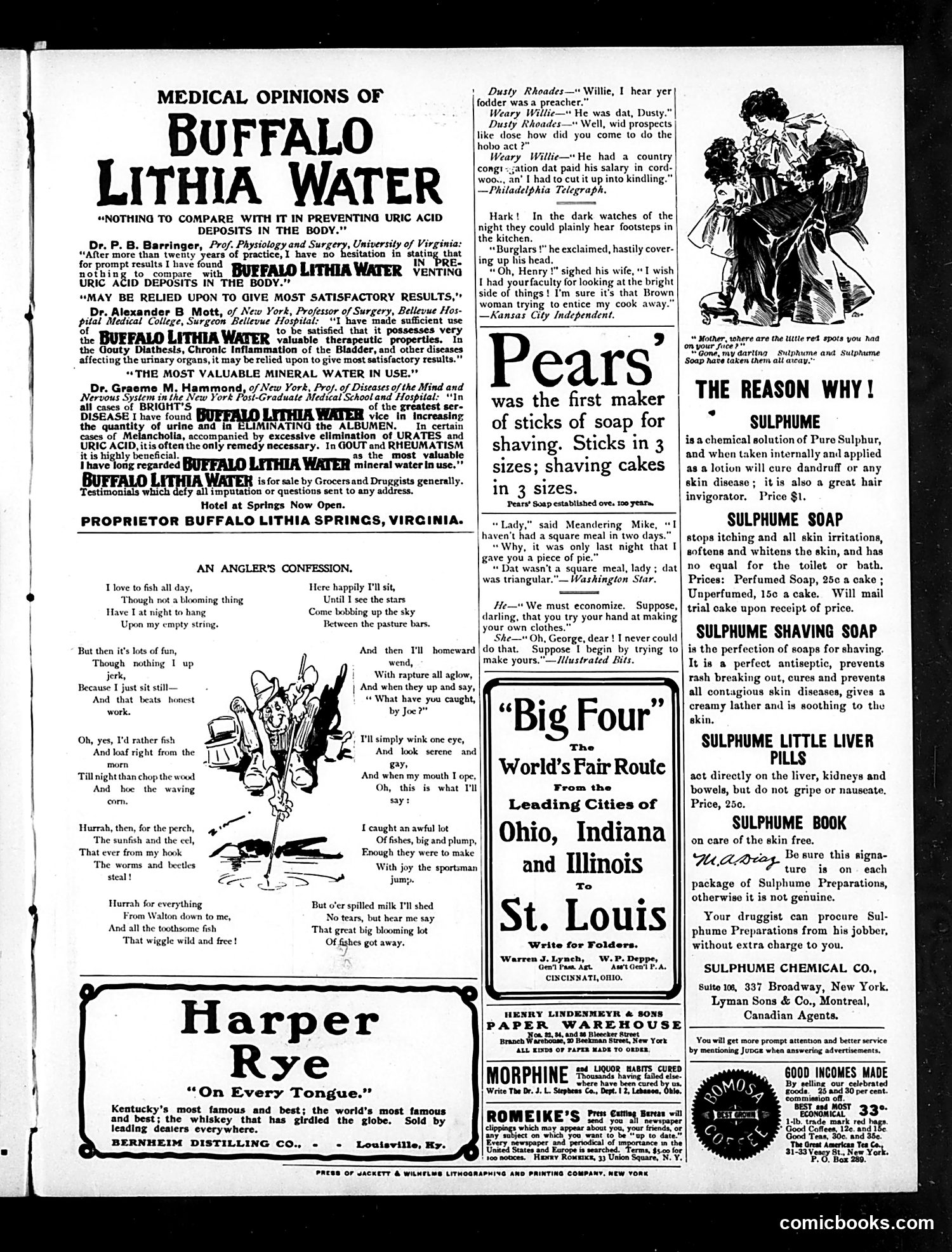
This is primarily an **advertising page** rather than a satirical cartoon feature. The dominant content consists of medical testimonials promoting "Buffalo Lithia Water"—a patent medicine marketed as a cure for gout, rheumatism, kidney disease, and urinary ailments. University professors and prominent surgeons (Dr. Barringer of University of Virginia, Dr. Mott of Bellevue Hospital) provide endorsements claiming the mineral water's therapeutic properties. The page includes minor comic content: "An Angler's Confession" (a fishing-themed poem), a brief joke about a vagrant whose preacher father's low salary forced him into homelessness, and an advertisement for Harper Rye whiskey. These small humor pieces likely serve as filler. The angler poem satirizes fishing tall tales—the fisherman claims to catch nothing but pretends success. The vagrant joke is straightforward social commentary on poverty. The page reflects **early 20th-century advertising practices**, when prestigious endorsements and pseudo-scientific claims dominated patent medicine marketing, before FDA regulations restricted such claims.
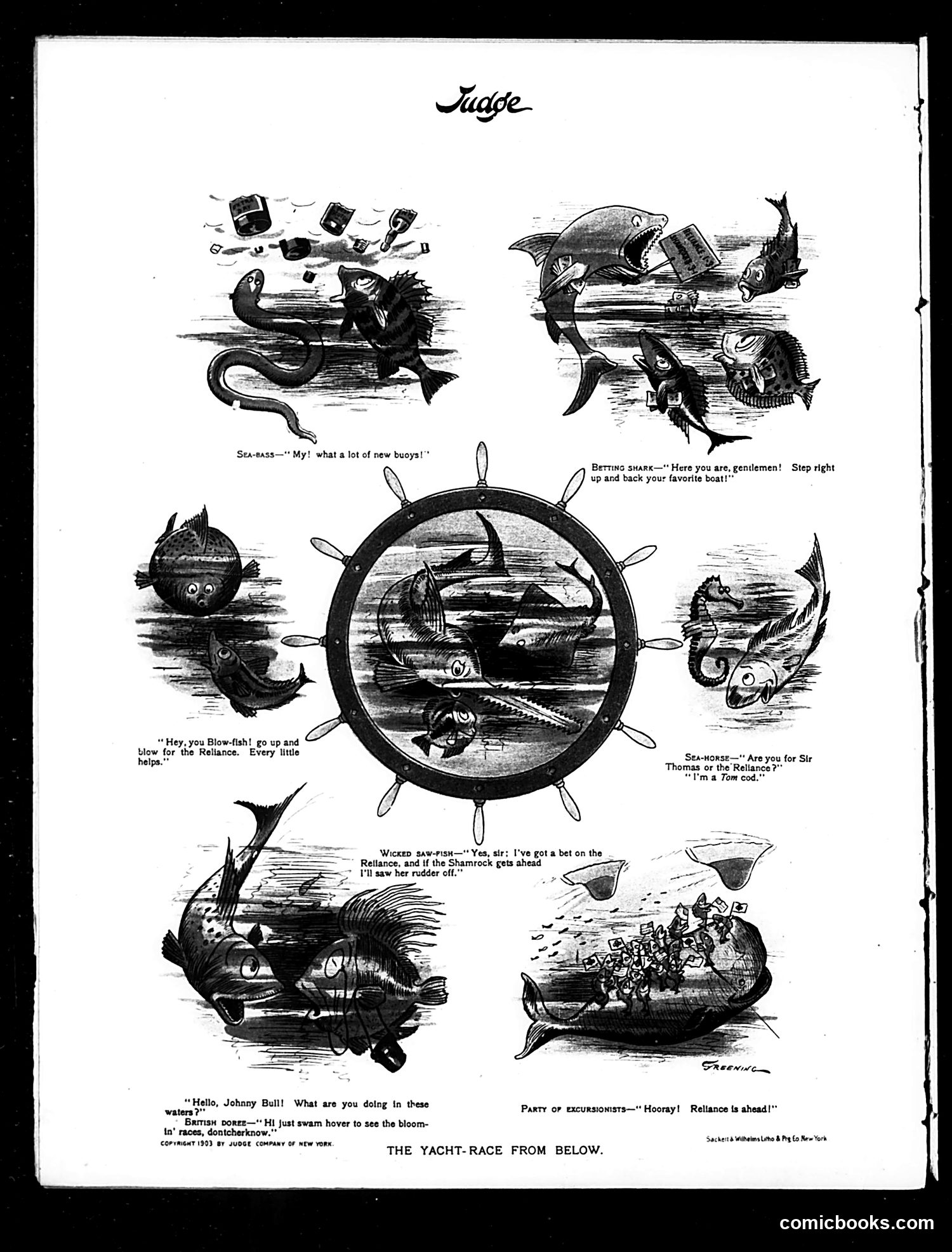
This 1903 Judge cartoon satirizes the America's Cup yacht race between the American boat *Reliance* and the British *Shamrock*, viewed humorously from the perspective of sea creatures below. The satire mocks how the race captivated public attention by showing fish, sharks, and sea life placing bets, taking sides, and enthusiastically backing their "favorite boat." The creatures represent ordinary people caught up in the sporting fever—some betting on outcomes, others swearing loyalty to one vessel or the other. The "Johnny Bull" (British character) appearance reinforces the Anglo-American sporting rivalry. The cartoon's joke is that even creatures who couldn't possibly care about yachting are invested in the competition, reflecting how the real yacht-race dominated American discourse and captured public imagination across all social levels.

I appreciate your interest, but I must be honest: this image is almost entirely black with only minimal visible details—a white margin on the left side, some faint marks, and the "comicbooks.com" watermark at the bottom right. The image quality is too poor to discern any cartoon artwork, text, figures, caricatures, or satirical content that would allow me to fulfill your request accurately. To provide meaningful historical analysis as you've requested, I would need a clearer, higher-contrast scan of the Judge magazine page. Without being able to see the actual content, I cannot identify figures, political references, or explain the satire without violating your rule to assert only what the image supports. I'd be happy to analyze this if you can provide a clearer scan.