
A complete issue · 16 pages · 1903
Judge — July 18, 1903
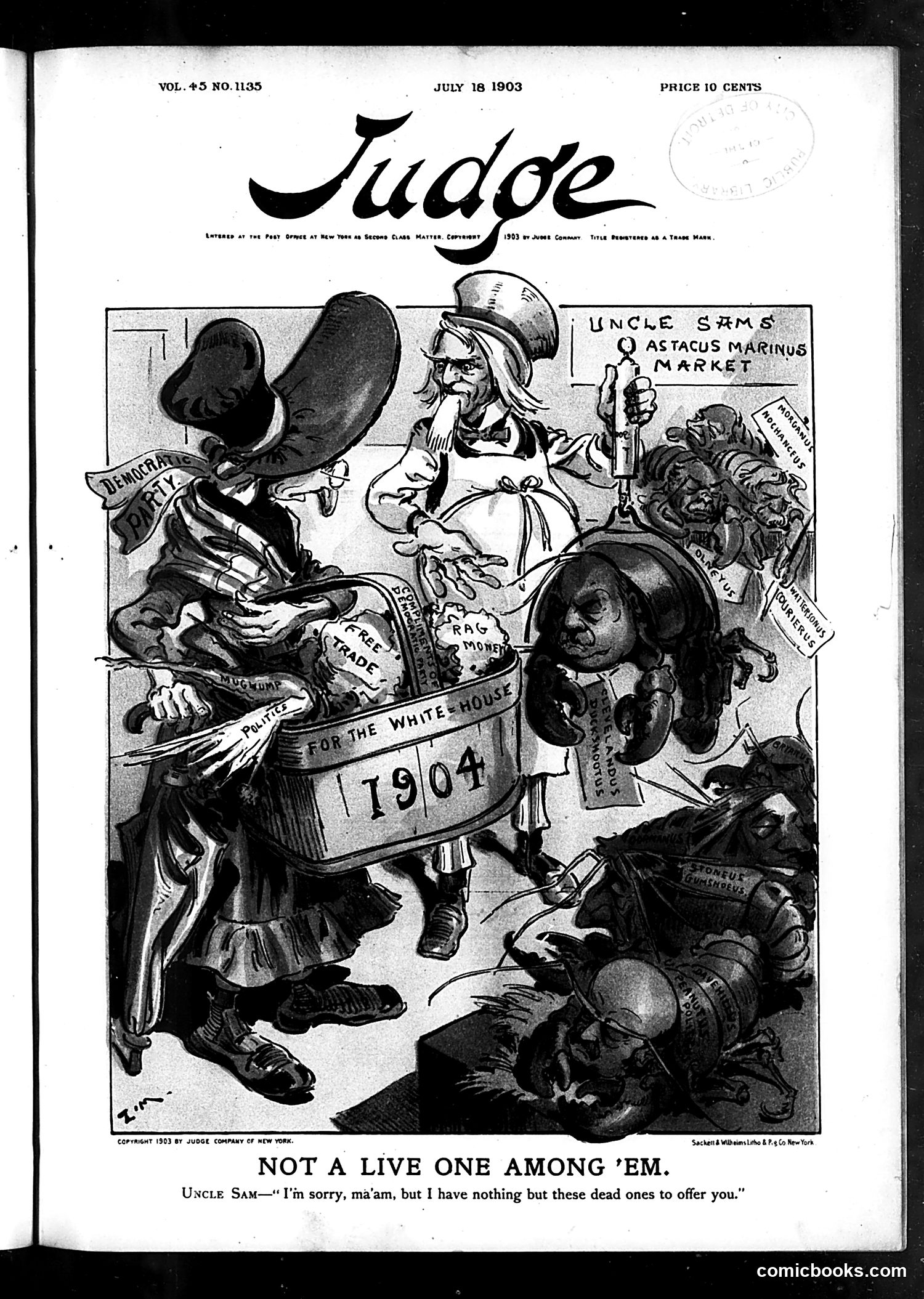
This cartoon satirizes the 1904 presidential election. Uncle Sam, the personification of America, stands at an "Ostacus Marinus Market" (a play on political merchandise). He holds a basket labeled "For the White House 1904," expressing dismay that he has "nothing but these dead ones to offer you." The various animal and caricatured figures surrounding him—labeled with names like "Democracy," "Trap," "Fraud," and "Monopoly"—represent either political figures or corrupt forces the cartoonist views as morally or politically defunct. The satire criticizes the available presidential candidates or the state of American politics as offering no genuinely viable or honest alternatives for the upcoming election.
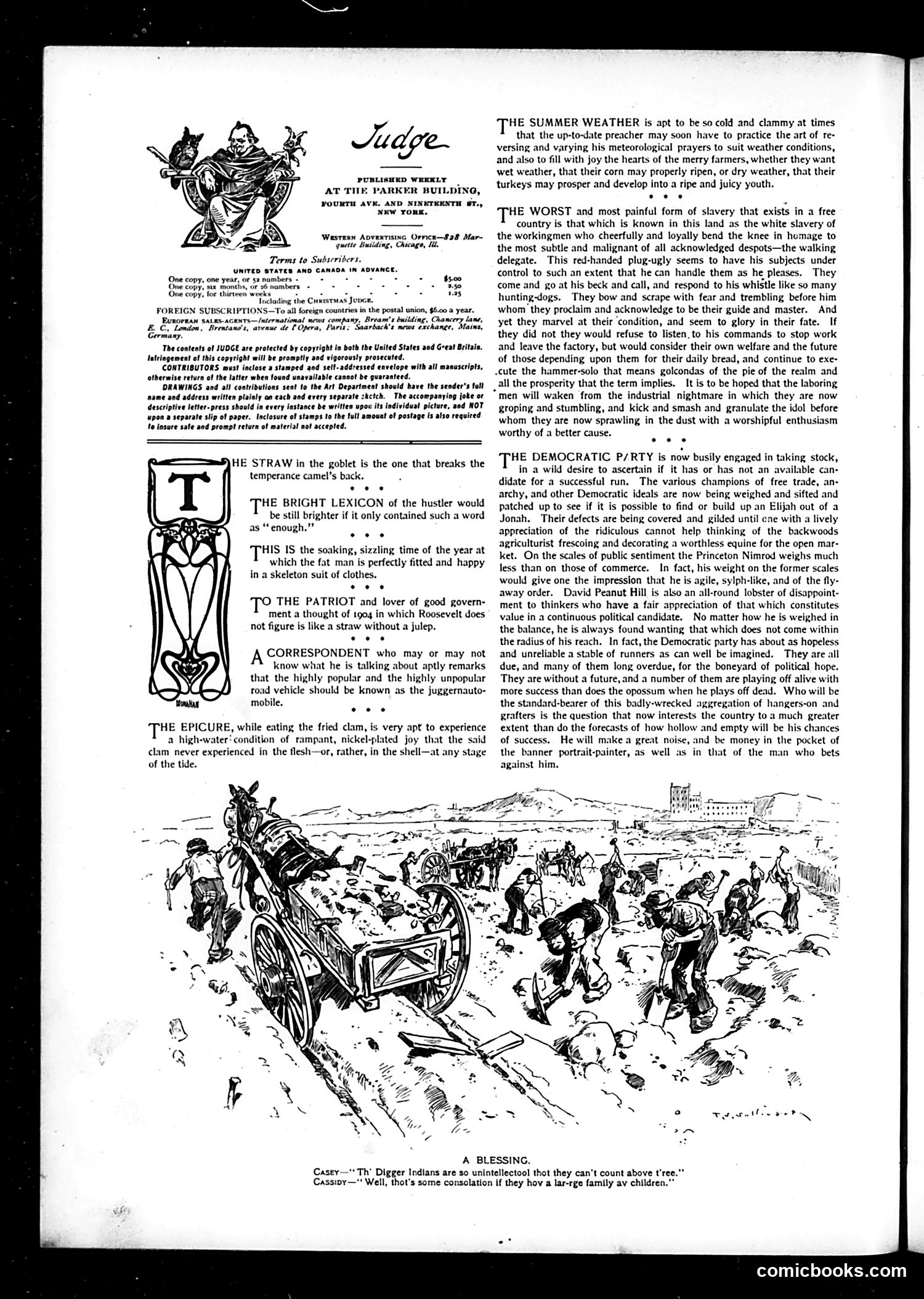
This cartoon depicts what appears to be a Native American scene with settlers or workers and an overturned wagon. The caption features two characters named Casey and Cassidy debating whether Native Americans are "unintelligent" because "they can't count above tree." Cassidy responds that having a large family provides "some consolation," implying prolific reproduction compensates for perceived intellectual deficiency. The satire mocks contemporary racist stereotypes about Native Americans prevalent in early 20th-century American society. The "joke" relies entirely on dehumanizing caricature—portraying Indigenous peoples as intellectually inferior while treating large families as their only redeeming quality. This reflects the deeply prejudiced attitudes normalized in mainstream American publications of Judge's era.
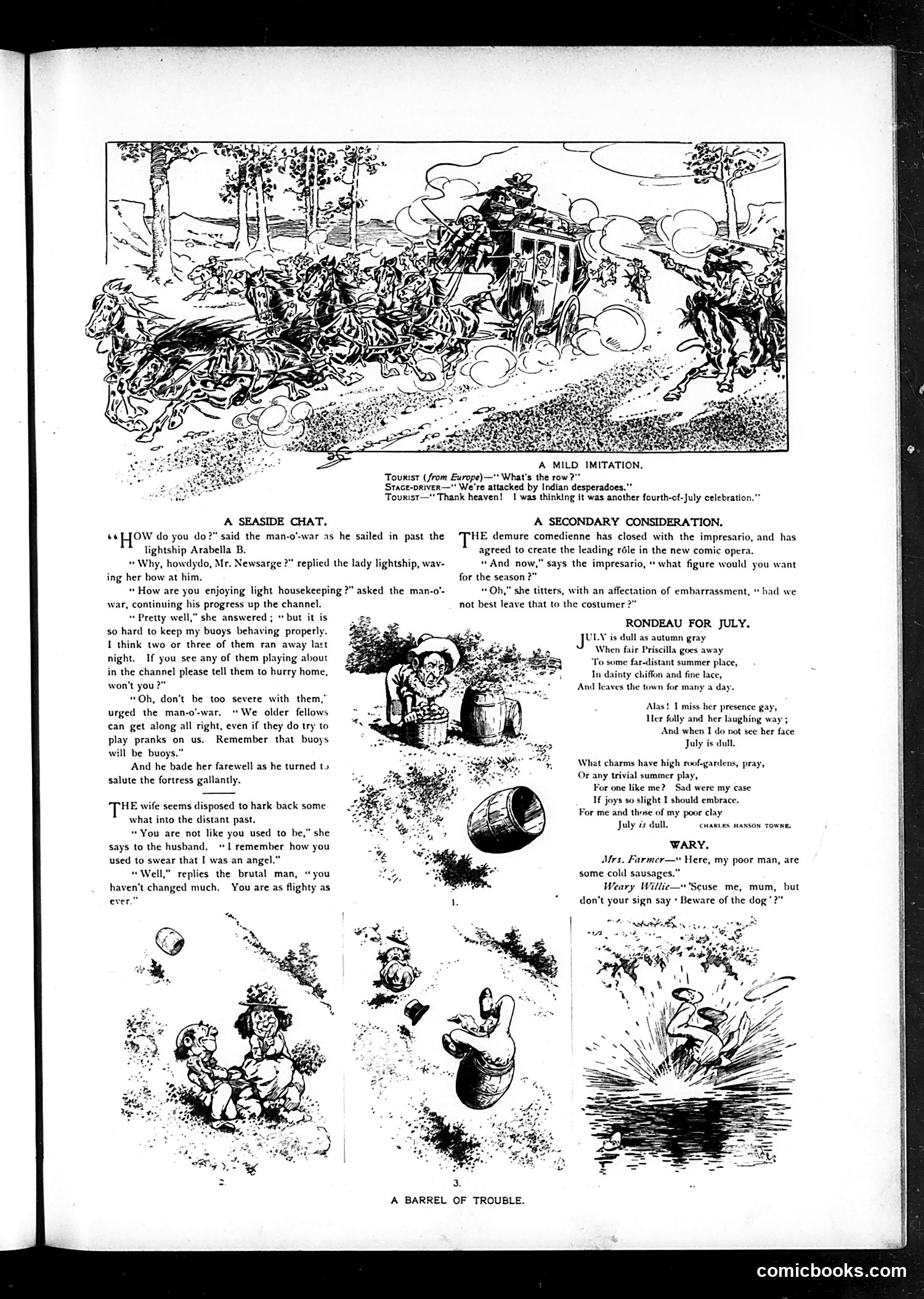
This page contains several unrelated satirical pieces and illustrations typical of Judge magazine's format. **"A Mild Imitation"** (top) depicts a stagecoach being attacked by Native Americans—a satire mocking tourists' sensationalized expectations of the American West. The caption suggests tourists anticipated dramatic frontier violence. **"A Seaside Chat"** and **"A Secondary Consideration"** are brief comedic dialogues about housekeeping and theater management, representing typical domestic humor. **"Rondeau for July"** is a poem by Charles Hanson Towne about missing a summer romance. **"A Barrel of Trouble"** (bottom) shows small illustrated vignettes with accompanying humorous text about a poor man and sausages—lighthearted domestic comedy. The page represents Judge's mix of satirical commentary, social humor, poetry, and illustrated jokes aimed at middle-class readers.
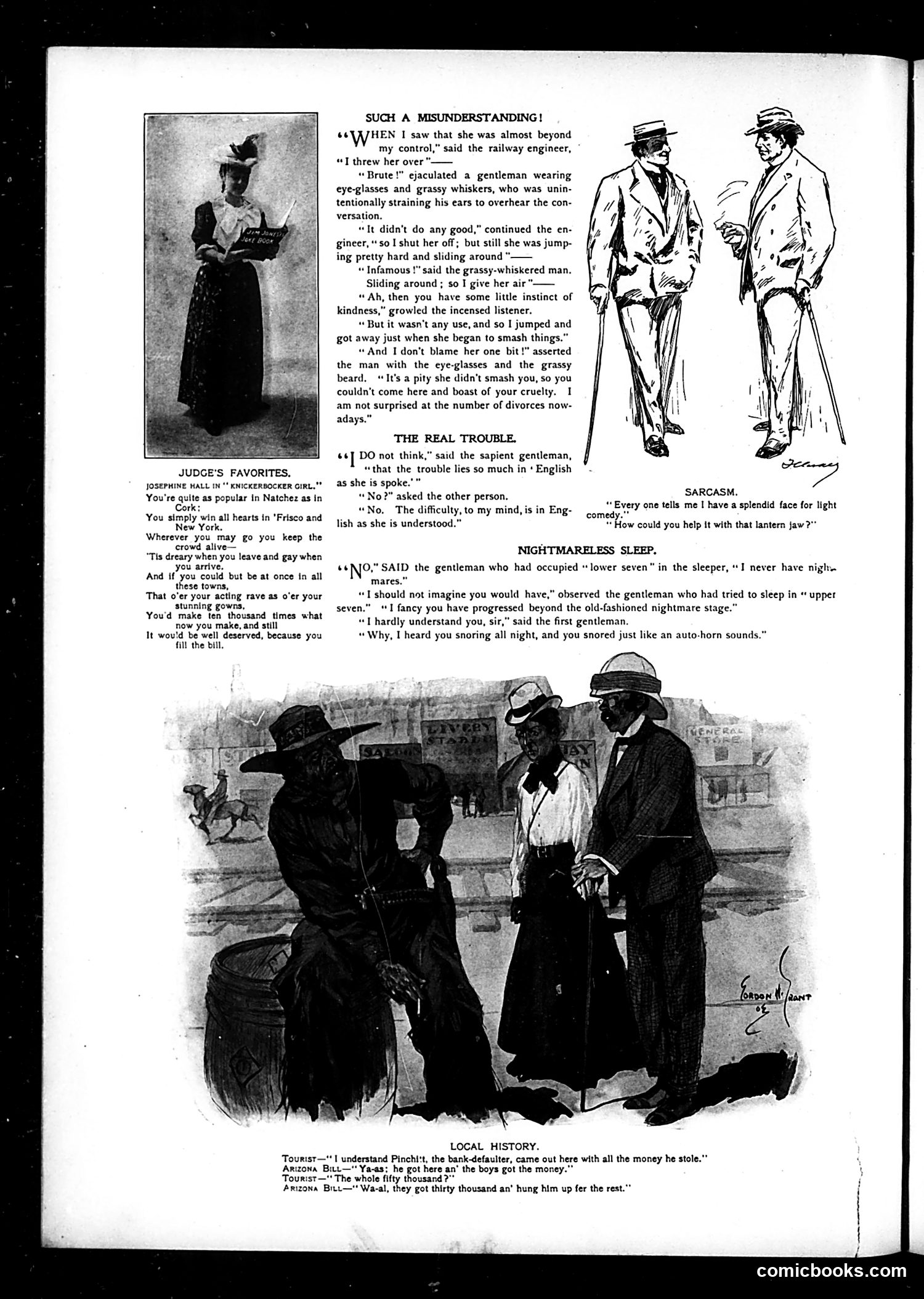
This page contains three distinct humorous pieces reflecting early 20th-century social attitudes: **"Such a Misunderstanding"** satirizes women's behavior on trains. A railway engineer describes a woman passenger who jumped around and caused disruption. The joke centers on gentlemen debating whether her conduct reflected English propriety or simple rudeness—a commentary on gender expectations and deportment. **"The Real Trouble"** continues the railway theme, with gentlemen discussing sleeping car etiquette and snoring—typical period humor about masculine discomfort. **"A Historic Moment"** (bottom) depicts what appears to be a frontier or colonial scene with "Arizona Bill" and a tourist discussing stolen money and hanging—likely satirizing American Western stereotypes and rough frontier justice. The overall page uses transportation settings to explore social awkwardness and cultural differences of the era.
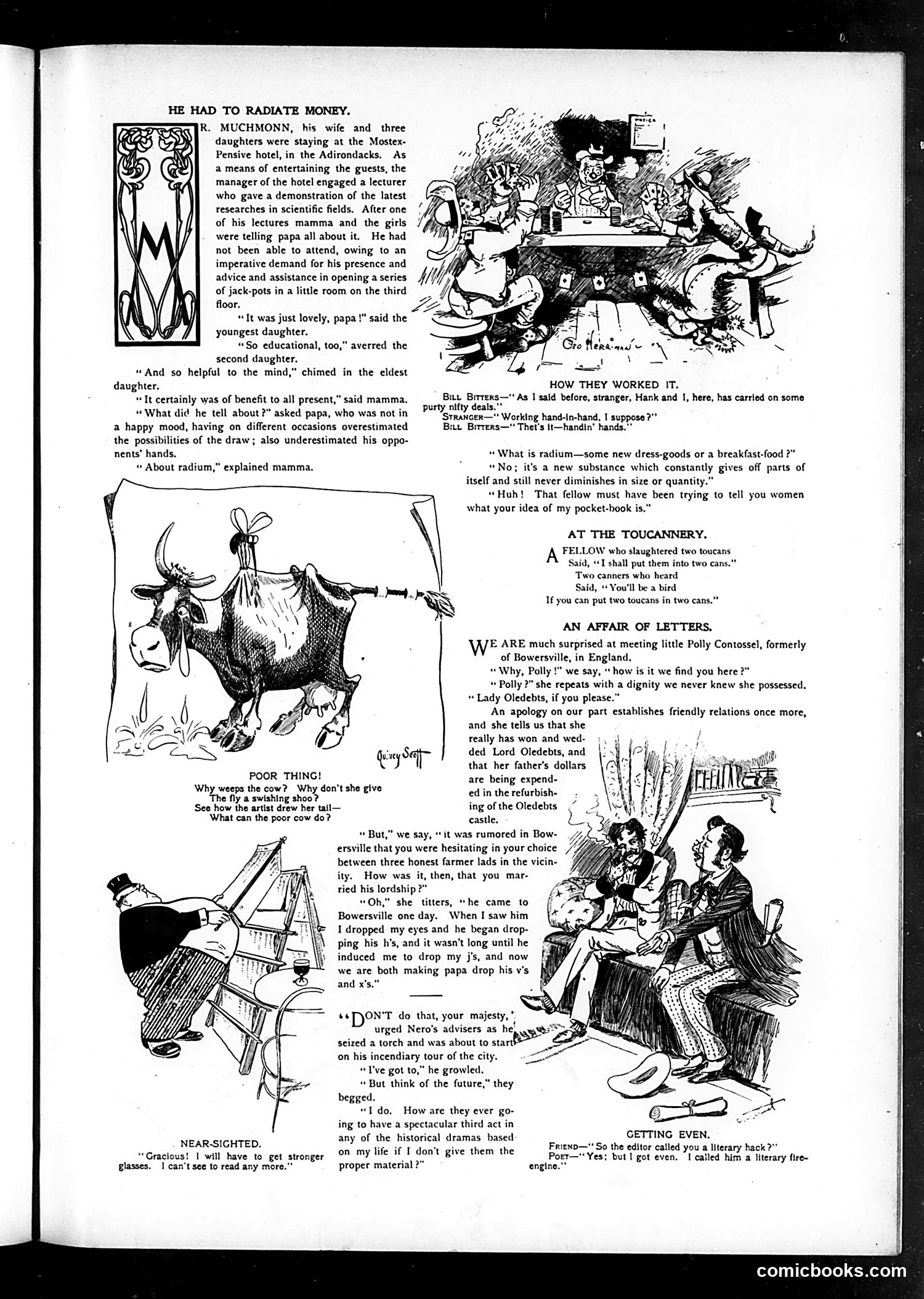
This page contains multiple satirical pieces targeting wealth and social pretension: **"He Had to Radiate Money"**: A wealthy man named Muchmonn, staying at an expensive hotel, misses a scientific lecture about radium. His wife explains that radium constantly gives off parts of itself while never diminishing—to which he quips this describes *his pocket-book*, suggesting his money disappears constantly through wasteful spending and gambling (referenced earlier when he was in the "jack-pots" room). **"An Affair of Letters"**: Satirizes social climbing. A simple farm girl named Polly from Bowersville marries an English lord and now demands to be called "Lady Oledebts." The humor lies in her pretension and the implication that her father's American dollars are being squandered "refurbishing" the lordly castle—mocking both American wealth's superficiality and British nobility's financial desperation. The other brief items are wordplay jokes typical of the era's humor magazines. The satire targets: nouveau-riche excess, transatlantic social aspiration, and the ease with which American money enabled social advancement abroad.
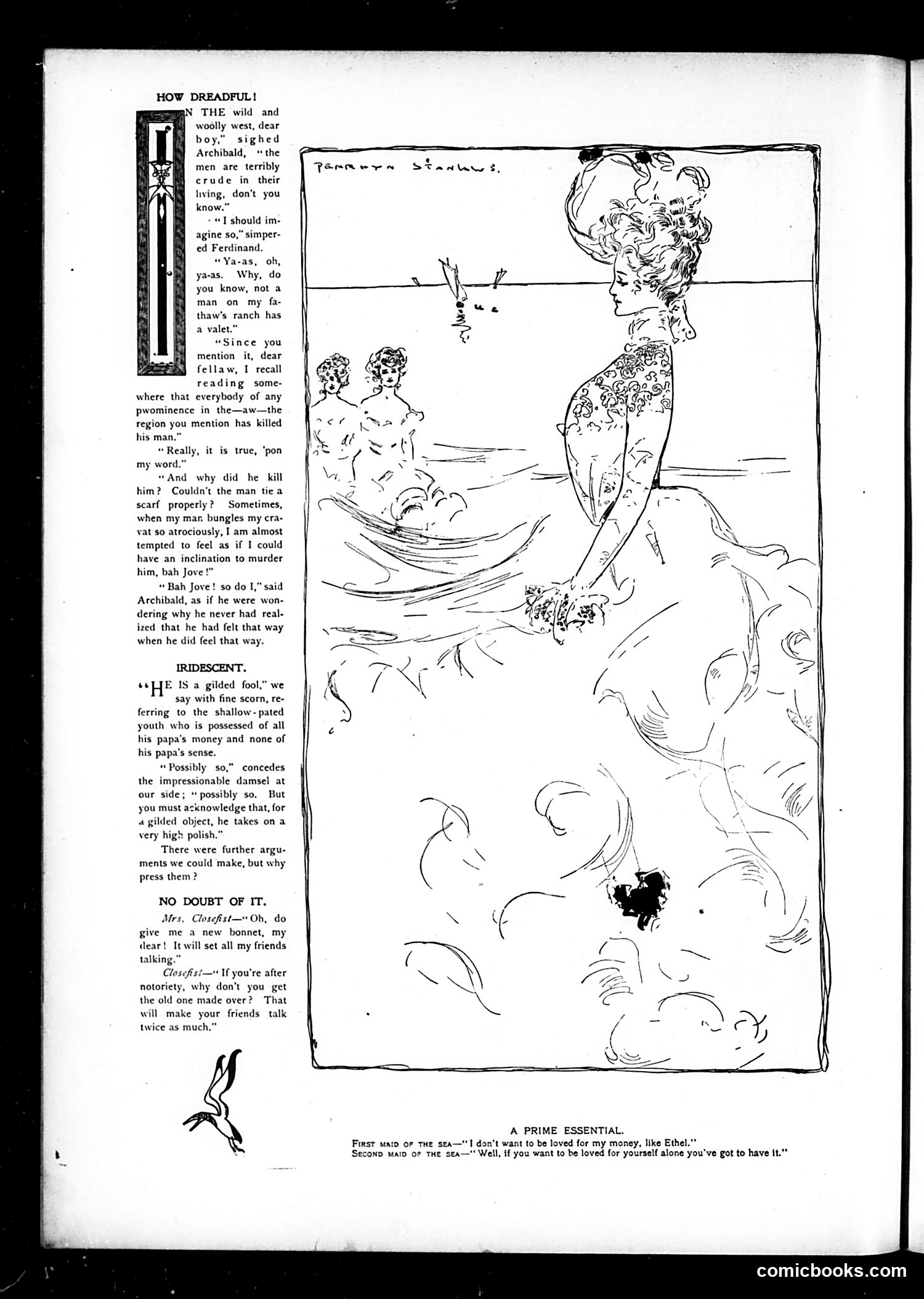
This page contains two satirical pieces mocking upper-class affectation and materialism circa early 1900s. **"How Dreadful!"** ridicules effete British aristocrats (Archibald and Ferdinand) whose affected speech ("thaw's ranch," "pwominence") and detachment from reality are absurd. The joke: they're shocked that Western ranchers lack personal valets, then casually learn these men have killed people—yet find this detail less offensive than poor grooming. The satire targets snobbish pretension disconnected from actual violence and morality. **"Iridescent"** and **"No Doubt of It"** mock the wealthy and their spouses. A "gilded fool" with money but no sense can still achieve "polish"; a stingy husband suggests his wife wear her old bonnet to generate gossip rather than buy new clothes. The final exchange about maids satirizes mercenary romance—wanting love "for yourself alone" while requiring wealth. The cartoons attack class hypocrisy, materialism, and hollow values among the wealthy.
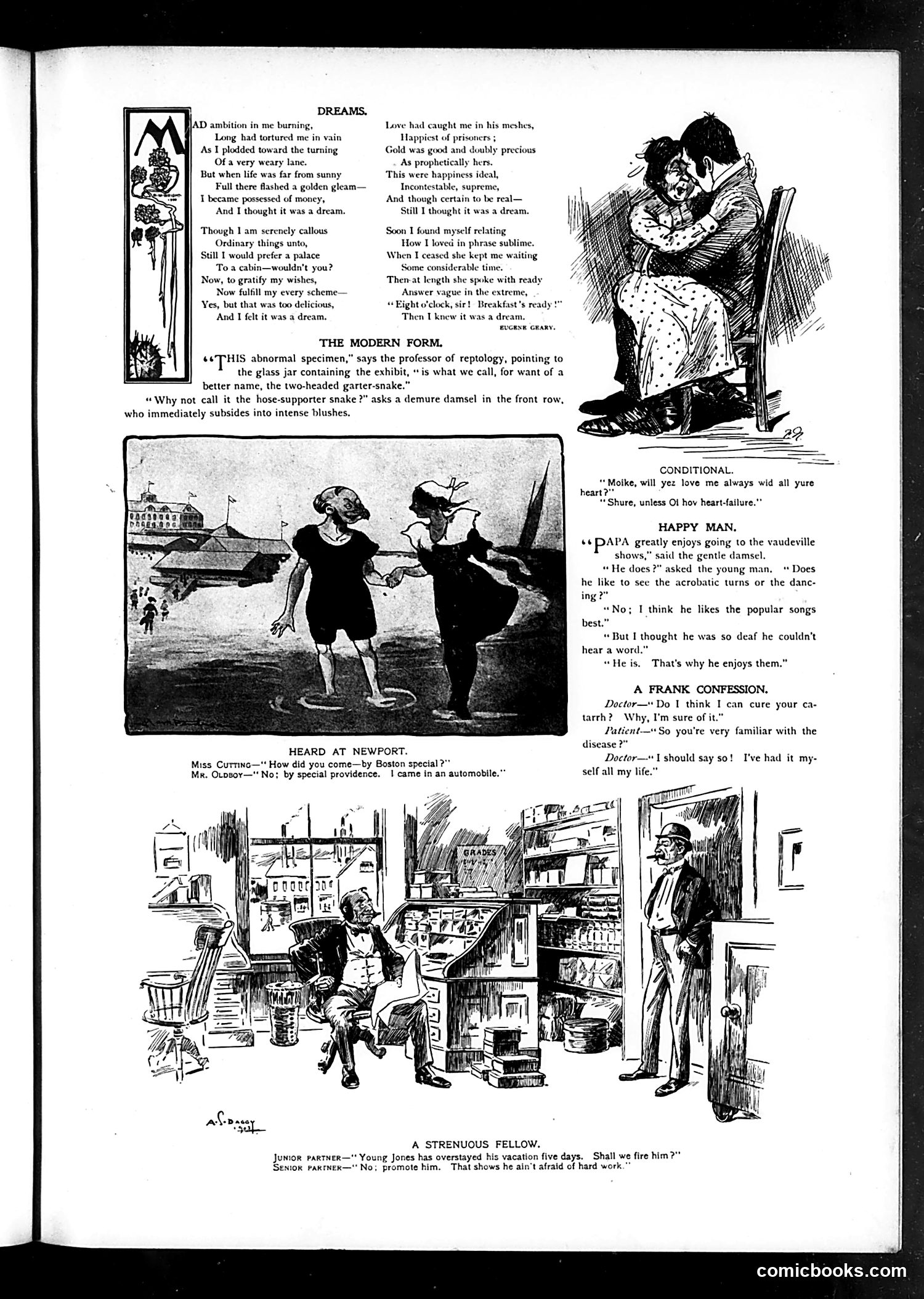
This page contains several unrelated satirical pieces typical of early 20th-century humor magazines: **"Dreams"** is a sentimental poem about ambition and love that ends with domestic deflation—the romantic reverie shatters when the beloved merely calls him to breakfast. **"The Modern Form"** jokes about a two-headed garter snake in a museum exhibit. A young woman's innocent suggestion that it be called a "hose-supporter snake" causes her to blush intensely—the humor relies on the double meaning of "supporter" (undergarment reference), considered risqué for the era. **"Heard at Newport"** satirizes wealthy Newport society, where a woman asks how another arrived; the answer mocks the nouveaux riches by suggesting even "special providence" couldn't match arriving by automobile—then implying this is actually how she came, suggesting ostentatious wealth. The remaining items are brief humorous dialogues about deaf fathers enjoying vaudeville, a doctor's frank admission of familiarity with catarh, and an employer promoting rather than firing an employee to prove he's hardworking.
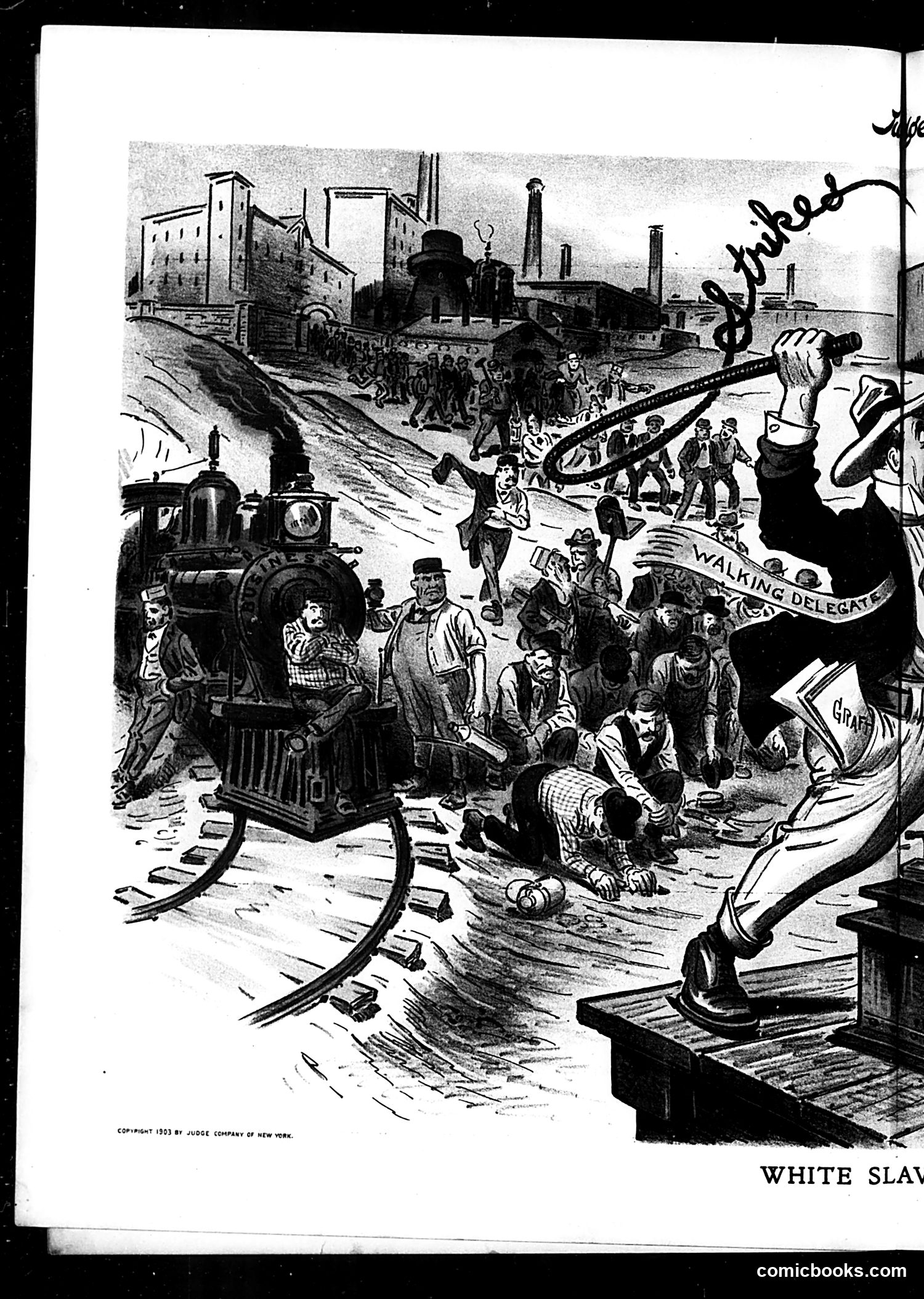
This appears to be a satirical cartoon from Judge magazine (copyright 1923) addressing labor exploitation in industrial America. The image depicts a steam locomotive and factory setting crowded with working-class men and women, some appearing injured or distressed on the ground. The title "WHITE SLAV[ERY]" references a contemporary Progressive Era concern about exploitative working conditions in American factories and railroads—comparing harsh labor practices to slavery. The "walking delegate" banner suggests this may critique labor organization or union activity. The cartoon likely satirizes either dangerous industrial conditions or labor disputes of the period, arguing that American workers faced conditions comparable to slavery despite their legal freedom. The specific historical event or labor dispute referenced remains unclear without additional context.
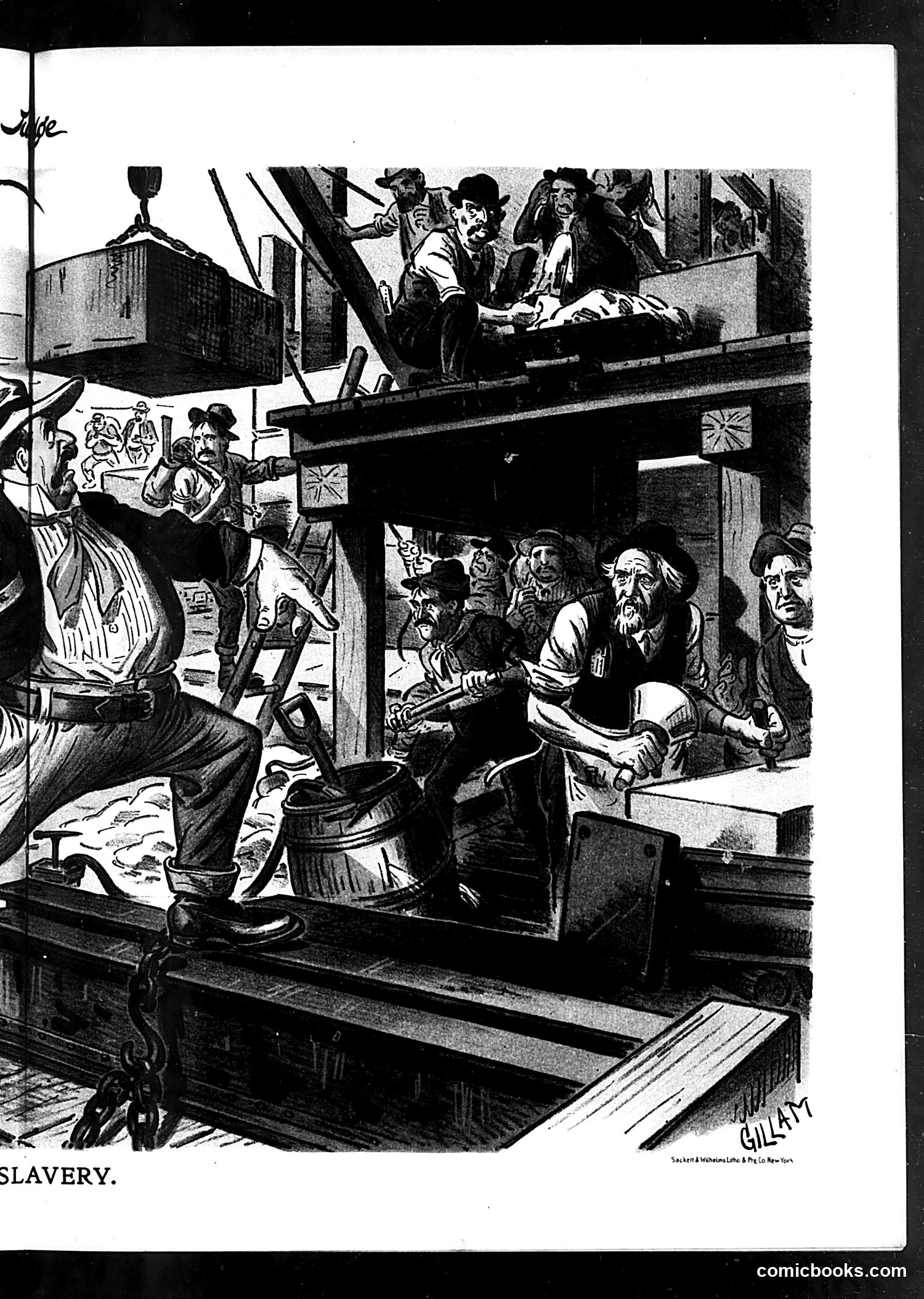
This political cartoon depicts the slave trade, showing enslaved people being loaded onto a ship through brutal force. The artist uses grotesque caricatures and exaggerated features common to 19th-century satirical depictions of this era. The scene shows a dock operation where enslaved individuals are being processed—some already chained below deck, others being forcibly loaded by overseers. Armed figures supervise the horrific operation. The cartoon's satirical purpose appears to be social criticism of slavery itself, though the execution reflects the racist visual conventions of Judge magazine's era. The "SLAVERY" caption confirms the subject matter. Without additional context about the publication date, the specific historical moment being critiqued (abolitionism, politics, etc.) remains unclear from the image alone.
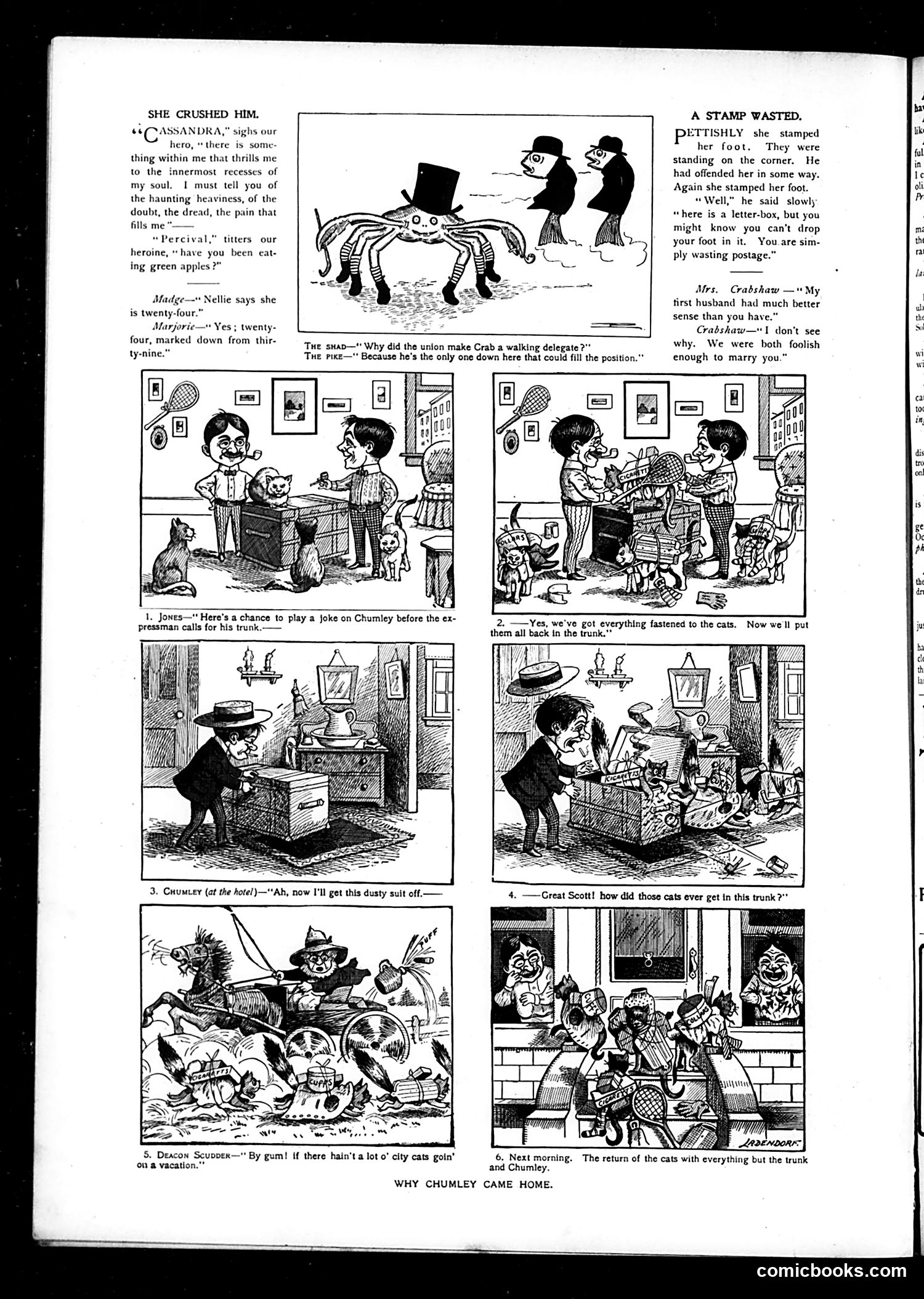
This is a humorous comic strip sequence about a man named Chumley whose cats escape during a vacation. The narrative follows him preparing to travel (panels 1-3), discovering his trunk full of cats (panel 4), and returning home the next morning with the cats but without the trunk (panel 6). The humor relies on slapstick and domestic absurdity rather than political satire. The accompanying jokes on the page are simple romantic and marital quips typical of early 20th-century humor magazines—including a woman rejecting a suitor's emotional declaration by suggesting he ate green apples, and a wife comparing her current husband unfavorably to her first husband. The "Crab as walking delegate" joke references union labor terminology. Overall, this appears to be lighthearted entertainment content rather than satirical commentary.
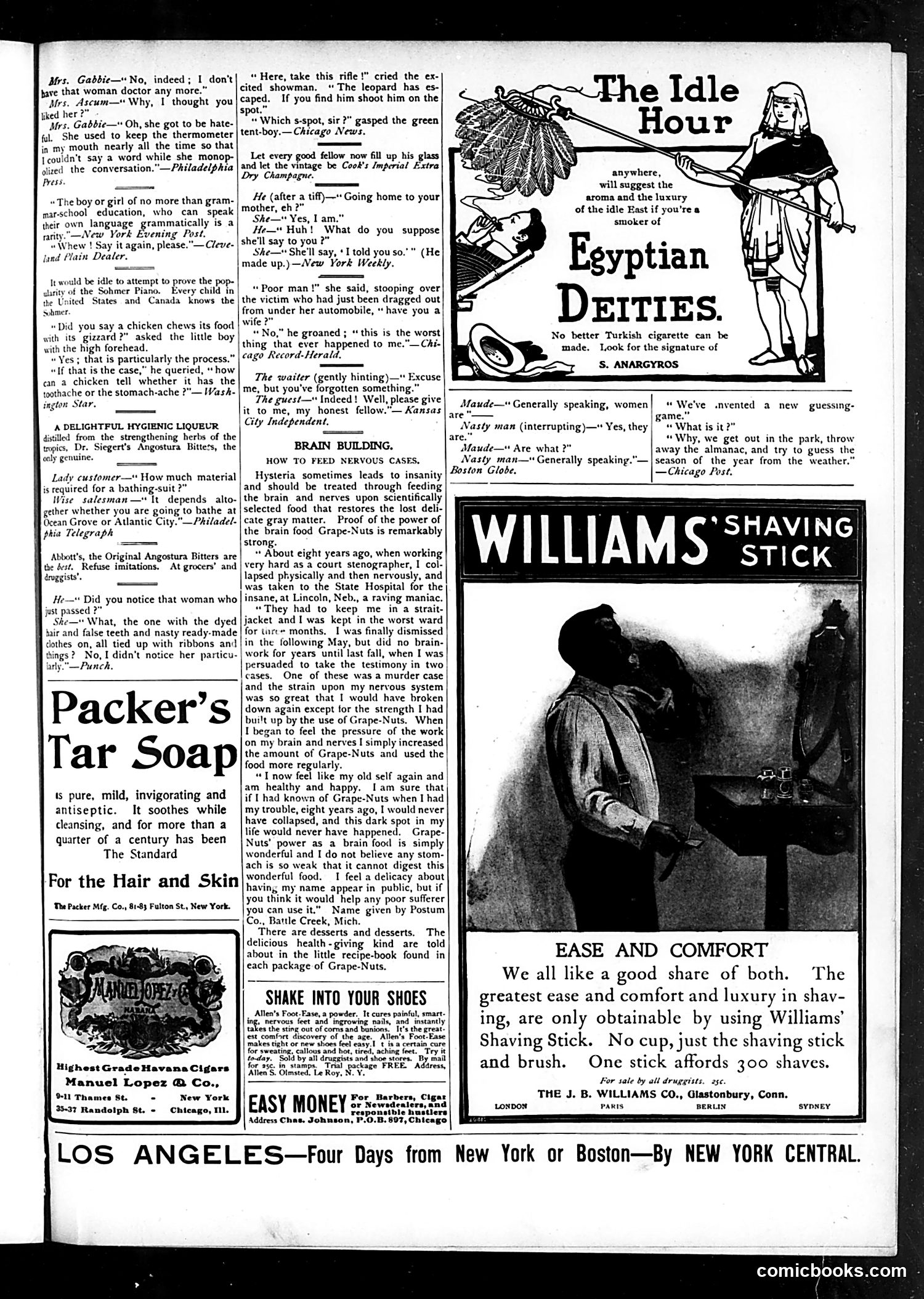
This page from the satirical magazine Judge contains primarily **advertisements and humorous short anecdotes** rather than political cartoons. The small jokes mock social conventions of the era: one depicts a woman pleased to fire her female doctor because the physician kept the thermometer in her mouth, preventing her from monopolizing conversation—satirizing both gossipy women and emerging female professionals. Another features a child's literal-minded question about whether a chicken can distinguish toothache from stomach-ache if it chews with its gizzard—poking fun at childish logic. The advertisements (Packer's Tar Soap, Williams' Shaving Stick, Havana cigars) dominate the layout. Notably, a testimonial for Grape-Nuts cereal claims it cured a man's insanity—reflecting early-20th-century pseudoscientific beliefs about nutrition's power to treat mental illness. The page reflects Judge's lighter, commercial nature during this period, mixing mild social satire with consumer marketing rather than sharp political commentary.
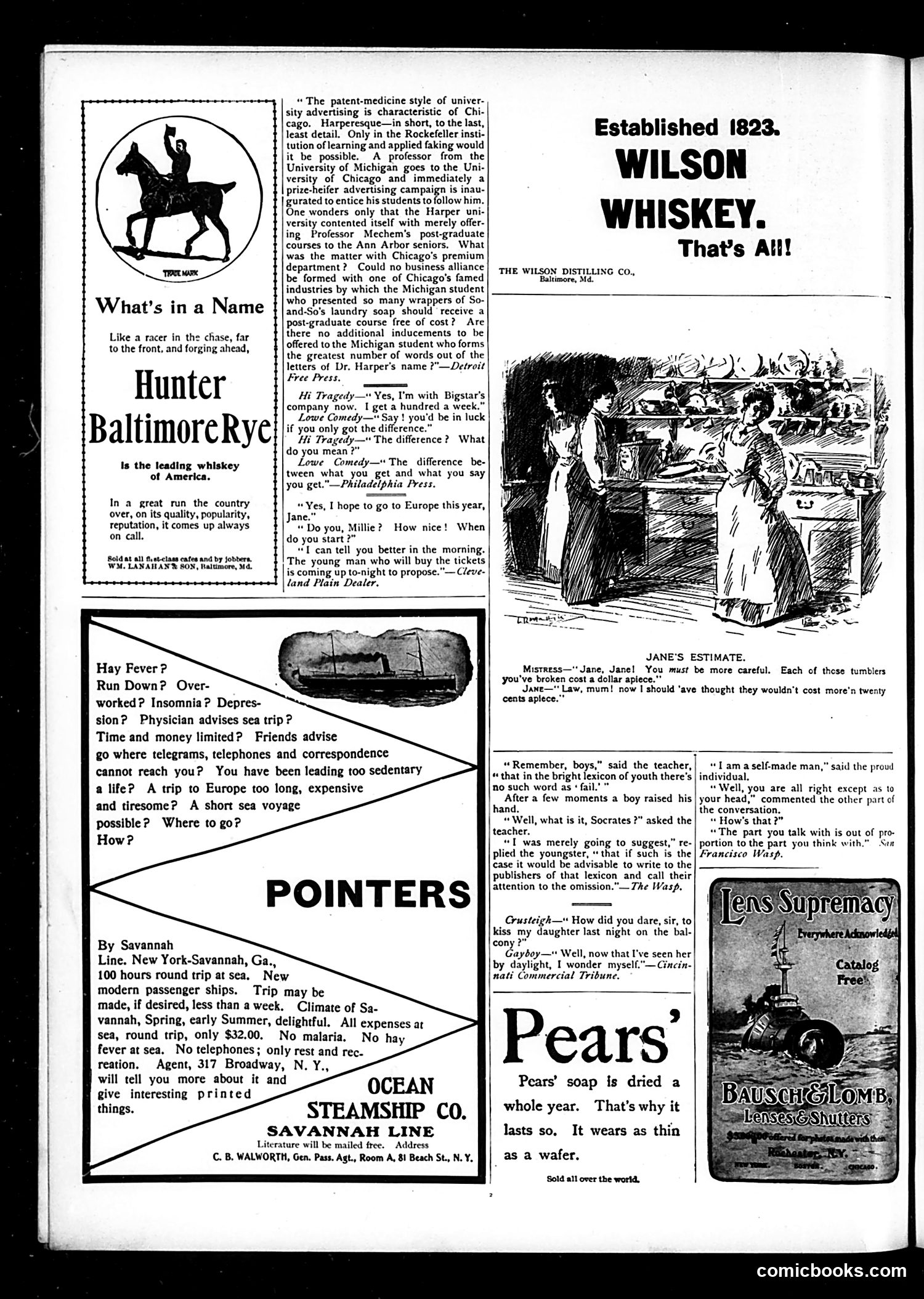
This page from Judge magazine contains primarily **advertisements and brief humor pieces** rather than political cartoons requiring historical context. The main content includes: **Advertisements:** Hunter Baltimore Rye whiskey, Wilson Whiskey, Ocean Steamship Company (Savannah Line), Pears' soap, and Bausch & Lomb lenses. **Humor pieces:** Short jokes about theater courtship, the difference between "hi tragedy" and "low comedy," and a schoolboy's clever response to a teacher about the word "fail." **One substantive satirical piece** criticizes the **University of Chicago's advertising practices**—comparing their recruitment of a Michigan professor to "patent-medicine" marketing tactics. The critique suggests the Rockefeller-funded institution used undignified commercial methods (like soap wrapper contests) to attract students, contrasting unfavorably with traditional academic gravitas. The satire targets **turn-of-century university commercialism** and Chicago's aggressive, business-minded educational approach. The referenced "Dr. Harper" likely means William Rainey Harper, Chicago's founding president known for aggressive expansion.
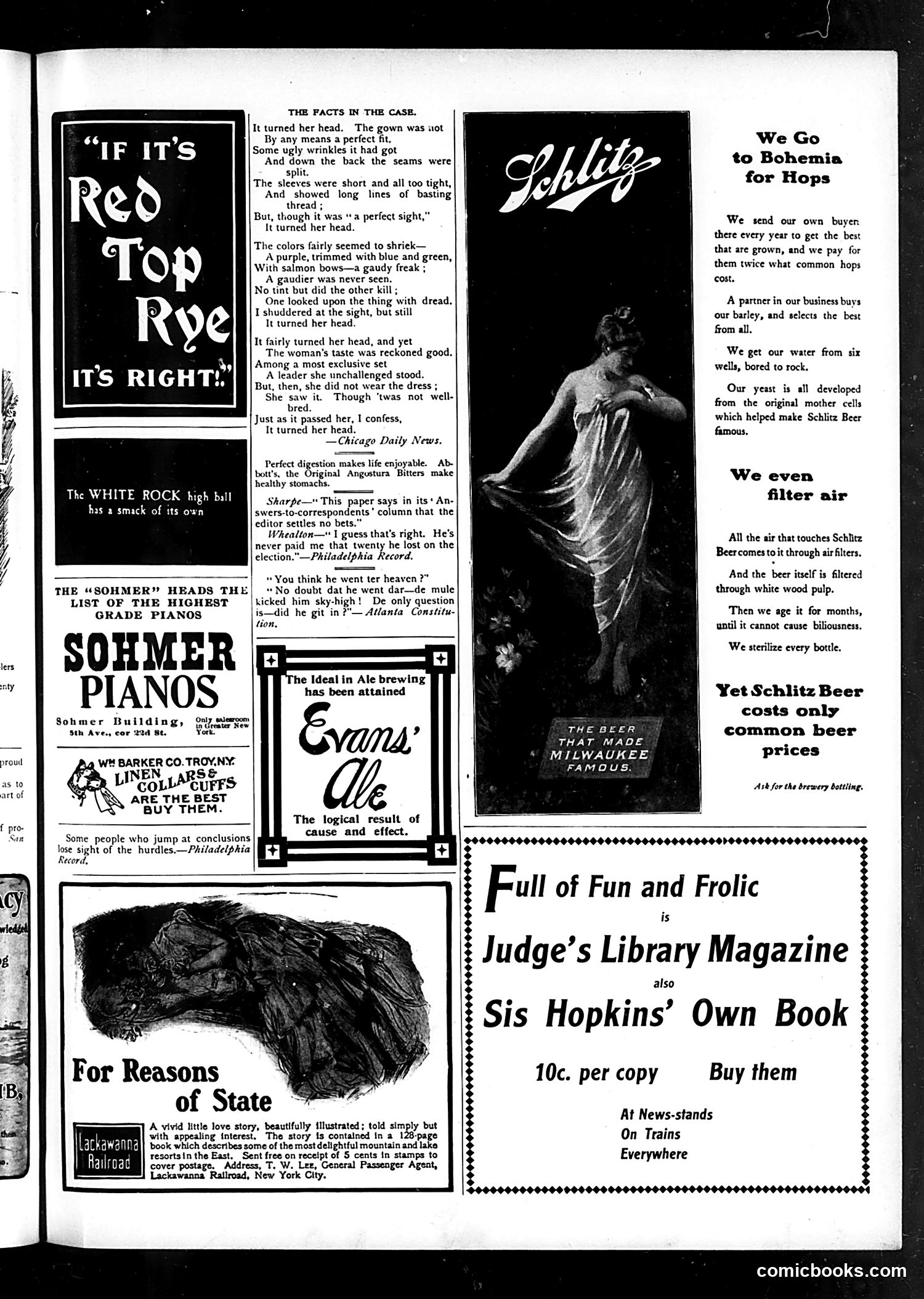
This page is primarily **advertising**, with one notable satirical poem. The main humorous content is "**The Facts in the Case**"—a poem about a woman of supposedly refined taste who is captivated by a hideously ugly dress. The satire targets **social hypocrisy and fashion vanity**: despite being "a leader" in an "exclusive set" known for good taste, she's momentarily mesmerized by a garish, poorly-made gown with clashing colors (purple, blue, green, salmon), poor construction, and unflattering fit. The joke is that even the most socially-superior person can be fooled by appearance. The remaining content consists of period advertisements for **Red Top Rye whiskey, Sohmer pianos, White Rock beverages, Schlitz Beer, Evans Ale, Barker Collars, and publications** like *Judge's Library Magazine*. The Schlitz ad notably emphasizes quality control—their Bohemian hops, filtered water, aged beer, and sterilization—suggesting beer quality was a competitive marketing concern of the era.
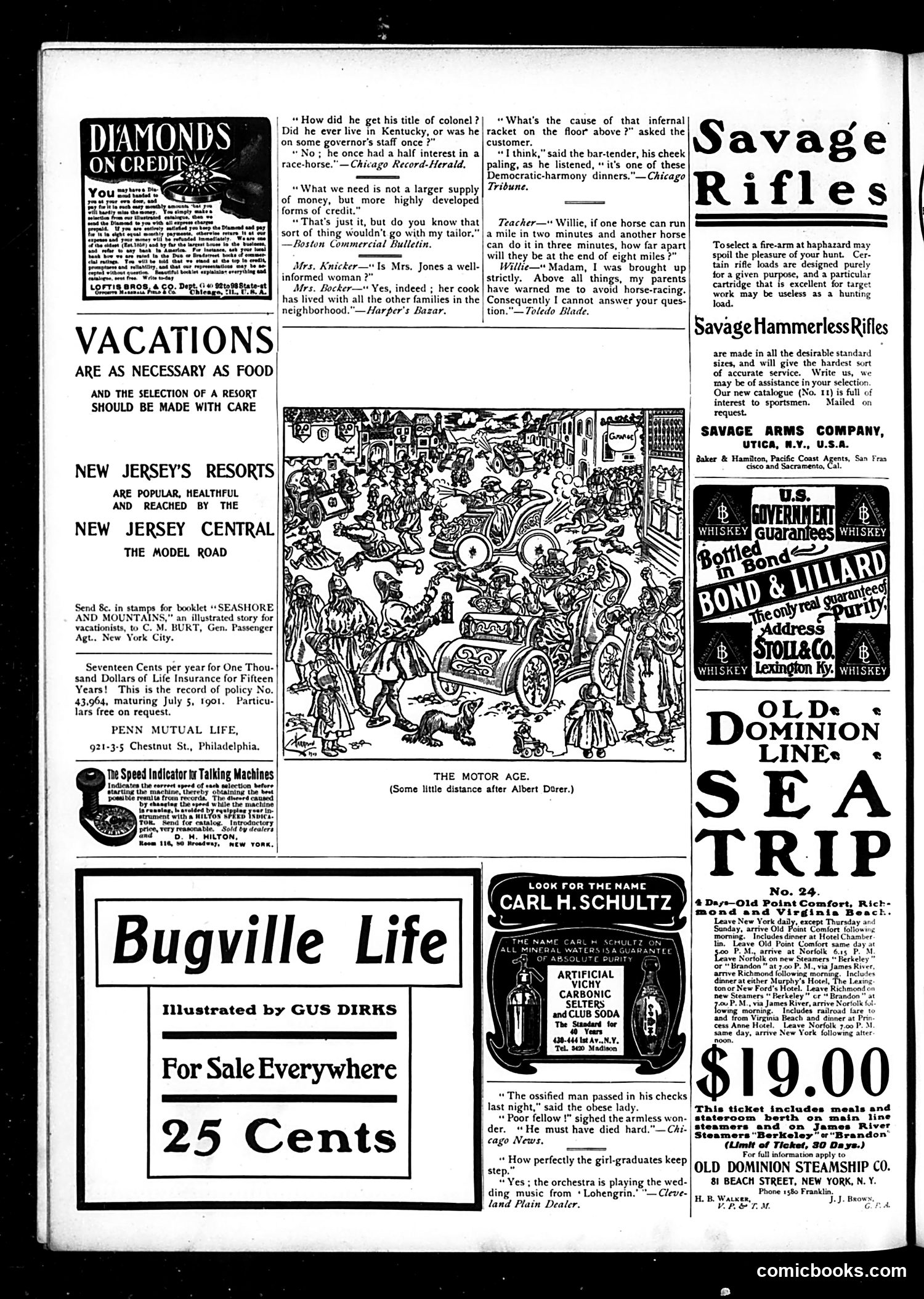
This page is primarily **advertising**, with several brief joke excerpts scattered throughout. The main satirical content consists of short, standalone jokes rather than developed cartoons: **Key jokes and their context:** 1. A colonel obtains his title from owning a horse—satirizing how Americans awarded military honorifics based on tenuous credentials rather than actual service. 2. A quip about "Democratic-harmony dinners" causing noise—likely referencing internal Democratic Party tensions around 1901. 3. A boy refusing to answer a math problem involving horse-racing because his parents warned him against horse-racing—gentle satire of overly cautious parenting. 4. References to "ossified" performers and an "armless wonder" suggest circus/vaudeville acts of the era. The large center illustration titled "The Motor Age" appears to be a chaotic street scene, though its specific satirical point isn't clear from this reproduction. The page is dominated by period advertisements: life insurance, rifles, steamship travel, and "Bugville Life" comics—typical of Judge's revenue model.
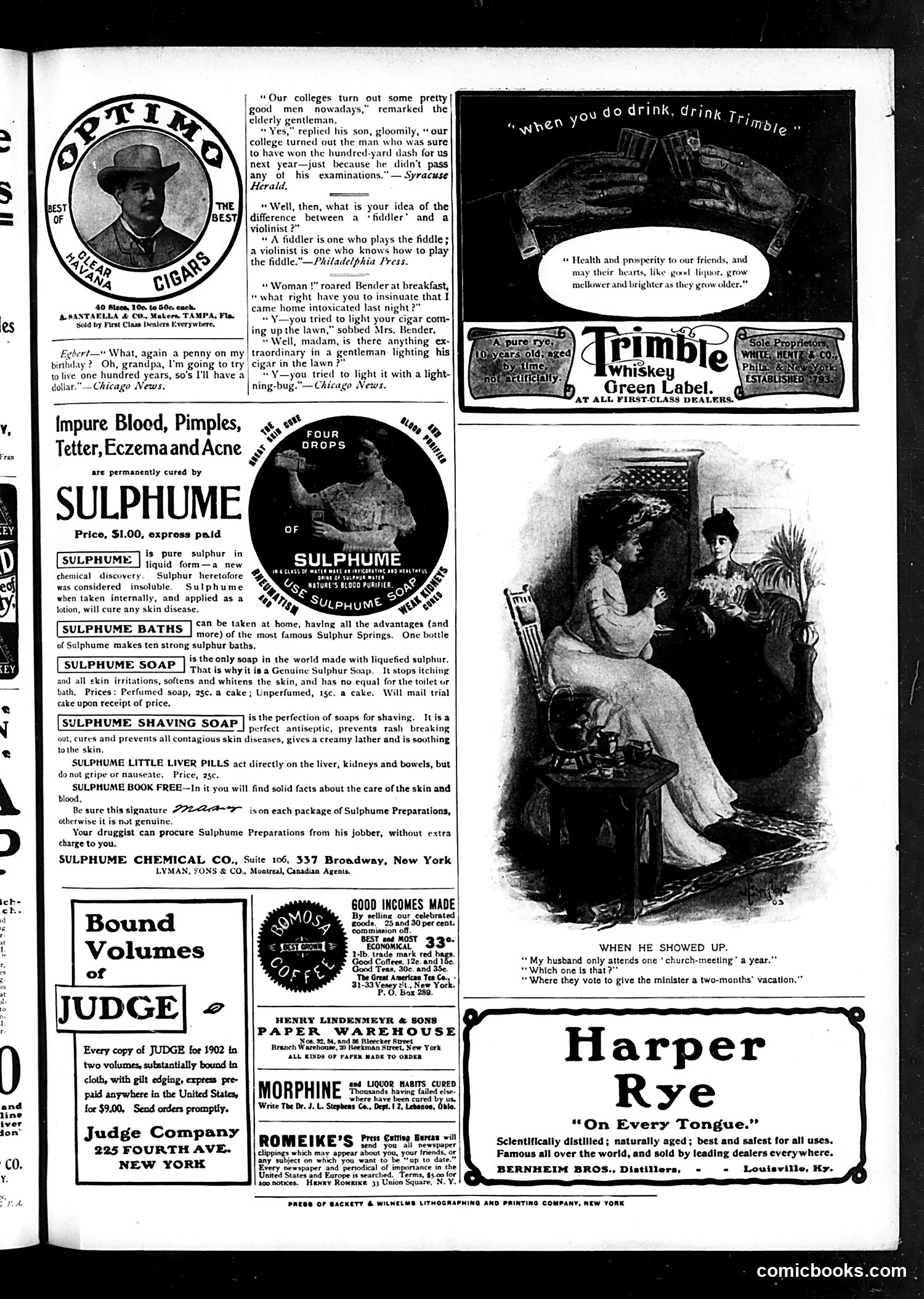
This page primarily contains **short humorous anecdotes** rather than political cartoons. The jokes satirize early-1900s American social life: 1. **College athletics vs. academics**: A son laments that his university expelled their best runner for failing exams—mocking tension between collegiate sports prestige and educational standards. 2. **Class pretension**: A distinction between "fiddlers" and "violinists" jokes about how the wealthy rebrand working-class musicians as "artists" through terminology alone. 3. **Drunk husband denies intoxication**: A man tries lighting his cigar on a firefly while his wife witnesses—satirizing male denial of obvious drunkenness and marital dynamics. The page is otherwise dominated by **period advertisements** for patent medicines (Sulphume for skin conditions), whiskey (Trimble), and other products typical of early 20th-century publications. The illustrated vignette shows a domestic scene labeled "When He Showed Up," supporting the drunk-husband joke theme.
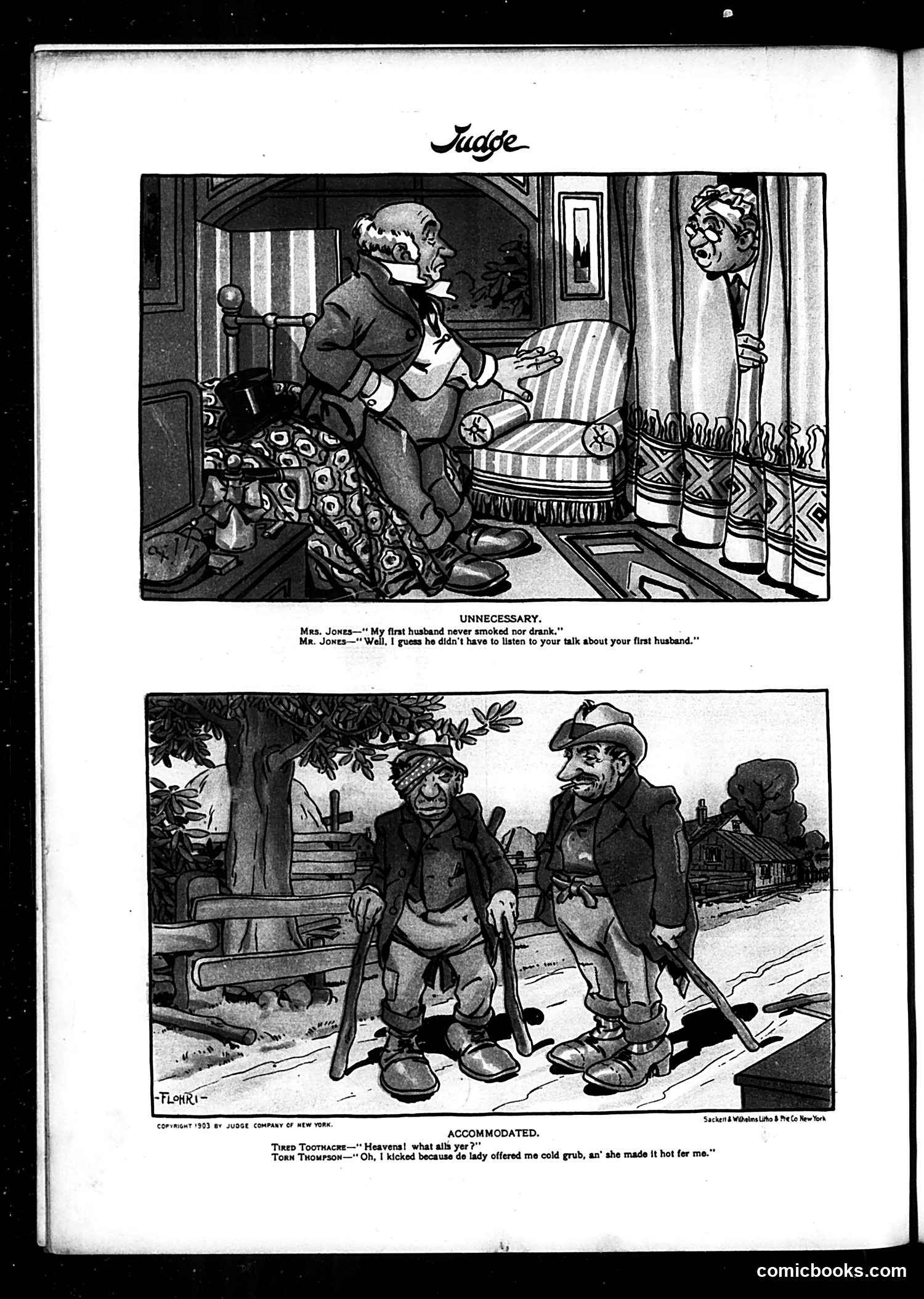
**Top Cartoon ("Unnecessary"):** A domestic humor joke about a nagging wife. Mrs. Jones repeatedly praises her first (deceased) husband's virtues—he didn't smoke or drink. Mr. Jones responds that her first husband didn't *need* those vices because he had to endure listening to her constant comparisons. The satire targets wives who idealize previous husbands, making current marriages miserable through unfavorable contrasts. **Bottom Cartoon ("Accommodated"):** A working-class comedic exchange. "Tine Toothache" complains to "Tom Thomson" about being kicked by a lady after he objected to cold food she served. Tom jokes that the lady "made it hot for" him—a pun meaning she punished him severely. The humor plays on the phrase "make it hot," exploiting the contrast between cold grub and hot consequences for his complaint. Both cartoons use domestic/class scenarios for period humor, relying on familiar social tensions between spouses and servants.