
A complete issue · 16 pages · 1903
Judge — July 11, 1903
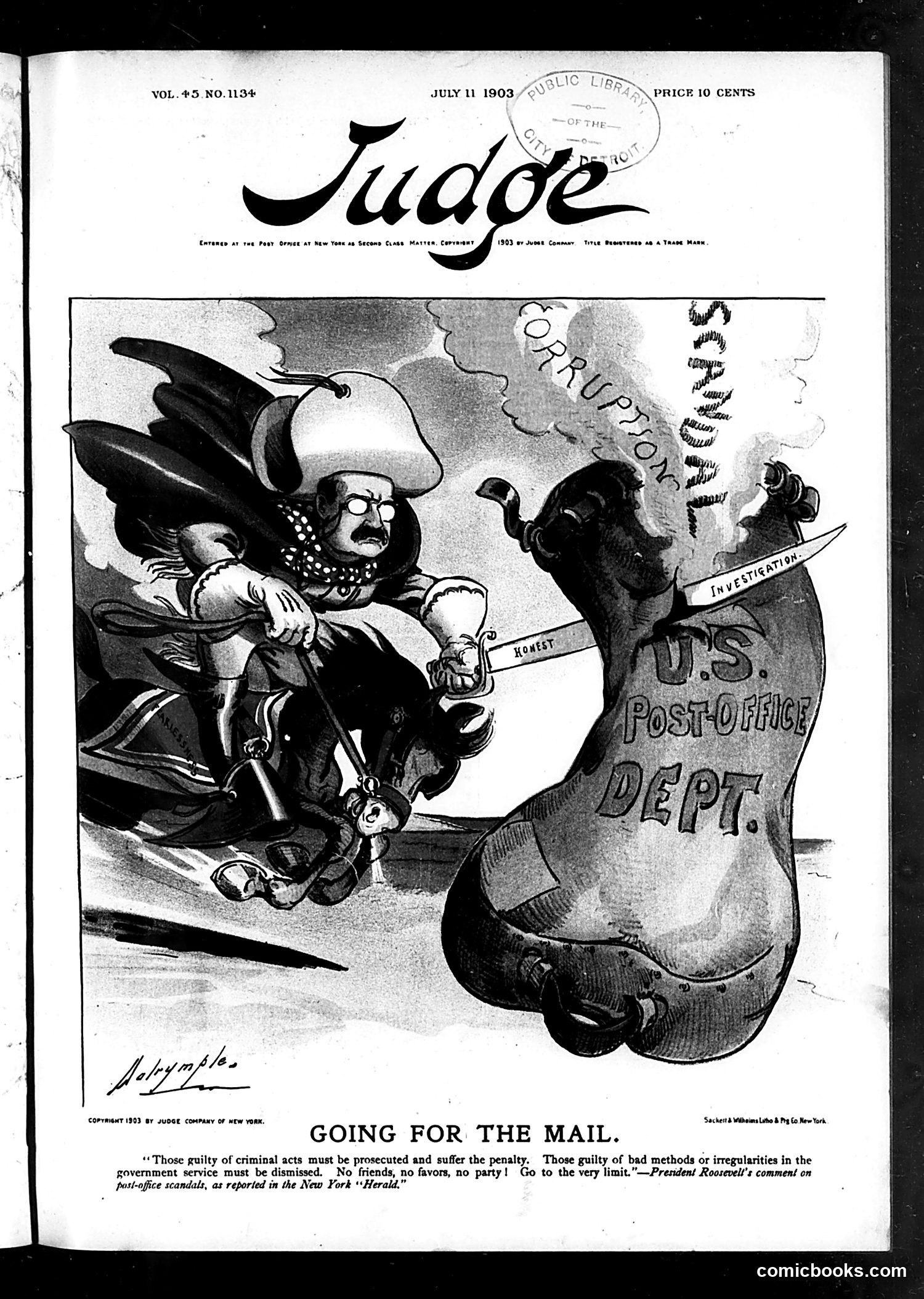
This political cartoon satirizes Post Office Department corruption scandals. A rotund figure labeled "U.S. Post Office Dept." pursues two fleeing characters—one labeled "Honest" and another representing "Corruption"—while holding banners reading "Investigation" and "Corruption." The cartoon illustrates President Roosevelt's quoted comment (below) about prosecuting criminal acts and bad methods in government service without favoritism. The imagery suggests the Post Office Department was chasing down dishonest practices, depicted as figures literally escaping. This references the Post Office scandals of the early 1900s, where mail contracts and mismanagement became a major corruption issue requiring Roosevelt's intervention and investigation.
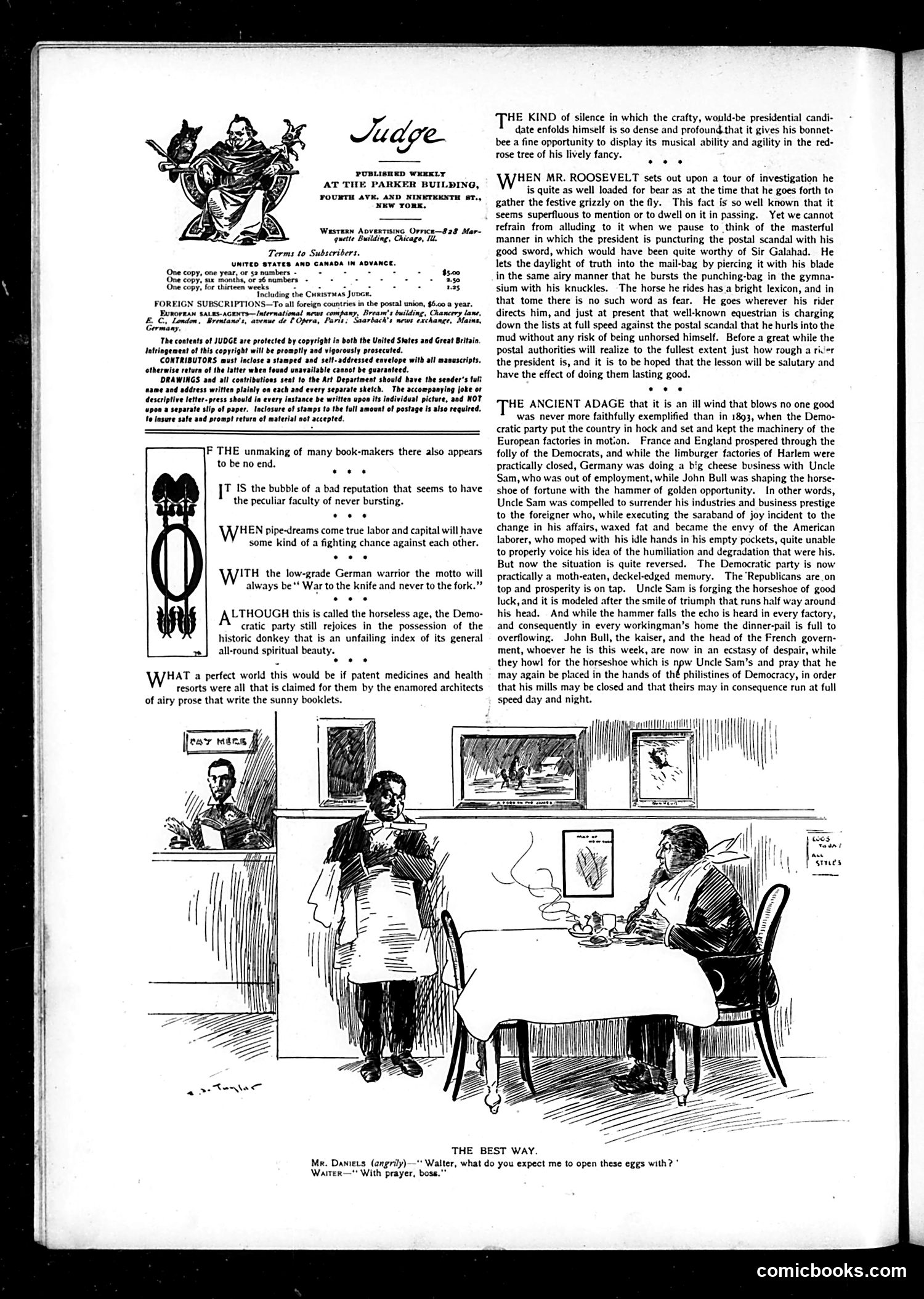
This cartoon satirizes early 20th-century class attitudes toward domestic service. A well-dressed man (labeled "Mr. Daniels") confronts his waiter with an impossible demand: "Walter, what do you expect me to open these eggs with?"—implying the eggs are served in their shells, unopened. The joke mocks the employer's deliberate rudeness disguised as bewilderment. The waiter's response—"With prayer, boss"—suggests that servants were expected to endure such humiliation with resigned acceptance, their only recourse being prayer. The cartoon critiques both the absurdity of upper-class pretension and the exploitation of working-class people, who had no realistic means to challenge such treatment beyond silent suffering or religious faith.
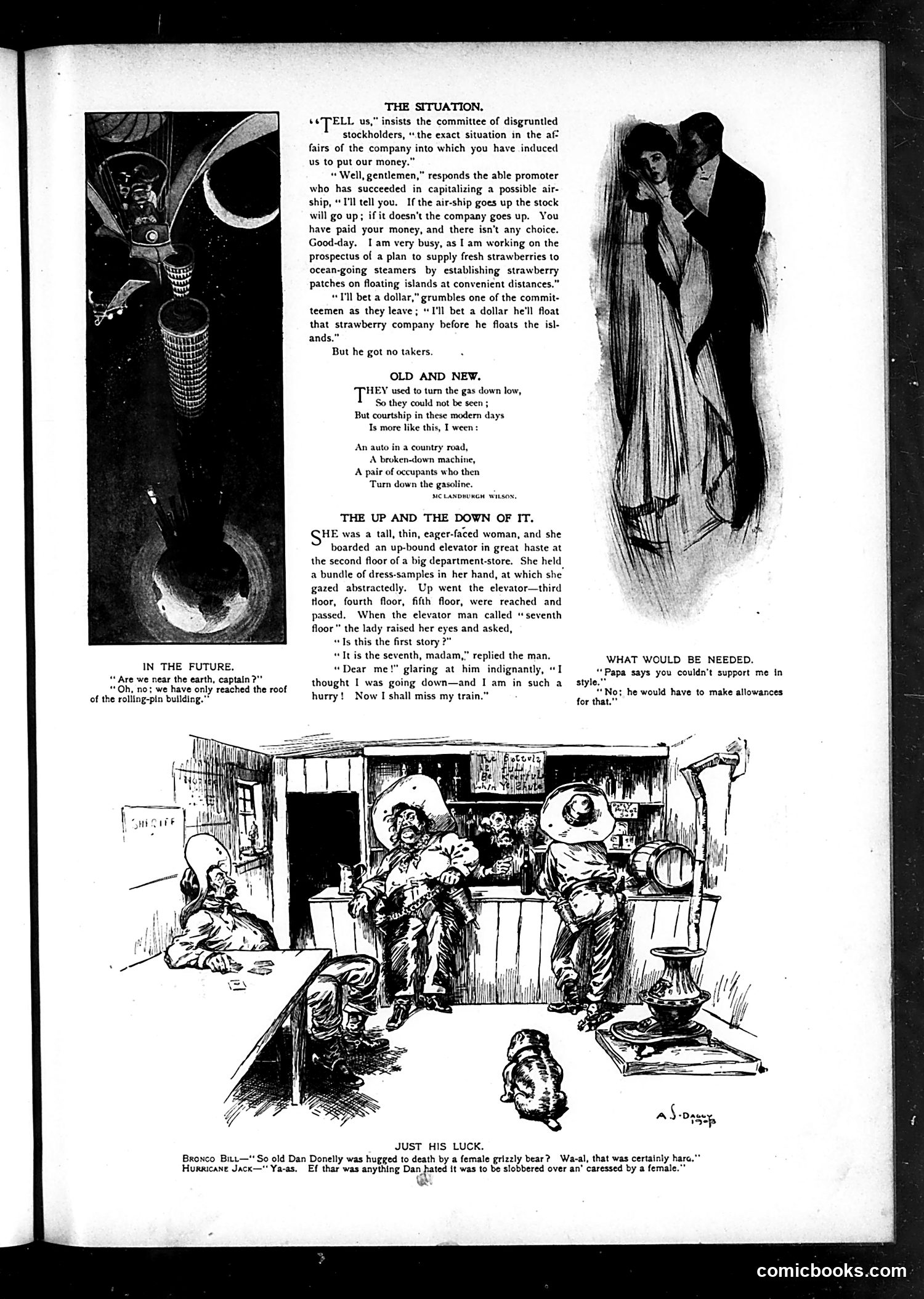
This page contains several satirical pieces targeting business and social issues of the era: **"The Situation"** mocks an air-ship promoter trying to convince skeptical stockholders to invest. The satire targets speculative business schemes promising fantastic returns (strawberry patches on floating islands) while offering no real guarantees—a common critique of early 20th-century stock promotions. **"Old and New"** presents a brief poem contrasting old-fashioned courage with modern mechanical reliance, reflecting period anxieties about industrialization. **"The Up and the Down of It"** satirizes an elevator operator's misunderstanding—a woman asks for the "seventh floor" but he thinks she said "seventh story," leading to a humorous mix-up about narrative versus building levels. **"In the Future"** appears to show a ship captain scene, likely satirizing aviation or exploration predictions. The overall tone critiques business fraud, technological anxiety, and class-based miscommunication.
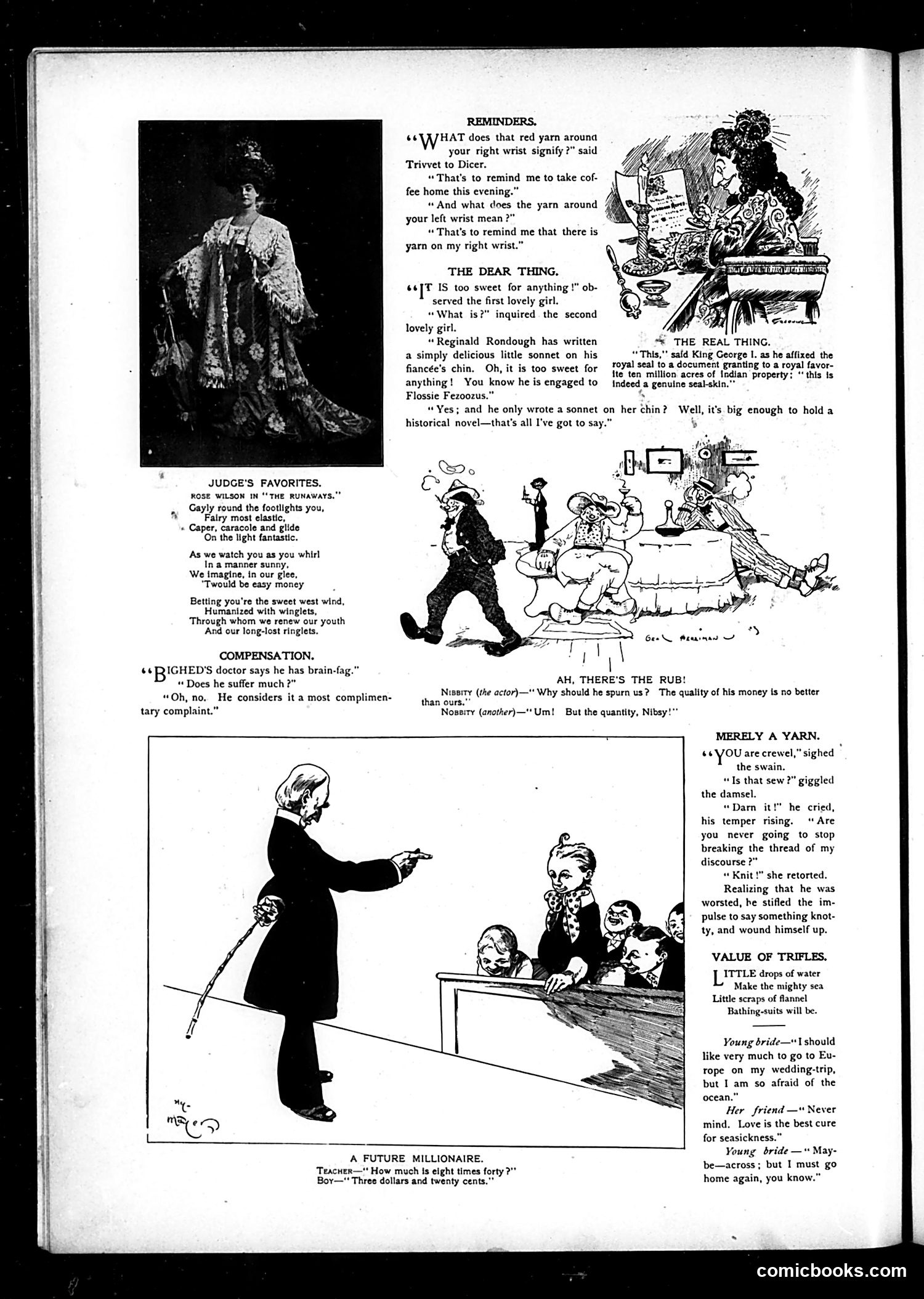
This page contains humorous anecdotes and light satirical sketches rather than political cartoons. The content includes: **"Reminders"** - A joke about yarn tied around wrists as memory aids, playing on domestic forgetfulness. **"The Dear Thing"** - A society joke about Reginald Rondough writing sonnets for his fiancée, mocking literary pretension among the wealthy. **"Judge's Favorites"** - Verse celebrating leisure activities (foxhunting, yachting, golf). **"A Future Millionaire"** - A classroom joke about monetary values. **"Merely a Yarn"** - A domestic quarrel story involving sewing. The cartoons depict everyday middle-class and upper-class domestic life with gentle humor. There's no identifiable political content—this represents Judge's lighter, society-focused humor rather than hard satire of specific public figures or events.
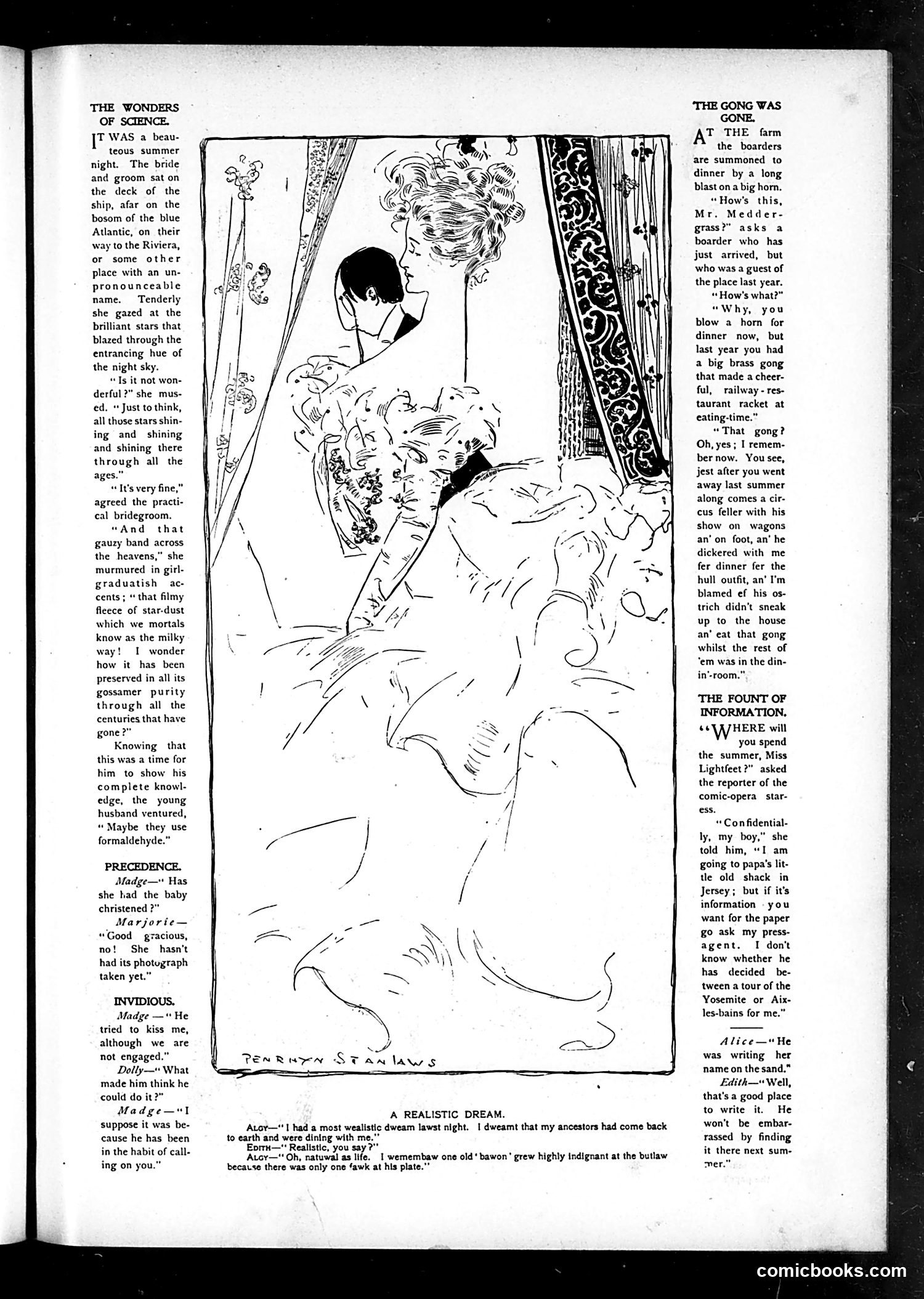
This page contains five brief humorous pieces typical of early 20th-century American magazine satire: **"The Wonders of Science"**: A newlywed couple on a ship. The bride romantically ponders the stars and Milky Way; her practical husband suggests they're preserved with "formaldehyde"—a darkly absurd joke mocking the gap between romantic idealism and scientific materialism. **"Precedence" and "Invidious"**: Quick one-liners about social hierarchies. A woman prioritizes photographing her baby over christening it (vanity over tradition). A man's kiss attempt is attributed to habit from calling on someone else. **"The Gong Was Gone"**: A farmhouse keeper explains his dinner gong disappeared when a circus ostrich ate it—obvious nonsense humor playing on rural gullibility. **"The Fount of Information"**: A theater reporter asks where a comic-opera actress will summer; she deflects all personal questions to her press agent, satirizing celebrity publicity machinery. All rely on period-specific social attitudes and simple wordplay rather than complex political commentary. The satire targets romantic pretension, social climbing, and emerging celebrity culture.
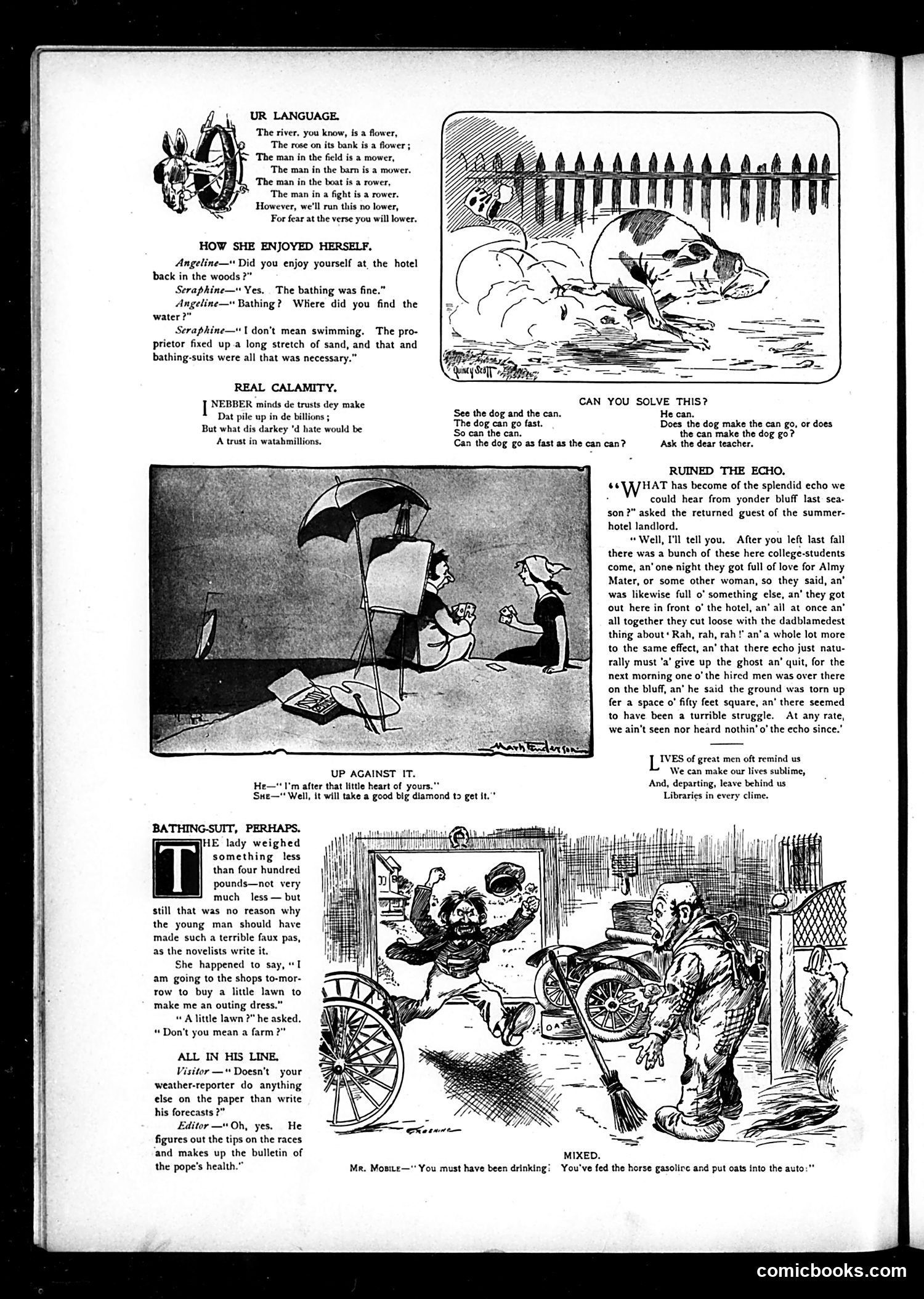
This page contains multiple satirical pieces typical of early 20th-century humor: **"Ur Language"** is a lighthearted wordplay poem exploiting homophones (flower/flour, mower/mower, rower/rower). **"How She Enjoyed Herself"** jokes about a resort that offered only sand-bathing instead of water—satirizing false advertising or rustic accommodations marketed as luxurious. **"Real Calamity"** features a dialect joke (appearing to use stereotypical African American speech patterns common to period humor) contrasting massive financial trusts with personal frustrations—typical satirical comparison of scale. **"Ruined the Echo"** humorously blames rowdy college students' celebratory shouting for literally destroying an echo—absurdist rural comedy. **"Bathing-Suit, Perhaps"** mocks a young man's tactless suggestion that a large woman needs a "farm" rather than a "lawn" for her dress fabric—slapstick social embarrassment humor. **"All in His Line"** satirizes a newspaper weather-reporter who also fabricates horse-racing tips and papal health bulletins—mocking journalistic unreliability. The page reflects period standards and prejudices alongside common humor tropes.
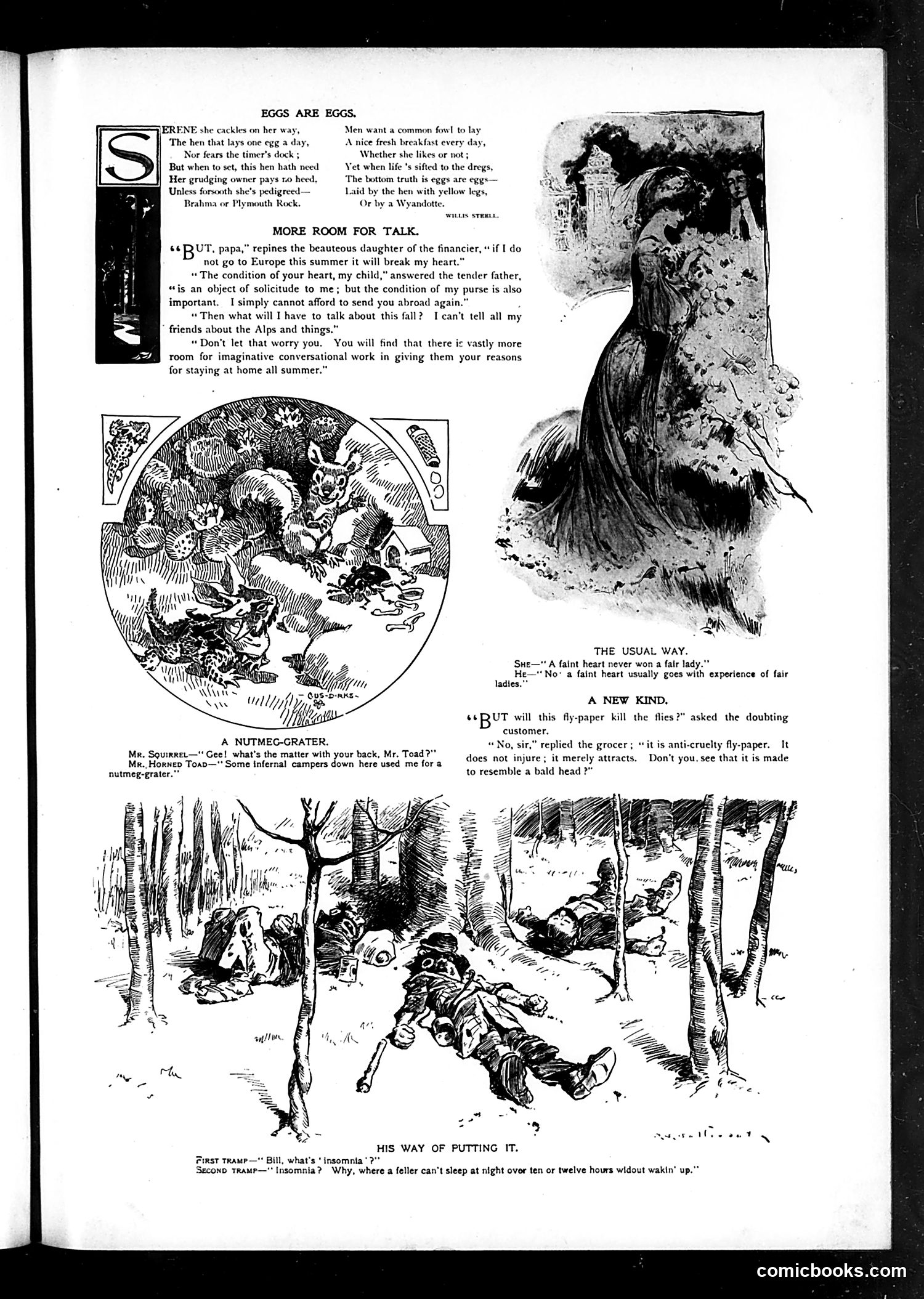
This page contains multiple humorous vignettes satirizing early 20th-century American society: **"Eggs Are Eggs"** (top): A poem mocking class pretension about poultry. The joke: wealthy people obsess over pedigree chicken breeds (Brahmas, Wyandottes), but ultimately, eggs from any hen are functionally identical. This satirizes social climbing and the absurd value placed on status symbols. **"More Room for Talk"**: A financier refuses his daughter's European travel demand due to expense. She complains she'll have nothing to discuss with friends. He suggests she invent excuses instead—satirizing wealthy daughters' superficial concerns and their reliance on travel for conversation material. **"The Usual Way"** and **"A New Kind"**: Brief comedic exchanges about courtship and a novelty "anti-cruelty" flypaper shaped like a bald head—gentle absurdist humor. **"His Way of Putting It"**: Tramps debate insomnia's meaning, with one defining it as inability to sleep for "ten or twelve hours"—mocking vagrant perspectives on rest. The cartoons collectively mock wealth, pretension, and class anxieties typical of Judge's satirical approach.
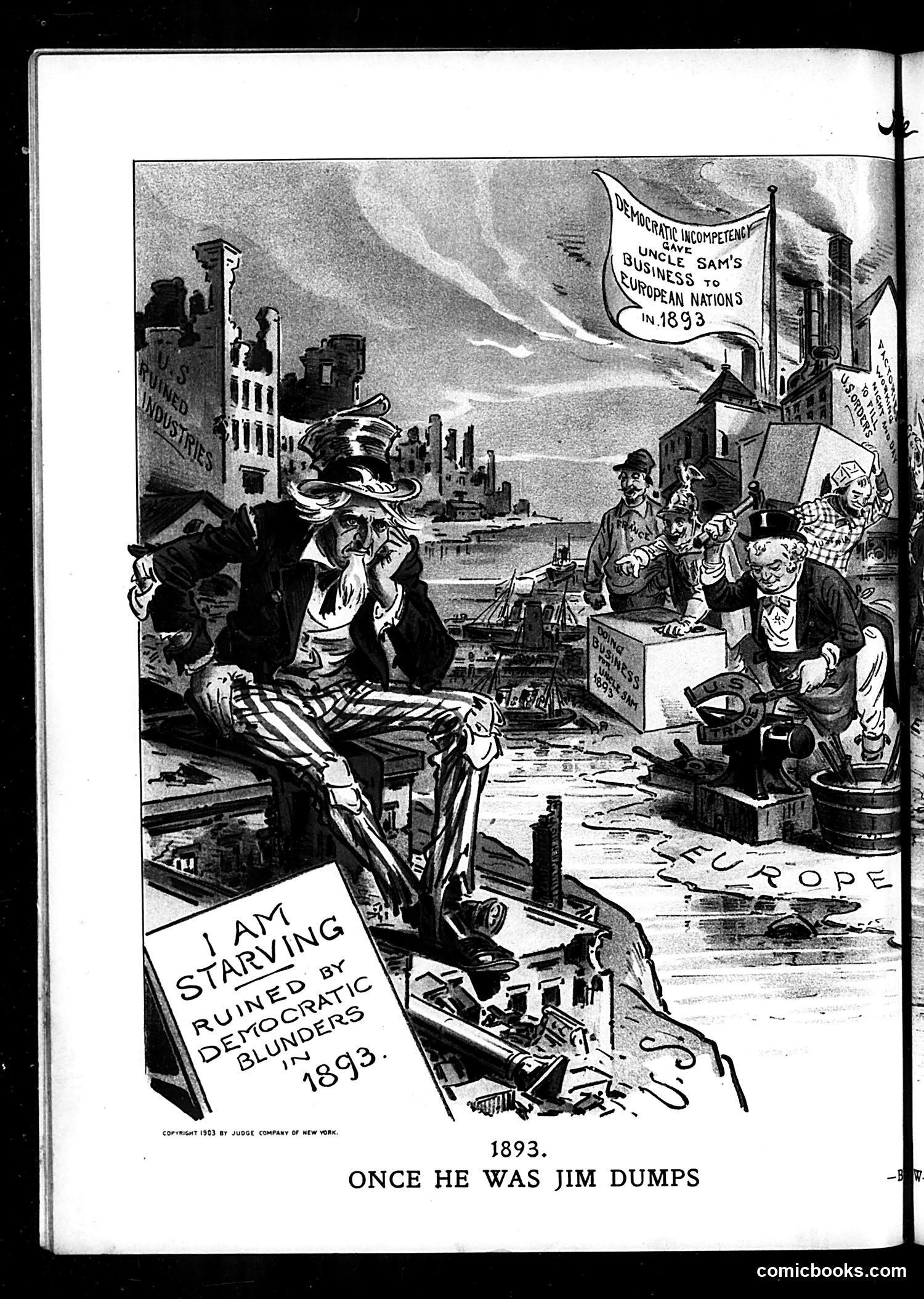
This Judge magazine cartoon satirizes Uncle Sam's perceived incompetence in foreign policy circa 1893. Uncle Sam sits starving and disheveled in the foreground, labeled "I AM STARVING RUINED BY DEMOCRATIC BLUNDERS 1893." He's surrounded by European nations (identifiable by their flags and period dress) who appear to be profiting from American mismanagement, one holding a banner reading "DEMOCRATIC INCOMPETENCY OF UNCLE SAM'S BUNGLED EUROPEAN NATIONS IN 1893." The cartoon blames the Democratic administration (likely Cleveland's) for economic and diplomatic failures, contrasting Uncle Sam's former prosperity ("Jim Dumps") with his current decay. The industrial cityscape burning in the background emphasizes economic distress, probably referencing the 1893 financial panic.
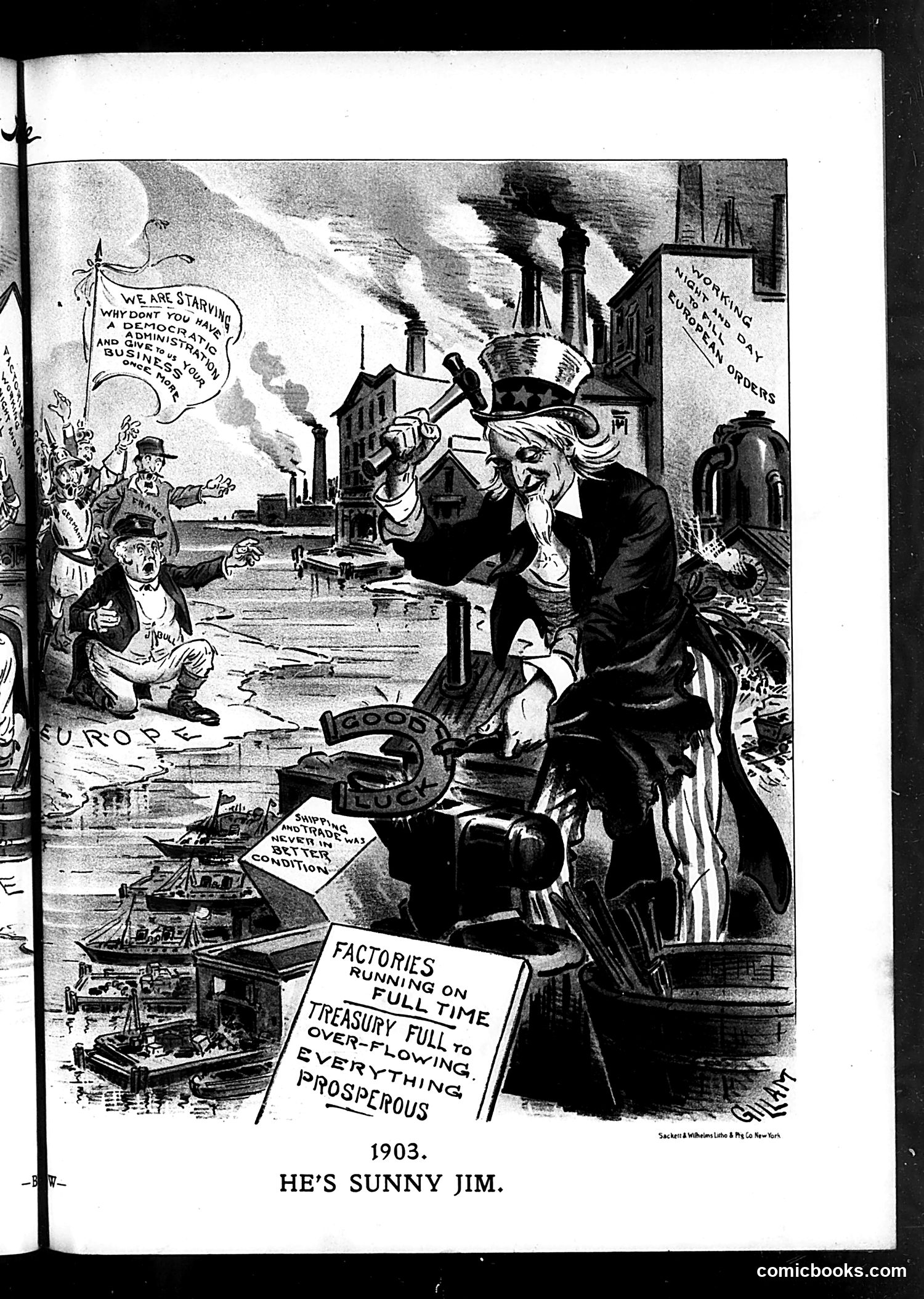
This political cartoon satirizes an optimistic government official—likely President Theodore Roosevelt, given the 1903 date and the nickname "Sunny Jim." The central figure, depicted as a cheerful, pipe-smoking man, ignores starving workers on the left while presiding over industrial prosperity. The cartoon's irony is sharp: while factories run at full capacity and the treasury overflows, workers literally starve. Signs reading "Factories Running on Full Time" and "Treasury Full to Overflowing" contrast bitterly with the speech bubble asking why people don't support "Democratic Administration"—suggesting the government claims credit for prosperity while ignoring economic suffering. The drowning figures and industrial smokestacks emphasize that wealth concentration masks widespread poverty, a common Progressive-era critique of unchecked capitalism.
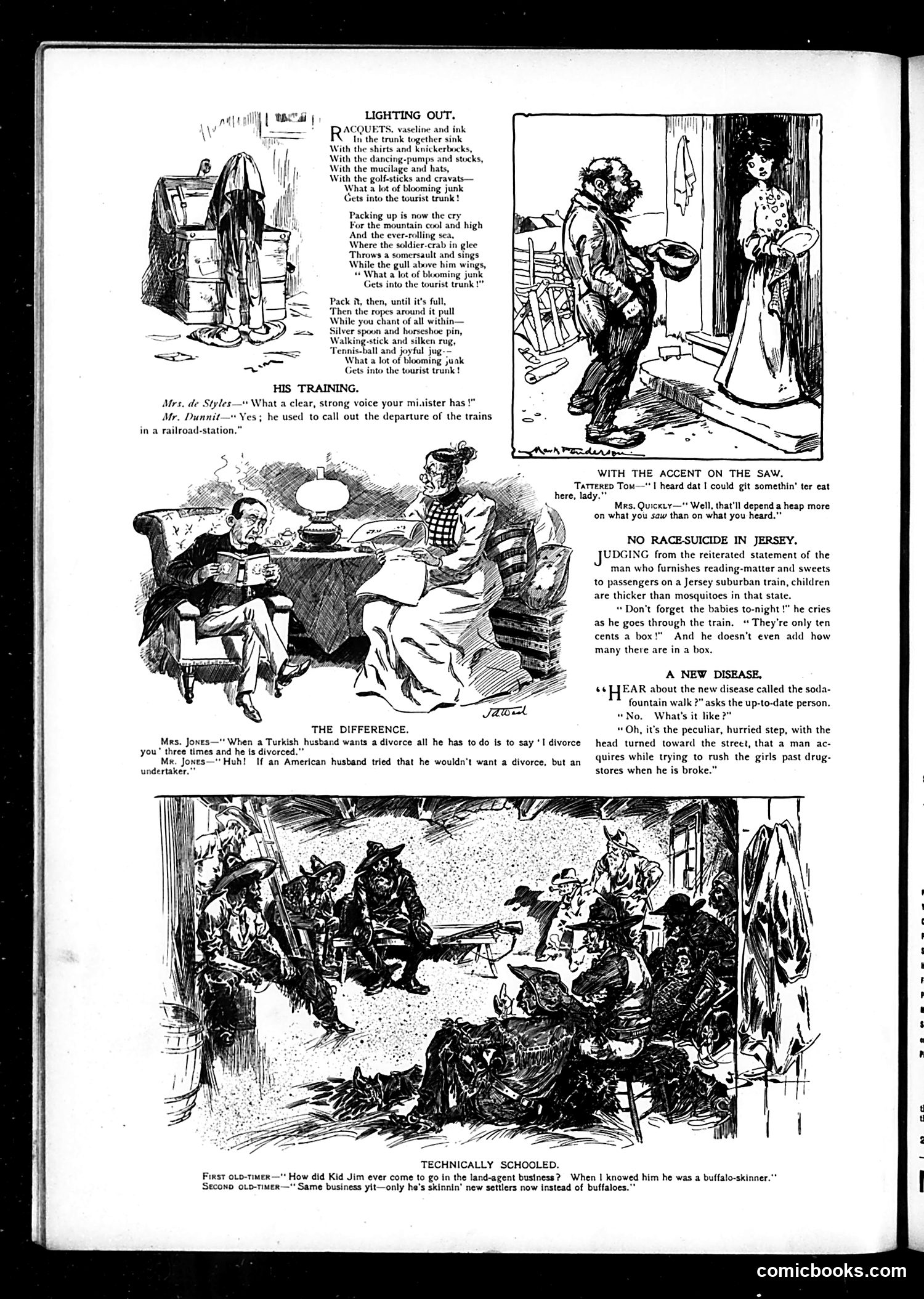
This page contains multiple satirical jokes and cartoons typical of early 20th-century American humor: **"Lighting Out"** is a humorous poem about packing for vacation, mocking tourists who overstuff their trunks with unnecessary items. **"His Training"** jokes that a minister's clear voice comes from his previous job calling train departures—mocking both clergy and railroad workers. **"With the Accent on the Saw"** plays on a vagrant's dialect, suggesting what matters isn't what he *heard* about food availability but what he can *saw* (steal/obtain). **"No Race-Suicide in Jersey"** satirizes a train candy vendor's claim that babies are cheap ("ten cents a box"), mocking both aggressive salesmanship and concerns about declining birth rates among certain populations. **"A New Disease"** lampoons the "soda-fountain walk"—a hurried gait young men adopted while chasing girls past drugstores without money. **"The Difference"** contrasts Turkish divorce customs with American marriage, suggesting an American husband attempting similar tactics would face murder charges from his wife. **"Technically Schooled"** jokes that a former buffalo-skinner became a land agent still "skinning" (swindling) settlers instead.
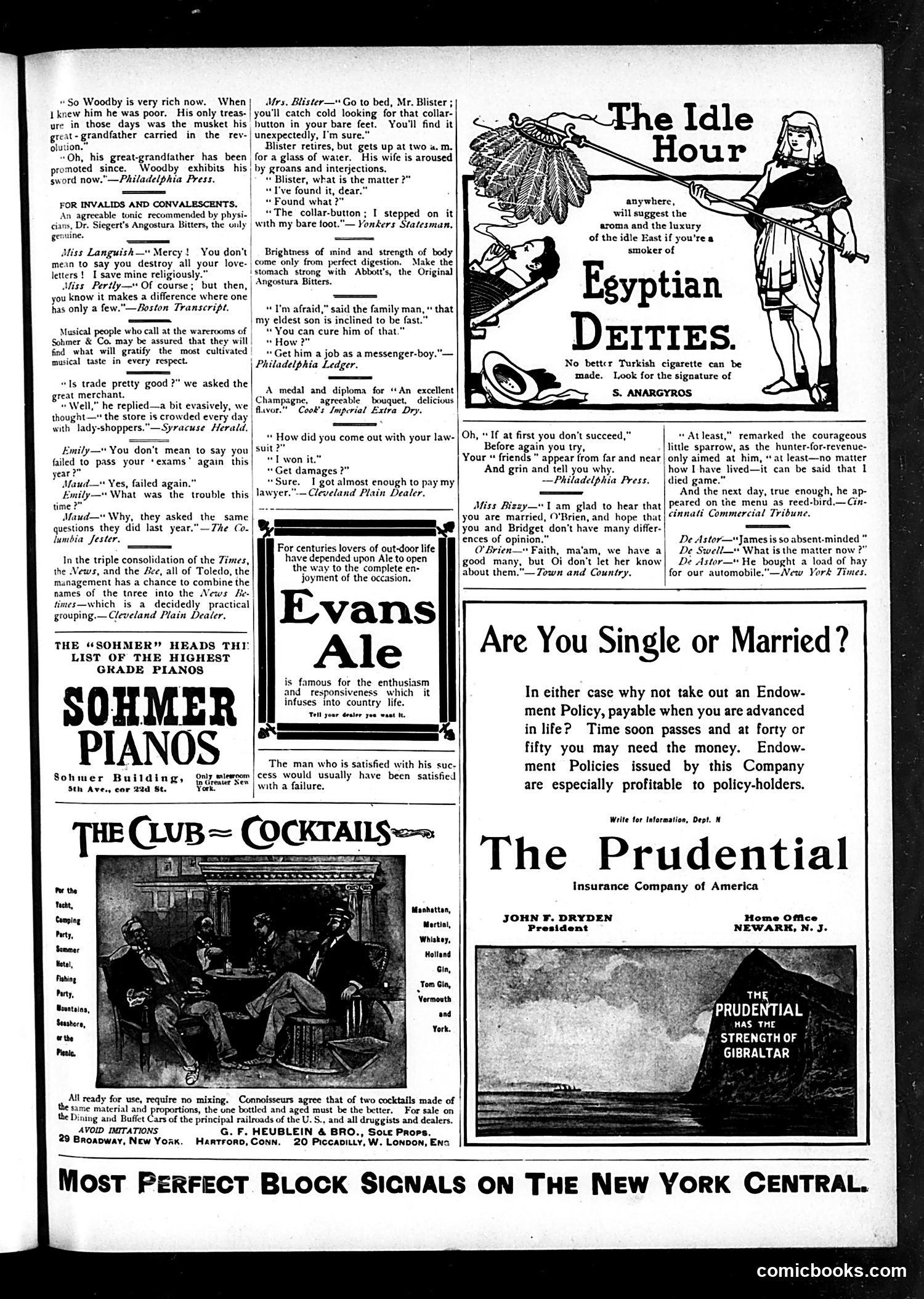
This page from *Judge* magazine is primarily **advertising with brief comedic snippets** rather than political satire. The small humor pieces are domestic jokes typical of early 20th-century magazines—a husband searching for a lost collar button at 2 a.m., a son's laziness, failed law suits, and exam failures. These relied on relatable, mundane situations rather than topical reference. **The main content** consists of product advertisements: Sohmer Pianos, Evans Ale, Egyptian Deities cigarettes, Angostura Bitters, The Prudential Insurance Company, and Club Cocktails. The only illustration accompanying editorial content is the Egyptian-themed cigarette ad, which uses Orientalist imagery (a figure in Egyptian dress) common to the era's marketing. **The political/social context** is minimal here—this appears to be a standard magazine page mixing light humor with commercial content, reflecting how *Judge* funded itself. The ads suggest the magazine's affluent readership: piano buyers, cocktail drinkers, life insurance clients.
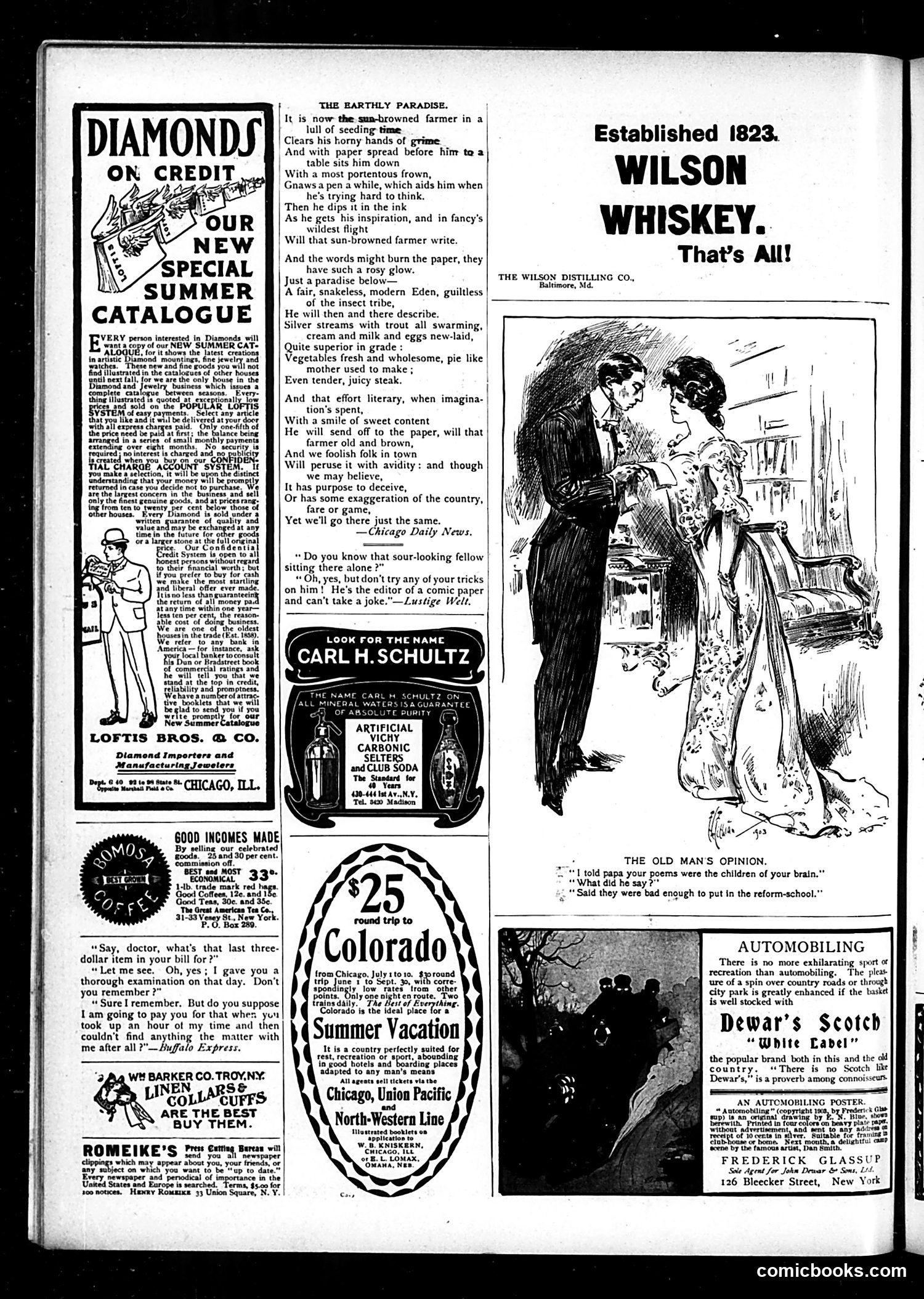
This page is primarily **advertising**, with minimal satirical content. The main cartoon, titled "The Old Man's Opinion," depicts an elderly man confronting a young poet about submitting inferior work to a reform school. It's a light humor piece about literary criticism rather than political satire. The poem "The Earthly Paradise" mocks a common genre: farmers writing idealized descriptions of rural life to newspapers, depicting impossibly perfect conditions (snakeless Edens, superior produce) that urban readers naively believe, then attempt to relocate to the country. The satire targets both the farmers' exaggeration and city dwellers' gullibility. Surrounding the content are period advertisements for diamonds, coffee, whiskey, train travel to Colorado, and automobiles—typical of Judge magazine's commercial pages. The page reflects early 20th-century consumer culture and gentle satirical humor rather than sharp political commentary.
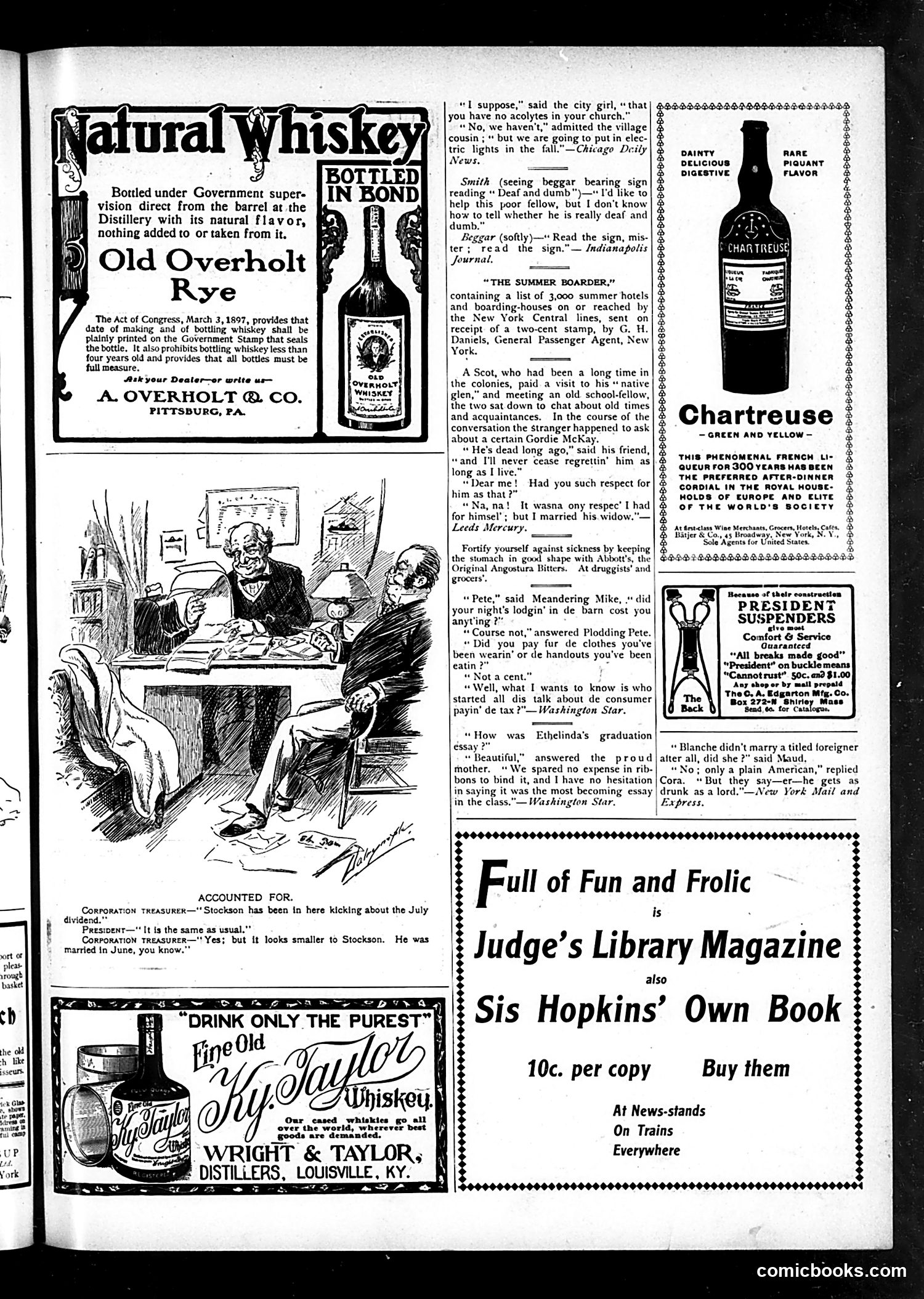
This page is primarily **advertising** for whiskey brands (Old Overholt Rye, Fine Old Shu Taylor, Chartreuse) interspersed with short humorous anecdotes—typical Judge magazine content from the early 1900s. The one political cartoon depicts a **Corporation Treasurer and President** discussing a stockholder named Stockson who complained about his July dividend appearing smaller. The joke's punchline: Stockson was married in June, implying his new wife is spending his money, making the dividend seem comparatively smaller. This satirizes the era's anxieties about marriage's financial impact on men and corporate shareholders. The surrounding brief jokes reference topics like rural electrification, deaf beggars, Scottish widows, and graduation essays—period humor emphasizing class differences (city vs. rural folk) and gender dynamics typical of early-20th-century American satire. No major political figures or events appear to be referenced.
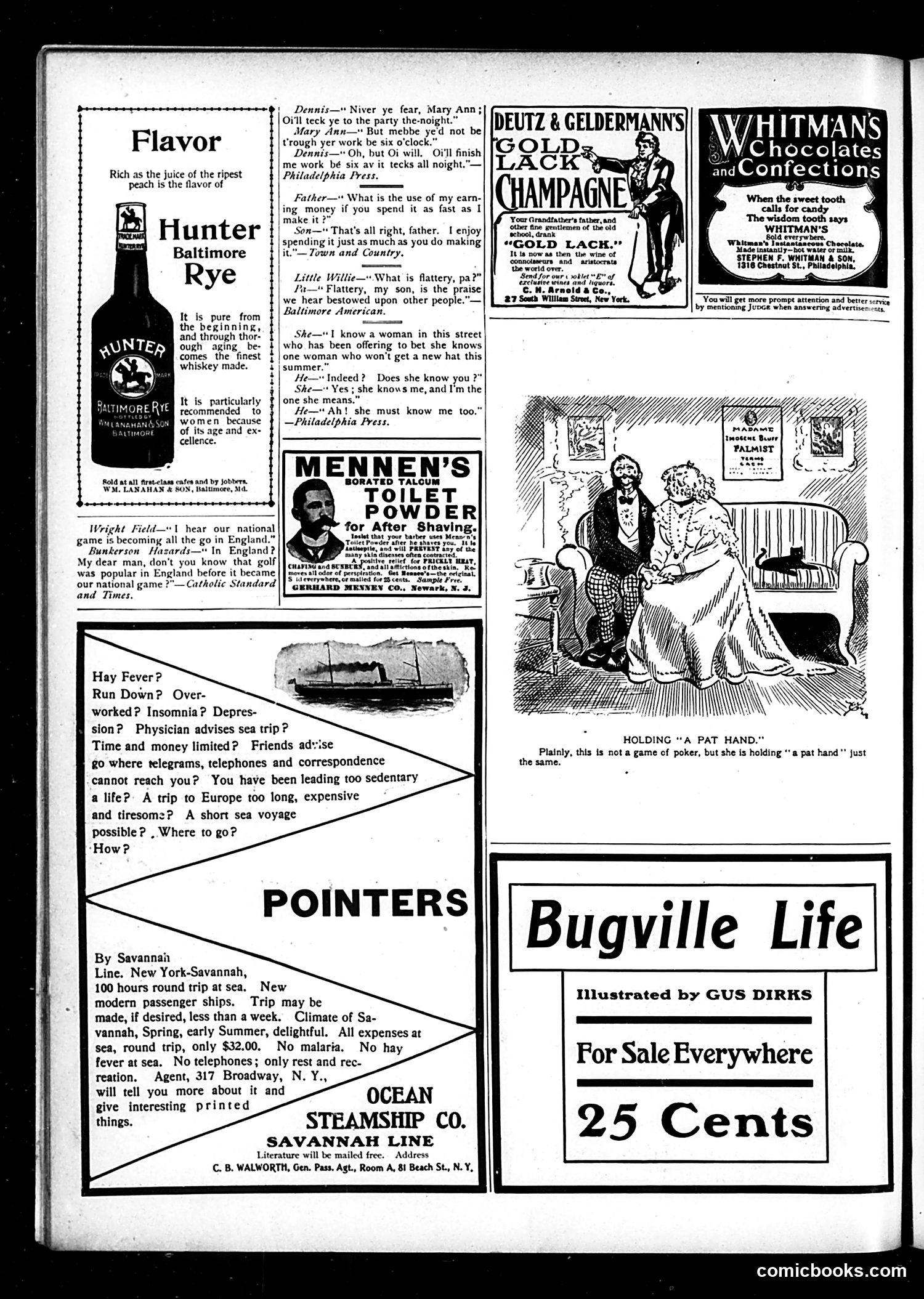
This page is primarily **advertising** with several brief comic jokes interspersed. The main cartoon shows a woman holding a baby, captioned "Holding 'A Pat Hand.'" The joke is a pun: "pat hand" refers to a winning poker hand one won't exchange, but here it literally means holding a satisfied baby—a domestic "win." The other content consists of short joke exchanges: - Irish immigrants (Dennis and Mary Ann) discussing attending a party - A father-son dialogue about spending money as fast as it's earned - A question about flattery (praise of *others*, not yourself) - A woman betting another won't buy a new hat, implying the second woman never does - A golf vs. baseball debate These are gentle, period-typical humor pieces with no apparent political satire. The page is dominated by product advertisements for Hunter Baltimore Rye whiskey, Mennen's talcum powder, Whitman's chocolates, Ocean Steamship Company cruises, and Bugville Life (a 25-cent publication). The ads target early 1900s middle-class concerns: grooming, leisure travel, and consumer goods.
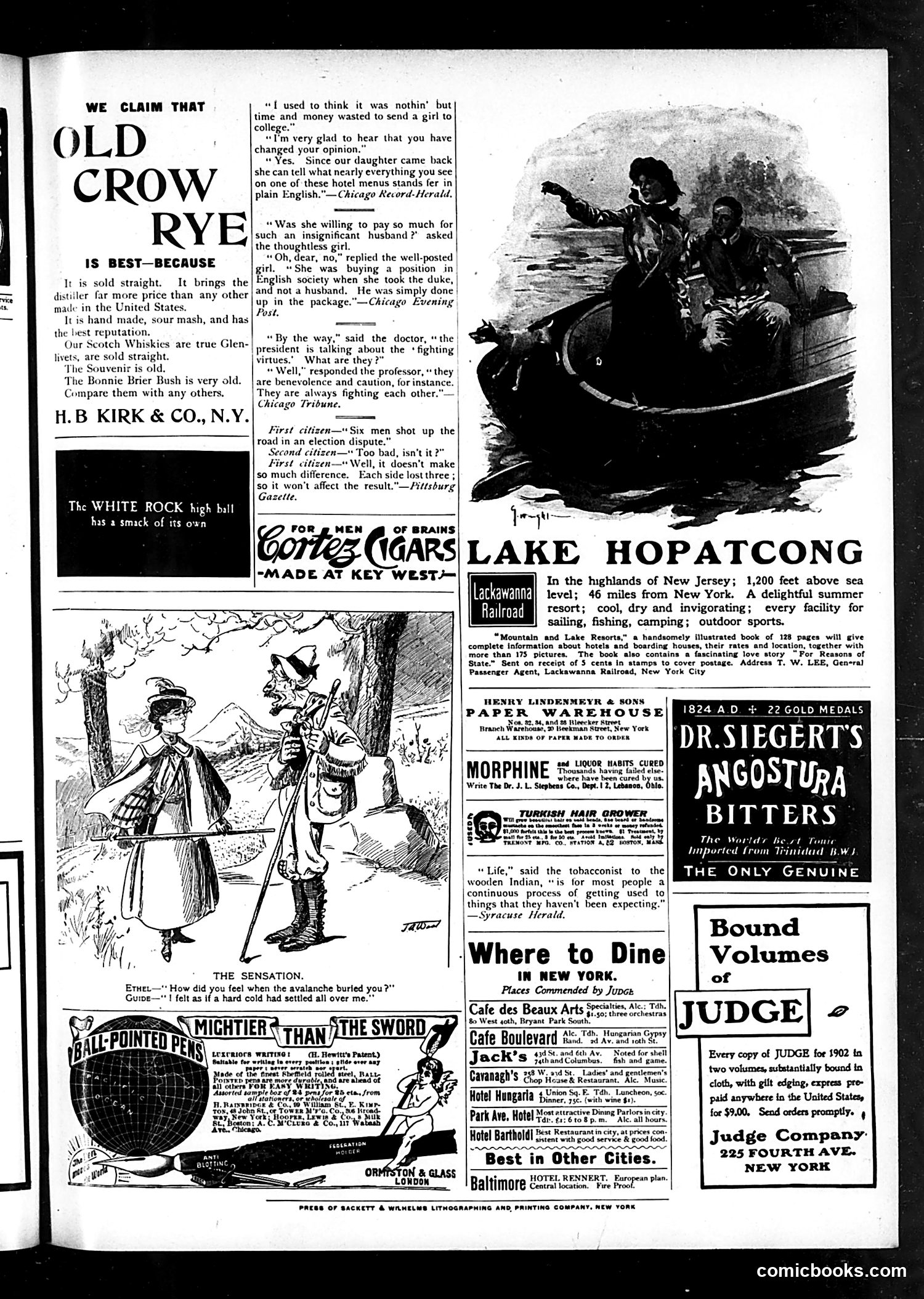
This page is primarily **advertising** with scattered short humorous anecdotes. The OCR'd text reveals satirical vignettes about contemporary American life, circa early 1900s: **The humor targets:** 1. **Women's education** – A father admits his daughter's college education proved worthwhile when she learned to read fancy restaurant menus in plain English. 2. **Transatlantic marriage** – A woman marries a British duke purely for social position, not love; he's mere "packaging." 3. **Political philosophy** – A professor claims benevolence and caution are always "fighting" each other, satirizing political contradictions. 4. **Election violence** – Three deaths on each side in an election dispute cancel out, so "it won't affect the result"—dark satire on political violence's apparent futility. The cartoons (visible but unclear without better resolution) appear to use similar gentle satirical commentary on society. The page is dominated by period advertisements for whiskey, cigars, writing implements, medicines, and resorts—reflecting Judge's function as both humor magazine and advertising vehicle.
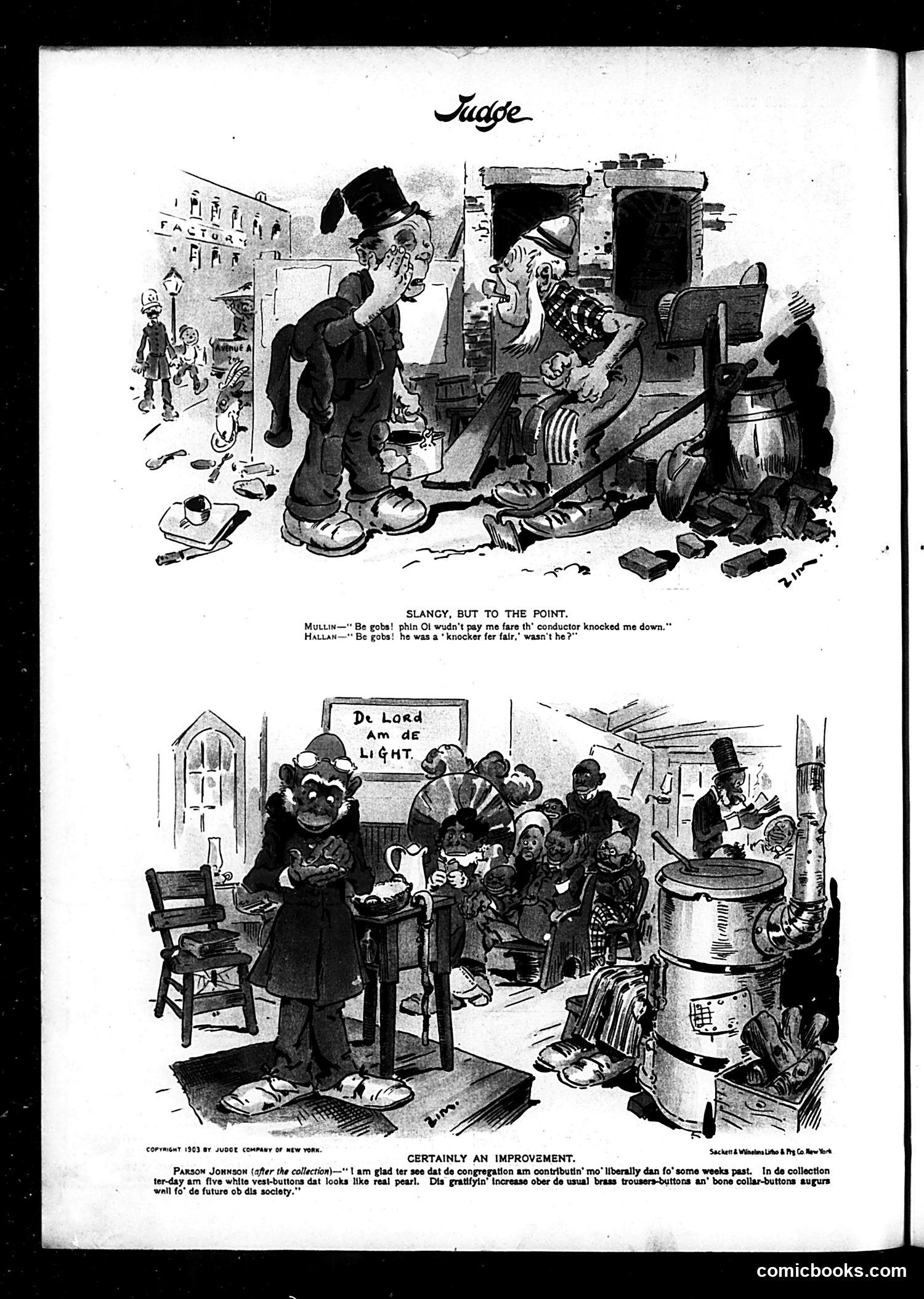
**Top Cartoon: "Slangy, But to the Point"** Two working-class Irish immigrants (indicated by dialect: "Be gobs!") discuss a street conductor who physically knocked one down over a fare dispute. The satire mocks both their rough speech patterns and the casual violence of urban transportation workers toward poor passengers—presenting it as darkly comedic rather than shocking. **Bottom Cartoon: "Certainly an Improvement"** A Black preacher (Parson Johnson) celebrates increased church donations, but the "improvement" is actually degrading: the collection now includes pearl-like vest buttons and bone collar-buttons instead of the usual brass ones—items poor congregants likely removed from their own worn clothing. The satire exposes the preacher's obliviousness to his flock's poverty while claiming progress, critiquing both religious hypocrisy and indifference to congregants' desperation. Both cartoons use ethnic/racial caricature typical of 1903 Judge humor to mock social pretense and class disparities.