
A complete issue · 16 pages · 1903
Judge — June 13, 1903
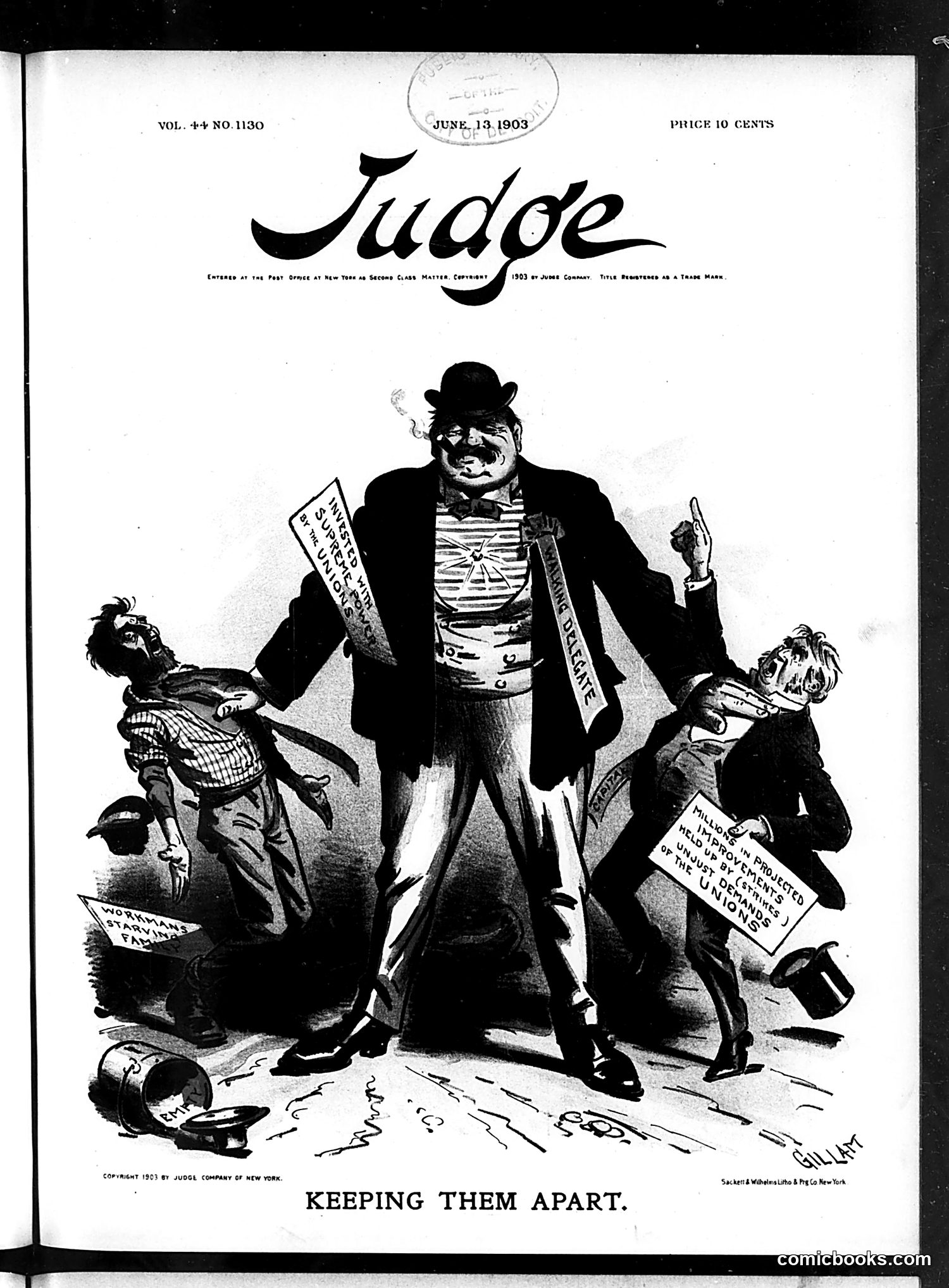
This political cartoon depicts a large central figure (appearing to be Uncle Sam or a political leader) forcibly separating two smaller figures labeled as various groups or nations. The title "KEEPING THEM APART" suggests the cartoon critiques U.S. foreign policy regarding conflict resolution or intervention. The smaller figures hold signs with text that's partially legible but appears to reference disputes or tensions. The scattered debris and chaotic composition emphasize discord. Without clearer visibility of all sign text and context for June 1903 events, I cannot definitively identify which specific international conflict this references—whether the Philippines, Latin American disputes, or European tensions of that period. The cartoon clearly satirizes American attempts to mediate or control foreign disputes, though the exact political situation remains unclear from the image alone.
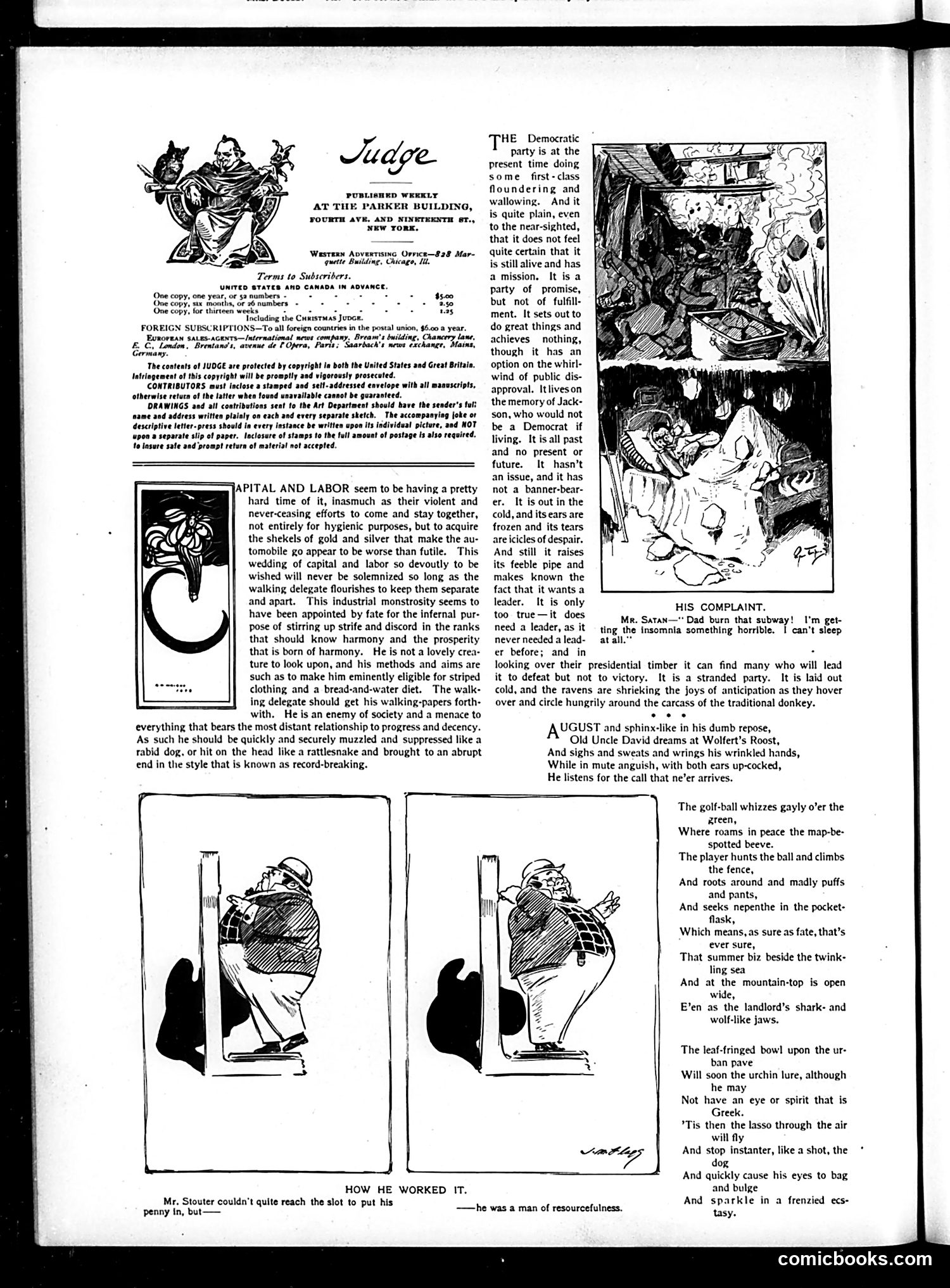
This page critiques the Democratic Party during a period of internal discord. The main editorial argues that Democrats are divided and ineffectual—promising great things but delivering nothing. The party allegedly lacks direction and a viable leader. The two cartoon panels below titled "How He Worked It" show a figure (likely a Democratic politician) attempting to reach a slot, depicted as struggling with limited resources or capability—a visual metaphor for political incompetence. The poetic text on the right appears to be satirical commentary on contemporary political figures and leisure activities, though specific references are unclear from this page alone. Overall, Judge uses humor and caricature to mock Democratic Party dysfunction and leadership failures during this period. The specific historical moment remains unclear without additional context.
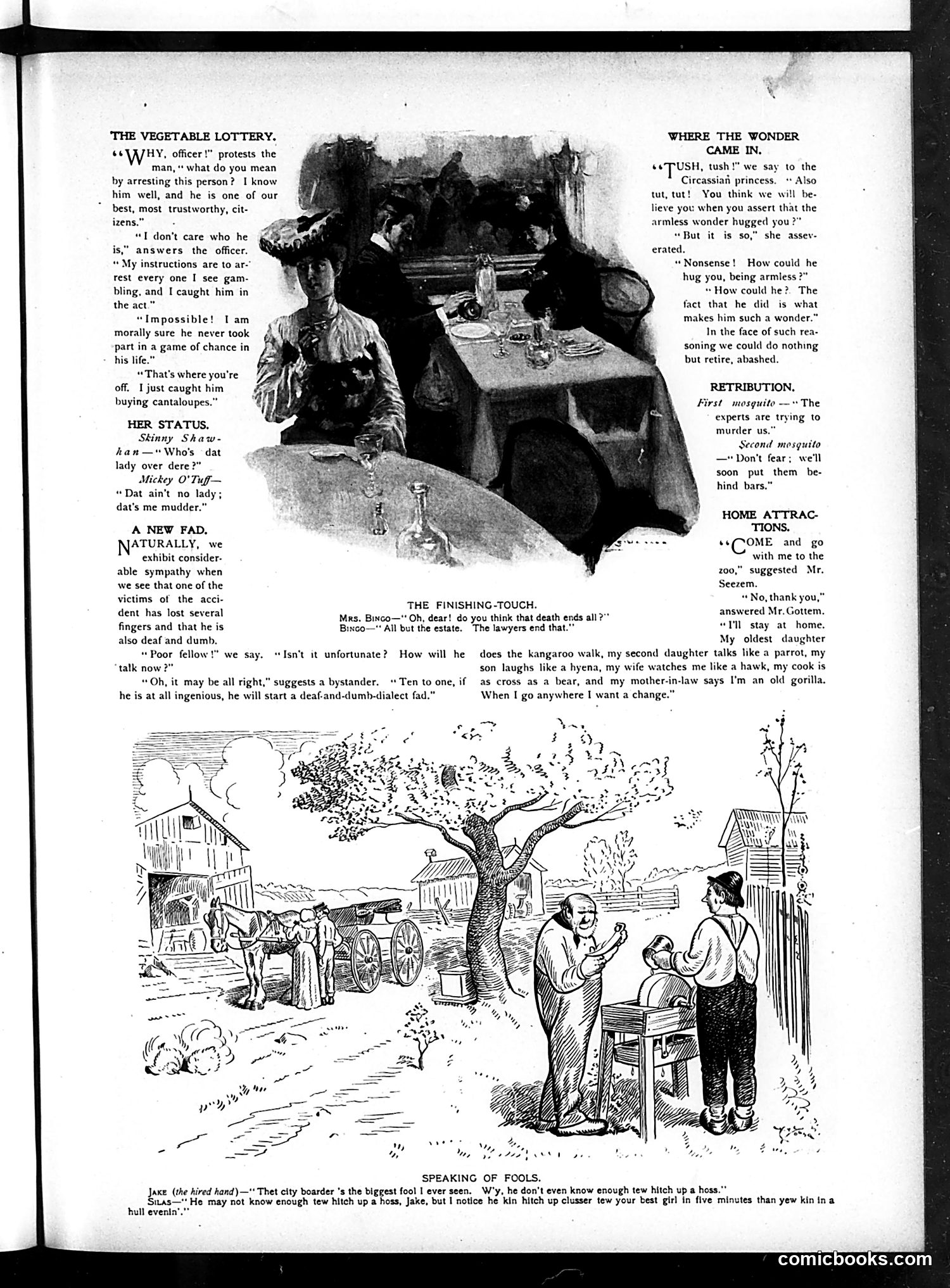
This page contains several short humorous sketches typical of Judge's satirical style, rather than a single political cartoon. **"The Vegetable Lottery"** mocks an officer arresting someone for gambling, with the twist that the "game of chance" involves vegetables—satirizing selective law enforcement. **"Her Status"** is a brief ethnic joke playing on dialect humor common to the era. **"A New Fad"** jokes about accidental injuries becoming fashionable, with dark humor about losing fingers. **"The Finishing Touch"** depicts a domestic scene where a wife discusses estate matters while her husband faces death—satirizing legal/financial anxieties. The bottom illustration, "Speaking of Fools," shows rural characters and appears to be a general humor sketch about rural life and foolishness. The content reflects early 20th-century American satirical humor: class anxieties, immigrant stereotypes, and domestic/legal concerns.
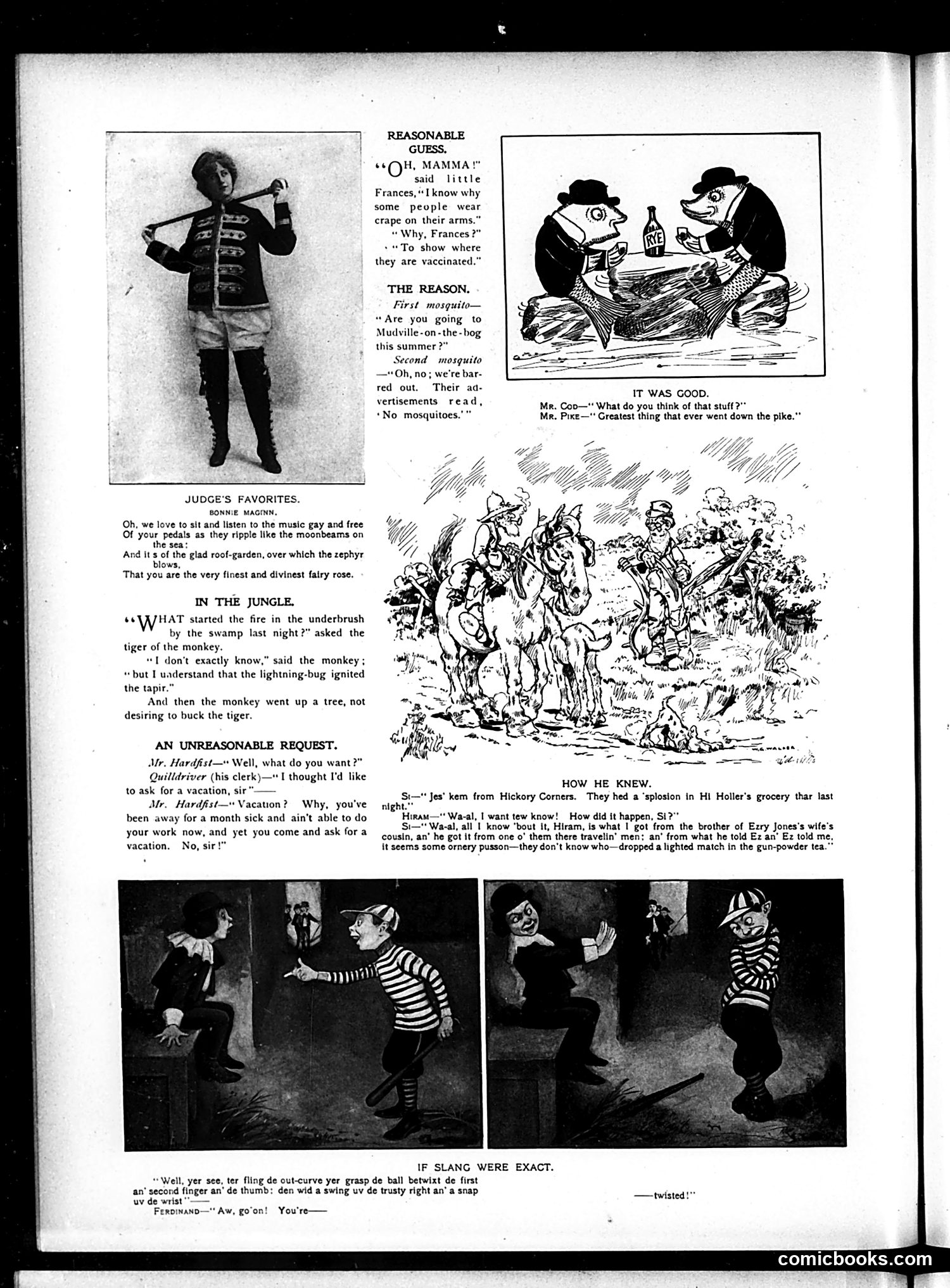
This page contains several unrelated humorous sketches typical of Judge magazine's satirical format. **"Reasonable Guess"**: A dialogue joke about vaccination marks on arms, with a photograph of a performer (labeled "Judge's Favorites: Bonnie Maginn") in theatrical costume. **"It Was Good"**: A cartoon of two anthropomorphic fish discussing something going "down the pike." **"In the Jungle"**: A narrative joke about a monkey, lightning-bug, and fire, illustrated with a detailed jungle scene drawing. **"An Unreasonable Request"**: A brief dialogue between Mr. Hardhat and a clerk about vacation requests. **"If Slang Were Exact"**: A photo sequence showing a character demonstrating literal interpretation of slang expressions, with accompanying dialogue attempting exact phonetic spelling of colloquial speech. The page reflects early-to-mid 20th-century American humor emphasizing wordplay, visual gags, and everyday social situations.
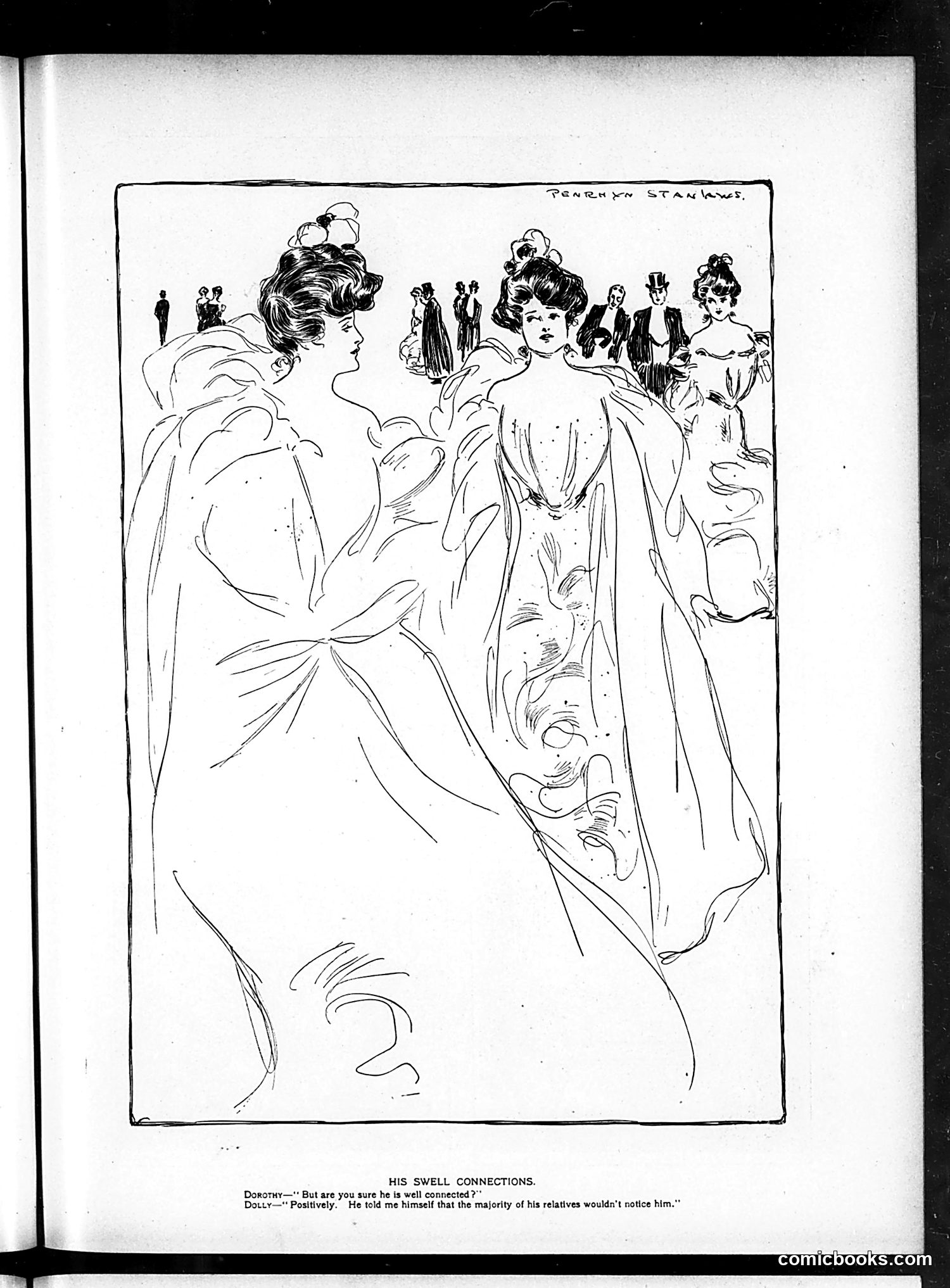
This cartoon satirizes social climbing and false pretense among the wealthy. The dialogue jokes about a man's claimed "connections" (social relationships with important people). Dorothy questions whether he's truly "well connected," while Dolly assures her he is—but her explanation reveals the humor: he claims most of his relatives *wouldn't even notice* his absence, meaning he's actually *disconnected* from his own family. The elaborate gowns and formal setting suggest high society, making the irony sharper. The satire targets people who boast of social status while actually being isolated or unimportant within their own circles. It's a gentle mockery of Gilded Age pretension and social aspiration, suggesting that true "connections" require actual family bonds and social standing, not mere claims.
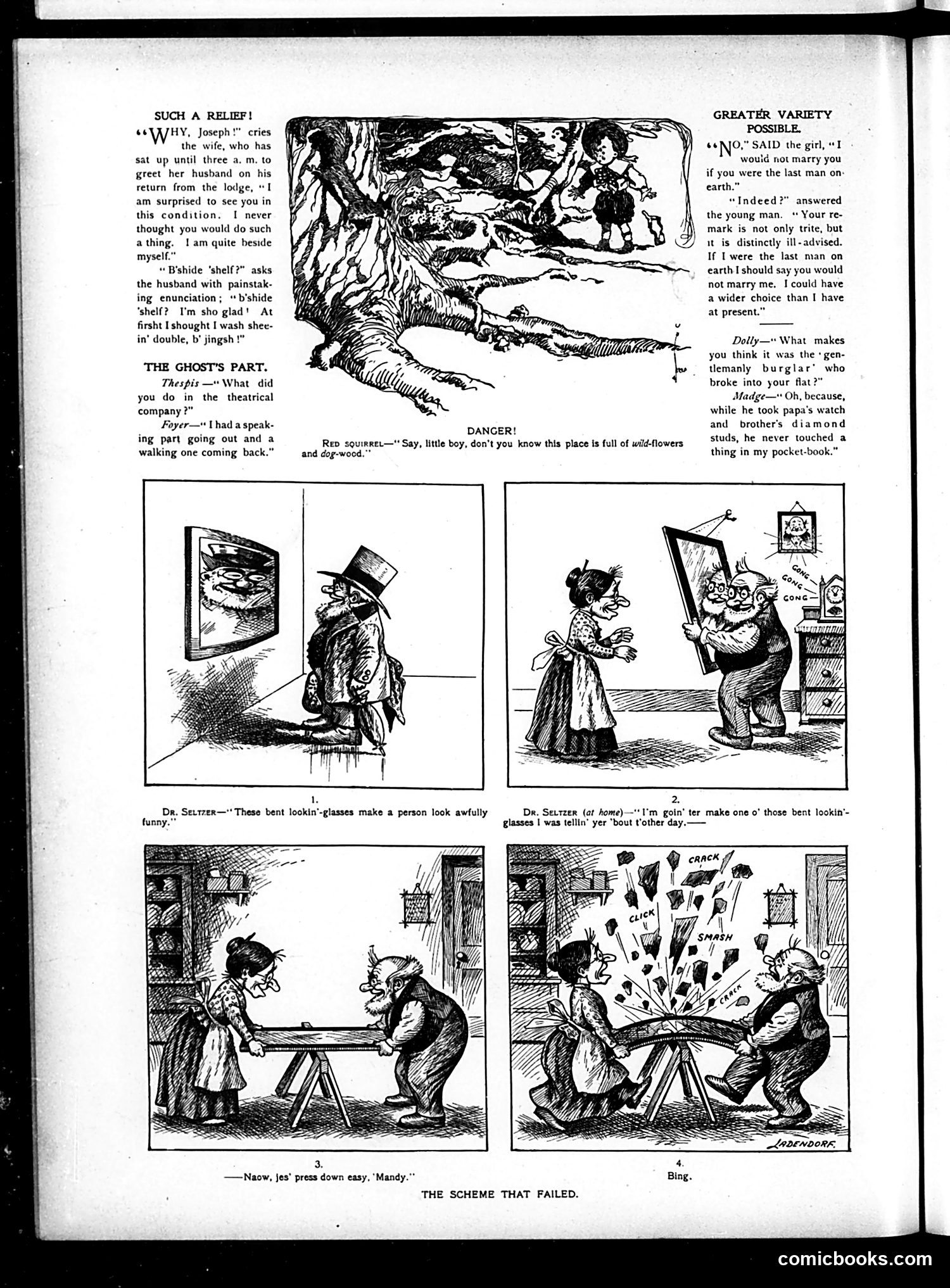
This page contains several unrelated humorous vignettes typical of early 20th-century satirical magazines: **Top stories** mock domestic situations: a drunk husband returning from his lodge, and a young woman rejecting a suitor with a clichéd line, which he pedantically points out. **"The Ghost's Part"** jokes about theater—an actor with only speaking roles in rehearsal but silent walk-on parts in actual performances. **Four-panel comic strip** ("The Scheme That Failed") shows a domestic mishap: a woman and man attempt to use a see-saw or similar device, which explosively backfires in the final panel. **Right column** includes anecdotes about distorting mirrors, a squirrel warning a boy away from wildflowers, and a "gentlemanly burglar" who steals valuables but respects a woman's personal items. The humor relies on wordplay, domestic comedy, and period-specific references rather than political content. This appears to be standard entertainment rather than political satire.
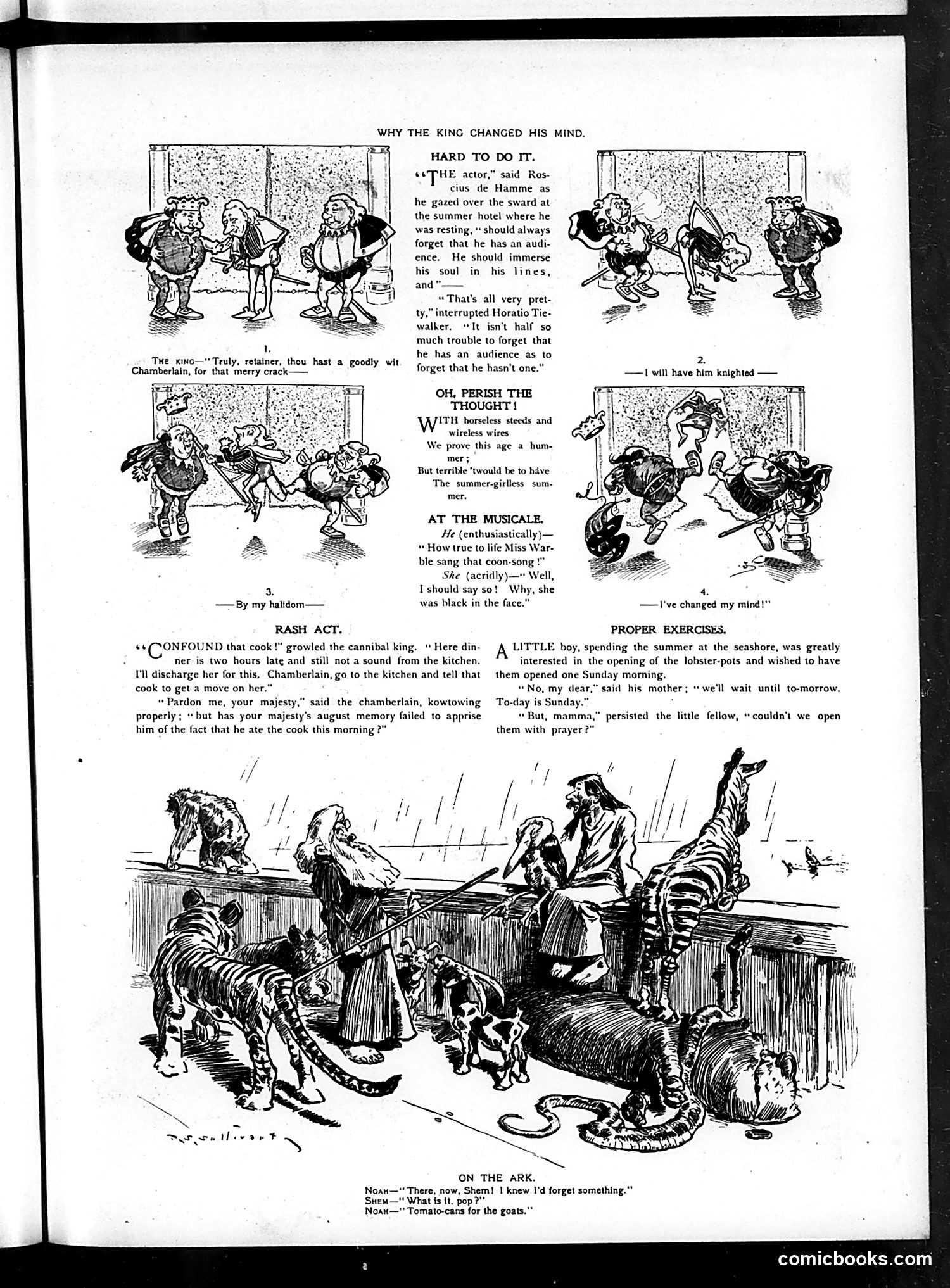
This page contains multiple unrelated humor pieces typical of Judge magazine's format. **"Why the King Changed His Mind"** presents a medieval court scene with wordplay about actors forgetting audiences—a theatrical in-joke about performance technique. **"Hard to Do It"** satirizes theatrical pretension through dialogue between two characters discussing method acting. **"Oh, Perish the Thought!"** jokes about modern conveniences (horseless carriages, wireless) while suggesting summer would be unbearable without young women—typical period sexism. **"At the Musicale"** mocks both a sentimental performance of a "coon-song" (a racist minstrel genre) and the audience's emotional reaction to it. **"Rash Act"** is a cannibalism joke: the cannibal king can't find his cook because he ate her earlier. **"Proper Exercises"** depicts a child's innocent logic—suggesting prayer instead of work to open lobster traps on Sunday (religious observance joke). **"On the Ark"** presents Noah forgetting tomato cans, treating the biblical flood story as comedic domestic scenario. These are disconnected gag pieces reflecting early 20th-century humor sensibilities, including period stereotypes.
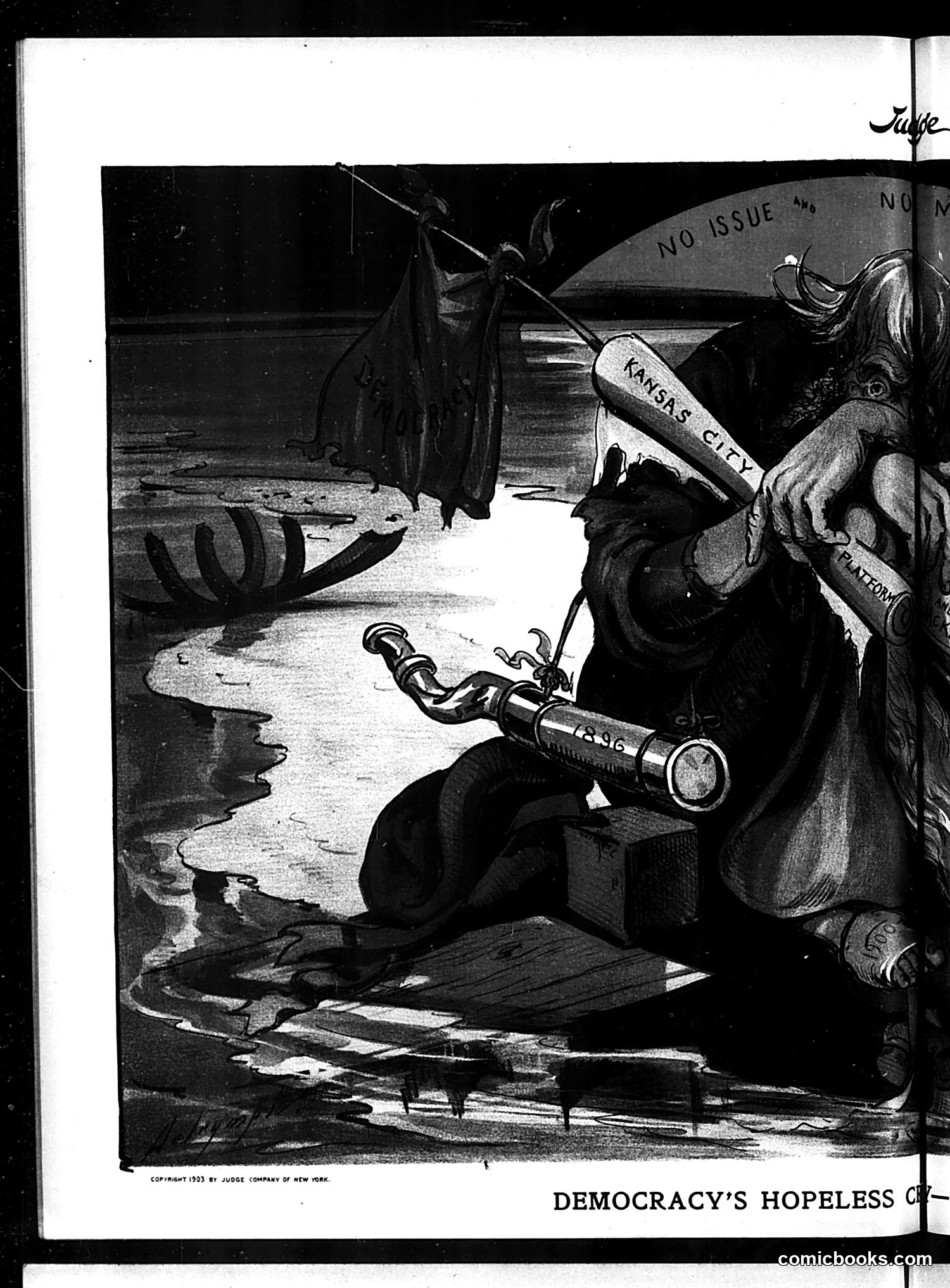
This political cartoon depicts **Democracy personified as a woman** sitting amid wreckage and destruction. She holds a "Kansas City" ballot or document, while around her lie broken weapons, torn papers, and debris—symbols of political chaos and failure. The title "**Democracy's Hopeless**[ness]" suggests the cartoon critiques American democracy circa 1903 as fundamentally broken or ineffective. The woman's defeated posture and the surrounding devastation imply that democratic institutions—represented by voting and governance—have collapsed into disorder. The specific reference to Kansas City likely points to local political corruption or electoral problems of that era, used as evidence of democracy's broader failure. The Judge magazine's satirical intent appears to be lamenting the dysfunction plaguing American political systems at the turn of the 20th century.
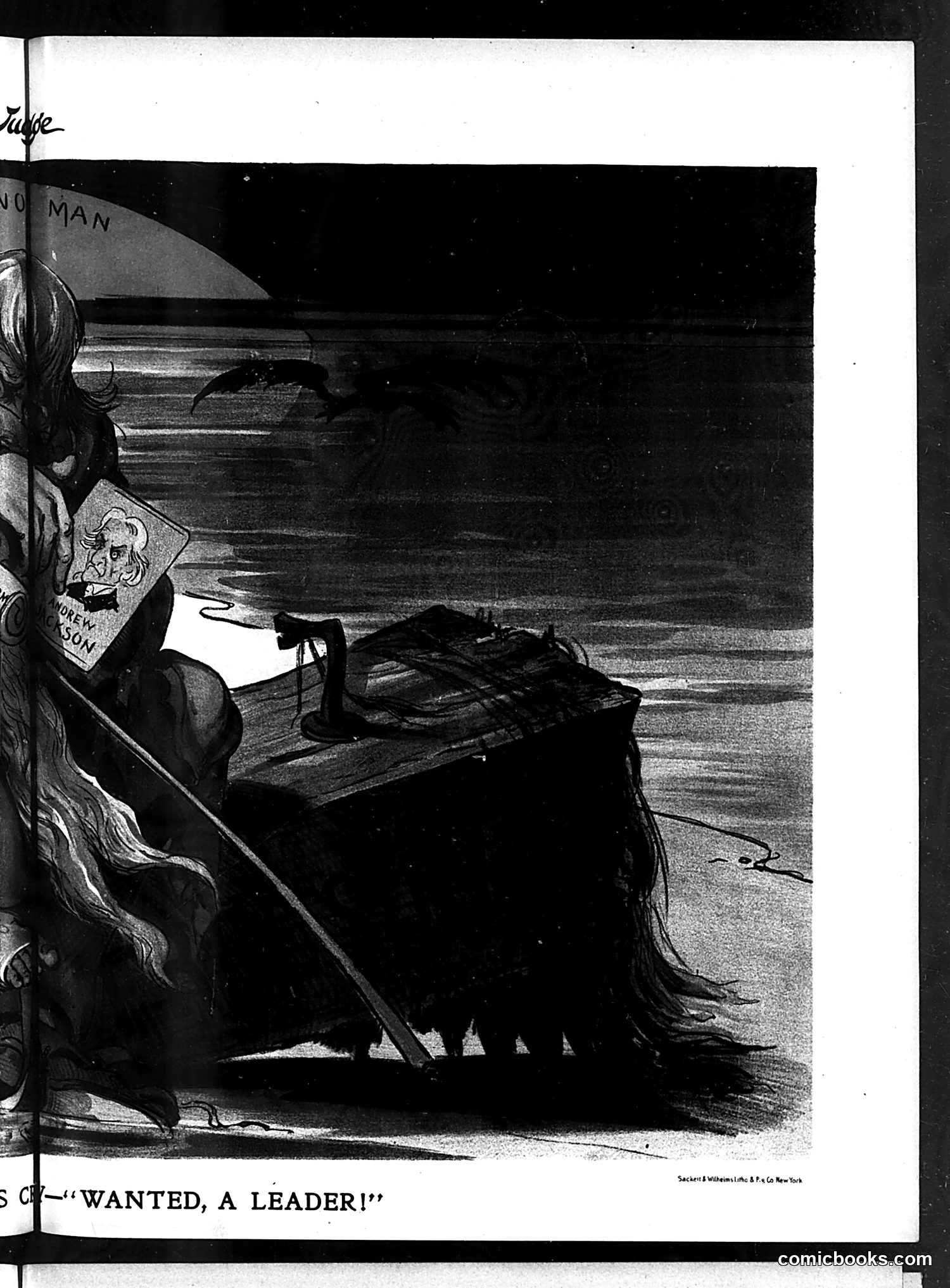
This Judge magazine cartoon is titled "Wanted, a Leader!" The image shows a figure on the left (appearing to wear period clothing with long hair) looking at what seems to be a wanted poster or notice. The right side depicts a dark, shadowy figure or silhouette seated at a desk or table. The satire appears to critique political or governmental leadership—the "wanted" framing suggests a search for someone to fill a leadership role, implying the current leader or available candidates are inadequate or absent. Without a clear date visible, the specific historical context is unclear, but the visual suggests commentary on a leadership vacuum during a particular political moment. The dramatic contrast between light and shadow emphasizes the absence or inadequacy of visible leadership.
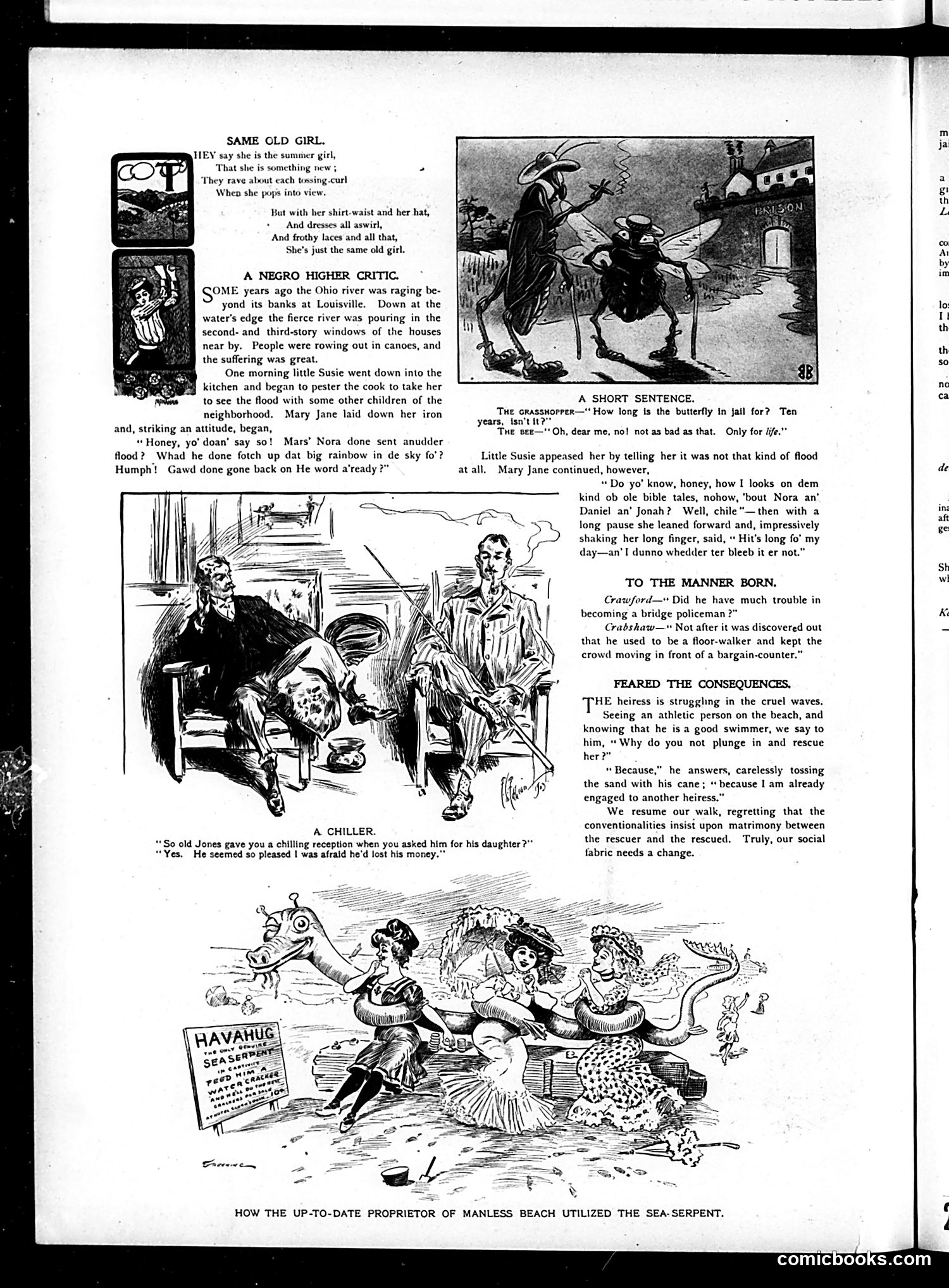
This page contains multiple satirical pieces typical of early-20th-century American humor: **"Same Old Girl"**: A poem mocking the "summer girl" phenomenon—the notion that women transformed into exotic new beings each season was dismissed as mere fashion changes disguising the same person underneath. **"A Negro Higher Critic"**: A dialect-heavy story featuring a Black cook named Mary Jane. The humor relies on minstrel-show stereotypes: her malapropisms about the Ohio River flood and biblical references ("Nora an' Daniel an' Jonah") are presented as amusing ignorance. This reflects the casual racism standard in early Judge. **"A Chiller," "A Short Sentence"**: Brief joke setups typical of the magazine's format. **"To the Manner Born"**: Satirizes social climbers—a floor-walker (department store employee) becoming a bridge policeman through prior retail experience. **"Feared the Consequences"**: Social satire about marriage conventions: a man won't rescue a drowning heiress because saving her would obligate him to marry her. The bottom cartoon satirizes commercialization, showing a beach proprietor using a sea-serpent as an attraction.
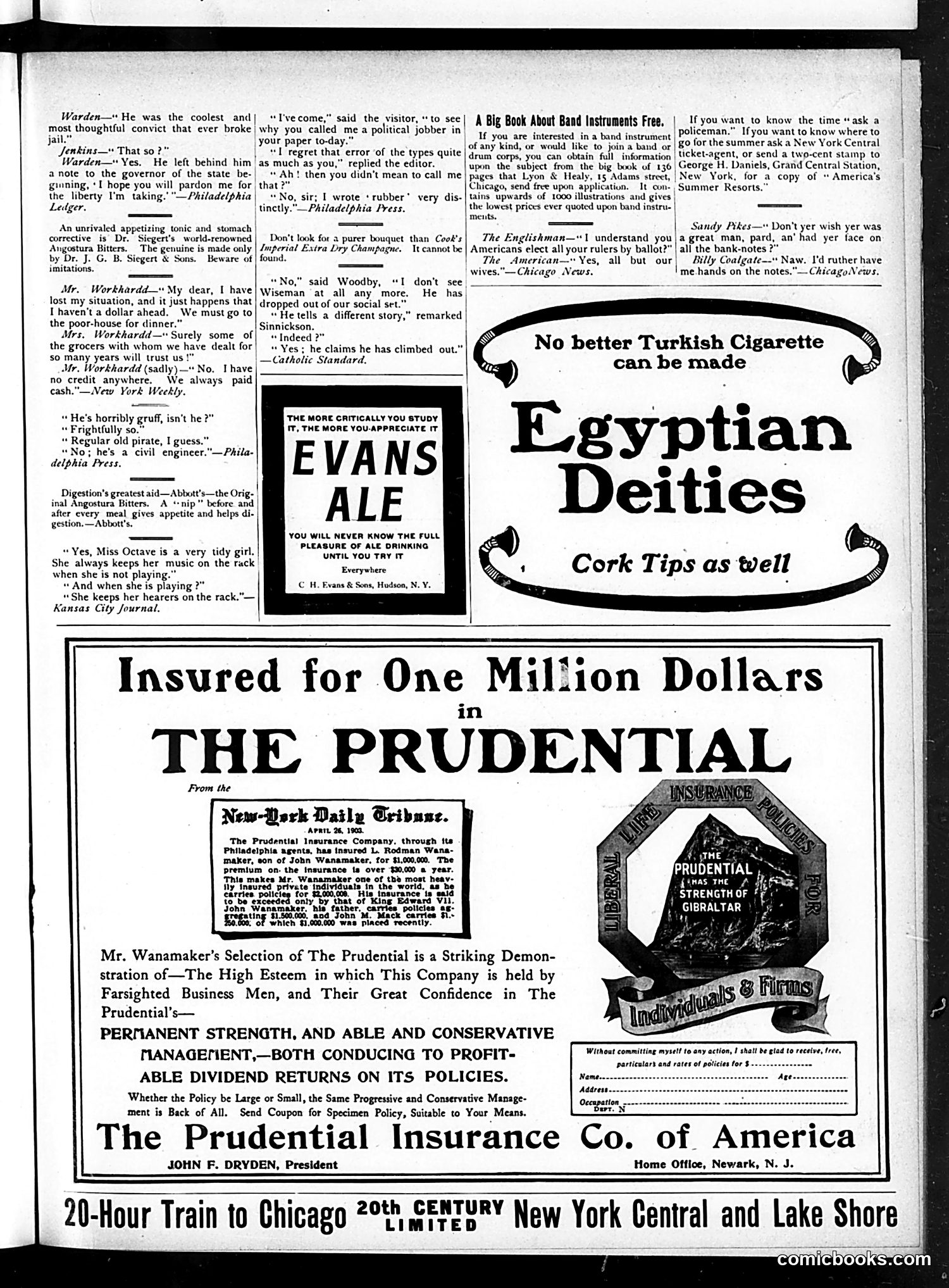
This page is primarily **advertising and filler content**, typical of early 1900s satirical magazines. The cartoons are brief, disconnected jokes rather than unified political satire: **The Humor:** - Short comic vignettes mock everyday frustrations: a convict's polite note to the governor, a poor man discovering he has no credit, social climbers, and workplace gossip - One joke contrasts American and British views on democracy—Americans elect "all your rulers," implying self-governance versus British monarchy - Wordplay dominates ("rubber" vs. "robber"; a pianist's "hearers on the rack") **The Advertisements:** The page is dominated by product ads (Evans Ale, Egyptian Deities cigarettes, Prudential Insurance, band instruments) interspersed with jokes. The Prudential ad notably promotes the company's financial strength by highlighting John Wanamaker Jr.'s $1 million insurance policy—using wealthy clients as proof of trustworthiness. **Context:** This reflects pre-WWI American consumer culture and Judge's role as entertainment for middle-class readers, mixing gentle social observation with aggressive advertising.
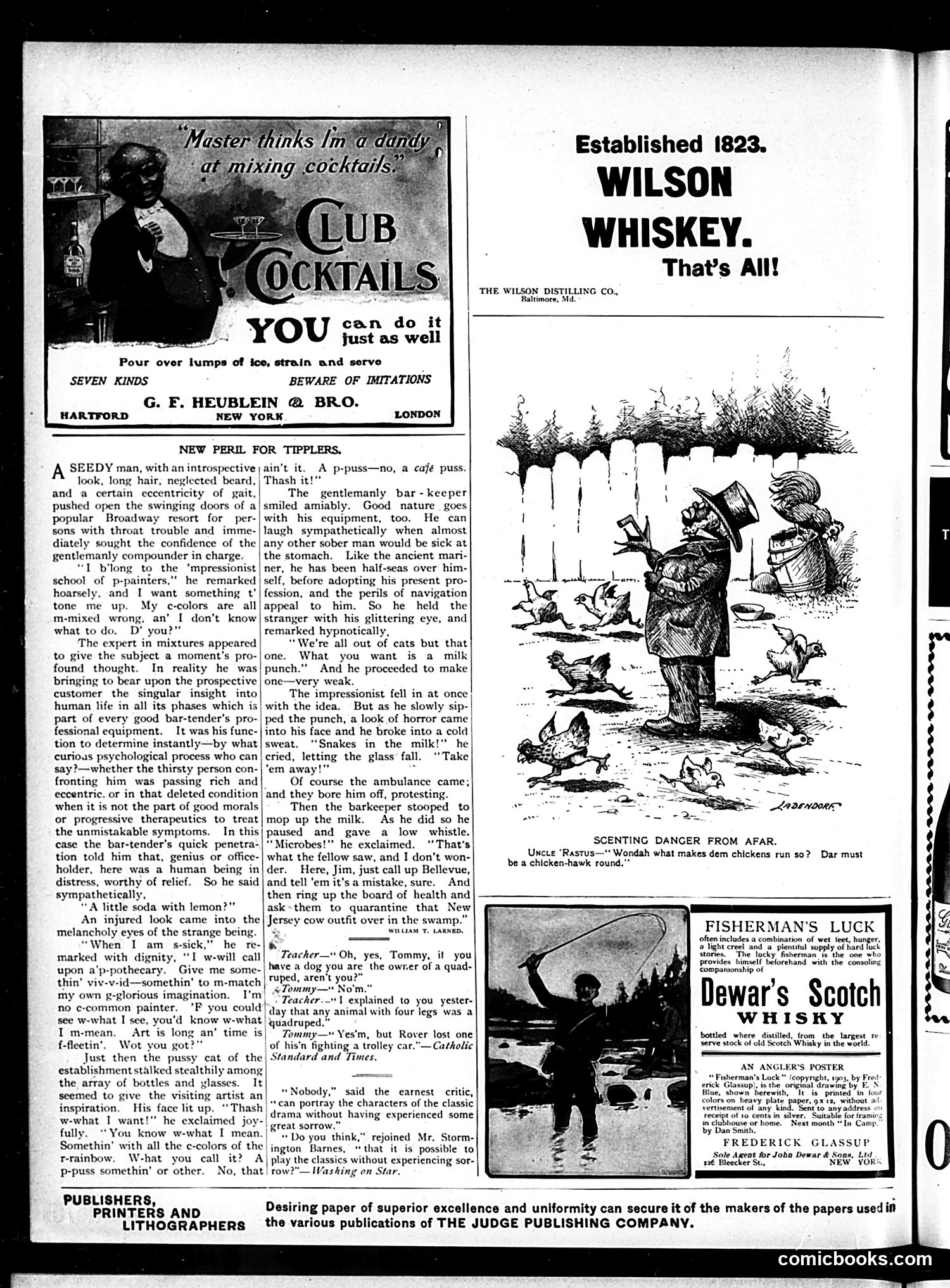
This is a satirical story about a disheveled artist visiting a bar. The joke targets both artistic pretension and concerns about public health/sanitation. An impoverished "impressionist" painter, depicted as eccentric and unkempt, enters a Broadway bar seeking a drink to "tone him up." The bartender, portrayed as wise and experienced, initially offers him wholesome remedies. When the artist insists on something more vivid—requesting a "café puss" (a cocktail)—the bartender serves him a weak milk punch instead. The punchline: the artist hallucinates "snakes in the milk" and is taken away by ambulance. The bartender then quips about "microbes" and jokes about quarantining the milk's source—a "New Jersey cow outfit." The satire mocks both the artist's pretentious poverty and, more pointedly, reflects contemporary Progressive Era anxieties about contaminated milk supplies and unsanitary dairy conditions—a genuine public health crisis of the early 1900s.
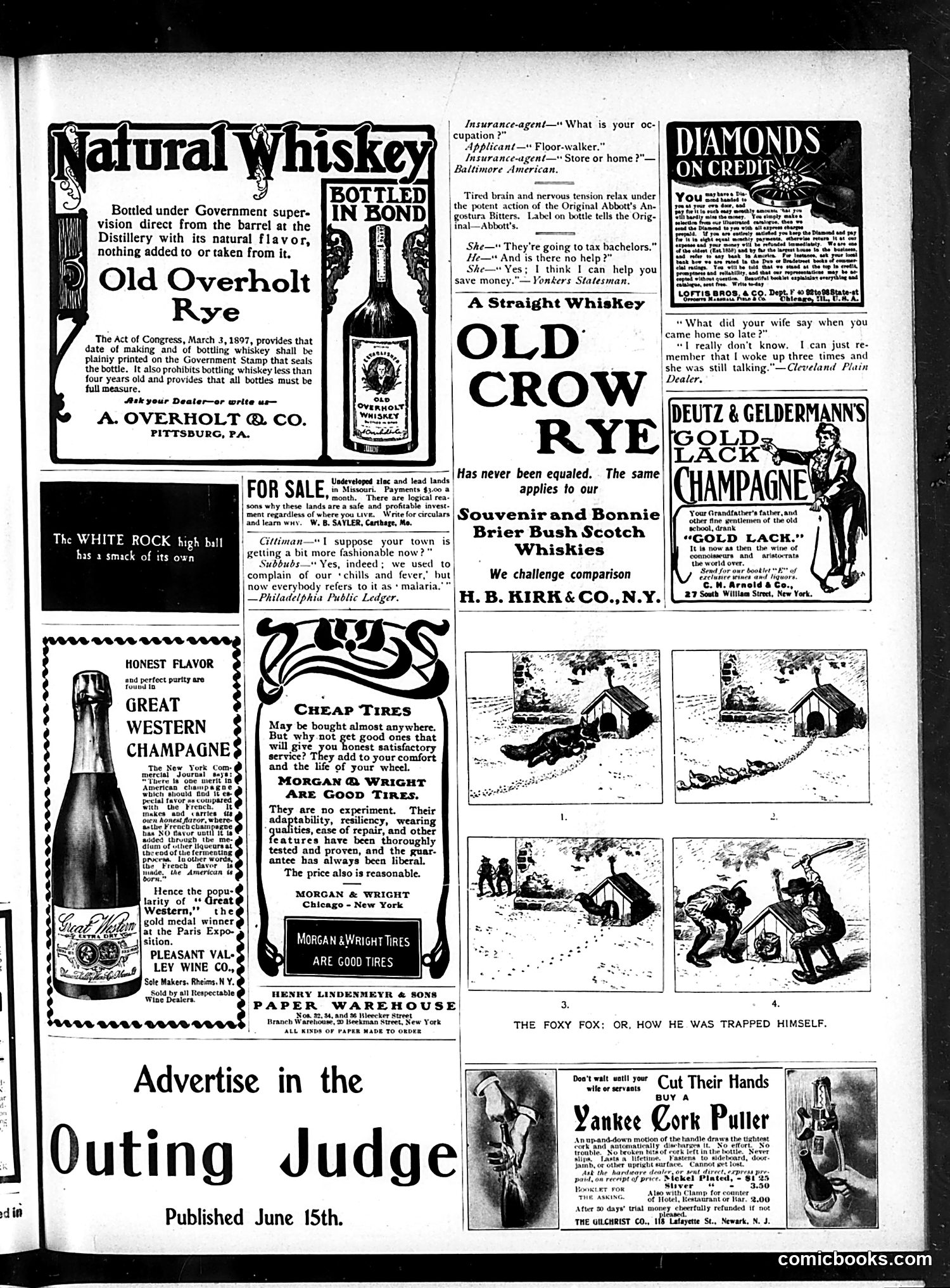
This page is primarily **advertising**, not editorial content or political satire. It showcases numerous product advertisements from the early 1900s: whiskeys (Old Overholt Rye, Old Crow), champagne, wine, tires (Morgan & Wright), diamonds on credit, and various other goods. The only satirical content appears in small **captioned jokes** scattered throughout: - A joke about "malaria" replacing "chills and fever" as terminology (social commentary on fashion in illness naming) - An exchange about taxing bachelors - A joke about a wife's lengthy talking - A floor-walker insurance applicant These brief jokes mock petty concerns: pretentious language, marriage anxiety, and workplace classifications—typical of Judge's light social satire. The page also includes **"The Foxy Fox: Or How He Was Trapped Himself,"** a four-panel comic strip (numbered 1-4) showing a fox's misadventure, though details are unclear in this reproduction. Overall, this is a commercial publication page reflecting early-1900s consumer goods and mild humor.
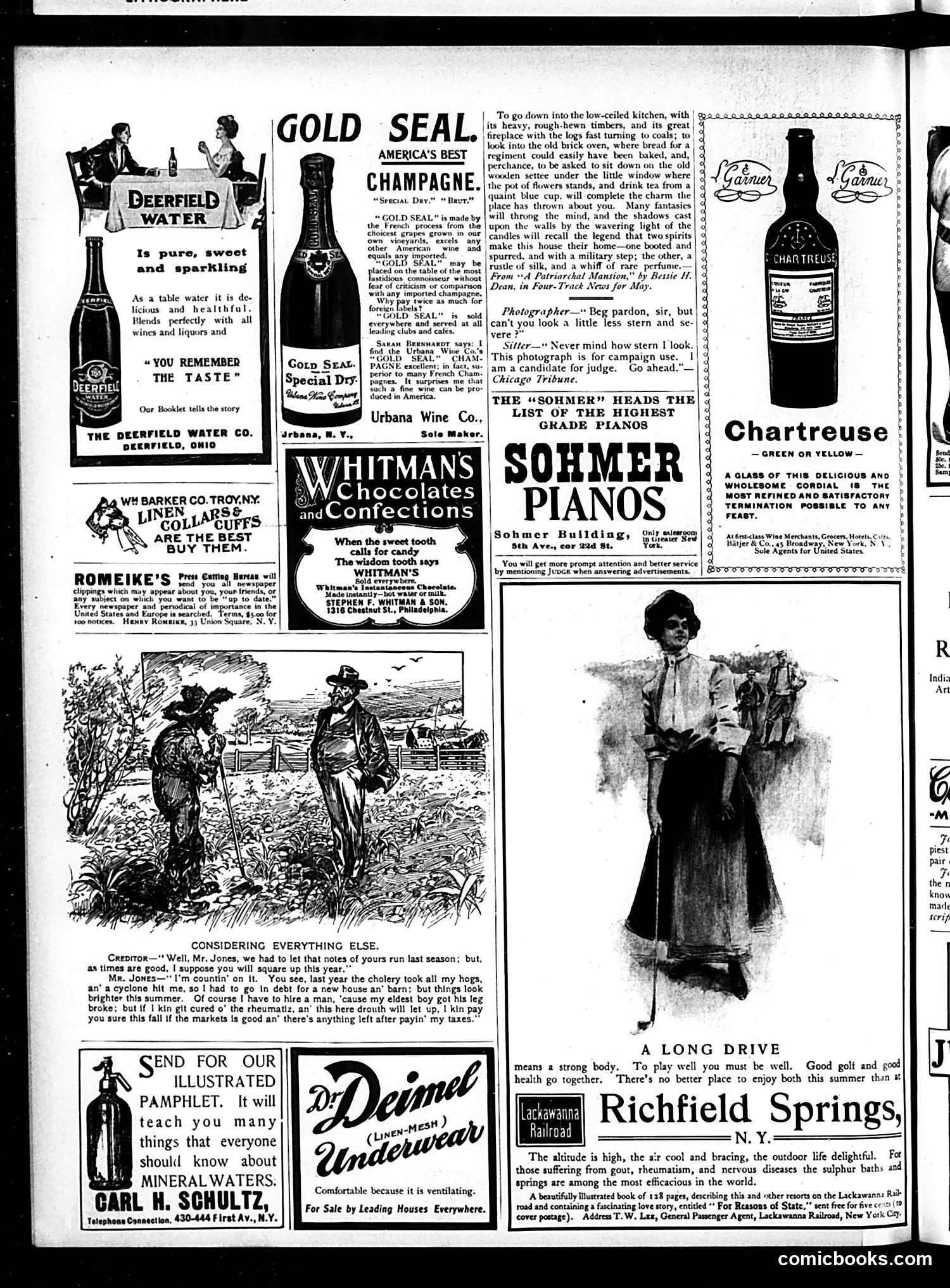
This page is primarily **advertising**, with two satirical cartoons interspersed. ## The Cartoons: **"Considering Everything Else"** depicts a creditor and debtor (Mr. Jones). The satire mocks rural debtors' perpetual excuses—Jones catalogs disasters (cholera, cyclone, broken leg, drought, taxes) yet still promises payment "this fall." The joke reflects post-agricultural-crisis economic anxiety, suggesting chronic farmer indebtedness was endemic and excuses predictable. **"Photographer" caption** shows a stern political candidate refusing to smile for campaign photos, saying "This photograph is for campaign use." It satirizes the artificiality of political image-making—candidates perform seriousness rather than authenticity. ## Advertisements: The page features luxury goods (Gold Seal Champagne, Chartreuse liqueur, Sohmer Pianos, Deimel Underwear) and services (Romeike's clipping bureau, Richfield Springs resort). These reflect Judge's wealthy readership. The text excerpt about a haunted "patriarchal mansion" suggests period fascination with colonial Americana and ghost stories.
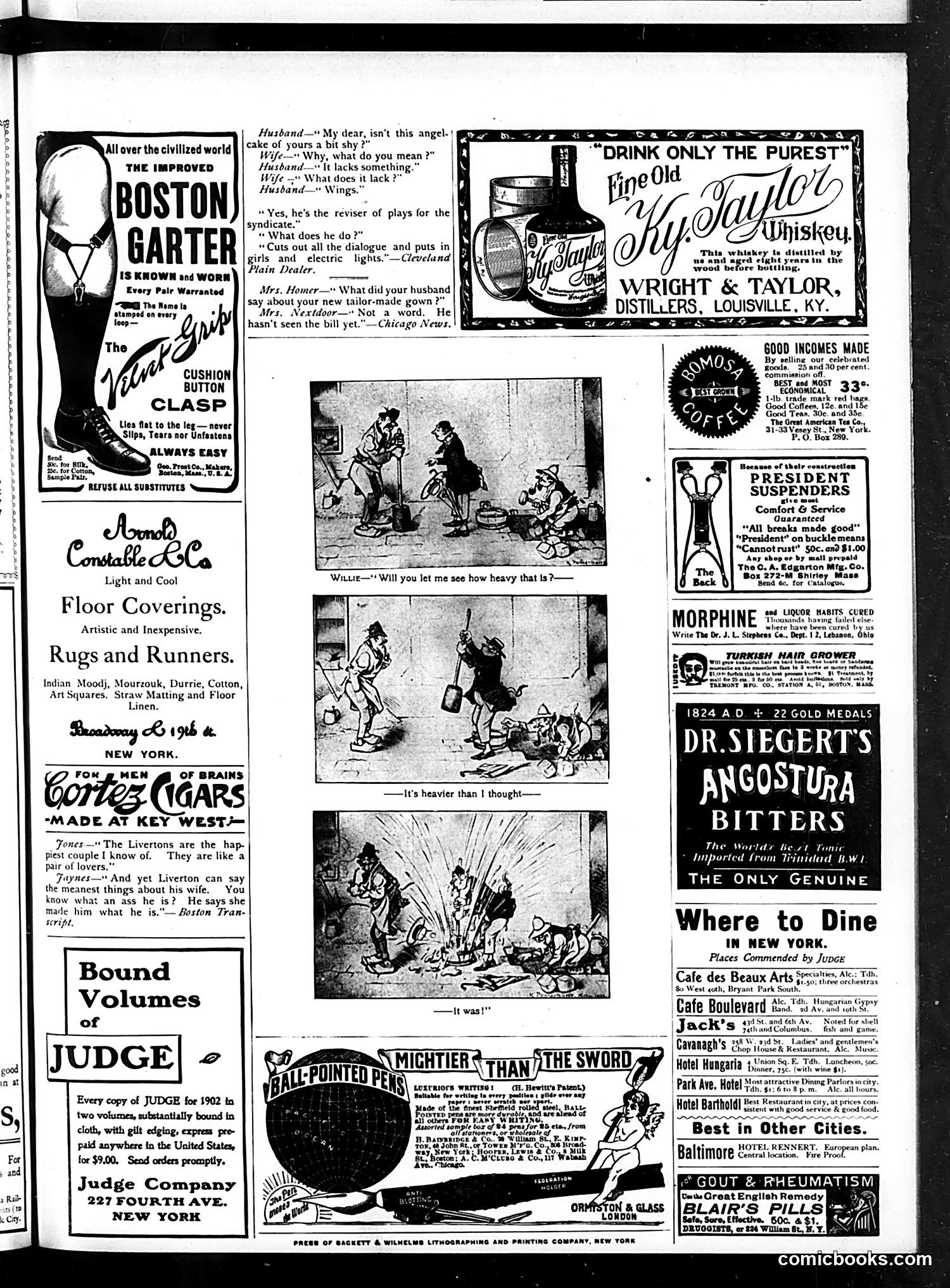
This page from Judge magazine (circa 1902) contains several brief comedic exchanges and extensive advertising. The cartoons themselves are modest: **The main humor pieces** are short joke dialogues typical of Judge's format: - A husband criticizes his wife's "angel cake" for lacking "wings"—a pun on the cake's name - A joke about a theater play "reviser" who cuts dialogue and adds "girls and electric lights"—satirizing commercial theater's shift toward spectacle over substance - A domestic joke where a wife hasn't shown her husband a bill, playing on marital financial tensions **The large central image** shows what appears to be a slapstick scene with multiple figures in chaotic action, though the specific satirical target is unclear from the visible caption alone. **The page is dominated by advertising**—for whiskey, cigars, floor coverings, coffee, hair products, bitters, and restaurants—reflecting Judge's commercial dependence. These ads reveal period consumer culture and patent medicine prevalence. The overall tone reflects early 1900s American humor: domestic squabbles, theatrical satire, and wordplay.
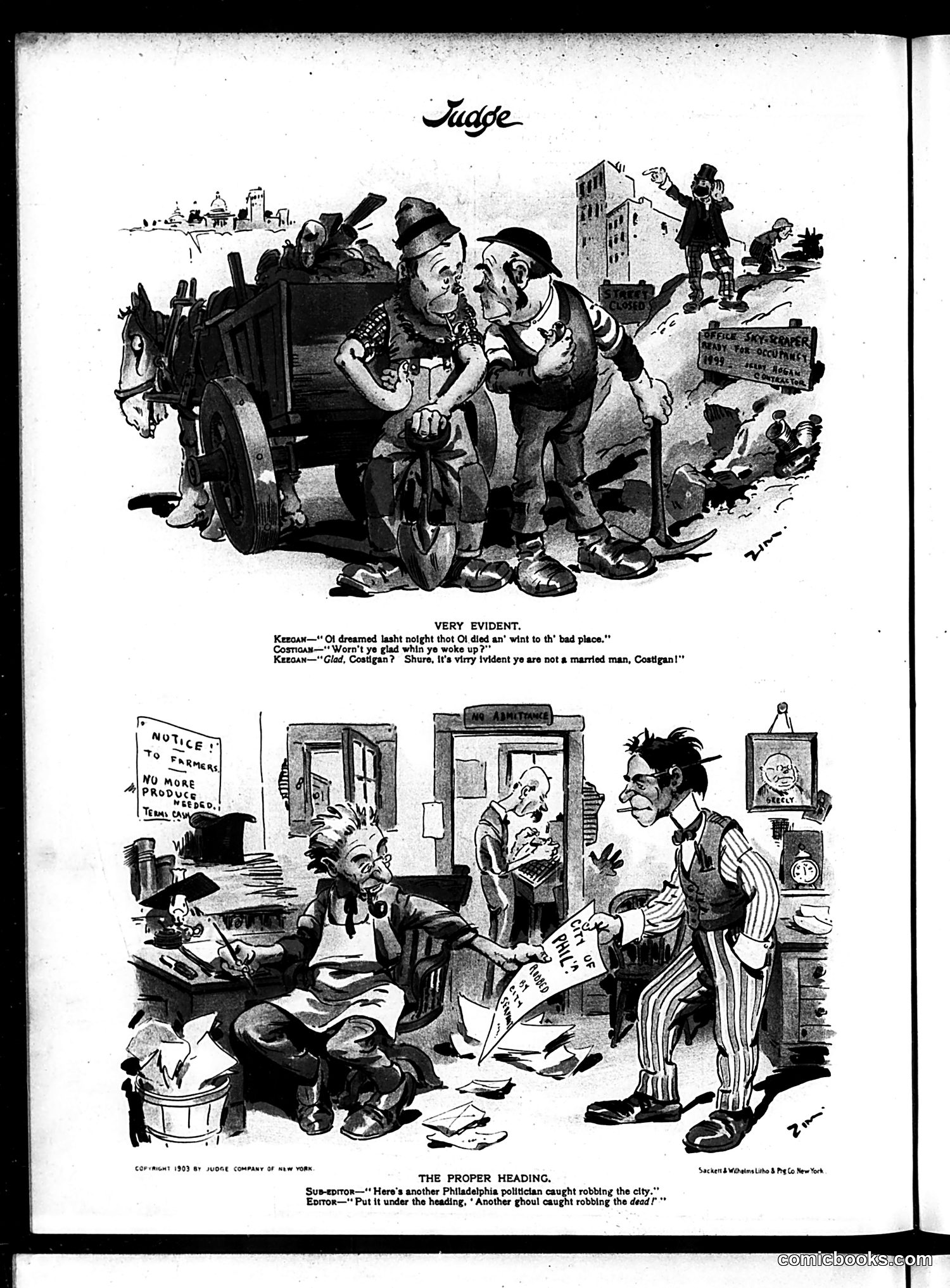
**Top cartoon ("Very Evident"):** Features Irish characters (identifiable by dialect spelling and names like Keegan and Costigan) discussing a dream. The joke turns on marital misery—Keegan dreamed he went to "the bad place" (hell) but was glad to wake up, because being married is apparently worse than damnation. It's a crude joke about marriage as a man's punishment. **Bottom cartoon ("The Proper Heading"):** Mocks Philadelphia politics and corruption. A newspaper editor receives tips about yet another politician caught stealing from the city. The satirical "correction" suggests the headline should read "Another ghoul caught robbing the dead"—implying Philadelphia politicians are so corrupt and their theft so routine that they're essentially desecrating the city itself. It's commentary on systemic political corruption as normal practice.