
Judge, 1903-06-13 · page 10 of 16
Judge — June 13, 1903 — page 10: what you’re looking at
What you’re looking at
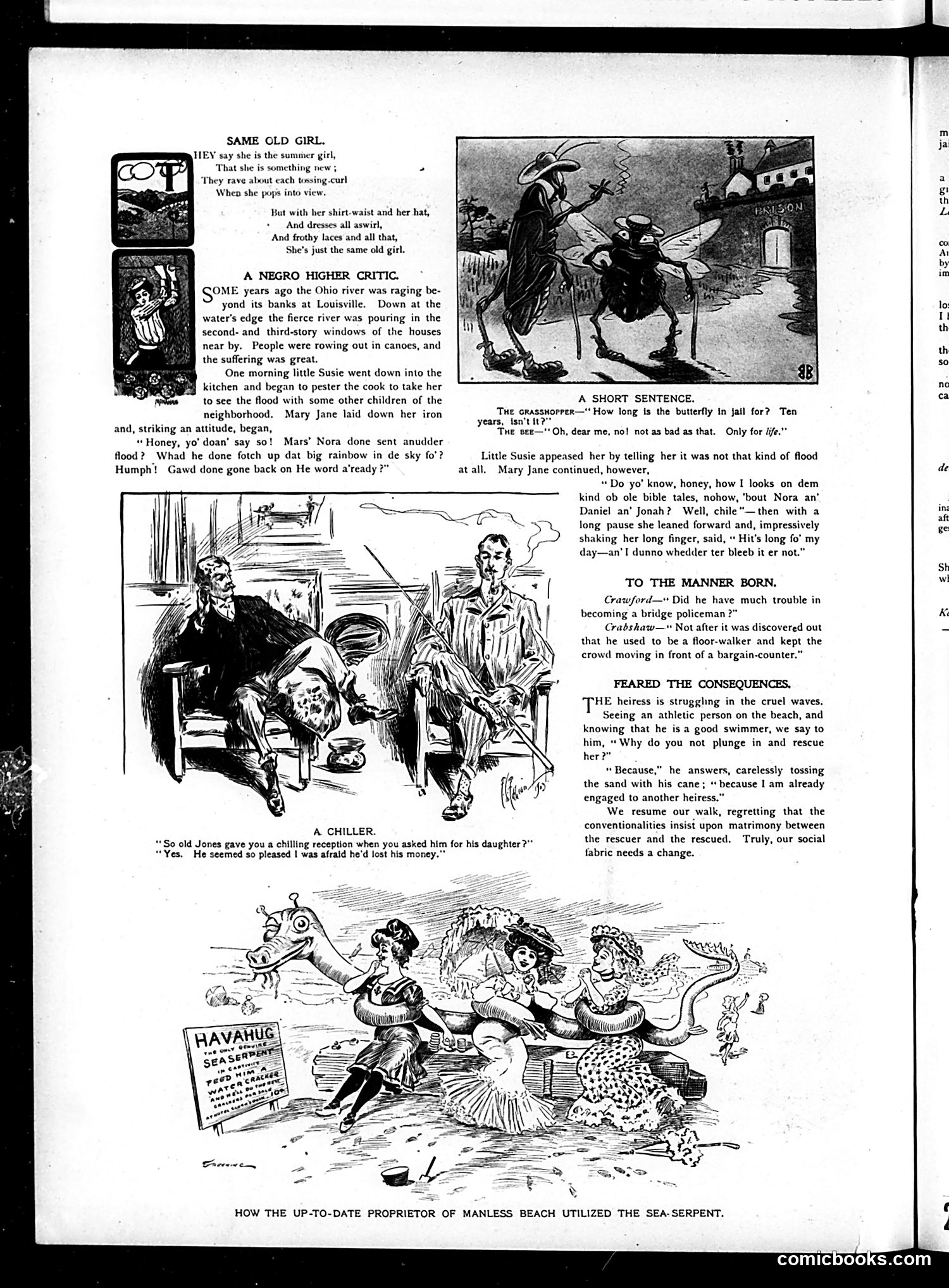
This page contains multiple satirical pieces typical of early-20th-century American humor: **"Same Old Girl"**: A poem mocking the "summer girl" phenomenon—the notion that women transformed into exotic new beings each season was dismissed as mere fashion changes disguising the same person underneath. **"A Negro Higher Critic"**: A dialect-heavy story featuring a Black cook named Mary Jane. The humor relies on minstrel-show stereotypes: her malapropisms about the Ohio River flood and biblical references ("Nora an' Daniel an' Jonah") are presented as amusing ignorance. This reflects the casual racism standard in early Judge. **"A Chiller," "A Short Sentence"**: Brief joke setups typical of the magazine's format. **"To the Manner Born"**: Satirizes social climbers—a floor-walker (department store employee) becoming a bridge policeman through prior retail experience. **"Feared the Consequences"**: Social satire about marriage conventions: a man won't rescue a drowning heiress because saving her would obligate him to marry her. The bottom cartoon satirizes commercialization, showing a beach proprietor using a sea-serpent as an attraction.
📄 Transcribed text from this page (OCR, searchable)
Machine-transcribed from the original scan — historical spelling and the odd misread are preserved.
SAME OLD GIRL. say she is the summer girl, That she is something new 5 ‘They rave about each tossing.curl When she pops into view. But with her shirt-waist and her hat, And dresses all aswirl, And frothy laces and all that, She's just the same old girl. A NEGRO HIGHER CRITIC. SOME years ago the Ohio river was raging be- yond its banks at Louisville. Down at the water's edge the fierce river was pouring in the second- and third-story windows of the houses near by. People were rowing out in canoes, and the suffering was great. One morning little Susie went down into the kitchen and began to pester the cook to take her to see the flood with some other children of the A SHORT SENTENCE, neighborhood. Mary Jane laid down her iron Tue crassnorrer—“ How long is the butterfly In jail for? Ten and, striking an attitude, began, “Honey, yo’ doan’ say so! Mars’ Nora done sent anudder flood? Whad he done fotch up dat big rainbow in de sky fo'? Little Susie appeased her by telling her it was not that kind of flood Humph't Gawd done gone back on He word a'ready 2” at all, Mary Jane continued, however, A CHILLER. “So old Jones gave you a chilling reception when you asked him for his daughter?" “Yes. He seemed so pleased | was afraid he'd lost his money.”* years, Isn't it?" Tue vee—* Oh, dear me, no! not as bad as that. Only for life."" “Do yo’ know, honey, how I looks on dem kind ob ole bible tales, nohow, ‘bout Nora an’ Daniel an’ Jonah? Well, chile"—then with a long pause she leaned forward and, impressively shaking her long finger, said, “ Hit’s long fo’ my day—an'I dunno whedder ter bleeb it er not.” TO THE MANNER BORN. Crawford—" Did he have much trouble in becoming a bridge policeman ?” Crabshaw—* Not after it was discovered out that he used to be a floor-walker and kept the crowd moving in front of a bargain-counter.” FEARED THE CONSEQUENCES. THE heiress is struggling in the cruel waves. Seeing an athletic person on the beach, and knowing that he isa good swimmer, we say to him, “Why do you not plunge in and rescue her?” “Because,” he answers, carelessly tossing the sand with his cane; “because Iam already engaged to another heires: We resume our walk, regretting that the conventionalities insist upon matrimony between the rescuer and the rescued. Truly, our social fabric needs a change. HOW THE UP-TO-DATE PROPRIETOR OF MANLESS BEACH UTILIZED THE SEA- SERPENT. comicbooks.com de a a