
A complete issue · 16 pages · 1903
Judge — March 28, 1903
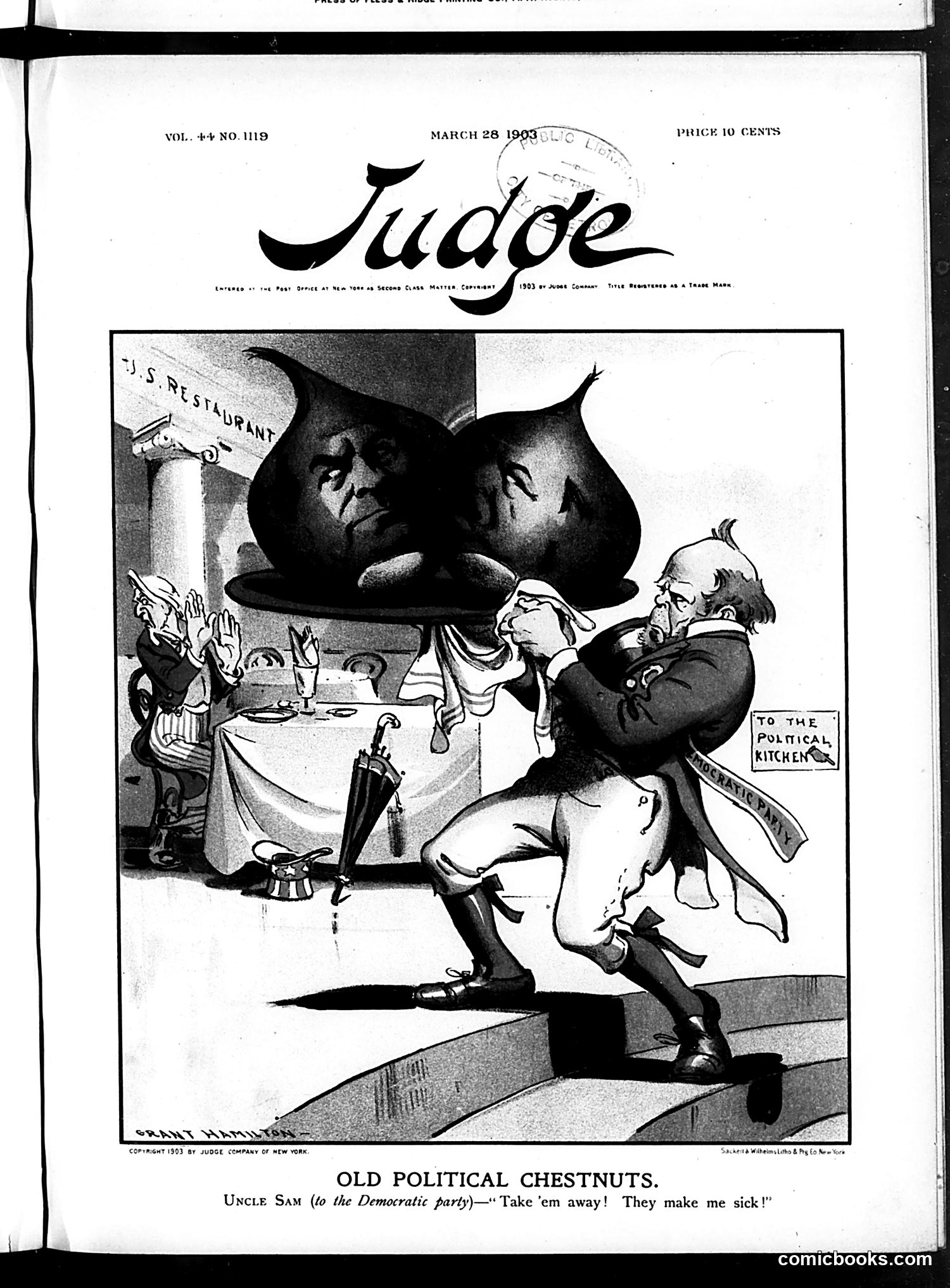
This Judge magazine cover from March 28, 1903 uses a cooking metaphor to mock the Democratic Party. Uncle Sam, representing America, stands disgusted at a restaurant kitchen labeled "U.S. Restaurant," refusing a dish of oversized "chestnuts"—a period idiom meaning tired, worn-out ideas or old jokes. Two caricatured Democratic politicians serve this unappetizing fare from a large pot. The "Political Kitchen" sign clarifies the satirical target. The cartoon suggests Democrats are recycling stale, failed policies rather than offering fresh political solutions to American voters. The specific Democratic figures are unclear from the image alone, though the exaggerated caricatures and period styling were typical of Judge's partisan Republican-leaning commentary on opposition politics.
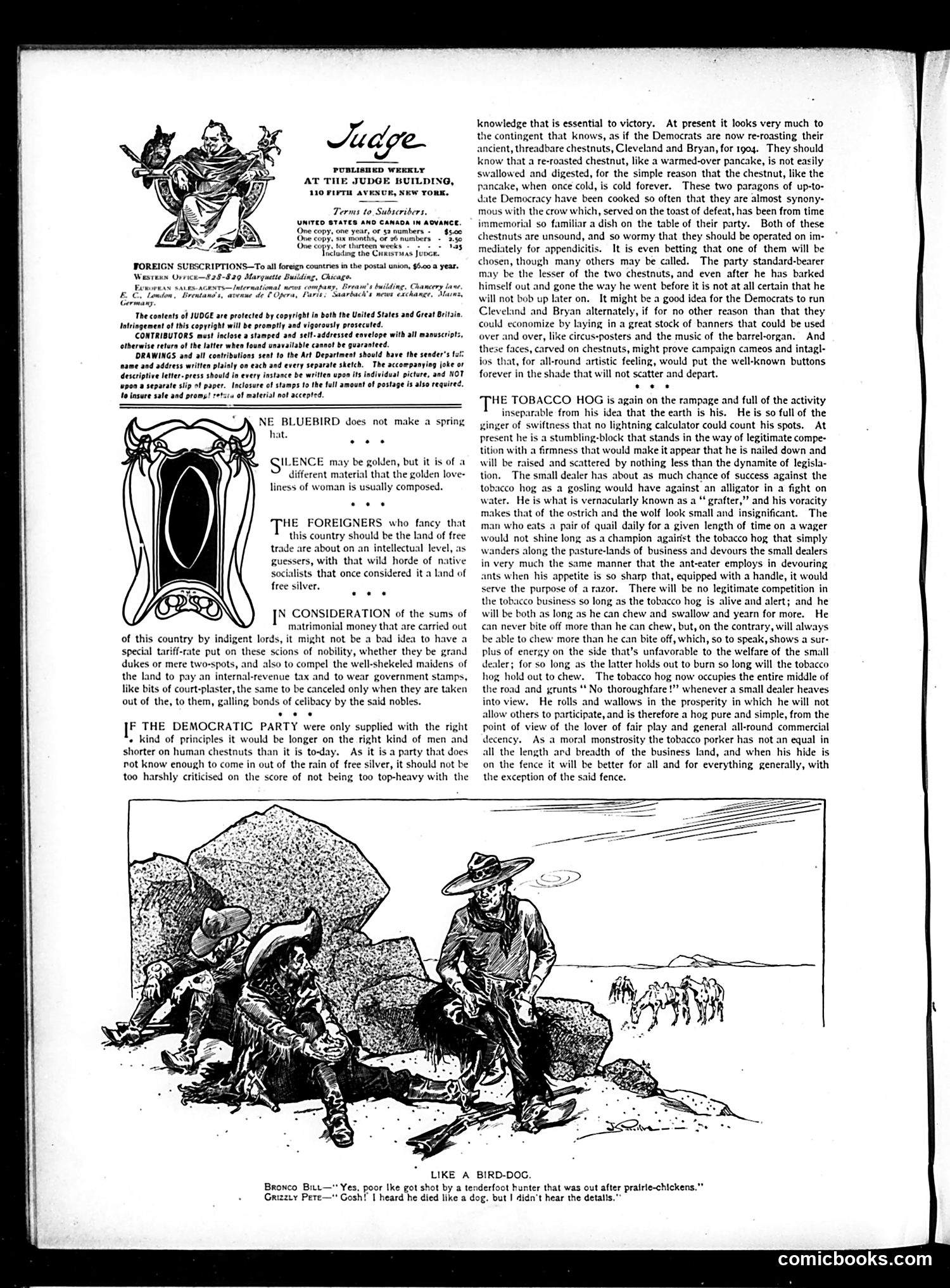
This page contains political commentary and a Western humor cartoon. The main editorial text attacks the Democratic Party, specifically criticizing Cleveland and Bryan as the party's standard-bearers. The author argues Democrats' ideas are so "cooked" and overused they've become stale—comparing them unfavorably to reheated chestnuts and cold pancakes. The bottom cartoon, titled "Like a Bird-Dog," depicts two cowboys (labeled "Bronco Bill" and "Grizzly Pete") discussing an incident where someone "got shot by a tenderfoot hunter" while chasing "prairie-chickens." The joke plays on confusion between hunting game birds and the slang term for women, creating crude Western humor typical of the era's satirical publications.
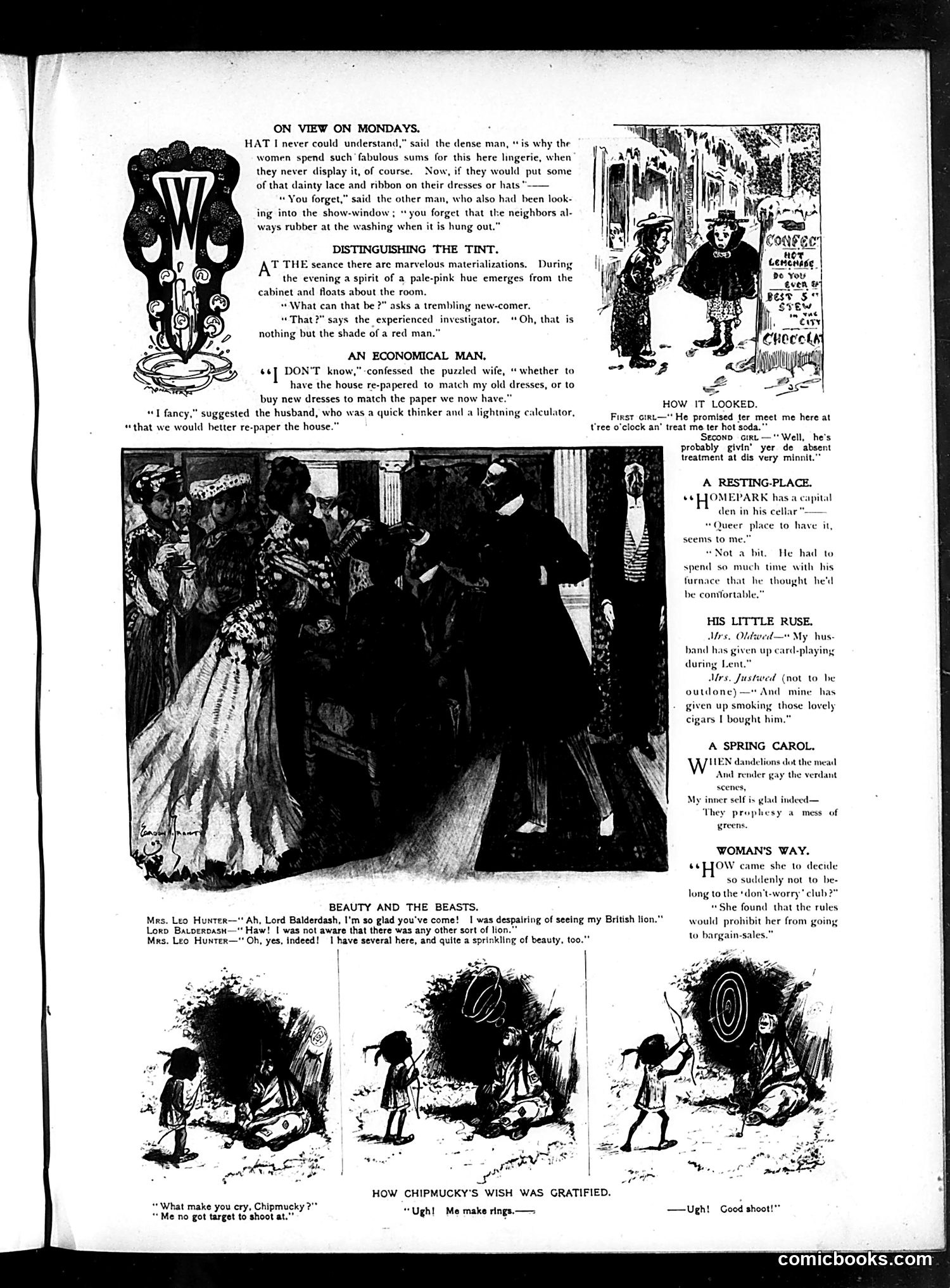
This page contains several unrelated satirical pieces typical of Judge's format. The top section mocks middle-class domestic anxieties—wives confused about household expenses, husbands suggesting practical solutions like re-papering. The central illustration captioned "Beauty and the Beasts" depicts a formal social gathering where Mrs. Leo Hunter complains to Lord Balderdash about missing British lions, while he claims the room contains "several here, and quite a sprinkling of beauty, too"—suggesting the male guests are beastly or unattractive. The bottom comic strip "How Chipmucky's Wish Was Gratified" shows a child's simple desire for toy rings being fulfilled, presented as gentle humor about childhood wants. The page primarily reflects early 20th-century domestic humor and social observation rather than specific political commentary.
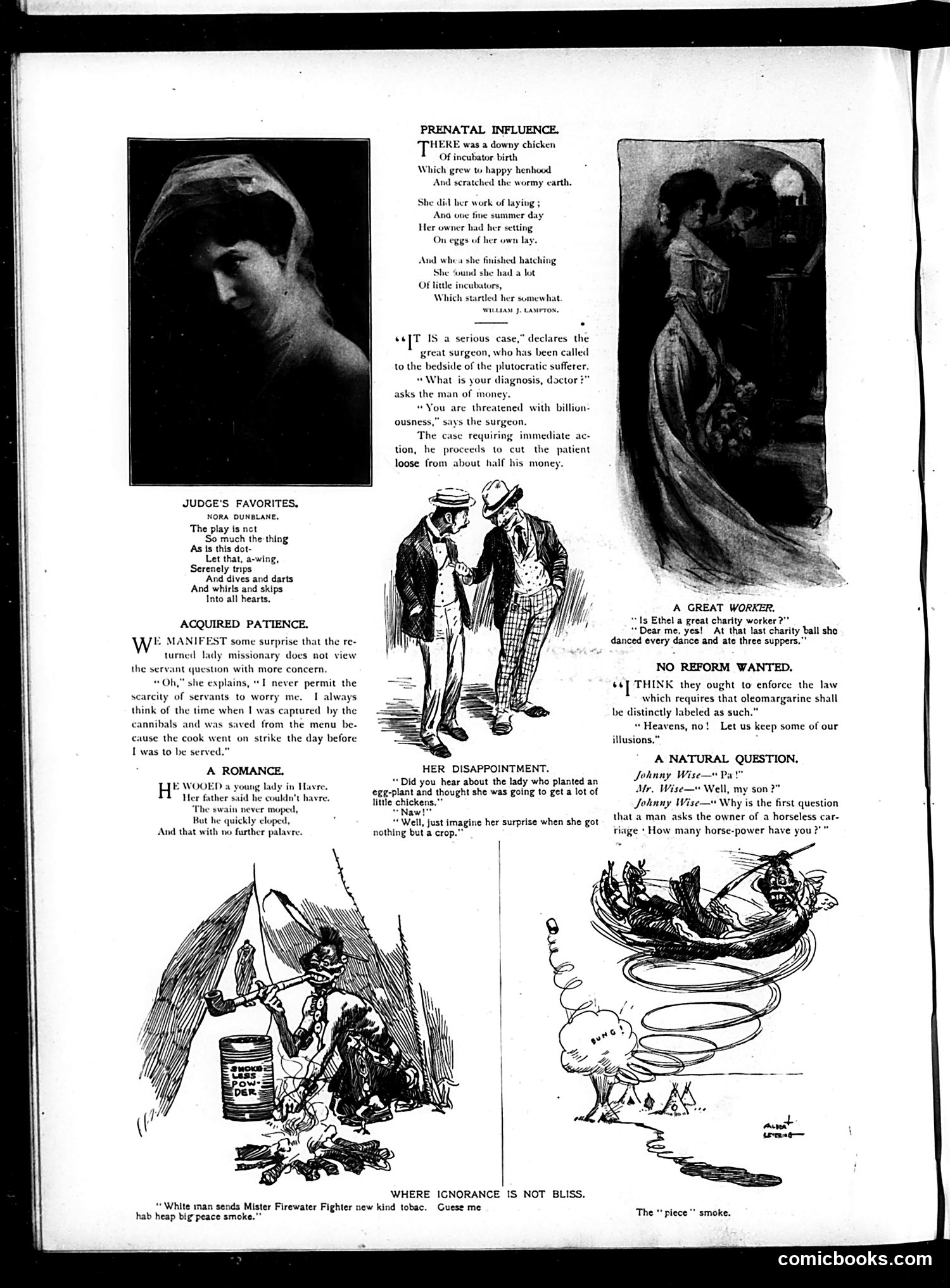
This page contains several satirical pieces and illustrations typical of Judge's social humor: **"Prenatal Influence"** (top) uses verse to mock the idea that a mother's experiences during pregnancy affect her offspring—here, a woman sitting on eggs results in hatching "incubators" rather than chicks. The satire targets pseudoscientific beliefs about maternal impression. **"A Great Worker"** (right) appears to satirize charity work, with dialogue questioning whether charitable acts are genuine or performative. **"A Natural Question"** (bottom right) jokes about horse-power measurement through absurdist illustration. **Other sections** include mild romantic and medical humor ("A Romance," "Prenatal Influence"). The overall tone is lighthearted social satire targeting contemporary superstitions, class attitudes, and medical misconceptions rather than specific political figures or events.
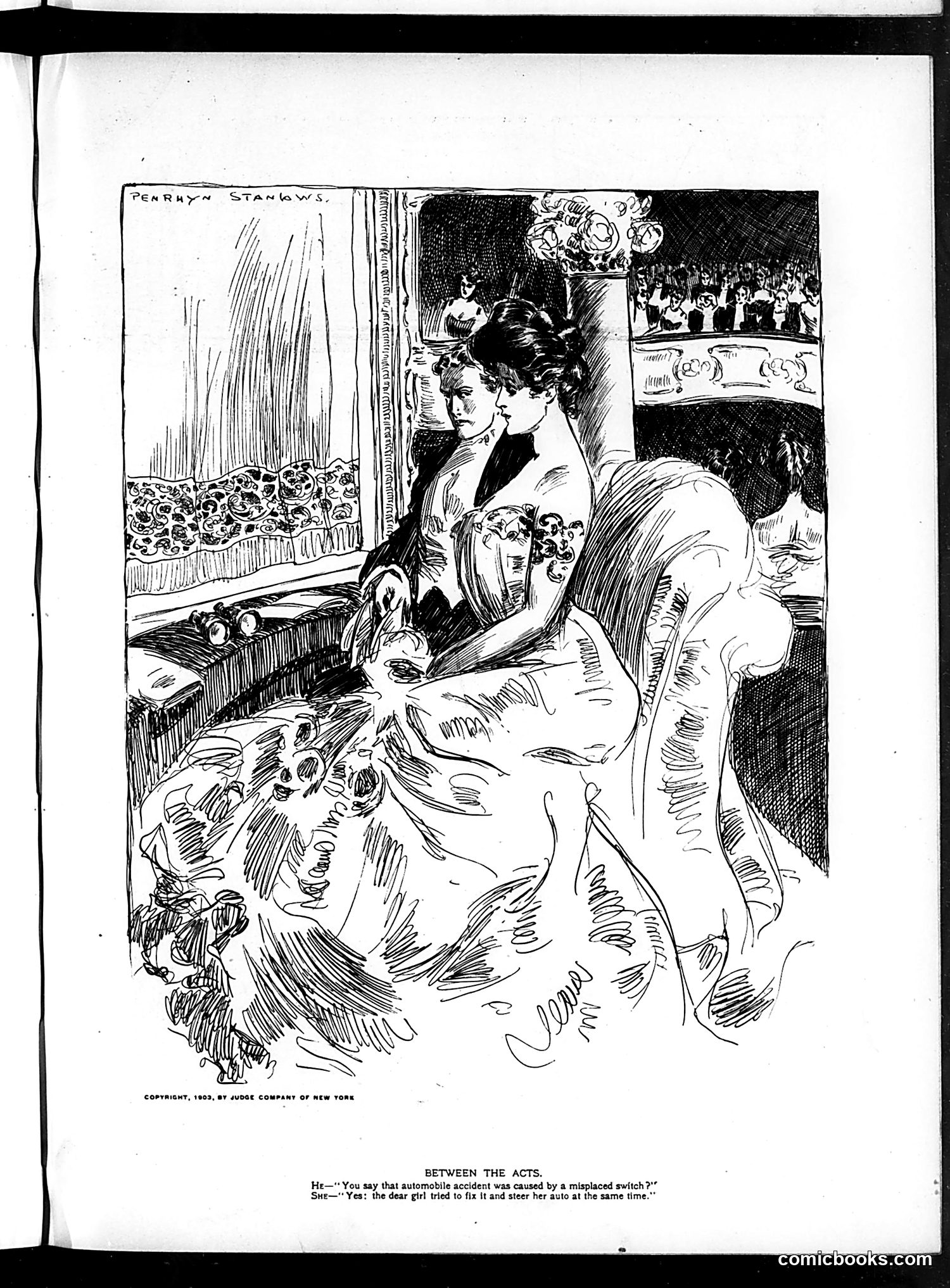
This is a social humor piece titled "Between the Acts," showing an elegantly dressed couple in conversation at what appears to be a theater or social venue (visible audience in background). The joke plays on early 1900s automobile culture. The man asks if a car accident was caused by a "misplaced switch." The woman replies that "the dear girl tried to fix it and steer her auto at the same time"—implying female incompetence at operating automobiles. The satire reflects contemporary anxiety about women drivers, a novelty in this era. The cartoon mocks both the new technology and period assumptions about women's mechanical capability. The refined setting contrasts with the mundane accident, creating comedic irony typical of *Judge* magazine's upper-class audience humor.
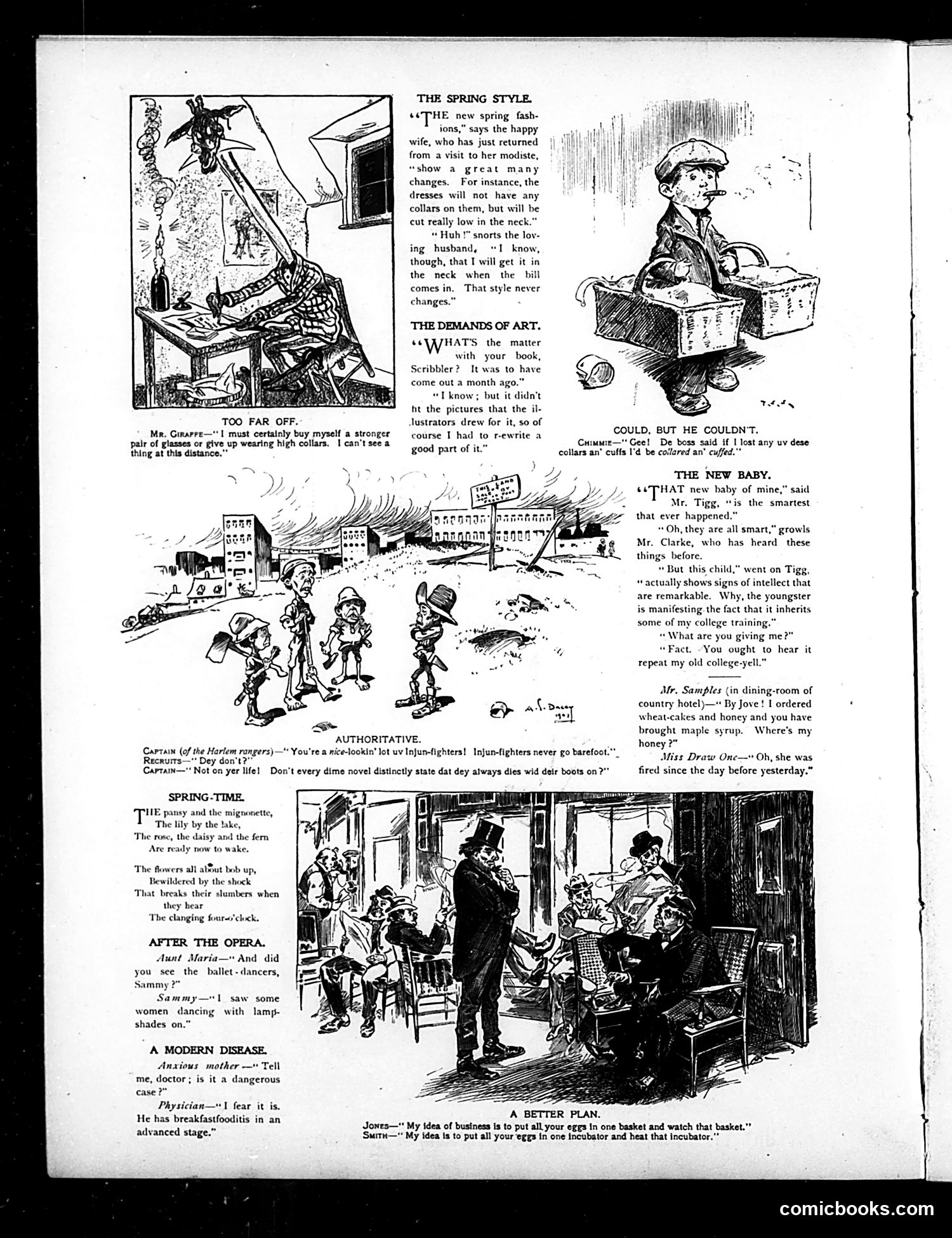
This page from Judge contains multiple short satirical pieces typical of early-20th-century humor magazines: **"The Spring Style"**: Mocks high fashion's constant changes. A wife announces new low-neckline dresses; her husband jokes that while collars disappear from clothing, they'll appear on his bills—implying fashion's expense never changes. **"The Demands of Art"**: Satirizes publishers' and illustrators' inefficiency. A book was delayed a month because illustrations didn't match the text, requiring rewrites. **"The New Baby"**: A father boasts his infant shows inherited intelligence and college training (repeating a college yell). A cynical listener finds this ridiculous. **Other brief jokes** mock: a man needing stronger glasses due to high collars; a worker threatened with being "collared" for losing work collars; a diner receiving maple syrup instead of honey; and contrasting business philosophies about risk management. The humor relies on wordplay, absurdity, and gentle social observation rather than political commentary—typical of Judge's general satirical approach.
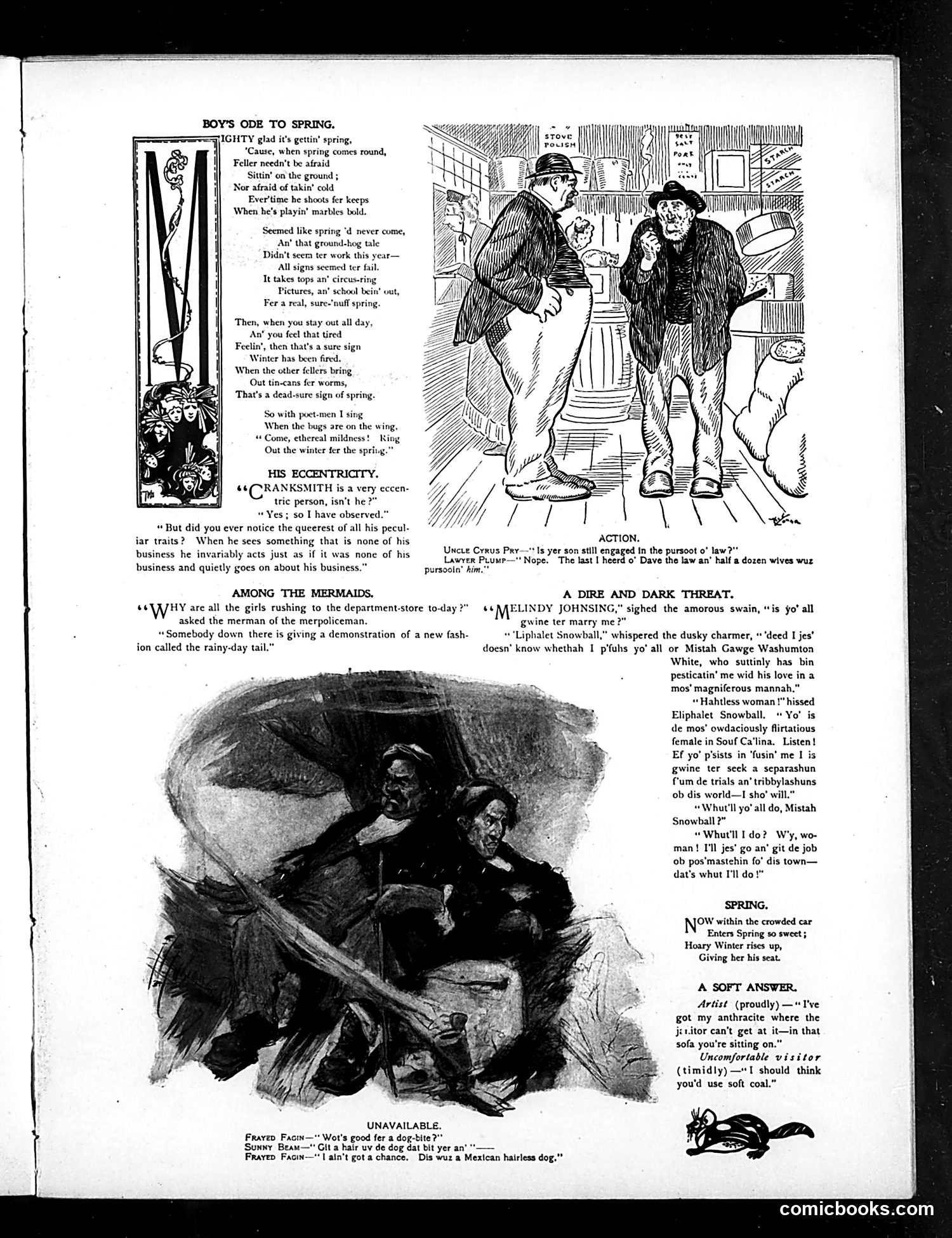
This page collects humorous short pieces typical of early 20th-century American satirical magazines: **"Boy's Ode to Spring"** is nostalgic verse about childhood pleasures—marbles, tin cans for fishing worms—marking spring's arrival. **"His Eccentricity"** jokes about a man named Cranksmith who mildly scandalizes society by minding his own business instead of gossiping—satire of busybodies. **"Among the Mermaids"** makes a fashion pun: mermaids rush to department stores for the new "rainy-day tail." **"A Dire and Dark Threat"** and **"Action"** feature stereotypical African American dialect humor (common but offensive by modern standards), depicting courtship drama and a lawyer pursuing legal cases and wives simultaneously. **"Unavailable"** offers a remedial joke: asked about treating dog bites with hair of the dog, a man says he can't—the dog was hairless. **"A Soft Answer"** plays on coal types: an artist hides anthracite in his sofa; a visitor suggests soft coal instead. The page reflects period humor conventions, including heavy reliance on ethnic caricature.
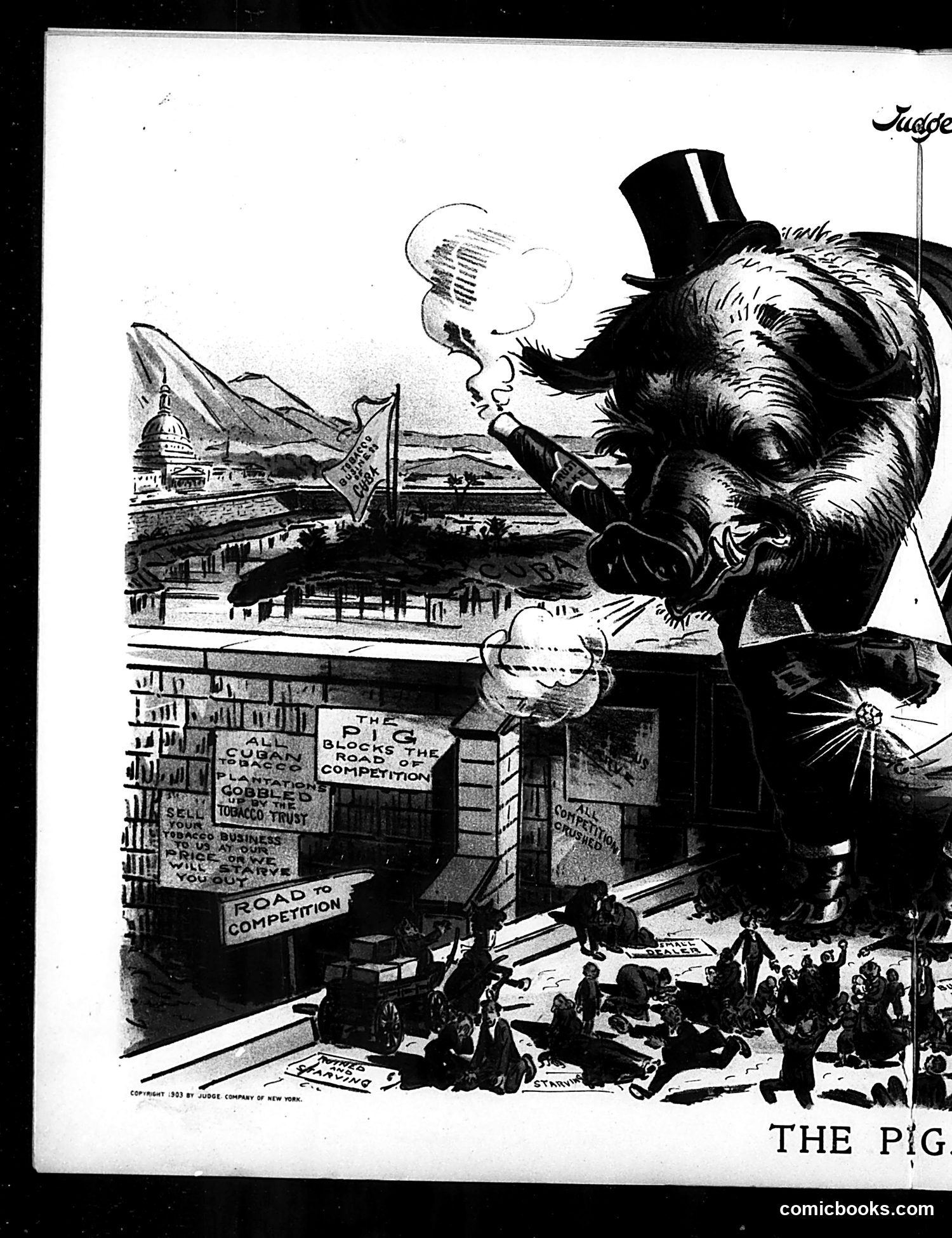
This political cartoon depicts a large anthropomorphic pig wearing a top hat, representing corrupt business interests or monopolies. The pig overlooks an urban landscape with a Capitol building visible in the background, suggesting federal influence. The building below is labeled "The Pig Blocks Road of Competition" with additional text referencing "All Squeal Schemes" and "Road to Competition." The crowd of small figures at street level appears to represent ordinary citizens or competitors being blocked or exploited. The satire targets corporate monopolies and their stranglehold on fair competition during the early 1900s—likely addressing trusts or large corporations that controlled markets and prevented smaller businesses from competing fairly. The "pig" imagery suggests greed and corruption at the highest business levels.
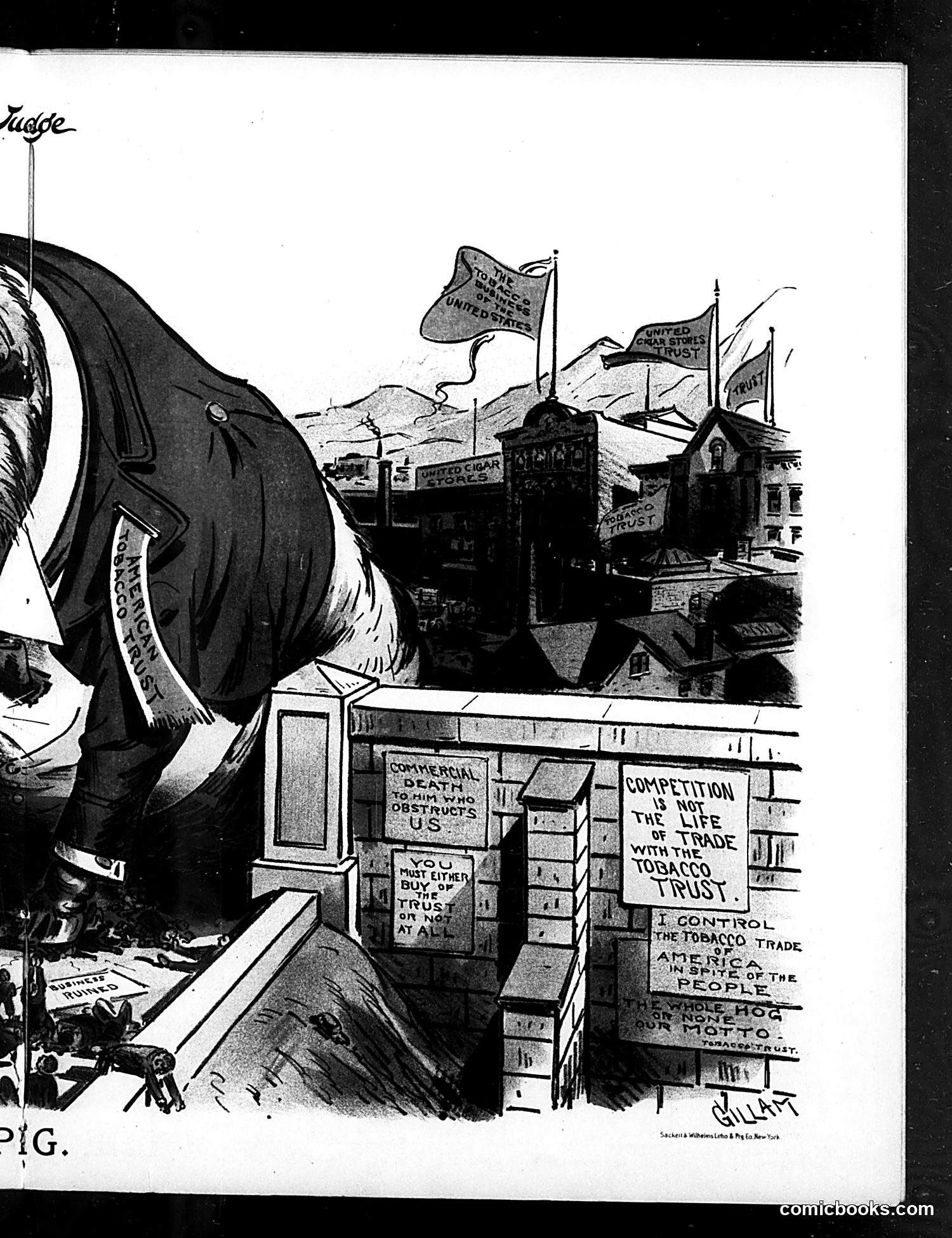
This **Judge** magazine cartoon satirizes monopolistic control of the tobacco industry. A large pig (representing a monopoly or trust) dominates the left side, while buildings labeled "United Cigar Stores Trust" fly flags in the background—depicting an actual commercial chain. The visible signs read: "Commercial Death to Him Who Obstructs Us," "You Must Either Buy of the Trust or Not at All," "Competition is Not the Life of Trade with Tobacco Trust," and "No One Controls the Tobacco Trade in America Except the People"—the last being ironic given the trust's apparent dominance. The satire criticizes how the tobacco trust used monopolistic practices to eliminate competition and control commerce, presenting itself as serving the public while actually restricting consumer choice. This reflects Progressive Era concerns about corporate trusts.
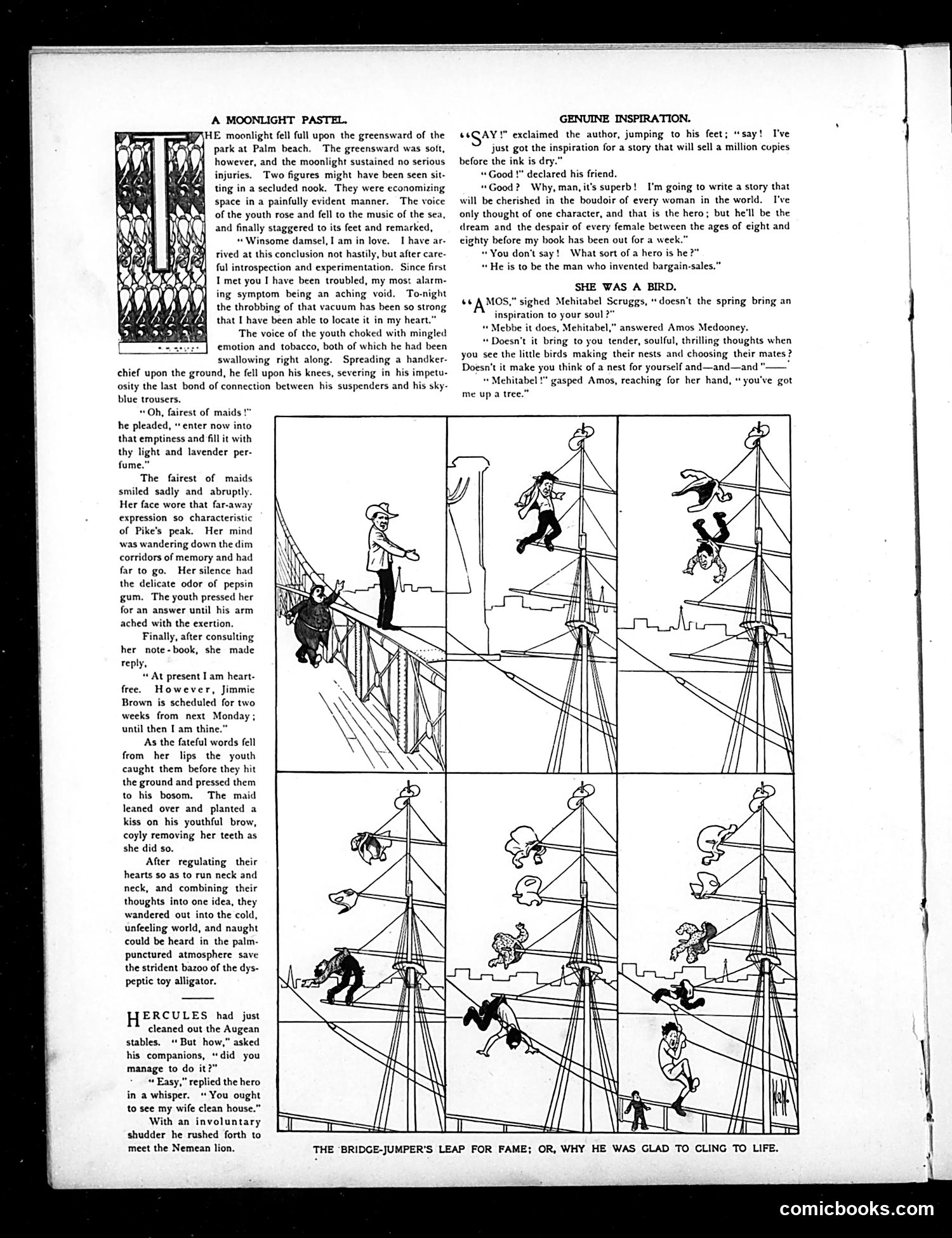
This page contains three humorous short stories typical of Judge's satirical style: **"A Moonlight Pastel"** mocks romantic melodrama. A young man proposes in flowery language at Palm Beach, but the satire undercuts sentiment with physical comedy (his suspenders breaking) and his tobacco-induced emotion, suggesting romance is often performative rather than genuine. **"Genuine Inspiration"** satirizes commercial literature. An author claims he'll write a bestseller beloved by all women—about a man who "invented bargain-sales." The joke ridicules both publishers' cynicism about female readers and the absurdity of making a mundane businessman a romantic hero. **"She Was a Bird"** parodies sentimental courtship. A woman responds to romantic overtures by literally consulting her appointment book, revealing she's only "heart-free" for two weeks before "Jimmie Brown is scheduled." The crude physical humor (removing teeth while kissing) undercuts romantic pretense. The **comic strip panels** (titled "The Bridge-Jumper's Leap for Fame") show acrobatic figures on ships' rigging—likely illustrating theatrical spectacle or daredevil stunts, another target of Judge's humor about modern entertainment.
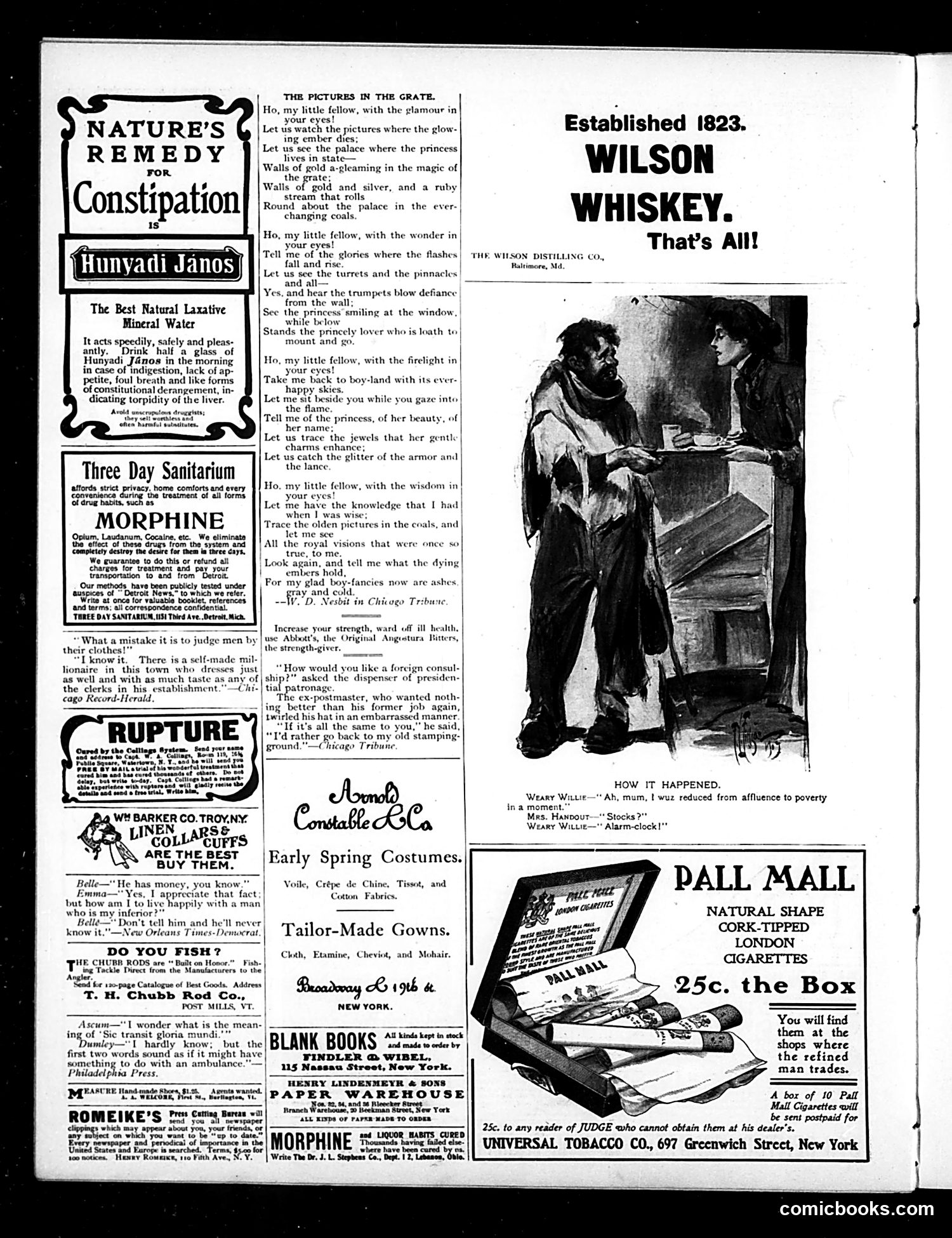
This page is primarily advertising with some interspersed humor content. The main feature is **"The Pictures in the Grate,"** a sentimental poem encouraging a child to imagine magical visions in fireplace embers—a nostalgic piece with no apparent satirical intent beyond whimsical entertainment. The page is dominated by period advertisements: medicinal remedies (Hunyadi Janos laxative, morphine treatment centers, Abbott's Bitters), Wilson Whiskey, and Doll Mall cigarettes. Several brief comedic anecdotes appear—about a poorly-dressed millionaire, a jobseeker preferring his old position, and a character rendered poor by breaking an alarm clock. No specific political figures or events are clearly identifiable. The humor is genteel and domestic rather than satirical. This appears to be a typical early-20th-century magazine page where editorial content was secondary to commercial advertising.
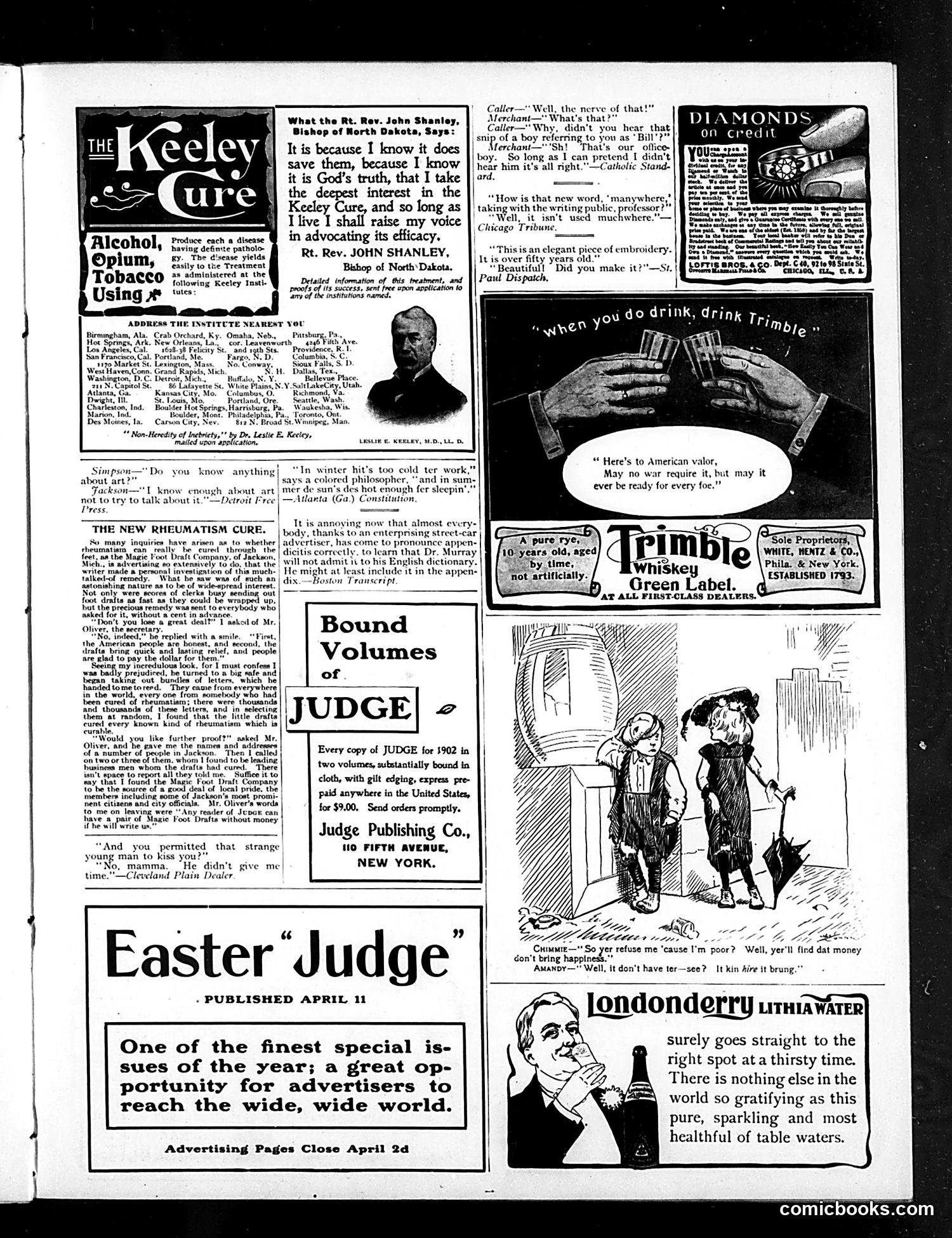
This page is primarily **advertising and promotional content** rather than political satire. The main elements include: **The Keeley Cure advertisement** (top left): Promotes a treatment for alcohol and opium addiction, featuring an endorsement from Rt. Rev. John Shanley, Bishop of North Dakota. This reflects early 1900s attitudes toward addiction as a treatable disease. **The "Magic Foot Draft" article**: Humorously describes a dubious rheumatism cure involving foot wraps, presented as investigative reporting that validates the product—satirizing both patent medicine marketing and credulity. **Trimble Whiskey ad**: Standard liquor advertising promising quality ("pure rye, 10 years old, aged by time"). **Londonderry Lithiawater ad**: Marketed as a health beverage for "thirsty times." **Judge Magazine promotion**: Announcing the Easter issue (April 11) as a major advertising opportunity. The irony is unintentional but notable: the page simultaneously promotes addiction cures and alcohol/patent medicines—reflecting the era's confused, unregulated approach to health and commerce.
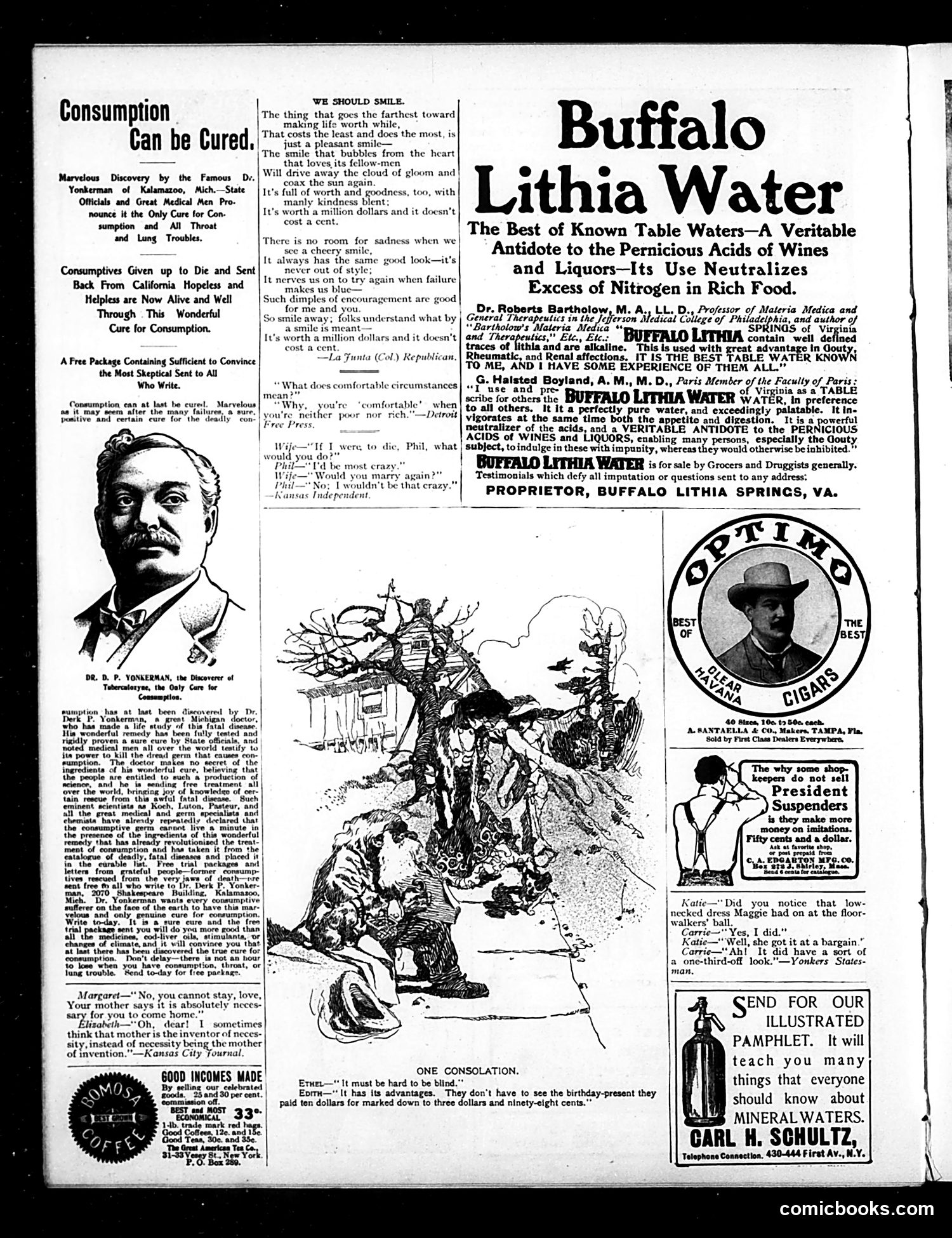
This page primarily features **medical advertisements**, particularly for consumption (tuberculosis) treatment and Buffalo Lithia Water, with minimal satire. The main content includes: **Dr. D.P. Yonkerman's Consumption Cure**: A lengthy advertisement claiming a "marvelous discovery" that can cure tuberculosis, with testimonials from "grateful people." The credibility is undermined by vague language about "ingredients" and comparisons to famous physicians (Koch, Pasteur, Lister), typical of patent medicine fraud of the era. **Buffalo Lithia Water ad**: Claims to neutralize acids, aid digestion, and treat various ailments—another common health product pitch of the period. **Minor elements**: A brief joke about a woman being the "inventor of necessity," cigars advertisement, and a call to learn about mineral waters. The **satire is implicit**: The page illustrates the era's widespread quack medicine industry, where unproven treatments were heavily advertised in mainstream publications. The repetition of medical claims with minimal scientific basis reflects early-20th-century consumer skepticism that *Judge* likely intended to mock.
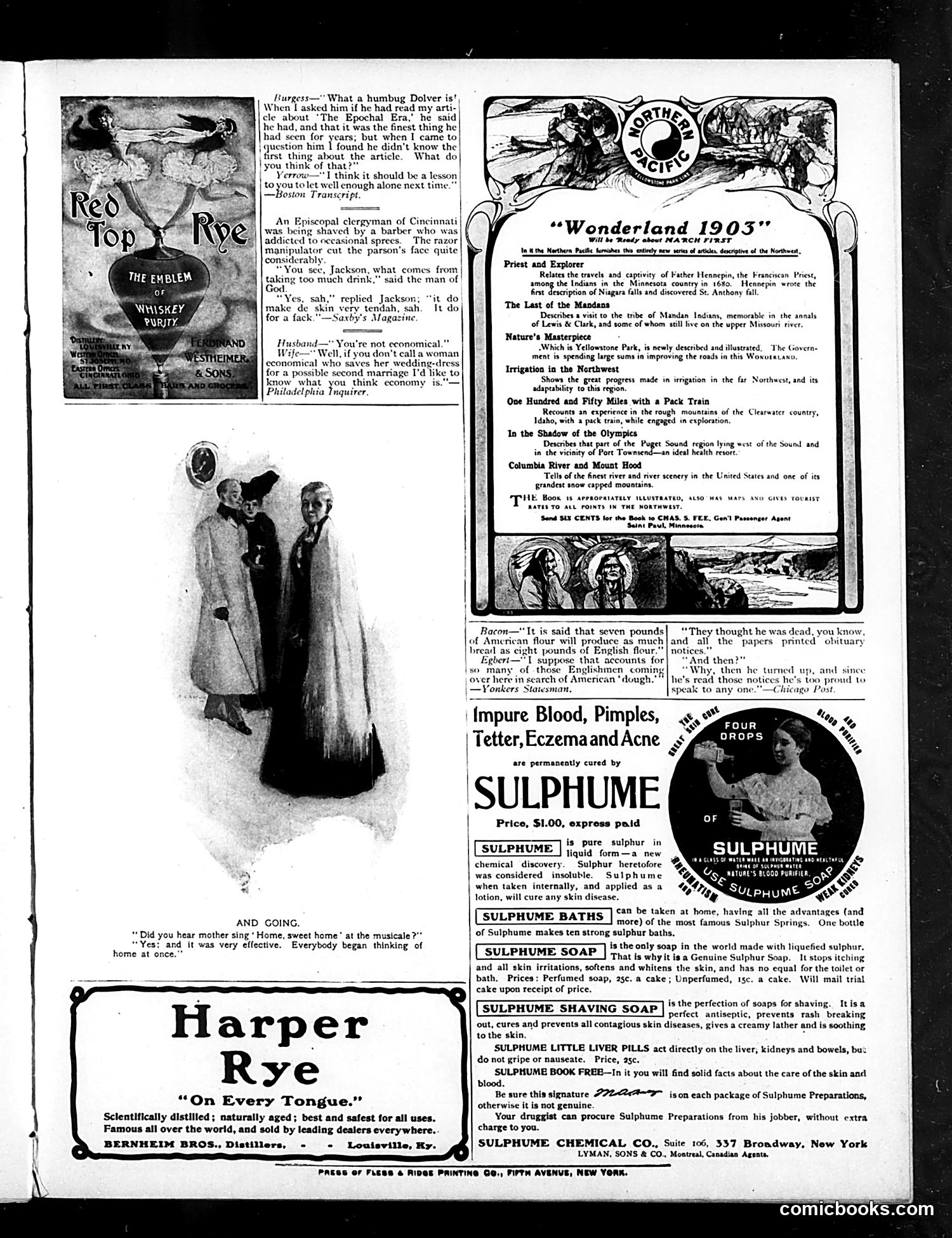
This page contains multiple short jokes and advertisements rather than a single political cartoon. The humor pieces reference early 1900s concerns: **The jokes** mock various social pretenses: a clergyman's drunkenness, insincere flattery about unread articles, women's economic wastefulness regarding wedding dresses, and a man embarrassed by his own published obituary. **The main advertisement** is for Harper Rye whiskey, marketed as "scientifically distilled" and "naturally aged"—typical early-1900s liquor marketing before Prohibition. **The "Wonderland 1903" section** advertises a Northern Pacific Railway travel book describing Western American attractions (Yellowstone, Mount Hood, Native American sites), reflecting the era's growing tourism industry. **The Sulphume ads** promote a patent medicine claiming to cure skin conditions—characteristic of the period's largely unregulated and often fraudulent medical products. The page reflects turn-of-the-century American middle-class anxieties about authenticity, propriety, and consumer culture.
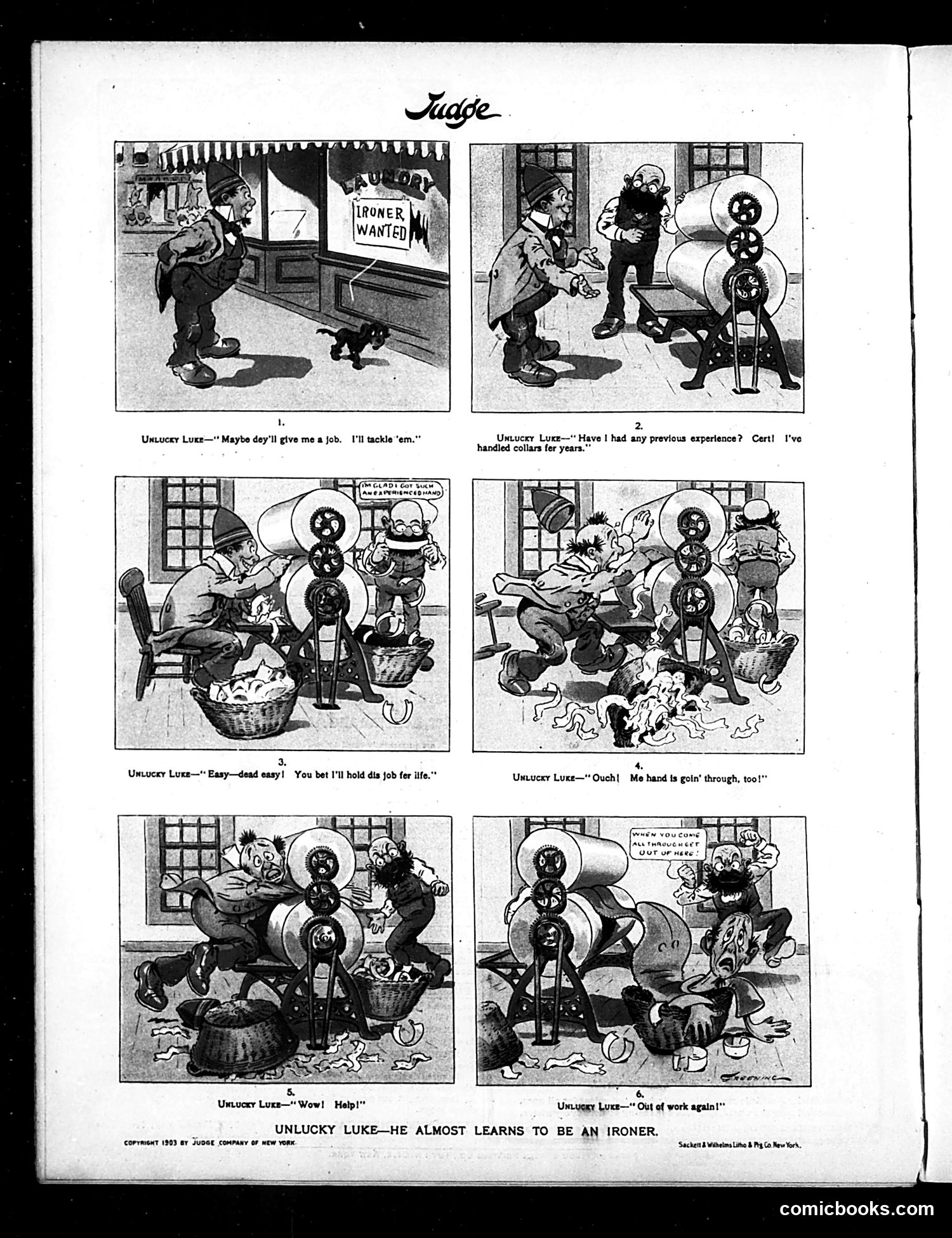
This 1903 comic strip follows a hapless character seeking employment as a laundry ironer. The joke hinges on slapstick incompetence: Luke claims experience handling "collars" but immediately causes chaos with the industrial ironing machine, which appears to malfunction spectacularly in successive panels. Clothes, baskets, and the ironer itself fly chaotically through the workspace. The satire reflects early-20th-century anxieties about unskilled labor and industrial work. The "Unlucky Luke" character embodies the bumbling working-class everyman—a stock figure in period humor. The repeated comedic disasters ("Out of work again!") mock both the character's ineptitude and the precarious, low-skill job market of the era, where workers moved between unstable positions.