
A complete issue · 16 pages · 1903
Judge — February 21, 1903
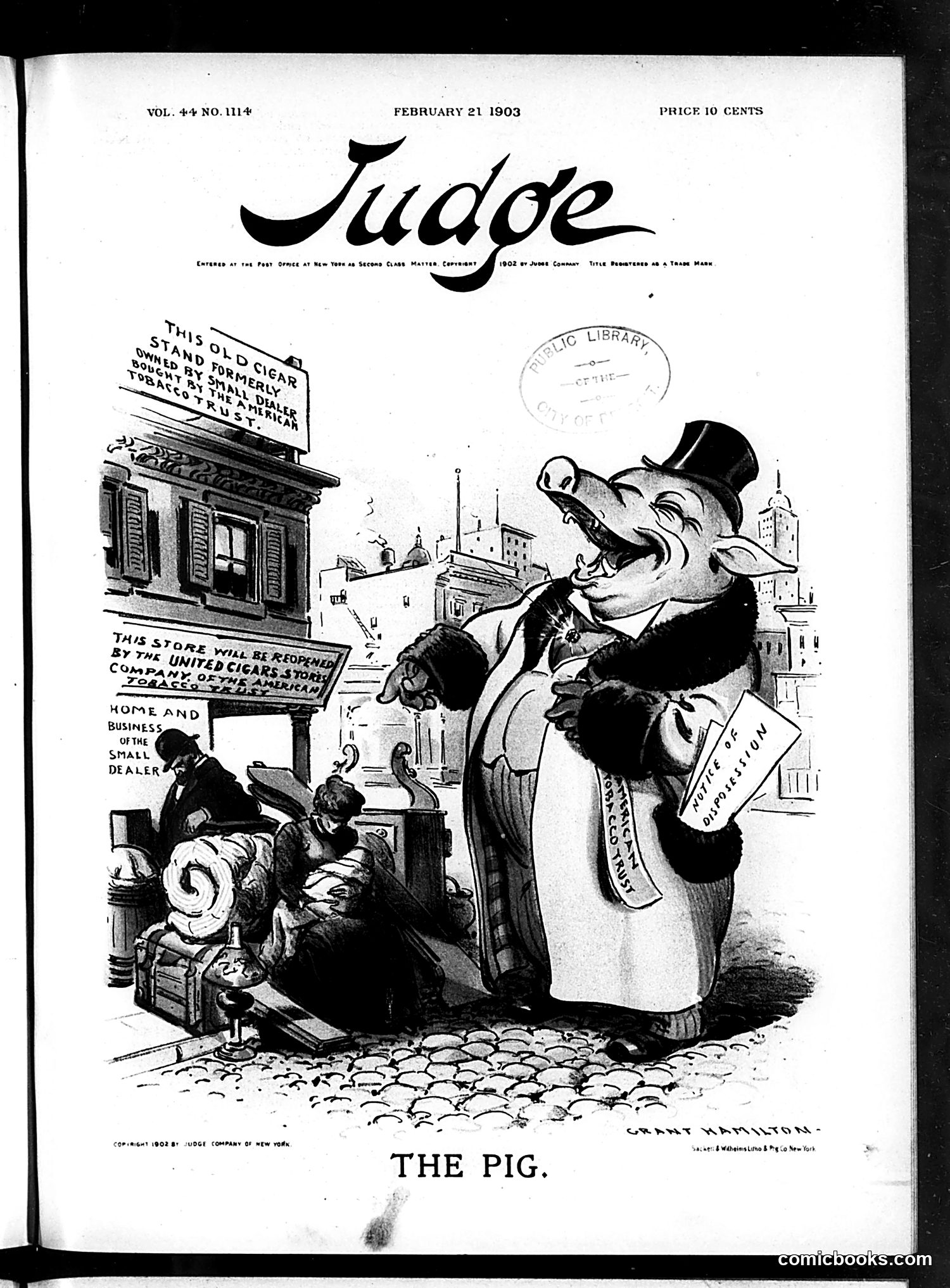
This political cartoon depicts a large pig in a top hat and coat labeled "OPPOSITION" holding papers marked "INJUNCTION" and "CONTEMPT OF COURT." The pig appears to be a capitalist figure confronting small working-class people outside a storefront marked as belonging to the "United Cigar Store Company." The satire criticizes wealthy business interests (represented as the pig) using legal injunctions and contempt-of-court charges as weapons against labor organizers or small business competitors. The impoverished figures below represent ordinary people or small dealers being crushed by monopolistic corporate power and the judicial system's support for big business. The cartoon critiques how wealthy monopolies exploited legal mechanisms to suppress economic competition and labor activism during the Progressive Era.
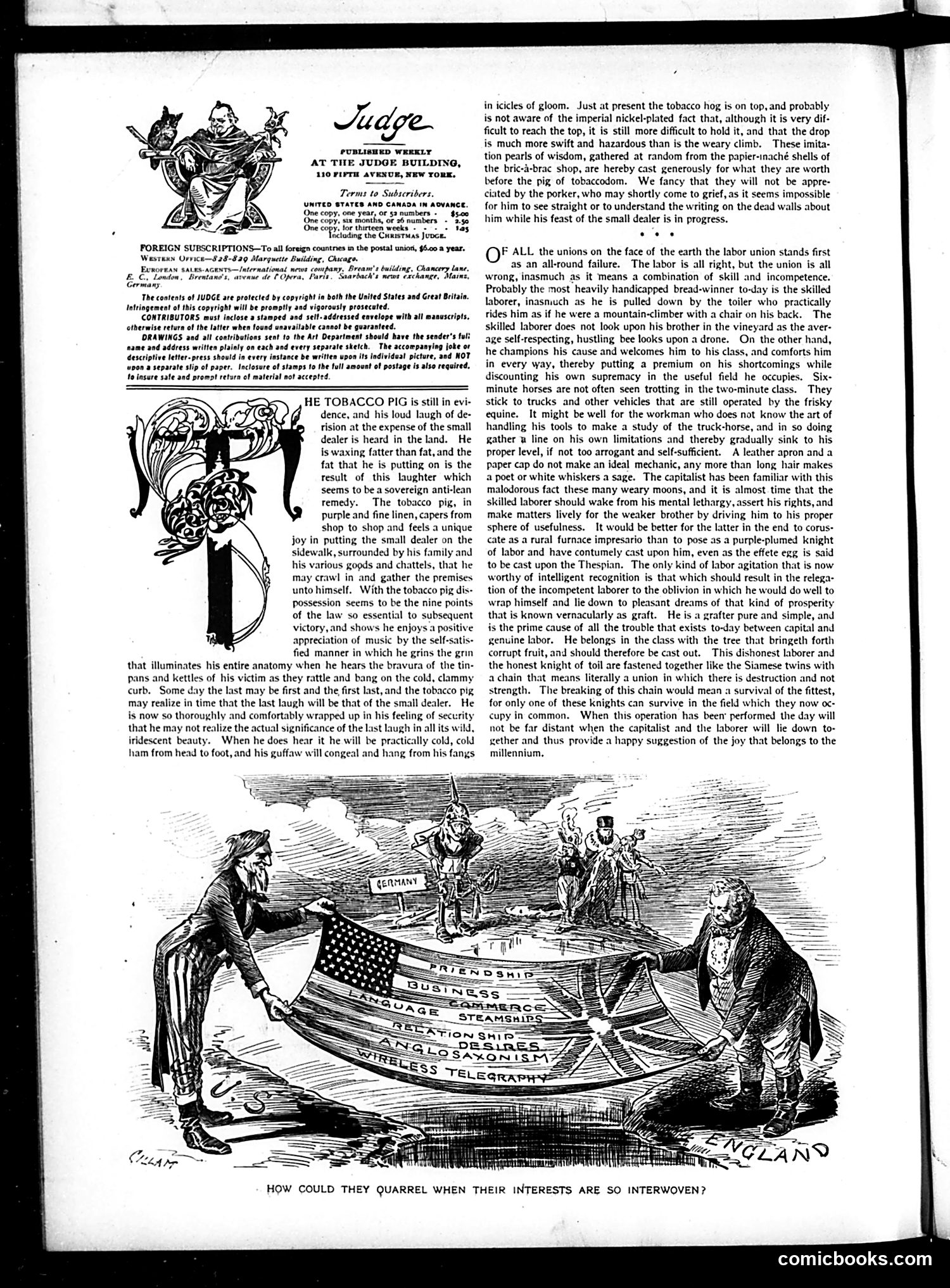
The bottom cartoon depicts **America and England** (labeled figures on left and right) jointly holding a rope laden with symbols of their interconnected interests: "Friendship," "Business," "Trade," "Steamships," "Colonial Desires," "Wireless Telegraph," and "German" threat at center. The caption asks: "How Could They Quarrel When Their Interests Are So Interwoven?" This appears to be **pre-WWI or early WWI-era commentary** arguing that despite historical rivalries, America and Britain share too many economic and strategic interests to seriously conflict. The German presence on the rope suggests the cartoonist viewed Germany as the real threat binding the two nations together. The satire implies their interconnected commerce and imperial ambitions make war between them economically irrational.
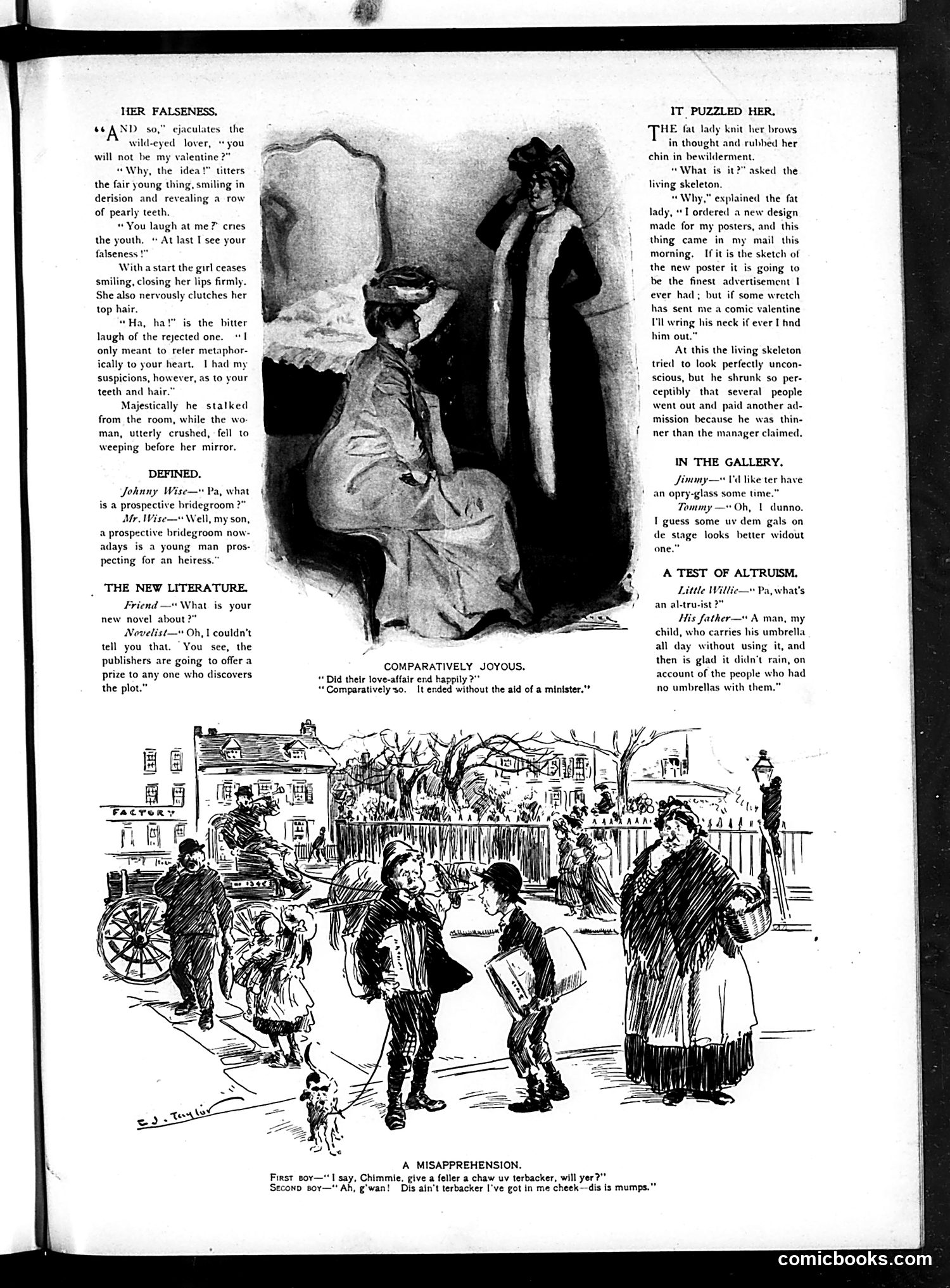
This page contains several short humor pieces and illustrations typical of Judge's satirical style. **"Her Falseness"** and **"It Puzzled Her"** are brief romantic comedies about deception and misunderstanding—common domestic humor themes. **"Defined"** jokes about the term "prospective bridegroom." **"The New Literature"** satirizes publishers' desperate search for novel plots. **"In the Gallery"** and **"A Test of Altruism"** are quick observational gags about cultural behavior. The main illustration, **"Comparatively Joyous,"** depicts a street scene where children ask an adult for help with a "love-affair," which "ended without the aid of a minister"—likely satirizing how common-folk resolve romantic disputes, contrasting with upper-class formality. **"A Misapprehension"** shows street children misunderstanding adult slang about a "terrier." These are general social satire pieces, not political commentary.
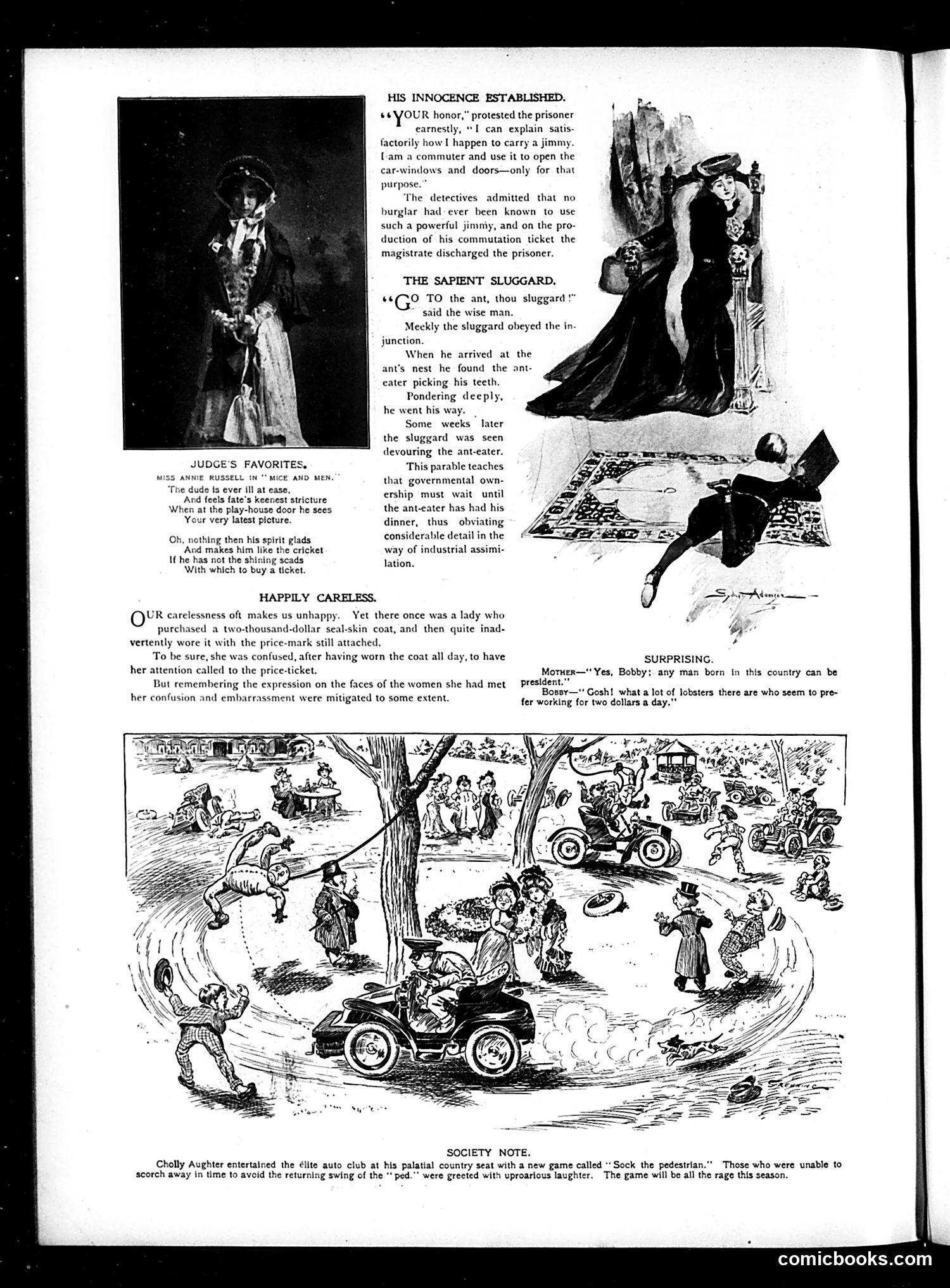
This page from Judge magazine contains several satirical pieces: **"His Innocence Established"**: A prisoner successfully proves his innocence using a jimmy (crowbar) as a commuting tool—satirizing the absurdity of judicial evidence. **"The Sapient Sluggard"**: A parable mocking government inefficiency, where a wise man's instruction to a sluggard goes unheeded until the sluggard observes an ant-eater dining, suggesting governmental processes move too slowly. **"Judge's Favorites"**: A brief joke about Annie Russell in "Mice and Men." **"Happily Careless"**: Humor about a woman who wore a seal-skin coat with its price tag still attached all day. **"Society Note"**: A satirical item describing "Sock the Pedestrian," a dangerous new auto club game where participants swing at pedestrians from moving vehicles. The page primarily targets judicial incompetence, government slowness, and the reckless behavior of wealthy auto enthusiasts.
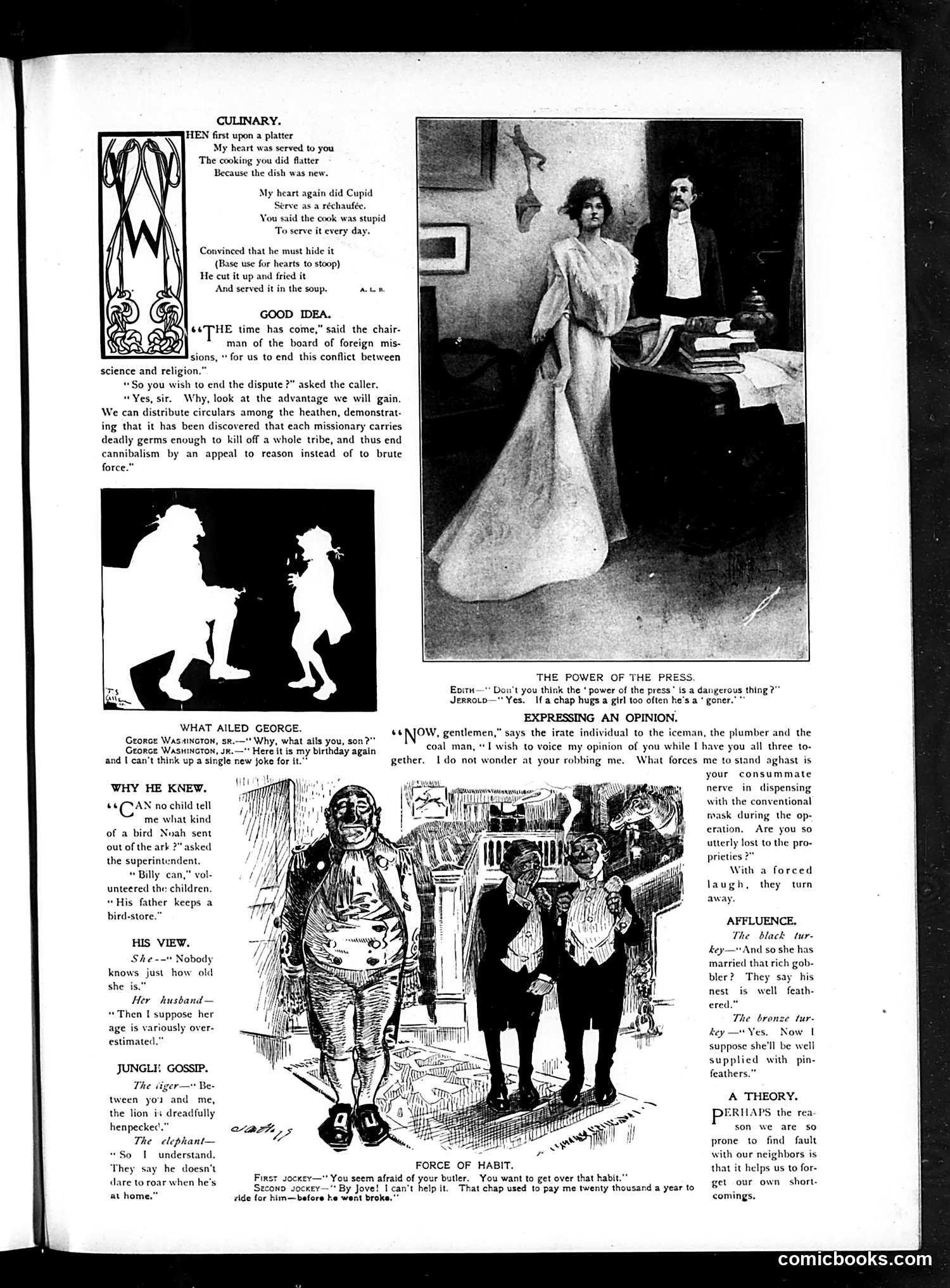
This page contains multiple satirical pieces mocking social pretensions and human nature circa early 1900s: **"Culinary"** uses romantic metaphor—a lover's heart repeatedly served—to mock men who tire of devoted women once novelty fades. **"Good Idea"** satirizes missionary work: a board chairman proposes distributing literature claiming missionaries carry deadly germs to convince cannibals to stop eating them—substituting fear for moral persuasion. The satire targets both religious hypocrisy and colonial attitudes toward "heathens." **"The Power of the Press"** is a pun: "power of the press" means both media influence and physical pressure—if a man hugs a girl too often, he becomes a "goner" (engaged/doomed). **"Expressing an Opinion"** mocks a working man's (iceman, plumber, coal man) outrage at being robbed, but his real complaint is they rob him *without removing their professional masks*—satirizing class hypocrisy. **"Jungle Gossip"** presents animal stereotypes (henpecked lion) reflecting Victorian gender attitudes. **"Force of Habit"** jokes about a butler's former employer paying him handsomely—now the butler fears authority from ingrained habit. The overall tone is cynical about human nature, relationships, and social hierarchies.
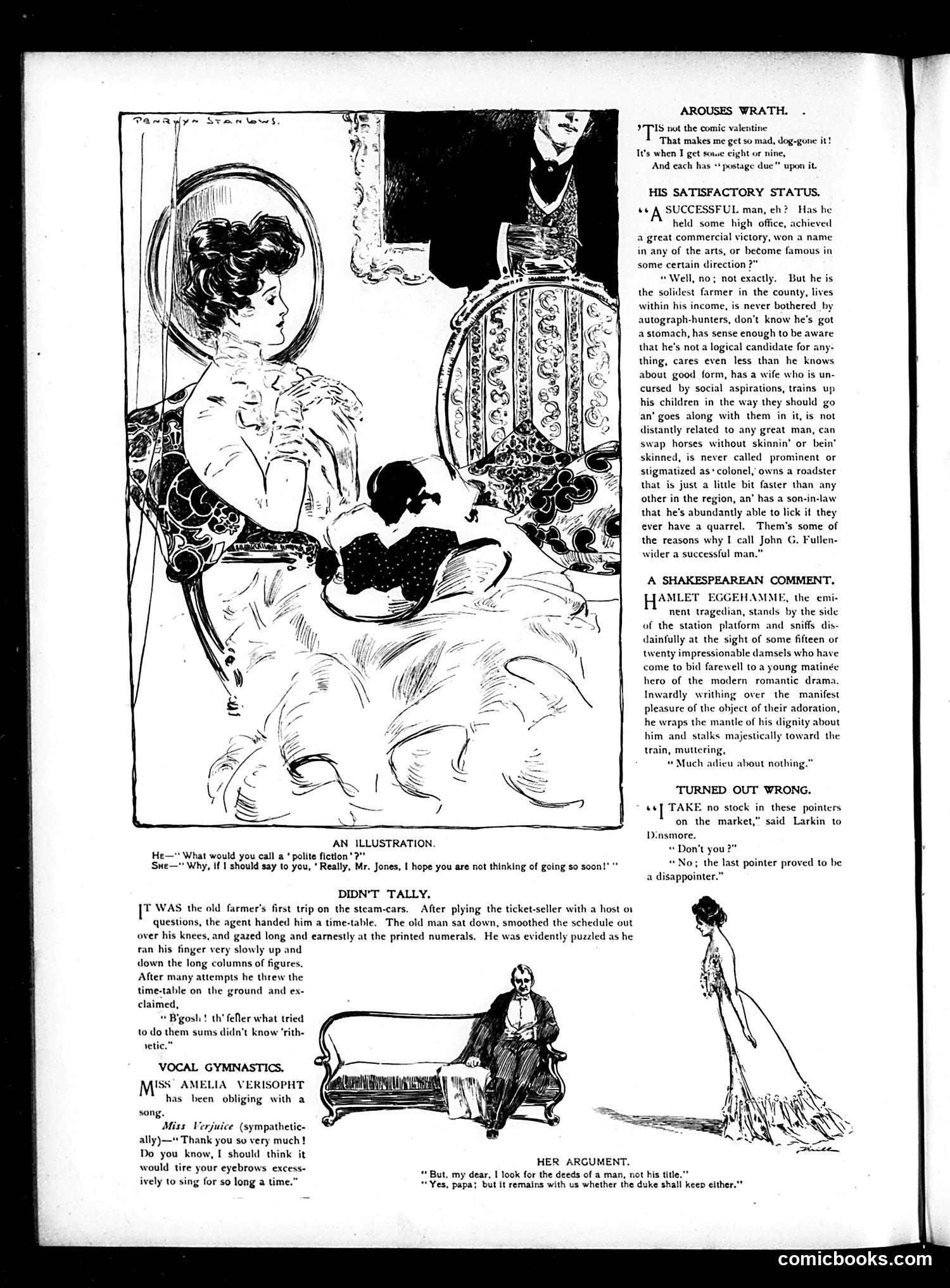
This page contains several brief satirical pieces mocking American social pretensions and romantic conventions: **"His Satisfactory Status"** ironically defines success not as wealth or fame, but as a humble farmer living within his means, unbothered by social climbing—a critique of Gilded Age status-seeking. **"A Shakespearean Comment"** mocks theatrical vanity through an actor (Hamlet Eggehamme) disdainfully ignoring admirers at a train station, while muttering Shakespeare's "Much Adieu About Nothing"—satirizing performers' inflated self-importance. **"Didn't Tally"** jokes about a farmer confused by a train schedule, unable to reconcile the numbers—poking fun at rural unfamiliarity with modern technology. **"Vocal Gymnastics"** features Miss Amelia Verisopht thanked for singing, with a guest concerned the performance tired her eyebrows—absurdist humor about excessive politeness. **"Her Argument"** concludes with a daughter asserting character matters more than titles—mild social commentary on aristocratic pretension. The overall theme: deflating Victorian/Edwardian vanity, snobbery, and affectation.
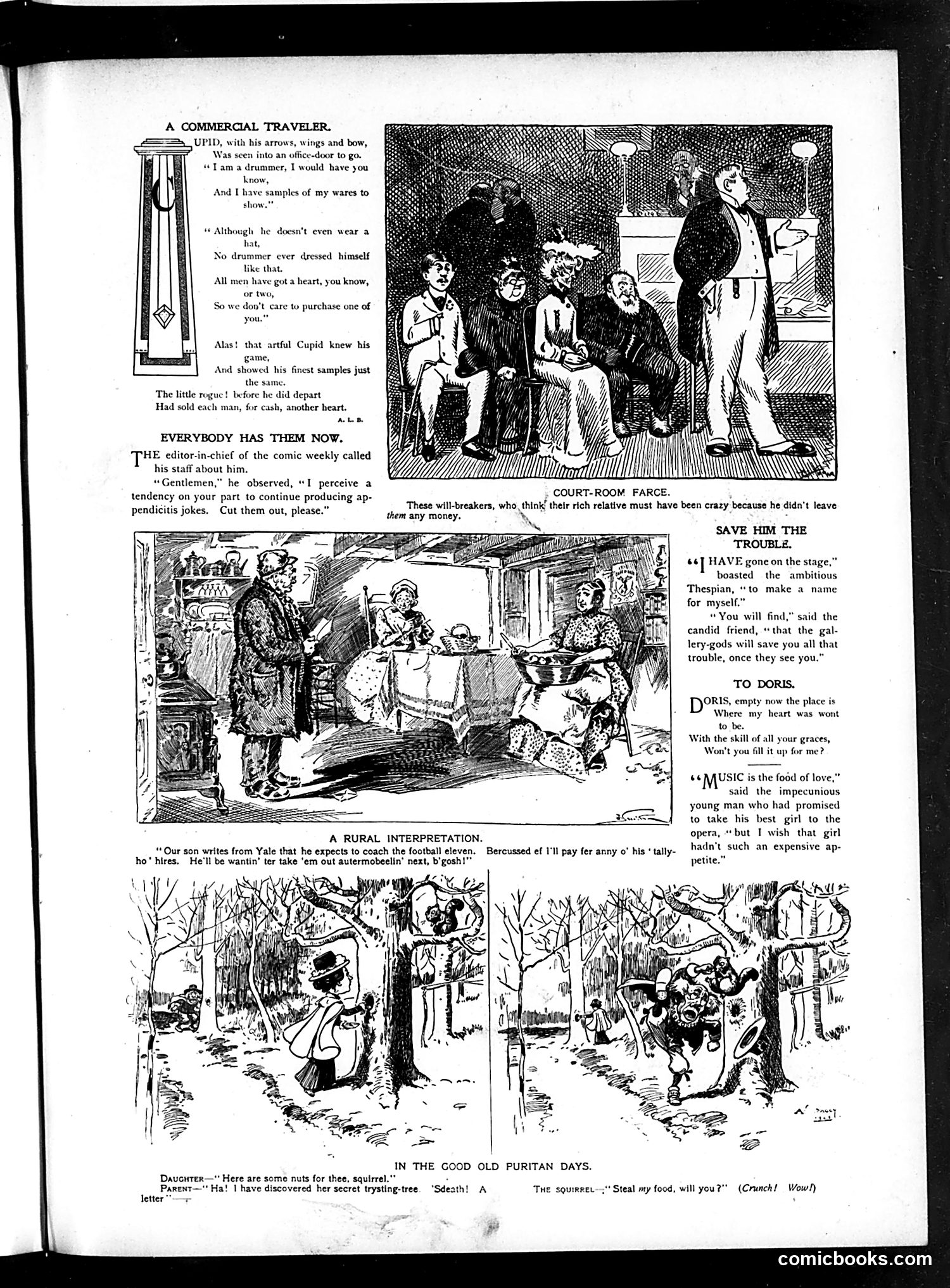
This page collects several humorous pieces satirizing early 20th-century American life: **"A Commercial Traveler"**: Uses Cupid as a traveling salesman ("drummer") selling wares—a metaphor for love as commerce. The joke: even those claiming not to want romance end up "purchasing" hearts anyway. **Editor's Note**: Mocks editorial exhaustion with a tired joke format (appendicitis humor), showing how quickly satire becomes stale and overused. **"Court-Room Farce"**: Ridicules will contests where relatives claim a deceased's non-inheritance proves insanity—implying greed-driven lawsuits. **"Rural Interpretation"**: A rural parent misunderstands Yale coaching as leading to expensive automobile outings, satirizing generational confusion over education costs. **"Good Old Puritan Days"**: Contrasts Puritan severity with modern behavior through forest squirrel scenes—likely mocking nostalgic views of stricter past morality. The scattered romantic verses mock sentimental poetry and impoverished suitors unable to afford their girlfriends' expensive tastes. Overall, the page targets pretension, commercialism, and social climbing.
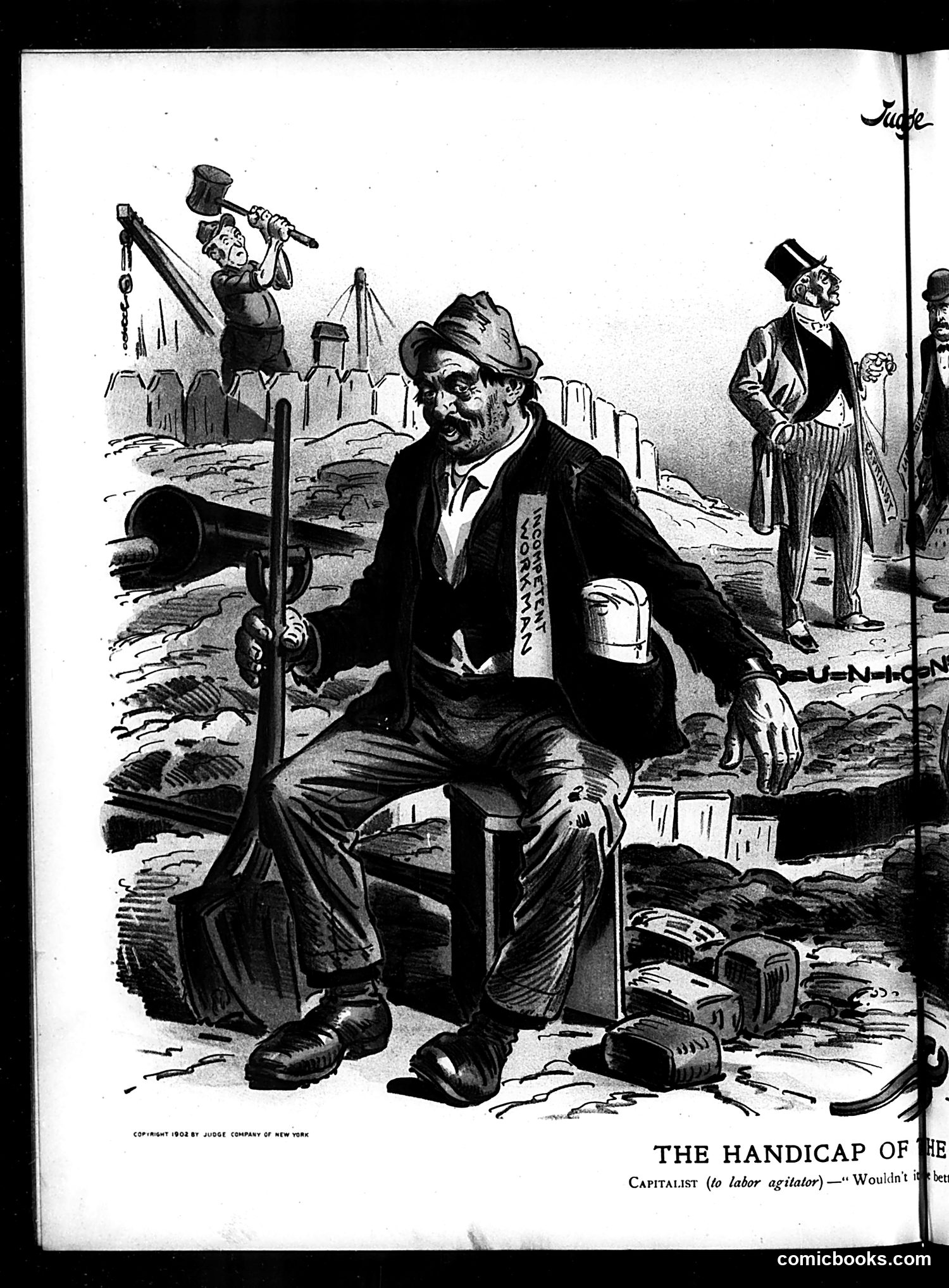
This political cartoon satirizes capitalism's relationship to labor activism. The central figure, labeled "Capitalist (to labor agitator)," is depicted as disabled or handicapped—sitting and using a crutch or support tool—suggesting capitalism itself is weakened or compromised by labor organizers' demands. The cartoon's incomplete caption ("Wouldn't it bet...") leaves the specific taunt unclear, but the visual metaphor is evident: the capitalist claims some disadvantage while confronting the labor agitator. Background figures in top hats represent wealth or authority observing the confrontation. This reflects early 20th-century tensions between industrial capitalists and growing labor movements. The cartoon's ironic title suggests the "handicap" may actually belong to labor, or the point is rhetorical—questioning who truly suffers disadvantage in labor disputes.
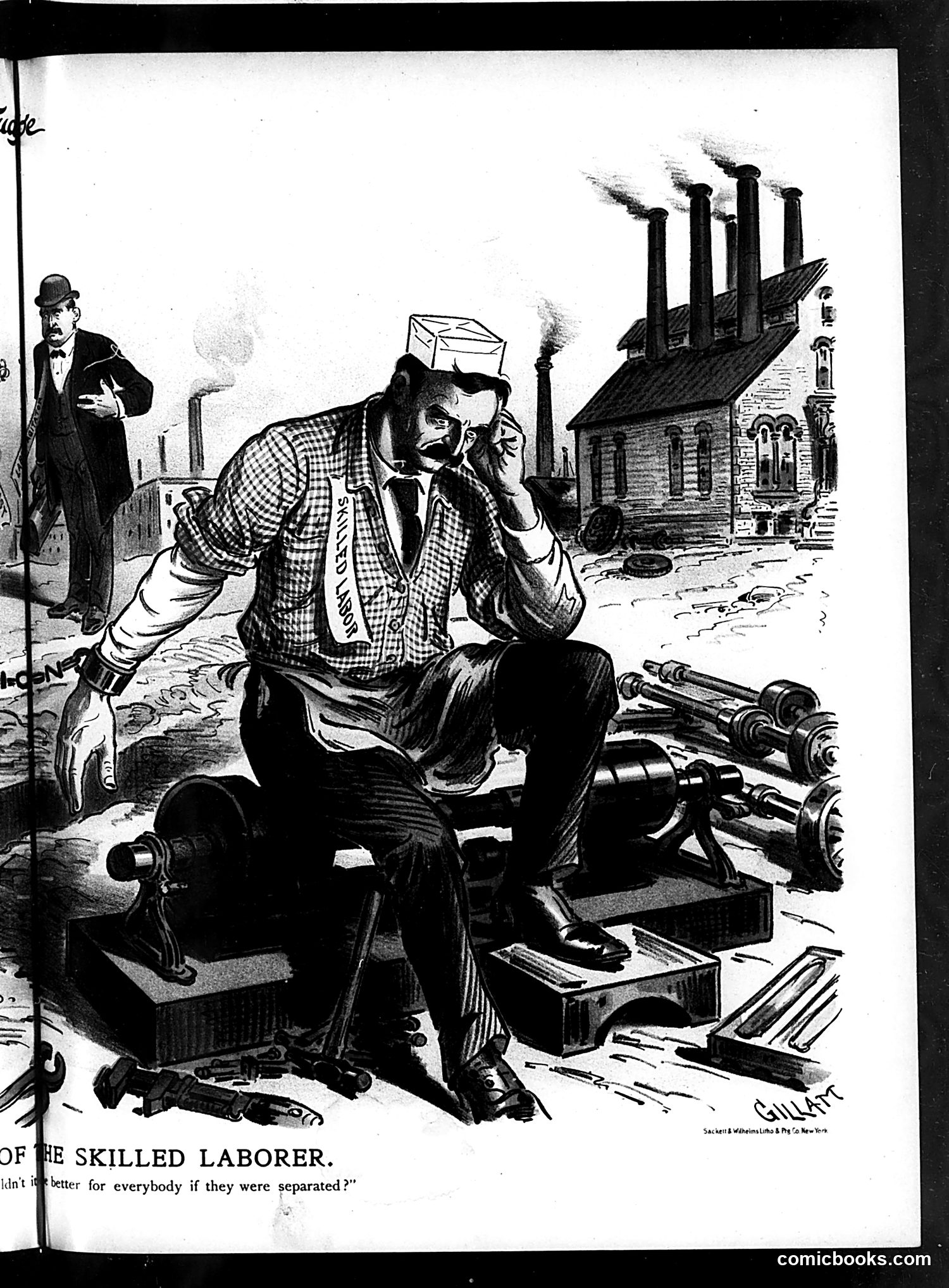
This political cartoon satirizes labor conflict, likely from the early 20th century. A distressed skilled worker sits amid discarded tools and machinery, head in hand in despair. Industrial buildings with smoking smokestacks loom behind him. A well-dressed figure (appears to be a businessman or capitalist) stands observing in the background. The caption—"Wouldn't it be better for everybody if they were separated?"—suggests sarcasm about separating skilled and unskilled laborers, possibly referencing labor union divisions or class stratification. The cartoon critiques either capitalist indifference to worker suffering or conflicts within the labor movement itself. The skilled laborer's dejection contrasts with the detached observer, emphasizing economic disparity and the worker's powerlessness during industrial-era labor disputes.
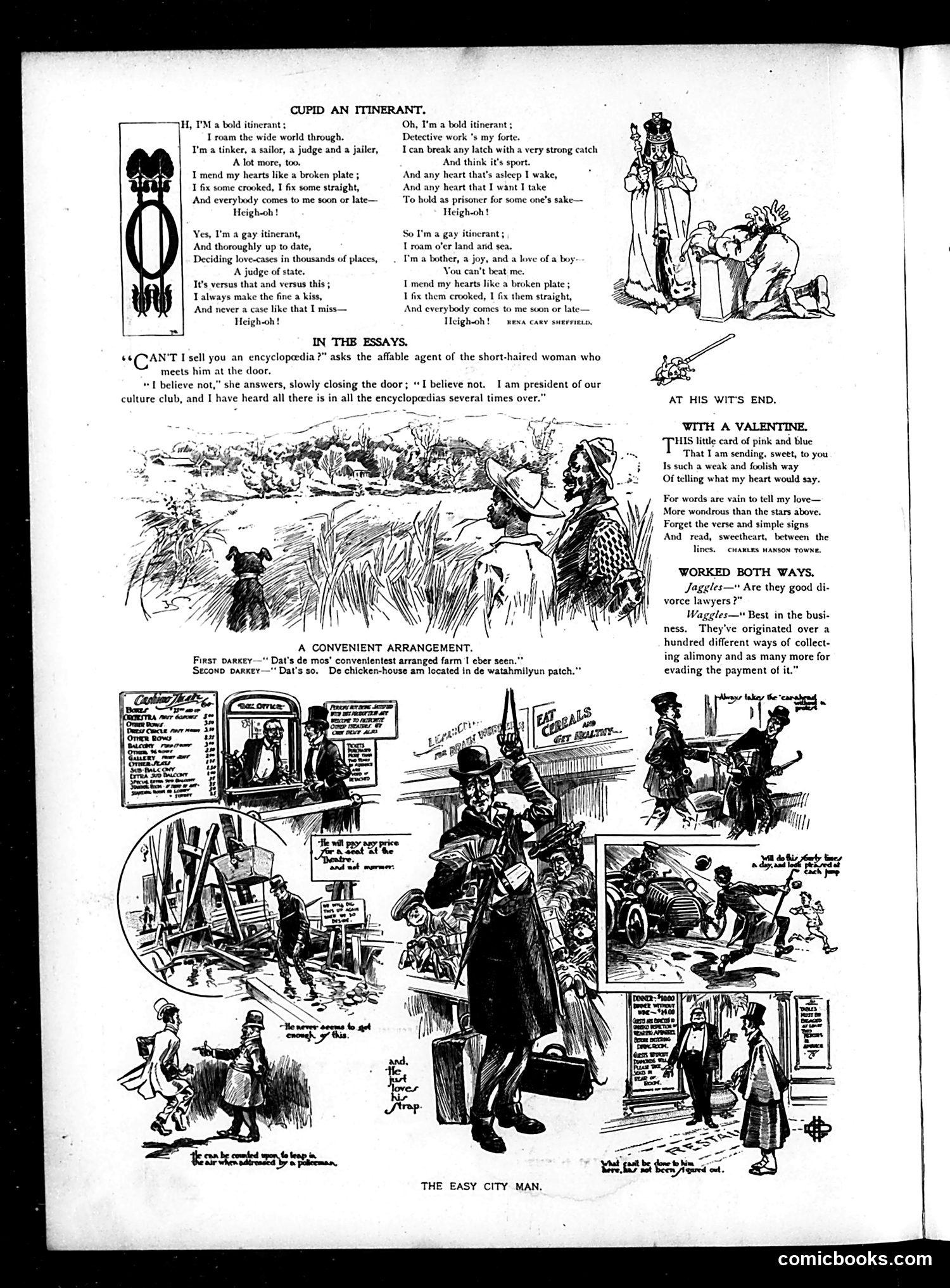
This page contains several satirical pieces typical of early 20th-century American humor: **"Cupid an Itinerant"** presents Cupid as a traveling salesman/con artist who manipulates hearts and romantic relationships for profit—mocking both sentimentality and the era's commercialization of romance. **"In the Essays"** satirizes intellectual pretension: a woman dismisses an encyclopedia salesman by claiming she's already read all encyclopedias multiple times through her "culture club," highlighting the gap between claimed sophistication and actual knowledge. **"A Convenient Arrangement"** uses dialect humor (common in period publications) about a farm where the chicken-house is positioned in the watermelon patch—implying practical absurdity or possibly theft/poaching jokes. **"The Easy City Man"** depicts an urban character navigating various situations—likely satirizing city dweller incompetence or naiveté. **"Worked Both Ways"** jokes about divorce lawyers who both maximize alimony collection *and* help clients evade payment—satirizing legal corruption and the monetization of marital dissolution. The overall tone targets commercialism, false intellectualism, and professional duplicity.
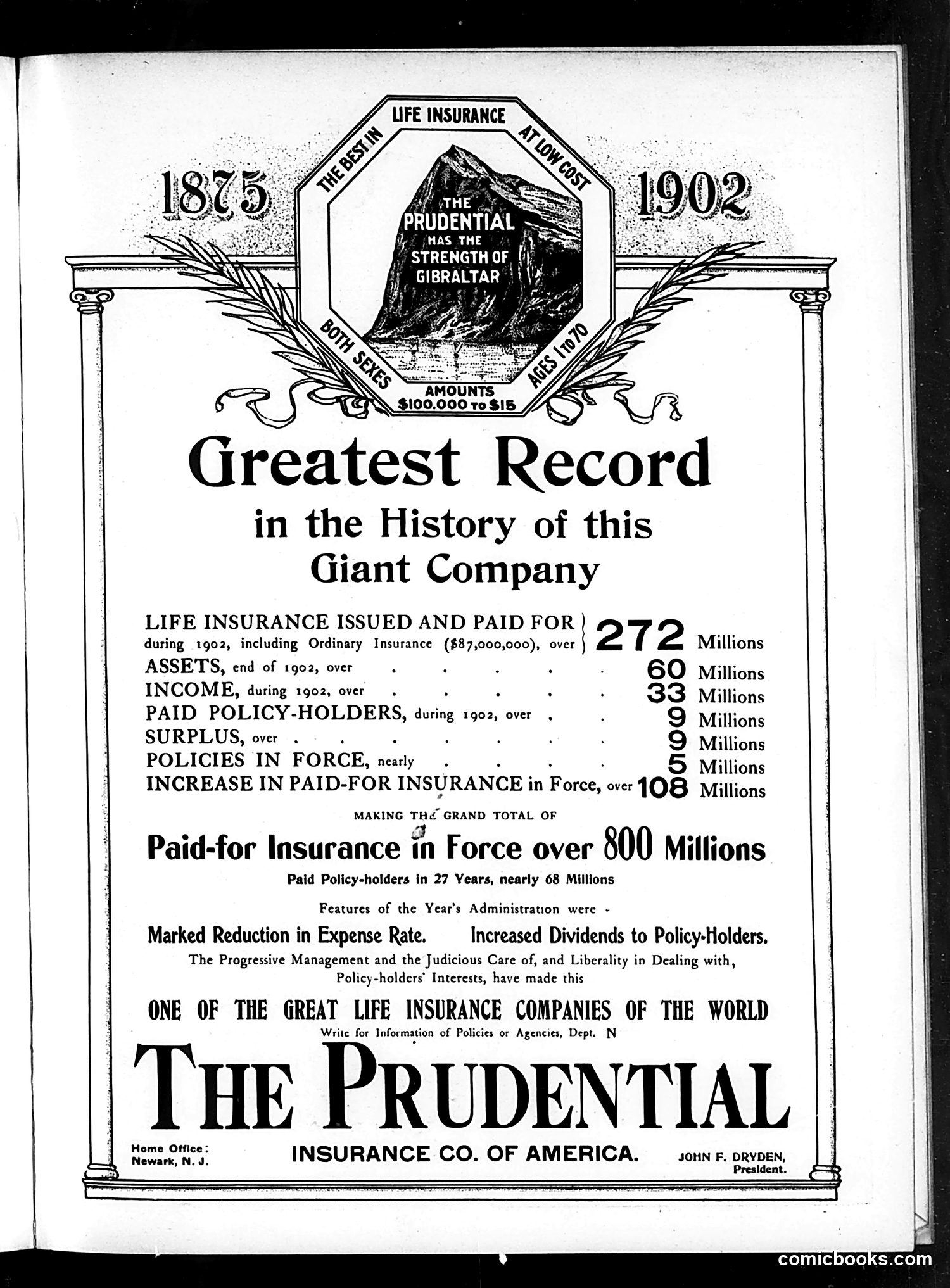
This is not a cartoon or satire—it's a straightforward **corporate advertisement** for The Prudential Insurance Company of America, appearing in *Judge* magazine between 1885-1902. The page celebrates the company's financial achievements during 1902: $272 million in life insurance issued, $60 million in assets, and over $800 million in total paid-for insurance in force. It highlights management accomplishments including "marked reduction in expense rate" and "increased dividends to policy-holders." The only visual element is The Prudential's logo—the Rock of Gibraltar with the motto "The Prudential has the Strength of Gibraltar"—a branding device emphasizing stability and security to potential customers. This represents early 20th-century corporate promotion: large insurance companies used magazine advertising to build consumer confidence by publicizing their financial strength and customer payouts, particularly important in an era before modern financial regulation.
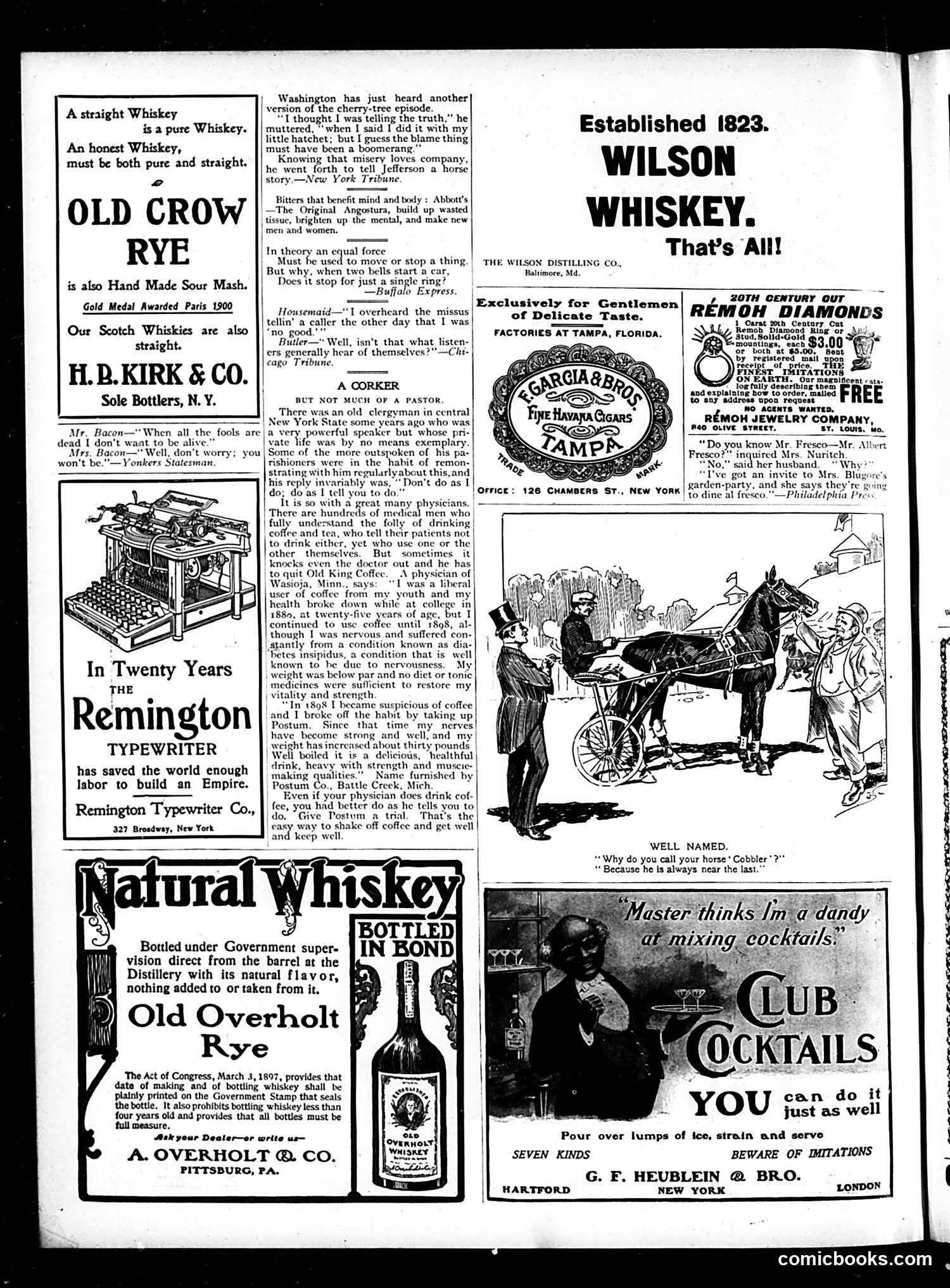
This page is primarily **advertising**, not political satire. It features whiskey and typewriter ads alongside minor humorous anecdotes. The one cartoon present shows a man on horseback speaking to pedestrians, captioned "Well Named" — a simple visual joke about a horse always being "near the last" (a pun on the horse's name, "Cabbler"). The Washington anecdote references the famous cherry-tree legend about young George Washington admitting he cut down his father's tree. Here, someone claims he thought he was "telling the truth" about using a hatchet, but it "boomeranged" — a mild joke about political hypocrisy or dishonesty masquerading as honesty. Other brief jokes mock servants, clergy, and doctors who don't follow their own advice about coffee consumption. The advertisements promote whiskey brands (Wilson, Old Crow, Old Overholt), Remington typewriters, and jewelry — standard commercial content for the era. The page reflects early-1900s American consumer culture and light social humor rather than sharp political commentary.
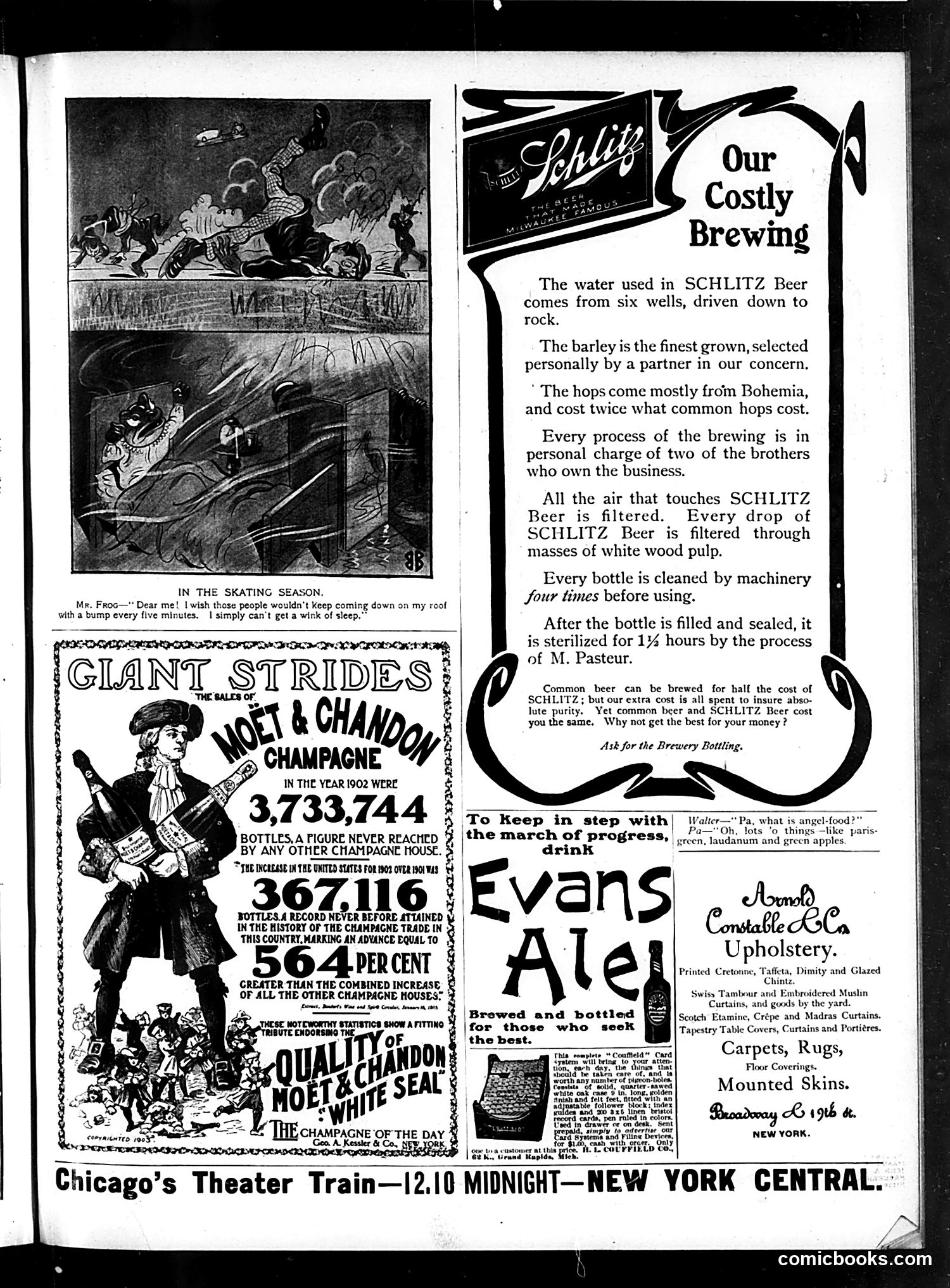
This page is primarily **advertising**, not political satire. It contains several product advertisements from the early 1900s: **Main content:** - A small cartoon captioned "In the Skating Season" shows a man (Mr. Frock) complaining about people ice-skating on his roof and disturbing his sleep—a gentle domestic humor joke. - **Schlitz Beer** advertisement emphasizes manufacturing quality and purity (filtered water, selected barley, sterilization by Pasteur's process). - **Moët & Chandon Champagne** ad boasts sales statistics, claiming 3.7+ million bottles sold in 1902 and record growth in America. - **Evans Ale** advertisement includes a small joke: a child asks what "angel-food" is; the father lists undesirable substances. - **Arnold Constable & Co.** advertises upholstery fabrics and home goods. The page reflects **turn-of-the-century consumer culture**, emphasizing scientific/industrial manufacturing methods as selling points. The skating cartoon is the only actual humor; everything else prioritizes product claims and market statistics.
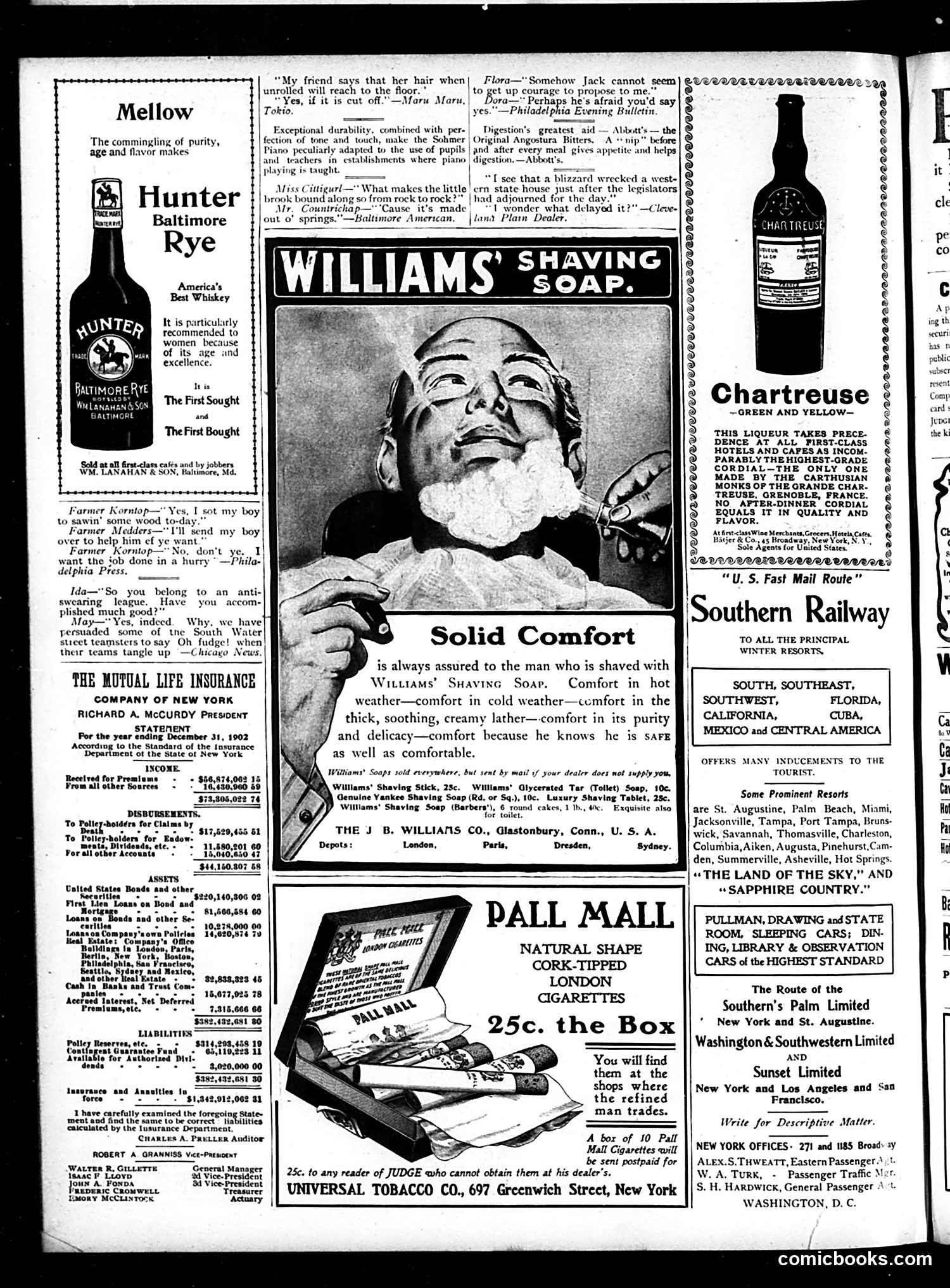
This page is primarily **advertising and financial statements**, not political satire. Judge magazine typically included humor, but this particular page consists mostly of: 1. **Product advertisements** for whiskey (Hunter Baltimore Rye), shaving soap (Williams'), cigarettes (Pall Mall), and liqueur (Chartreuse) 2. **Mutual Life Insurance financial statement** for 1902, showing income and disbursements 3. **Brief humorous anecdotes** in the margins—short jokes about farmers, swearing leagues, and romantic misadventures—typical filler humor of the era 4. **Southern Railway tourism advertisement** promoting winter resorts The page contains **no identifiable political cartoons or caricatures**. The shaving soap ad features a generic man's face, not a specific public figure. This appears to be a typical magazine page from the early 1900s mixing commercial content with light domestic humor.
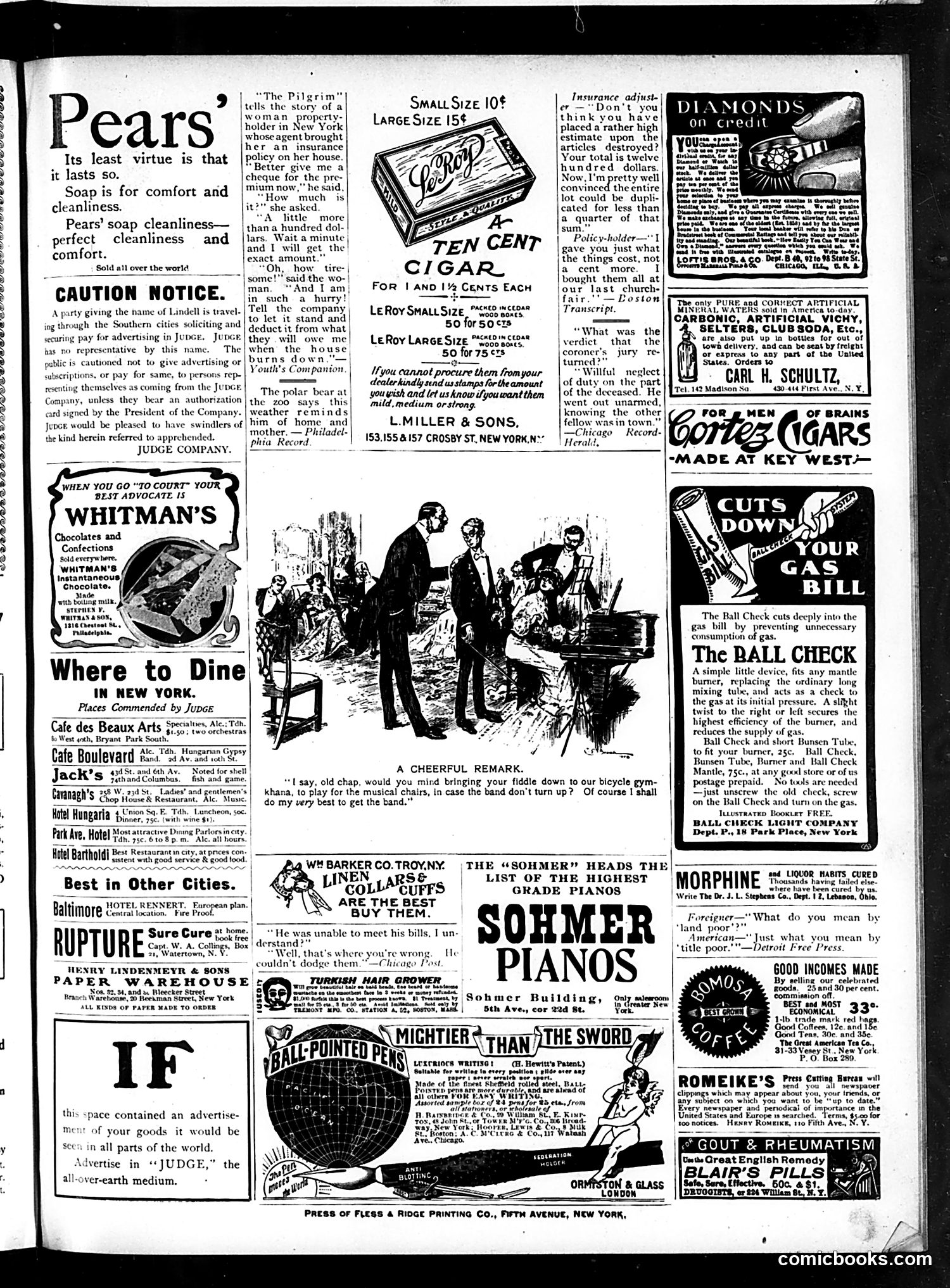
This page is primarily **advertising**, typical of early 20th-century magazines. The notable satirical content includes: ## Main Cartoon: "A Cheerful Remark" The central illustration depicts a social awkwardness joke: a man asks a neighbor to bring his violin to a "bicycle gymkhana" (a British athletic event) to play for "musical chairs" in case the band fails to show. The humor lies in the absurd, polite desperation—essentially asking someone to serve as backup entertainment at a social event, framed as a casual favor. ## Editorial Content Brief satirical snippets appear throughout: - An insurance agent debate where a property owner suggests deducting premiums from future claims - A coroner's jury verdict about "willful neglect" regarding an armed confrontation - A polar bear commenting on weather These are light, observational humor pieces rather than political satire. The page reflects **early 1900s American social commentary** on insurance practices, bureaucratic absurdity, and genteel society manners—aimed at educated, urban readers.
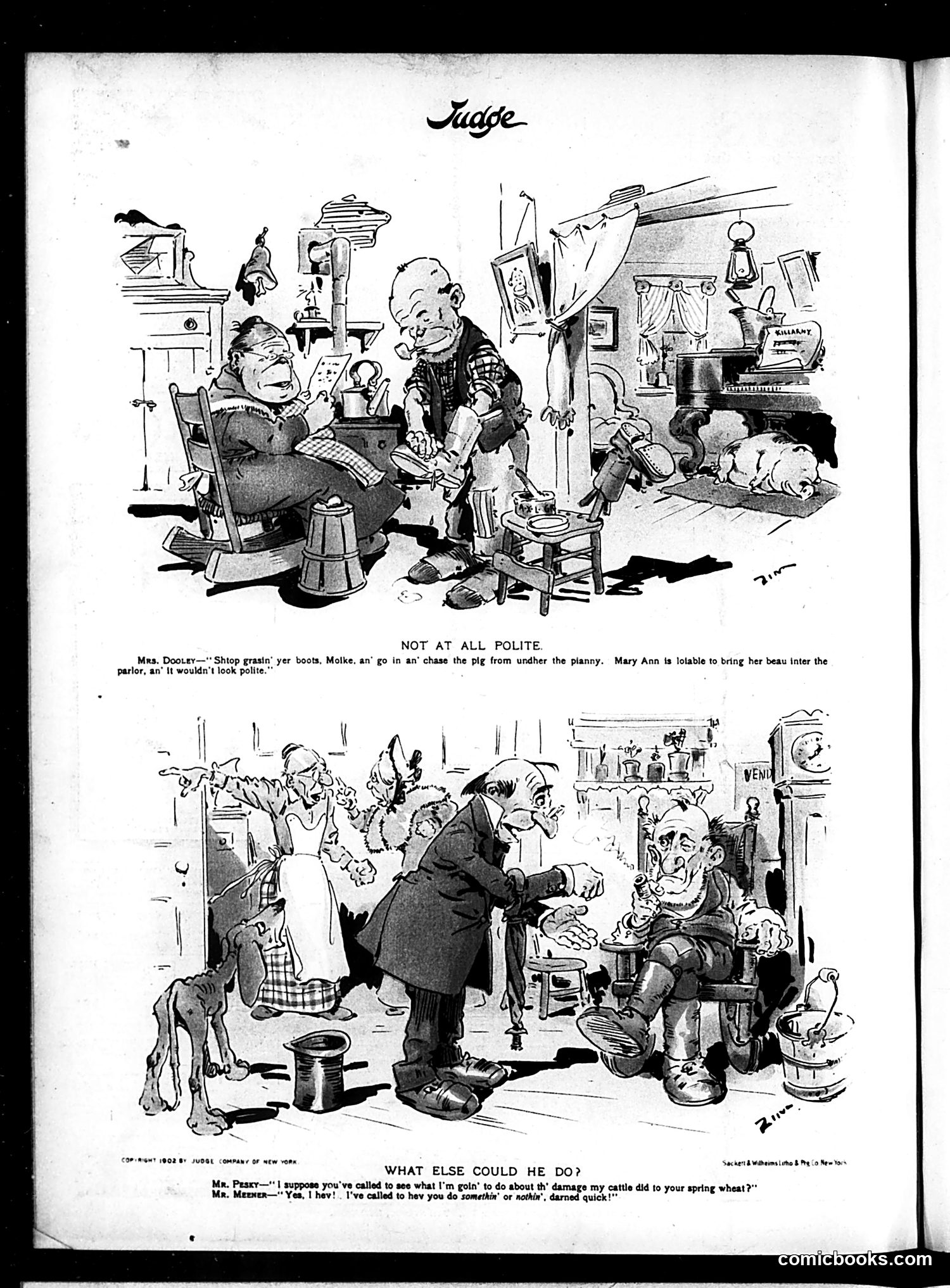
This page contains two satirical cartoons depicting working-class and immigrant domestic life, likely from the early 20th century. **Top cartoon ("Not at All Polite"):** Mrs. Dooley (an Irish immigrant character, indicated by dialect) scolds Molke (likely a Jewish immigrant servant) to stop grazing his boots and remove a pig from under the piano before Mary Ann brings her boyfriend into the parlor. The satire mocks the pretensions of newly respectable immigrants trying to appear genteel despite their humble circumstances and farmyard animals. **Bottom cartoon ("What Else Could He Do?"):** Mr. Perry confronts Mr. Messer about cattle damage to his spring wheat, demanding immediate compensation or action. The humor lies in the absurd dilemma—the farmer has few actual options but is pressured to "do somethin' or nothin', darned quick," satirizing rural disputes and the often helpless position of farmers dealing with livestock damage. Both cartoons use ethnic dialect and caricature typical of Judge's era humor.