
Judge, 1903-02-21 · page 6 of 16
Judge — February 21, 1903 — page 6: what you’re looking at
What you’re looking at
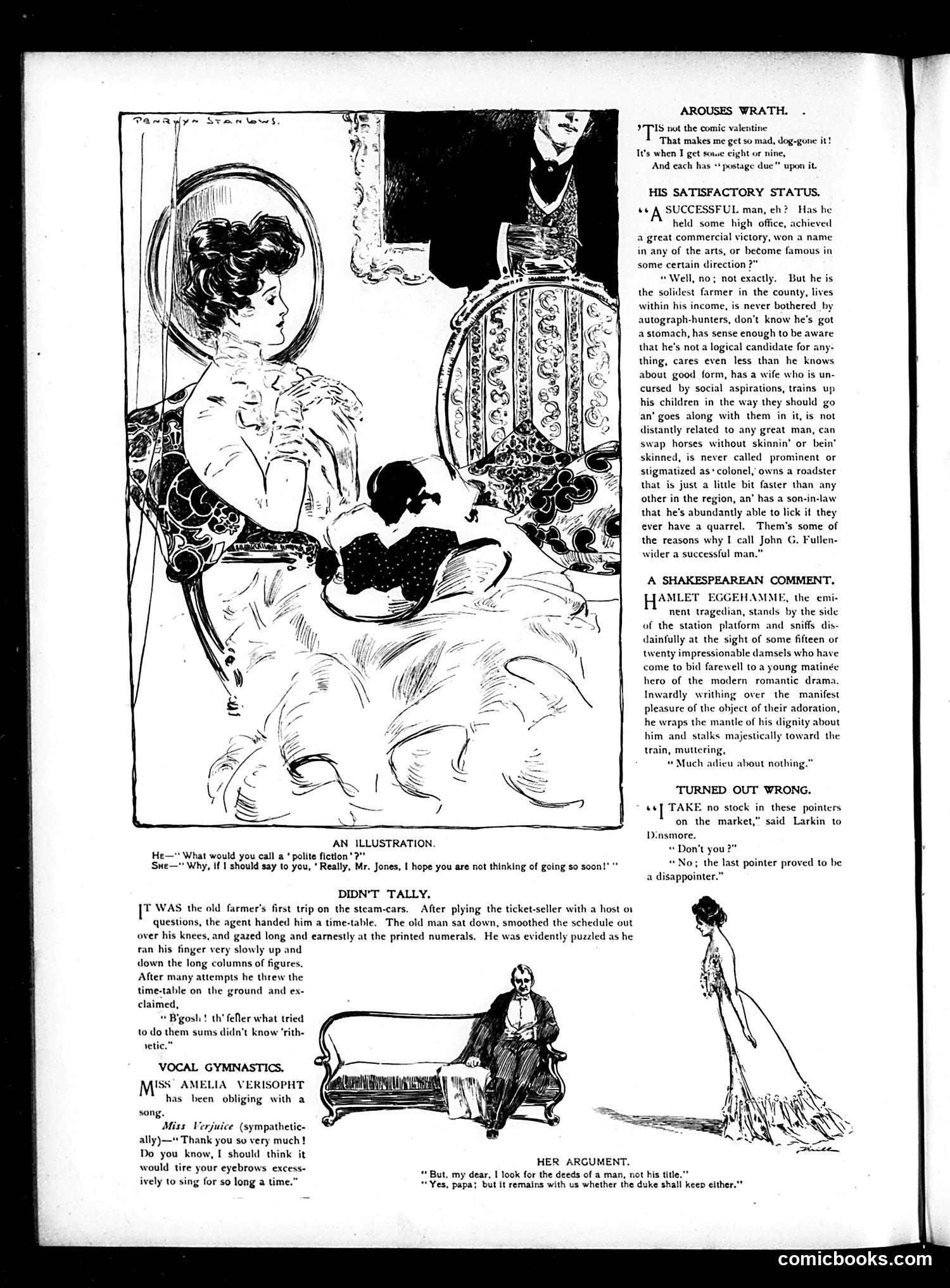
This page contains several brief satirical pieces mocking American social pretensions and romantic conventions: **"His Satisfactory Status"** ironically defines success not as wealth or fame, but as a humble farmer living within his means, unbothered by social climbing—a critique of Gilded Age status-seeking. **"A Shakespearean Comment"** mocks theatrical vanity through an actor (Hamlet Eggehamme) disdainfully ignoring admirers at a train station, while muttering Shakespeare's "Much Adieu About Nothing"—satirizing performers' inflated self-importance. **"Didn't Tally"** jokes about a farmer confused by a train schedule, unable to reconcile the numbers—poking fun at rural unfamiliarity with modern technology. **"Vocal Gymnastics"** features Miss Amelia Verisopht thanked for singing, with a guest concerned the performance tired her eyebrows—absurdist humor about excessive politeness. **"Her Argument"** concludes with a daughter asserting character matters more than titles—mild social commentary on aristocratic pretension. The overall theme: deflating Victorian/Edwardian vanity, snobbery, and affectation.
📄 Transcribed text from this page (OCR, searchable)
Machine-transcribed from the original scan — historical spelling and the odd misread are preserved.
AROUSES WRATH. . ITTIS not the comic valentine ‘That makes me get so mad, dog-gone it! It's when I get soe eight or nine, And each has *‘ postage due” upon it. HIS SATISFACTORY STATUS. “A SUCCESSFUL man, eh? Has he held some high office, achieved a great commercial victory, won a name in any of the arts, or become famous in some certain direction ?” “Well, no; not exactly. But he is the solidest farmer in the county, lives within his income, is never bothered by autograph-hunters, don’t know he's got a stomach, has sense enough to be aware that he’s not a logical candidate for any: thing, cares even less than he knows about good form, has a wife who is un- cursed by social aspirations, trains up his children in the way they should go an’ goes along with them in it, is not distantly related to any great man, can swap horses without skinnin’ or bein’ skinned, is never called prominent or stigmatized as‘ colonel,’ owns a roadster that is just a little bit faster than any other in the region, an’ has a son-in-law that he’s abundantly able to lick if they ever have a quarrel. Them’s some of the reasons why I call John G, Fullen- wider a successful man.” A SHAKESPEAREAN COMMENT. AMLET E AMME, the emi- nent tragedian, stands by the side of the station platform and sniffs dis- dainfully at the sight of some fifteen or twenty impressionable damsels who have come to bid farewell toa young matinée hero of the modern romantic drama. Inwardly writhing over the manifest pleasure of the object of their adoration, he wraps the mantle of his dignity about him and stalks majestically toward the train, muttering, “ Much adieu about nothing.” ‘TURNED OUT WRONG. LA] TAKE no stock in these pointers on the market," said Larkin to AN ILLUSTRATION Dinshere: He—" What would you call a ‘ polite fiction *?"” Done your eae Sue—" Why, if | should say to you, ‘Really, Mr. Jones, | hope you are not thinking of going so soon!" * (0; the last pointer proved to be a disappointer.” DIDN'T TALLY, T WAS the old farmer's first trip on the steam-cars. After plying the ticket-seller with a host ot questions, the agent handed him a time-table. ‘The old man sat down, smoothed the schedule out over his knees, and gazed long and earnestly at the printed numerals. He was evidently puzzled as he ran his finger very slowly up and down the long columns of figures. After many attempts he threw the time-table on the ground and ex- claimed, “ Bigosh! th’ feler what tried todo them sums didn’t know ‘rith- retic.” VOCAL GYMNASTICS. M's AMELIA VERISOPHT has been obliging with a song. Miss Verjuice (sympathetice ally)—* Thank you so very much! Do you know, I should think it would tire your eyebrows excess EE Rc UneNT: ie reales “But, my dear, I look for the deeds of a man, not his title."” ively to sing for so long a time. “Yes, papa; but it remains with us whether the duke shall keep either."” comicbooks.com