
A complete issue · 24 pages · 1903
Judge — February 7, 1903
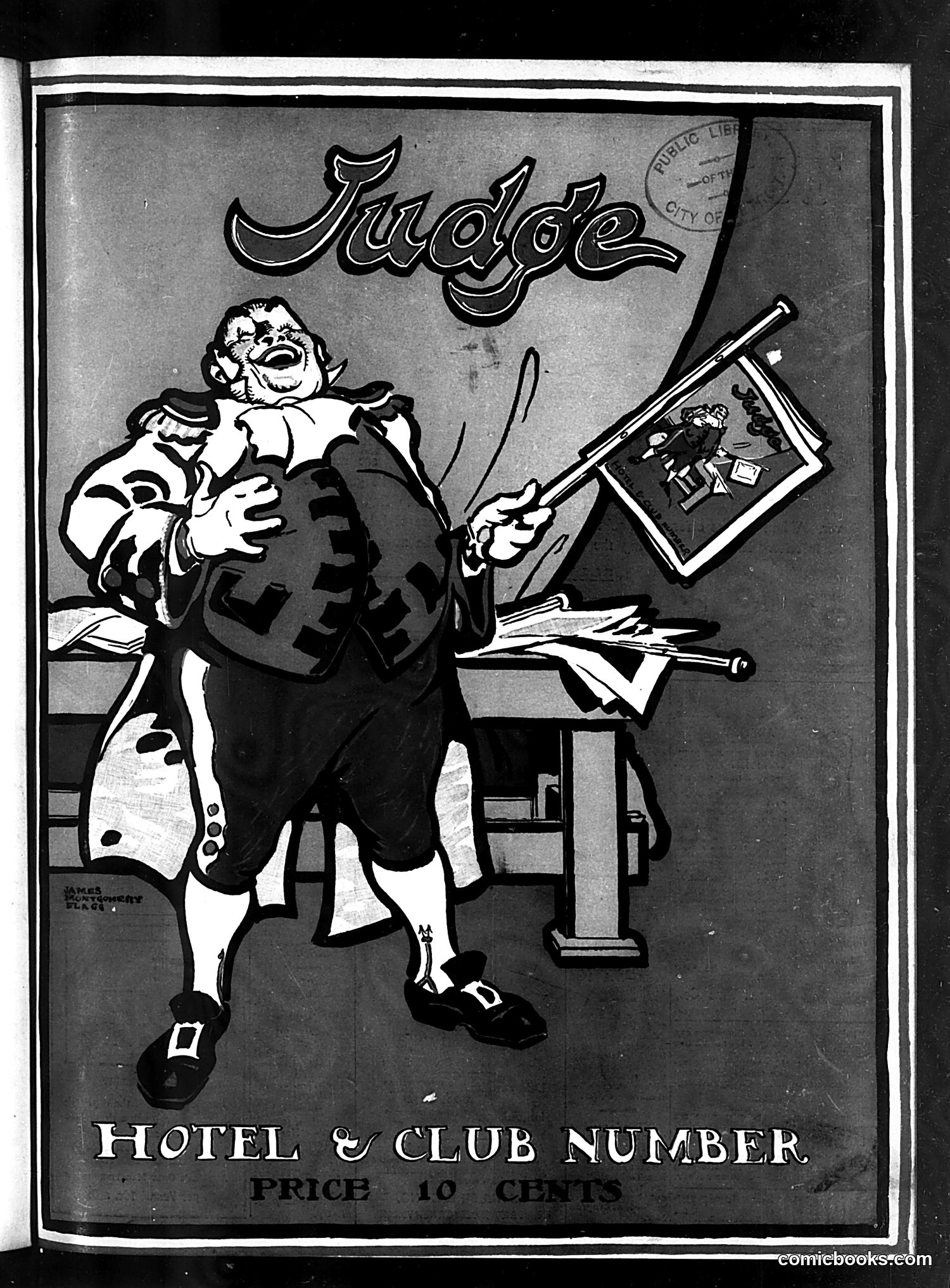
This is a cover for Judge magazine's "Hotel & Club Number" (priced at 10 cents), drawn by James Montgomery Flagg. The caricature depicts a corpulent, exaggerated figure—likely representing a wealthy hotel or club patron or proprietor—sitting at a desk in an office. He's shown in an absurd, undignified pose, appearing to juggle or manage multiple items including what appears to be a portrait or photograph on the wall. The satire likely mocks the pretensions, excess, or questionable practices of hotel and club management during this era. The grotesque portrayal and chaotic scene suggest Judge magazine was ridiculing the vanity, financial scheming, or moral failings of those running such establishments. Without the specific date, the exact target remains unclear, but the satire clearly aims at this social sector.
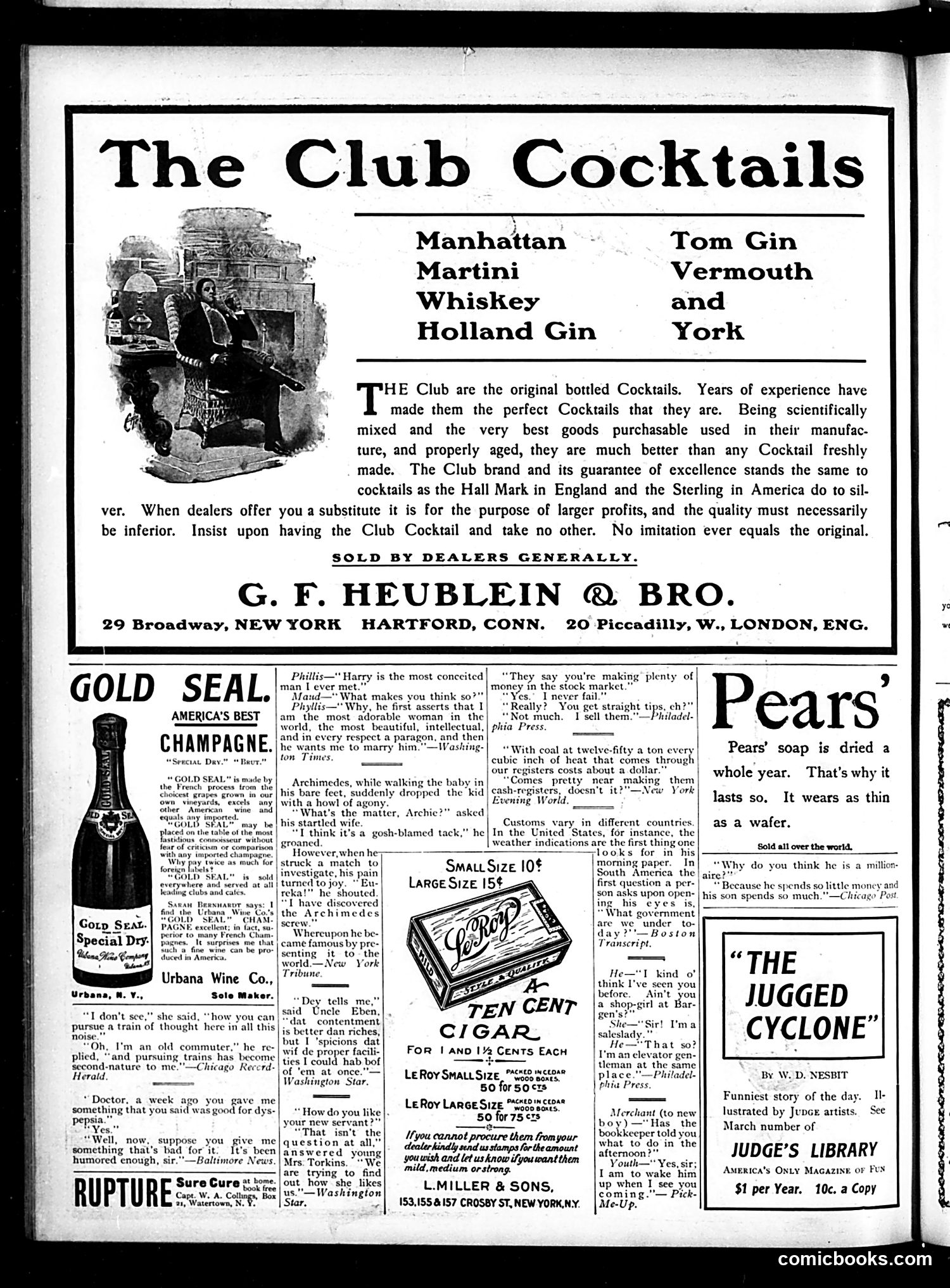
This page is primarily **advertising**, not political satire. It contains: 1. **The Club Cocktails ad** (top): Promotes bottled cocktails as superior to fresh-made drinks, claiming scientific precision and quality comparable to English "Hall Mark" standards. The warning against substitutes reflects competitive market concerns. 2. **Gold Seal Champagne ad**: Features a bottle and testimonial praising French champagne's quality. 3. **Pears' Soap ad**: Highlights the product's durability, lasting "a whole year" because it "wears as thin as a wafer." 4. **LeRoy Ten Cent Cigar ad**: Shows the product packaging. 5. **Rupture ad**: Medical device advertisement. 6. **Minor humorous pieces**: Brief jokes about conceit, money-making, and servants—typical filler content for Judge magazine's satirical style. The page reflects early 20th-century consumer culture and advertising practices.
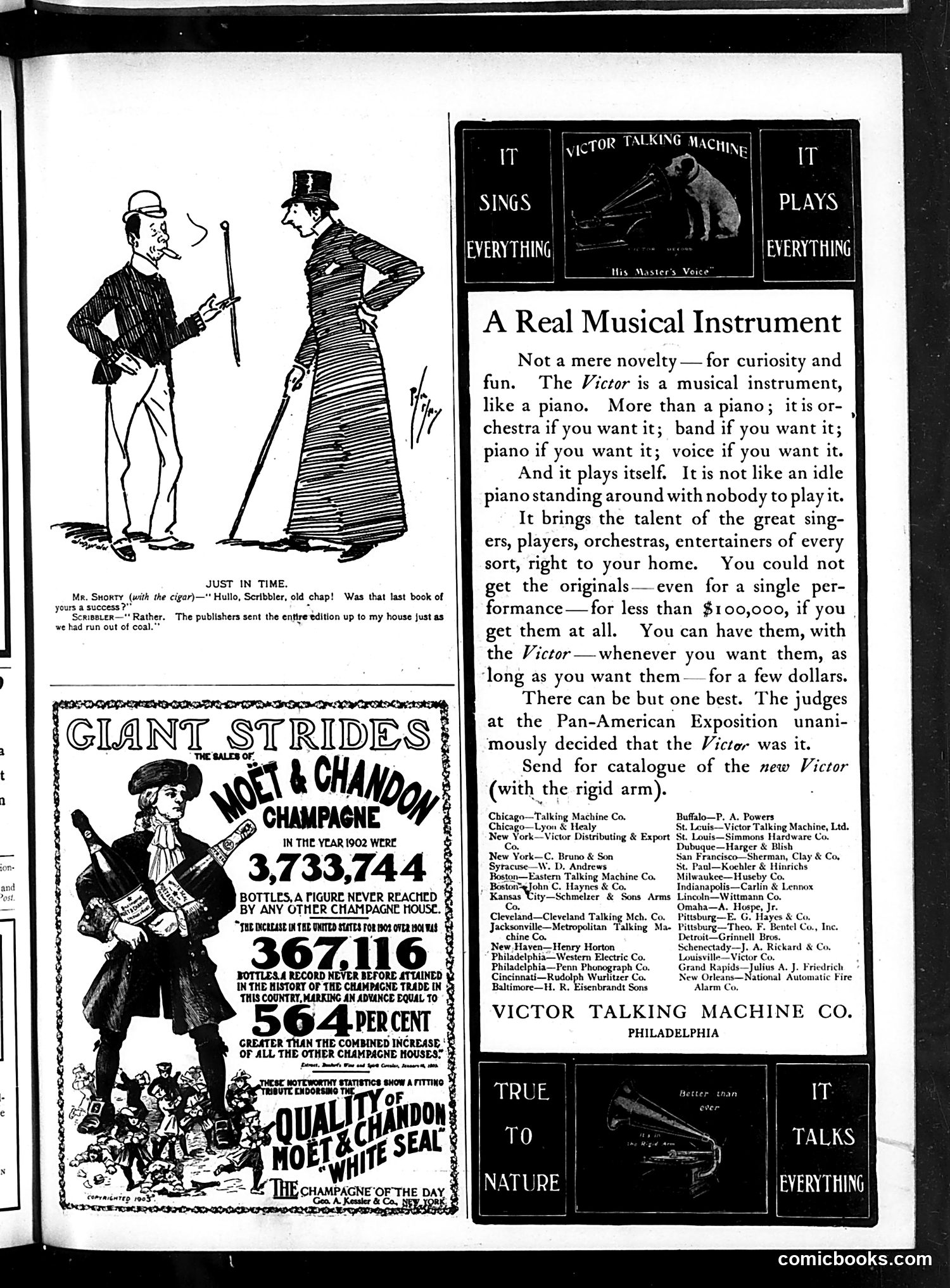
This page is primarily **advertising** rather than political satire. The top cartoon titled "Just in Time" appears to be a humorous domestic scene showing a man and woman with golf clubs, likely making a joke about leisure activities or marital dynamics, though the specific reference is unclear from the caption alone. The large lower advertisement promotes **Moët & Chandon Champagne**, celebrating sales figures from 1902 with a costumed figure. It emphasizes the champagne's market dominance using statistics. The right side advertises the **Victor Talking Machine** (an early phonograph), claiming it's a genuine musical instrument—not merely a novelty—that can reproduce performances by famous singers and orchestras affordably, positioning it against competitors. Both ads represent early 1900s consumer products targeting affluent readers.
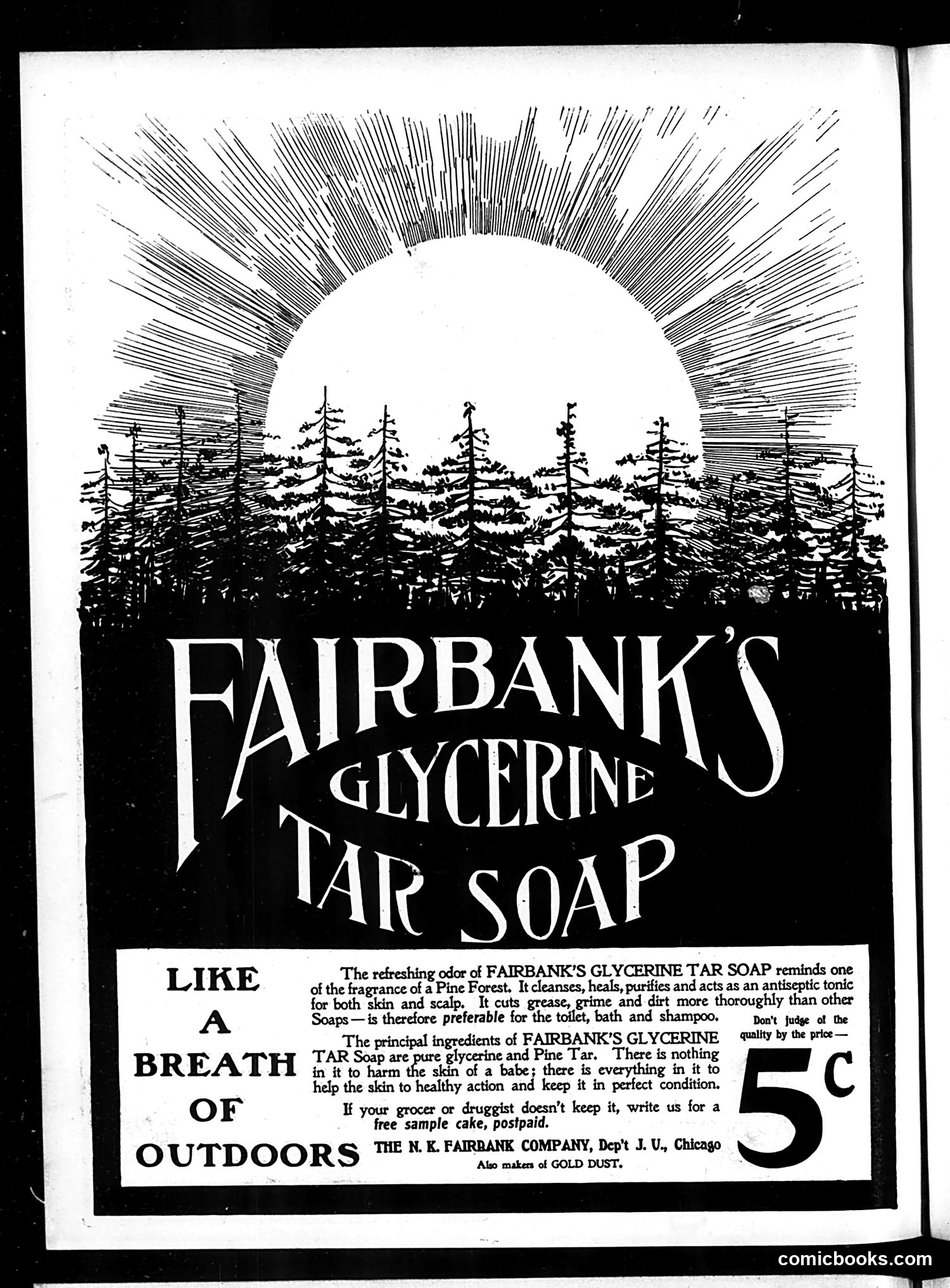
This page is **primarily a product advertisement**, not a political cartoon or satire. It promotes Fairbank's Glycerine Tar Soap, priced at 5 cents. The advertisement uses an artistic nature motif—a large sun rising over a pine forest—to evoke the "refreshing odor of a Pine Forest" that the soap allegedly provides. The tagline "Like a Breath of Outdoors" connects the product to natural, healthful properties. The text emphasizes the soap's practical benefits: cleansing, healing, antiseptic qualities, and effectiveness at removing "grease, grime and dirt." It notes the product is suitable for toilet, bath, and shampoo use. There is **no political satire or caricature** on this page. This is straightforward early 20th-century consumer advertising, manufactured by The N.K. Fairbank Company of Chicago.
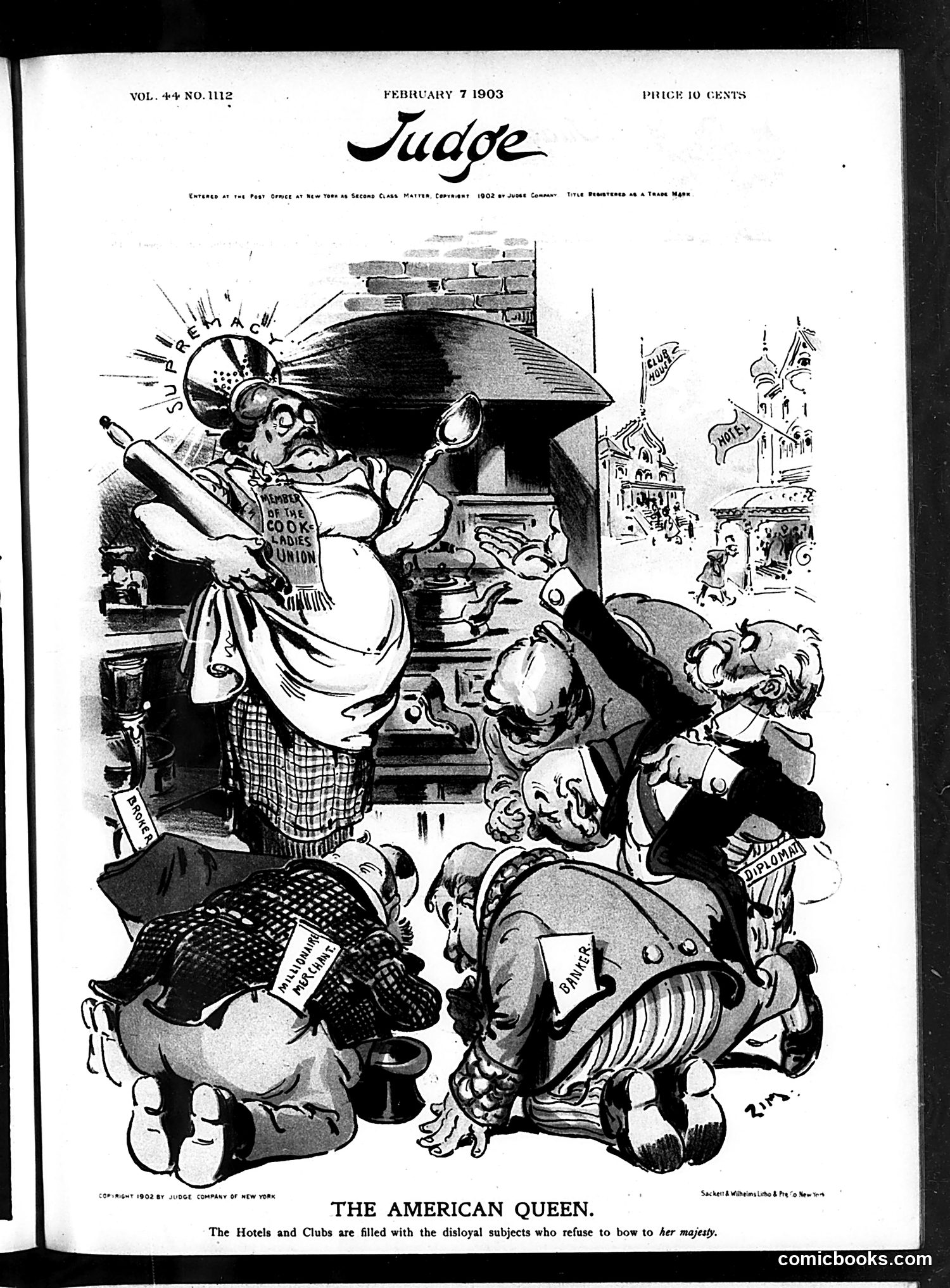
This political cartoon satirizes wealthy American socialites and club members as "disloyal subjects" refusing to show proper deference to an inflated female figure crowned and enthroned like royalty. The caricatured figures at the bottom—labeled with what appear to be club and hotel names—represent the American upper class who frequented exclusive establishments. The satire mocks the pretensions and aristocratic airs of America's wealthy elite during the Gilded Age, particularly their snobbish behavior and exclusive social hierarchies. By depicting them as literal subjects defying a queen, the cartoonist ridicules how they conducted themselves with quasi-royal pretension despite America's democratic ideals, treating social clubs and hotels as kingdoms of their own.
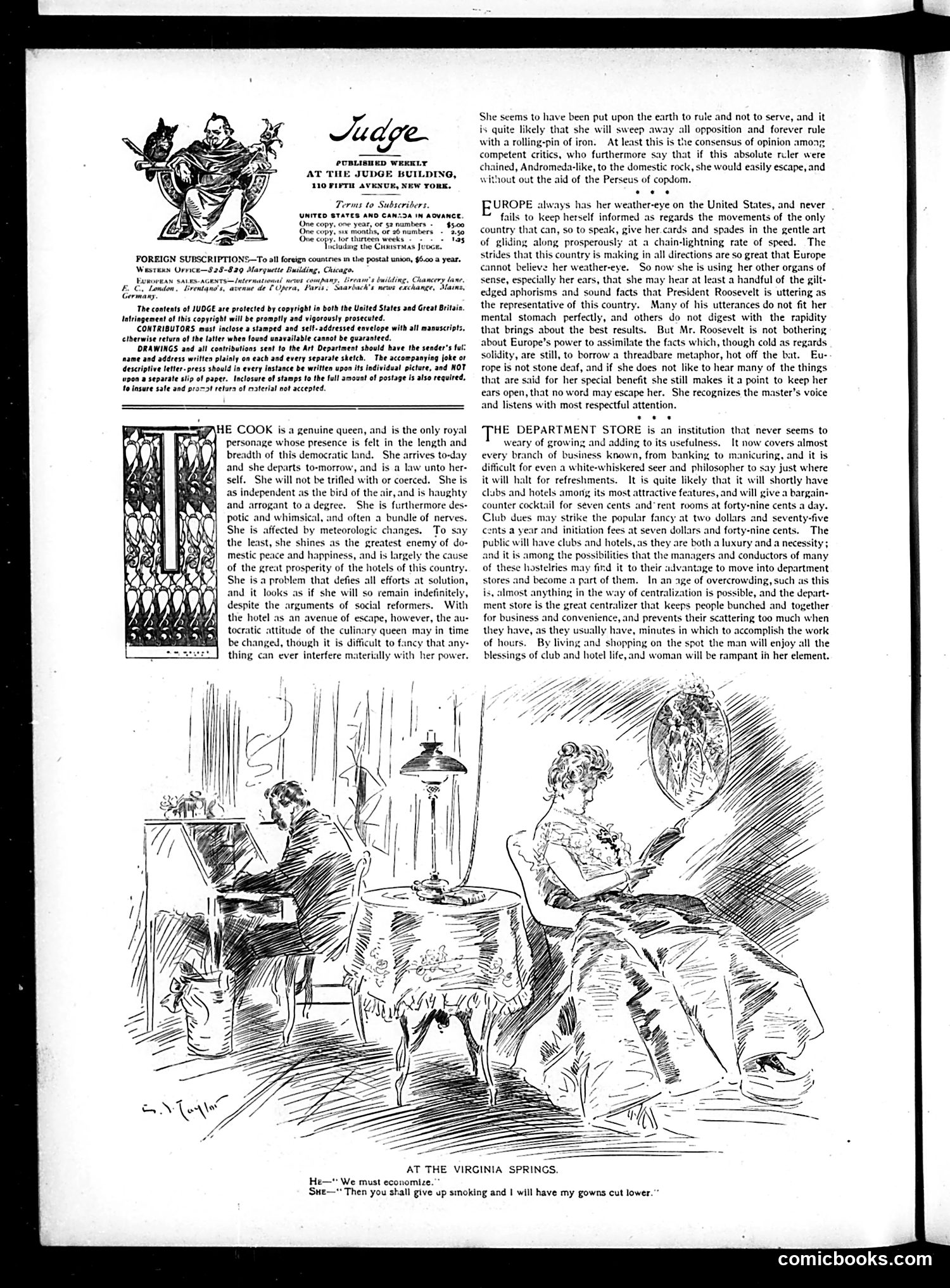
This Judge magazine page contains three distinct editorial commentaries: 1. **"The Cook"**: A satirical piece treating the kitchen cook as an autocratic "queen" who rules hotels despotically with her "rolling-pin of iron." The metaphor suggests cooks held extraordinary power over hotel operations and guest satisfaction—a commentary on labor hierarchy and the cook's outsized influence on hospitality businesses. 2. **"Europe" (text only)**: Discusses Europe's skeptical monitoring of American progress and President Roosevelt's statements. The satire suggests Europe doubts America's rapid industrial advancement and finds Roosevelt's rhetoric difficult to accept, though it grudgingly pays attention. 3. **"The Virginia Springs" (cartoon)**: Shows a couple at a resort; the man proposes economizing by smoking less if she'll lower her gown neckline. This jokes about marital negotiation and competing personal indulgences—contemporary concerns about propriety and conspicuous consumption. The overall tone mocks institutional power structures, international rivalry, and domestic gender dynamics of the early 20th century.
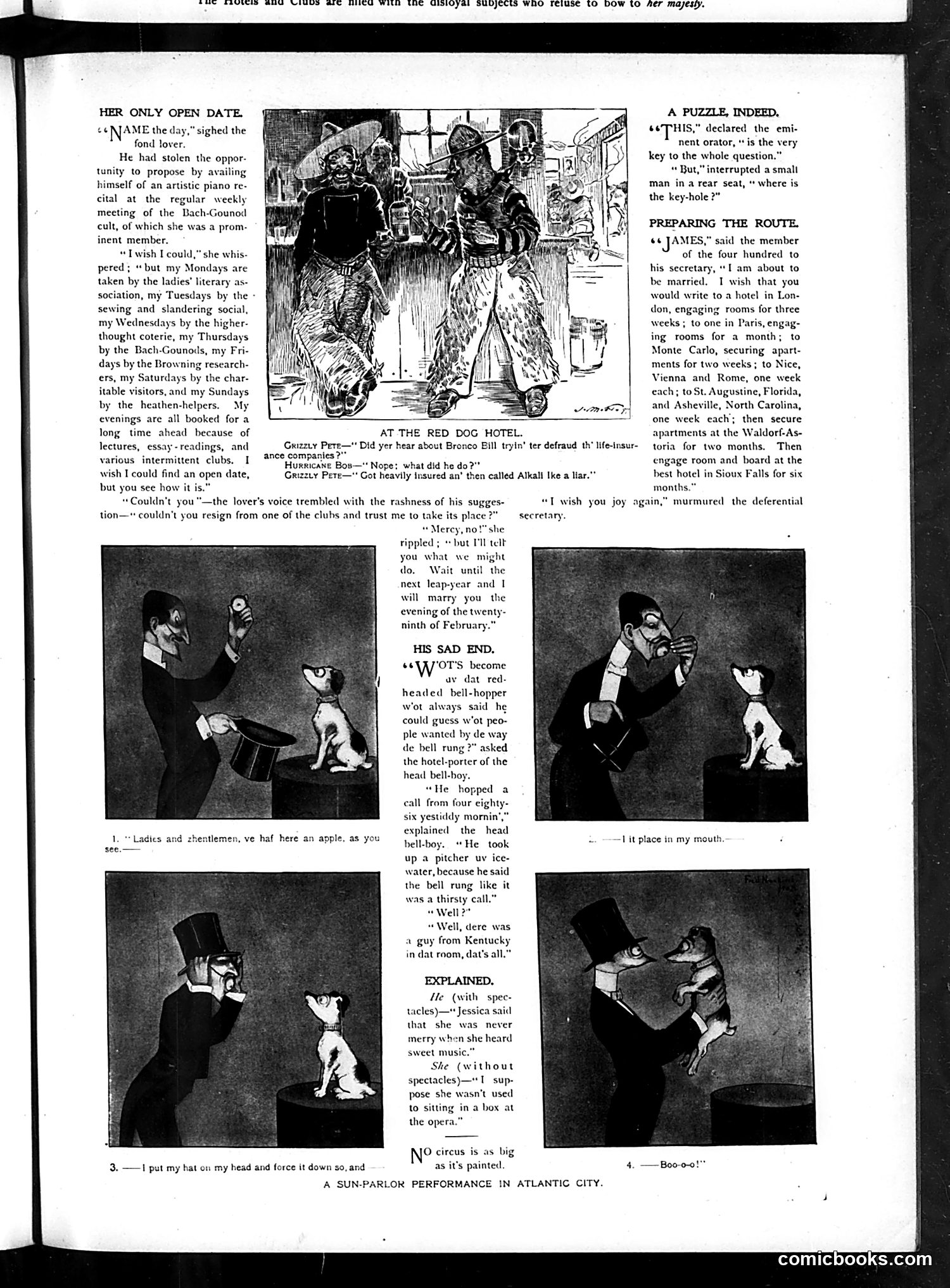
This page contains several unrelated humorous sketches typical of Judge magazine's satirical format. **"Her Only Open Date"** mocks the overscheduled leisure class—a woman so committed to ladies' clubs, literary associations, and cultural societies that she can only marry on leap-year day (February 29th), occurring every four years. **"At the Red Dog Hotel"** features frontier characters (Guizzy Pete, Hurricane Bos, Alkali Ike) discussing someone's failed insurance fraud scheme—a common theme in turn-of-the-century humor. **"His Sad End"** presents a bell-hop's unfortunate misunderstanding: a Kentucky guest rang the bell like "a thirsty call," so the bell-hop brought ice water rather than room service—with implied tragic consequences. **The bottom strip** appears to be a magician's act ("A Sun-Parlor Performance") involving an apple and hat trick. The cartoons satirize class pretensions, frontier buffoonery, and working-class mishaps—standard Judge fare of the era.
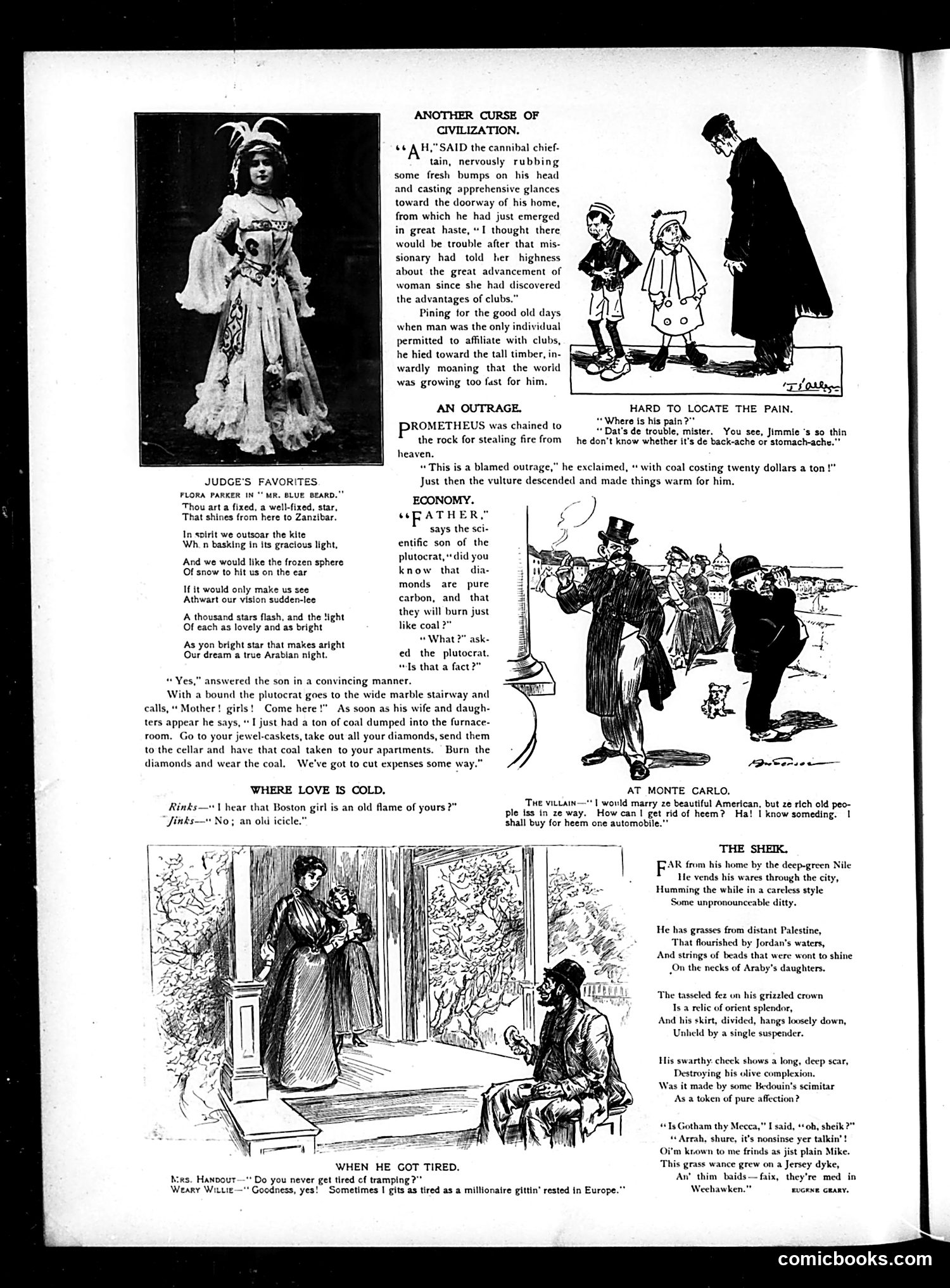
This page collects several satirical pieces typical of early 20th-century American humor: **"Another Curse of Civilization"** mocks women's advancement through a cannibal chief who fears his wife has joined clubs (women's organizations), lamenting that "the world was growing too fast for him." **"Economy"** satirizes wealthy plutocrats: a scientist tells a rich man that diamonds are pure carbon and burn like coal. The plutocrat literally burns his wife's diamonds in the furnace to "cut expenses," exposing the absurdity of the wealthy class's economic reasoning. **"The Sheik"** presents an Irish immigrant peddler in New York (named Mike) who poses as an exotic Middle Eastern merchant, selling "Palestinian grass" from Jersey marshes and beads made in Weehawken—a satire on immigrant entrepreneurship and consumer gullibility. The cartoons employ exaggeration and irony to critique: women's suffrage concerns among men, wealthy absurdity, and ethnic immigrant stereotypes (Irish accent/dialect). The humor reflects period attitudes now considered offensive.
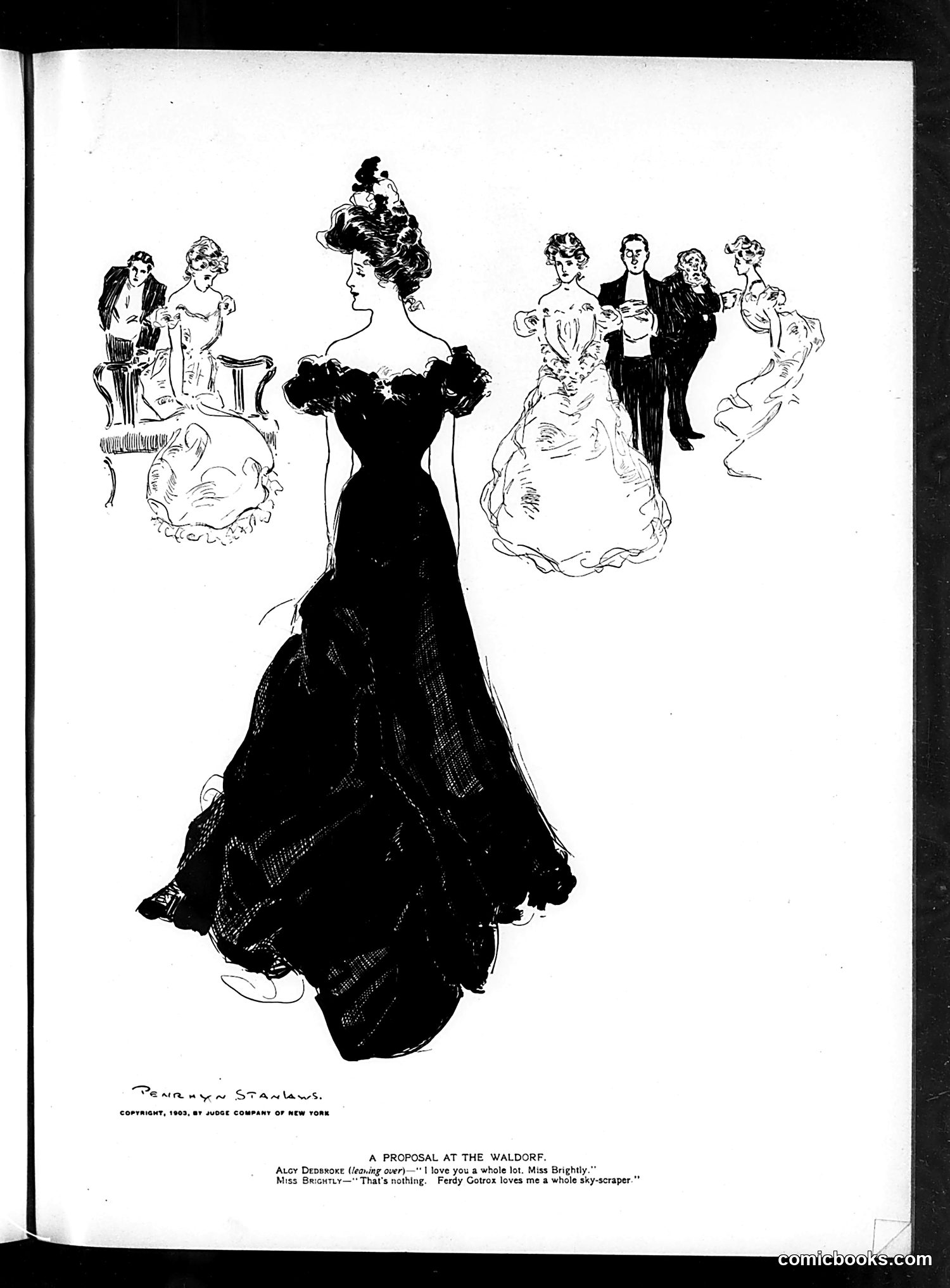
This cartoon satirizes wealthy suitors competing through extravagant displays of wealth rather than genuine affection. Algy Deronde offers emotional devotion ("I love you a whole lot"), but Miss Brightly dismisses this as inadequate compared to Ferdy Gotroz's material offering—an entire skyscraper. The joke targets the materialism of the wealthy leisure class at the prestigious Waldorf Hotel. The central female figure in an elegant black gown is surrounded by elaborately dressed socialites, emphasizing the shallow, commodity-based nature of upper-class romance and courtship during the Gilded Age. The satire mocks how wealthy men competed for women's affections through real estate and financial gestures rather than sentiment, and how women of means measured romantic worth in dollars and property. It's a critique of mercenary marriage practices among the ultra-wealthy.
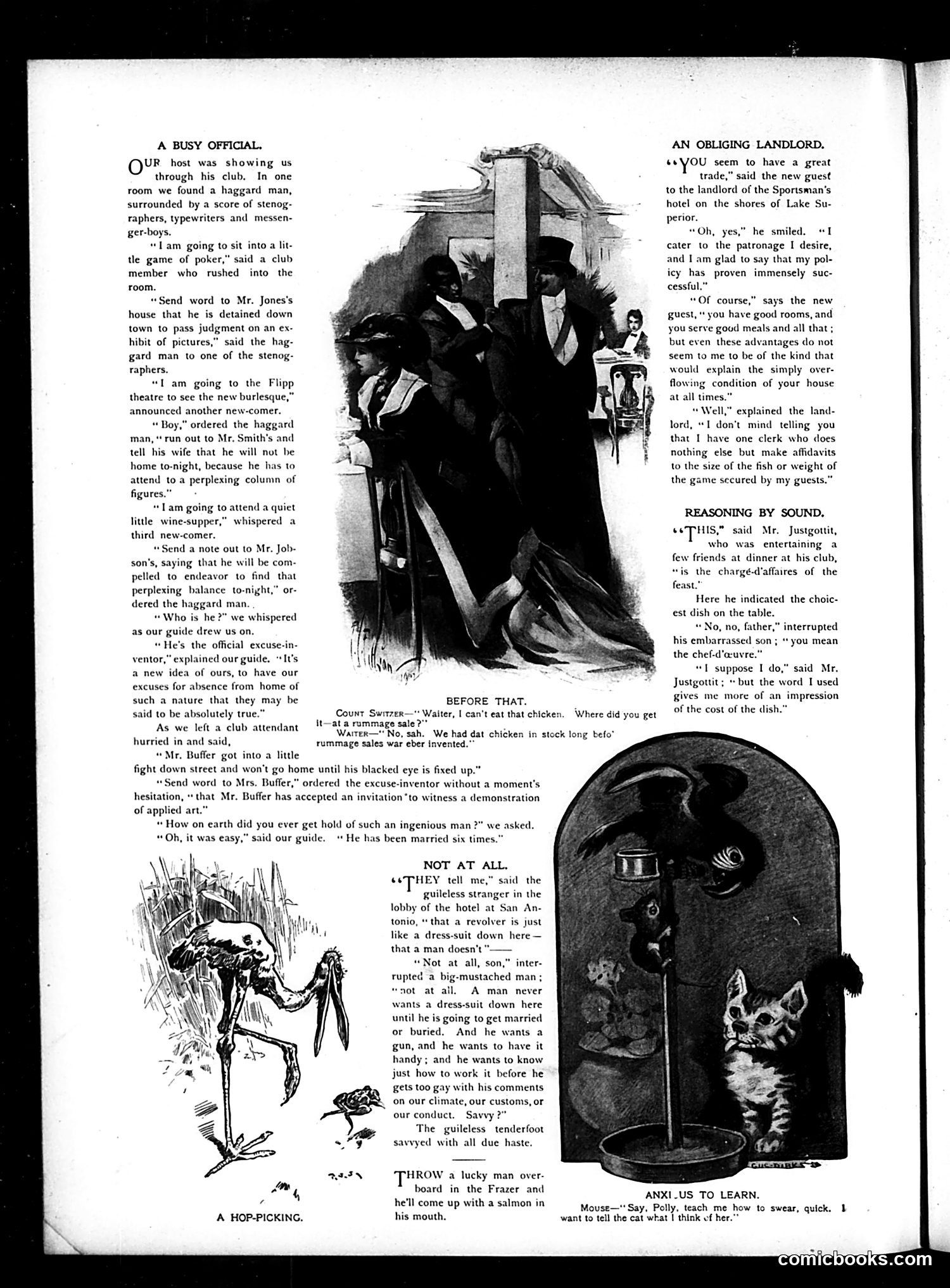
This page contains three satirical pieces typical of Judge's social humor: **"A Busy Official"** mocks the modern executive culture—a harried businessman surrounded by stenographers and messengers, inventing elaborate excuses for club members' absences from home. The joke targets how business demands create absurd bureaucracy: the "excuse-inventor" is so skilled that he's been married six times (implying he's made excuses his entire life). **"An Obliging Landlord"** satirizes tourist exaggeration. A hotel owner admits his real business isn't good rooms or food, but rather a clerk who falsifies affidavits about fish sizes and game weights—mocking fishermen's notorious habit of lying about their catches. **"Not at All"** contrasts Eastern formality with Western frontier culture. A man explains that unlike dress-suits (unnecessary in Texas), revolvers are essential everyday items—a practical commentary on frontier violence. The cartoons illustrate each story with period pen-and-ink drawings showing the described scenarios.
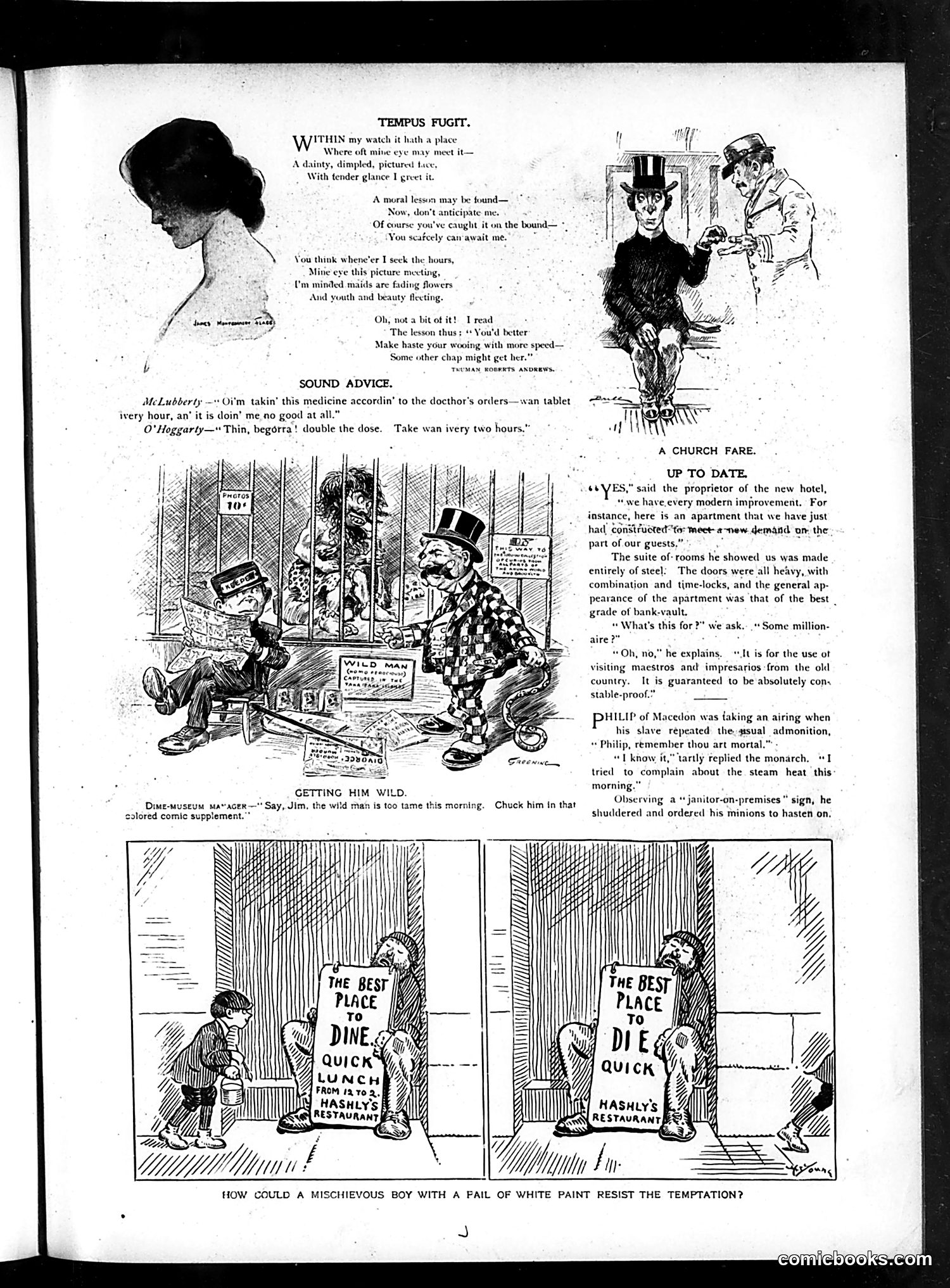
This page contains several satirical pieces typical of early 20th-century American humor: **"Tempus Fugit"** is a poem-and-illustration about a man who keeps a woman's picture in his watch. The joke: he pretends the image reminds him of mortality and the fleeting nature of youth, but really he's just anxious another man will court her faster. **"Sound Advice"** depicts Irish characters (indicated by dialect spelling) where one recommends doubling medicine doses—absurd medical humor playing on ethnic stereotypes common to the era. **"Getting Him Wild"** shows a dime museum manager reviving a sluggish "wild man" exhibit by exposing him to a colored comic supplement—mocking both sensationalist entertainment and comics themselves. **"A Church Fare"** and **"Up to Date"** offer brief social satire: a hotel proprietor advertises a burglar-proof steel apartment supposedly for wealthy guests, but reveals it's actually for foreign maestros and impresarios—suggesting these artists are dishonest or untrustworthy. The final comic shows a boy tempted by a restaurant sign, with the punchline about white paint—visual humor about childish mischief.
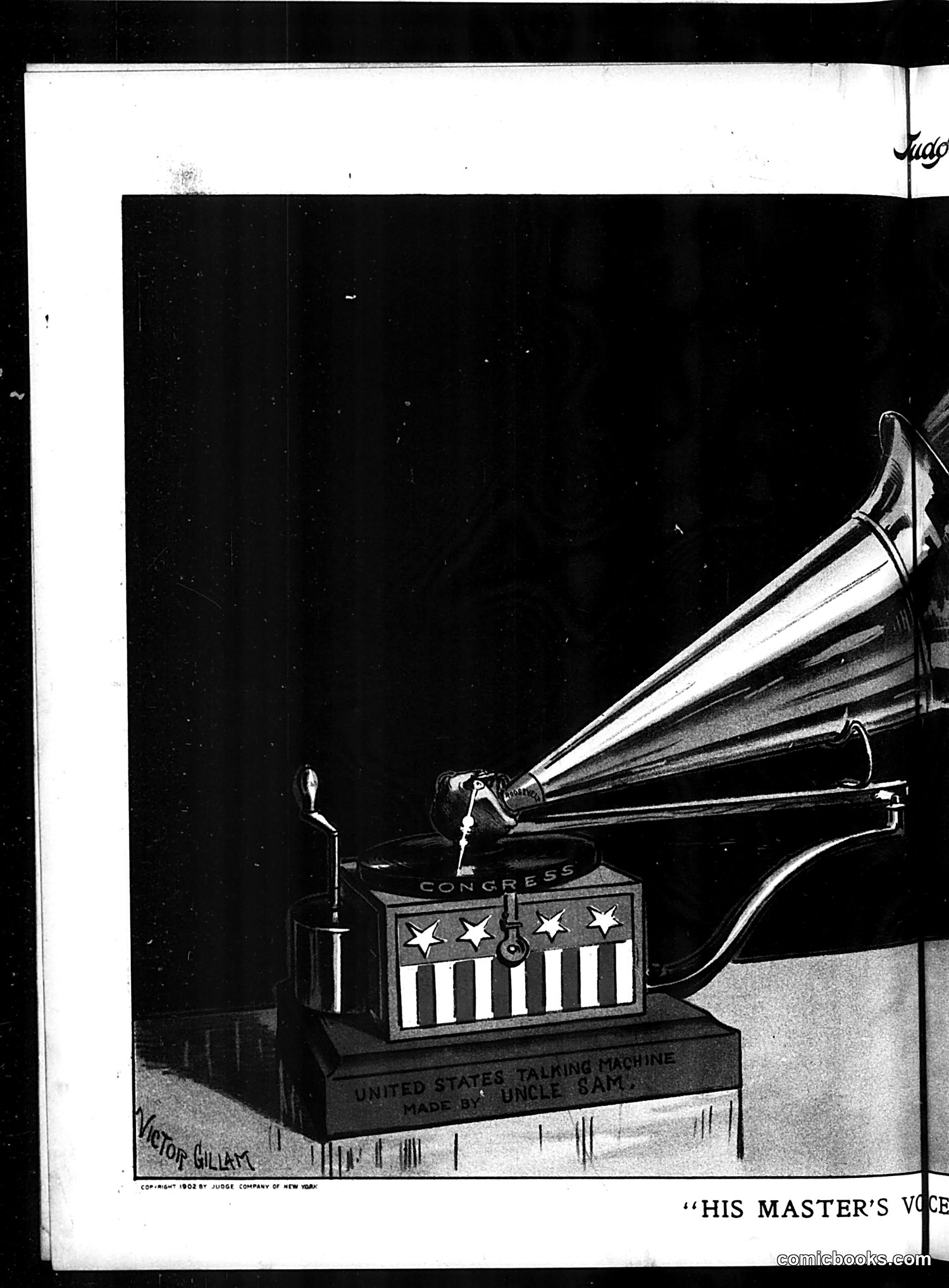
This Judge magazine cartoon, credited to Victor Gillam, depicts a satirical "United States Talking Machine" labeled "Made by Uncle Sam" and marked "Congress." The device resembles a gramophone or phonograph with an enormous horn speaker. The satire critiques Congress as merely a mechanical device that amplifies predetermined messages rather than engaging in genuine deliberation. The patriotic imagery (stars and stripes) suggests the cartoon questions whether Congress serves authentic American interests or simply reproduces scripted output. The title "His Master's Voice" (a famous phonograph trademark) implies Congress functions as a puppet mechanism rather than representing independent legislative authority. This reflects Progressive Era skepticism about institutional authenticity and political manipulation.
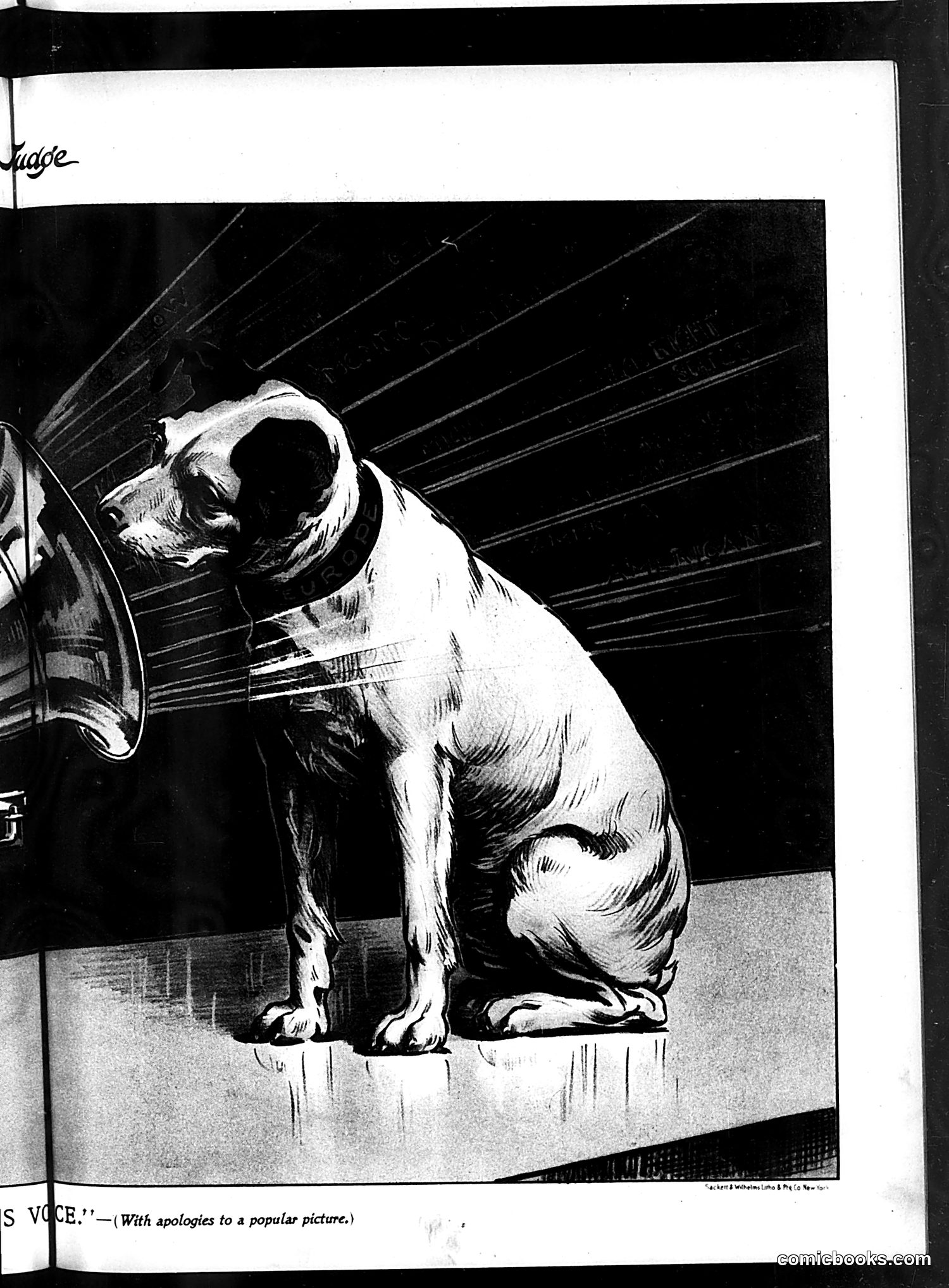
This is a satirical cartoon featuring a dog standing on its hind legs, appearing to speak or bark at what seems to be a megaphone or speaker device. The caption reads "S VICE" (likely "SERVICE") with a note: "(With apologies to a popular picture.)" The satire parodies a well-known image—likely a famous propaganda or inspirational poster featuring a human figure. By substituting a dog for the person, the cartoonist mocks whoever or whatever the original picture represented, suggesting they are behaving like an obedient dog or are merely following orders without independent thought. Without knowing the specific date and original image being referenced, the exact political target remains unclear, but this appears to be Commentary on blind obedience or servility in public discourse.
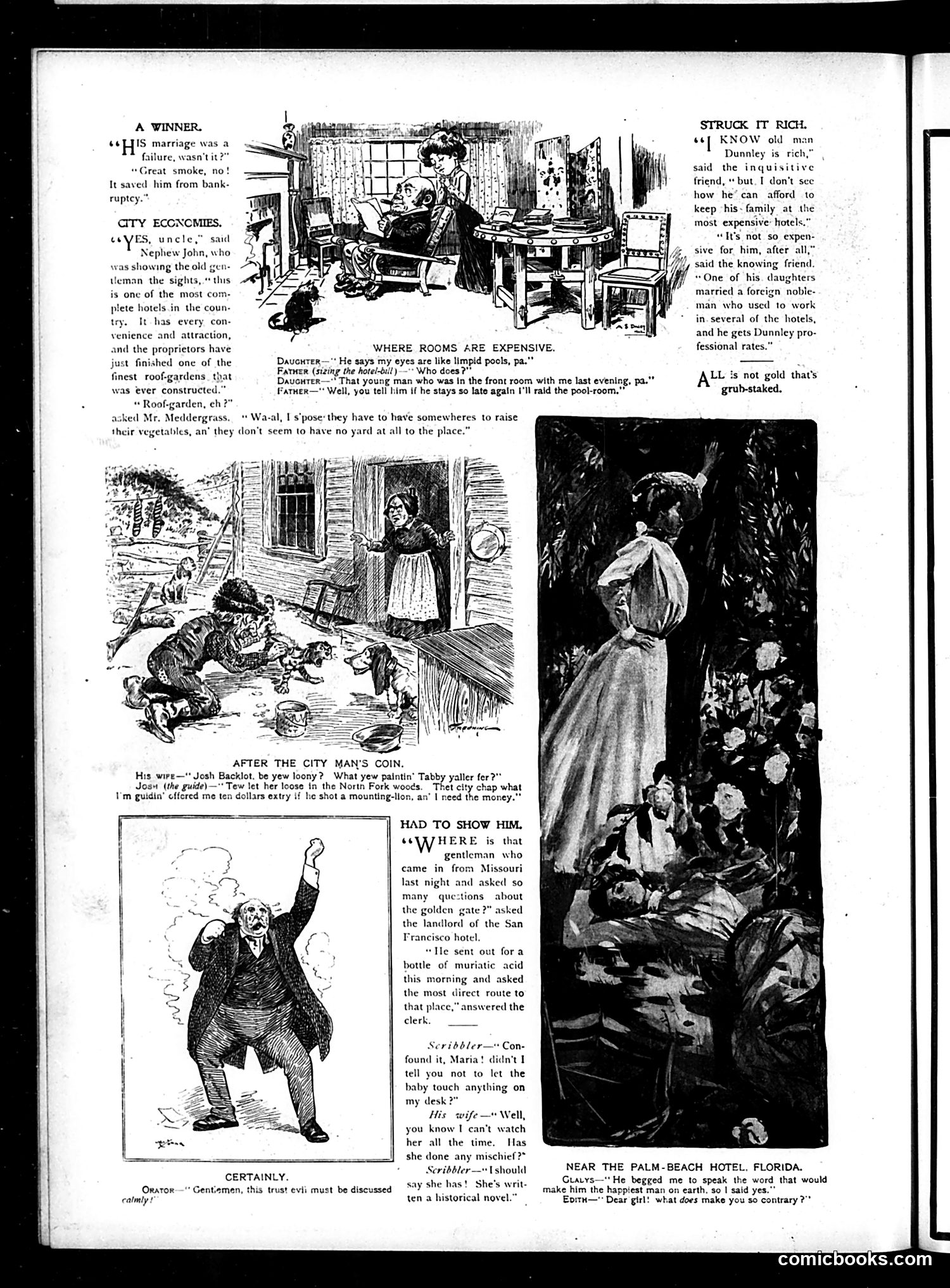
This page contains five separate satirical vignettes mocking American social pretensions and rural-urban contrasts: **"A Winner"**: Marriage saves a man from bankruptcy through the dowry—satirizing marriages of convenience among the desperate wealthy. **"City Economies"**: A nephew shows his uncle an expensive hotel with a roof garden. The uncle notes they must grow vegetables since "they don't seem to have no yard"—mocking urban density and city dwellers' disconnection from farming. **"Where Rooms Are Expensive"**: A daughter brags about a suitor's compliments while her father recoils at the hotel bill—juxtaposing romantic flattery against financial reality. **"After the City Man's Coin"**: A rural guide deceives a city tourist into paying extra to shoot a lion by painting the family cat yellow—satirizing rural cunning exploiting gullible city visitors. **"Struck It Rich"** and other segments continue this pattern: foreign nobleman hotel workers, Missouri visitors asking naive questions, scribblers' wives writing novels. The overall theme: rural shrewdness versus urban naïveté and pretension, typical Judge satire targeting both groups.
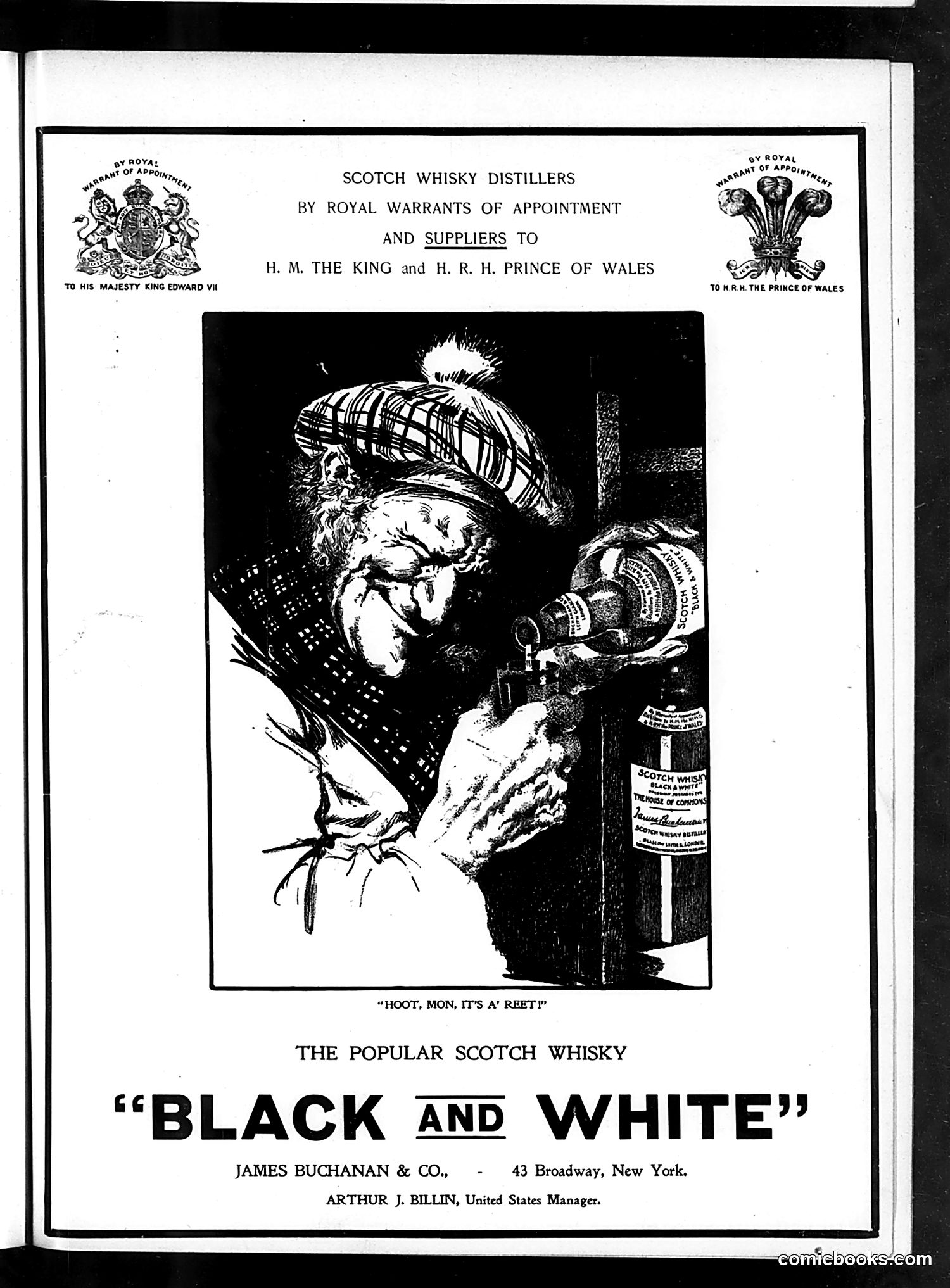
This is primarily **advertising copy**, not political satire. The page promotes "Black and White" Scotch whisky, made by James Buchanan & Co. The illustration shows a **Scottish caricature** — an elderly man in tartan dress and tam o'shanter hat — examining whisky bottles with apparent approval. The caption "Hoot, mon, it's a' reet!" uses exaggerated Scottish dialect for comic effect ("Hoot, man, it's all right!"). The advertisement leverages **royal warrants** displayed at the top, claiming official appointment as suppliers to King Edward VII and the Prince of Wales. This royal endorsement was a prestigious marketing tool of the era. The "Scotsman character" stereotype was common in early 20th-century advertising — used to connote authenticity and tradition in Scottish whisky marketing. The joke relies on ethnic humor and dialect comedy typical of the period, rather than political commentary.
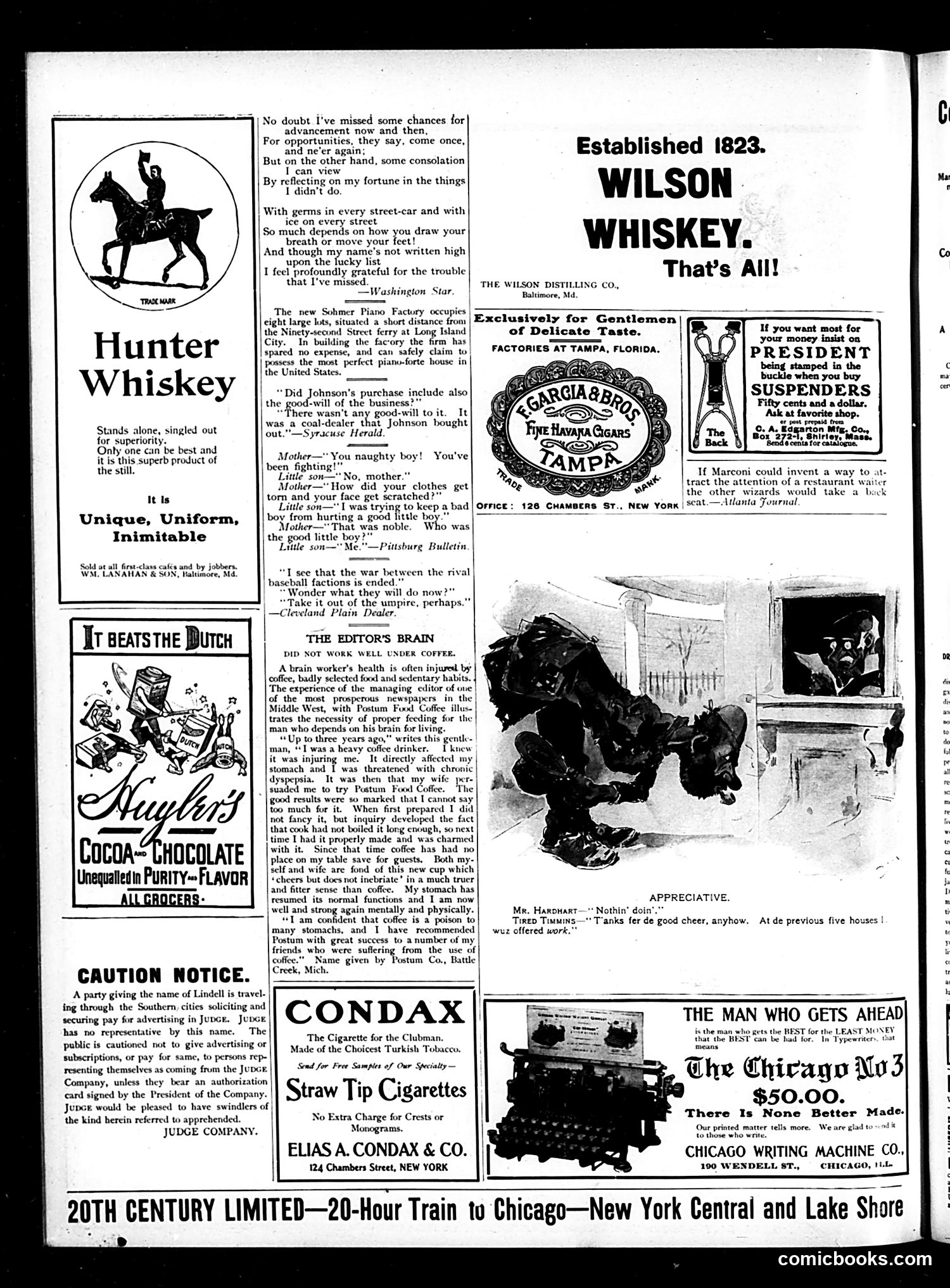
This page is primarily **advertisements and filler content** rather than political satire. The actual satirical element is limited to brief humorous quotes at the top from publications like the Washington Star and Pittsburgh Bulletin—lighthearted observations about missing opportunities and a child's innocent misunderstanding of his role in a schoolyard fight. The rest of the page consists of product advertisements: Hunter Whiskey, Wilson Whiskey, Garcia y Bros Fine Havana Cigars, Naylor's Cocoa-Chocolate, Condax Cigarettes, The Chicago No. 3 typewriter, and Postum Food Coffee. There is also a caution notice warning readers not to be defrauded by someone falsely representing himself as a Judge Company advertising agent. **No clear political figures or caricatures appear**. The illustrated "appreciative" scene showing tired figures (captioned "Me Hardart—'Nothin' doin'") appears generic rather than depicting specific individuals. This is primarily a **commercial page**, typical of Judge magazine's revenue model.
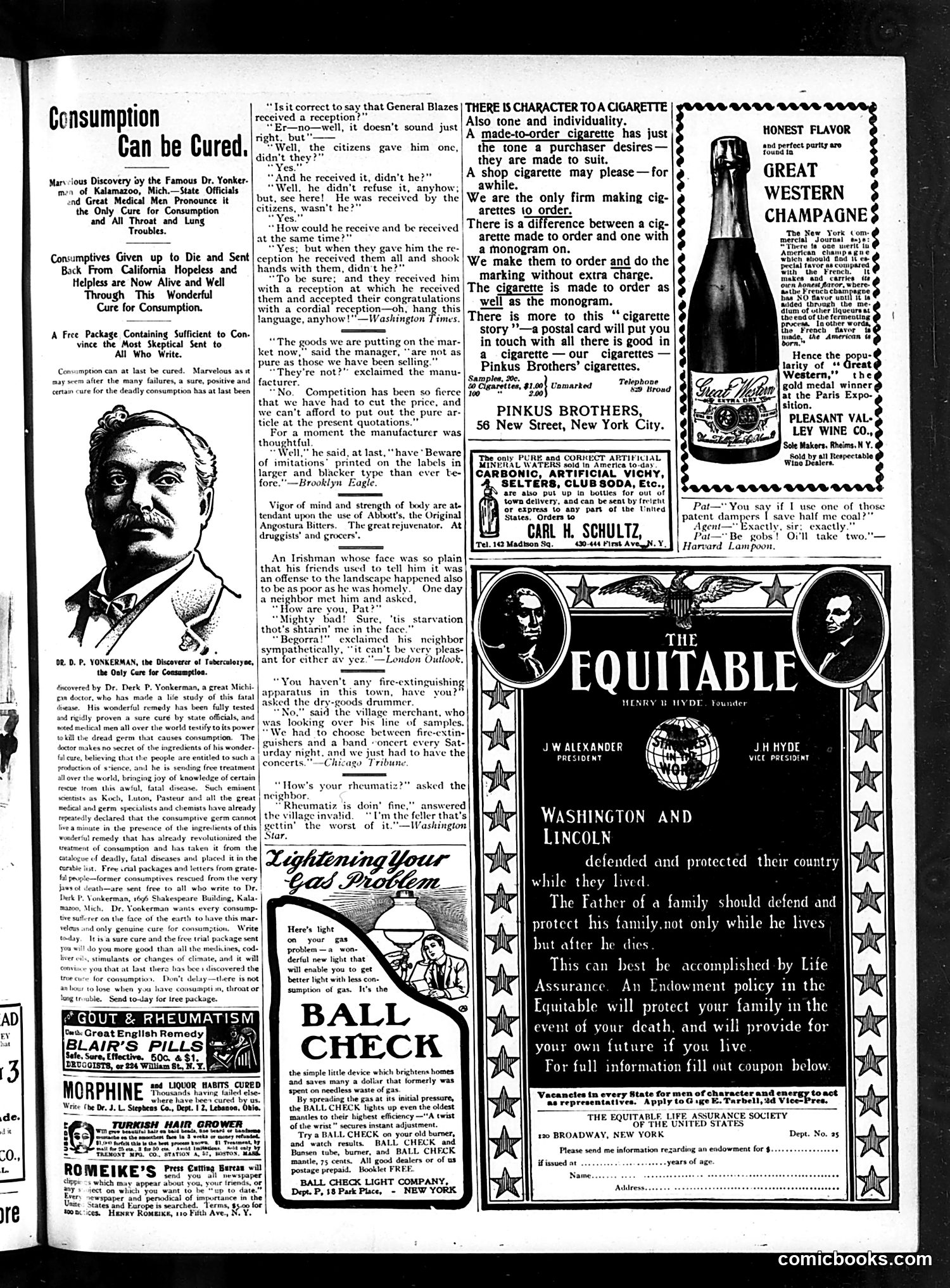
This page from Judge (an American satirical magazine) is primarily **advertising**, not political satire. The content includes: **Main advertisement**: A medical cure-all claiming consumption (tuberculosis) can be cured by Dr. Venkerman's discovery—a common fraudulent claim of the era before antibiotics. **Humorous dialogues**: Small comic exchanges, including one about General Blazes receiving a reception (appears to be mild political humor about ambiguous statements) and an Irish immigrant joke about poverty. **Commercial ads**: Pinkus Brothers cigarettes (emphasizing custom-made qualities), Ball Check lighting devices, hair-growth products, and The Equitable Life Assurance Society promoting life insurance with references to Washington and Lincoln as protectors. **Context**: This reflects early 20th-century American advertising practices—mixing dubious medical claims with consumer goods and patriotic imagery. The magazine combined satirical commentary with revenue from advertisements, many making exaggerated or false health claims now recognized as fraudulent.
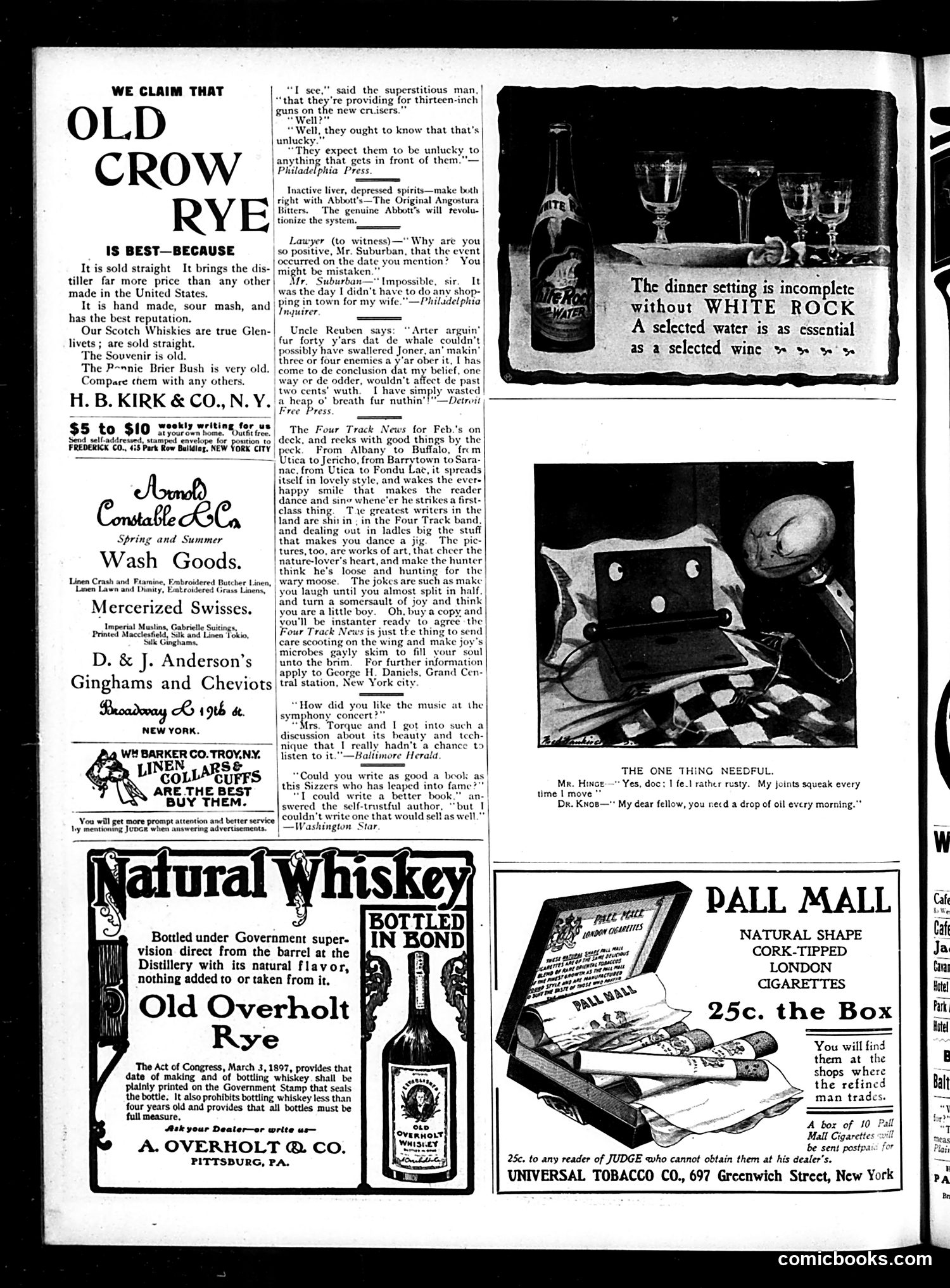
This page is primarily **advertisements and filler content** with several brief satirical jokes typical of early 1900s humor magazines. The page contains multiple short jokes on various topics: - A superstitious man warns against thirteen-inch naval guns as unlucky - A lawyer cross-examines a suburban witness about a date (the joke being the man remembers it because he avoided shopping) - "Uncle Reuben" debates whether whales could swallow Jonah for forty years - A couple argues about symphony music's beauty rather than listening to it - A publisher boasts he writes better books than a famous author The **advertisements dominate**: Old Crow Rye whiskey, Old Overholt Rye, Pall Mall cigarettes, various fabric merchants, and employment notices. **No major political satire is evident.** The humor is gentle domestic/social comedy reflecting period concerns: marriage dynamics, naval modernization, and literary pretension. The cartoon content consists mainly of product advertisements with illustrations rather than political commentary.
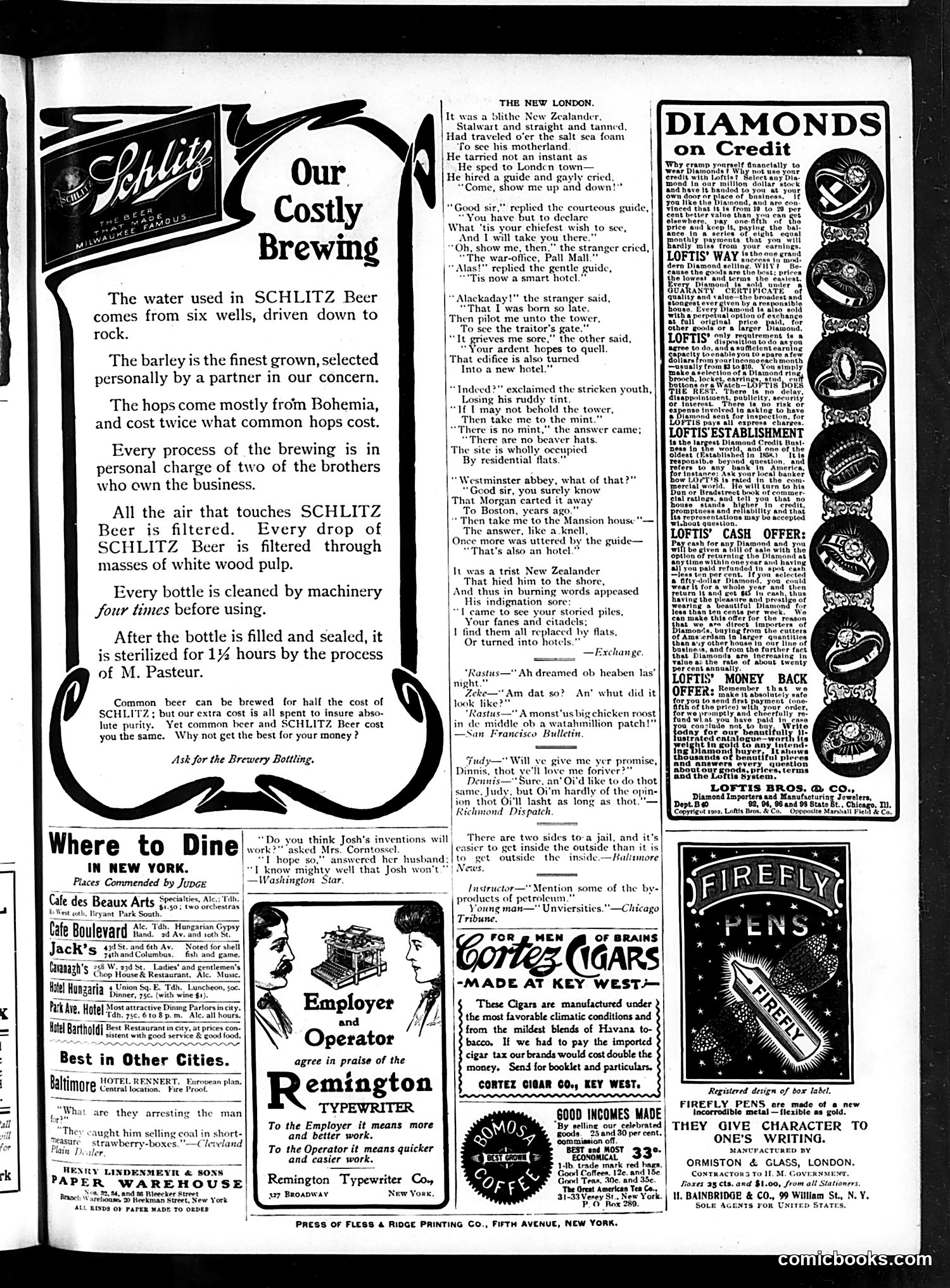
This page features a satirical poem mocking London's commercialization. A visiting New Zealander arrives eager to see famous British landmarks—the Tower of London, Westminster Abbey, the Mansion House, the Mint—only to discover each has been converted into a hotel. The satire targets the transformation of historic London into modern commercial spaces. The visitor's mounting frustration, departing in "burning words" of indignation, reflects contemporary anxieties about commercialism eroding cultural heritage. The final stanza emphasizes his disappointment: London's "fanes and citadels" are "replaced by flats, / Or turned into hotels." This likely comments on actual 1900s-era development pressures and the perceived tension between preserving British historical identity and modern capitalist expansion. The humor derives from the absurdity of historically significant sites becoming mere lodging—a pointed critique of prioritizing profit over patrimony.
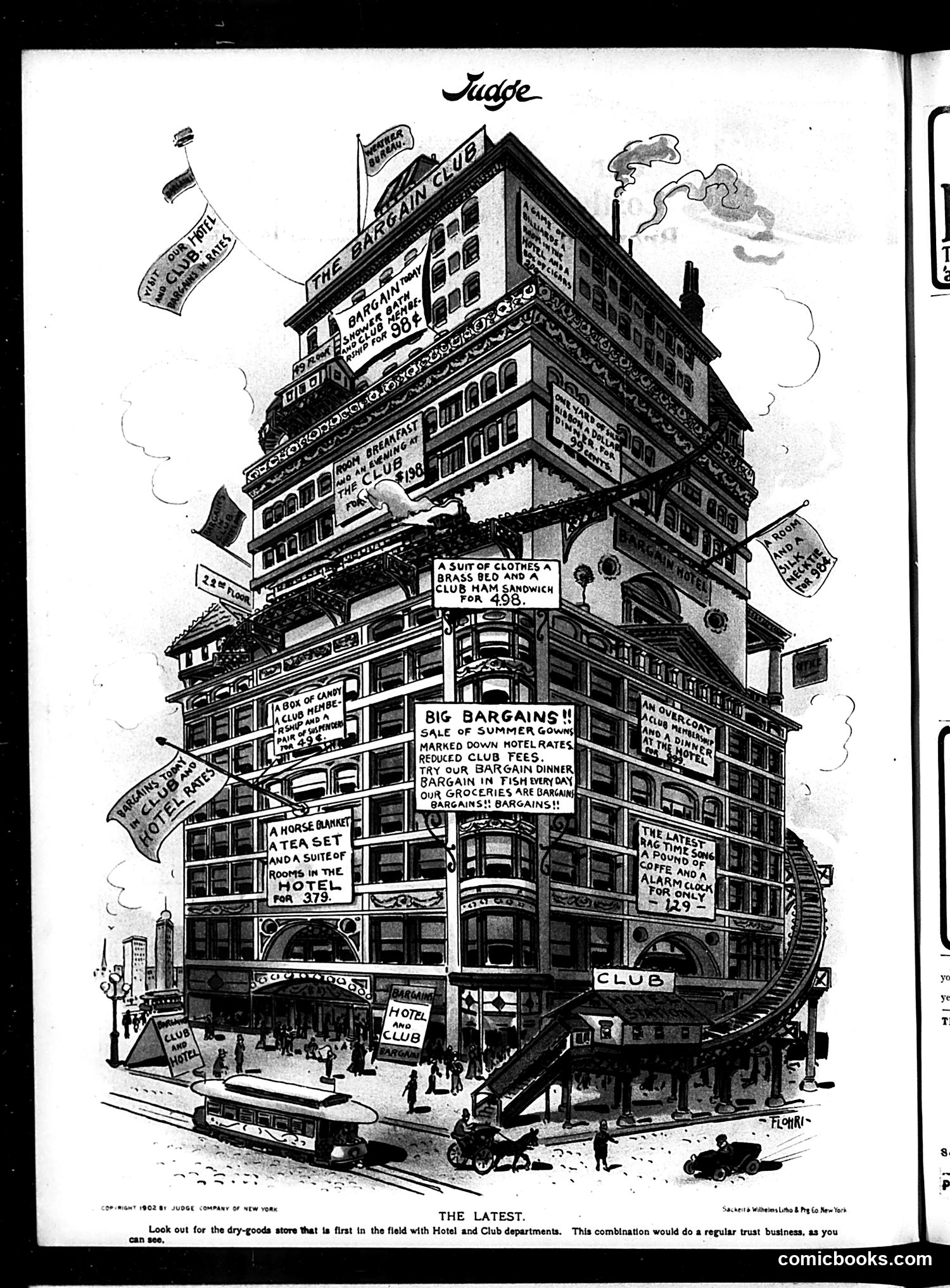
This cartoon satirizes the era of **department store expansion and business consolidation** (likely early 1900s, given the architectural style and reference to "trusts"). The towering building decorated with bargain signs represents a massive commercial enterprise attempting to monopolize multiple retail sectors simultaneously—clothing, hotel services, dining, groceries, and club amenities. The satire's point: The cartoon warns that such aggressive vertical integration resembles an illegal "trust" (corporate monopolies that were politically controversial and legally challenged in the Progressive Era). The caption's dry concluding line—"This combination would do a regular trust business"—is sarcastic criticism. The image mocks the absurdity of a single establishment claiming to offer everything from suits to ham sandwiches at rock-bottom prices, suggesting this model represents anti-competitive business practices that undermine smaller specialized retailers. The crowded street below shows the store's popular draw, emphasizing both the threat and the public's attraction to consolidated bargain shopping.
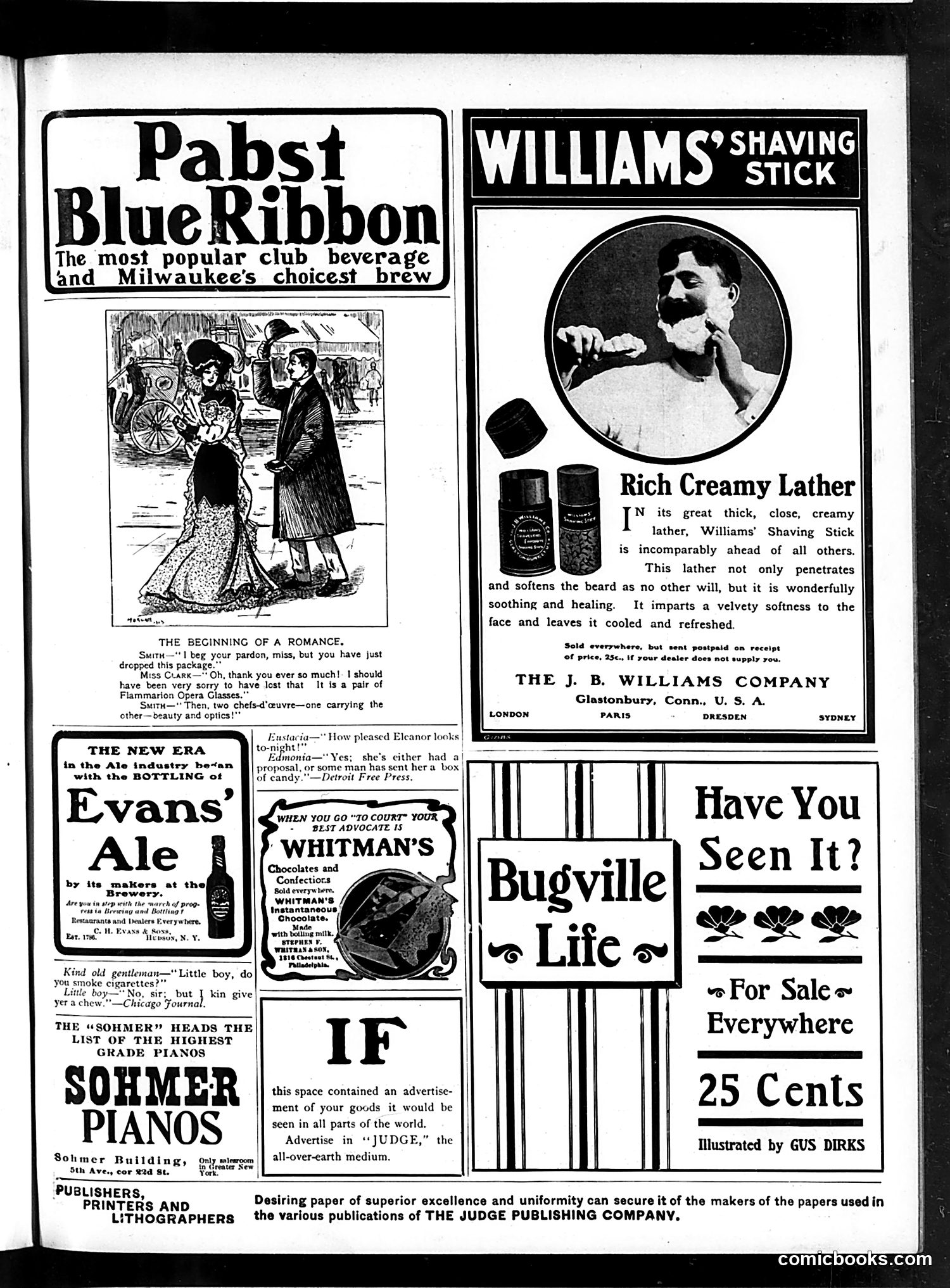
This page is primarily **advertisements** rather than satirical content. The ads target early-1900s consumers: **Main Advertisements:** - **Pabst Blue Ribbon**: Beer marketed as Milwaukee's finest, featuring a small comic about a man returning a lost opera glasses case to a woman—a genteel "romance" setup typical of period advertising humor. - **Williams' Shaving Stick**: Emphasizes "rich creamy lather" with a mustachioed man's portrait, appealing to masculine grooming standards of the era. - **Evans' Ale**: Another brewery product - **Sohmer Pianos**: High-end instruments - **Bugville Life**: A 25-cent publication illustrated by Gus Dirks - **Whitman's Chocolates**: Positioned as courtship gifts The small comedy pieces (opera glasses, cigarette smoking) are generic period humor used to make ads engaging rather than satirical commentary. The page demonstrates how Judge monetized readership through luxury consumer goods marketed to middle and upper-class audiences.
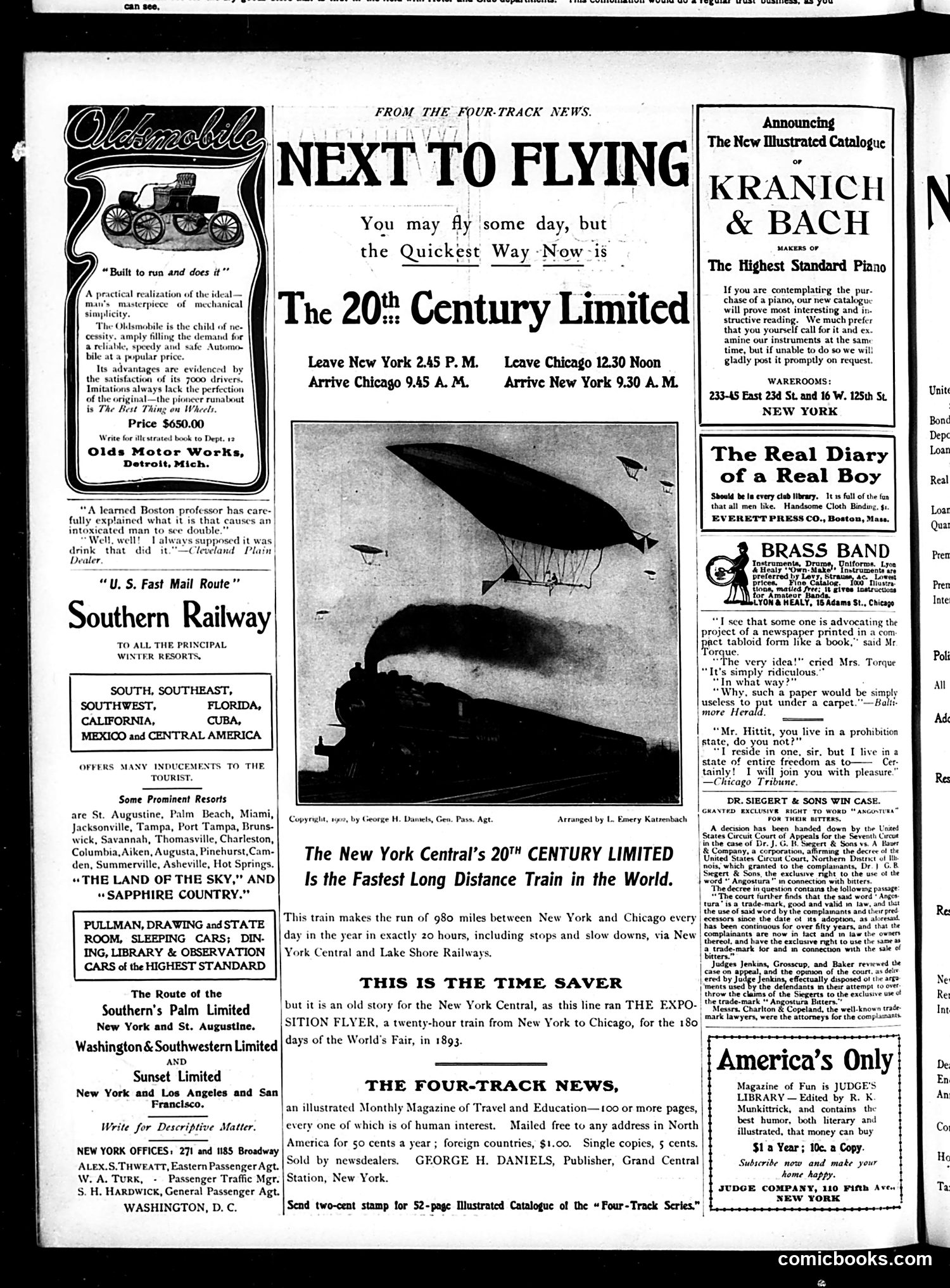
This page is primarily **advertising and promotional content** rather than editorial cartoons. The central image shows an airship/dirigible, accompanying the headline "NEXT TO FLYING," advertising the New York Central's "20th Century Limited" train as the fastest way to travel between New York and Chicago. The page contains no political satire or social commentary. Instead, it features: - **Transportation advertisements** (Oldsmobile, Southern Railway, New York Central trains) - **Consumer product ads** (Kranich & Bach pianos, brass band instruments, diary books) - **A brief humorous dialogue** at bottom-right mocking the idea of newspapers printed in compact book form The "joke" isn't satirical—it's simply people dismissing an impractical newspaper format. The airship image is used metaphorically to suggest the train's speed rivals flying. This is essentially a **commercial publication**, not a satirical one, reflecting Judge magazine's reliance on advertising revenue.
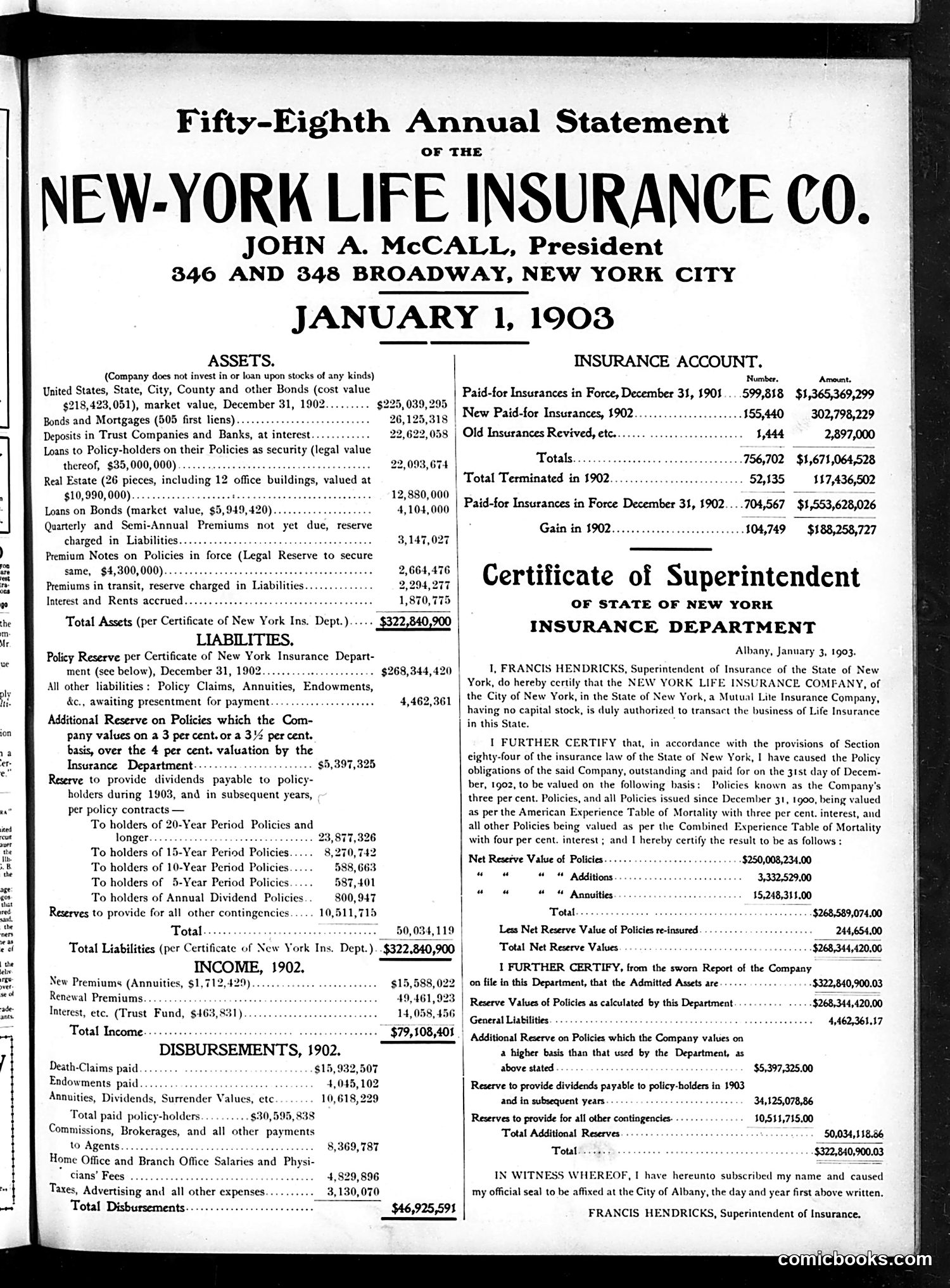
This is **not a cartoon or satirical content** — it's a financial document. The page contains the **Fifty-Eighth Annual Statement of the New-York Life Insurance Company** dated January 1, 1903, signed by President John A. McCall, with official certification from Francis Hendricks, New York's Superintendent of Insurance. The document lists the company's assets ($322.8 million), liabilities, insurance accounts, and disbursements for 1902. It includes a formal government certificate validating the company's authorized status and financial valuations using mortality tables and interest calculations. **Context for modern readers:** This appears to be a standard regulatory filing, likely published in *Judge* magazine as financial news or public record. There is no satire visible here — it's straightforward insurance industry documentation from the early 20th century, demonstrating how major financial institutions reported their operations to state authorities.
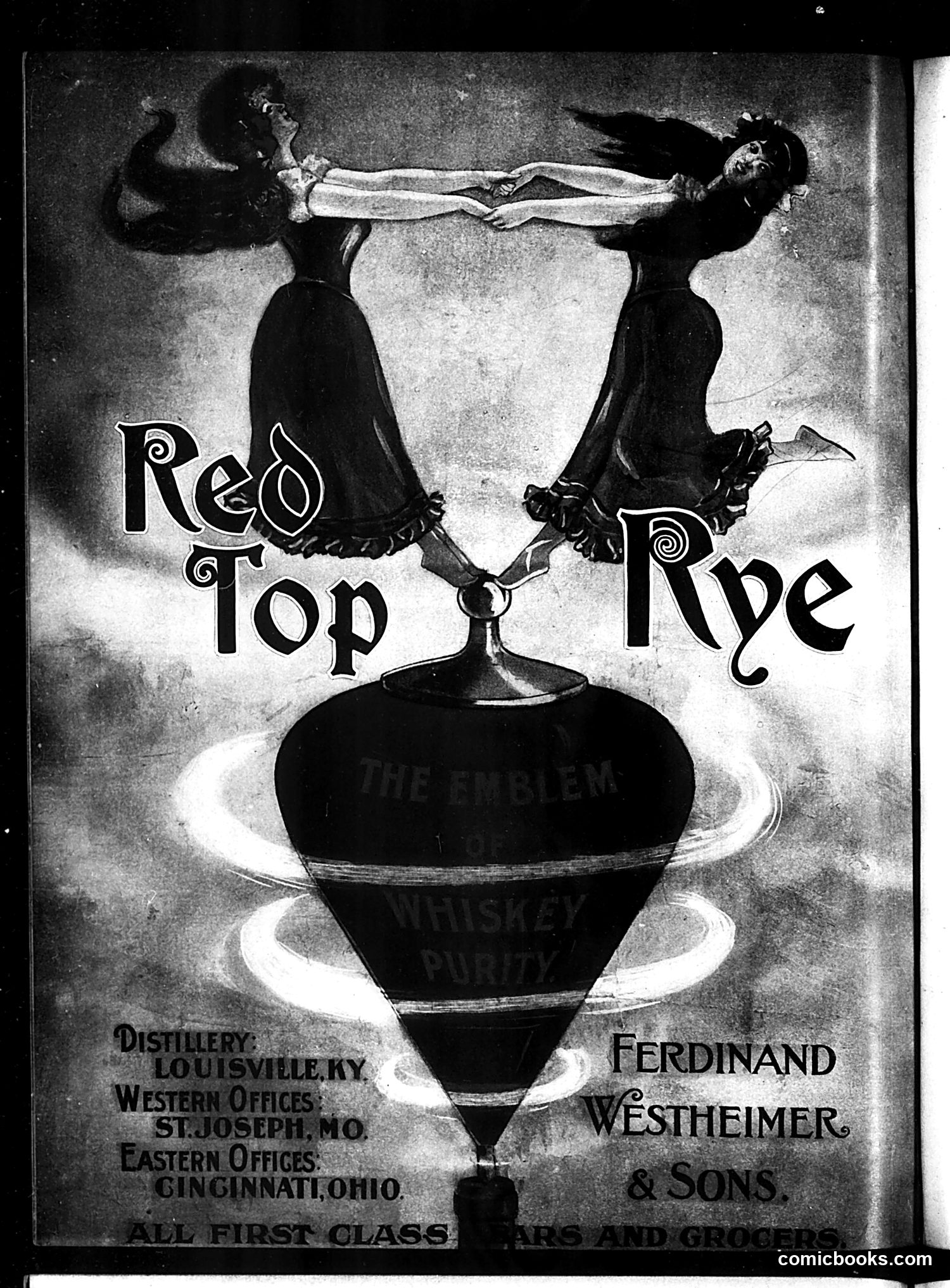
This is primarily a **whiskey advertisement** rather than political satire. It promotes "Red Top Rye" whiskey from Ferdinand Westheimer & Sons, with distillery operations in Louisville, Kentucky and offices in St. Joseph, Missouri and Cincinnati, Ohio. The advertisement features an Art Deco design with two stylized female figures balanced on an inverted bottle/funnel shape. The image emphasizes the product's purity and quality ("All First Class" and marked "The Emblem" and "Whiskey Purity"). This dates to the Prohibition era or shortly after—the elaborate marketing and emphasis on "first class" quality suggests distillers were competing aggressively to establish brand prestige during or following alcohol restrictions.