
A complete issue · 17 pages · 1902
Judge — December 27, 1902
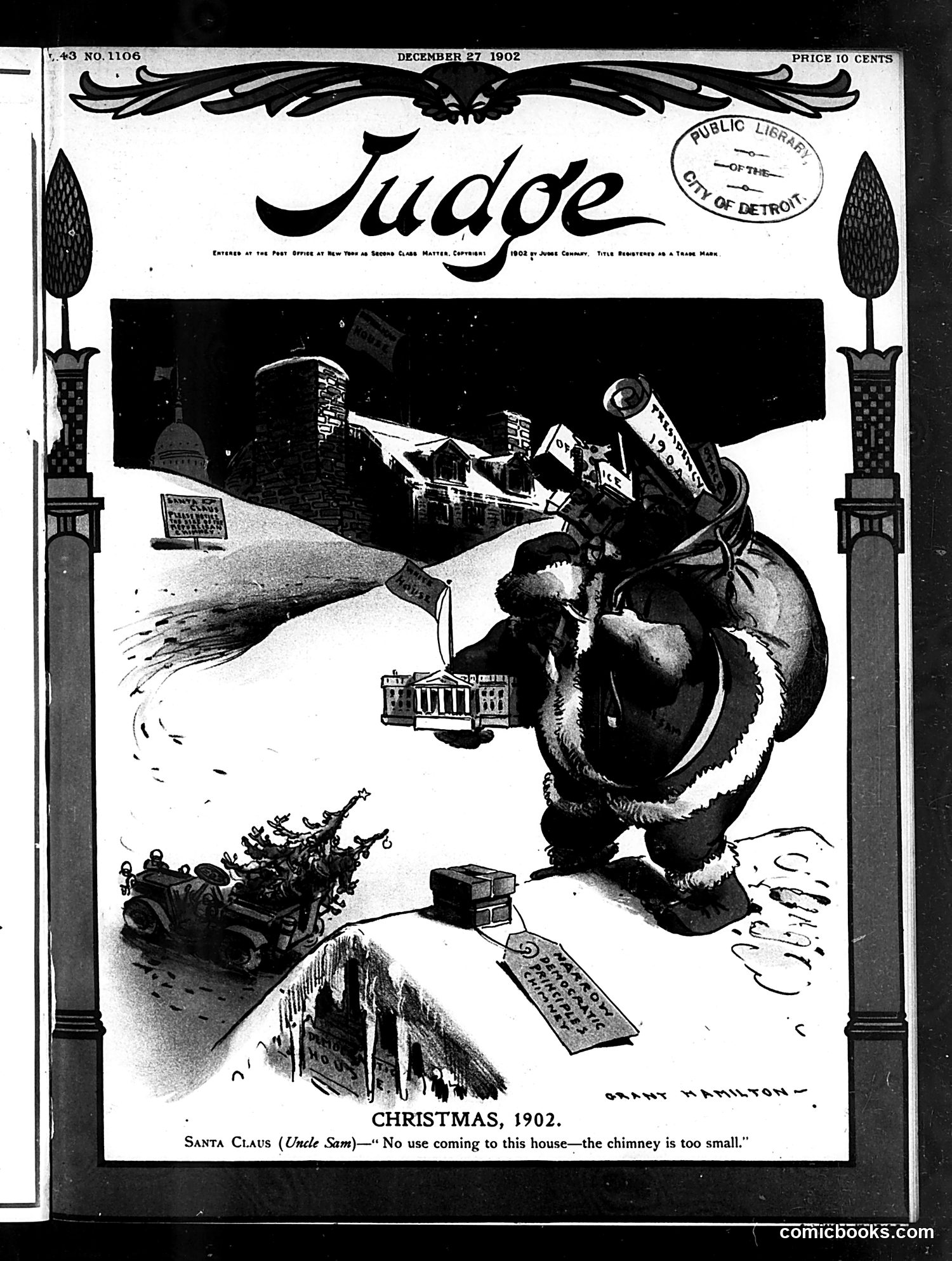
This Christmas cartoon depicts Santa Claus unable to deliver presents because "the chimney is too small." The image shows Santa (labeled "Uncle Sam") holding oversized gifts and military equipment—including what appears to be a battleship, cannon, and other military hardware—confronting an impossibly tiny house chimney. The satire likely critiques American imperial ambitions in 1902. The U.S. was actively engaged in the Philippine-American War and had recently acquired overseas territories. Santa/Uncle Sam's massive military acquisitions cannot fit into domestic infrastructure, suggesting the nation is overextended by foreign adventures and military spending. The "chimney too small" represents America's limited domestic capacity to handle such aggressive expansion, ironically presented as a Christmas gift-giving problem.
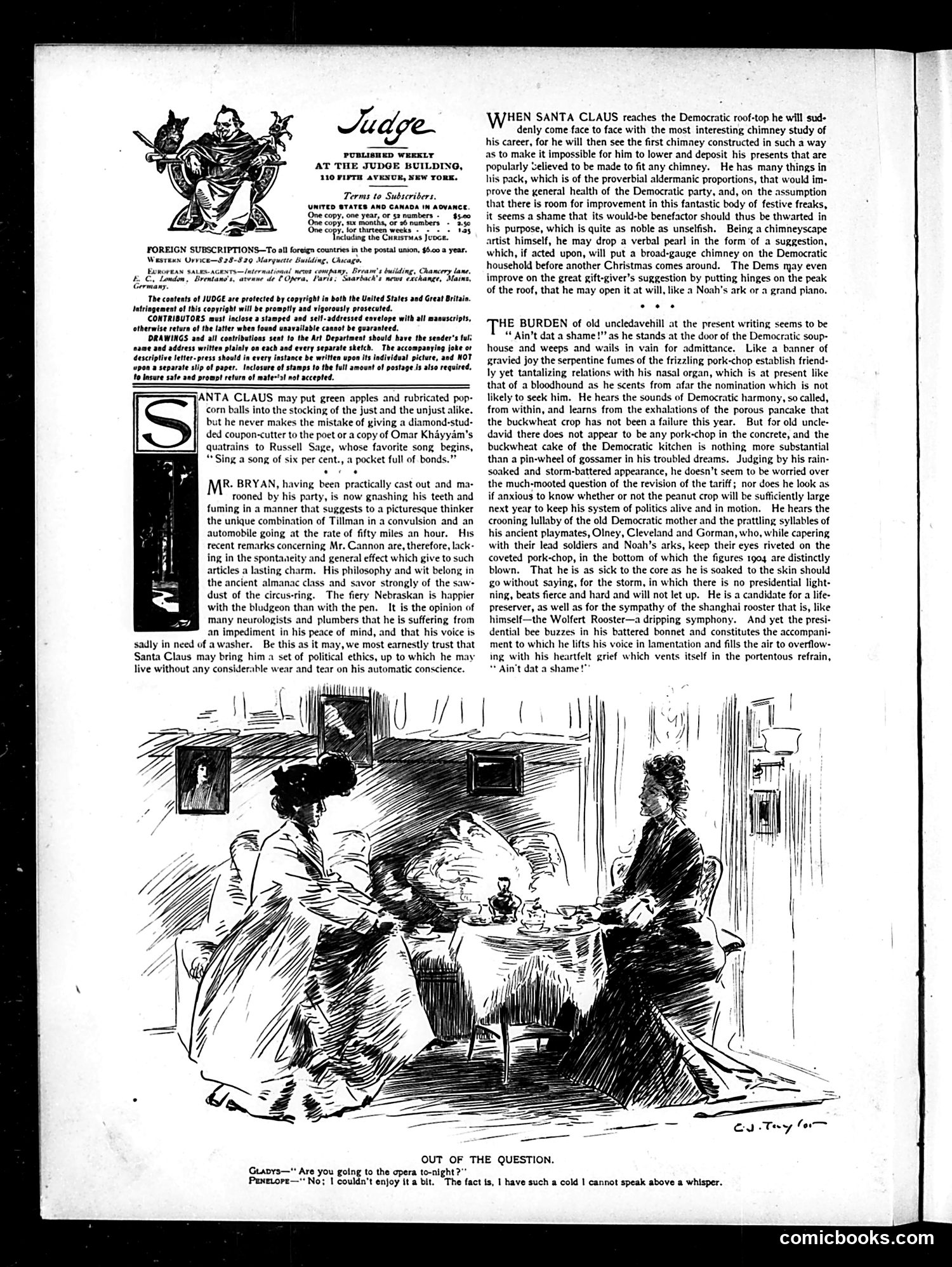
This page contains two main sections: **Editorial Content ("Judge"):** The text discusses Santa Claus visiting the Democratic Party, critiquing Democratic political failures and internal discord. It references specific Democratic figures—likely Cleveland, Olney, Gormán, and others—mocking their leadership and comparing the party to a "bloodhound" seeking a scent. **Political Cartoon ("Out of the Question"):** Shows two women in conversation. "Gladys" asks "Penelope" if she's attending the opera, and Penelope declines, citing illness—she has "such a cold I cannot speak above a whisper." The joke's specific political target is **unclear** from the image alone, though it likely references a contemporary social or political scandal where someone's public silence was notable or ironic. The cartoon dates to the late 19th century based on the publication style and artistic technique.
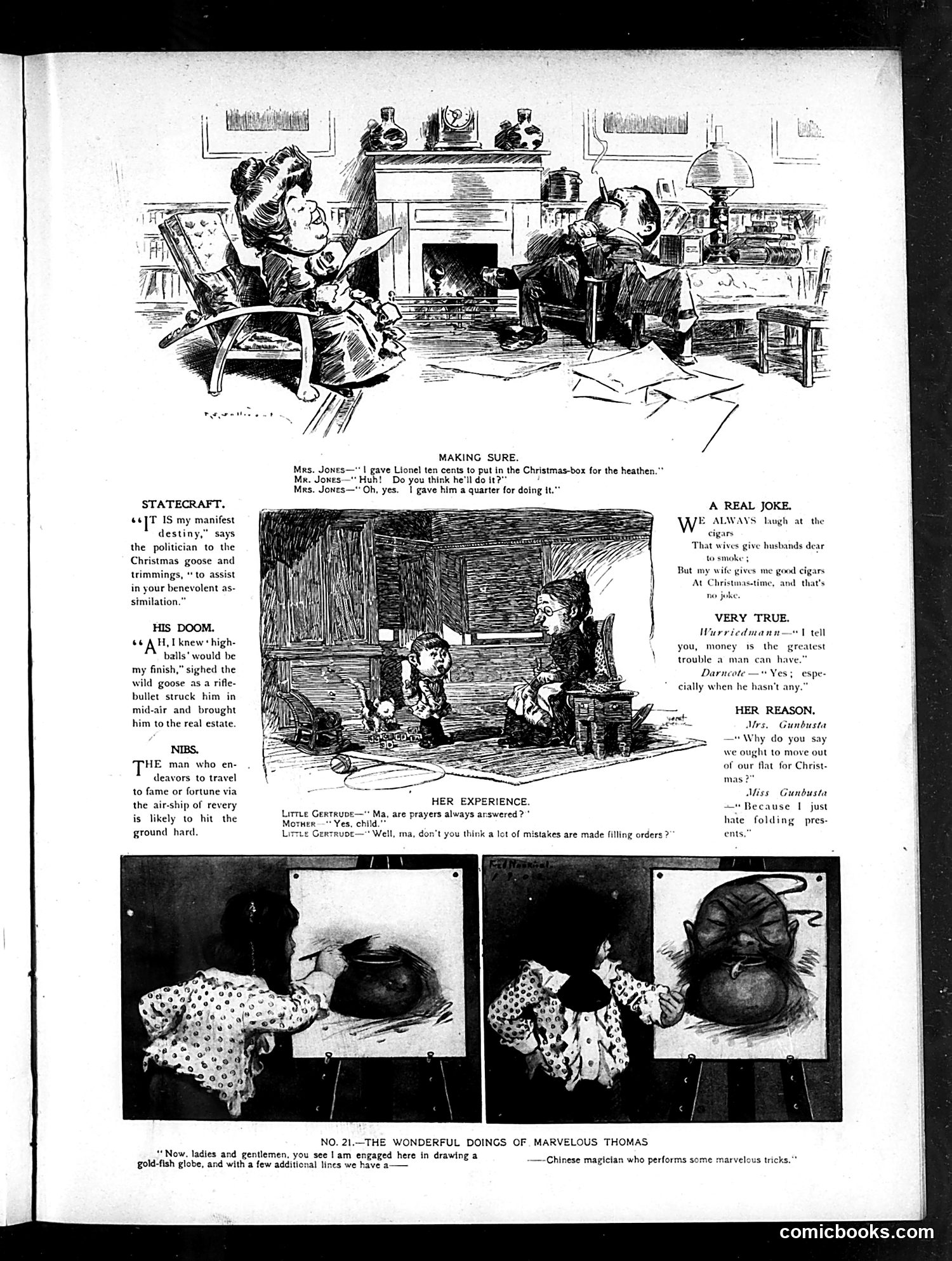
This page contains multiple satirical humor pieces typical of Judge's Christmas-themed content: **"Making Sure"** depicts a domestic scene where Mrs. Jones gives her husband money for a Christmas charity donation, then questions whether he'll actually contribute it—implying husbands can't be trusted with charitable giving. **"Statecraft," "His Doom," "Nibs,"** and other brief jokes mock politicians' pretensions, marriage dynamics, and social absurdities. The lower section, **"Her Experience,"** shows a woman artist drawing, with a magician's portrait, satirizing either artistic incompetence or the difficulty of capturing likeness. Overall, the page reflects early 20th-century domestic humor emphasizing marital discord, class anxieties, and social hypocrisy—standard Judge material mocking bourgeois American life through exaggeration and wordplay.
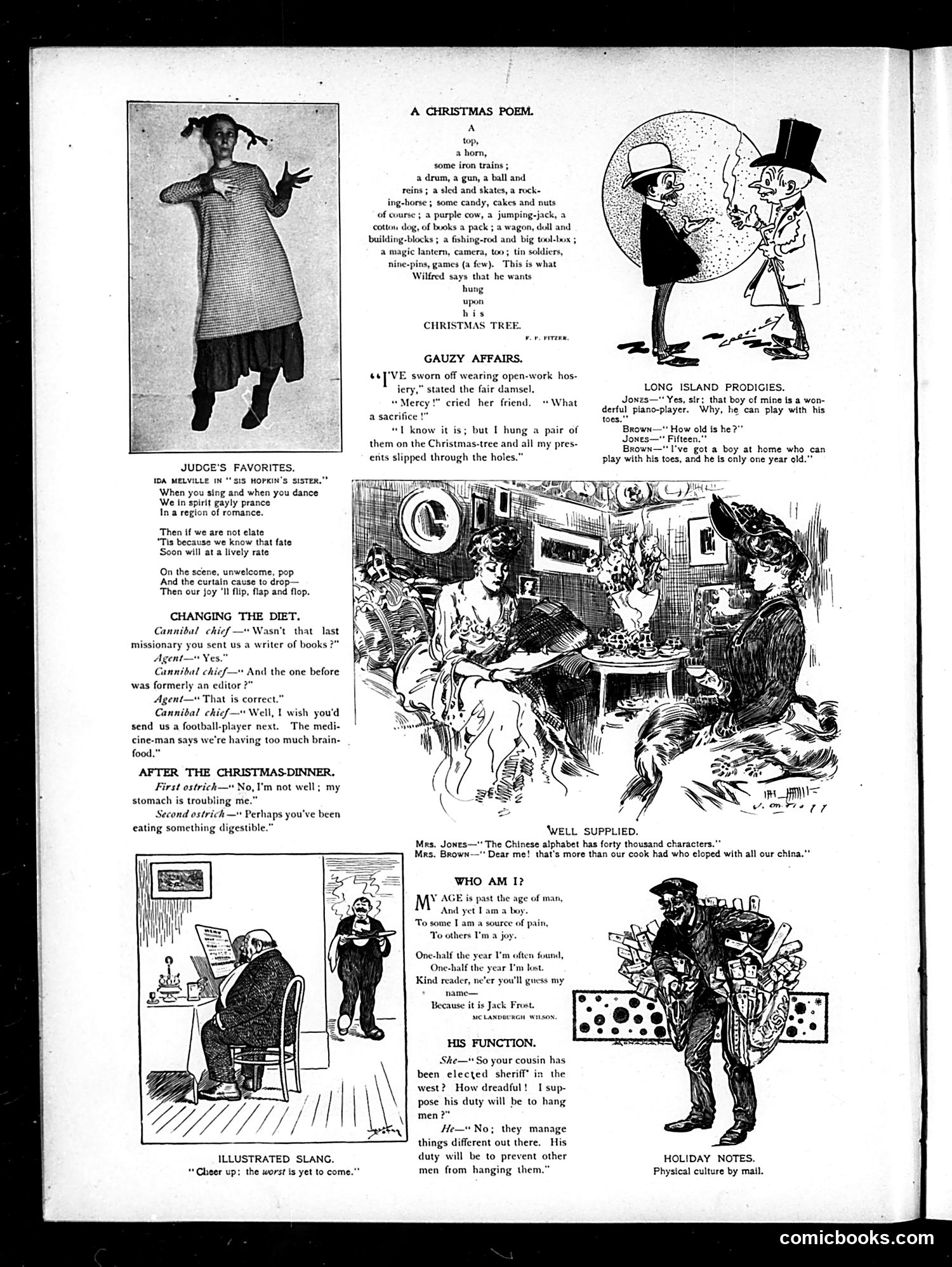
This page contains several unrelated satirical pieces typical of Judge magazine's format. **"A Christmas Poem"** by C.F. Stffer lists humorous gift expectations—toys, drums, and other period items—culminating in a Christmas tree. **"Judge's Favorites"** references Ida Melville in "His Honor's Sister," a theatrical performance, with accompanying verse about dancing and romance. **"Gauzy Affairs"** presents a brief dialogue joke about a woman claiming her Christmas tree decoration consists of worn hosiery, creating a pun on "open-work" stockings. **"Long Island Prodigies"** and other sections contain short comedy sketches and wordplay typical of the magazine's humor. The illustrations are period cartoons with no identifiable political figures or major social commentary visible—primarily domestic humor and theatrical references for contemporary readers.
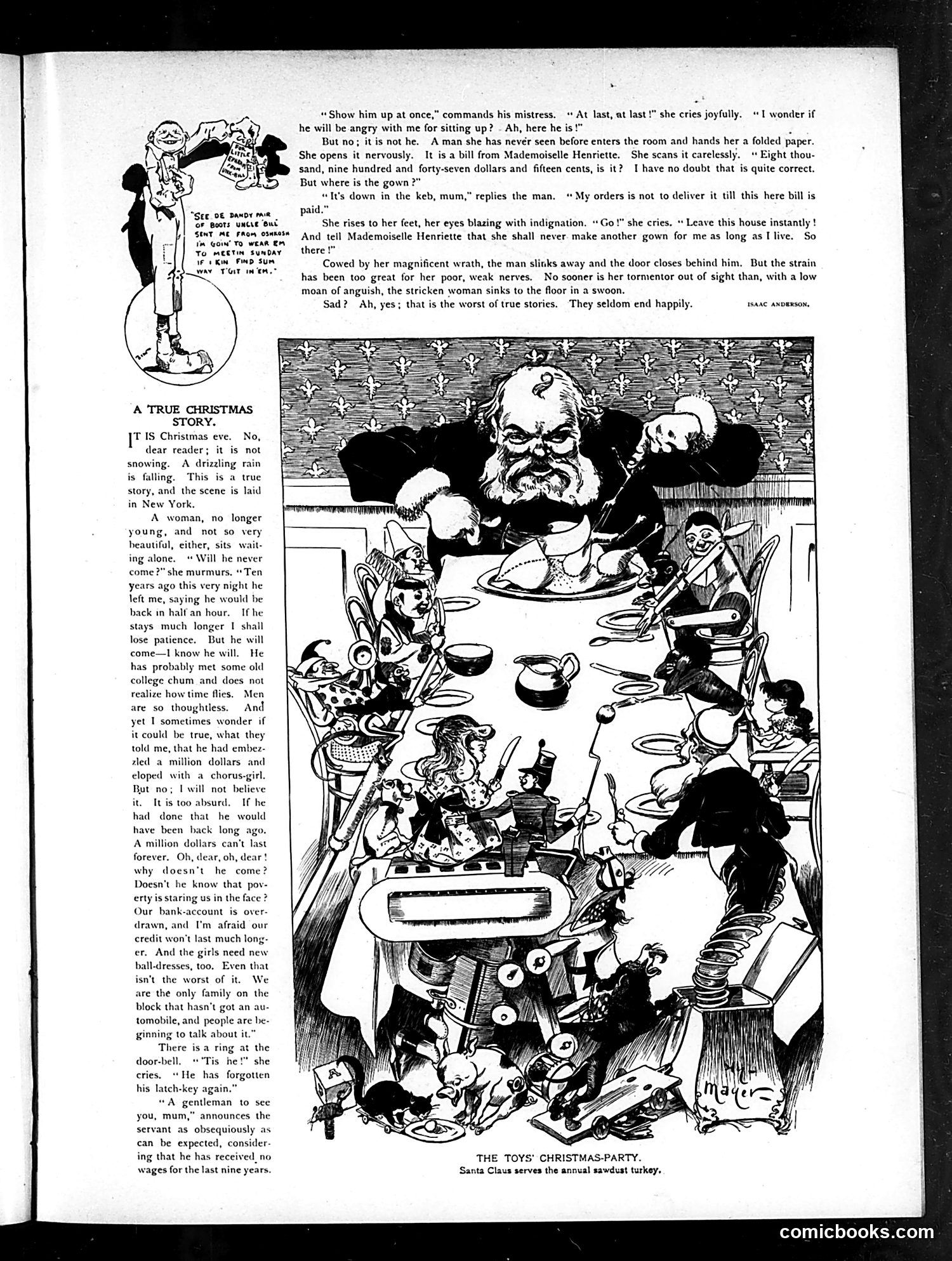
**Top Story ("A True Christmas Story")**: This narrative satire by Isaac Anderson mocks the frivolous spending habits of wealthy women. A neglected wife awaits her husband's return after ten years, fretting over status symbols—automobiles, ball-dresses—and the family's depleted finances. When a dressmaker's bill arrives for $8,947.15 with the gown held hostage until payment, her theatrical outrage causes her to faint. The satire targets both female materialism and the pretense of maintaining appearances despite financial ruin. The ironic title undercuts the sentimental Christmas story tradition. **Bottom Illustration ("The Toys' Christmas-Party")**: Depicts Santa Claus as a grotesque, bloated figure serving toys a "sawdust turkey" at a Christmas dinner. This appears to critique commercialized Christmas and the transformation of holiday sentiment into manufactured consumption—toys celebrating artificial abundance with fake food. The grotesque Santa suggests corruption of Christmas ideals through capitalist excess. Both pieces satirize Gilded Age consumer culture and class anxiety.
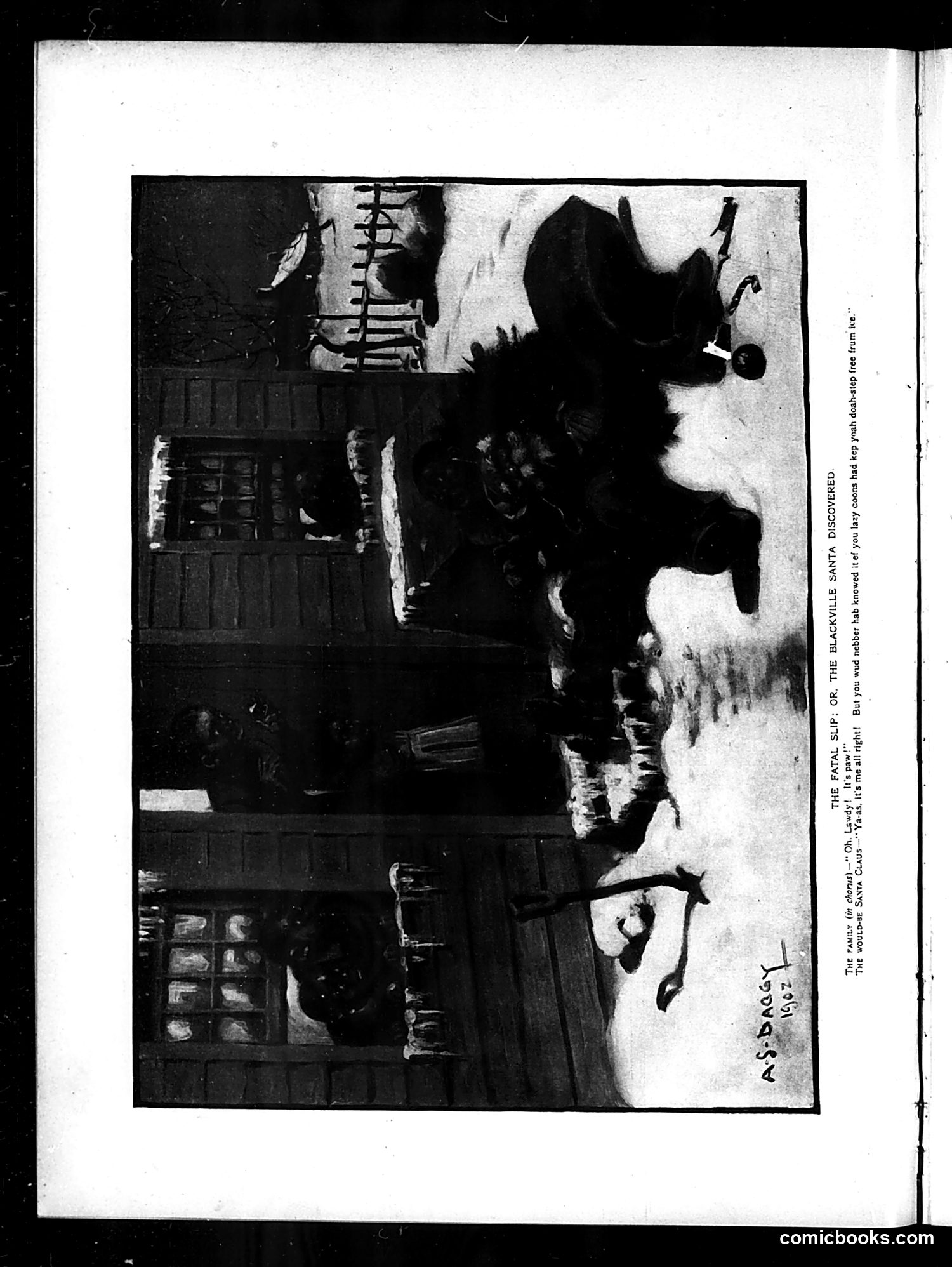
I cannot reliably read the OCR text provided, as it appears corrupted or illegible. The image itself, rotated 90 degrees, shows what appears to be a dramatic black and white scene with figures and architectural elements (a building with doors/windows, a ladder). However, without clear caption text or readable OCR data, I cannot confidently identify the specific figures, political references, or satirical point being made. To properly explain this Judge magazine page to a modern reader, I would need: - Legible text identifying the cartoon's title or subject - Readable captions or dialogue - The publication date I recommend checking the original source for clearer image quality or accompanying metadata.
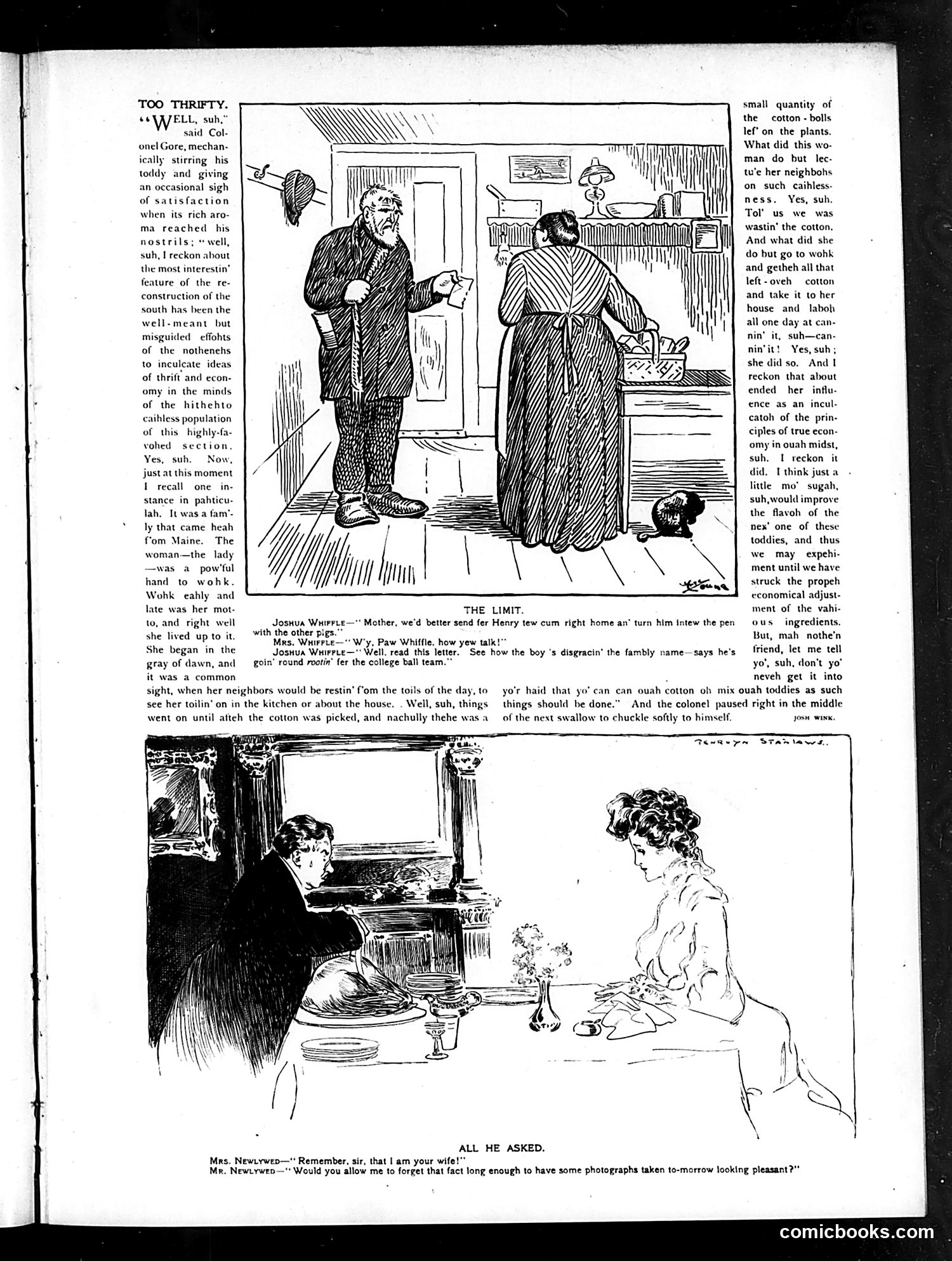
**"Too Thrifty"** (top cartoon): Colonel Gore, a Southern gentleman, tells of a Maine woman who visited from the North. When she observed cotton waste on local plantations, she lectured neighbors about thrift—then spent a day canning leftover cotton bolts. The colonel concludes this "Yankee" lesson in economy backfired so thoroughly it ended her moral influence. The satire mocks Northern presumption about Southern inefficiency while also poking fun at misguided do-gooderism and the absurdity of canning cotton. **"The Limit"** (middle): Joshua Whiffles receives a letter reporting his son is "disgracin' the family name" by rooting for the college ball team rather than studying. The satire questions parental priorities—treating athletic enthusiasm as shameful when it's harmless youthful behavior. **"All He Asked"** (bottom): A husband asks his wife to pose pleasantly for photographs, she protests that she's his wife (implying he should accept her as-is), and he simply wants her to look happy for the camera. Light domestic humor about marriage and photography vanity.
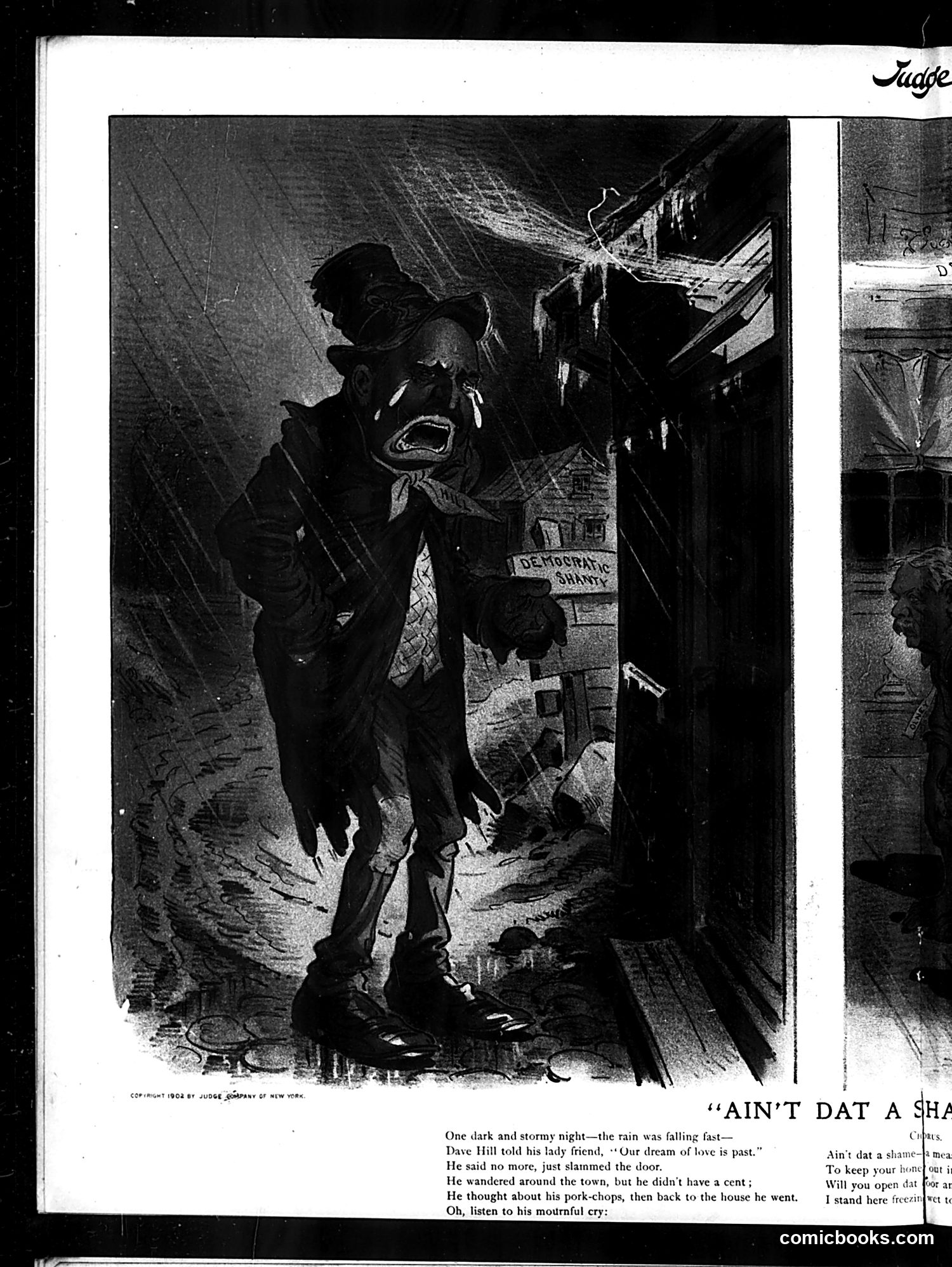
This appears to be a **satirical narrative comic** from Judge magazine, not a political cartoon. It depicts a domestic drama featuring a character named Dave Hill who quarrels with his "lady friend" over a failed romance, storms out penniless into the rain, then returns to the house—apparently drawn back by thoughts of pork chops. The humor relies on **class-based and ethnic caricature**: the exaggerated facial features and dialect ("Ain't dat a shame") employ racist caricaturing common in early 20th-century American humor magazines. The joke's premise—a poor man's romantic pretensions undercut by his hunger for cheap food—plays on stereotypes about working-class or immigrant characters prioritizing basic sustenance over dignity or love. The satire targets romantic ideals versus material survival, though filtered through the dehumanizing visual and verbal conventions of its era.
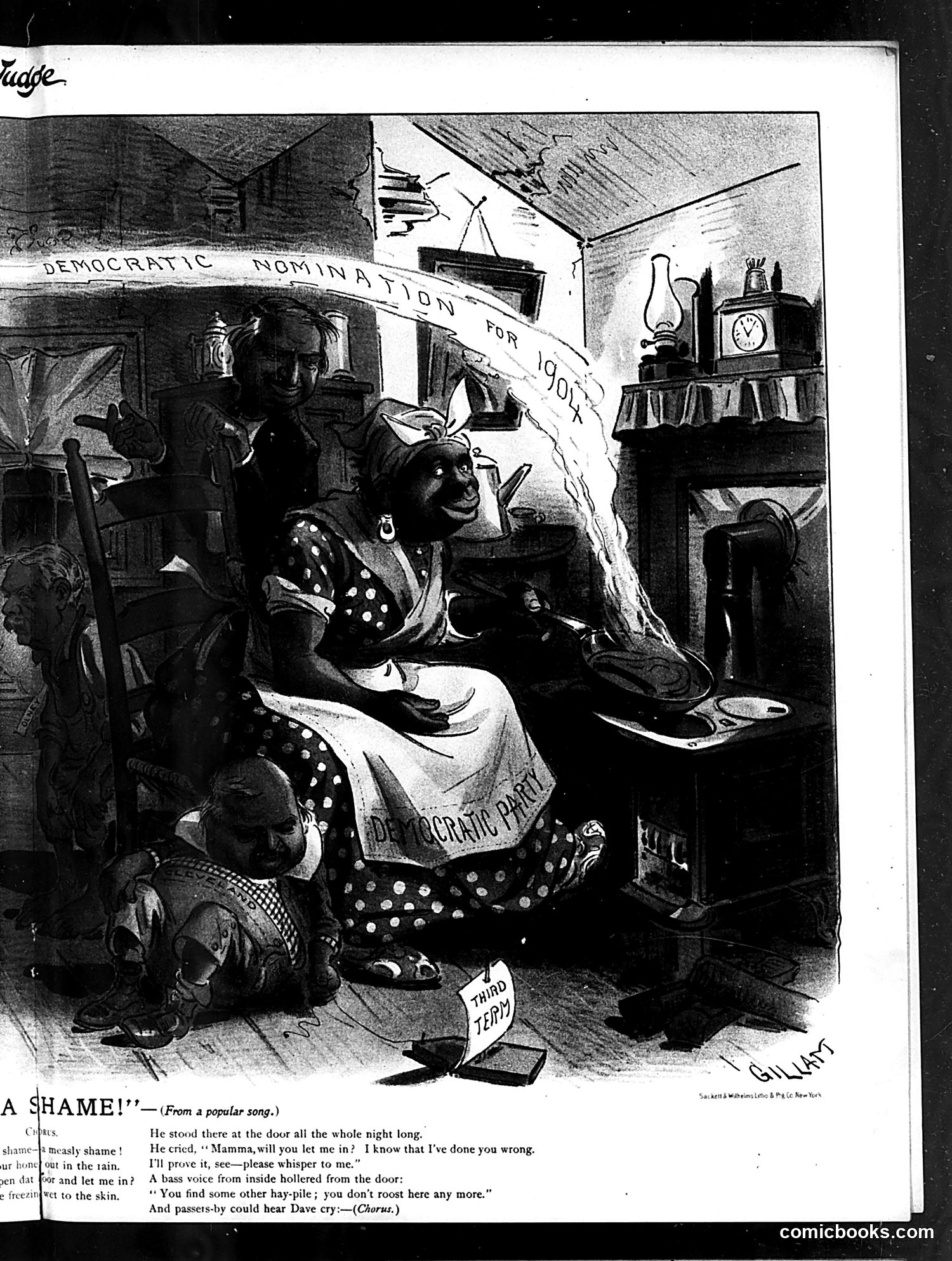
This Judge cartoon satirizes the 1901 Democratic National Convention through an anthropomorphic animal allegory. A donkey (the Democratic Party symbol) sits inside a home while another donkey stands outside in the rain, pleading for readmission. The interior donkey represents the party establishment, while the exterior figure likely represents a faction or candidate shut out from nomination proceedings. The banner reading "DEMOCRATIC NOMINATION FOR 1901" confirms the political context. The cartoon mocks Democratic Party division and exclusion tactics—suggesting the party is rejecting its own members or factions. The accompanying song lyrics emphasize the shame of this internal discord, with the rejected figure crying outside while the party establishment refuses entry. The satire criticizes Democratic infighting and suggests hypocrisy: the party mascot literally rejecting another donkey highlights internal fracturing and loss of unity heading into the election cycle.
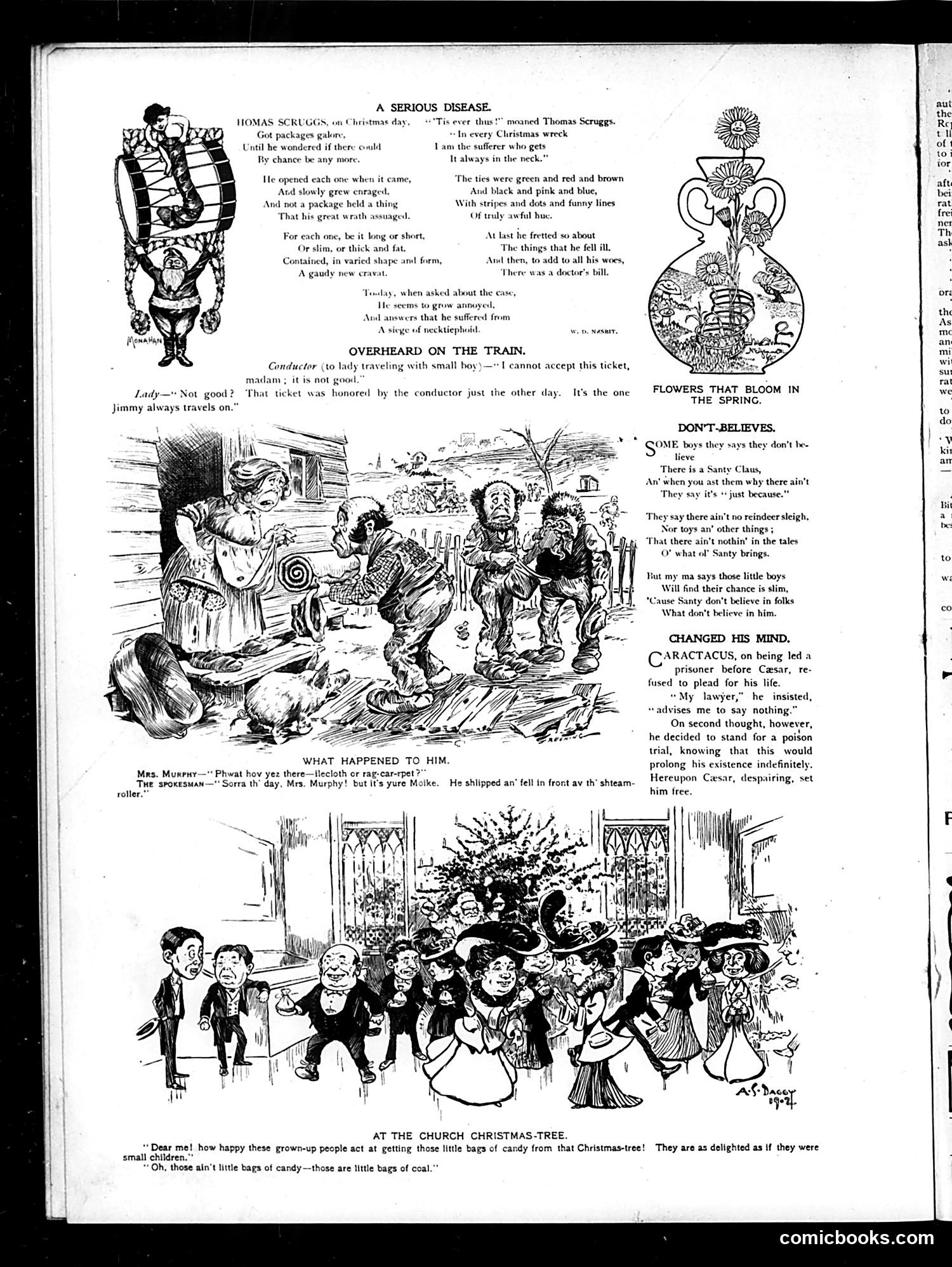
This page contains several humorous sketches satirizing holiday excess and human nature: **"A Serious Disease"** mocks overwrought gift-giving, depicting Thomas Scruggs receiving so many ugly neckties that he contracts "necktiephoid"—a fictional disease from tacky presents. The satire targets the commercialized Christmas tradition of obligatory, thoughtless gift-giving. **"Overheard on the Train"** jokes about a woman using an expired ticket her son previously traveled on, highlighting either dishonesty or obliviousness. **"What Happened to Him"** contains an ethnic-stereotype joke about an Irish worker (references to "Moike," "av th' shteam-roller") in an accident. **"At the Church Christmas-Tree"** sarcastically compares candy bags to bags of coal—suggesting grown-ups receiving cheap, worthless items, perhaps mocking charitable distribution or economic disparity during the holidays. **"Don't Believes"** presents children skeptical of Santa Claus, with moralizing that belief has consequences. The page overall satirizes holiday hypocrisy, commercialism, and social pretense among American middle and upper classes.
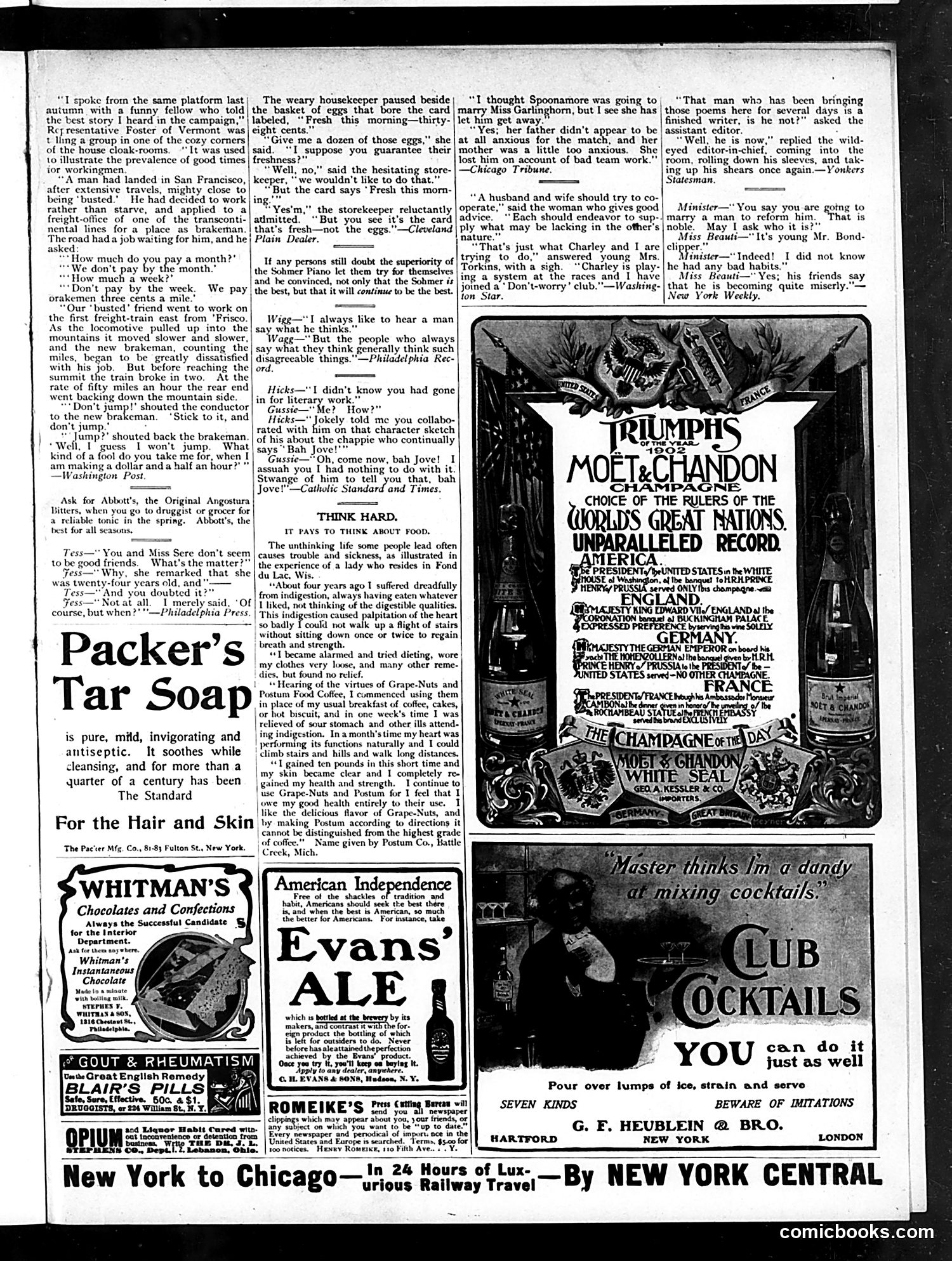
This page is primarily **advertising with scattered humorous anecdotes**—typical of Judge's format. ## Main Content: The humor pieces are brief, unconnected jokes: 1. **The "Brakeman" story**: A newly hired railroad worker earning three cents per mile refuses to jump from a runaway train, declaring "I am making a dollar and a half an hour!" The joke mocks the era's economic desperation—a man values dangerous work so highly he won't abandon a crashing train. 2. **Minor jokes** about women's ages, literary pretension, and spousal bickering—standard period humor targeting domestic life and marital discord. ## Advertising: The page features product ads (Packer's Tar Soap, Whitman's Chocolates, Evans' Ale, remedies) and a prominent **Moet & Chandon champagne advertisement** emphasizing America's dominance in "worlds greatest nations." ## Historical Context: This reflects early 1900s American values: economic anxiety, rigid gender roles, and nationalist pride. The brakeman story particularly captures working-class precarity—men grateful for dangerous, low-wage labor.
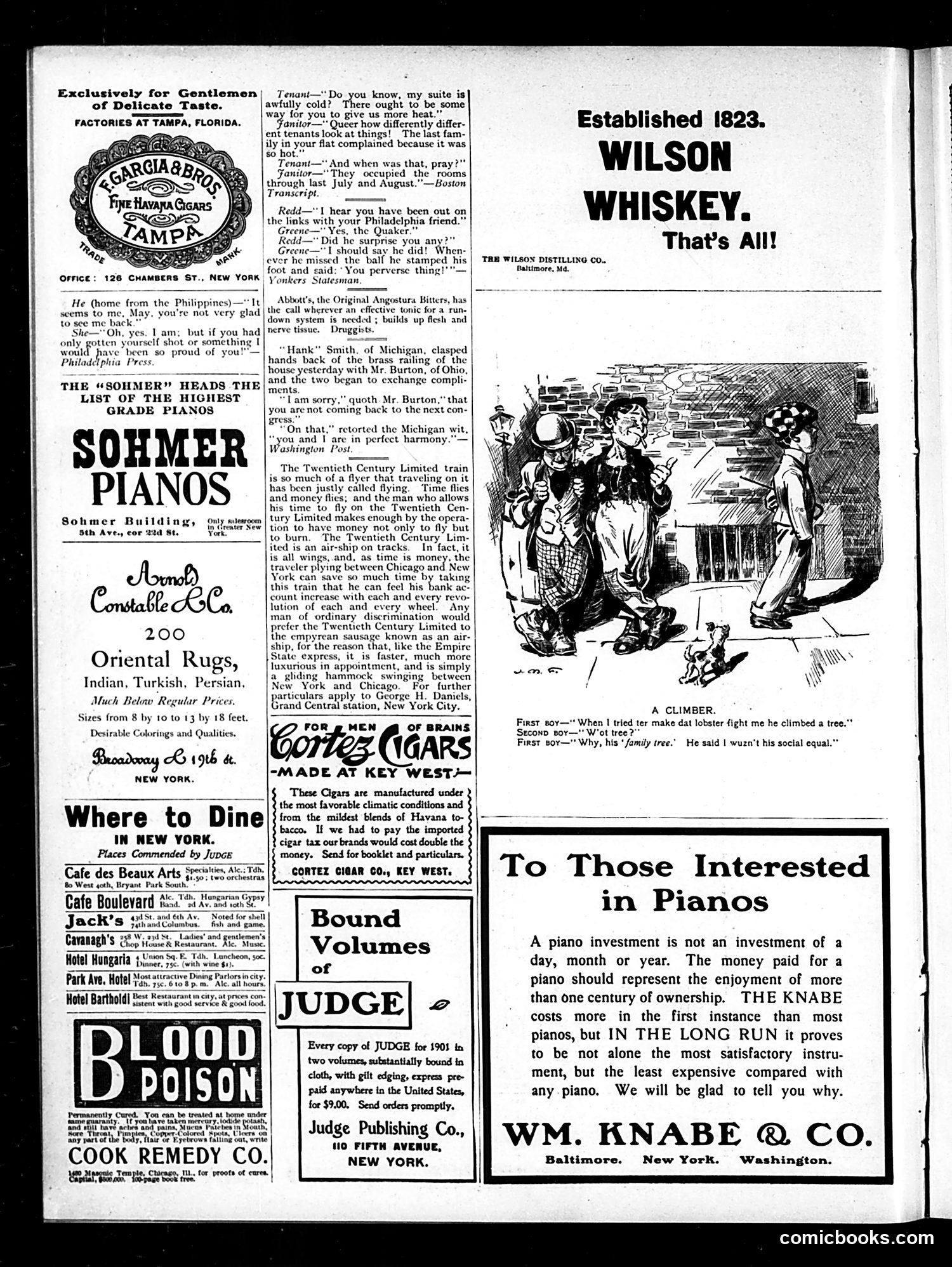
This page from Judge magazine (circa 1901-1906, based on advertisements) contains several short humorous dialogues rather than political cartoons. The jokes satirize everyday American life: **"A Climber"** depicts class anxiety: a working-class boy attempts to impress a girl by claiming to have climbed a tree, but she dismisses him as her "social equal"—mocking both working-class pretensions and upper-class snobbery. Other dialogues joke about mundane domestic situations: a wife coldly greeting her soldier husband home from the Philippines, a quarrelsome couple disagreeing about apartment temperature, and men exchanging hollow political pleasantries. The cartoons are primarily **social satire** targeting middle-class anxieties about status, marriage, and modernity—typical Judge fare. The page is dominated by **advertisements** (pianos, cigars, restaurants, rugs, whiskey), reflecting the magazine's revenue model. There are no identifiable political figures or references to specific events.
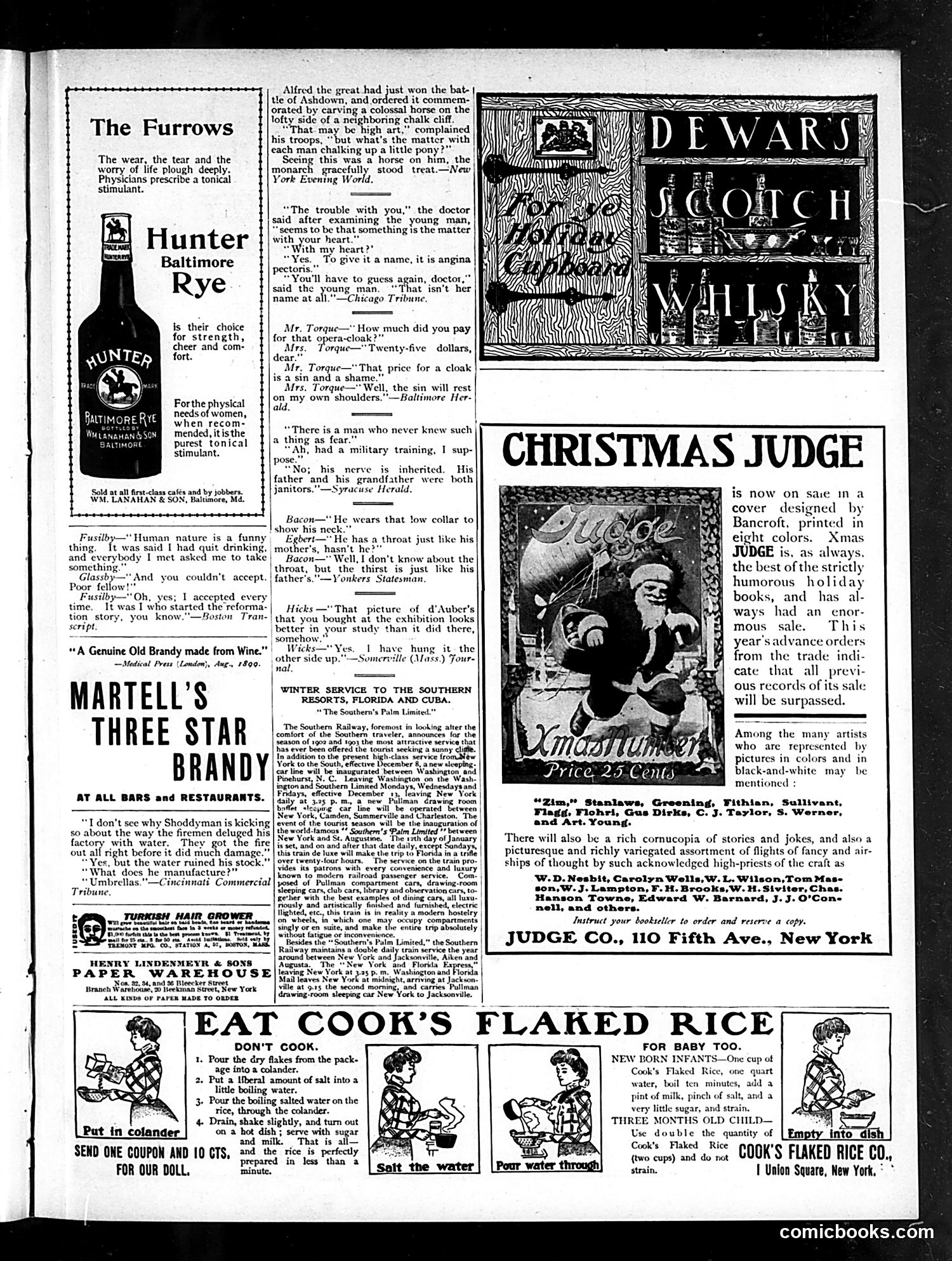
This page is primarily **advertising and humor columns** rather than political cartoons. The main content includes: **Advertisements:** The page heavily features alcohol ads (Hunter Rye, Martell's Brandy) and food products (Cook's Flaked Rice), with claims about health benefits—typical of early 20th-century marketing that made unsubstantiated medical promises. **"Christmas Judge" Promotion:** A small announcement for the magazine's holiday issue, featuring Santa Claus imagery and noting it will showcase humorous holiday-themed illustrations. **Humor Columns:** Brief anecdotes about everyday life—misunderstandings about heart conditions, fashion mishaps, and social embarrassments. These are gentle, domestic jokes with no political content, reflecting the magazine's satirical but relatively lighthearted approach to social behavior and relationships. **"The Furrows" Section:** An opening editorial-style piece discussing life's hardships, using alcohol as a "tonical stimulant." The page reflects early-1900s advertising culture and middle-class humor rather than serious political satire.
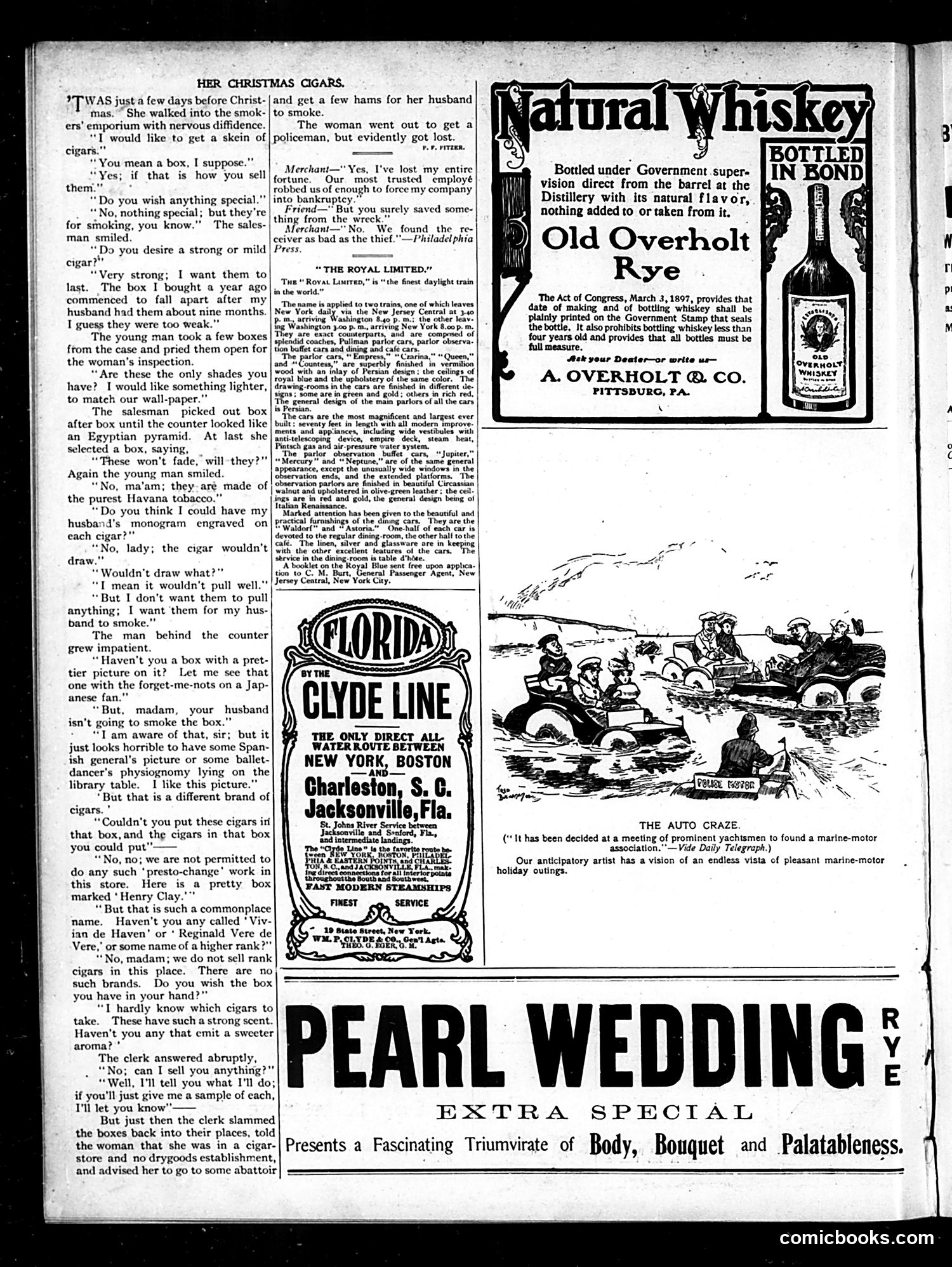
This story-cartoon satirizes early 20th-century gender roles and consumer confusion. A woman enters a cigar shop to buy cigars for her husband—a comedic premise itself, as women didn't typically smoke. Her questions reveal her complete ignorance: she worries cigars will fade, wants her husband's monogram engraved (the clerk explains "the cigar wouldn't draw"), and most absurdly, selects boxes based on decorative appeal for her library table rather than the cigars' quality. The salesman's mounting impatience culminates in him telling her to go buy hams instead—suggesting women belong in food shopping, not tobacco commerce. The final line (she leaves to find a policeman "but evidently got lost") implies female incompetence at independent tasks. The joke mocks both women's supposed unfitness for commerce and their consumer frivolousness, while also satirizing the salesman's exasperation with an unreasonable customer.
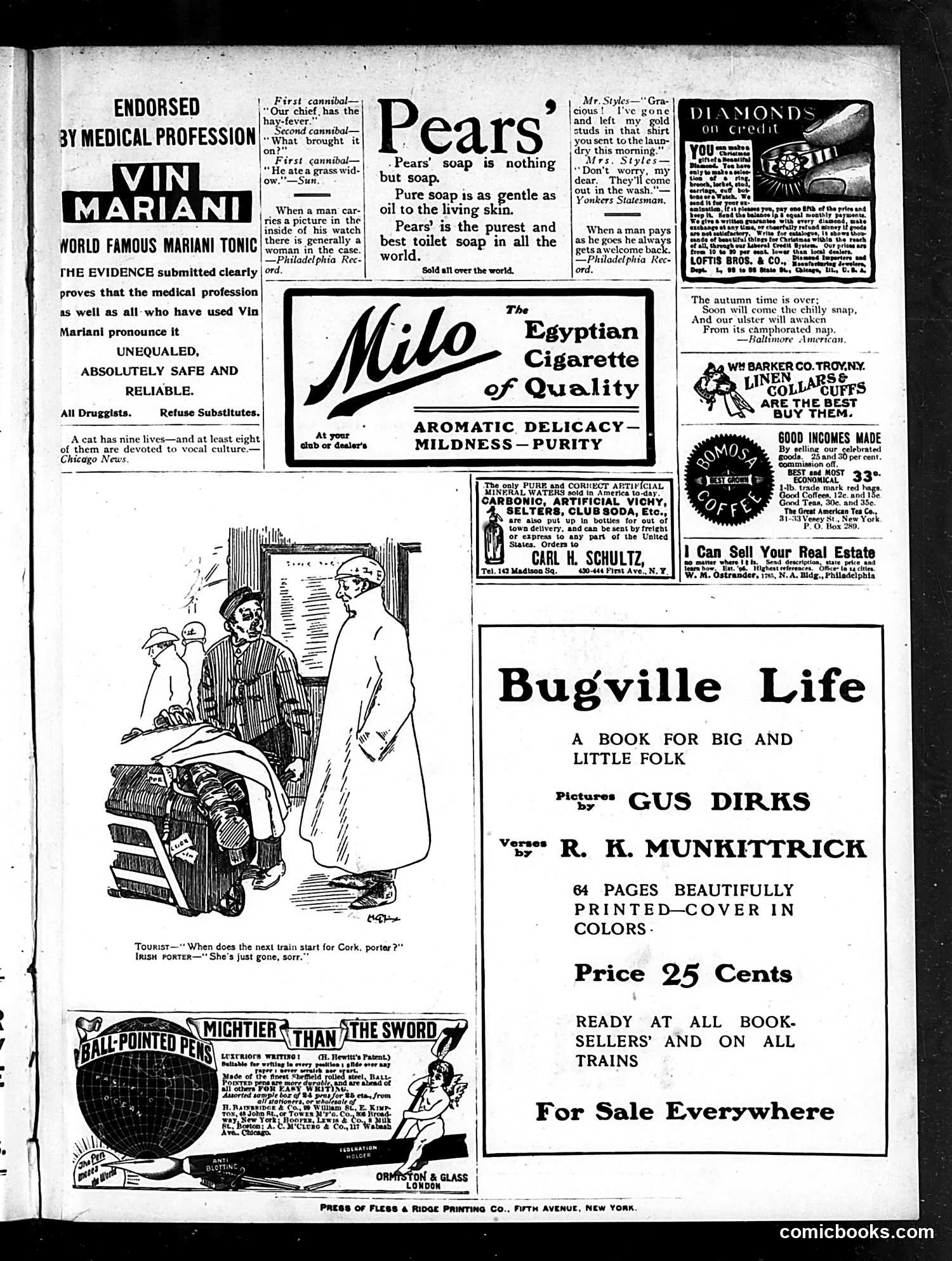
This page is primarily **advertising** rather than editorial content, typical of Judge's revenue model. Key elements: **The Main Cartoon:** The Irish porter joke at bottom-left depicts a stereotypical Irish character in period dress. The humor relies on Irish dialect ("She's just gone, sorr") and plays on ethnic stereotypes common in early 20th-century American humor—portraying Irish immigrants as comically simple or linguistically distinctive. **Patent Medicine Advertisements:** The Vin Mariani tonic claims medical endorsement, reflecting the era before FDA regulation when dubious tonics were widely advertised with unsubstantiated health claims. **Period Humor:** Several short jokes use common tropes: "grass widow" (a woman separated from her husband), a man keeping a lover's picture hidden, and marital jest about laundry mishaps. **Product Ads:** Egyptian cigarettes, Pears' soap, and other consumer goods represent typical Judge advertising supporting the magazine's operation. The page captures early 1900s advertising practices and ethnic humor standards that would be considered offensive today.
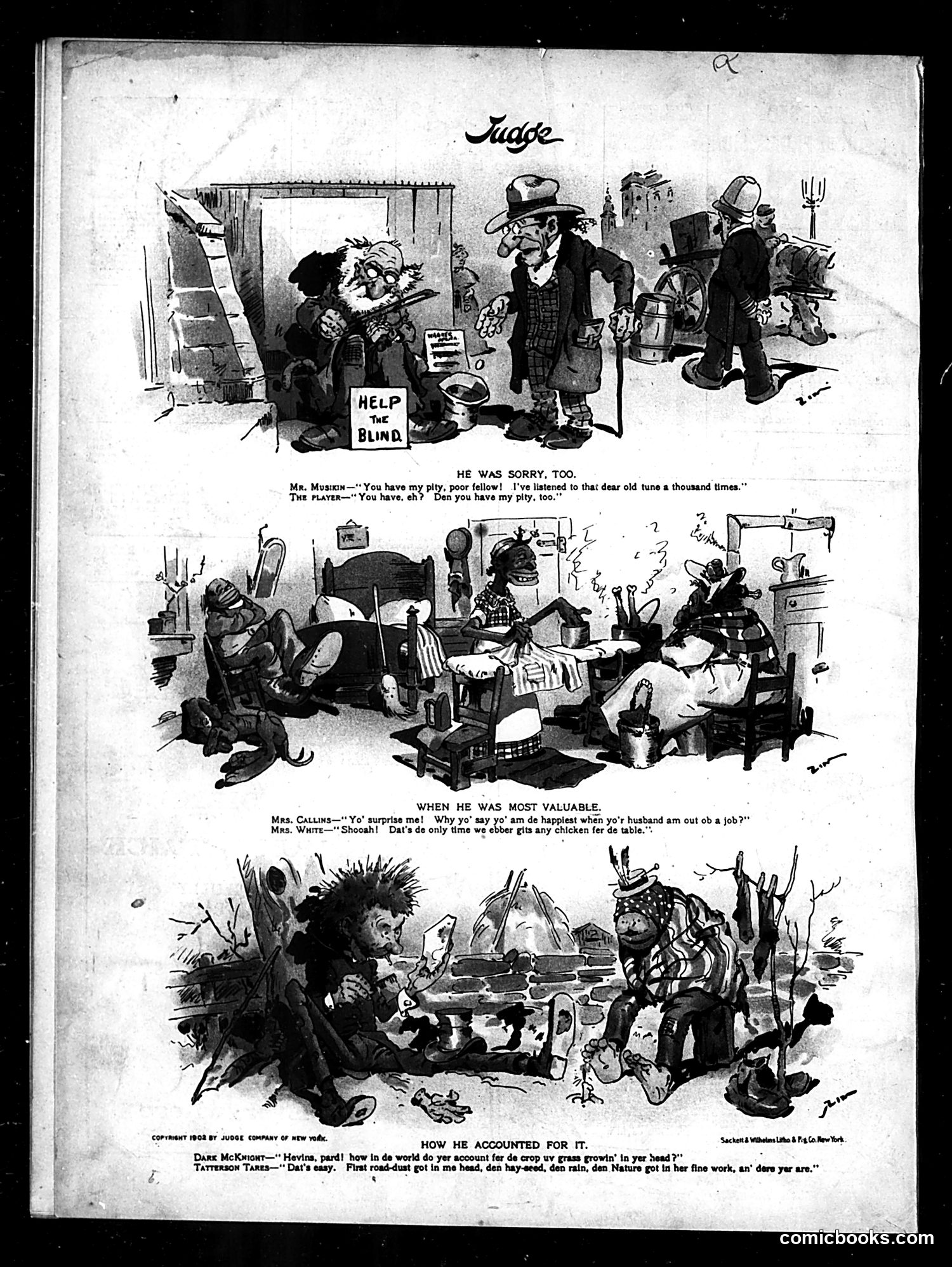
This page contains three separate comic vignettes satirizing working-class and rural life: **Top panel ("He Was Sorry, Too")**: A street musician with a blind beggar. The musician claims sympathy for hearing the same old tune repeatedly; the beggar replies he deserves pity for *having to listen* to the musician play it. **Middle panel ("When He Was Most Valuable")**: Uses dialect humor (characteristic of early 1900s satire) to mock poverty. Mrs. Watts says she's happiest when her husband is jobless because only then can they afford to buy chicken for dinner—suggesting unemployment benefits or charity provide more reliable income than his wages. **Bottom panel ("How He Accounted for It")**: Rural characters in dialect debate why one has grass growing on his head. The explanation involves negligence and nature taking its course—a joke about poor hygiene or laziness. The cartoons target working-poor and rural populations through exaggerated dialect and scenarios depicting economic hardship, using humor that modern readers would recognize as containing racial and class stereotypes typical of the era.

I can see this is a page from Judge magazine, as indicated by the watermark "comicbooks.com" at the bottom. However, the image is almost entirely black with very minimal visible content - I can barely make out some faint decorative elements on the left and right margins that might be ornamental borders or text. The OCR text provided only contains "comicbooks.com," which appears to be a website reference rather than actual magazine content. Without legible text or discernible cartoon illustrations, I cannot reliably identify the figures, political references, or satirical intent of this page. The image quality or scanning may have rendered the content illegible. To properly analyze this Judge magazine page, a clearer image would be needed.