
A complete issue · 20 pages · 1902
Judge — November 29, 1902
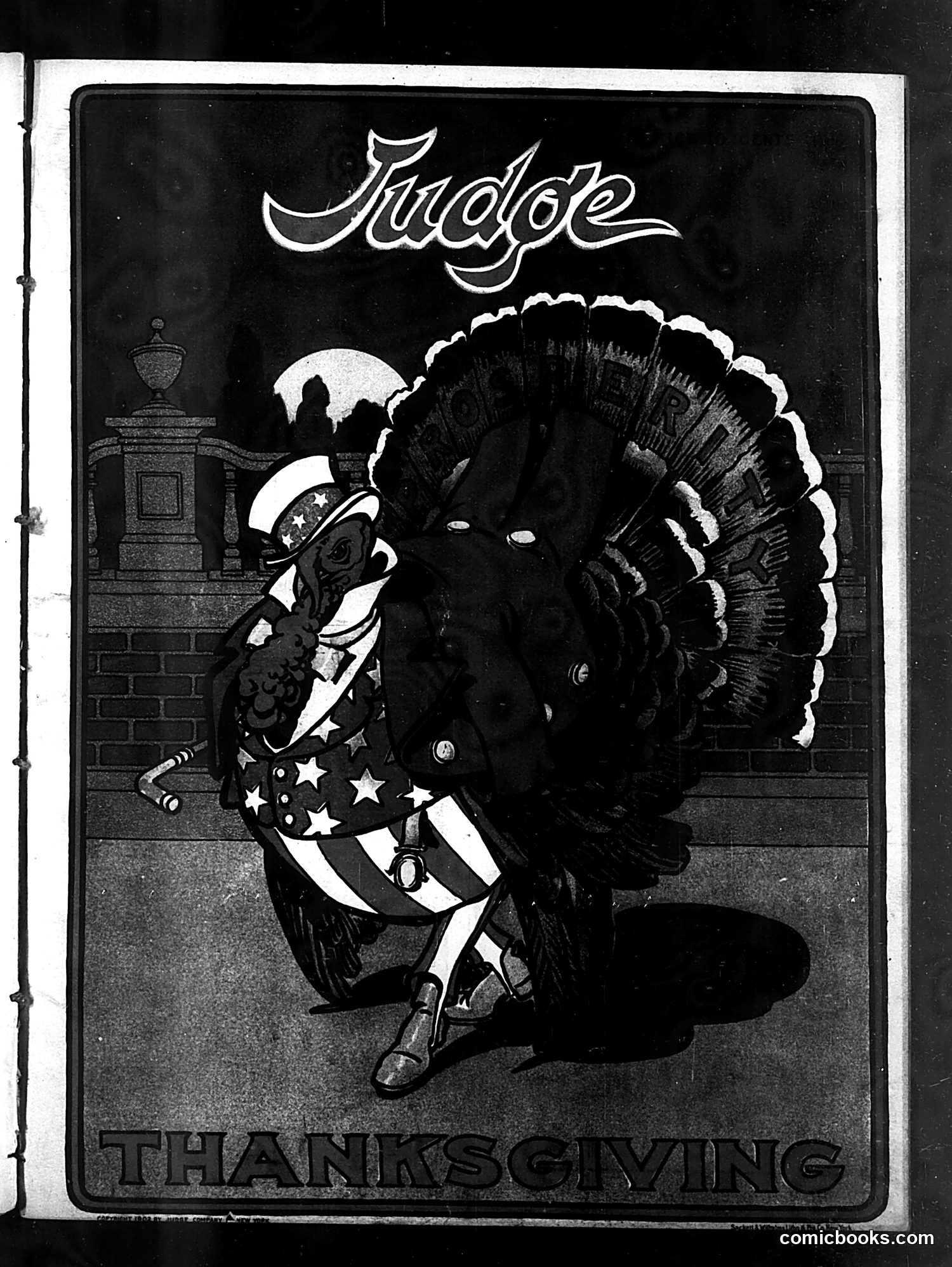
This Thanksgiving-themed cover from *Judge* magazine depicts **Uncle Sam** (identifiable by his star-spangled outfit and patriotic attire) presenting a large turkey. The cartoon's title "Judge" appears at top, with "Thanksgiving" at bottom. The satire appears to celebrate American abundance and national prosperity during the Thanksgiving holiday. Uncle Sam's proud presentation of the turkey—a traditional symbol of American Thanksgiving—suggests national pride in America's bounty or resources. The architectural background (possibly government buildings) reinforces the patriotic theme. Without specific dates or additional context, this appears to be straightforward patriotic satire using Thanksgiving imagery, likely referencing American prosperity or national achievement during whatever era this was published.
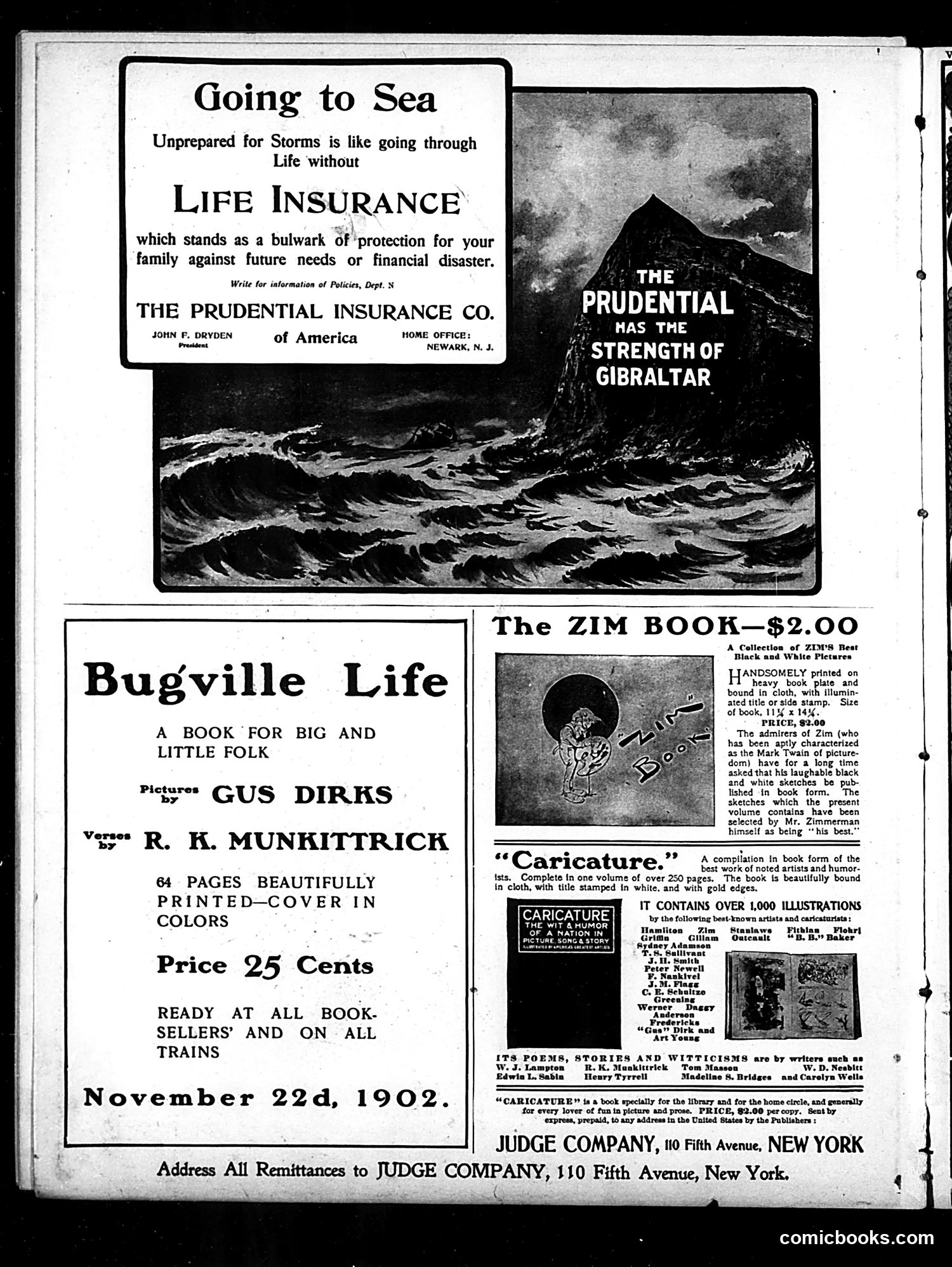
This page is primarily **advertising**, not political satire. The top half features a Prudential Insurance advertisement using maritime imagery—stormy seas and Gibraltar—to sell life insurance as "protection" against financial disaster. The metaphor equates unprepared life (going to sea unprotected) with lacking insurance. The bottom half advertises two unrelated products: "Bugville Life," a children's picture book by Gus Dirks with verses by R.K. Munkittrick (25 cents), and "The Zim Book" ($2.00), a collection of caricatures and humorous sketches containing over 1,000 illustrations. No clear political satire appears on this page. It represents typical early-1900s Judge content: commercial advertisements mixed with promotional material for contemporary publications.
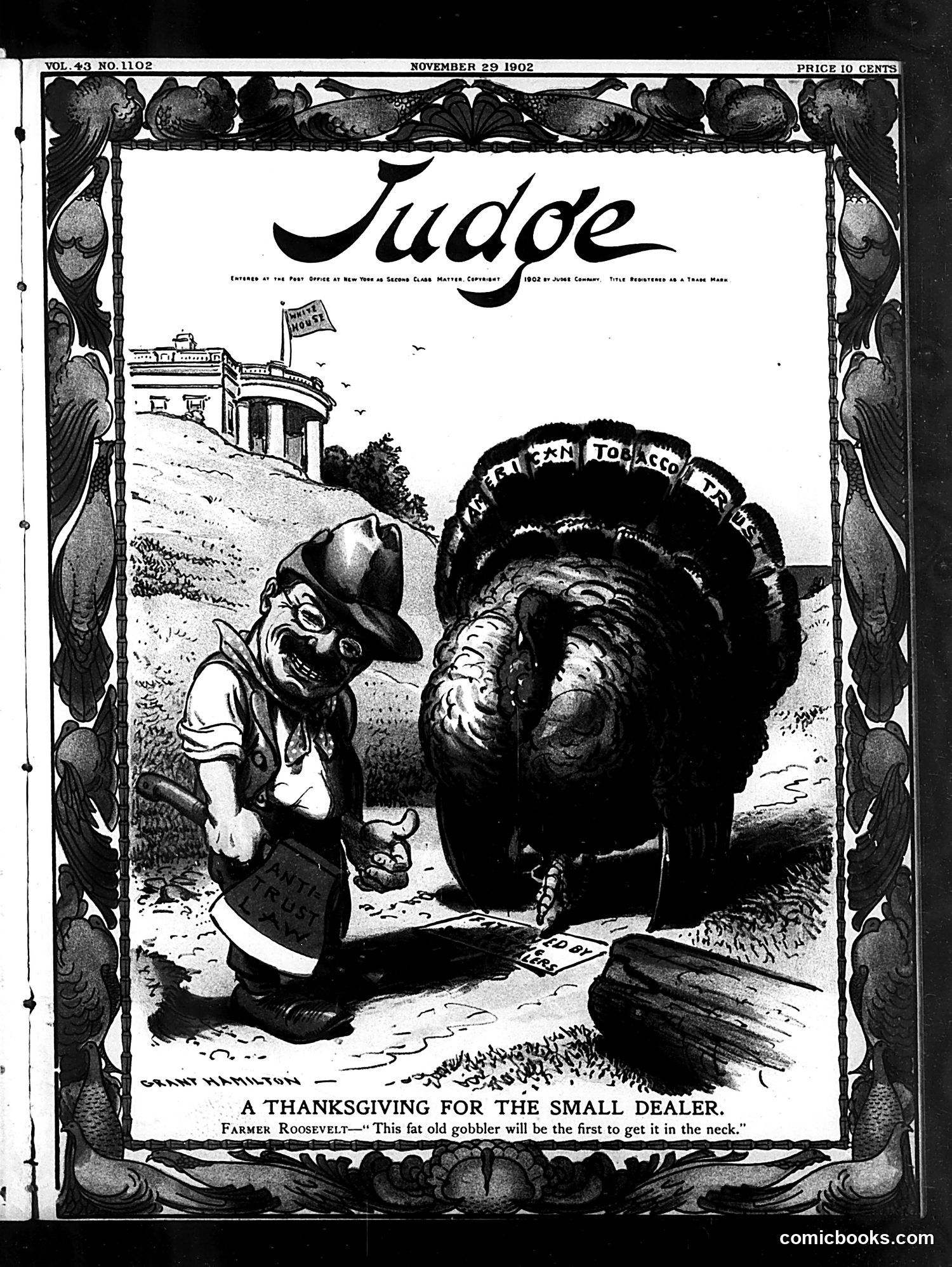
This political cartoon by Grant Hamilton depicts a Thanksgiving scene satirizing President Theodore Roosevelt's trust-busting policies. The large turkey represents monopolistic corporations or "fat old gobbler[s]" that Roosevelt targeted. The small figure on the left, labeled "Farmer Roosevelt," wields an axe menacingly toward the bird. The caption quotes Roosevelt: "This fat old gobbler will be the first to get it in the neck," referencing his aggressive prosecution of large trusts and monopolies—a central policy of his presidency. The cartoon celebrates this anti-monopoly stance as a Thanksgiving blessing for "the small dealer" (farmers and small businesses), presenting Roosevelt's trust-busting as protecting ordinary Americans from corporate exploitation.
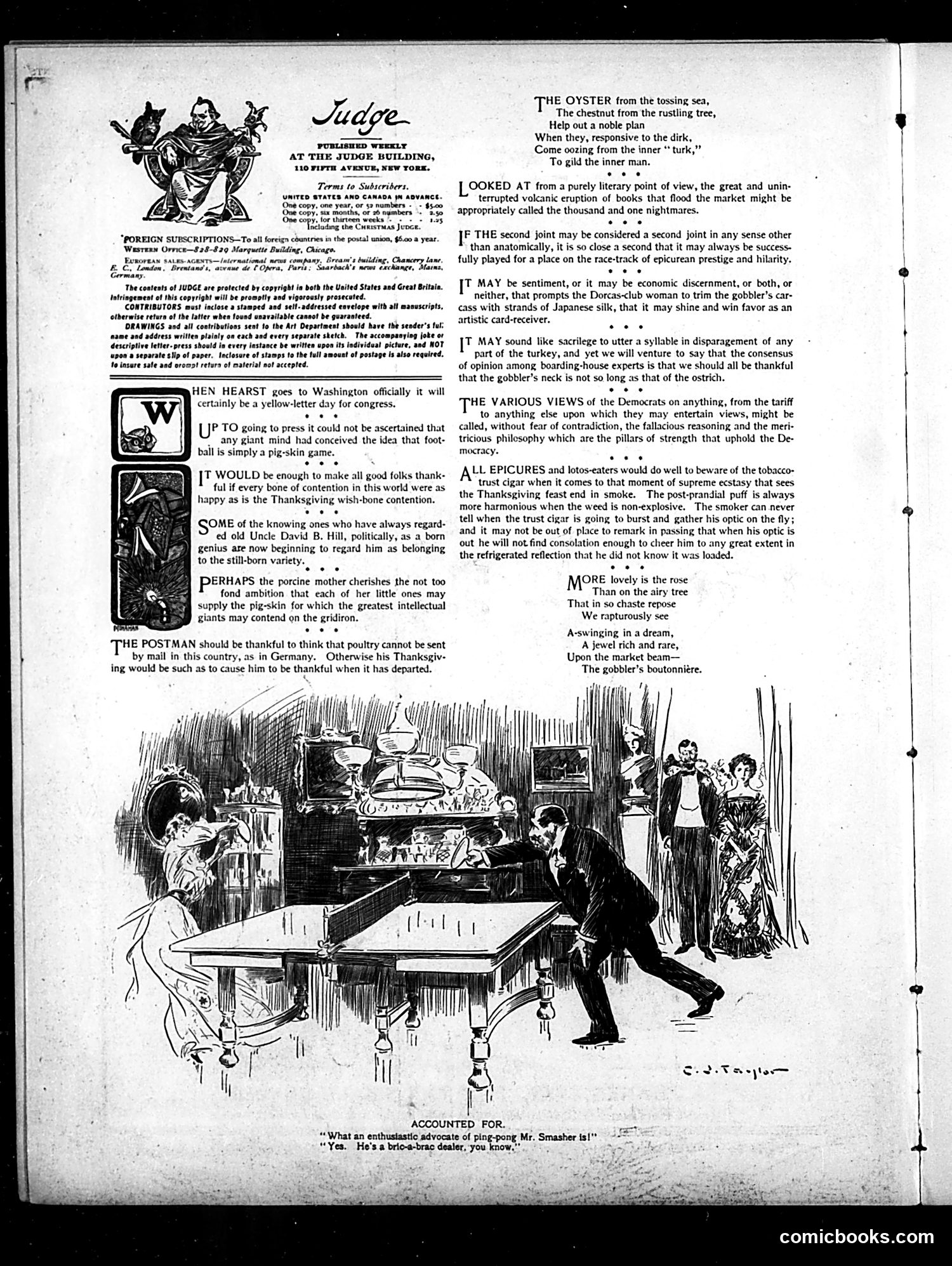
This page contains several brief satirical observations rather than a single unified cartoon. The main illustration depicts a ping-pong game, captioned "Accounted For" with dialogue about "an enthusiastic advocate of ping-pong Mr. Smasher." The text snippets offer social commentary on contemporary topics: volcanic eruptions of published books flooding the market; debate among Democrats on various issues (tariffs, philosophy); cigar smokers' anxieties about explosive cigars at Thanksgiving; and poultry delivery challenges in Germany versus America. The page's humor relies on topical references unclear without historical context—likely addressing early 1900s political debates, publishing trends, and domestic inconveniences. The ping-pong illustration appears a lighthearted visual joke about an unnamed "enthusiast," possibly mocking a contemporary figure or general social fad.
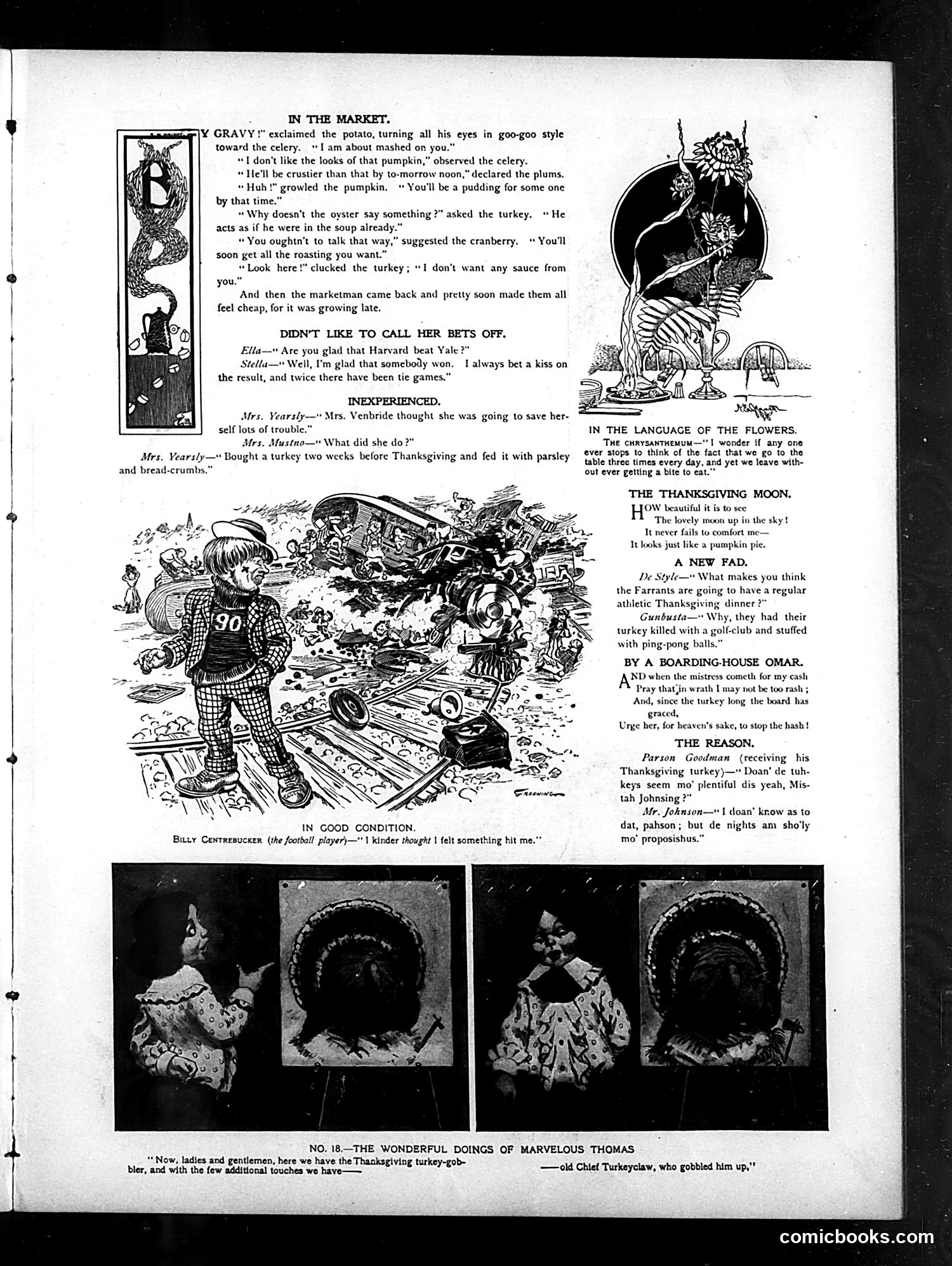
This is a Thanksgiving-themed satirical page from *Judge* magazine featuring multiple short jokes and cartoons about holiday preparations. The main content includes anthropomorphic vegetables arguing in a market ("Gravy! I am about mashed on you"), a woman who bets kisses on Harvard-Yale games, and jokes about inexperienced cooking. The central illustration shows a boy discovering a turkey in a market amid produce. Notable pieces include "In the Language of the Flowers" (musing on chrysanthemums), "The Thanksgiving Moon" (a pumpkin pie pun), and "A New Fad" (the Farrants serving a turkey killed with a golf club, stuffed with ping-pong balls—mocking wealthy people's athletic obsessions). The final dialogue between "Parson Goodman" and "Mr. Johnson" uses dialect humor (common but now offensive racial caricature) about turkey abundance. The page is primarily light humor exploiting holiday themes, puns, and period social commentary rather than serious political satire.
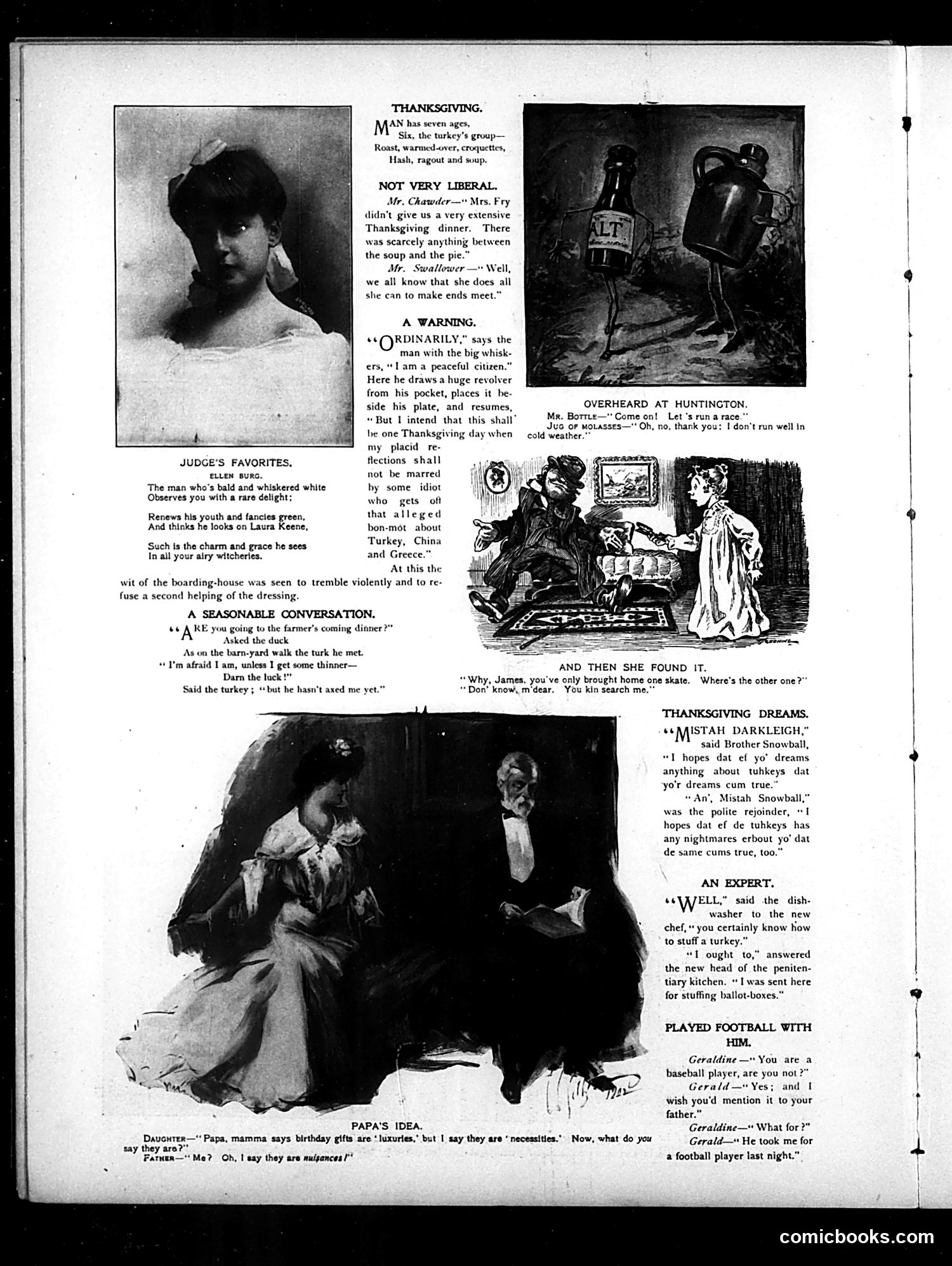
This satirical page from *Judge* magazine uses humor to comment on American social customs and class distinctions around Thanksgiving. The central joke explores Thanksgiving's repetitive nature: a man notes that turkey appears in seven forms (roast, warmed-over, croquettes, hash, ragout, soup)—mocking how working-class families stretched one bird across multiple meals from necessity. Several sketches mock middle-class frugality: Mrs. Fry serves a meager dinner; a man threatens violence if his Thanksgiving mood is disrupted; a duck and turkey nervously discuss their fate. Other jokes target political corruption: a prison kitchen chef jokes about "stuffing ballot-boxes," referencing election fraud. A comic dialogue between "Geraldine" and "Gerald" plays on class pretension. The overall tone reflects *Judge*'s typical satire targeting both working-poor struggles and wealthy affectation, using Thanksgiving—then America's most universal holiday—as a lens for examining social hypocrisy and economic anxiety.
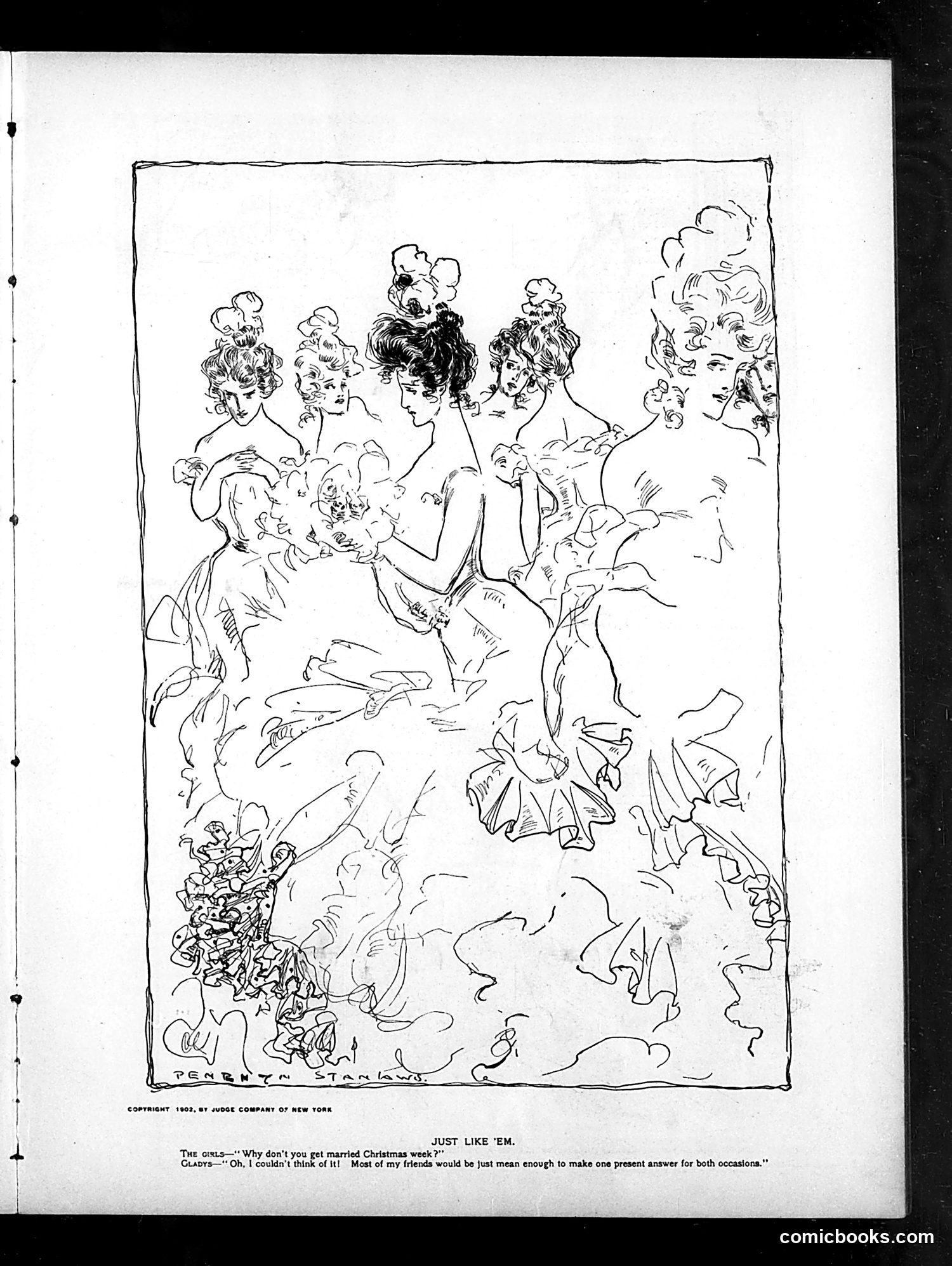
This is a single-panel cartoon satirizing women's materialism and gift-giving expectations around Christmas weddings. Two women discuss why one won't marry during Christmas week. The joke hinges on the complaint that friends would deliberately give one combined gift covering both the wedding and holiday rather than separate presents—exploiting the occasion overlap to economize. The cartoon mocks women as primarily motivated by accumulating gifts, suggesting they're calculating enough to avoid situations reducing their haul. The crowd of elaborately-dressed, coiffed women depicted reinforces period stereotypes about frivolous femininity and social competition. The title "Just Like 'Em" implies this behavior is typical of women generally. This reflects early-20th-century Judge magazine's frequently misogynistic humor targeting women's perceived materialism and superficiality.
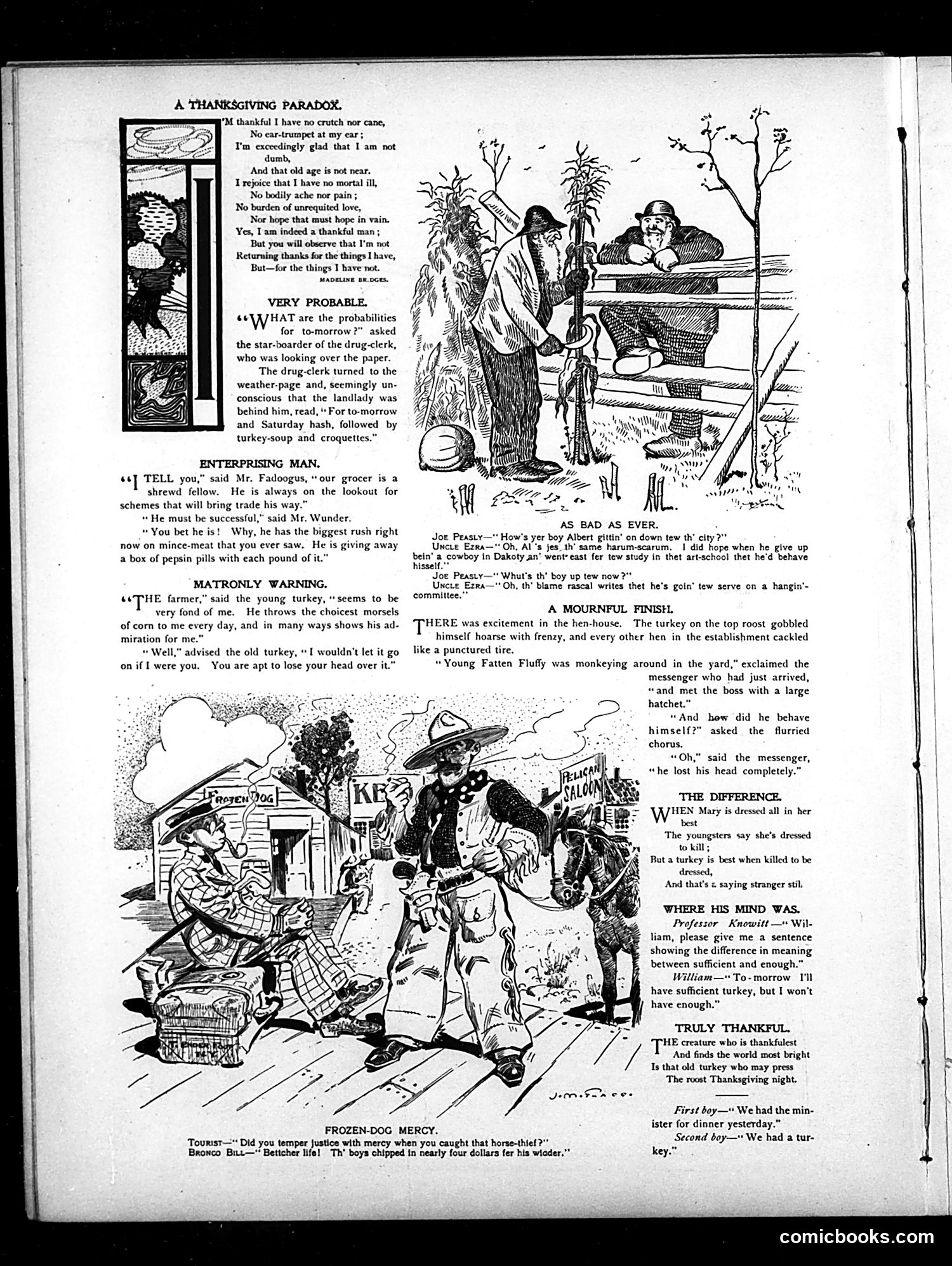
This page collects short humorous pieces centered on Thanksgiving themes, primarily featuring turkeys as comedic subjects. **Main Satire:** The recurring joke is dark irony about turkeys' fate. "A Mournful Finish" depicts a turkey losing its head (literally) to a hatchet—a pun on the expression. "Truly Thankful" morbidly suggests the turkey should be "thankful" it can roost one last night before slaughter. "The Difference" contrasts Mary being "dressed to kill" (fashionably) with turkeys being "killed to be dressed" (for cooking). **Supporting Content:** Shorter jokes mock human foolishness: a grocer giving away pepsin pills with mincemeat (digestive aid for tainted food), a young turkey warned against accepting corn from a farmer (foreshadowing slaughter), and a young man named Albert becoming no better despite leaving cowboy life for art school (now serving on a "hanging committee"). **Context:** This represents typical early-20th-century American humor—darkly cynical about holiday traditions while relying on puns and anthropomorphized animals for comedy.
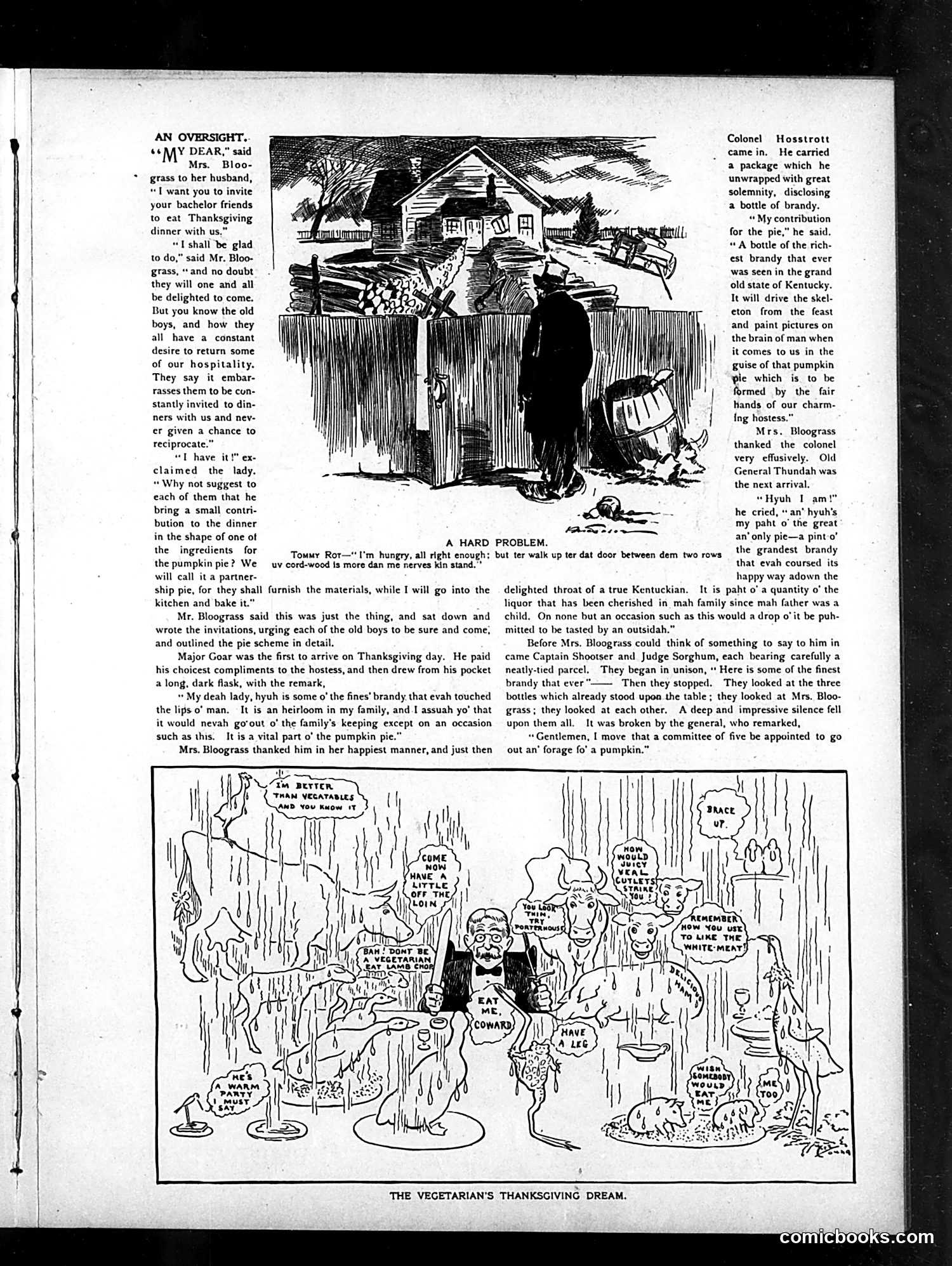
The top story satirizes Southern hospitality conventions. Mrs. Bloograss invites bachelor friends to Thanksgiving dinner, asking each to contribute an ingredient for pumpkin pie—a scheme to let them reciprocate her hospitality. However, Major Goar, Colonel Hosstrott, General Thundah, Captain Shootser, and Judge Sorghum (all rendered with exaggerated Southern dialect and manners) each arrive bearing bottles of expensive Kentucky brandy instead of actual pie ingredients. The joke: these Southern gentlemen interpret "contribution" as liquor, leaving Mrs. Bloograss with five bottles of brandy and no pie. The general's solution—"appoint a committee to forage for a pumpkin"—mocks both Southern formality and the impracticality of the situation. The bottom cartoon, "The Vegetarian's Thanksgiving Dream," appears to depict a vegetarian's surreal nightmare where vegetables and produce are anthropomorphized and threatening, satirizing the vegetarian lifestyle through absurdist humor.
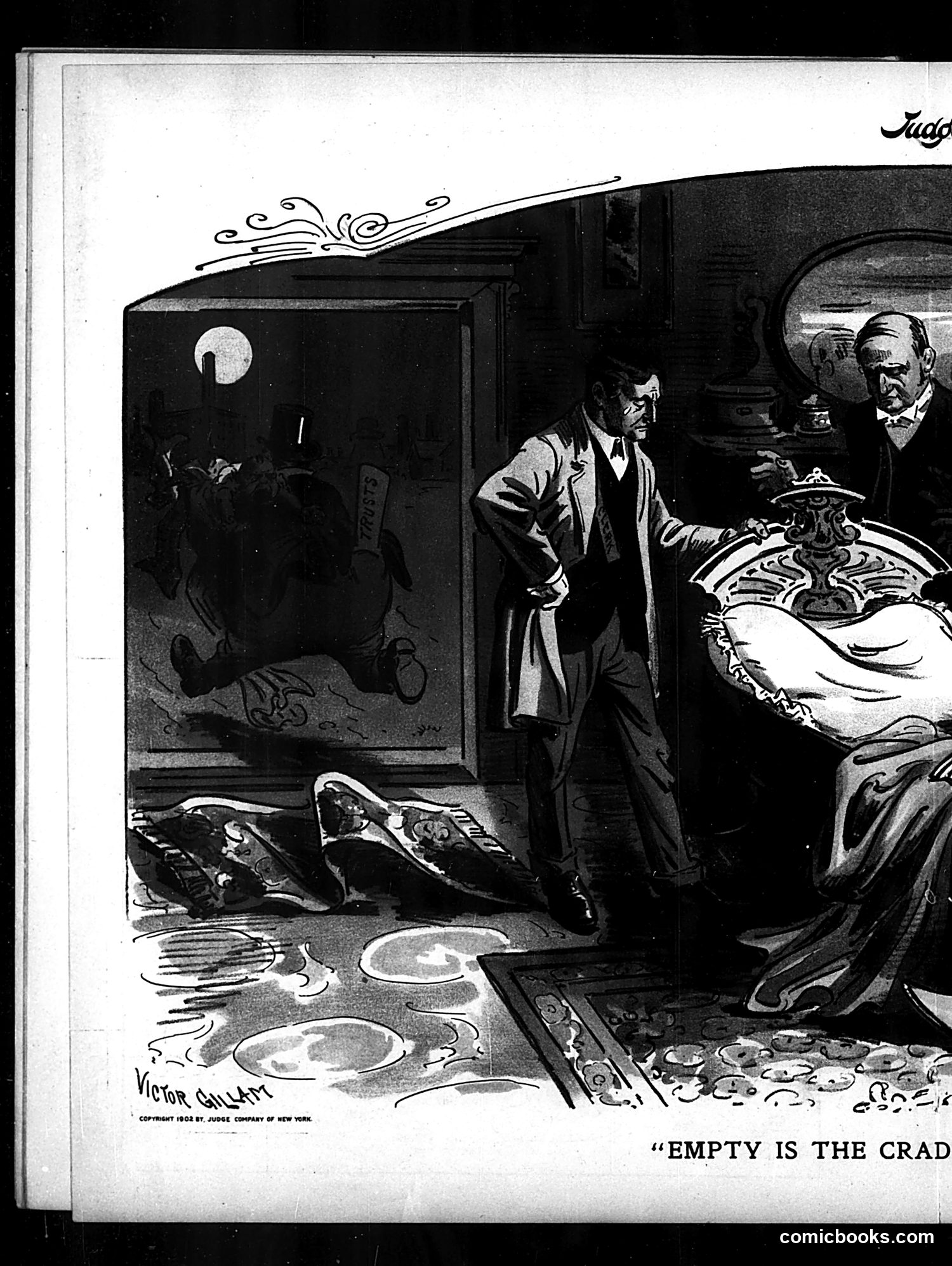
This 1902 Judge cartoon by Victor Gillam appears to satirize wealth inequality and greed. The image shows a wealthy man in bed surrounded by empty plates and dishes, while a working-class man stands in a doorway observing the scene—likely representing the poor or working classes witnessing excess. The title "EMPTY IS THE CRAD[LE]" (cradle, partially cut off) suggests commentary on inherited wealth, empty promises, or the hollowness of material excess. The contrast between the luxurious bedroom scene and the figure at the threshold emphasizes social division during the Gilded Age, a period of extreme wealth concentration in America. The specific political figures or events referenced remain unclear from the visible text alone, though the satire clearly critiques wealthy indulgence amid broader social inequality.
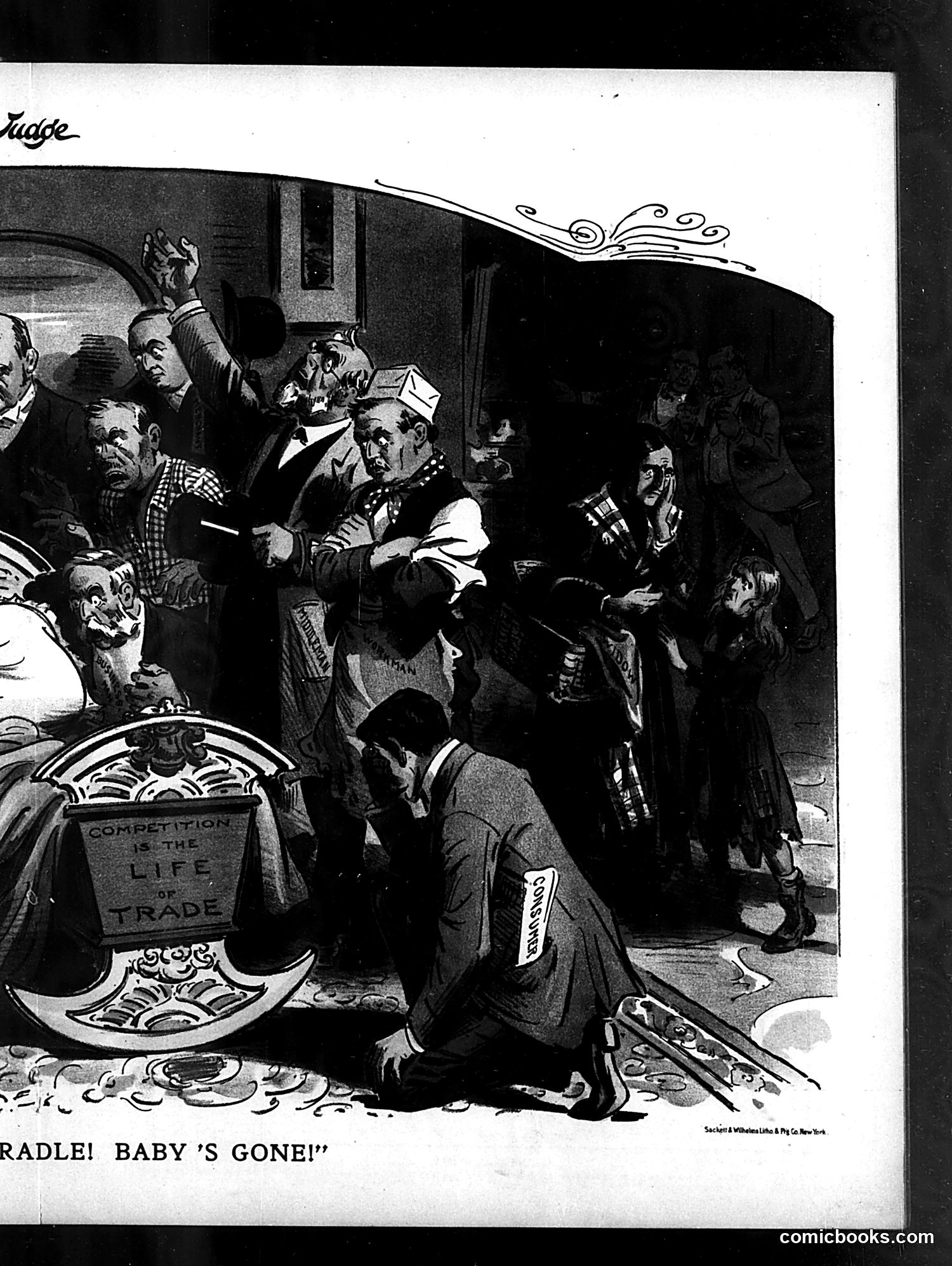
This Judge magazine cartoon titled "Cradle! Baby's Gone!" appears to be a satirical commentary on industrial or trade competition. The central visual metaphor—a cradle labeled "COMPETITION IS THE LIFE OF TRADE"—suggests concerns about business practices or economic upheaval. The crowded scene depicts various figures (appearing to include military or authority figures based on their attire) seemingly disturbed or alarmed by something. The dramatic posturing and the exclamation "Baby's gone!" suggests the cartoon critiques how competitive economic forces are portrayed as destructive or threatening to established interests. Without more specific dating or context, the exact political target remains unclear, though the imagery suggests anxieties about changing trade practices or market disruption during an industrial era. The satire likely mocks either those alarmed by competition or competitive practices themselves as destabilizing.
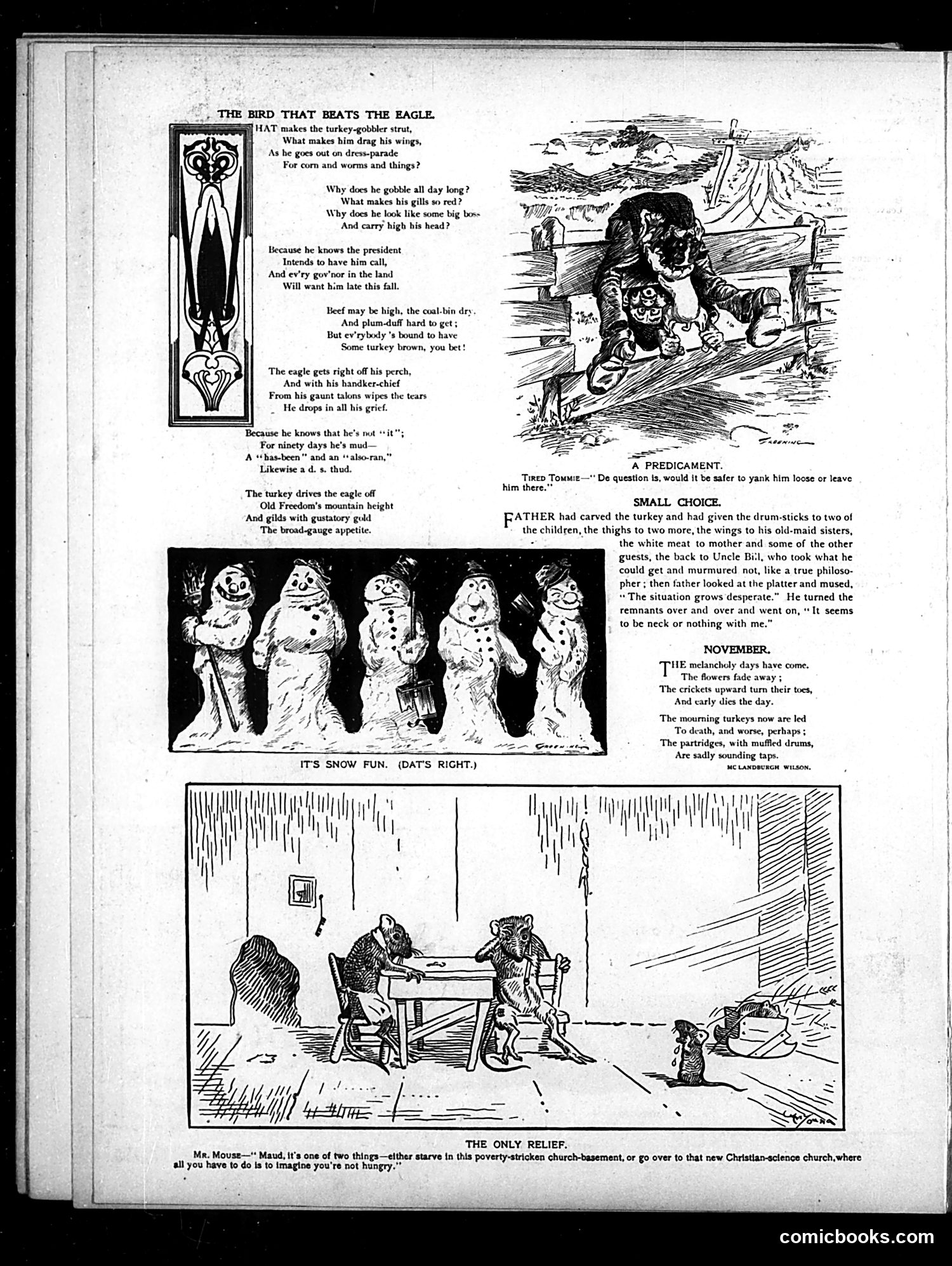
This Judge magazine page satirizes **Thanksgiving and American politics circa the early 1900s**. The main poem mocks how turkeys strut proudly, unaware they're destined for the holiday table—a metaphor for political figures enjoying temporary prominence before inevitable downfall. The eagle (symbolizing American freedom/the presidency) weeps because he's been sidelined: for "ninety days he's mud—/ A 'has-been' and an 'also-ran.'" This likely references a president losing power or influence. The cartoons below offer domestic humor: one shows children carving a turkey where only the least desirable "neck or nothing" remains for father—commenting on family hierarchy and scarcity. Another depicts mice debating whether to starve in a church basement or join a Christian Science church (mocking that religious sect's denial of material hardship). The "November" poem sentimentally mourns turkeys' deaths as autumn approaches, treating their fate as tragic. **Overall theme**: Political power is fleeting; even grand figures face sudden irrelevance, much like celebrated turkeys facing slaughter.
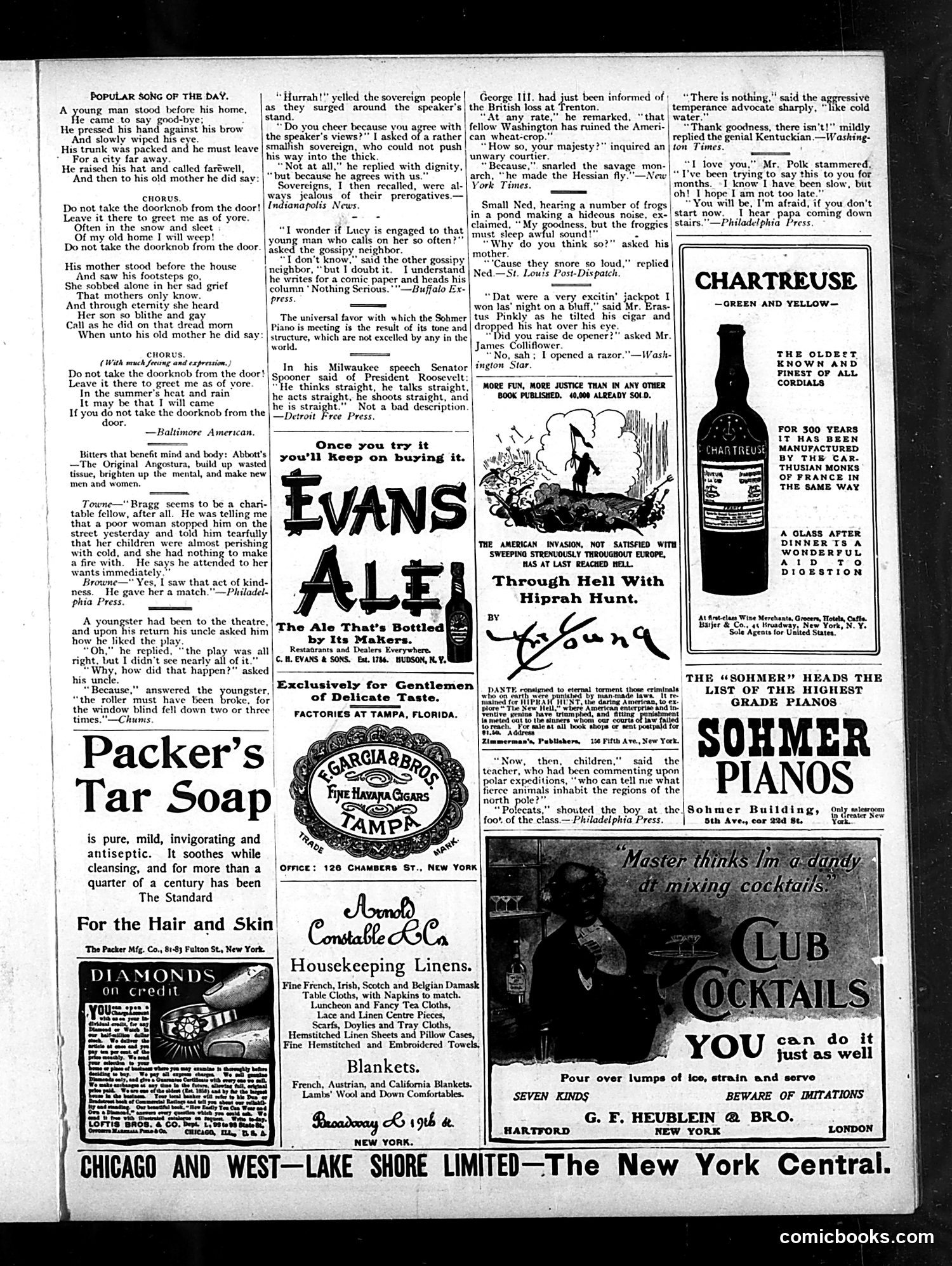
This page from Judge contains mostly **advertisements and light humorous verses** rather than pointed political satire. The main "cartoon" is a sentimental song titled "Do Not Take the Doorknob from the Door"—a parody of melodramatic farewell songs, where a young man leaving home pleads with his mother to preserve the doorknob as a memento. The satire mocks overwrought Victorian sentimentality. Other jokes include: - A quip about "sovereign people" cheering a speaker they disagree with simply for agreeing *with them*—satirizing mob mentality - A reference to George III learning of the British loss at Trenton (American Revolution)—a historical allusion rather than contemporary satire - Brief anecdotes mocking gossip, theater-goers, and miserliness The page is primarily **commercial**, filled with advertisements for Evans Ale, Packer's Tar Soap, pianos, and other products. The humor is gentle and domestic rather than sharp political commentary.
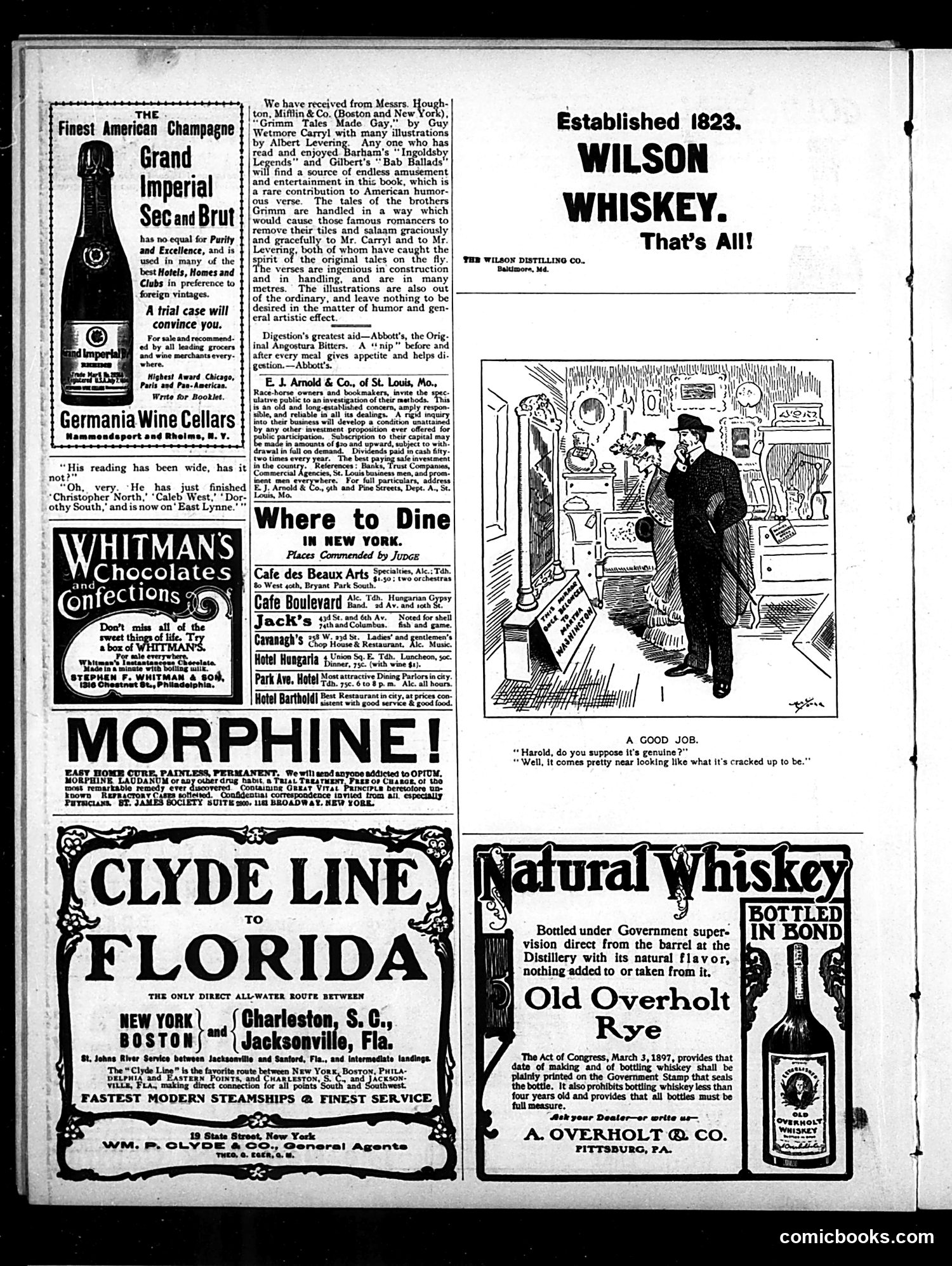
This page is primarily **advertising**, dominated by product promotions for alcohol, chocolate, and patent medicines—typical of early 1900s magazines. The single cartoon, titled "A Good Job," shows two men examining what appears to be a whiskey bottle. One asks if it's "genuine"; the other replies it "comes pretty near looking like what it's cracked up to be." The joke plays on consumer skepticism about product authenticity and marketing claims—a dig at fraudulent advertising common in the era. The surrounding ads reveal period anxieties: morphine addiction treatments, various "cure-all" bitters and tonics, and competing whiskey brands all claiming superiority. The cartoon's mild cynicism reflects readers' justified wariness about unregulated patent medicines and spirits that often contained harmful substances or misrepresented their contents. The "Where to Dine" section and luxury champagne ads suggest Judge's affluent readership.
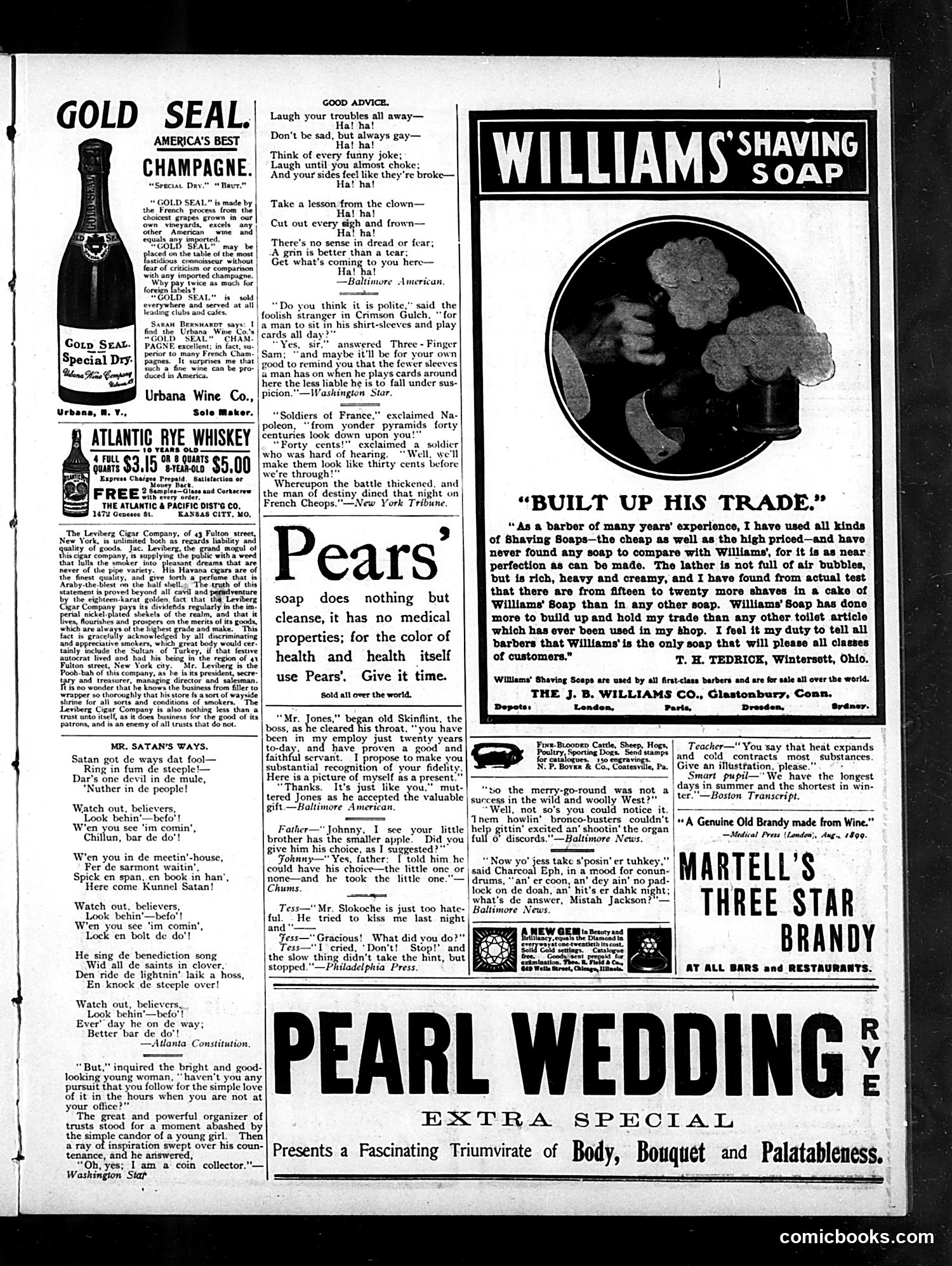
This page is primarily **advertising and light humor** rather than political satire. The content includes: **Advertisements dominate**: Gold Seal Champagne, Atlantic Rye Whiskey, Williams' Shaving Soap, Pears' Soap, and Martell's Brandy occupy substantial space with product claims typical of early 20th-century marketing. **Humor pieces**: - "Good Advice" (Baltimore American) offers generic encouragement to laugh away troubles—common sentimental verse - "Mr. Satan's Ways" (Atlanta Constitution) presents a dialect poem about Satan as a moral threat, using period racial vernacular - Brief anecdotes about politeness in Crimson Gulch and Napoleon's soldiers **The Williams Shaving Soap testimonial** features "T.J. Probandt, Wilmington, Ohio," a barber claiming the soap "built up his trade"—standard advertising copy. The page lacks coherent political commentary or recognizable caricatures. It appears to be a typical Judge miscellany: advertisements interspersed with safe, accessible humor and moral platitudes rather than incisive satire.
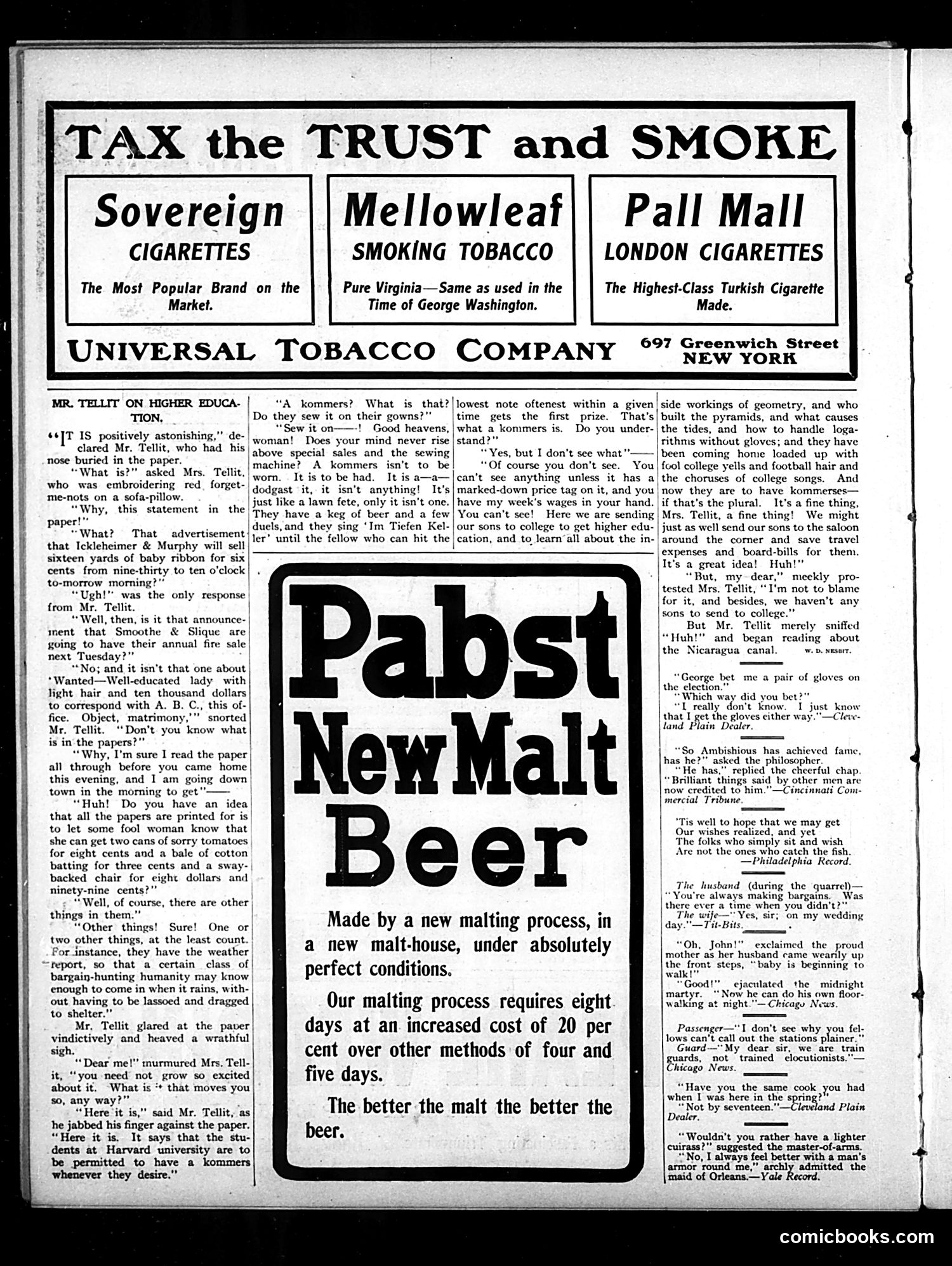
This page contains two distinct elements: **Top Section:** Tobacco advertisements ("Tax the Trust and Smoke") promoting cigarettes and smoking tobacco from the Universal Tobacco Company. These ads invoke patriotic imagery (George Washington) and claim superiority ("highest-class"). **Main Content:** A satirical domestic comedy titled "Mr. Tellit on Higher Education." Mr. Tellit is outraged that Harvard University is permitting students to hold "kommers"—German-style beer-drinking social gatherings featuring drinking, dueling, and singing. The satire targets wealthy Americans' anxiety about higher education: they're paying to send sons to college to learn serious subjects, only to have them participate in what amounts to glorified tavern parties. Mrs. Tellit's confusion (asking if kommers are sewn onto clothing) provides comic relief, while Mr. Tellit's exasperation reflects broader Progressive Era concerns about student behavior and institutional oversight at elite universities. The large Pabst beer advertisement below is contextually ironic—appearing on a page criticizing college drinking culture.
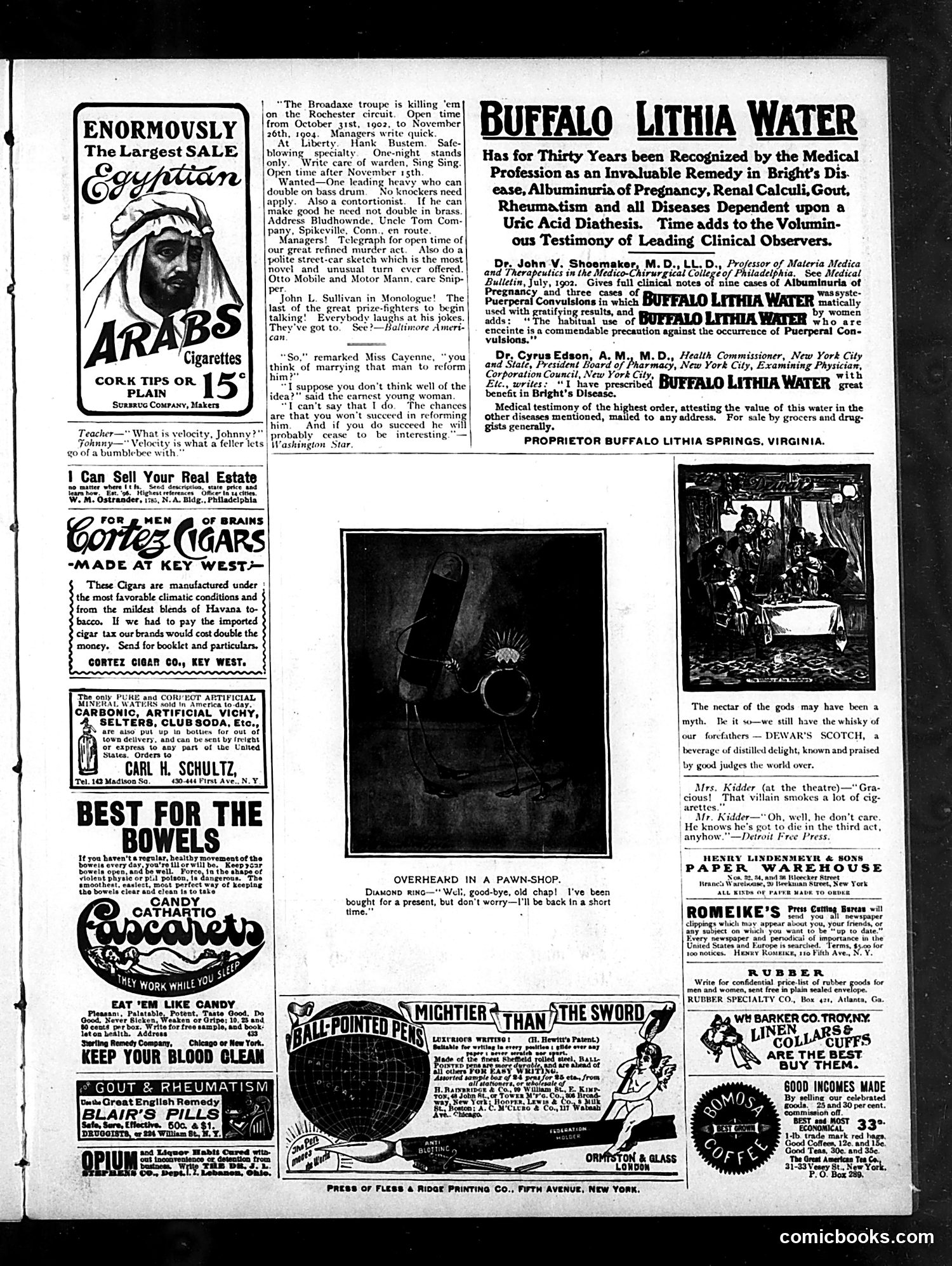
This page is predominantly **advertising**, typical of early 1900s satirical magazines that relied heavily on paid announcements. The few editorial elements present include: **"Teacher-Johnny" joke**: A mild schoolroom humor piece where a student defines "velocity" as "what a feller lets go of a bumblebee with"—simple physical comedy. **"Overheard in a Pawn-Shop"**: A brief dialog where someone sells a diamond ring (ostensibly a gift) but promises to retrieve it later—suggesting financial desperation masked by false pride. The rest consists of period advertisements for cigarettes (Aras, Cortez), patent medicines (Buffalo Lithia Water for kidney/urinary ailments, remedies for constipation), cigars, and mineral waters. These ads reflect contemporary medical pseudoscience—particularly the ubiquitous "water cure" remedies that promised to treat serious diseases. The page provides social context about early-1900s entertainment (vaudeville circuit notices), consumer culture, and medical quackery rather than political satire.
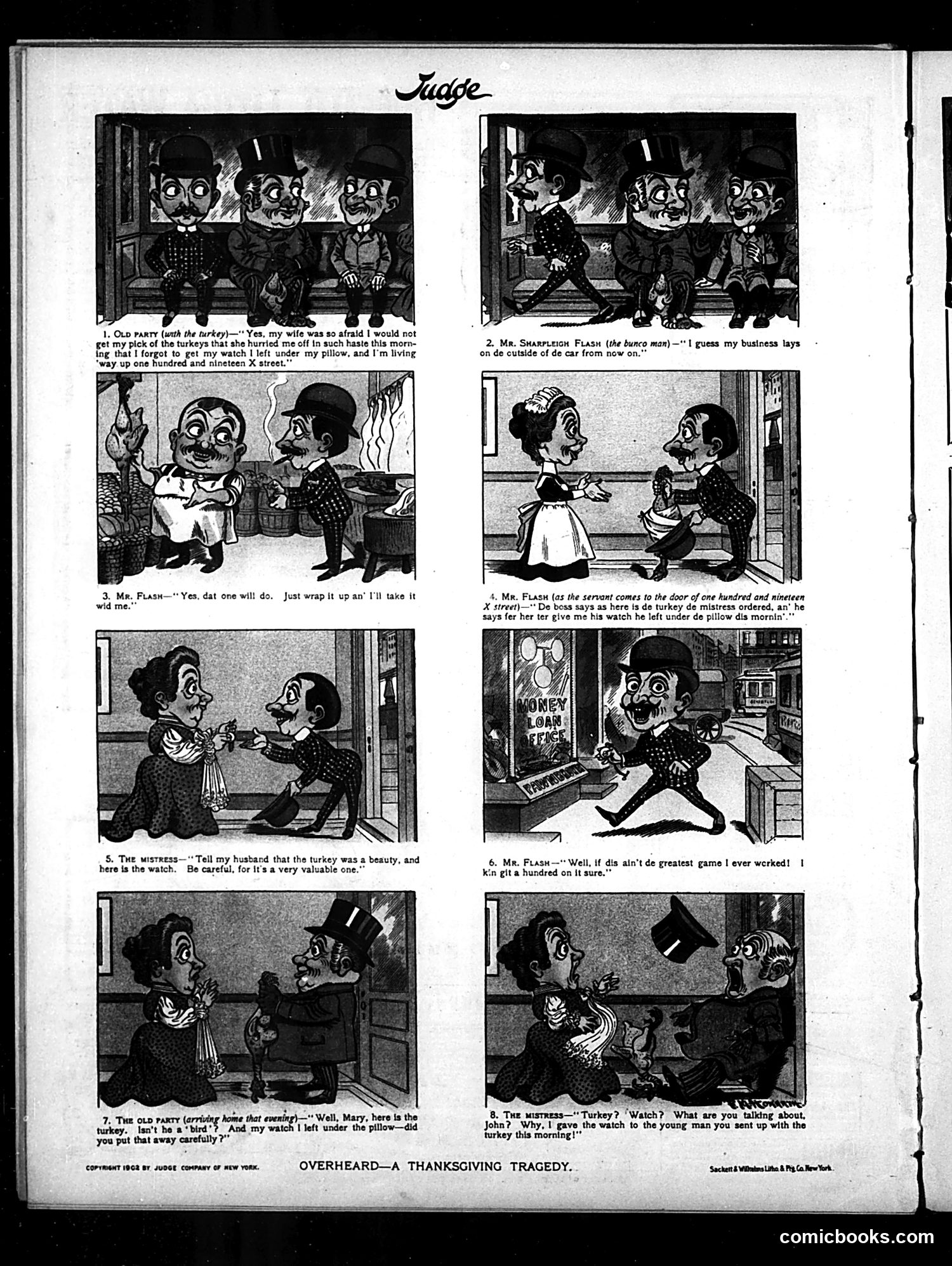
This 1902 Judge comic strip depicts a classic con game exploiting Thanksgiving preparations. A man ("Mr. Flash," identified as "the bunco man"—a swindler) overhears a guest mention he left his valuable watch under his pillow while hurrying to buy a turkey. Flash poses as a servant, convinces the homeowner to give him the watch under the pretense of returning it to the guest, then attempts to pawn it for money. The satire targets urban con artists and the gullibility of the middle class during holiday shopping chaos. The joke's irony: the mistress had already given the watch to a young man delivering the turkey—so Flash's elaborate scheme collapses when exposed. The exaggerated caricatures and dialect reflect period stereotypes. The strip mocks both criminal cunning and the social disorder of holiday commerce.
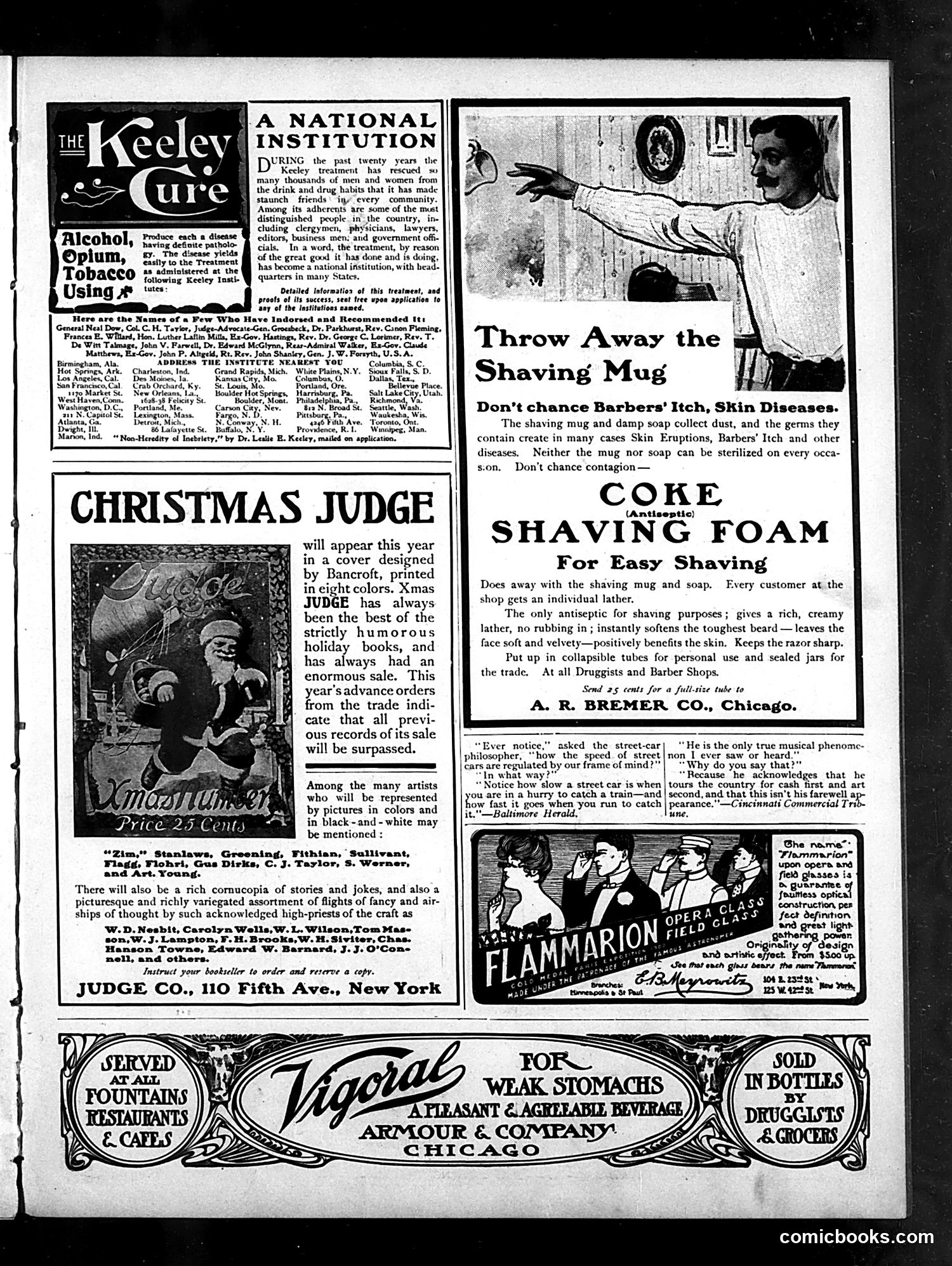
This page is primarily **advertising and promotional content** rather than political satire. It features: 1. **Keeley Institute advertisement** (top left): Promotes a medical treatment for alcohol and drug addiction, listing endorsements from prominent figures (General Neal Dow, clergy, physicians, lawyers). This reflects late-19th/early-20th-century attitudes toward addiction as a treatable disease. 2. **"Throw Away the Shaving Mug"** (top right): Health advertisement warning against shared barber equipment transmitting "Barbers' Itch" and skin diseases—promoting Coke Shaving Foam as a hygienic alternative. 3. **Christmas Judge announcement** (bottom left): Promotional material for an upcoming holiday issue featuring cartoonists and humorists. 4. **Vigoral beverage advertisement** (bottom): Product marketed for "weak stomachs." The page reflects **Progressive Era health consciousness**—concerns about hygiene, disease transmission, and medical treatment were emerging public issues. No significant political cartoon or satire is present; this is a commercial publication page typical of early-1900s magazines.
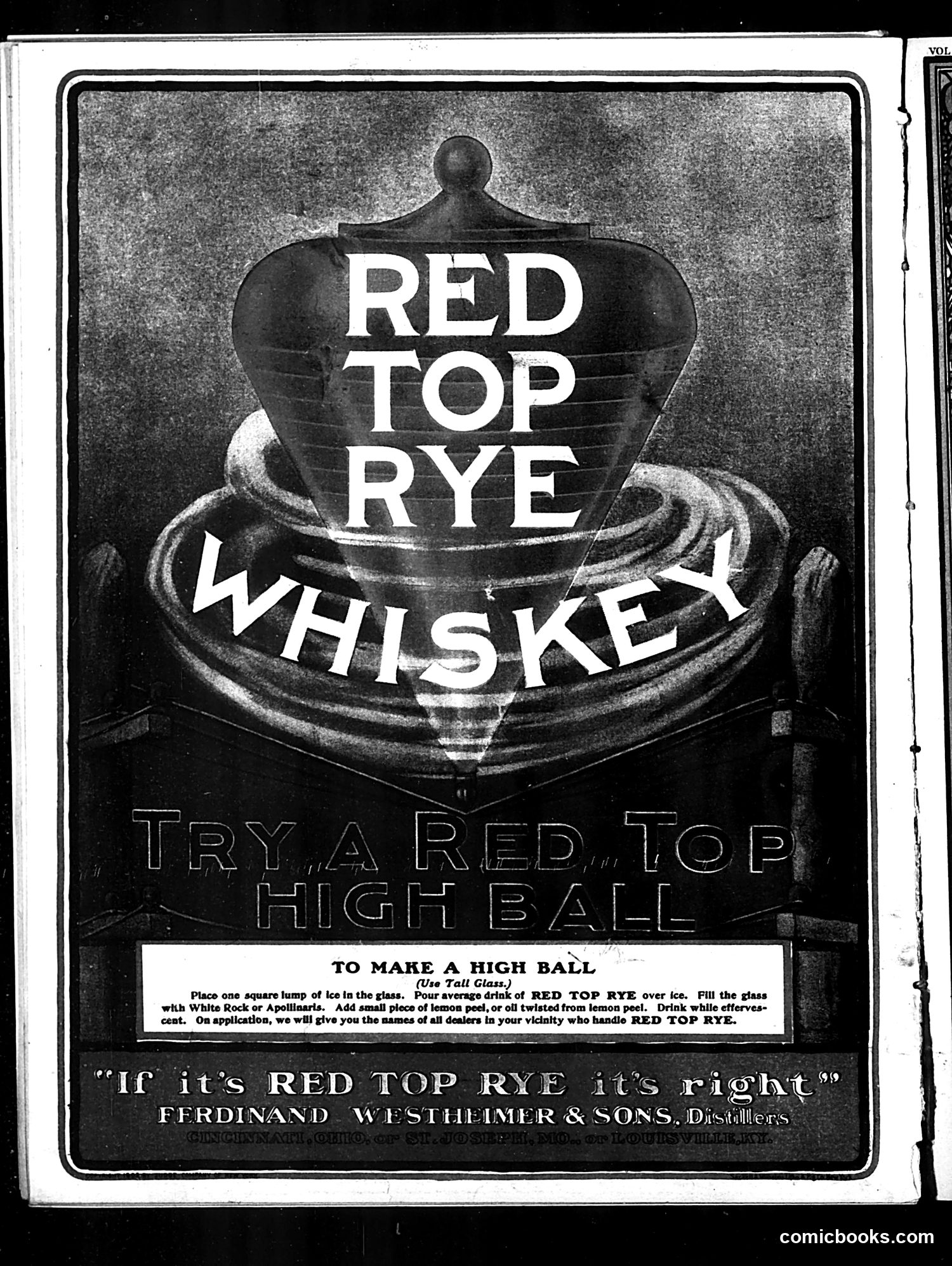
This is a full-page advertisement for Red Top Rye whiskey by Ferdinand Westheimer & Sons distillers, not political satire. The image features a decorative crown symbol prominently displaying the product name, with instructions for preparing a "high ball" cocktail—a popular mixed drink of the era combining whiskey, soda water, ice, and lemon. The advertisement includes a recipe and tagline ("If it's RED Top Rye it's right") typical of early 20th-century liquor marketing. The crown imagery suggests quality and prestige. This represents pre-Prohibition advertising (before 1920), when such products were legally and openly promoted in mainstream publications like *Judge* magazine.