
A complete issue · 16 pages · 1902
Judge — November 8, 1902
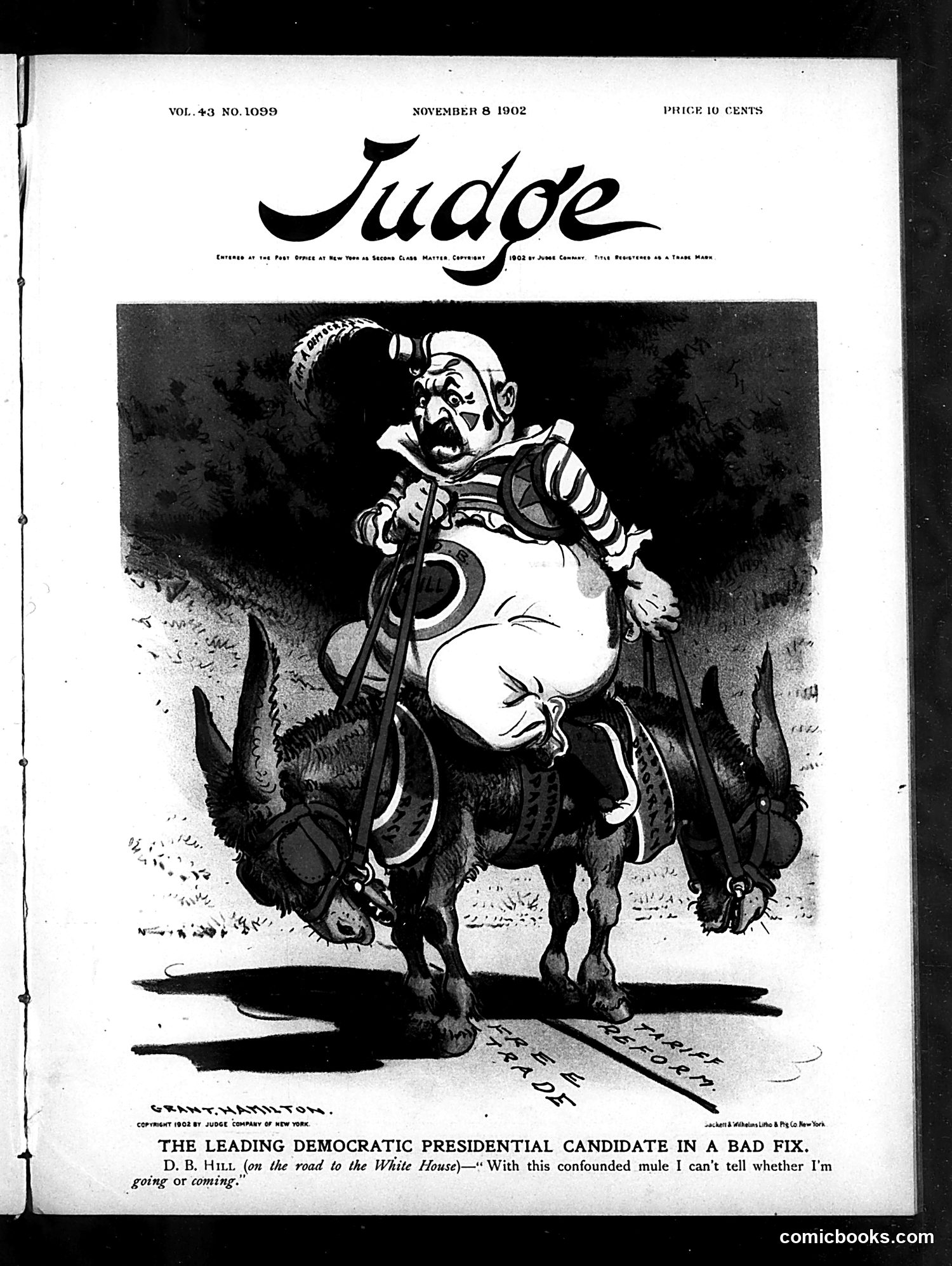
This political cartoon satirizes **D.B. Hill**, a Democratic presidential hopeful, depicted as a confused figure riding a mule (symbolizing the Democratic Party). The caption quotes Hill saying he cannot tell "whether I'm going or coming" regarding his path to the White House. The satire targets Hill's unclear or inconsistent political positioning during his presidential ambitions. The mule—traditionally representing Democrats—is uncontrollable and heading in no clear direction, visually reinforcing the joke that Hill lacks a coherent campaign strategy or political direction. The artist is **Grant Hamilton** (credited at bottom). The cartoon's point: Hill is an unsuitable Democratic candidate precisely because his political stance is muddled and directionless.
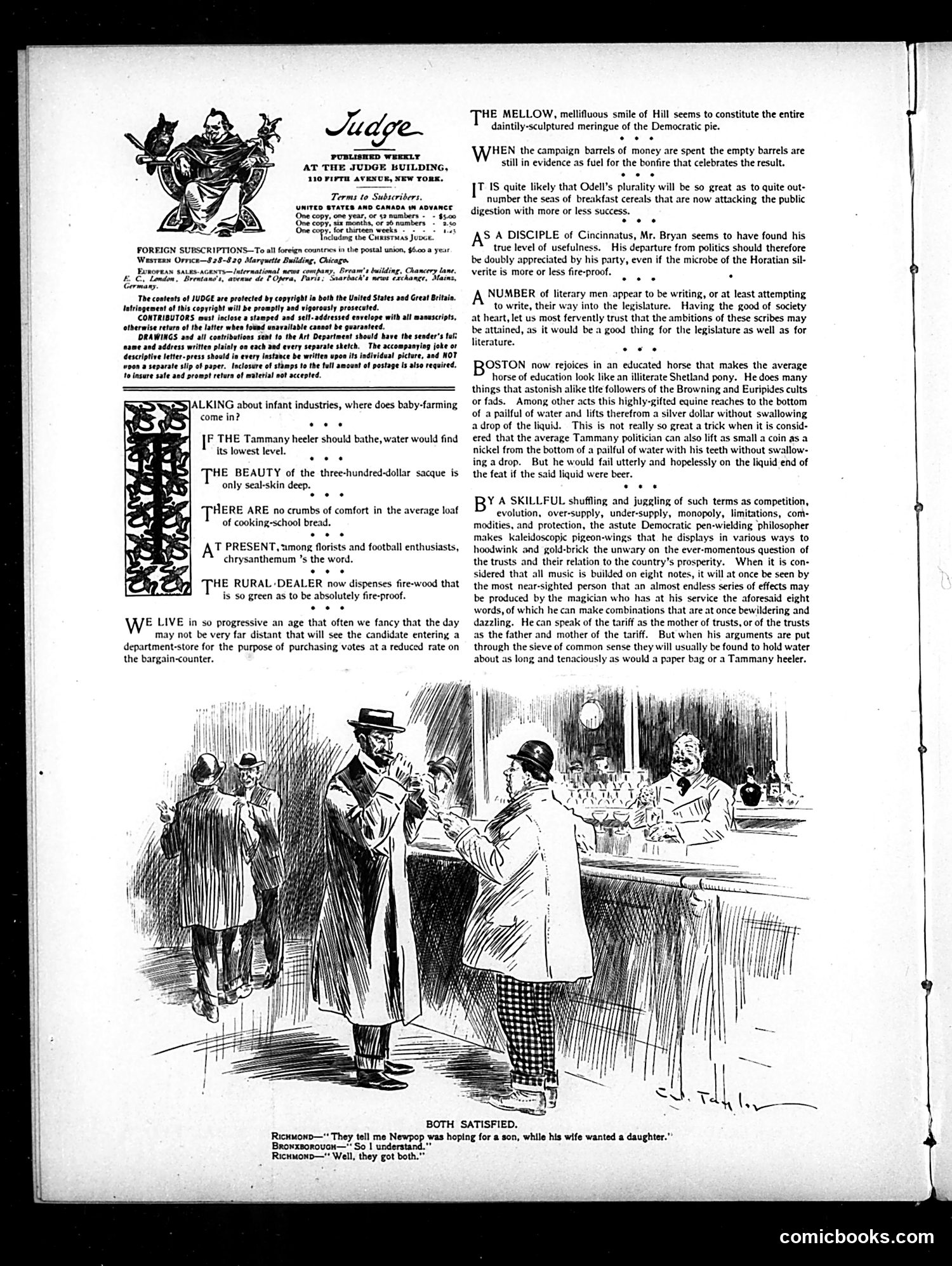
This page contains editorial commentary rather than a political cartoon. The "Judge" masthead and various short satirical observations critique contemporary issues. The topics addressed include: - **Campaign finances**: References to "empty barrels" of money spent on elections - **William Jennings Bryan**: Mentioned as a Populist/Democratic figure whose plurality support is questioned - **Literary ambitions**: Satirizes men attempting to write, hoping their legislative and literary efforts will succeed - **Boston education**: Mocks an educated horse that outperforms actual illiterate candidates - **Democratic Party philosophy**: Criticizes their economic policies and trade positions The bottom illustration labeled "Both Satisfied" shows a Richmond conversation about a son and daughter, appearing to comment on social/class outcomes. The commentary reflects Gilded Age concerns about populism, campaign spending, and educational standards.
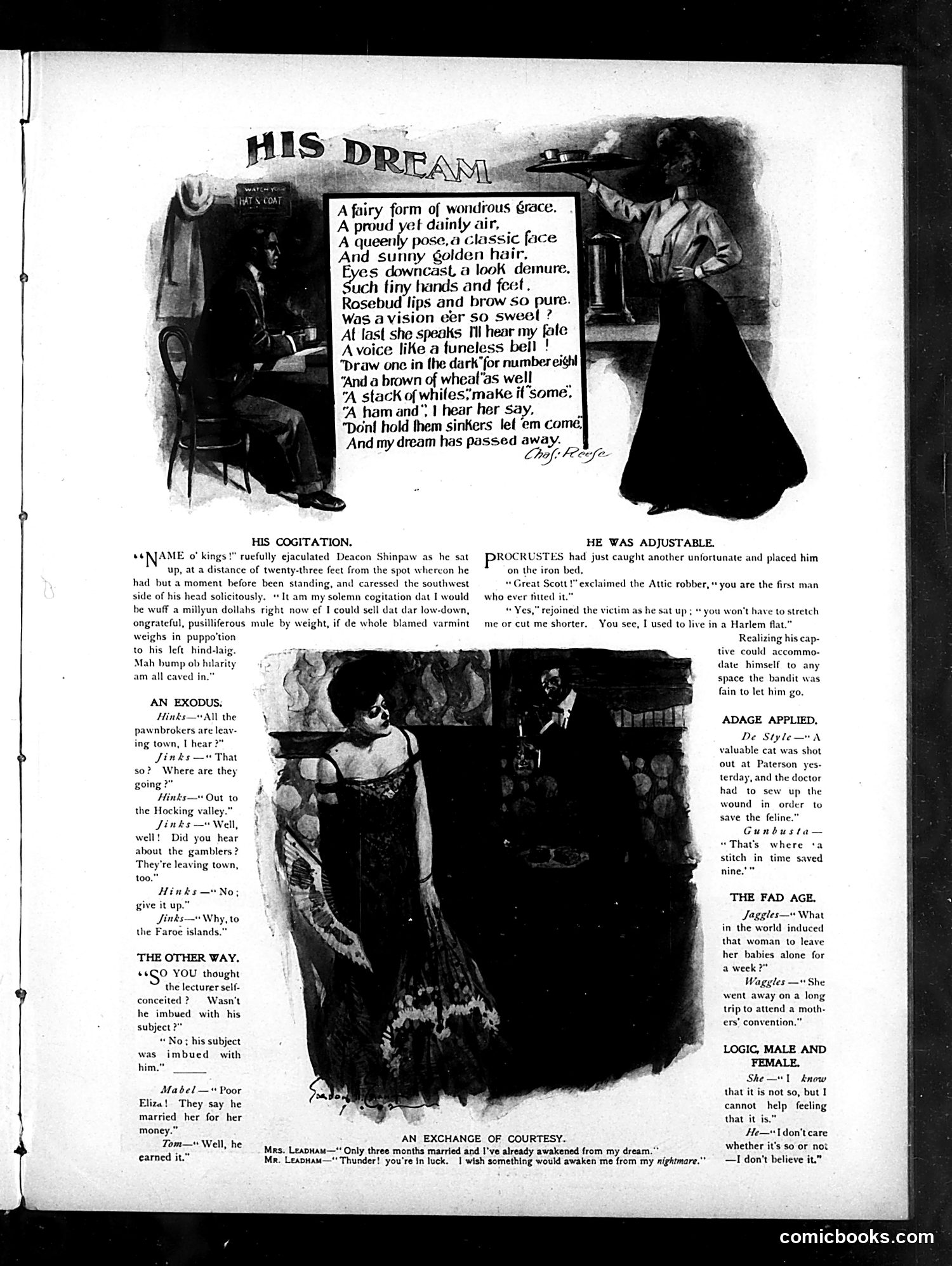
This page contains several humorous sketches and satirical short pieces typical of Judge magazine's social commentary. The main content includes: **"His Dream"** (top): A romantic poem about an idealized woman, contrasting with sketches of ordinary life. **Social Satire Pieces**: Short dialogues mocking contemporary attitudes—including "The Other Way" (about a self-conceited lecturer), "An Exodus" (pawnbrokers leaving town), "He Was Adjustable" (a bandit adapting to circumstances), "Adage Applied" (a veterinary joke), "The Fad Age" (women abandoning babies for conventions), and "Logic, Male and Female" (gender stereotypes). **"An Exchange of Courtesy"** (bottom): Shows a couple where the husband claims three months of marriage has awakened him from his dream—the wife wishes something would awaken her from her "nightmare," suggesting marital disillusionment. The satire targets early 20th-century social pretensions, gender relations, and contemporary fads with gentle mockery.
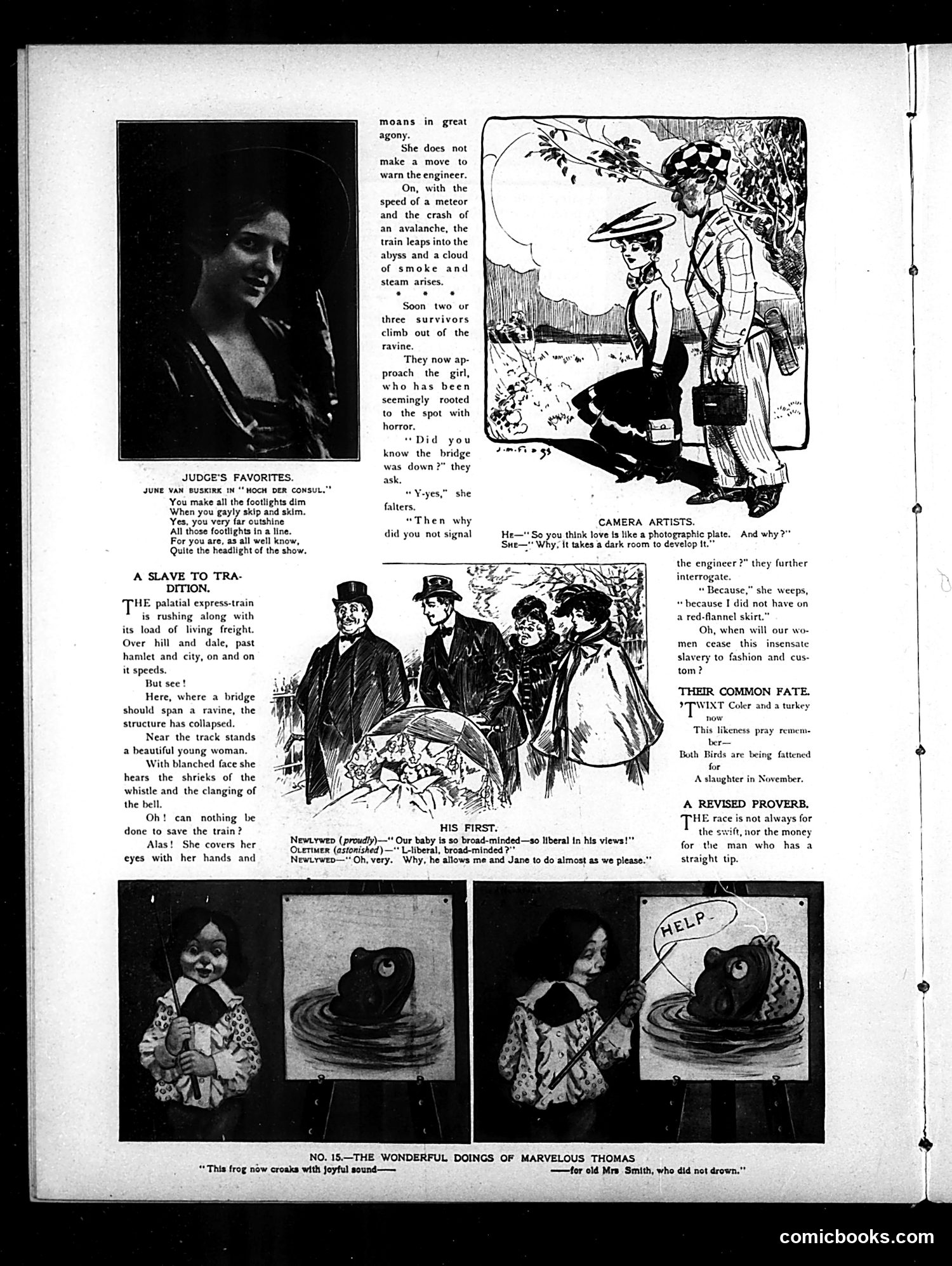
This page contains several satirical pieces from Judge magazine: **"A Slave to Tradition"** critiques blind adherence to social conventions, using a train disaster as metaphor. The poem suggests people follow destructive customs without question. **"Camera Artists"** appears to mock photographers or visual artists, with dialogue suggesting pretentious attitudes about their work and fashion criticism. **"His First"** shows what appears to be a character described as "so liberal in his views," with humor about tolerance. **Bottom panel** ("The Wonderful Doings of Marvelous Thomas") depicts a comedic sequence with a child and a frog in water, likely a humorous domestic scene. The overall tone suggests early-20th-century American social satire targeting conventional behavior, artistic pretension, and domestic humor. The specific political references are unclear without additional historical context.
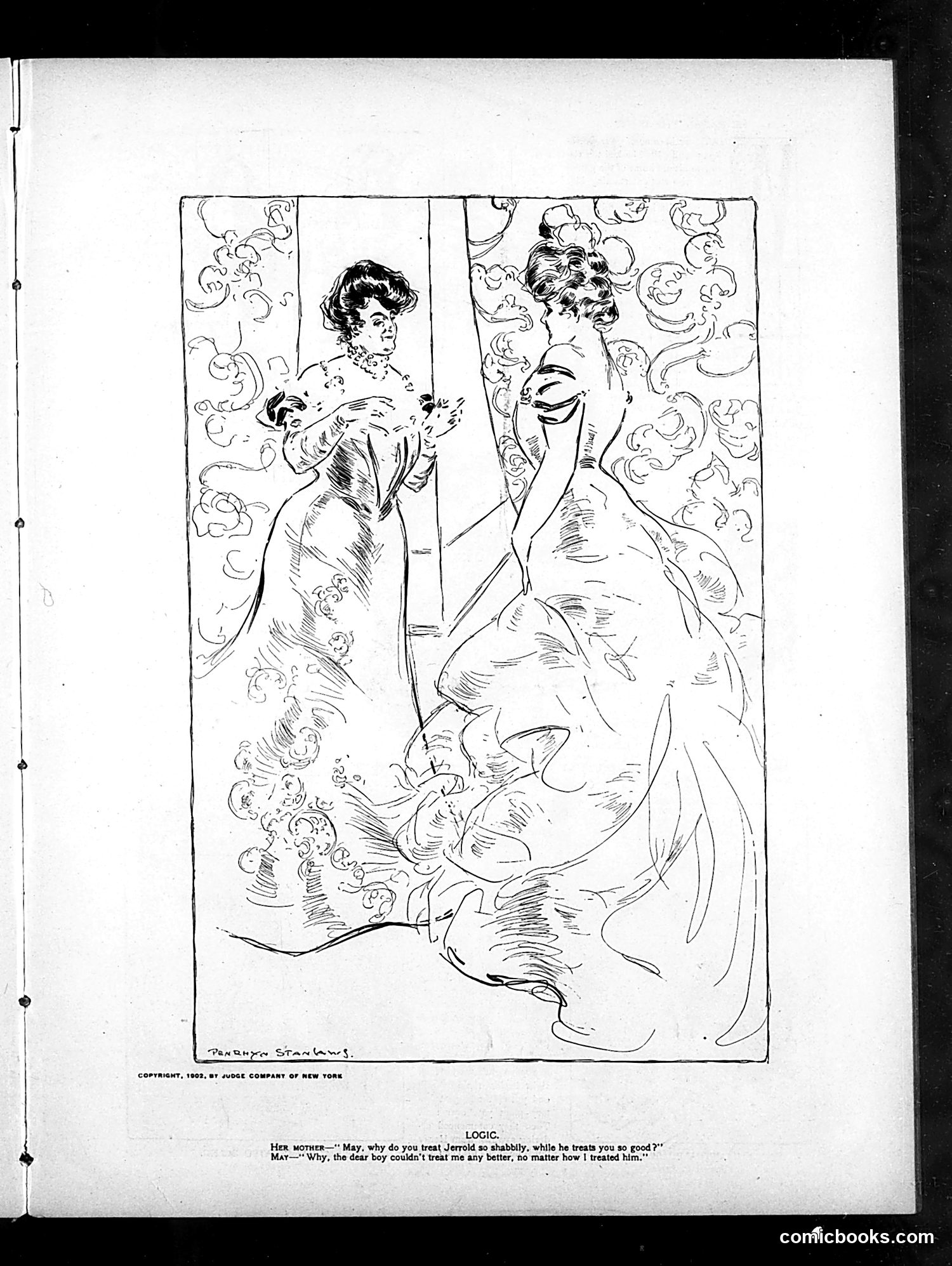
This 1902 Judge cartoon titled "Logic" depicts a domestic scene with two female figures in an ornate interior. The dialogue presents a paradoxical relationship dynamic: one woman (the "mother") questions why "May" treats "Jerrold" poorly when he treats her well. May's response—that Jerrold couldn't treat her better regardless of her behavior—satirizes romantic logic and courtship norms of the era. The cartoon mocks women who exploit male devotion, suggesting that some men's affection is unconditional regardless of how they're treated. It's a commentary on gender relations and courtship dynamics, criticizing both naïve male sentiment and female manipulation. The ornate wallpaper and fashionable dress suggest upper-class romance, making the critique one of social manners and expectations within that sphere.
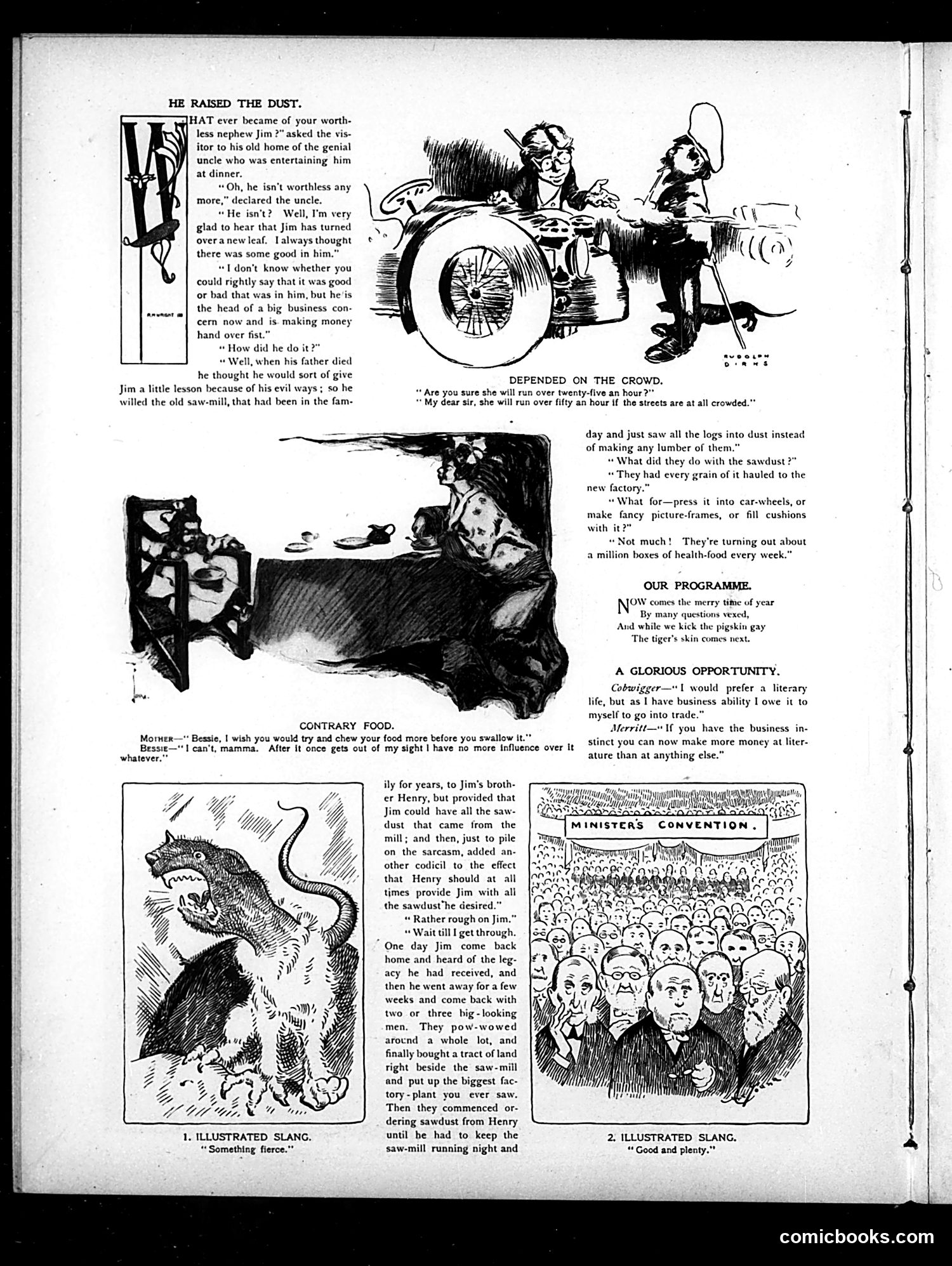
This page satirizes **American entrepreneurial ingenuity and industrial transformation** in the late 19th/early 20th century. **Main Story ("He Raised the Dust"):** A supposedly worthless nephew, Jim, is left only sawdust from his father's will as punishment—while his brother Henry inherits the profitable saw mill. Rather than accept defeat, Jim and investors build a massive factory beside the mill, converting sawdust into health-food boxes. They buy all Henry's sawdust output, forcing him to operate the mill continuously to supply them. The satire mocks how American businessmen could turn apparent liabilities into gold through industrial innovation and relentless capitalist ambition. **Supporting Content:** Additional brief jokes include a car's speed depending on street crowding, a child who won't chew food ("no influence once out of sight"), and wordplay on "illustrated slang" phrases. The overall message celebrates—with gentle irony—American business acumen: even sawdust becomes profitable when entrepreneurial energy meets industrial scale.
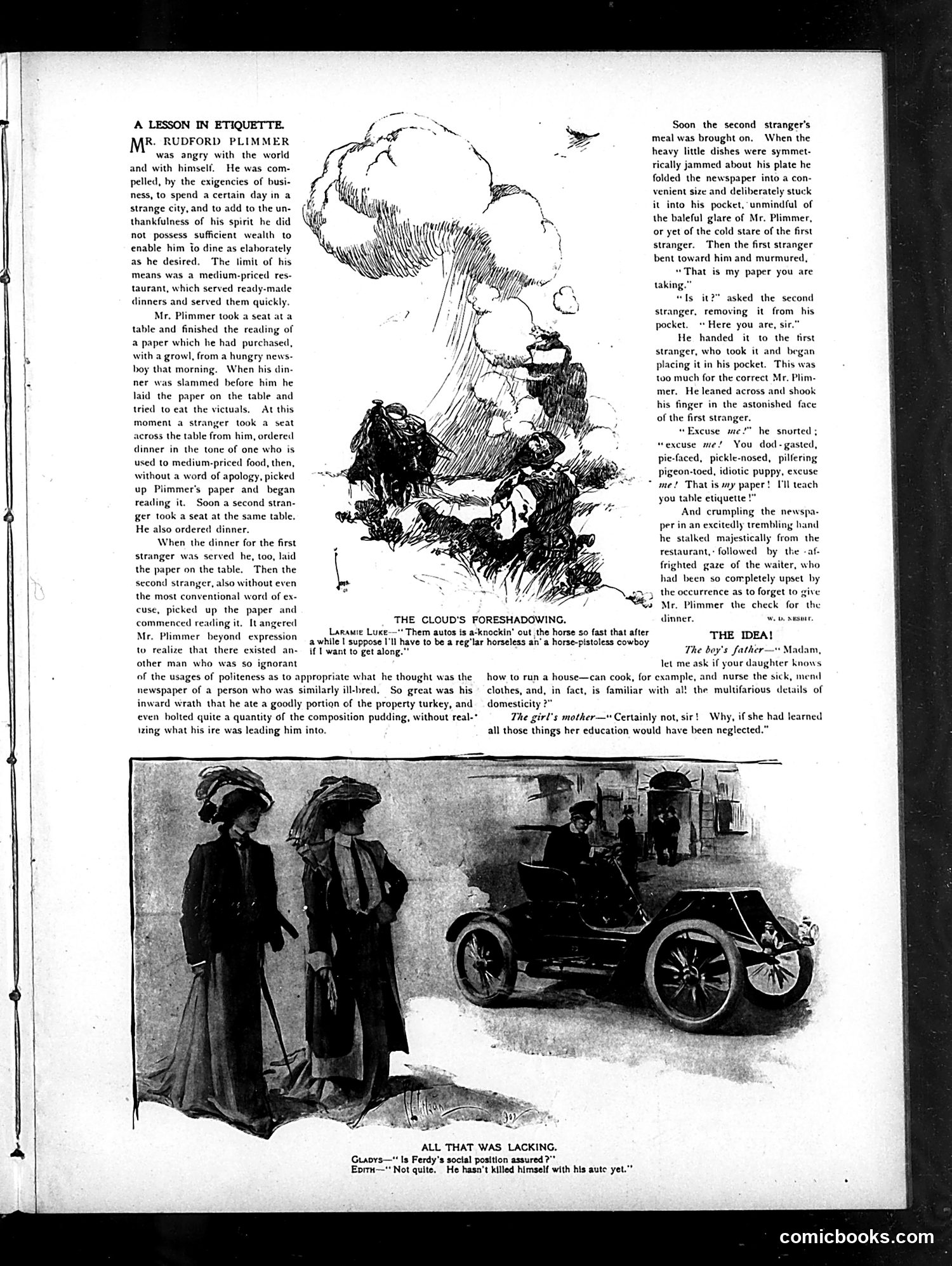
This satirical story mocks a man named Rudford Plimmer who obsesses over proper behavior while being hypocritical himself. Plimmer is furious when two strangers casually take his newspaper at a restaurant without apology—he considers this a serious breach of etiquette. However, when confronted about his own rudeness, Plimmer explodes into profanity-laden insults and leaves without paying, demonstrating far worse manners than the original offenders. The joke targets self-righteous people who demand others follow social rules while ignoring their own violations. The cartoon illustrates Plimmer's angry outburst, capturing the absurdity of his position. The accompanying smaller jokes about cars replacing horses and a woman's education further satirize class pretensions and social anxieties of the era.
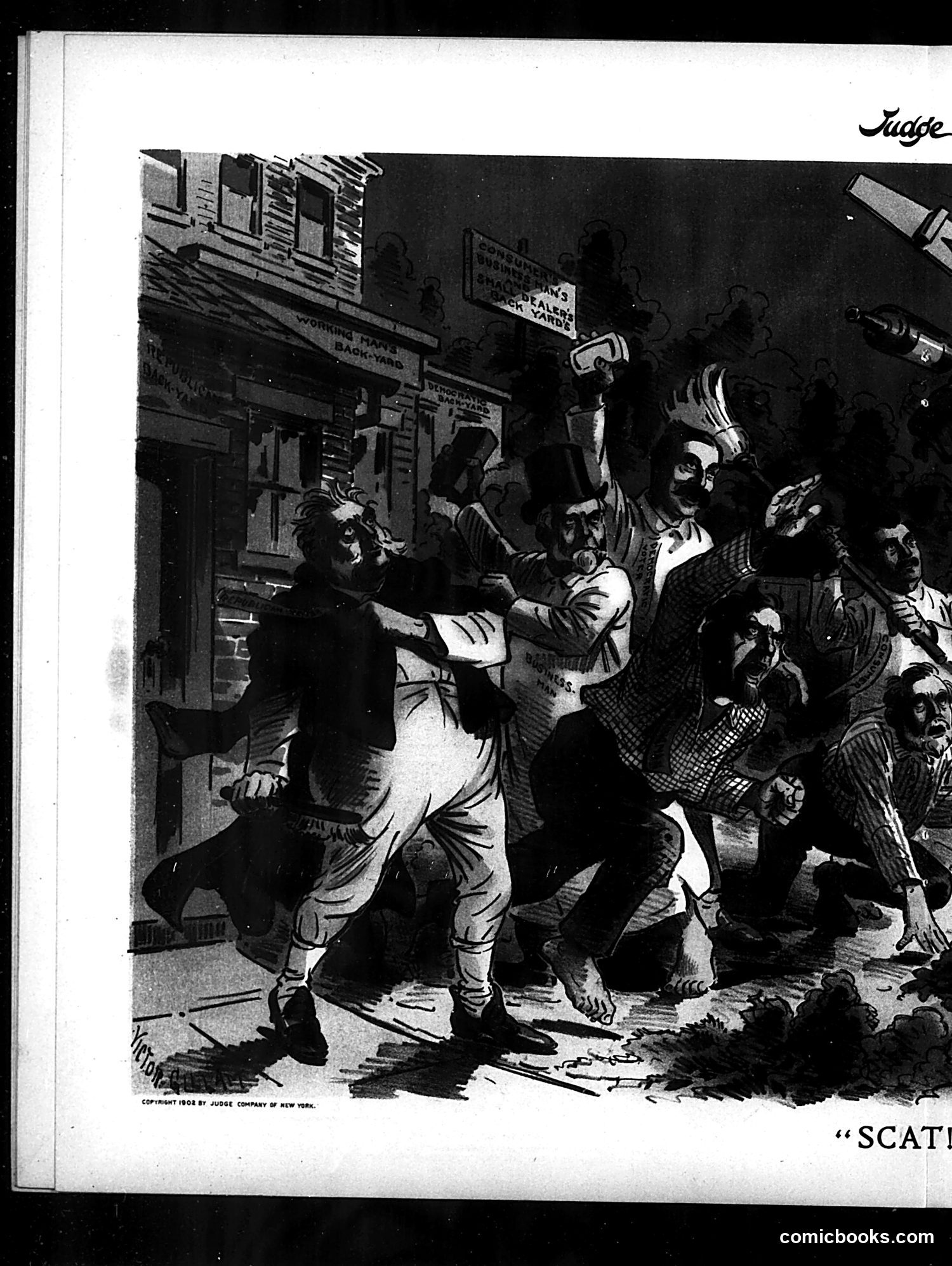
This appears to be a satirical cartoon from Judge magazine (copyright 1895, Judge Company of New York) titled "SCATI..." (title cut off). The image depicts a chaotic street scene outside storefronts with exaggerated caricatures of figures in period dress—some appearing to be involved in physical altercation or commotion. The style suggests late 19th-century social or political satire, likely commenting on urban street life, labor disputes, or public disorder common to that era. Without the complete title and clearer text, the specific political or social target remains unclear. The cartoonist's intent—whether mocking a particular group, event, or social problem—cannot be definitively stated from the visible portions alone. The exaggerated character depictions were typical of Judge's satirical approach to contemporary issues.
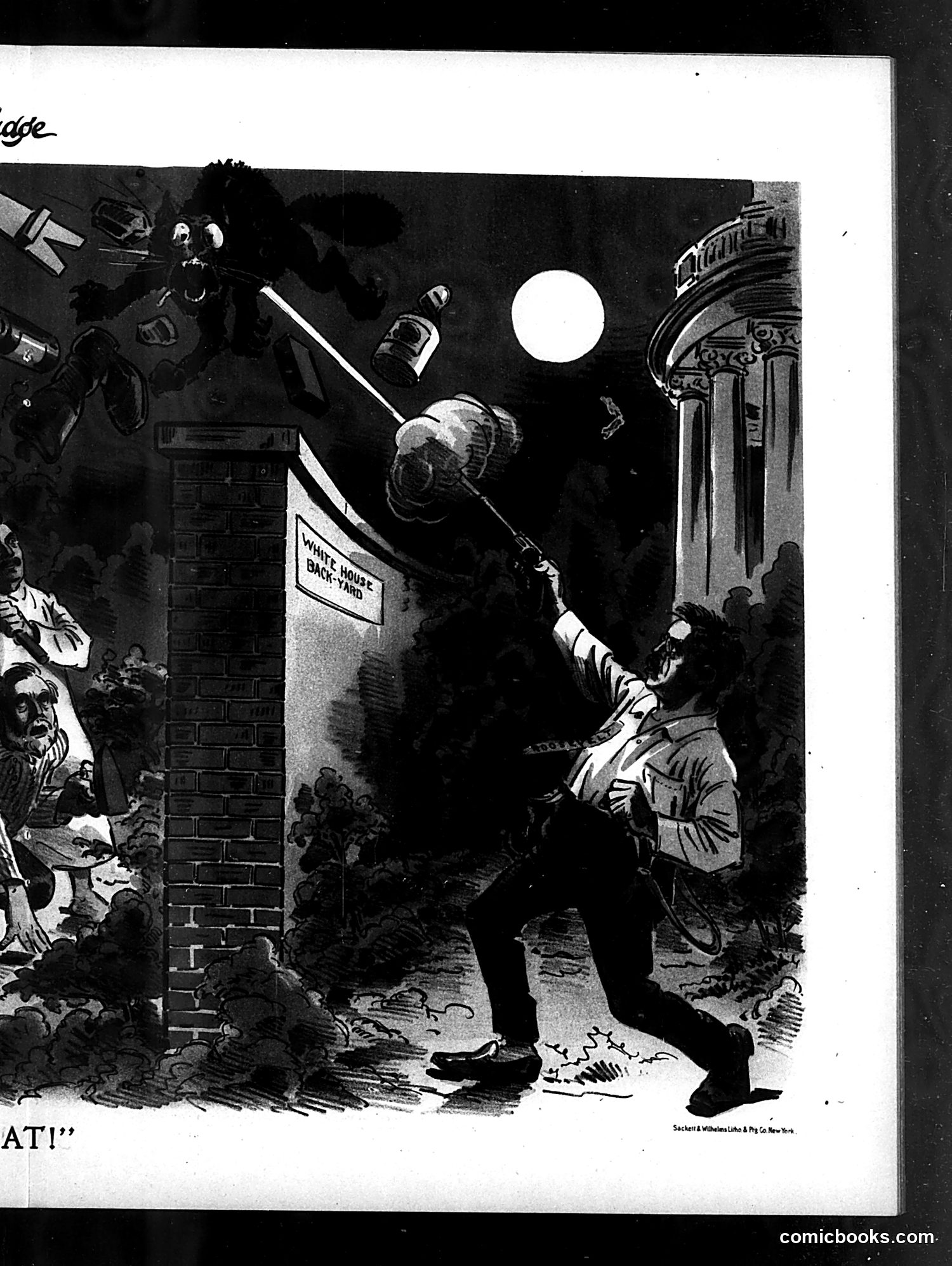
This appears to be a nighttime scene at the White House, with a figure in formal dress pointing upward at the full moon. The sign reads "WHITE HOUSE BACKYARD," establishing the location. The cartoon likely satirizes a political figure or event involving the White House during Judge magazine's era (late 19th/early 20th century). The formal dress and pointing gesture suggest commentary on either: - A political figure's ambitions or aspirations (reaching for the moon/impossible goals) - An astronomical or scientific event being observed - Political overreach or delusion Without clearer textual context or date information visible, the specific target and satirical point remain unclear, though the nighttime setting and moon-gazing suggest commentary on unrealistic expectations or failed ambitions.
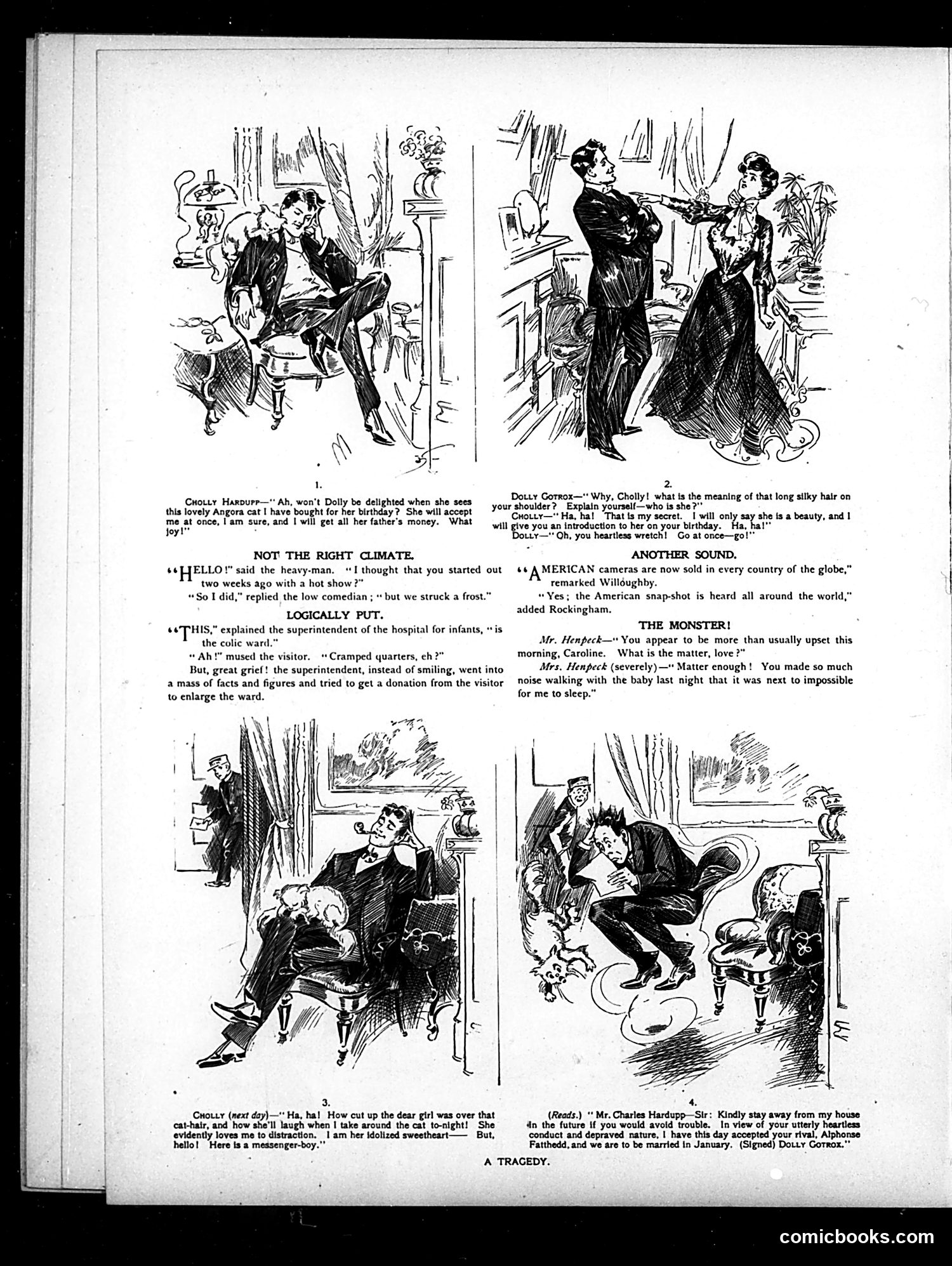
This page contains six separate humorous sketches satirizing courtship, relationships, and social pretension in what appears to be early 20th-century America. The main recurring character is **Crotty Harpur**, a scheming suitor attempting to win "Dolly" through gift-giving (an Angora cat), expecting to gain access to her father's money. The joke develops across panels 1, 3, and 4: Dolly discovers cat hair on Crotty's shoulder, assumes it's from another woman, and rejects him—accepting a rival suitor instead. The satire targets materialistic courtship and male deception. Other sketches mock professional incompetence (a theater manager blaming weather for poor reviews), hospital administrators guilt-tripping donors, and domestic power dynamics ("The Monster" depicts a wife terrorizing her husband over baby-related noise). The "Another Sound" section is a pun about American cameras being "heard around the world"—a joke about photography terminology. Overall, the page reflects period anxieties about marriage, money, and class aspiration through lighthearted domestic comedy.
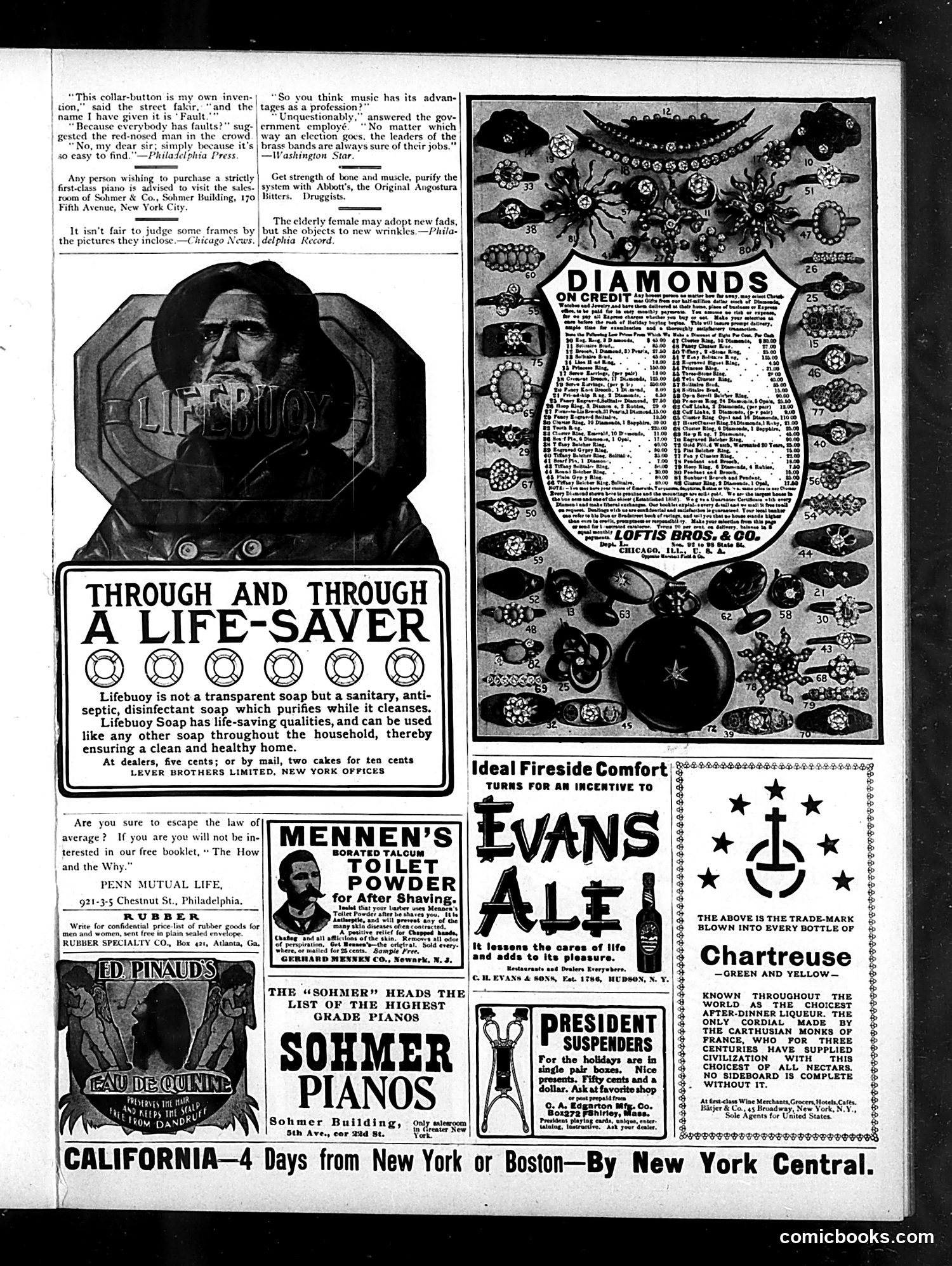
This page is **primarily advertising**, with minimal editorial content. The main cartoon-like element is a small illustration at top-left titled "Through and Through a Life-Saver," depicting a man's head, advertising Lifebuoy soap as a disinfectant product. The bulk of the page comprises commercial advertisements for consumer goods typical of the early 20th century: pianos (Sohmer), toiletries (Mennen's talcum powder), suspenders, diamonds, liqueur (Chartreuse), and insurance products. There are also a few brief quoted quips at the top—one about a collar-button "invention" and another about brass bands and elections—but these appear to be filler commentary rather than satirical cartoons. A small decorative ad for Evans Ale appears with a trademark symbol. The page footer advertises rail travel to California. **No significant political satire or social commentary is evident.** This functions as a commercial/advertising page with minimal editorial material.
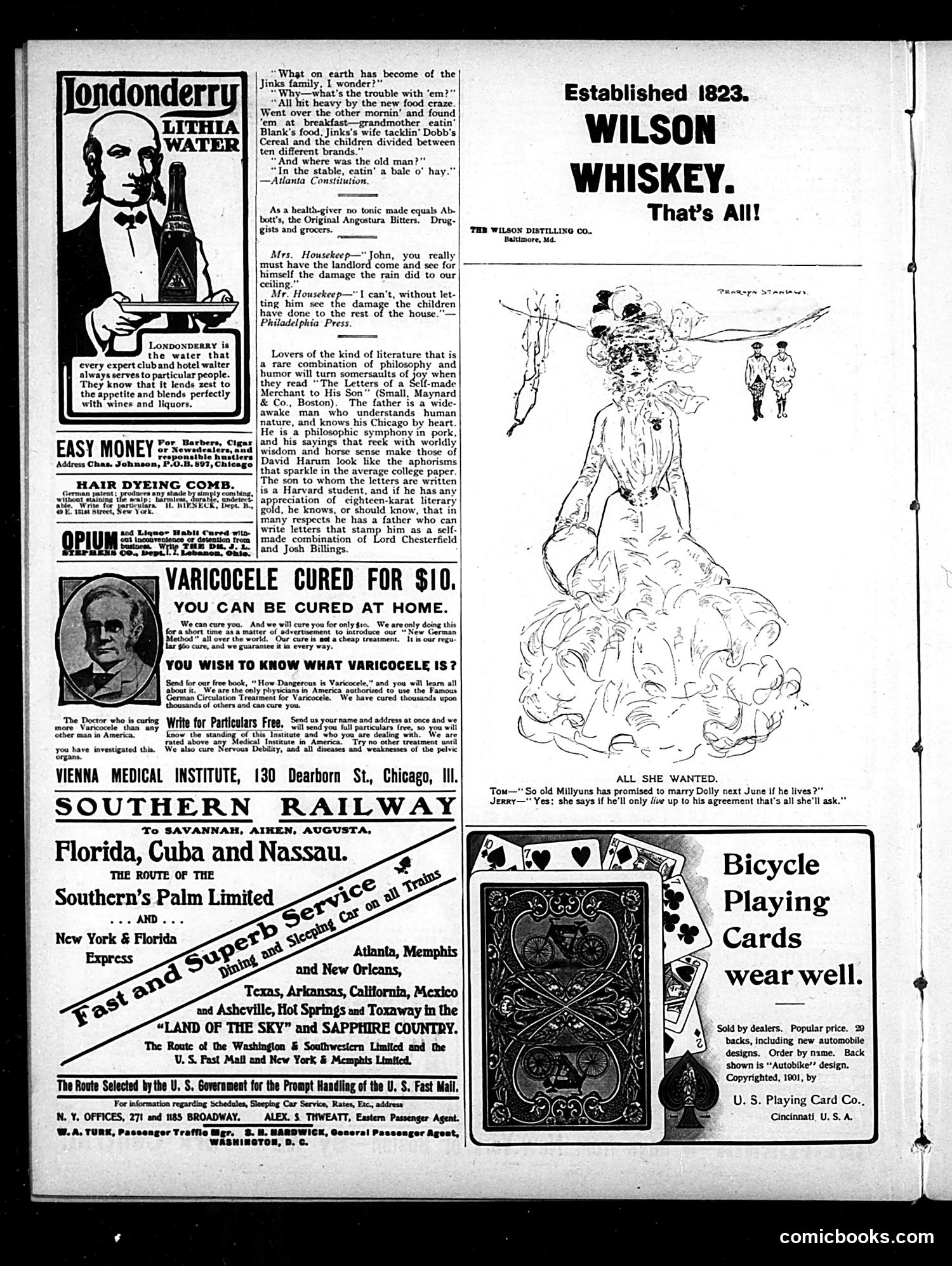
This page is primarily **advertising** with one satirical joke. The main cartoon depicts a family obsessed with the early 1900s "food craze"—the period's faddish enthusiasm for branded breakfast cereals and health foods. The humor lies in the absurd escalation: grandmother eats one brand, mother another, children divided among ten brands, and the father eating hay in the stable, suggesting the fad has driven the family to nutritional chaos. The joke mocks Americans' gullibility toward commercial food marketing and health claims. This reflects genuine contemporary anxiety about industrialized food and advertising's persuasive power. The remainder is pure advertising: patent medicines (Abbott's Bitters, varicocele "cures"), railway services, Wilson Whiskey, and Bicycle Playing Cards. These ads reveal the era's unregulated medical fraud and aggressive commercial marketing targeting consumers' health anxieties.
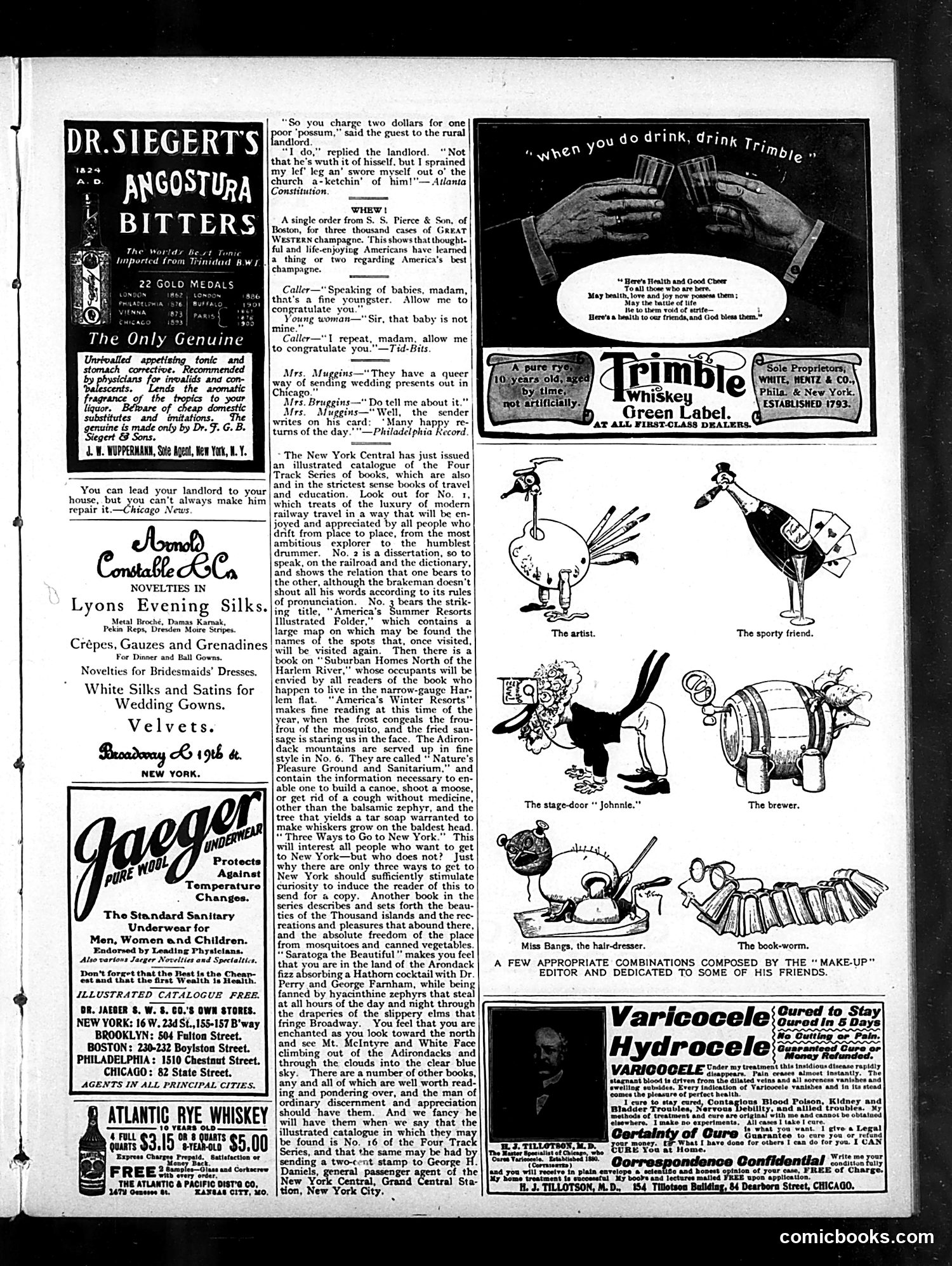
This page is primarily **advertising** with minimal editorial cartoon content. The small illustrated vignettes scattered throughout (titled "The artist," "The sporty friend," "The stage-door 'Johnnie,'" "The brewer," "Miss Bangs, the hair-dresser," and "The book-worm") appear to be humorous character sketches rather than political satire—depicting stereotypical social types of the era. The page's main text consists of product advertisements (Dr. Siegert's Angostura Bitters, fabric novelties, Dr. Jaeger's underwear, Atlantic Rye Whiskey, Trimble Whiskey) interspersed with short humor pieces and anecdotes about landlords, babies, and wedding gifts. The brief jokes rely on period-specific assumptions (rural landlords, possum-catching, champagne consumption as a marker of sophistication) but contain no identifiable political figures or events. This appears to be a typical **advertisements-and-humor** page from Judge magazine rather than a page dedicated to satire or commentary.
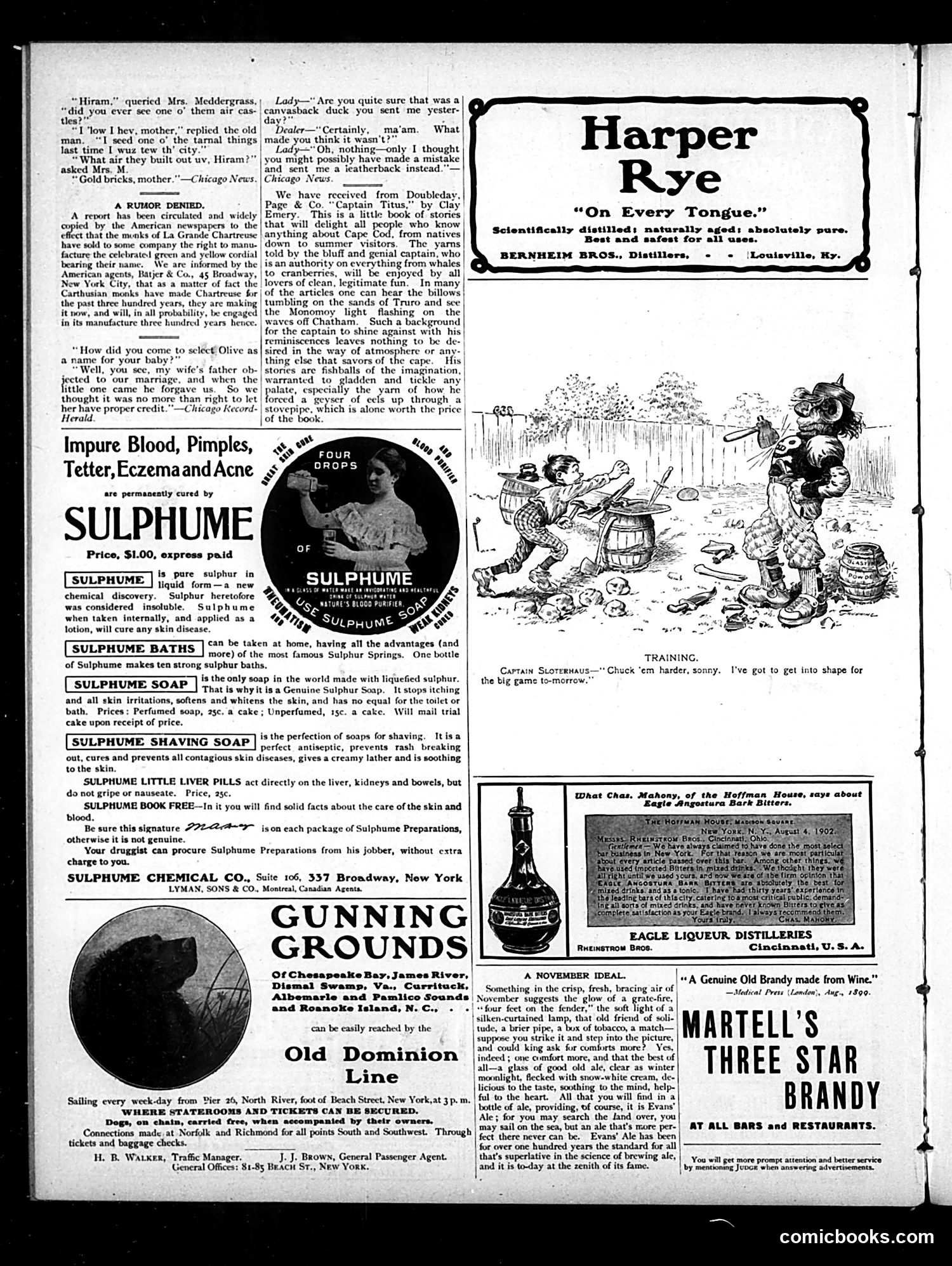
This page contains primarily **advertisements and brief humorous anecdotes** rather than political cartoons. The small illustrated cartoon shows a rural couple discussing "air cas[es]" (automobiles), with the husband claiming he saw one in the city, calling it made of "gold bricks"—a period slang term for a worthless swindle. This is gentle satire on early automobiles as expensive luxuries and on rural unfamiliarity with urban novelties. Other jokes involve a woman questioning whether a duck she received was actually a canvasback (expensive) or a cheaper substitute, and a father forgiving his objections to his daughter's marriage, allowing the baby to be named "Olive" as proper "credit" to him. **Most of the page is dominated by advertisements**: Sulphume (a patent medicine promising to cure skin conditions through liquid sulphur), Gunning Grounds (a steamship line), and liquor advertisements (Eagle Liqueur Distilleries and Martell's Brandy). The content reflects early 1900s consumer culture and the prevalence of dubious patent medicines marketed with pseudo-scientific claims.
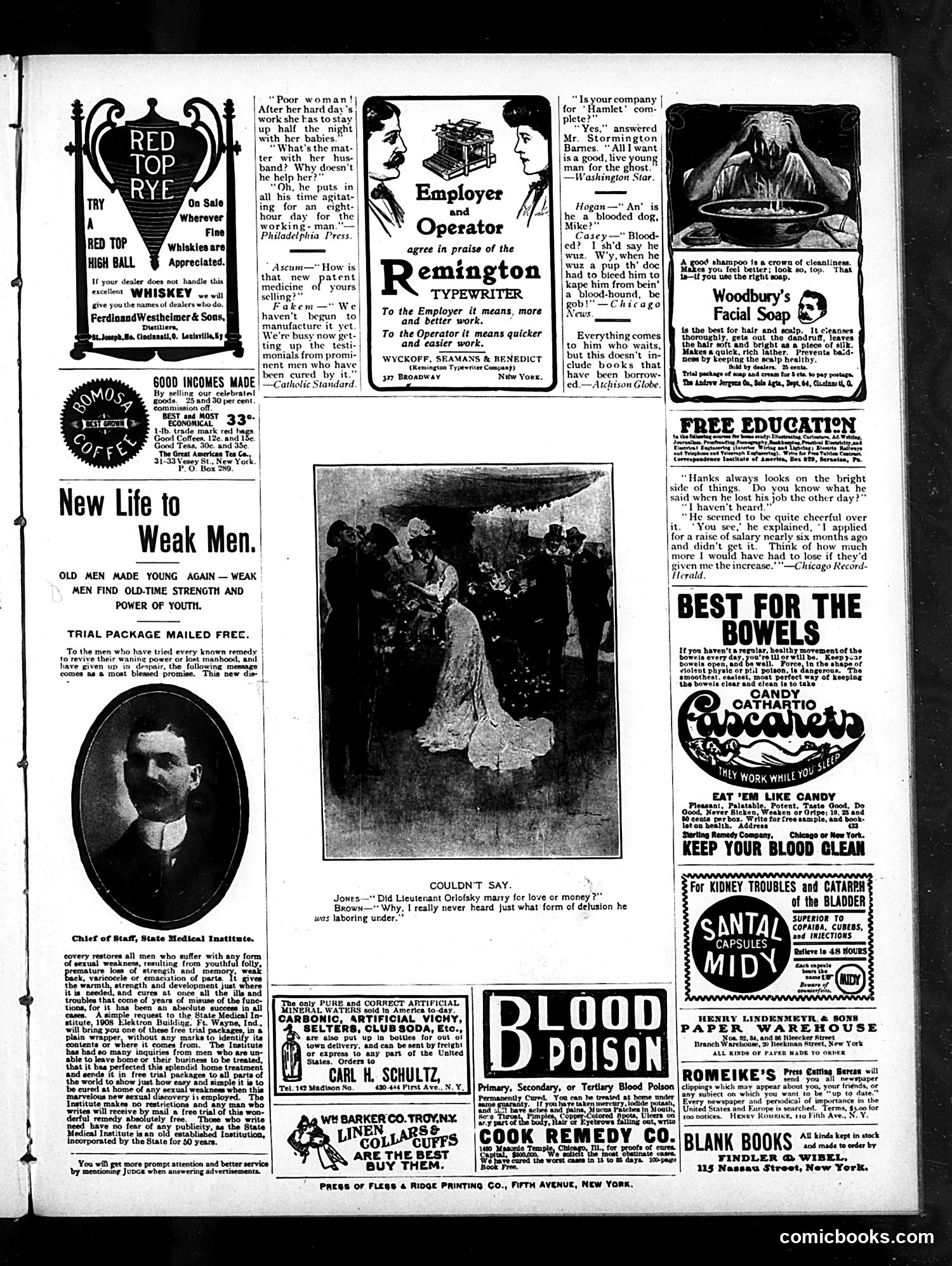
This page is primarily **advertising and humorous short jokes** rather than political cartoons. The content reflects early 20th-century American commercial culture and social attitudes. ## Key Elements: **Main Advertisements:** - Remington typewriters (emphasizing productivity for employers/operators) - Whiskey, patent medicines, and tonics (including dubious "cures" for male weakness) - Food/beverage products and beauty soaps **Humor/Jokes:** The brief comedic segments mock contemporary social issues: a husband neglecting his wife while engaging in labor activism; the challenge of borrowing books; conflicting motivations for marriage; and workplace dynamics. **Visual Content:** The central photograph shows what appears to be a formal social scene, though its specific satirical relevance isn't immediately clear from the visible text. **Notable Pattern:** The advertisements for "weak men" remedies and patent medicines reflect the era's pseudoscientific marketing and reflect period attitudes toward masculinity and health. The page exemplifies Judge's mix of satirical humor and commercial content typical of early-1900s American magazines.
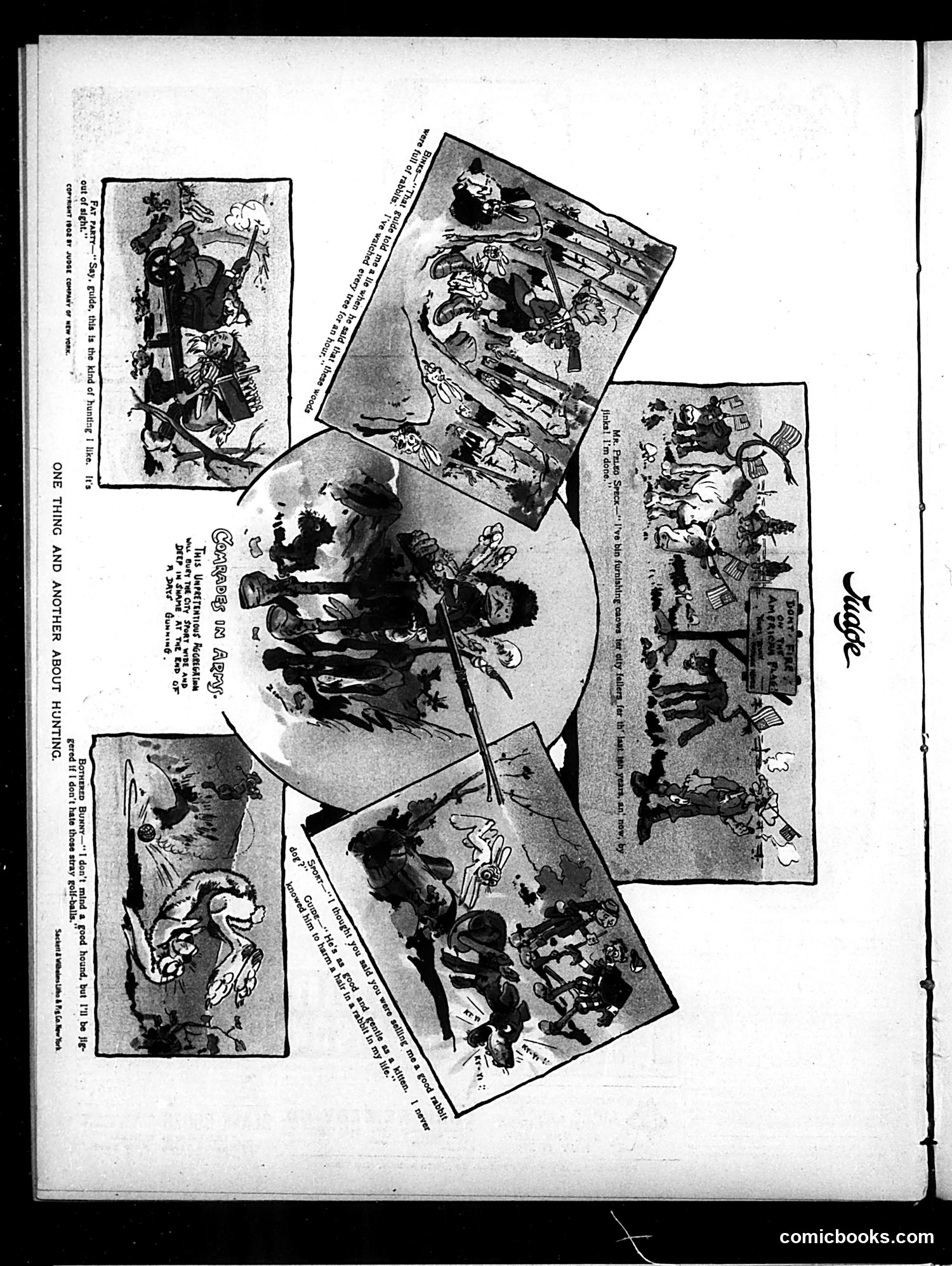
This page presents multiple satirical vignettes mocking different types of hunters and hunting experiences. The central circular image appears to show an urban "sport" engaged in what the caption describes as shameful activity—likely hunting stray golf balls in the city, a humorous contrast to traditional hunting. The bottom panel features a dialogue between what appears to be a wealthy city "dude" and a guide. The dude confesses to hating stray golf balls while ostensibly hunting, suggesting he's more interested in complaining about golf than actual hunting. This satirizes the pretentious leisure activities of wealthy urban dwellers attempting rural pastimes they don't genuinely understand or enjoy. The surrounding vignettes likely continue this theme, mocking various incompetent or absurd hunting scenarios. The satire targets the gap between romanticized hunting culture and the reality of inexperienced city folk playing at being outdoorsmen.