
Judge, 1902-11-08 · page 4 of 16
Judge — November 8, 1902 — page 4: what you’re looking at
What you’re looking at
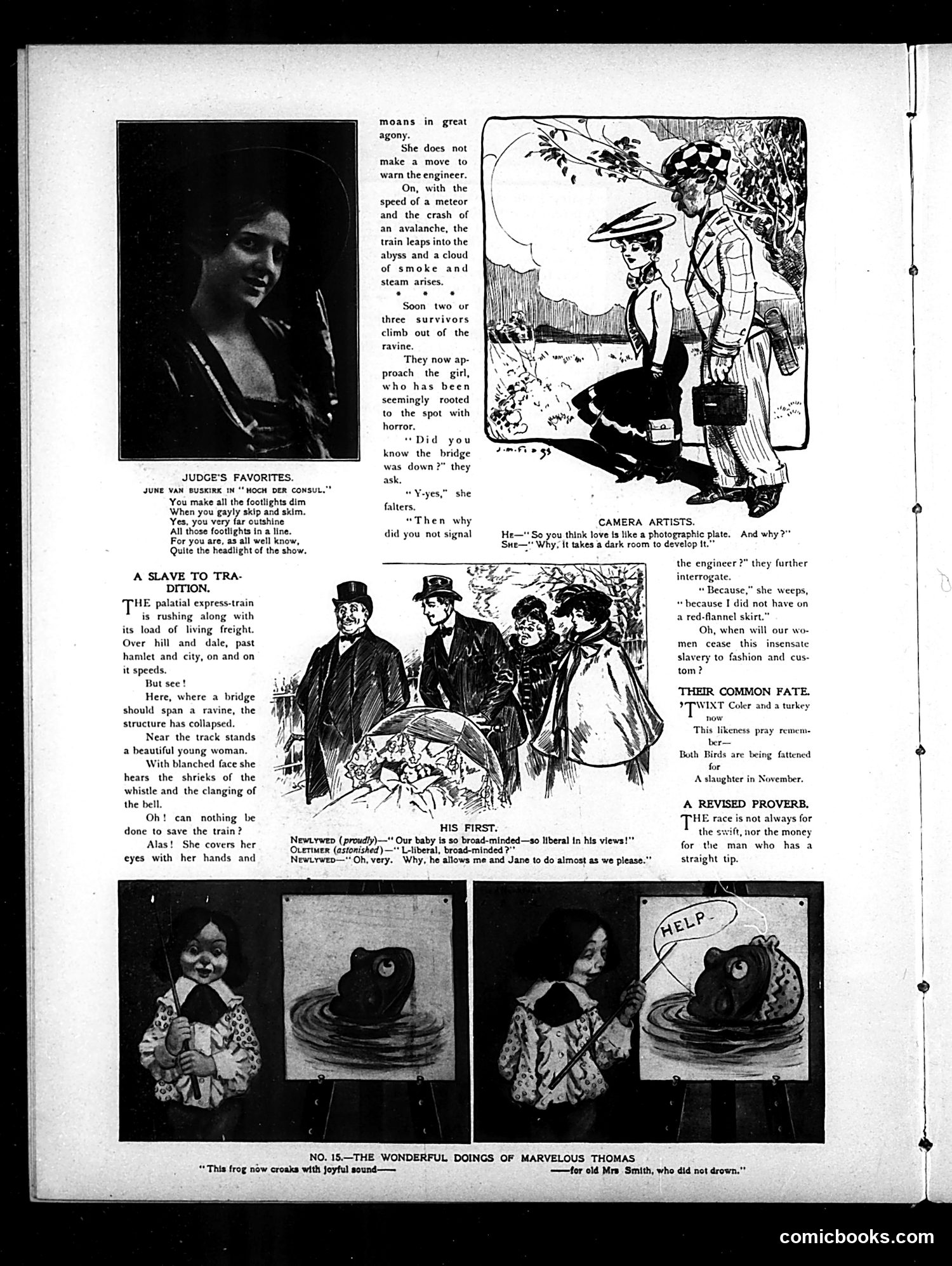
This page contains several satirical pieces from Judge magazine: **"A Slave to Tradition"** critiques blind adherence to social conventions, using a train disaster as metaphor. The poem suggests people follow destructive customs without question. **"Camera Artists"** appears to mock photographers or visual artists, with dialogue suggesting pretentious attitudes about their work and fashion criticism. **"His First"** shows what appears to be a character described as "so liberal in his views," with humor about tolerance. **Bottom panel** ("The Wonderful Doings of Marvelous Thomas") depicts a comedic sequence with a child and a frog in water, likely a humorous domestic scene. The overall tone suggests early-20th-century American social satire targeting conventional behavior, artistic pretension, and domestic humor. The specific political references are unclear without additional historical context.
📄 Transcribed text from this page (OCR, searchable)
Machine-transcribed from the original scan — historical spelling and the odd misread are preserved.
moans in great agony. She does not make a move to warn the engineer. On, with the speed of a meteor and the crash of an avalanche, the train leaps into the abyss and a cloud of smoke and steam arises. oe Soon two or three. survivors climb out of the ravine. ‘They now ap- proach the girl, who has been seemingly rooted to the spot with horror. “Did you know the bridge was down?" they JUDGE'S FAVORITES. ask. JUNE VAN BUSKIRK IN “'MOCM DER CONSUL.”* You make all the footlights dim When you gayly skip and skim. Yes, you very far outshine All those footlights in a line. For you are, as all well know, Quite the headlight of the show. *Y-yes," she falters. “Then why did you not signal CAMERA ARTISTS. So you think love {s like a photographic plate. And why?” ‘Why, it takes a dark room to develop {t."” A SLAVE TO TRA- DITION. HE. palatial express-train is rushing along with its load of living freight. Over hill and dale, past hamlet and city, on and on it speeds. But see! Here, where a bridge should span a ravine, the structure has collapsed. Near the track stands a beautiful young woman. With blanched face she hears the shrieks of the whistle and the clanging of the bell. Oh! can nothing be done to save the train? Alas! She covers her eyes with her hands and Newtywen (proudly). Overimer (axtonished) — NewLrwep— Oh, very. HIS FIRST. Our baby is so broad-minded—so liberal In his views! Liliberal, broad-minded ?”* Why, he allows me and Jane to do almost as we please.”” NO. 15.—THE WONDERFUL DOINGS OF MARVELOUS THOMAS the engineer ?” they further interrogate. + Because,” she weeps, “because I id not have on rt.” Oh, when will our wo- men cease this insensate slavery to fashion and cus- tom? ‘THEIR COMMON FATE. IT WIXT Coler and a turkey a red-flannel s This likeness pray remem. ber— Both Birds are being fattened for A slaughter in November. A REVISED PROVERB. THE race is not always for the swift, nor the money for the man who has a straight tip. “This frog now croaks with joyful souné—— —or old Mrs Smith, who did not drown.” comicbooks.com