
Judge, 1902-11-08 · page 6 of 16
Judge — November 8, 1902 — page 6: what you’re looking at
What you’re looking at
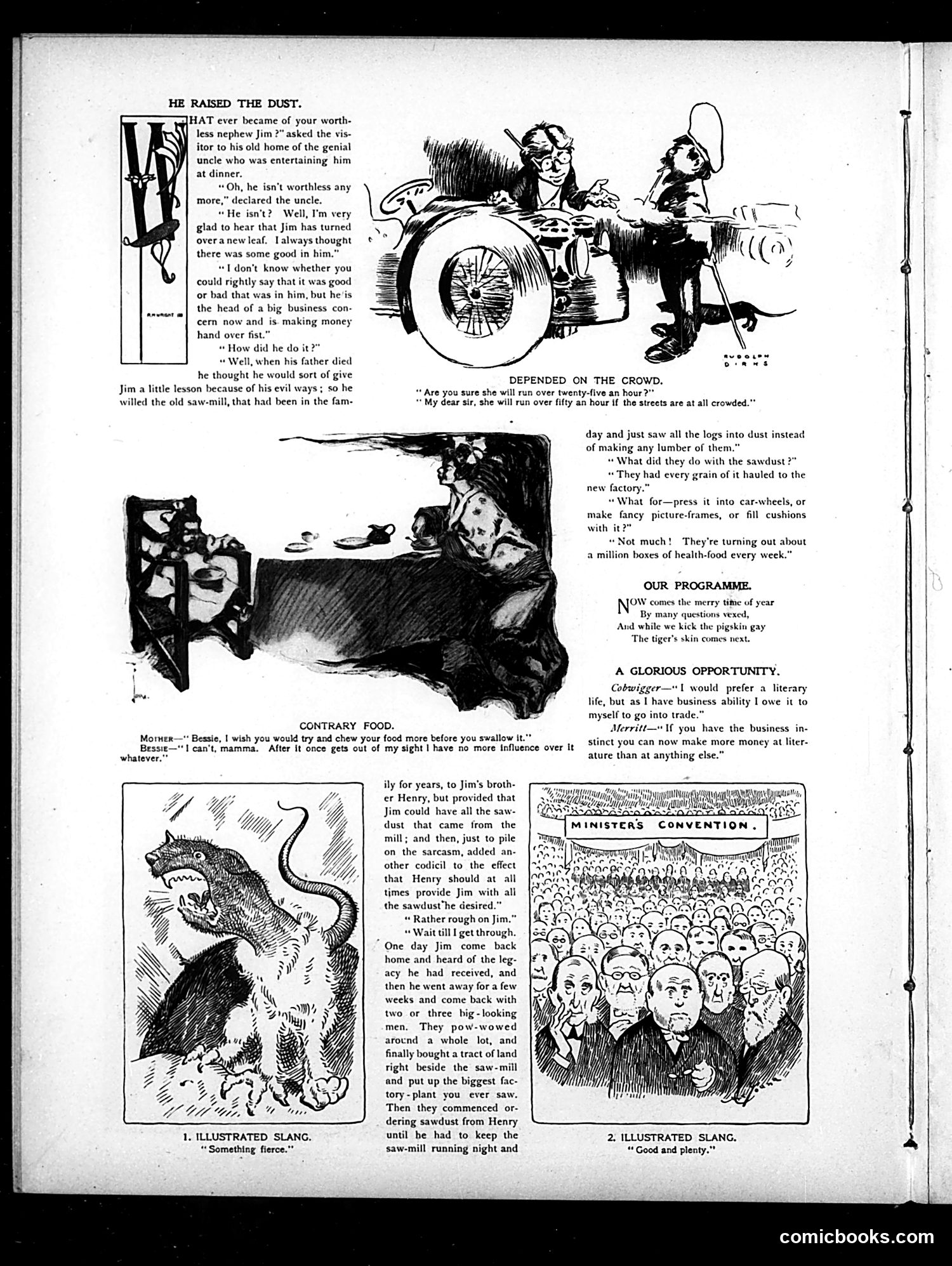
This page satirizes **American entrepreneurial ingenuity and industrial transformation** in the late 19th/early 20th century. **Main Story ("He Raised the Dust"):** A supposedly worthless nephew, Jim, is left only sawdust from his father's will as punishment—while his brother Henry inherits the profitable saw mill. Rather than accept defeat, Jim and investors build a massive factory beside the mill, converting sawdust into health-food boxes. They buy all Henry's sawdust output, forcing him to operate the mill continuously to supply them. The satire mocks how American businessmen could turn apparent liabilities into gold through industrial innovation and relentless capitalist ambition. **Supporting Content:** Additional brief jokes include a car's speed depending on street crowding, a child who won't chew food ("no influence once out of sight"), and wordplay on "illustrated slang" phrases. The overall message celebrates—with gentle irony—American business acumen: even sawdust becomes profitable when entrepreneurial energy meets industrial scale.
📄 Transcribed text from this page (OCR, searchable)
Machine-transcribed from the original scan — historical spelling and the odd misread are preserved.
| HAT ever became of your worth- less nephew Jim ?" asked the vis- itor to his old home of the genial uncle who was entertaining him at dinner. “Oh, he isn’t worthless any more,” declared the uncle. “He isn’t? Well, I'm very glad to hear that Jim has turned overanewleaf, [always thought there was some good in him.” “I don't know whether you could rightly say that it was good or bad that was in him, but he'is the head of a big business con- cern now and is. making money hand over fist.” “ How did he do it?” « Well, when his father died he thought he would sort of give Jim a little lesson because of his evil ways; so he willed the old saw-mill, that had been in the fam- CONTRARY FOOD. Morner— Bessie, | wish you would try and chew your food more before you swallow it.”” “I can't, mamma. After it once gets out of my sight | have no more influence over It Bessit whatever." 1, ILLUSTRATED SLANG. “Something fierce." DEPENDED ON THE CROWD. re you sure she will run over twenty-five an hour?” " My dear sir, she will run over fifty an hour if the streets are at all crowded.”” day and just saw all the logs into dust instead of making any lumber of them.” “ What did they do with the sawdust ?” “ They had every grain of it hauled to the new factory.” “What for—press it into car-wheels, or make fancy picture-frames, or fill cushions with it?” Not much! They're turning out about a million boxes of health-food every week.” OUR PROGRAMME. NOW comes the merry time of year By many questions vexed, And while we kick the pigskin gay The tiger's skin comes next. A GLORIOUS OPPORTUNITY. Cobwigger—“\ would prefer a literary life, but as I have business ability Lowe it to myself to go into trade. Merritt— If you have the business in- stinct you can now make more money at liter- ature than at anything else.” ily for years, to Jim's broth- er Henry, but provided that Jim could have all the saw- dust that came from the mill ; and then, just to pile the sa , added an- CURRIN | on the sarcasm, added an: TT A | Aah ay other codicil to the effect [rm Wo nin pe caw heh ) that Henry should at all |O°A¥ caf times provide Jim with all JOA20 1 eGR ERO? the sawdust’he desired. rN ade LEA « Rather rough on Jim.” PN eG “ Wait till I get through. “One day Jim come back home and heard of the leg- acy he had received, and then he went away for a few weeks and come back with two or three hig -looking men, They pow-wowed arocnd a whole lot, and finally bought a tract of land right beside the saw-mill and put up the biggest fac- tory-plant you ever saw. Then they commenced or- dering sawdust from Henry until he had to keep the saw-mill running night and 2, ILLUSTRATED SLANG. “Good and plenty." comicbooks.com >»