
A complete issue · 16 pages · 1902
Judge — August 30, 1902
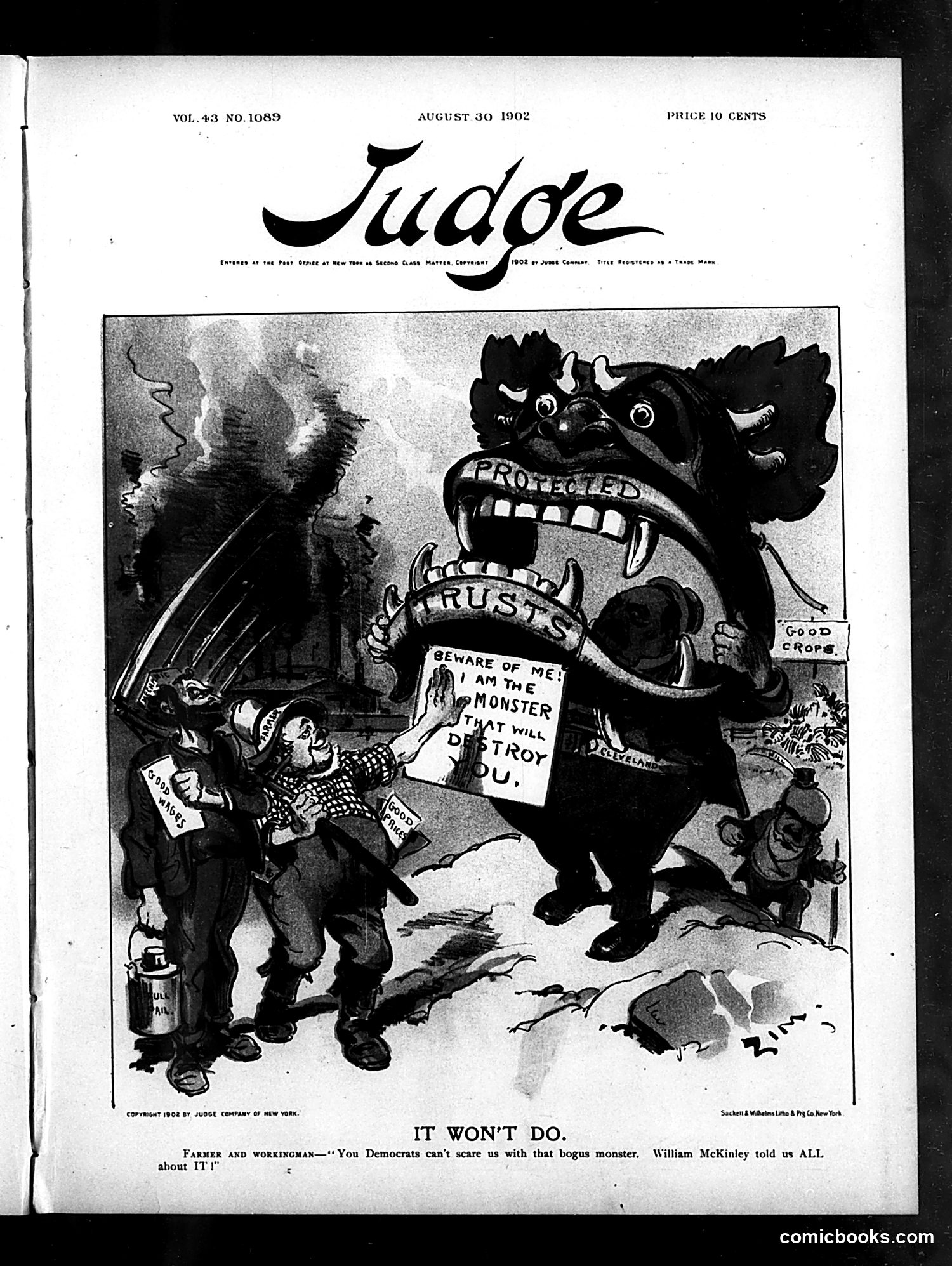
This political cartoon satirizes Democratic attempts to use William McKinley as a scare tactic during the 1902 election cycle. The large monster labeled "PROTECTED TRUSTS" and "CRUSHED" represents corporate monopolies—a major political issue of the Progressive era. Two figures labeled as a "Farmer and Workingman" dismiss the monster threat, with one stating: "You Democrats can't scare us with that bogus monster. William McKinley told us ALL about IT!" The satire suggests McKinley's Republican administration had already addressed trust concerns so effectively that Democratic fearmongering about unchecked corporate power rang hollow. The "Good Crops" notation indicates economic prosperity under McKinley, further undercutting Democratic campaign messaging.
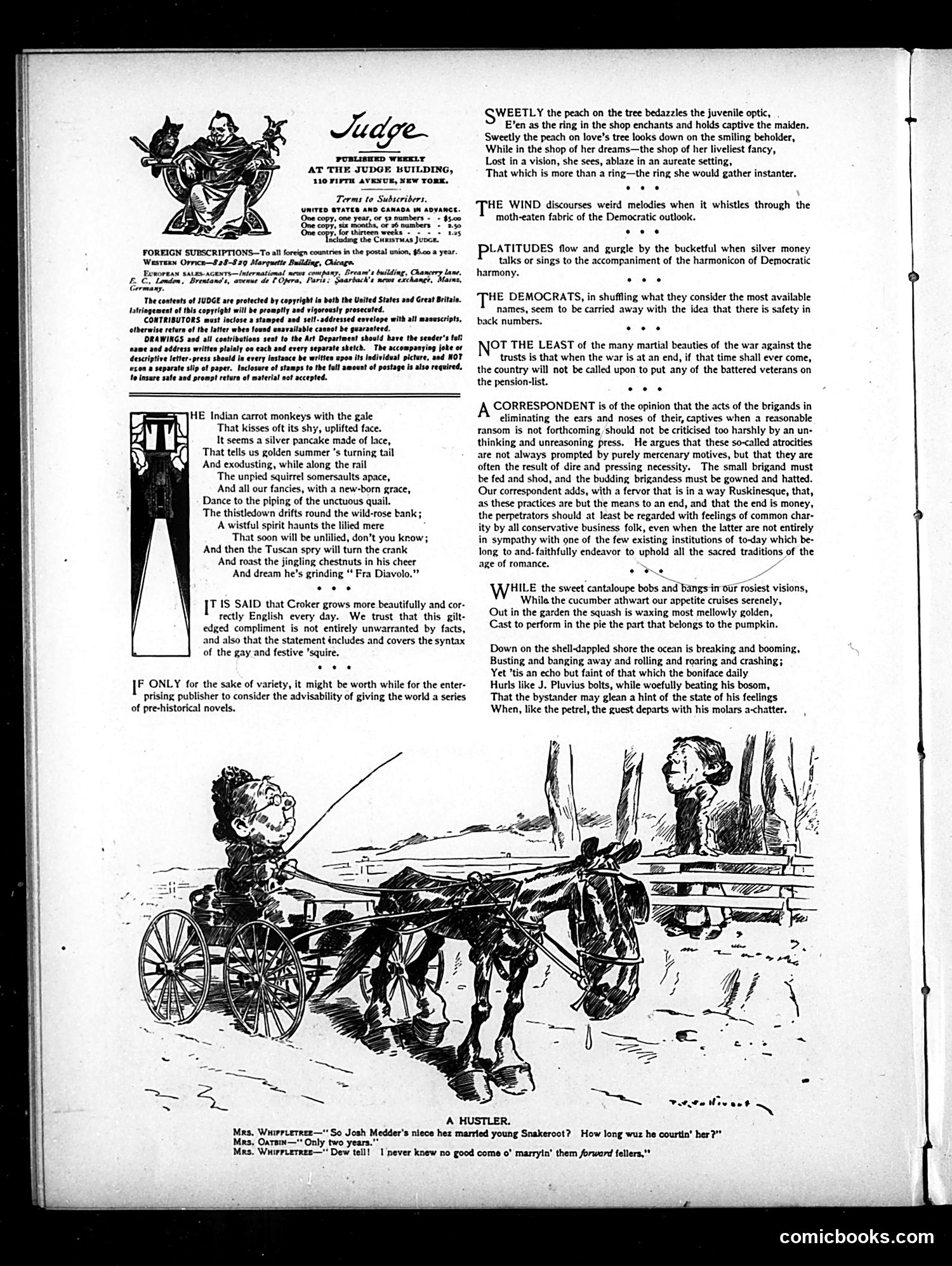
This Judge magazine page contains editorial commentary and a cartoon titled "A Hustler." The main illustration depicts two figures with a horse and cart on a rural road—one driving, one riding. The dialogue below reads: "Mrs. Whiffletree—'So Josh Medder's niece has married young Snakeroot? How long was he courtin' her?' Mrs. Catton—'Only two years.' Mrs. Whiffletree—'De tell! I never knew no good come o' maryin' them Jonseril fellers.'" This appears to be rural/folk humor about courtship and marriage, poking fun at local characters and family reputations in small-town America. The term "hustler" likely refers sarcastically to the suitor's courtship efforts. The surrounding editorial text discusses war brigades, Democratic politics, and press criticism—standard Judge magazine commentary—but relates separately from this cartoon's domestic humor.
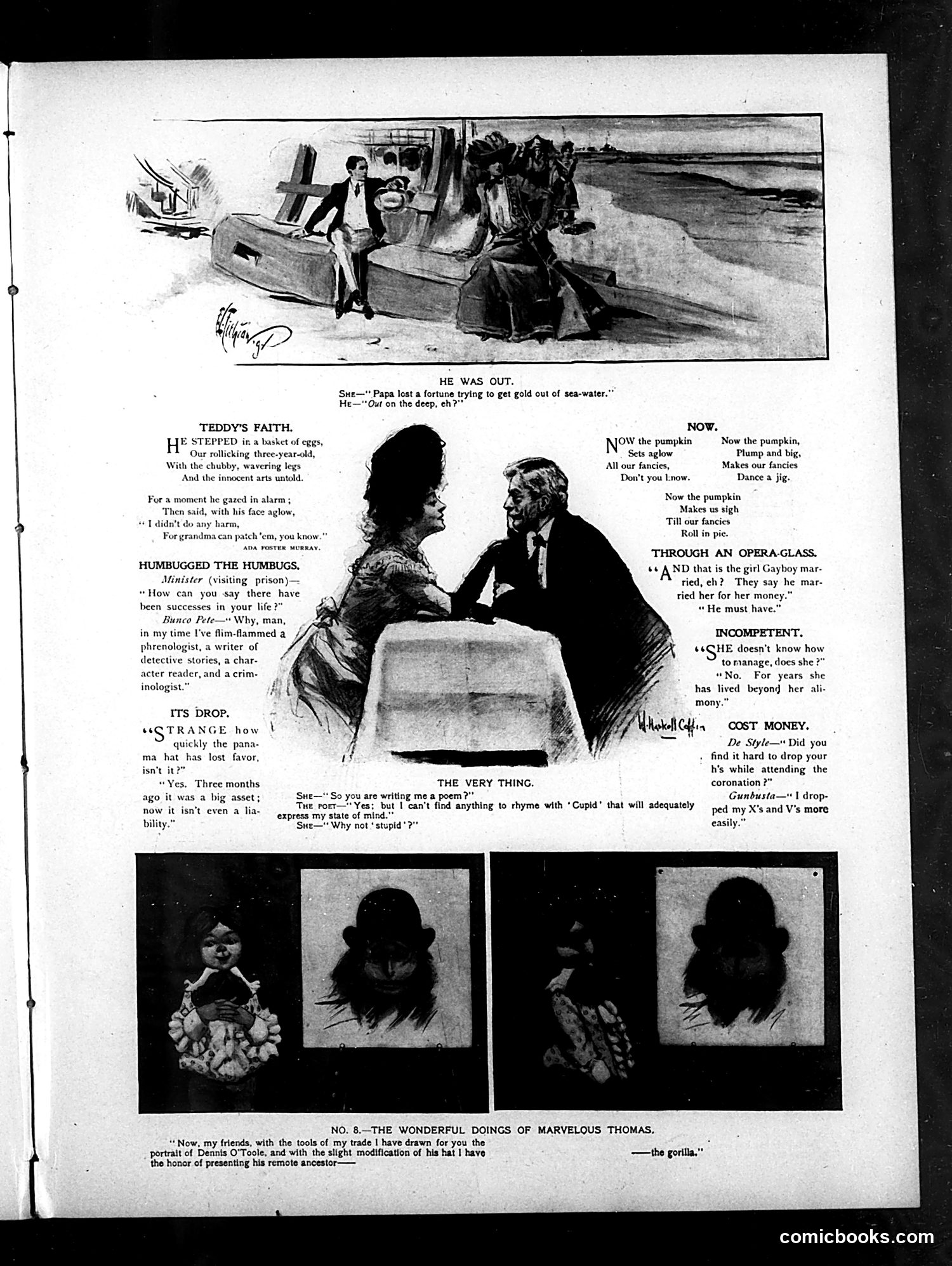
This page contains several unrelated satirical pieces typical of Judge magazine's format. The top illustration shows a beach scene with the caption "HE WAS OUT," depicting a man and woman at the seaside with dialogue about losing a fortune trying to extract gold from seawater—satirizing get-rich-quick schemes. The center contains brief humorous sketches with titles like "TEDDY'S FAITH," "HUMBUGGED THE HUMBUG," and "ITS DROP," offering social commentary through short dialogic exchanges. The bottom section titled "NO. 8—THE WONDERFUL DOINGS OF MARVELOUS THOMAS" appears to be an ongoing satirical series, with photographs allegedly showing someone's claimed magical abilities transforming a gorilla into a human, mocking spiritualist frauds or charlatan performers popular in the early 20th century. The overall tone targets various contemporary follies and deceptions.
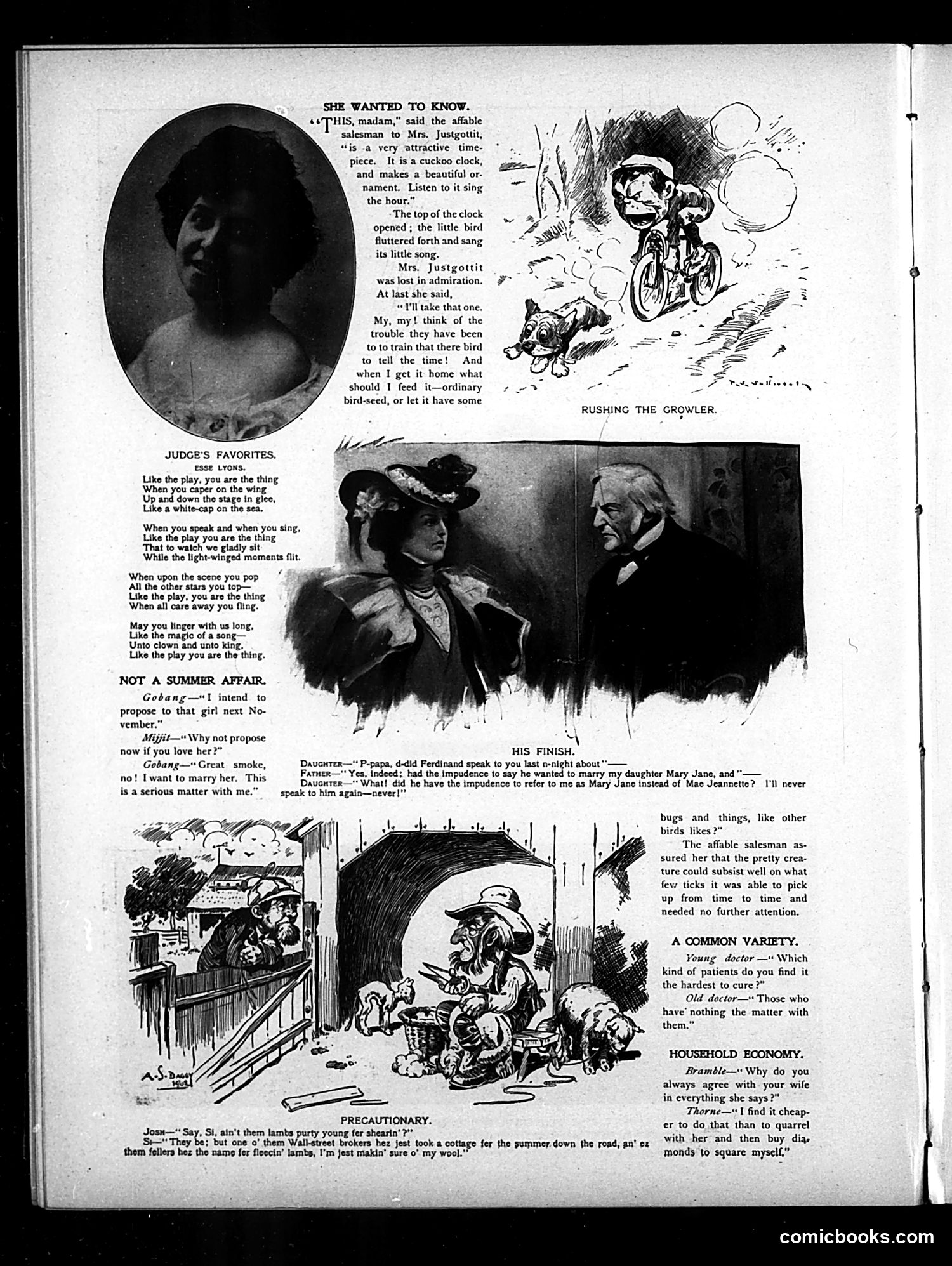
This page contains several humor pieces and illustrations typical of Judge's style. The top section "She Wanted to Know" depicts a salesman discussing a cuckoo clock with a Mrs. Juggotilt, who becomes enchanted by the bird and considers buying one—the joke being her naive enthusiasm for a simple mechanical toy. "Judge's Favorites" presents a poem about theatrical performance. Lower sections include brief comic dialogues about marriage proposals ("Not a Summer Affair"), medical practice ("A Common Variety"), and household economics. The illustrations use exaggerated character types and working-class scenarios common to Judge's satirical approach. The humor targets domestic life, commerce, and social pretension rather than specific political figures or events. The overall tone is genteel comedy aimed at middle-class readers.
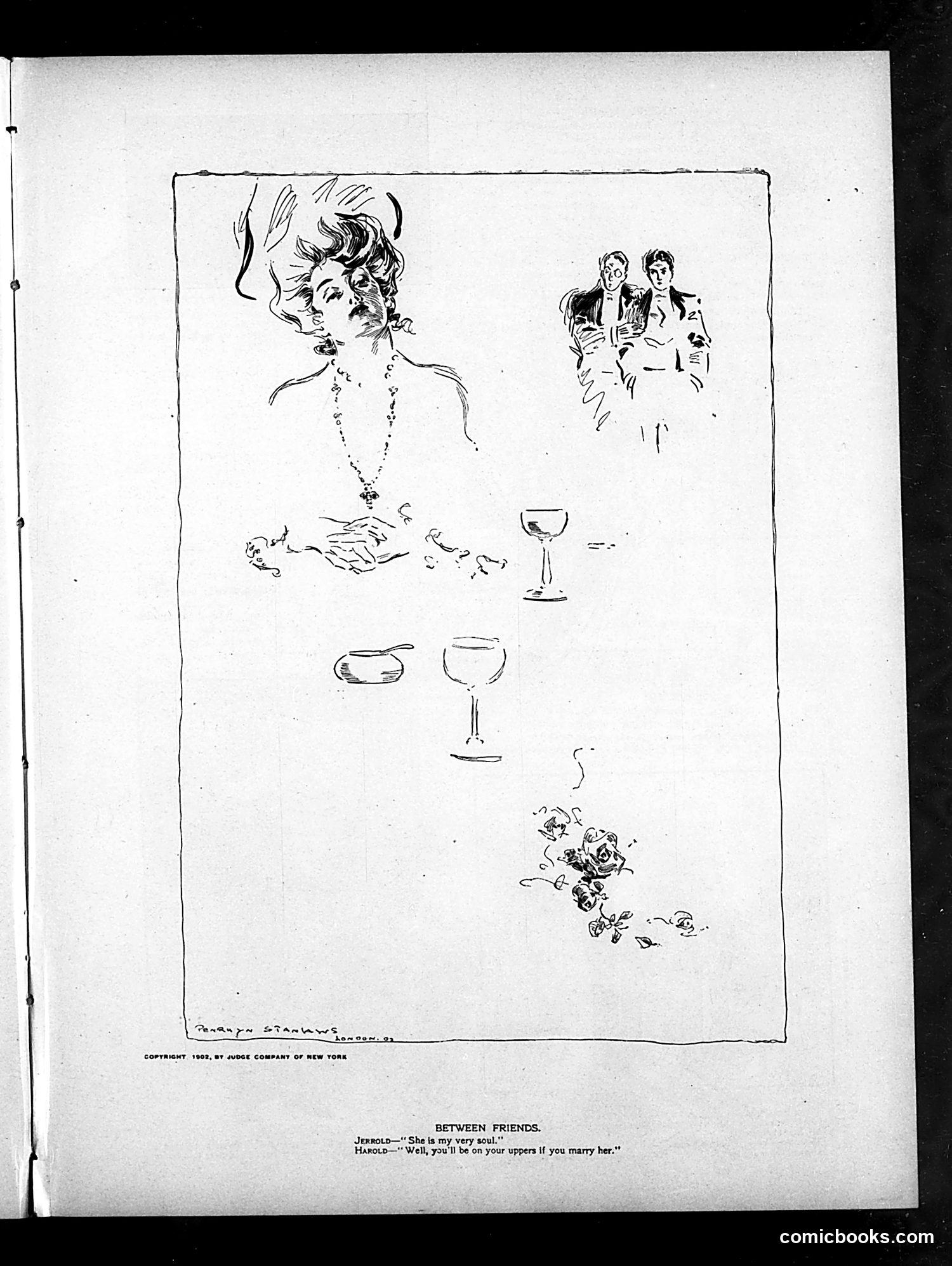
This is a romantic/financial satire. The cartoon depicts two men discussing a woman—one (labeled "Jerrold") declares she is his "very soul," expressing romantic devotion. His friend "Harold" responds with practical cynicism, warning that marrying her will leave him financially ruined ("on your uppers" is period slang for being destitute). The joke contrasts romantic idealism with economic reality. The sketched elements—champagne glasses, flowers, and the woman's fashionable appearance with jewelry—suggest she's either expensive to maintain or comes from wealth expectations. The satire mocks both the sentimental lover blind to practical concerns and, implicitly, the financial burden women (or wives) represented in early 20th-century middle-class consciousness. It's a cynical commentary on marriage and male anxiety about spousal expenses.
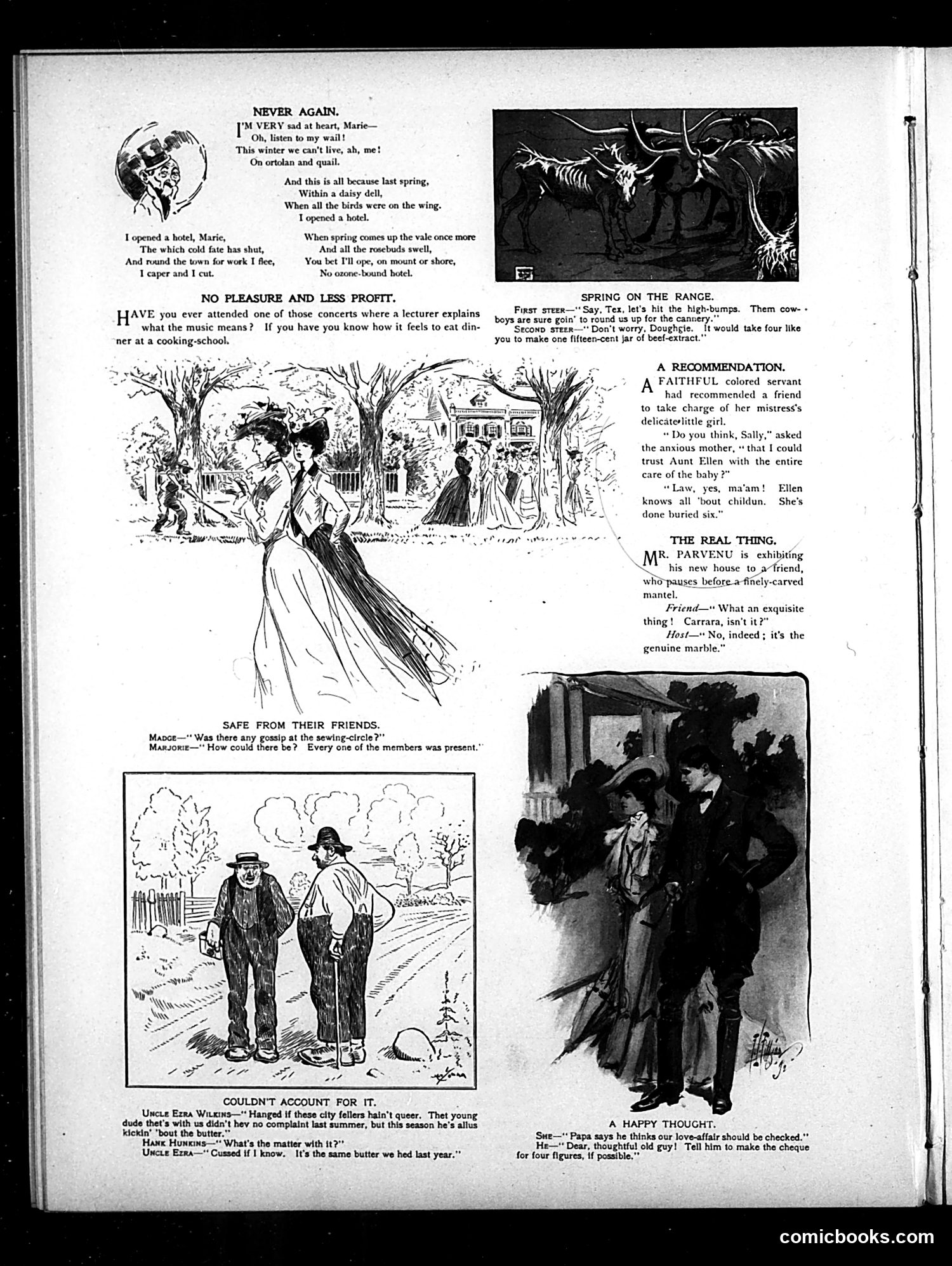
This page contains several brief satirical vignettes typical of early 20th-century American humor: **"Never Again"** mocks a man who opened a bird hotel during spring migration, ruining the local bird population for hunting. Now impoverished, he can no longer afford luxuries like ortolan and quail—the very birds he displaced. **"No Pleasure and Less Profit"** compares attending a lecture-concert explaining music to eating dinner at a cooking school: both are tedious educational experiences rather than genuine enjoyment. **"Safe From Their Friends"** jokes that a sewing circle couldn't gossip because all members were present—implying women gossip about those absent. **"Couldn't Account For It"** features rural characters (Uncle Ezra Wilkins, Hank Hunkins) puzzled why a city visitor complains about butter this season when it's identical to last year's—subtle mockery of city folk's pretension. **"A Happy Thought"** and **"The Real Thing"** are brief quips about servant recommendations and genuine versus imitation marble. The humor relies on period social stereotypes and class-based comedy.
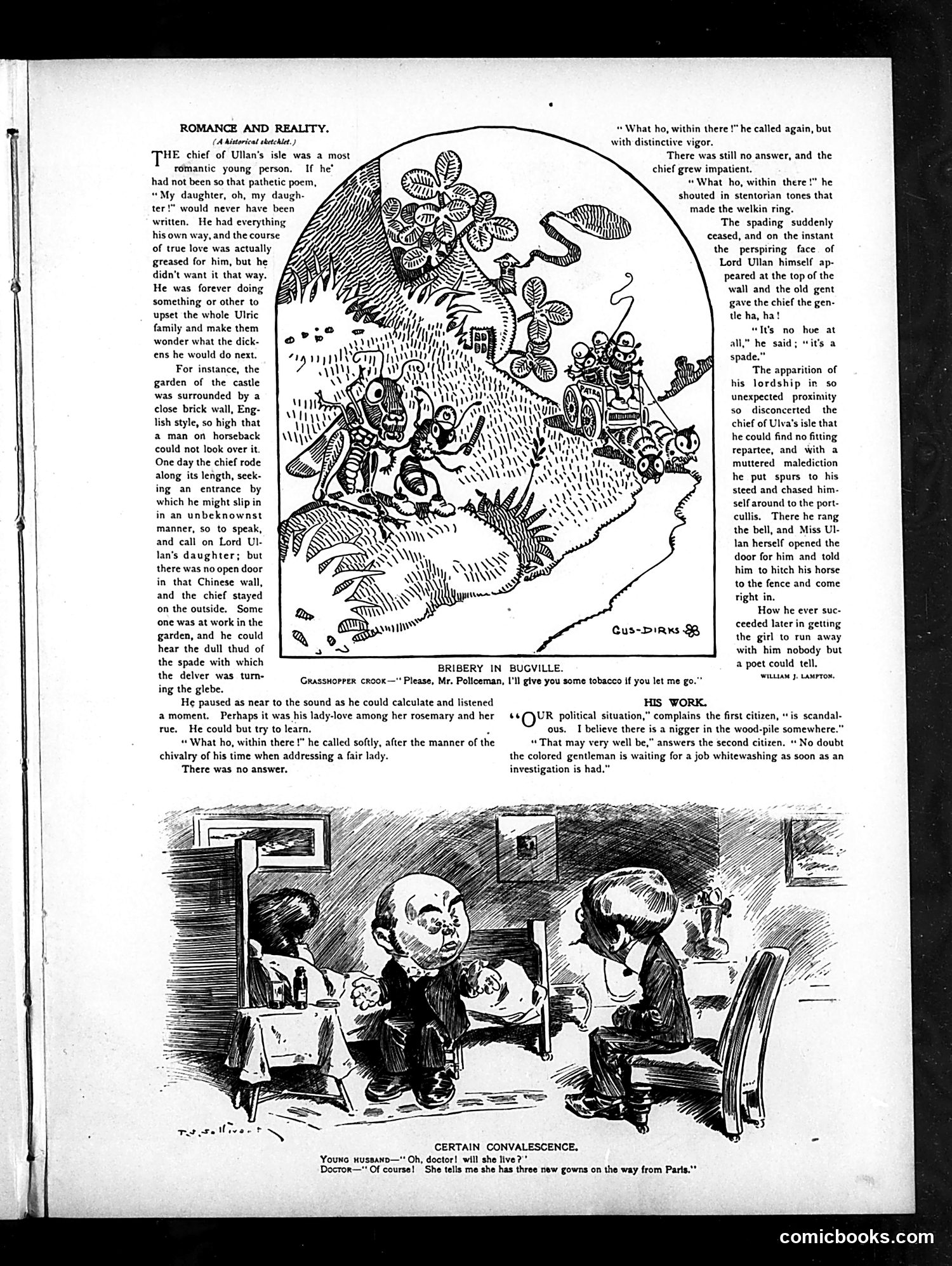
**Top Story ("Romance and Reality"):** A humorous historical sketch mocking romantic ideals versus practical reality. A lovestruck chief attempts to court a maiden by calling over her father's garden wall, mishearing "spade" as "hoe"—a pun suggesting his romantic incompetence. The joke: despite his elaborate courtship attempts, the girl simply runs away with him later, making all his scheming pointless. **"Bribery in Bugville" Cartoon:** A grasshopper offers tobacco to a policeman to escape arrest—crude satire on municipal corruption and bribery in American politics/law enforcement. **"His Work" Dialog:** Political commentary about corruption ("a nigger in the wood-pile"—period slang for hidden problems). The second citizen quips that the "colored gentleman" awaits a whitewashing job once investigations conclude—suggesting officials will be conveniently exonerated through corrupt means. **"Certain Convalescence":** A doctor assures a worried husband his wife will recover because she's purchasing new Parisian gowns—satirizing shallow materialism as life-affirming. These pieces reflect Judge's typical satirical tone on politics, social pretension, and moral hypocrisy.
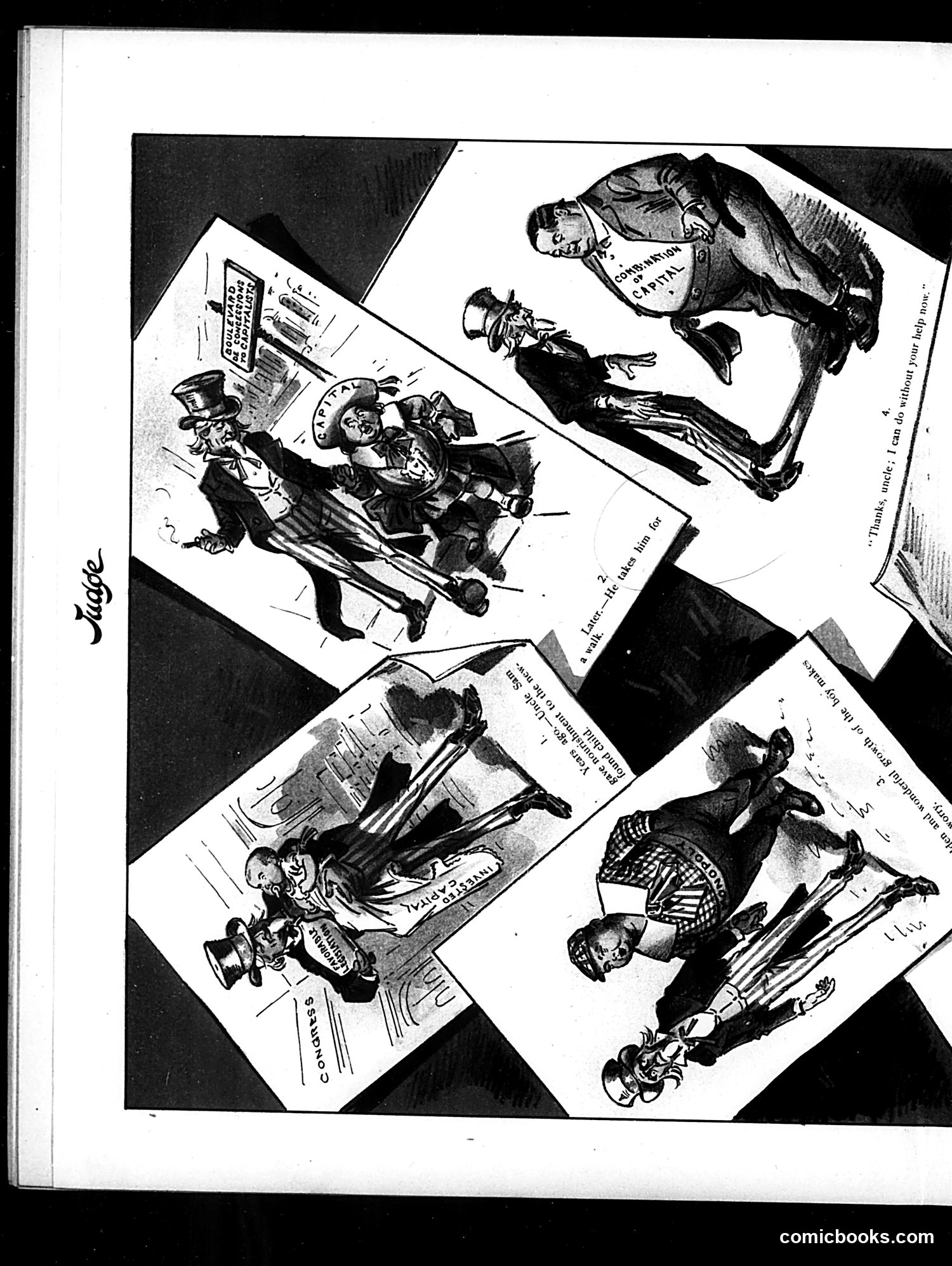
I can see this is a page from *Judge* magazine showing multiple cartoon panels arranged at angles on a black background, but the OCR text provided is essentially unreadable gibberish and doesn't correspond to what's visible in the image. From the IMAGE alone, I can observe: The page contains several black and white satirical illustrations featuring men in period dress (appearing to be late 19th or early 20th century), some wearing top hats and formal attire. The figures appear to be engaged in various exaggerated poses and situations typical of political satire. However, without legible captions or text, I cannot definitively identify the specific political figures, events, or satirical points being made. To properly analyze this cartoon's meaning, legible text would be essential.
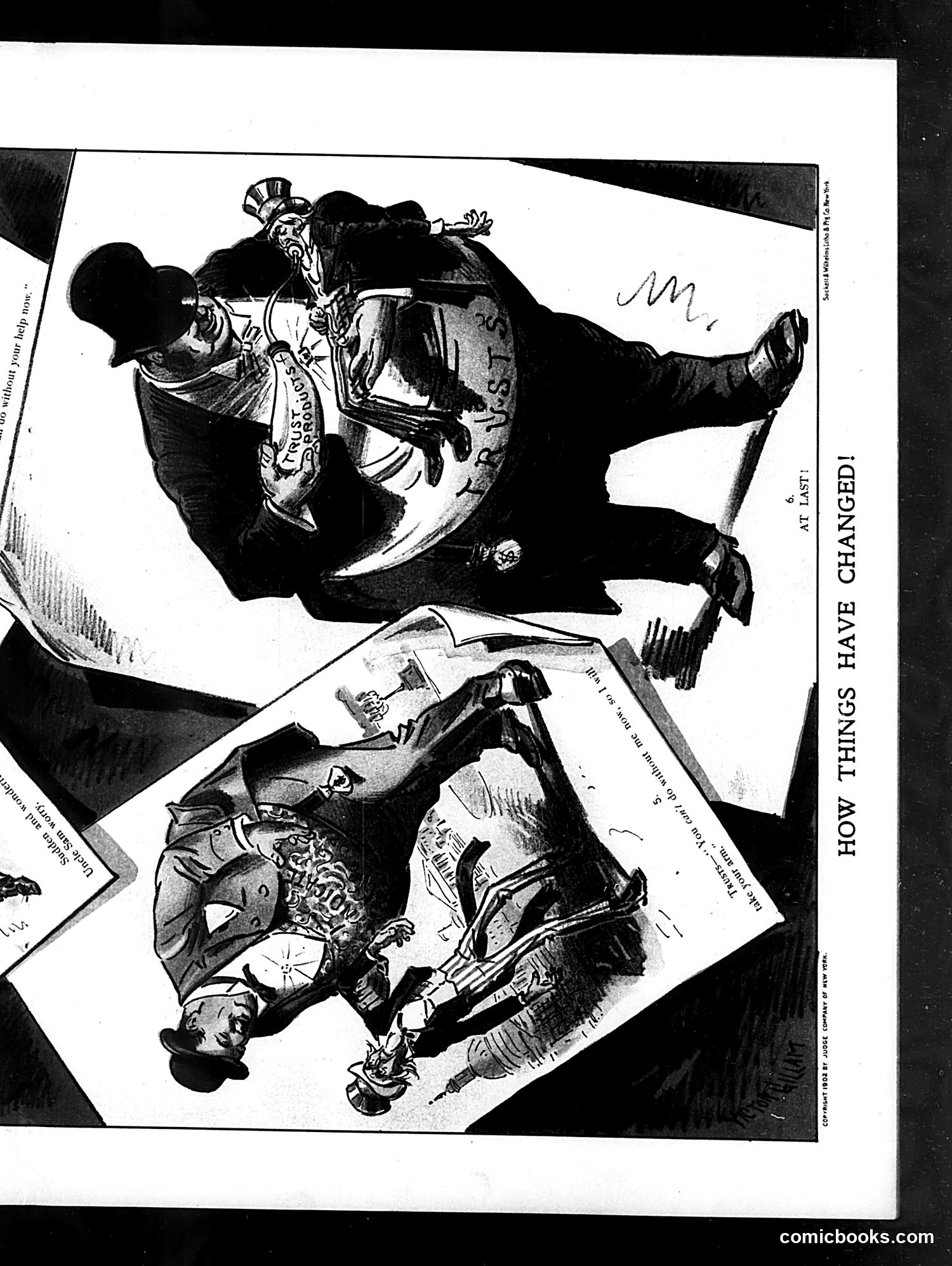
I can see this is a page from *Judge* magazine showing political cartoons with exaggerated caricatures of men in formal dress. The title reads "HOW THINGS HAVE CHANGED!" However, the OCR text is largely illegible, making it difficult to identify the specific figures or historical context with confidence. The artwork shows what appears to be caricatured politicians or public figures in different poses across multiple panels, suggesting a commentary on political change or behavior over time. Without readable text identifying the subjects or the specific historical moment being satirized, I cannot reliably explain which figures are depicted or what events are being referenced. To accurately interpret this cartoon's political point, I would need either clearer text or additional contextual information about the magazine's publication date.
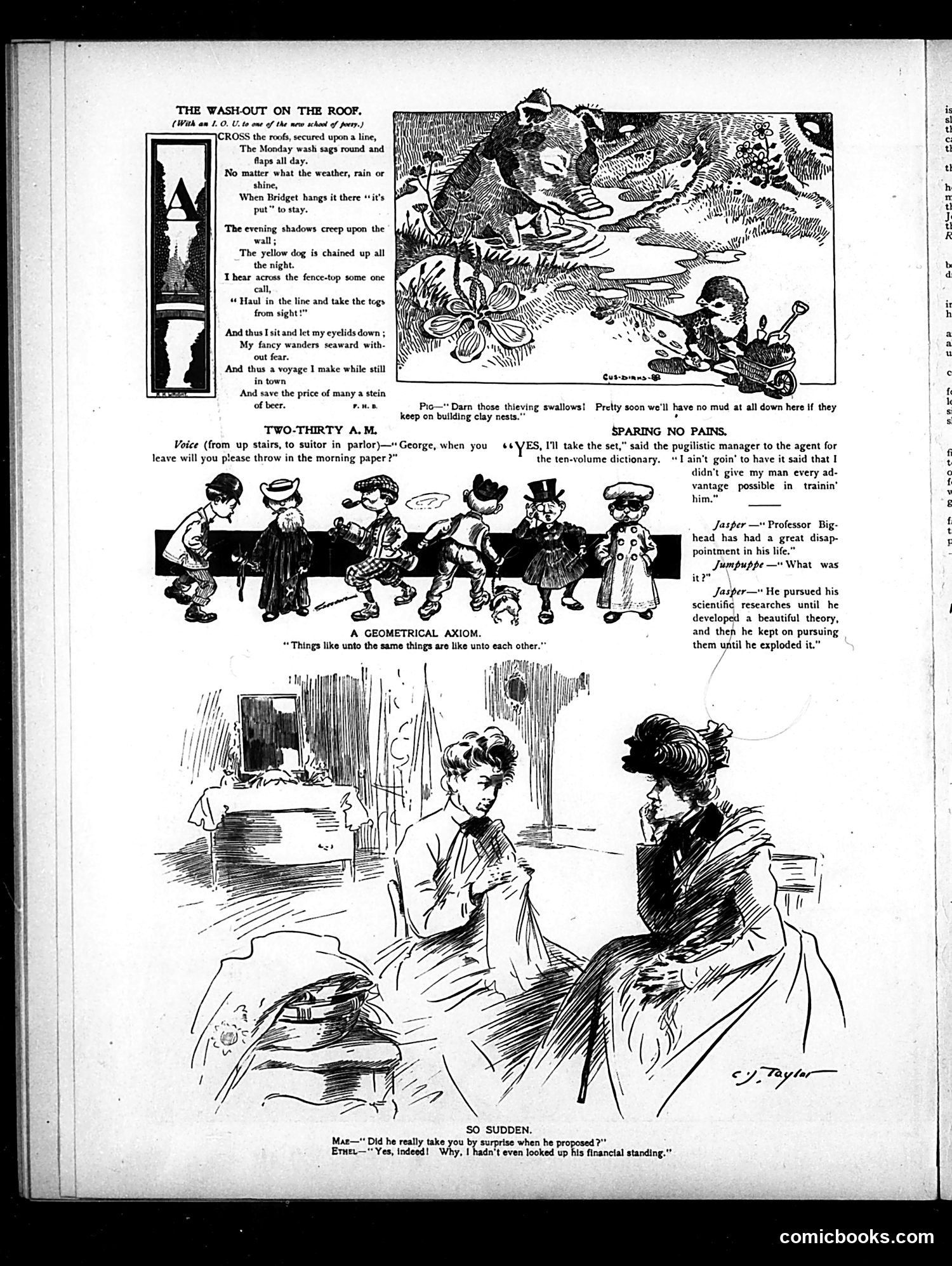
This page contains several unrelated satirical items typical of early-20th-century humor magazines: **"The Wash-Out on the Roof"** parodies contemporary "free verse" poetry by presenting mundane laundry-hanging as pseudo-literary subject matter—mocking the new poetic movement's elevation of ordinary domestic scenes. **"Two-Thirty A.M."** jokes about a suitor being asked to retrieve the morning newspaper before leaving a woman's house at an unseemly hour, implying impropriety. **"A Geometrical Axiom"** presents simple-minded logic through children's dialogue. **"Sparing No Pains"** satirizes a boxing manager equipping his fighter with a ten-volume dictionary for "training"—absurdly conflating intellectual and physical preparation. **"So Sudden"** presents a woman surprised by a marriage proposal, but her concern is financial due diligence rather than romance—satirizing matrimonial mercenary attitudes. The illustrations employ caricature and exaggeration typical of the era's cartooning style.
This page is primarily **advertisements** interspersed with brief humorous anecdotes typical of early 20th-century American magazines. The text-based humor includes: 1. **Church-sleeping husband joke**: A wife is glad her husband slept through a sermon criticizing women's clothing expenses—so she won't hear him repeat it. 2. **George Washington anecdote**: A satirical take on Washington's legendary work ethic, showing an aide waking him after brief sleep to continue his duties. 3. **Young couple disclosure**: An engagement reveal where a floor-walker at a department store confesses his job to an heiress—who reveals she works in the same store's ribbon department. 4. **Teacher/flag joke**: Crude humor where schoolboys claim the flag tops the flagpole simply because "that's where the flag-pole is"—missing the patriotic significance. The **advertisements** showcase period products: Packer's Tar Soap, Mennen's Talcum Powder, Dr. Siegert's Bitters, and others—typical of magazine monetization in this era. No political cartoons are visible; this is a **humor and advertising page**.
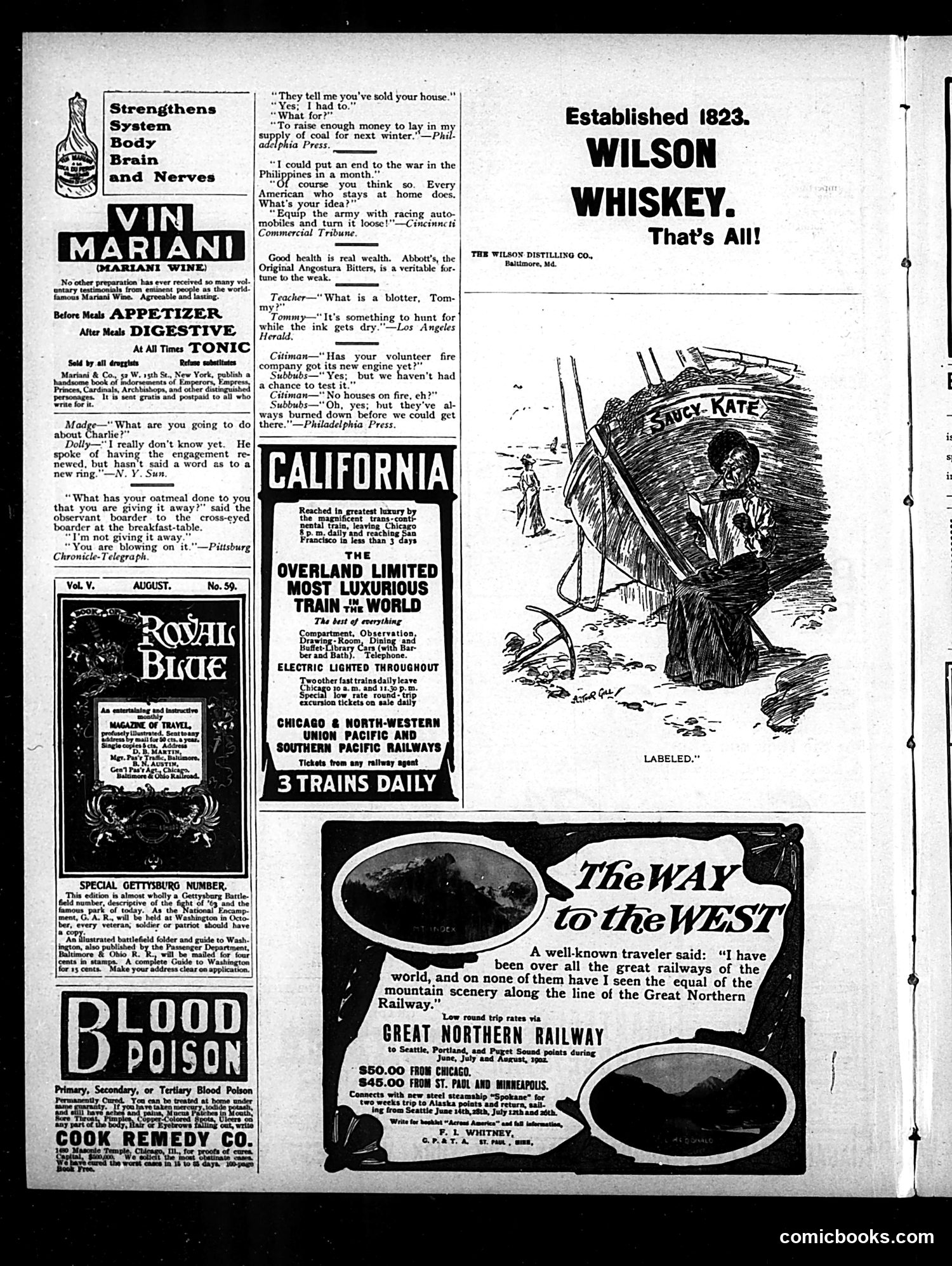
This page from Judge (established 1823) is primarily **advertising**, with several short humorous anecdotes scattered throughout. The main satirical content addresses **early-20th-century American concerns**: coal shortages (forcing home sales), the **Philippine-American War** (with a joke about ending it via racing automobiles), and volunteer fire departments' ineffectiveness. These jokes mock contemporary anxieties and bureaucratic incompetence. The cartoons include a sketch labeled "LABELED" (depicting someone with a boat named "NANCY-KATE"), and an illustration for the Great Northern Railway showcasing scenic mountain travel. The bulk of the page consists of patent medicine advertisements (Vin Mariani wine, Abbott's Bitters, Cook Remedy) typical of the era, plus railroad promotions for luxury train travel to California and the West. These ads reflect Gilded Age consumer culture and the era's unregulated pharmaceutical industry. The humor is light, observational comedy aimed at middle-class readers.
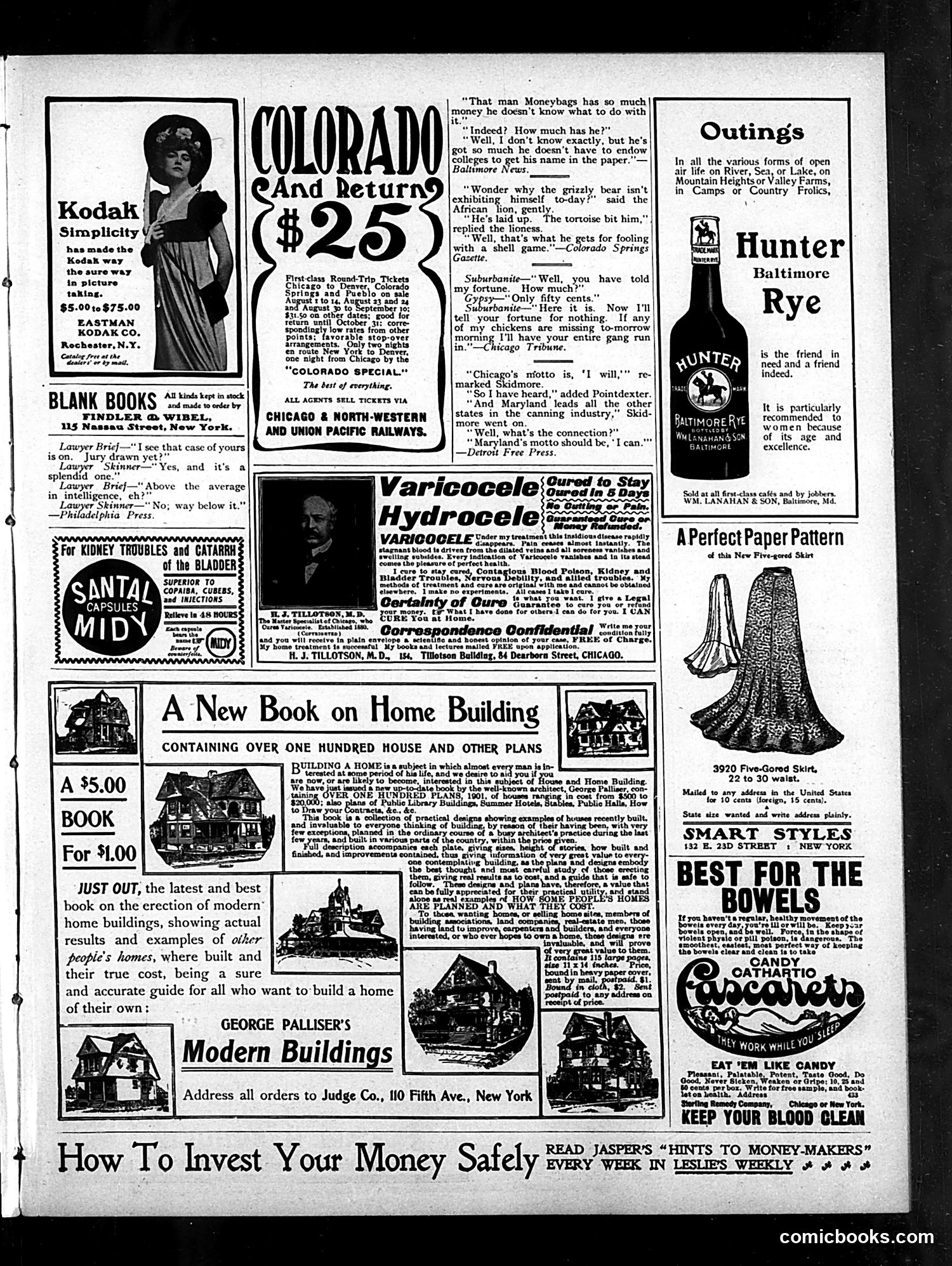
This page is primarily **advertising** rather than editorial cartooning, featuring multiple commercial ads for products and services typical of early 20th-century America. The few **humor items** present are brief jokes: - A lawyer joke about a wealthy man ("Moneybags") so rich he doesn't need to endow colleges for publicity - An exchange at a zoo where a lion jokes about a tortoise playing a "shell game" - A fortune-teller refusing payment, threatening to curse the customer's chickens - A Maryland/canning pun ("Maryland's motto should be, 'I can'") These are **mild, gentle satire** targeting wealth, con artists, and state stereotypes—typical of Judge's lighthearted style. The advertisements themselves reflect period concerns: kidney/bladder remedies, home-building guides, Kodak cameras, and travel to Colorado—reflecting era interests in health, domestic expansion, and tourism.
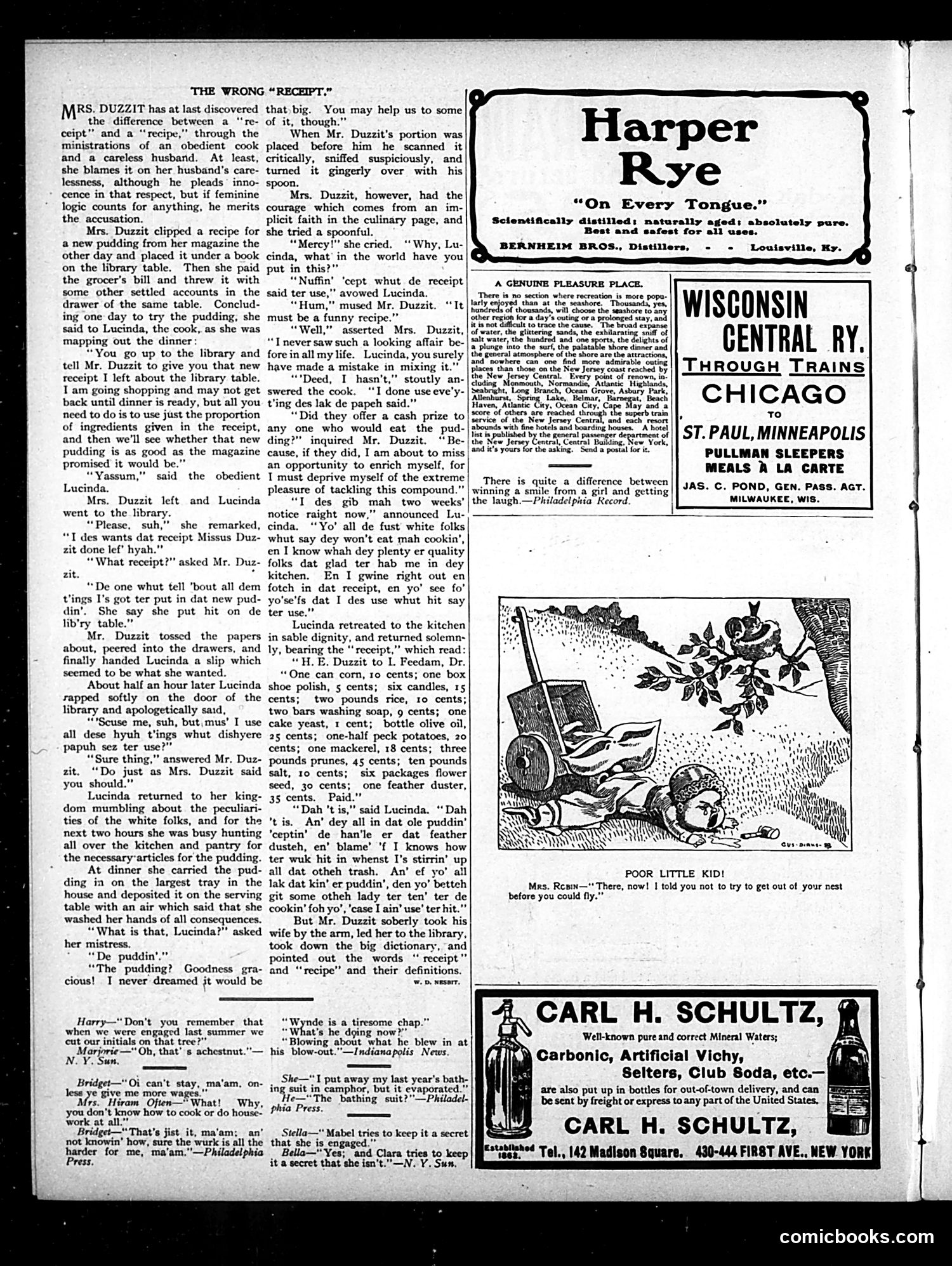
This story-cartoon satirizes the miscommunication that results when Mr. Duzzit hands the cook Lucinda the wrong slip of paper—not the magazine recipe his wife intended, but a grocery bill or receipt listing household purchases and prices. Lucinda faithfully follows the "receipt," literally adding every item listed (corn, potatoes, salt, prunes, flower seeds, etc.) to the pudding, creating an inedible disaster. The humor lies in: 1. **Class/dialect comedy**: Lucinda's phonetic dialect ("Nuffin' 'cept whut de receipt said") emphasizes she's a conscientious servant following instructions literally 2. **Marital blame-shifting**: Mrs. Duzzit blames her careless husband; he deflects 3. **The pun**: "Receipt" (bill) vs. "recipe" (instructions) — a common confusion deliberately exploited The moral, typical of early-1900s humor, mocks both masculine incompetence in domestic matters and the absurdity of literal obedience to written instructions. The illustration shows an absurdly enormous pudding, emphasizing the ridiculous outcome.
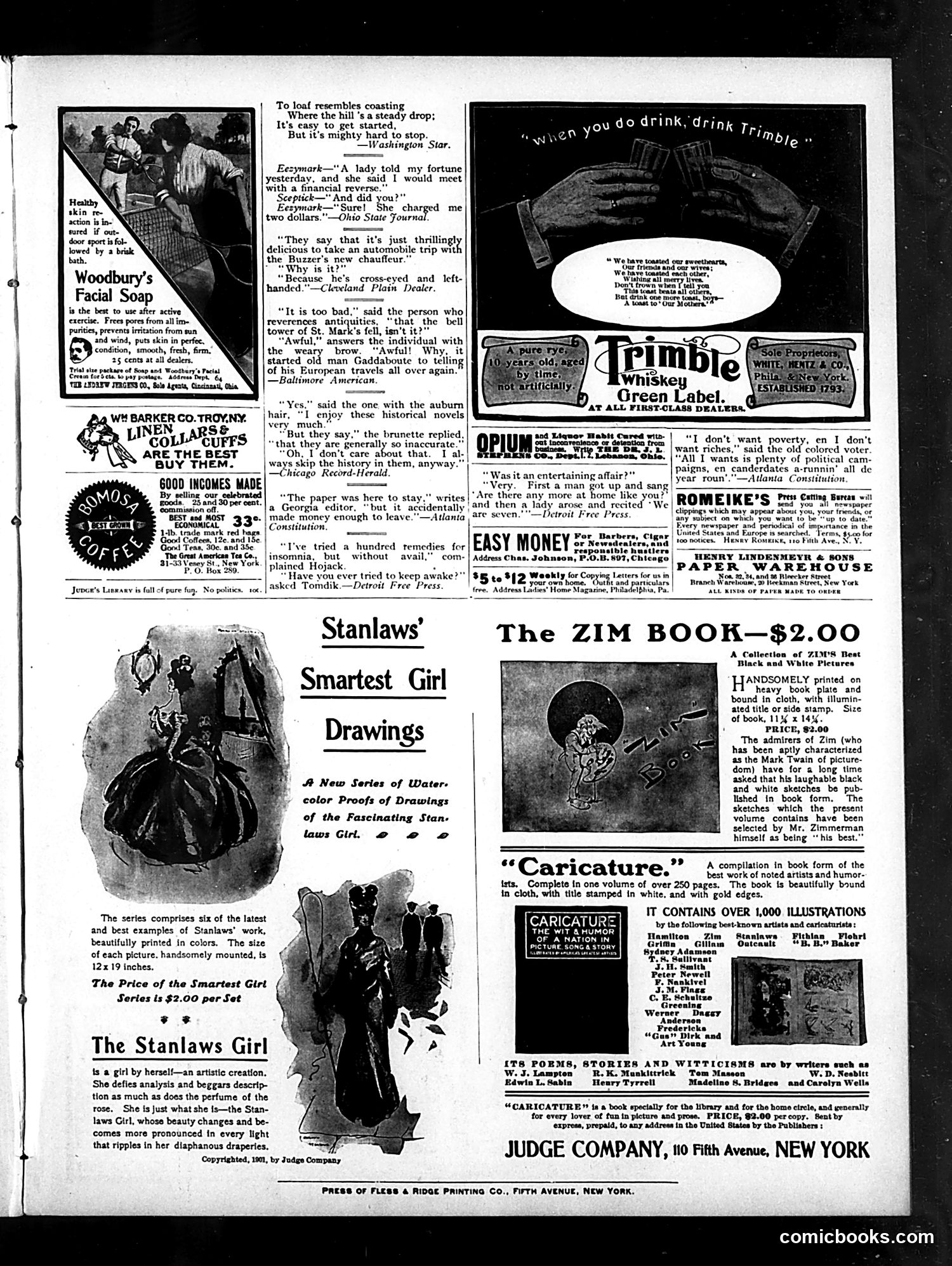
This is primarily an **advertising and humor page** from Judge magazine, not a political cartoon page. The content consists of: **Humorous anecdotes** occupying the upper half—brief jokes about fortune-telling scams, automobile chauffeurs, and historical novels' inaccuracies. These are gentle social satire targeting everyday pretensions rather than political figures. **Commercial advertisements** dominating the lower portion: Woodbury's Facial Soap, Trimble Whiskey, coffee, and notably **Stanlaws' Smartest Girl drawings**—watercolor art prints of an idealized young woman, marketed as decorative series. The page reflects **early 1900s consumer culture**, advertising both beauty products and artistic prints to affluent readers. The "Stanlaws Girl" represents the era's aestheticized femininity—described as defying analysis, emphasizing beauty over substance. **No identifiable political figures or references appear.** The humor is domestic and commercial rather than satirical commentary on current events or politics.
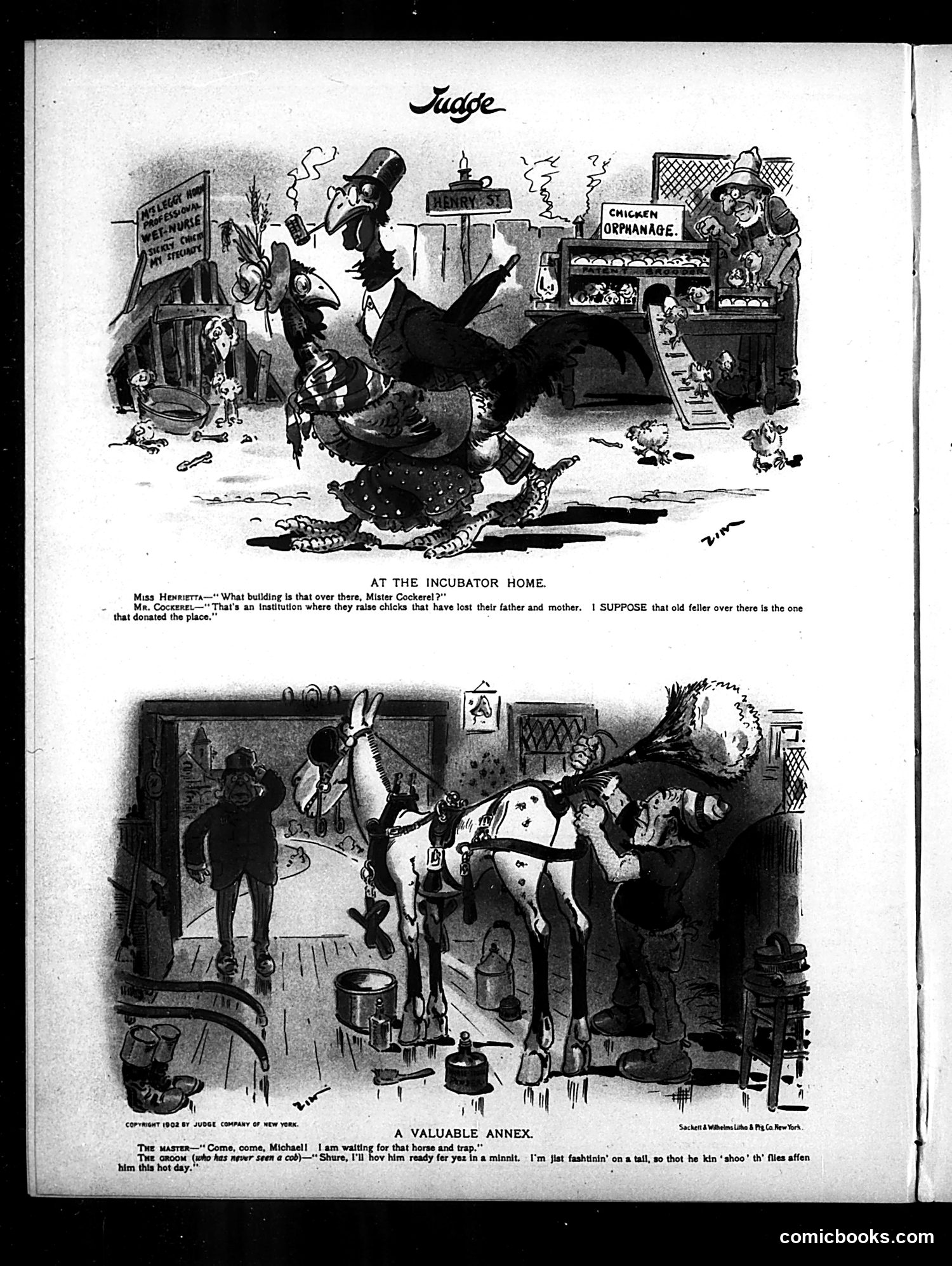
This page contains two satirical cartoons mocking charity institutions and Irish immigrant workers. **Top cartoon ("At the Incubator Home")**: Features a rooster and hen visiting an orphanage for chicks. The joke's dark implication: the rooster jokingly suggests the orphanage's donor is "that old feller"—implying he fathered the orphaned chicks, mocking both promiscuity and the existence of such charitable institutions. **Bottom cartoon ("A Valuable Annex")**: An Irish stable worker (indicated by heavy dialect) misunderstands his employer's request for "a horse and trap" (carriage). He's attaching a long tail to a horse, thinking "shoo" means the tail will swat flies. The humor relies on ethnic stereotyping—portraying the Irish character as dimwitted and prone to malapropism, a common trope in late-19th/early-20th century American satire. Both cartoons reflect period attitudes toward institutions and immigrant labor.