
A complete issue · 16 pages · 1902
Judge — May 31, 1902
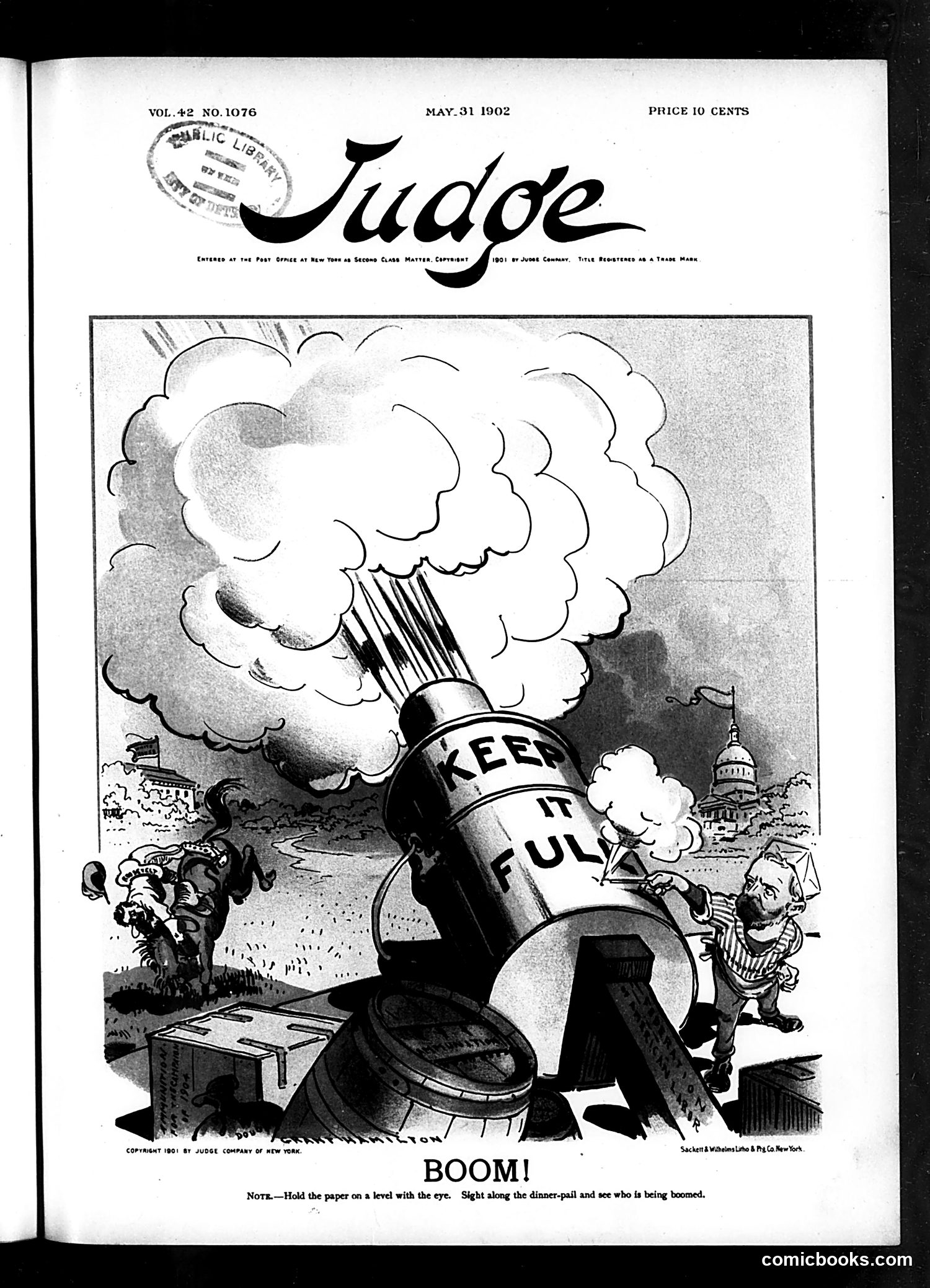
This political cartoon depicts a large cannon labeled "KEEP IT FULL" exploding with massive clouds of smoke. The note instructs readers to "Hold the paper on a level with the eye. Sight along the dinner-pail and see who is being boomed." This is a satirical commentary on political campaigning, specifically the practice of "booming" a candidate—promoting them heavily for office. The "dinner-pail" reference likely alludes to economic prosperity messaging ("a full dinner-pail" was a common political slogan promising voter prosperity). The cannon's explosion suggests the chaotic, explosive nature of campaign promotion and propaganda. By holding the page at eye level and sighting along the barrel, readers would presumably see which political figure was being promoted or attacked, making this an interactive political satire typical of Judge's style.
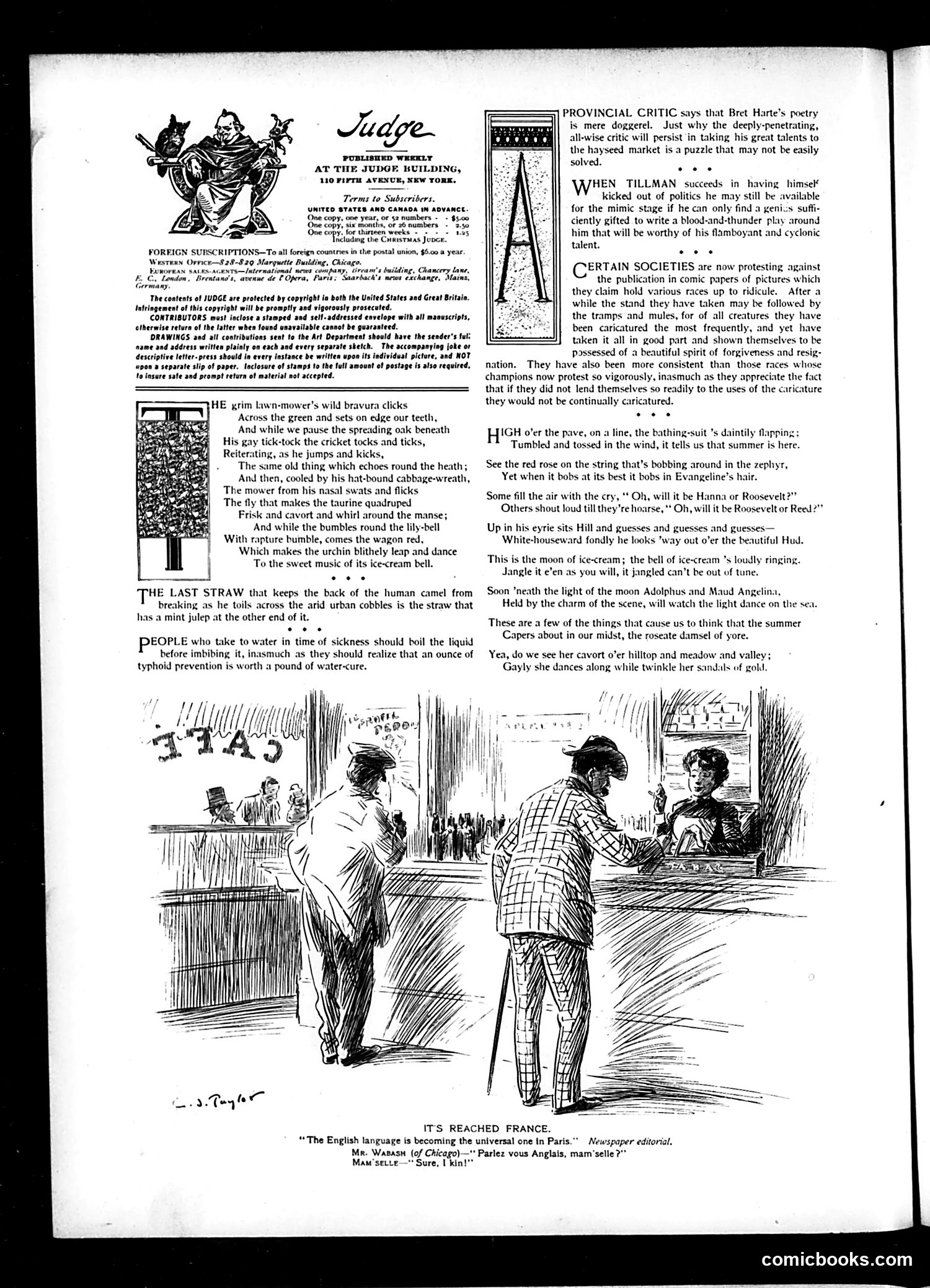
This page contains literary criticism and social commentary rather than political cartoons. The main text discusses Bret Hart's poetry, Tillman's political prospects, and animal welfare societies—none specific enough to date precisely. The cartoon at bottom, titled "It's Reached France," depicts two men at what appears to be a Paris newspaper office. The caption quotes a Chicago resident asking a Parisian editor if "the English language is becoming the universal one in Paris," with the editor responding affirmatively. This satirizes American cultural influence spreading globally—a recurring Judge theme mocking how American English and culture were penetrating even traditionally French-speaking Europe. The joke reflects early 20th-century anxiety about American cultural dominance abroad.
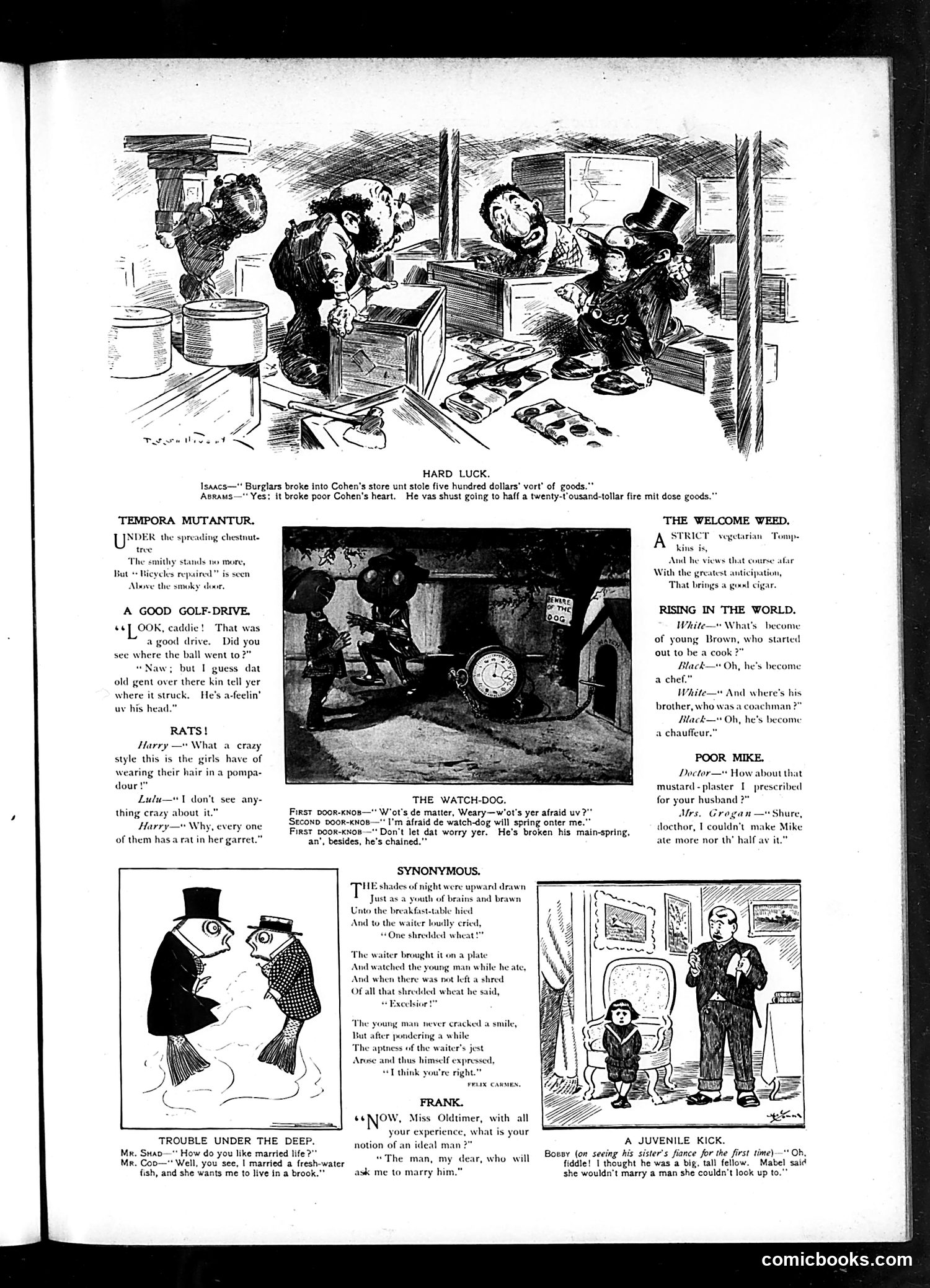
This page contains multiple unrelated short humorous pieces typical of Judge magazine's format. The top cartoon "Hard Luck" depicts men in what appears to be a shop or store discussing a burglary—likely satirizing poor business or neighborhood crime. The remaining pieces are mostly domestic humor and light jokes: "A Good Golf Drive" mocks golf enthusiasts; "Rats!" jokes about women's hairstyles; "The Watch-Dog" presents a domestic scene; "Synonymous" offers wordplay humor; and "A Juvenile Kick" shows a family scene with child behavior. These appear to be general-audience comedy rather than specific political satire. The cartoons target everyday situations—marriage, parenting, hobbies, fashion—reflecting upper-middle-class American life. Without additional context or recognizable public figures, the specific references remain unclear, though the humor relies on contemporary social observations.
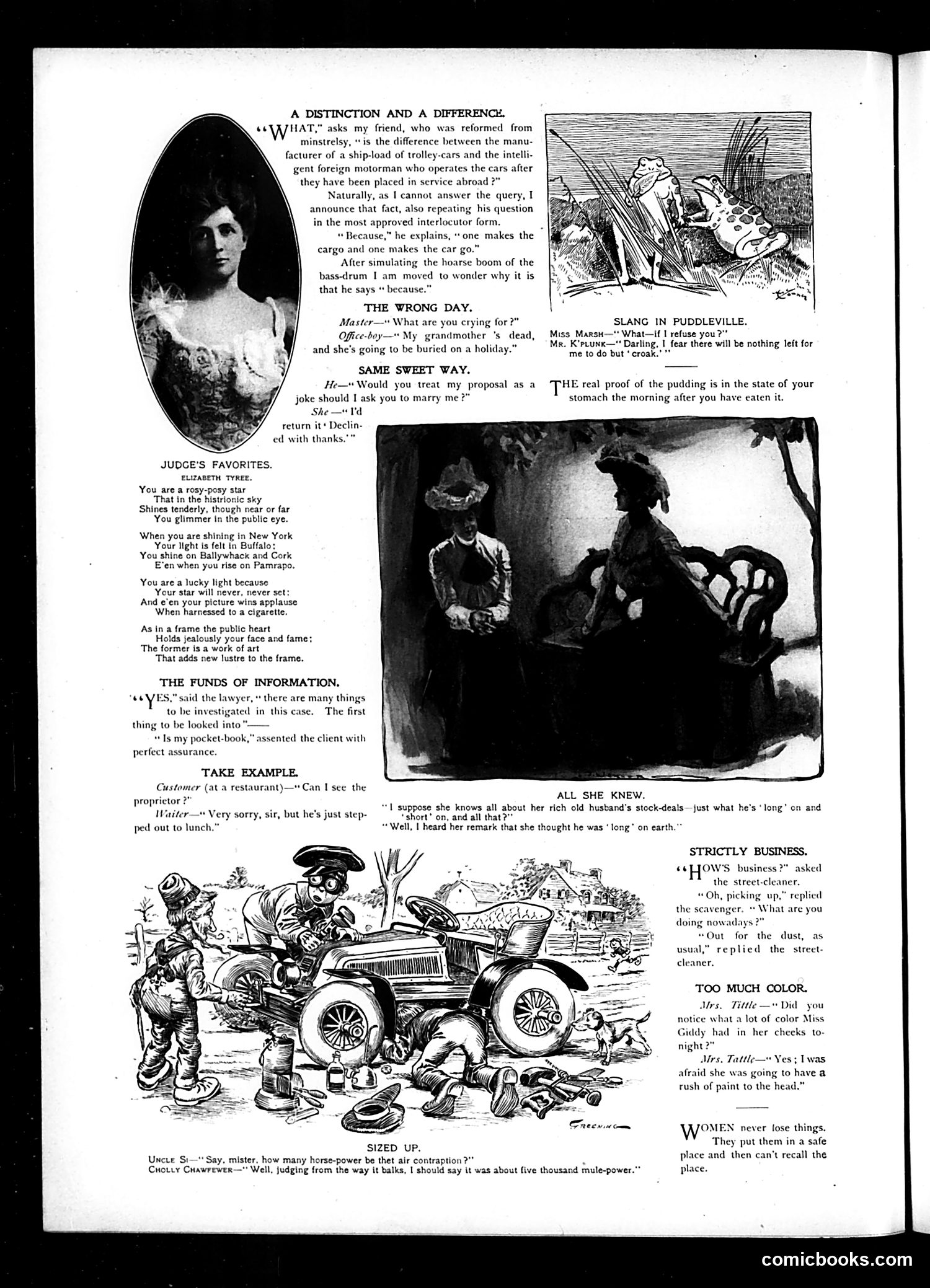
This page contains several unrelated satirical items typical of early 20th-century Judge magazine: **"A Distinction and a Difference"** mocks someone's use of "because" as a conjunction—a linguistic pet peeve presented as absurd reasoning. **"Judge's Favorites"** is a poem praising Elizabeth Tyree, apparently a notable figure of the era (likely theatrical or public). **"The Funds of Information"** and subsequent sections are brief humorous anecdotes about everyday situations—a waiter's excuse, a street-cleaner's job duties, a woman's excessive makeup. The cartoons show domestic/working-class scenes: children by water, an automobile accident, etc. These are general humor pieces without identifiable political figures, relying on social observation and wordplay rather than topical satire. The content reflects period attitudes toward gender, class, and propriety without specific historical references requiring explanation.
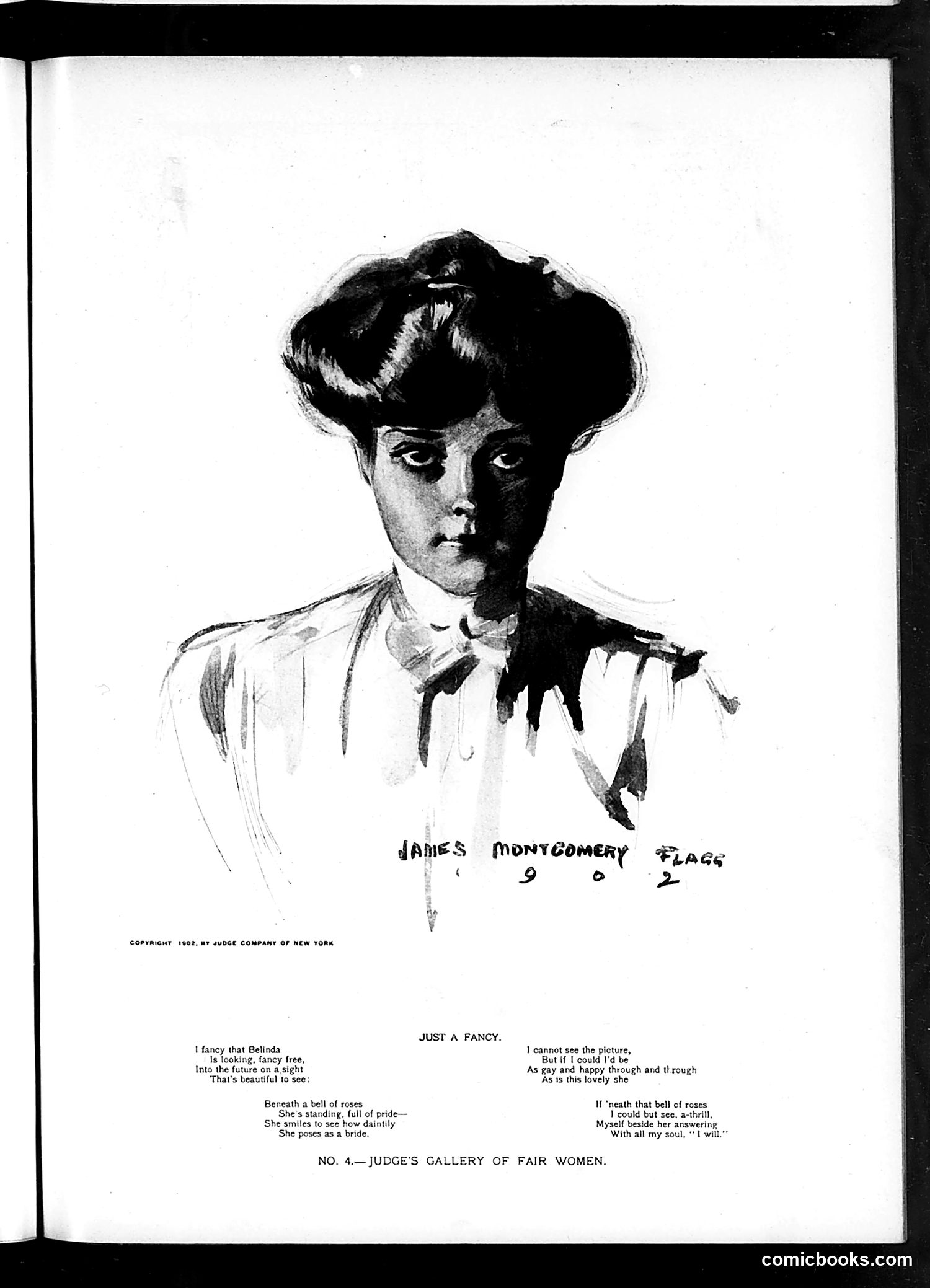
This is a romanticized portrait from Judge's recurring "Gallery of Fair Women" feature—a genteel series celebrating attractive women rather than political satire. The subject is identified as "James Montgomery Flagg," the renowned illustrator who signed this sketch in 1902. The accompanying poem, "Just a Fancy," presents a sentimental daydream: a man imagines a woman named Belinda dreaming of her future wedding beneath roses, and he fantasizes about standing beside her at the altar. It's a wistful romantic reverie—popular sentimental fare for the era's magazine audience. This represents Judge's lighter content: decorative portraiture and romantic verse aimed at middle-class readers, distinct from the magazine's typically sharp political cartoons. The drawing showcases Flagg's skilled draftsmanship in capturing early 1900s women's fashion (the distinctive pompadour hairstyle and high collar) and refined aesthetic sensibility.
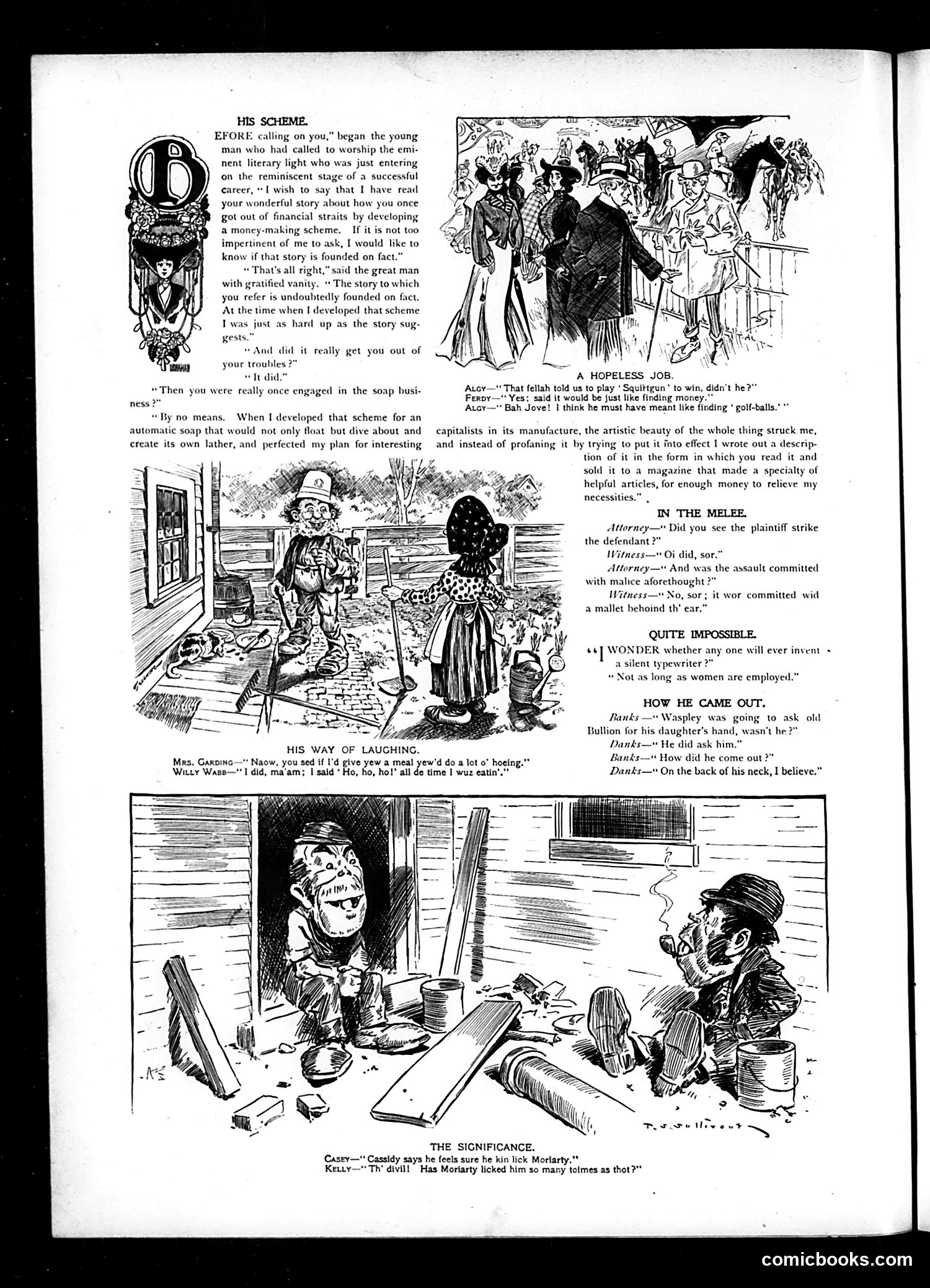
This page contains multiple unrelated satirical cartoons and jokes typical of early Judge magazine format. **"His Scheme"** mocks literary pretension: a famous author admits his published success story about escaping financial hardship through a clever soap invention was entirely fictional—he actually just sold the *description* of the scheme to a magazine for money. The satire targets both the author's vanity and readers who believe published "success stories." **"A Hopeless Job"** jokes about con artists misleading investors with false tips. **"In the Melee"** uses Irish dialect humor (common in period satire) where a witness describes an assault with a "mallet behind th' ear"—the lawyer mishears legal terminology. **"How He Came Out"** plays on the double meaning of "came out"—Waspley's courtship attempt failed literally and metaphorically (he has back-of-neck bruises). **"The Significance"** uses Irish working-class dialect for a joke about repeated beatings establishing dominance. The cartoons reflect period stereotypes and humor conventions no longer considered acceptable.
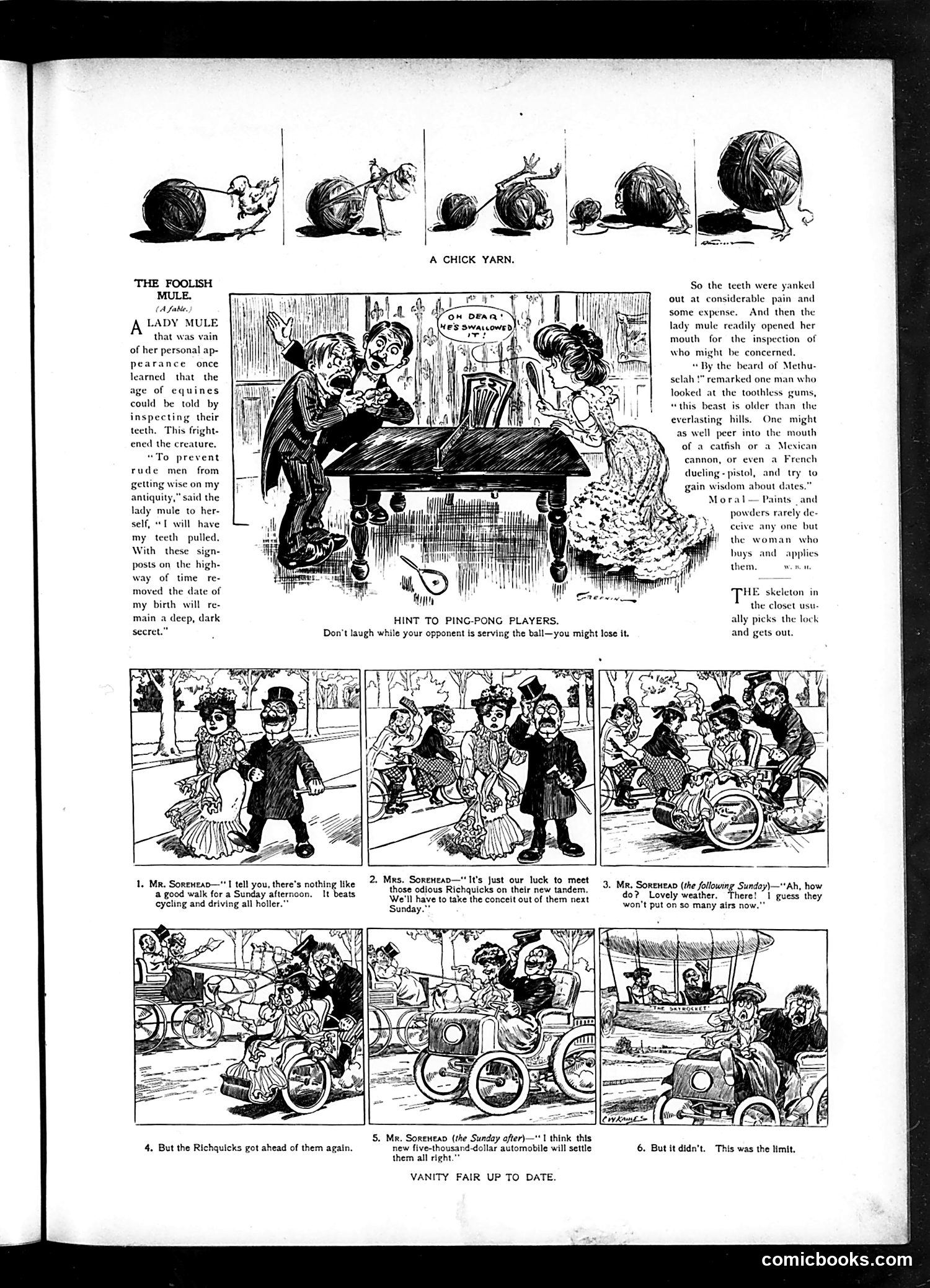
**"The Foolish Mule"** is a moral fable about vanity: a vain mule, embarrassed by her age, has her teeth extracted to hide her true age from inspection. The satiric point: the strategy backfires—a toothless mouth actually advertises her advanced age more obviously, making her deception counterproductive. The moral explicitly warns that "paints and powders rarely deceive any one but the woman who buys and applies them"—targeting female vanity and cosmetic self-deception. **"Vanity Fair Up to Date"** follows, depicting the Richquick family acquiring a new automobile, which the husband believes will solve their social problems. The final panel reveals it didn't—suggesting nouveau riche optimism about material goods proving hollow. Together, the page satirizes American consumer culture and vanity, particularly targeting wealthy families and women's cosmetic practices. The tone is moralistic and somewhat misogynistic by modern standards, typical of early-20th-century satirical magazine humor.
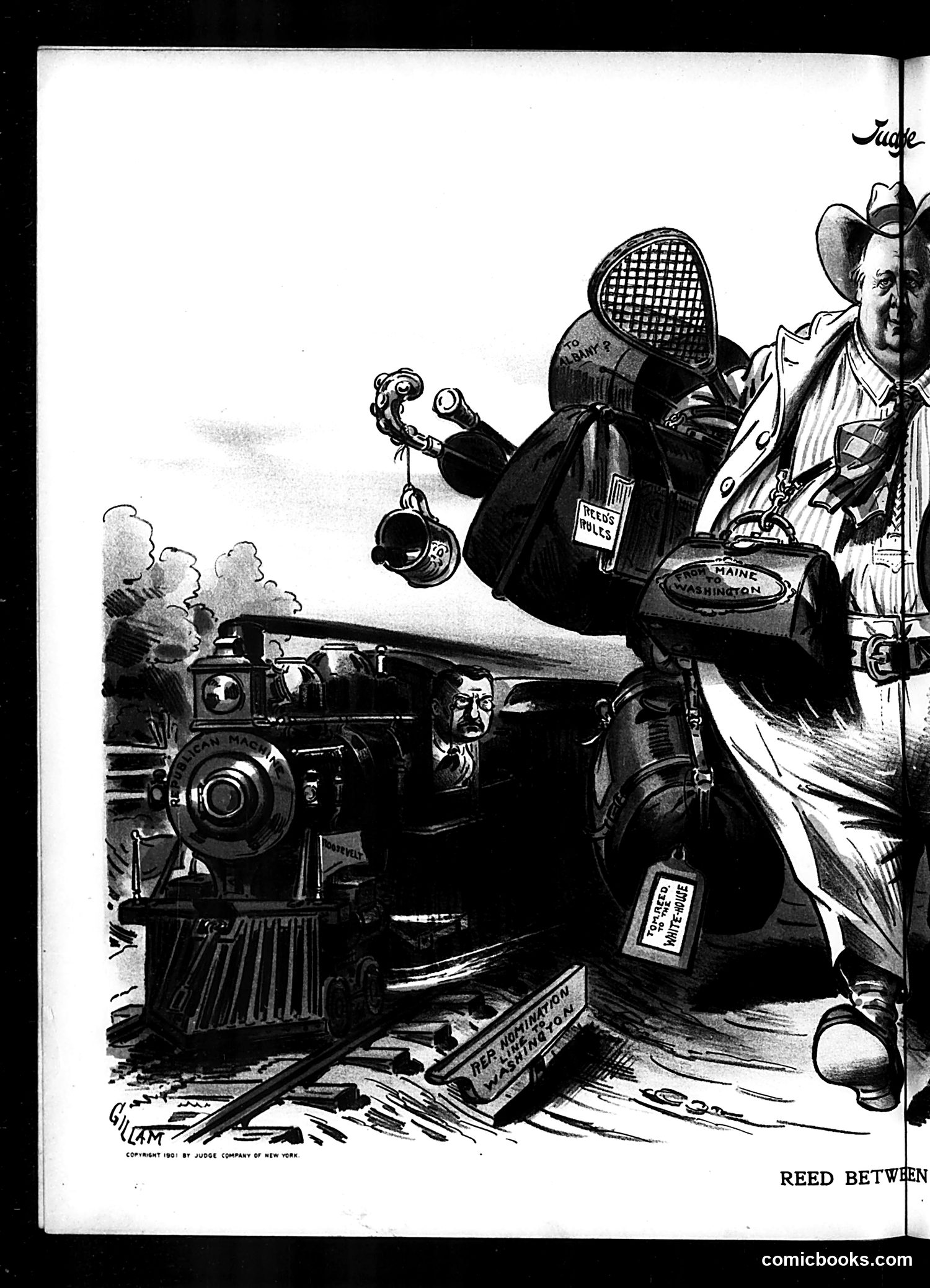
This 1901 Judge magazine cartoon satirizes what appears to be a political figure (likely Senator Thomas Brackett Reed, suggested by the "REED BETWEEN" caption) caught between competing interests. The central figure, depicted with a tennis racket and holding juggling balls labeled "MAINE" and "WASHINGTON," represents someone trying to balance regional political demands. The locomotive labeled "CAN MANU" (likely "CANADIAN MANUFACTURER") and the figure on the right with luggage suggest tensions between American and Canadian economic interests, possibly regarding tariffs or trade policy. The cartoon ridicules the subject's attempt to simultaneously please multiple constituencies—a common target of Judge's political satire during this period of American expansionism and protectionist debates.
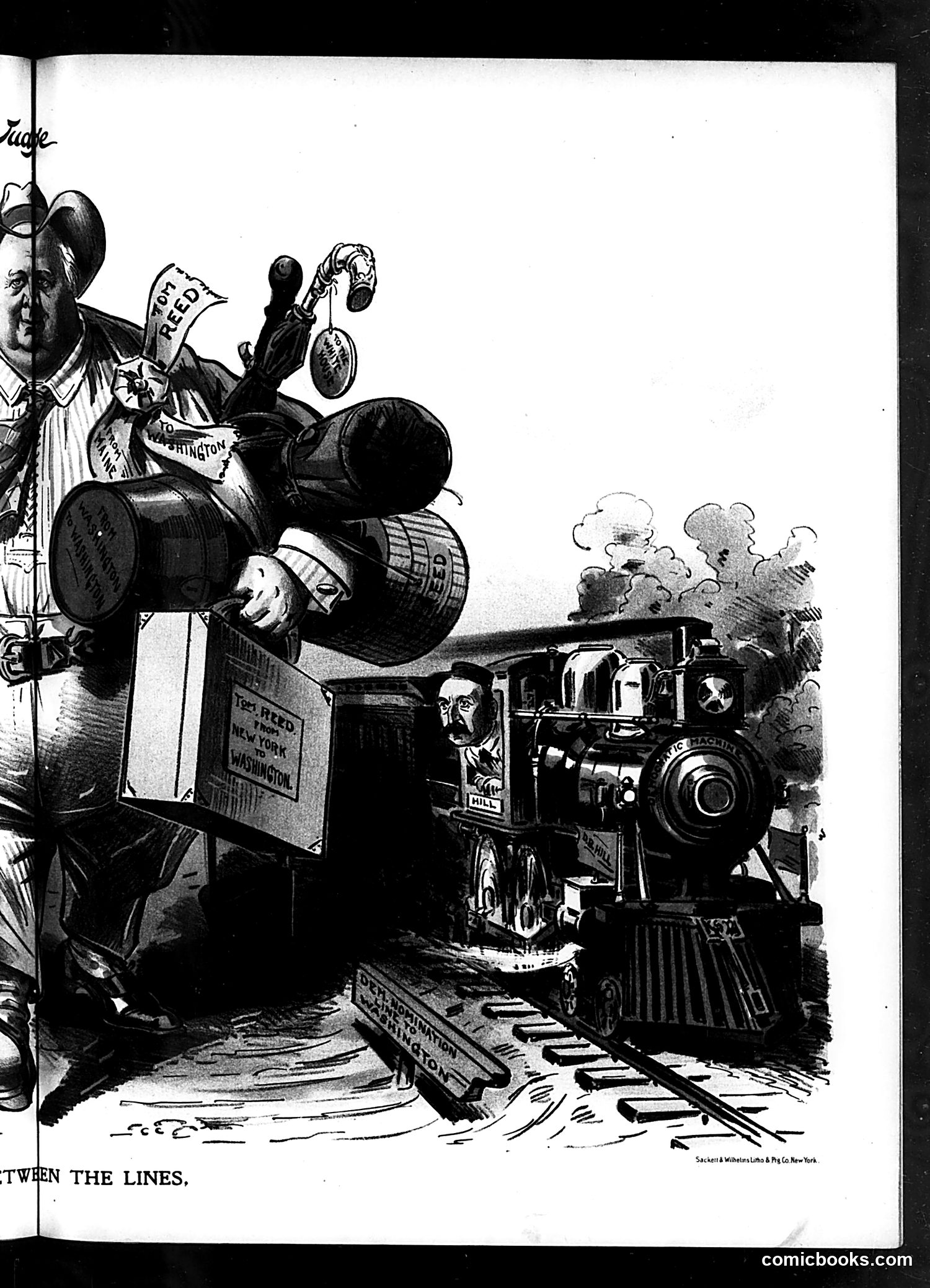
This Judge magazine cartoon depicts a portly figure (left) manipulating barrels and scales above a railroad train. The figure appears to represent corporate or political manipulation of rail transport, likely critiquing monopolistic practices or rate-fixing schemes that were common concerns during the Gilded Age/Progressive Era. The barrels labeled "TARIFF" and other commercial goods suggest commentary on trade policy and freight manipulation. The train operator below appears unaware of the schemes occurring above, suggesting hidden dealings "between the lines" of official business. The cartoon likely satirizes corrupt railroad practices, political favoritism, or price manipulation affecting American commerce and consumers. The specific references on the barrels remain partially unclear due to image quality, but the overall message concerns dishonest financial manipulation in the railroad industry.
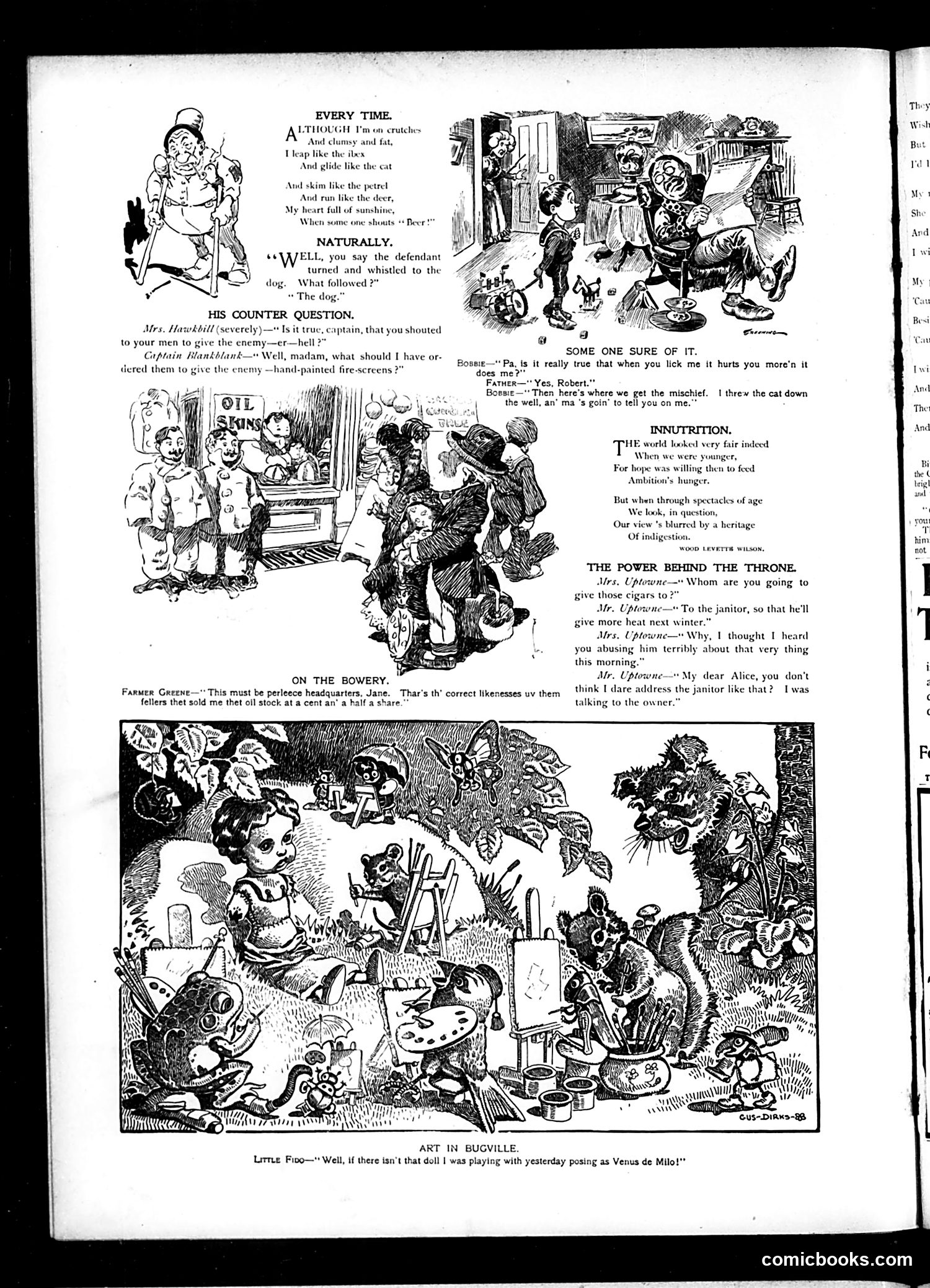
This early 20th-century satirical page mocks various social types and situations through interconnected cartoons: **"Every Time"** jokes that despite physical limitations, people gain superhuman energy when beer is mentioned—satirizing American drinking culture. **"Naturally"** plays on courtroom absurdity: a defendant's dog follows him after being whistled to, the obvious punchline being mocked as needing explanation. **"His Counter Question"** ridicules military command by having a captain sarcastically question what he should've ordered troops to give enemies instead of "hell"—lampooning both military authority and wartime brutality. **"Some One Sure of It"** satirizes parental hypocrisy: a child exploits his father's claim that punishment hurts parents more, using this logic to justify mischief. **"Power Behind the Throne"** mocks social climbing: a wealthy man manipulates the janitor with cigars to ensure heat, then denies addressing him directly—exposing class pretense. **"On the Bowery"** depicts rural/working-class naïveté through a farmer mistaking police headquarters for an oil-stock scam office. The page satirizes drinking culture, legal absurdity, military excess, parental hypocrisy, class manipulation, and rural gullibility.
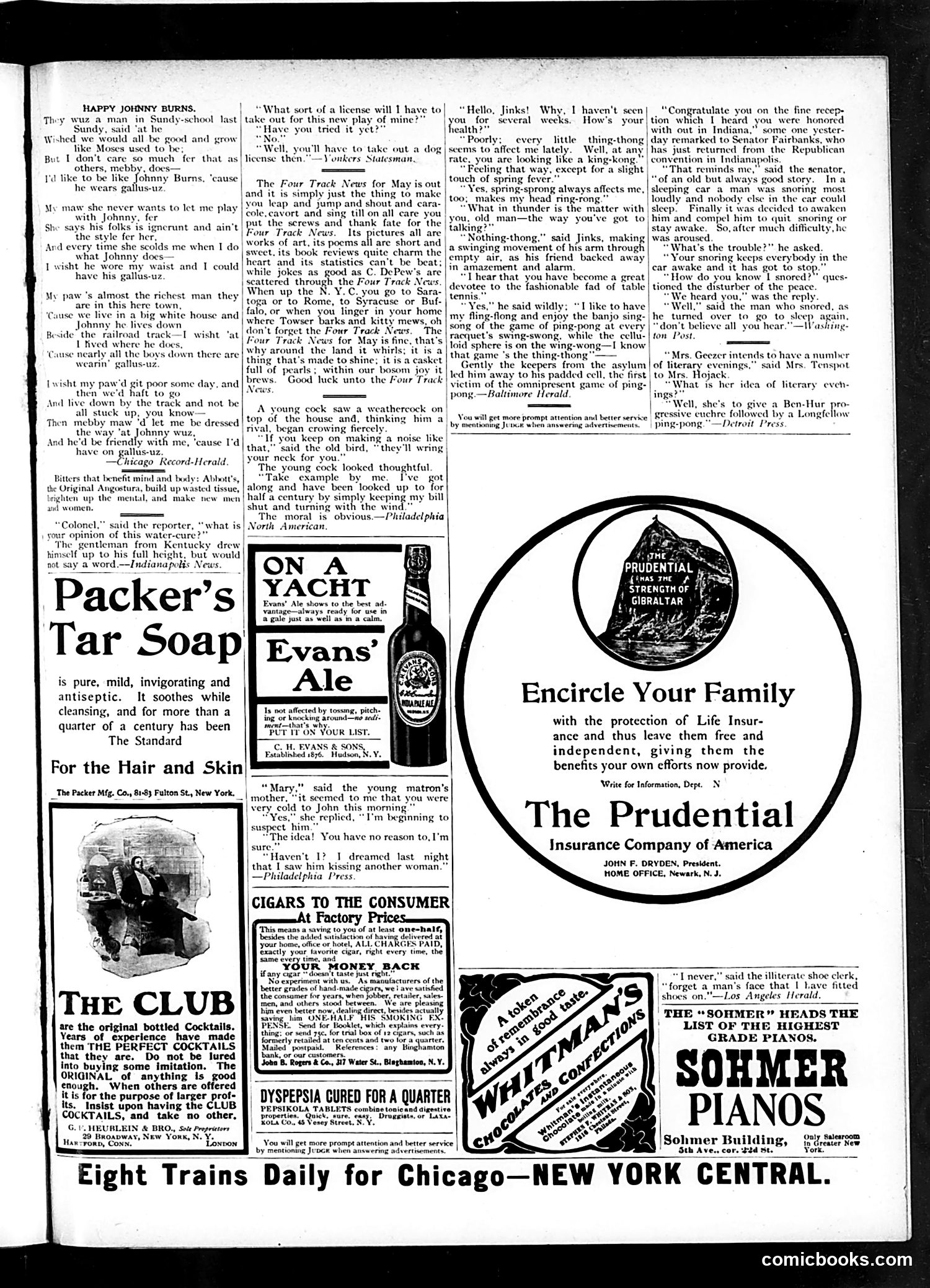
This page is primarily **advertising**, with several short humorous anecdotes interspersed. The "Happy Johnny Burns" pieces appear to be folksy rural humor about a boy who admires his peer's suspenders and modest lifestyle—typical sentimental comedy of the era. The illustrated anecdotes include morality tales: a young rooster learning not to challenge authority (the weathercock), and a story about a wife's jealous dream—standard domestic humor. The advertisements dominate: Packer's Tar Soap, Evans' Ale, The Club cocktails, Sohmer Pianos, Prudential Insurance, and direct-to-consumer cigars. These reflect early 20th-century consumer culture and mail-order retail innovation. There is **no political satire** visible on this page. The content is light entertainment and commercial promotion typical of Judge's content during this period—personal anecdotes and ads rather than political commentary.
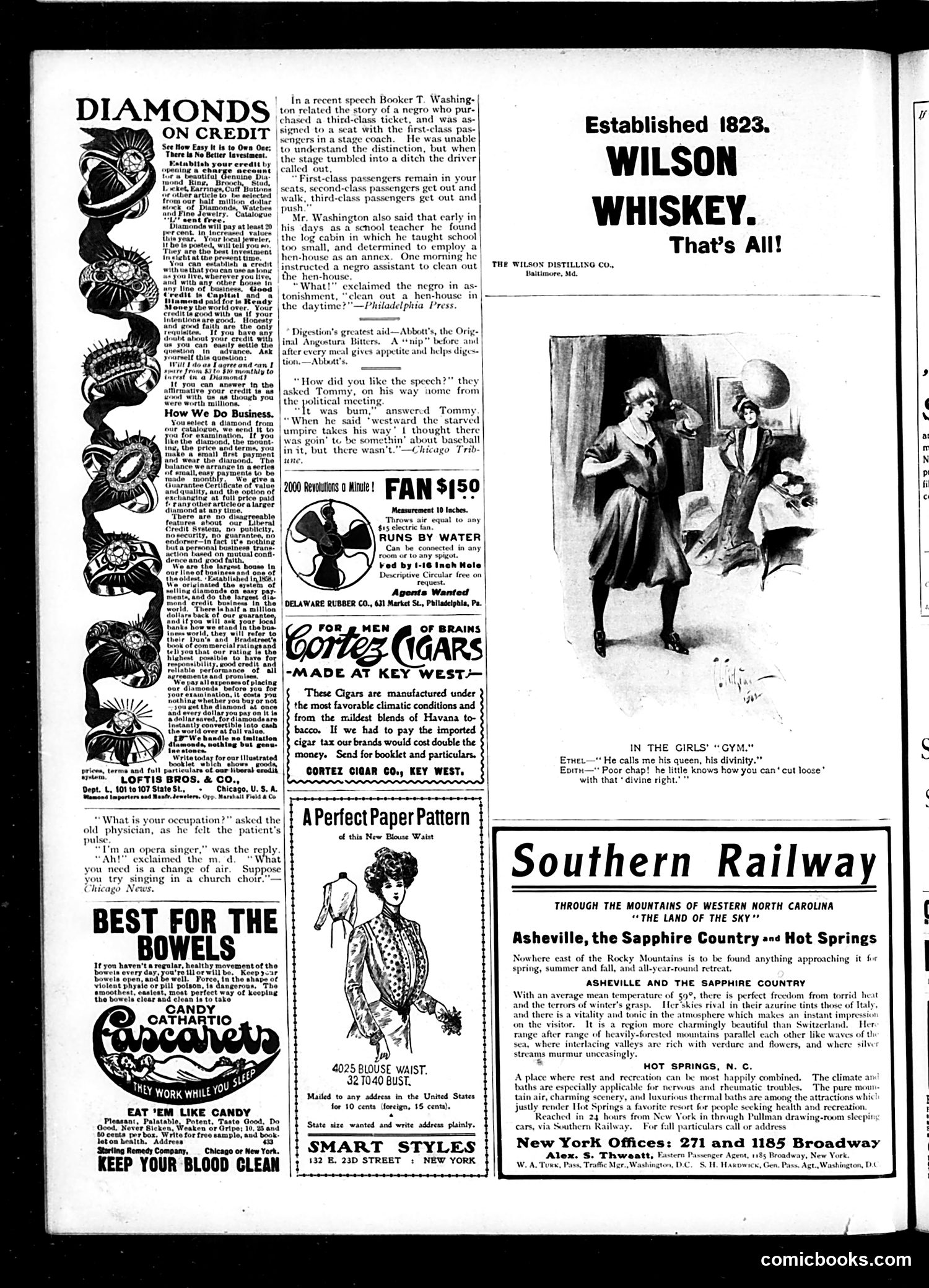
This page is primarily **advertising** with minimal political satire. The "Diamonds on Credit" section dominates the left side—a sales pitch for easy-payment jewelry from Loftis Bros. & Co. of Chicago. The text emphasizes accessible credit systems for purchasing diamonds and watches regardless of wealth. The only satirical content appears in the small humorous anecdotes scattered throughout: a story attributed to Booker T. Washington about racial segregation in a stagecoach ("first-class" passengers ride, "third-class" passengers push when stuck), and another about him using a henhouse as a classroom annex. These jokes mock Washington's accommodation philosophy through absurdist scenarios illustrating class and racial distinctions of the era. The remainder consists of period product advertisements (candy laxatives, cigars, fans, whiskey, patent medicines)—typical of Judge magazine's revenue model. No explicit political cartoon appears on this page.
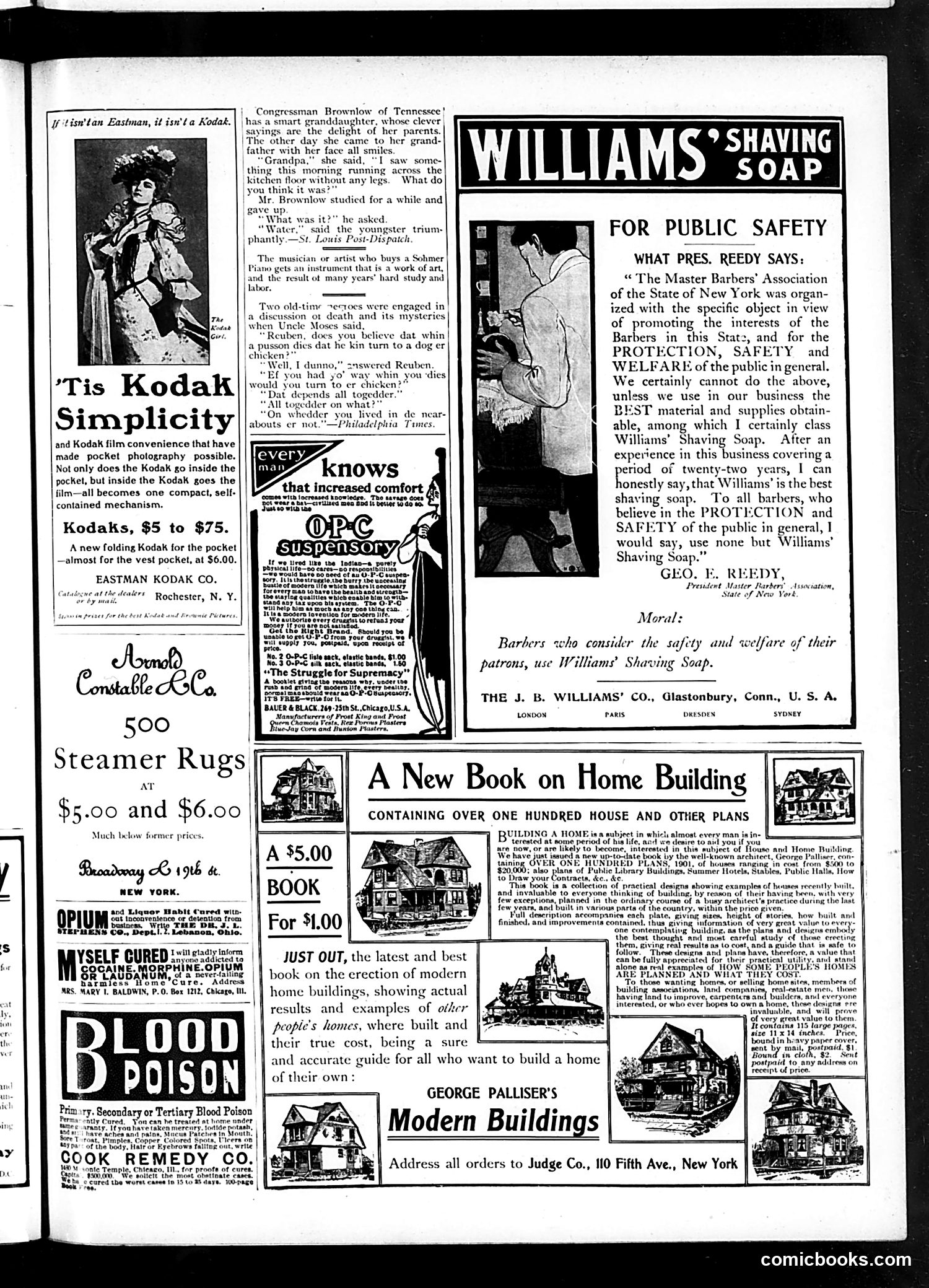
This page is primarily **advertising**, with minimal editorial content. The small jokes/anecdotes are filler material around ads. The **cartoon element** is minimal—a single illustration labeled "'Tis Kodak Simplicity" shows a woman with cameras, advertising Kodak pocket cameras. This is a straightforward product ad, not satire. The page contains two brief humorous anecdotes (one about Congressman Brownlow's granddaughter finding a needle, another about two Black men discussing death) that appear to be time-fillers typical of Judge's lighter content, though they reflect period attitudes. The substantive content is **advertising**: cameras, rugs, medical "cures" (opium and blood poison treatments—dubious by modern standards), a Sohmer piano, Williams' Shaving Soap, and a home-building book. The Williams' ad uses an endorsement from the Master Barbers' Association president as a marketing strategy. This is not a satirical or political page, but rather a standard magazine ad section typical of early 1900s publications.
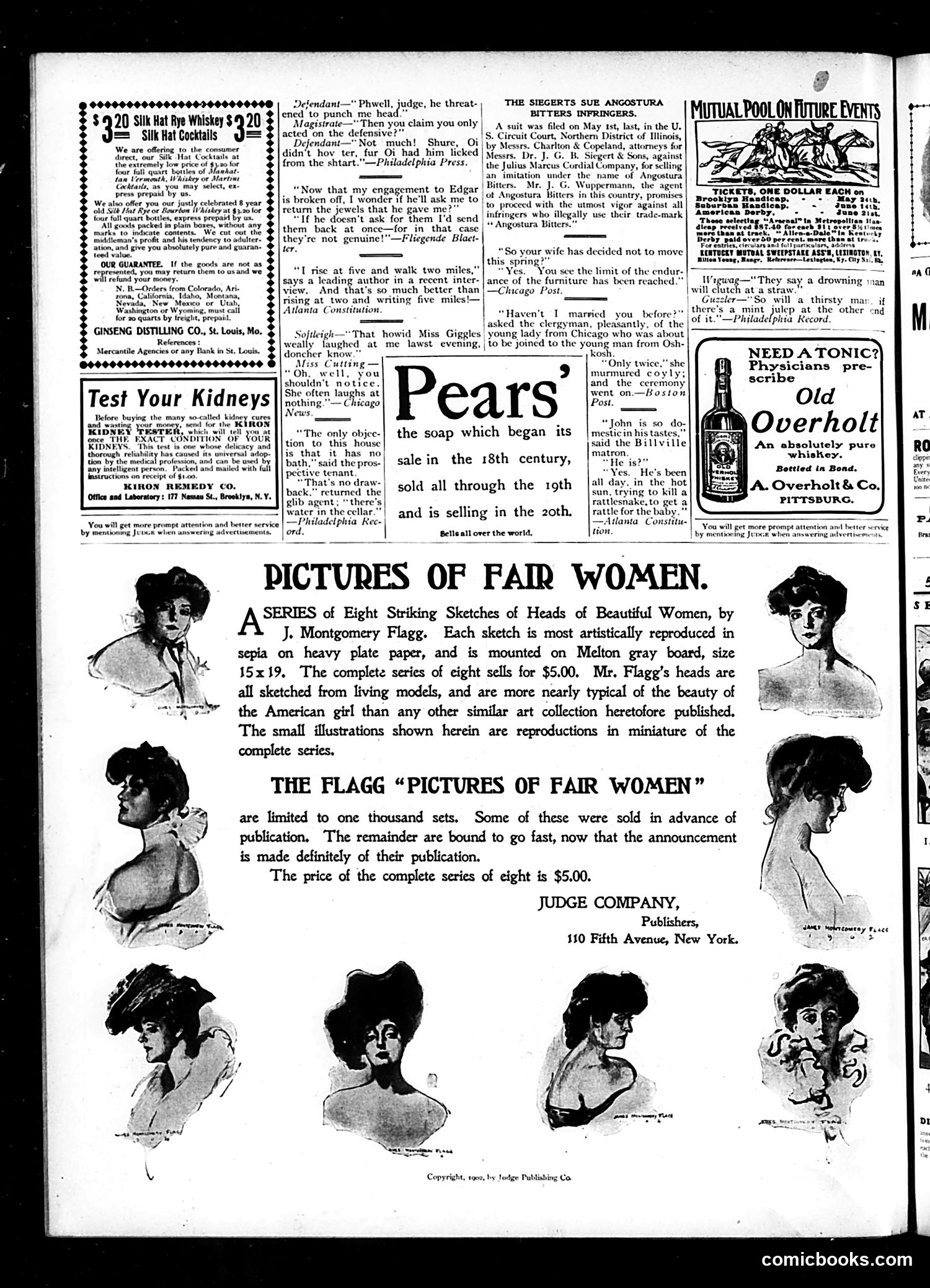
This page is primarily **advertising and light humor** rather than political satire. The upper section contains commercial ads for whiskey, kidney remedies, and soap—typical Judge magazine revenue sources. The middle contains brief **jokes** mocking various social types: a working-class defendant claiming self-defense unconvincingly; an engaged woman hoping for fake jewelry so she needn't return it; an author bragging about early rising; a woman moving repeatedly, wearing out furniture; a newly-married woman admitting previous marriages; a tenant complaining about a flooded cellar. These are gentle, domestic humor—no political figures or events are referenced. The jokes target everyday absurdities and human foibles (dishonesty, vanity, domestic complaints). The main visual content advertises **"Pictures of Fair Women"** by artist J. Montgomery Flagg—portrait sketches sold as a series, representing idealized American beauty standards of the era. There is no coherent satirical message; this is a standard magazine page mixing revenue-generating advertisements with filler humor.
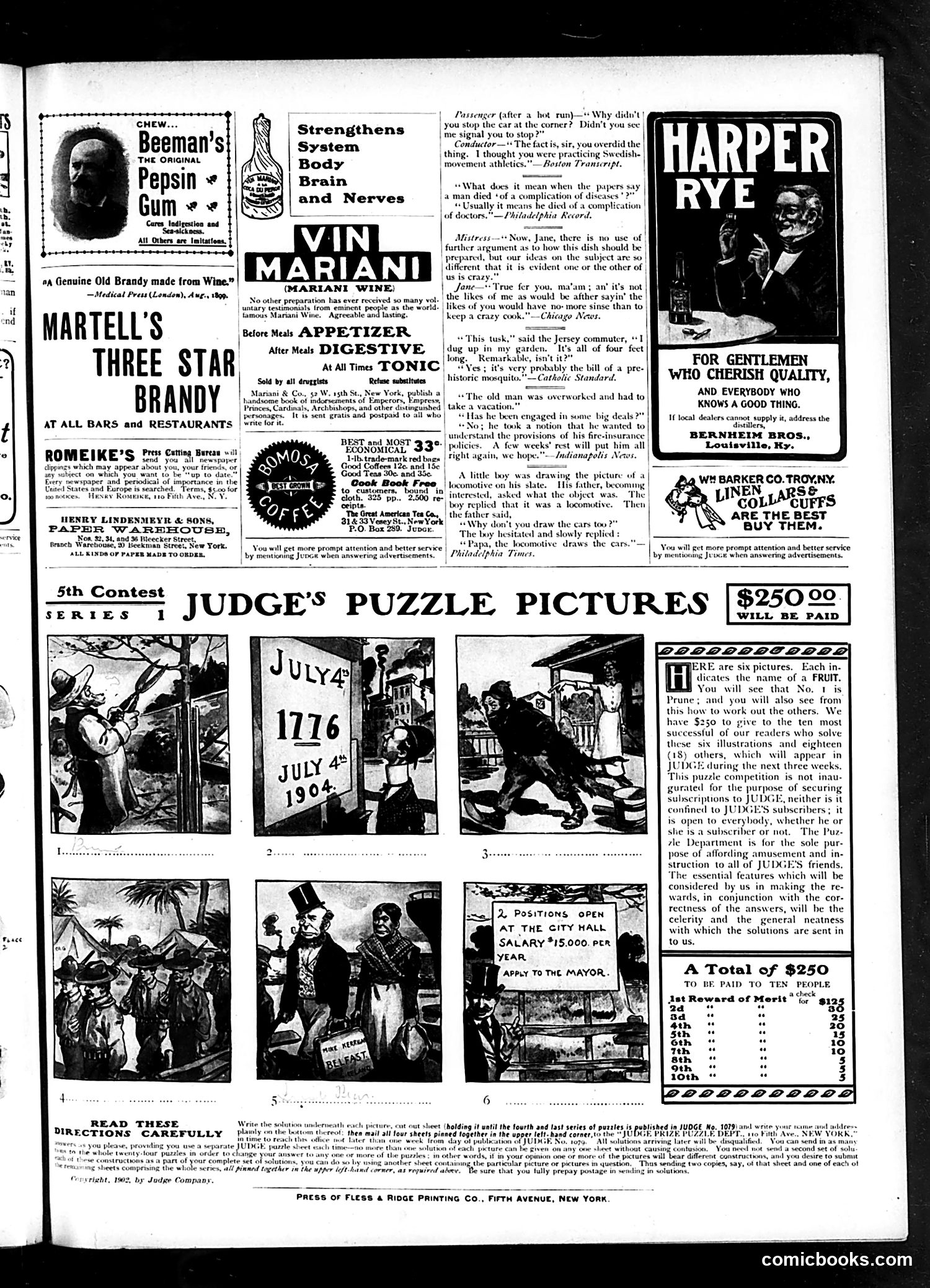
This page is primarily **advertising and contest content** rather than political satire. The bulk consists of product advertisements (Beeman's Pepsin Gum, Martell's Brandy, Vin Mariani wine, Romeike's press clipping service) typical of early 1900s magazines. The main editorial content is the **"Judge's Puzzle Pictures" contest** — a rebus puzzle competition offering $250 in prizes ($25 to each of ten winners) for readers who can identify six fruits from illustrated clues. The example shows "Prune" for picture No. 1. The scattered conversational snippets (about a streetcar conductor, a cook, a Jersey commuter's mosquito) appear to be **brief humorous anecdotes** — filler material common to Judge magazine, offering light social commentary rather than pointed political satire. This page reflects Judge's business model: combining light entertainment, consumer advertising, and reader participation contests to build circulation.
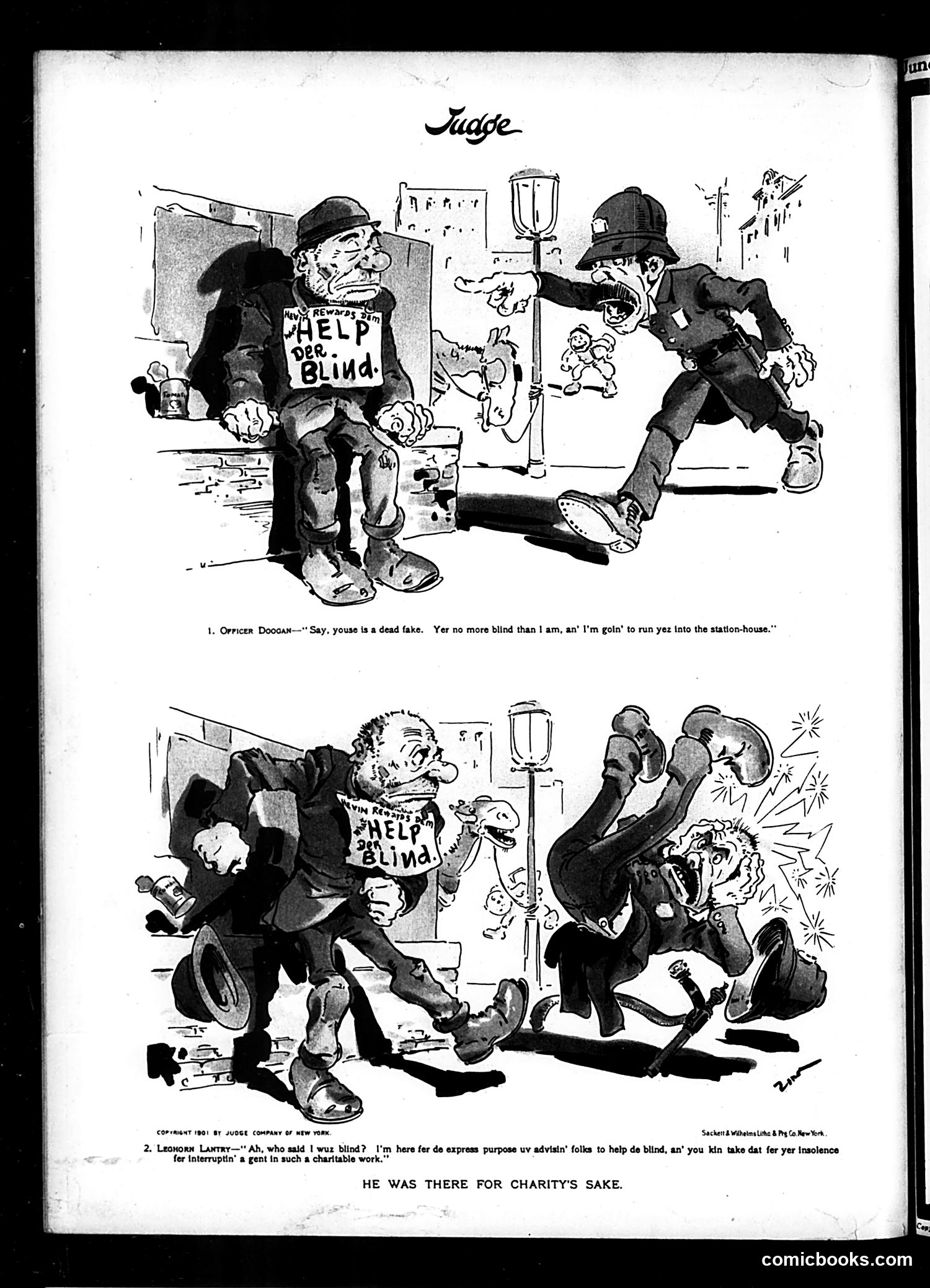
This two-panel Judge cartoon satirizes police corruption disguised as charity work. Panel 1 shows Officer Doogan confronting a blind beggar wearing a "Help the Blind" sign, claiming the beggar is a "dead fake." Panel 2 reveals the joke's irony: **Leonora Lawry**, apparently a corrupt police officer himself, interrupts to claim *he's* the one legitimately "advisin' folks to help de blind"—while clearly shaking down the beggar for money under the pretense of charity work. The satire targets how public officials exploited charitable causes for personal profit. The dialect humor (typical of early 1900s Judge) and caricatured features were standard for the era's satirical approach. The title's sarcasm—"He Was There for Charity's Sake"—drives home the hypocrisy: the real fraud is the official, not the street beggar.