
A complete issue · 16 pages · 1902
Judge — May 24, 1902
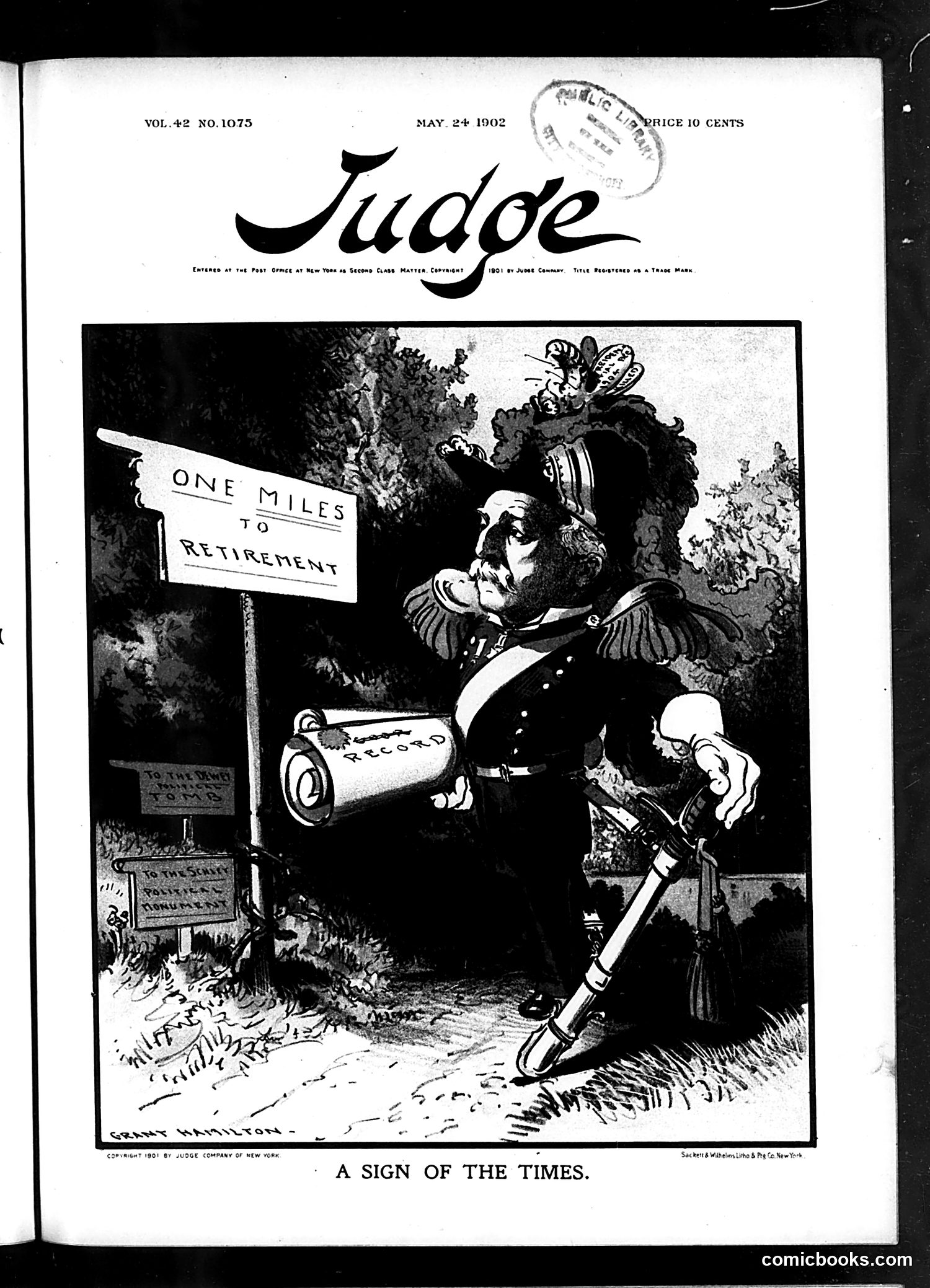
This political cartoon depicts a military figure in formal dress uniform examining a signpost reading "ONE MILES TO RETIREMENT." The caricature appears to show an aging officer approaching the end of his career—the exaggerated features and formal attire suggest this references a specific high-ranking military or political figure of the era, though the identity isn't entirely clear from the image alone. The satire mocks the figure's apparent reluctance or preoccupation with retirement, suggesting prolonged service beyond typical expectations. The "sign of the times" title implies this reflects broader contemporary attitudes about aging leadership figures clinging to power. The detailed military regalia indicates the cartoon targets someone of significant rank or influence in American military or government circles circa 1902.
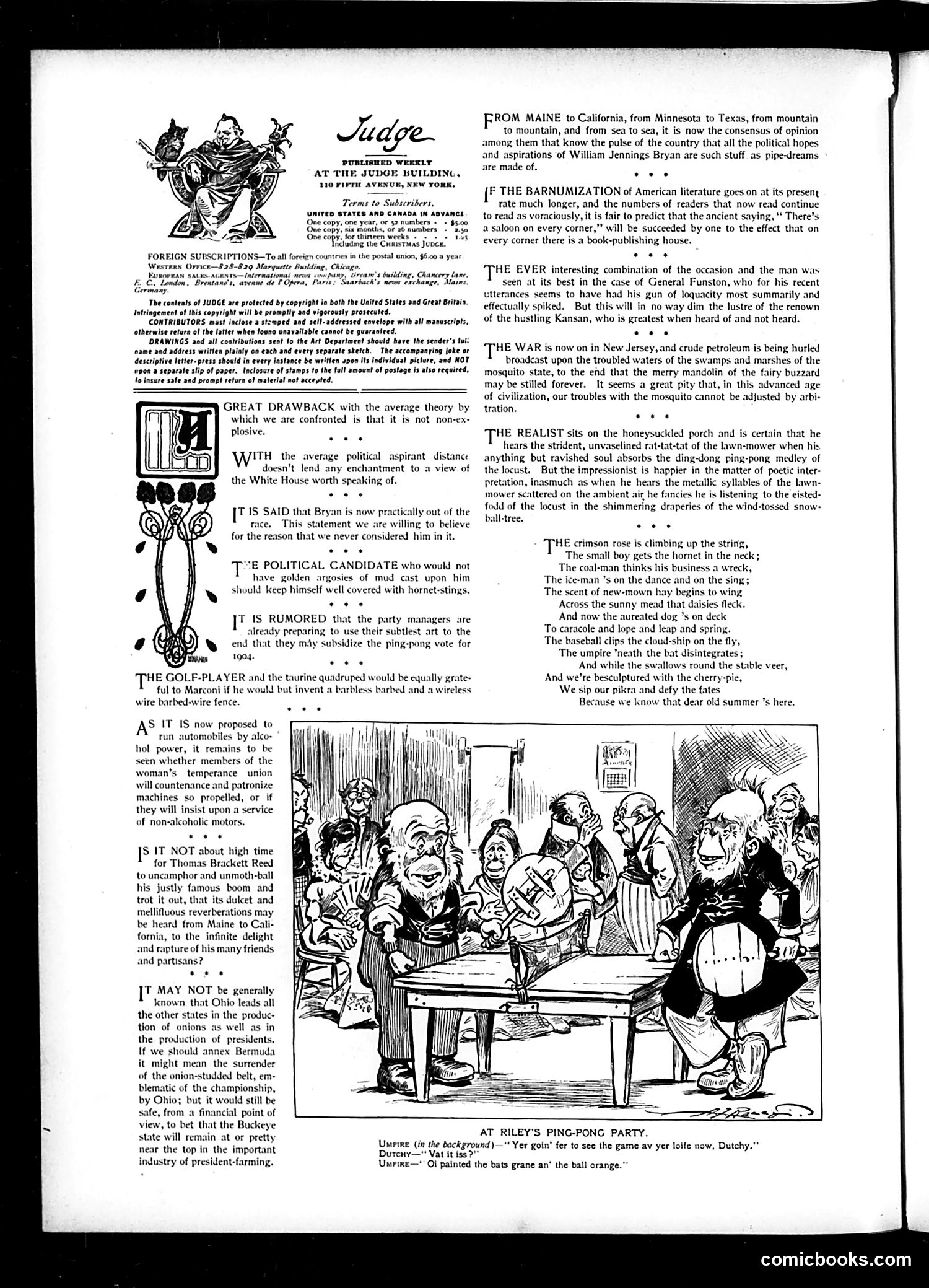
This page contains editorial commentary on contemporary political issues, though the specific date isn't visible. The main cartoon, "At Riley's Ping-Pong Party," depicts a social gathering where political figures apparently discuss games and current events. The dialogue references seeing "the game" and painting "the bats grane an' the ball orange," suggesting satirical commentary on political maneuvering disguised as leisure activity. The left column includes various short political observations, including comments on William Jennings Bryan, General Funston, and petroleum interests in New Jersey. References to "the mosquito state" and crude petroleum suggest early 20th-century industrial/agricultural concerns. The text mocks political candidates, party managers, and various public figures through brief, pointed jabs typical of Judge's satirical style.
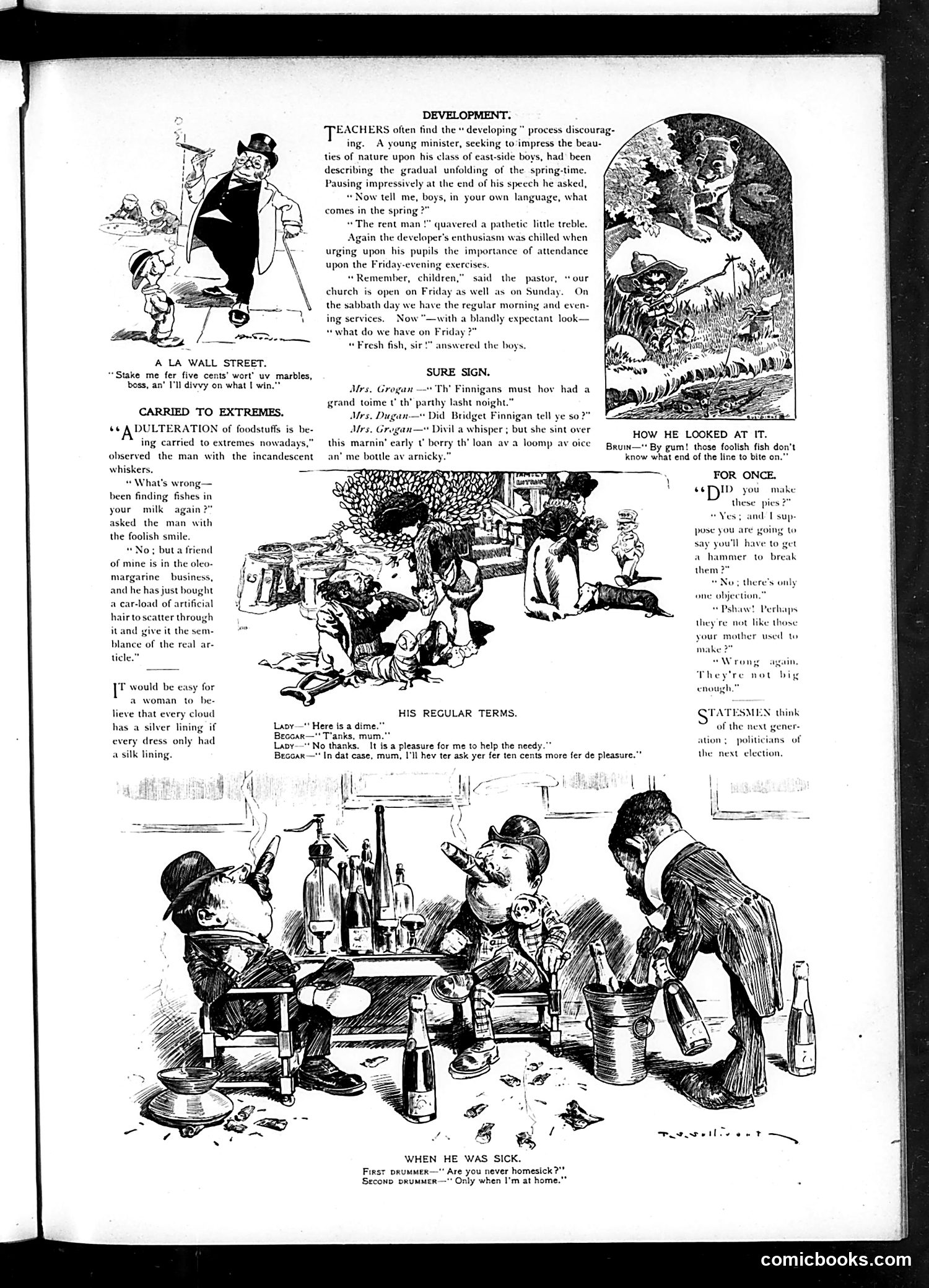
This page contains satirical sketches with social commentary rather than political cartoons: **"Development"** mocks ineffective teachers. A minister's attempt to inspire boys about spring by asking them to describe it backfires when they answer "fresh fish"—suggesting urban poor children have different priorities than pastoral ideals. **"Carried to Extremes"** ridicules a man obsessed with artificial hair products who ironically bought "a carload of artificial hair to scatter through it." **"His Regular Terms"** shows a beggar's negotiation for charity, satirizing both poverty and miserly responses. **"When He Was Sick"** uses a joke about drummers (traveling salesmen) being homesick only when at home—commenting on their itinerant lifestyle. The humor targets class pretensions, consumer absurdity, and working-class conditions of the era.
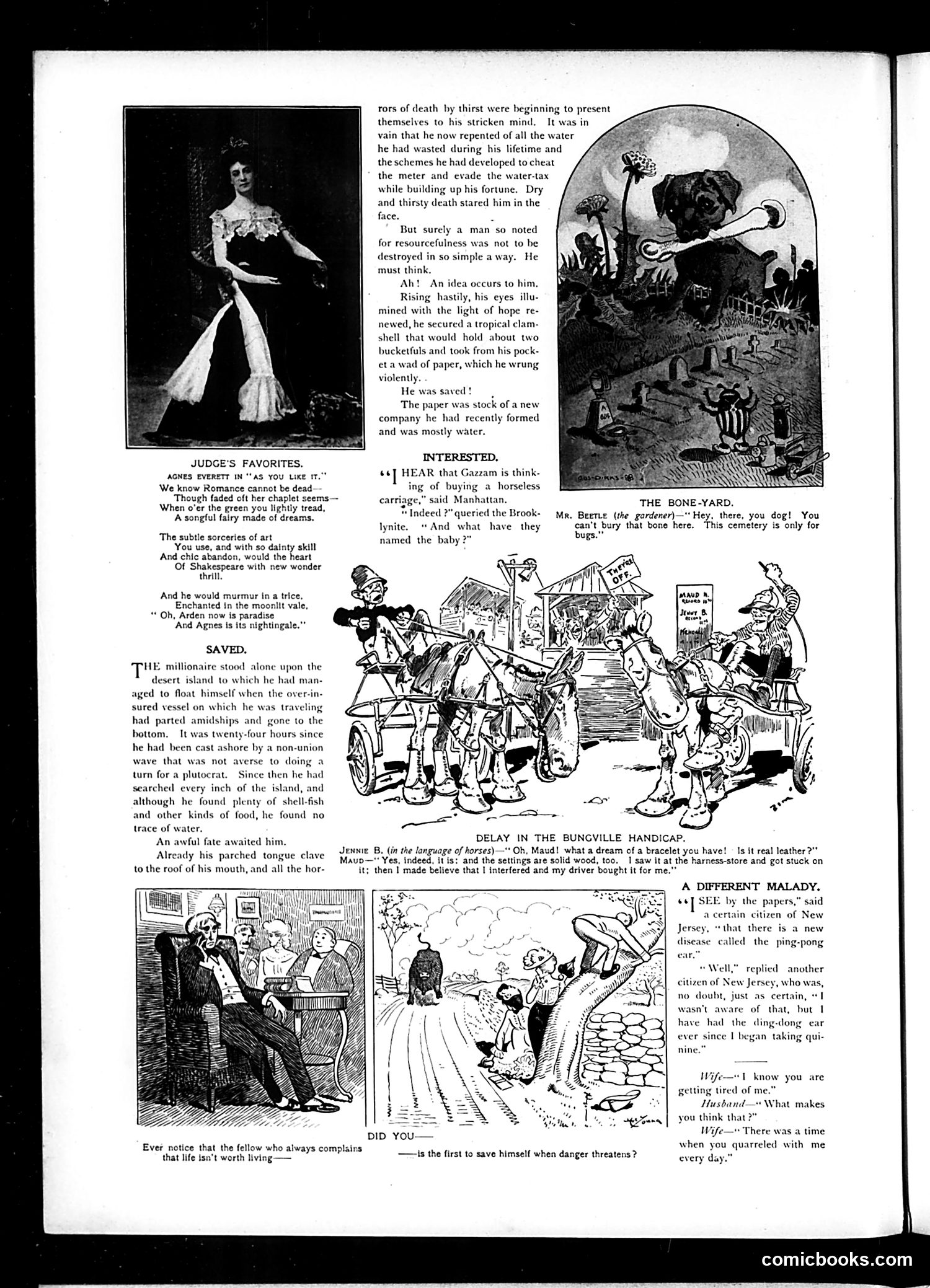
This page contains several satirical vignettes rather than a single political cartoon. The sketches appear to mock various social pretensions and follies: **"Judge's Favorites"** (top left) presents a poem mocking romantic literary affectation, likely satirizing overwrought Victorian poetry. **The Bungville scene** depicts humorous domestic situations involving the newly wealthy or aspirational middle class—figures like "Gazzam" discussing horseless carriages (automobiles) and naming babies, suggesting satire of nouveau riche social climbing. **"A Different Malady"** (bottom right) jokes about a New Jersey "ping-pong ear" disease, likely a humorous fabrication poking fun at medical fads or hypochondriacs. The remaining sketches appear to satirize everyday social pretension, complaining, and marital discord. The humor targets middle-class aspirations and modern anxieties rather than specific political figures.
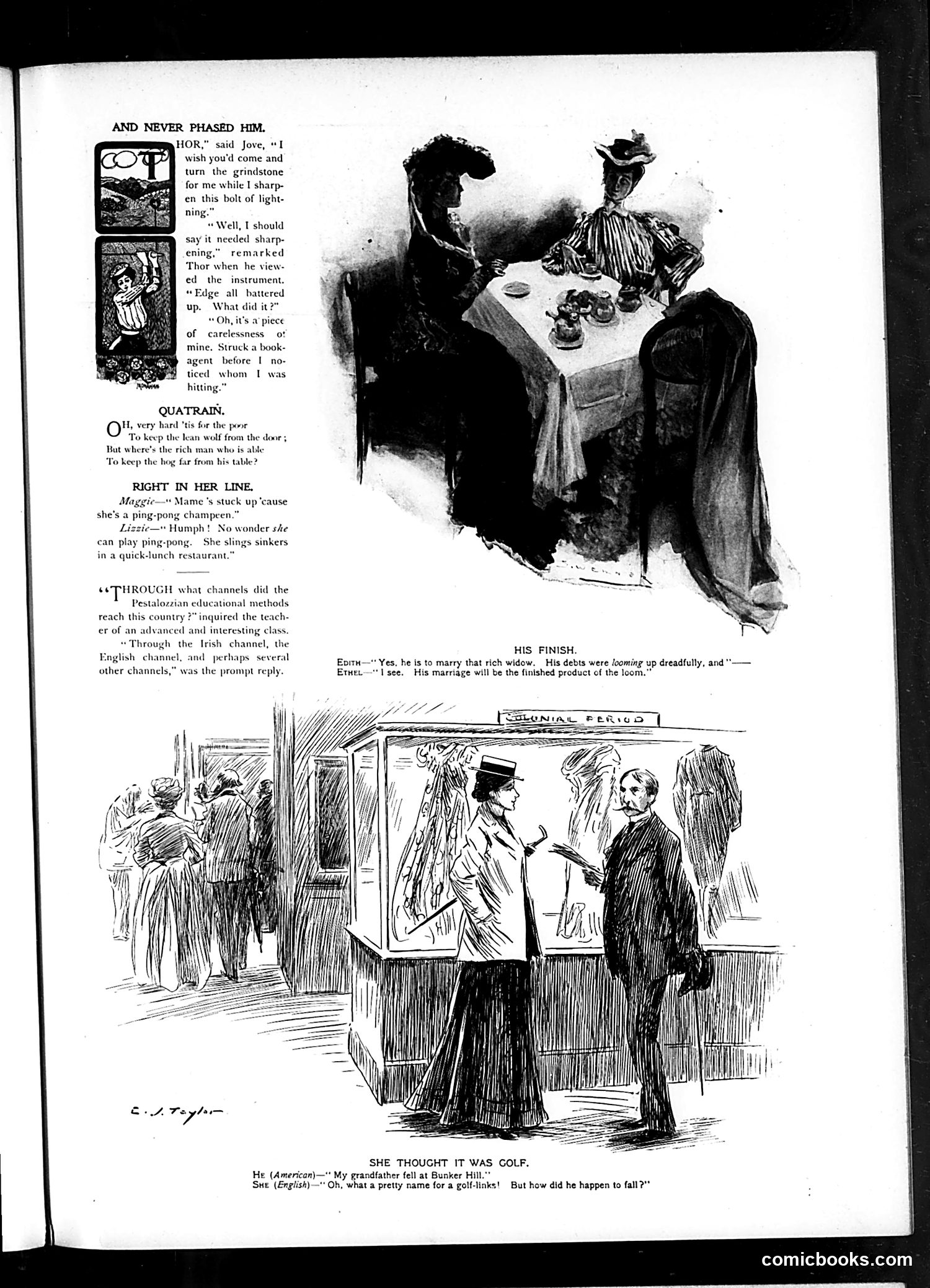
This page contains three separate jokes typical of early-20th-century American satirical humor: 1. **"His Finish"** (top): A domestic scene where a man marries a wealthy widow to escape debt. The pun plays on textile industry terminology—his marriage is "the finished product of the loom," meaning both marriage and financial rescue are complete. 2. **"She Thought It Was Golf"** (bottom): An American and English woman misunderstand each other. When he mentions his grandfather died at "Bunker Hill" (the Revolutionary War battle), she assumes it's a golf course and asks how he "fell." The joke mocks perceived English ignorance of American history and golf terminology confusion. 3. **"Right in Her Line"** (middle): Brief quip suggesting a woman named "Mame" is both a ping-pong champion and restaurant server ("slings sinkers"—slang for serving food quickly). The page satirizes social pretension, transatlantic cultural gaps, and financial desperation—common Judge themes. No specific political figures appear.
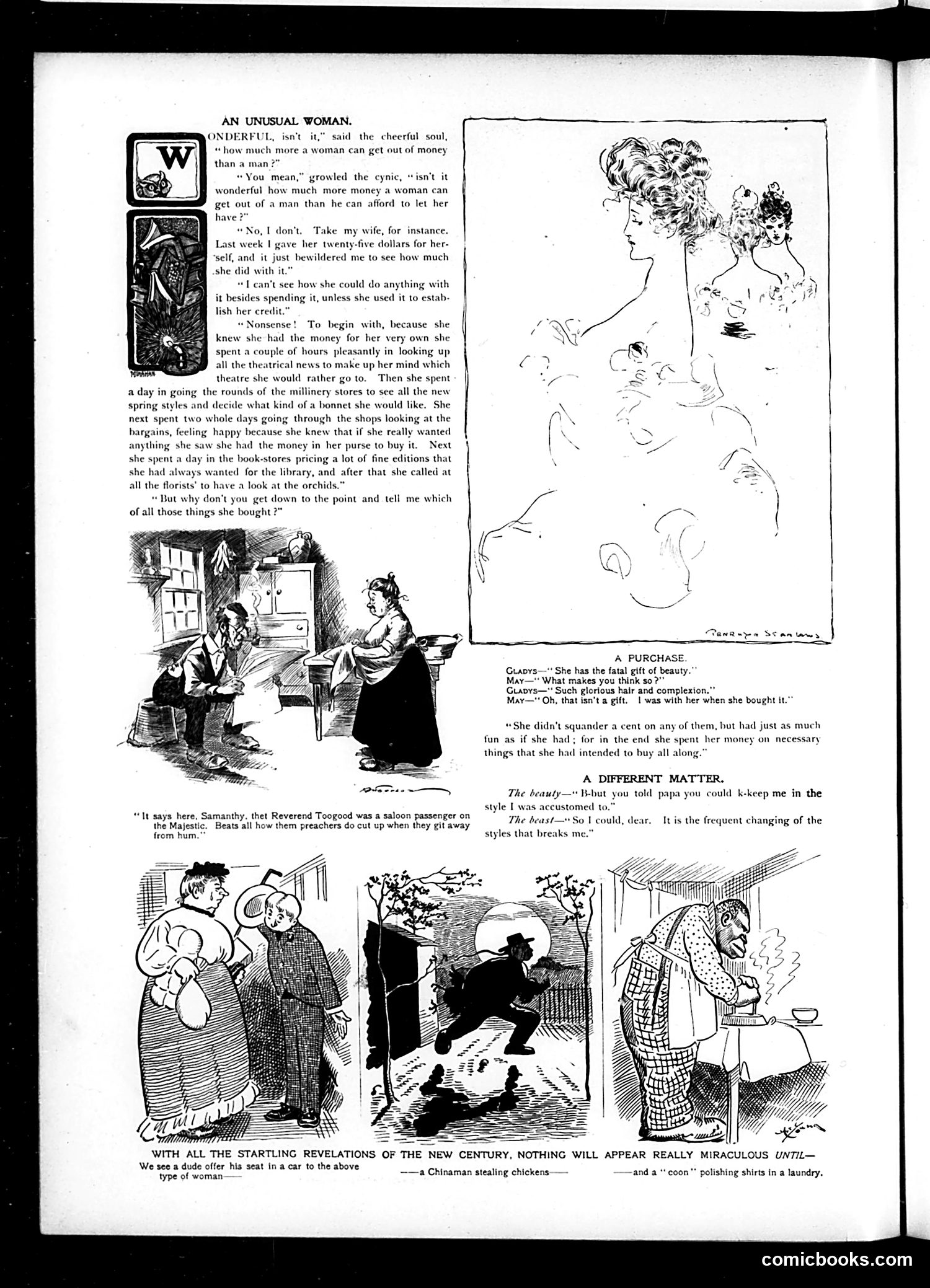
This page satirizes gender and consumer behavior in the early 20th century. The main dialogue mocks the supposed economic superiority women claim over money—a cynic argues women actually extract money *from* men rather than manage it wisely. The humor targets women's shopping habits: the wife spends days window-shopping and browsing (theaters, millinery, bookstores, florists) without purchasing anything, then buys "necessary things" anyway—suggesting women enjoy the *leisure* of shopping more than acquiring goods. Secondary cartoons reinforce this theme: "A Purchase" jokes that a woman's beauty is store-bought, not natural. "A Different Matter" depicts marital conflict over a wife's expensive lifestyle expectations. The page's final line references period stereotypes about Chinese immigrants and African Americans, suggesting the magazine's casual racism alongside its gender satire.
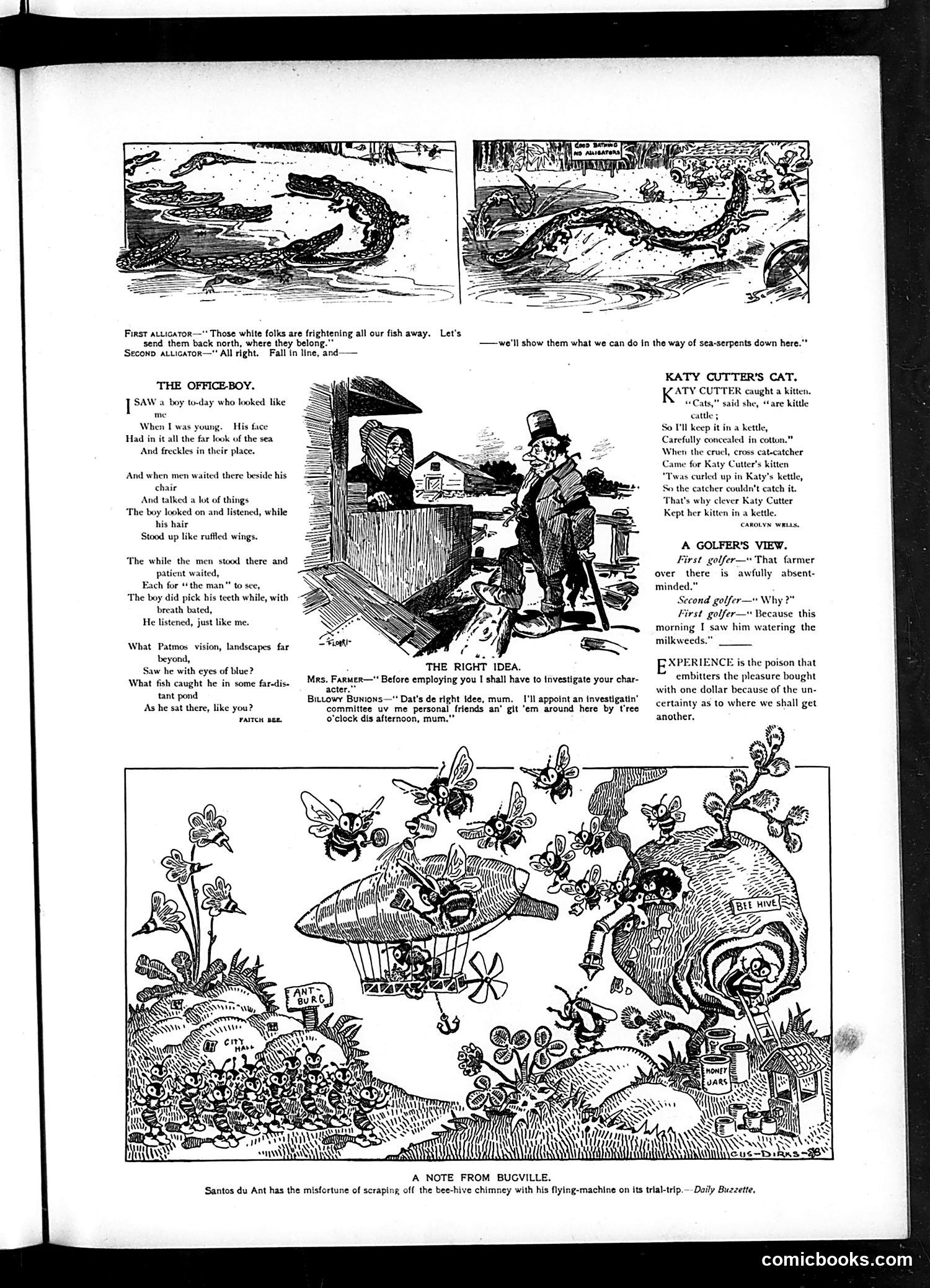
This page contains several short satirical pieces typical of early 20th-century American humor magazines: **"The Alligators"** (top): A racist joke where alligators discuss driving away "white folks" northward, reversing contemporary racial tensions. **"The Office-Boy"**: A sentimental poem about a young office worker daydreaming—nostalgic rather than satirical. **"The Right Idea"**: A class-based joke where "Bitowy Bunions," apparently a working-class character with a dialect accent, proposes investigating his own character through "personal friends" before employment—satirizing naive job applicants. **"Katy Cutter's Cat"** and **"A Golfer's View"**: Light, domestic humor pieces without political content. **"A Note from Bugville"**: A whimsical illustrated fantasy about insects and a flying machine, poking fun at aviation aspirations. The page reflects Judge's mix of political/social satire with genteel humor and sentimental verse—aimed at educated, middle-class readers amused by working-class caricatures and absurdist scenarios.
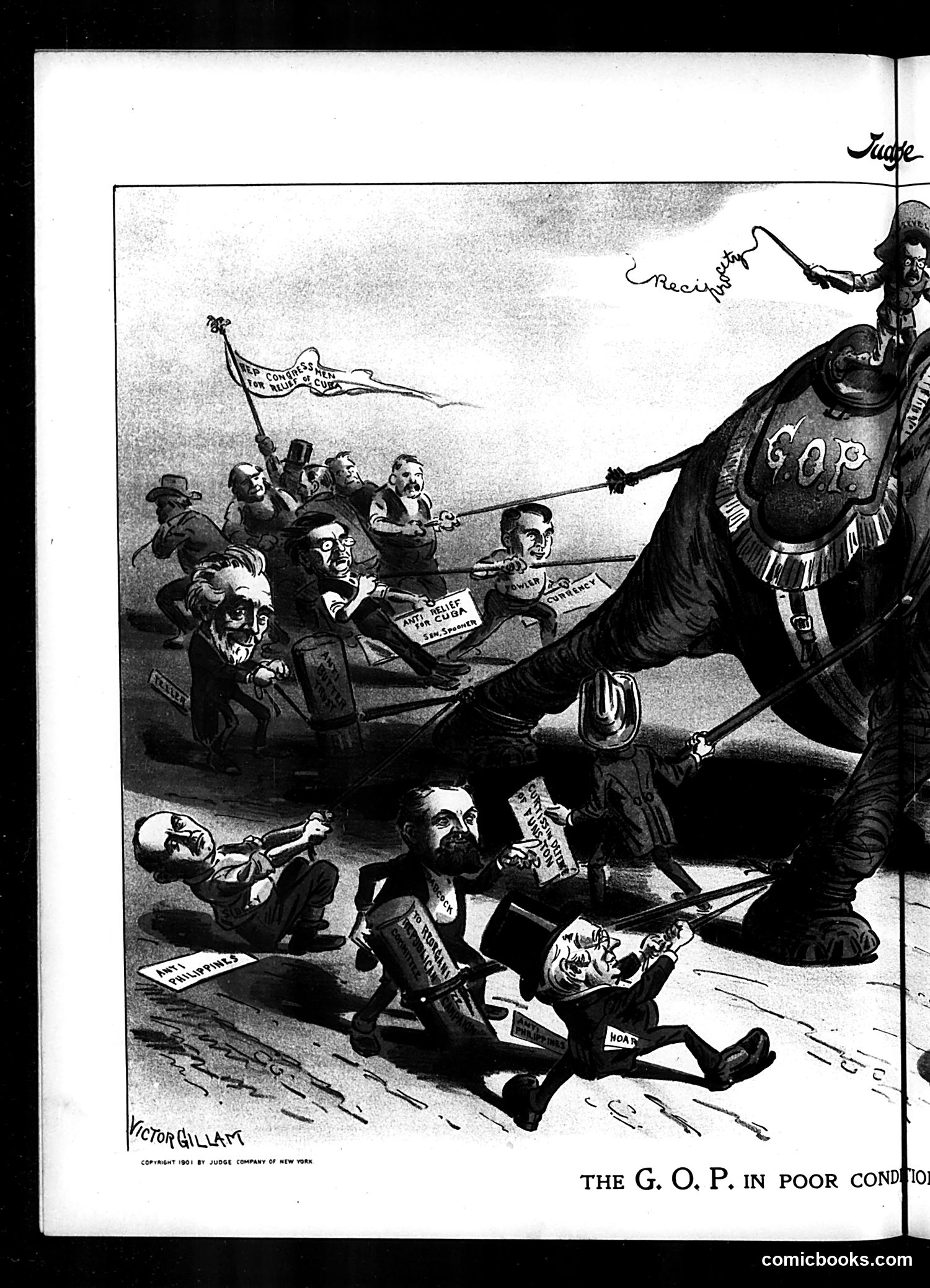
This 1901 Judge cartoon by Victor Gillam satirizes the Republican Party (G.O.P.) as a sickly elephant being examined by party politicians. The large elephant—the GOP's traditional symbol—appears weakened or diseased, while small caricatured figures (likely Republican leaders) cluster around it with concern, holding documents and offering remedies. The satire suggests internal Republican Party problems or divisions following President McKinley's first term. The "poor condition" referenced in the title implies the party faces serious troubles—possibly related to patronage disputes, tariff debates, or factional conflicts common in early 1900s GOP politics. The cartoon mocks party leaders' apparent helplessness in addressing these ailments, portraying them as ineffectual physicians unable to cure their organization's ills.
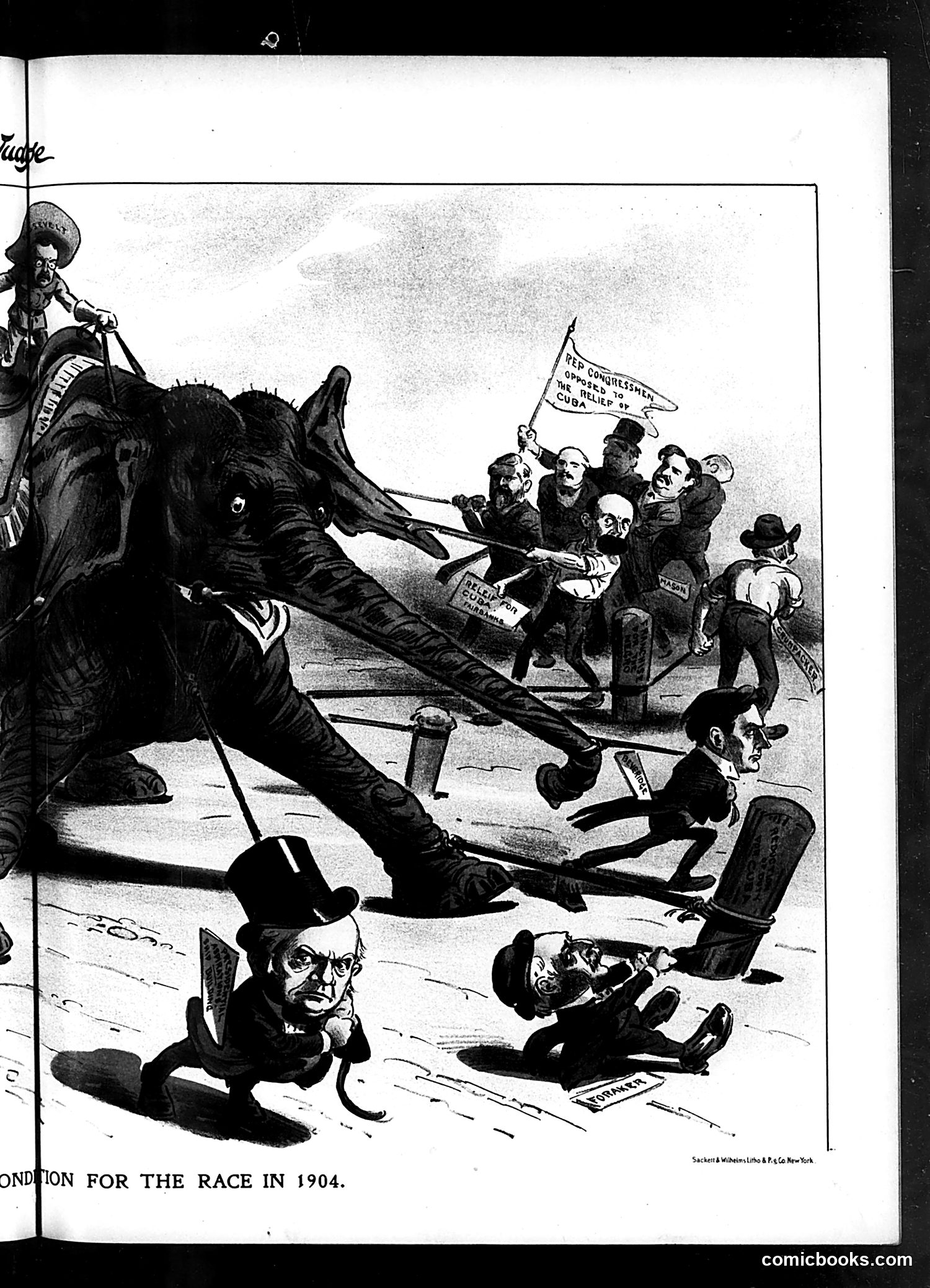
This Judge magazine cartoon satirizes the 1904 U.S. presidential race. A massive elephant (representing the Republican Party) tramples smaller figures representing Democratic candidates and opposition politicians. The elephant is controlled by a figure on top (likely President Theodore Roosevelt or Republican leadership), while those beneath struggle with a banner reading what appears to be "Congress" or party-related text. The cartoon depicts Republicans as overwhelmingly dominant, literally crushing their political opponents underfoot. The exaggerated scale emphasizes Republican power and the perceived weakness of Democratic resistance. This reflects the historical reality: Roosevelt's Republicans dominated 1904 politics. The "condition for the race" suggests the unequal battlefield Democrats faced entering that election year.
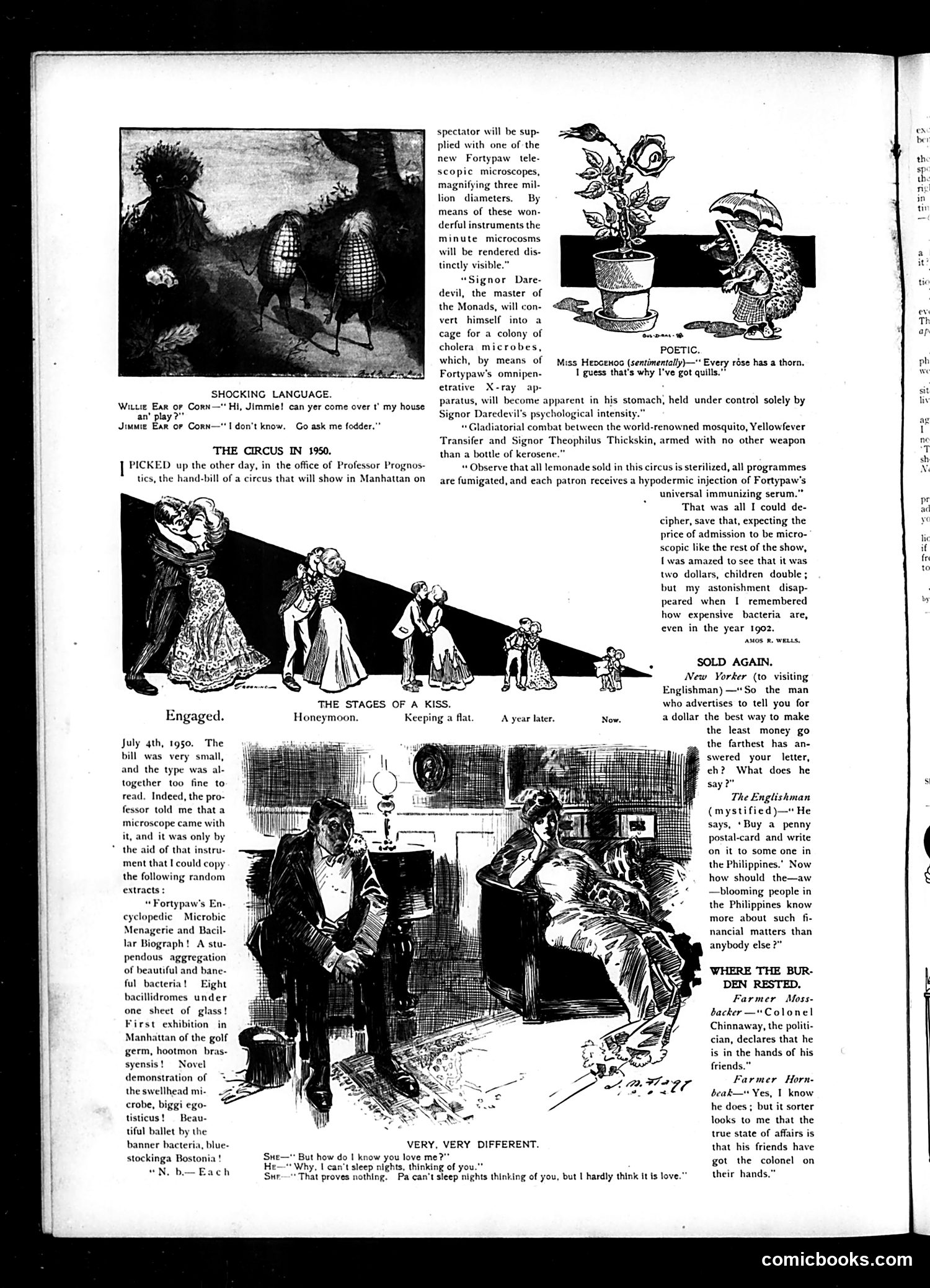
This page contains three separate satirical pieces: **"The Circus in 1950"** imagines a future "Microbie Menagerie" showcasing bacteria as entertainment attractions. The satire mocks both scientific advancement obsession and turn-of-the-century germ theory anxiety. References like "Fortypaw's telescopic microscopes" and cholera bacteria performances parody how contemporaries sensationalized microscopic discoveries. The admission price joke—expensive because "bacteria are costly"—satirizes how producers exploit public fascination with invisible threats. **"The Stages of a Kiss"** uses sequential illustrations to humorously track romantic relationships' decline from engagement through honeymoon to the mundane "keeping a flat" stage—a commentary on marriage's loss of passion. **"Sold Again"** presents a simple con: an English visitor asks an American advertiser for money-saving advice; the advertiser suggests sending a penny postcard to the Philippines—implying the Philippines somehow contain financial wisdom, which the bewildered Englishman finds absurd. It's likely satirizing either American confidence in colonial subjects or skepticism about dubious business advice schemes.
This page is primarily **advertising** with scattered brief comic vignettes typical of Judge's format. The small cartoons illustrate wordplay and domestic humor common to the era: a geography editor married versus "mappy," disputes about patience in marriage, women's supposed unsuitability for business, and a political boss revising unflattering descriptions of himself. The advertisements dominate the page—whiskey (Old Cambridge Rye), brandy (Martell's Three Star), bitters (Angostura, Evans), pianos (Sohmer), suspenders (President), a perfume (ED. Pinaud's), and railroad service (Overland Limited). The only identifiable figure is a caricatured man in the "Boston Garter" ad, shown as a "standard for gentlemen." No clear political satire or major social commentary appears. This represents Judge's typical mix of light domestic humor and commercial promotion targeting middle-class male readers.
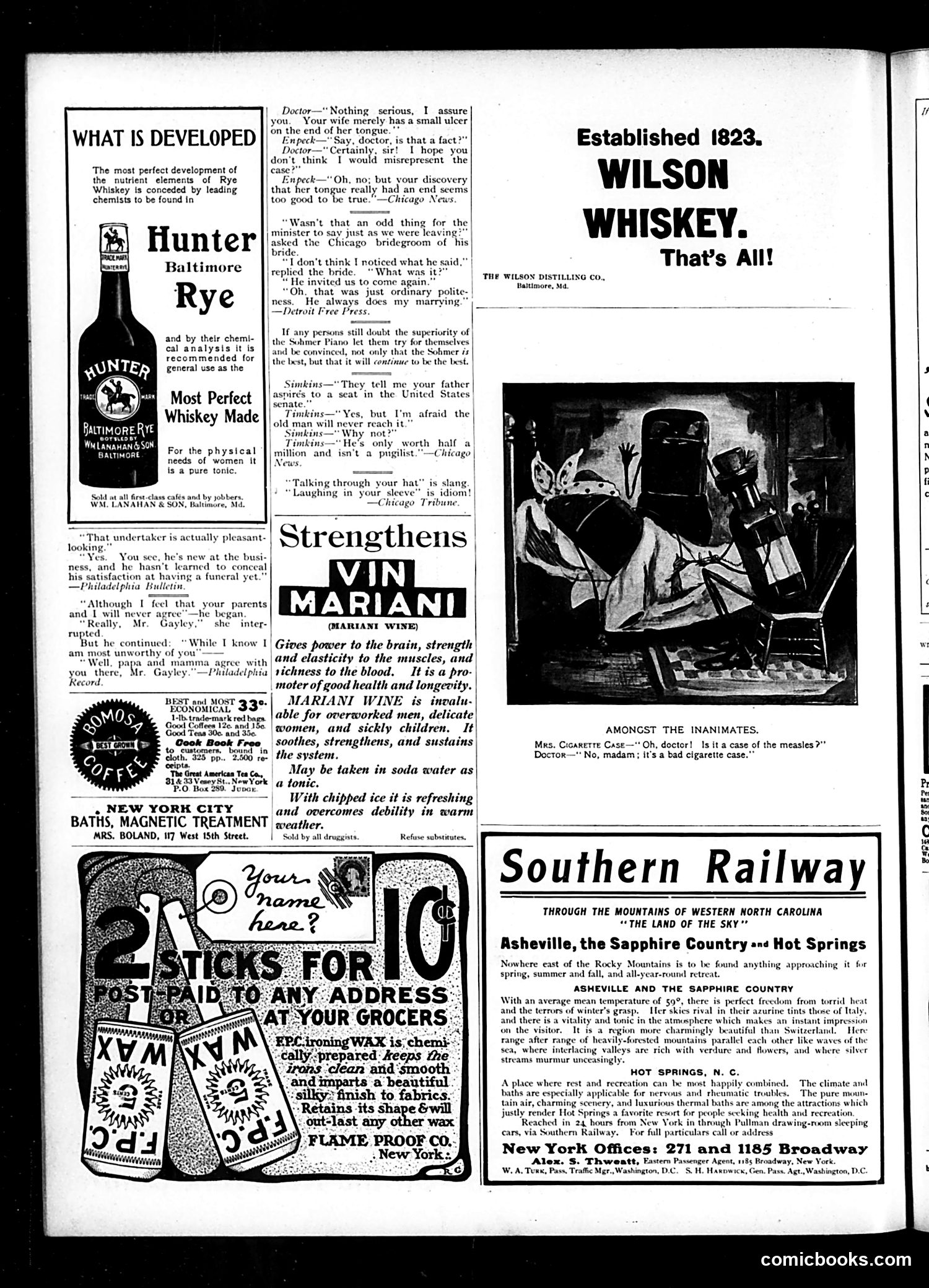
This page is primarily **advertising**, not political satire. It contains multiple product advertisements typical of early 20th-century magazines: **Key Ads:** - **Hunter Baltimore Rye Whiskey** and **Wilson Whiskey** — competing liquor brands claiming health benefits - **Vin Mariani** — a wine tonic marketed as strengthening the brain and muscles, "invaluable for overworked men, delicate women, and sickly children" - **Southern Railway** — promoting Asheville, North Carolina as a health resort - Various other products (coffee, wax, magnetic bath treatments) **The Humor:** Scattered jokes mock doctors and social pretense — a doctor's slip about a wife's "ulcer on the end of her tongue" (implying she talks too much), and quips about wealth and ambition. **Historical Context:** These advertisements reflect pre-FDA regulation, when patent medicines and alcohol were marketed with unsubstantiated health claims. The page exemplifies how magazines monetized readers' anxieties about health and status.
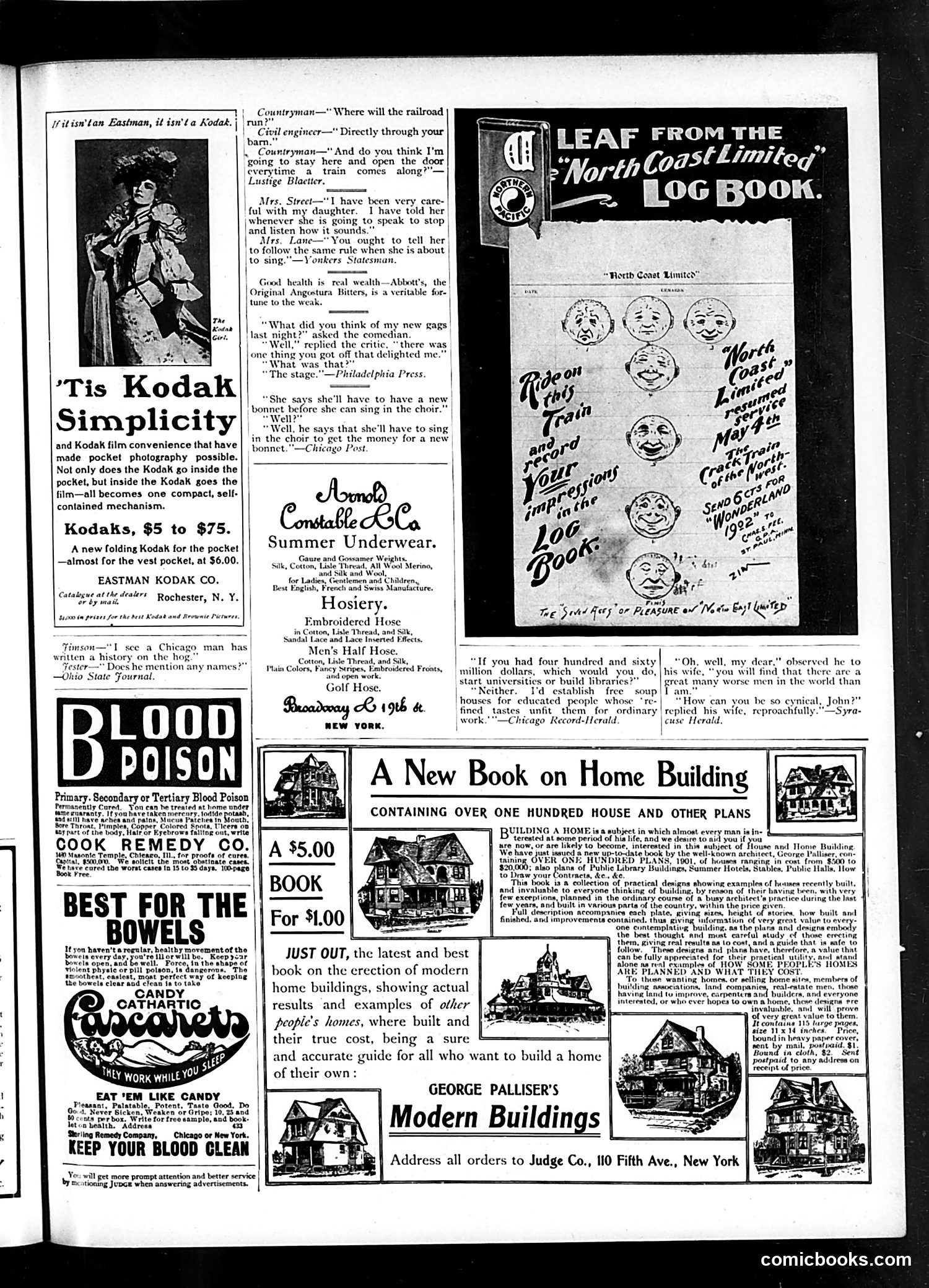
This page is primarily **advertising**, not political satire. The content consists of commercial advertisements from circa 1900s, with minimal editorial cartoon content. The few jokes present are brief, lightweight material: - A **"railroad through barn" exchange** between a countryman and engineer—simple rural humor about unexpected train routes - **Musician/critic exchanges** about singing and performance—mild mockery of pretension - A **cynic's dialogue** about philanthropy versus personal vice—gentle social commentary on hypocrisy The page's dominant feature is a large advertisement for **George Palliser's "Modern Buildings" book** on home construction, surrounded by smaller ads for Kodak cameras, undergarments, remedies (blood poison cure, digestive aids), and other consumer goods. No identifiable political figures or events are referenced. This appears to be a standard commercial magazine page where advertising revenue substantially outweighs editorial content—typical for early-1900s periodicals.
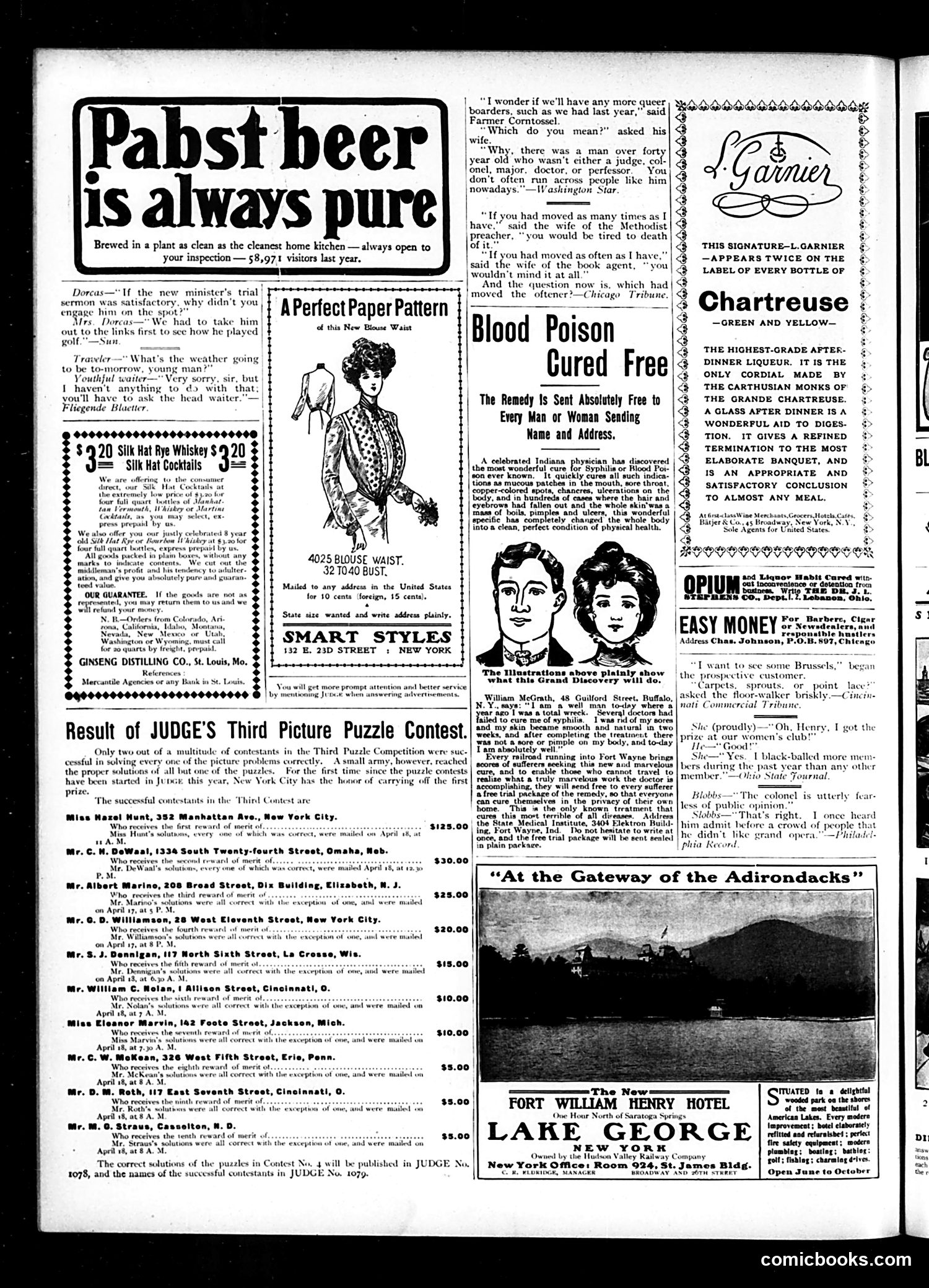
This page is primarily **advertising and editorial content**, not political satire. The main elements: **Pabst Beer advertisement** (top): A purity claim reflecting turn-of-century marketing—breweries advertised their facilities' cleanliness to counter public health concerns about brewing practices. **"Blood Poison Cured Free"**: Medical advertising typical of the era, likely referring to syphilis treatment. Such ads exploited desperate patients and were often fraudulent. **Judge magazine's picture puzzle contest results**: Recognition of readers who solved visual puzzles, awarding cash prizes—a common engagement strategy. **Small jokes/anecdotes**: Reprinted humor about ministers, travelers, and preachers—light observational comedy reflecting middle-class concerns about respectability and social status. **Fashion pattern**: A mail-order blouse waist design (standard women's magazine content). **Fort William Henry Hotel advertisement**: Tourism promotion. The page reflects **early 1900s consumer culture**: direct-mail commerce, dubious medical claims, visual entertainment, and aspirational advertising.
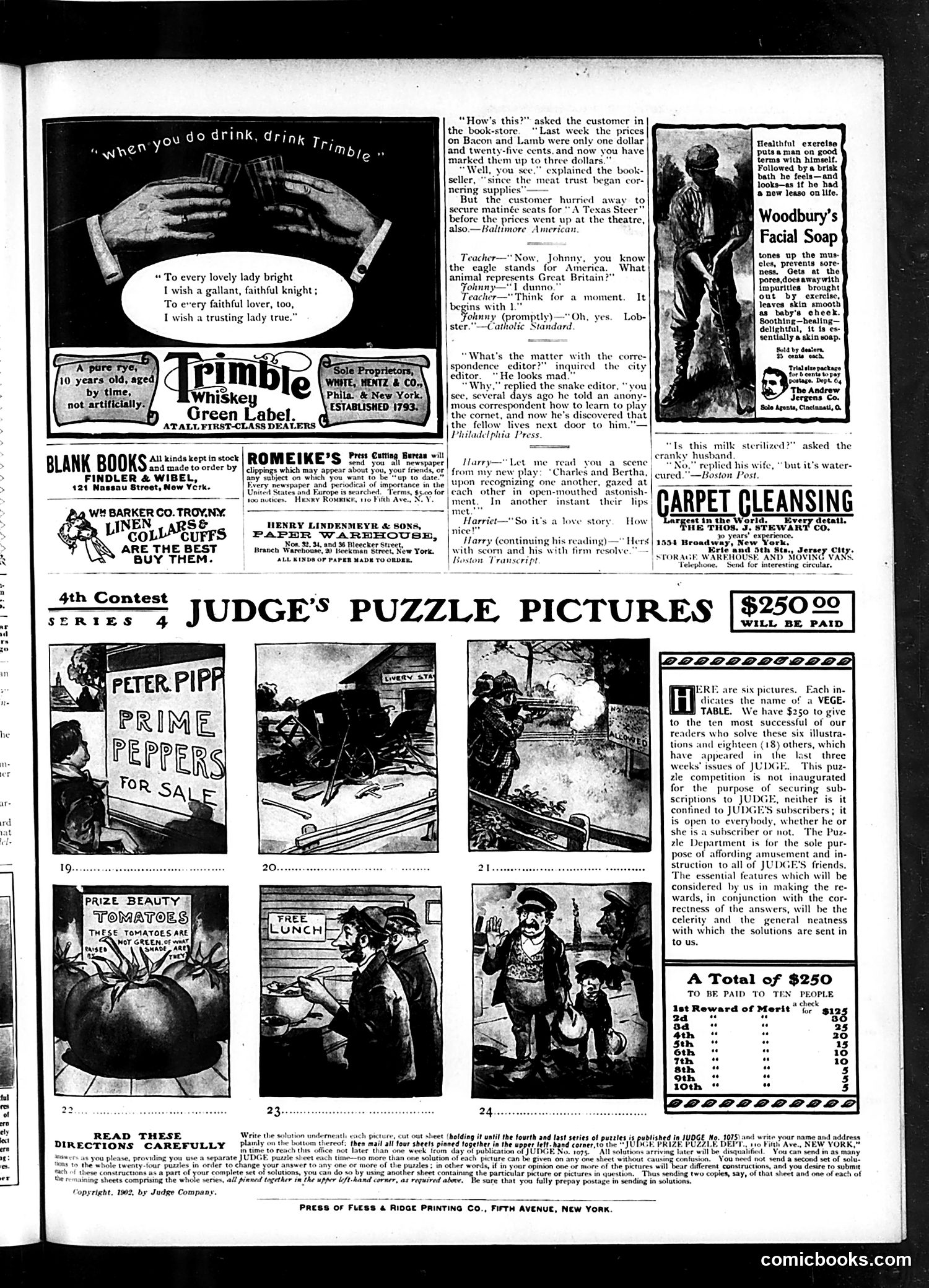
This page mixes advertising with satirical content typical of early-1900s Judge magazine. **The Meat Trust Cartoon**: The opening dialogue mocks price inflation in butcher shops. A customer notes that bacon and lamb prices have tripled in a week. The satire targets the "meat trust"—a contemporary monopoly scandal where large meat-packing corporations were accused of price-fixing. The joke's cynical punchline: the customer rushes to buy theater tickets before *those* prices rise too. **The Eagle/Lobster Exchange**: A teacher-student dialogue satirizes American patriotism. When asked what the eagle represents, Johnny guesses "lobster," confusing the national symbol with seafood. The humor lies in the child's innocent ignorance of civic symbols. **Other Items**: The page includes unrelated advertisements (Trimble Whiskey, soap), gossip columns about theatrical/newspaper figures, and a puzzle contest. The page reflects Progressive-era anxieties about corporate monopolies and consumer prices, wrapped in light satirical humor.
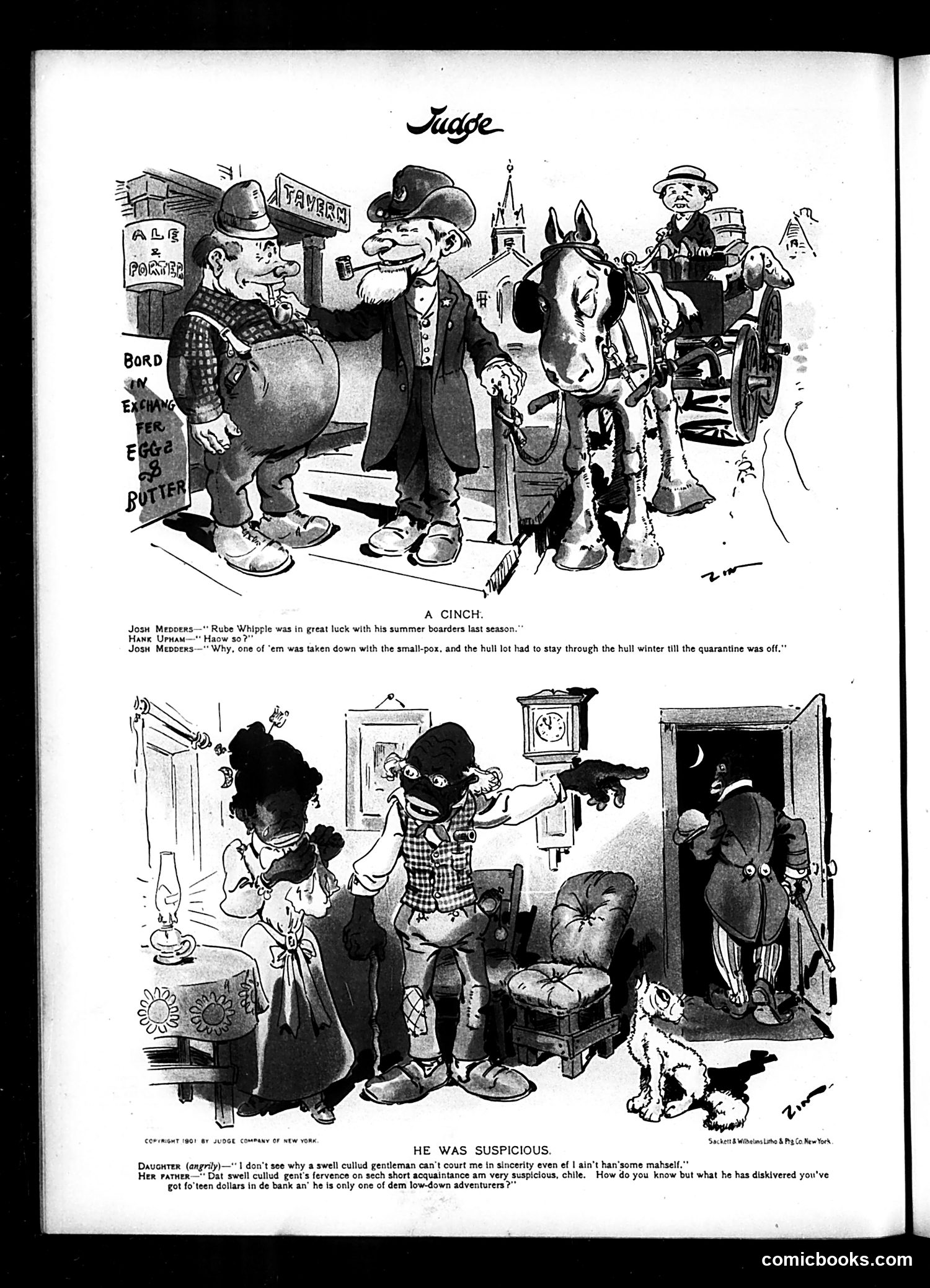
**Top cartoon ("A Cinch"):** Rural characters discuss a boarding house owner's profitable misfortune. When a smallpox case forced all summer boarders to remain through winter quarantine, they had to pay for extended lodging—a financial "cinch" (easy win). The satire mocks the callousness of exploiting disease for profit. **Bottom cartoon ("He Was Suspicious"):** Uses racist dialect and stereotypes to depict an African American father warning his daughter against a suitor's romantic intentions. The joke relies on period racial caricatures: the father suspects the gentleman is courting her only for her meager savings ("fo'teen dollars"), portraying Black people as gullible and materialistic. Both cartoons reflect 1901 attitudes: casual exploitation of illness and crude racial mockery presented as humor. The second cartoon's offensive language and stereotypes are characteristic of the era's casual racism in mainstream publications.