
A complete issue · 16 pages · 1902
Judge — March 8, 1902
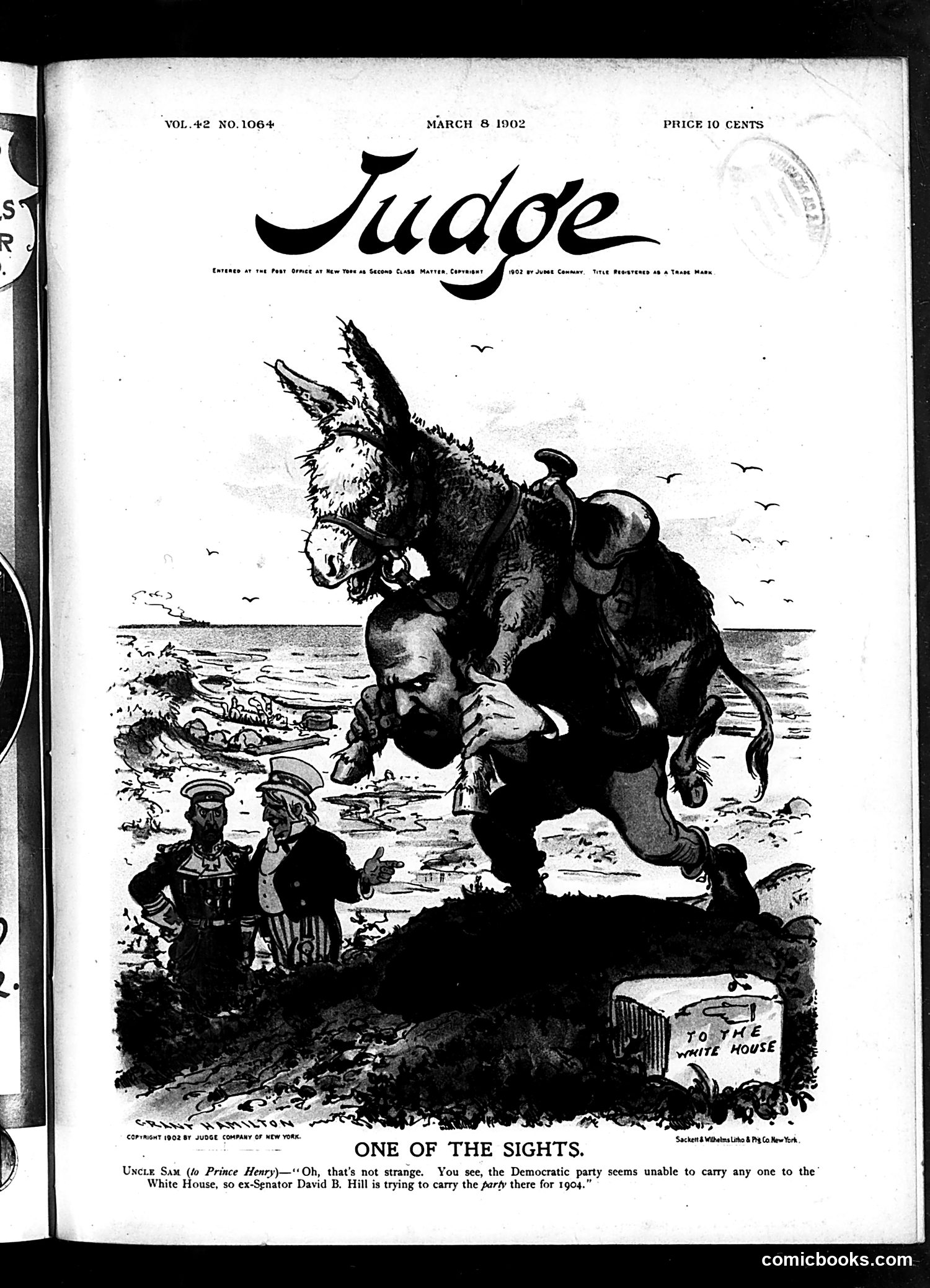
This satirical cartoon depicts **Uncle Sam struggling to carry a Democratic donkey** to the White House. The caption references **ex-Senator David B. Hill**, who apparently attempted to deliver the Democratic party to the White House for the 1904 election, but the donkey proves too unwieldy to transport. The humor satirizes the Democratic party's internal weakness and disorganization in early 1902—suggesting they're an impossible burden to carry into the upcoming presidential race. The two naval figures observing the scene likely represent Republican observers mocking Democratic electoral prospects. The cartoon mockingly illustrates how the Democratic party had become a liability rather than an asset for any candidate attempting to lead them to victory.
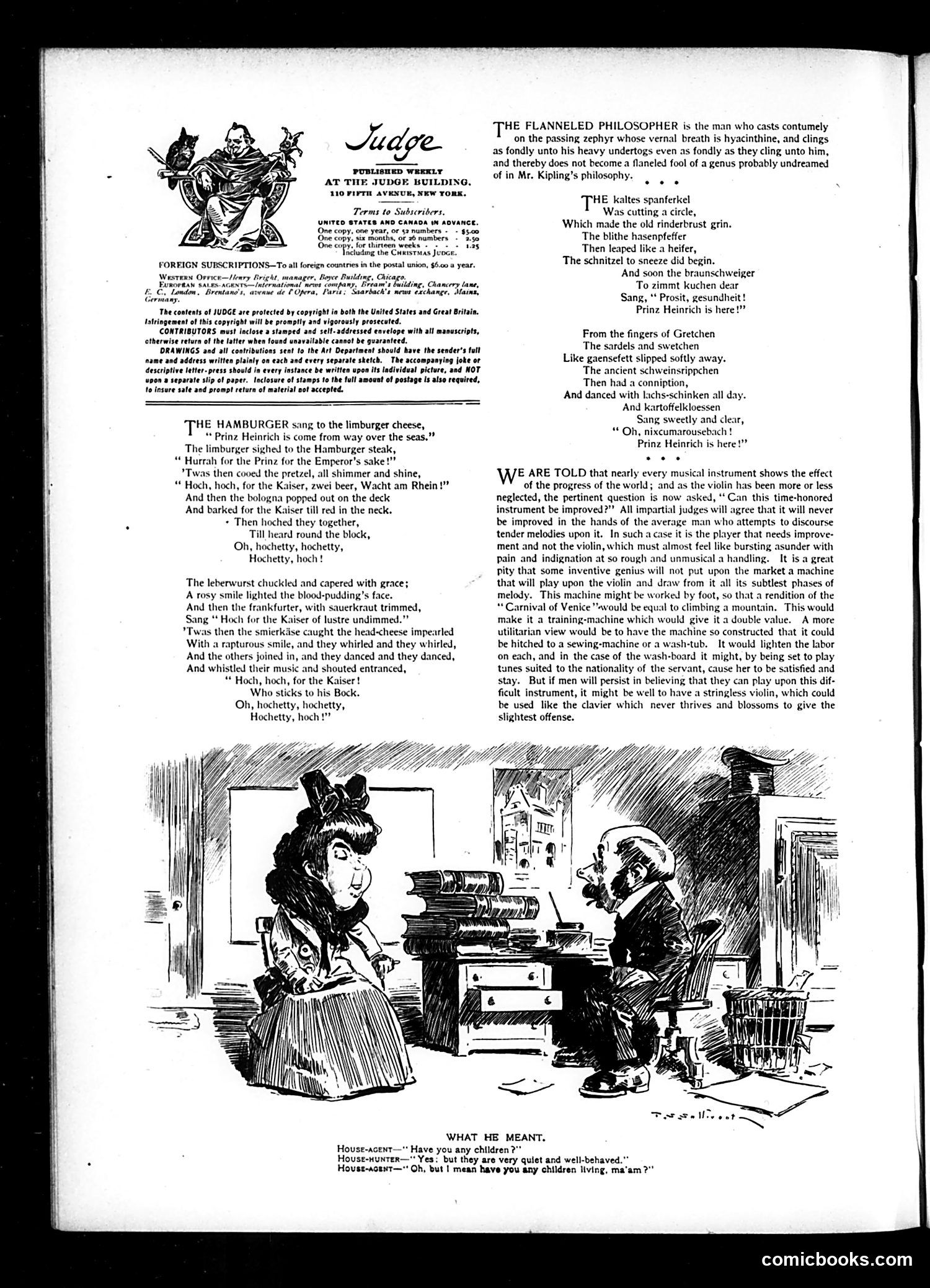
This page contains satirical poetry and prose mocking German culture and philosophy, likely from the WWI era when anti-German sentiment was high in American publications. "The Flanneled Philosopher" parodies German intellectual pretension. The poems mock German figures and customs—references to "Prinz Heinrich," Hamburg cheese, and the Kaiser suggest contemporary German political figures. The repeated phrase "Hoch, hoch, for the Kaiser!" satirizes German militarism. The bottom cartoon "What He Meant" shows a domestic scene where a housewife misunderstands a visitor's inquiry about children, humorous wordplay without obvious political content. Overall, the page reflects wartime American ridicule of German culture and militarism through exaggerated dialect and stereotypes common to Judge's satirical approach during this period.
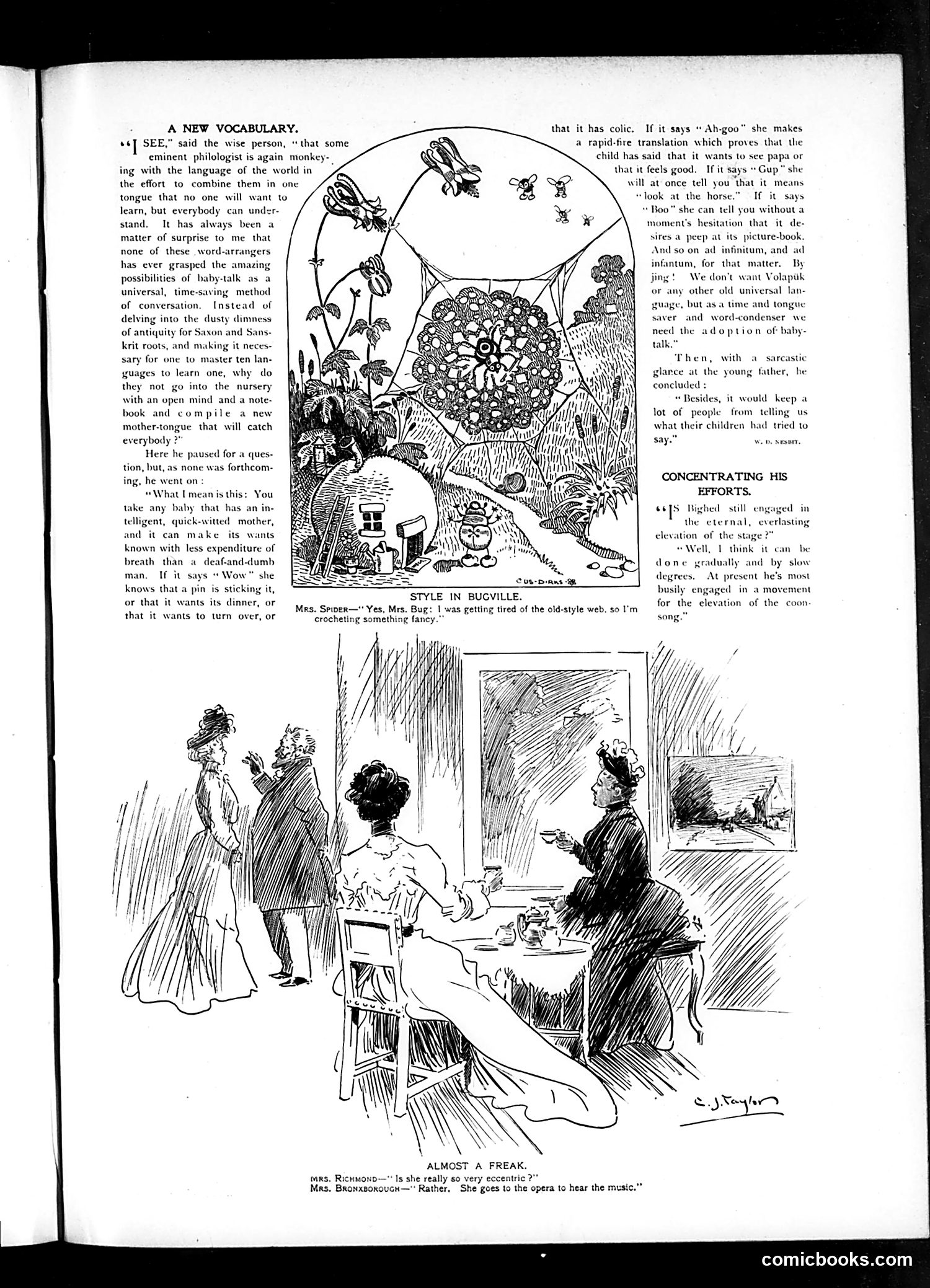
This page contains three distinct elements: 1. **"A New Vocabulary"** - A satirical essay with illustration mocking how parents use simplified "baby talk" with infants, arguing this practice is unnecessary and impedes language development. 2. **"Style in Bugville"** - A cartoon showing Mrs. Spider telling Mrs. Bee she's tired of old-fashioned web design and is "crocheting something fancy" instead. This appears to be light social satire on fashion trends and keeping up appearances. 3. **"Almost a Freak"** - A drawing-room scene where Mrs. Richmond asks if someone is "really so very eccentric," with the response that she "goes to the opera to hear the music." This satirizes social pretension among wealthy women who attend opera for social status rather than genuine appreciation. All three pieces mock various forms of affectation and social convention in early 20th-century middle/upper-class society.
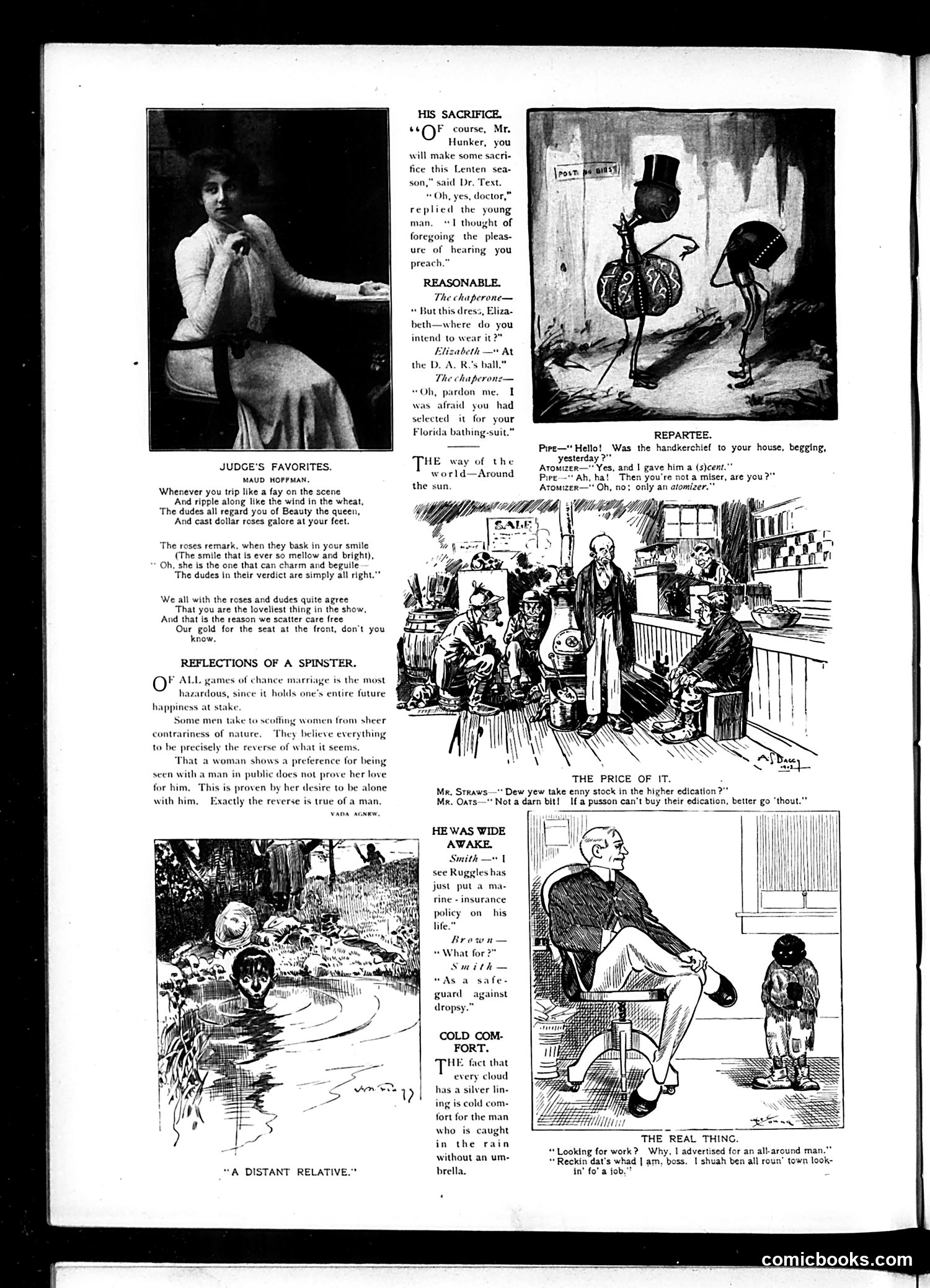
This page contains several unrelated humorous pieces typical of Judge magazine's format: **"Judge's Favorites"** presents poetry about roses and daisies, seemingly celebrating feminine beauty with conventional sentimentality. **"Reflections of a Spinster"** offers social commentary on marriage, suggesting women who appear content unmarried actually desire male companionship—a rather cynical take on women's independence. The cartoon strips include domestic humor: "His Sacrifice" (a couple discussing Lenten sacrifice), "Reasonable" (clothing choice dialogue), "Repartee" (a landlord collecting rent), "The Price of It" (education expenses), "He Was Wide Awake" (insurance as protection), and "The Real Thing" (job-seeking humor). These pieces reflect early-20th-century gender attitudes and working-class life, with gentle satirical jabs at marriage, women's roles, and economic concerns rather than serious political commentary.
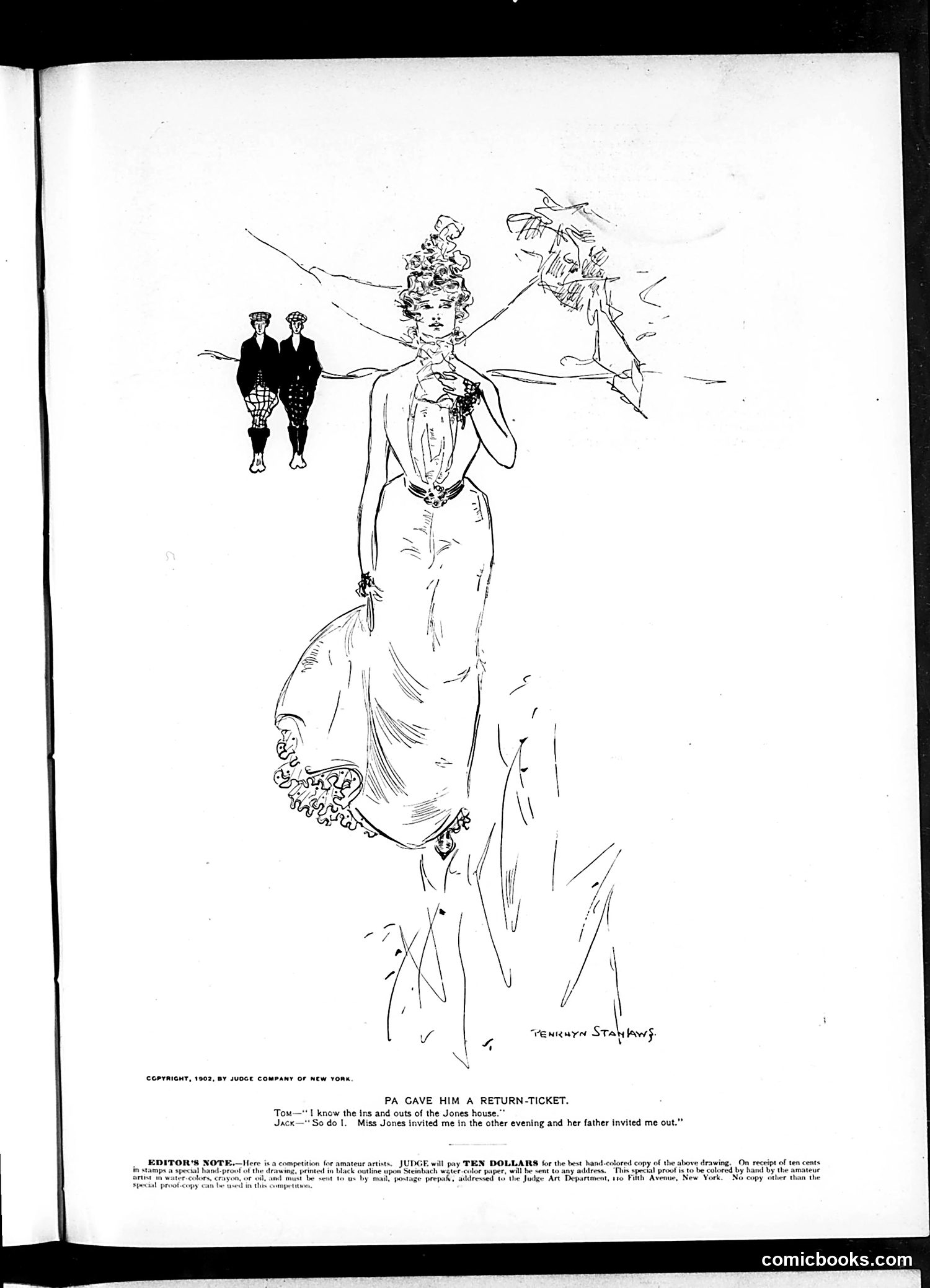
This 1902 Judge cartoon satirizes social courtship customs. The joke hinges on a young man's embarrassing expulsion from the Jones household: he was invited inside by Miss Jones but promptly ejected by her father ("Pa"), who apparently disapproved of the visitor's intentions or behavior. The central figure is an elegantly dressed woman, likely representing Miss Jones or a personification of the situation. The two small figures on the left appear to be Tom and Jack (the dialogue speakers), depicted as fashionable young men in period dress. The humor relies on the double meaning of "ins and outs"—Tom thinks Jack knows the Jones house's layout, but Jack reveals he knows it because he was literally thrown out. The "return-ticket" title suggests the father forcefully ejected him, making his exit memorable. This reflects period anxieties about courtship propriety and parental gatekeeping.
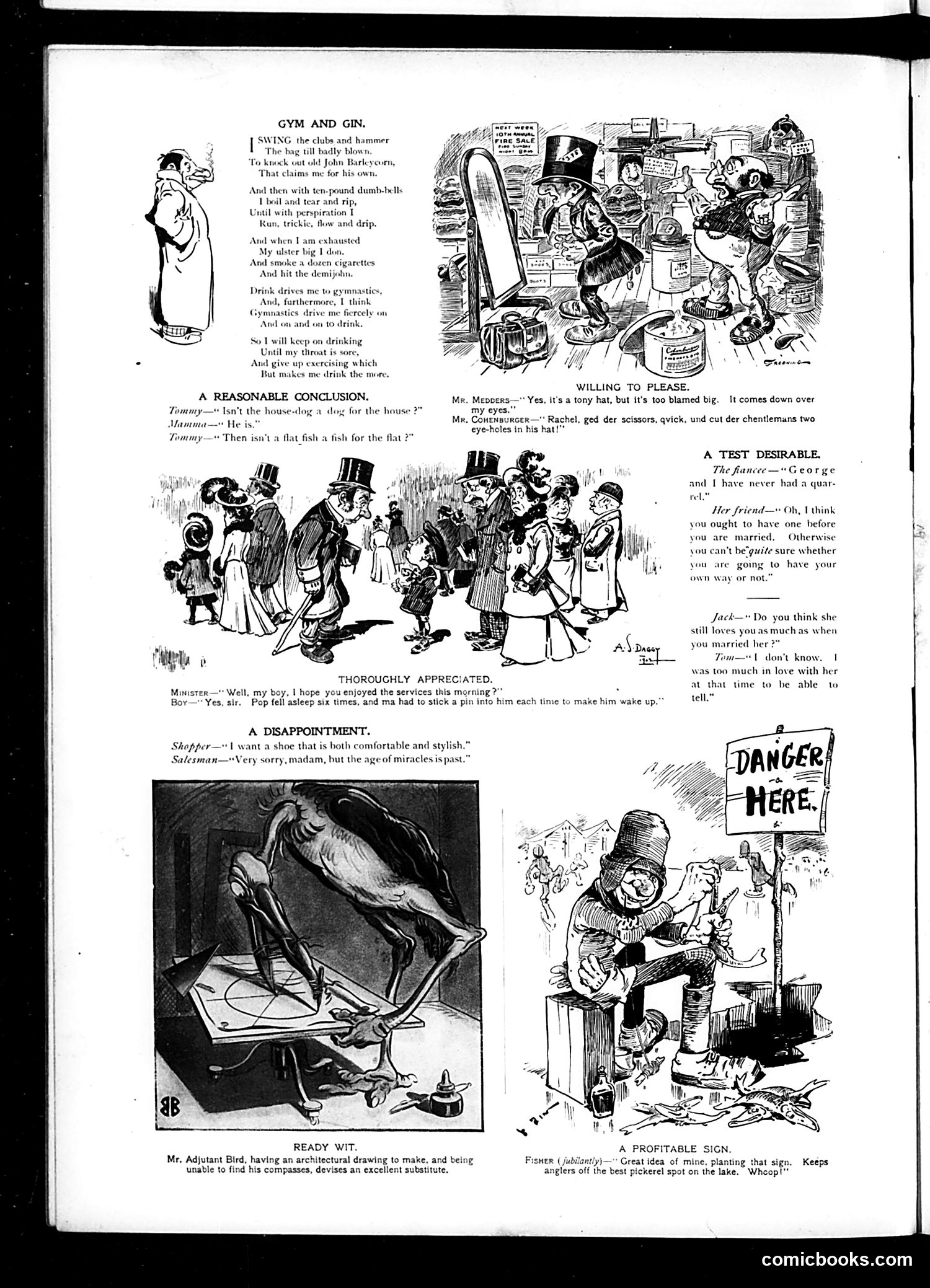
This page contains multiple unrelated jokes typical of Judge magazine's satirical format. **"Gym and Gin"** mocks the contradictory behavior of a drinker who exercises to combat alcohol's effects, then immediately returns to drinking—a circular logic exposing self-deception about addiction. **"A Reasonable Conclusion"** is a children's riddle joke with no political content. **"Thoroughly Appreciated"** satirizes inattentive churchgoers: the father falls asleep repeatedly during services, requiring his wife to jab him awake with pins—commentary on obligatory religious attendance without genuine piety. **"A Test Desirable"** jokes about premarital quarrels as necessary to establish marital independence. **"A Disappointment"** uses a shopkeeper's sardonic response ("age of miracles is past") to mock impossible consumer demands—comfort and style in shoes being presented as mutually exclusive. **"Ready Wit"** and **"A Profitable Sign"** are brief absurdist visual gags with minimal satirical content. The page reflects early 20th-century middle-class concerns: alcoholism, church hypocrisy, marriage dynamics, and consumer culture.
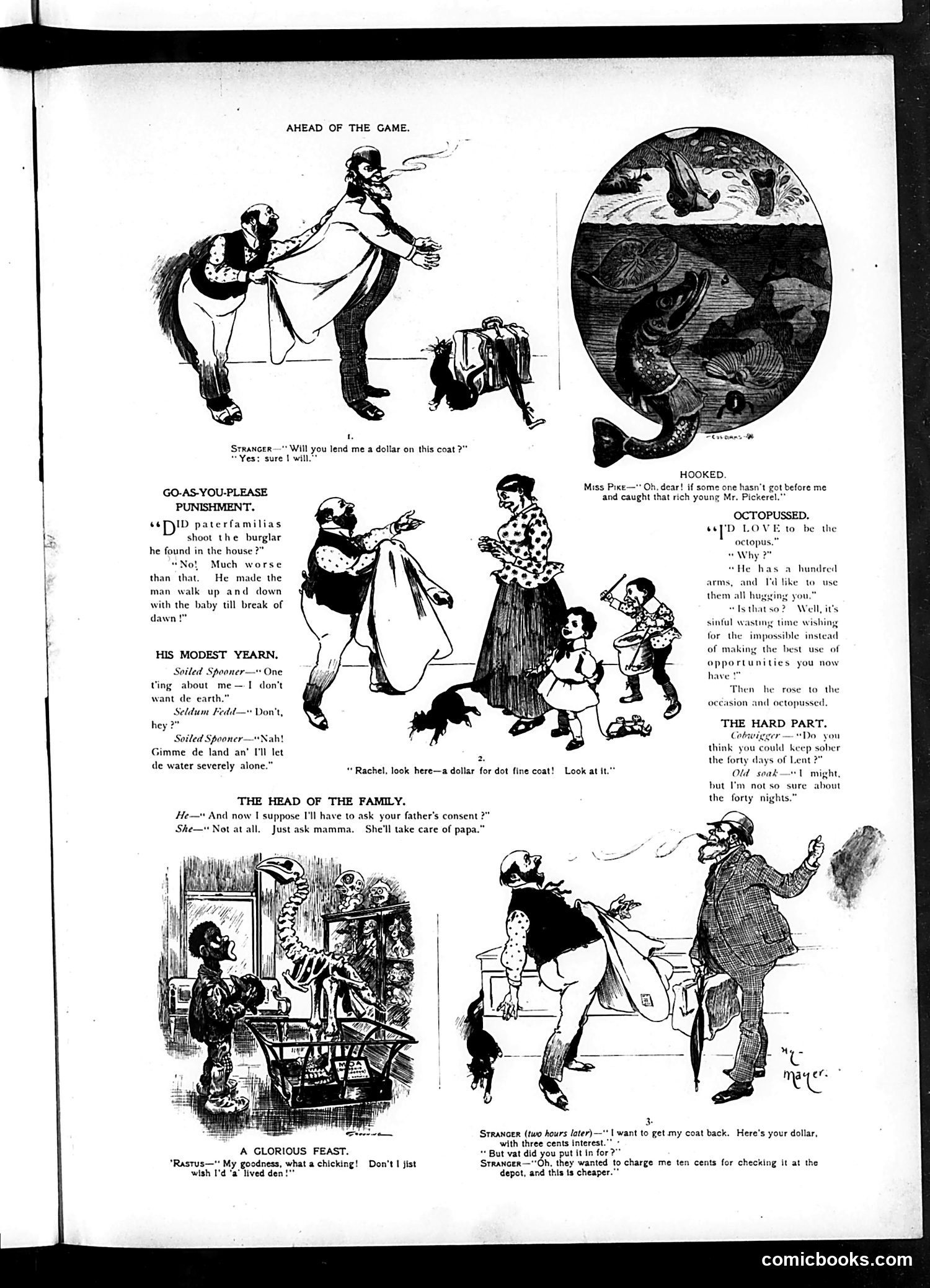
This page from *Judge* contains six separate humorous vignettes satirizing various social situations and character types common to the era. **"Ahead of the Game"** mocks a con artist who borrows a dollar against a coat, suggesting he's scheme-savvy. **"Hooked"** plays on marriage anxiety—a woman worries a rival has "caught" a wealthy bachelor (Mr. Pickerel), using fishing metaphors. **"Go-as-You-Please Punishment"** depicts a burglar forced to walk a crying baby at dawn—suggesting this domestic torture worse than prison, satirizing parental exhaustion. **"Octopussed"** uses the octopus as a metaphor for an embrace-loving suitor with "a hundred arms." **"The Head of the Family"** suggests wives, not husbands, control household decisions—a common joke about female domestic authority. **"The Hard Part"** depicts a drunk struggling with Lenten sobriety, worrying about the "forty nights" of temptation. The final scene shows a man retrieving his pawned coat, having paid interest rather than warehouse fees—demonstrating working-class financial desperation and scheming.
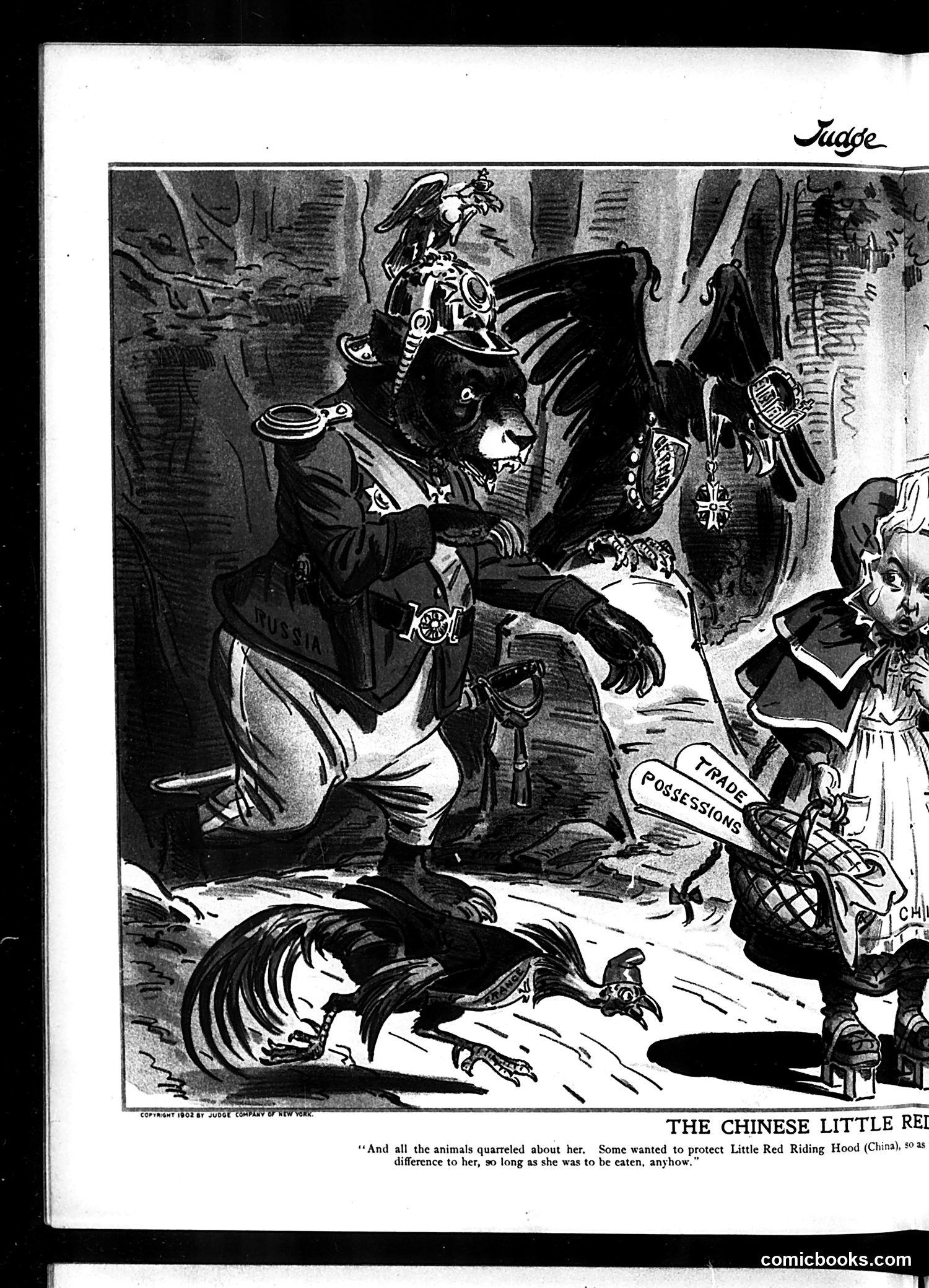
This political cartoon satirizes international competition over China's fate during the period of Western imperial expansion in Asia. The anthropomorphic animals represent different imperial powers arguing about how to "protect" or exploit China (depicted as "Little Red Riding Hood"). The Russian bear is prominent, wearing military regalia and labeled "RUSSIA." Other powers appear eager to divide Chinese trade and territorial possessions, shown by the "TRADE POSSESSIONS" label visible in the image. The dark humor suggests these nations cynically debate China's "protection" while actually competing to consume it—they'll "eat" China regardless of their professed concerns. This reflects late-19th/early-20th-century anxieties about China's dismemberment through unequal treaties and spheres of influence imposed by Western and Russian imperial powers.
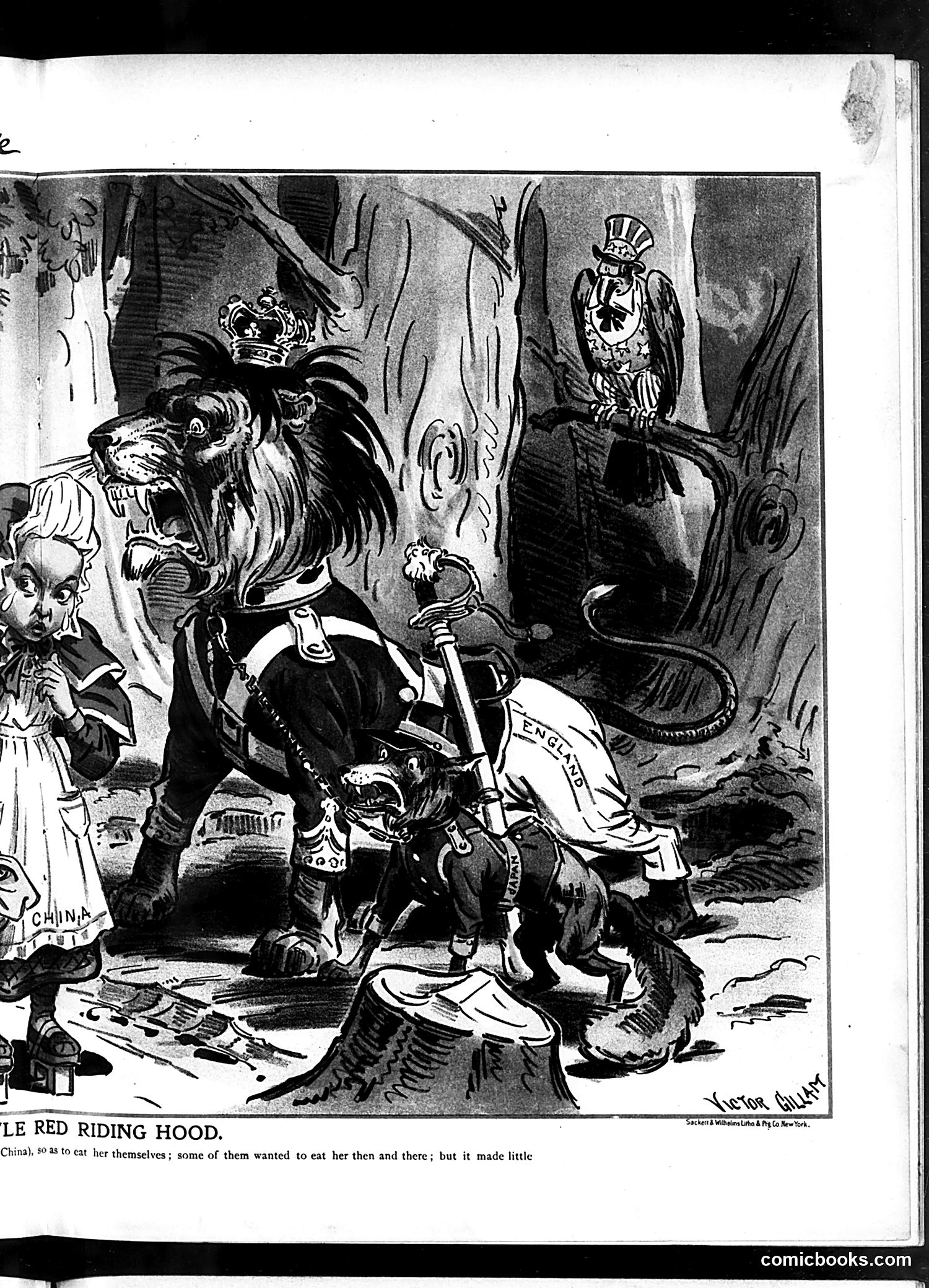
This political cartoon, signed by Victor Gillam, appears to be a satirical take on "Little Red Riding Hood" with imperial/colonial themes. The central figure is a leonine character wearing military regalia and a crown, likely representing a European imperial power (possibly Germany or Russia, given the styling). The "Red Riding Hood" figure appears to be China, depicted in the context of imperial powers competing to exploit or "devour" her resources. The various heraldic emblems above suggest different nations' claims or interests. The OCR text references entities wanting to "eat her themselves," suggesting the cartoon satirizes the predatory "carving up" of China among competing imperial powers—a reference to late 19th/early 20th-century colonial competition in Asia. The wolf figure represents imperial appetite and aggression.
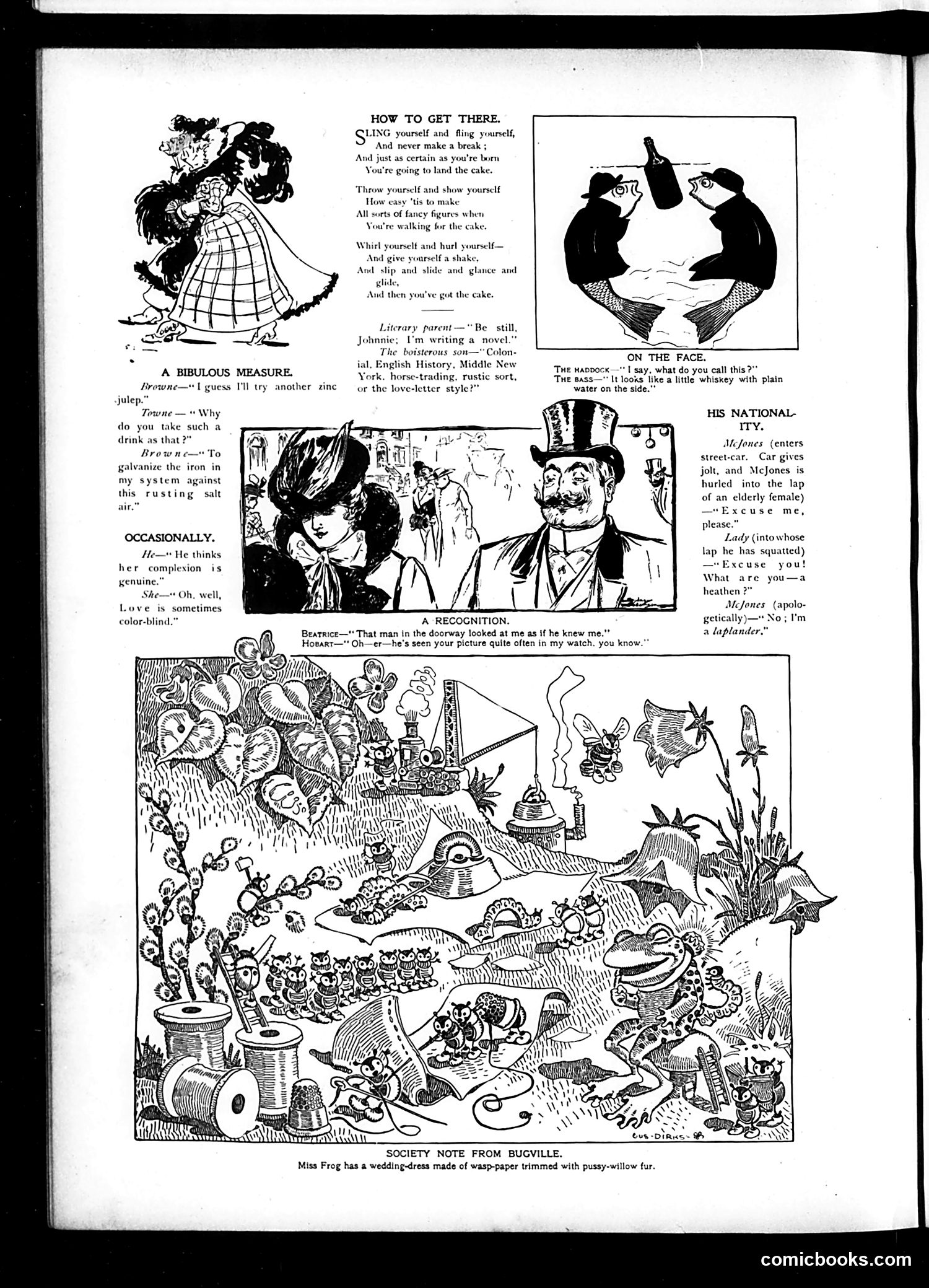
This page contains several unrelated humorous sketches typical of early 20th-century satirical magazines: **"How to Get There"** mocks people's desperate, undignified efforts to win cakes at social events—likely referring to popular parlor games or competitions where contestants performed exaggerated physical antics. **"A Bibulous Measure"** jokes about drinking habits: one man defends consuming cheap "zinc juleps" as medicinal against "rusting salt air," while another sketch pairs a pompous "literary parent" writing a novel with his disruptive child. **"On the Face"** and **"His Nationality"** are brief, mild gags about appearance and ethnic identity (the "laplander" reference suggests stereotyping). **"A Recognition"** plays on vanity—a woman thinks a man recognizes her, but he's merely seen her photograph in his watch. **"Society Note from Bugville"** is whimsical anthropomorphic humor about insects having human social pretensions (a frog's fancy wedding dress). The page reflects Judge's blend of domestic comedy, mild social observation, and absurdist humor rather than sharp political satire.
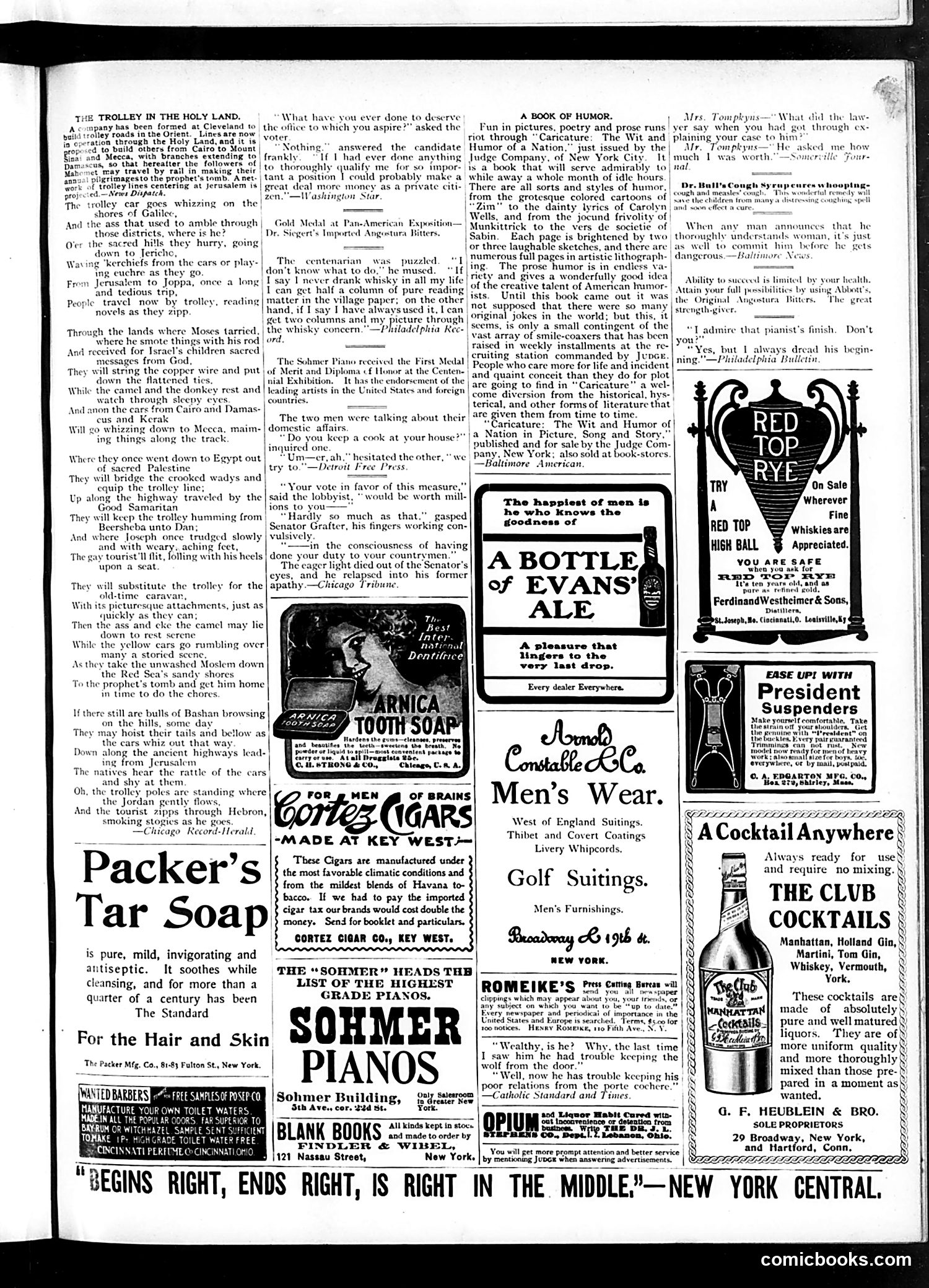
This page contains a satirical poem, "The Trolley in the Holy Land," mocking the real proposal to build electric trolley lines through Palestine and the Middle East. The satire ridicules this "modernization" as culturally tone-deaf and absurd—imagining tourists riding trolleys past sacred Biblical sites (the Jordan River, Hebron, Mount Sinai) while reading novels, playing cards, and smoking cigars, replacing camels and traditional pilgrimage with industrial tourism. The humor targets both American expansionism (exporting technology everywhere) and the disconnect between commercialism and spiritual reverence. The piece suggests that industrializing holy lands for profit trivializes their religious significance. The rest of the page is primarily advertisements for consumer products (soap, cigars, pianos, clothing) typical of this era's Judge magazine format.
This page is primarily **advertising**, not political satire or cartoons. Judge magazine uses it to showcase commercial products and humorous short anecdotes rather than editorial commentary. The page contains various brief jokes about married life, legal proceedings, and social behavior—typical "consensus of opinion" humor content. For example, one joke mocks a groom choosing Milwaukee because he got a free pass; another presents a woman worrying obsessively about her hat while claiming not to worry about trivial matters. The majority of the page consists of advertisements for whiskeys (Wilson, Hunter, Old Overholt), F.P.C. Wax for ironing, and other consumer products typical of the 1890s-1910s era. One ad promotes Canadian summer resorts via the Grand Trunk Railway. **No significant political figures or events are referenced.** The humor is domestic and lighthearted rather than satirical social commentary. This appears to be a standard advertising-heavy issue of Judge rather than a page featuring the magazine's signature political cartoons.
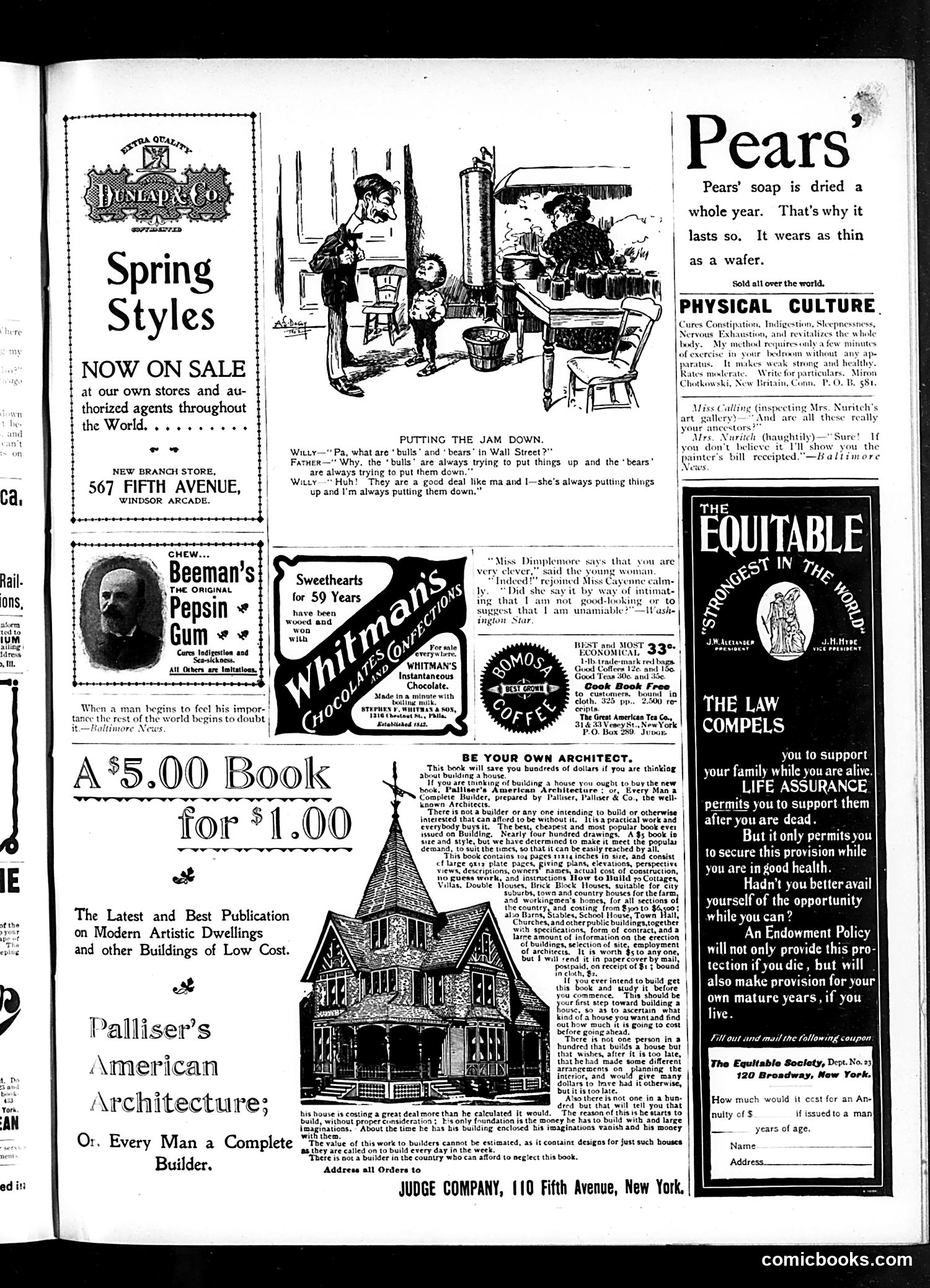
This page is primarily **advertising** with one central satirical cartoon titled "Putting the Jam Down." ## The Main Cartoon The cartoon jokes about **Wall Street terminology** ("bulls" and "bears") by having a farmer misinterpret them through domestic life. His child asks what bulls and bears mean in finance; the father explains bulls push prices up while bears push them down. The father then quips that his wife behaves identically—she's always putting things up (like preserves/jam), while he's always putting them down. The satire conflates **financial market manipulation with household domestic roles**, suggesting that the dramatic ups and downs of Wall Street resemble the perpetual marital negotiation between spouses over household management and storage. It's a gentle, family-friendly pun playing on the double meaning of "putting things up/down." ## Supporting Content The page features period advertisements for Pears soap, Beeman's gum, Whitman's chocolate, and Palliser's architecture book—typical early 20th-century Judge content. A Life Assurance advertisement appears on the right.
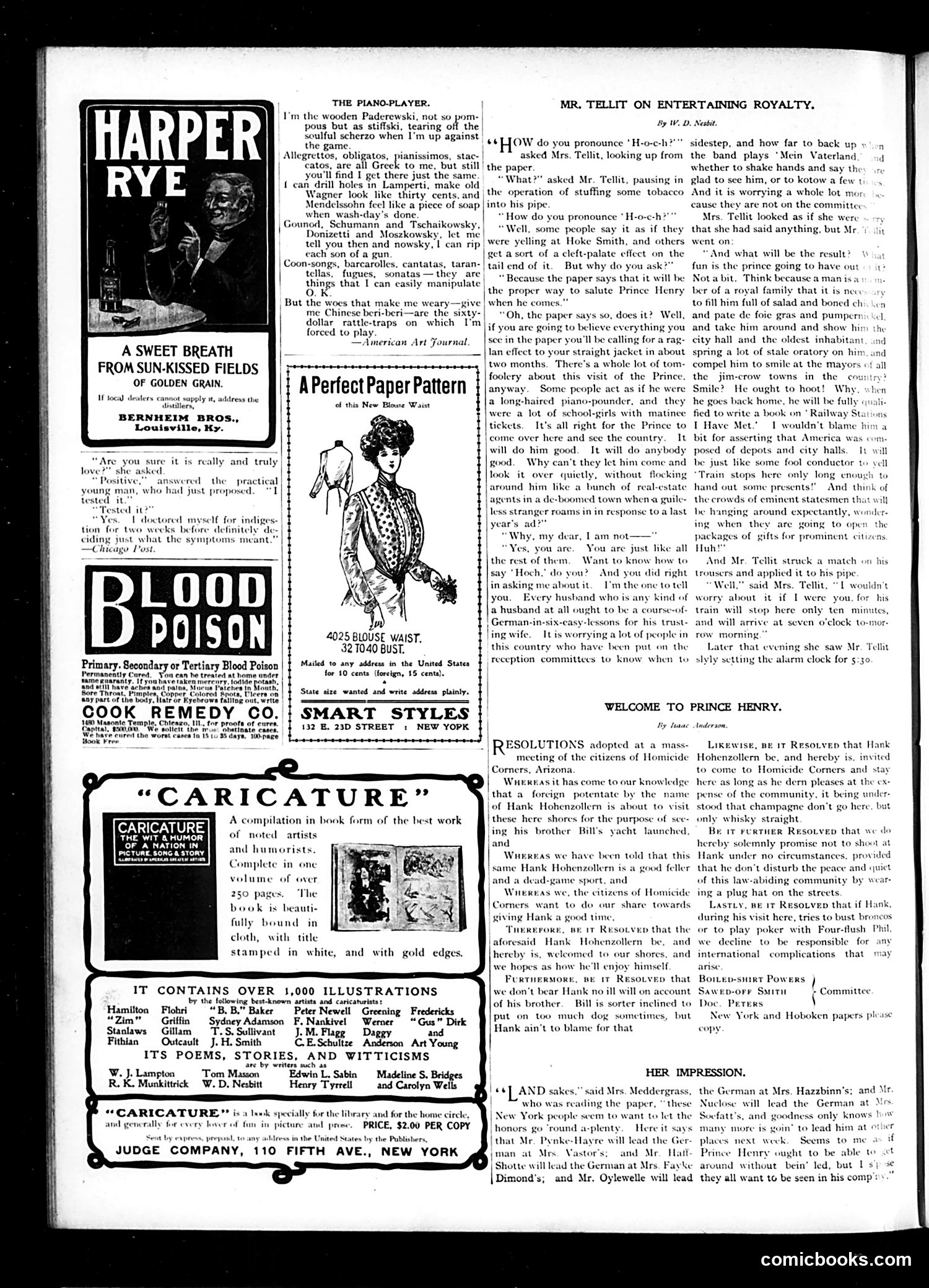
This page is primarily **advertising and filler content** from Judge, a satirical weekly. The main text feature is "Mr. Tellit on Entertaining Royalty" by W.D. Nesbit—a humorous piece about how to properly greet Prince Henry (likely Prince Henry of Prussia, who visited America around 1902). The joke: Mr. Tellit dismisses newspaper advice on pronouncing the German greeting "Hoch" as absurd fussiness. He mocks the public's obsequious excitement over the royal visit, sarcastically comparing people who believe everything in papers to those needing "straightjackets" and likening the Prince to an overhyped "long-haired piano-pounder" rather than royalty deserving special deference. The satire targets **American newspaper sensationalism and social pretension**—the tendency of publications and the public to manufacture elaborate protocols around foreign dignitaries. The page also includes typical Judge advertisements (whiskey, patent medicine, fashion patterns) and promotional material for a "Caricature" book compilation.
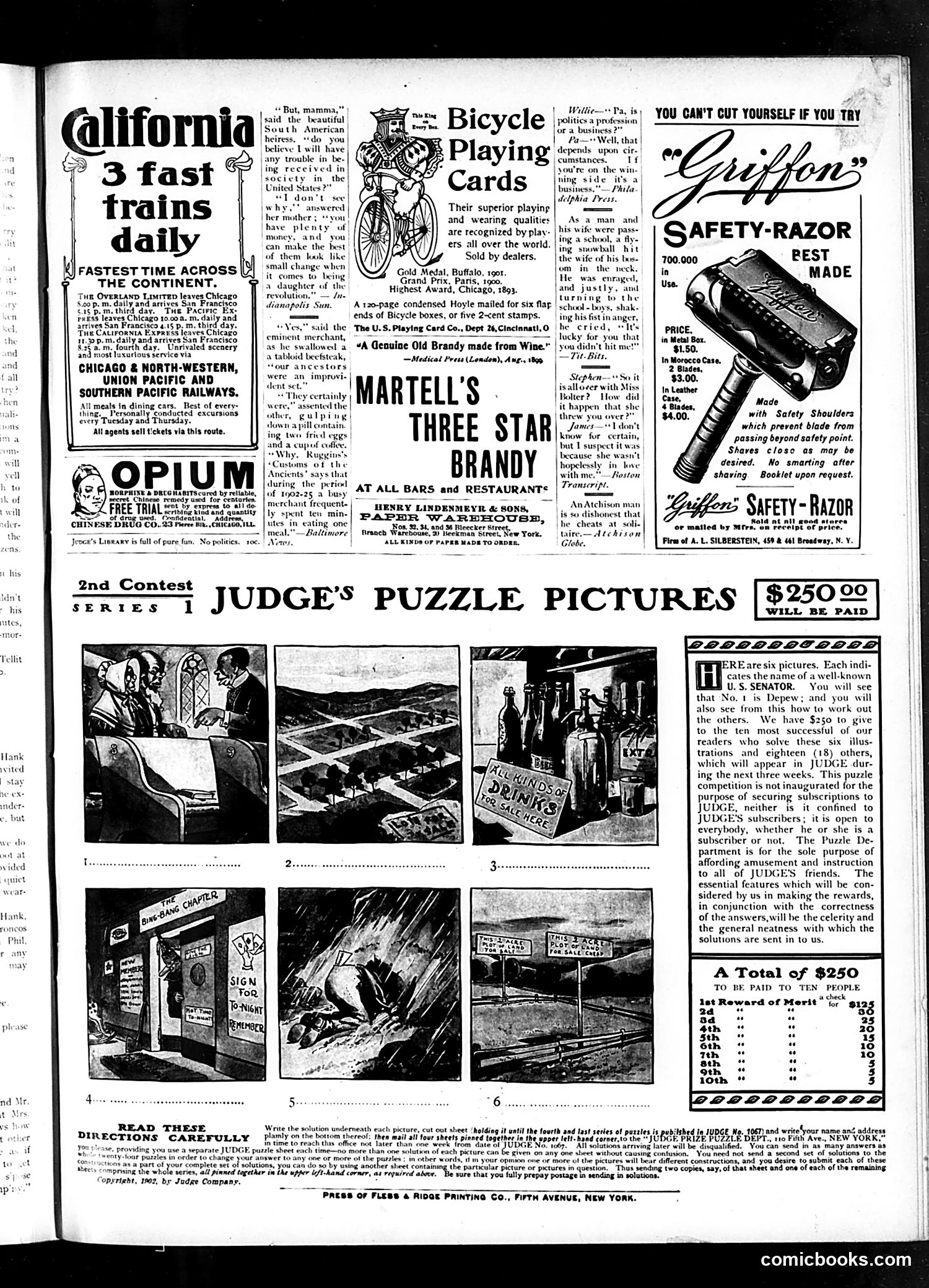
This page is primarily **advertising and puzzle content** rather than political satire. The top half features commercial advertisements: California train schedules, Bicycle Playing Cards (emphasizing their quality for card players), Martell's Three Star Brandy, Opium (a patent medicine), and Griffon Safety Razors. The dominant content is **"Judge's Puzzle Pictures" — Series 1**, a contest offering $250 total prize money ($25 to $3 per person) to readers who identify six U.S. Senators from illustrated caricatures. The instructions note that picture #1 depicts Senator Depew, and readers must identify the other five senators from the remaining images shown. This was a popular early-1900s puzzle competition format — readers cut out sheets, wrote answers, and mailed them in. The puzzle was open to non-subscribers and ran over three weeks in Judge magazine. The page reflects Judge's dual function: **satirical commentary mixed with entertainment and revenue-generating advertising and contests**.
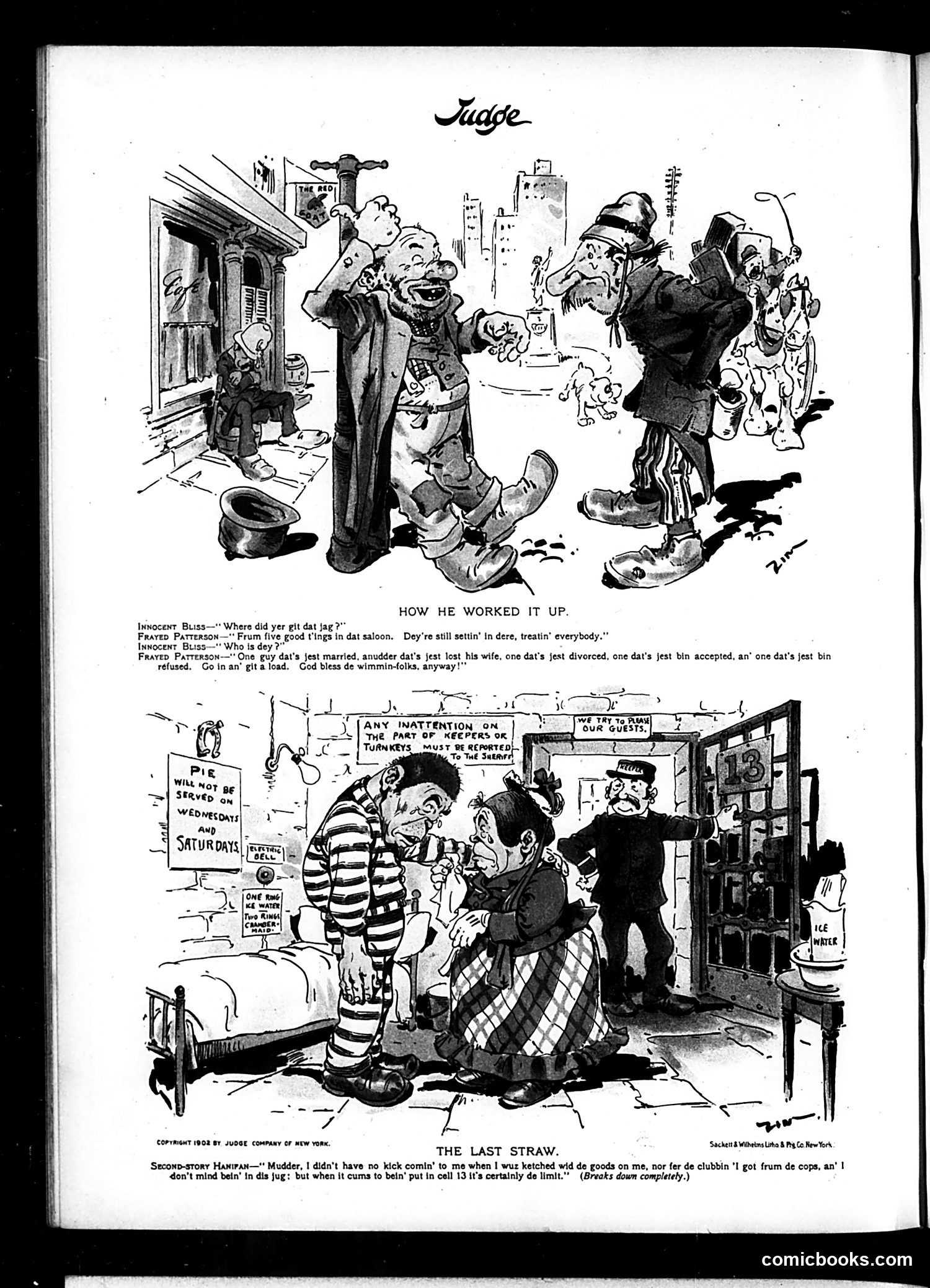
This 1902 *Judge* page contains two satirical cartoons mocking Irish immigrants and urban social problems. **Top cartoon ("How He Worked It Up"):** Uses stereotypical Irish dialect to joke about saloon culture. A man brags he got drunk by exploiting five patrons' life events—a newlywed, a widower, a divorcé, an engaged man, and a rejected suitor—all buying rounds to celebrate or commiserate. The joke mocks both Irish drinking habits and how various emotional states drive bar spending. **Bottom cartoon ("The Last Straw"):** Depicts a second-story burglar (safecracker) in jail complaining that while he accepts arrest and police brutality, being placed in "cell 13" crosses the line. This likely references a superstition about the number 13, playing on immigrant working-class anxieties. The humor targets criminal underworld culture and superstitious beliefs. Both cartoons use heavy ethnic caricature and dialect humor typical of early-1900s American satire, reflecting period attitudes toward immigrants and criminals.