
A complete issue · 20 pages · 1902
Judge — March 1, 1902
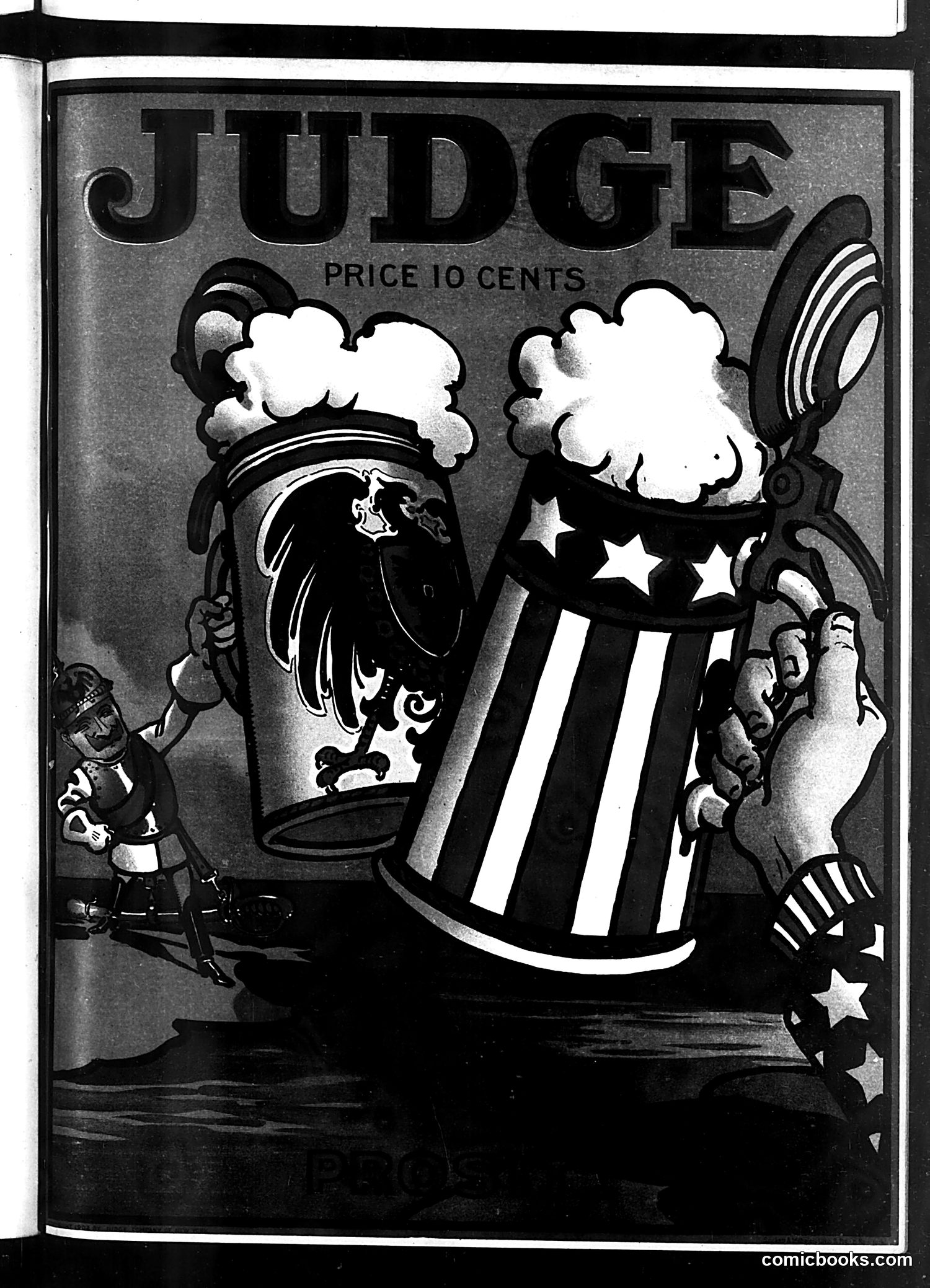
This is a Judge magazine cover (price 10 cents) featuring patriotic beer imagery. Two large beer mugs dominate the composition—one plain, one decorated with stars and stripes in an American flag design. Both overflow with foam. On either side stand small military or political figures in formal dress, appearing to present or gesture toward the mugs. The imagery suggests satire about American beer consumption, patriotism, or possibly Prohibition-era politics, though the exact historical moment is unclear without a date. The patriotic decoration of one mug and the formal presentation suggest the cartoonist is commenting on how beer consumption was being tied to American identity or nationalism—possibly mocking jingoistic rhetoric or the beer industry's patriotic marketing during a politically contentious period.
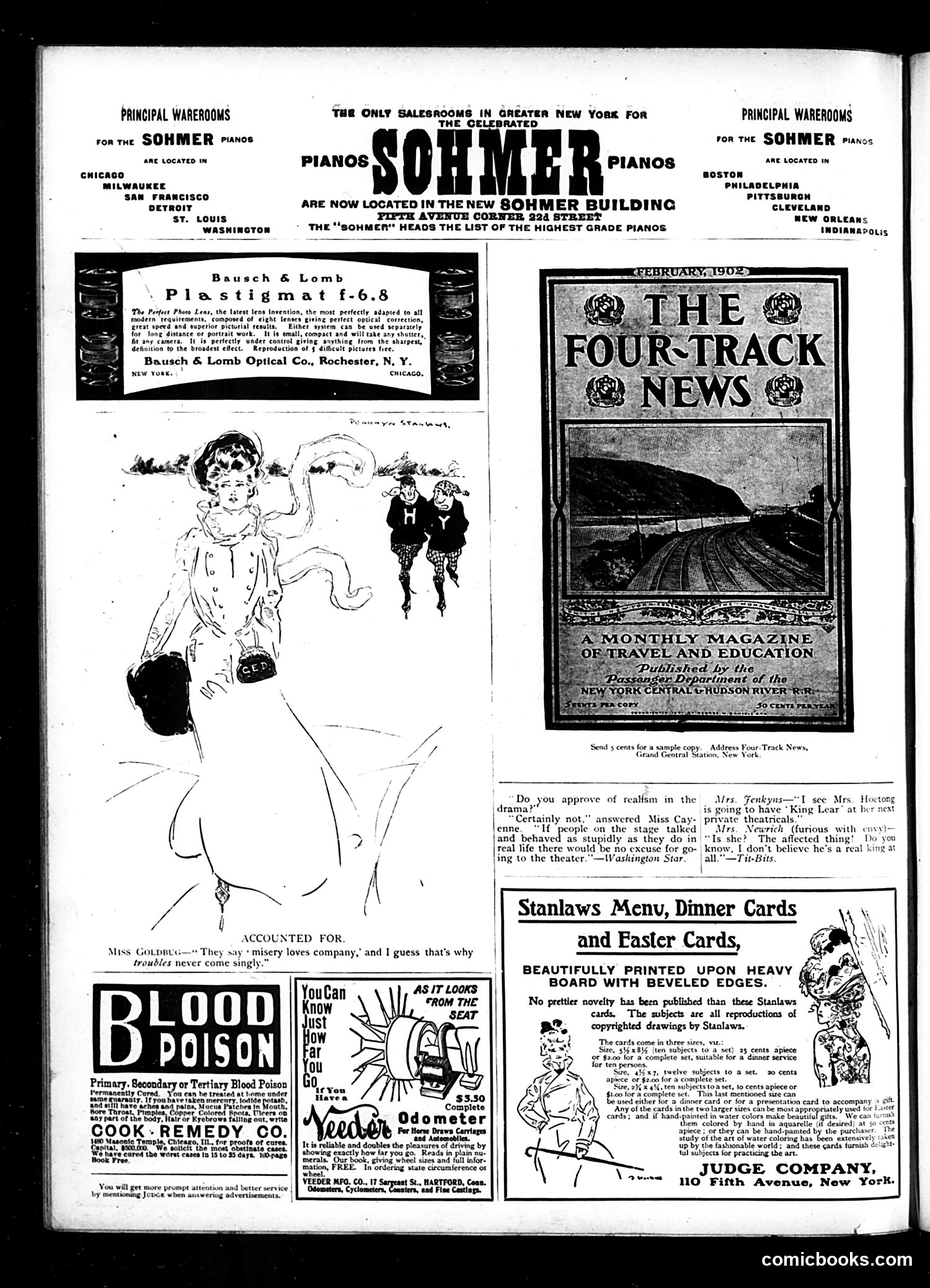
This page is primarily **advertising and commercial content** rather than political satire. The dominant elements include: - **Sohmer Pianos advertisements** (top and sides) promoting their new showroom location - **The Four-Track News** magazine cover (railroad/travel publication) - **Stanlaws Menu and Easter Cards** advertisement - Various patent medicine ads (Blood Poison remedy, Veeder Odometer) The only cartoon appears to be a small sketch labeled "ACCOUNTED FOR" depicting Miss Goldup, with a humorous caption about "misery loves company." This is light social satire about relationships rather than political commentary. The page reflects early 1900s advertising practices and consumer culture, with minimal satirical content typical of Judge's editorial cartoons.
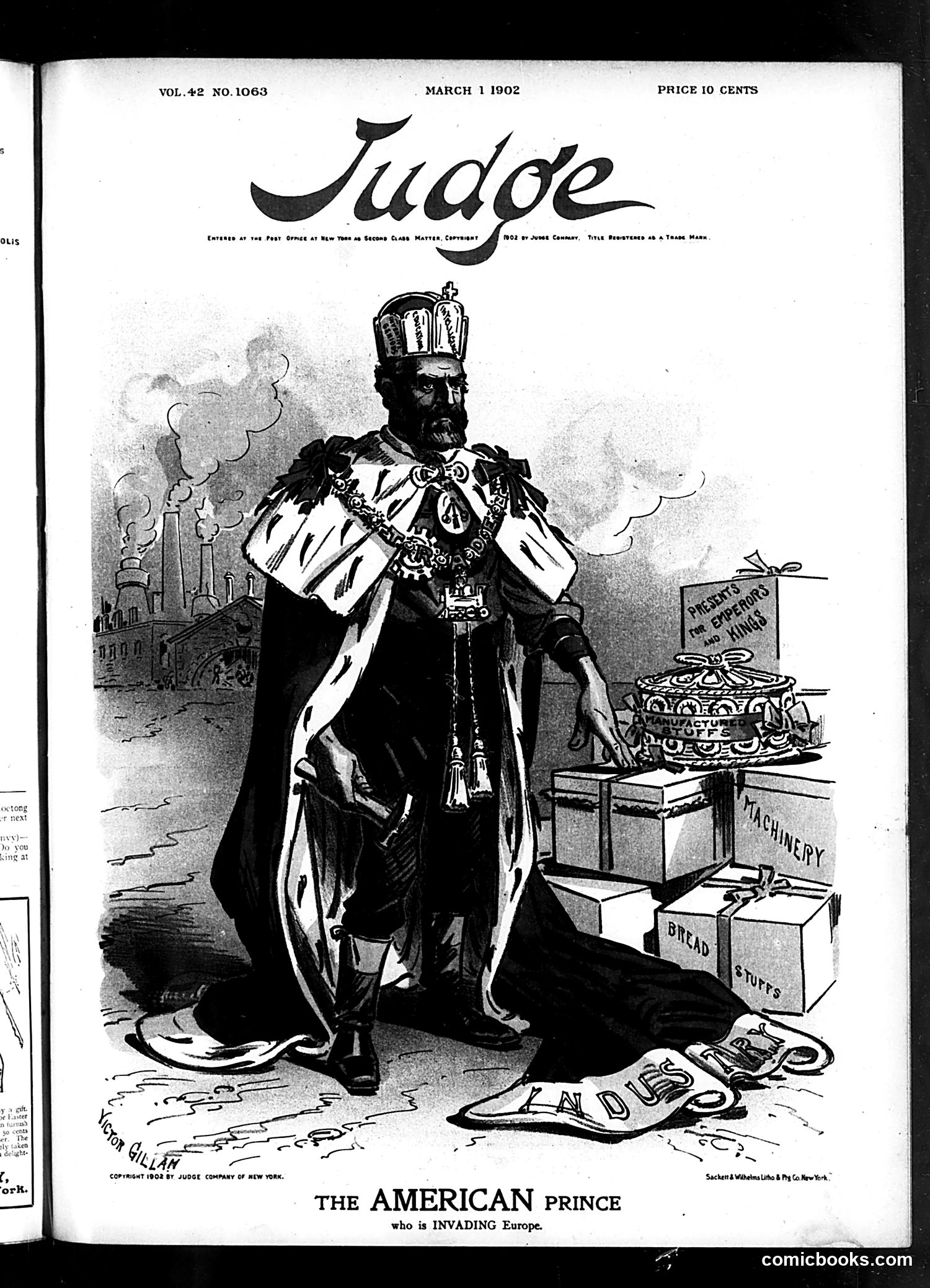
This *Judge* magazine cover from March 1, 1902, satirizes American industrial wealth and influence expanding into Europe. The central figure is a bearded man in royal regalia—a crown, ermine-trimmed robes, and medals—depicted as an "American Prince." Around him are stacked boxes labeled "MACHINERY," "BREAD," and "STUFFS," alongside a sign reading "PATENTS & EXPORTS OF ALL KINDS." Industrial smokestacks appear in the background. The satire suggests that American business interests and industrial products—not traditional military or diplomatic power—are the true "invaders" of Europe during this period of American industrial expansion. The royal costume mockingly elevates American commerce to imperial status, commenting on the era's rapid American economic dominance in international markets.
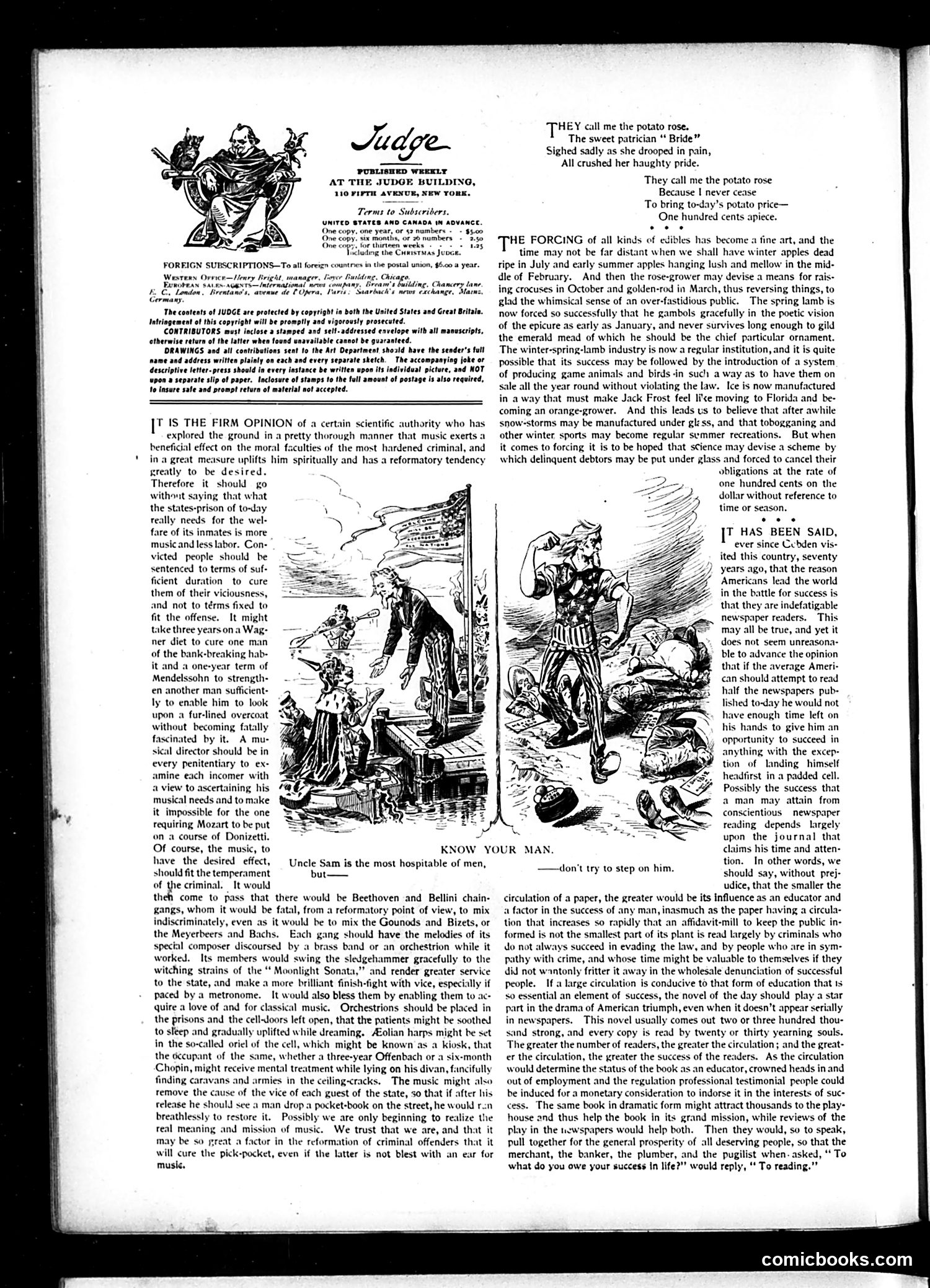
This page contains editorial content about music's role in criminal reform, arguing that orchestral music should be used in prisons to improve inmates' behavior. The editors claim music has a "reformatory tendency" and could reduce recidivism. The cartoon titled "KNOW YOUR MAN" depicts "Uncle Sam" (identifiable by his characteristic tall hat and goatee) stepping over or interacting with a prone figure, with the caption "don't try to step on him." This appears to satirize American attitudes toward labor or working-class figures, suggesting caution against mistreating ordinary citizens. The page also includes a poem mocking the "potato rose"—likely referencing artificial price inflation or market manipulation of basic produce during wartime scarcity. The overall tone critiques both criminal justice practices and economic exploitation.
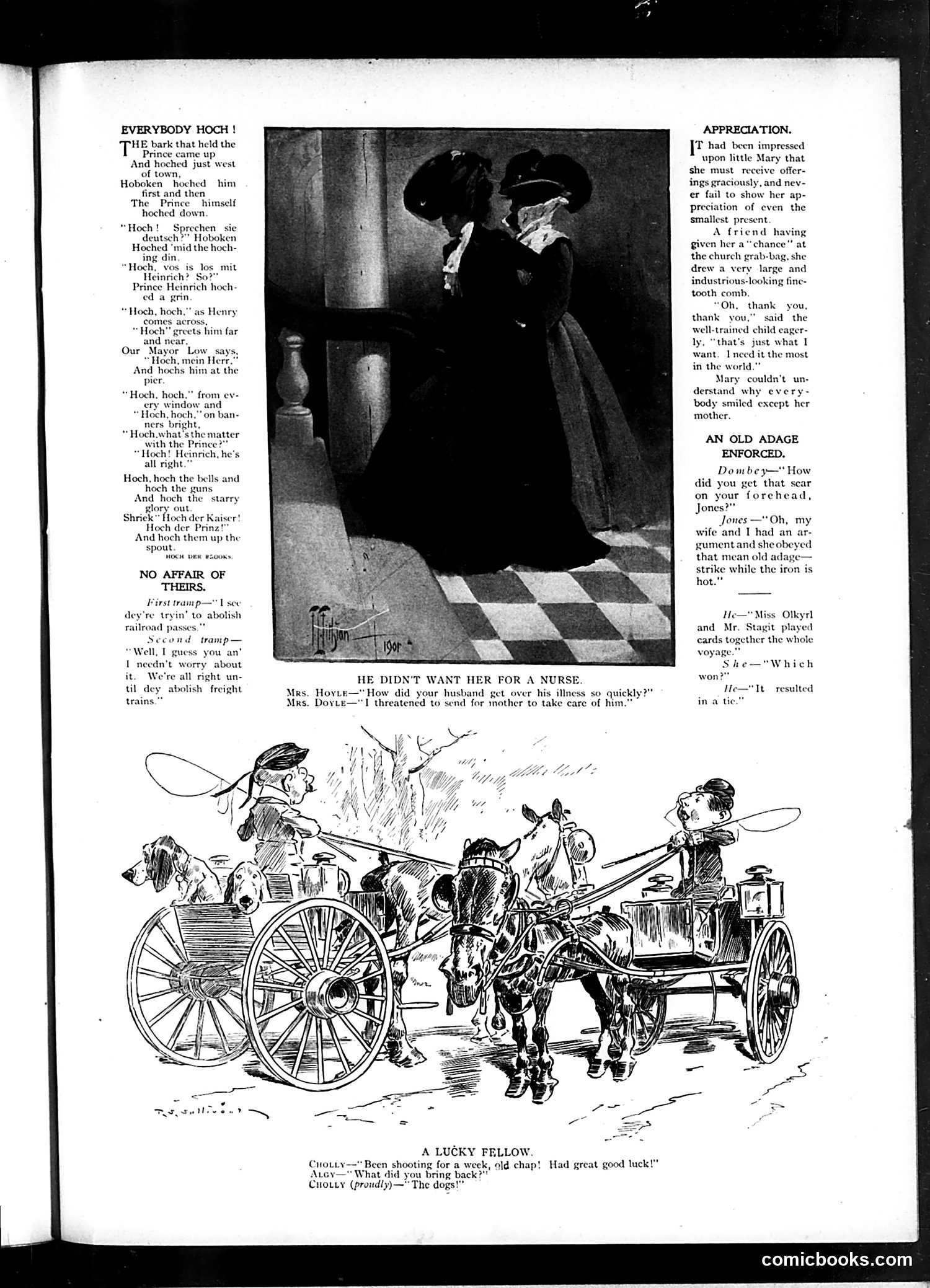
This Judge magazine page contains three distinct satirical pieces: **"Everybody Hoch!"** mocks German-American enthusiasm for visiting German royalty (Prince Heinrich). "Hoch" is a German toast. The satire targets immigrant communities' fervent displays of patriotism toward their homeland, showing exaggerated celebration spreading through Hoboken (a German-American neighborhood). **"Appreciation"** gently jokes about teaching children proper manners—the girl's polite response to a comb gift, while everyone else finds humor in her earnest gratitude. **"An Old Adage Enforced"** uses the phrase "strike while the iron is hot" literally: a wife beat her husband during an argument, justifying it as following traditional wisdom. **"A Lucky Fellow"** presents straightforward hunting humor: a hunter brags about success but admits he only shot dogs, not game. The page reflects early 20th-century American attitudes toward German immigrants, children's etiquette training, domestic discord treated as comedy, and rural hunting culture.
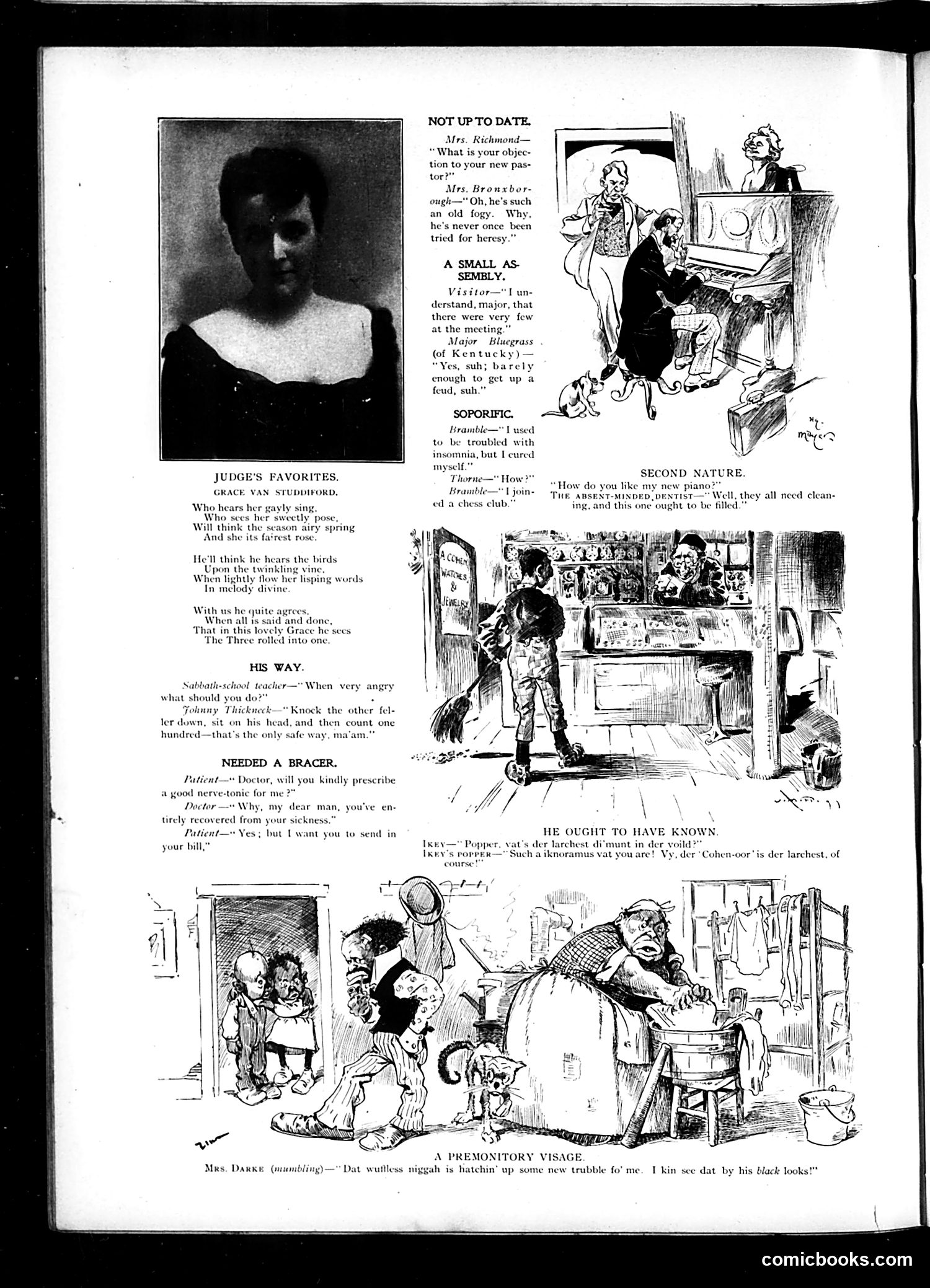
This page from *Judge* magazine contains multiple short humorous sketches typical of late 19th/early 20th-century American satire. **Key content includes:** - A portrait of **Grace Van Studdiford**, likely a theater performer, with accompanying poetic praise - Social humor mocking various types: an overly aggressive Sunday school boy, a doctor's patient worried about paying bills, and a Kentucky major so isolated his social life consists of "barely enough to get up a feud" - Anti-Semitic caricatures labeled "Ikey" and his "rorrer" (brother) using exaggerated dialect to mock Jewish immigrants' speech and presumed ignorance about diamonds - A domestic scene with offensive racial language depicting a Black servant - Mild observations about modern life (pianos needing cleaning, pastors being "old fogies") **The satire targets** social pretension, rural backwardness, and immigrants while relying heavily on ethnic and racial stereotypes considered acceptable humor in this era. The page reflects the publication's broader tendency toward casual bigotry alongside genteel social commentary.
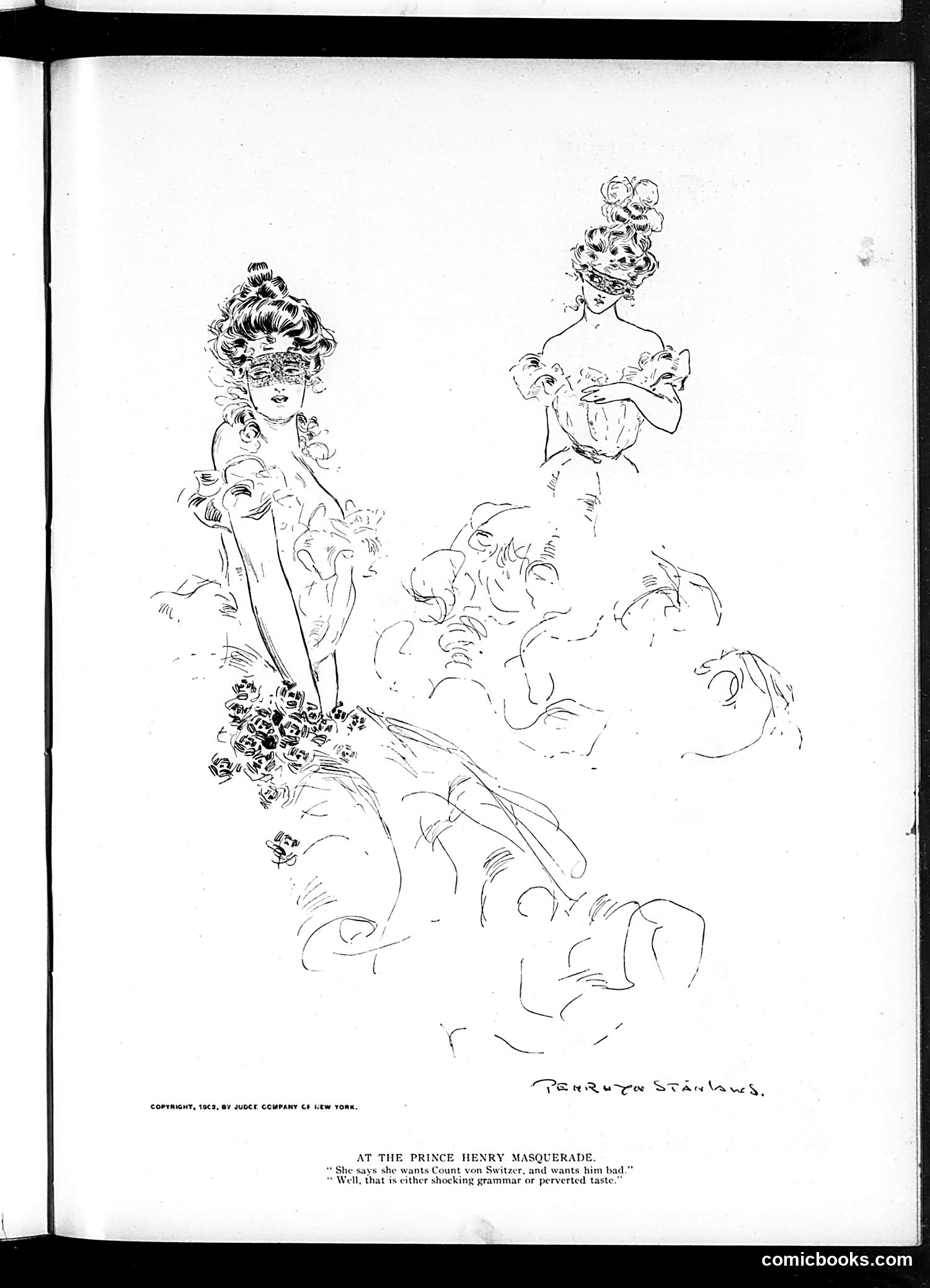
This cartoon by Frederic Dorman Stanlaws satirizes social pretension at a masquerade ball. Two elegantly dressed women discuss a third woman's romantic interest in "Count von Switzer." The joke operates on two levels: the woman's stated desire is crude ("wants him bad"), which the other woman interprets as either grammatically improper or as evidence of questionable taste in men. The cartoon mocks both the artificial formality of masquerade society and the social climbing that occurs within it—the absurdity that a "count" would be a desirable prize at such an event. The title references "Prince Henry," likely alluding to a contemporary social event or theatrical production, positioning this as commentary on high-society pretense and the dubious value of European aristocratic titles among ambitious Americans.
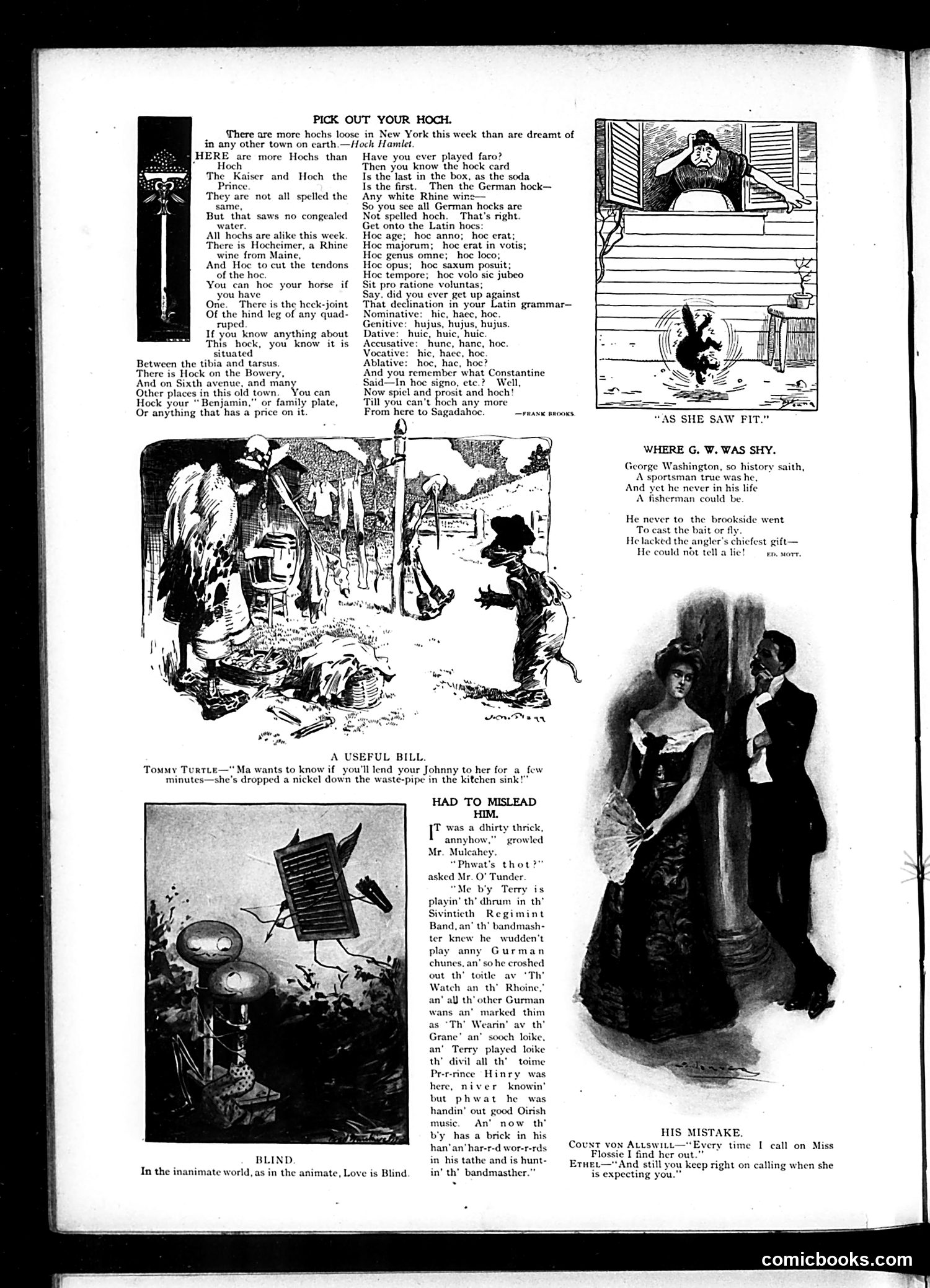
This page satirizes the scandal surrounding **Dr. Hawley Harvey Crippen**, a notorious criminal of the era (implied by references to "Hoch"). The lead article "Pick Out Your Hoch" is a pun-heavy piece playing on multiple meanings of "hoch/hock" — German wine, a horse's joint, pawnshops, Latin declensions — to mock New York's obsession with the criminal case dominating headlines. The cartoon "Had to Mislead Him" satirizes **German culture during anti-German sentiment** (likely WWI-era), showing Irish bandmaster censoring German compositions by relabeling them as Irish songs so a German prince wouldn't recognize them. It's humor about ethnic deception and cultural tensions. The other items are lighter comic vignettes: "Where G.W. Was Shy" makes a pun about George Washington's honesty; "His Mistake" depicts a count's romantic miscalculation. These fill out the satirical miscellany typical of Judge magazine's format.
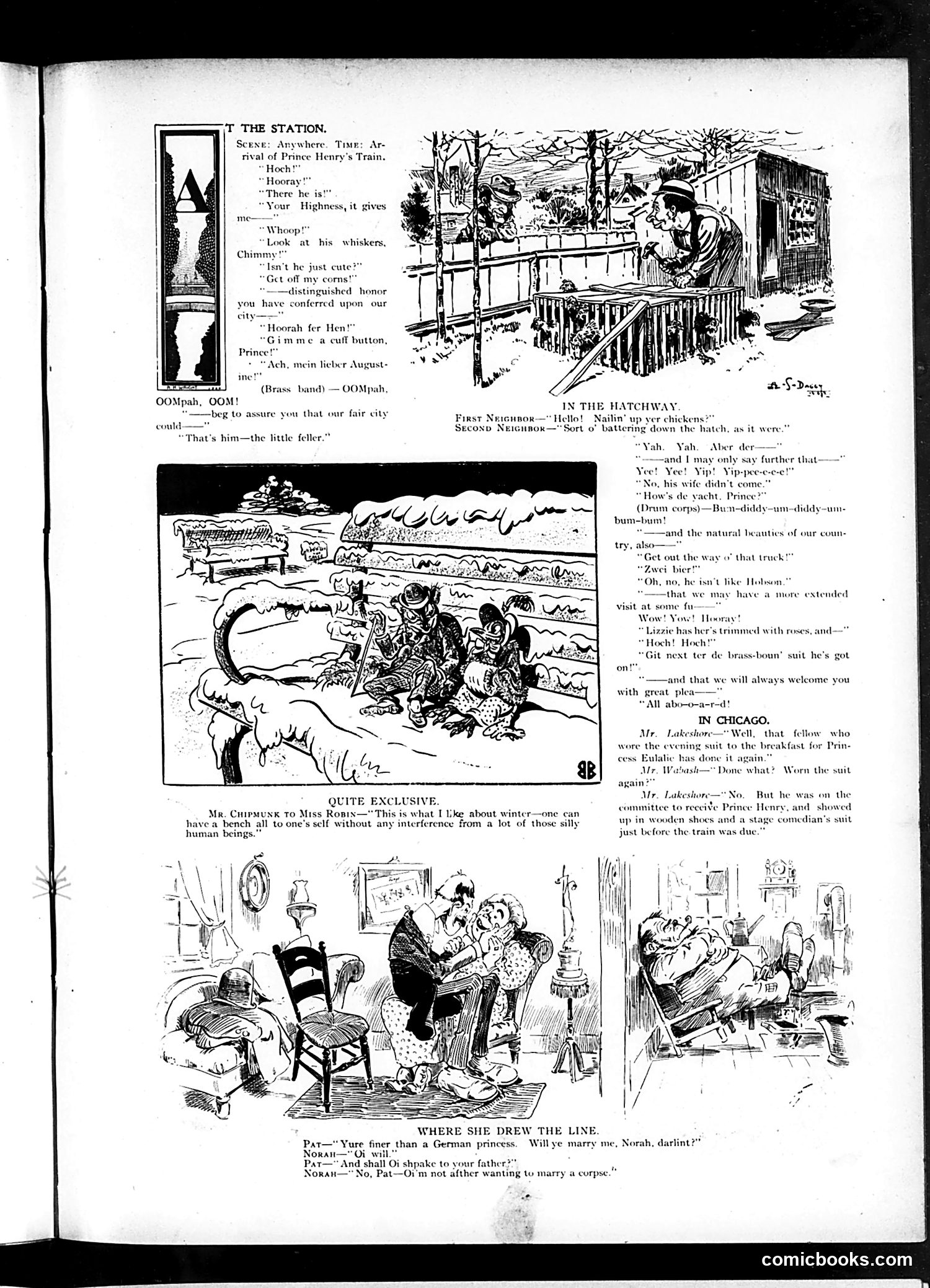
This page satirizes the visit of **Prince Henry of Prussia** to America (likely early 1900s). The cartoons mock both the prince and Americans' fawning response to foreign royalty. **"At the Station"** depicts crowds greeting Prince Henry with excessive enthusiasm—cheering his whiskers, demanding cuff buttons as souvenirs. The satire targets American social climbers and their obsequiousness toward European nobility. **"In the Hatchway"** continues the theme, with neighbors gossiping about a Chicago man who wore formal evening wear to meet the prince, then wore the same suit repeatedly afterward—mocking pretentious social-climbing through borrowed respectability. **"Quite Exclusive"** shows a woman enjoying winter solitude on a bench, unrelated to the prince storyline. **"Where She Drew the Line"** features Irish immigrant characters (Pat and Norah) in a marriage proposal—the joke being Norah refuses to speak to her father because he's dead, suggesting lower-class Irish stereotypes. Overall, Judge ridicules American deference to foreign royalty and class pretension.
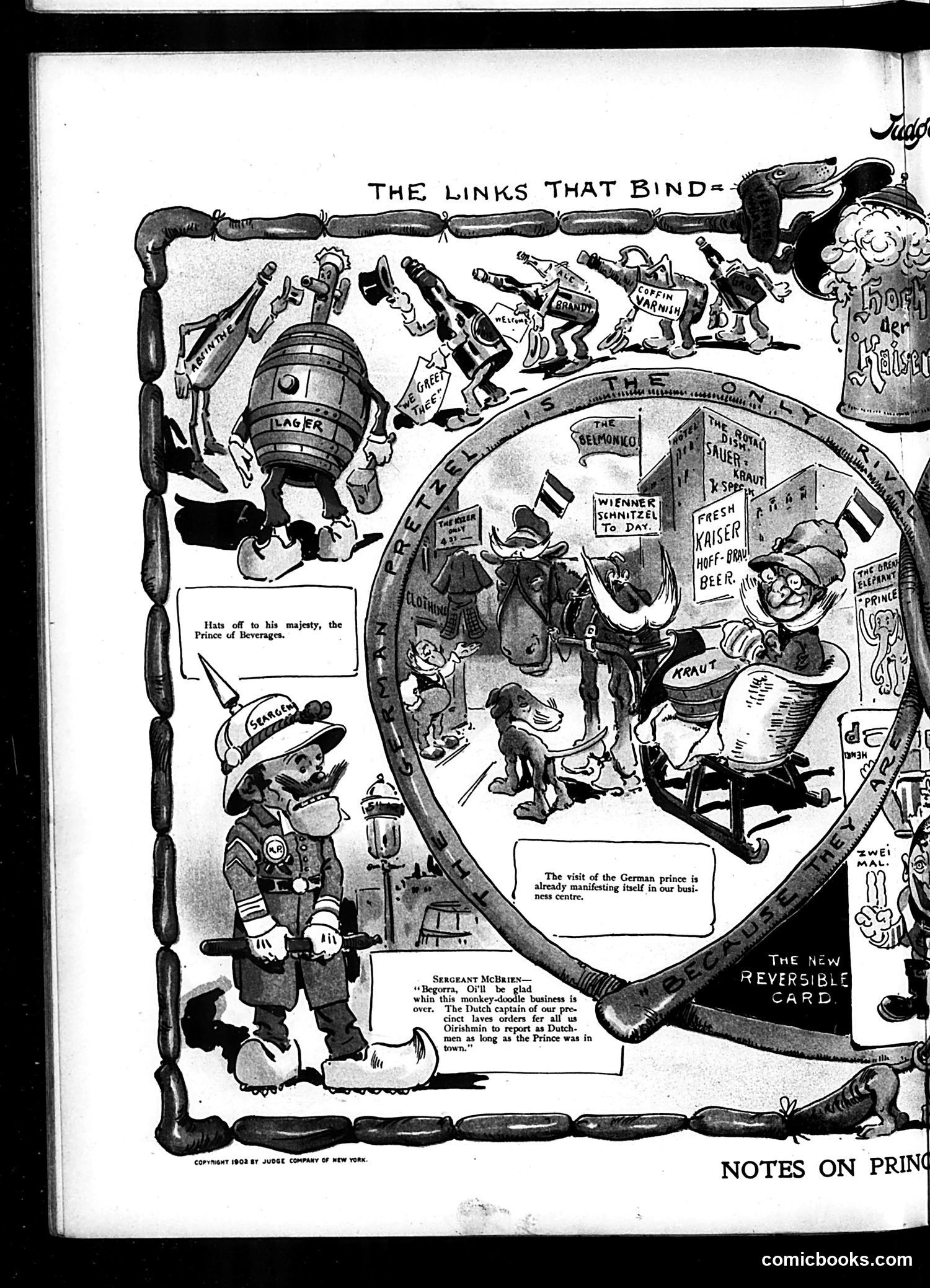
This 1902 satirical cartoon mocks the visit of a German prince to America and its commercial/political consequences. **Key elements:** - **"Prince of Beverages"**: A barrel-shaped figure represents German beer, satirizing how German beer imports dominated American business and culture. - **The chain/links**: Symbolize commercial and cultural ties binding America to Germany through the beer trade and immigration. - **The circular scene**: Shows German beer brands (Kaiser, Schnitzel) and associated businesses thriving in what appears to be a German-American neighborhood. - **Irish policeman dialogue**: A humorous commentary on ethnic politics—an Irish cop complains he's ordered to pose as "Dutch" (German) while the prince visits, reflecting real tensions between Irish and German immigrant communities competing for political favor and business opportunities. The cartoon satirizes how corporate interests and ethnic politics shaped American cities during this period of heavy German immigration.
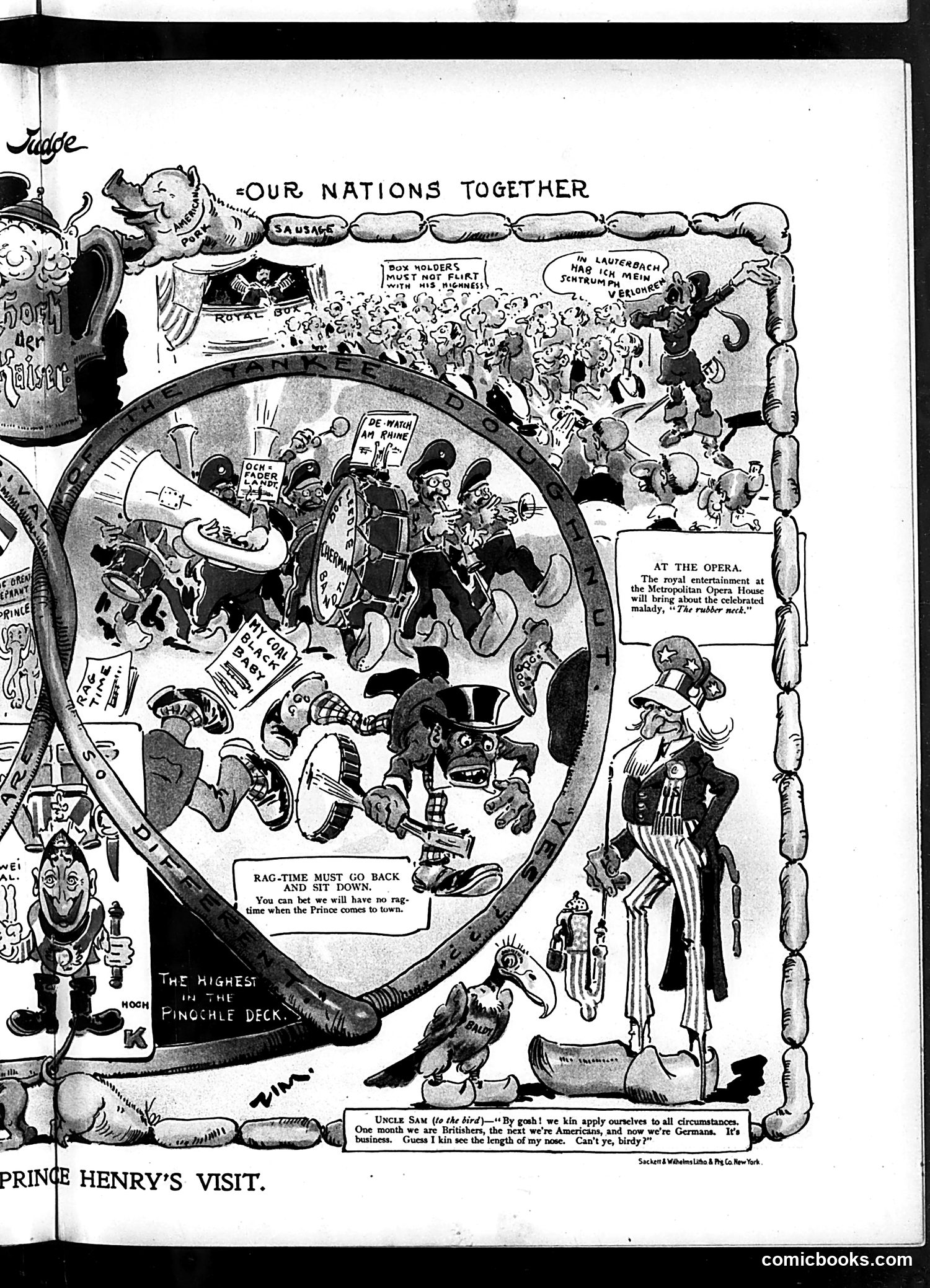
This satirical Judge cartoon mocks American opportunism during Prince Henry of Prussia's visit to the United States. The main circular vignette depicts chaotic scenes at the Metropolitan Opera House, where Americans scramble to entertain the royal guest while abandoning their own cultural identity. The satire centers on American fickleness: Uncle Sam (bottom right) admits Americans shift allegiances monthly—"one month we are Britishers, the next we're Americans, and now we're Germans." The "rag-time must go back and sit down" caption ridicules suppressing American jazz culture to appear refined before European royalty. The sausage-chain border labeled "Our Nations Together" suggests nations artificially linked together. The cartoon critiques American sycophancy and lack of cultural confidence when faced with foreign dignitaries, suggesting Americans will abandon their own traditions for appearances of respectability.
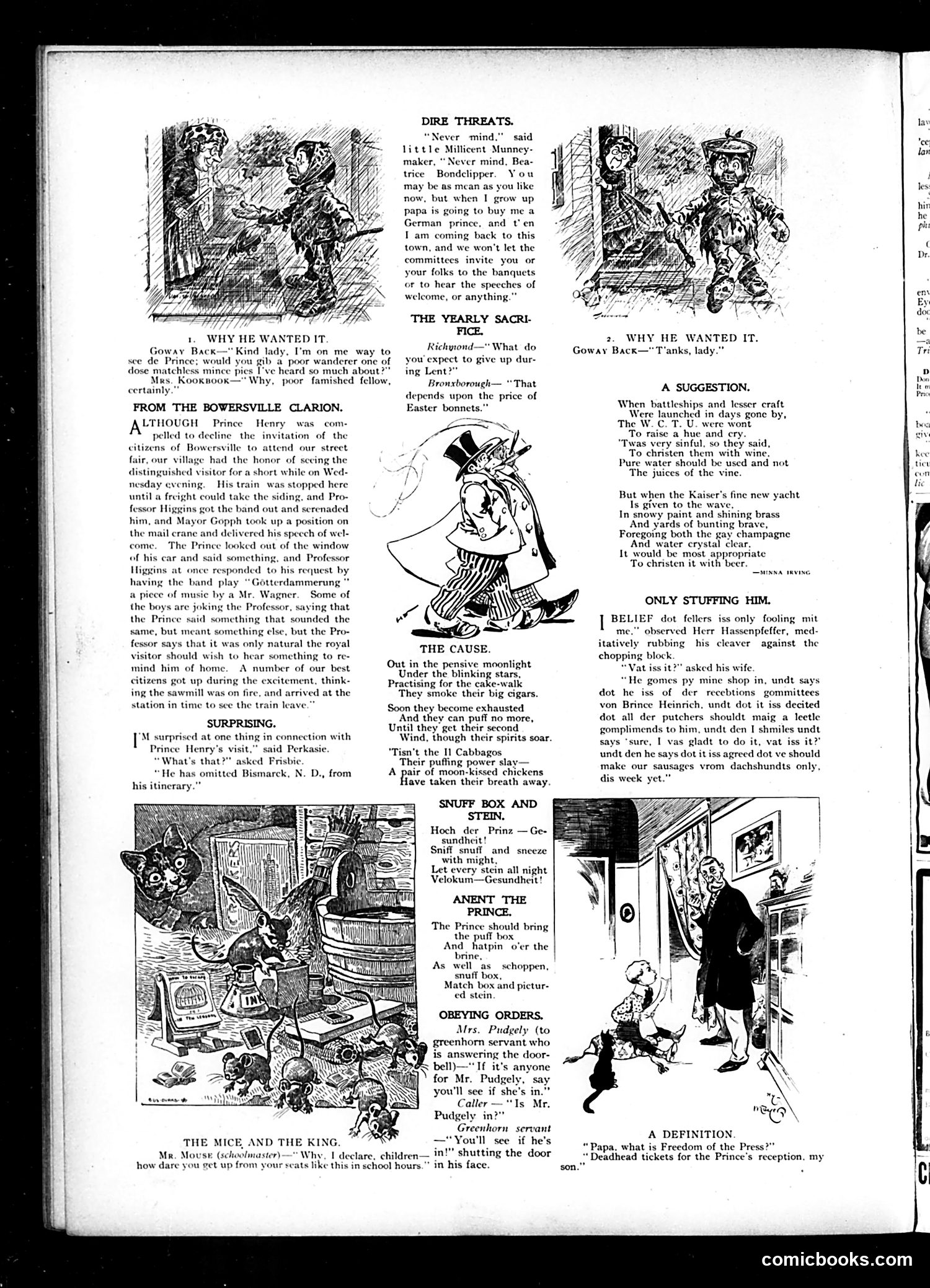
This page satirizes **Prince Henry of Prussia's 1902 visit to America**. The main targets are: **"Why He Wanted It"** depicts poor immigrants seeking mementos from the Prince's visit, mocking both their deference and American civic enthusiasm over foreign royalty. **"From the Bowersville Clarion"** ridicules small-town America's over-the-top efforts to welcome Prince Henry. Professor Higgins plays Wagner ("Gotterdammerung") as a greeting—likely a joke about the German-language complexity or pretentiousness. The satirist mocks provincial Americans' attempts at sophistication and their desperate desire for royal attention. **"The Yearly Sacrifice"** jokes about women exhausting themselves preparing Easter bonnets, a recurring spring fashion obsession. Other items mock German customs (snuff, beer) and American servant-class obsequiousness. The humor relies on class satire, ethnic stereotyping (German accents, Jewish figures), and poking fun at American social pretension and deference to European nobility.
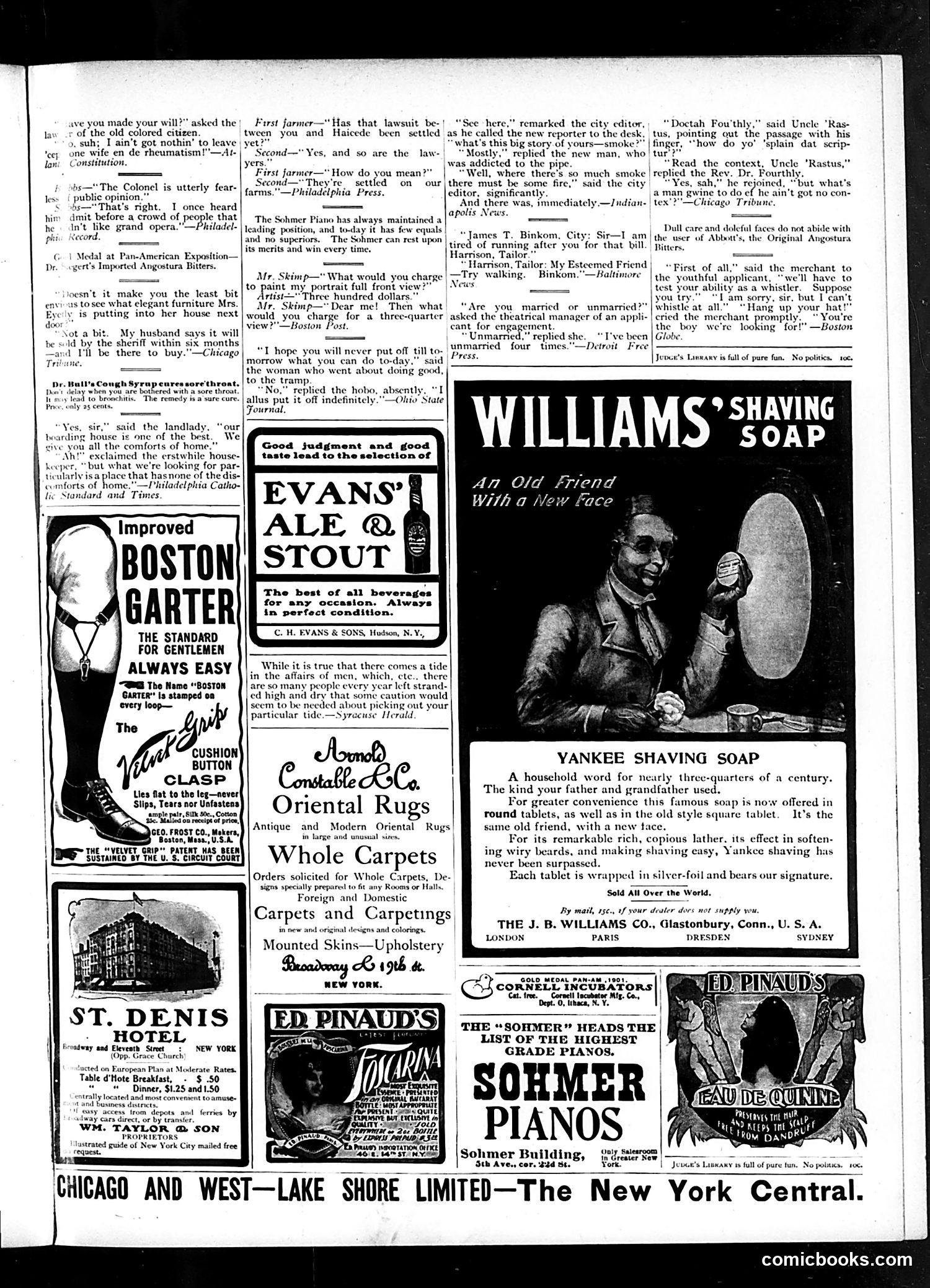
This page is primarily **advertisements with brief satirical snippets**, typical of Judge magazine's format. The main satirical content consists of short jokes rather than full cartoons: - A dialogue mocking a poor Black citizen asked about his will, who replies he owns nothing but a wife and rheumatism - A joke about a colonel who publicly admits disliking grand opera (suggesting philistinism or pretension) - Various workplace and domestic humor snippets The **racial humor is period-typical but reflects deeply offensive stereotypes**—the dialect-heavy "Doctah Fou'thly" exchange with "Uncle Rastus" treats Black characters as sources of comedic illiteracy and ignorance, standard (but reprehensible) for early 1900s American publications. The page is dominated by **product advertisements**: Boston Garter suspenders, Evans' Ale & Stout, Williams' Shaving Soap, the St. Denis Hotel, Sohmer Pianos, and Oriental Rugs—reflecting Judge's commercial operation alongside satire. No specific political figures or events are referenced visibly on this particular page.
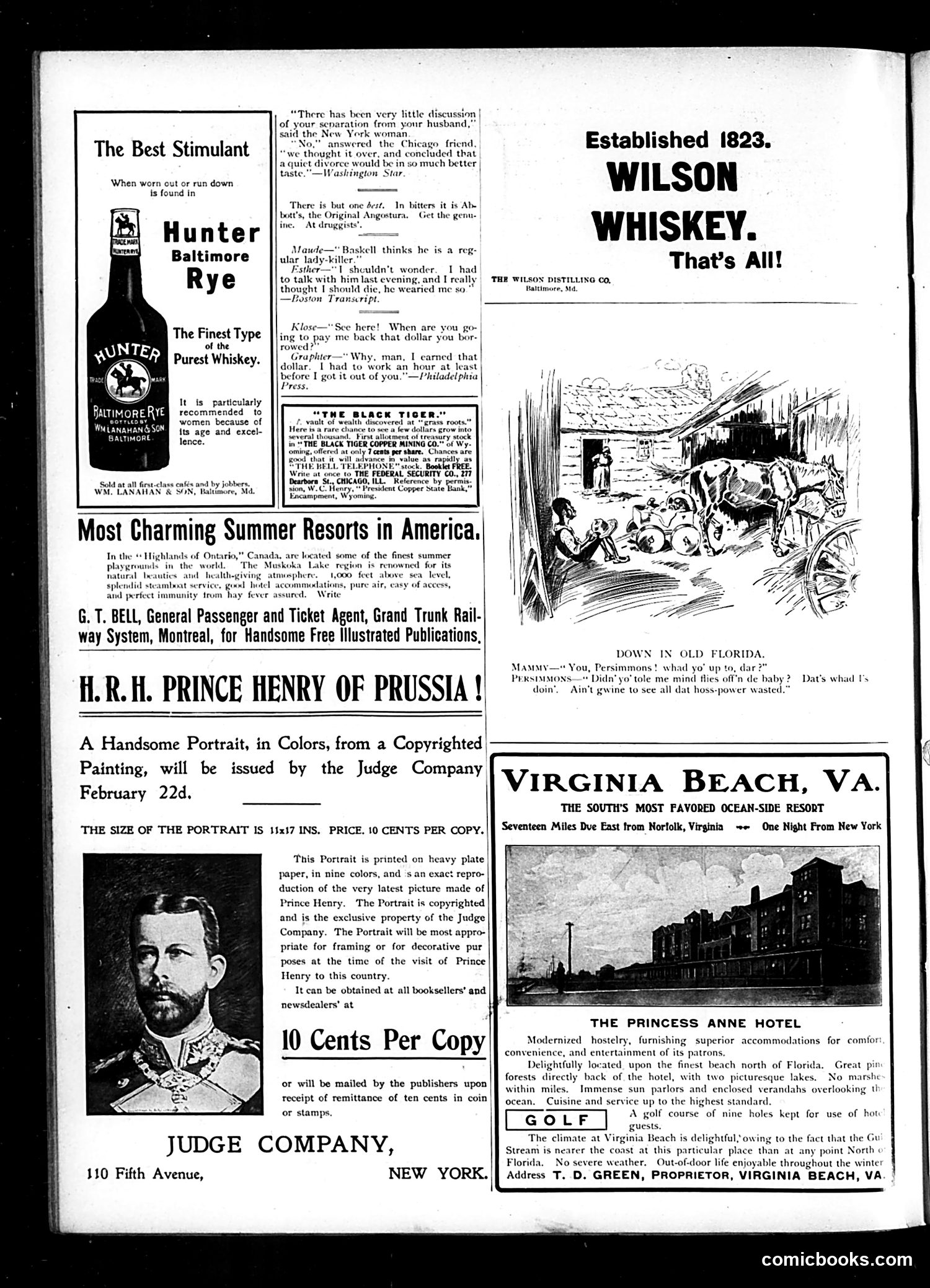
This page is primarily **advertisements and humor snippets** rather than political satire. The main elements are: **Advertisements dominate:** Hunter Baltimore Rye whiskey, Wilson Whiskey, vacation resorts (Muskoka Lake, Virginia Beach), and a portrait offer of Prince Henry of Prussia (scheduled to visit America in 1902). **Brief humor pieces** include jokes about marital separation, borrowing money, and a racial dialect joke ("Down in Old Florida") featuring caricatured African American characters discussing a baby and horse-power—typical of era minstrelsy humor. **Prince Henry reference:** The portrait announcement suggests contemporary interest in German-American relations and royal visits during the early 1900s. The page reflects Judge's mixed content model: combining satirical cartoons with commercial advertising and period-appropriate (if now offensive) ethnic humor. There's no coherent political message—it's a snapshot of commercial culture and acceptable period attitudes.
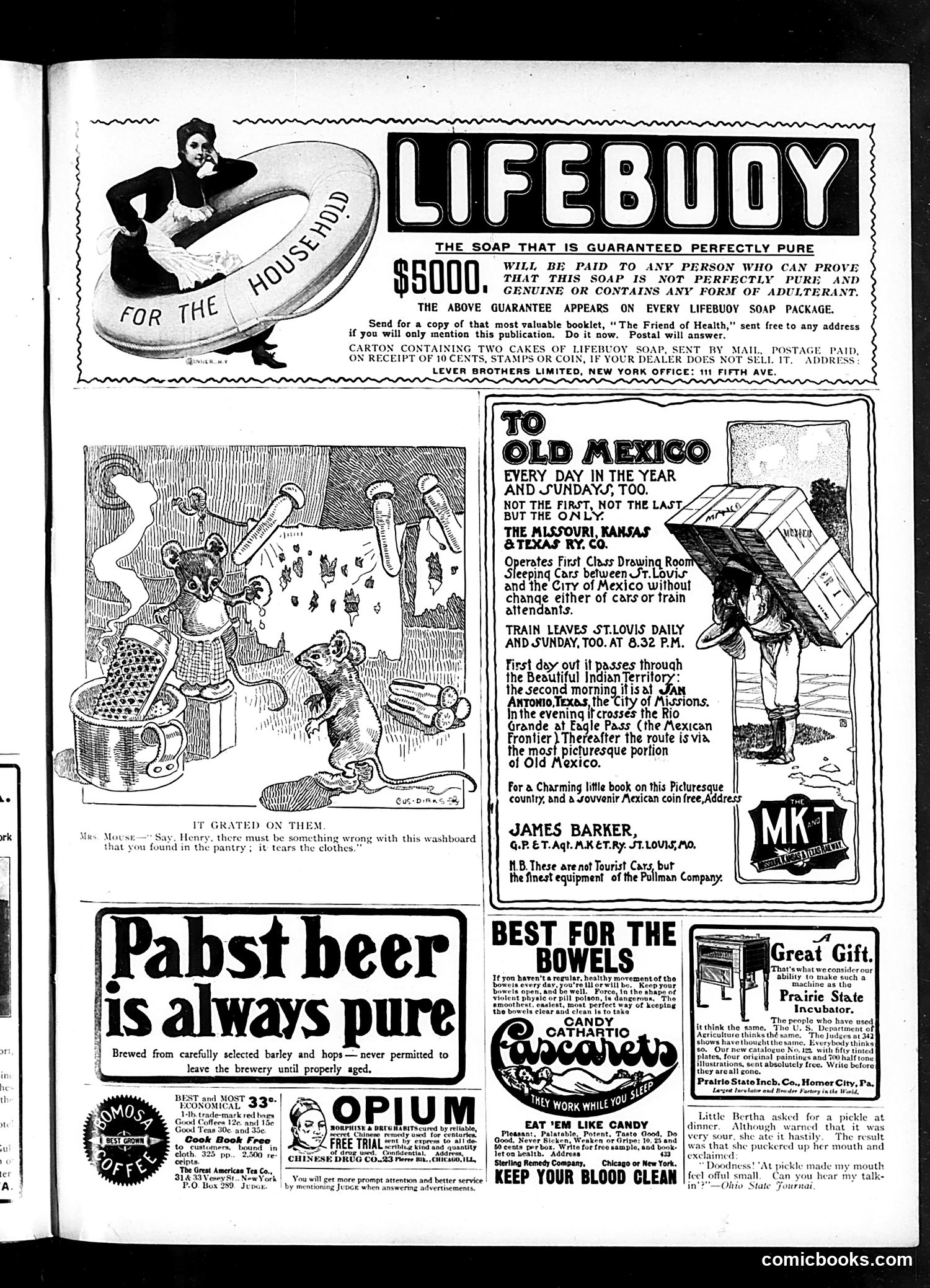
This page is primarily **advertising**, not satire or political commentary. It contains multiple commercial advertisements typical of early 20th-century magazines: **Major Ads:** - **Lifebuoy Soap**: Emphasizes purity with a $5,000 guarantee against adulteration—reflecting contemporary concerns about food and product safety - **Missouri, Kansas & Texas Railway**: Promotes daily service to Mexico City, appealing to travelers and tourists - **Pabst Beer**: Markets itself as "always pure," again capitalizing on purity messaging - **Opium**: Shockingly, advertises opium as medicine with a "free trial," legal before regulation - **Cascarets**: Bowel medication sold as candy - Various patent medicines **The One Cartoon** (bottom left): A domestic humor sketch where a wife questions a washboard's quality to her husband, suggesting it tears clothes—a small joke about household products. The page reflects the **unregulated advertising landscape of the era**, when patent medicines, opium, and dubious health products were openly advertised without FDA oversight.
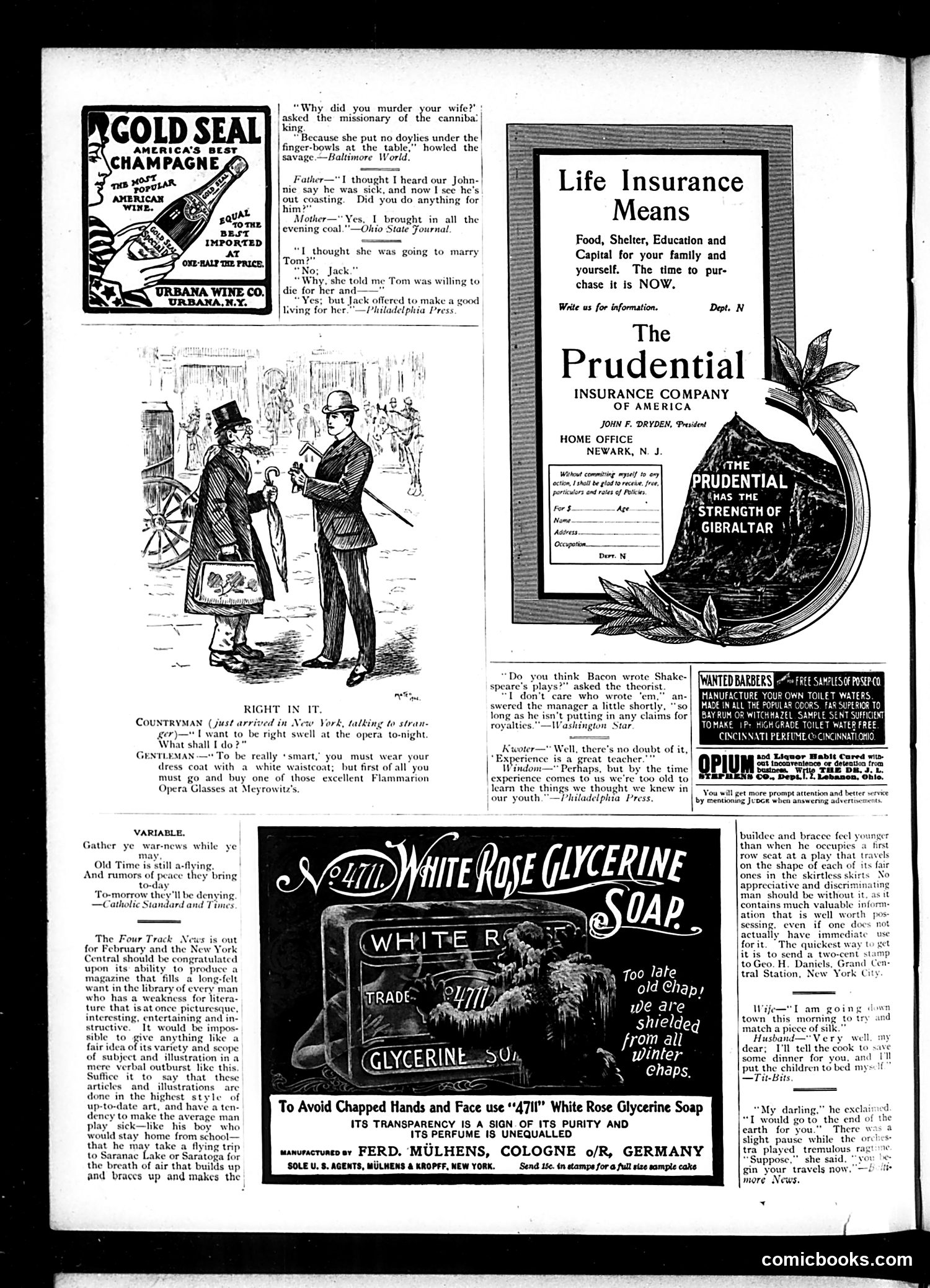
This page contains primarily **advertisements and brief joke columns** rather than political cartoons. The main satirical content includes short humorous anecdotes: 1. **"Right in It"** depicts a newly arrived gentleman seeking opera etiquette advice—the joke being that the gentleman is told to purchase opera glasses at Meyrowitz's, a commercial plug. 2. Several **short joke exchanges** about marriage and relationships, typical of period humor (e.g., "Why did you murder your wife?" about doylies under finger-bowls—satirizing overly refined domestic expectations). The page is **dominated by period advertisements**: Gold Seal Champagne, Prudential Insurance ("has the strength of Gibraltar"), White Rose Glycerine Soap, Opium, and various other products common to early 20th-century magazines. The **"Variable" column** appears to be miscellaneous observations and poetry snippets about current events and society. Rather than biting political satire, this represents the **lighter, consumer-oriented humor** Judge used alongside heavy advertising to fill pages.
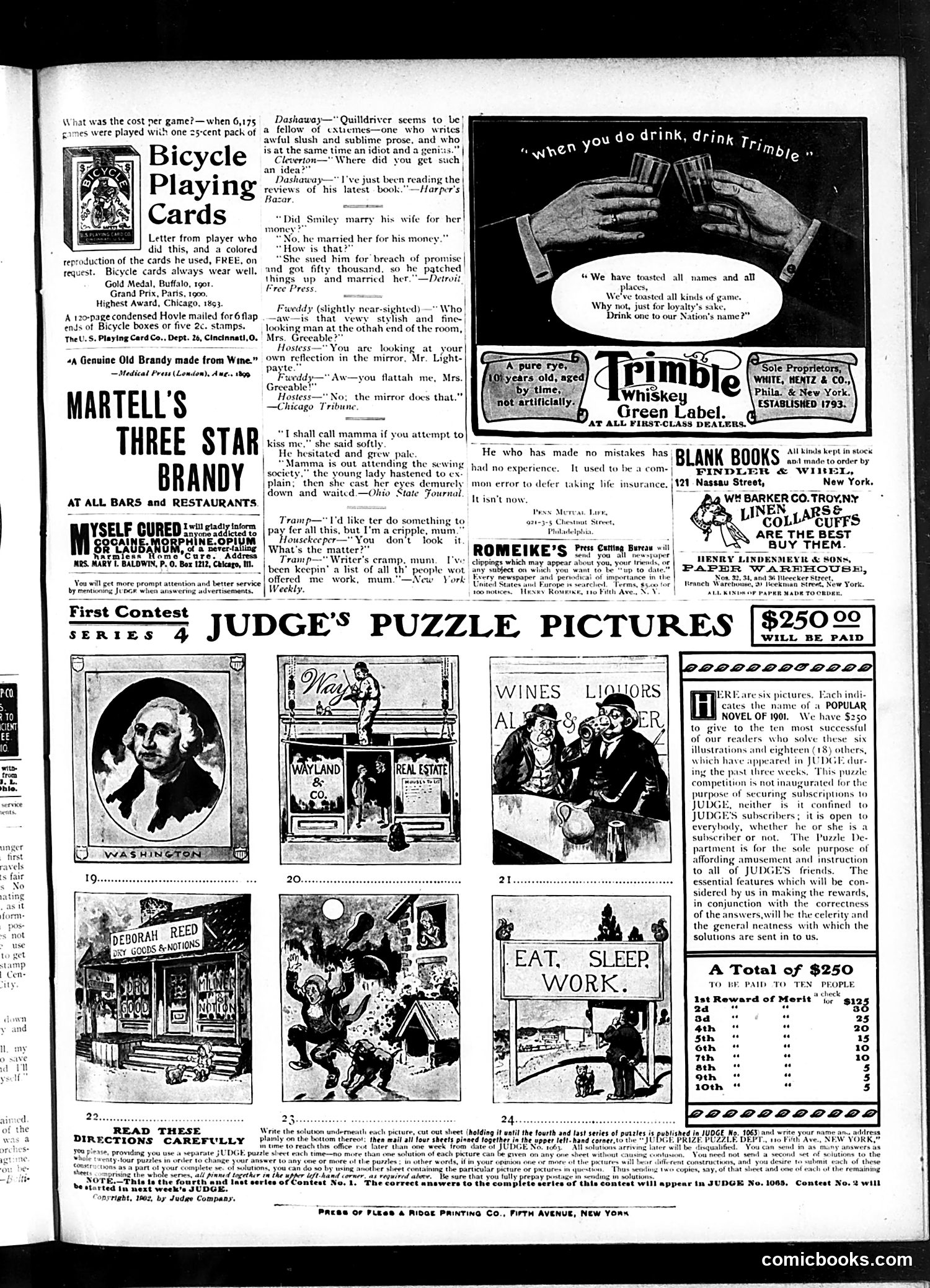
This is primarily an **advertising and puzzle page** from Judge magazine (1901). The main content is a "Puzzle Pictures" contest offering $250 in prizes for readers who can identify novels from illustrations. The puzzle explicitly states it's open to all readers, not just subscribers, and emphasizes the competition rewards correctness, neatness, and merit. The page contains numerous product advertisements (Bicycle Playing Cards, Martell's Brandy, Trimble Whiskey, blank books, clipping services) interspersed with **brief comedic exchanges**—short jokes about marriage for money, a man mistaking his reflection for another person, and a tramp with "writer's cramp" from listing job offers. These small jokes reflect typical early-1900s humor: social commentary on mercenary marriages, vanity, and irony about unemployment. The overall page design is typical of Judge's mixed editorial-advertising format, where satirical content supported the magazine's commercial operations.
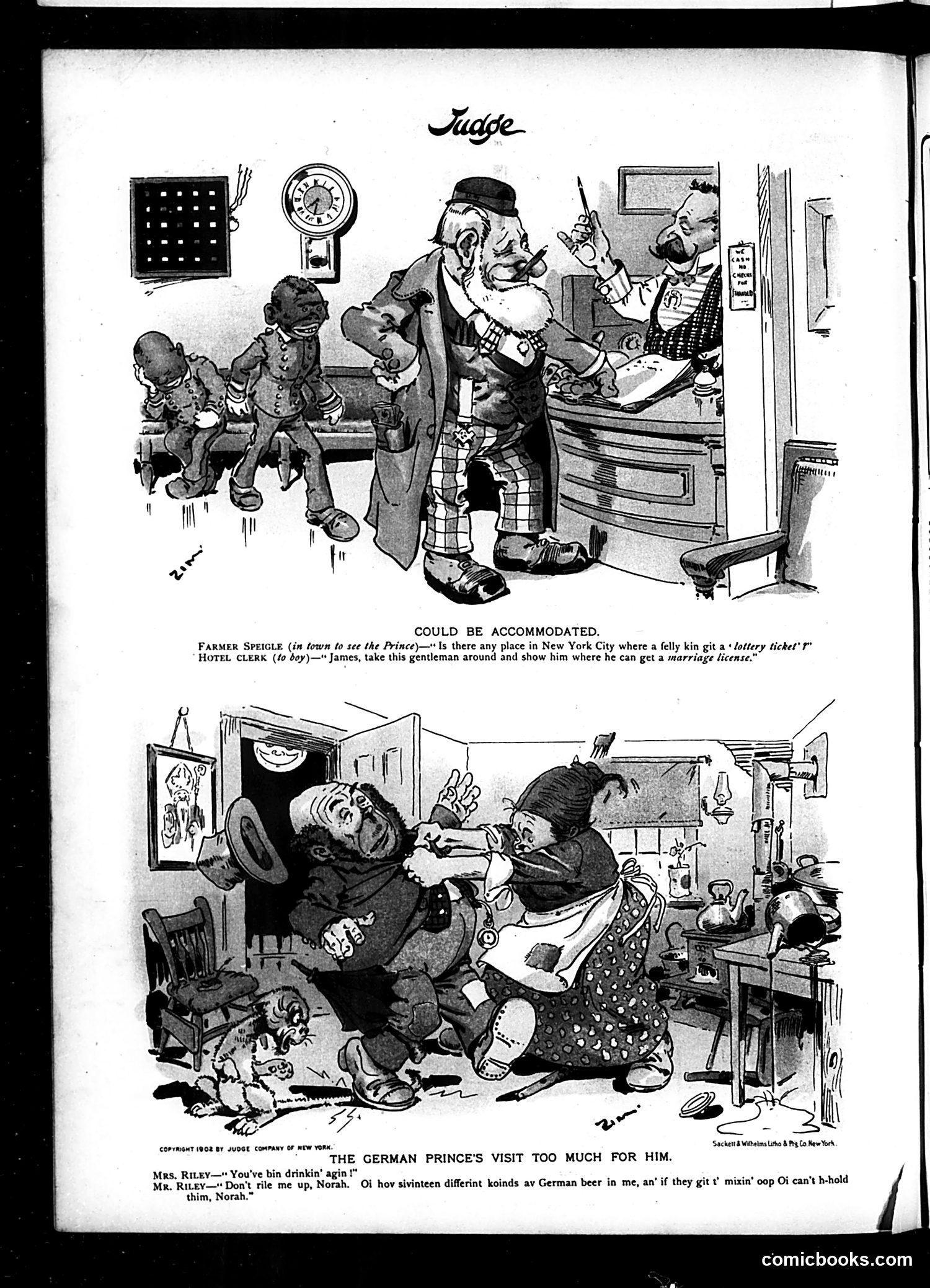
These two cartoons satirize a visit by a German Prince to New York City (the cartoons reference "the Prince" and "German Prince's Visit"). **Top cartoon**: A rural farmer ("Farmer Speigle") arrives in the city seeking a lottery ticket but is redirected by a hotel clerk to get a marriage license instead—mocking both the farmer's naiveté about urban vices and New York's permissive culture. **Bottom cartoon**: An Irishman named Riley, drunk on seventeen types of German beer, complains to his wife Norah that mixing all these beers is making him unable to control himself. This jokes about both the German Prince's visit introducing foreign beer culture to America and stereotypes Irish immigrants as heavy drinkers prone to domestic quarrels. Both cartoons use ethnic stereotyping (Irish, German, rural American) common to Judge's satirical style, mocking immigration, cultural clash, and urban vice in early-20th-century America.
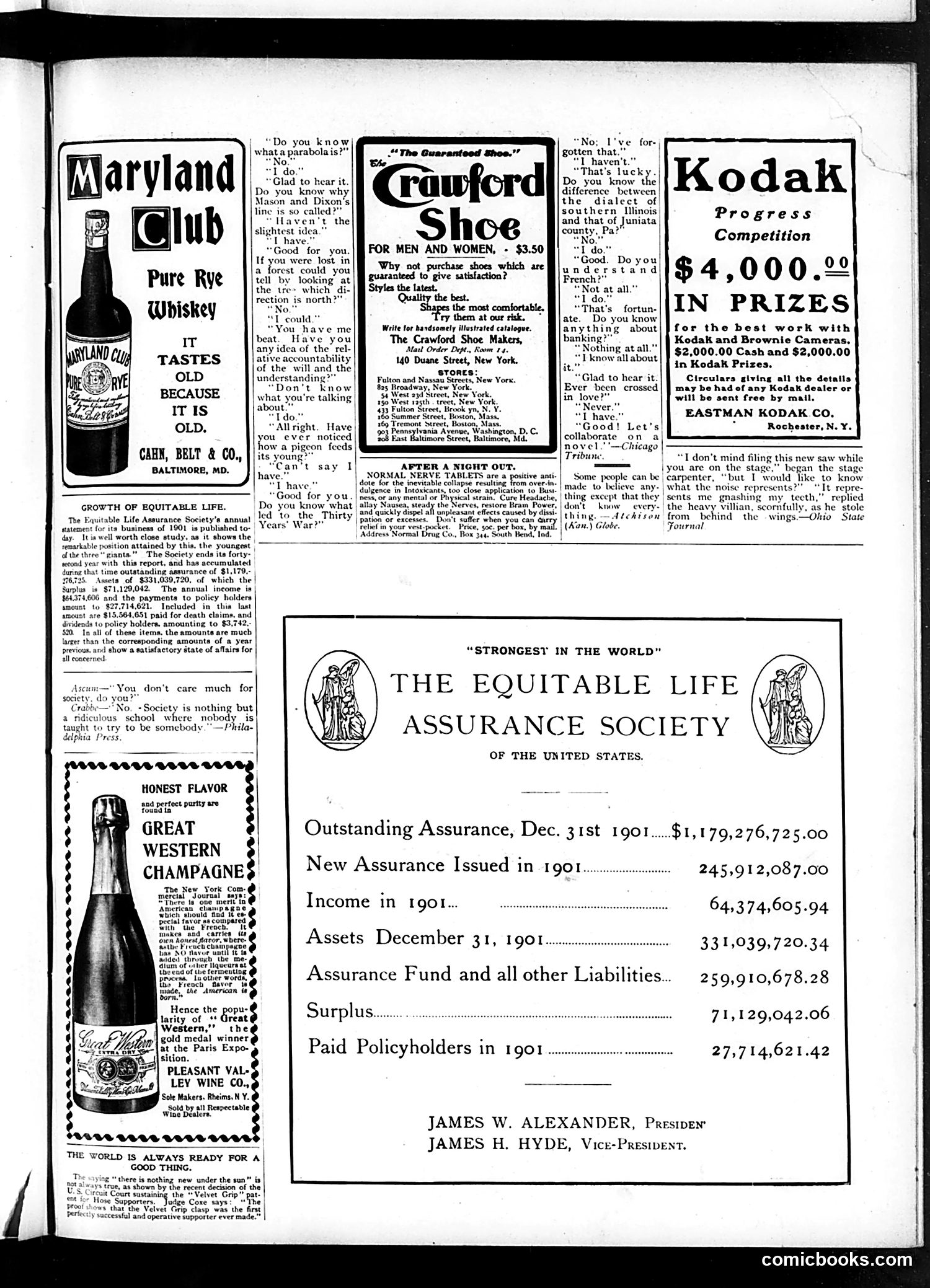
This page is primarily **advertisements and financial statements**, not political satire or comics. The main content features: 1. **Product ads**: Maryland Club Whiskey, Crawford Shoes, Kodak cameras, Great Western Champagne, and Normal Nerve Tablets (a hangover cure) 2. **A financial statement** for the Equitable Life Assurance Society, presenting impressive 1901 figures ($1.1+ billion in outstanding assurance, $331 million in assets) 3. **Two brief comic dialogues**: - An exchange where one character boasts of obscure knowledge (parabolas, Mason-Dixon line, tree directions) while the other admits ignorance - A theater joke about a carpenter filing a saw during a villain's "teeth-gnashing" scene The dialogues are light humor with no political content—simply playing on pretentious knowledge and theatrical mishaps. The page reflects early 1900s consumer culture and life insurance industry confidence.
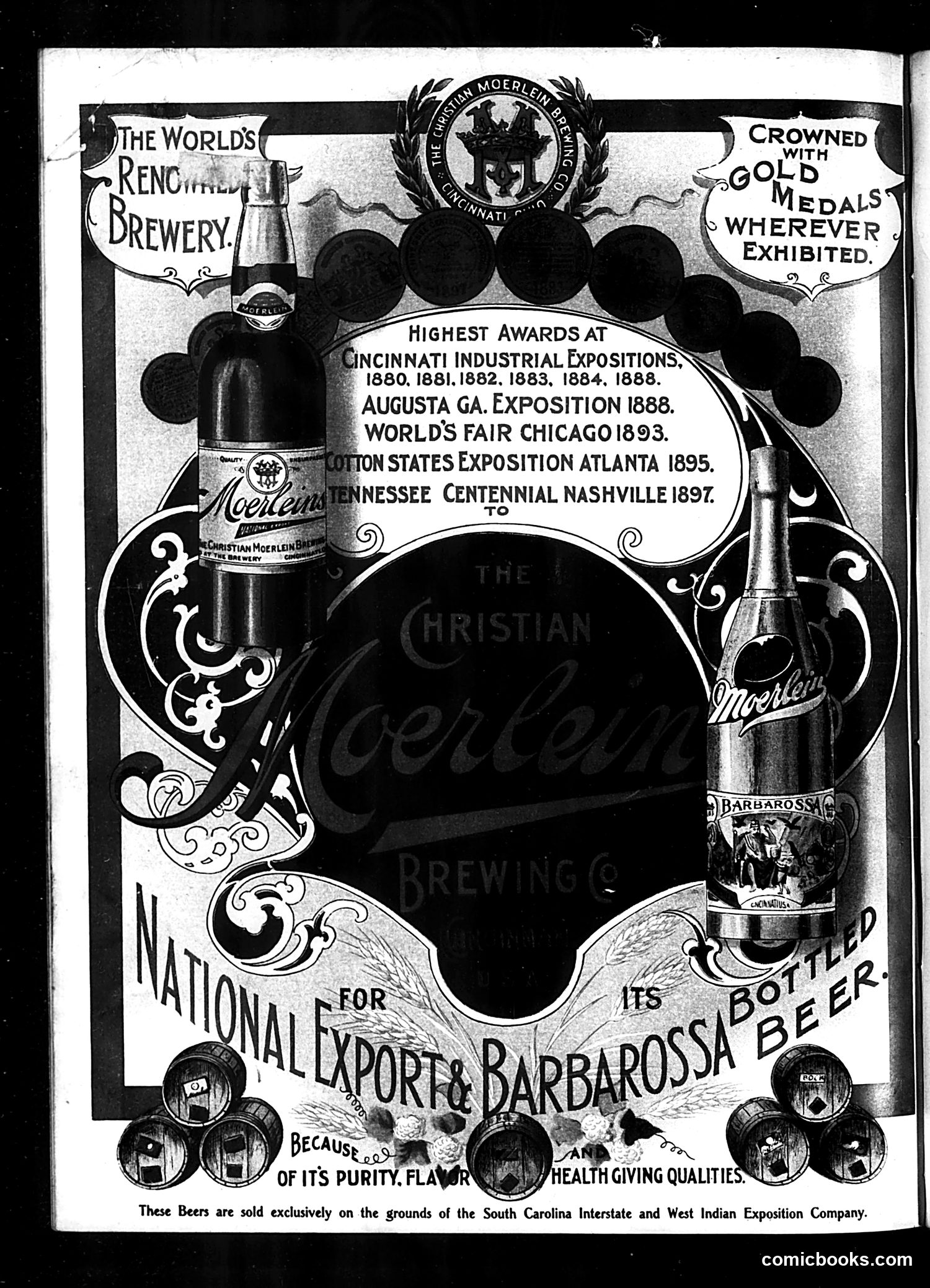
This is **primarily an advertisement**, not satire or political commentary. It promotes Christian Moerlein Brewery's beers—specifically their "National Export" and "Barbarossa" brands. The ornate design showcases beer bottles flanking a large central medallion, surrounded by gold medals (depicted as circles). The text lists prestigious awards won at major late-19th-century expositions: Cincinnati Industrial Expositions (1880-1888), Chicago World's Fair (1893), Atlanta Cotton States Exposition (1895), and Nashville Tennessee Centennial (1897). The tagline claims these beers are "crowned with gold medals wherever exhibited" and boasts of "purity, flavor, health giving qualities." The note at bottom indicates exclusive sales at South Carolina's Interstate and West Indian Exposition. This is essentially a trade advertisement leveraging the brewery's award-winning reputation to market their product—a common approach for breweries in this era to establish credibility and prestige.