
Judge, 1902-03-01 · page 4 of 20
Judge — March 1, 1902 — page 4: what you’re looking at
What you’re looking at
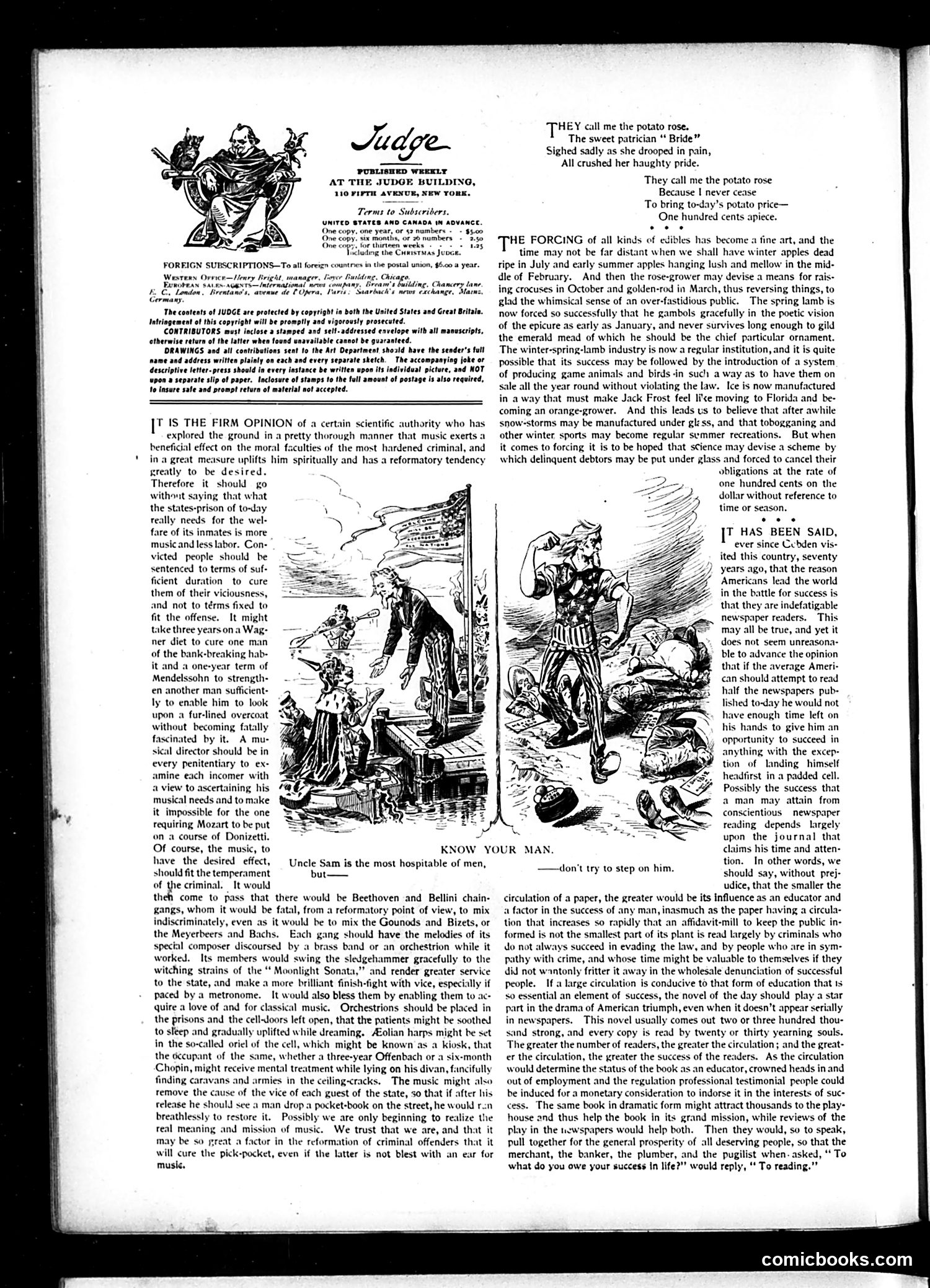
This page contains editorial content about music's role in criminal reform, arguing that orchestral music should be used in prisons to improve inmates' behavior. The editors claim music has a "reformatory tendency" and could reduce recidivism. The cartoon titled "KNOW YOUR MAN" depicts "Uncle Sam" (identifiable by his characteristic tall hat and goatee) stepping over or interacting with a prone figure, with the caption "don't try to step on him." This appears to satirize American attitudes toward labor or working-class figures, suggesting caution against mistreating ordinary citizens. The page also includes a poem mocking the "potato rose"—likely referencing artificial price inflation or market manipulation of basic produce during wartime scarcity. The overall tone critiques both criminal justice practices and economic exploitation.
📄 Transcribed text from this page (OCR, searchable)
Machine-transcribed from the original scan — historical spelling and the odd misread are preserved.
PUBLISHED WEEELY AT THE JUDGE BUILDIN ubscribers. UNITED STATES AND CANADA IN ADVANCE. One copy, one year, oF $2 numbers FOREIGN SUBSCRIPTIONS—To all foreign co Western Orricr—enry fright, manager, Layer Burlding. Chicago. Evnotean sain aggyte—Intermational news company. Bream's building, Chancery lane. 4, Cy London. rentane's, avenue de Opera, Harts; Starbach's news exchange, Main Cormiany. The contents of JUDGE are protected by ¢ Infringement of this copyright will be promptly CONTRIBUTORS must inclose a etherwise return of ight ia both the United States and Great Britale. jorously prosecuted. essed envelope with all manuscripts, 0 scriptive letter-press should i upon a separate 5 {to insure safe and pre its individual pictore, and NOT int of postage is also required, T IS THE FIRM OPINION of a in. scientific authority who has explored the ground in a pretty thorough manner that music exerts a effect on the moral faculties of the most hardened criminal, and in a great measure uplifts him spiritually and has a reformatory tendency greatly to be desired. Therefore it should go without saying that what the states-prison of to-day really needs for the wel- fare of its inmates is more music and less labor. Con: victed people should be sentenced to terms of suf- ficient duration to cure them of their viciousness, and not to térms fixed to fit the offense. It might take three years on a Wag- ner diet to cure one man of the bank-breaking hab- it and a one-year term of Mendelssohn to strength- en another man sufficient- ly to enable him to look upon a fur-lined overcoat without becoming fatally fascinated by it. A mus sical director should be in every penitentiary to ex- amine each incomer with a view to ascertai musical need: it impossible for the one requiring Mozart to be put on a course of Donizetti. Of course, the music, to have the desired effect, should fit the temperament of the criminal. It would theh come to pass that there would be Beethoven and Bellini chain- gangs, whom it would be fatal, from a reformatory point of view, to mix indiscriminately, even as it would be to mix the Gounods and Bizets, or the Meyerbeers and Bach Each gang should have the melodies of its special composer discoursed by a brass band or an orchestrion while it worked. Its members would swing the sledgehammer gracefully to the witching strains of the “ Moonlight Sonata,’’ and render greater service to the state, and make a more brilliant finish-fight with vice, especially if paced by a metronome. It would also bless them by enabling them to ac- quire a love of and for classical music. Orchestrions should be placed in the prisons and the cell-loors left open, that the patients might be soothed to sleep and gradually uplifted while dreaming. Zolian harps might be set in the so-called oriel of the cell, which might be known as a kiosk, that the Gecupant of the same, whether a three-year Offenbach or a six-month Chopin, might receive ment. ment while lying on his divan, fancifully finding caravans and armies in the ceiling-cracks, The music might also remove the cause of the vice of each guest of the state, so that if after his release he should see a man drop a pocket-book on the street, he would rn breathlessly to restore it. Possibly we are only beginning to realize the real meaning and mission of music. We trust that we are, and that it may be so great a factor in the reformation of criminal offenders that it will cure the pick-pocket, even if the latter is not blest with an ear for music, Uncle Sam is the most hospitable of men, but—— KNOW YOUR MAN, lai THEY call me the potato rose. The sweet patrician Bride” Sighed sadly as she drooped in pain, All crushed her haughty pride. They call me the potato rose Because | never cease To bring to-day’s potato price— One hundred cents apiece. ‘HE FORCING of all kinds of edibles has become a fine art, and the time may not be far distant when we shall have winter apples dead ripe in July and early summer apples hanging lush and mellow in the mi dle of February. And then the rose-grower may devise a means for rai ing crocuses in October and golden-rod in March, thus reversing things, to glad the whimsical sense of an over-fastidious public. The spring lamb is now forced so successfully that he gambols gracefully in the poetic vision of the epicure as early as January, and never survives long enough to gild the emerald mead of which he should be the chief particular ornament. The winter-spring-lamb industry is now a regular institution, and it is quite possible that its success may be followed by the introduction of a system of producing game animals and birds in such a way as to have them on sale all the year round without violating the law. Ice is now manufactured in a way that must make Jack Frost feel lice moving to Florida and be- coming an orange-grower. And this leads us to believe that after awhile snow-storms may be manufactured under glzss, and that tobogganing and other winter sports may become regular summer recreations. But when it comes to forcing it is to be hoped that science may devise a scheme by which delinquent debtors may be put under glass and forced to cancel their obligations at the rate of one hundred cents on the dollar without reference to time or season, eee T HAS BEEN SAID, ever since Cubden vis- ited this country, seventy ) years ago, that the reason Americans lead the world in the battle for success is that they are indefatigable newspaper readers. This may all be true, and yet it does not seem unreasona- ble to advance the opinion that if the average Ameri- can should attempt to read half the newspapers pub- lished to-day he would not have enough time left on his hands to give him an opportunity to succeed in anything with the excep- tion of landing himself headfirst in a padded cell. Possibly the success that a man may attain from conscientious newspaper reading depends largely upon the journal that ims his time and atten- tion. In other words, we should say, without prej- udice, that the smaller the circulation of a paper, the greater would be its influence as an educator and factor in the success of any man, inasmuch as the paper having a circula- tion that increases so rapidly that an affidavit-mill to keep the public in- formed is not the smallest part of its plant is read largely by criminals who do not aly ceed in evading the law, and by people who are in sym- xithy with crime, and whose time might be valuable to themselves if they did not wantonly fritter it in the wholesale denunciation of successful people. If a large circulation is conducive to that form of education that 15 so essential an element of success, the novel of the day should play a star part in the drama of American triumph, even when it doesn’t appear serially in newspapers. This novel usually comes out two or three hundred thou- sand strong, and every copy is read by twenty or thirty yearning souls. The greater the number of readers, the greater the circulation; and the great- er the circulation, the greater the success of the readers. As the circulation would determine the status of the book a: educator, crowned heads in and ‘out of employment and the regulation professional testimonial people could be induced for a monetary consideration to indorse it in the interests of suc- cess. The same book in dramatic form might attract thousands to the play- house and thus help the book in its grand mission, while reviews of the play in the newspapers would help both. Then they would, so to speak, pull together for the general prosperity of all deserving people, so that the merchant, the banker, the plumber, and the pugilist when- asked, “ To what do you owe your success In life?” would reply, To reading.” —don't try to step on him. comicbooks.com