
A complete issue · 20 pages · 1902
Judge — February 8, 1902
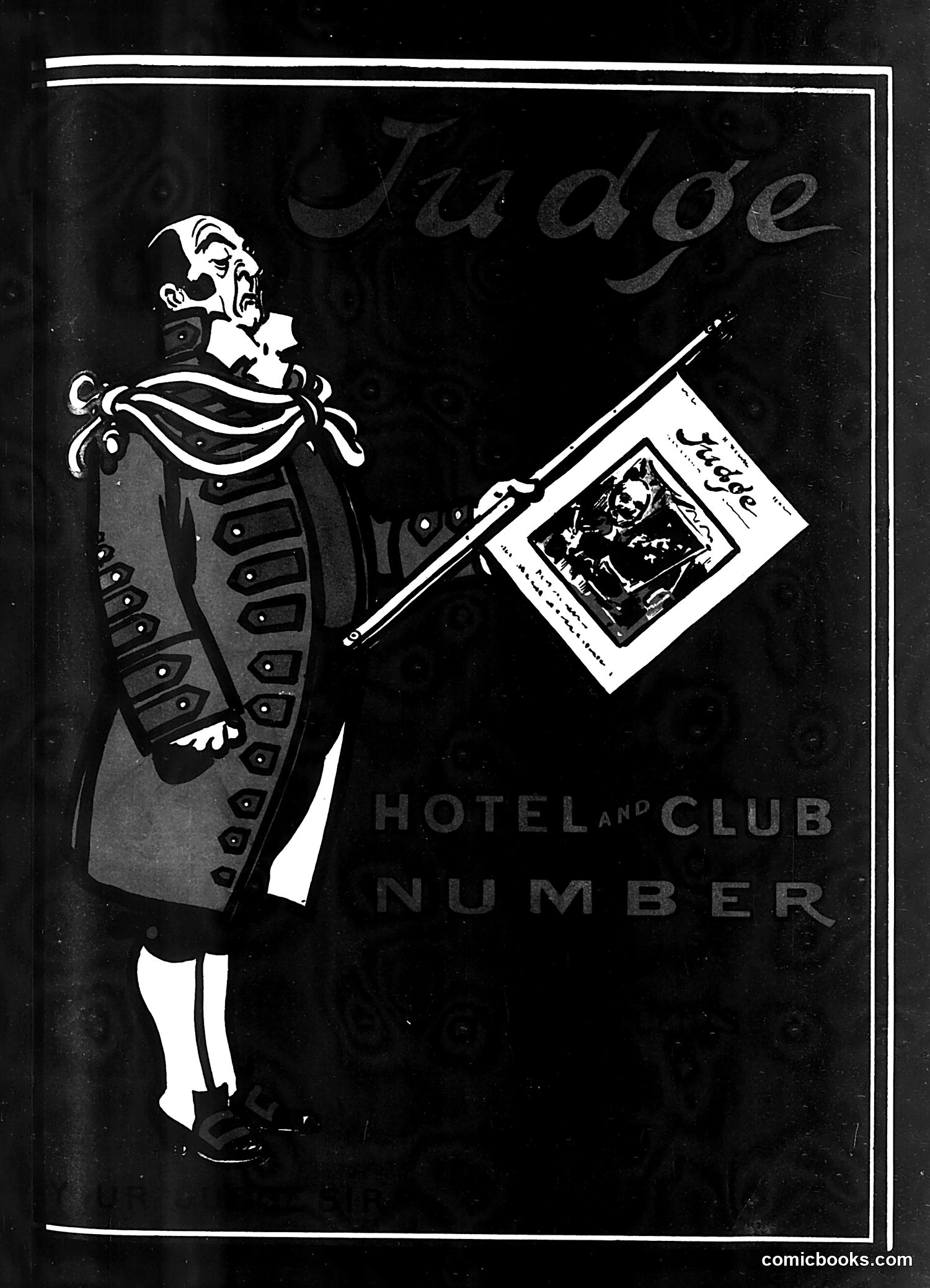
This appears to be a cover or advertisement page from Judge magazine featuring a grotesque caricatured figure in elaborate military dress holding a flag. The exaggerated facial features and theatrical costume suggest this is political satire, likely targeting a specific military or political leader of the era. The text reads "Judge" at top and "HOTEL AND CLUB NUMBER" at bottom, indicating this is part of a special issue. The artistic style and black-and-white execution suggest early-to-mid 20th century publication. Without clearer identifying text or date information visible in the image, I cannot definitively identify which specific political figure or military leader is being caricatured, though the grotesque styling indicates satirical criticism of someone in power during that period.
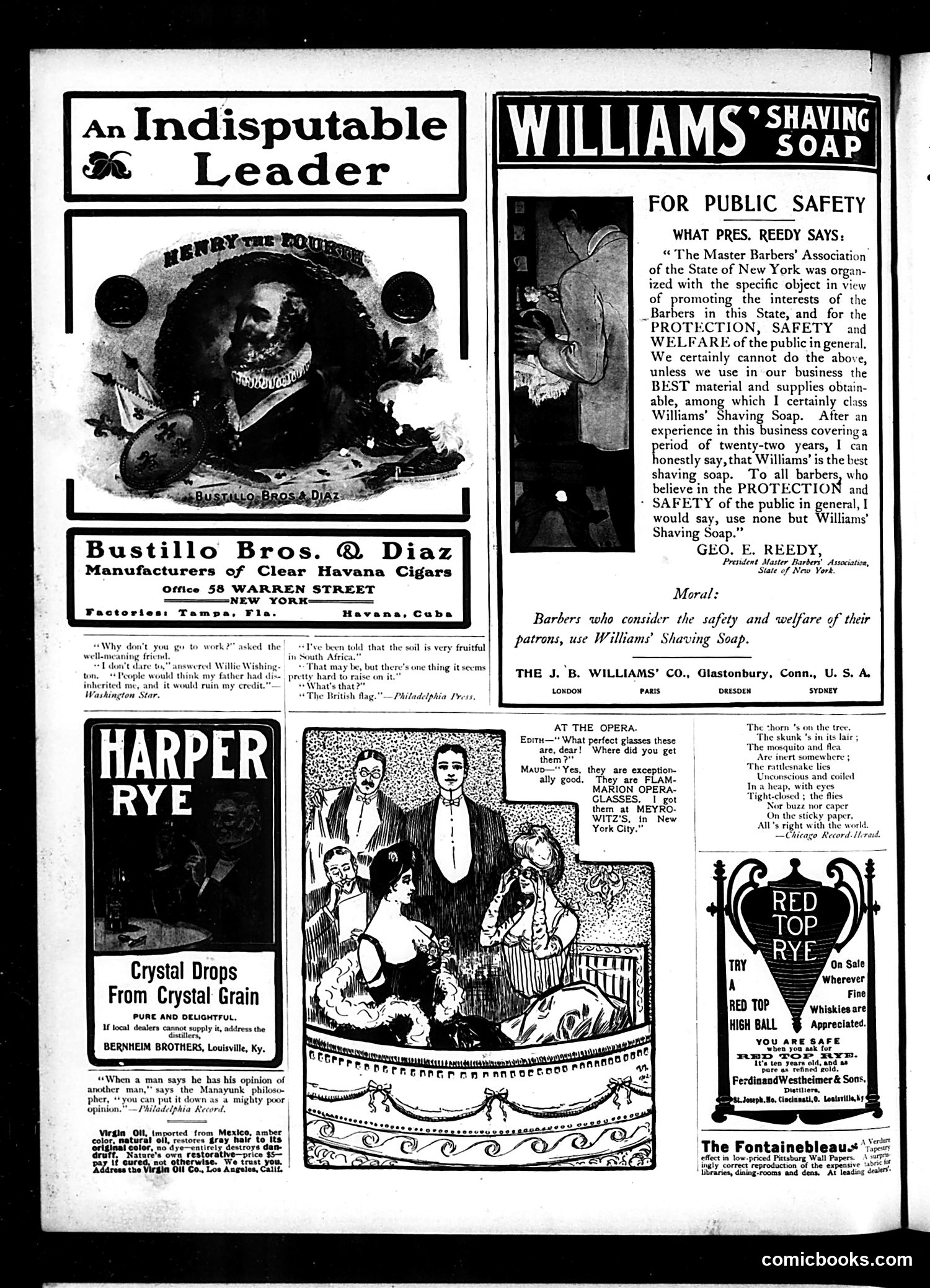
This page is primarily **advertising**, not political satire. The dominant content includes: 1. **Bustillo Bros. & Diaz cigars** (top left): Features a caricatured face promoting "Clear Havana Cigars" from New York/Havana. 2. **Williams' Shaving Soap** (top right): Includes a testimonial from "Geo. E. Reedy, President Master Barbers Association, State of New York," endorsing the product for "protection, safety and welfare." 3. **Harper Rye whiskey** (bottom left) and **Red Top Rye** (right): Liquor advertisements. 4. **Center illustration**: An operatic or theatrical scene, likely advertising entertainment venues. The page demonstrates how Judge magazine, while known for satire, heavily relied on paid advertisements to sustain publication. The content reflects early-20th-century consumer culture rather than political commentary.
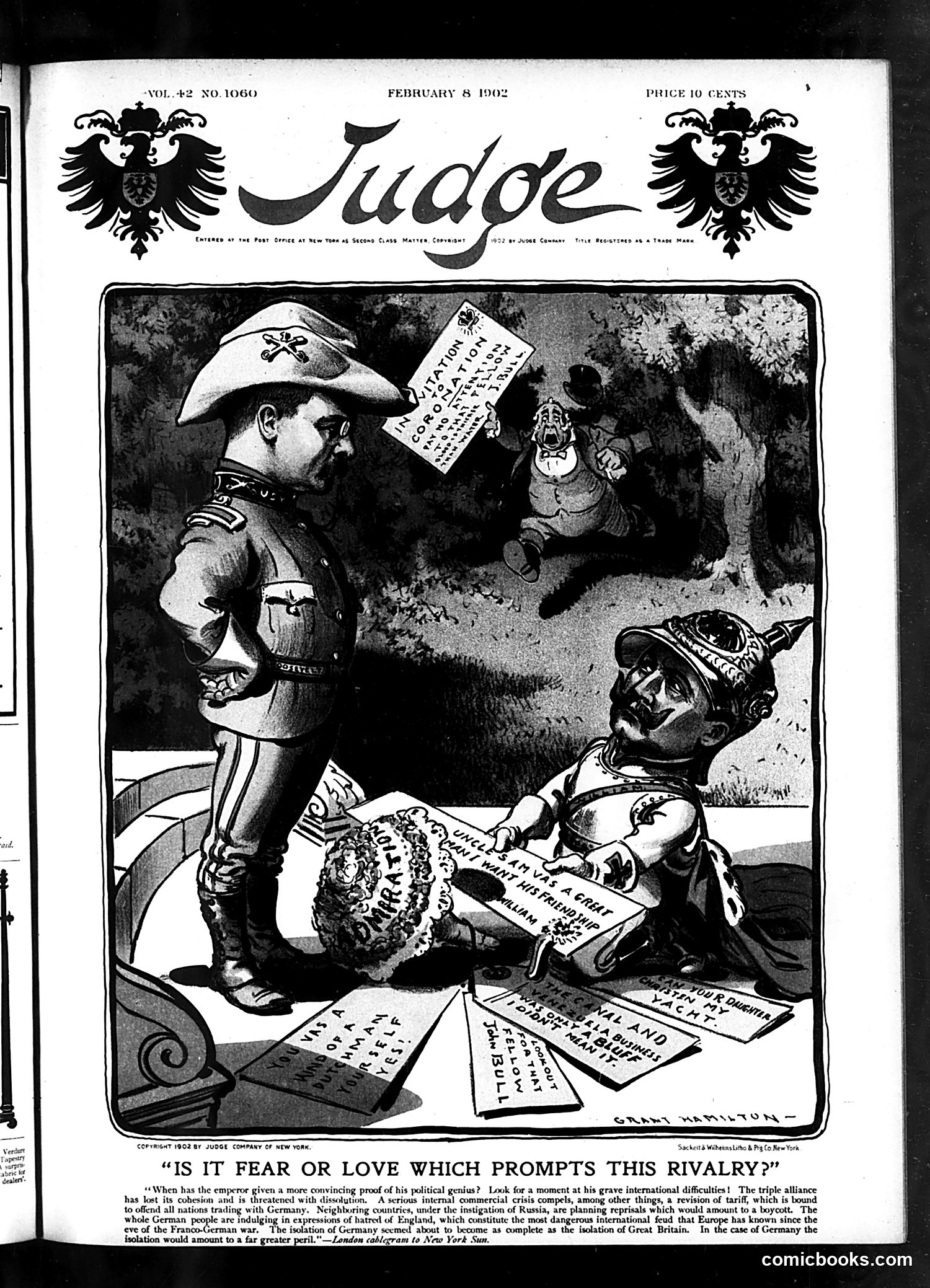
This political cartoon satirizes international tensions, likely related to the Boer War and European rivalries. The central figure appears to be a German military officer examining documents labeled with territorial claims and international disputes. Smaller caricatured figures (possibly representing other nations) surround him, also holding documents about commercial interests and conflicts. The caption "IS IT FOR LOVE WHICH PROMPTS THIS RIVALRY?" sarcastically questions whether nations' conflicts are motivated by genuine principle or merely economic self-interest. The accompanying text references "triple alliance," Germany's tensions with England, and commercial competition among nations regarding colonial territories and trade routes. The satire critiques the hypocritical pretenses masking imperialist competition for global dominance.
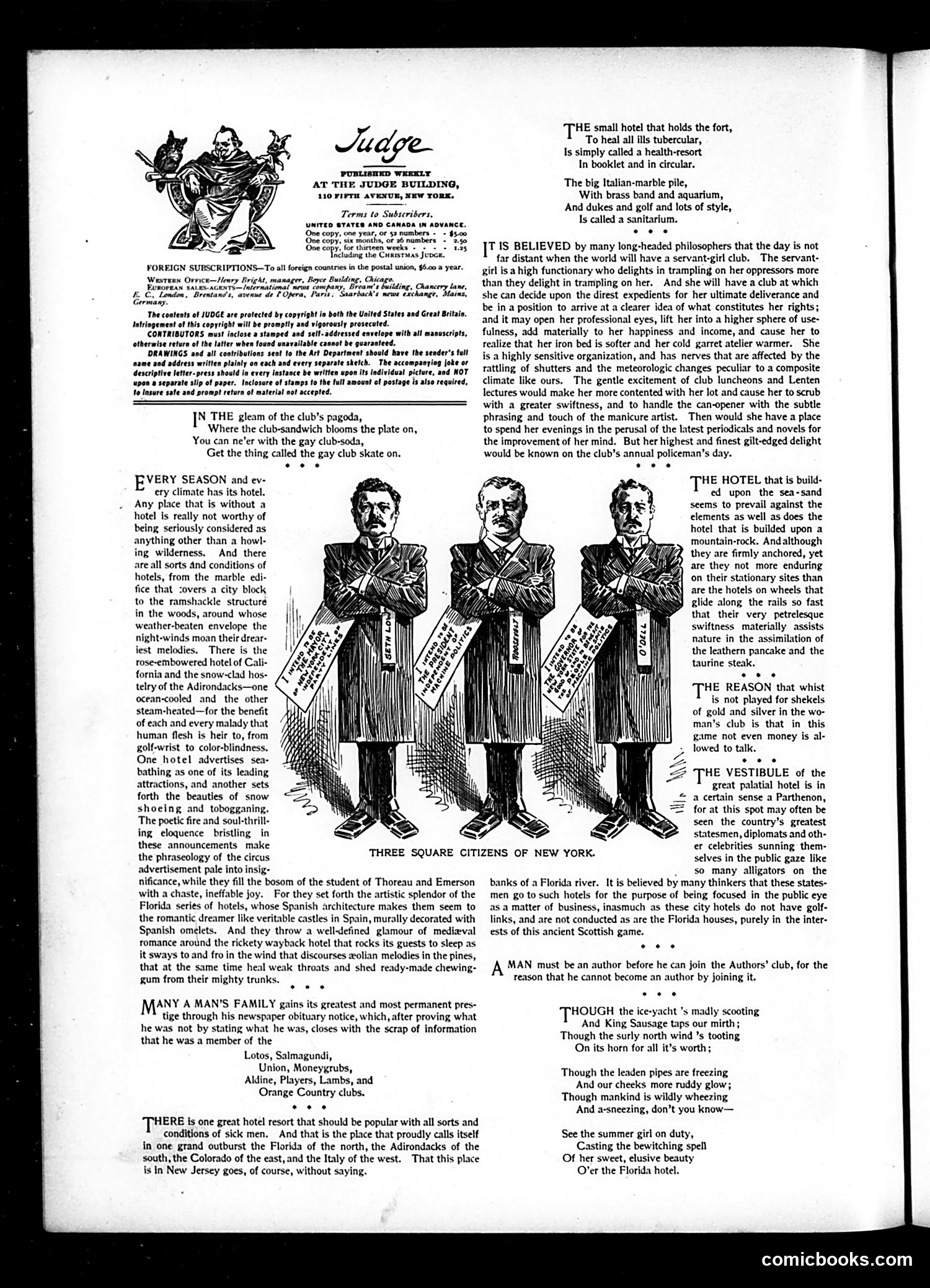
The central illustration shows "Three Square Citizens of New York"—three men in formal dress holding what appear to be membership cards or certificates. Based on the surrounding text discussing "clubs" (mentioning "club-sandwich," "sky club skate," and various social clubs like "Lotos, Salmagundi, Union, Moneybags, Aldine, Players, Lambs, and Orange Country clubs"), this satirizes New York's exclusive club culture. The satire targets wealthy Manhattan gentlemen's clubs of the era—institutions that defined social status and respectability. The three identical figures emphasize how conformist and interchangeable these "square citizens" are despite their pretensions to distinction. The accompanying text mocks club membership as a marker of importance while highlighting the absurdity of such exclusivity.
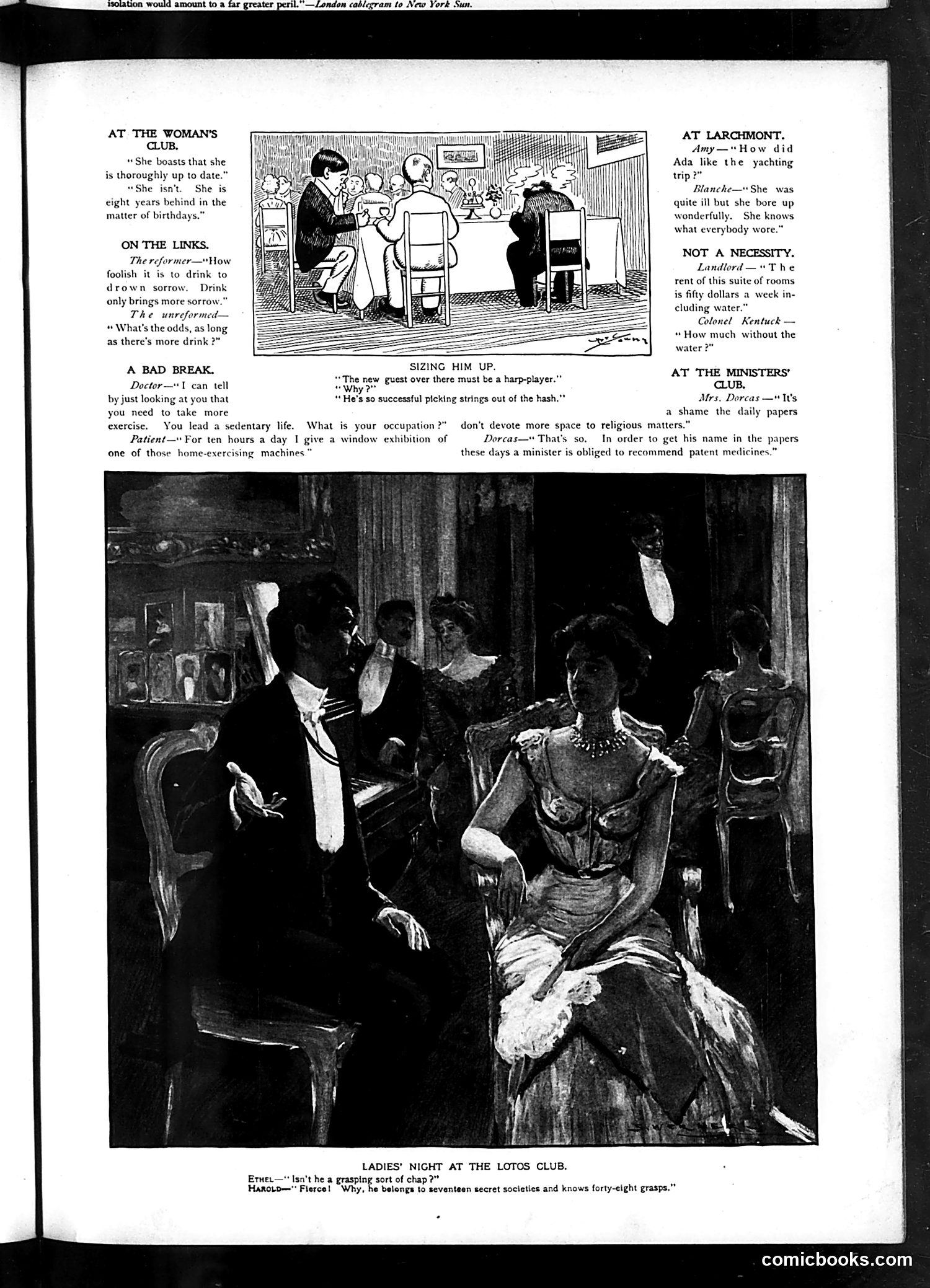
This page presents several brief satirical vignettes mocking upper-class social pretensions and hypocrisies of the early 20th century. **Key satires:** - **"At the Woman's Club"**: Women obsess over fashion details while remaining ignorant of basic facts (being "eight years behind" in knowing their own ages). - **"On the Links"**: A reformer lectures against drinking while the "unreformed" man pragmatically notes more drinking solves the problem—satirizing selective moralism. - **"A Bad Break"**: A doctor's diagnosis based purely on appearance, implying shallow judgments pass for expertise. - **"Sizing Him Up"**: Mocking both a supposed "harp-player" guest and ministers who must engage in sensationalism to get newspaper coverage rather than genuine religious authority. - **"Ladies' Night at the Lotos Club"**: The final image satirizes men who join numerous "secret societies" as mere social climbers and con artists. The overall theme: Society's upper echelons are vain, hypocritical, and more concerned with appearance and social status than substance.
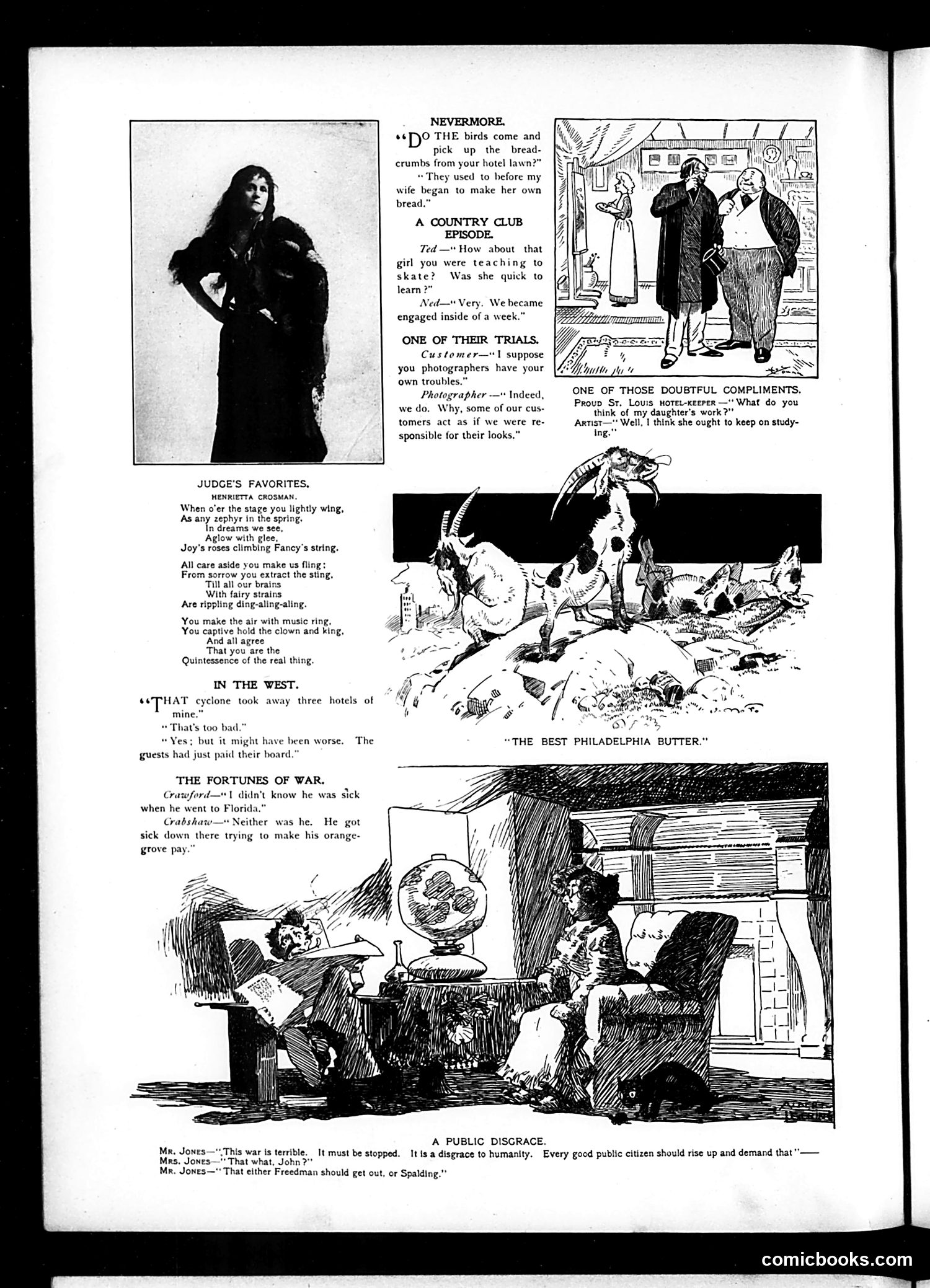
This page from **Judge** (a satirical weekly) contains multiple short humor pieces typical of early 20th-century American comedy: **Top left**: A tribute to actress **Henrietta Crosman**, praising her theatrical performances with romantic verse—standard celebrity flattery from the era. **Short jokes** scattered throughout mock everyday situations: a cyclone destroying hotels (the owner's relieved guests already paid), a man's orange grove failing in Florida, homemade bread deterring birds, and rapid courtship at a country club. **"A Public Disgrace"** (bottom): References what appears to be a **baseball controversy**—likely about players **Freedman** and **Spalding** (prominent figures in early 1900s baseball politics). The joke satirizes how people weaponize public outrage over sports disputes, with Mr. Jones demanding one player be expelled but unsure which. **Overall tone**: Light domestic humor, celebrity worship, and sports-world satire—reflecting upper-middle-class concerns of the period. No overtly political content, just entertainment for Judge's affluent readership.
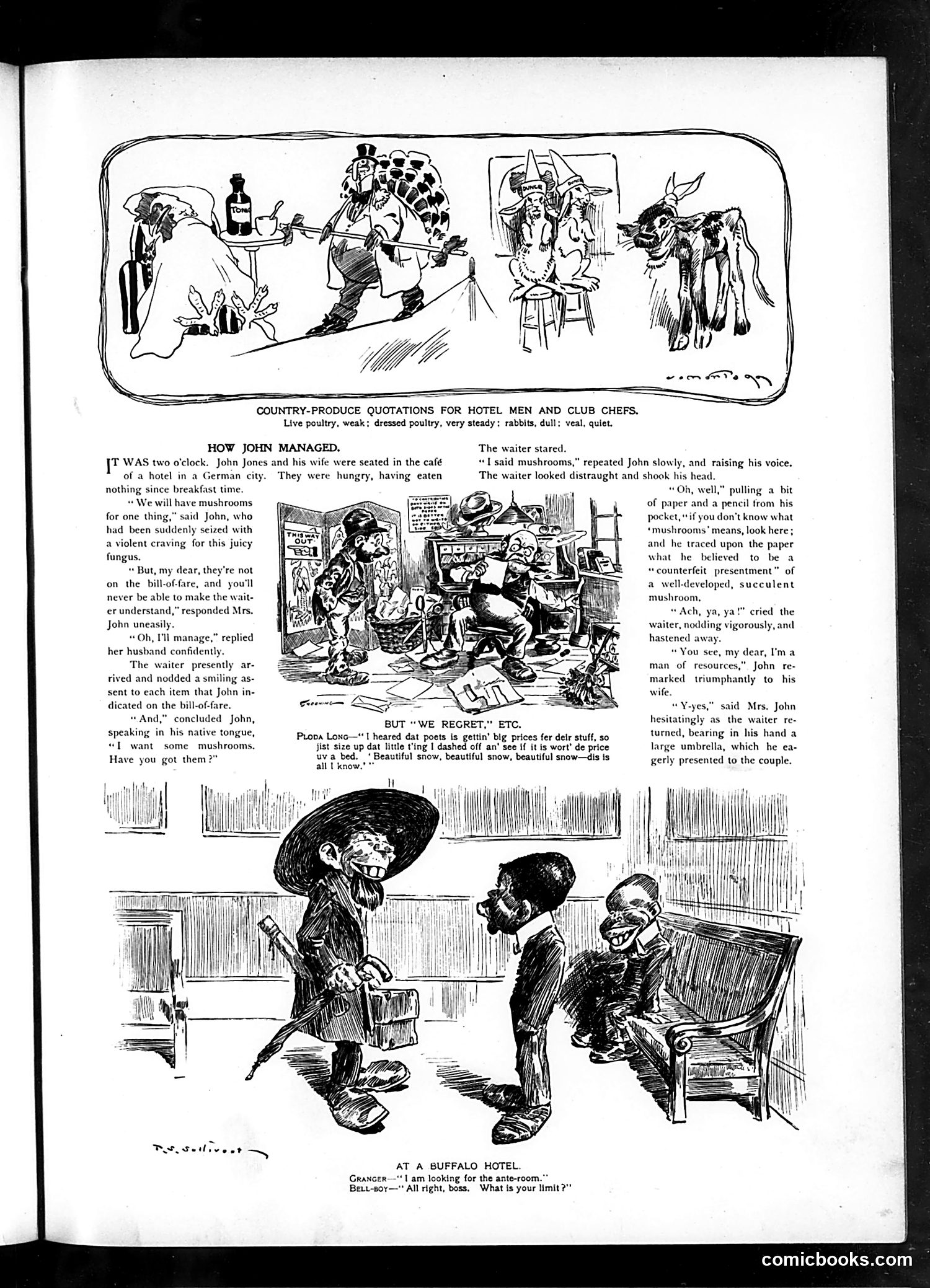
This Judge magazine page contains three separate humorous sketches satirizing hotel and restaurant culture. **"How John Managed"**: An American tourist in a German hotel attempts to order mushrooms. When the waiter doesn't understand his English, John confidently draws a picture—intending to depict a mushroom. The waiter interprets the sketch as an umbrella and returns with one instead. The joke mocks American tourists' assumption that language barriers can be overcome through simple gestures or drawings, and highlights the comedy of miscommunication. **"But We Regret"**: A brief exchange where Prova Long pitches poetry to editors, comparing herself to famous poets ("Beautiful Snow"). **"At a Buffalo Hotel"**: A bellhop misinterprets "ante-room" (a waiting room) as "anti-room," then humorously asks the guest about their betting limit, treating it as gambling terminology. All three sketches rely on wordplay, mispronunciation, and miscommunication for comedic effect—reflecting early 20th-century American humor conventions.
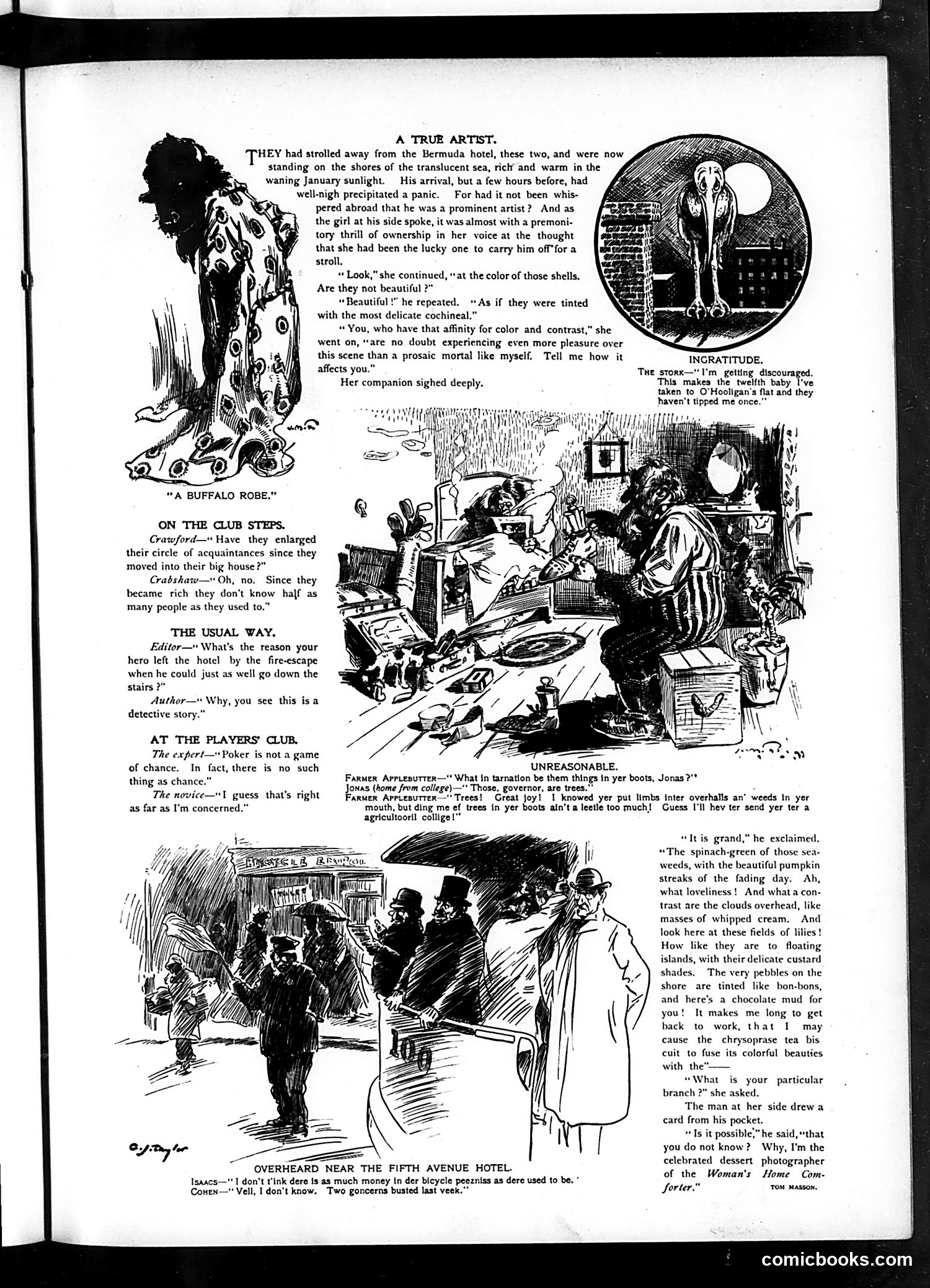
This page mocks pretentious artistic affectation and social climbing. The main story features a self-proclaimed "prominent artist" who describes natural scenery in absurdly overwrought language—calling seashells "tinted with cochineal," clouds "masses of whipped cream," and mud "chocolate." The punchline reveals he's actually a "dessert photographer" for *Woman's Home Companion*, suggesting his grandiose artistic pretensions are hollow commercial work. Supporting sketches satirize other social absurdities: newly rich people losing friends after gaining wealth, a detective story author using contrived plot devices, a college student bringing home "trees" in his boots (pretentious affectation), and poker players debating whether chance exists. The humor targets American social anxiety around class mobility, artistic pretense, and the gap between self-image and reality—common Judge magazine themes critiquing Gilded Age society.
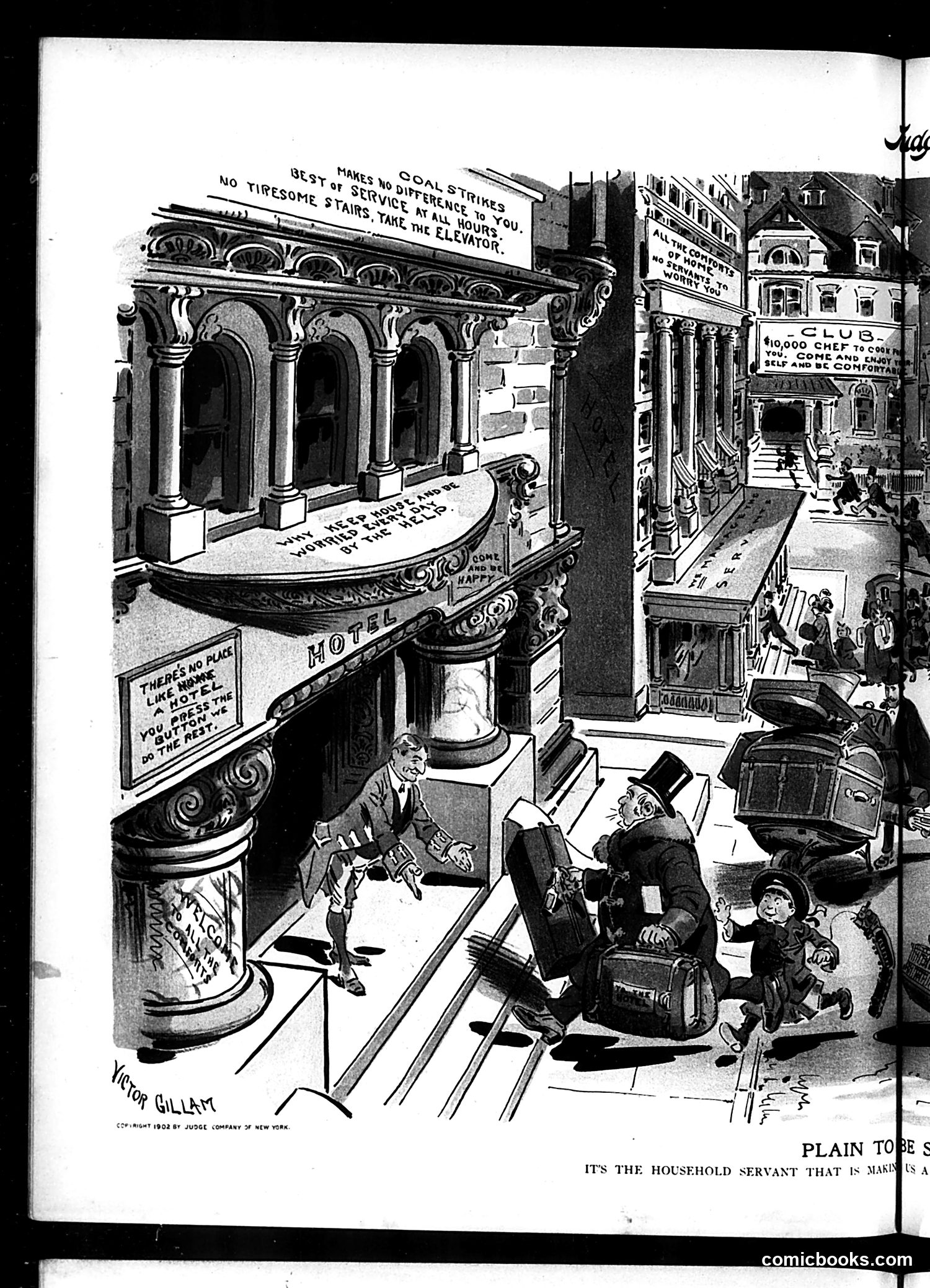
This is a Victor Gillam cartoon from Judge magazine (1902) satirizing luxury hotels. The elaborate classical hotel facade on the left contrasts with street-level chaos: well-dressed guests struggle with luggage while children run underfoot. The signs mock extravagant hotel amenities ("$10,000 chef," "no tiresome stairs," "all the comforts of home") while the reality shows discomfort and confusion. The cartoon's point appears to be criticizing how hotels advertise luxury they cannot deliver—promising perfection while actual guests experience disorder and inconvenience. The caption's incomplete phrase "It's the household servant that is making us a..." likely completes a social critique about servants' labor being exploited to maintain these false promises of comfort. The satire targets both hotel marketing exaggeration and the gap between advertised elegance and lived experience.
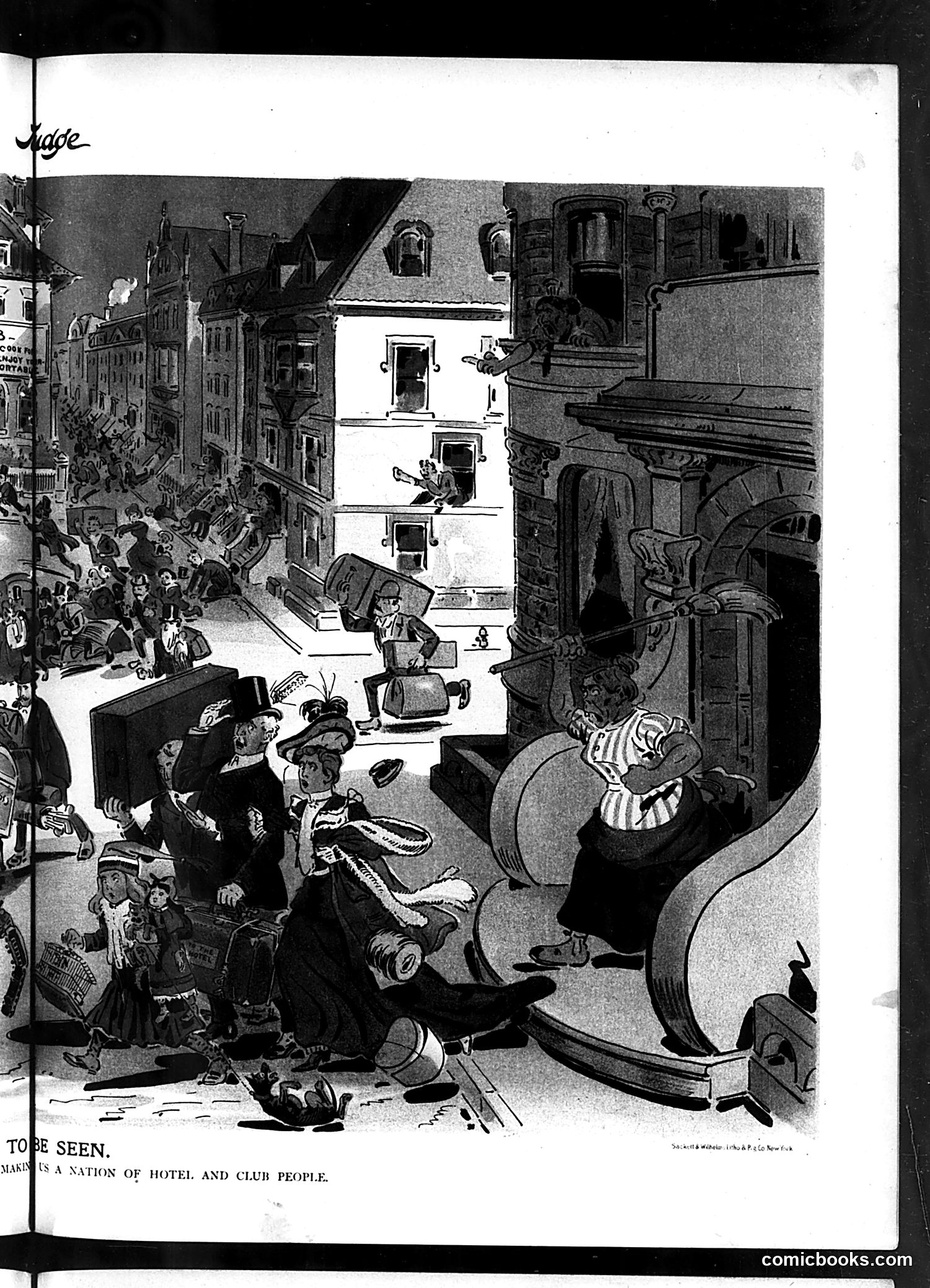
This Judge cartoon satirizes the leisure habits of wealthy Americans, particularly those who frequented exclusive hotels and clubs. The scene depicts an ornate urban streetscape where fashionably dressed figures—identifiable by their fine clothing and top hats—congregate outside what appears to be an upscale establishment. The satire targets the social pretension and conspicuous display of the leisure class: these wealthy individuals seem to exist primarily to "be seen" in fashionable venues rather than engage in meaningful activity. The crowded, theatrical composition emphasizes how their entire social identity revolves around public visibility and status signaling at hotels and clubs—institutions that marked one's social position in Gilded Age or Progressive Era America.
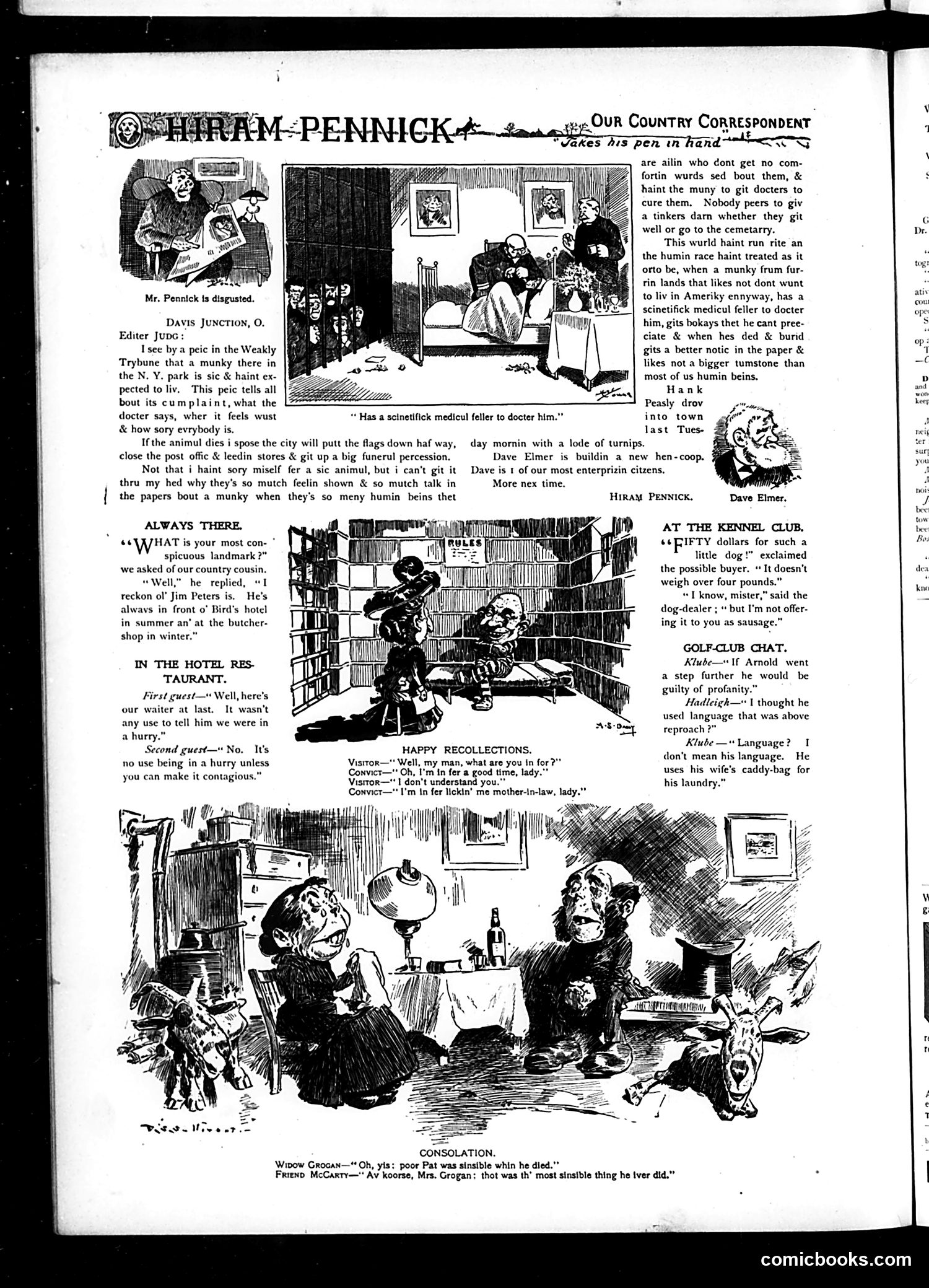
This page features humorous rural/small-town commentary and illustrated jokes typical of Judge magazine's satirical approach. **Main Content:** The lead piece is a letter from a disgusted reader complaining that newspapers give extensive medical coverage to a sick monkey in a New York park while ignoring sick poor humans. The satire critiques misplaced public sympathy—society mourns an exotic animal but ignores suffering citizens. **Supporting Sketches:** - "Always There" jokes about a man permanently stationed at a hotel - Hotel restaurant humor about being in a hurry - Kennel Club chat mocking a buyer haggling over a tiny dog's price - Golf Club banter about crude language - "Happy Recollections": a prison inmate explains he's in jail for beating his mother-in-law - "Consolation": Irish widow and friend agree her dead husband's most sensible act was dying The humor relies on working-class dialect, domestic violence jokes (considered acceptable then), and social commentary on class disparities—all typical of early 20th-century American satire.
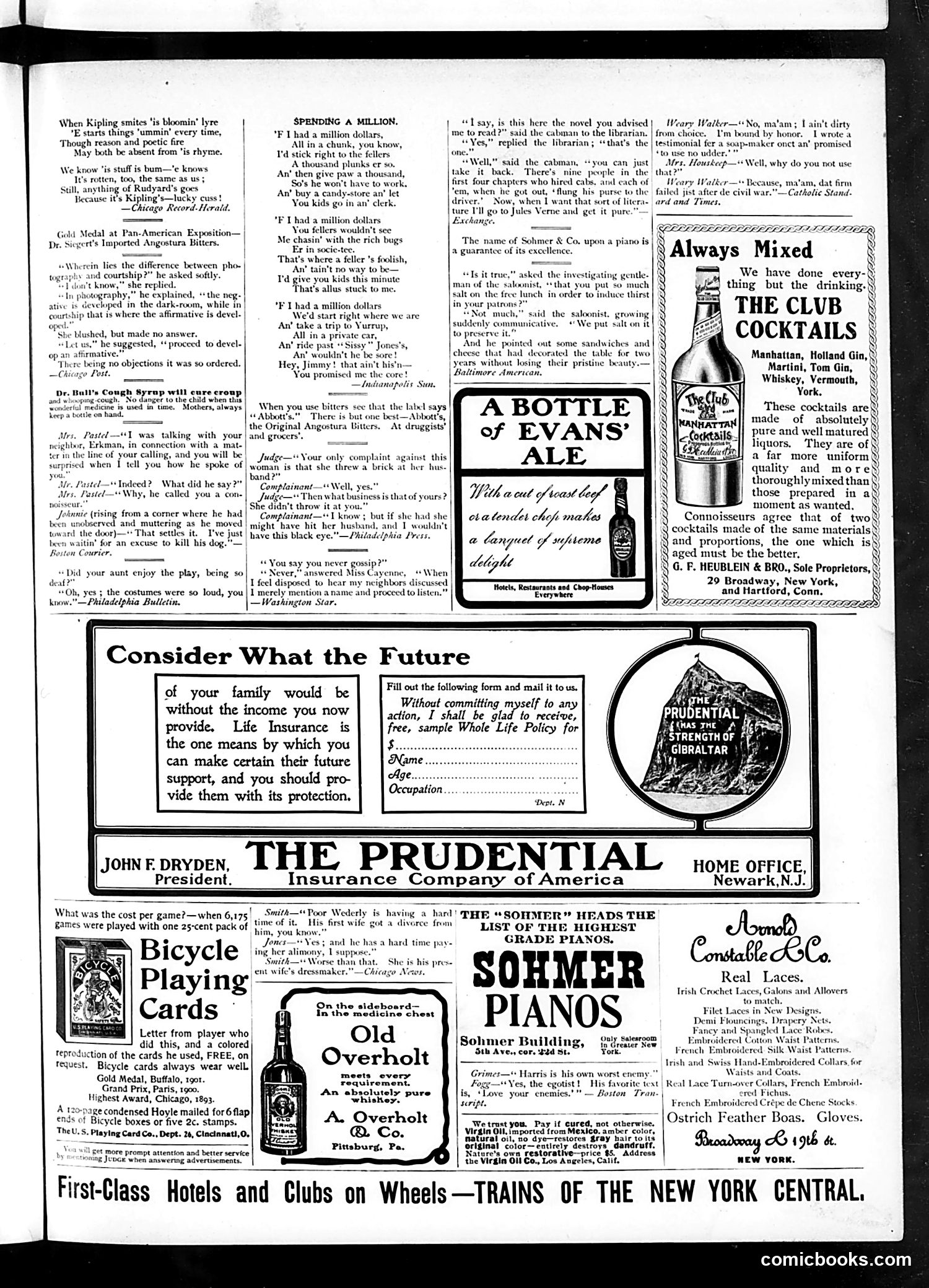
This page from *Judge* magazine (circa 1916, based on advertising styles) is primarily **advertising with some satirical poetry and humor pieces**, not political cartooning. The notable content includes: **Satirical poems** mocking Rudyard Kipling's poetry as mediocre but popular because of his name—a common literary jab at celebrity authors. **A repeated joke structure** about "If I had a million dollars"—reflecting early 20th-century working-class fantasy and economic inequality themes. **Practical humor** about everyday life: a librarian discussing novels featuring cab drivers, a saloonist adding salt to free lunch to increase drink sales, and domestic disputes over trivial matters. The **advertisements** dominate: Evans Ale, Sohmer Pianos, Prudential Insurance, Bicycle Playing Cards, Overholt Whiskey, and Arnold Constable clothing reflect period consumer culture and leisure activities. The page captures *Judge*'s formula: light satire mixed with period advertising, aimed at middle-class readers. No major political figures or events are referenced—it's social satire of everyday manners and consumerism.
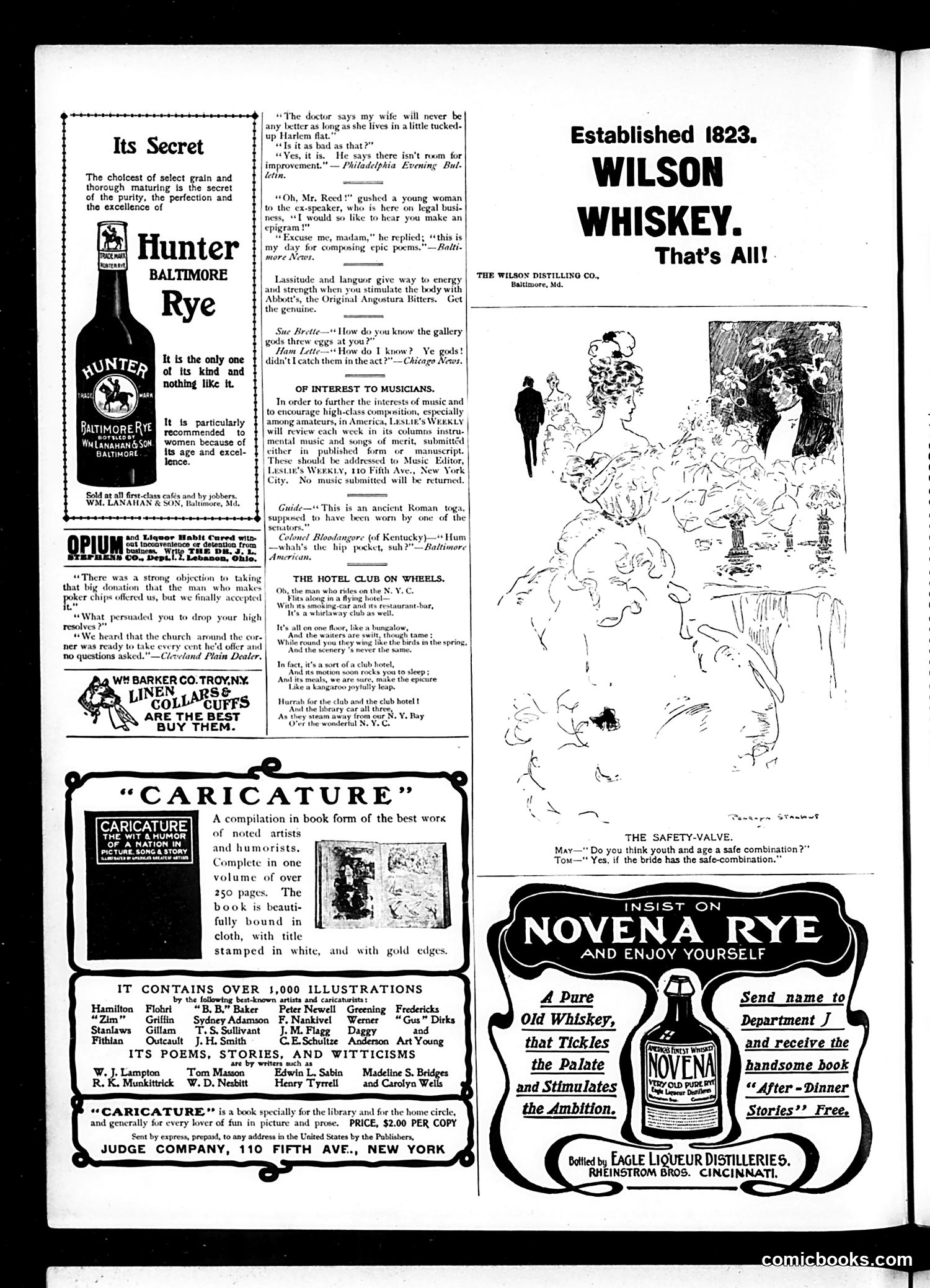
This page is primarily **advertising and editorial content** rather than political satire. The main cartoon visible depicts "The Hotel Club on Wheels"—a humorous sketch about a man riding on the N.Y.C. streets. The accompanying poem suggests social commentary on urban living conditions, comparing apartment life unfavorably to country life. The page contains numerous **product advertisements** for whiskey (Wilson, Novena Rye), Hunter Baltimore Rye, linens, and other goods typical of early 20th-century magazines. There is also an **announcement for a music competition** encouraging composers to submit work to Leslie's Weekly, and **promotional material** for a book called "Caricature: The Wit & Humor of a Nation," featuring over 1,000 illustrations by prominent contemporary cartoonists. The scattered jokes and quips throughout reflect gentle, domestic humor rather than sharp political satire—typical of Judge's lighter content mixed among advertisements.
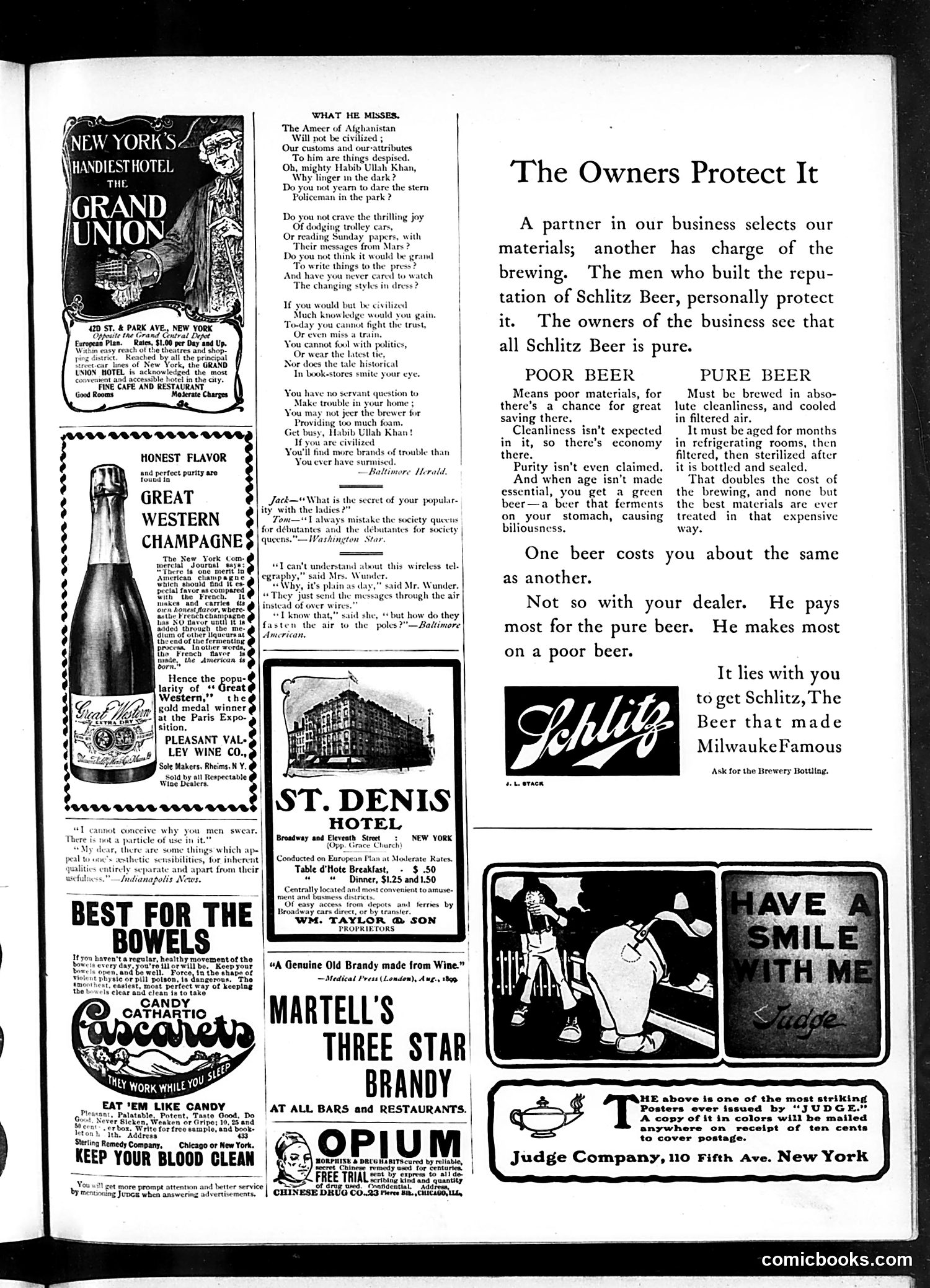
This page is primarily **advertising with one satirical poem**. The main satire is "What He Misses," a poem mocking the **Ameer of Afghanistan** for refusing Western "civilization." The joke targets both the Afghan leader's resistance to modernization and American smugness about Western culture. The satire is ironic: the poem "civilizes" him by listing petty modern annoyances—trusts, trains, politics, fashion, servant problems, brewery complaints, and trivial social troubles. The punchline suggests that "civilization" brings more problems than it solves. The rest of the page consists of period advertisements for hotels, champagne, brandy, candy laxatives, and notably **Schlitz Beer**, which emphasizes purity and quality control as marketing advantages. The ads reflect turn-of-the-century commercial messaging and class anxieties about product reliability. The page contains no other political cartoons—it's a typical Judge magazine layout mixing humor, satire, and advertising revenue.
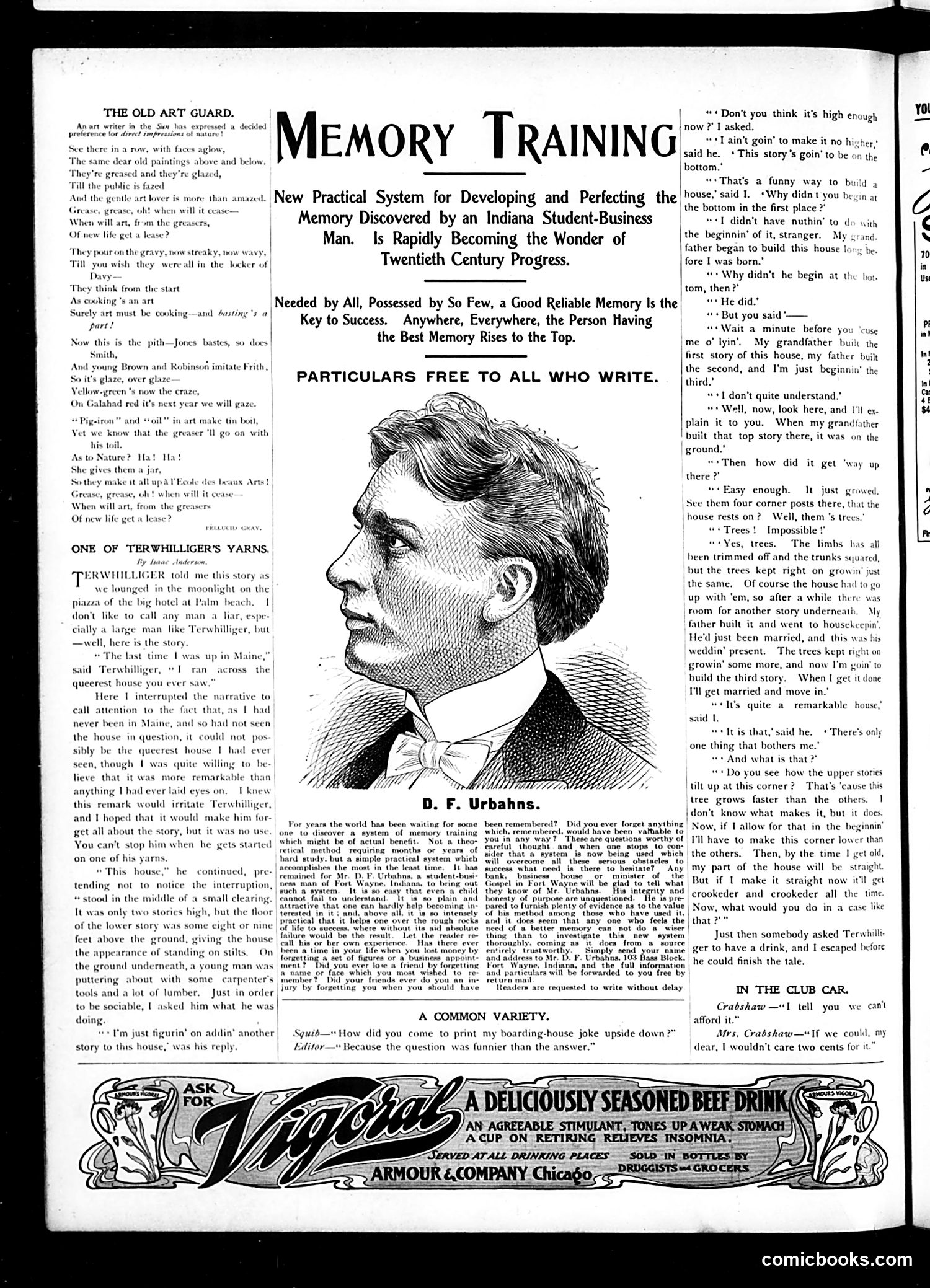
This page contains two distinct pieces of satirical content: **"The Old Art Guard" (poem, left side):** A critique of academic painters who over-rely on heavy glazing and varnishing techniques. The repeated refrain "Grease, grease, when will it cease" mocks contemporary artists who layer thick, glossy finishes on paintings, obscuring the work beneath. References to painters like Jones, Brown, Robinson, and Frith suggest established academic practitioners. The satire targets outdated painting methods becoming laughably excessive and formulaic. **"One of Terwhilliger's Yarns" (right side):** A tall tale about a Maine house built progressively upward. The joke relies on absurdist logic: a man adds a story to the *bottom* because trees "grew" beneath the original structure, elevating it. This mocks credulous listeners and implausible frontier stories—a classic American tall-tale tradition. **The Portrait:** D.F. Urbahns appears to be the subject of a biographical sketch (text visible below the engraving describes a memory-training system he developed). The page exemplifies Judge's blend of artistic criticism, humorous fiction, and advertorial content.
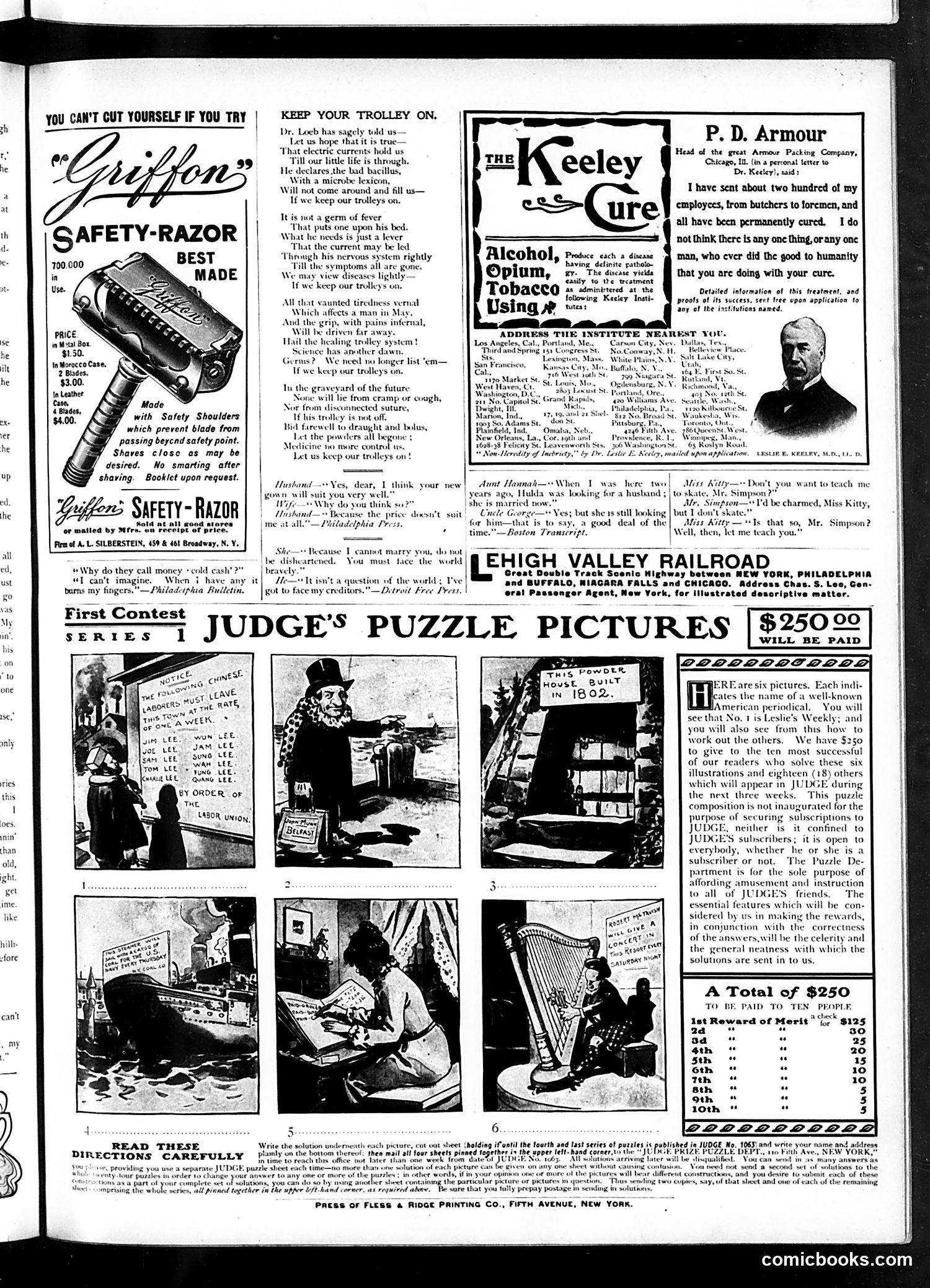
This page contains primarily **advertisements and a puzzle contest**, not political satire. The ads promote patent medicines and devices reflecting early 1900s quackery: Griffon Safety Razors, Dr. Loeb's "trolley" electric cure (suggesting electricity treats disease), and the Keeley Institute's addiction cure for alcohol, opium, and tobacco—endorsed by P.D. Armour (Chicago meatpacker). A poem mocking Dr. Loeb's electric cure treatment dominates the left side, satirizing the absurd medical claims of the era. The bottom half announces Judge's "First Contest Series 1"—a $250 puzzle where readers identify six American periodicals from illustrated clues. Image 1 is identified as *Leslie's Weekly*. The contest is open to all readers, not just subscribers. The page reflects the **magazine's commercial nature** and period medical frauds rather than political commentary. Small sidebar jokes about marriage and courtship provide typical editorial humor.
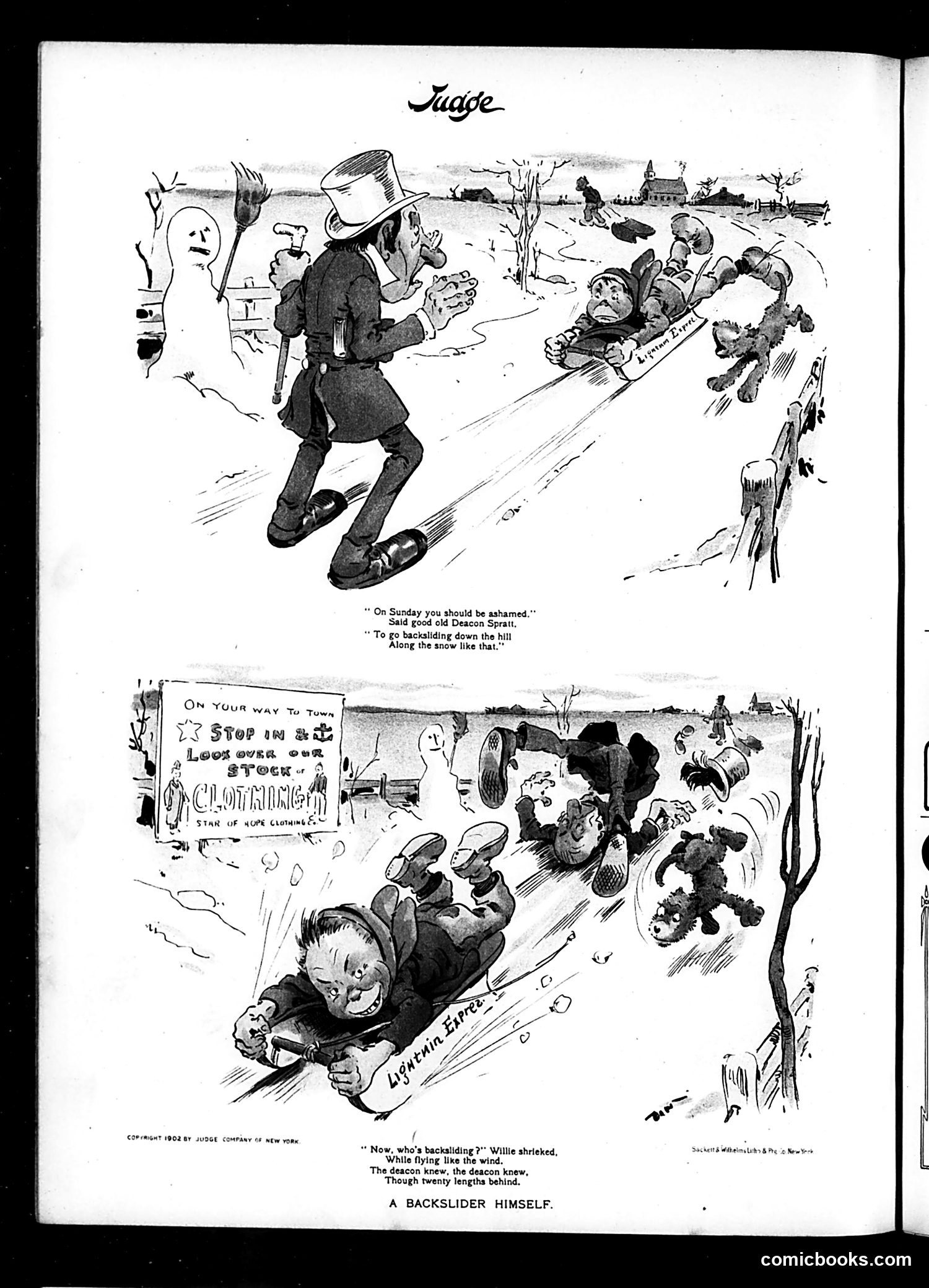
This two-panel satirical cartoon plays on the double meaning of "backsliding"—both the literal winter sport of sledding backwards down a hill, and the religious/moral meaning of abandoning one's principles. In the top panel, Deacon Spratt (a pious church authority figure) hypocritically scolds a child for sledding on Sunday, calling it shameful. The bottom panel shows the ironic punchline: Willie asks "who's backsliding?" while the deacon himself is caught sledding down the hill at speed, "twenty lengths behind" them. The title's joke is that the deacon is literally and figuratively a "backslider"—he violates the very moral standard he just preached, exposing his hypocrisy. The cartoon satirizes religious hypocrisy and sanctimoniousness, showing how moral authority figures often fail to follow their own rules.
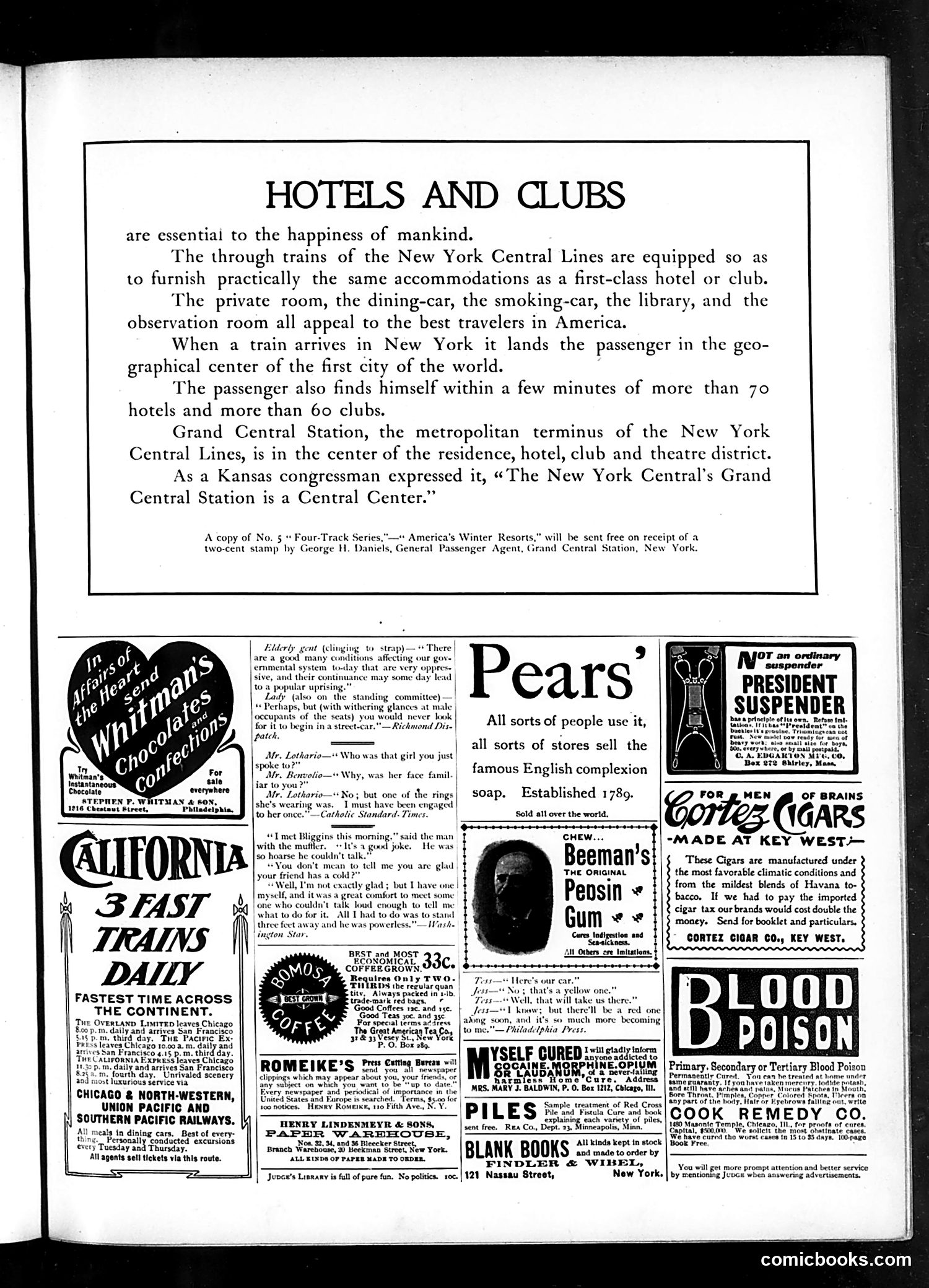
This page is primarily **advertising**, not political satire. It contains a mix of commercial advertisements from the early 20th century, framed around a promotional article about New York Central Railroad's luxury train accommodations and Grand Central Station. The upper section features a **railroad advertisement** claiming trains offer hotel-like comforts. A Kansas congressman is quoted praising Grand Central Station as "a Central Center"—a mild joke playing on the word "central." The remainder consists of **product advertisements** for period goods: Pears' soap, California train routes, coffee, Beeman's chewing gum, blood poison remedies, blank books, cigars, and a newspaper clipping service. The small conversational snippets scattered throughout are light humor about everyday situations—a man complaining about a talkative woman, observations about romance and etiquette—typical filler content for magazines of this era. There are no political cartoons or significant satire on this particular page.
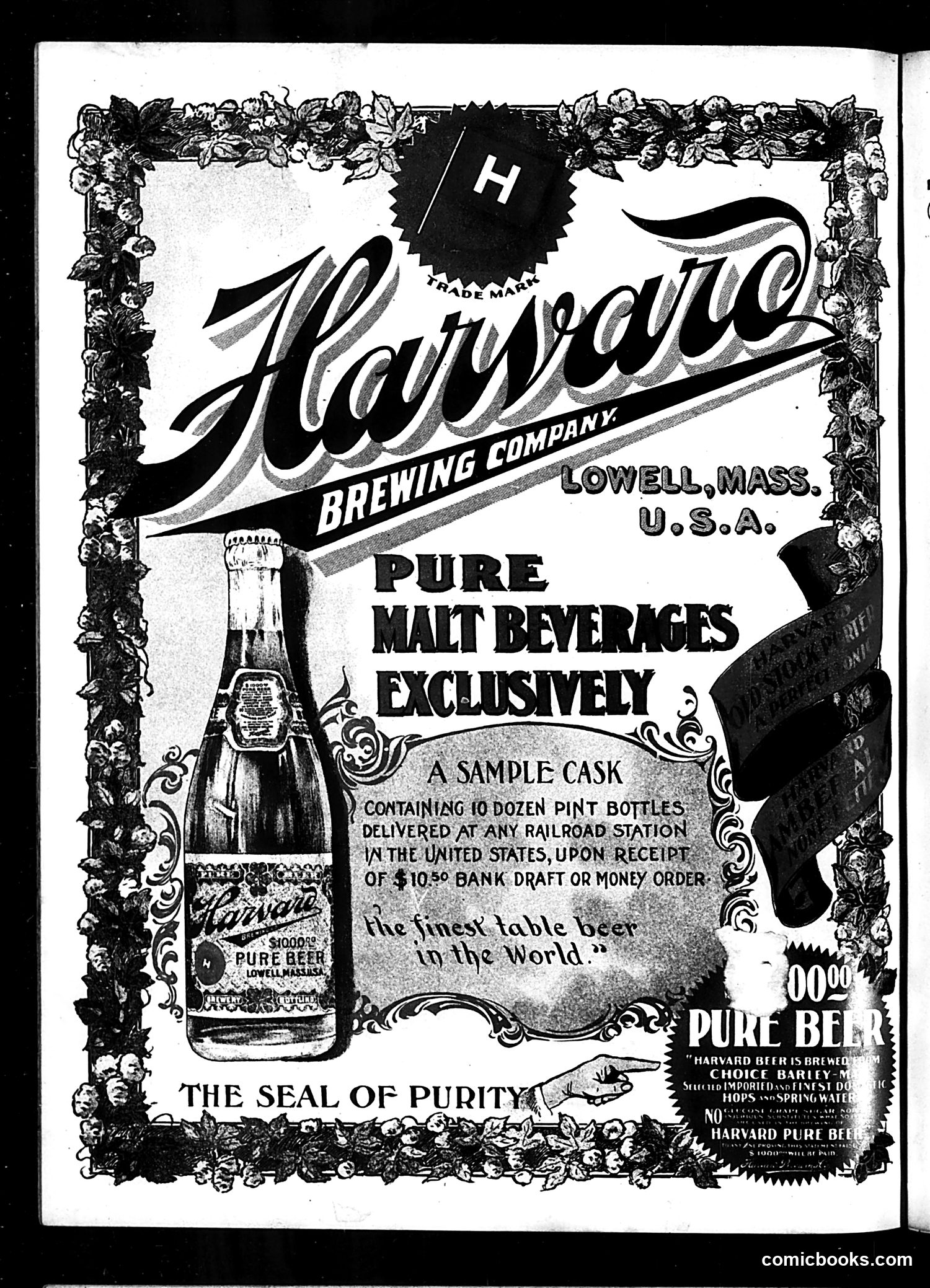
It advertises **Haffbrau Brewing Company** of Lowell, Massachusetts, promoting their "Pure Malt Beverages Exclusively." The ad offers a sample cask of 10 dozen pint bottles for $10.50, deliverable to any U.S. railroad station. It emphasizes "The Seal of Purity" and claims their beer is "The finest table beer in the World." A smaller competing ad appears for **Harvard Pure Beer**, highlighting imported choice barley and hops. This appears to be from the Prohibition era or pre-Prohibition period when breweries aggressively marketed mail-order beer delivery. The ornate decorative border and bottle imagery were typical of early 20th-century beer advertising style.