
A complete issue · 17 pages · 1902
Judge — February 1, 1902
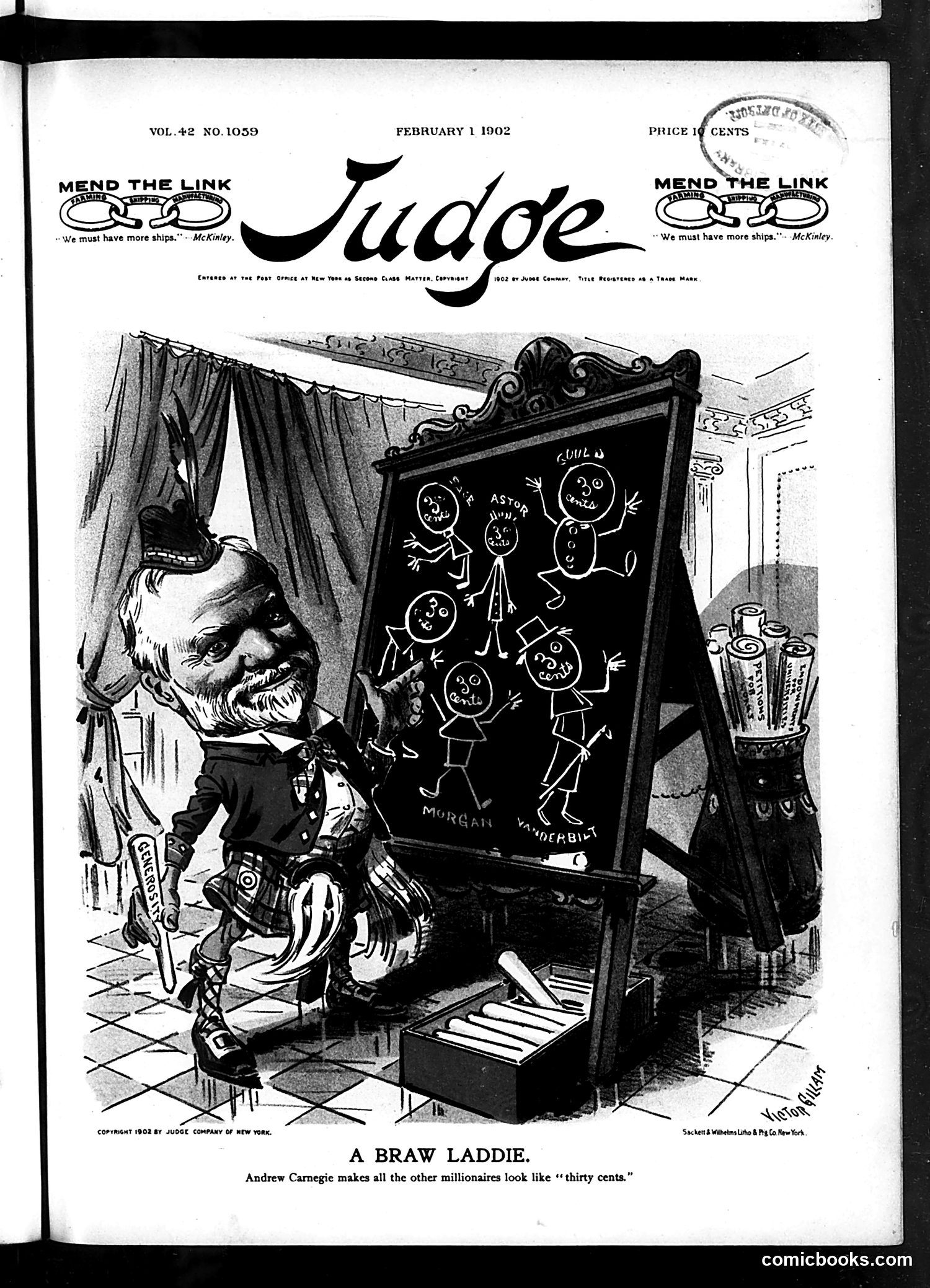
This cartoon satirizes **Andrew Carnegie**, the Scottish-born steel magnate and philanthropist. The caricature depicts him as a "braw laddie" (Scottish dialect for "fine boy"), shown as a diminutive figure next to a blackboard displaying stick-figure children labeled with names including "Morgan" and "Vanderbilt." The satire's point: Carnegie's massive charitable giving and wealth made other millionaires appear insignificant by comparison—he "makes all the other millionaires look like 'thirty cents.'" The childlike drawings suggest his rivals are mere children in financial stature beside him. The image references the era's "Gilded Age" wealth competition and Carnegie's reputation as America's most prominent philanthropist, having already begun his famous library and educational endowments by this date.
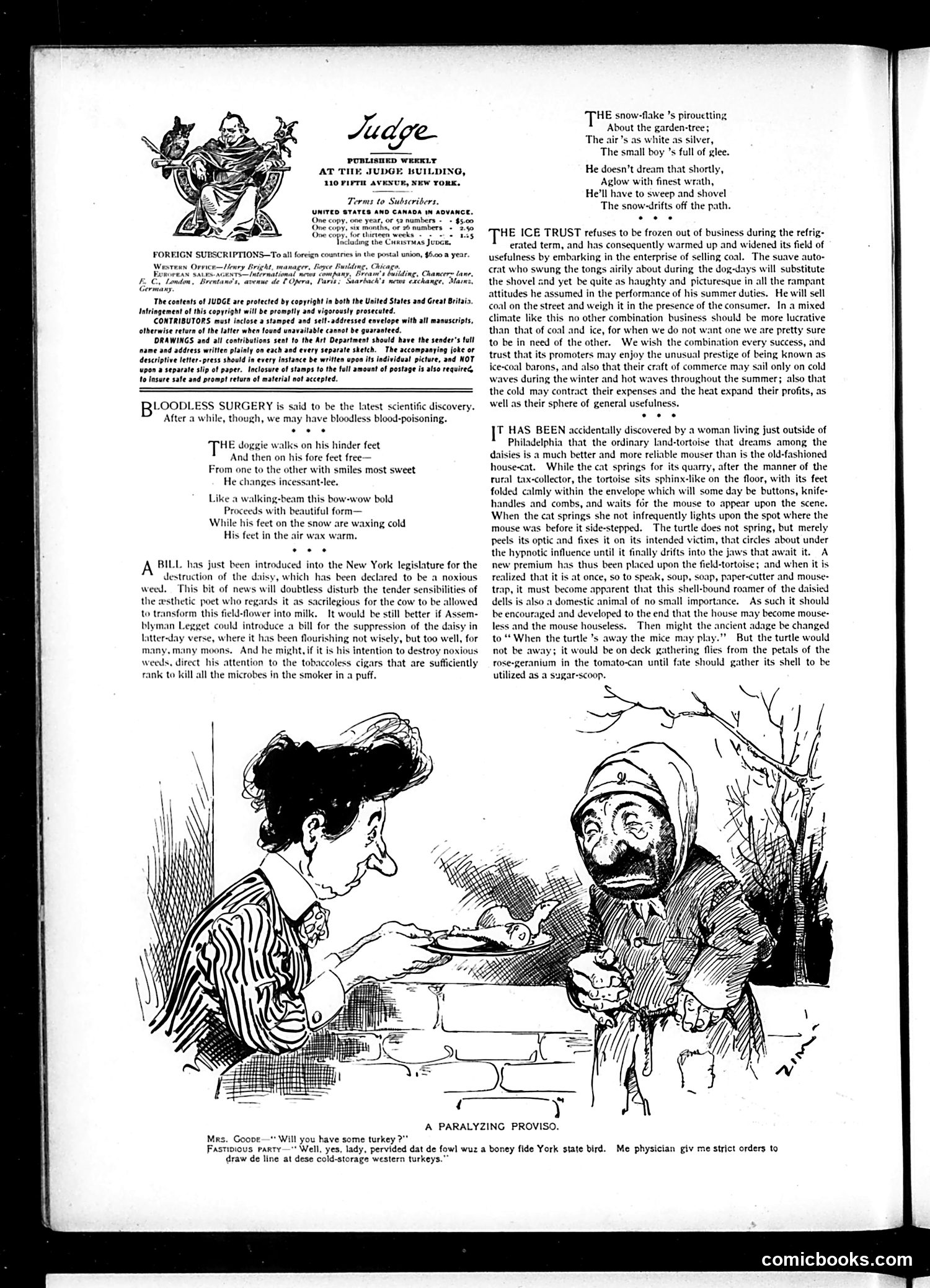
This cartoon satirizes food safety regulations, likely from the early 1900s. A well-dressed woman (Mrs. Goode) asks a disreputable-looking man about turkey for dinner. He replies that he can only offer fowl from "cold storage" because his physician ordered strict compliance with regulations. The joke critiques overly restrictive food laws: the "paralyzing proviso" makes obtaining fresh poultry impossible, forcing consumers toward inferior stored goods instead. The ragged, unsavory vendor character emphasizes the regulation's counterproductive effect—it doesn't improve food quality but rather paralyzes commerce and consumer choice. This reflects Progressive Era tensions between food safety reform (following *The Jungle* scandals) and business complaints that regulations were too burdensome or achieved opposite effects.
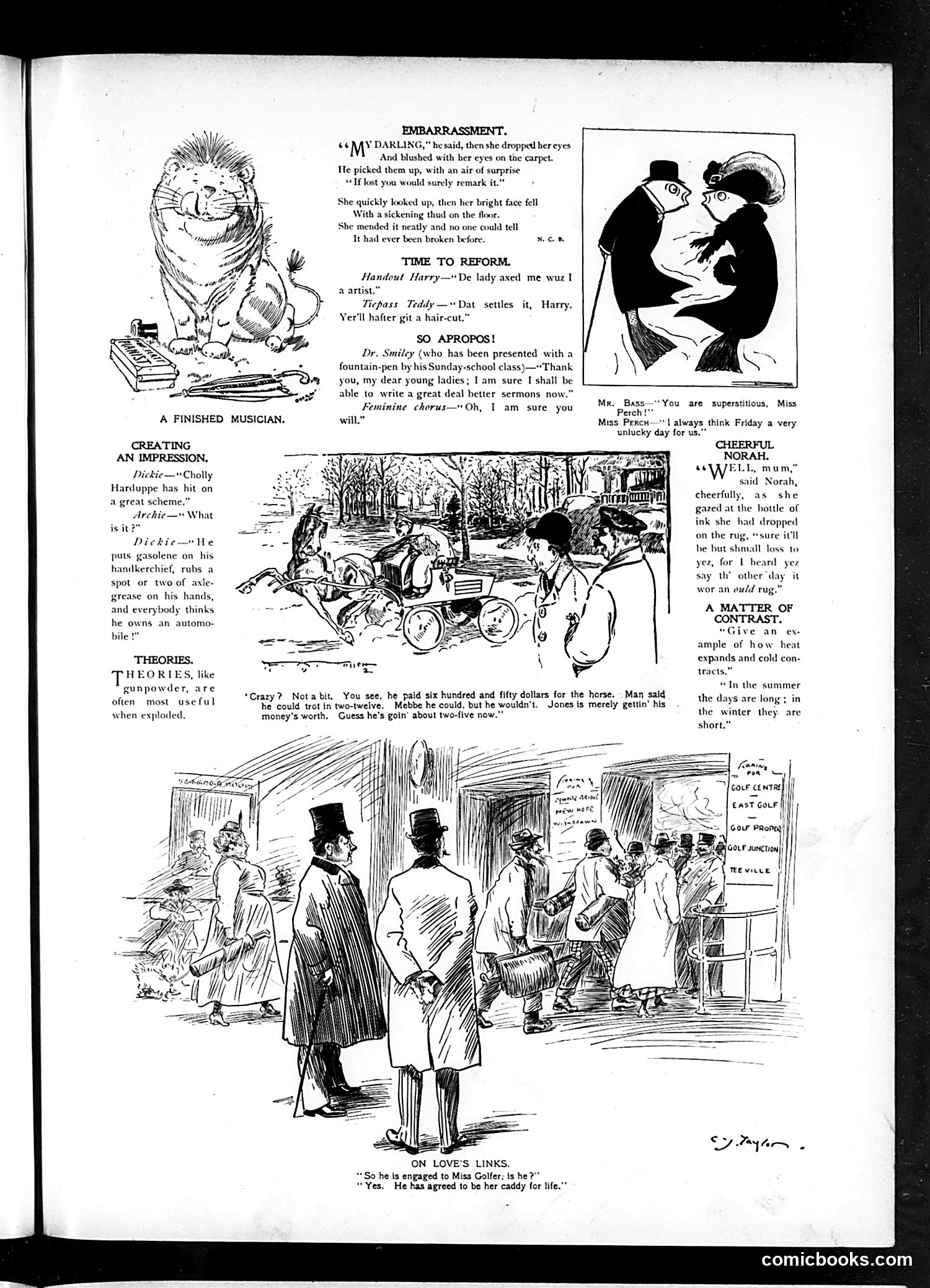
This page contains several unrelated humorous sketches typical of Judge's satirical format: **"Embarrassment"** depicts a woman dropping her eyes on a carpet—a visual pun playing on the phrase "dropping one's eyes." **"A Finished Musician"** shows a lion with sheet music, likely satirizing pretentious artistic claims. **"Time to Reform"** and other brief jokes mock social types: an artist, a clergyman receiving a fountain pen, and superstitious attitudes (Friday being unlucky). **"On Love's Links"** (bottom cartoon) jokes about an engagement to Miss Colfier, with a golf-themed punchline ("caddy for life"). The page primarily offers light social satire targeting common Victorian-era stereotypes: artistic pretension, religious pomposity, and romantic entanglements. No specific political figures or events are referenced—this is general-interest humor rather than political commentary.
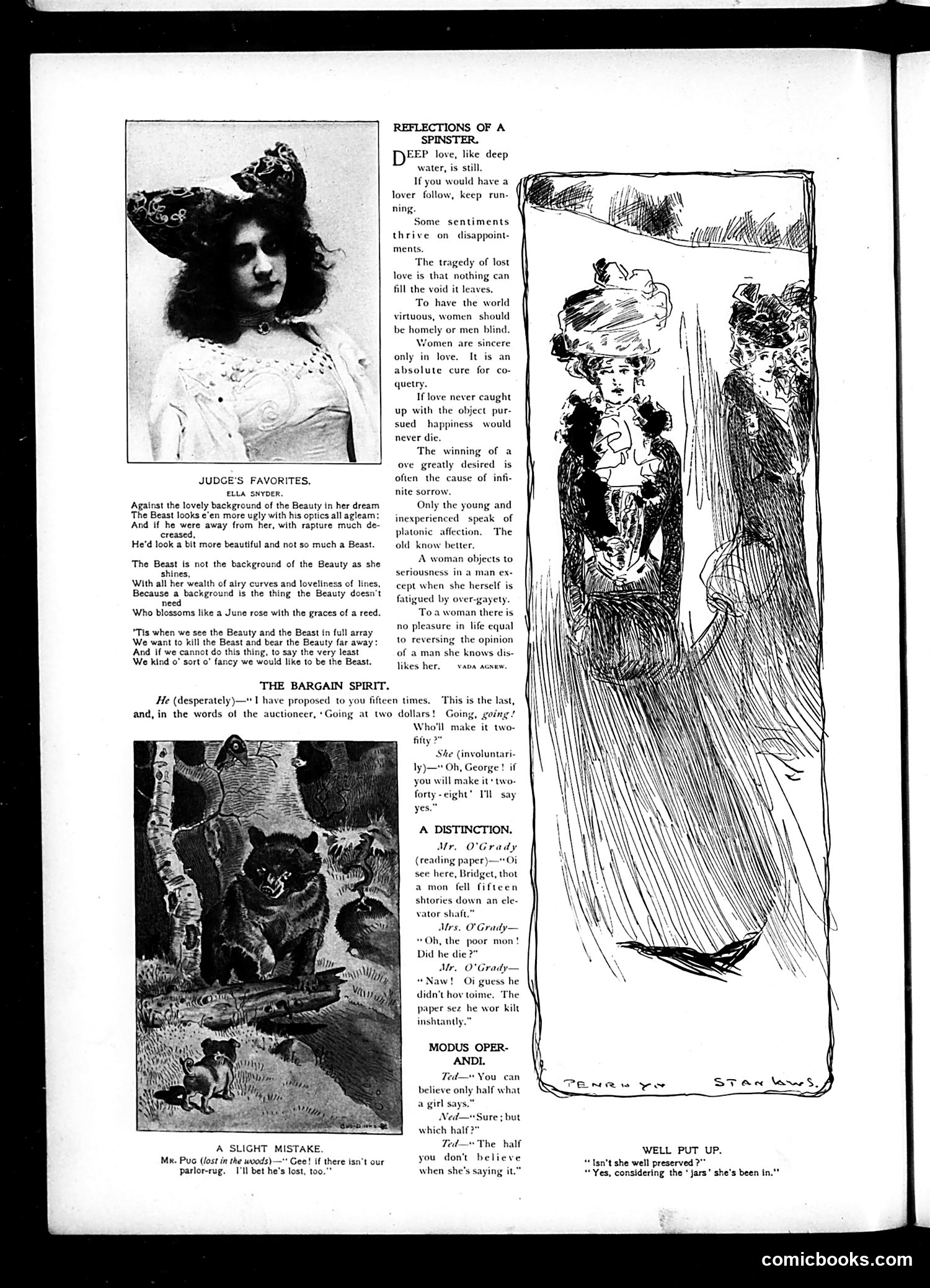
This page contains several humorous pieces typical of early 20th-century Judge magazine: **"Judge's Favorites"** features a photograph of an actress (identified as Ella Snyder) with accompanying verse about beauty versus intelligence, a common satirical theme of the era. **"Reflections of a Spinster"** offers romantic advice in verse form, satirizing both unmarried women and courtship conventions of the period. **"The Bargain Spirit"** presents a dialogue joke about auction bidding, poking fun at negotiation and haggling behavior. **"A Distinction"** depicts a brief comic exchange about a man falling down an elevator shaft—dark humor typical of the magazine's style. The remaining pieces ("Modus Operandi," "A Slight Mistake," "Well Put Up") are brief joke sequences about everyday situations, characteristic of Judge's format of short humorous sketches targeting contemporary social behaviors and gender dynamics.
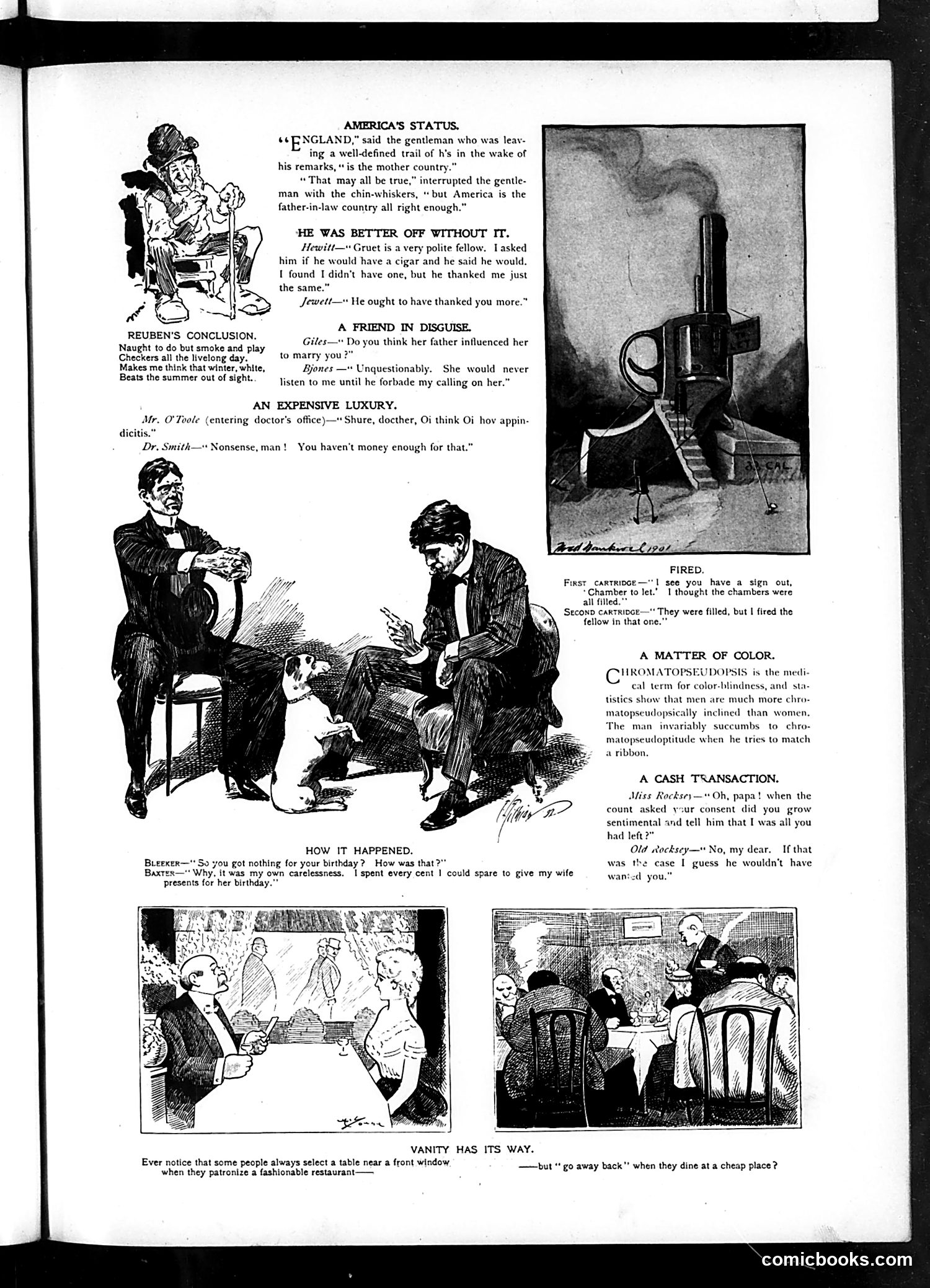
This page of satirical humor contains multiple brief jokes reflecting early 20th-century American social attitudes: **"America's Status"** jokes about America's relationship to Britain—portraying Americans as confident enough to claim superiority despite being the younger nation. **"He Was Better Off Without It"** mocks excessive politeness as dishonest. **"A Friend in Disguise"** presents a dark joke about paternal interference in courtship—the father forbidding visits actually encouraged the daughter to marry the suitor. **"An Expensive Luxury"** satirizes class consciousness: a poor Irishman can't afford appendicitis because he lacks money for medical care. **"A Matter of Color"** jokes that men are color-blind (unable to match ribbons), using pseudo-medical terminology for comedic effect. **"A Cash Transaction"** contains a cynical joke about dowries—the father didn't negotiate financially with a count suitor. **"Vanity Has Its Way"** observes that status-conscious people display themselves in fancy restaurants but hide in cheap ones. The humor relies on class, gender, and national stereotypes typical of the era.
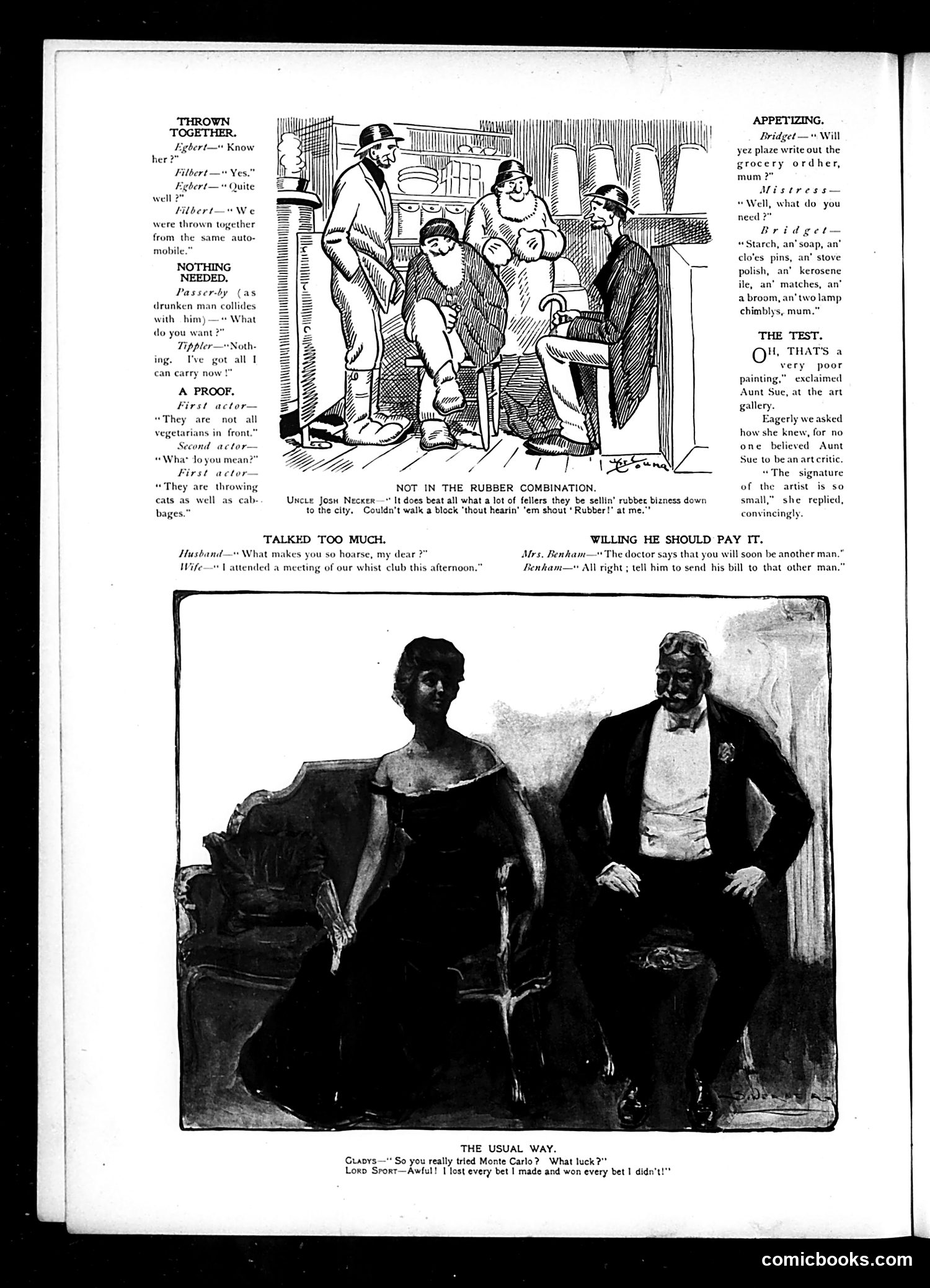
This page contains several short satirical jokes typical of early 20th-century humor magazines: **"The Usual Way"** (bottom illustration) mocks gambling at Monte Carlo—a wealthy man loses every intentional bet but wins every accidental one, capturing the absurdity of chance. **"Talked Too Much"** jokes about a husband's hoarse voice from attending a whist (card game) club meeting, implying gossipy chatter. **"Willing He Should Pay It"** satirizes a patient's medical bill dispute—suggesting the doctor send the invoice to "another man," implying infidelity or shifting blame. **"Not in the Rubber Combination"** references rubber salesmen aggressively hawking their wares in the city, with "Uncle Josh Necker" (a rural character type) complaining about constant sales pitches. **"Appetizing"** portrays an Irish servant girl ("Bridget") listing mundane household supplies to her employer in comically malapropish English. The cartoons use stereotypical character types—rural figures, servants, gamblers—to mock contemporary urban life, domestic situations, and commercial practices.
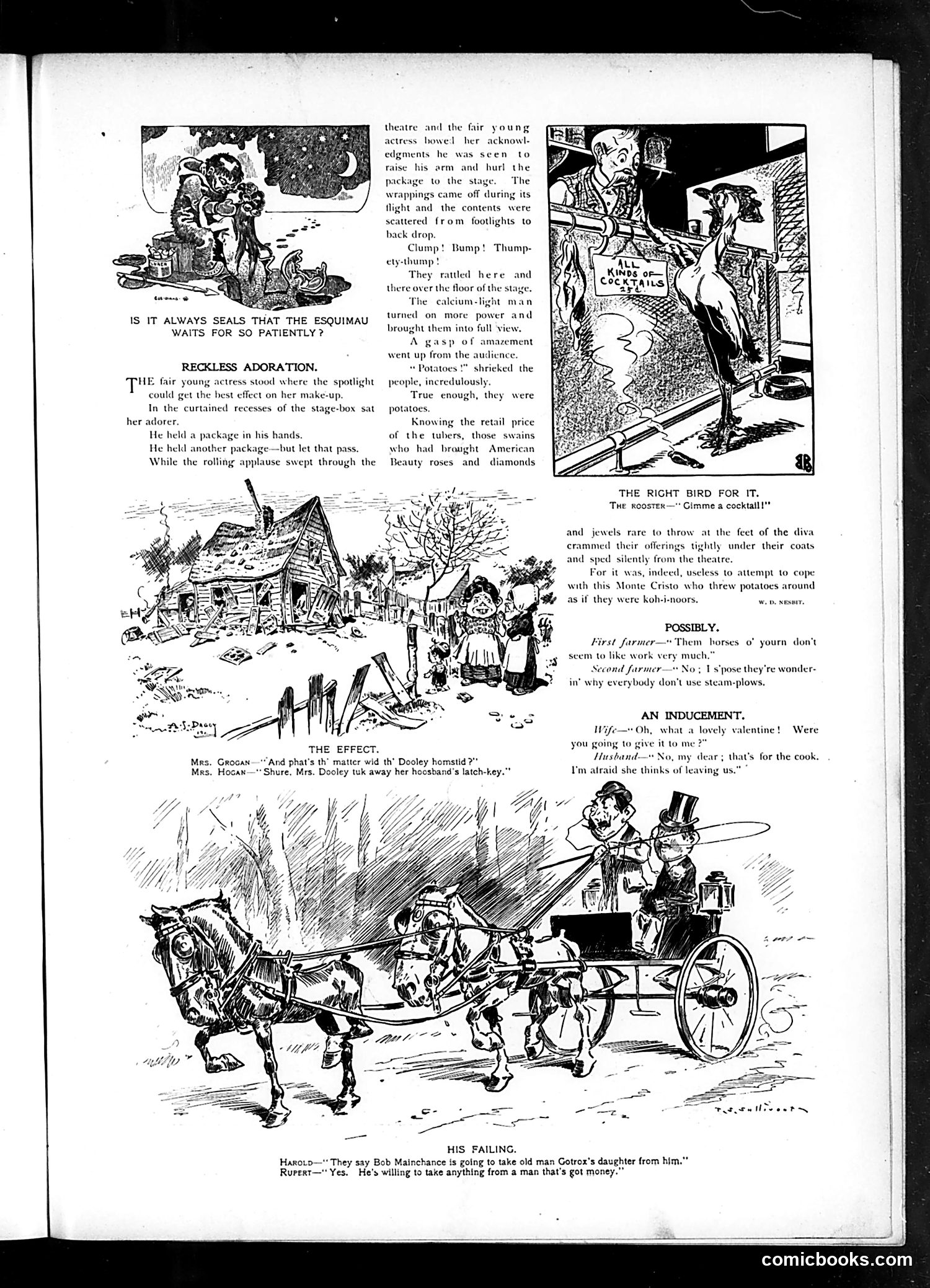
This page contains several unrelated satirical vignettes typical of Judge magazine's humor: **"Reckless Adoration"**: A wealthy theater patron attempts to impress an actress by throwing expensive gifts onto the stage during her performance. The joke: he throws potatoes instead of the jewelry and roses other suitors offer. This mocks both the absurd excess of stage-door admirers and the economic reality that even modest gifts (potatoes had real monetary value) could embarrass wealthy rivals trying to outdo each other. **"The Effect"**: Irish immigrant dialogue (indicated by dialect) about a man losing his house key—likely a joke about working-class domestic life and marital discord. **"His Failing"** and **"An Inducement"**: Brief joke captions about a fortune-hunter willing to marry for money, and a husband planning to give a valentine to the cook rather than his wife—typical period humor about infidelity and domestic dissatisfaction. These are lighthearted social satires rather than political commentary.
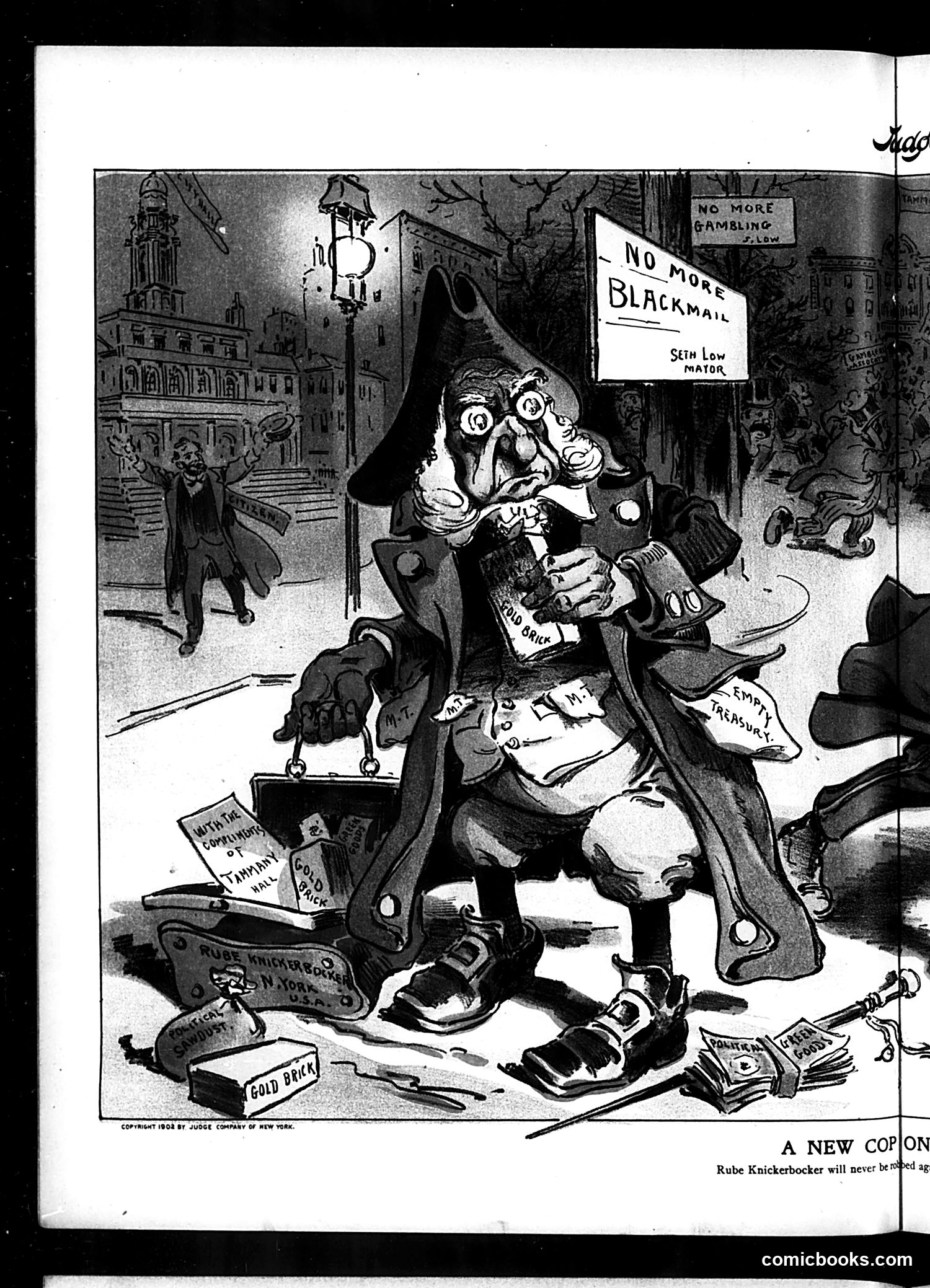
This 1902 Judge cartoon satirizes **Rube Knickerbocker**, apparently a well-known figure of the era (likely a sports personality or public character). The caricatured figure is weighed down with labels referencing various scandals and vices: "blackmail," "gambling," "gold brick," and references to "Tammany" (the notoriously corrupt New York political machine) and "Treasury." The signs reading "NO MORE BLACKMAIL" and "NO MORE GAMBLING" suggest Knickerbocker's reform or rehabilitation. The cartoon mocks this supposed reformation, depicting him as still mired in corruption and vice despite claims of reform. The title "A New Cop On" (incomplete in the visible text) likely plays on Knickerbocker's surname, suggesting he cannot escape his reputation even with a supposed "new" clean start.
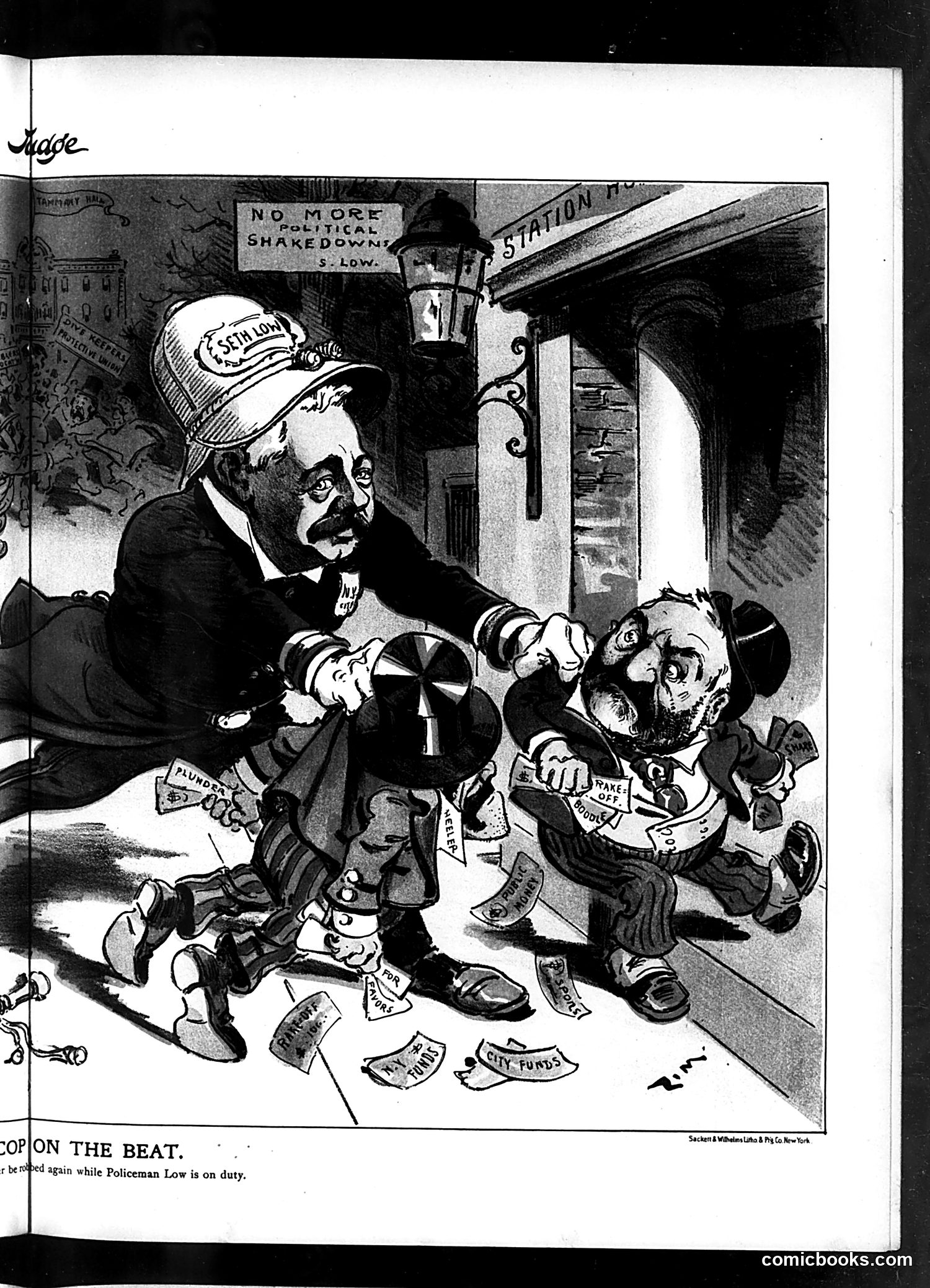
This Judge magazine cartoon depicts a well-dressed man in a "Schizon" cap wielding a club against three caricatured figures labeled with text including "City Funds" and what appears to be "Plunder" and "Wake" (text unclear). The sign reads "No More Political Shakedown, S. Low." The cartoon appears to satirize a police official—likely "Policeman Low"—cracking down on corruption involving city finances and graft. The caption's wordplay ("on the beat" / "Ped again") suggests repeated misconduct occurring during this official's watch. The three small figures likely represent corrupt practices or officials being disciplined. Without clearer identification of "S. Low" and the specific historical moment, the exact political scandal referenced remains uncertain, though the cartoon clearly celebrates anti-corruption efforts in municipal government.
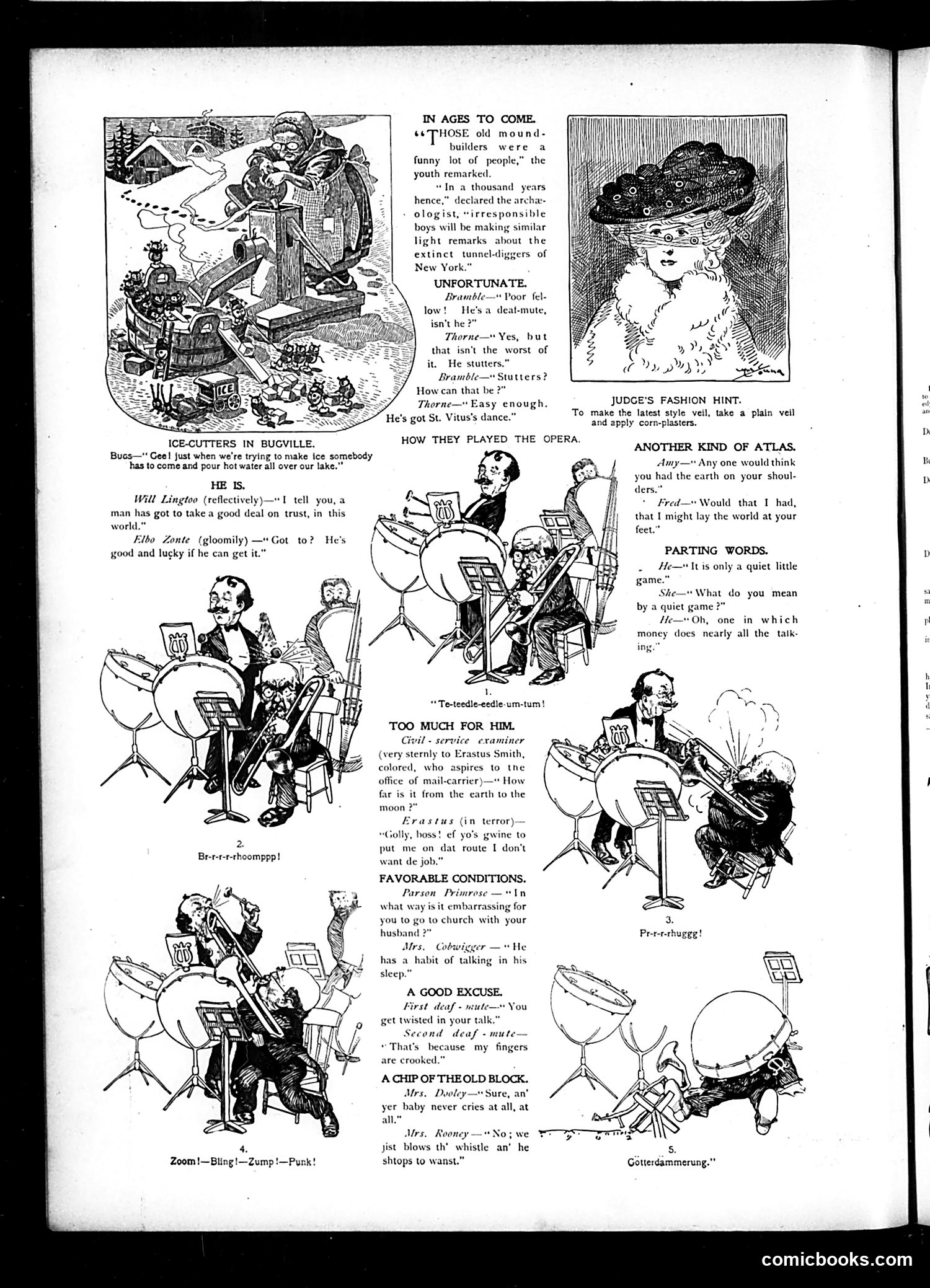
This page contains multiple unrelated humorous cartoons and jokes typical of early 20th-century satirical magazines. **Key content includes:** - **Ice-cutters in Bugville**: Anthropomorphic bugs complain that hot water ruins their lake-ice harvesting—absurdist humor with no deeper political meaning. - **Opera joke**: A man impresses a woman with romantic rhetoric about laying "the world at your feet," satirizing overwrought romantic clichés. - **Civil Service exam**: An African American applicant (stereotypically depicted) panics when asked the Earth-to-Moon distance for a mail carrier job—the joke relies on period racial stereotypes and the absurdity of irrelevant exam questions. - **Various domestic humor**: Jokes about deaf-mutes, stuttering, sleep-talking husbands, and babies—standard domestic comedy without political satire. - **Fashion/etiquette tips**: Brief advice columns on makeup application and social behavior. The page exemplifies Judge's mix of wordplay, domestic comedy, and period-appropriate (though often offensive by modern standards) ethnic humor, with minimal actual political commentary.
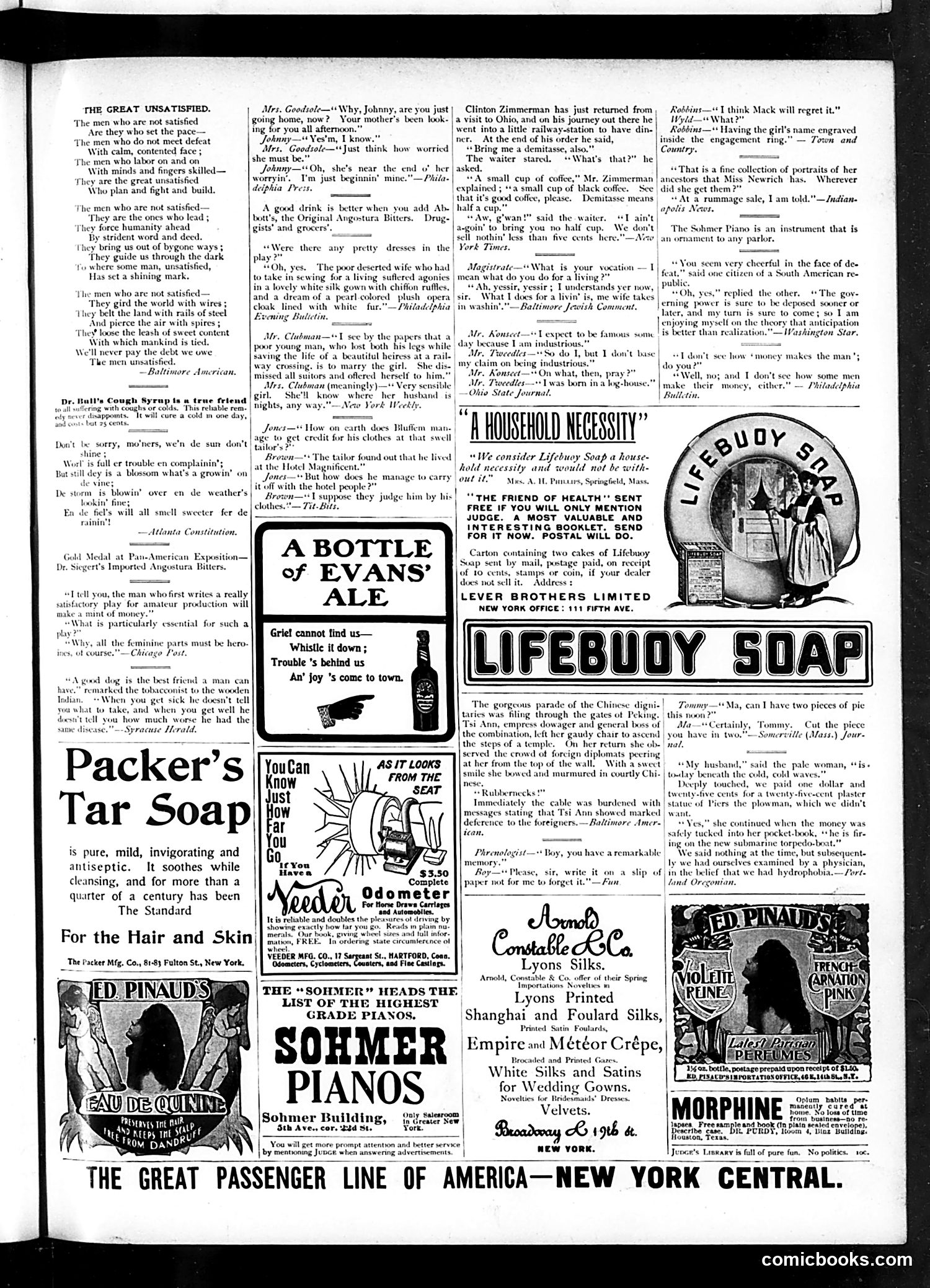
This page from Judge magazine is primarily **advertisements and light humor**, not political cartoons. The main content includes: **Poetry/Commentary**: "The Great Unsatisfied" celebrates ambitious, restless people who drive progress—a common early-20th-century theme valorizing entrepreneurial ambition and discontent with the status quo. **Humorous Vignettes**: Brief dialogue pieces satirizing everyday life—a worried mother, a man hiding from creditors, a poor woman admiring fine clothes. These target human vanity and social pretension with gentle mockery. **Advertisements**: The page heavily features ads for products (Packer's Tar Soap, Evans' Ale, Sohmer Pianos, Lifebuoy Soap, Ed Pinaud's hair products) typical of Judge's revenue model. **Notable**: A small item jokes about engraving a girl's name inside an engagement ring—likely satirizing premature romantic presumption. The page reflects Judge's dual function: satirical magazine mixed with commercial advertising. The humor is domestic and social rather than political—aimed at middle-class readers concerned with propriety, commerce, and personal relationships.
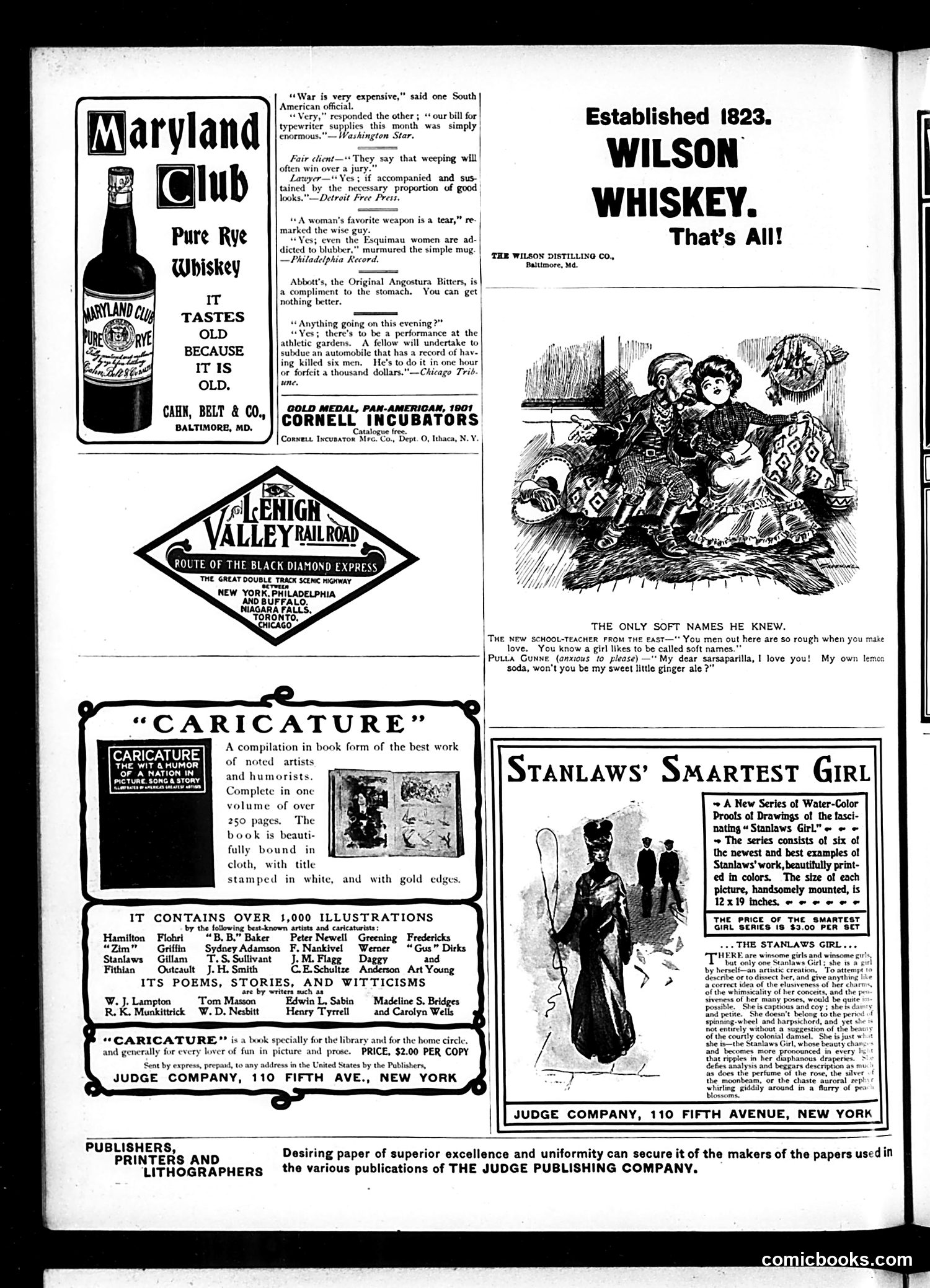
This page is primarily **advertisements and promotional material** rather than political satire. The main cartoon, "The Only Soft Names He Knew," depicts a comedic misunderstanding: an Eastern schoolteacher instructs a rough Western man to use "soft names" when courting. He responds by calling his love interest by brand names (sarsaparilla, ginger ale)—the only "soft" terms he knows from commercial products. The joke mocks rural Western masculinity and ignorance of romantic conventions, playing on early 1900s East-West cultural stereotypes. The page also includes several short jokes about war expenses, women's tears as weapons, and an automobile stunt—typical light satire of the era. The bulk of the page comprises advertisements for whiskey (Maryland Club, Wilson brand), the Lehigh Valley Railroad, and most prominently, a "Caricature" book compilation and "Stanlaws' Smartest Girl" art series, all published by Judge Company.
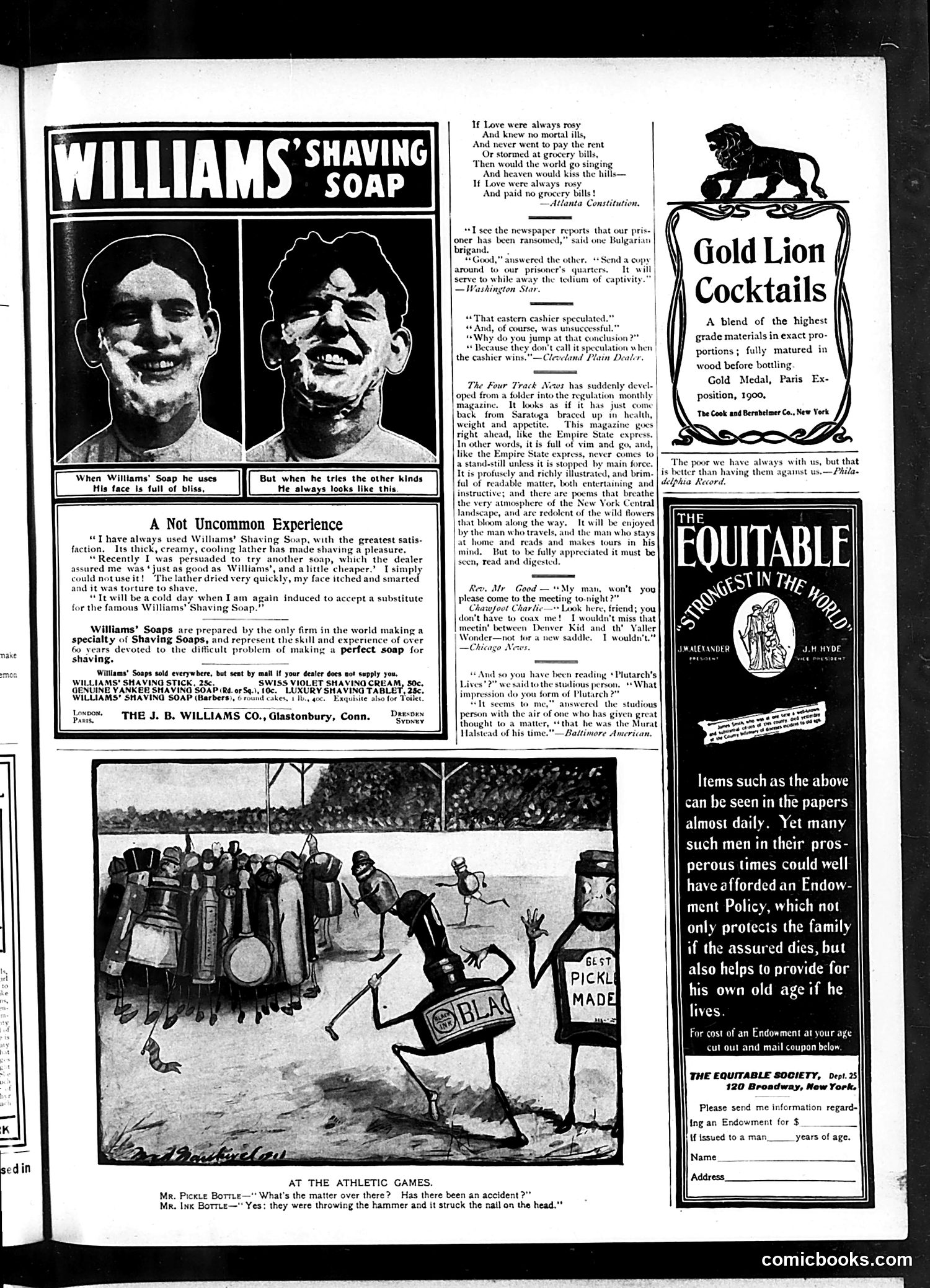
This Judge magazine page (circa early 1900s) contains primarily **advertisements and humorous filler content**, not political satire. The main items are: 1. **Williams' Shaving Soap ad**: A testimonial claiming the product's superiority—a common advertising format where a satisfied customer rejects cheaper alternatives. 2. **"At the Athletic Games" cartoon**: A visual pun about hammer-throwing. The joke plays on the phrase "struck the nail on the head" (meaning success) by literally depicting hammer-throwers hitting a nail. 3. **Miscellaneous jokes and anecdotes**: Brief humorous pieces about brigands, cashiers, railroad magazines, and Plutarch—typical light entertainment filler. 4. **Equitable Society insurance ad**: Promoting life insurance as financial protection. The page reflects early 1900s advertising culture and mass-market humor, with no significant political commentary. The cartoons rely on wordplay and situational humor rather than social critique.
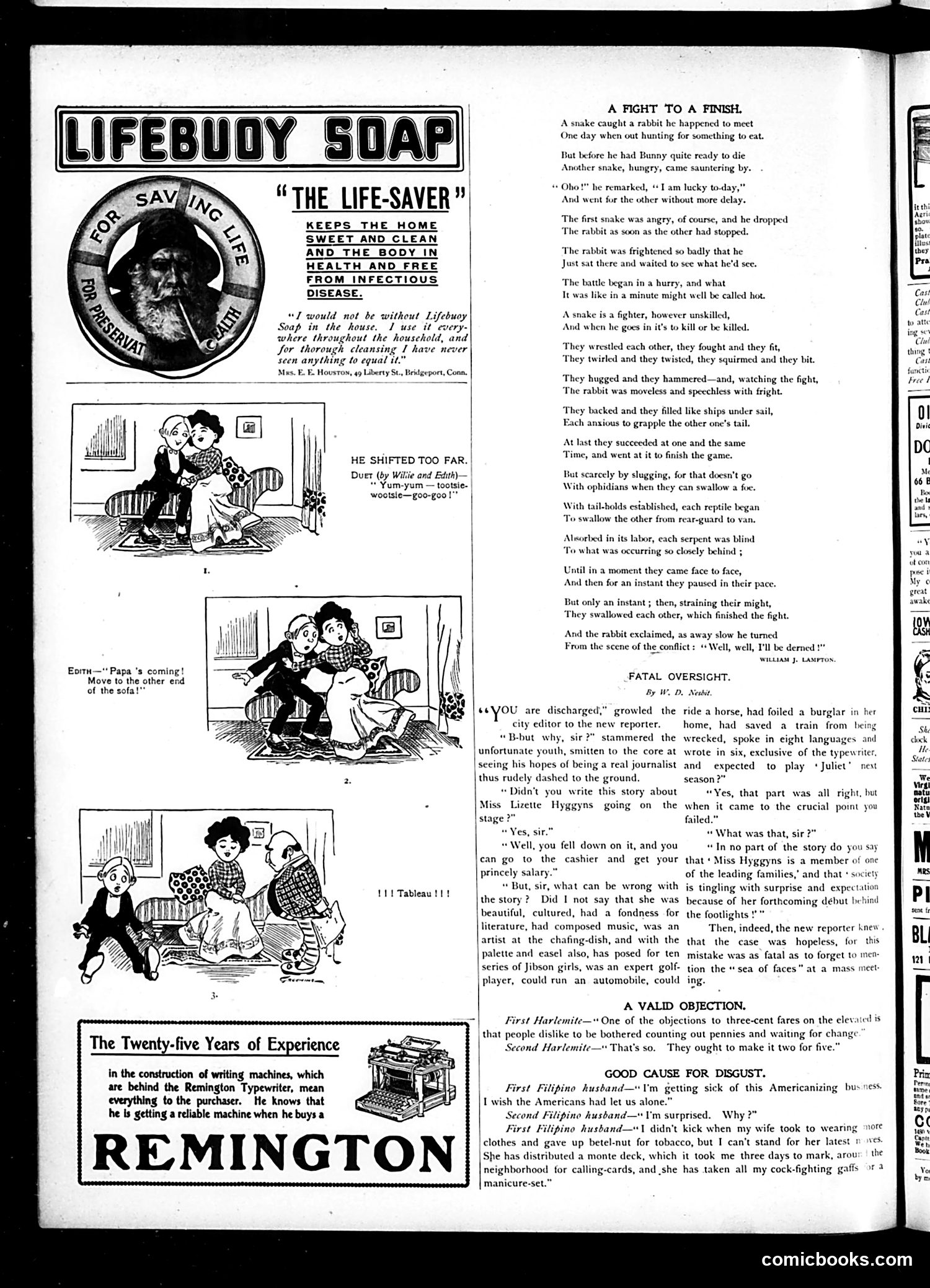
This page contains multiple unrelated items typical of early 20th-century satirical magazines: **Left side:** A Lifebuoy Soap advertisement disguised as editorial content, featuring testimonials and three comic panels about a couple (presumably named Duer and Edith) repositioning themselves on a sofa when the father arrives home—a mild domestic humor joke. **Center/Right:** "A Fight to a Finish," a narrative poem about two snakes battling over a rabbit. The satirical point appears to be social commentary through animal allegory—two rivals become so consumed fighting each other that they inadvertently destroy themselves (by swallowing each other), while the innocent bystander (rabbit) escapes unharmed. This likely reflects contemporary political or social conflicts where competing factions harm themselves through conflict. **Bottom right:** "Fatal Oversight," a short humorous story about a newspaper editor firing a reporter for an article about a woman that failed to mention her family's social standing—satirizing journalism's obsession with class status over substantive accomplishment.
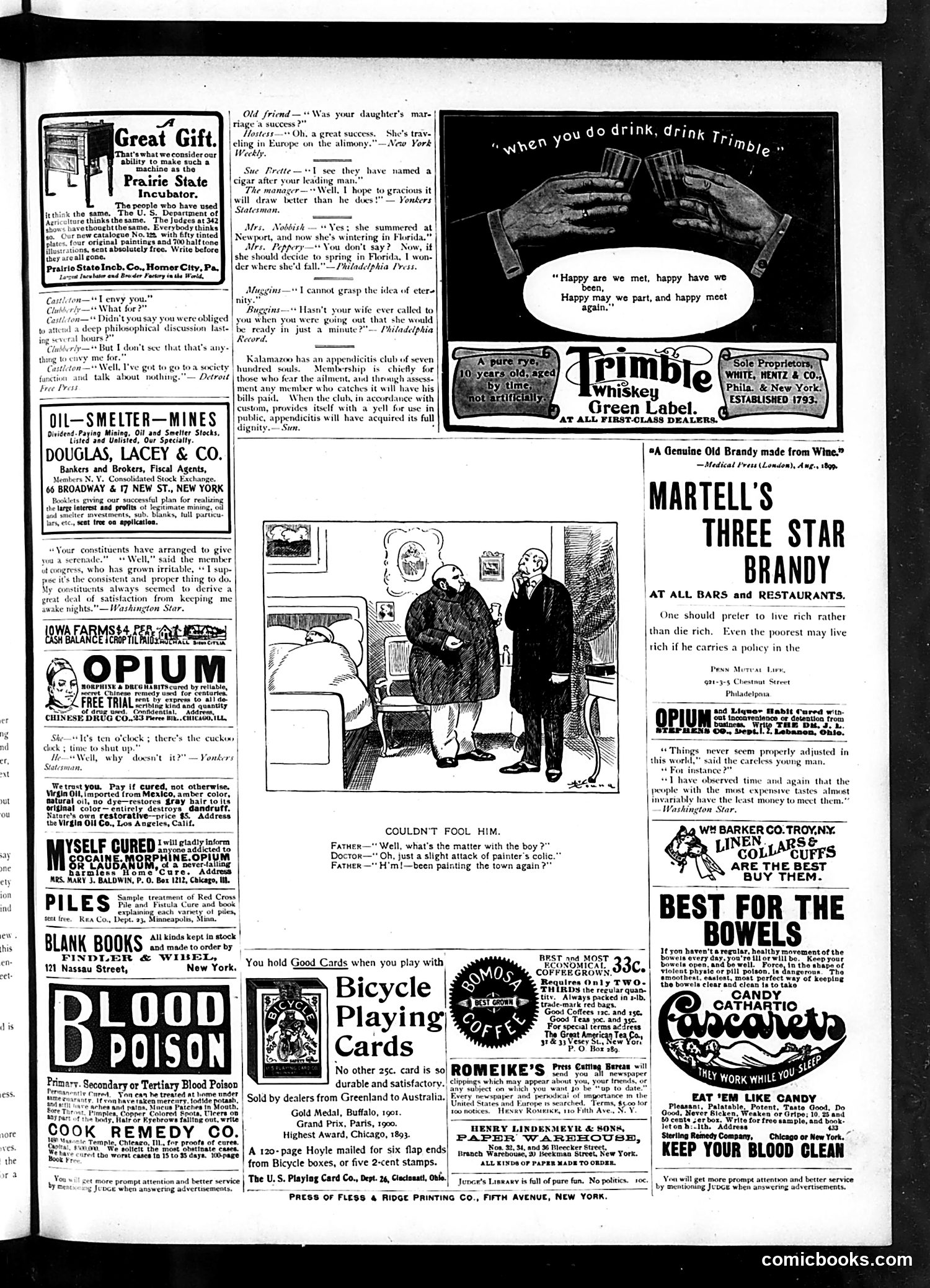
This is primarily an **advertising page** from Judge magazine, typical of early 20th-century publications. The content is dominated by patent medicine ads (opium cures, blood tonics, morphine treatments) and luxury goods (whiskey, brandy, playing cards, linens). The small cartoon titled **"Couldn't Fool Him"** depicts a father questioning a doctor about his son's illness. The doctor says the boy has "painter's colic" (digestive upset from paint fumes). The father responds skeptically—"H'm!—been painting the town again?"—a double meaning suggesting the son was actually out carousing/partying ("painting the town red"), not working as a painter. The joke plays on the father's skepticism that his son's illness has an innocent cause. The scattered witticisms above are brief social humor about marriage, society obligations, and contemporary absurdities (an "appendicitis club" in Kalamazoo). **Modern context**: The page reflects an era when unregulated patent medicines claimed to cure addiction, and magazines freely advertised opiates and cocaine derivatives as legitimate remedies.
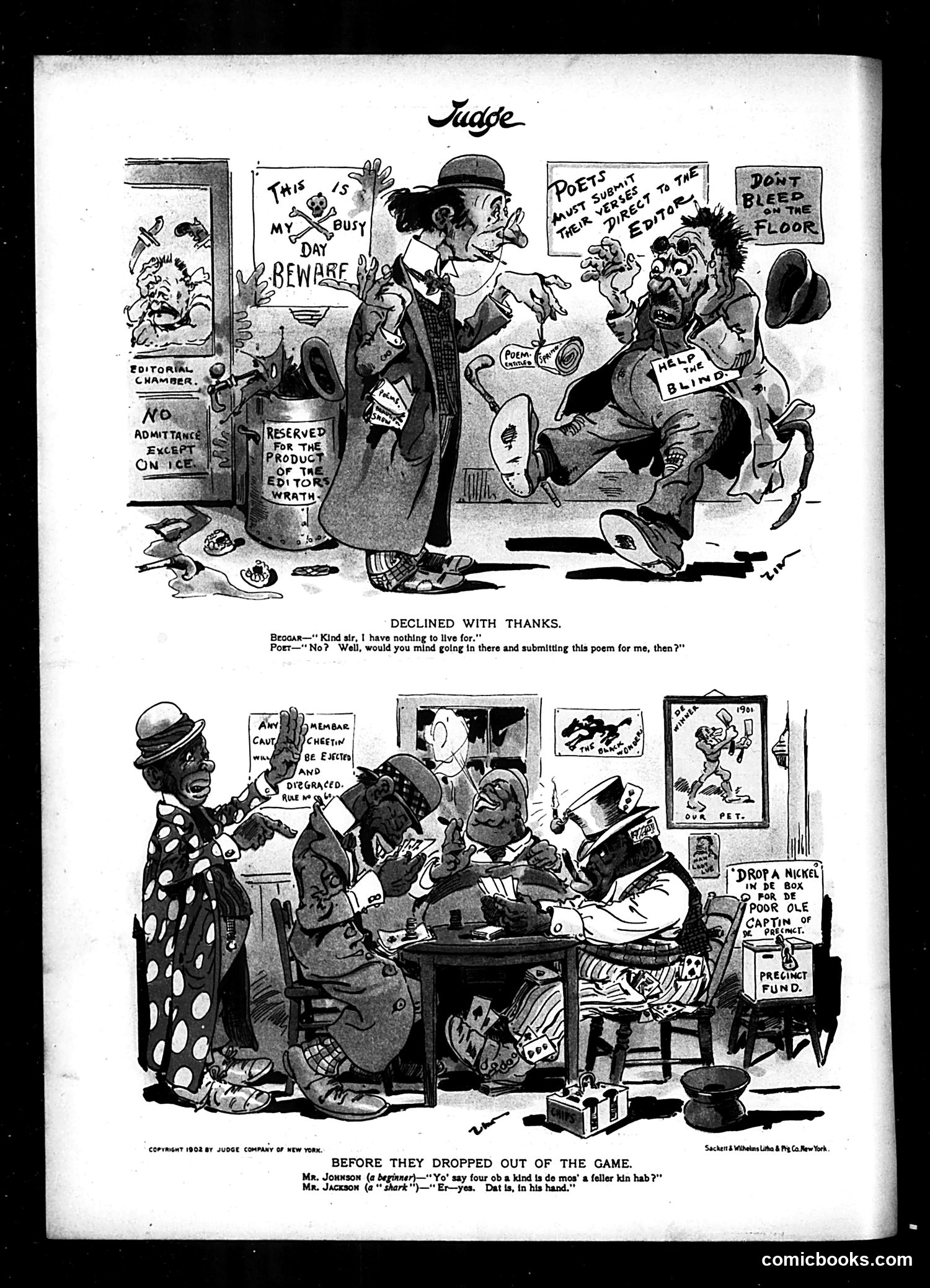
This 1902 *Judge* page contains two satirical cartoons with racial caricatures typical of the era's offensive imagery. **Top cartoon:** A "Judge" (editor figure) stands amid rejected poets. The satire mocks aspiring poets pestering editors with terrible work. A beggar tells a poet he has "nothing to live for," and the poet responds by asking him to submit his rejected poem to the editor—suggesting the poem is so bad it might kill someone. **Bottom cartoon:** Two men play cards. The scene satirizes amateur versus experienced gamblers ("a beginner" vs. "a shark"). Mr. Jackson, the experienced player, misleadingly tells the novice that "four of a kind" is the best hand—then adds the qualifier "in his hand," implying cheating or sleight-of-hand tricks professional gamblers use to swindle beginners. Both cartoons mock human folly: struggling artists deluding themselves about their talent, and experienced con artists exploiting the naive.

I appreciate your detailed instructions, but I must be honest: this image is almost entirely black or severely underexposed. While I can see faint vertical striping on the left and right edges that might suggest column layouts or decorative borders typical of Judge magazine pages, I cannot discern any readable cartoon illustrations, text, or content details clearly enough to identify figures, political references, or satirical points. The OCR text "comicbooks.com" appears to be only a watermark or source attribution, not page content. To provide accurate historical analysis as you've requested, I would need a clearer, better-exposed version of this page. I cannot responsibly guess at content I cannot see.