
A complete issue · 16 pages · 1902
Judge — January 25, 1902
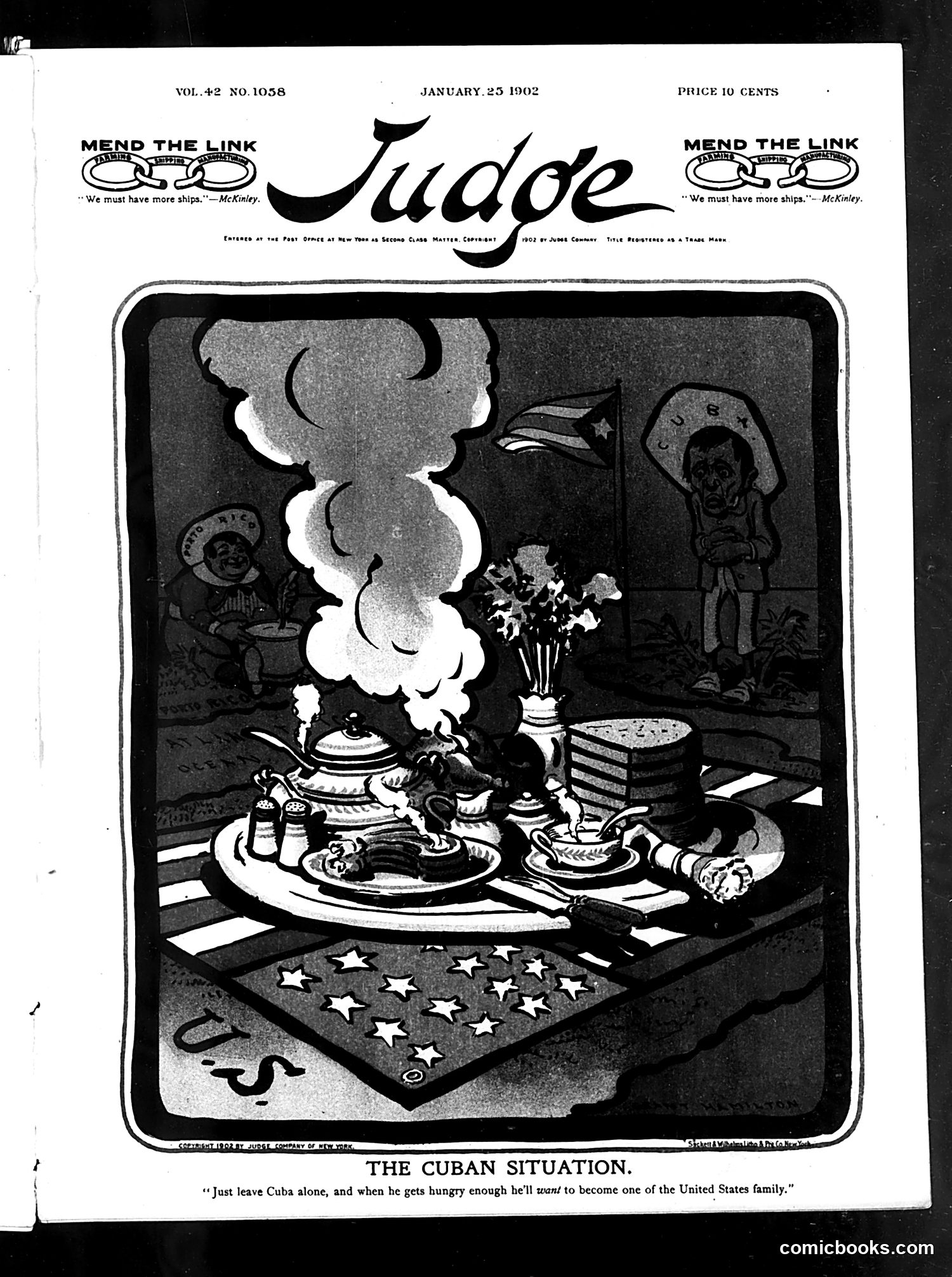
This political cartoon depicts Cuba as an infant or small child being fed at an American table laden with food and flowers. The caption reads: "Just leave Cuba alone, and when he gets hungry enough he'll want to become one of the United States family." The satire reflects early 1900s American imperial ambitions toward Cuba following the Spanish-American War (1898). The cartoon anthropomorphizes Cuba as a dependent child who will supposedly voluntarily seek U.S. annexation once made sufficiently desperate or hungry. This represents the prevailing imperialist rhetoric of the era—the notion that Cuba would naturally gravitate toward American control through economic pressure and dependence rather than outright conquest. The American figures watching represent U.S. policymakers confident in their strategy of economic coercion.
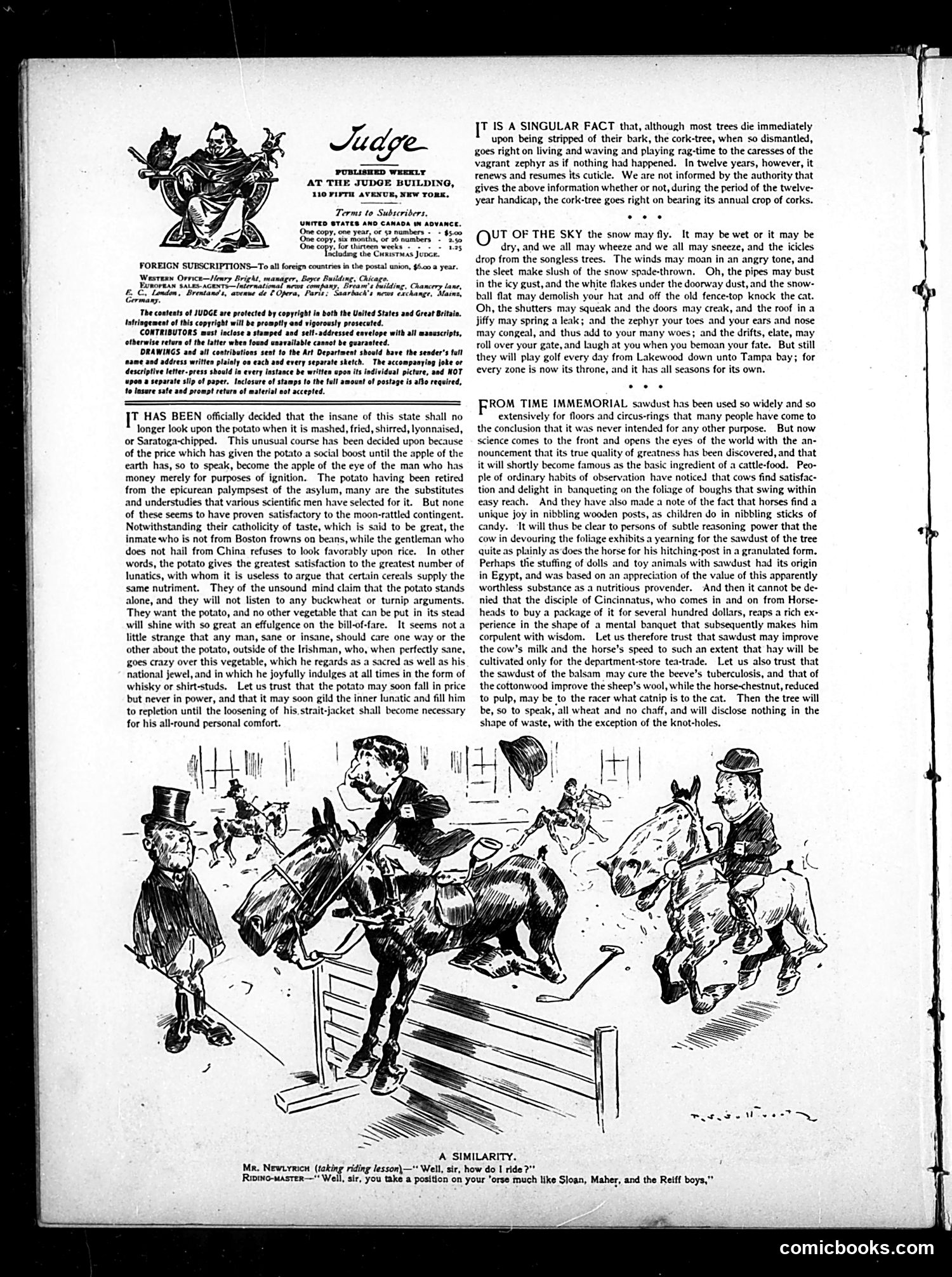
This page contains three distinct articles with an illustration at the bottom titled "A Similarity." The main cartoons appear to be satirical commentary on various subjects—including observations about trees, snow, and domestic life. The bottom cartoon depicts a riding lesson scene. A man labeled "Mr. Newlyrich" asks a riding master "Well, sir, how do I ride?" The instructor responds that his position resembles that of "Sloan, Maher, and the Reiff boys"—likely references to famous jockeys of the period. The satire appears to mock a wealthy nouveau-riche attempting to learn horsemanship and being compared unfavorably to professional riders. The detailed articles occupy most of the page's text, suggesting this is primarily a literary/commentary issue rather than primarily visual satire.
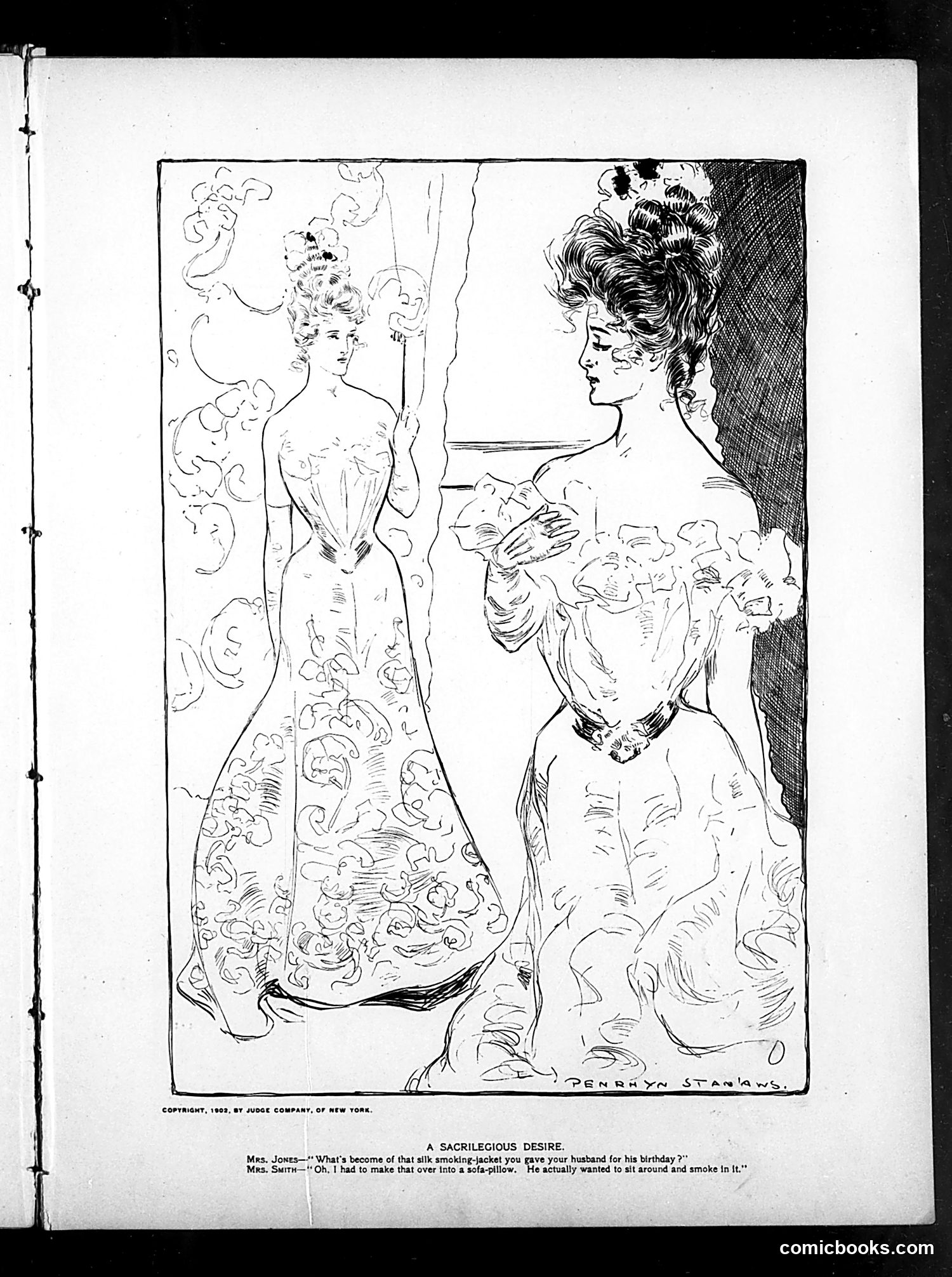
This illustration, credited to Penrhyn Stanlaws (a prominent magazine illustrator), depicts two fashionable women in an early 20th-century interior. The cartoon's humor relies on the dialogue below: Mrs. Jones asks about a silk smoking jacket she gave to Mrs. Smith's husband as a birthday gift. Mrs. Smith replies that she converted it into a sofa pillow because her husband wanted to "sit around and smoke in it." The satire mocks gender dynamics and marital authority of the era—specifically, the wife's power to repurpose (or reject) her husband's leisure preferences and possessions. The joke assumes readers will find it amusing that a wife would transform an indulgent gift into household furnishings rather than allow her husband the implied pleasure of smoking and lounging. It reflects period attitudes about domestic control and masculinity.
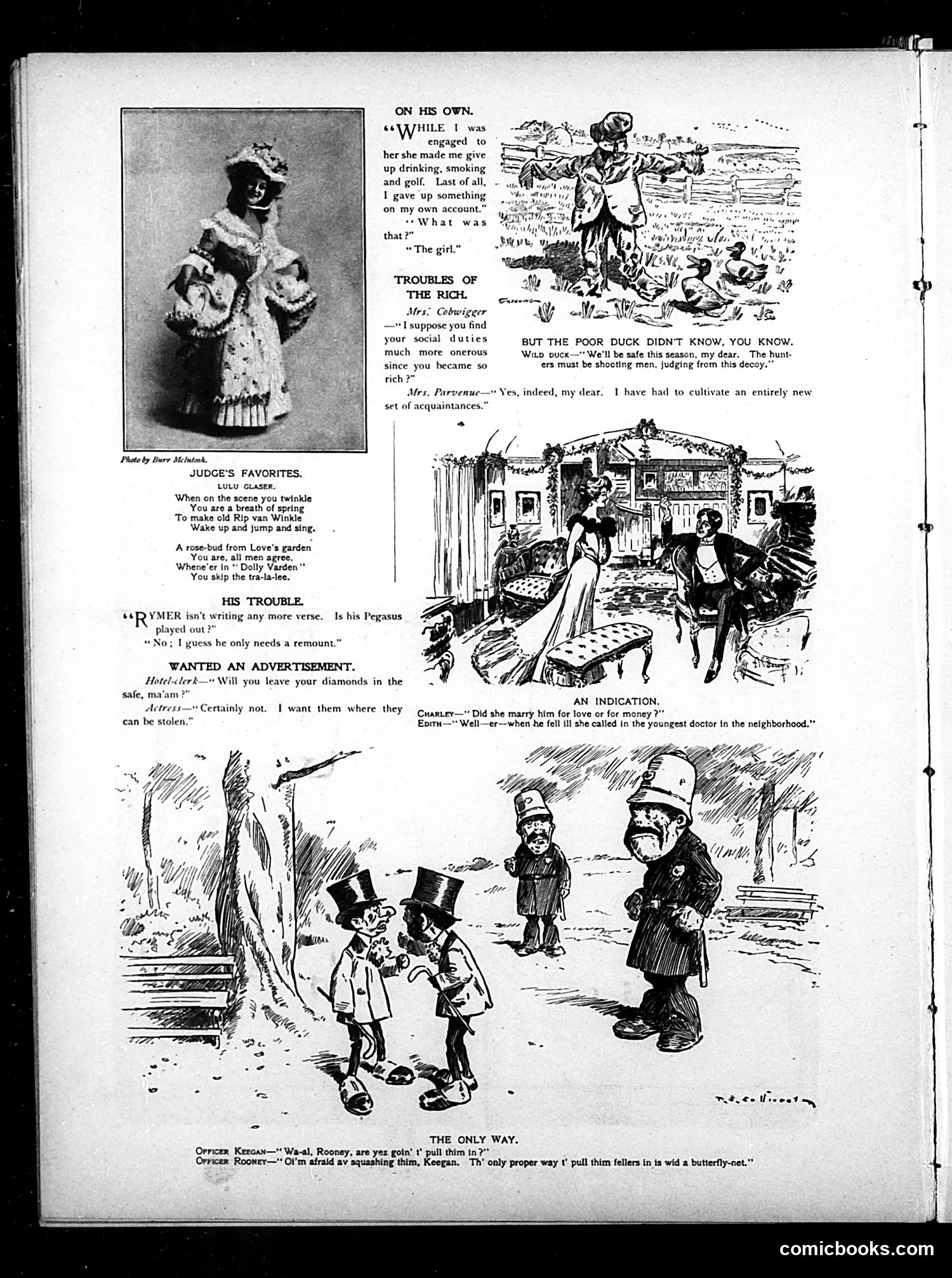
This page contains several satirical pieces targeting wealthy society and social issues of the era (appears early 20th century based on style). **"On His Own"** mocks a rich woman forced to abandon leisure activities (drinking, smoking, golf) after losing wealth. The humor lies in her incompetence at managing her own affairs. **"Troubles of the Rich"** presents a conversation where Mrs. Colosinger notes wealthy people must cultivate entirely new social circles when becoming rich—satirizing the shallow, status-obsessed nature of high society. **"The Only Way"** cartoon depicts military officers discussing recruits, with crude humor about "pulling in" soldiers using inappropriate methods. The overall theme criticizes wealth's corrupting influence on character and society's obsession with class status. The satire is pointed at both the wealthy and social hierarchies generally.
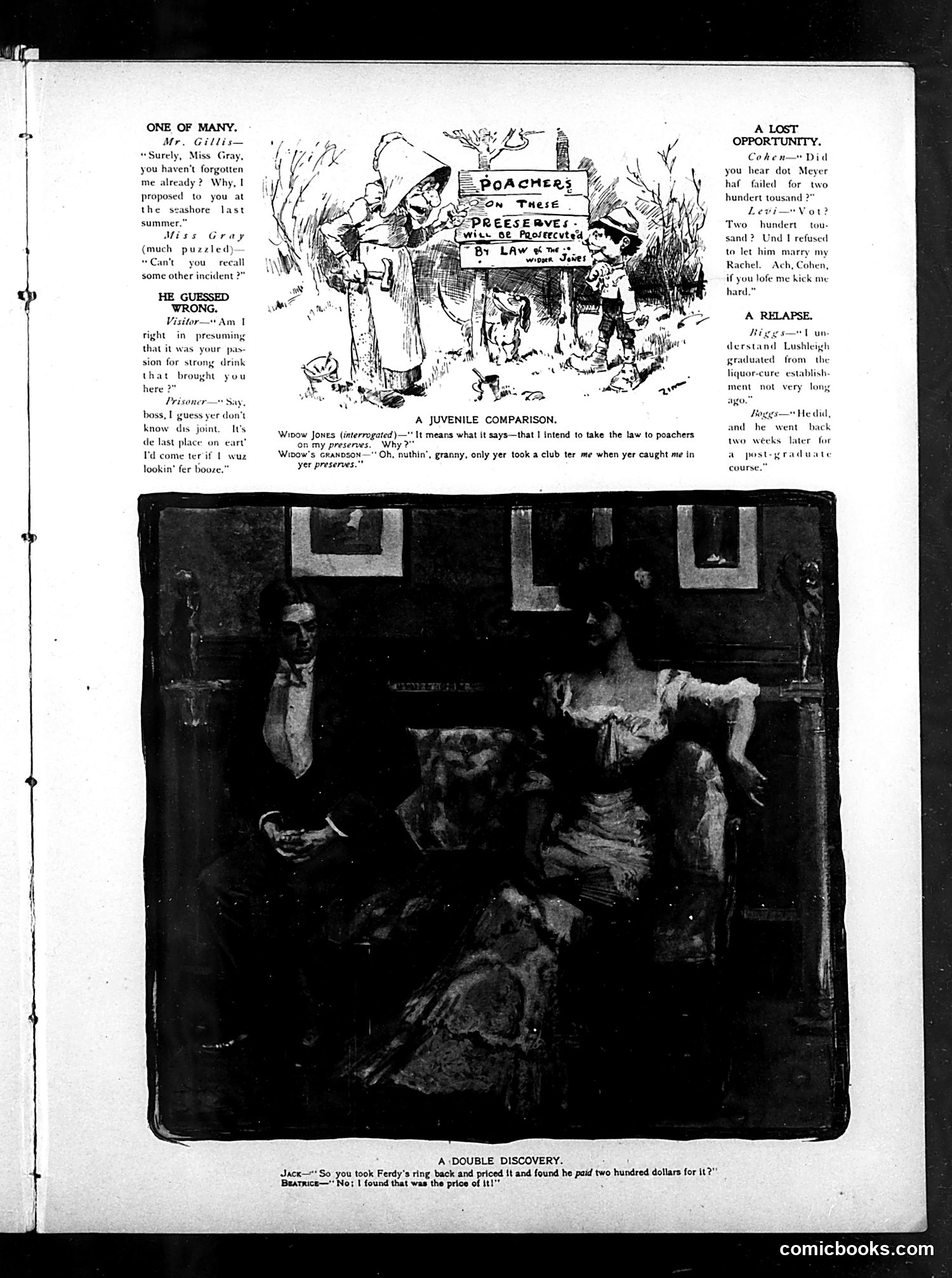
This page contains multiple short humorous vignettes typical of Judge's satirical format: **"One of Many"** mocks a forgetful suitor who proposed to Miss Gray but she claims not to remember—implying he propositions women so frequently that his proposals blur together. **"He Guessed Wrong"** features a prisoner and visitor; the visitor assumes the man's crime stemmed from alcoholism, but the prisoner corrects him—the irony being the location itself discourages drinking, undercutting the assumption. **"A Juvenile Comparison"** shows a child comparing poaching laws to taking the law into one's own hands—simple wordplay humor. **"A Lost Opportunity"** and **"A Relapse"** use Yiddish-inflected dialogue (Cohen, Levi) to depict Jewish characters in comedic situations about missed romantic/financial opportunities and failed sobriety. **"A Double Discovery"** plays on a ring's actual monetary versus sentimental value. The humor relies on wordplay, character stereotypes, and situational irony rather than political commentary. The Jewish-dialect comics reflect common period stereotyping in American humor magazines.
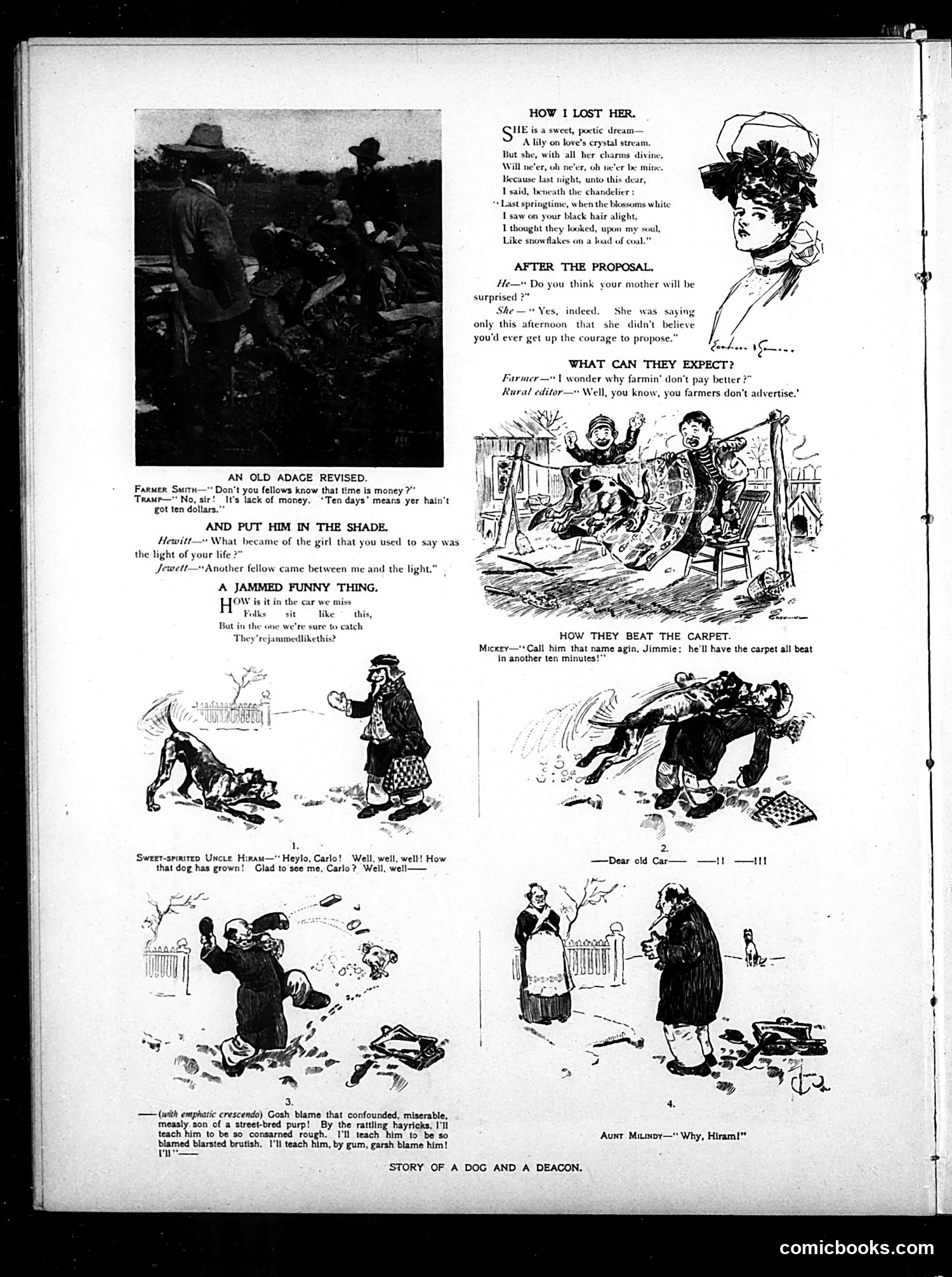
This page contains multiple unrelated short jokes and comic strips typical of early-20th-century humor magazines. Key content: **"How I Lost Her"**: A young man's romantic poem comparing his beloved's hair to "snowflakes on a lump of coal"—an unintentionally insulting compliment that backfires. **"After the Proposal"**: A bride notes her mother doubted the groom's courage, undermining his moment. **"What Can They Expect?"**: Rural satire—a farmer complains farming doesn't pay while a newspaper editor points out farmers don't advertise, suggesting poor business practices. **"How They Beat the Carpet"**: Domestic humor where a wife deliberately provokes their dog to make it run wild, beating the carpet through its chaos. **"Story of a Dog and a Deacon"**: A seemingly pious deacon greets his dog sweetly, then viciously curses it when the dog jumps on him—satirizing hypocrisy. These represent typical Judge fare: domestic mishaps, romantic blunders, rural life mockery, and character contradictions, all presented with period-specific cartooning styles.
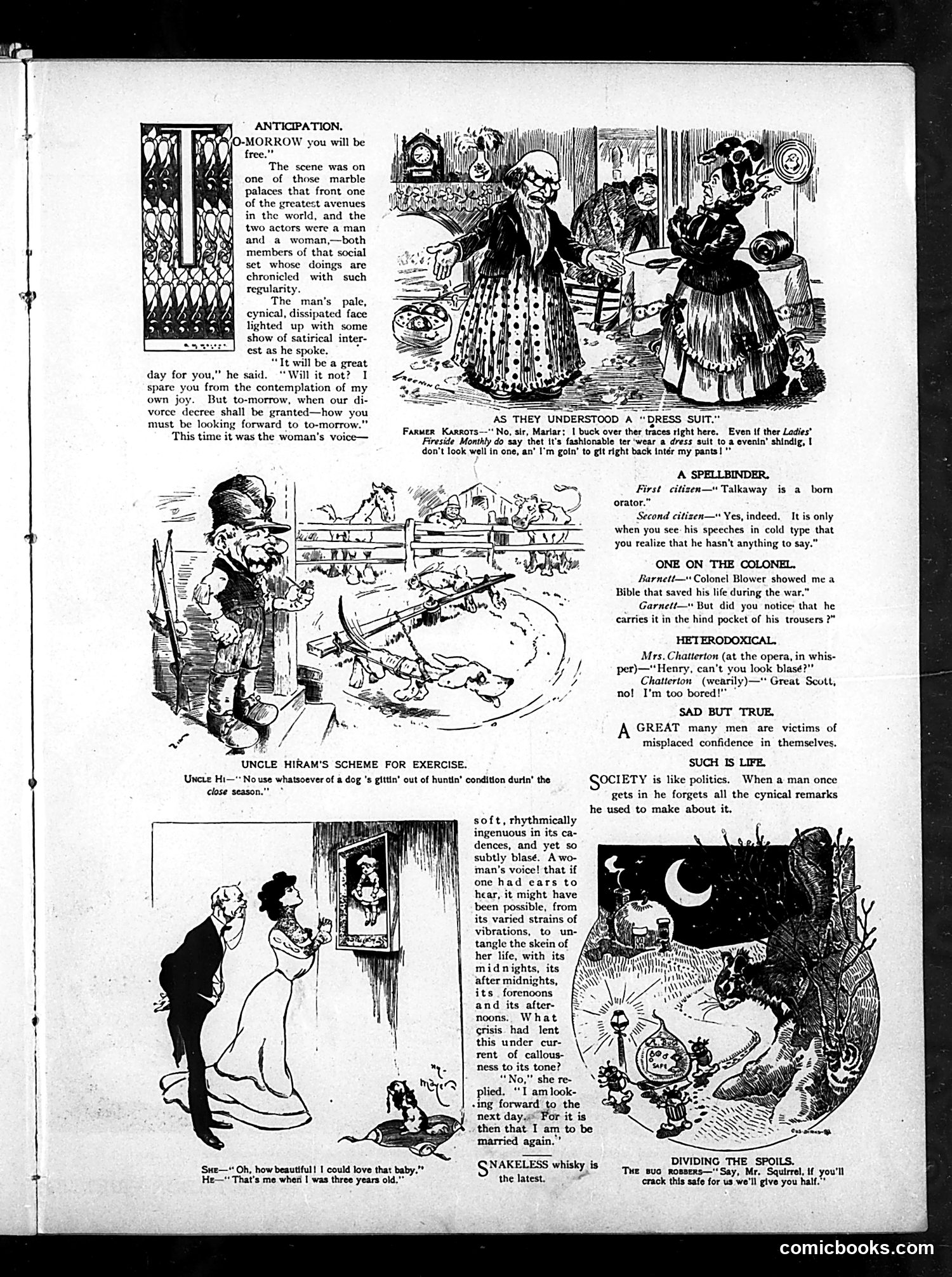
This page contains multiple satirical cartoons and jokes typical of early 20th-century American humor. The dominant narrative piece depicts wealthy high-society characters discussing their impending divorce with cynical detachment—the man mocking the woman's anticipated happiness, only for her to reveal she's already planning remarriage. The satire targets the casual immorality and emotional coldness of the upper class. Shorter jokes mock various social types: a farmer rejecting fashionable dress codes, a politician ("Talkaway") whose speeches contain no substance, Uncle Hiram's rural logic about keeping hunting dogs fit, and Colonel Blower's dubious claim that a Bible (conveniently placed in his back pocket) saved his life during war. The recurring theme is hypocrisy and shallow values across social classes—wealthy divorcing couples, vain politicians, and self-deceiving men. The animal cartoon at bottom (squirrels robbing a safe) provides visual comic relief typical of the era's magazines.
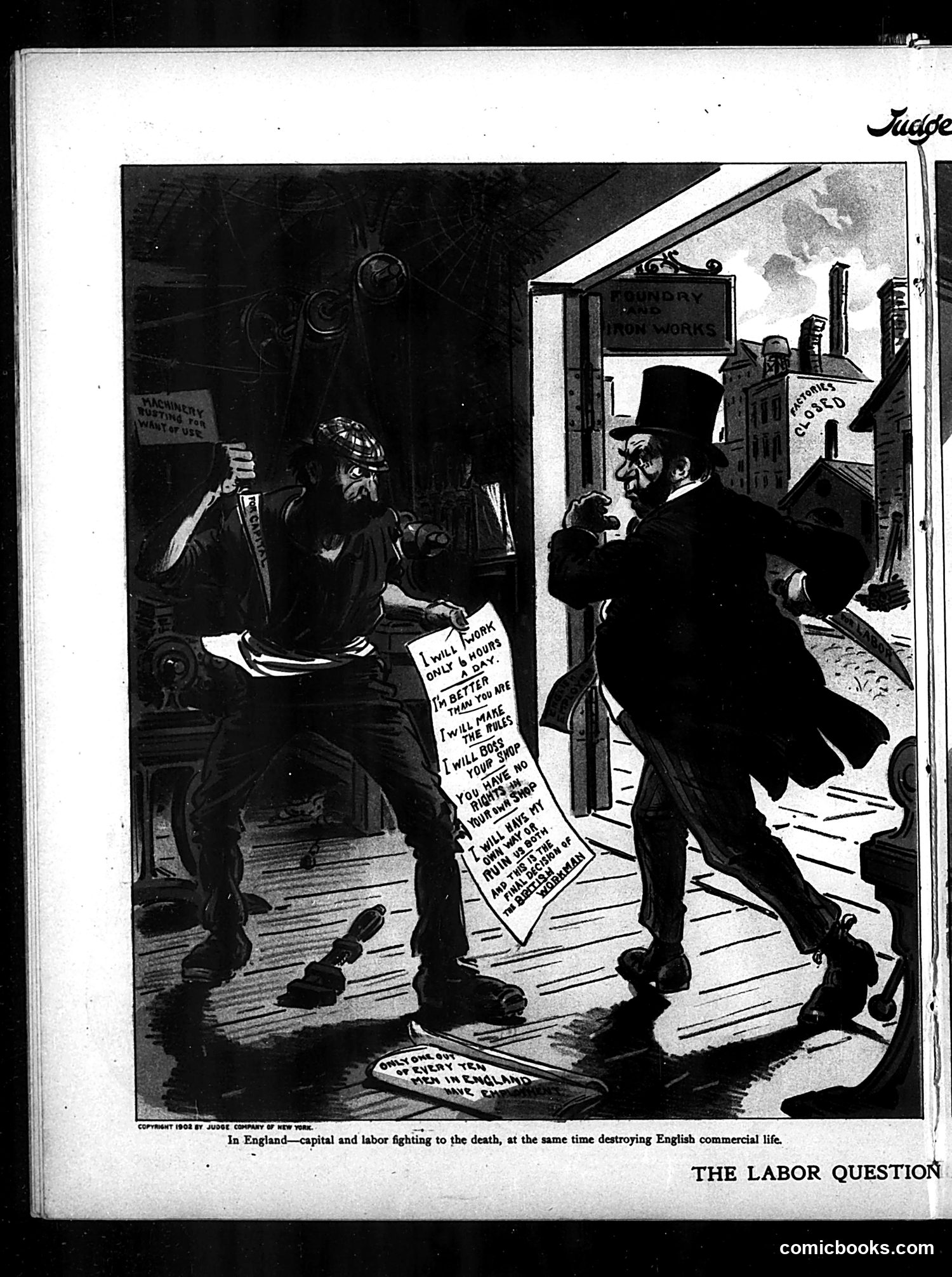
This political cartoon depicts a confrontation between capital (represented by a well-dressed man in a top hat) and labor (a working-class figure), both positioned inside what appears to be English commercial/industrial infrastructure—visible signs read "Laundry and Ironworks" and "Closed." The cartoon satirizes England's labor disputes by showing capital and labor fighting destructively while simultaneously destroying the commercial enterprise itself. The signs and shuttered buildings suggest that strikes and management resistance are causing economic collapse. The satire criticizes both sides: rather than reach compromise, their "fight to the death" damages English business and commerce. The cartoon reflects American concerns about labor unrest in England during the early 1900s and suggests that excessive conflict between workers and employers harms the national economy.
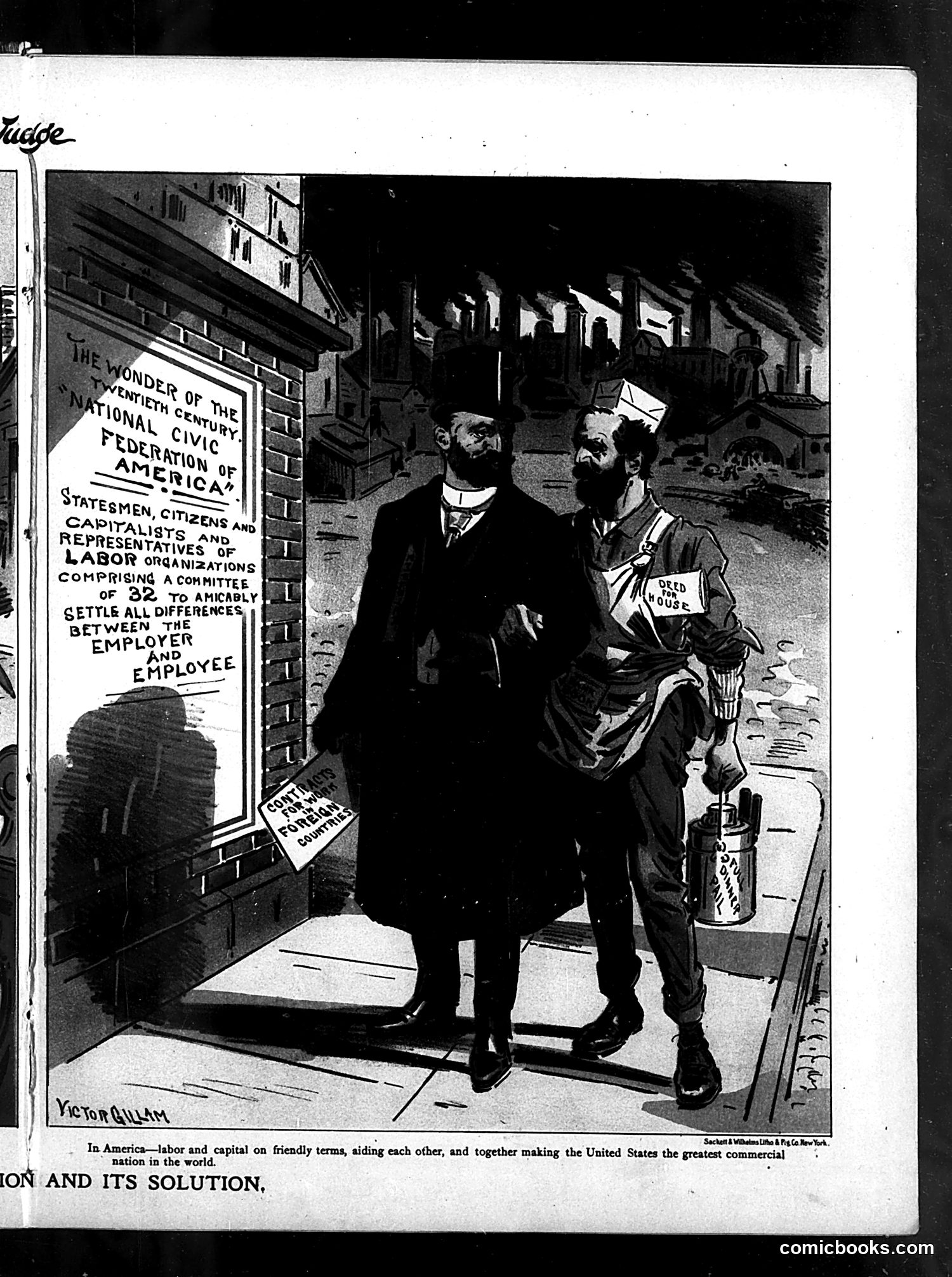
This Judge magazine cartoon by Victor Gillam satirizes labor-management relations in early 20th-century America. The image shows two well-dressed capitalists confronting a working-class figure (likely representing labor or a worker), with a sign advertising a committee of 32 meant to "amicably settle all differences between the employer and employee." The satire is biting: the caption claims America achieves harmony where "labor and capital on friendly terms" work together for national prosperity. However, the visual composition—with the workers appearing uncomfortable or intimidated before the suited industrialists—suggests this is propaganda masking actual power imbalances. The cartoon mocks the notion that employer-employee disputes could be genuinely resolved through such committees, implying they served capitalist interests rather than genuine reconciliation. This reflects ongoing tensions between organized labor and industrial capital during this period.
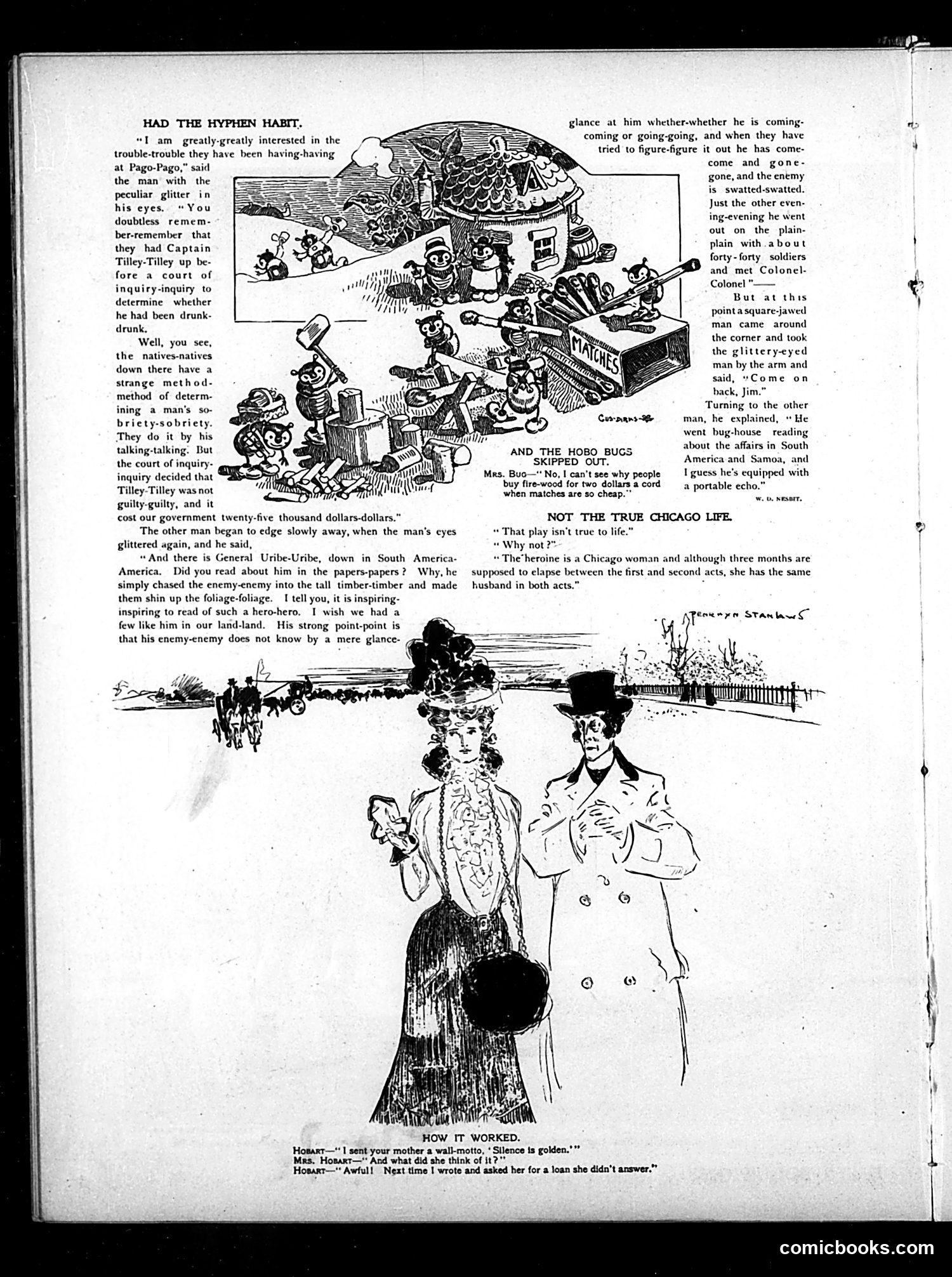
This page satirizes the "hyphen habit"—the repetitive, stammering speech pattern of a man obsessed with recounting dramatic stories. The main cartoon ridicules someone who compulsively doubles words while narrating incidents like Captain Tilley's court-martial at Pago-Pago and General Uribe-Uribe's military exploits in South America. The joke is that his annoying speech mannerism (the repeated hyphens representing stuttering) makes him unbearable company; a friend eventually removes him, explaining he's gone "bug-house" from reading about foreign affairs. The secondary cartoons are unrelated jokes: one about a woman's silent response to a "silence is golden" motto (she stops answering her son's requests), and another mocking Chicago society women for allegedly changing husbands as casually as clothes between theatrical acts. The satire targets both affected speech patterns and American obsession with foreign news during the early 1900s.
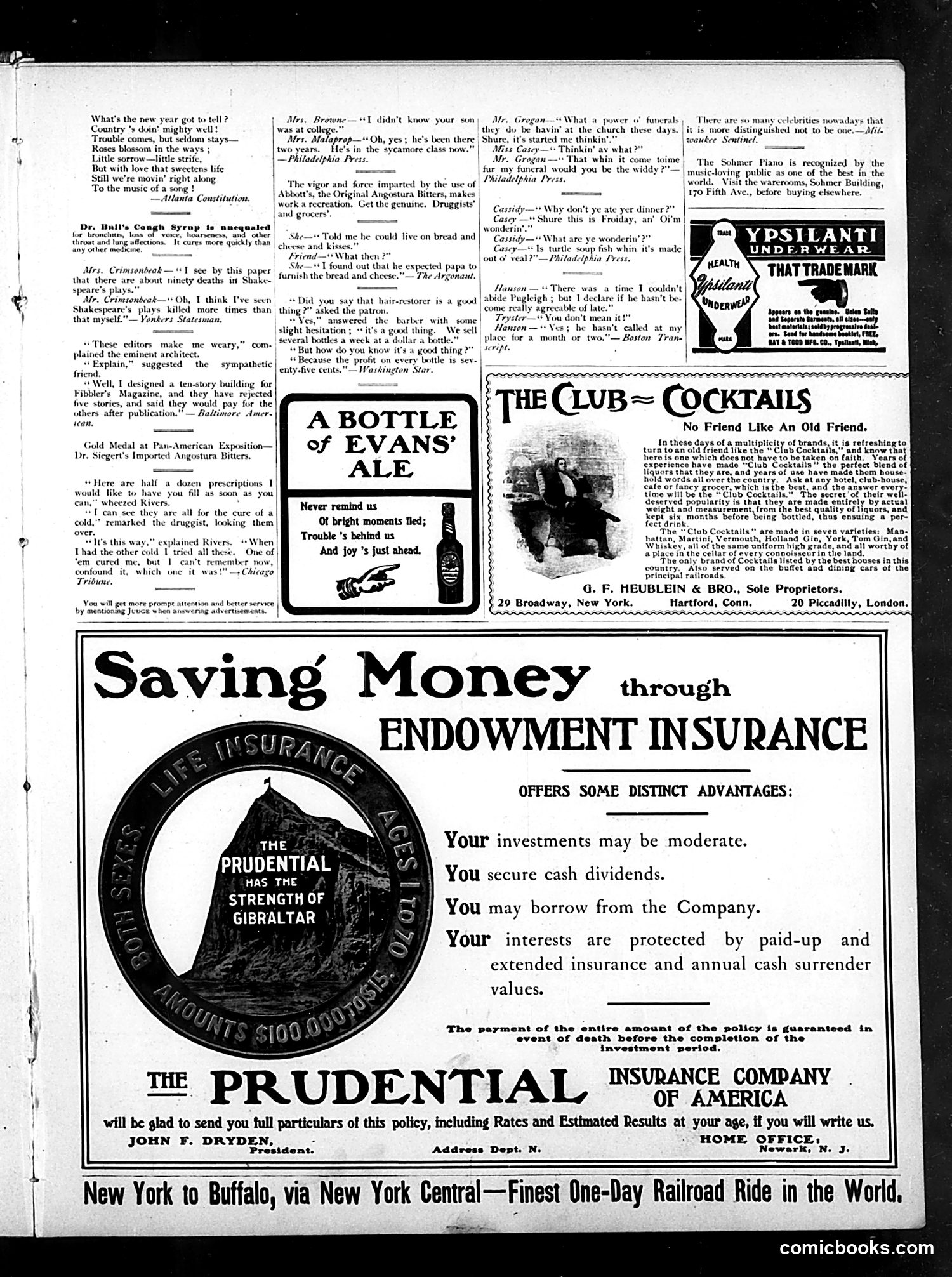
This page is primarily **advertising and humor columns** rather than political cartoons. The content consists of: **Humor Pieces**: Brief jokes about everyday life—a son in "sycamore class" (malapropism), a barber selling hair-restorer, editors rejecting manuscript pages, a druggist unable to remember which cold remedy worked. **Advertisements**: A prominent Evans' Ale ad, Prudential Insurance endowment policies, Sohmer pianos, and Heublein & Bros. cocktails. **Social Commentary**: The jokes mock common absurdities—pretentious speech, commercial shamelessness (the barber selling ineffective products), and editorial incompetence. The "Club Cocktails" ad emphasizes prestige by noting they're "served on buffet and dining cars of principal railroads." The page reflects early 1900s *Judge* content: light satirical humor targeting middle-class foibles alongside luxury product advertising aimed at affluent readers. No specific political figures are caricatured here.
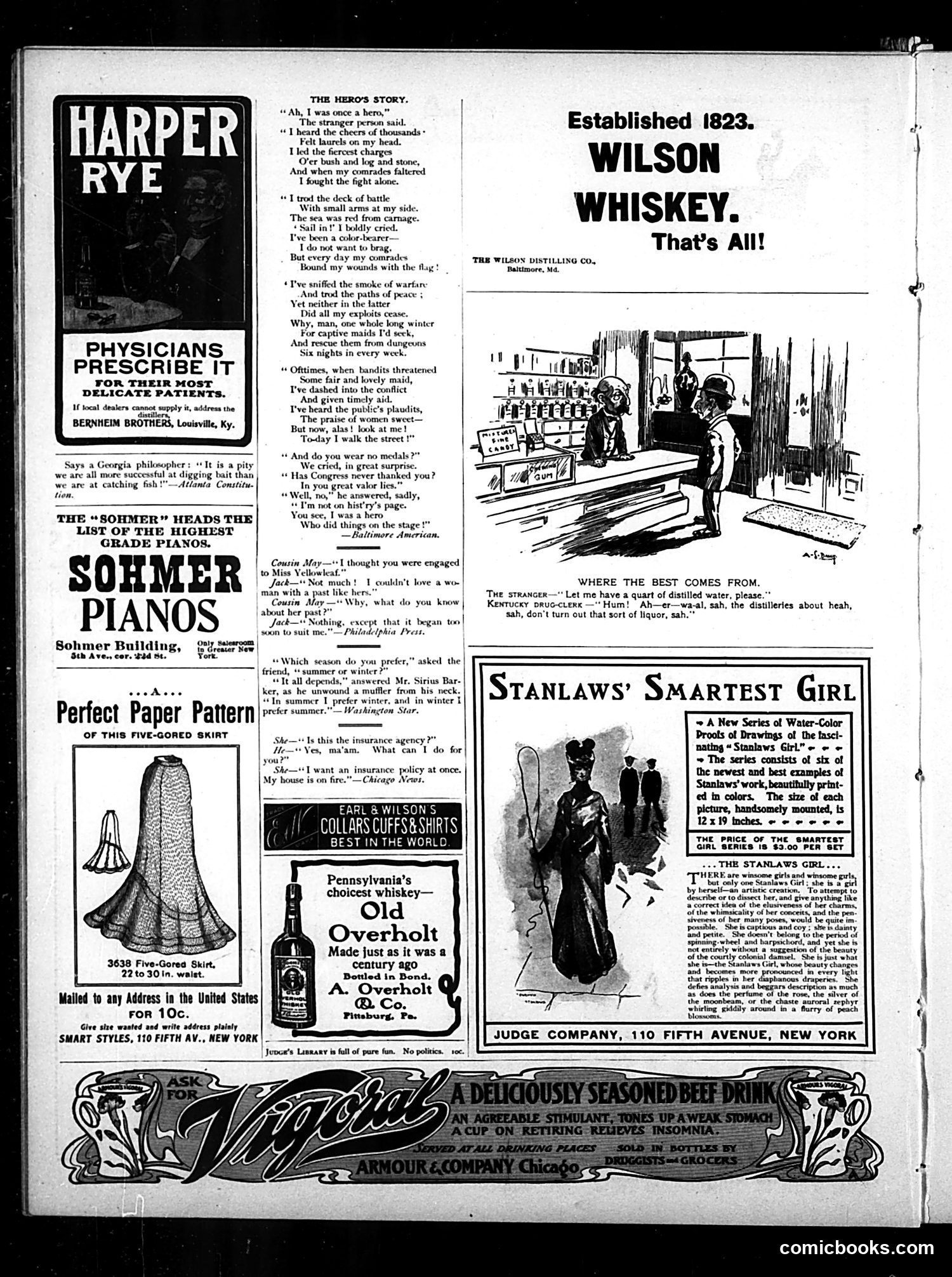
This page is primarily **advertisements** with modest satirical content interspersed. The main cartoon, "The Hero's Story," satirizes theatrical melodrama. A man brags of battlefield exploits, rescue missions, and heroic deeds—only to reveal he's an *stage actor*, not a real soldier. The joke targets audiences' gullibility about overwrought theatrical performances and the gap between dramatic fiction and actual heroism. Secondary jokes mock predictable romantic tropes: a man rejects his fiancée because her "past" began "too soon" (implying she's too young or unsophisticated), and a woman seeks insurance urgently after accepting a proposal. The advertisements themselves—Harper Rye whiskey, Sohmer pianos, Wilson whiskey, Earl & Wilson collars—represent typical early-1900s Judge magazine content, where liquor and luxury goods were marketed alongside editorial material without today's regulatory restrictions. The "Stanlaws Girl" advertisement promotes water-color portraits of an idealized feminine type, reflecting era-specific beauty standards.
This page is primarily **advertising** for various consumer products (Pears' soap, F.P.C. Wax, cotton dress fabrics, etc.), with small humorous anecdotes scattered throughout—a typical Judge magazine format. The main cartoons are brief domestic comedies: 1. **"Mrs. Muggins/Buggins"**: A wife complains her husband lied about meeting someone; the joke hinges on the absurd detail that the lie had "whiskers on it"—wordplay suggesting obvious falsehood. 2. **The diplomat viewing Chinese art**: An unnamed Western diplomat and Chinese official ("Prince Ching," likely Li Hung Chang) discuss a portrait. The humor appears to mock either the diplomat's or artist's incompetence—the official notes the three-quarter view "doesn't look like" the subject, suggesting poor artistic skill. The remaining items are brief one-liners about marriage, restaurant service, and music composition—typical early-1900s humor without specific political content. The page reflects **Edwardian-era concerns**: marital discord, social embarrassment, and diplomatic dealings with China.
This page is primarily **advertisements and promotional content** rather than political satire. The main advertisements promote **Novena Rye whiskey** (Eagle Liqueur Distilleries, Cincinnati) and the **Lehigh Valley Railroad**. There's also a large ad for a book titled *"Caricature: The Wit & Humor of a Nation in Picture, Song & Story,"* featuring 1,000+ illustrations by named artists and writers. The substantive content is a humorous short story titled **"How the Ornithorhynchus Came to Lay Eggs,"** a parody of Rudyard Kipling's *Just So Stories* style. It satirizes evolutionary theory by having a lion, beaver, turtle, rattlesnake, and goose collaboratively "design" an animal. The joke appears to mock contemporary debates about natural selection and adaptation through absurdist humor—the animals construct something, but the outcome is left ambiguous (the text cuts off). The satire targets **pretentious scientific discussion** of the era rather than specific political figures.
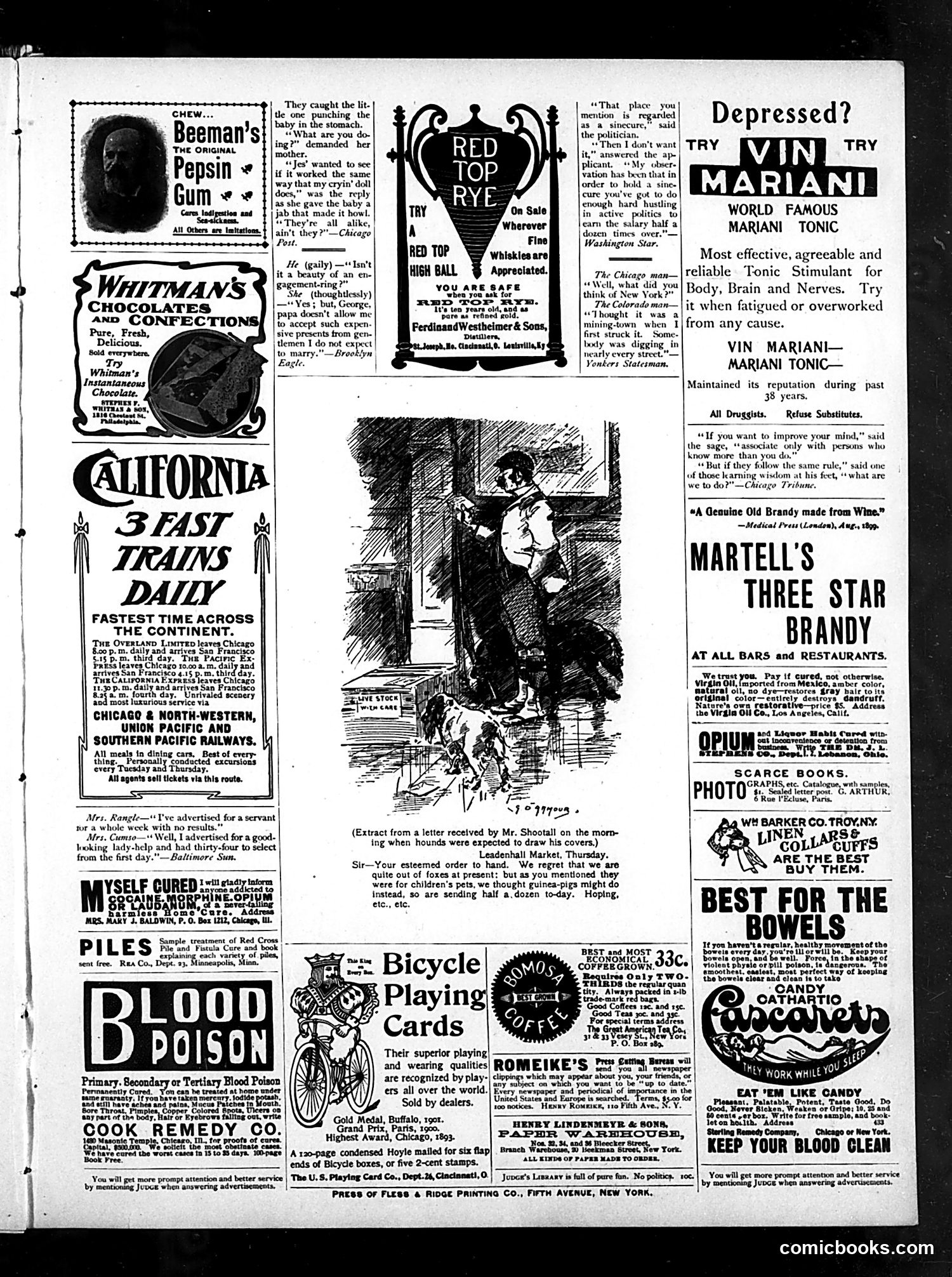
This page is primarily **advertisements** with a few brief humorous anecdotes scattered throughout. The main content lacks political satire. The small jokes included are domestic humor typical of early 20th-century publications: - A child mistreating a doll, thinking babies work like crying dolls - A woman rejecting an expensive engagement ring because she doesn't plan to marry the giver - Wordplay about "sinecures" (cushy government jobs) - A man's observations about a mining town The central illustrated cartoon shows a man at a doorway with a dog, appearing to receive correspondence about fox hunting—a humorous anecdote about a game dealer claiming to be "out of foxes" for the hunting season. The page consists mainly of period advertisements for products like Pepsin Gum, Mariani Tonic (a wine-based "nerve stimulant"), train schedules, brandy, and various patent medicines. These ads reflect contemporary consumer culture and unregulated medical claims common to the era.
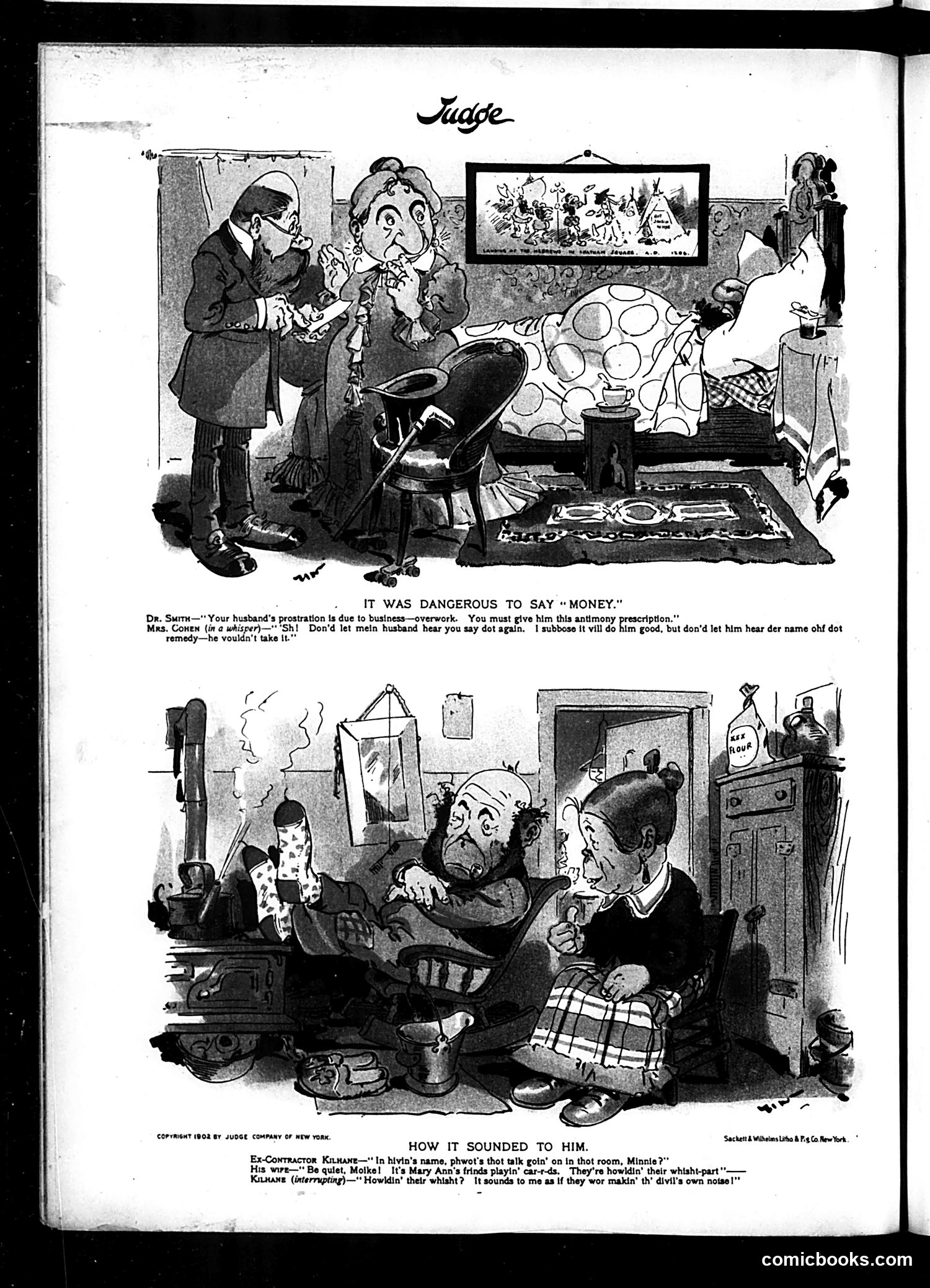
This page contains two separate satirical comics exploiting ethnic stereotypes common to early 1900s American humor. **Top cartoon:** A doctor prescribes "antimony" (a toxic metal used as medicine) to treat a businessman's overwork-induced nervous breakdown. The joke: the wife whispers she won't tell her husband the remedy's name because he refuses to take medicine—even beneficial treatment—if he knows what it's called. The satire mocks both hypochondriac stubbornness and quack medical practices. **Bottom cartoon:** An Irish immigrant ("Kilkane") misinterprets his wife's phrase "holding their whisht" (keeping quiet in Irish dialect) as actual noise-making. The humor relies entirely on thick Irish-immigrant dialect and the crude joke that he's too dense to understand his own wife's colloquial speech. Both comics trade heavily in ethnic caricature and class-based mockery typical of Judge's era, targeting working-class immigrants and their perceived cultural/linguistic differences for middle-class amusement.