
Judge, 1902-01-25 · page 2 of 16
Judge — January 25, 1902 — page 2: what you’re looking at
What you’re looking at
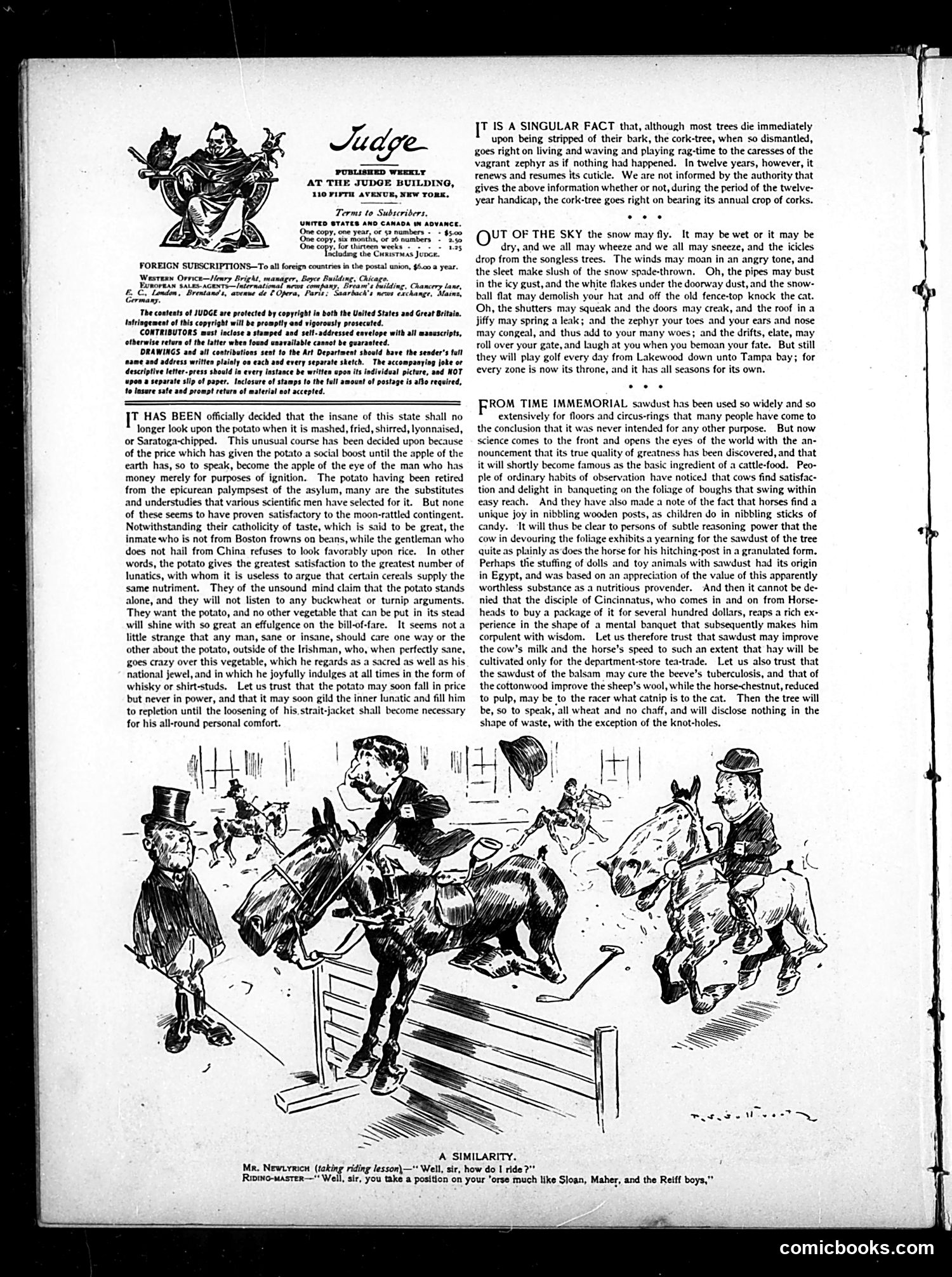
This page contains three distinct articles with an illustration at the bottom titled "A Similarity." The main cartoons appear to be satirical commentary on various subjects—including observations about trees, snow, and domestic life. The bottom cartoon depicts a riding lesson scene. A man labeled "Mr. Newlyrich" asks a riding master "Well, sir, how do I ride?" The instructor responds that his position resembles that of "Sloan, Maher, and the Reiff boys"—likely references to famous jockeys of the period. The satire appears to mock a wealthy nouveau-riche attempting to learn horsemanship and being compared unfavorably to professional riders. The detailed articles occupy most of the page's text, suggesting this is primarily a literary/commentary issue rather than primarily visual satire.
📄 Transcribed text from this page (OCR, searchable)
Machine-transcribed from the original scan — historical spelling and the odd misread are preserved.
— AT THE JUDGE BUILDING, 110 VIFTH AVENUE, NEW ToRK. Terms to Subscribers. UNITED STATES AND CANADA W ADVANCE. One copy, one year, or 52 numbers - - $5.00 One copy, six months, of 2 numbers = "a.$0 One copy, for thirteen weeks = - = = 1.35 jacluding the Cumist sas J FOREIGN SUBSCRIPTIONS—To all foreign countries in the postal union, $5.00 year. —Henry Bright, manager, Beyce Building, Chicage. forma nctnro— International new company, reams tilding, Chancery lane, 2 Brentands, avenue deb Opera, Parle: Saarbach's news tichange, Masne, The contests of JUDGE are protected by co} tafriagemeat of this copyright ORS tr HAS BEEN officially decided that the insane of this state shall no longer look upon the potato when it is mashed, fried, shirred, lyonnaised, or Saratoga-chipped. This unusual course has been decided upon because of the price which has given the potato a social boost until the apple of the earth has, so to speak, become the apple of the eye of the man who has money merely for purposes of ignition. The potato having been retired from the epicurean palympsest of the asylum, many are the substitutes and understudies that various scientific men have selected for it. But none of these seems to have proven satisfactory to the moon-rattled contingent. Notwithstanding their catholicity of taste, which is said to be great, the inmate who is not from Boston frowns on beans, while the gentleman who does not hail from China refuses to look favorably upon rice. In other words, the potato gives the greatest satisfaction to the greatest number of lunatics, with whom it is useless to argue that certain cereals supply the same nutriment. They of the unsound mind claim that the potato stands alone, and they will not listen to any buckwheat or turnip arguments. They want the potato, and no other vegetable that can be put in its stead will shine with so great an effulgence on the bill-of-fare. It seems not a little strange that any man, sane or insane, should care one way or the other about the potato, outside of the Irishman, who, when perfectly sane, goes crazy over this vegetable, which he regards as a sacred as well as his national jewel, and in which he joyfully indulges at all times in the form of whisky or shirt-studs. Let us trust that the potato may soon fall in price but never in power, and that it may soon gild the inner lunatic and fill him to repletion until the loosening of his, strait-jacket shall become necessary for his all-round personal comfort. T IS A SINGULAR FACT that, although most trees die immediately upon being stripped of their bark, the cork-tree, when so dismantled, goes right on living and waving and playing rag-time to the caresses of the vagrant zephyr as if nothing had happened. In twelve years, however, it renews and resumes its cuticle. We are not informed by the authority that gives the above information whether or not, during, the period of the twelve- year handicap, the cork-tree goes right on bearing its annual crop of corks. QUT OF THE SKY the snow may fly. It may be wet or it may be dry, and we all may wheeze and we all may sneeze, and the icicles drop from the songless trees. The winds may moan in an angry tone, and the sleet make slush of the snow spade-thrown. Oh, the pipes may bust in the icy gust, and the white flakes under the doorway dust, and the snow- ball flat may demolish your hat and off the old fence-top knock the cat. Oh, the shutters may squeak and the doors may creak, and the roof ina jiffy may spring a leak; and the zephyr your toes and your ears and nose may congeal, and thus add to your many woes; and the drifts, elate, may roll over your gate, and laugh at you when you bemoan your fate. But still they will play golf every day from Lakewood down unto Tampa bay; for every zone is now its throne, and it has all seasons for its own. ROM TIME IMMEMORIAL sawdust has been used so widely and so extensively for floors and circus-rings that many people have come to the conclusion that it was never intended for any other purpose. But now science comes to the front and opens the eyes of the world with the an- nouncement that its true quality of greatness has been discovered, and that it will shortly become famous as the basic ingredient of a cattle-food. Peo- ple of ordinary habits of observation have noticed that cows find satisfac- tion and delight in banqueting on the foliage of boughs that swing within easy reach. And they have also made a note of the fact that horses find a unique joy in nibbling wooden posts, as children do in nibbling sticks of candy. ‘It will thus be clear to persons of subtle reasoning power that the cow in devouring the foliage exhibits a yearning for the sawdust of the tree quite as plainly as‘does the horse for his hitching-post in a granulated form. Perhaps the stuffing of dolls and toy animals with sawdust had its origin in Egypt, and was based on an appreciation of the value of this apparently worthless substance as a nutritious provender. And then it cannot be de- nied that the disciple of Cincinnatus, who comes in and on from Horse- heads to buy a package of it for several hundred dollars, reaps a rich ex- perience in the shape of a mental banquet that subsequently makes him corpulent with wisdom. Let us therefore trust that sawdust may improve the cow’s milk and the horse’s speed to such an extent that hay will be cultivated only for the department-store tea-trade. Let us also trust that the sawdust of the balsam may cure the beeve’s tuberculosis, and that of the cottonwood improve the sheep’s wool, while the horse-chestnut, reduced to pulp, may be to the racer what catnip is to the cat. Then the tree will be, so to speak,’all wheat and no chaff, and will disclose nothing in the shape of waste, with the exception of the knot-holes. A SIMILARITY. Mr. Newvrnic (taking riding lesson\—“* Well, sir, how do | ride?"* Rioimo-wasrer—" Well, sir, you take a position on your ‘orse much like Sloan, Maher, and the Reiff boys,” comicbooks.com