
Judge, 1902-01-25 · page 7 of 16
Judge — January 25, 1902 — page 7: what you’re looking at
What you’re looking at
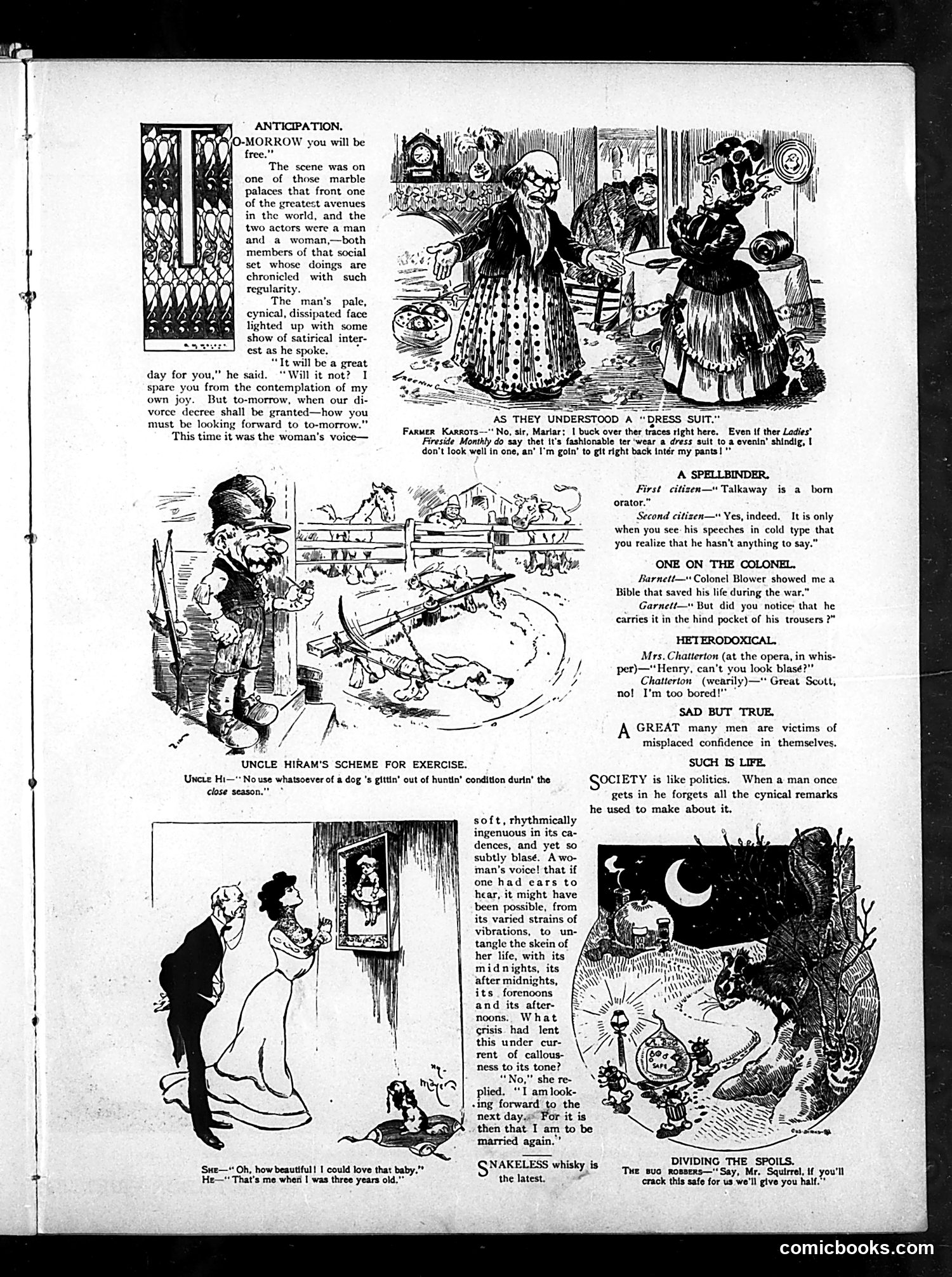
This page contains multiple satirical cartoons and jokes typical of early 20th-century American humor. The dominant narrative piece depicts wealthy high-society characters discussing their impending divorce with cynical detachment—the man mocking the woman's anticipated happiness, only for her to reveal she's already planning remarriage. The satire targets the casual immorality and emotional coldness of the upper class. Shorter jokes mock various social types: a farmer rejecting fashionable dress codes, a politician ("Talkaway") whose speeches contain no substance, Uncle Hiram's rural logic about keeping hunting dogs fit, and Colonel Blower's dubious claim that a Bible (conveniently placed in his back pocket) saved his life during war. The recurring theme is hypocrisy and shallow values across social classes—wealthy divorcing couples, vain politicians, and self-deceiving men. The animal cartoon at bottom (squirrels robbing a safe) provides visual comic relief typical of the era's magazines.
📄 Transcribed text from this page (OCR, searchable)
Machine-transcribed from the original scan — historical spelling and the odd misread are preserved.
-2-—— oy z fo} zx z 2 $ 2 £ z free." The scene was on one of those marble palaces that front one of the greatest avenues in the world, and the two actors were a man and a woman,—both members of that social set whose doings are chronicled with such regularity. The man’s pale, cynical, dissipated face lighted up with some show of satirical inter- est as he spoke. ie “It will be a great day for you,” he said. ‘Will it not? I spare you from the contemplation of my own joy. But to-morrow, when our di- vorce decree shall be granted—how you must be looking forward to to-morrow.” This time it was the woman's voice— 44, <2. a vous mt sil Ai | { xh Farmer Karrots—'‘No, sir, Marlar; 1 buck over ther traces right here. Even if ther Ladies" Fireside Monthly do say thet \t's fashionable ter ‘wear a dress sult toa evenin’ shindig, | don't look well in one, an’ I'm goin’ to git right back Intér my pants! "" A SPELLBINDER. First citizen—" Talkaway is a bom orator.” Second citizen—" Yes, indeed. It is only when you see-his speeches in cold type that you realize that he hasn't anything to say.” UNCLE HIRAM'S SCHEME FOR EXERCISE. Uncte Hi—"* No use whatsoever of a dog 's gittin’ out of huntin’ condition durin’ the close season.” ‘Sue—“ Oh, how beautiful! | could love that baby.”” He—" That's me wheri | was three years old," ONE ON THE COLONEL. Barnett—" Colonel Blower showed me a Bible that saved his life during the war.” Garnett— But did you notice: that he carries it in the hind pocket of his trousers 2” HETERODOXICAL, Mrs. Chatterton (at the opera, in whis- }—Henry, can't you look blasé?"” Chatterton (wearily)—" Great Scott, no! I'm too bored!" SAD BUT TRUE. GREAT many men are victims of misplaced confidence in themselves. SUCH IS LIFE. SOCIETY is like politics. When a man once gets in he forgets all the cynical remarks he used to make about it. soft, rhythmically ingenuous in its ca- dences, and yet so subtly blasé. A wo- man’s voice! that if one had cars to hear, it might have been possible, from its varied strains of vibrations, to un- tangle the skein of her life, with its mid nights, its after midnights, its forenoons and its after- noons. What crisis had lent this under cur- rent of callous- ness to its tone? “No,” she re- plied. “I am look- ing forward to the next day. For it is then that I am to be married again.’ DIVIDING THE SPOILS. Tue suo nossers—Say, Mr. Squirrel, if you'll crack this safe for us we'll give you hall.” GNAKECESS: whisky is the latest. i comicbooks.com