
A complete issue · 18 pages · 1901
Judge — November 23, 1901
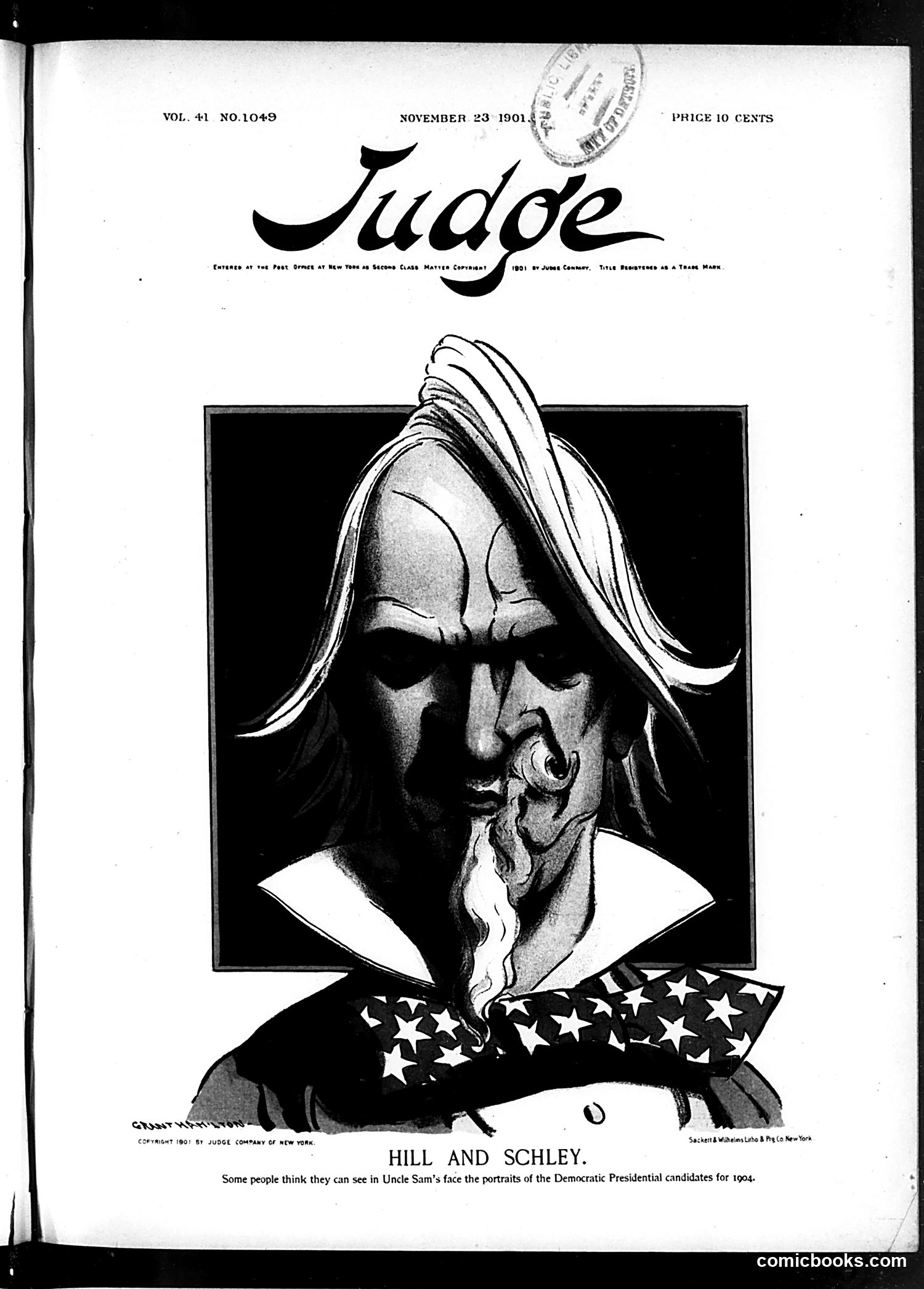
This political cartoon presents a caricatured face labeled "Hill and Scheley," referencing Democratic presidential candidates for the 1904 election. The figure wears Uncle Sam's characteristic starred clothing, and the caption notes: "Some people think they can see in Uncle Sam's face the portraits of the Democratic Presidential candidates for 1904." The satire suggests that these two Democratic politicians' features are so prominent or distinctive that they appear superimposed within Uncle Sam's visage—a visual joke about their political prominence. The exaggerated caricature style was typical of Judge's satirical approach. Without additional context, the specific identities and political positions of "Hill" and "Scheley" remain unclear to modern readers.
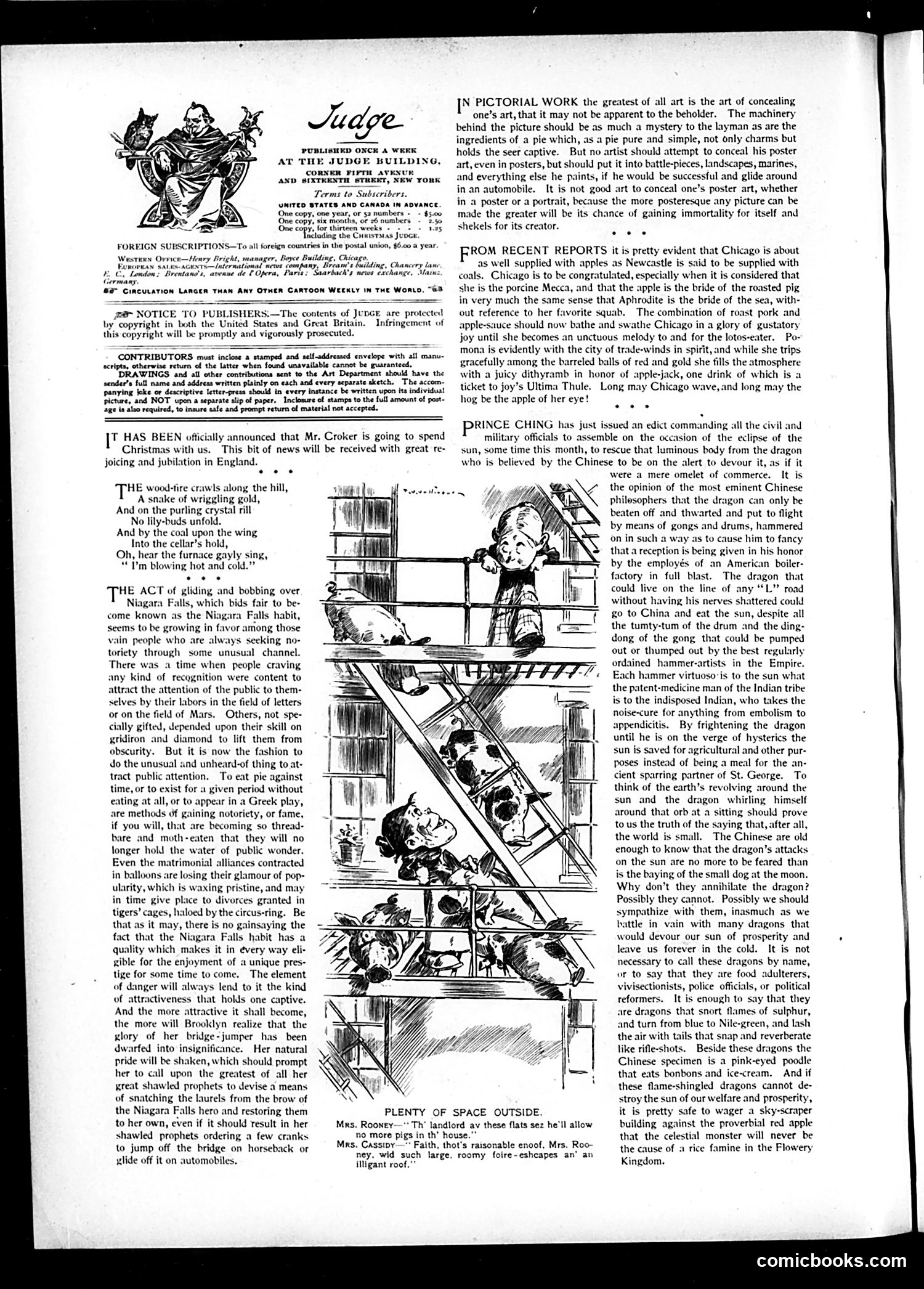
This page contains editorial commentary and a multi-panel cartoon titled "PLENTY OF SPACE OUTSIDE." The cartoon depicts what appears to be a residential building with tenants, likely satirizing housing conditions or tenant-landlord relations of the era. The text discusses Prince Ching's edict in China regarding dragon worship and imperial ceremonies. The longer commentary uses the dragon as metaphor to critique various American problems—reformers, politicians, and social issues—suggesting these are destructive forces comparable to mythical dragons. The page also includes a brief poetic verse about Niagara Falls and mentions Mr. Croker spending Christmas in England, though the specific context isn't clear from this excerpt alone. The overall tone is satirical social commentary typical of Judge magazine's style.
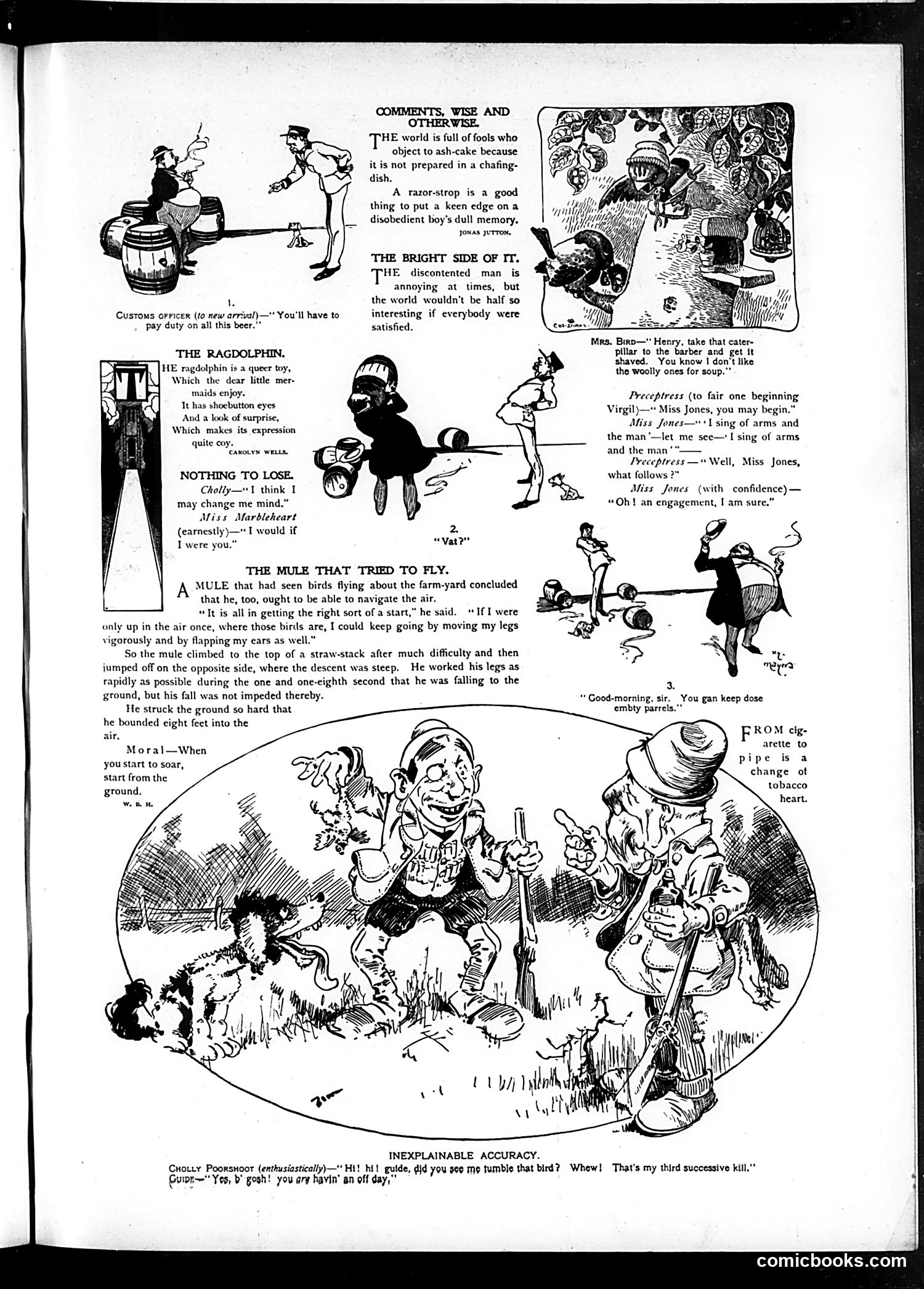
This page contains satirical humor and comic illustrations typical of early 20th-century Judge magazine. The content includes: **"The Ragdolphin"** - A whimsical piece about a creature that's part doll, part dolphin, mocking pseudo-scientific or fantastical descriptions. **"The Mule That Tried to Fly"** - A fable about a mule attempting aviation, illustrating the absurdity of creatures exceeding their natural capabilities—likely satirizing human overambition or people pursuing unsuitable occupations. **Various satirical vignettes** involving customs officers, domestic disputes, and social commentary on contemporary manners and behavior. The cartoon style and humor target everyday social situations and human folly rather than specific political figures or events. The overall tone is lighthearted mockery of pretension and impracticality.
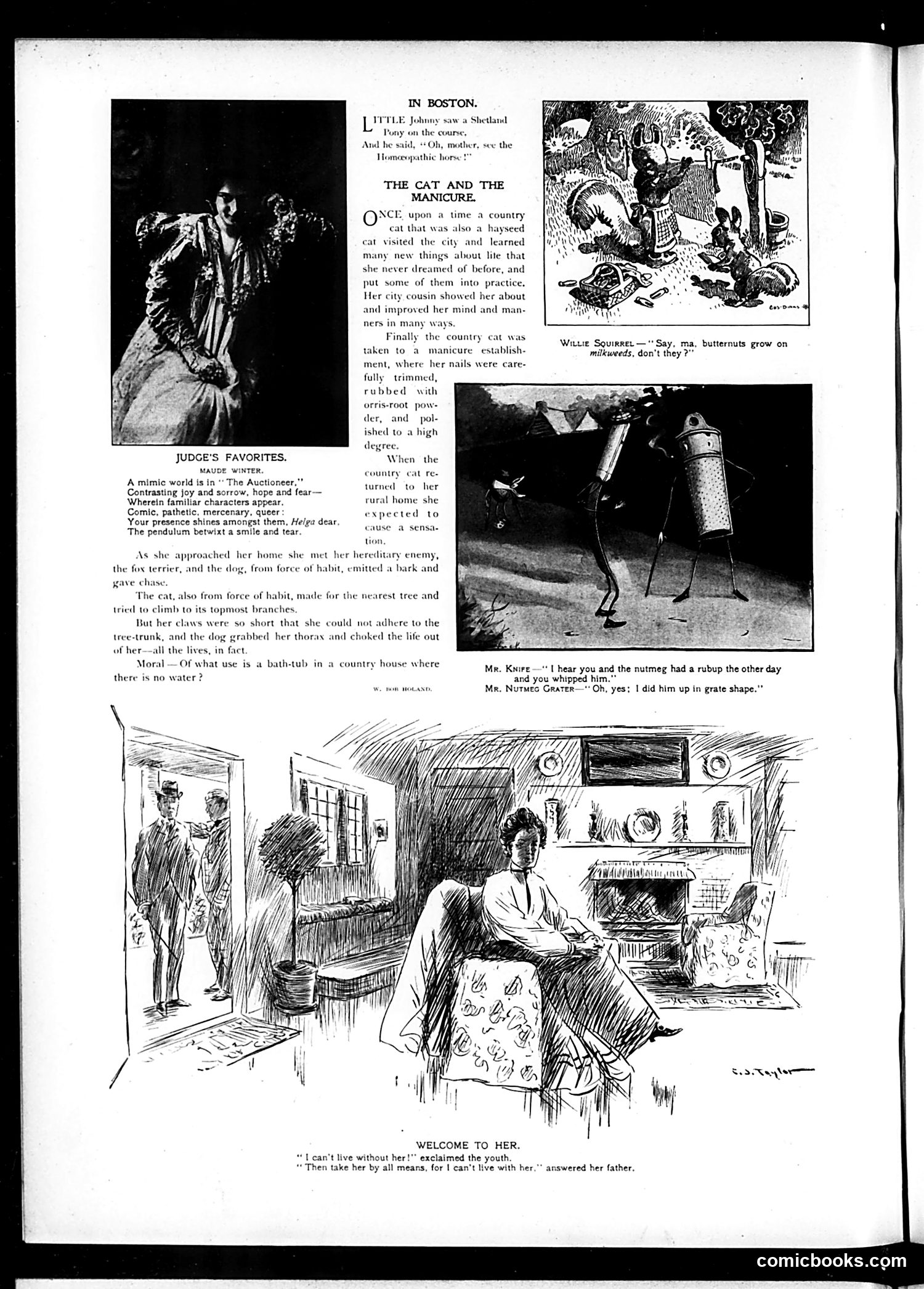
This page contains three distinct items: 1. **"Judge's Favorites"** (left): A theatrical photograph labeled "The Auctioneer" - likely showcasing a popular stage performance of the era, presented as entertainment commentary. 2. **"The Cat and the Manicure"** (top right): A humorous story about a country cat visiting the city and learning "refined" manners at a manicure establishment. The accompanying illustrations show comic situations (Willie Squirrel asking about buttercups). This satirizes rural-to-urban culture clash and the pretensions of cosmetic refinement. 3. **"Welcome to Her"** (bottom): A domestic sketch showing a young woman's arrival at her new home, with dialogue about her indispensability. This appears to comment on marriage dynamics and female dependency. The page mixes theatrical promotion, light satirical humor, and social commentary typical of Judge's format.
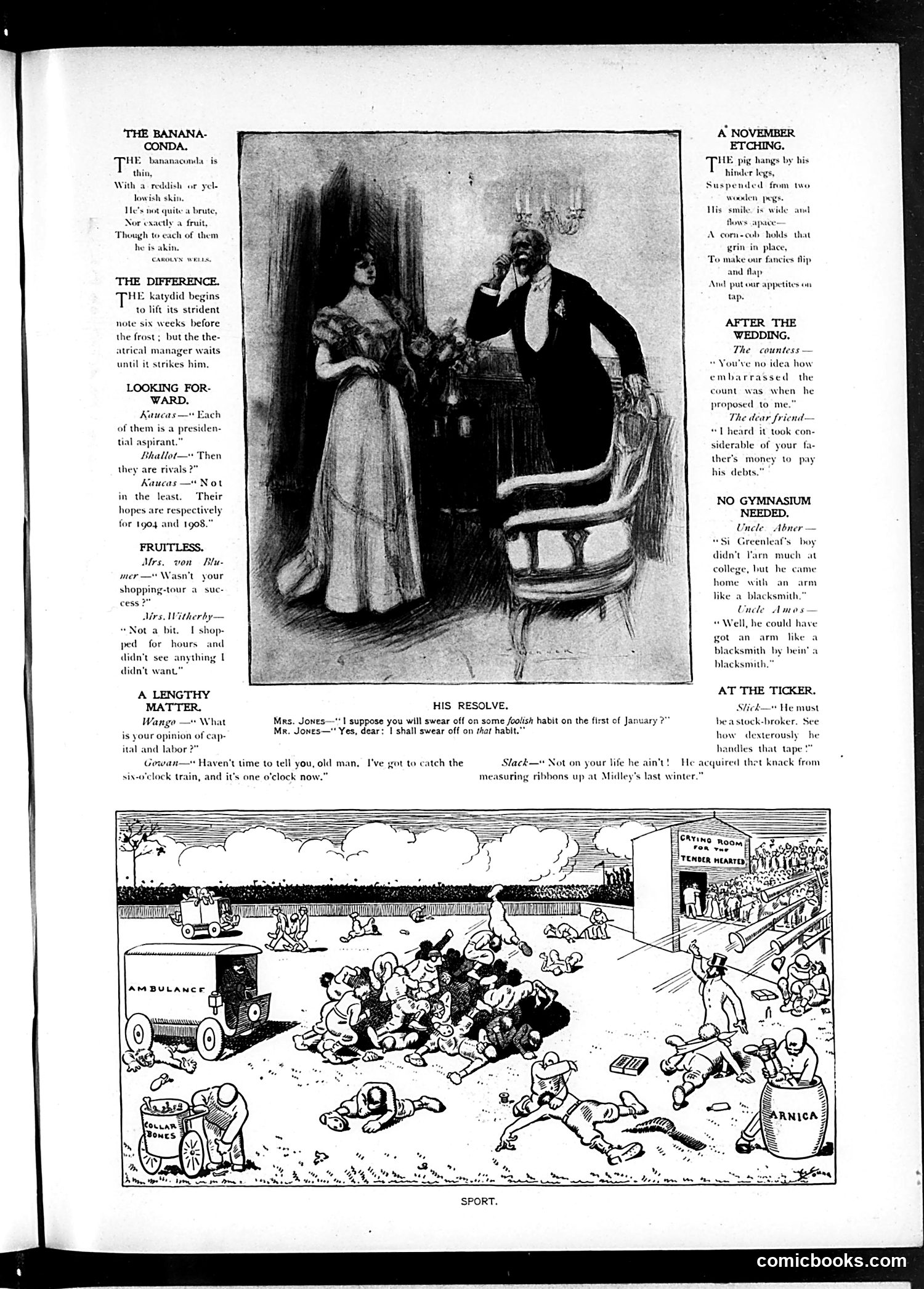
This page contains several short humorous pieces typical of early-20th-century American satirical magazines: **The main cartoon ("Sport")** depicts a chaotic accident scene with an ambulance, seemingly mocking the era's emerging "sport" of automobile driving—a dangerous new activity causing injuries and comedic mayhem. **The smaller text items** are brief jokes addressing contemporary social topics: - Class and marriage ("After the Wedding") mocks wealthy European nobility, suggesting the countess married for money to pay debts - Gender roles and shopping ("Fruitless") satirizes women's consumer culture - Labor negotiations ("A Lengthy Matter") comments on capital-labor disputes through rushed conversation - New Year's resolutions ("His Resolve") jokes about broken promises **The top illustration** appears to depict a formal social scene, likely illustrating one of the accompanying joke texts about etiquette or courtship. The humor relies on observational comedy about modern life, social pretension, gender relations, and contemporary anxieties—typical Judge magazine fare for educated, middle-class readers.
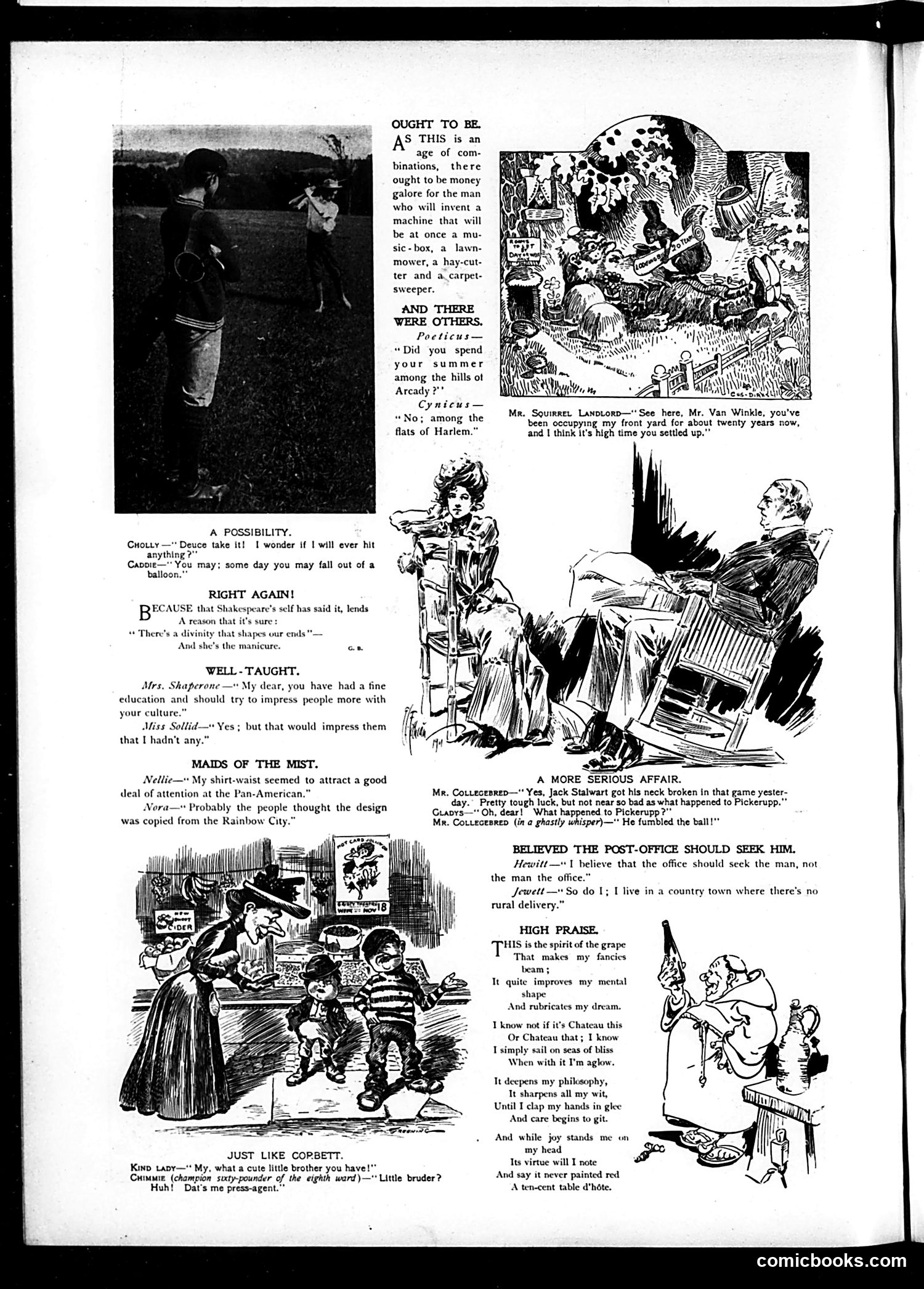
This page collects brief satirical jokes and cartoons typical of early 1900s American humor. Key items include: **"Ought to Be"**: Satirizes the era's enthusiasm for mechanized combination devices—imagining one machine serving as music box, lawn mower, hay-cutter, and carpet-sweeper. It mocks industrial-age optimism about labor-saving inventions. **Various social comedy bits**: Short exchanges mocking pretension ("culture"), romantic/marital dynamics, and period absurdities. "Right Again!" plays on Shakespeare references and manicure culture. **"Maids of the Mist"**: References the Pan-American Exposition (likely 1901 Buffalo fair), with "Rainbow City" being its nickname—a gentle joke about fashion trends. **"More Serious Affair"**: Dark humor about a football injury ("fumbled the ball"), showing period concern with the sport's dangers. **"High Praise"** and **"Just Like Corbett"**: Wine/alcohol humor and boxing references (Corbett was famous boxer James J. Corbett), reflecting popular male leisure interests. The overall tone is genteel satire aimed at middle-class readers, mixing wordplay with social observation.
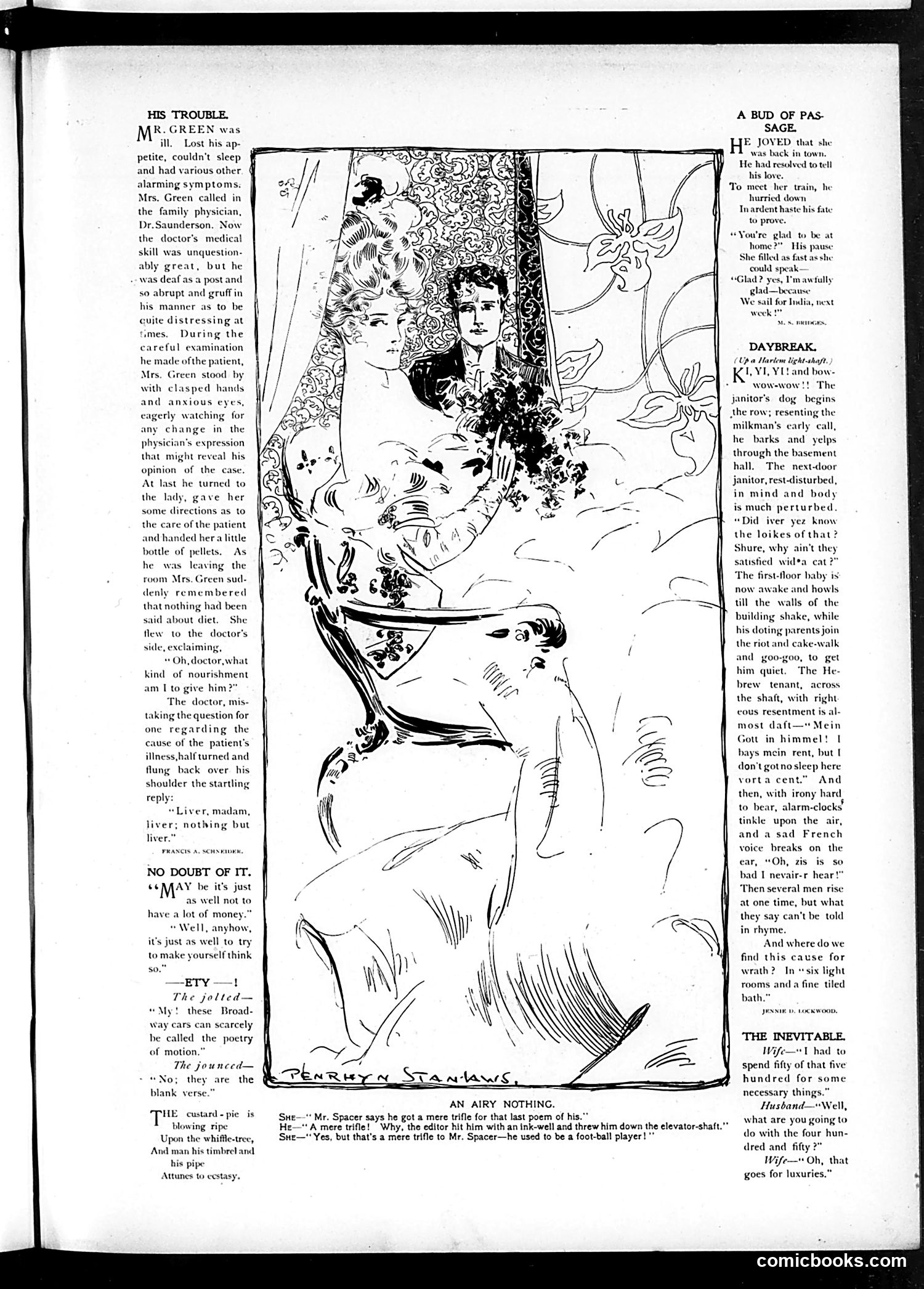
This page contains several short humorous pieces typical of early 20th-century American satirical magazines: **"His Trouble"** depicts a deaf doctor's misunderstanding: when Mrs. Green asks what to feed her ill husband, the doctor mishears her as asking about the *cause* of illness and replies "Liver, madam, liver"—implying the husband's liver is the problem, not that he should eat liver. **"An Airy Nothing"** mocks struggling poets: a editor's violent rejection (hitting with ink-well, throwing down elevator) is dismissed as a "mere trifle" because the poet formerly played football. **"Daybreak"** humorously catalogs urban noise complaints—dog, baby, janitor, French tenant—all supposedly in a building advertised as having "six light rooms and a fine tiled bath," satirizing real estate marketing that ignores neighborhood reality. **"The Inevitable"** jokes about wives' spending: the husband assumes the remaining money will go to "luxuries" after "necessary things." These reflect common early 1900s urban frustrations and gender dynamics around money and domestic life.
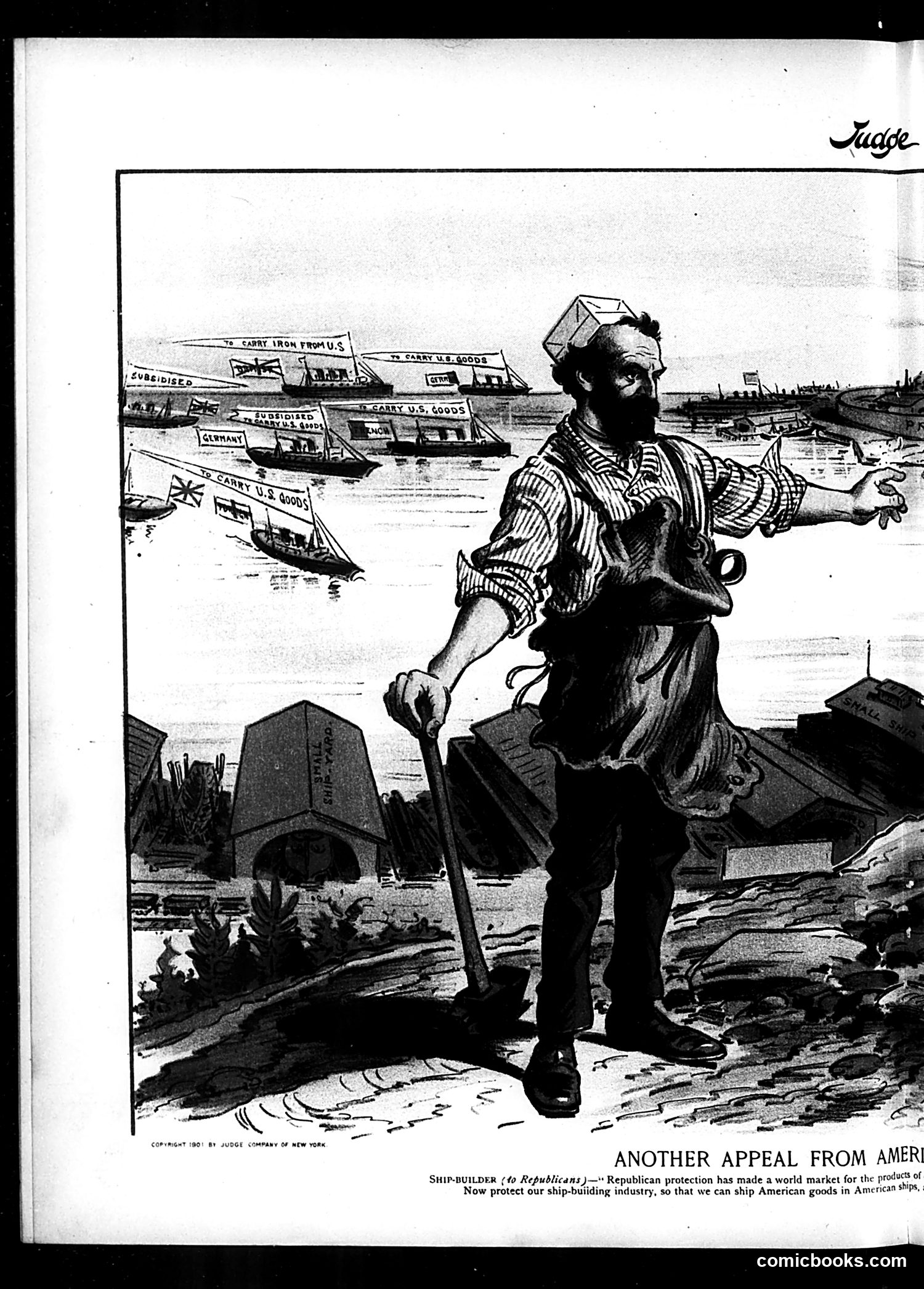
This is a political cartoon advocating for Republican protectionist policies. The figure is labeled a "Ship-Builder" addressing Republicans, making an appeal for tariff protection of the American shipbuilding industry. The cartoon's argument is circular: Republican protection allegedly created markets for American products worldwide, so now Republicans should protect shipbuilding specifically so American goods can be transported in American-built ships rather than foreign ones. The background shows various cargo ships labeled with "U.S. GOODS," illustrating the concern that American merchandise is being shipped in non-American vessels. The satire critiques the self-interested lobbying of industrialists who benefit from protective tariffs—they want continued government favor to monopolize shipping their own goods. This reflects early 1900s debates over American protectionism and industrial policy.
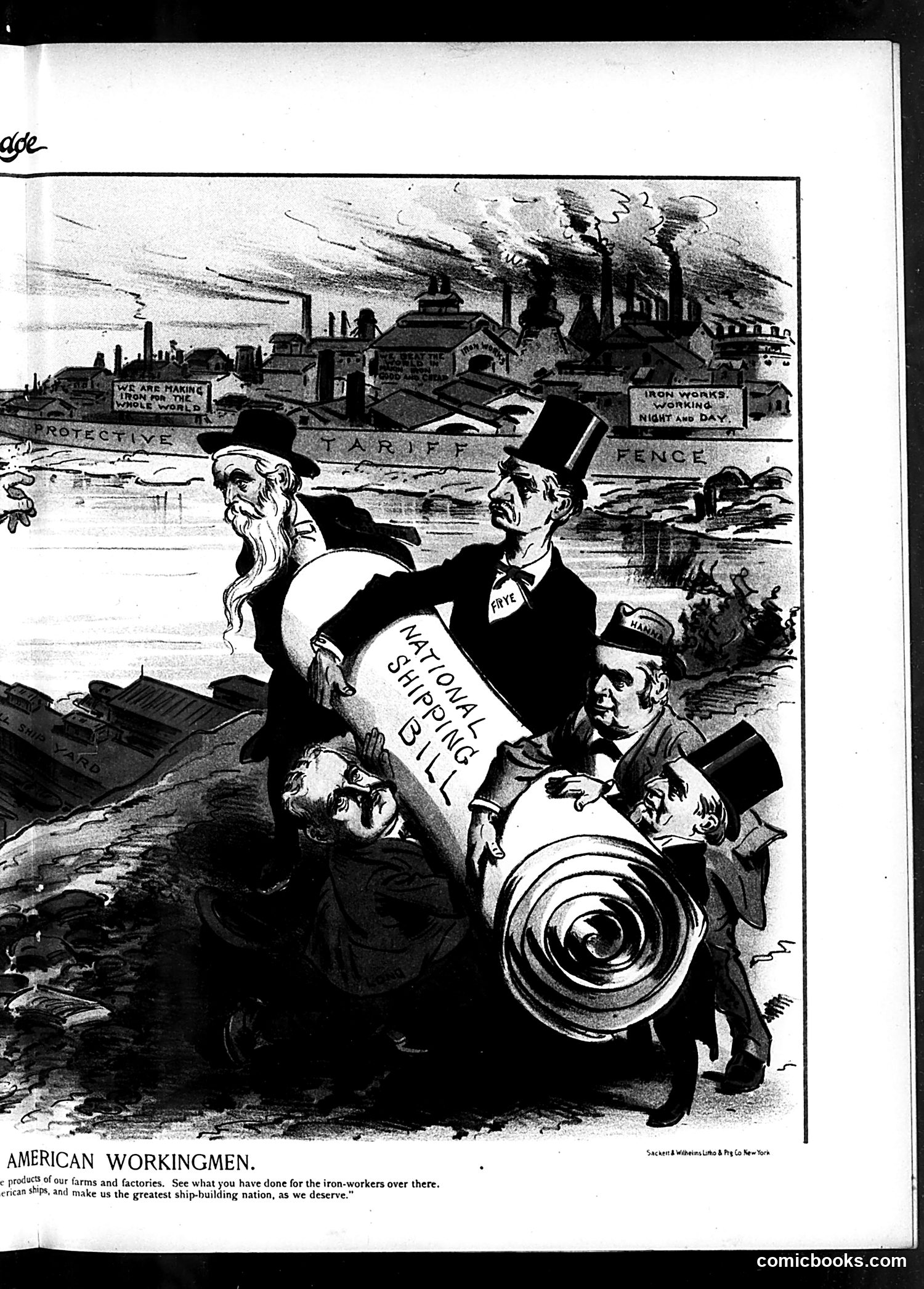
This political cartoon satirizes American workers and their advocates during what appears to be a World War I-era shipbuilding debate. The caricatured figures—including men in top hats labeled with positions like "FRYE" and "MANILA"—represent political/business leaders promoting nationalist shipbuilding interests. They're depicted literally carrying a large scroll reading "NATIONAL SHIPPING BILL" while invoking concern for "iron-workers." The industrial backdrop shows factories and smokestacks, emphasizing manufacturing capacity. The satire suggests these elites are manipulating working-class concerns about job creation and national strength to advance their own agenda. The text's appeal to "make us the greatest ship-building nation" reveals how patriotic rhetoric was being used to push specific economic policies that may have benefited corporations more than workers themselves.
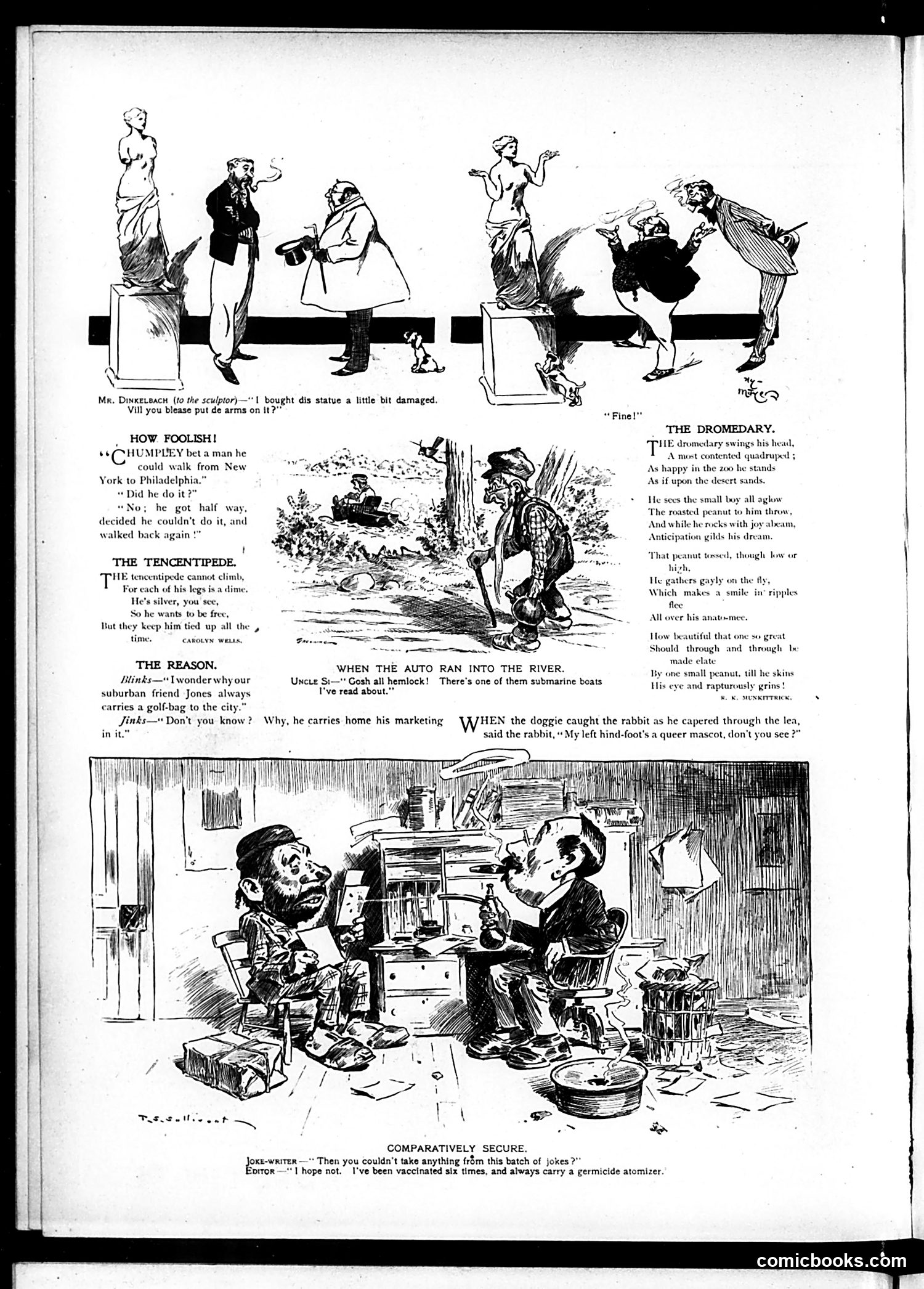
This page contains several short humorous pieces typical of early 20th-century American satirical magazines: **Top panels**: Sketches depicting social situations—a sculptor accused of damaging a statue, and various comedic interactions. **"How Foolish"**: A joke about someone betting they could walk New York to Philadelphia, turning back halfway—mocking overconfidence. **"The Tencentipede"**: A play on words about a centipede whose legs are dimes (ten cents each), wanting freedom but kept restrained—possibly satirizing financial constraints or labor issues of the era. **"The Reason"**: A joke about Jones carrying a golf bag to the city for his "marketing"—implying deceptive or leisure-focused business practices. **Verses and illustrations**: Light poetry about a dromedary (camel), an auto accident, and a rabbit-and-dog chase—simple observational humor. **Bottom panel**: "Comparatively Secure"—a joke about a journalist/editor who's been vaccinated multiple times and carries germicide, suggesting anxiety about contamination from "bad jokes." The page is mostly gentle, domestic humor without apparent political commentary.
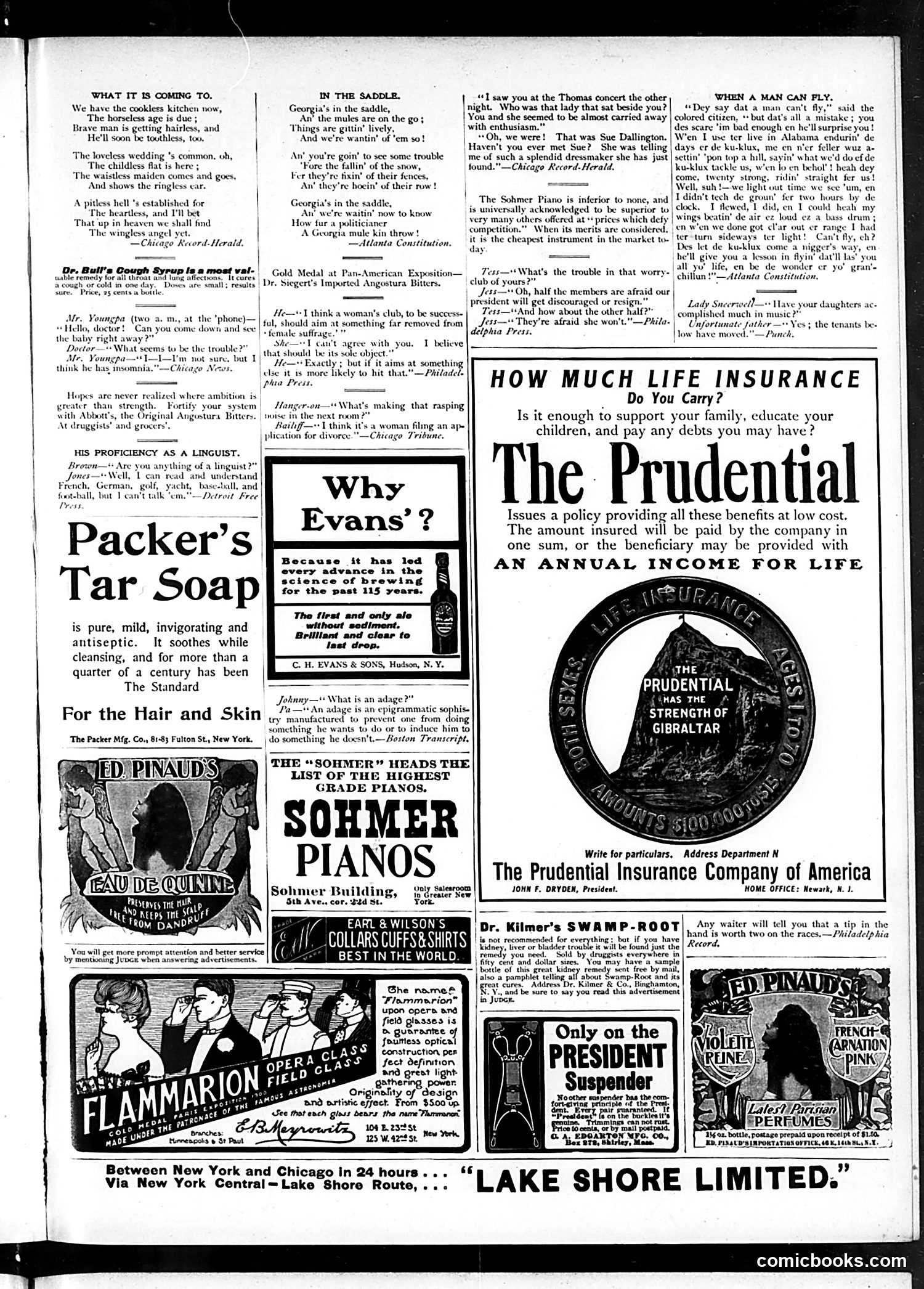
This page is primarily **advertising**, interspersed with short humorous items typical of Judge magazine's satirical style. The notable cartoon/joke content includes: **"What It Is Coming To"** — A satirical poem lamenting modern loss of traditional things: cookless kitchens, horseless carriages, hairless men, loveless weddings, childless homes, waistless women. The satire mocks anxiety about rapid industrialization and social change. **"Georgia in the Saddle"** — A dialect poem using rural/minstrel-show language, apparently referencing Georgia politics (likely post-Reconstruction era given the "mule" metaphor common in Southern political satire). The meaning is unclear without more historical context. **Various short joke items** about gender relations, divorce filing, and a lengthy dialect story about the Ku Klux Klan using racist stereotypes and minstrel-show language—reflecting the casual racism endemic to period publications. The remainder consists of advertisements for products (Packer's Tar Soap, Evans' ale, Sohmer Pianos, Prudential Insurance, etc.), which was standard Judge revenue.
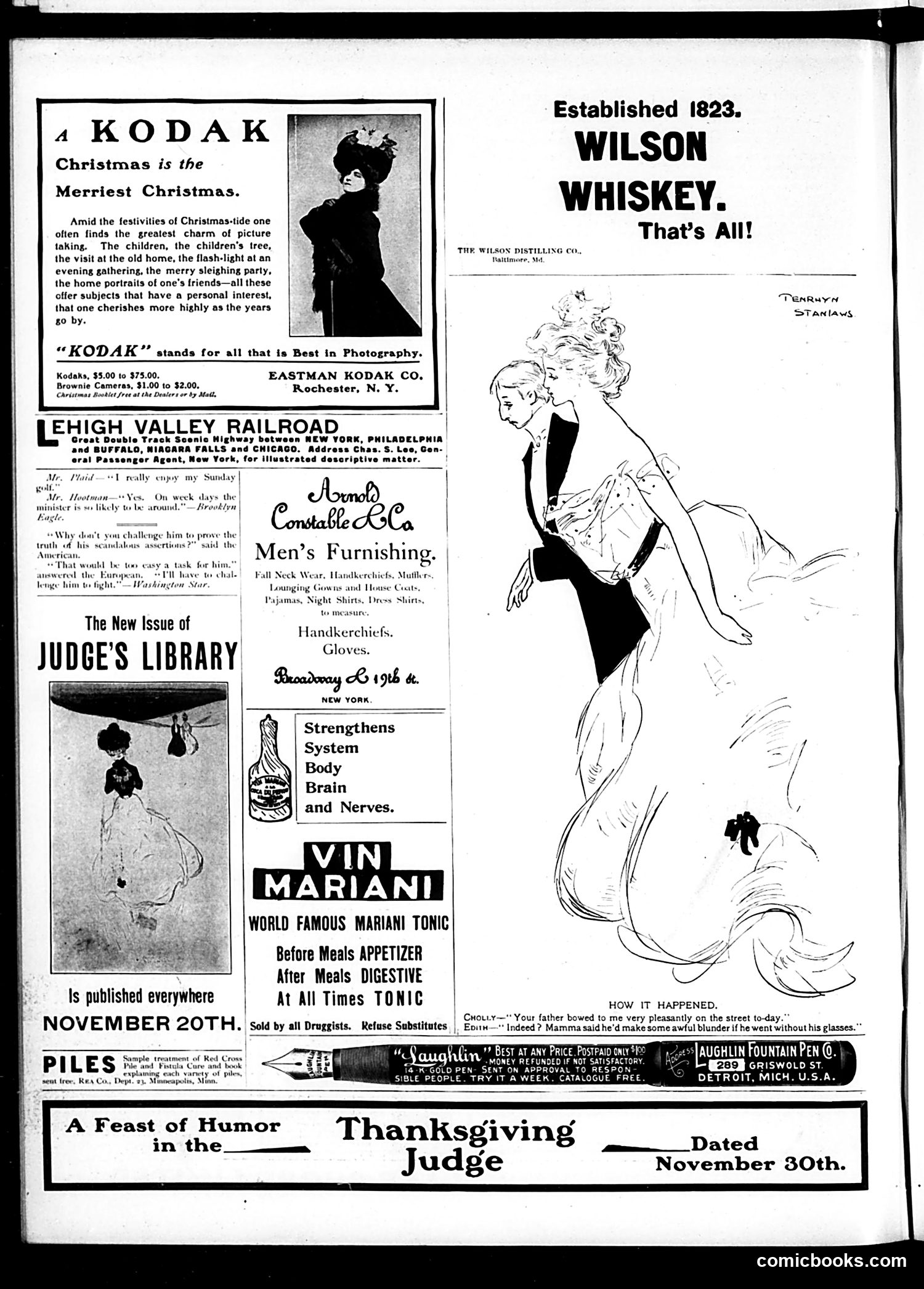
This page is primarily **advertising**, with a small comic dialogue at the bottom. The main visual content features a large illustration of a woman in an elegant black dress and feathered hat—typical Gibson Girl-style fashion of the era. The only joke/comic content is the brief exchange labeled "HOW IT HAPPENED": A woman (Crouty) reports that a man bowed to her pleasantly on the street. Her companion (Edna) replies that the man's mother said he'd "make some awful blunder if he went without his glasses"—implying he didn't recognize who Crouty was and bowed to the wrong person entirely. **The satire**: Genteel social pretense meets practical reality. The joke mocks both the formality of street etiquette and vanity, suggesting that courtesy may stem from poor eyesight rather than genuine recognition or respect. The page also advertises Wilson Whiskey, Kodak cameras, men's furnishings, Vin Mariani tonic (a wine-based patent medicine), and other period products typical of Judge's revenue model.
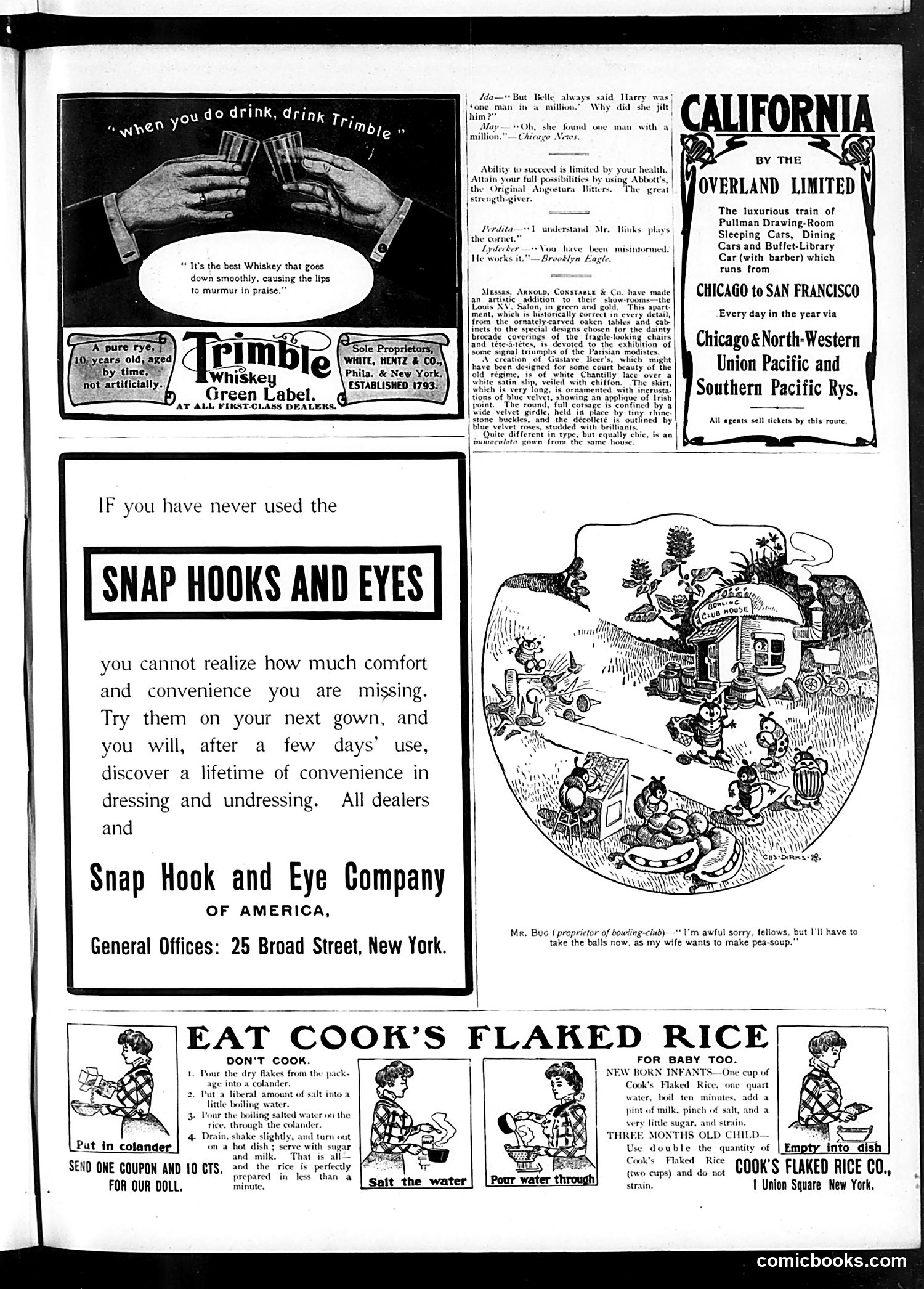
This page is primarily **advertising** with one cartoon. The ads promote consumer products (Trimble Whiskey, Snap Hooks and Eyes, Cook's Flaked Rice, the Overland Limited train) typical of early 20th-century magazine commerce. The single cartoon depicts **Mr. Bucks, proprietor of a bowling club**, apologizing to patrons because his wife needs the bowling balls to make pea soup—an absurd domestic interruption. The humor relies on the incongruity of using sporting equipment for cooking and the hen-pecked husband trope common to period comedy. The joke satirizes male subservience to wives' domestic demands, a recurring theme in Judge's humor. The page reflects turn-of-the-century American consumer culture and gender dynamics, where wives' domestic authority could override husbands' leisure activities without question—presented here as humorous rather than problematic.
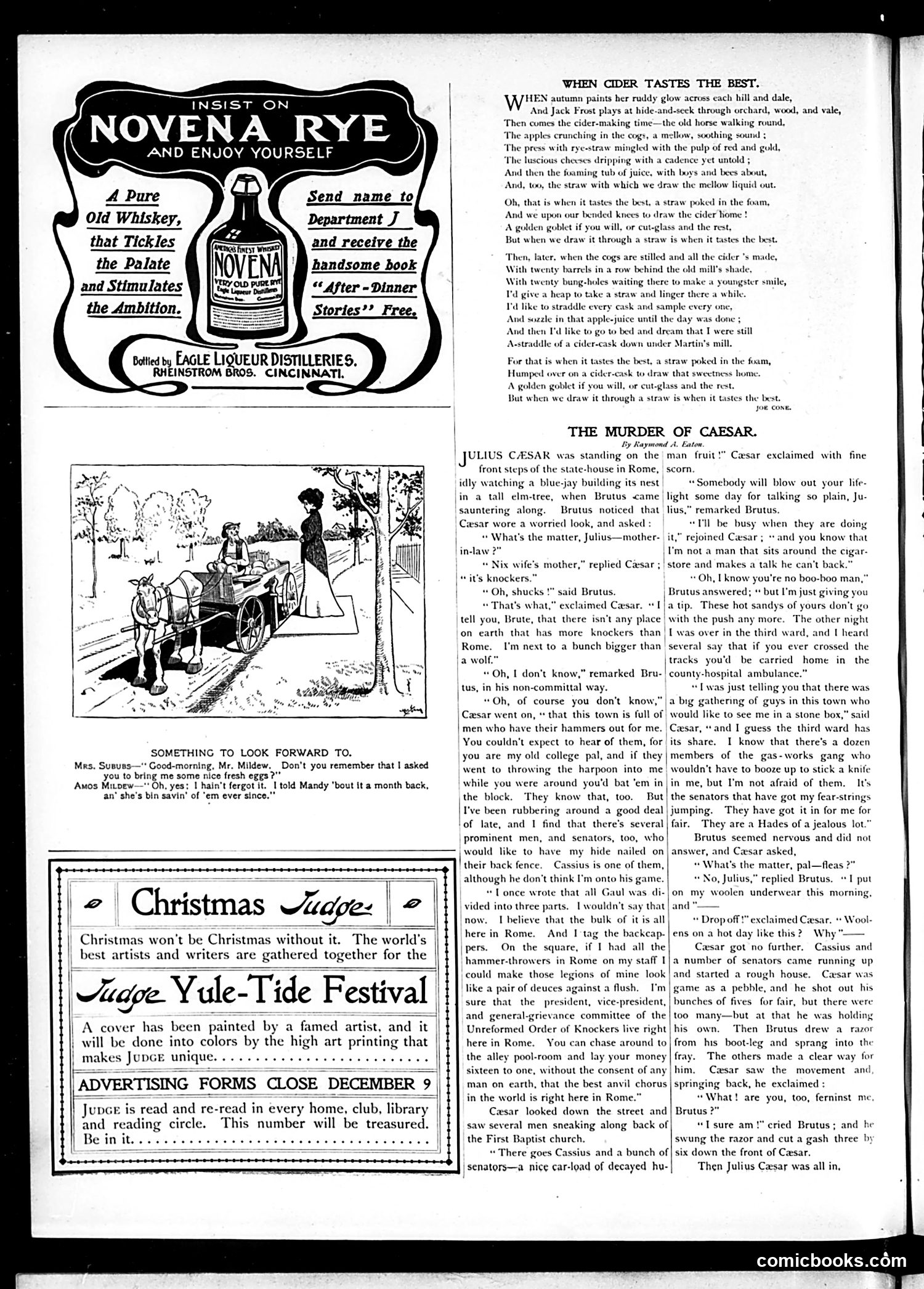
This page contains primarily **advertising and light humor** rather than political satire. **Main Elements:** 1. **Novena Rye Whiskey Ad**: A liquor advertisement promoting whiskey as a digestive aid that "tickles the palate and stimulates the ambition"—typical early 20th-century patent medicine marketing. 2. **"Something to Look Forward To"**: A domestic humor comic strip about a man who was supposed to bring fresh eggs a month ago but hasn't delivered—gentle, class-based humor about rural/working-class domestic life. 3. **"When Cider Tastes the Best"**: A nostalgic poem celebrating autumn cider-making, depicting rural Americana with romantic imagery of farm life and straw-drawn cider. 4. **"The Murder of Caesar"**: A comedic short story using Caesar's assassination as a setup for modern urban humor—Caesar complains about "knockers" (door-to-door solicitors) and suspicious colleagues in Rome, playing ancient history against contemporary annoyances. 5. **Christmas Judge Advertisement**: Promotional material for an upcoming holiday issue. The page reflects early 20th-century American concerns: consumer products, rural nostalgia, and domestic comedy.
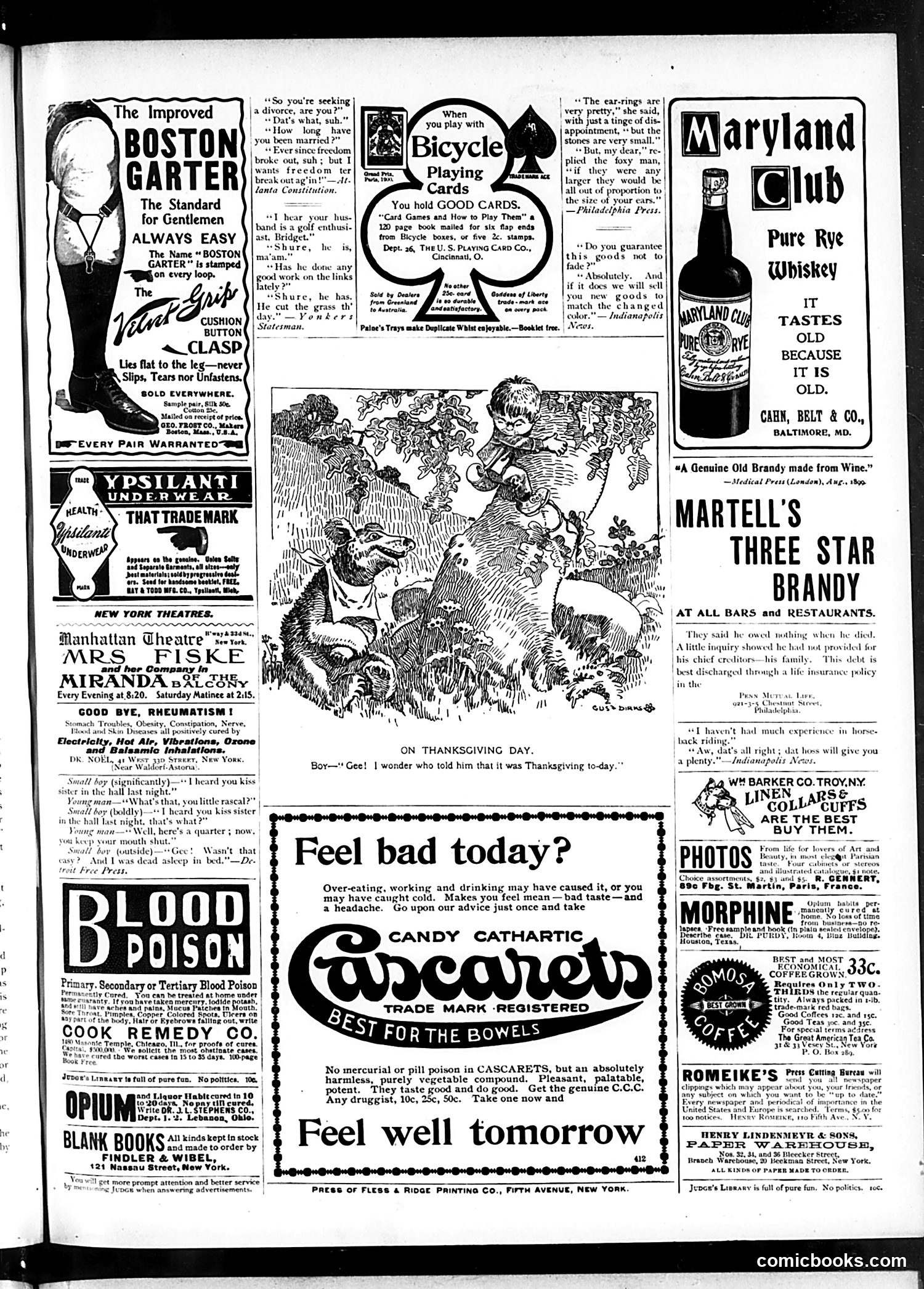
This Judge magazine page (mostly advertisements with one cartoon) centers on a **Thanksgiving Day joke** about a small boy and racial stereotypes. The main cartoon depicts a **young African American boy** teasing a white boy about catching him kissing his sister. The humor relies on minstrel-show dialect ("Gee!") and the "innocent child speaking truth" trope—a stock device in period humor. The page is otherwise filled with **late-19th-century patent medicine and product ads**: blood poison cures, morphine products, "Cascarets" candies (laxatives), and various dubious medical remedies reflecting an era before FDA regulation. These ads reveal what people actually feared (rheumatism, constipation, venereal disease) and the snake-oil solutions marketed to them. The **Maryland Club whiskey and Martell's brandy ads** show alcohol was openly advertised in family magazines. Overall, the page documents period attitudes toward race, commerce, and unregulated medicine—all quite foreign to modern standards.
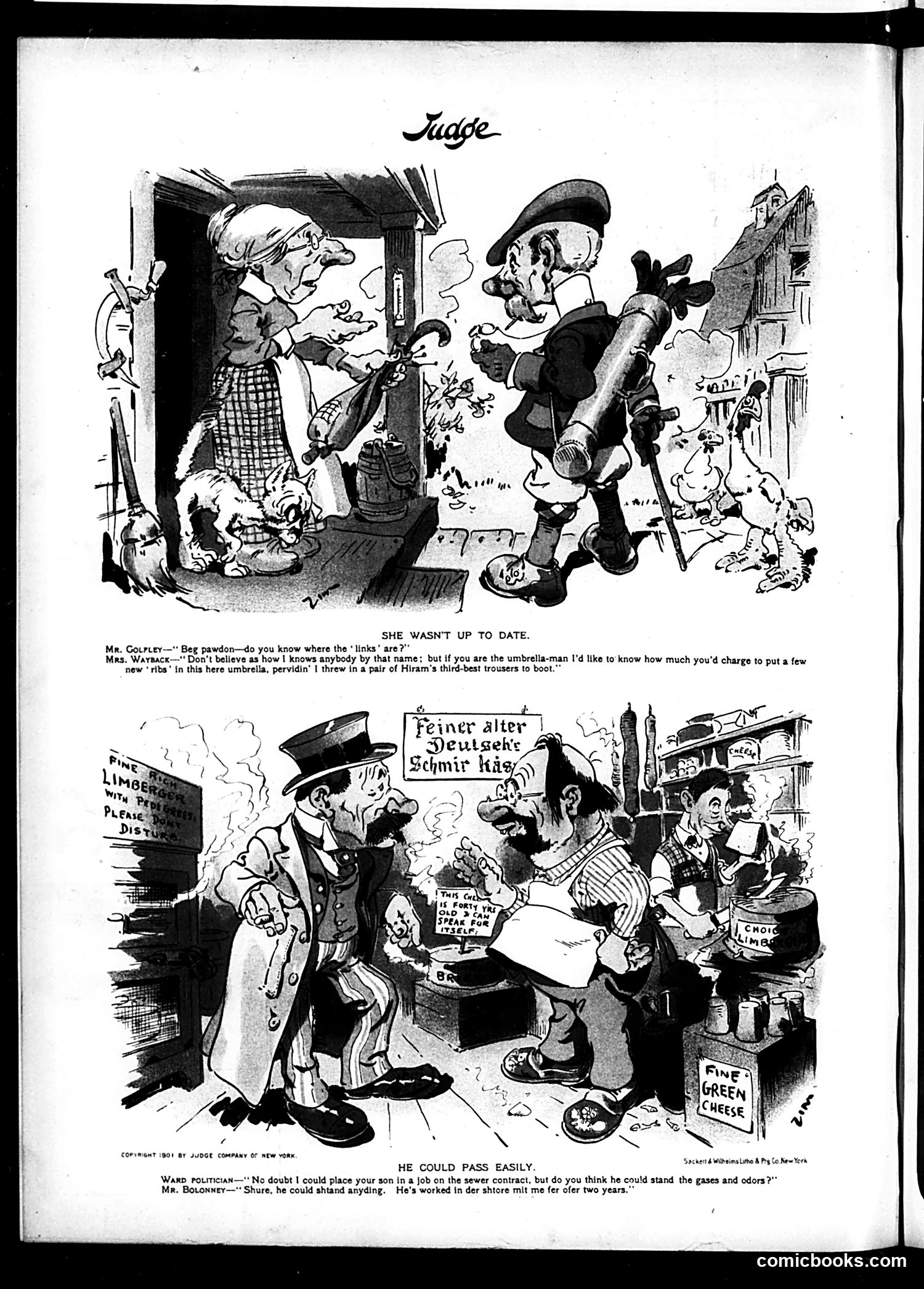
**Top cartoon ("She Wasn't Up to Date"):** A woman mishears "links" (golf courses) as a person's name, responding with working-class dialect about umbrella repairs. The satire mocks lower-class unfamiliarity with upper-class leisure activities like golf—a genteel sport associated with wealth and refinement. **Bottom cartoon ("He Could Pass Easily"):** A ward politician offers a sewer job to an immigrant father, questioning if his son could tolerate the fumes. The father boasts the boy can "shtand anyding" after working in their store. The satire ridicules both political patronage (jobs awarded through connections rather than merit) and immigrant stereotypes—portrayed through exaggerated dialect ("shtand," "shtore," "ofer")—suggesting immigrants were suited only for the dirtiest work. Both cartoons use class and ethnic humor typical of early-1900s American satire, reflecting contemporary anxieties about immigration and social mobility.
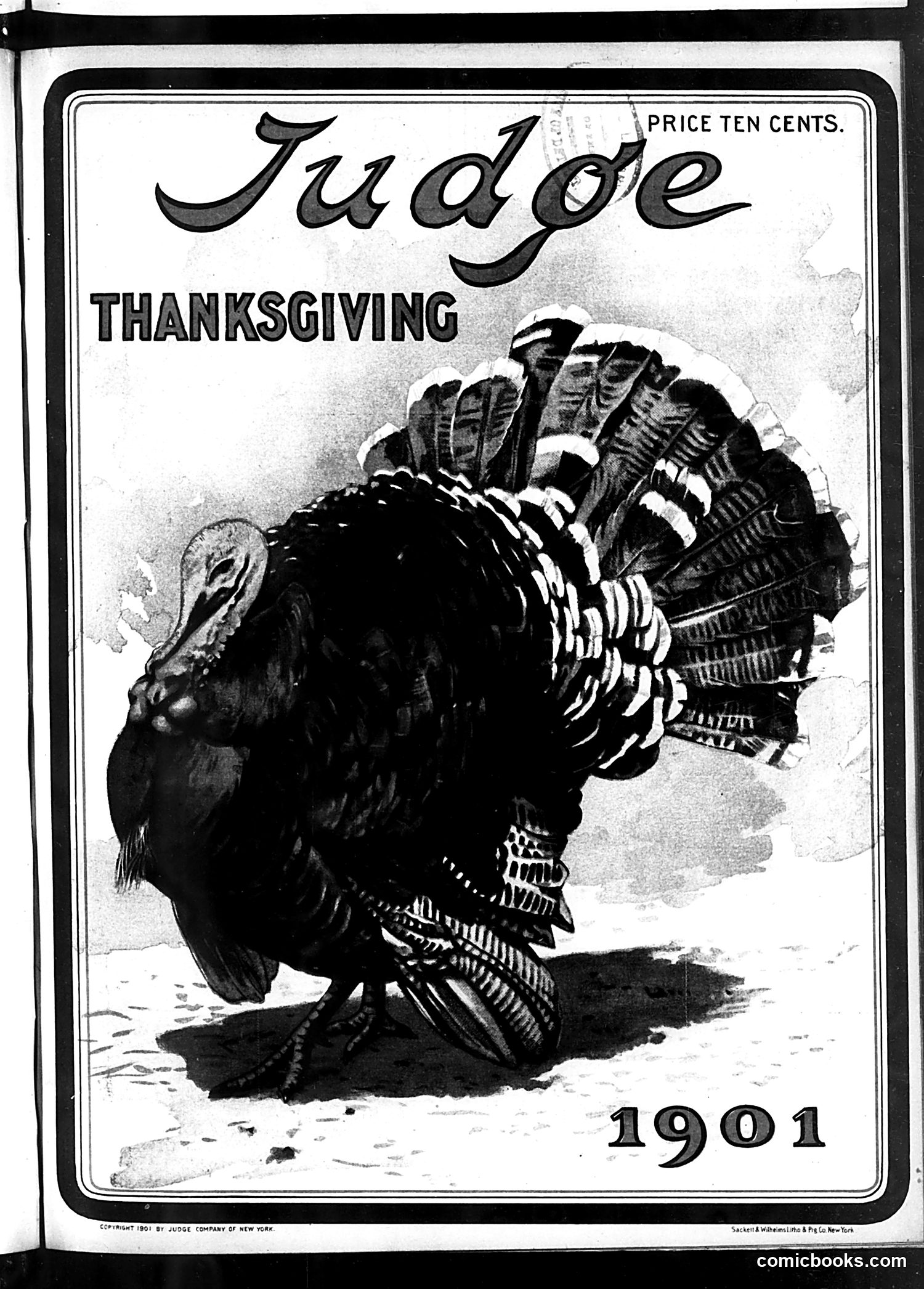
This is the cover of *Judge* magazine's Thanksgiving issue from 1901. It features a detailed illustration of a turkey in a characteristic Thanksgiving pose—displaying its elaborate tail feathers and puffed chest—rendered in bold black and white. The image is straightforward seasonal imagery rather than political satire. The turkey was already an established symbol of American Thanksgiving by this date. The cover functions as holiday decoration and theme-setting for the magazine's contents, which likely included holiday-themed humor and commentary throughout the issue. At ten cents, this represented the magazine's standard price point for the era. No specific political figures or satirical commentary appears evident on this particular cover.
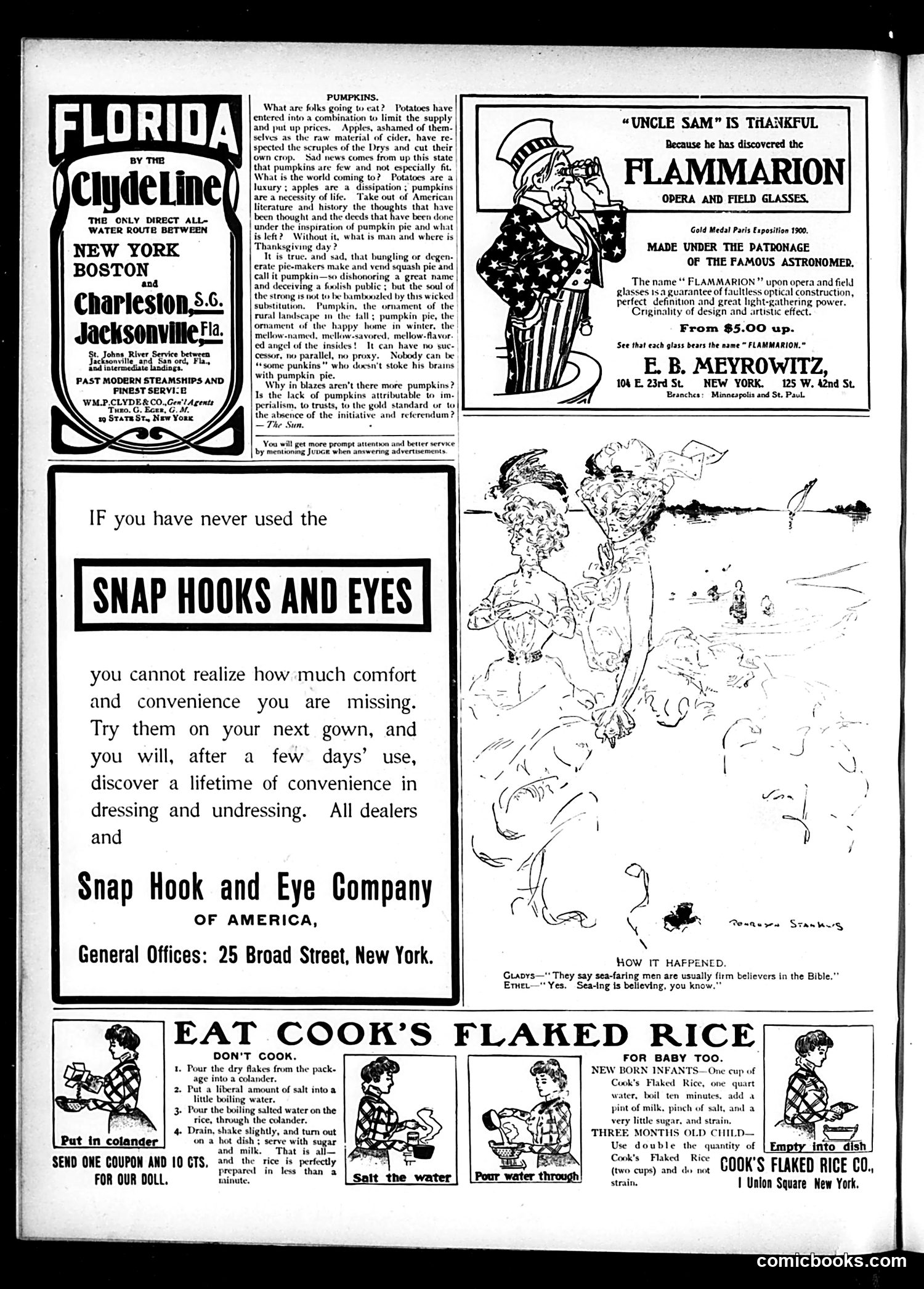
This page is primarily **advertising** with minimal editorial content. The main notable item is a cartoon titled "How It Happened" featuring two characters—Gladys and Ethel—making a pun about sea-faring men and faith. Ethel jokes that sailors believe in the Bible because "sea-ing is believing"—a visual/phonetic play on "seeing" and "sea." It's mild wordplay typical of the era's humor. The rest of the page consists of product advertisements: Florida steamship routes, Flammarion opera glasses (endorsed by "Uncle Sam"), snap hooks and eyes for clothing, and Cook's Flaked Rice (with instructions for infant feeding). There's also a brief editorial piece about pumpkins lamenting their scarcity and questioning why (blaming imperialism, trusts, and the gold standard), though this appears tangential. The page represents Judge's typical mix of light satire and commercial promotion rather than substantive political commentary.