
A complete issue · 16 pages · 1901
Judge — November 2, 1901
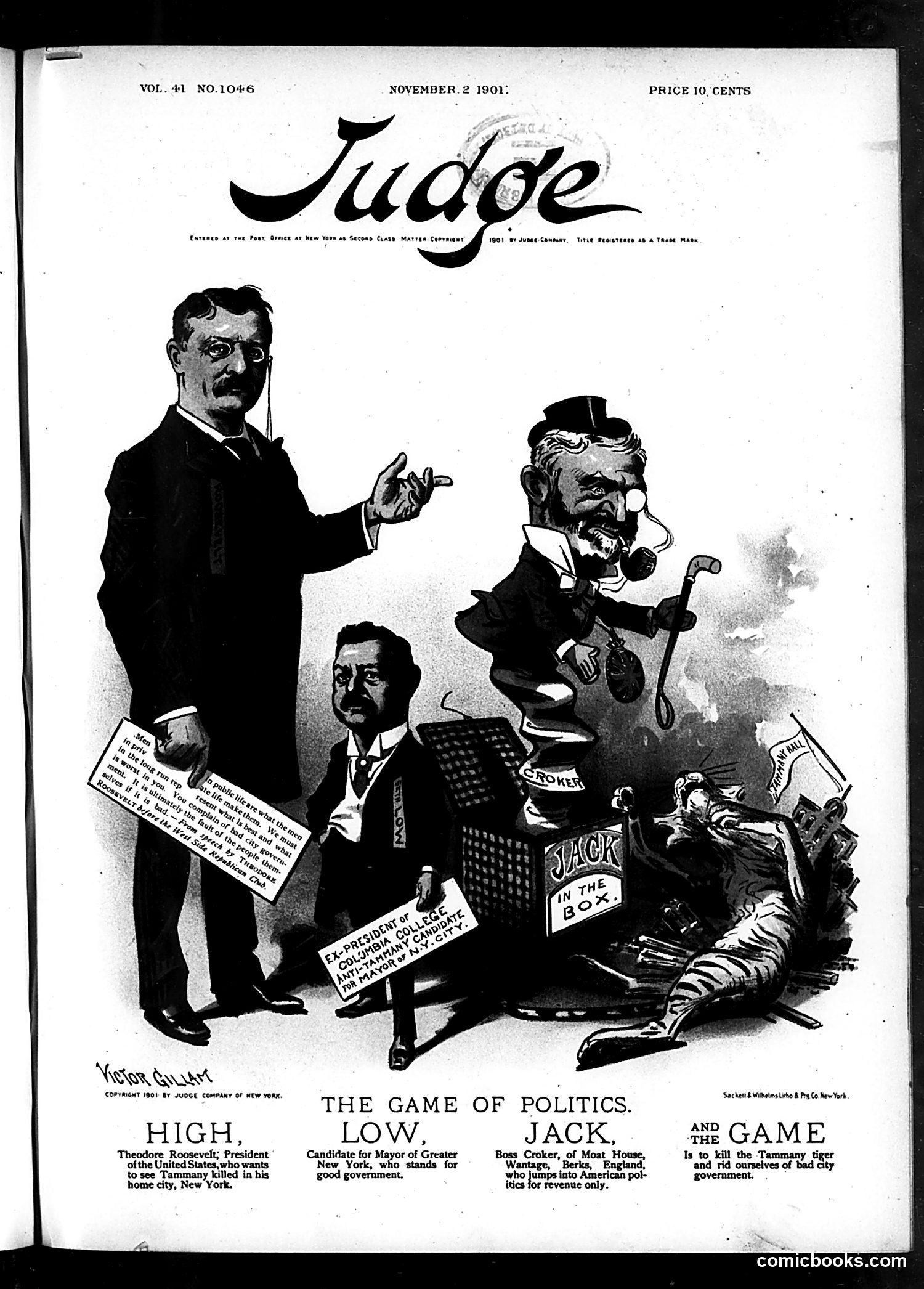
This satirical cartoon depicts four figures in a political game: **"HIGH"** (left): Theodore Roosevelt, U.S. President, wanting to kill the Tammany Hall political machine in New York City. **"LOW"** (center): A candidate for NYC Mayor representing good government reform. **"JACK"** (right): Boss Croker of Tammany Hall (a powerful Democratic political organization in New York), shown as a caricature smoking a pipe, who "jumps into American politics for revenge only." **"THE GAME"** (right, small figure): A tiger representing the goal—to eliminate Tammany Hall's corrupt city government. The cartoon frames this as a card game where Roosevelt, reformers, and Croker compete over control of New York politics. Tammany Hall was infamous for machine politics and corruption in the Gilded Age.
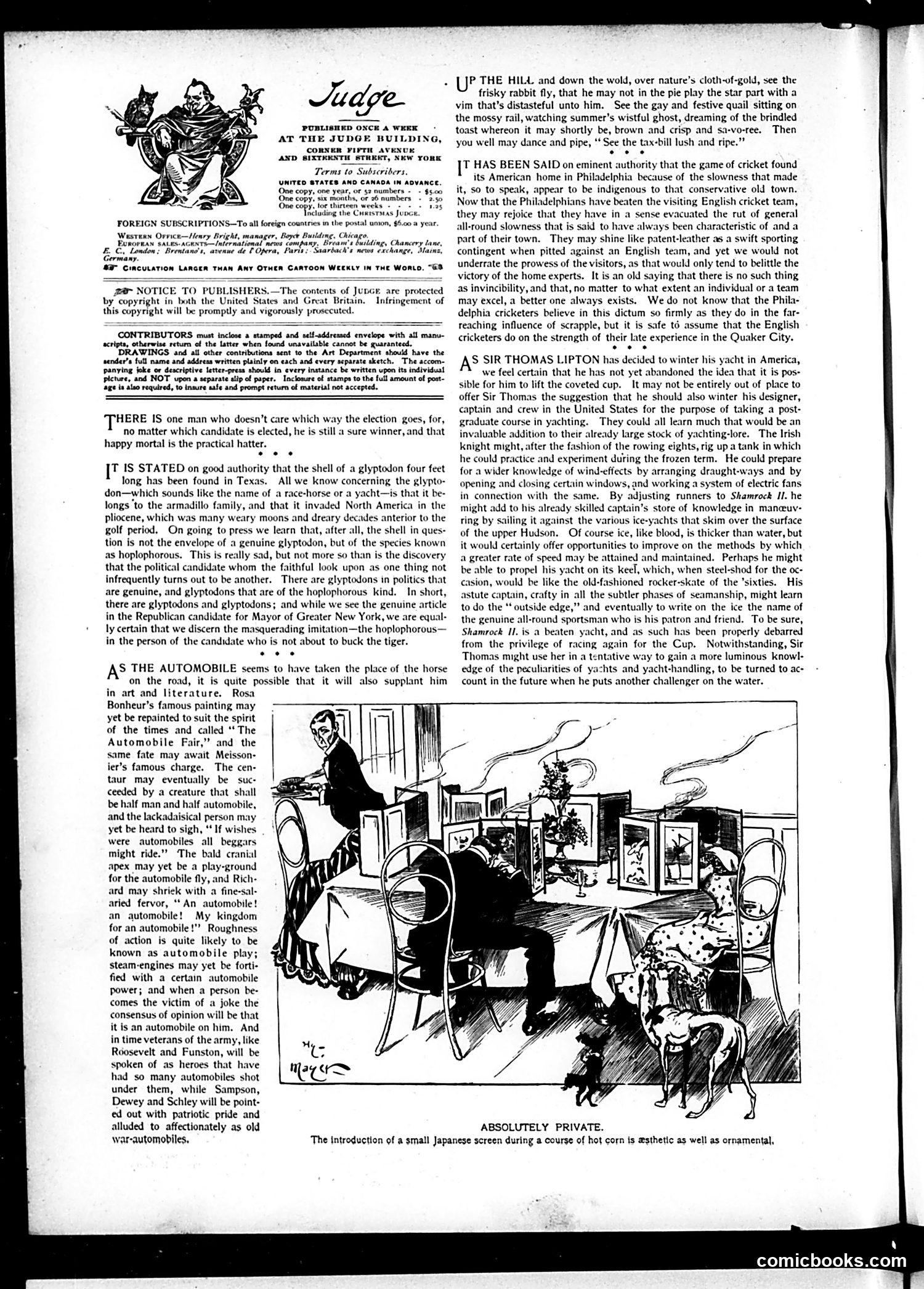
This page contains a satirical cartoon titled "ABSOLUTELY PRIVATE," depicting a domestic scene where a man sits reading while a woman operates what appears to be a Japanese folding screen or room divider decorated with hot corn imagery. The satire likely mocks the fashionable adoption of Japanese aesthetic elements in American homes during the early 20th century. By juxtaposing refined "artistic" Japanese décor with mundane American domestic life (and specifically hot corn—a lowbrow food reference), Judge ridicules wealthy Americans' pretentious embrace of exotic design trends while remaining fundamentally American in their actual lives and tastes. The accompanying text discusses Philadelphia cricket teams and yachting, suggesting the page addresses upper-class leisure pursuits and social aspirations more broadly.
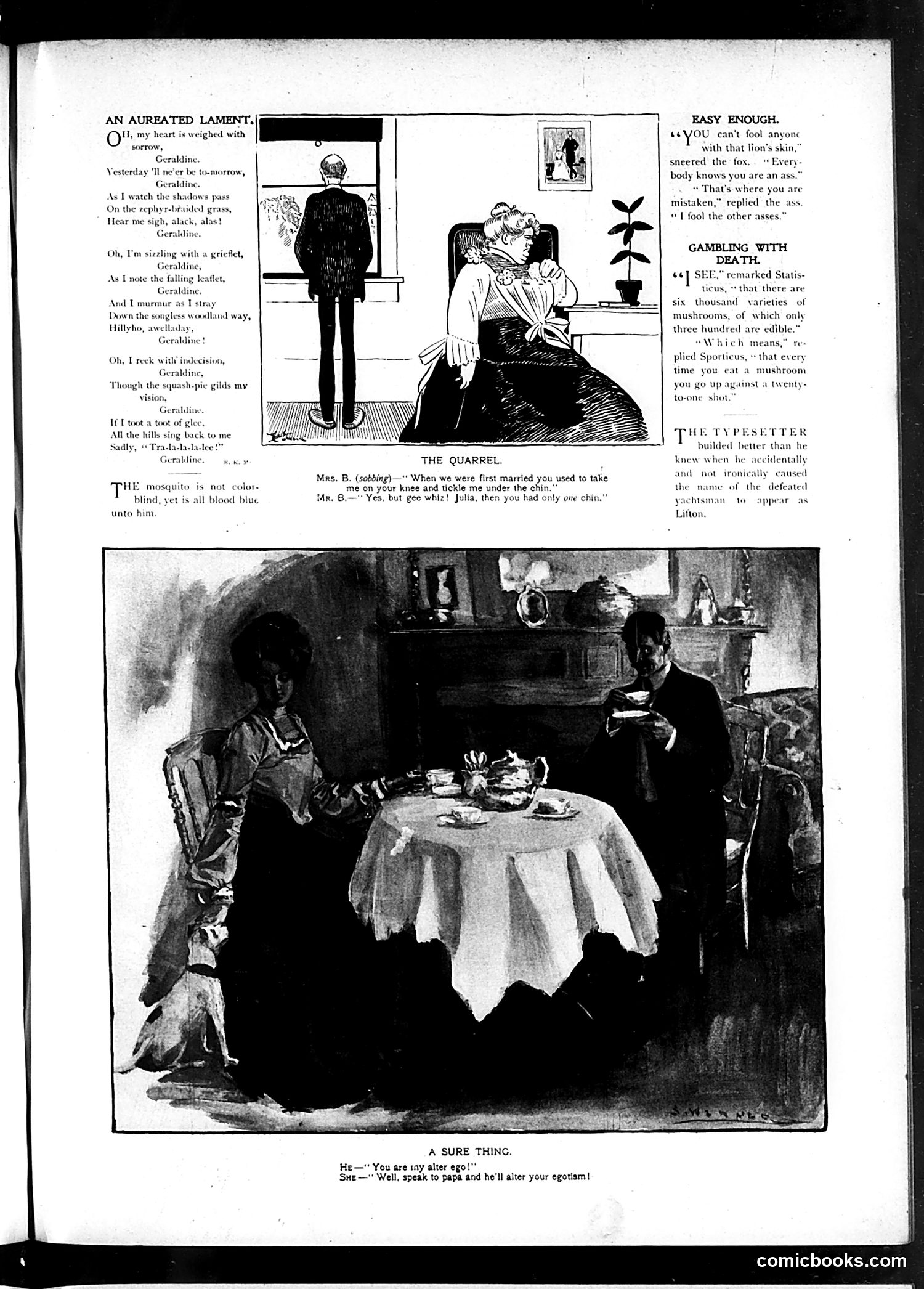
This page contains several satirical pieces typical of early 20th-century American humor: **"An Aureated Lament"** is a poem in the voice of "Geraldine," likely a working-class character lamenting poverty and hardship—the repetitive refrain suggests resigned acceptance of her difficult circumstances. **"The Quarrel"** cartoon depicts a marital dispute where the husband criticizes his wife for her extravagance, referencing her past frugality before marriage. It's a commentary on changing behavior after marriage and domestic financial conflict. **"A Sure Thing"** shows a couple where she tells him to speak to her father about altering his egoism—likely mocking male stubbornness and suggesting paternal intervention in marriage problems. The page primarily satirizes domestic life, class struggle, and marital discord common to Judge's satirical focus on American society.
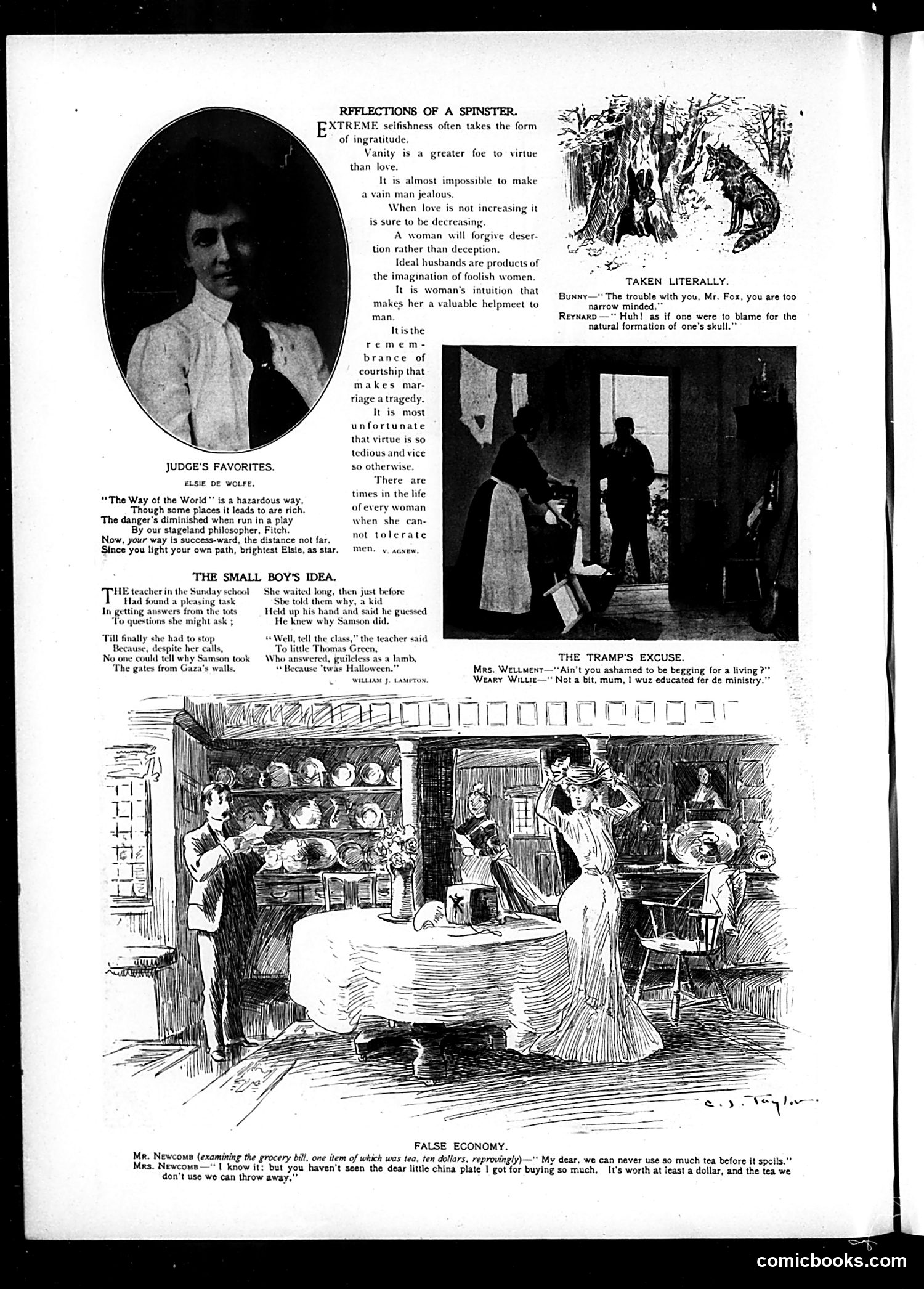
This Judge magazine page contains three satirical pieces satirizing social hypocrisy and gender dynamics of the era: 1. **"Reflections of a Spinster"** mocks women's romantic expectations, suggesting vain women create impossible standards for husbands. 2. **"The Small Boy's Idea"** is a poem about a Sunday school lesson where a boy misunderstands a biblical story about Samson, apparently conflating it with domestic punishment. 3. **"False Economy"** (bottom cartoon) satirizes middle-class penny-pinching. Mrs. Newcomb brags about economizing on tea to save money while boasting about an expensive china plate—illustrating the illogical priorities of the nouveau riche trying to appear wealthy while actually being frugal. The page reflects turn-of-century American anxieties about class aspiration, marriage, and women's roles.
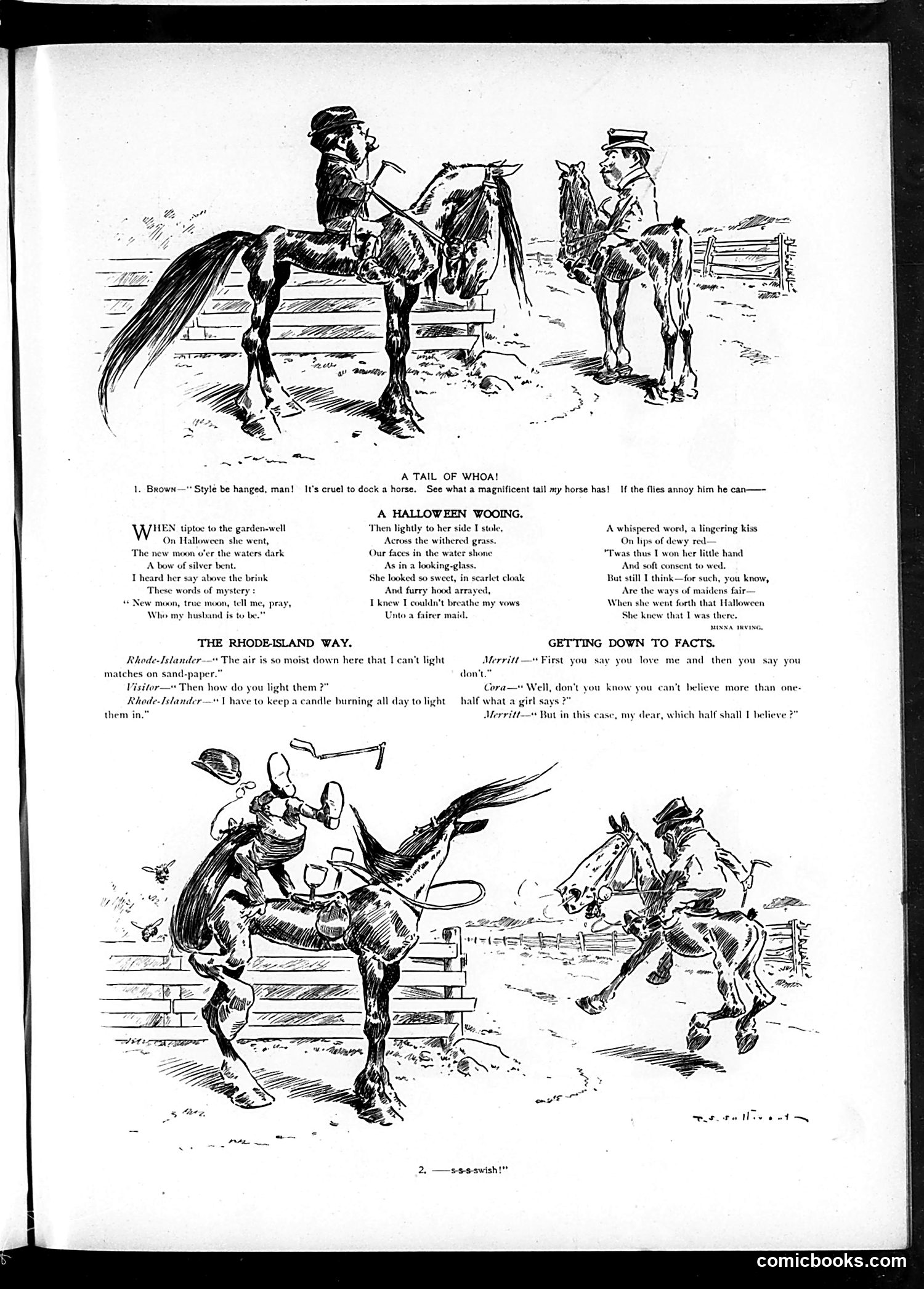
This page contains several humor pieces typical of early 20th-century Judge magazine: **"A Tail of Whoa!"** (top): A cowboy joke about horse tail-docking. Brown defends his horse's magnificent tail as useful for fly-swatting, satirizing the fashionable practice of docking horses' tails for style—cruel treatment presented as absurd vanity. **"A Halloween Wooing"** (middle-left): A sentimental romantic poem illustrated with a young couple meeting by moonlight on Halloween, reflecting period interest in supernatural courtship rituals. **"The Rhode Island Way"** (middle): A regional humor piece joking about Rhode Island's perpetually damp climate making it impossible to light matches normally—implying residents must keep candles burning all day. **"Getting Down to Facts"** (right): A brief comic dialogue where "Merritt" and "Cora" debate a woman's contradictory statements about love, the humor resting on stereotypes about female inconsistency. The cartoons use simple pen-and-ink illustrations to accompany lighthearted domestic, romantic, and regional humor typical of the era's satirical magazines.
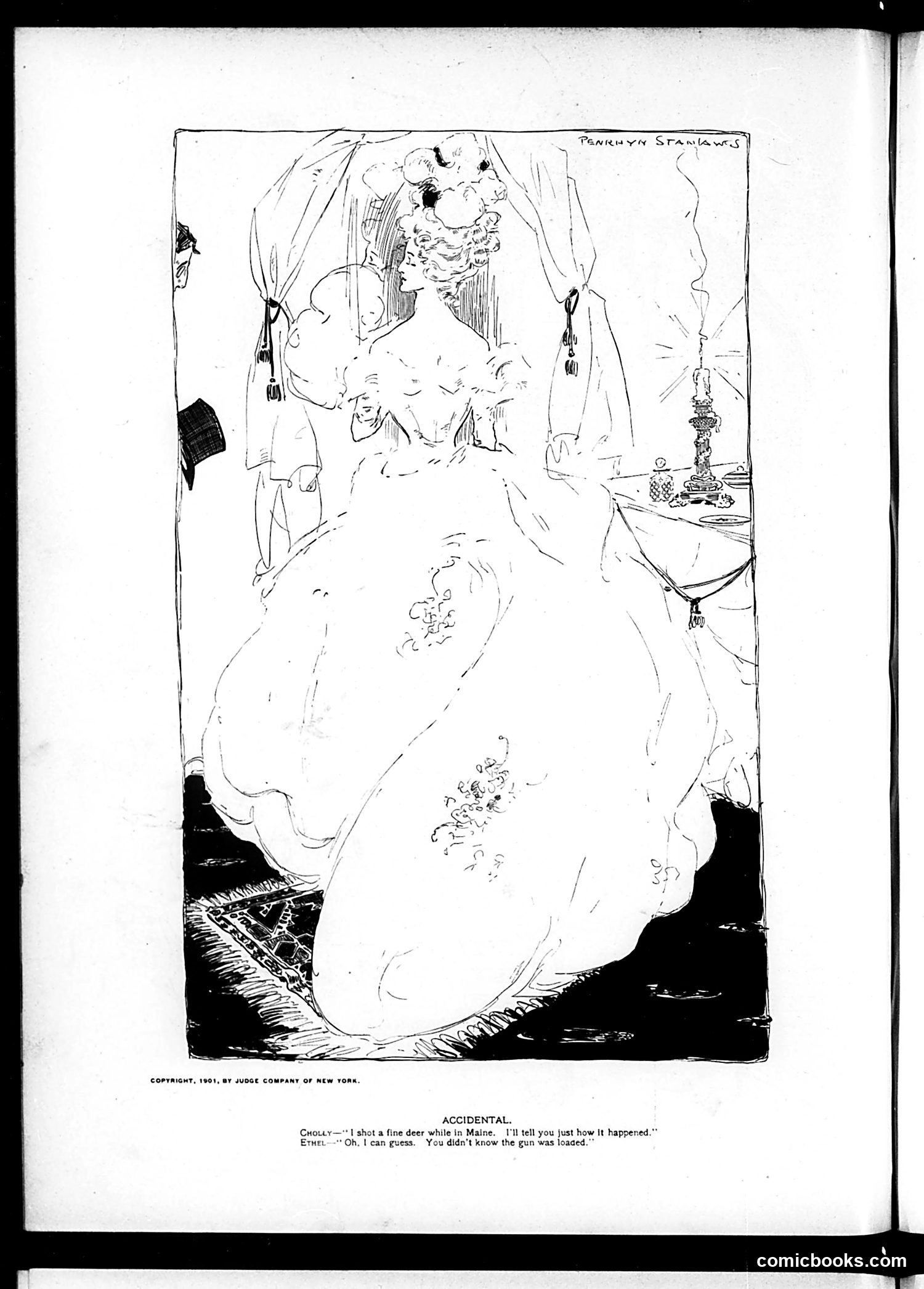
This 1901 Judge cartoon depicts two men discussing a hunting accident. The title "Accidental" and dialogue suggest satirical commentary on careless hunting practices. One man (Crotty) claims he shot a deer in Maine and begins explaining; the other (Ethel) interrupts with a sardonic quip—implying the "accident" occurred because Crotty didn't realize his gun was loaded, a common excuse for negligent shooting. The humor mocks hunters' incompetence and irresponsibility, particularly the tendency to blame ignorance rather than admit carelessness. The illustration shows an elegantly dressed woman in a bedroom setting with hunting trophies and casual firearms, suggesting the absurdity of combining refined domestic spaces with dangerous, loaded weapons. This reflects turn-of-the-century concerns about amateur hunters endangering themselves and others through negligence.
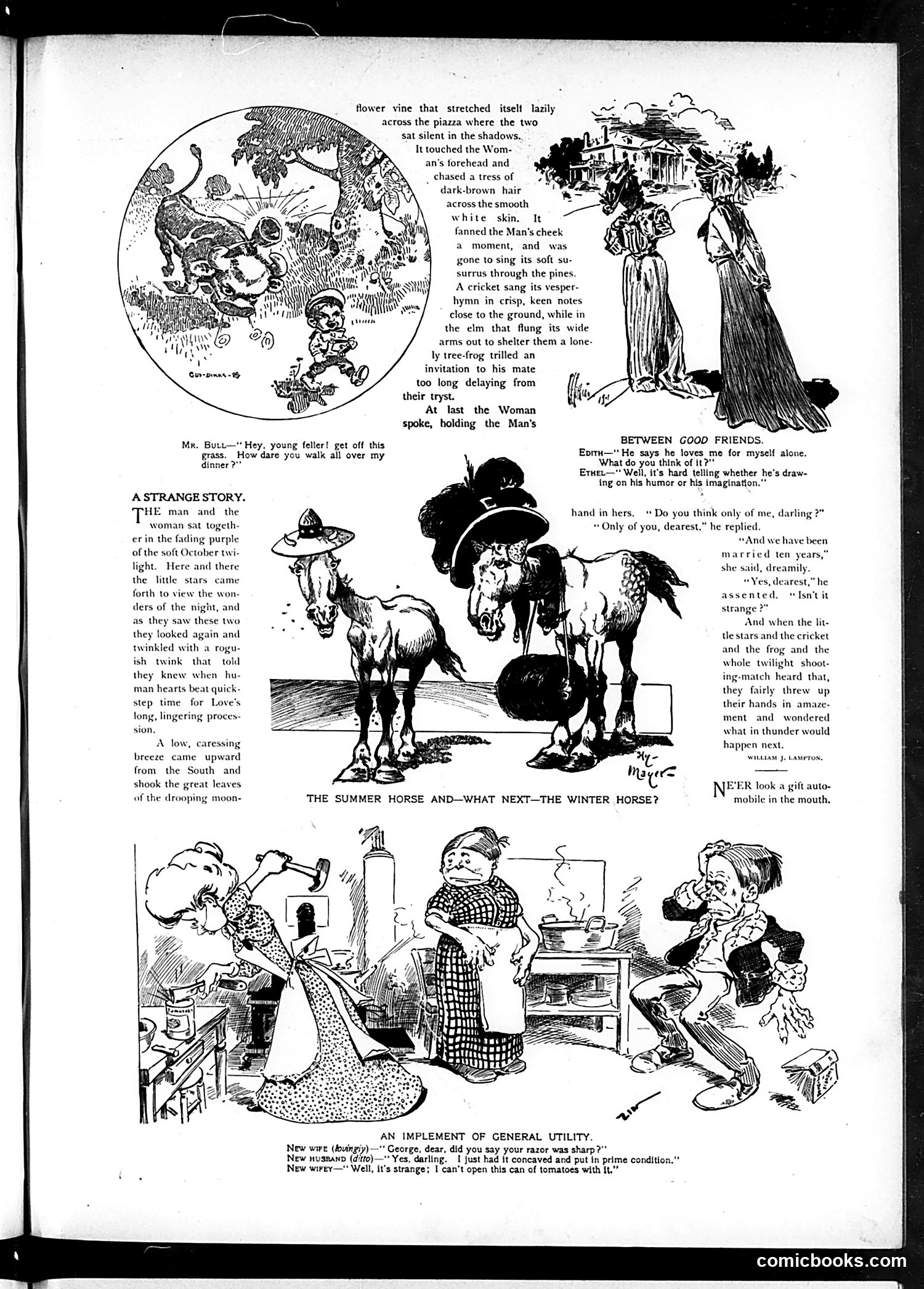
This page contains three distinct pieces of humor typical of early-20th-century American satire: **"A Strange Story"**: A romantic vignette mocking sentimental Victorian literature—a couple married ten years still exchanging clichéd romantic declarations ("Do you think only of me, darling?"), with personified nature (stars, crickets, frogs) supposedly amazed at their continued devotion. The satire targets overwrought romantic fiction. **"Between Good Friends"**: A joke about a man claiming to love a woman "for herself alone," with the punchline questioning whether he's joking or simply has an active imagination—implying men's romantic declarations are unreliable. **"An Implement of General Utility"**: The bottom cartoon satirizes newly married couples and modern domestic life. A new wife, trying to open a tomato can with her husband's "sharp" razor (recently honed), highlights the absurdity of poor tool selection and perhaps gentle mockery of newlyweds navigating household tasks. Together, these pieces humorously critique romance, marriage expectations, and domestic life—common Judge magazine themes.
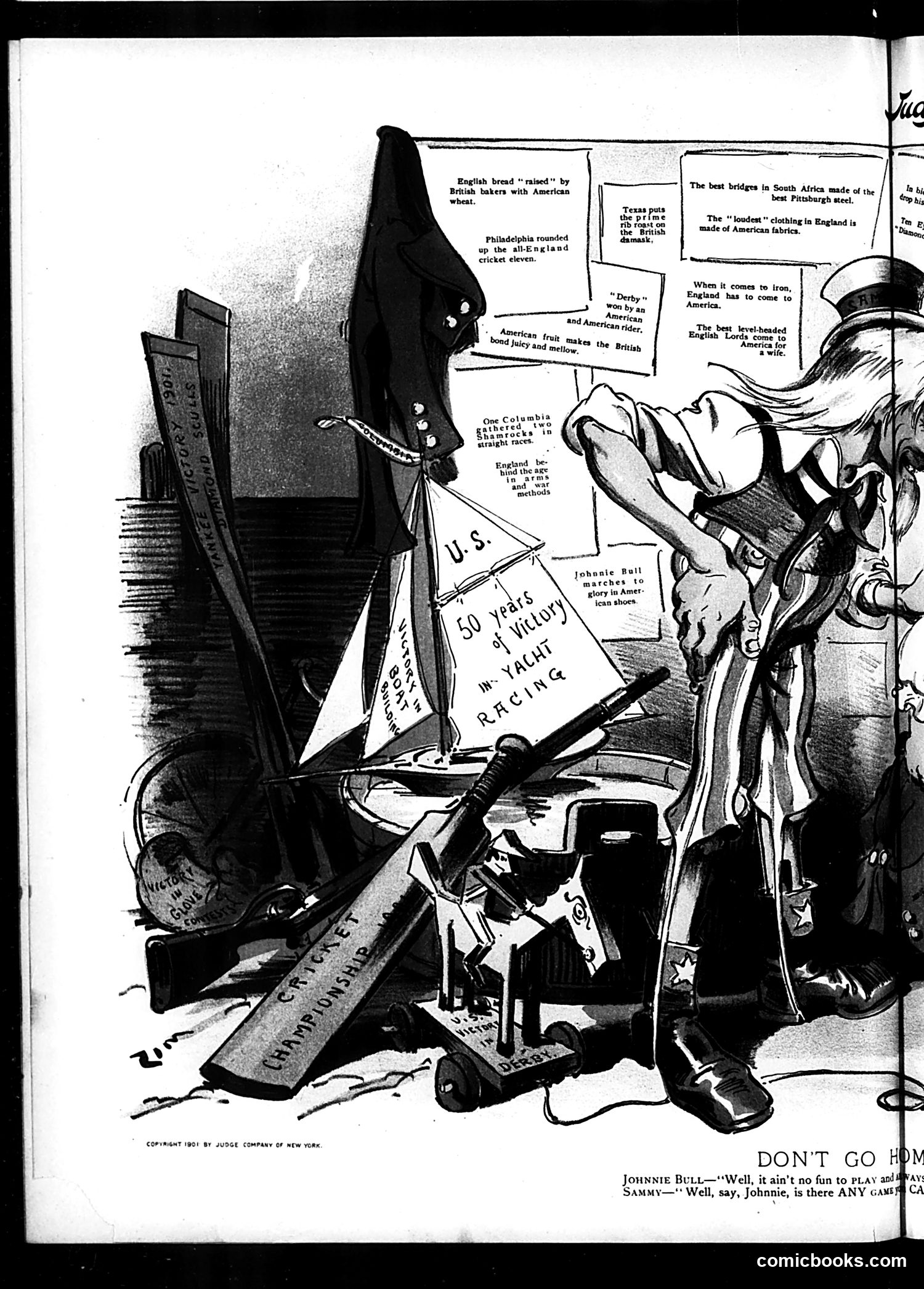
This early 1900s cartoon satirizes Anglo-American economic competition through personified national characters. "Johnnie Bull" (Britain, depicted as a portly figure in black) confronts "Sammy" (Uncle Sam, representing America, shown on the right). The surrounding text boxes present a series of comparative boasts—each claiming American or British superiority in specific industries: bread, steel, cricket, clothing, iron, etc. The satire works by having Britain (Johnnie Bull) forced to acknowledge America's growing industrial dominance across multiple sectors. The bottom dialogue suggests Britain ("Johnnie Bull") complains that competing with America isn't "fun" anymore, implying American economic success has made traditional British advantages obsolete. This reflects the historical moment when the United States was displacing Britain as the world's leading industrial power—a major shift in global economic hierarchy circa 1900-1910.
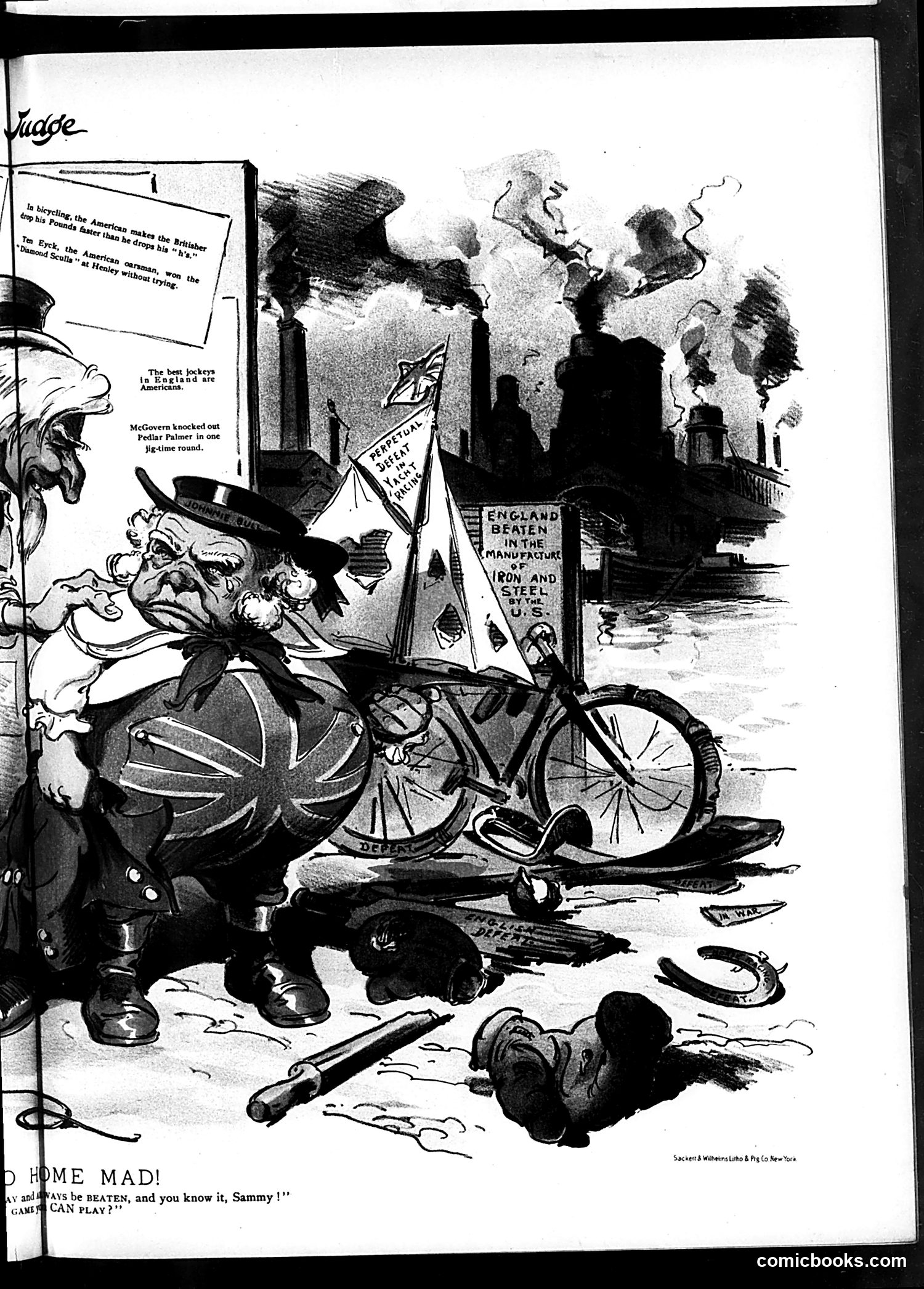
This political cartoon satirizes British boxing and national pride. A caricatured British bulldog character (labeled "England") holds a bicycle and banner reading "England's Lead in the Manufacture of Iron and Steel," while observing industrial smokestacks in the background. The accompanying text references McGovern knocking out Pedlar Palmer (likely a boxing match), suggesting Americans are "the best jocks" for England—a jab at British athletic and industrial prowess being overtaken by American competitors. The "HOME MAD!" caption and dialogue ("You'll be beaten, and you know it, Sammy!") implies Britain's manufacturing dominance is under threat. This appears to reflect late 19th or early 20th-century anxieties about American industrial and economic competition against British superiority.
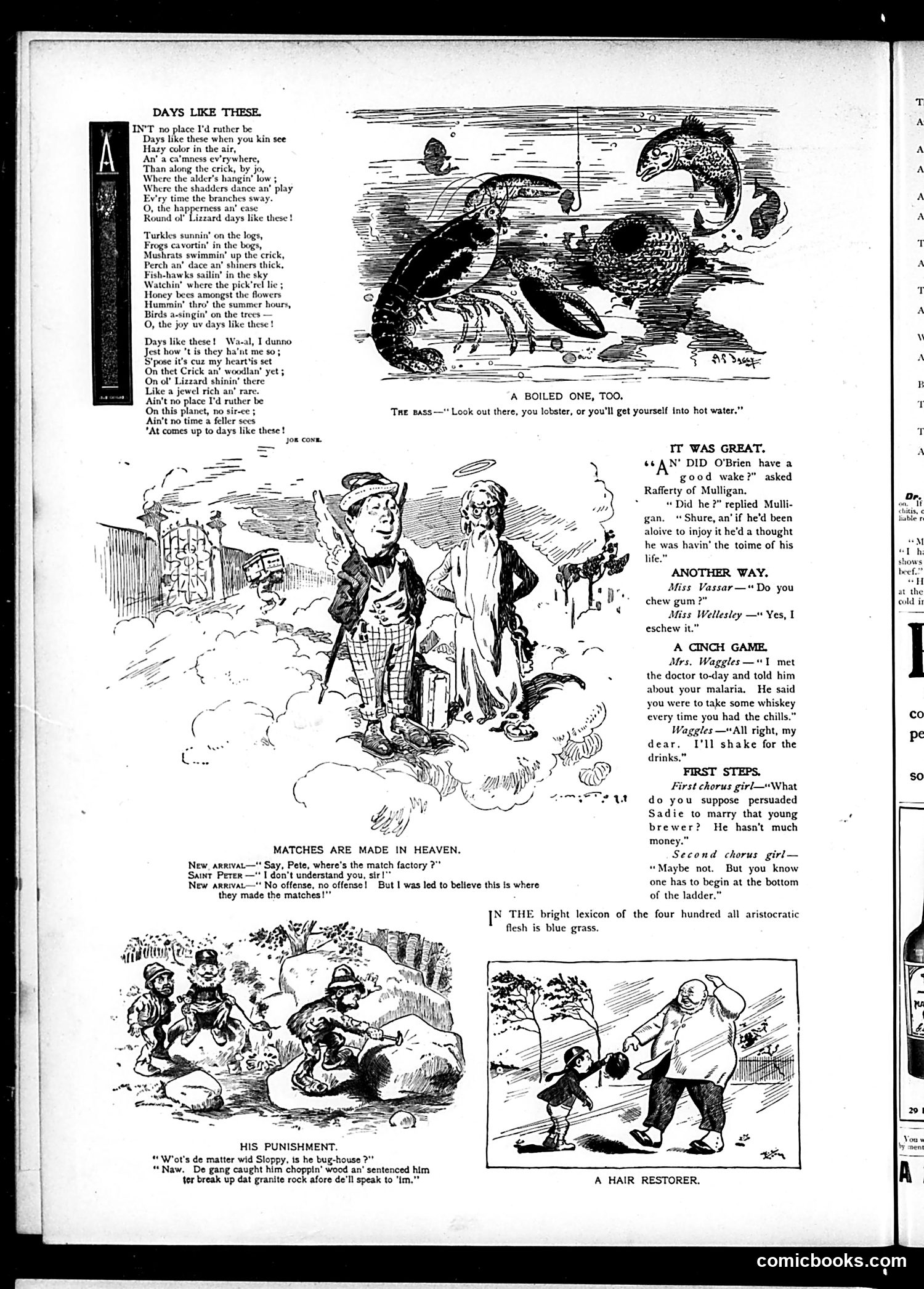
This page contains multiple short humorous pieces typical of early 20th-century American satire: **"Days Like These"** is a nostalgic rural poem celebrating fishing and nature, with no apparent political content—pure sentimental humor. **The fish cartoon** ("A Boiled One, Too") shows a bass warning a lobster about hot water, a visual pun on the phrase itself. **The remaining pieces** are brief jokes about Irish-American characters (O'Brien's wake), college girls, marriage, and urban life. "His Punishment" depicts what appears to be immigrant or working-class figures, with dialect humor common to the era. The page reflects Judge's formula: mixing nature nostalgia, visual puns, ethnic humor (Irish and immigrant stereotypes rendered in exaggerated dialect), and domestic comedy. The satire targets no specific political figures or events—instead, it relies on class-based humor and period stereotypes that would resonate with Judge's educated, middle-class readership.
This page is primarily **advertisements and filler content** rather than political cartoons. The notable elements include: **Poems and short humor pieces**: Several dated, sentimental or whimsical literary pieces ("At the Table," jokes about marriage, church attendance, and everyday observations) that reflect early-1900s magazine filler. **Social satire** in the brief quoted quips: References to women's religious hypocrisy, class attitudes, and domestic life appear in short one-liners, but these are generic social commentary rather than targeted political satire. **Advertisements dominate**: For products like Pears' soap, Sohmer pianos, Club Cocktails, railway tickets, and underwear—typical of a magazine's revenue model. The page lacks identifiable caricatures or specific political figures. It represents *Judge*'s mix of light humor, nostalgia, and advertising—not the sharp political satire the magazine was known for.
This page is primarily **advertisements and filler content**, not political satire. The main items include: **Advertisements:** - **Cuban Splits cigars** (15¢/package) — marketed as affordable, quality Havana tobacco - **Wilson Whiskey** (established 1823) - **Eagle Maraschino Cherries** for cooking - **Lehigh Valley Railroad** promoting Pan-American Exposition trips - **Cook's Flaked Rice** with cooking instructions for adults and infants **Humorous Content:** The only satirical element is "If Longfellow Had Lived in Bugland" — a parody of Longfellow's "The Village Blacksmith," reimagined with insects as characters. The joke appears to reference contemporary anxieties about German military power ("Would scare nine German bands"). There's also a brief dialogue joke about a suitor seeking approval for marriage. The page reflects early 1900s consumer culture and advertising practices within a satirical magazine format, though it lacks the pointed political commentary Judge typically featured.
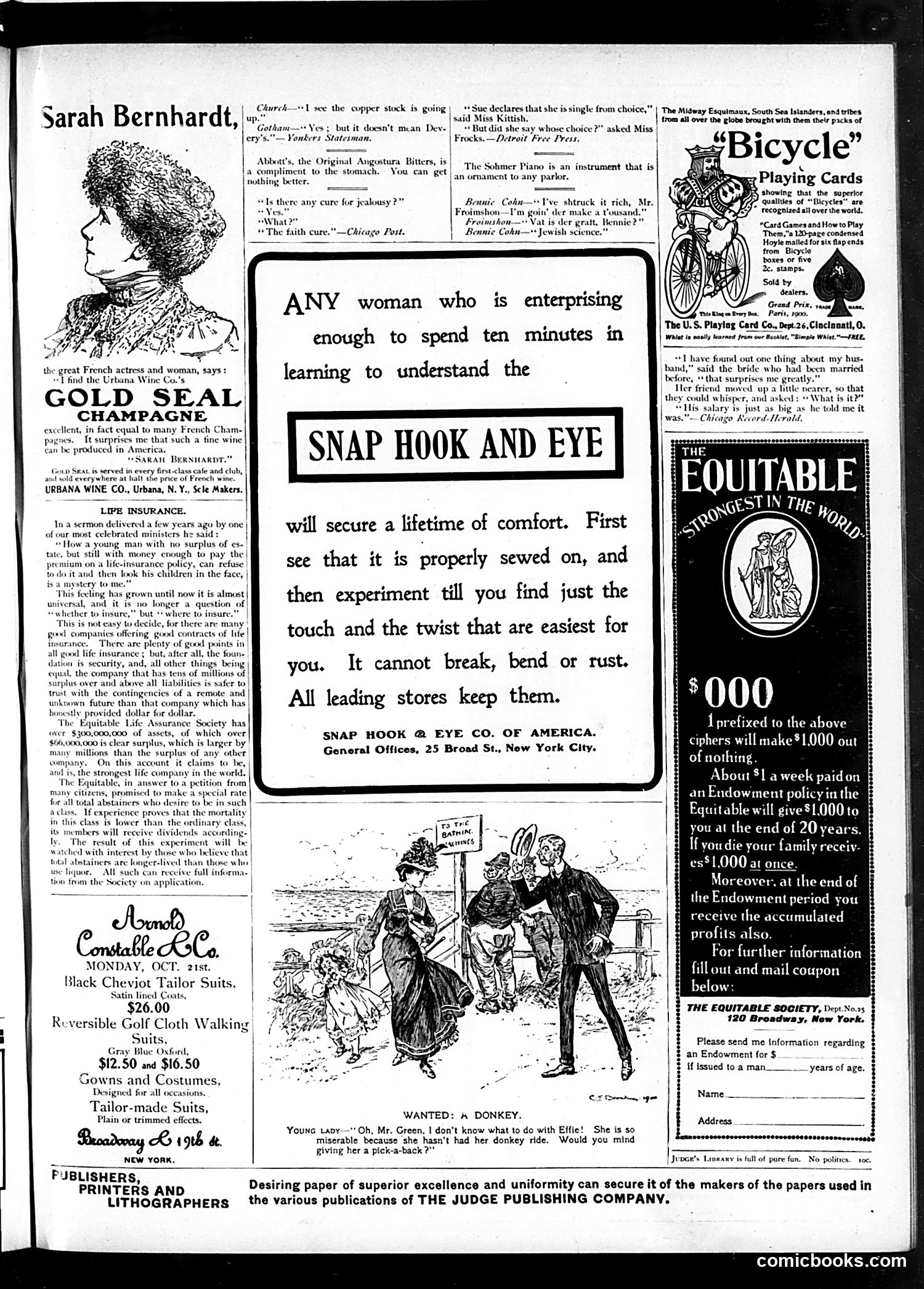
This is primarily a **page of advertisements** for consumer products, with brief embedded jokes and cartoons typical of Judge magazine's satirical humor. **Key content:** The largest advertisement promotes **snap hooks and eye fasteners**—basic clothing closures—as a domestic innovation that will improve women's lives. The accompanying cartoon shows a woman asking to borrow a man for giving her child a "pick-a-back" (piggyback) ride since her donkey isn't available. The satire mocks wealthy leisure: a family can afford a donkey for children's amusement but must borrow a neighbor. **Other notable ads:** - A **Sarah Bernhardt endorsement** for Gold Seal Champagne, leveraging the famous French actress's celebrity - **Equitable Life Insurance** offering special rates for "total abstainers" (non-drinkers), reflecting period debates over temperance and mortality statistics - **Arnold Constable clothing** and **Bicycle Playing Cards** The small text jokes scattered throughout are typical Judge humor—wordplay about romantic choice, piano lessons, and Jewish stereotypes (reflecting the magazine's casual bigotry of that era).
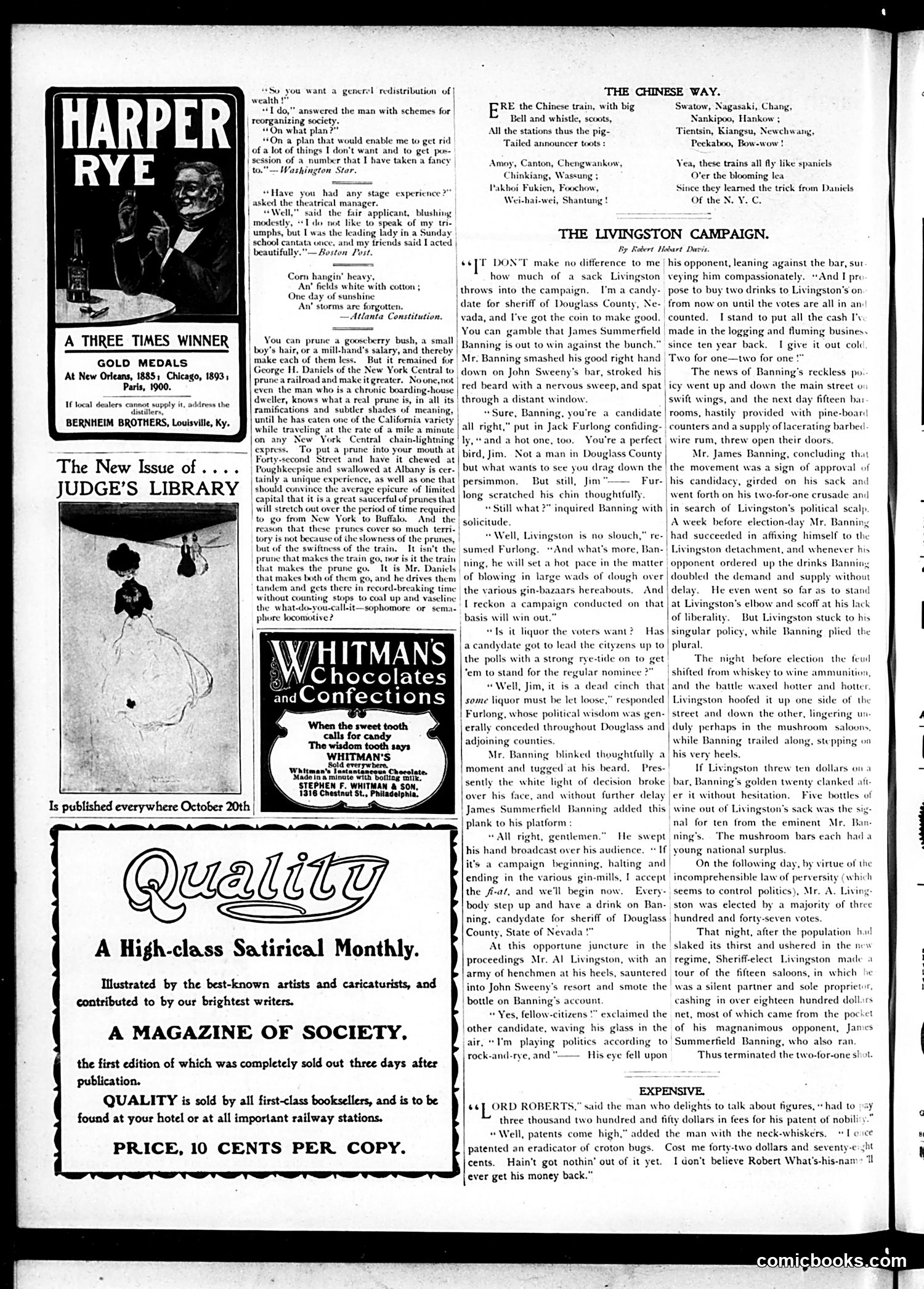
This page from Judge magazine (a satirical publication) contains several short humorous pieces and advertisements rather than a single coherent cartoon. The main satirical content includes: 1. **"So you want a general redistribution of wealth"** — A brief joke mocking socialist/reformist rhetoric by having a man claim he supports wealth redistribution purely to dispose of unwanted possessions and acquire others he desires. 2. **"The Chinese Way"** — A satirical poem mocking Chinese place names and stereotypically portraying Chinese people ("pig-tailed announcer") through exaggerated, condescending dialect humor. It credits railroad innovations to American railroad executive George H. Daniels. 3. **"The Livingston Campaign"** — A story fragment about a Nevada sheriff candidate named Banning determined to win against opponent Livingston. The page is primarily **advertising-heavy**, featuring promotions for Harper Rye whiskey, Whitman's Chocolates, Judge's Library, and Quality magazine. The satirical humor reflects early 1900s attitudes, including casual racism toward Chinese people that would be considered deeply offensive today.
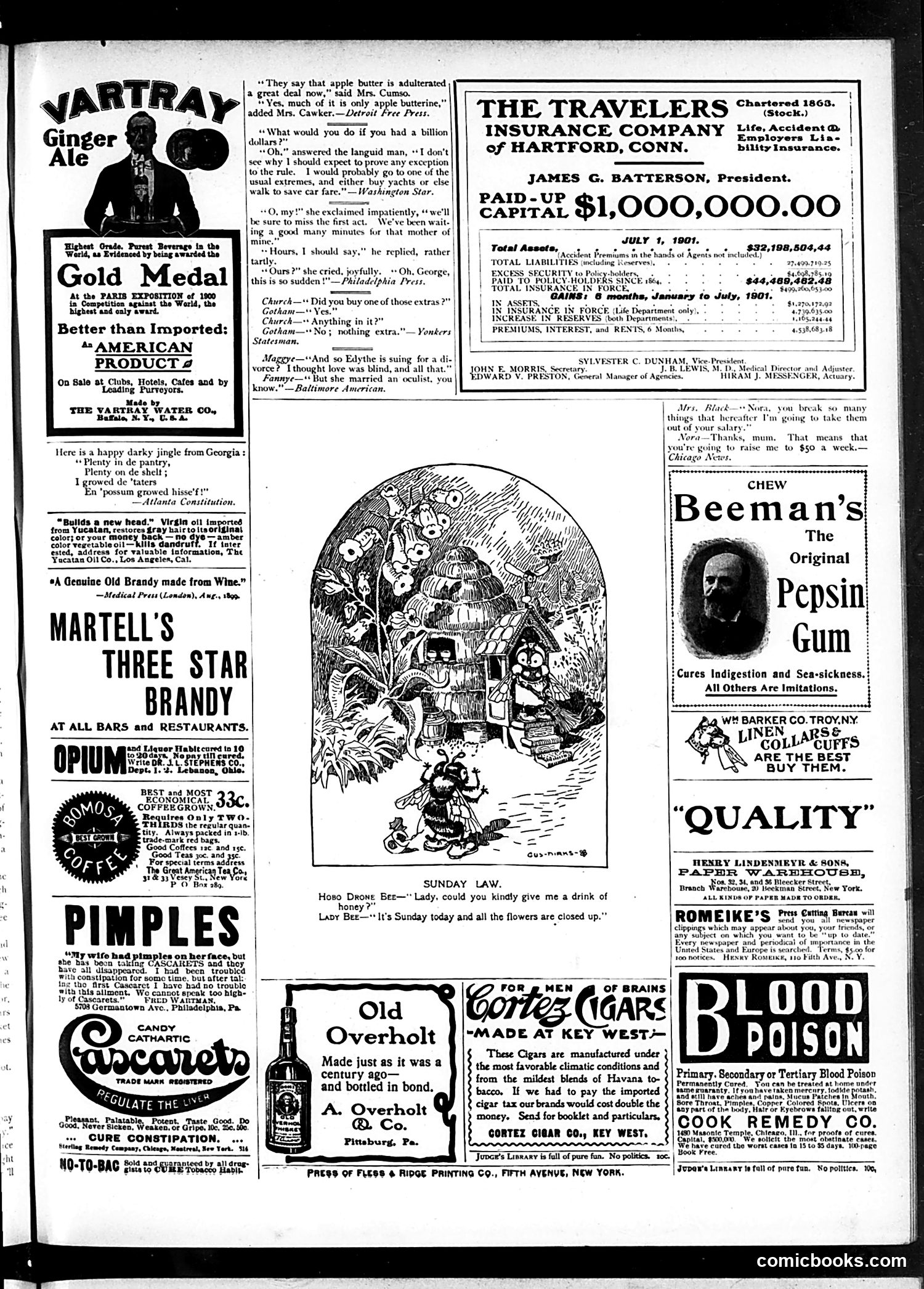
This page is primarily **advertisements and brief humor**, not a sustained political cartoon. The main content consists of: **Advertisements** dominating the layout, selling patent medicines (Beeman's Pepsin Gum, Blood Poison cure), alcohol (Martell's Brandy, Old Overholt whiskey), and consumer goods. These ads reveal period attitudes: many hawked dubious "cures" for common ailments without regulation. **Brief comic dialogues** scattered throughout, including: - A joke about "apple butterine" (margarine masquerading as butter)—reflecting contemporary food-adulteration scandals - A quip about wealthy men's eccentric spending habits - A "Sunday Law" joke about bees and closed flowers on the Sabbath - A Georgia dialect verse celebrating rural plenty **One central illustration**: A detailed, whimsical drawing of a cottage interior, apparently accompanying "SUNDAY LAW," though its exact satirical point is unclear from context. The page reflects early-20th-century concerns: food fraud, class anxiety, and religious observance. The dense advertising underscores Judge's commercial dependence on patent-medicine manufacturers.
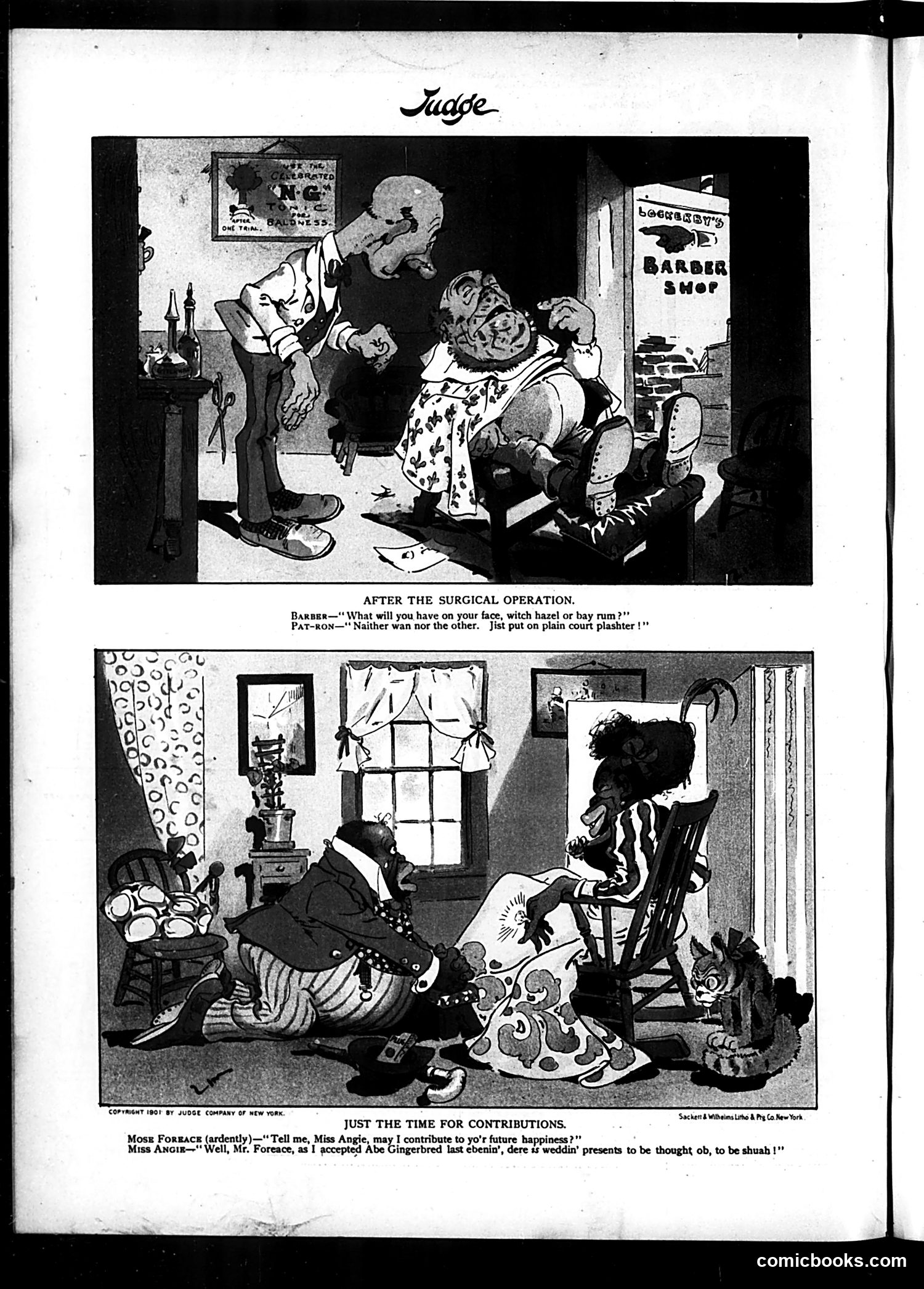
These two cartoons use ethnic caricature humor typical of early 20th-century American satire. **Top cartoon:** A barber tends to a client with facial bandages after "surgical operation." The joke plays on Irish dialect ("Naither wan nor the other") and suggests the client's face needed medical intervention—implying Irish people's appearance as inherently flawed or comical. **Bottom cartoon:** "Moss Forback" (depicted with exaggerated features) proposes to "Miss Angie," but she's already accepted "Abe Gingerbred" the previous evening. Her response—focused on wedding gifts rather than romance—satirizes women as mercenary. The names and accents suggest Jewish and Irish characters, common targets for ethnic ridicule in Judge's satire. Both rely on period stereotypes: Irish and Jewish immigrants portrayed through dialect, caricatured features, and dismissive characterization. The humor assumes readers shared these prejudices.