
Judge, 1901-11-02 · page 2 of 16
Judge — November 2, 1901 — page 2: what you’re looking at
What you’re looking at
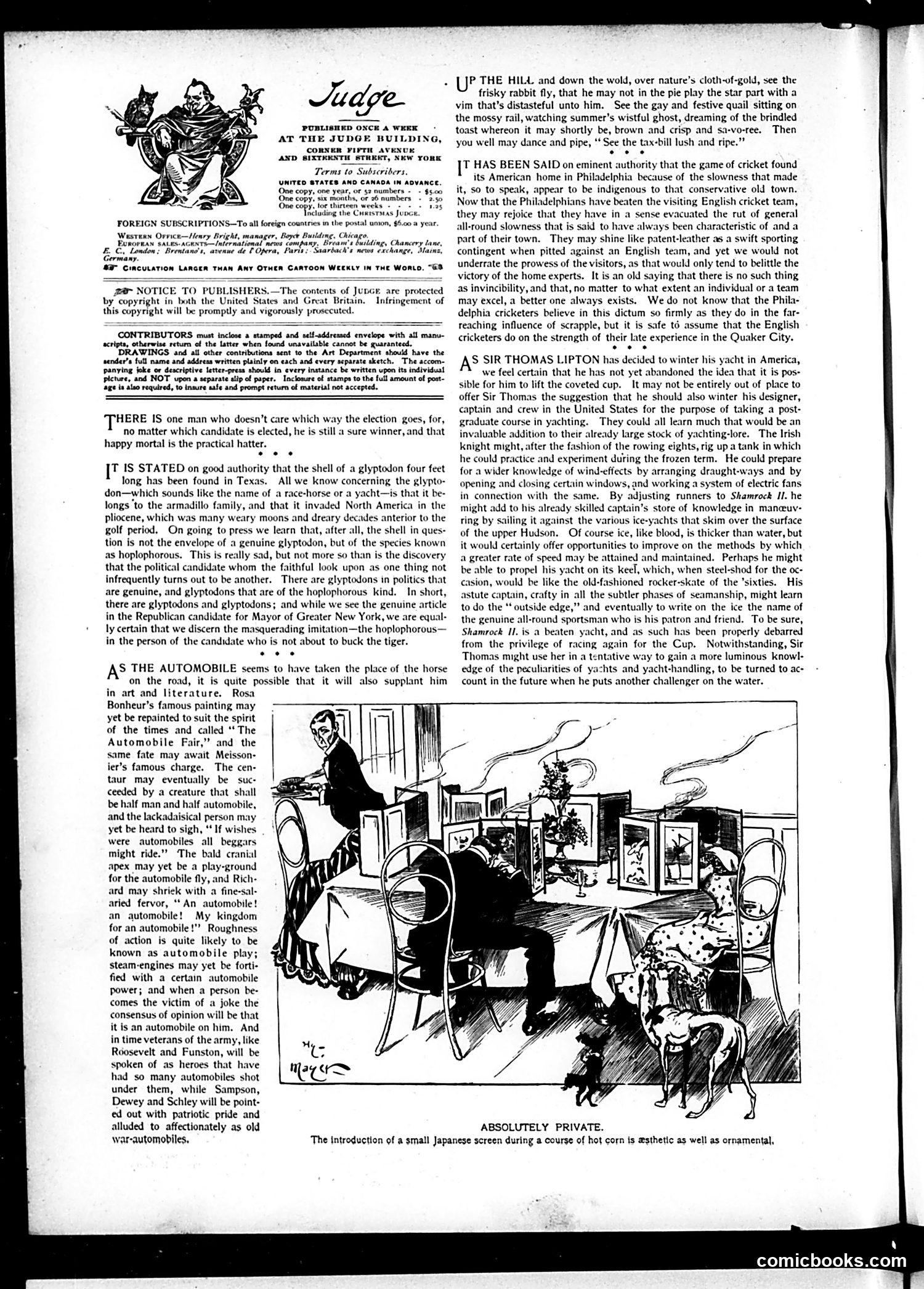
This page contains a satirical cartoon titled "ABSOLUTELY PRIVATE," depicting a domestic scene where a man sits reading while a woman operates what appears to be a Japanese folding screen or room divider decorated with hot corn imagery. The satire likely mocks the fashionable adoption of Japanese aesthetic elements in American homes during the early 20th century. By juxtaposing refined "artistic" Japanese décor with mundane American domestic life (and specifically hot corn—a lowbrow food reference), Judge ridicules wealthy Americans' pretentious embrace of exotic design trends while remaining fundamentally American in their actual lives and tastes. The accompanying text discusses Philadelphia cricket teams and yachting, suggesting the page addresses upper-class leisure pursuits and social aspirations more broadly.
📄 Transcribed text from this page (OCR, searchable)
Machine-transcribed from the original scan — historical spelling and the odd misread are preserved.
PUBLISHED ONCE A WEEK AT THE JUDGE BUILDING, CORNER YIFTH AVEXUK AND SIXTKENTH STREET, NEW YORK Terms to Subscribers. UNITED STATES AND CANADA IN ADVANCE. ‘One copy, one year, or $2 numbers ~~ Opy, six months, of 26 numbers FOREIGN SUBSCRIPTIONS—To all foreign countries in the post n—Henry Bright, manager, Boyce Build: AGENTS International mews com , avenue de C Opera, Paris amon, $4.00 a year. . Chicago. anes building, Chancery Lane, rhach's mews exchange, Me ST CIRCULATION LARGER THAN ANY OTHER CARTOON WEEKLY IN THE WoRLo. “GS ga@ NOTICE TO PUBLISHER: ents of JUDGE by copyright in both the United States and Great Britain. this copyright will be promptly and vigorously prosecuted. c protected Infringement of CONTRIBUTORS must inclose a stamped and self-addressed envelope with all manu- scripts, otherwise return of the latter when found unavailable cannot be guaranteed, DRAWINGS and all other contributions sent to the Art Department should have the sender's full name and addreas written plainly on each and every separate aketch. The accom- panying joke or descriptive letter-press should in every instance be written upon its individual Picture, and NOT upon a separate alip of paper. Inclosure of stamps to the full amount of post- age i also required, to insure safe and prompt return of material not accepted. HERE IS one man who doesn’t care which way the election goes, for, ‘No matter which candidate is elected, he is still a sure winner, and that happy mortal is the practical hatter. [7 IS STATED on good authority that the shell of a glyptodon four feet long has been found in Texas. All we know concerning the glypto- don—which sounds like the name of a race-horse or a yacht—is that it be- longs ‘to the armadillo family, and that it invaded North America in the pliocene, which was many weary moons and dreary decades anterior to the golf period, On going to press we learn that, after all, the shell in ques- tion is not the envelope of a genuine glyptodon, but of the species known as hoplophorous. This is really sad, but not more so than is the discovery that the political candidate whom the faithful look upon as one thing not infrequently turns out to be another. There are glyptodons in politics that are genuine, and glyptodons that are of the hoplophorous kind. In short, there are glyptodons and glyptodons; and while we see the genuine article in the Republican candidate for Mayor of Greater New York, we are equal- ly certain that we discern the masquerading imitation—the hoplophorous— in the person of the candidate who is not about to buck the tiger. S THE AUTOMOBILE seems to have taken the place of the horse on the road, it is quite possible that it will also supplant him in art and literature. Rosa Bonheur’s famous painting may P THE HILL and down the wold, over nature’s cloth-of-gold, see the frisky rabbit fly, that he may not in the pie play the star part with a vim that’s distasteful unto him. See the gay and festive quail sitting on the mossy rail, watching summer's wistful ghost, dreaming of the brindled toast whereon it may shortly be, brown and crisp and sa-vo-ree. Then you well may dance and pipe, “See the tax-bill lush and ripe.” T HAS BEEN SAID on eminent authority that the game of cricket found its American home in Philadelphia because of the slowness that made it, so to speak, appear to be indigenous to that conservative old town. Now that the Philadelphians have beaten the visiting English cricket team, they may rejoice that they have in a s evacuated the rut of general all-round slowness that is said to have always been characteristic of and a part of their town. They may shine like patent-leather as a swift sporting contingent when pitted against an English team, and yet we would not underrate the prowess of the visitors, as that would only tend to belittle the victory of the home experts. It is an old saying that there is no such thing as invincibility, and that, no matter to what extent an individual or a team may excel, a better one always exists. We do not know that the Phila- delphia cricketers believe in this dictum so firmly as they do in the far- reaching influence of scrapple, but it is safe té assume that the English cricketers do on the strength of their late experience in the Quaker City. AS SIR THOMAS LIPTON has decided to winter his yacht in America, we feel certain that he has not yet abandoned the idea that it is pos- sible for him to lift the coveted cup. It may not be entirely out of place to offer Sir Thomas the suggestion that he should also winter his designer, captain and crew in the United States for the purpose of taking a post- graduate course in yachting. They could all learn much that would be an invaluable addition to their already large stock of yachting-lore. The Irish knight might, after the fashion of the rowing eights, rig up a tank in which he could practice and experiment during the frozen term. He could prepare for a wider knowledge of wind-effects by arranging draught-ways and by opening and closing certain windows, and working a system of electric fans in connection with the i to Shamrock II. he might add to his store of knowledge in manceuv- ring by sailing it against the various ice-yachts that skim over the surface of the upper Hudson. Of course ice, like blood, is thicker than water, but it would certainly offer opportunities to improve on the methods by which ‘a greater rate of speed may be attained and maintained. Perhaps he might be able to propel his yacht on its keel, which, when steel-shod for the oc- casion, would be like the old-fashioned rocker-skate of the ‘sixties. His astute captain, crafty in all the subtler phases of seamanship, might learn to do the “ outside edge,” and eventually to write on the ice the name of the genuine all-round sportsman who is his patron and friend. To be sure, Shamrock Il. is a beaten yacht, and as such has been properly debarred from the privilege of racing again for the Cup. Notwithstanding, Sir Thomas might use her in a tentative way to gain a more luminous knowl- edge of the peculiarities of yachts and yacht-handling, to be turned to ac- count in the future when he puts another challenger on the water. yet be repainted to suit the spirit of the times and called ‘ The Automobile Fair,” and the same fate may await Meisson- ier’s famous charge. The cen- taur may eventually be suc- ceeded by a creature that shall be half man and half automobile, and the lackadaisical person may yet be heard to sigh, “If wishes were automobiles all beggars might ride.” The bald cranial ‘apex may yet be a play-ground for the automobile fly, and Rich- ard may shriek with a fine-sal- aried fervor, “An automobile! an automobile! My kingdom for an automobile!” Roughness of action is quite likely to be known as automobile play; steam-engines may yet be forti- fied with a certain automobile power; and when a person be- comes the victim of a joke the consensus of opinion will be that it is an automobile on him. And in time veterans of the army, like Roosevelt and Funston, will be spoken of as heroes that have had so many automobiles shot under them, while Sampson, Dewey and Schley will be point- ed out with patriotic pride and alluded to affectionately as old war-automobiles, ABSOLUTELY PRIVATE. ‘The introduction of a small Japanese screen during a course of hot corn is esthetic as well as ornamental,