
A complete issue · 16 pages · 1901
Judge — October 26, 1901
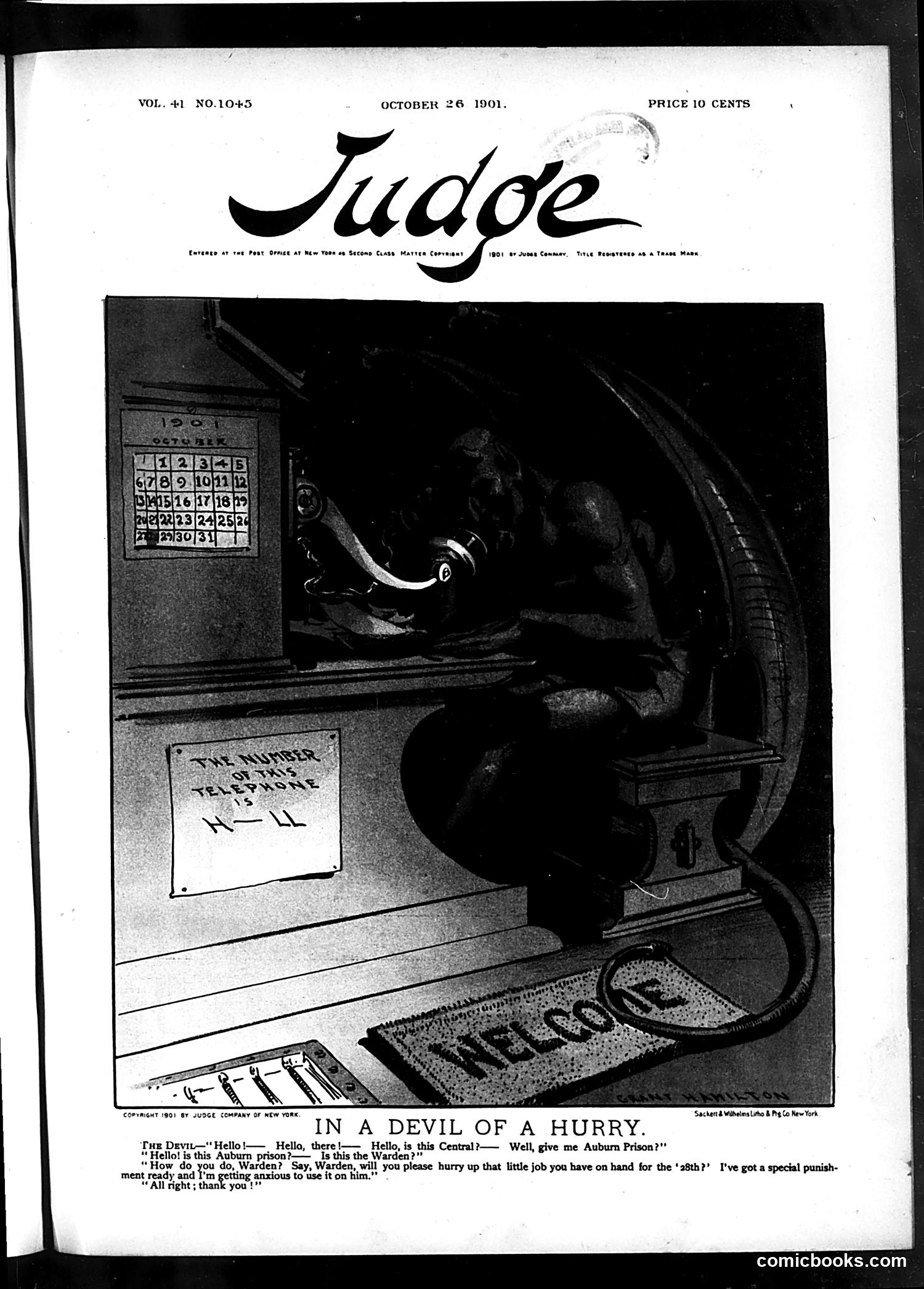
This Judge cartoon satirizes the efficiency of Auburn Prison's telephone system in 1901. The image shows a prison warden frantically calling Auburn Prison's central switchboard, desperate to reach the prison quickly—apparently to stop an execution or prevent some urgent prison matter ("the 'stiff'"). The joke plays on the irony that even in a life-or-death emergency requiring immediate communication, the prison operator is frustratingly slow or unavailable. The calendar visible suggests timing pressure. The satire mocks bureaucratic inefficiency and outdated communication systems that fail precisely when speed is critical—a commentary on early 20th-century institutional dysfunction masquerading as modern infrastructure.
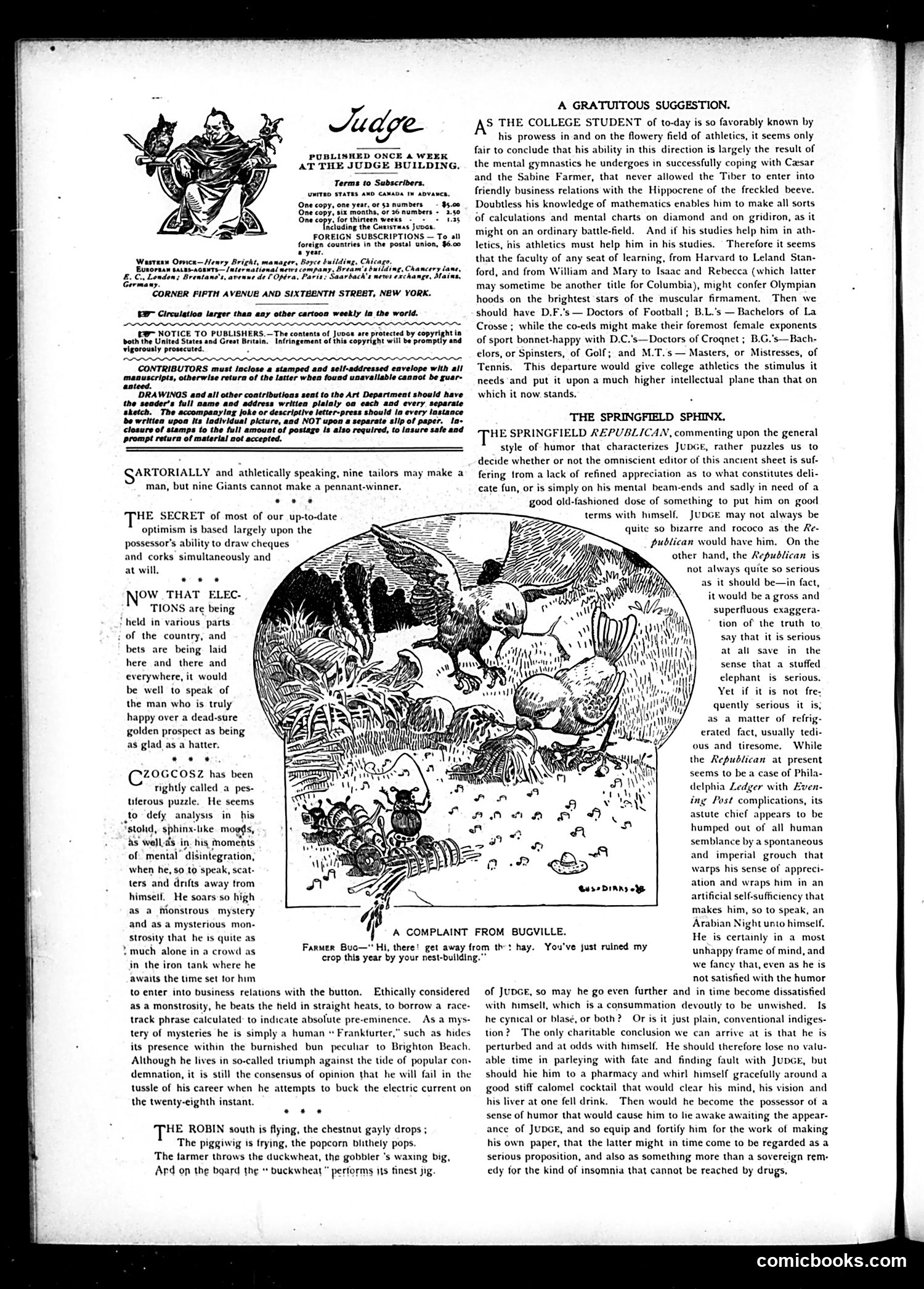
The main cartoon, titled "A Complaint from Bugville," depicts anthropomorphic insects (a farmer bug and other creatures) in a pastoral scene. The caption reads: "Please get away from it; hay. You've just ruined my crop this year by your nest-building." This appears to be a light satirical piece about agricultural pests—likely birds or insects damaging crops through their nesting habits. The humor is gentle rather than pointed political commentary. The surrounding text includes editorial content about college athletes and intellectual achievement, and commentary on the Springfield Republican newspaper's editorial style, suggesting debates about journalistic integrity and educational values. The overall page mixes social commentary with whimsical animal humor typical of Judge's satirical approach in this era.
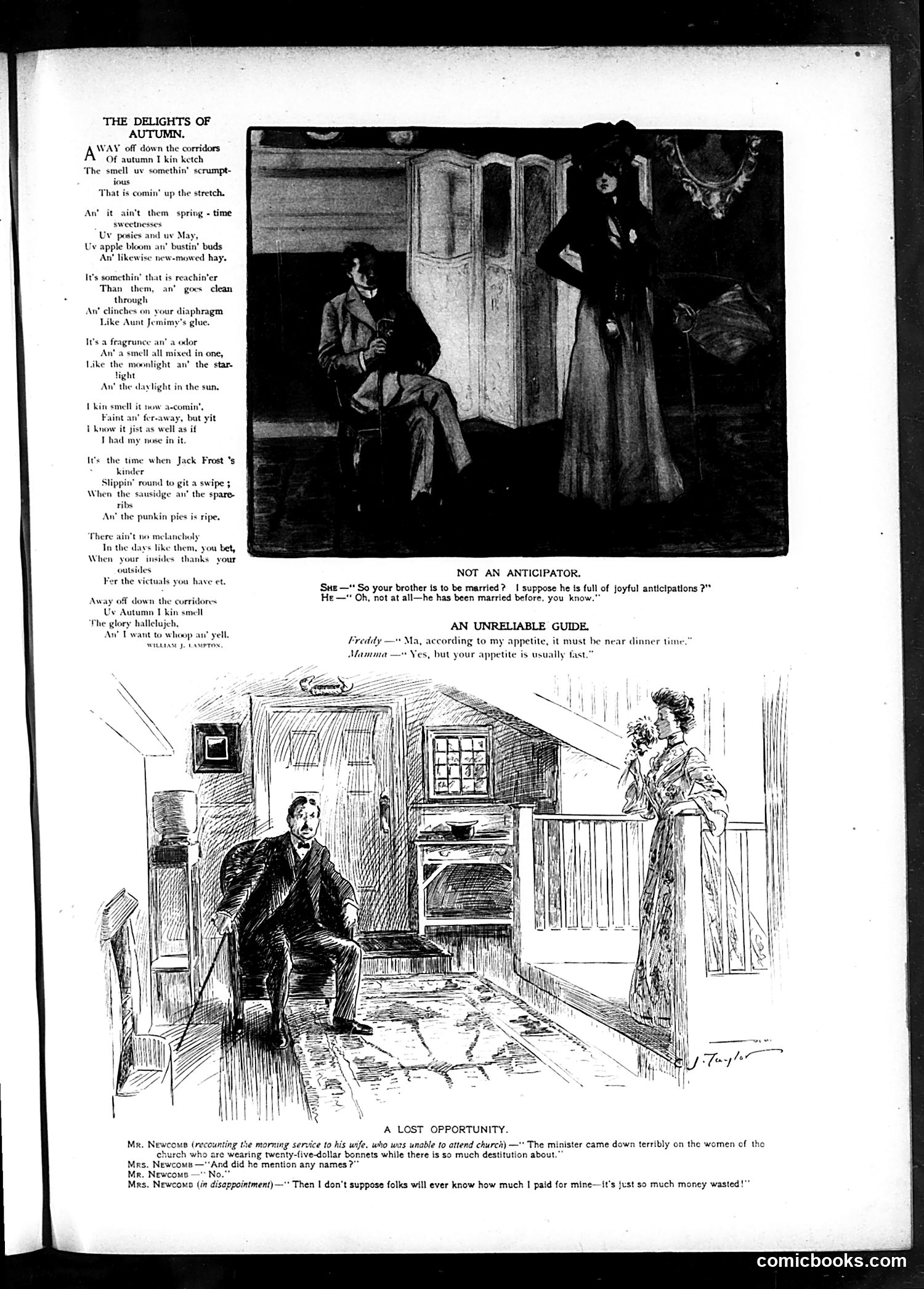
This Judge magazine page contains three separate humorous pieces: 1. **"The Delights of Autumn"** (poem, left): A nostalgic verse celebrating autumn's sensory pleasures—the smell of corridors, apple blossoms, hay—credited to William J. Lampton. 2. **"Not an Anticipator"** (top cartoon): A domestic scene where a woman tells a man his brother is marrying. The man responds he already knew, deflating her expectation of surprising him with news. 3. **"An Unreliable Guide"** and **"A Lost Opportunity"** (bottom cartoons): Both depict domestic disagreements. The first involves a wife contradicting her husband's dinner-timing advice. The second shows Mr. Newcomb complaining about his wife's expensive bonnet purchase at church. The cartoons satirize marital miscommunication and women's spending habits—common Judge magazine themes reflecting early-20th-century domestic comedy conventions.
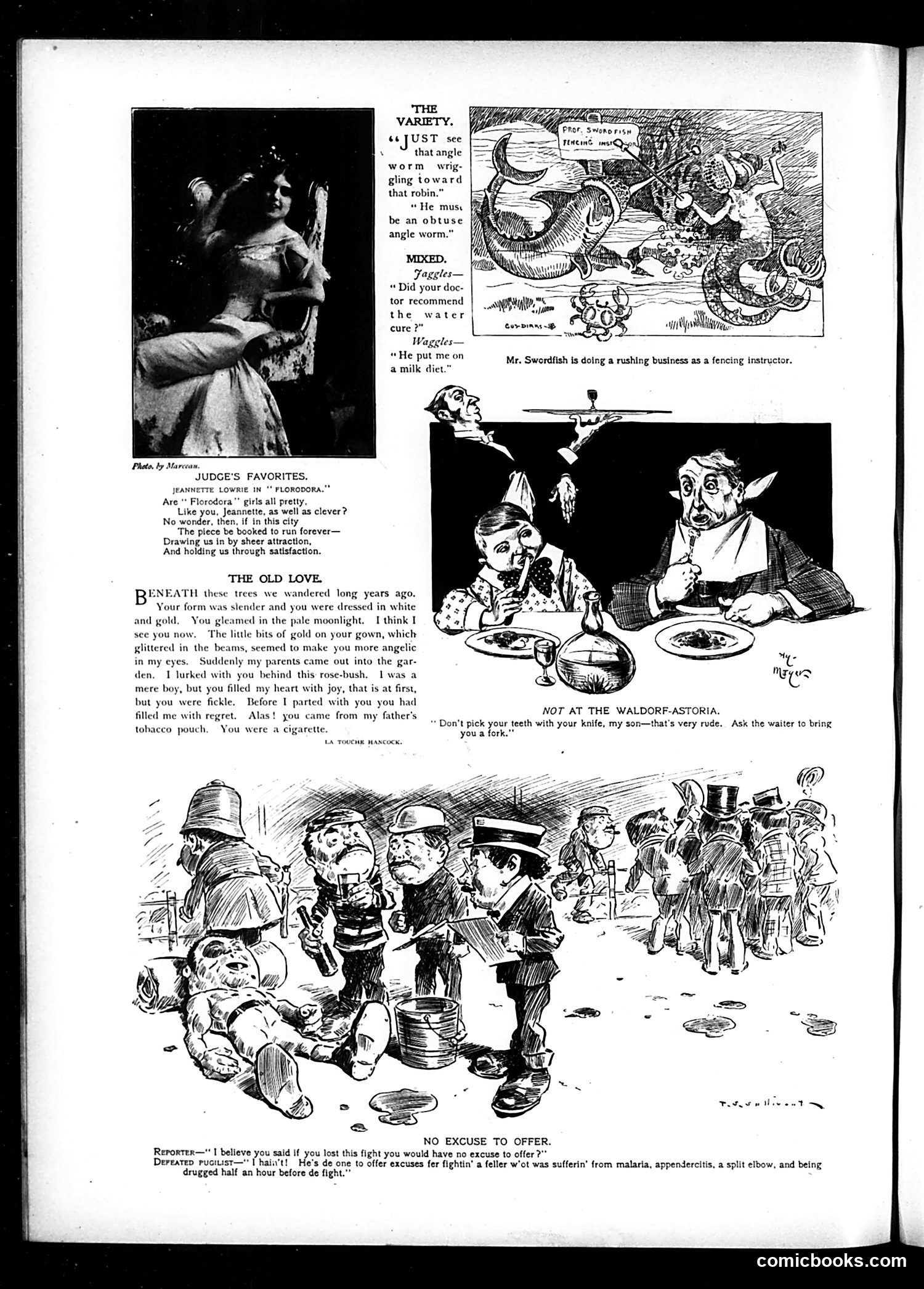
This page contains several satirical pieces typical of early 20th-century Judge magazine: **"The Variety"** section presents humorous dialogue snippets, including jokes about medical advice and diet recommendations. **"Judge's Favorites"** features a poem praising Jeanette Lowrie in a theatrical production ("Floodora"), suggesting she was a notable performer of that era. **"The Old Love"** is a sentimental poem about a past romance, mentioning specific details like white dress and gold accessories. **"Not at the Waldorf-Astoria"** depicts a dinner scene mocking crude manners—a man is told not to pick his teeth with his knife. **"No Excuse to Offer"** shows a street fight scene where a reporter questions a battered fighter about injuries, with the fighter listing various ailments as excuses. The overall tone satirizes social behavior and contemporary public figures through humor and caricature.
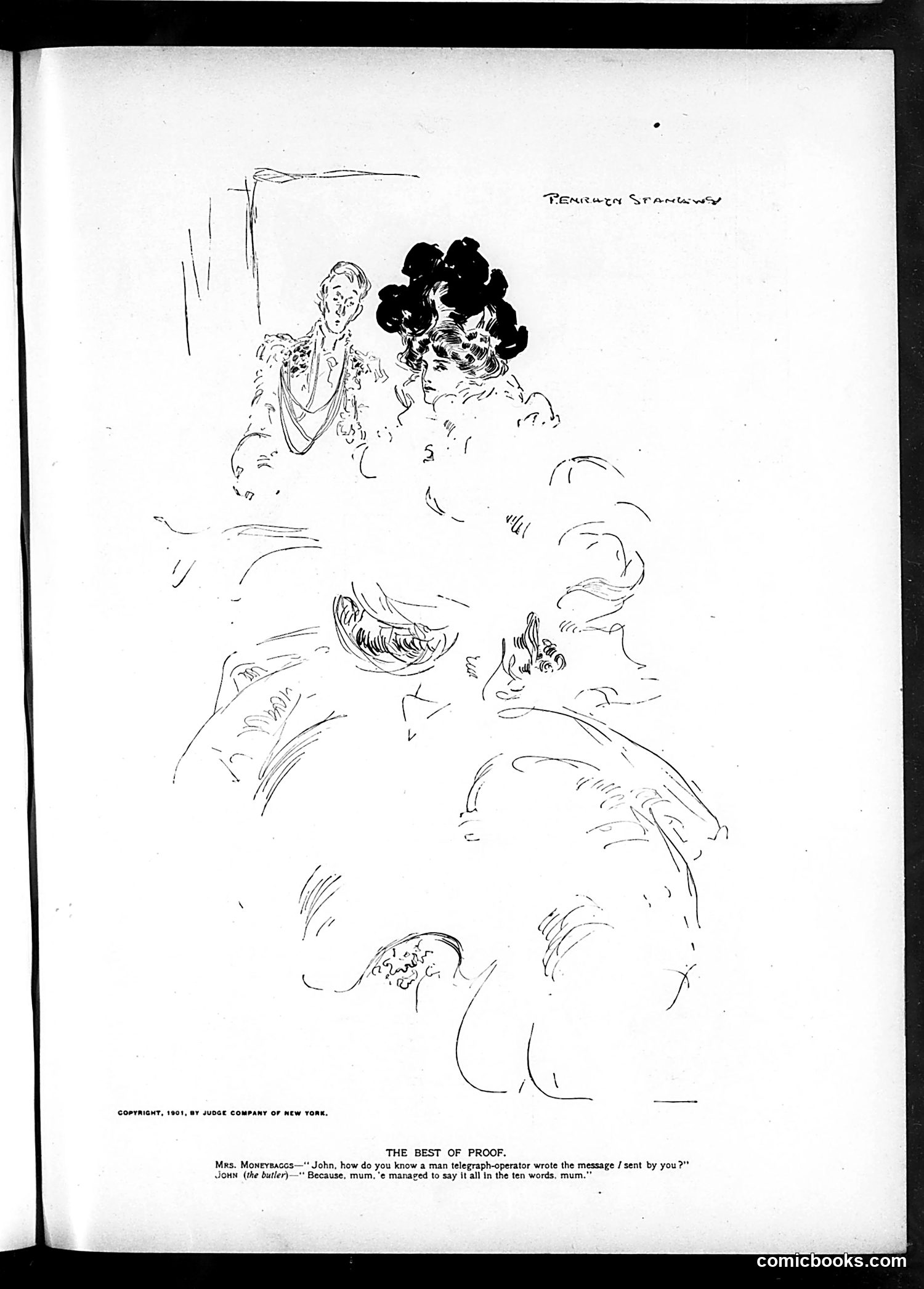
This 1901 Judge cartoon satirizes the brevity and efficiency of telegraph operators. The joke plays on class distinctions: Mrs. Moneybags (a wealthy woman) questions how her butler John knows a telegraph operator sent her message. John's proof is that the operator managed to convey everything in just ten words—the standard telegram length limit. The satire targets telegraph operators' reputation for conciseness born of necessity (charging by the word), contrasting this with the wealthy's tendency toward verbosity. It's also a gentle jab at Mrs. Moneybags's obliviousness to how telegraphy actually works. The cartoon reflects the telegraph's prominence in early 1900s communication technology.
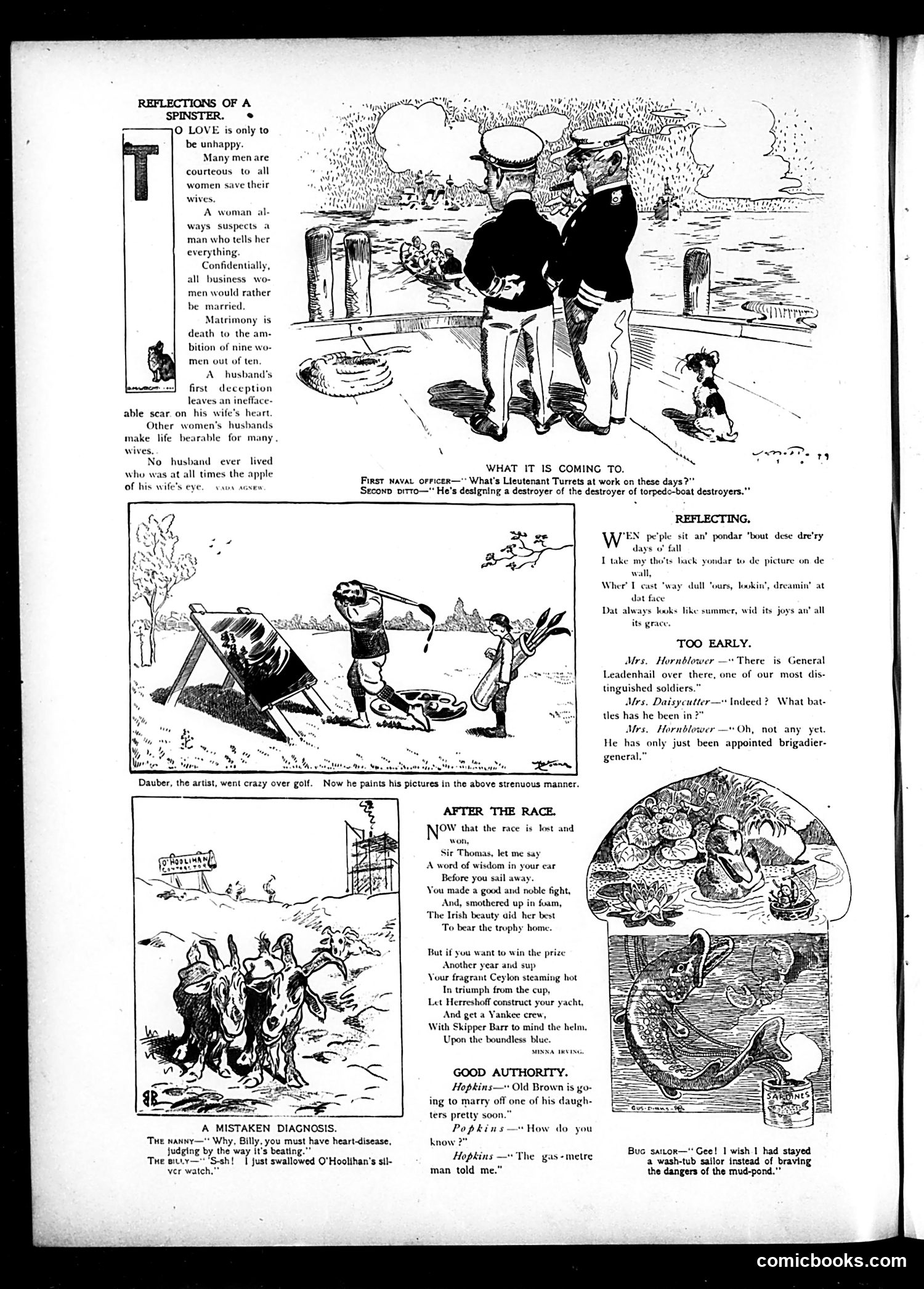
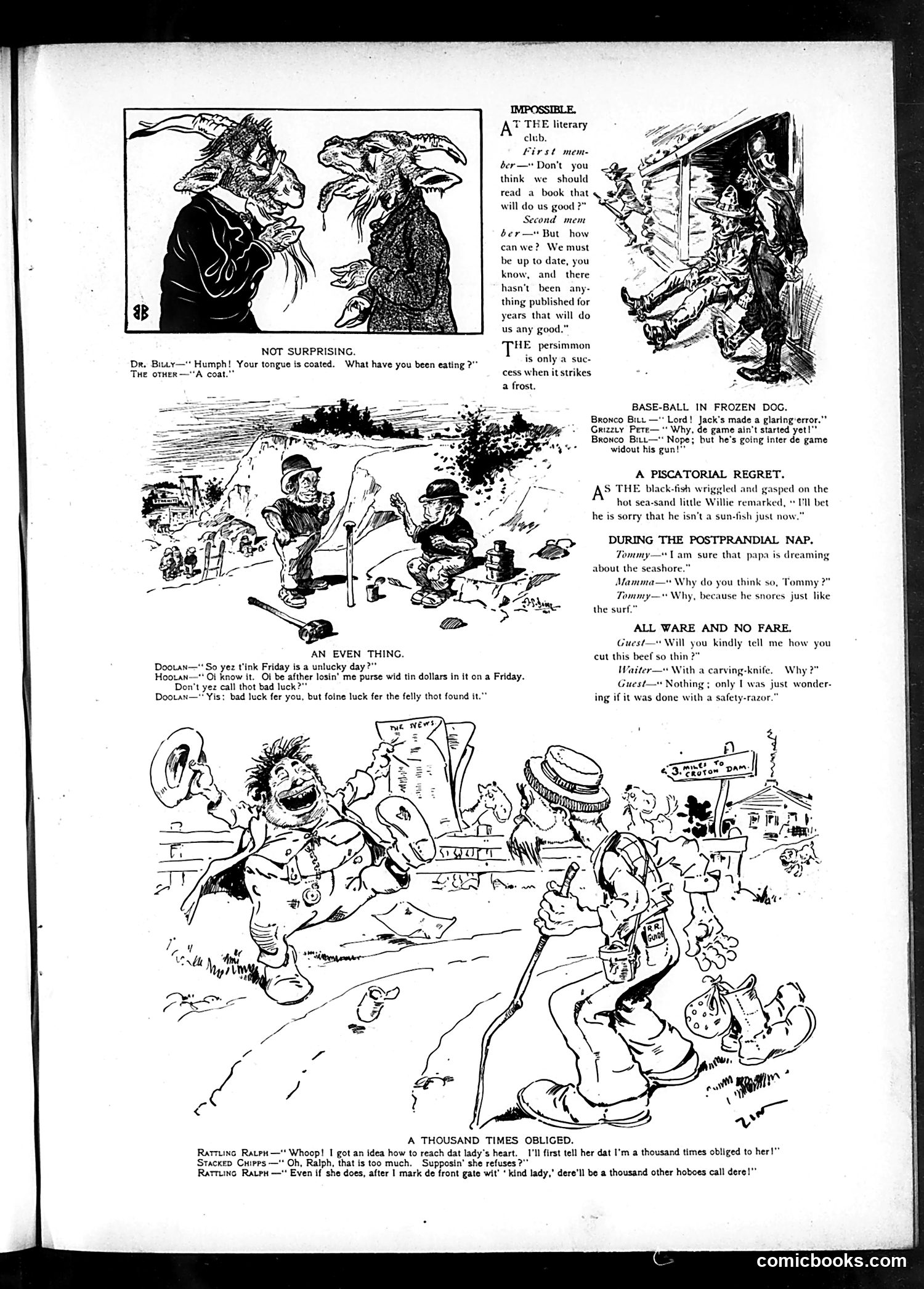
This page contains multiple brief satirical comics and jokes typical of early 20th-century American humor: **"Not Surprising"** mocks literary pretension—two club members dismiss reading anything worthwhile because nothing recent has been published worth their time, a jab at contemporary taste. **"An Even Thing"** plays on Irish-American dialect (common ethnic humor of the era), with a character claiming Friday bad luck cost him money, but the person who found his wallet had good luck—hence "even." **"Base-Ball in Frozen Dog"** appears to reference a baseball game with frontier/Western characters, though the specific reference is unclear. Other brief jokes target: a doctor's patient with a "coated tongue," a child's observation about a dying fish, a man snoring like ocean waves, a waiter's impossibly thin meat-cutting, and a suitor's overwrought courting strategy. The humor relies on puns, ethnic stereotypes, observational comedy about daily life, and gentle social satire—typical of Judge's mass-market appeal to early 20th-century readers.
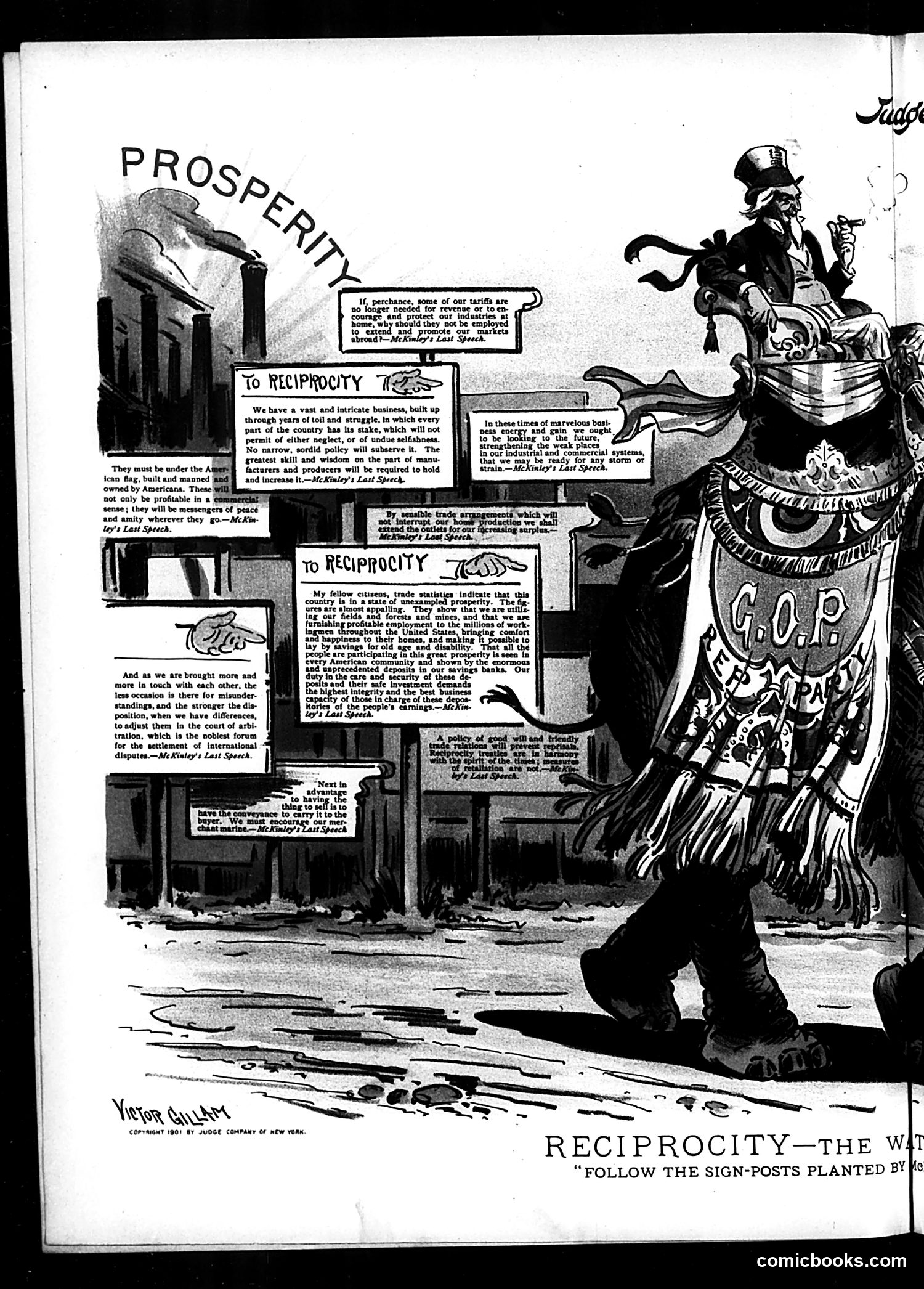
This page from *Judge* magazine satirizes President McKinley's advocacy for reciprocal trade agreements. The large figure on the right appears to be Uncle Sam or a personified America, laden with bundles labeled "G.O.P." (the Republican Party), being led along a path marked by "sign-posts" of McKinley's quotations about reciprocity and prosperity. The satire criticizes reciprocity policy by suggesting it's a deceptive route—the quotes about "peace," "prosperity," and "arbitration" are positioned as misleading guideposts. The industrial imagery (factories on the left) and the heavy burden Uncle Sam carries suggest the cartoon questions whether reciprocal trade truly benefits American workers and industry, or merely burdens the nation while enriching political leadership. The cartoon implies skepticism that McKinley's rhetoric about mutual benefit and international cooperation would deliver promised prosperity to ordinary Americans.
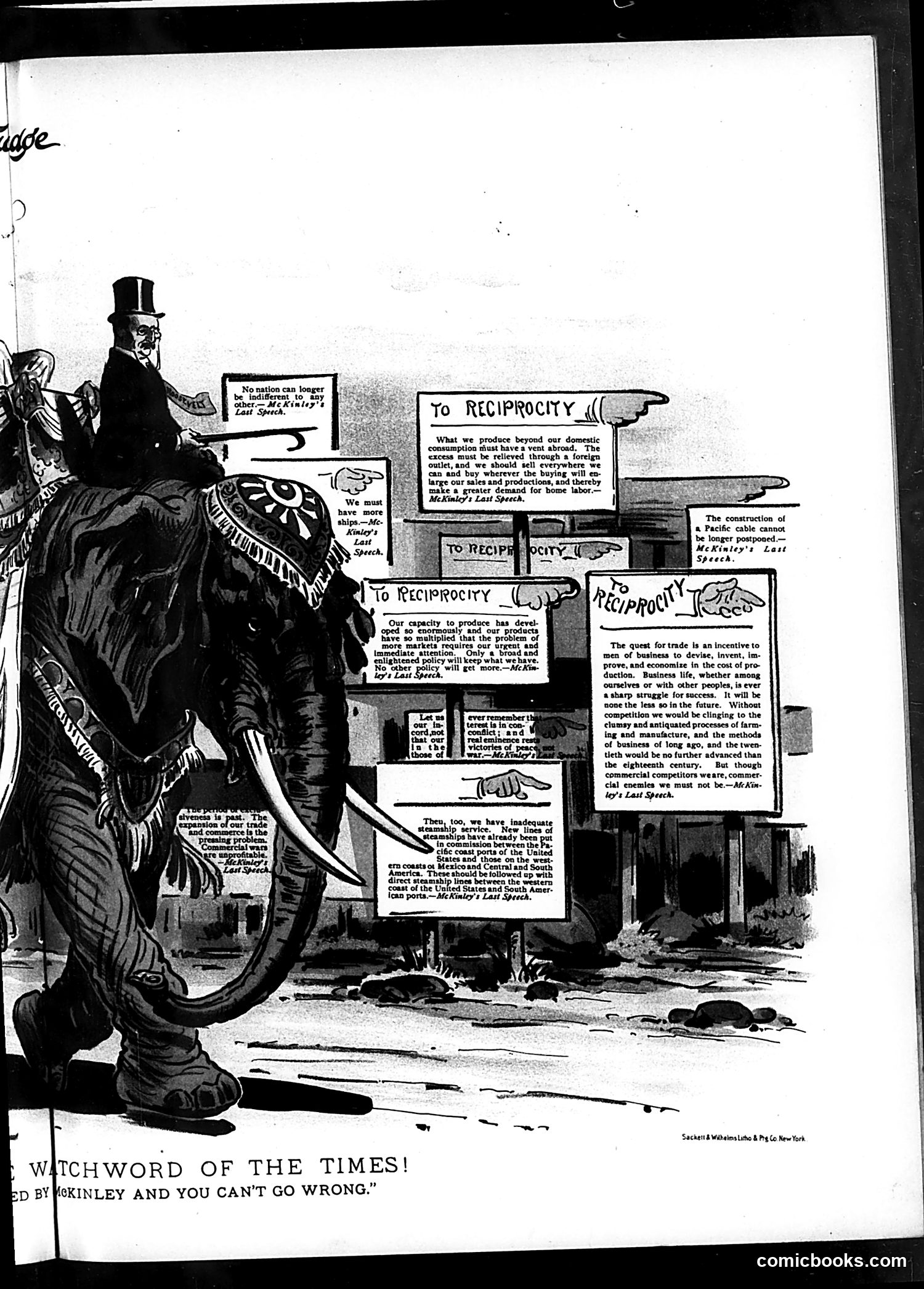
This Judge magazine page satirizes President McKinley's advocacy for reciprocal trade agreements. The central figure is an elephant (the Republican Party symbol) being ridden by McKinley, who waves proclamations about reciprocity—the policy of mutual trade concessions between nations. The satire mocks McKinley's repeated emphasis on trade expansion as a solution to economic problems. Multiple text boxes labeled "To Reciprocity" contain excerpts from his speeches, suggesting he's obsessed with this single remedy. The cartoon implies McKinley promotes reciprocity as a cure-all for labor demands, market saturation, and industrial competition, while downplaying practical complexities. The tagline "McKinley and You Can't Go Wrong" is ironic—suggesting blind faith in the president's trade policy. The overall message critiques what the cartoonist saw as oversimplified or propagandistic promotion of reciprocal trade as the answer to American economic challenges in the McKinley era.
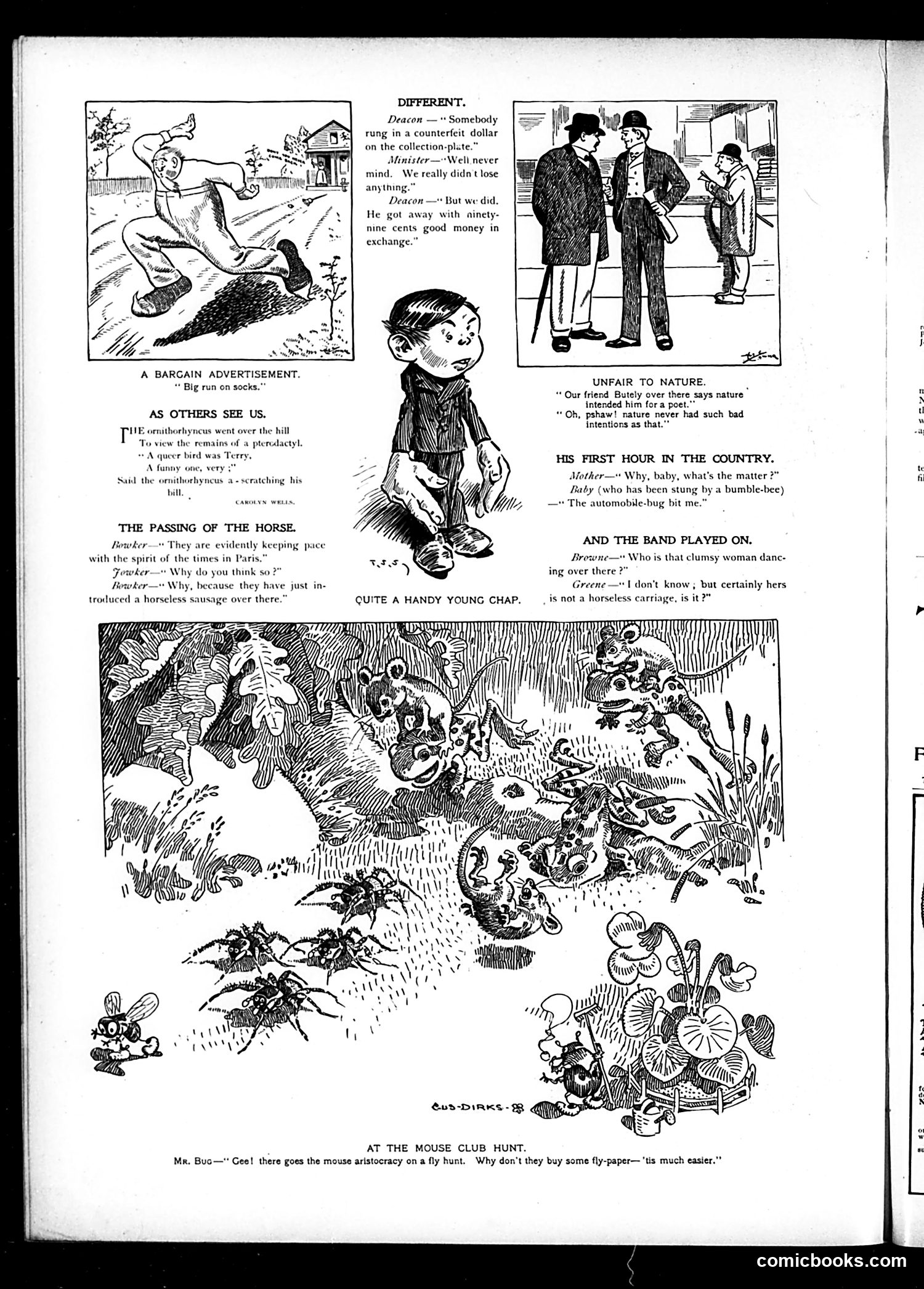
This page contains six unrelated humorous sketches typical of Judge magazine's satirical approach: 1. **"Different"** mocks clergy hypocrisy: a deacon complains that counterfeit money in the collection plate means the church lost ninety-nine cents in the exchange—absurd logic that satirizes financial reasoning. 2. **"A Bargain Advertisement"** references a commercial for socks with heavy demand. 3. **"As Others See Us"** presents nonsensical wordplay about extinct creatures (ornithomyncus, pterodactyl). 4. **"The Passing of the Horse"** jokes about Paris introducing "horseless sausages"—a pun on the automobile age, mocking how quickly technology is replacing traditional things. 5. **"His First Hour in the Country"** contains a pun: a baby stung by a bumblebee says "the automobile-bug bit me," conflating insects with cars. 6. **"At the Mouse Club Hunt"** depicts animals hunting, with humor about inefficient methods. The page exemplifies turn-of-century American humor: puns, absurdist logic, and gentle social observation rather than sharp political commentary.
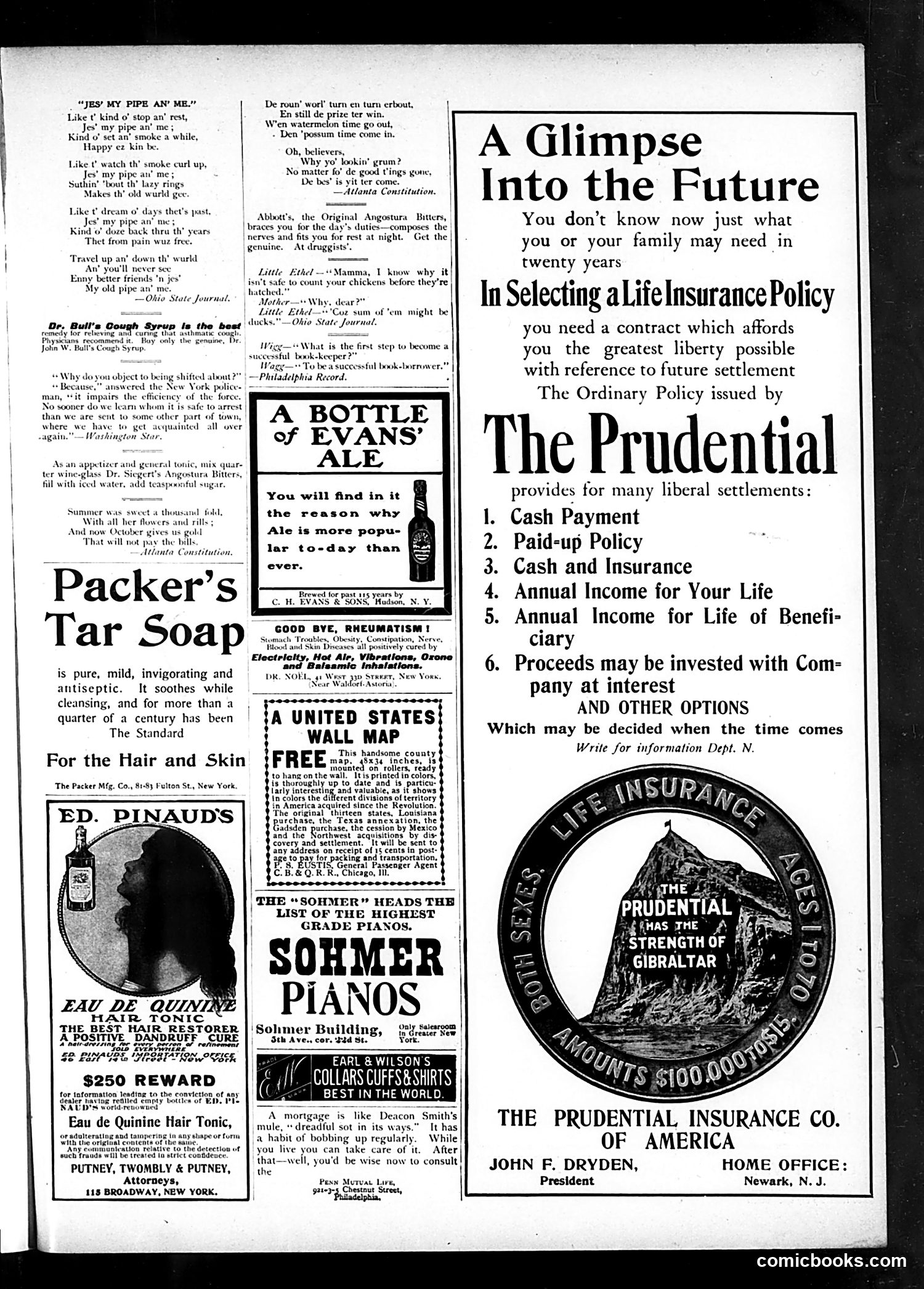
This page is primarily **advertising**, not editorial content or political satire. The dominant feature is a large life insurance advertisement for The Prudential Insurance Company, occupying roughly half the page. The smaller advertisements include period products (Packer's Tar Soap, hair tonics, pianos, collars/shirts) and services typical of early 20th-century publications. There are brief humorous items—a poem "Jes' My Pipe an' Me" using dialect, and short jokes about police reassignment and book borrowers—but these are filler content, not political cartoons. **The Prudential ad's appeal** emphasizes financial uncertainty and family security, urging readers to plan ahead with flexible settlement options. The company's logo features Gibraltar (symbolizing strength/stability), a marketing device still used today. The page reflects Judge's mixed format: satirical commentary alongside commercial content that subsidized publication.
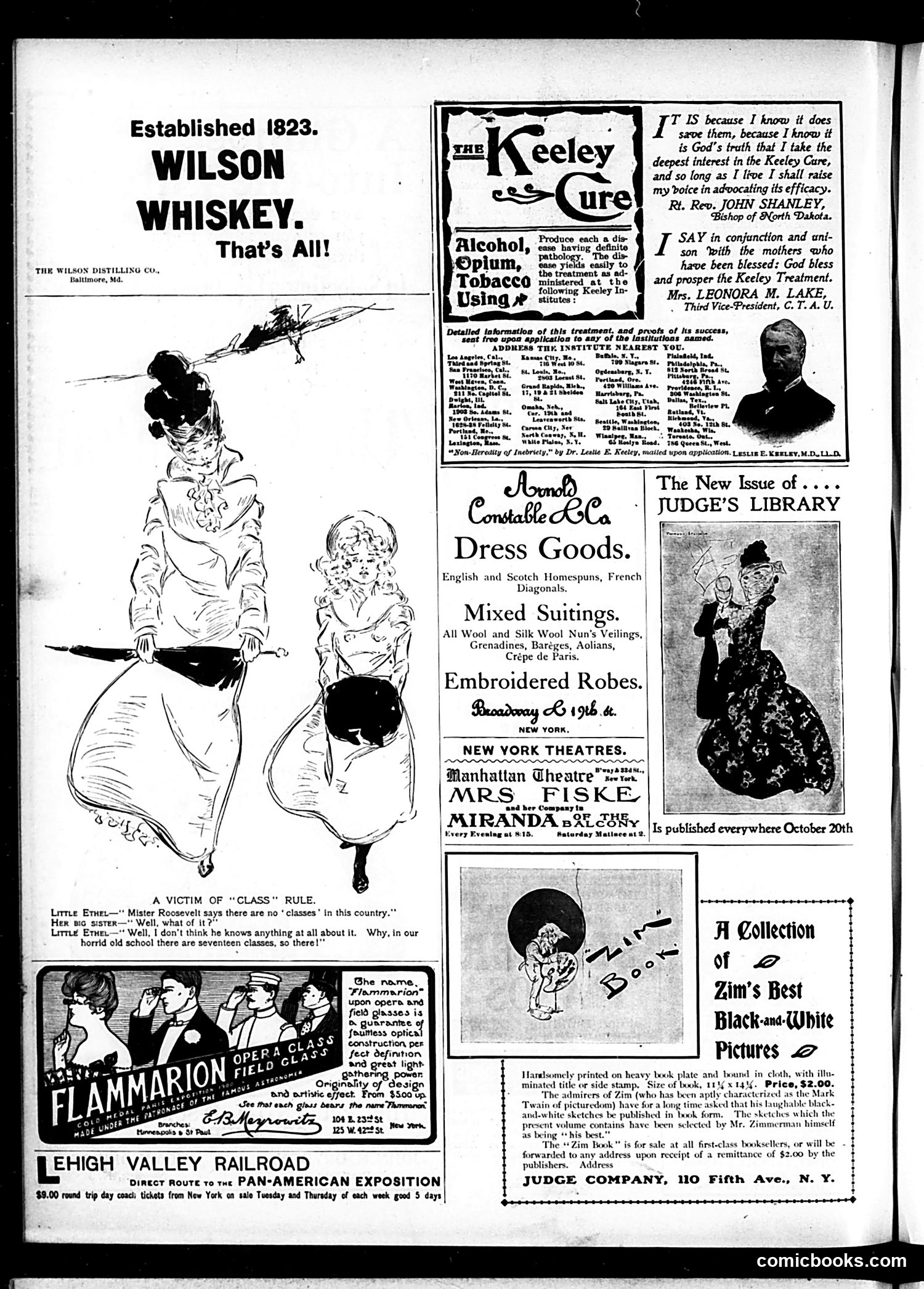
This cartoon satirizes President Theodore Roosevelt's claim that America has no social "classes." Two young girls discuss their school experience: the older sister dismisses Roosevelt's assertion, pointing out that their school has "seventeen classes"—a deliberate pun playing on the word "class" to mean grade levels rather than socioeconomic hierarchy. The joke relies on innocent literalism: the child misunderstands Roosevelt's political statement about class stratification (rich vs. poor) as merely referring to academic divisions. By having a child's simple observation undermine the President's claim, Judge magazine mocks Roosevelt's optimistic rhetoric about American equality. The satire suggests Roosevelt is either naive or dishonest about actual class divisions in American society—that even schoolchildren can see hierarchies he denies exist. This reflects Progressive Era debates about industrial capitalism, labor inequality, and whether America truly offered equal opportunity.
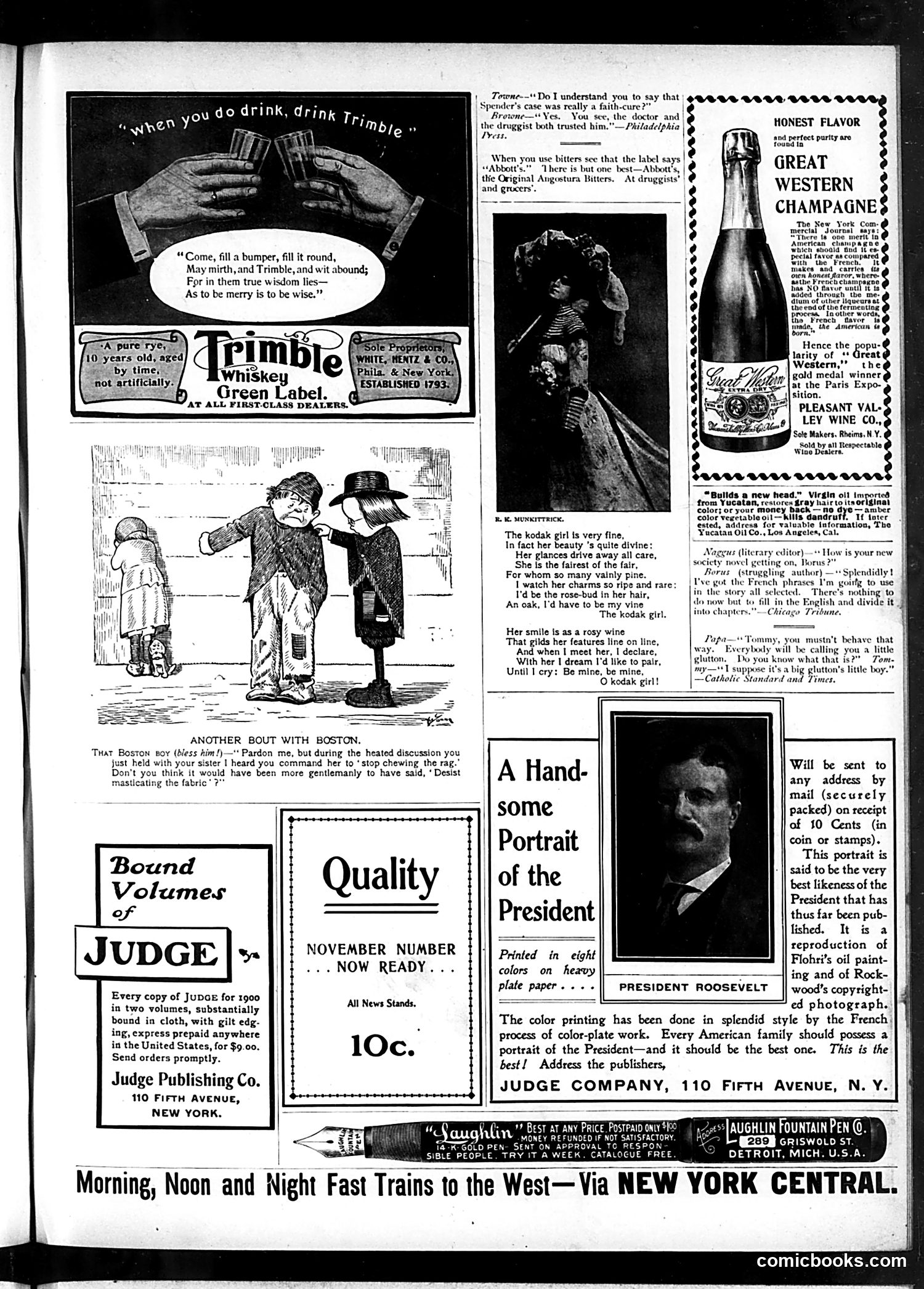
This page is primarily **advertising with minimal editorial content**. The main cartoon—"Another Bout with Boston"—is a brief verbal joke about class-conscious speech. A Boston woman criticizes her sister's crude command to "stop chewing the rag" (slang for talking), suggesting the more refined phrase "desist masticating the fabric" would be more gentlemanly. The humor targets Boston's reputation for pretentious, affected speech and social snobbery. The remainder of the page consists of **period advertisements**: Trimble whiskey, Great Western Champagne, Kodak photography products, Judge bound volumes, President Roosevelt portraits, and fountain pens. These ads reflect early 1900s consumer culture and product marketing strategies. The Roosevelt portrait advertisement is notable as contemporary political merchandise, though presented as patriotic rather than satirical. No significant political satire or social commentary appears on this particular page.
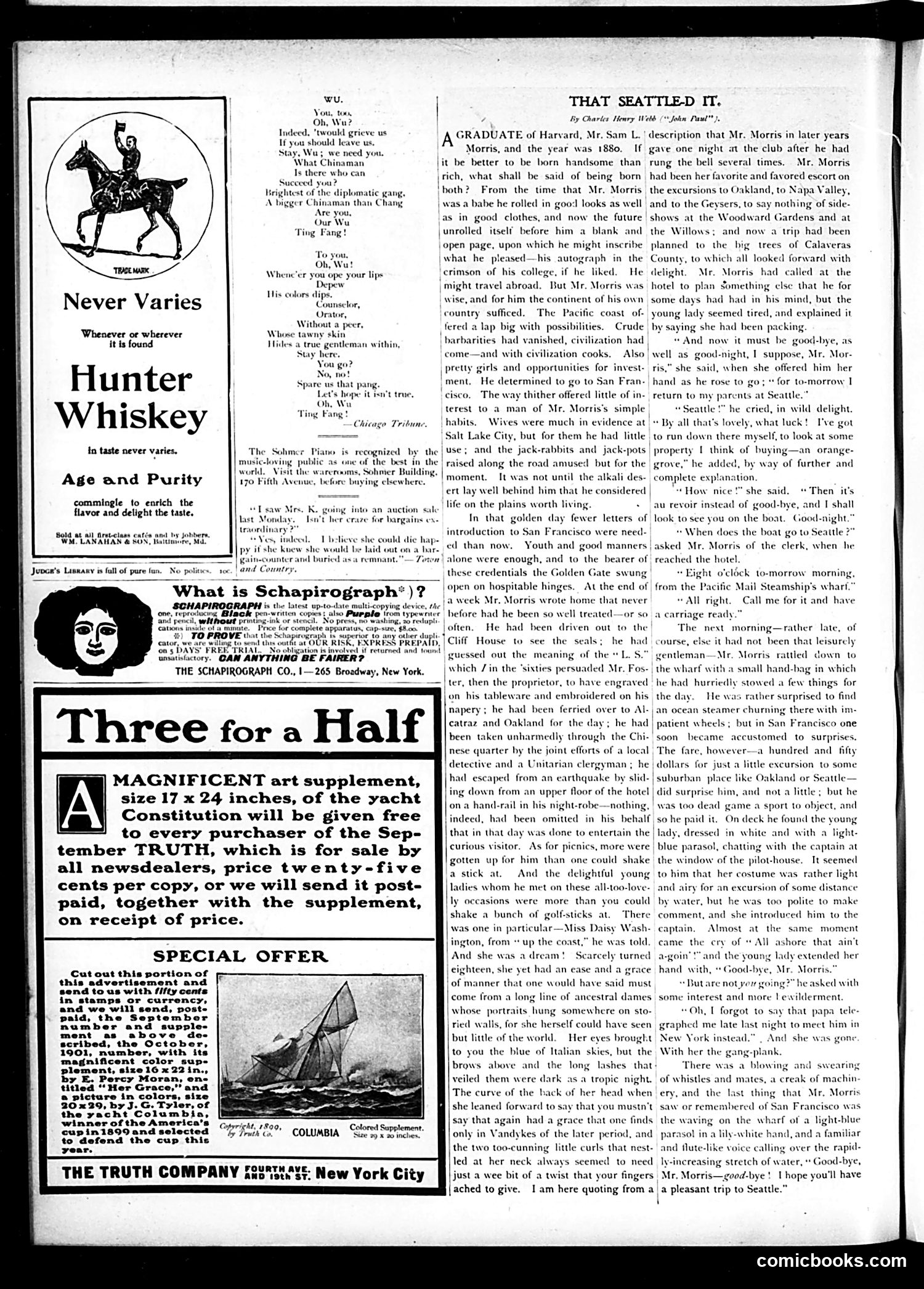
This page contains **primarily advertisements and a short story**, not political satire. The illustrated poem at top-left celebrates **Wu Ting-Fang**, a Chinese diplomat and writer prominent in American public discourse around 1900. The verses praise him as a sophisticated intellectual—"Brightest of diplomatic gang," "Without a peer"—contrasting refined Chinese culture with crude American attitudes. The satire is subtle: by hyperbolically flattering Wu, Judge likely comments on American perceptions of Chinese visitors or the diplomat's actual prominence in society. The main text, "That Seattle-d It" (a pun on "settled it"), tells a romance narrative about a Harvard graduate named Morris traveling west. The remainder comprises advertisements for **Hunter Whiskey**, the **Schapirograph** (a copying device), a yacht art supplement, and **Truth magazine**—typical magazine filler of the era. The page reflects 1901 American attitudes toward Chinese diplomacy and commercial entertainment advertising.
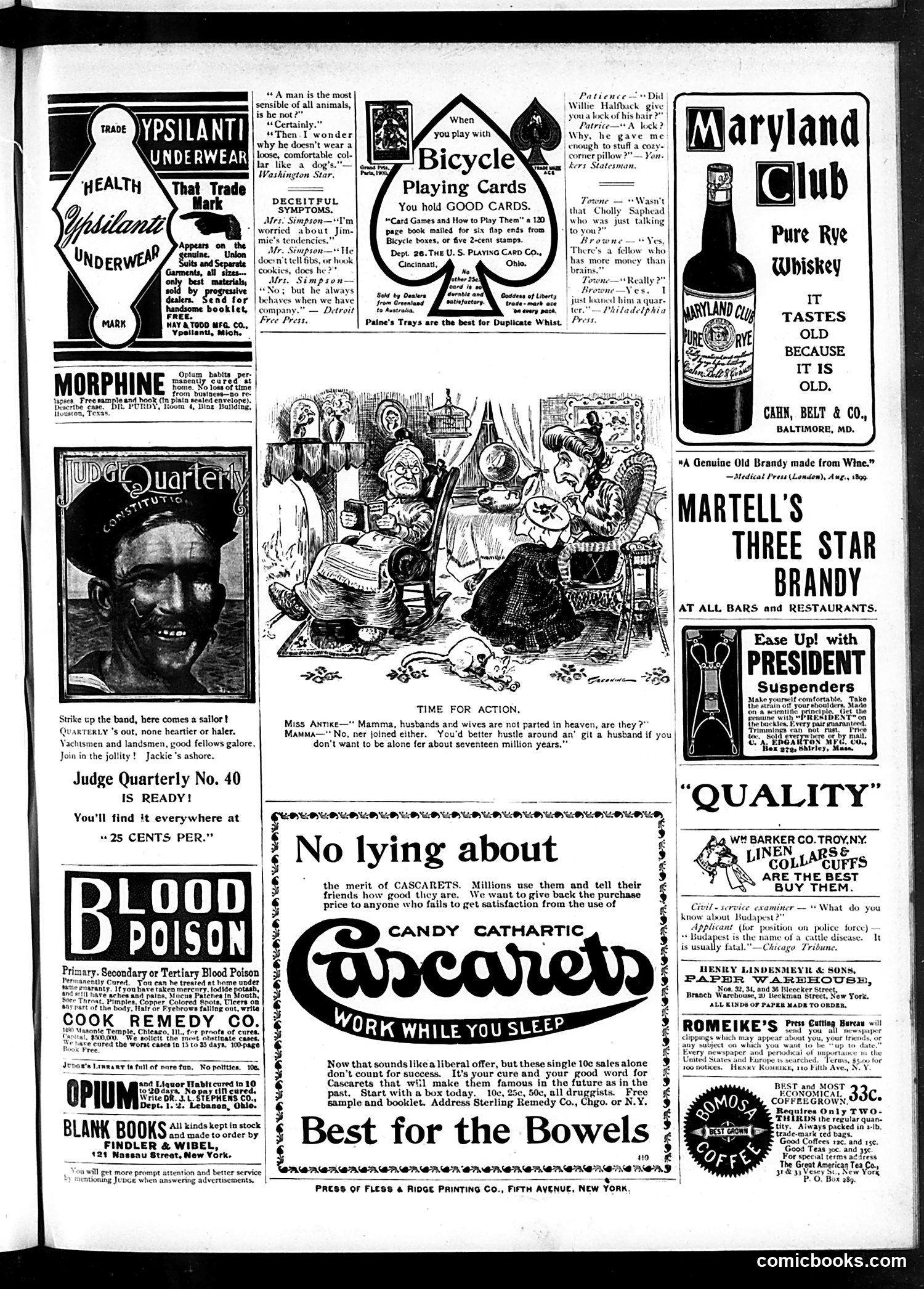
This page is primarily **advertisements and filler content** typical of early 1900s magazines, with minimal satirical cartoons. The main cartoon depicts a domestic scene titled "TIME FOR ACTION," showing a conversation between a mother and daughter about marriage. The daughter asks whether husbands and wives are separated in heaven; the mother replies they aren't separated—they're not even joined—and sarcastically suggests the daughter should "hustle around an' git a husband" if she doesn't want to be alone for "seventeen million years." **The satire targets marriage itself**: it's a dark joke about marital unhappiness, suggesting marriage is a kind of eternal drudgery rather than bliss. This reflects common period attitudes expressing skepticism about matrimony through humor. The remainder of the page contains patent medicines, whiskey, brandy, and other product advertisements—typical revenue sources for magazines of this era. There are no other significant political or social cartoons visible.
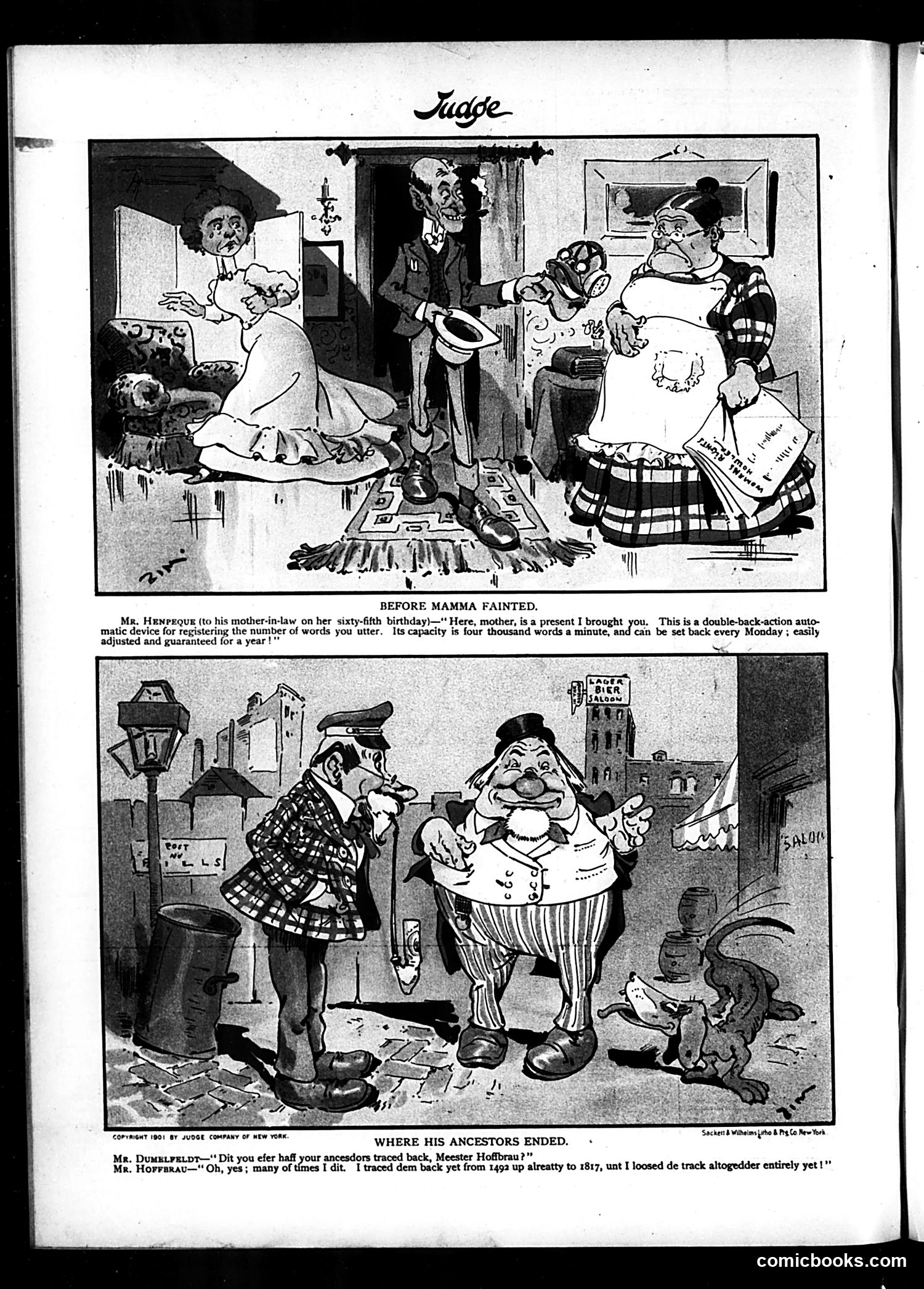
**Top Cartoon: "Before Mamma Fainted"** A son-in-law presents his overbearing mother-in-law with a word-counter device—a satirical jab at talkative women, specifically mothers-in-law. The joke relies on the period stereotype of women, particularly older female relatives, as endlessly chattering and gossip-prone. The device's capacity (4,000 words/minute, reset weekly) exaggerates her verbosity to absurd levels. This reflects early 20th-century gender stereotypes and family tension humor common in Judge. **Bottom Cartoon: "Where His Ancestors Ended"** Two men with Germanic accents (indicated by dialect spelling) discuss ancestry tracing. One claims to have traced ancestors back from 1492 to 1817, then "lost the track entirely"—suggesting his family line disappears into humble or disreputable origins. This mocks recent immigrants' attempts at genealogy and implies lower-class ancestry, playing on ethnic stereotypes about German immigrants and class anxieties of the period.