
Judge, 1901-10-26 · page 14 of 16
Judge — October 26, 1901 — page 14: what you’re looking at
What you’re looking at
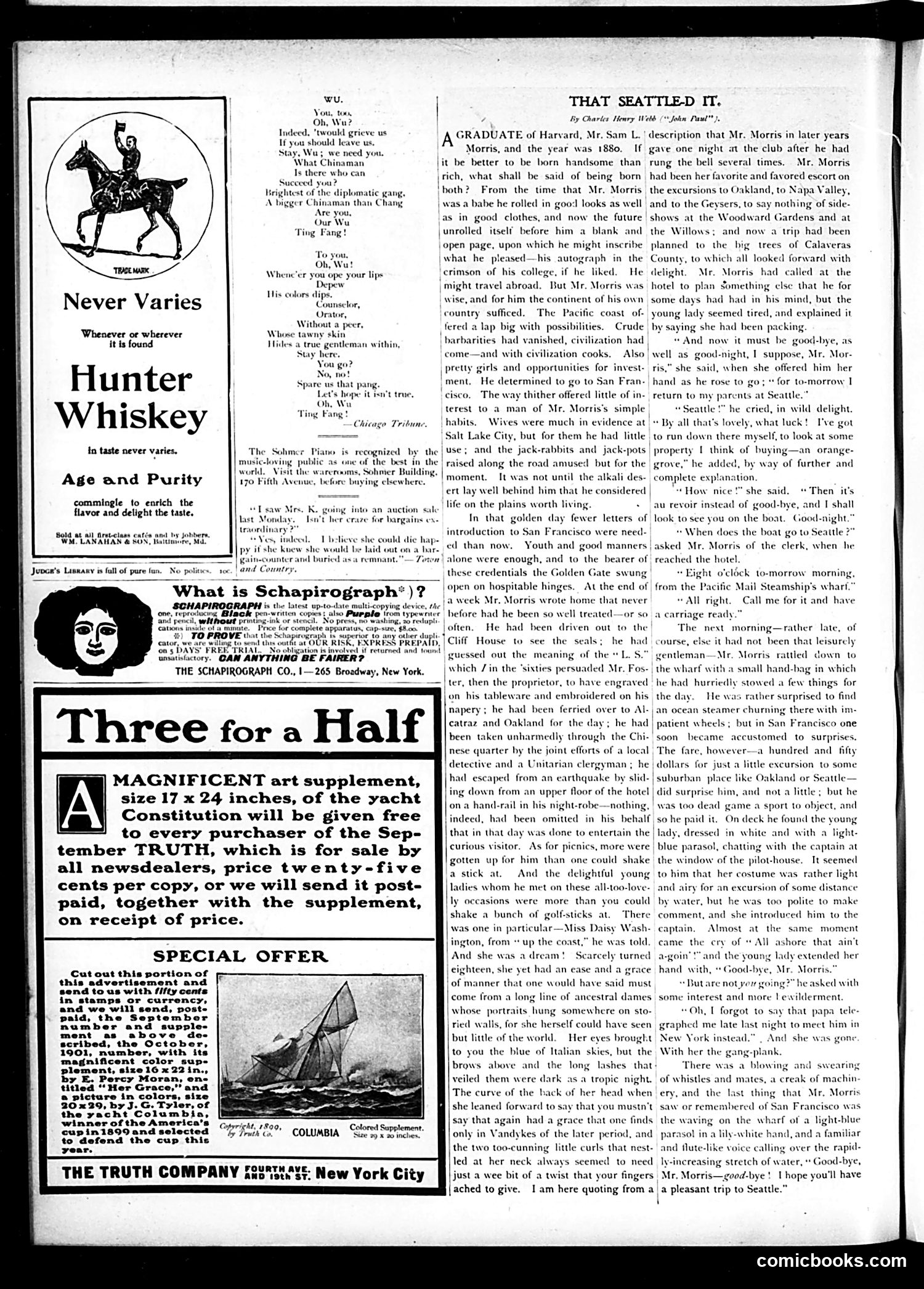
This page contains **primarily advertisements and a short story**, not political satire. The illustrated poem at top-left celebrates **Wu Ting-Fang**, a Chinese diplomat and writer prominent in American public discourse around 1900. The verses praise him as a sophisticated intellectual—"Brightest of diplomatic gang," "Without a peer"—contrasting refined Chinese culture with crude American attitudes. The satire is subtle: by hyperbolically flattering Wu, Judge likely comments on American perceptions of Chinese visitors or the diplomat's actual prominence in society. The main text, "That Seattle-d It" (a pun on "settled it"), tells a romance narrative about a Harvard graduate named Morris traveling west. The remainder comprises advertisements for **Hunter Whiskey**, the **Schapirograph** (a copying device), a yacht art supplement, and **Truth magazine**—typical magazine filler of the era. The page reflects 1901 American attitudes toward Chinese diplomacy and commercial entertainment advertising.
📄 Transcribed text from this page (OCR, searchable)
Machine-transcribed from the original scan — historical spelling and the odd misread are preserved.
wu. You, tow Oh, Wa? Indeed, 'twe should leave us What Chinaman Is there who can Succeed you? Krightest of 1 diplomatic gang, Ab ger Chinaman than Chang Are you, Our Wu ‘Ting Fang! Ob, Wu ‘er you ope your lips Depew lors dips. Counselor, Orator, Without a peer, Whose tawny skin les a true gentlema: Never Varies Whenever or wherever it ts found Hunter Whiskey in taste never varies. within, Let's hope it isn't true, Oh, Wa 4, Fang! The musi world, 170 Fifth Avenue, be Sohm. an ving Age and Purity commingle to enrich the flavor and delight the taste. Tsaw Mes. K. going into an aucti last Mor Is | traordinary y Ves indecd. believe she ex py if she kuew she would be laid Sold at all Aratclans cafce and by jobbers, WM. LANAHAN @ SON, It. Juoca’s Linkany is fall of pure fa Chicago Tribune. is recognized by the Use; and the jack blic as one of the best in the | raised along the road amused but for the Visit the warcrooms, Sohmer Building, ore buying elsewhere. W sake ther craze for bargains ex- Nd die hap- ‘inn alone were enough, and to the bearer of SCHAPIROGRAPH is thc Latest up. one, reproducing Blaek pen-written copes: also Purple Sind pene, wltfrourt printing ink or mene No pres, Cations inside ola Price for complete apparatus, cap-sizes $0. TO PROVE tt the Sch cator, we are willing to sera thts oat RISK. F ons DAYS’ FREE TRIAL. No obligation is involved unsutisiactory. CAN ANYTHING BE FAIRER? THE SCHAPIROGRAPH CO., 1—265 Broadway, New York. What is Schapirograph*)? _ irom typewnt hing, 20 relupt perioe to any other dupli. + PRESS PREPAID, srned and tourd MAGNIFICENT art supplement, size 17 x 24 inches, of the yacht Constitution will be given free to every purchaser of the Sep- A tember TRUTH, which is for sale by all newsdealers, price twenty-five cents per copy, or we will send it post- paid, together with the supplement, on receipt of price. SPECIAL OFFER Cut out this portion of this advertisement and send to us with fifty cents in stamps or currency, nd we will nd, poste paid, the Sertember number and supple- ment as above de. scribed, the October, 1901, number, with its magnificent color sup- plement, size 16 x 22 in. by E. Percy Moran, en. titled @ picture in colors, 20x29, by J. G. Tyler, of the yacht Columbia winner of the America’ cupini899 and selected to defend the cup this year. THE TRUTH COMPAN Copyright, 1809, ‘olored Supplemen by Truth co. be : Size 29 x 20 inches. COLUMBIA FOURTH AVE. 1D 19th ST. New York City THAT SEATTLE-D IT. ’ By Charles Henry Webbs GRADUATE of Harvard, Mr. Sam L. Morris, and the year was 1880. If jit be better to be born handsome than jrich, what shall be said of being born ‘both? From the time that Mr. Morris | was a babe he rolled in good looks as well as in good clothes, and now the future junrolled itselt’ before him a blank and open page, upon which he might inscribe what he pleased—his autograph in the crimson if he liked. He might travel abroad. But Mr. Morris was wise, and for him the continent of his own country sufficed. of- ties. Crude ization had Also | pretty girls and opportunities for invest. his colleg The Pacific coast fered a lap big with possi | barbarities had vanished, civ come—and with civilization cooks. |ment. He determined to go to San Fran- ‘The way thither offered little of in- terest to a man of Mr, Morris's simple habits. Wives were much in evidence at Salt Lake City, but for them he had little cisco, !moment. It was not until the alkali des- ert lay well behind him that he considered life on the plains worth living. : In that golden day fewer letters of introduction to San Francisco were need- ed than now. Youth and good manners these credentials the Golden Gate swung | open on hospitable hinges. At the end of a week Mr. Morris wrote home that never hefore had he been so well treated often. He had Cliff House to see guessed out the which /in the or so been driven out to the the seals; he had meaning of the" L. S. ixties persuaded Mr. ter, then the proprietor, to have engraved on his tableware and embroidered on his napery; he had been ferried over to A\ catraz and Oakland for the day; he had been taken unharmedly through the Chi- nese quarter by the joint efforts of a local detective and a Unitarian clergyman ; he had escaped from an earthqu: y slide ing down from an upper floor of the hotel ona hand-rail in his night-robe—nothing indeed, had been omitted in his behalf that in that day was done to entertain the curious visitor. ke | As for picnics, more were gotten up for him than one could shake a stick at. And the delightful young ladies whom he met on these all-too-love- ly occasions were more than you could shake a bunch of golf-sticks There | was one in particular—Miss Daisy Wash- | ington, from up the coas told | And she was a dream! Scarcely turned et had an ease a he eighteen, she of m: ind a grace nner that one would have said must come from a long line of ancestral dames whose portraits hung somewhere on sto- ried walls, for she herself could have seen but little of the world. Her eyes brought to you the blue of Italian skies, but the ed them were dark asa tropic night. The curve of the back of her head when she leaned forward to say that you mustn't say that again had a grace that one finds only in Vandykes of the later period, and the two too-cunning little curls that nest- led at her neck always seemed to need just a wee bit of a twist that your fingers ached to give. Iam here quoting from a abbits and jack-pots | brows above and the long lashes that: “John Paul"). description that Mr. Morris in later years gave one night at the club after he had rung the bell several times. Mr. Morris had been her favorite and favored escort on the excursions to Oakland, to Napa Valley, and to the Geysers, to say nothing of sid shows at the Woodward Gardens and at the Willows; and now a trip had been planned to the big trees of Calaveras County, to which all looked forward with Mr. 1 at the hotel to plan Something clse that he for some days had had in his mind, but the delight, Morris had call young lady seemed tired, and explained it by saying she had been packing. “And now it must be good-bye, as well as good-night, 1 suppose, Mr. Mor- ris," she said, when she offered him her hand as he rose to go; for to-morrow 1 return to my p Seattle !" he cried, in wild delight. “By all that's lovely, what luck! I've got to run down there myself, to look at some rents at Seattle. property [ think of buying—an orange- grove,” he added, by way of further and complete explanation “How nice!" she said. “Then it's au revoir instead of good-bye, and I shall look to see you on the boat. Good-night.” + When does the boat go tle asked Mr. Morris of the clerk, when he reached the hotel. + Eight o'cléck to-morrow morning, from the Pacific Mail Steamship’s whart,” + AML right. a carriage ready Call me for it and have The next morning—rather late, of course, else it had not been that leisurely tleman—Mr. Morris rattled down to the wharf with a small hand-bag in which he had hurriedly stowed a few things for the day. He was rather surprised to find an ocean steamer churning there with im- patient wheels; but in San Francisco one became accustomed The fare, however: soon to surprises. a hundred and fifty dollars for just a little excursion to some suburban place like Oakland or Seattle— did surprise him, and not a little ; but he was too dead game a sport to object, and so he paid it, On deck he found the young lady, dressed in white and with a ligh blue parasol, chatting with the captain at the window of the pilot-house. It seemed to him that her costume was rather light and airy for an excursion of some distance by water, but he was too polite to make comment, and she introduced him to the captain, Almost at the came the ery of «All ashore that ain't same moment a-goin’ !" and the young lady extended her hand with, “Good-bye, Mr. Morris.” + Butare not yor going?” he asked with some interest and more | ewilderment. “Oh, [ forgot to say that papa tele- graphed me late last night to mect him in New York instead.” | And she was gone With her the gang-plank. There was a blowing caring of whistles and mates, a creak of machin. ery, and the last thing that Mr. Morris saw or remembered of San Francisco was. the waving on the wharf of a light-blue parasol ir and flut a lily-white hand, and a familiar like voice calling over the rapid- ly-inereasing stretch of water, * Good-bye, Mr. Morris—good-bye | L hope you'll have a pleasant trip to Seattle comicbooks.com