
A complete issue · 16 pages · 1901
Judge — August 31, 1901
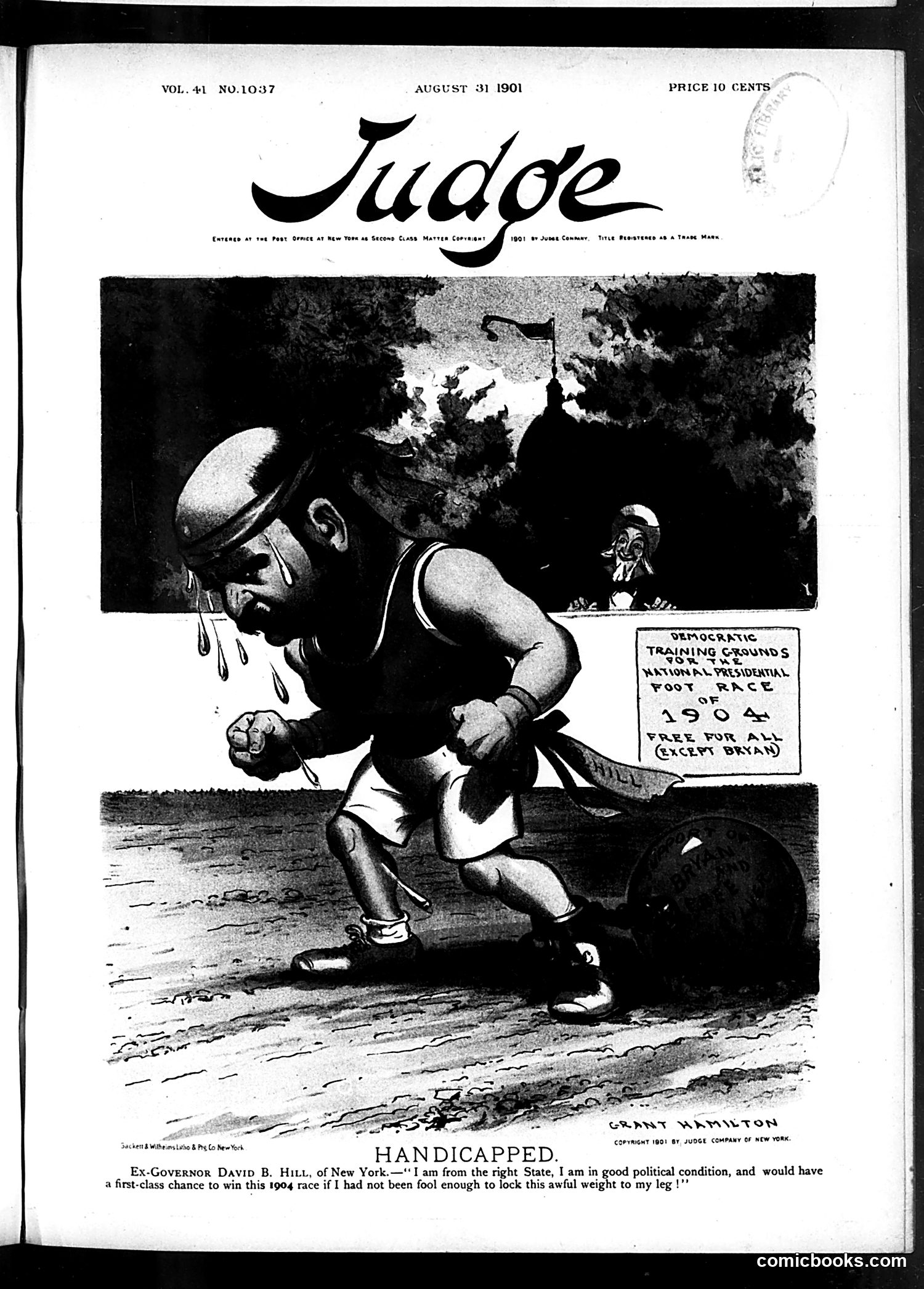
This Judge magazine cover from August 31, 1901 satirizes ex-Governor David B. Hill of New York's presidential ambitions. The cartoon shows Hill literally "handicapped"—weighted down by a heavy ball and chain attached to his leg—running in the "Democratic Training Grounds for the National Presidential Foot Race of 1904." The caption quotes Hill claiming he's "in good political condition" and would win the 1904 race "if I had not been fool enough to lock this awful weight to my leg." The "weight" appears to be a satirical reference to some political liability or controversial action from Hill's past that damaged his credibility or popularity, making him an unlikely Democratic nominee despite his political experience. The cartoon mocks his self-awareness of his diminished prospects.
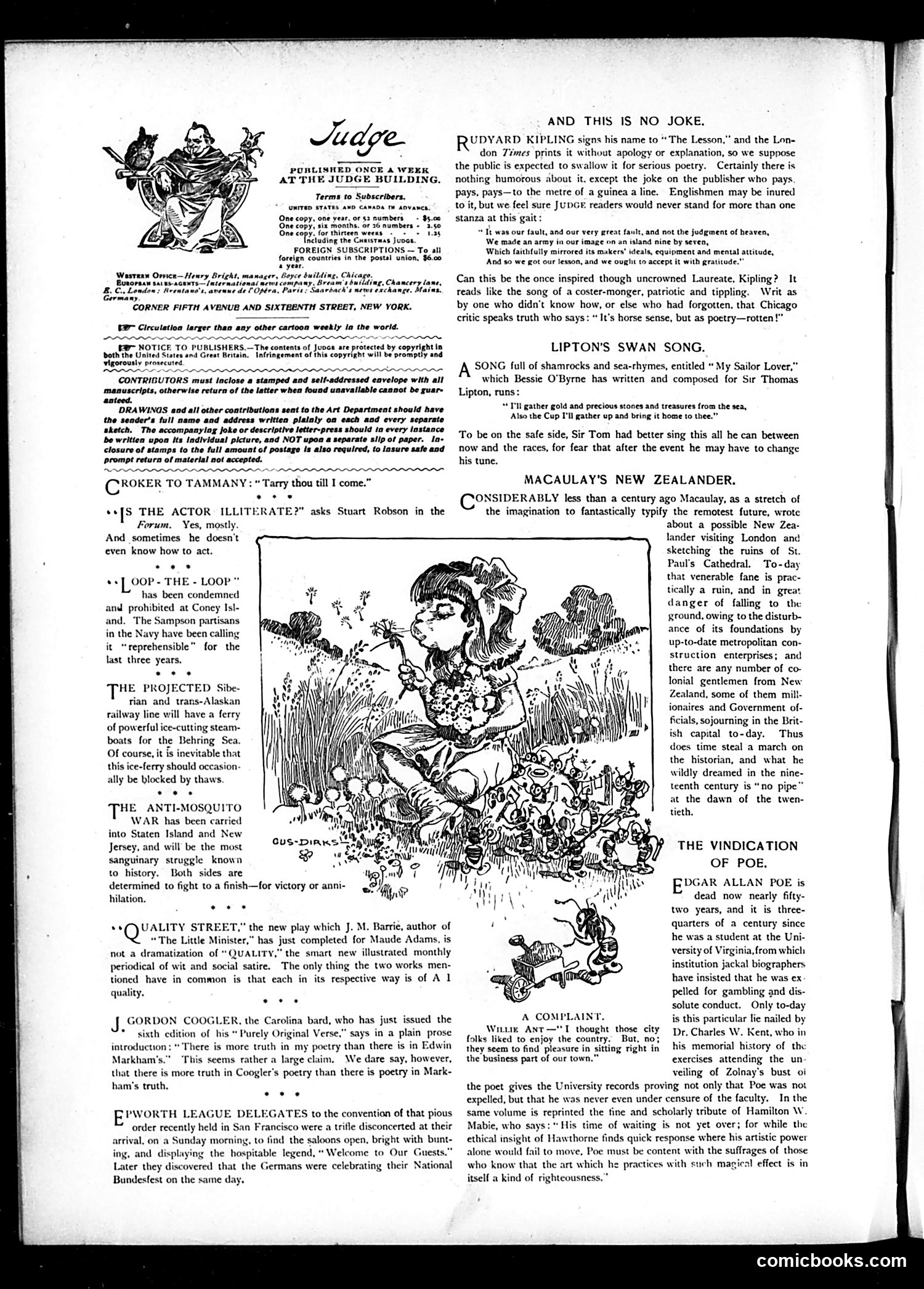
The main illustration depicts a grotesque caricature of a woman surrounded by various creatures and objects. Based on the accompanying article "Macaulay's New Zealander," this appears to satirize concerns about Britain's imperial decline and cultural decay. The text references a "possible future New Zealander visiting London and sketching the ruins of St. Paul's Cathedral," drawing on Thomas Macaulay's famous historical observation about civilization's fragility. The grotesque female figure likely represents either a degraded Britain or a satirized vision of the future. The page also contains brief commentary on theatrical and literary matters typical of Judge's format. Without clearer context on the specific historical moment, the exact identity of the caricatured figure remains uncertain, though the satire targets anxieties about national decline and cultural corruption.
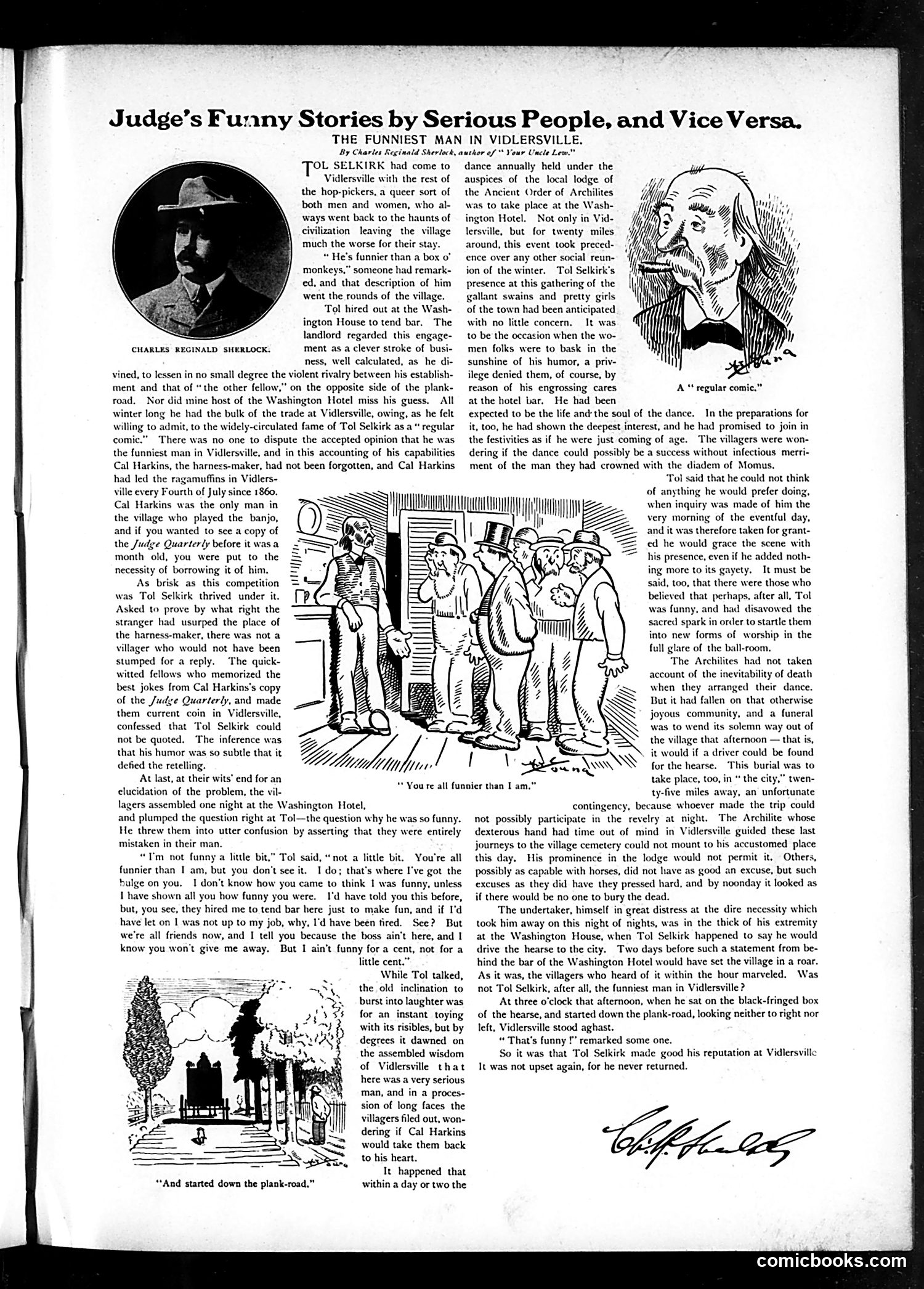
This story by Charles Reginald Sherlock satirizes small-town social pretension. The narrative concerns Tol Selkirk, a village character known as "the funniest man in Vidersville," whose reputation rests on telling crude jokes at the local bar. When the prestigious Archeological Lodge plans a formal dance at the Washington Hotel, the villagers expect Tol to perform—yet his attendance creates anxiety about his coarse humor potentially embarrassing the event. The satire mocks how small communities simultaneously celebrate and resent their colorful characters, and how social aspiration conflicts with authentic local culture. The accompanying illustrations show Tol among well-dressed villagers, emphasizing the class tensions between his rough informality and their pretended refinement.
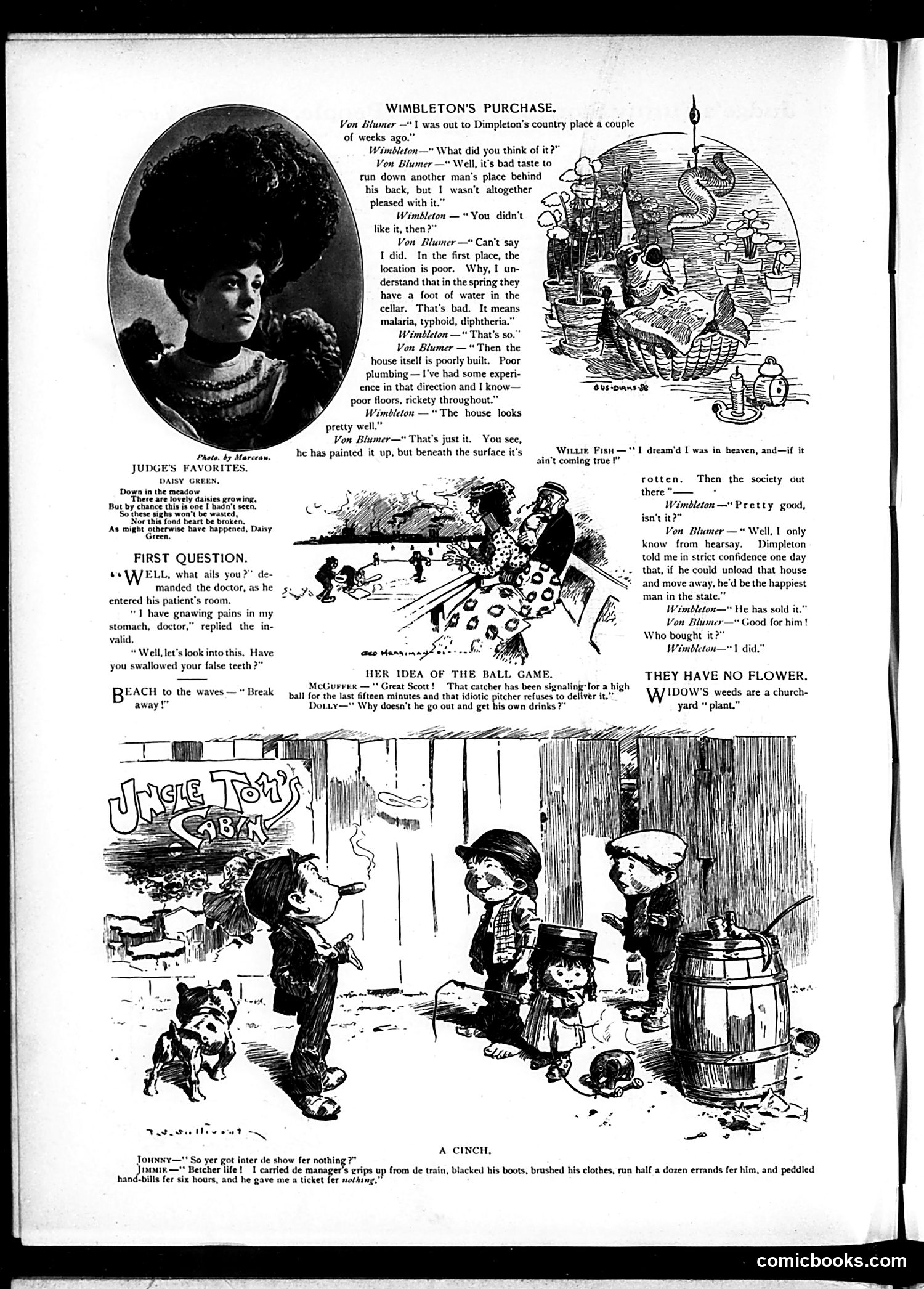
This page contains several satirical pieces: **"Wimbleton's Purchase"** (top) depicts a conversation between Von Blumer and Wimbleton about buying a country property. The satire mocks wealthy buyers who overlook serious flaws—poor location, water damage, rickety plumbing—focusing instead on superficial improvements. It's social commentary on wealthy urban elites making poor real estate investments while congratulating themselves on shrewd acquisitions. **"First Question"** and other brief humorous sketches use wordplay and situational comedy typical of Judge's satirical style. **"Uncle Tom's Cabin" and "A Cinch"** are illustrated comic vignettes with dialogue, appearing to be standalone humor pieces rather than political satire. The page primarily offers social satire targeting upper-class pretension and poor judgment, rather than explicit political commentary.
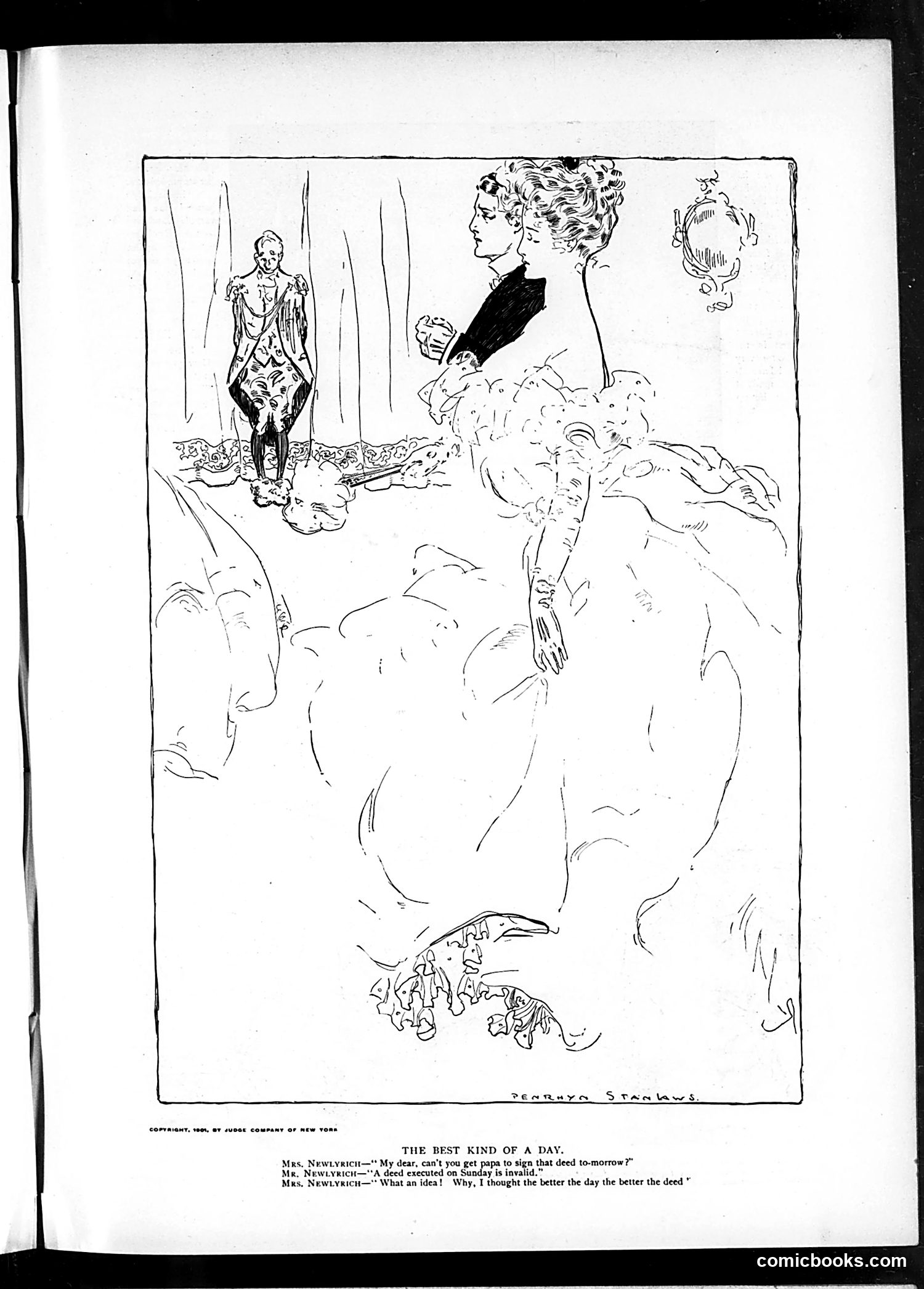
This cartoon satirizes Victorian moral hypocrisy through a domestic scene. Mrs. Newlyrich asks her husband to have her father sign a property deed on Sunday. Mr. Newlyrich objects that executing legal documents on the Sabbath is improper. Mrs. Newlyrich responds with mock innocence, claiming "the better the day the better the deed"—a misapplication of the pious maxim "the better the day, the better the deed" (meaning good deeds on holy days are virtuous). The joke mocks upper-class women's selective morality: Mrs. Newlyrich conveniently invokes religious propriety when it suits financial interests, while twisting religious sentiment to justify profit-seeking on a holy day. The cartoon critiques how wealthy Americans used piety as convenient cover for acquisitive behavior.
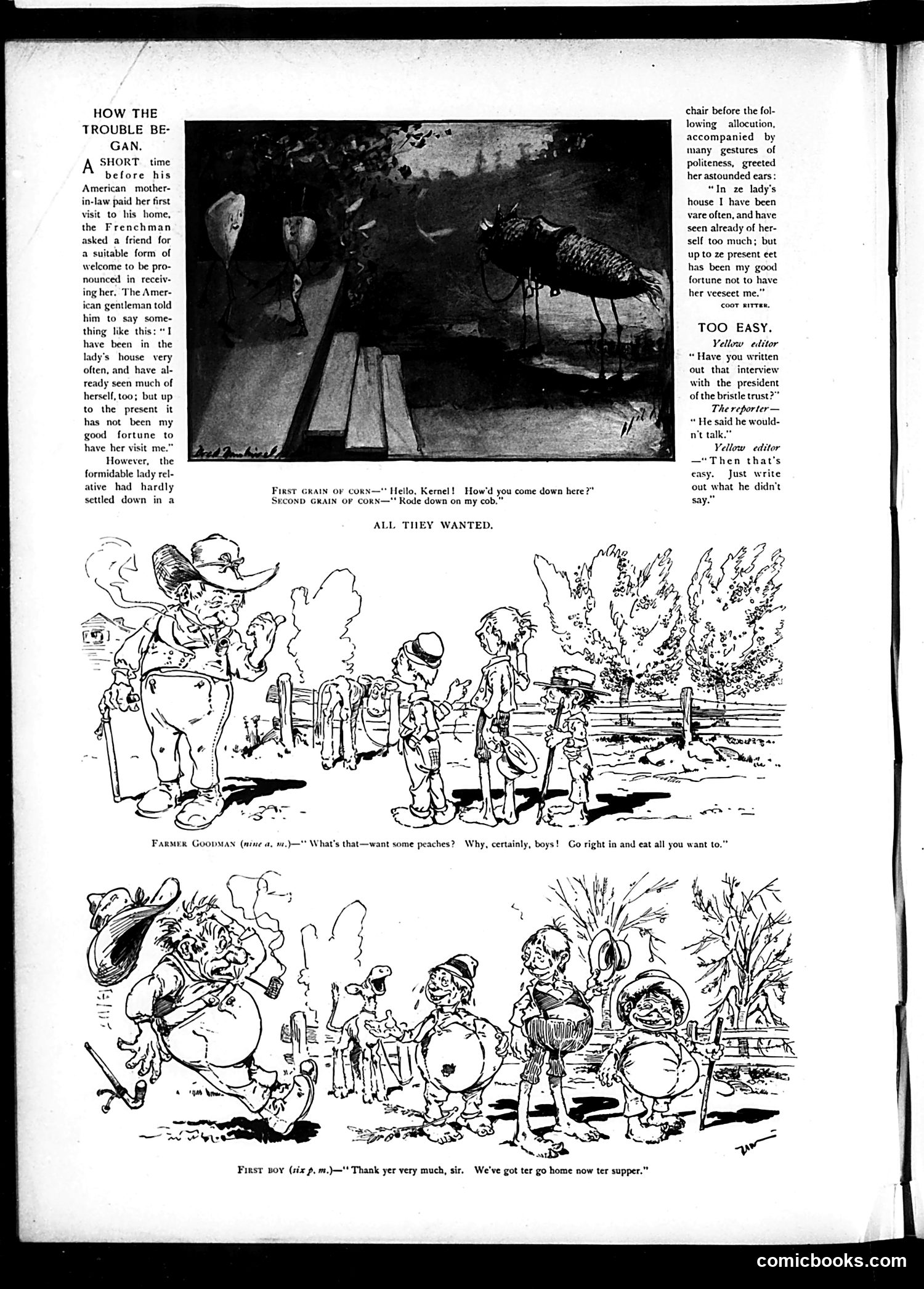
This Judge magazine page contains three separate satirical pieces: **"How the Trouble Began"**: A Frenchman attempts to welcome his American mother-in-law using formal English phrases provided by an American friend. He mangles the speech through heavy French accent and poor translation, accidentally insulting her by saying he's "seen already of herself too much" instead of expressing pleasure at her visit. The satire targets both French-American cultural miscommunication and the awkwardness of in-law relations. **"All They Wanted"**: A mild joke about corn kernels using a pun ("rode down on my cob"). **"Too Easy"**: A yellow journalist editor instructs a reporter to fabricate an interview with a trust president who refused to talk, satirizing sensationalist journalism practices of the era—specifically the willingness of "yellow press" outlets to simply invent quotes rather than report facts.
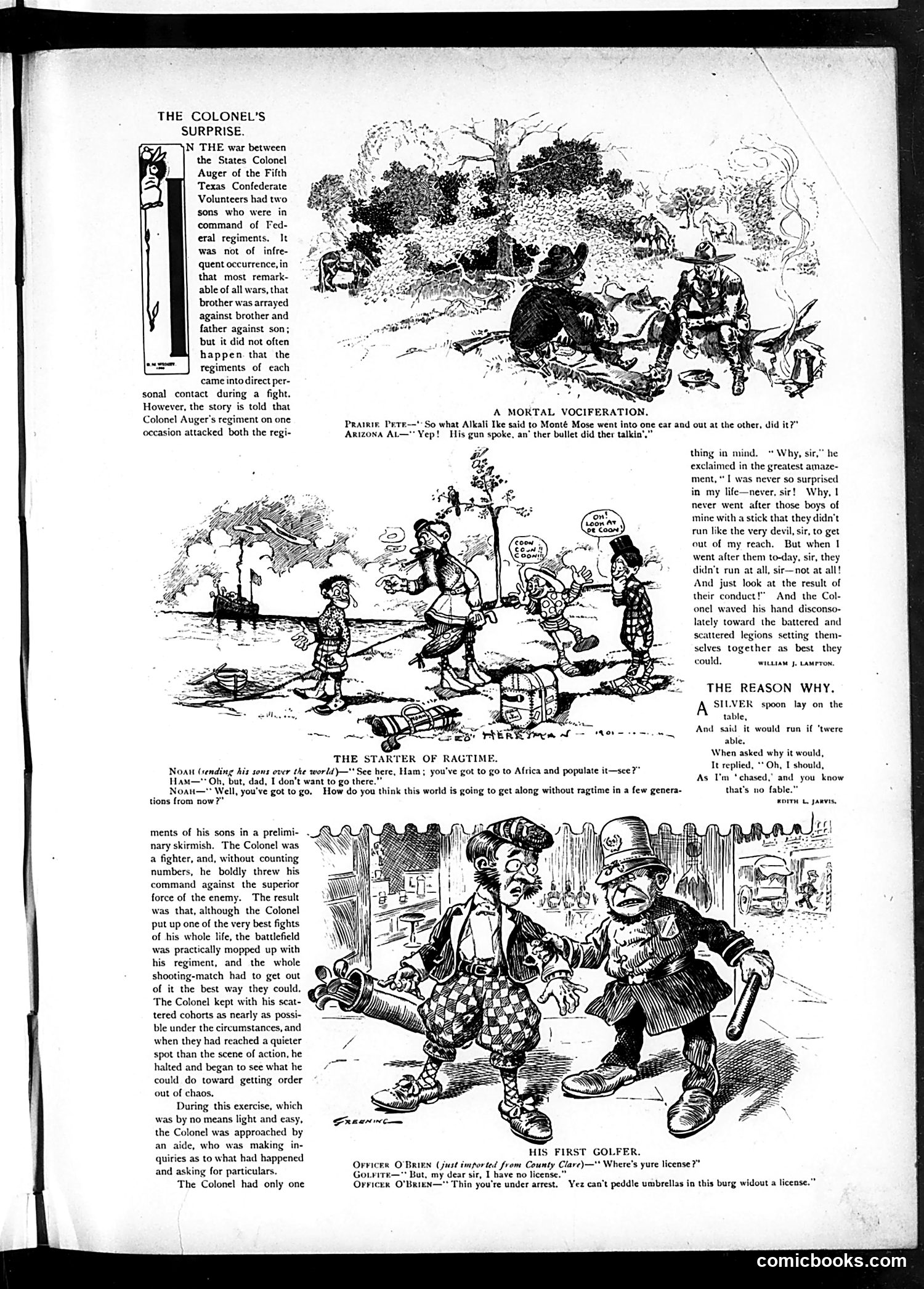
This page contains Civil War satire and period humor pieces: **"The Colonel's Surprise"** depicts a Confederate colonel whose two sons commanded Federal regiments. The joke: despite his parental authority (children normally fled his discipline), the Colonel's own regiment is decimated when facing his sons in battle—suggesting superior Federal military strength or that paternal intimidation fails against organized opposition. **"The Starter of Ragtime"** mocks Noah (biblical patriarch) demanding his sons populate Africa with ragtime music, satirizing both the era's racial attitudes and the then-recent explosion of ragtime as American popular music—portraying it as something that needs global distribution. **"His First Golfer"** shows Irish Officer O'Brien arresting a golfer, confusing a golf club for an umbrella and demanding a street-vending license—ethnic humor playing on Irish-American stereotypes and the relative newness of golf to America. **"The Reason Why"** contains wordplay about a silver spoon running because it's "chased" (pursued/desired). The cartoons employ slapstick, puns, and ethnic stereotyping typical of 1890s-1900s American humor magazines.
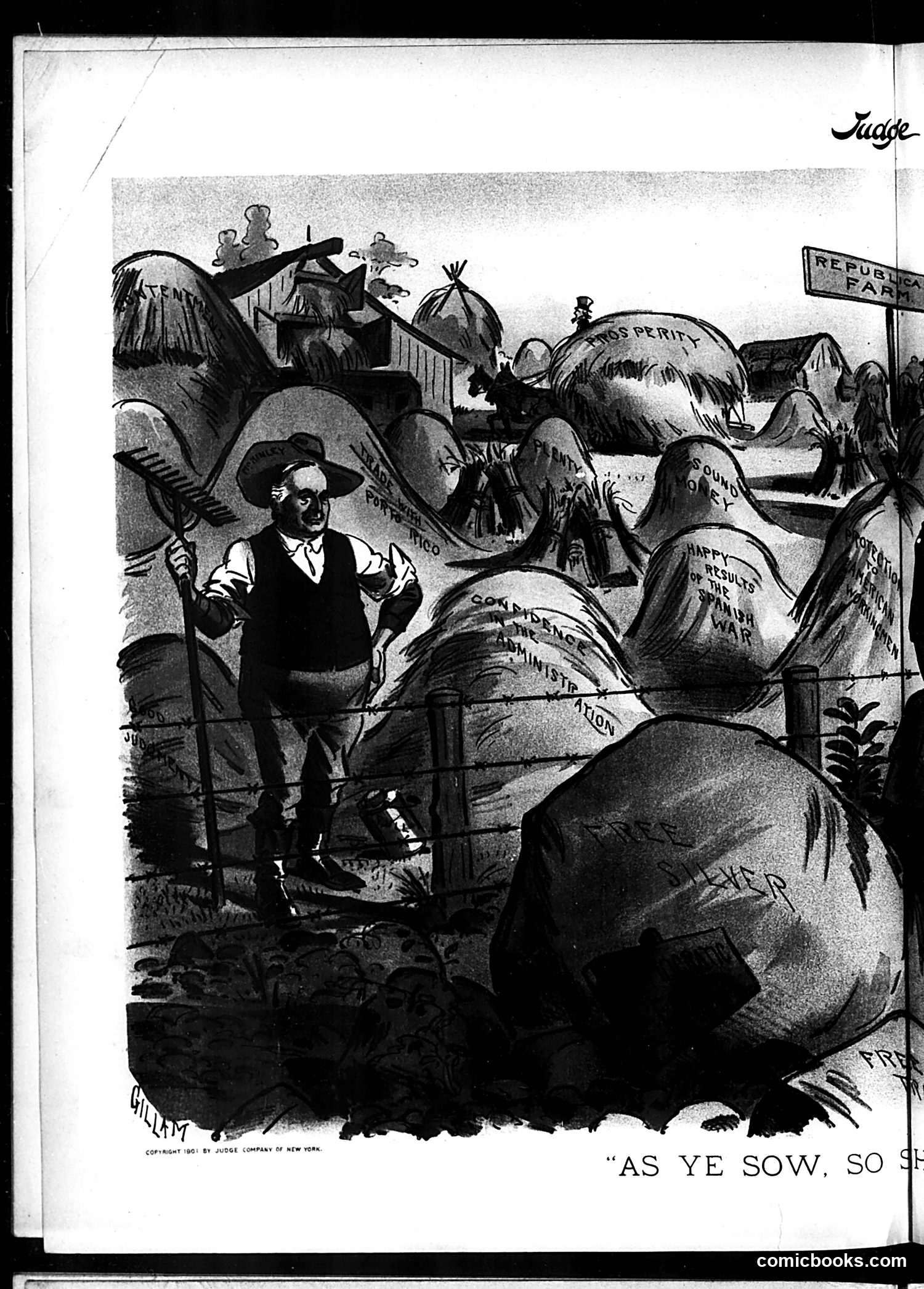
This Judge magazine cartoon titled "As Ye Sow, So [Ye Shall Reap]" uses biblical proverb to critique political consequences. A farmer figure (likely representing a politician or political party) stands among large sacks labeled with various political outcomes and policies—visible text includes references to "Republican," "Sound," "Happy Results," and "Ministration." The scene appears in a "Republica Farm" setting, as indicated by the sign. The satire suggests that political decisions and policies produce inevitable consequences, both positive and negative. The cartoonist appears to be commenting on how government actions generate specific results that return to haunt (or benefit) those responsible. The specific political figures or events referenced remain unclear without additional context, but the overall message warns about political accountability through natural cause-and-effect.
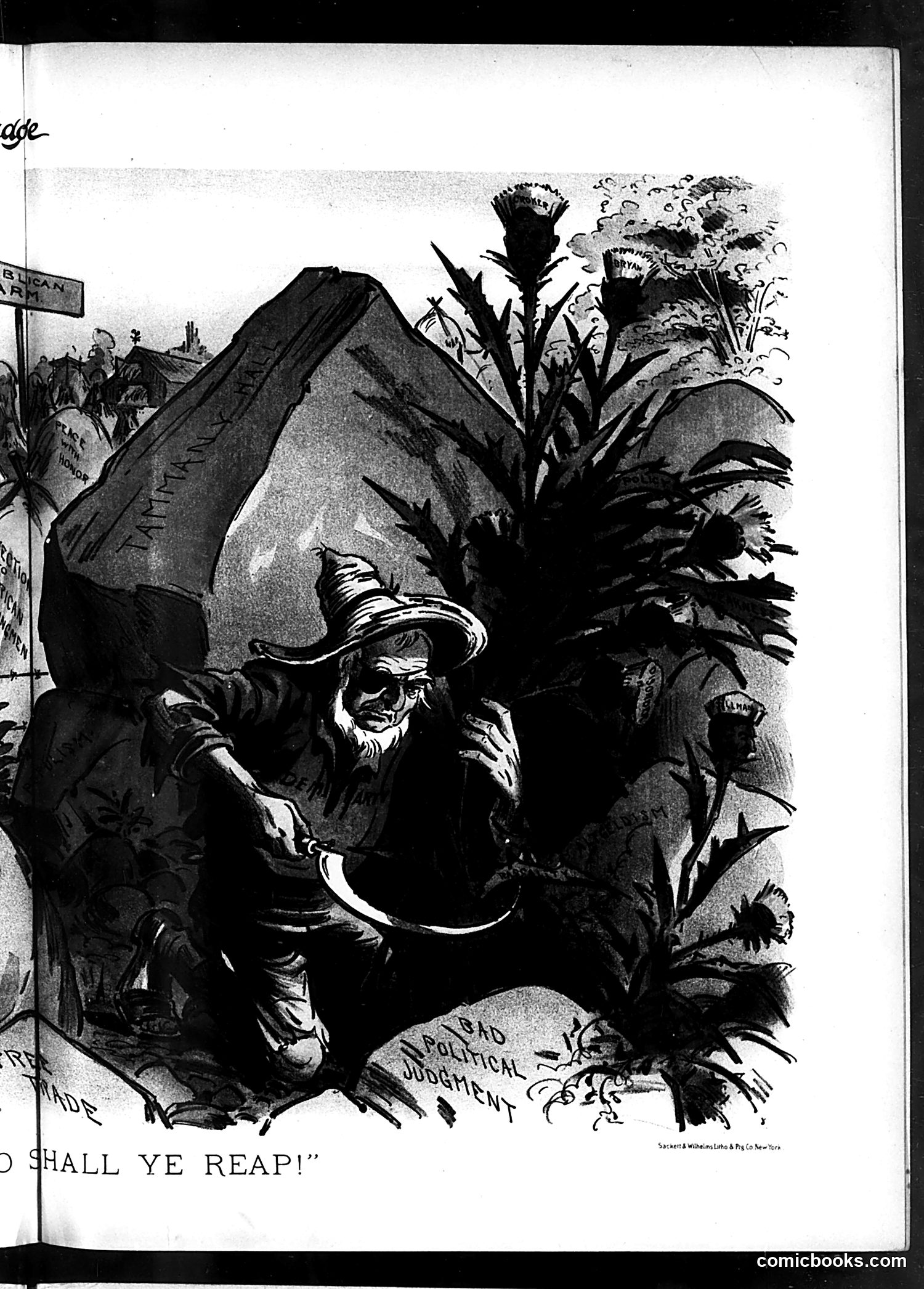
This is a satirical cartoon titled "As Ye Shall Reap," showing a figure in a hat holding a scythe amid thorny, hostile plants rather than a harvest. The imagery references the biblical proverb "as ye sow, so shall ye reap"—suggesting consequences for one's actions. The figure appears to be a political or social character reaping bitter results (thorns, weeds) from previous sowing. Signs visible on the left suggest "American" concerns, likely referencing domestic political consequences. The thorny vegetation replacing typical crops symbolizes that destructive policies or actions yield destructive outcomes rather than benefits. Without clearer date or context markers visible, the specific political situation remains unclear, but the cartoon warns that certain choices inevitably produce negative consequences.
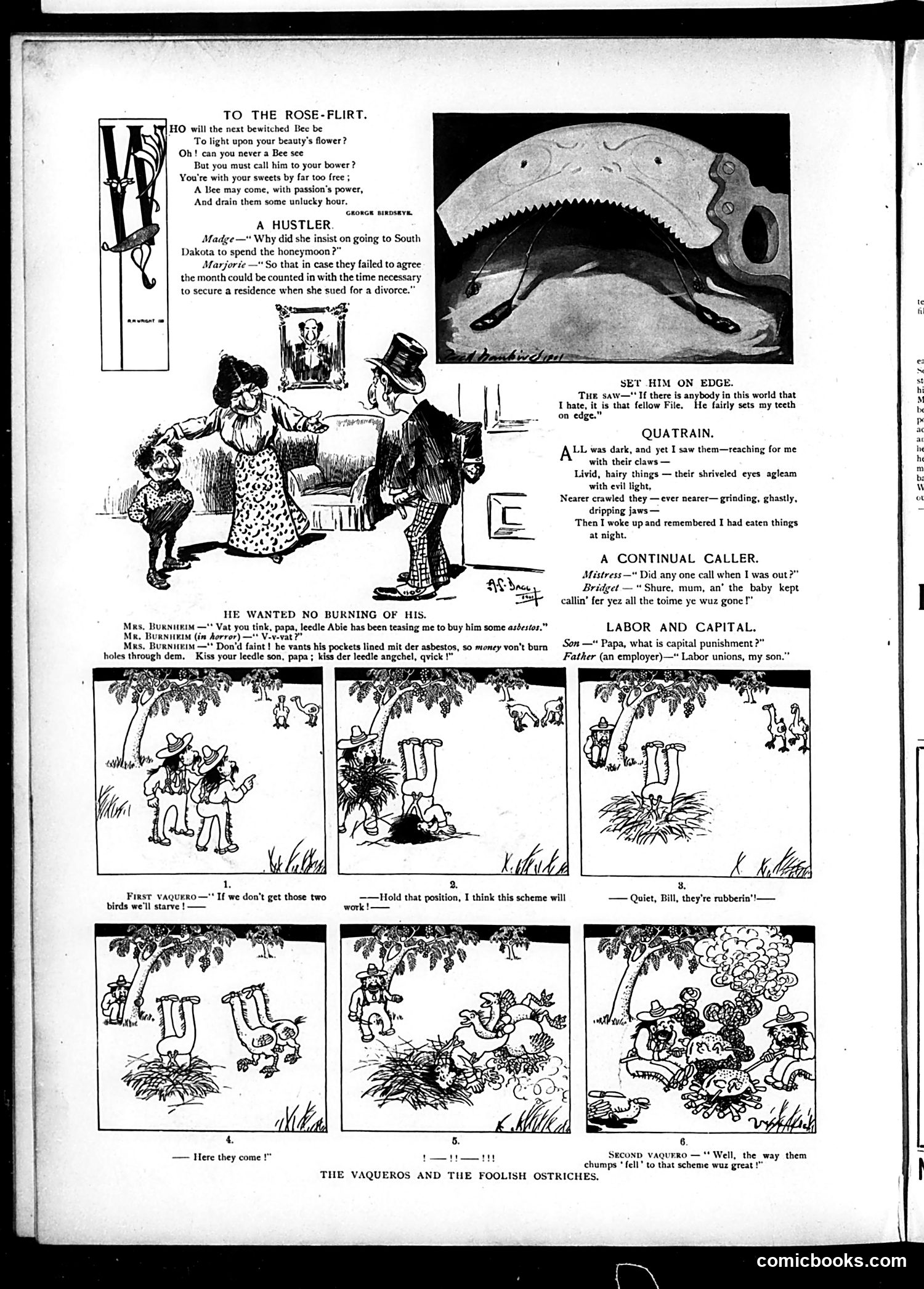
This page contains several satirical pieces typical of early 20th-century American humor: **"To the Rose-Flirt"** and **"A Hustler"**: Brief comic dialogues mocking romantic and business pretensions. **"Set Him on Edge" and "Quatrain"**: Short verse pieces with dark humor about violence and discomfort. **"The Vaqueros and the Foolish Ostriches"** (bottom): A six-panel comic strip showing vaqueros attempting to lasso ostriches beneath a tree. The joke appears to be slapstick physical comedy—the vaqueros' scheme fails spectacularly when the ostriches scatter, with one vaquero stating the "scheme was great" despite its obvious failure. This satirizes overconfident but incompetent plans. The humor is primarily observational and slapstick rather than explicitly political. The page reflects Judge's typical mix of verse, short jokes, and visual comedy aimed at middle-class readers.
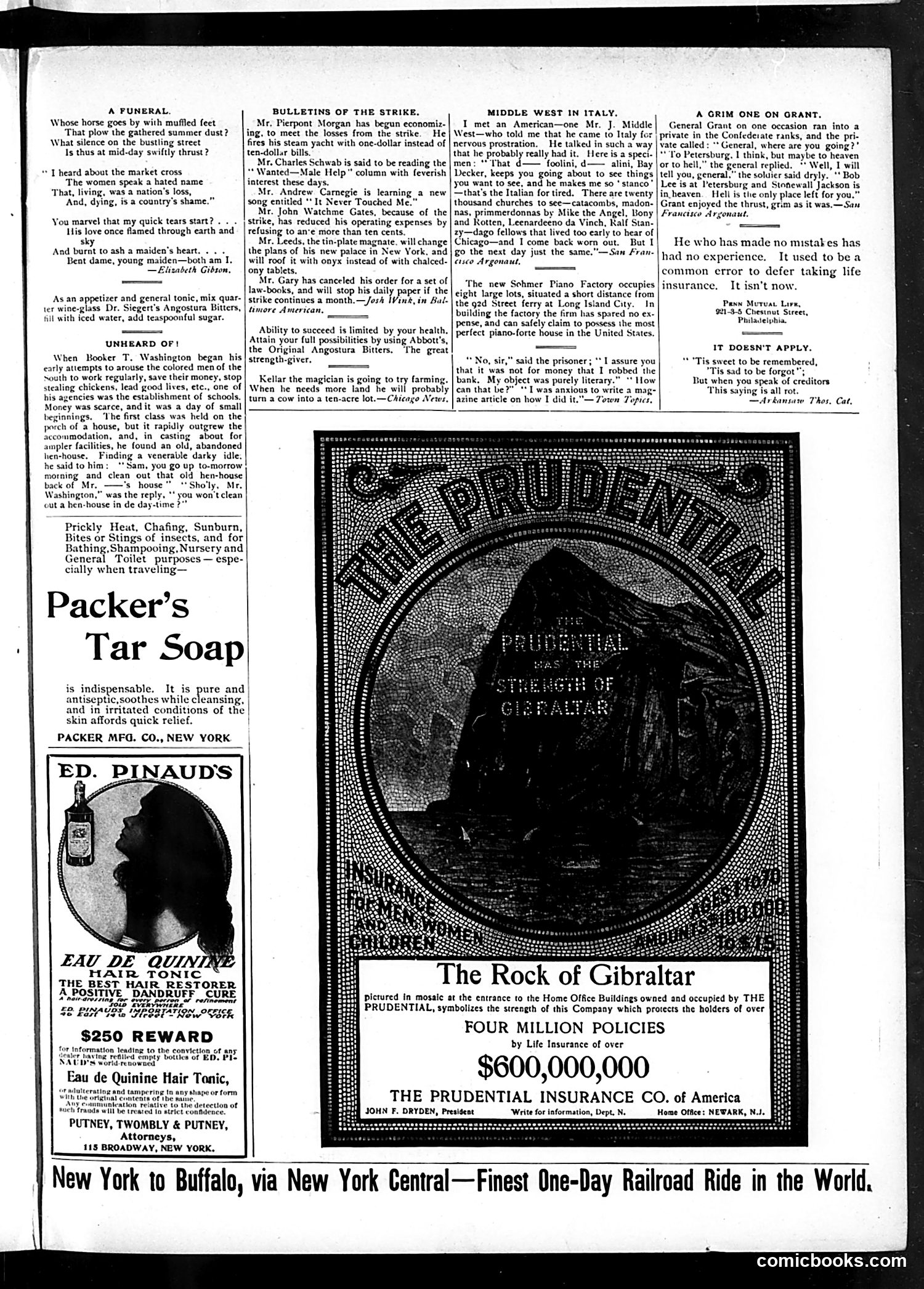
This page from *Judge* magazine contains primarily **advertisements and humorous short pieces**, rather than political cartoons. The notable content includes: **"A Funeral"** — A sentimental poem about mourning someone whose life was controversial ("living, was a nation's loss / And, dying, is a country's shame"). The subject is unclear from the page alone. **"Unheard Of!"** — A racial stereotype joke about Booker T. Washington's educational efforts. A Black worker supposedly refuses to clean a henhouse "in de day-time," playing on racist caricatures of laziness. **"Bulletins of the Strike"** — Satirical one-liners mocking wealthy industrialists (J.P. Morgan, Andrew Carnegie, etc.) during what appears to be a steel strike, suggesting they're economizing in absurd ways (using dollar bills to fire yachts, etc.). **"Middle West in Italy"** — A comedic observation about an American tourist's nervous condition in Italy. The page is largely filled with **period advertisements** for patent medicines and hair tonics—typical of early 20th-century magazines.
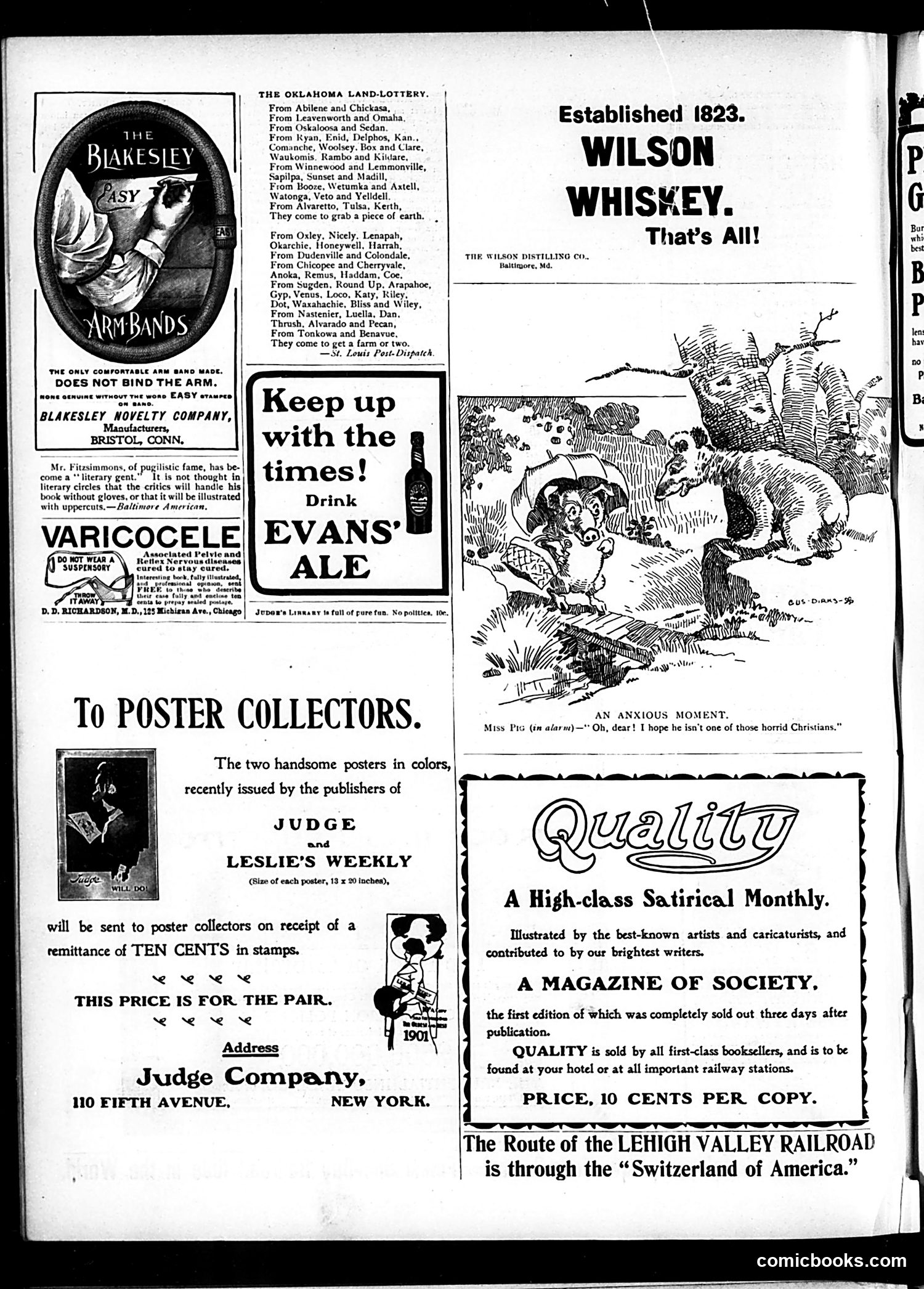
This page consists primarily of **advertisements and filler content** typical of Judge magazine, with one notable satirical item: **The Fitzsimmons reference** mocks boxer Bob Fitzsimmons's attempt to become a "literary gentleman." The joke is that critics will treat his book harshly ("without gloves") and that it will need illustrations—a jab at both his rough pugilistic background and the assumption his writing will be unsophisticated. **The Oklahoma Land-Lottery poem** catalogs towns from which settlers rushed to claim land in the Oklahoma Territory land runs (likely referencing the 1889 or later land rushes). The satire suggests these people come from nowhere towns chasing get-rich-quick schemes. **"An Anxious Moment"** cartoon shows a woman hoping a man isn't "one of those horrid Christians"—likely satirizing wealthy, secular society circles of the Gilded Age who viewed religious morality as unfashionable or restrictive. The remainder consists of product advertisements (whiskey, ale, arm bands, patent medicine) and promotional material for Judge and Quality magazines—standard magazine filler of the era.
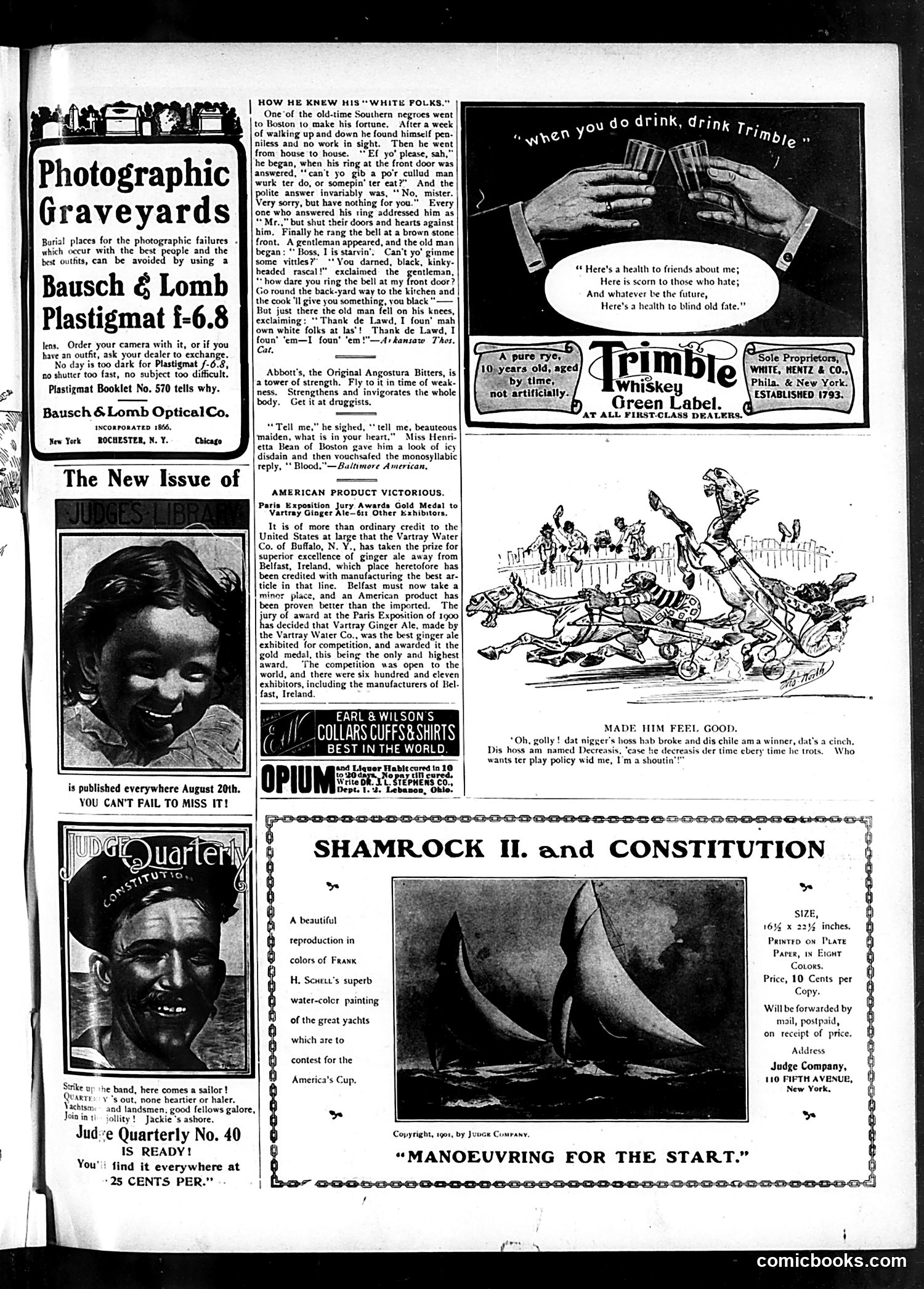
**Main Cartoon: "How He Knew His 'White Folks'"** This dialect story uses a racist trope popular in early 1900s American humor. A formerly enslaved man from the South seeks work in Boston. When Northern white people address him respectfully as "Mr." while refusing help, he's confused—this politeness contradicts his experience. Only when a man verbally abuses him with racial slurs does he feel at home, exclaiming he's found "his own white folks." The "joke" relies on the offensive premise that Black people expect and accept mistreatment from white people who are "their kind." It satirizes Northern hypocrisy: Northerners present themselves as more civilized than Southerners, yet the story suggests Southern brutality is more "honest" than Northern politeness masking indifference. The page is mostly advertisements; this story appears among commercial content for cameras, bitters, whiskey, and other products. It reflects Judge magazine's casual racism typical of the era.
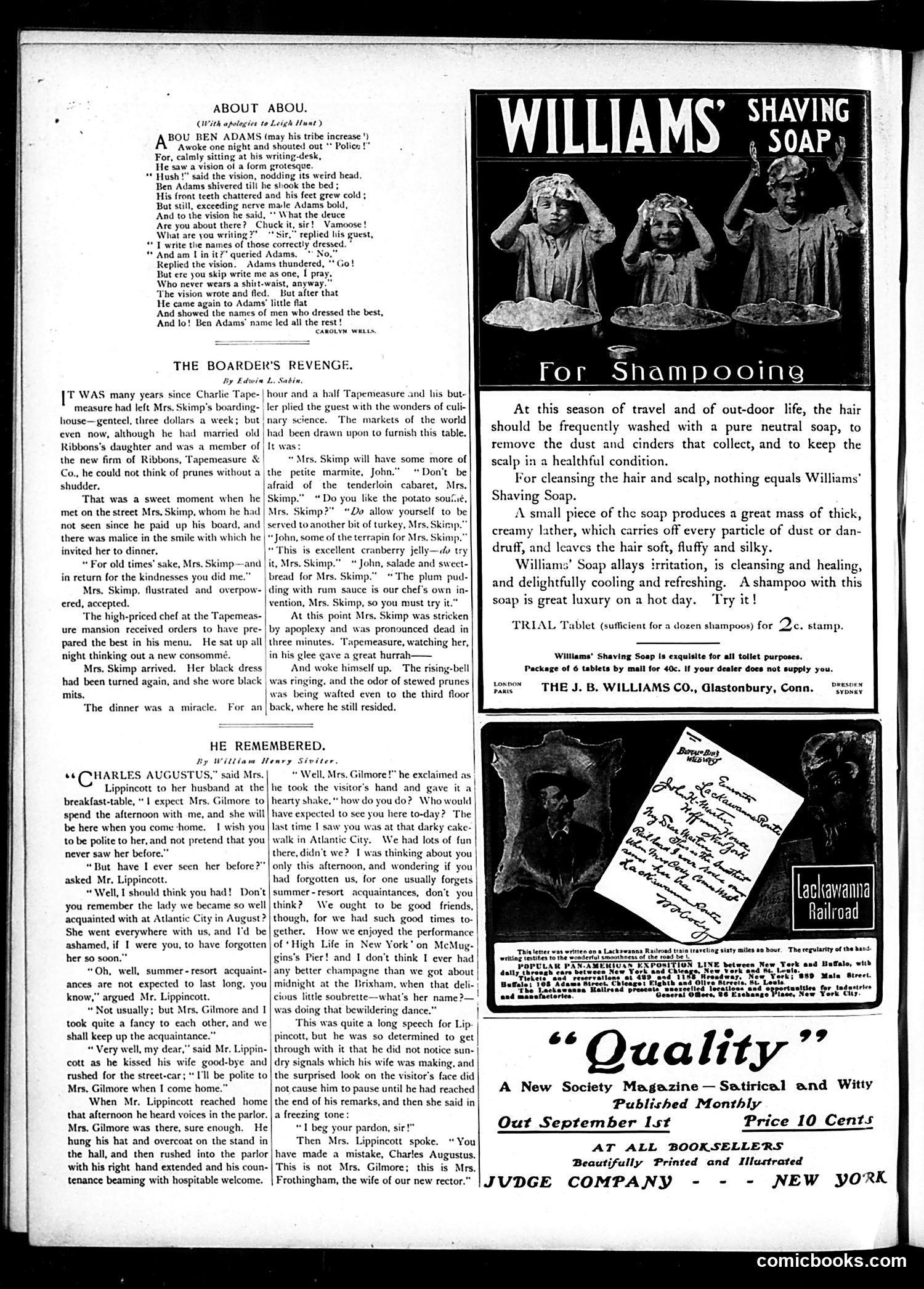
This page contains three distinct pieces: **"Abou Ben Adams"** (top left): A humorous poem parodying the famous Leigh Hunt poem "Abou Ben Adhem." The satire mocks vanity about dress—a vision shows Adams a list of "correctly dressed" men, and Adams demands to be included despite never wearing a shirt-waist. The joke targets male fashion consciousness and social pretension about appearance. **"The Boarder's Revenge"** (center): A short story about Charlie Tapemeasure, a former boarder at Mrs. Skimp's cheap boarding house, who invites her to an elaborate dinner at his now-wealthy home. After describing course after course of expensive food, the punchline reveals Mrs. Skimp dies of apoplexy—Tapemeasure's revenge for her stingy boarding-house meals. It's dark humor about social climbing and grudge-settling. **Advertisements** (right side): Williams' Shaving Soap and Lackawanna Railroad ads occupy the remainder. The page reflects turn-of-century American humor about class, fashion, and social mobility.
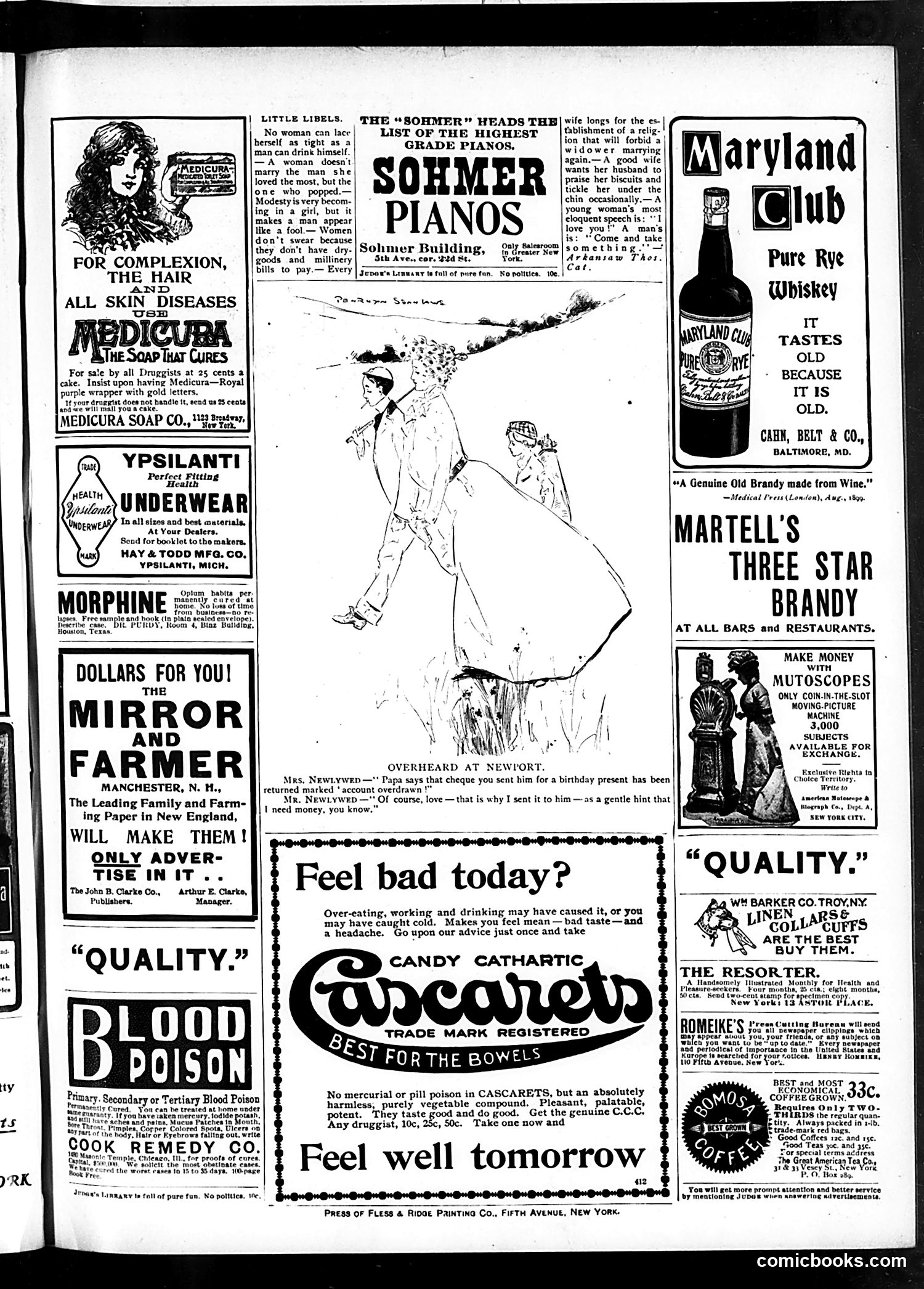
This page is primarily **advertising with minimal editorial content**. The main cartoon—"Overheard at Newport"—depicts a newly married couple's domestic exchange about a bounced check. The husband sent an insufficient check as a birthday gift as a "gentle hint" that his wife needs to manage money better. The satire targets **newlywed financial tensions and upper-class Newport society**, suggesting husbands used pecuniary manipulation to control wives' spending habits. The page's "Little Libels" section offers brief, cynical observations about women—mocking their inability to drink as much as men, their religious hypocrisy regarding remarriage, and their domestic pretensions. These reflect **period misogyny**. The bulk consists of patent medicines (Medicura soap, Cascarets laxative, morphine treatments), underwear, pianos, whiskey, and brandy—typical early-1900s advertising. Notably, **morphine and "blood poison" cures are advertised openly**, reflecting pre-regulation pharmaceutical marketing before the 1906 Pure Food and Drug Act.
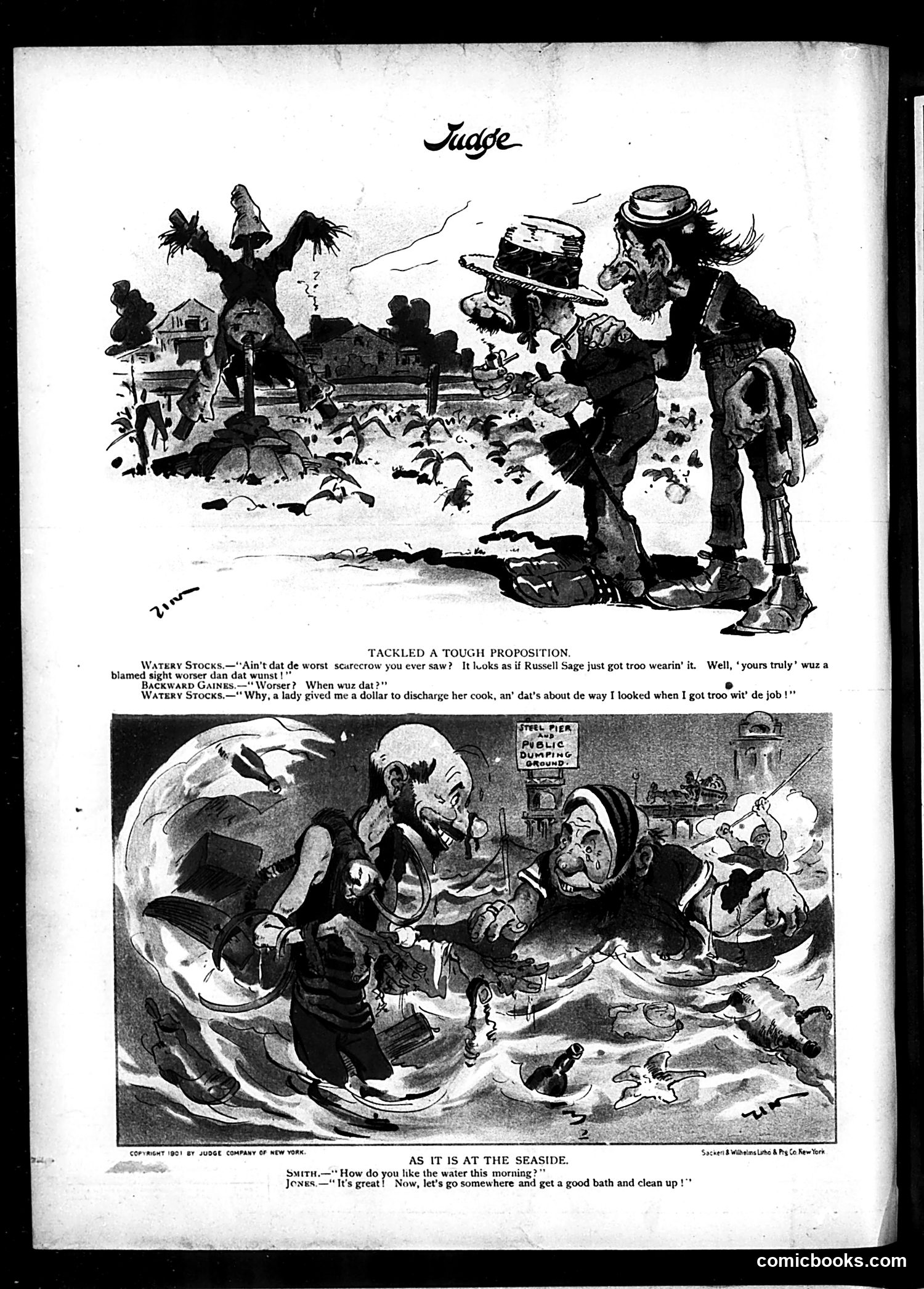
This page contains two separate satirical cartoons with period dialect humor typical of early Judge magazine. **Top cartoon ("Tackled a Tough Proposition"):** Features working-class characters discussing a scarecrow resembling wealthy financier Russell Sage. The joke relies on crude servant dialect, contrasting Sage's appearance with the speaker's own shabby appearance after botching a job (discharging a cook for a lady who paid only a dollar). The satire targets both Sage's appearance and the speaker's incompetence. **Bottom cartoon ("As It Is at the Seaside"):** Shows beach-goers in murky, polluted water. The joke's irony: one character praises the "great" water, then suggests going elsewhere to get clean—mocking seaside pollution and poor bathing conditions, likely referencing industrial contamination of American beaches during this industrial era. Both cartoons use exaggerated caricature and working-class voices for comedic effect, characteristic of Judge's satirical approach to social commentary.