
Judge, 1901-08-31 · page 2 of 16
Judge — August 31, 1901 — page 2: what you’re looking at
What you’re looking at
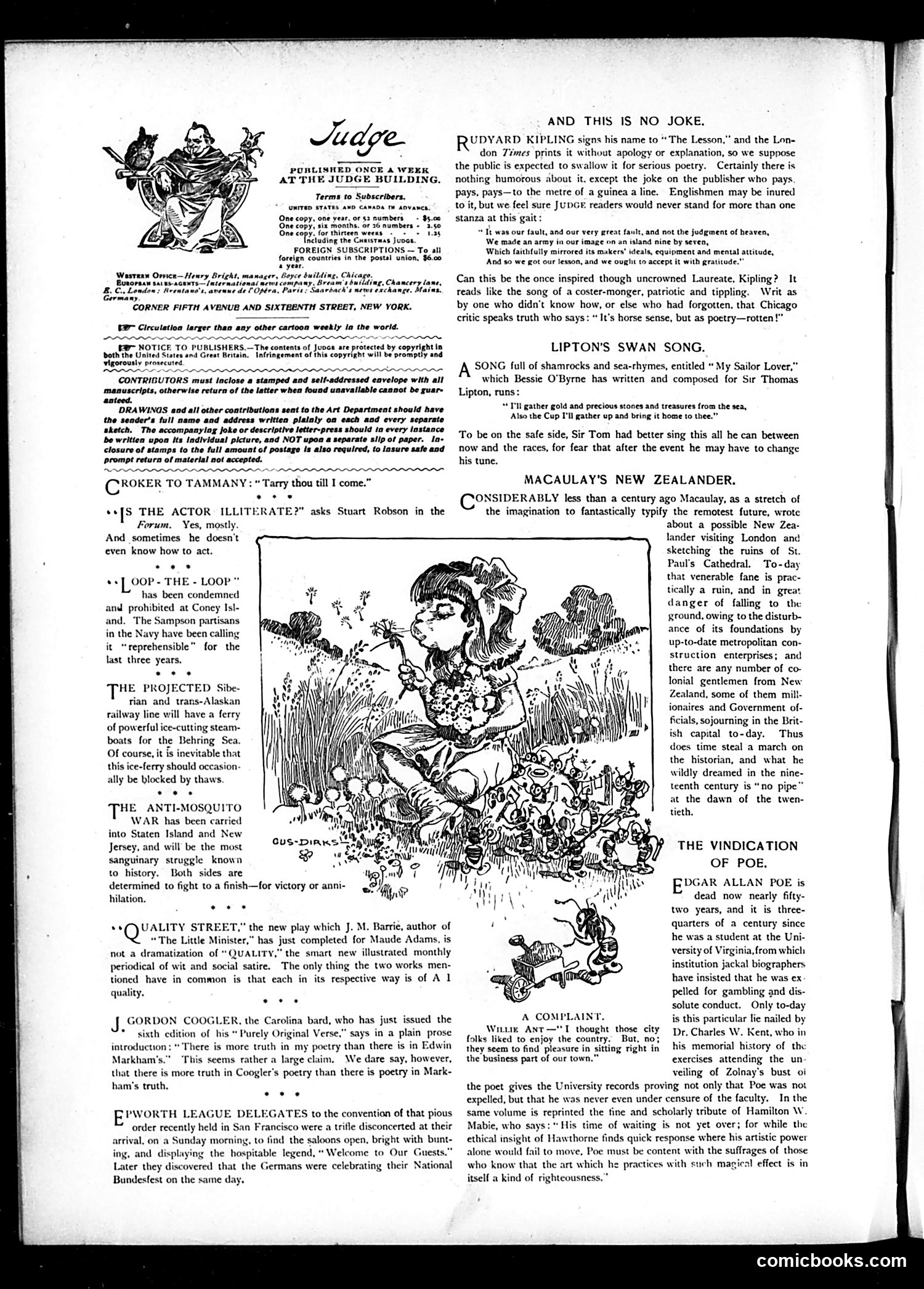
The main illustration depicts a grotesque caricature of a woman surrounded by various creatures and objects. Based on the accompanying article "Macaulay's New Zealander," this appears to satirize concerns about Britain's imperial decline and cultural decay. The text references a "possible future New Zealander visiting London and sketching the ruins of St. Paul's Cathedral," drawing on Thomas Macaulay's famous historical observation about civilization's fragility. The grotesque female figure likely represents either a degraded Britain or a satirized vision of the future. The page also contains brief commentary on theatrical and literary matters typical of Judge's format. Without clearer context on the specific historical moment, the exact identity of the caricatured figure remains uncertain, though the satire targets anxieties about national decline and cultural corruption.
📄 Transcribed text from this page (OCR, searchable)
Machine-transcribed from the original scan — historical spelling and the odd misread are preserved.
PUBLISHED 6 AT THE JUDG CE A WEEK BUILDING. Terms to Subscribers. uD STATES AND CANADA fH ADVAMCR. One copy, one year. or $2 numbers One copy, six months. or 26 numbers One copy: faclading the Cais FOREIGN SUBSCRIPTIONS — To all foreign countries in the postal union, $6.00 ayer, rrice—Henry Bright, manager, Boyce CORNER FIFTH AVENUB AND SIXTEENTH STREET, NEW YORK. 8 Circulation larger than any other cartoon weekly ia the world. rotected by copyright In pyright will be promptly and atents of Ju Infringement of this vigorously prosecuted. CONTRIBUTORS must Inclose a stamped and self-addressed envelope with all manuscripts, otherwise return of the latter whea found waavallable cannot be guare anteed. DRAWINGS and all other contributions sent to the Art Department should have the sender's full name and address written plainly on each and every separate should ta every lastance a its individual picture, and NOT upon a separate slip of paper. Ia- closure of stamps to the fall amount of postage Is also required, to lasure safe and prompt retura of material not accepted. CROKER TO TAMMANY: Tarry thou till I come.” eee “RATE?” asks Stuart Robson in the se[S THE ACTOR ILLIT Forum. Yes, mostly. And sometimes he doesn’t even know how to act. see oe Loor- THE - LOOP” has been condemned and prohibited at Coney Isl- and. The Sampson partisans in the Navy have been calling it “reprehensible” for the last three years. cee THE. PROJECTED Sibe- rian and trans-Alaskan railway line will have a ferry of powerful ice-cutting steam- boats for the Behring Sea. Of course, it is inevitable that this ice-ferry should occasion- ally be blocked by thaws. res THE ANTI-MOSQUITO WAR has been carried into Staten Island and New Jersey, and will be the most sanguinary struggle known to history. Both sides are determined to fight to a finish—for victory or anni- hilation. igh? 7 op *sQ)UALITY STREET," the new play which J. M. Barrie, author of “The Little Minister,” has just completed for Maude Adams, is not a dramatization of “QUALITY,” the smart new illustrated monthly periodical of wit and social satire. The only thing the two works men- tioned have in common is that each in its respective way is of A 1 quality. J GORDON COOGLER, the Carolina bard, who has just issued the * sixth edition of his “Purely Original Verse,” says in a plain prose introduction: * There is more truth in my poetry than there is in Edwin Markham’s.” This seems rather a large claim, We dare say, however, that there is more truth in Coogler’s poetry than there is poetry in Mark- ham’s truth, PWORTH LEAGUE DELEGATES to the convention of that pious order recently held in San Francisco were a trifle disconcerted at their arrival, on a Sunday morning, to find the saloons open, bright with bunt- ing, and displaying the hospitable legend, “Welcome to Our Guests.” Later they discovered that the Germans were celebrating their National Bundesfest on the same day. AND THIS IS NO JOKE, RUPYARD KIPLING signs his name to The Lesson,” and the Lon- don Times prints it without apology or explanation, so we suppose the public is expected to swallow it for serious poetry. Certainly there is nothing humorous about it. except the joke on the publisher who pays pays, pays—to the metre of a guinea a line. Englishmen may be inured to it, but we feel sure JUDGE readers would never stand for more than one stanza at this gait: ~ Tt was our fault, and our very great fault, and not the judgment of heaven, We made an army in our image on an island nine by seven, Which faithfully mirrored its makers’ ideals, equipment and mental attitude, And so we got our lesson, and we ought to accept it with gratitude.” Can this be the once inspired though uncrowned Laureate, Kipling? It reads like the song of a coster-monger, patriotic and tippling. Writ as by one who didn’t know how, or else who had forgotten, that Chicago critic speaks truth who says: “ It’s horse sense, but as poetry—rotten!” LIPTON’S SWAN SONG. A SONG full of shamrocks and sea-rhymes, entitled “ My Sailor Lover,” which Bessie O'Byrne has written and composed for Sir Thomas Lipton, runs: +1 gather gold and precious stones and treasures from the sea, Also the Cup I'll gather up and bring it home to thee.”” To be on the safe side, Sir Tom had better sing this all he can between now and the races, for fear that after the event he may have to change his tune. MACAULAY'S NEW ZEALANDER. ONSIDERABLY less than a century ago Macaulay, as a stretch of the imagination to fantastically typify the remotest future, wrote about a possible New Zea- lander visiting London and sketching the ruins of St. Paul's Cathedral. To-day that venerable fane is prac- tically a ruin, and in great danger of falling to the ground, owing to the disturb- ance of its foundations by up-to-date metropolitan con- struction enterprises; and there are any number of co- lonial gentlemen from New Zealand, some of them mill- ionaires and Government of- ficials, sojourning in the Brit- ish capital to-day. Thus does time steal a march on the historian, and what he wildly dreamed in the nine- teenth century is “no pipe” at the dawn of the twen- tieth, THE VINDICATION OF POE. EPGAar ALLAN POE is dead now nearly fifty- two years, and it is three- quarters of a century since he was a student at the Uni- versity of Virginia, from which institution jackal biographers have insisted that he was ex pelled for gambling and dis- solute conduct. Only to-day is this particular lie nailed by Dr. Charles W. Kent, who in his memorial history of the exercises attending the un veiling of Zolnay’s bust oi the poet gives the University records proving not only that Poe was not expelled, but that he was never even under censure of the faculty. In the same volume is reprinted the fine and scholarly tribute of Hamilton W Mabie, who say lis time of waiting is not yet over; for while the ethical insight of Hawthorne finds quick response where his artistic power alone would fail to move, Poe must be content with the suffrages of those who know that the art which he practices with such magical effect is in itself a kind of righteousness,” A COMPLAINT. Wie Ant—"T thought those city folks liked to enjoy the counti they seem to find pleasure in the business part of our town. comicbooks.com