
Judge, 1901-08-31 · page 3 of 16
Judge — August 31, 1901 — page 3: what you’re looking at
What you’re looking at
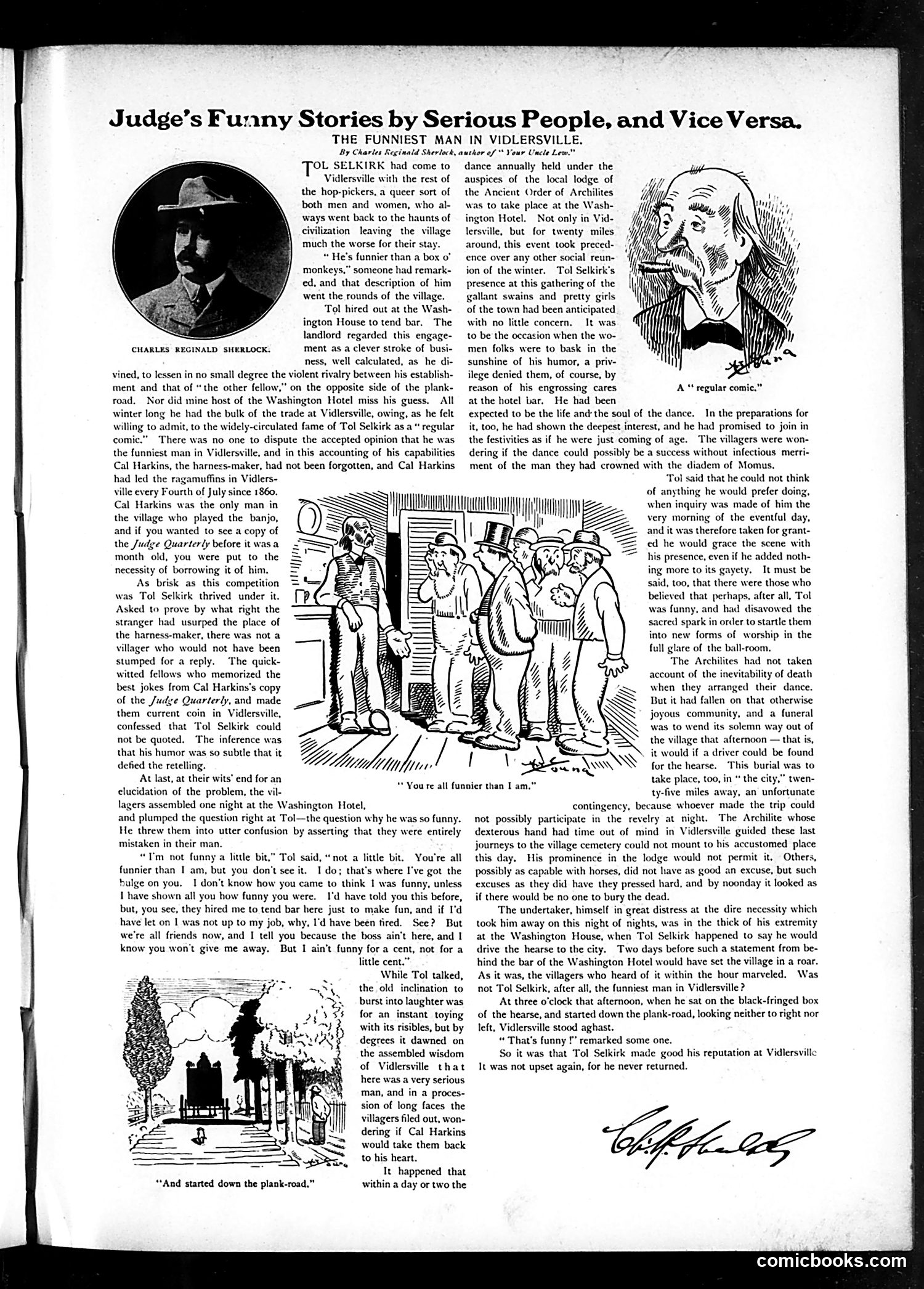
This story by Charles Reginald Sherlock satirizes small-town social pretension. The narrative concerns Tol Selkirk, a village character known as "the funniest man in Vidersville," whose reputation rests on telling crude jokes at the local bar. When the prestigious Archeological Lodge plans a formal dance at the Washington Hotel, the villagers expect Tol to perform—yet his attendance creates anxiety about his coarse humor potentially embarrassing the event. The satire mocks how small communities simultaneously celebrate and resent their colorful characters, and how social aspiration conflicts with authentic local culture. The accompanying illustrations show Tol among well-dressed villagers, emphasizing the class tensions between his rough informality and their pretended refinement.
📄 Transcribed text from this page (OCR, searchable)
Machine-transcribed from the original scan — historical spelling and the odd misread are preserved.
Judge’s Funny Stories by Serious People, and Vice Versa. THE FUNNIEST MAN IN VIDLERSVILLE, By Charles Toe SELKIRK had come to Vidlersville with the rest of the hop-pickers, a queer sort of both men and women, who al- vays went back to the haunts of 1g the village much the worse for their stay. “ He's funnier than a box o° monkeys,” someone had remark- ed, and that description of him went the rounds of the village. Tol hired out at the Wash- ington House to tend bar. The landlord regarded this engage- ment as a clever stroke of busi. ness, well calculated, as he di vined, to lessen in no small degree the violent rivalry between his establish- ment and that of “the other fellow,” on the opposite side of the plank- road. Nor did mine host of the Washington Hotel miss his guess. All winter long he had the bulk of the trade at Vidlersville, owing, as he felt willing to admit, to the widely-circulated fame of Tol Selkirk as a“ regular comic.” There was no one to dispute the accepted opinion that he was the funniest man in Vidlersville, and in this accounting of his capabilities Cal Harkins, the harness-maker, had not been forgotten, and Cal Harkins had led the ragamuffins in Vidlers- ville every Fourth of July since 1860. Cal Harkins was the only man in the village who played the banjo, and if you wanted to see a copy of the Judge Quarterly before it was a month old, you were put to the necessity of borrowing it of him, As brisk as this competition was Tol Selkirk thrived under it. Asked to prove by what right the stranger had usurped the place of the harness-maker, there was not a villager who would not have been stumped for a reply. The quick- witted fellows who memorized the best jokes from Cal Harkins’s copy of the Judve Quarterly, and made them current coin in Vidlersville, confessed that Tol Selkirk could not be quoted. The inference was that his humor was so subtle that it defied the retelling. At last, at their wits’ end for an elucidation of the problem, the vil- lagers assembled one night at the Washington Hotel, and plumped the question right at Tol—the question why he was so funny. He threw them into utter confusion by asserting that they were entirely mistaken in their man. “Tm not funny a little bit,” Tol said, “not a little bit. funnier than I am, but you don’t see it. I do; that's where I've got the bulge on you. I don’t know how you came to think I was funny, unless T have shown all you how funny you were. I'd have told you this before, but, you see, they hired me to tend bar here just to make fun, and if I'd have let on I was not up to my job, why, I'd have been fired. See? But we're all friends now, and I tell you because the boss ain't here, and I know you won't give me away. But I ain’t funny for a cent, not for a little cent.” While Tol talked, the old inclination to burst into laughter was for an instant toying with its risibles, but by degrees it dawned on the assembled wisdom of Vidlersville that here was a very serious man, and in a proces- sion of long faces the villagers filed out, won- dering if Cal Harkins would take them back to his heart. It happened that within a day or two the CHARLES REGINALD SHERLOCK. Z YW You're all “And started down the plank-road.” I Ce * You re all funnier than [ am.” ‘inald Sherlock, author of “ Your Uncle Lew." dance annually held under the auspices of the local lodge of the Ancient Order of Archilites was to take place at the Wash- ington Hotel. Not only in Vid- lersville, but for twenty miles around, this event took preced- ence over any other social reun- ion of the winter. Tol Selkirk’s presence at this gathering of the gallant swains and pretty girls of the town had been anticipated with no little concern. It was to be the occasion when the wo- men folks were to bask in the sunshine of his humor, a priv- ilege denied them, of course, by reason of his engrossing cares at the hotel bar. He had been expected to be the life and: the soul of the dance. In the preparations for it, too, he had shown the deepest interest, and he had promised to join in the festivities as if he were just coming of age. The villagers were won- dering if the dance could possibly be a success without infectious merri- ment of the man they had crowned with the diadem of Momus. ‘Tol said that he could not think of anything he would prefer doing, when inquiry was made of him the very morning of the eventful day, and it was therefore taken for grant- ed he would grace the scene with his presence, even if he added noth- ing more to it: ty. Tt must be said, too, that there were those who believed that perhaps, after all, Tol was funny, and had disavowed the sacred spark in order to startle them into new forms of worship in the full glare of the ball-room. The Archilites had not taken account of the inevitability of death when they arranged their dance. But it had fallen on that otherwise joyous community, and a funeral was to wend its solemn way out of 5 $ the village that afternoon — that is, S—\ AS it would if a driver could be found ce nA SSO for the hearse. This burial was to take place, too, in “ the city,” twen- ty-five miles away, an unfortunate contingency, because whoever made the trip could not possibly participate in the revelry at night. The Archilite whose dexterous hand had time out of mind in Vidlersville guided these last journeys to the village cemetery could not mount to his accustomed place this day. His prominence in the lodge would not permit it, Others, possibly as capable with horses, did not have as good an excuse, but such excuses as they did have they pressed hard, and by noonday it looked as if there would be no one to bury the dead. The undertaker, himself in great distress at the dire necessity which took him away on this night of nights, was in the thick of his extremity at the Washington House, when Tol Selkirk happened to say he would drive the hearse to the city, Two days before such a statement from be- hind the bar of the Washington Hotel would have set the village in a roar. As it was, the villagers who heard of it within the hour marveled. Was not Tol Selkirk, after all, the funniest man in Vidlersville ? At three o'clock that afternoon, when he sat on the black-fringed box of the hearse, and started down the plank-road, looking neither to right nor left, Vidlersville stood aghast. “ That's funny !” remarked some one. So it was that Tol Selkirk made good his reputation at Vidlersville It was not upset again, for he never returned. A “regular comic.” comicbooks.com