
A complete issue · 16 pages · 1901
Judge — August 17, 1901
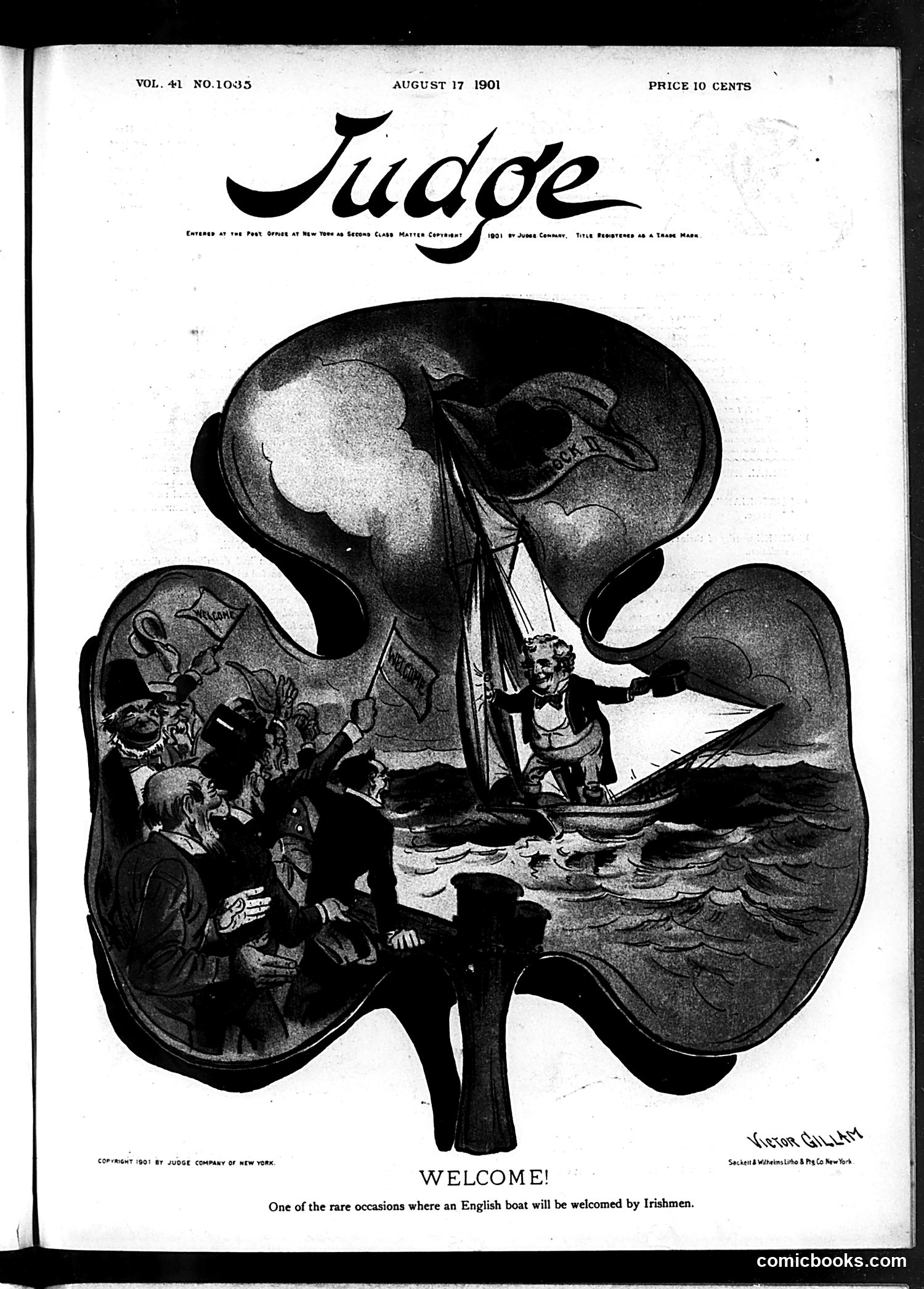
This political cartoon satirizes Anglo-Irish relations. The central image depicts a large shamrock (Irish symbol) containing two scenes: on the left, Irish figures appear hostile or unwelcoming; on the right, a British naval vessel approaches. The caption "WELCOME! One of the rare occasions when an English boat will be welcomed by Irishmen" uses irony to comment on Irish-British hostility. The joke relies on the stereotype that Irish people generally oppose English presence, making a British ship's welcome from Ireland extraordinarily rare. This reflects the real political tensions of the era—Ireland was under British rule but sought independence, making cordial Anglo-Irish relations genuinely uncommon. The satire targets both Irish antipathy toward Britain and the absurdity of expecting warm Irish hospitality toward English vessels.
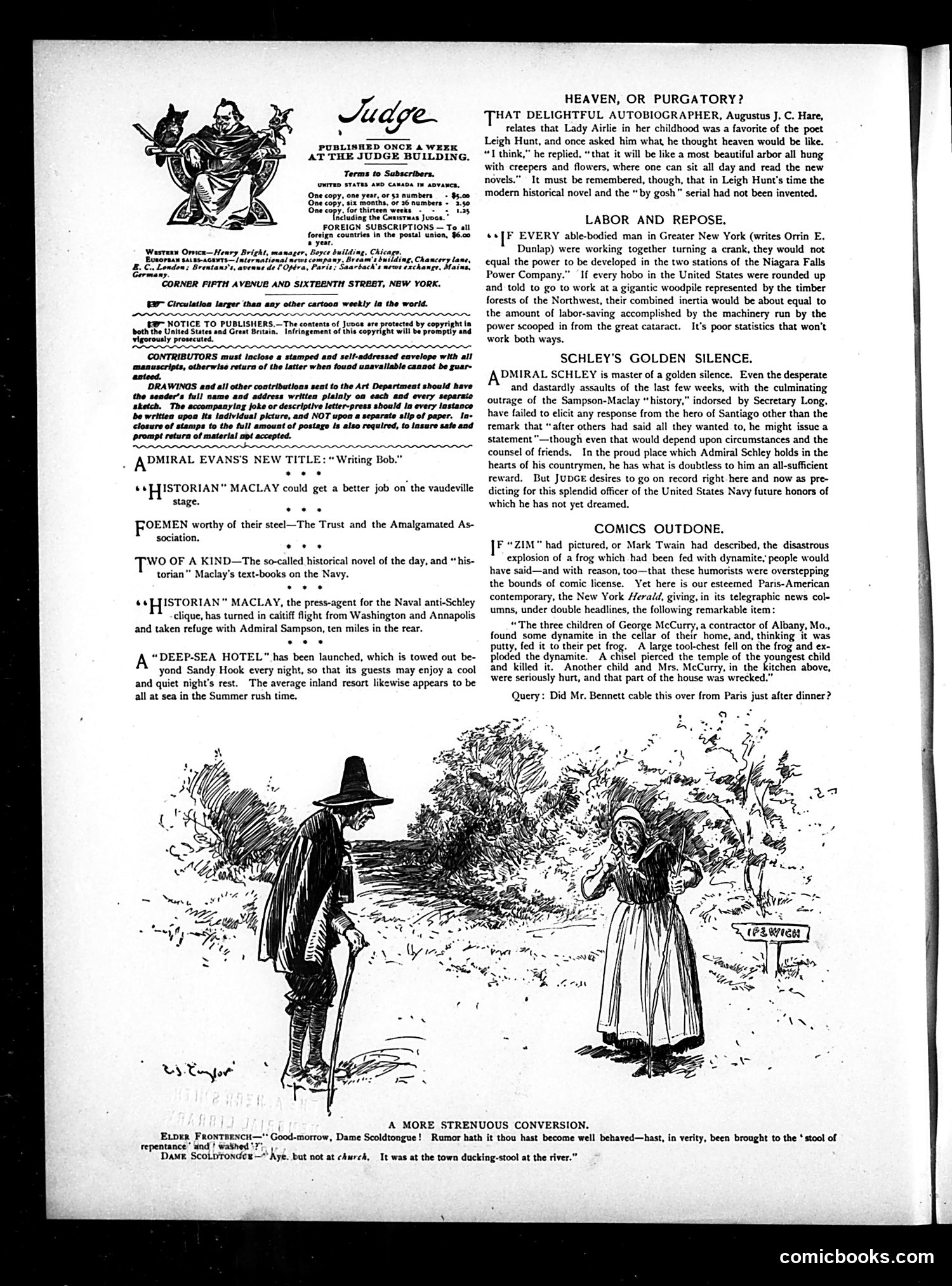
This cartoon depicts a rural conversion scene with an Elder Frothingham addressing Dame Scoldborough about a donkey's improved behavior. The caption quotes the Elder praising the donkey's reformation ("hath become well behaved—hast, in verity, been brought to the 'mood of repentance'"), while Dame Scoldborough delivers the joke's punchline: she beat the animal "at the town dockside at the river"—not through religious means, but through physical punishment. The satire mocks excessive religiosity and sanctimonious moralizing. The humor lies in the contrast between the Elder's grandiose spiritual language and the crude reality: the donkey was simply beaten into submission. It's a jab at those who dress up worldly solutions in pious language, particularly relevant to Progressive Era debates about reform methods versus actual change.
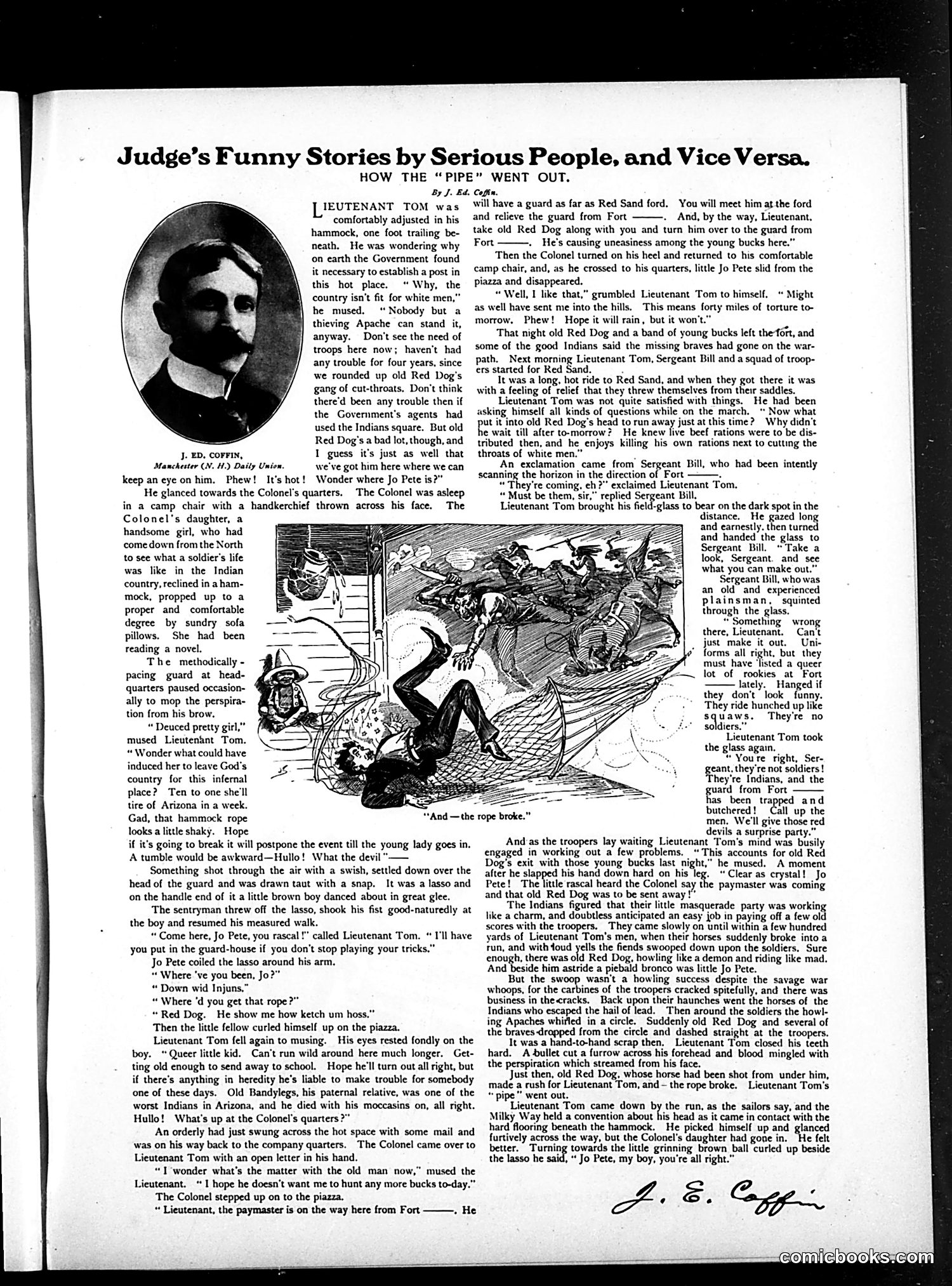
This page contains a humorous short story by J.E. Coffin, illustrated with two sketches. The narrative concerns Lieutenant Tom at a remote Army post ("Red Dog") in the Indian territories. The Colonel sends him on an errand, but Tom returns to find his quarters ransacked and his prized pipe missing—apparently taken by Native Americans or local trouble-makers. The story's humor derives from military life absurdities: the Lieutenant's distress over a lost pipe, the Colonel's dismissive attitude toward frontier dangers, and the anticlimax of the situation. The accompanying illustrations show frontier military camp life and action sequences. The satire gently mocks both military bureaucracy and the romanticized conflicts of frontier service, presenting petty concerns amid larger wilderness hardships.
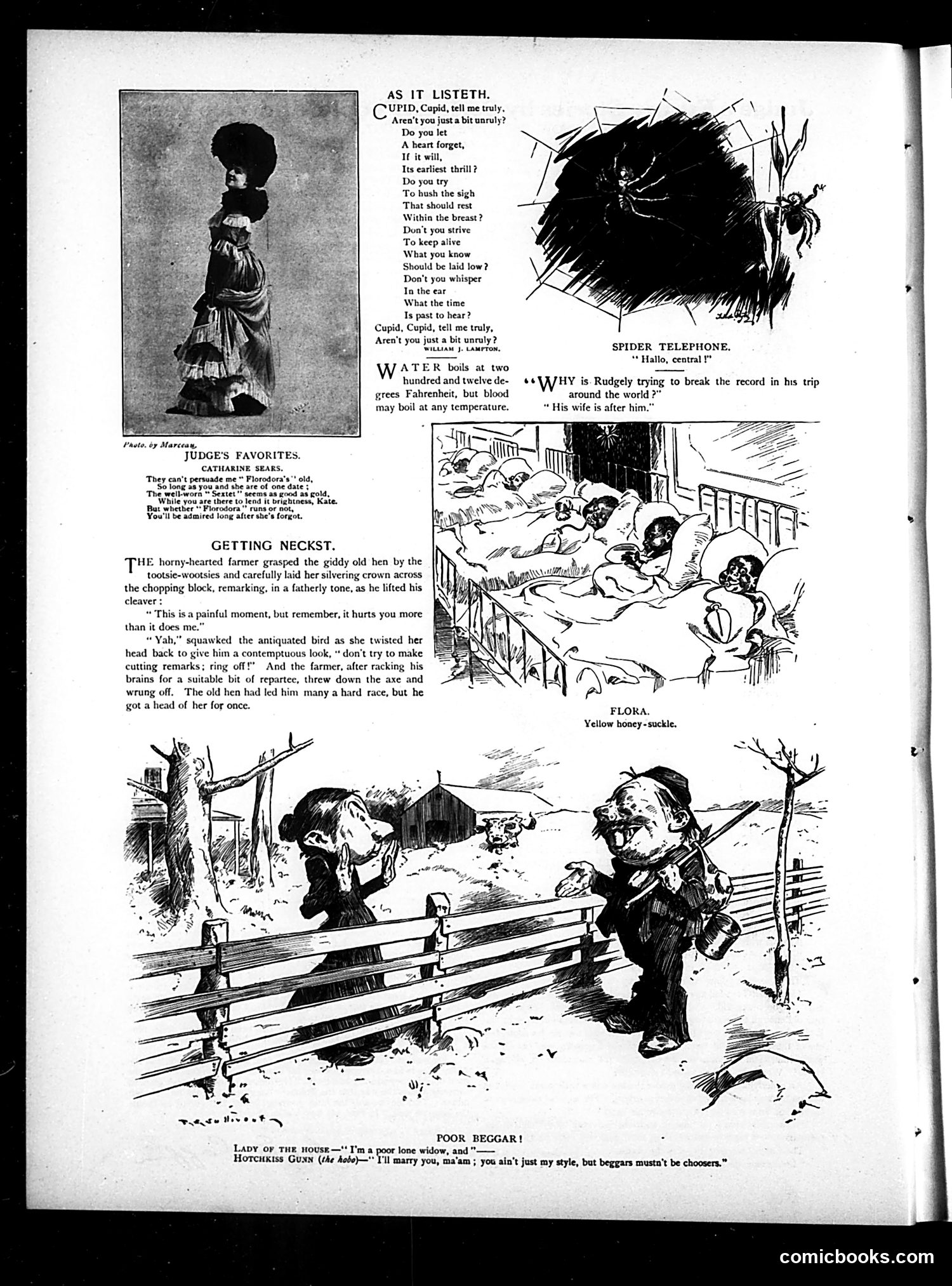
This page contains several unrelated comic vignettes typical of Judge's format: **"As It Listeth"** - A poem mocking romantic pretense, featuring the "Spider Telephone" cartoon (unclear reference). **"Judge's Favorites"** - Satirizes a public figure named "Theodora" (possibly a political wife), suggesting she gives contradictory advice depending on audience. **"Getting Neckst"** - A humorous story about a farmer punishing a hen, with implied sexual innuendo in the title and the farmer's comment about it "hurting" more than the bird. **"Poor Beggar!"** - A class-commentary cartoon where a poor man proposing to a wealthy widow is rejected because she considers him beneath her station—satirizing social pretension and marriage hypocrisy among the wealthy. The page reflects Judge's characteristic blend of social satire, wordplay, and class commentary.
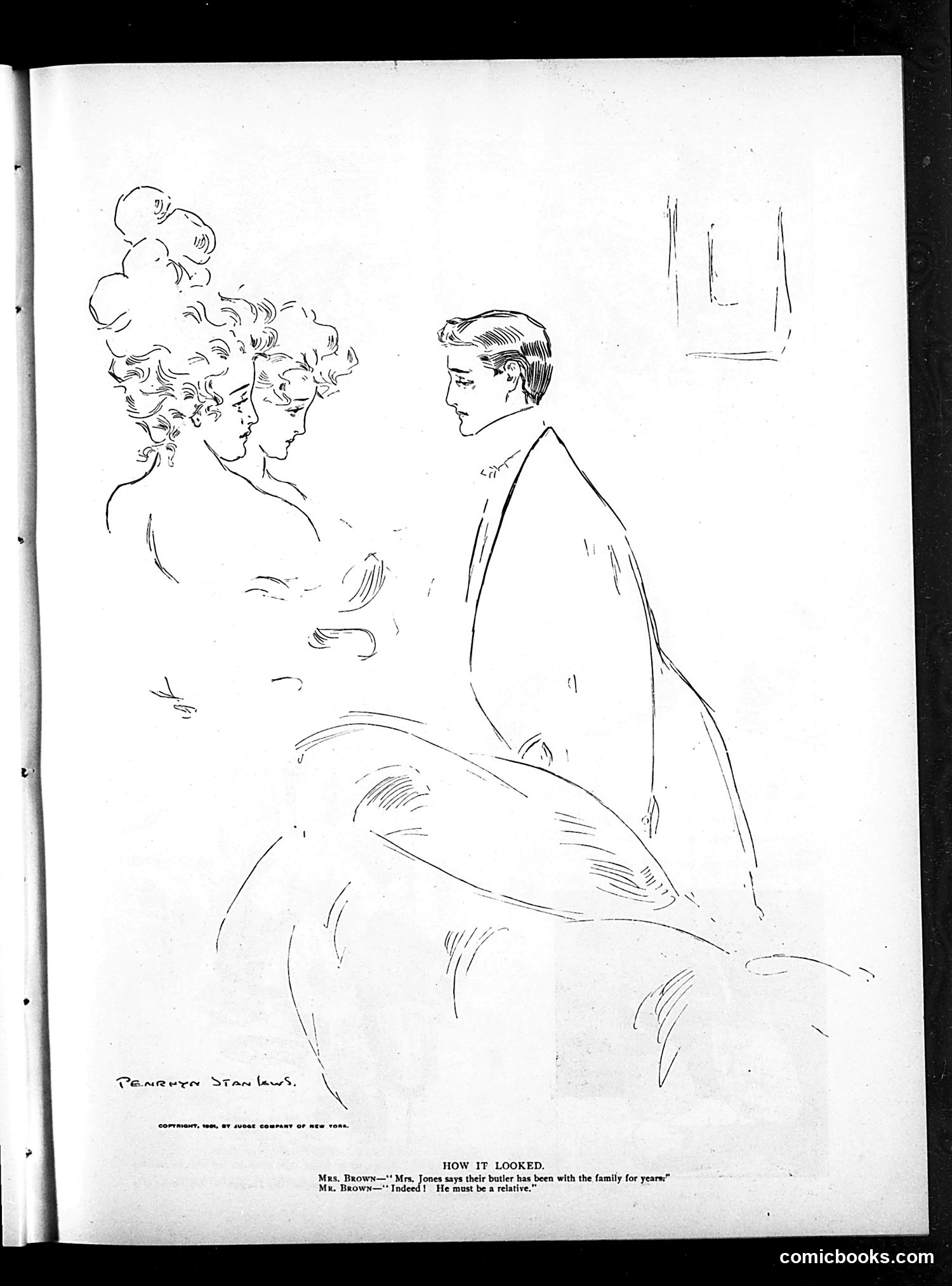
This single-panel cartoon satirizes domestic servant employment practices, likely from the early 1900s. The joke hinges on class and social assumptions of the era. **The Setup:** Mrs. Brown reports that the Jones family's butler has served them for years. **The Punchline:** Mr. Brown responds that the butler "must be a relative," implying that only family members would remain in such low-status service work for extended periods. **The Satire:** The cartoon mocks the social attitudes of wealthy households—suggesting that servants who stayed loyal for years were viewed as oddities, or that long-term service was so uncommon it seemed implausible unless motivated by familial obligation rather than genuine employment. It comments on the instability and poor conditions of domestic work, where servants typically turned over quickly rather than remaining in one household.
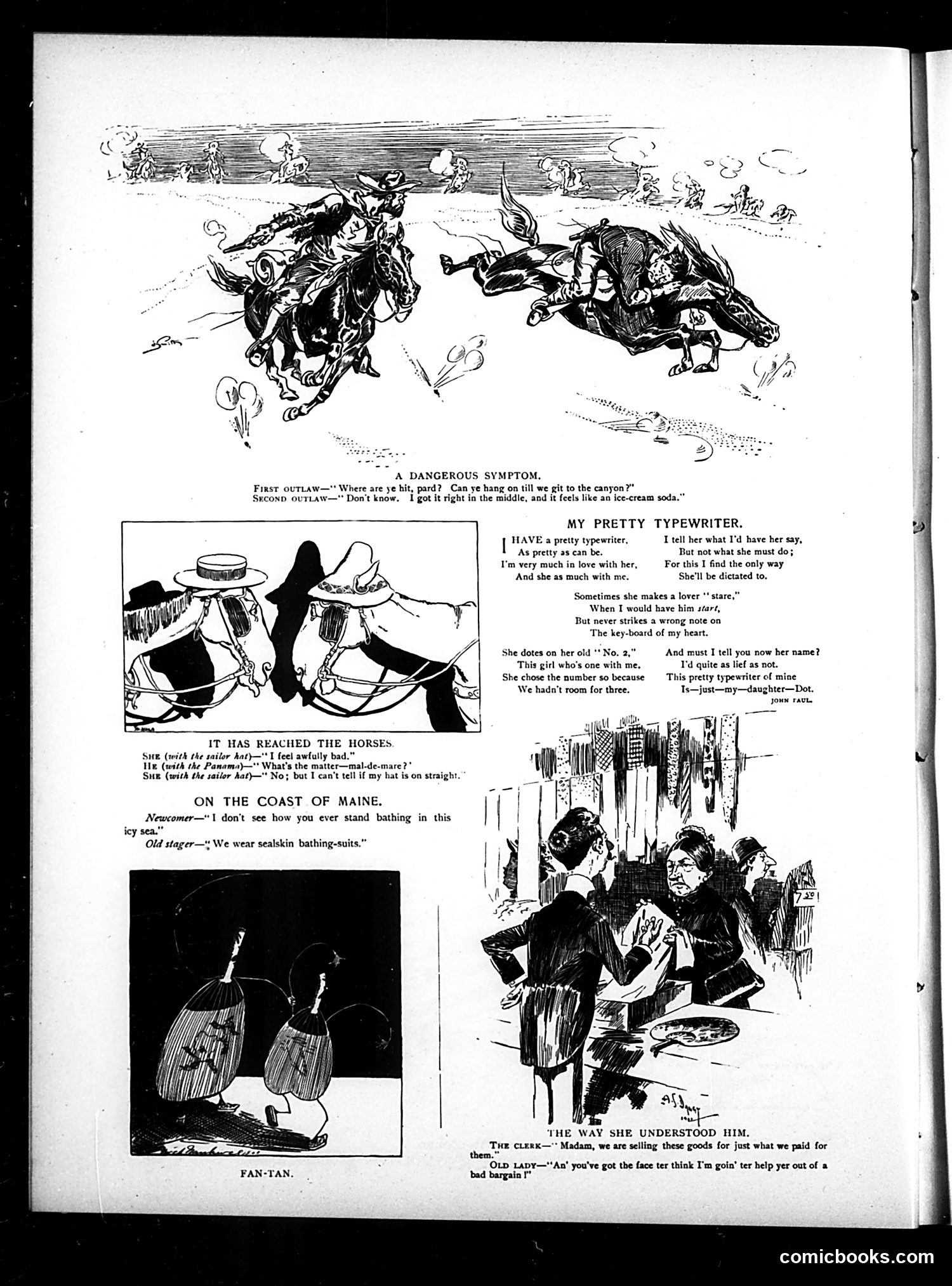
This page contains five separate humor pieces typical of early 20th-century Judge magazine: 1. **"A Dangerous Symptom"**: Two outlaws discuss an injury feeling like "an ice-cream soda"—likely satirizing the popular soda fountain culture or possibly referencing carbonation/fizzy sensations. 2. **"My Pretty Typewriter"**: A sentimental poem where "Dot" (the daughter) is metaphorically compared to a typewriter. This plays on typewriter popularity and the conceit of romantic devotion, punning on "dictated to." 3. **"It Has Reached the Horses"**: Two women discuss seasickness/hat straightness—light physical comedy about ship travel discomfort. 4. **"On the Coast of Maine"**: A joke about Maine's cold ocean waters, with locals claiming they wear "sealskin bathing-suits" (likely exaggeration). 5. **"The Way She Understood Him"**: A merchant claims goods are sold at cost; an elderly customer sarcastically refuses to help him out of his "bad bargain"—satirizing retail deception and haggling. These are largely apolitical, domestic humor pieces emphasizing wordplay and social observation.
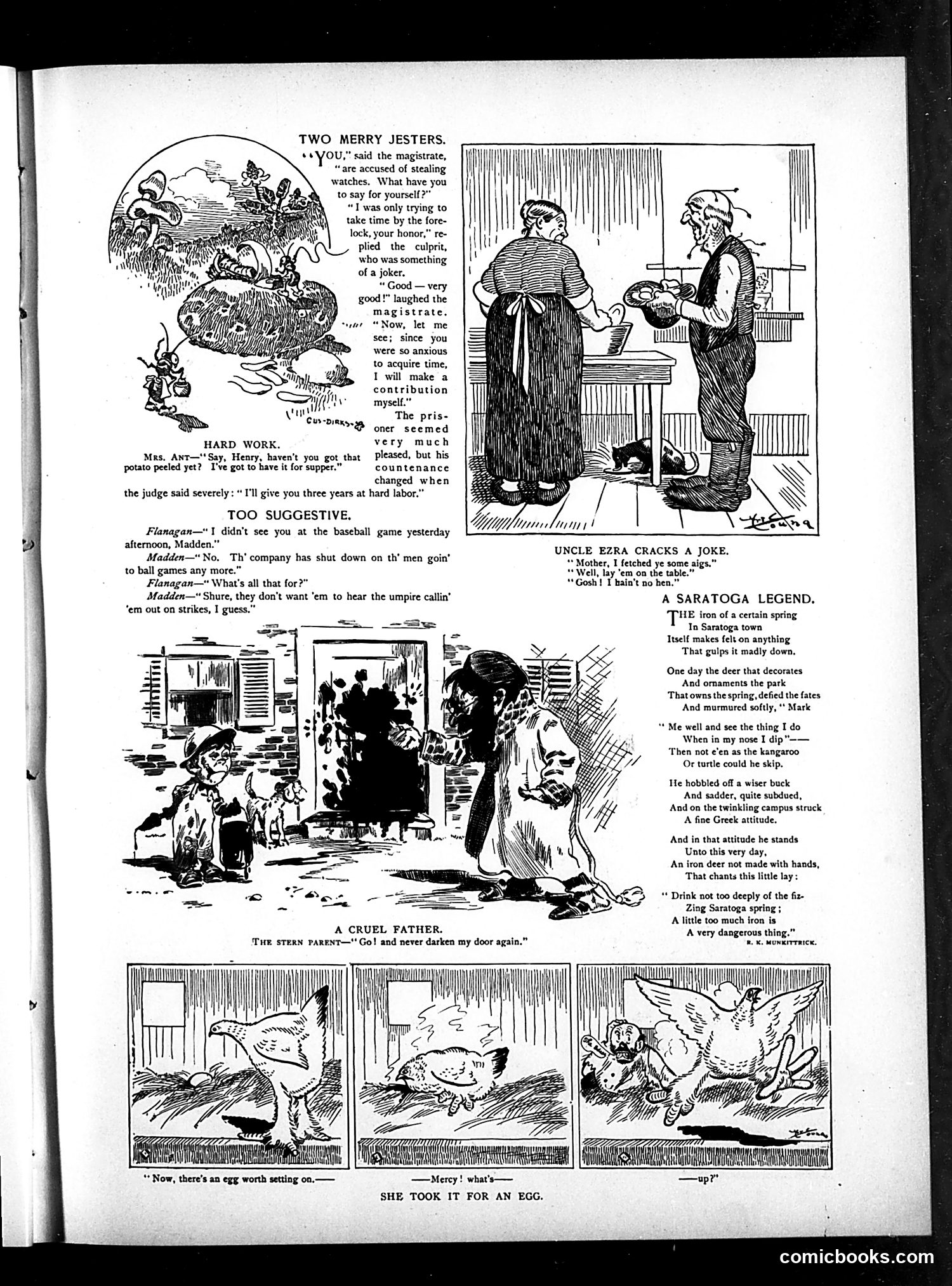
This page collects several brief humorous pieces typical of late-19th-century American satire: **"Two Merry Jesters"** presents a pun-based courtroom joke: a watch thief claims he was "taking time by the forelock" (a saying meaning to seize opportunity), which amuses the magistrate—until the judge quips he'll give the culprit "three years" to acquire time, revealing the wordplay. **"Hard Work"** and **"Too Suggestive"** are brief domestic/social gags about potato peeling and baseball, with minimal political content. **"Uncle Ezra Cracks a Joke"** features rural dialect humor, common in period comedy. **"A Saratoga Legend"** is a whimsical poem about a local legend regarding the iron-rich mineral spring at Saratoga, New York—a famous resort town. The poem warns against drinking too much of the water. **"She Took It for an Egg"** is a three-panel visual gag involving animals (appears to involve mistaken identity). Overall, this is primarily **light entertainment and wordplay** rather than sharp political satire, typical of Judge's miscellaneous humor sections.
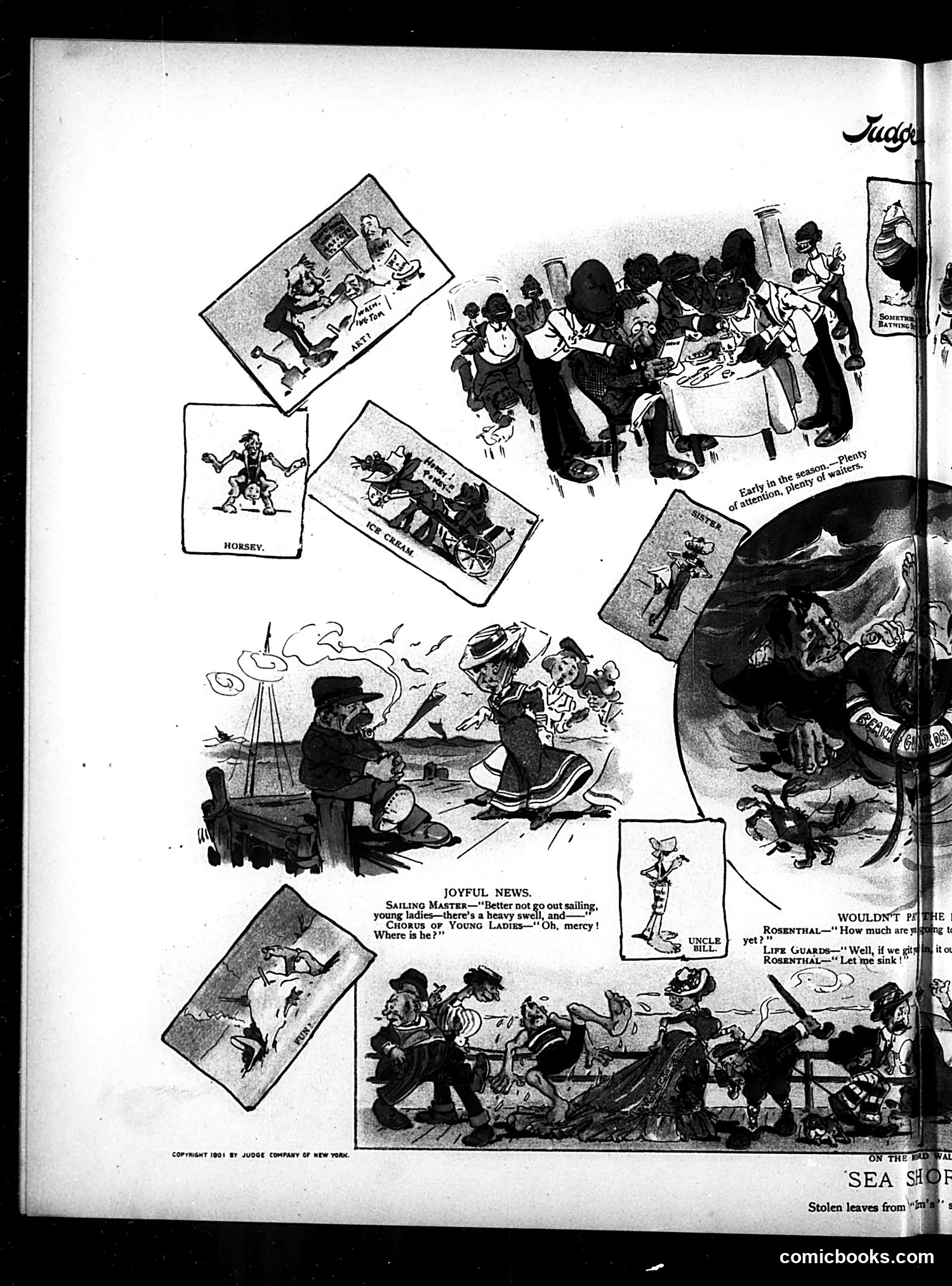
This page contains Victorian-era humor typical of Judge magazine's satirical style. The main visible cartoon, "Joyful News," depicts a sailing master warning young ladies about "a heavy swell," to which they respond by asking "Where is he?"—a double-entendre joke playing on the phrase's innocent nautical meaning versus its suggestive undertones about an attractive man. Several smaller illustrated vignettes appear scattered across the page (labeled "Horsey," "Uncle Bill," and others), though their complete captions are partially obscured or illegible in this reproduction. The copyright dates this to 1901, placing it in the Edwardian era. The humor relies on the period's conventions of coy innuendo and social commentary on courtship customs, typical of Judge's satirical approach to middle-class American society.
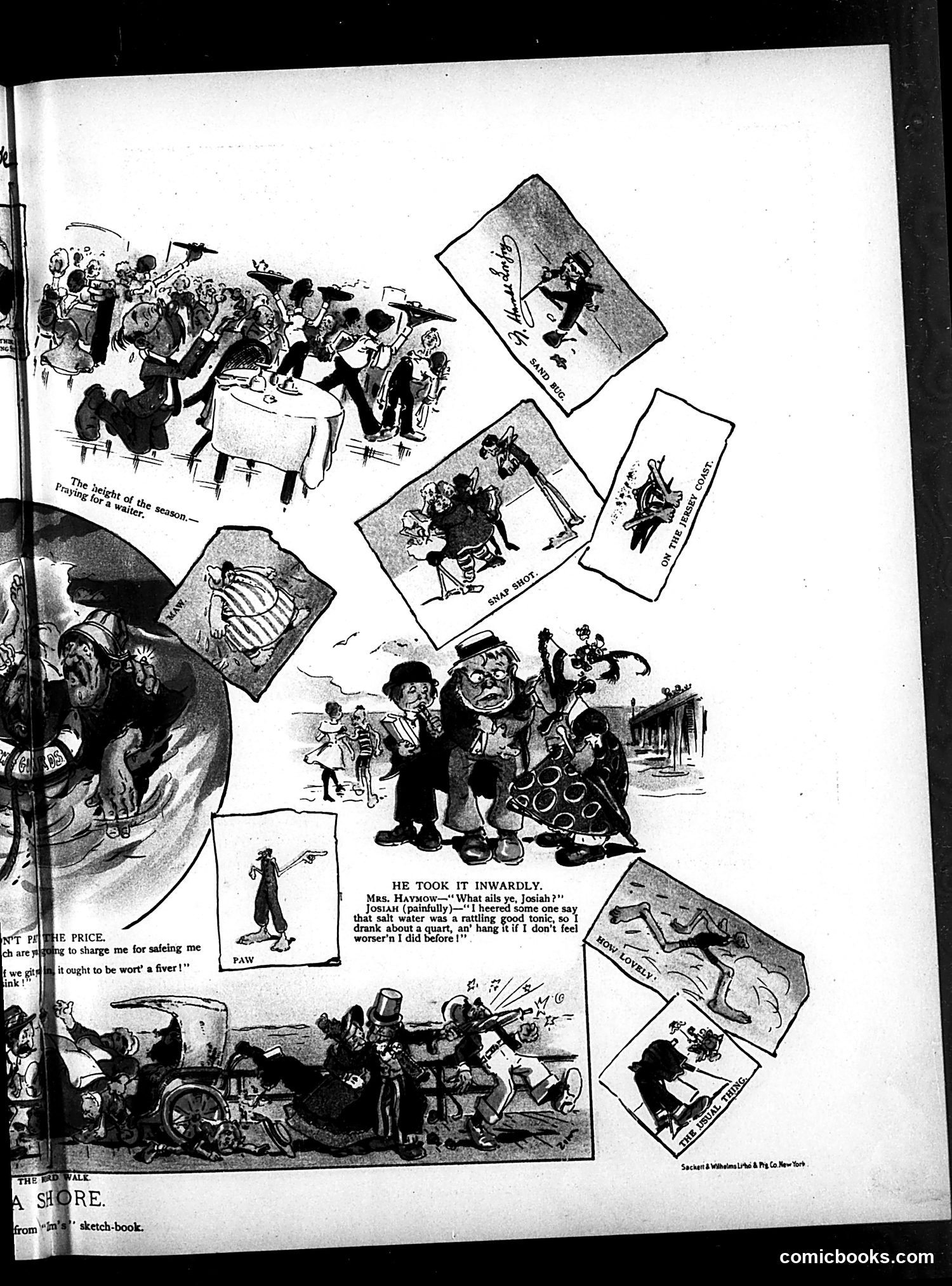
This appears to be a **humorous domestic sketch**, not political satire. The main cartoon titled "HE TOOK IT INWARDLY" depicts a rural or working-class couple: Mrs. Hayson and her husband Josiah. The joke concerns **folk medicine**: Josiah heard salt water was a tonic, drank a quart of it, and now feels worse. His pained expression and the dialogue ("worser'n I did before") satirize **gullible acceptance of dubious health remedies** — a common target of period humor. The surrounding vignettes and sketches appear to be additional comic sketches or character studies, though details are unclear from the image quality. This reflects early 20th-century American satirical humor mocking rural credulity and folk medicine practices that contradicted emerging medical knowledge.
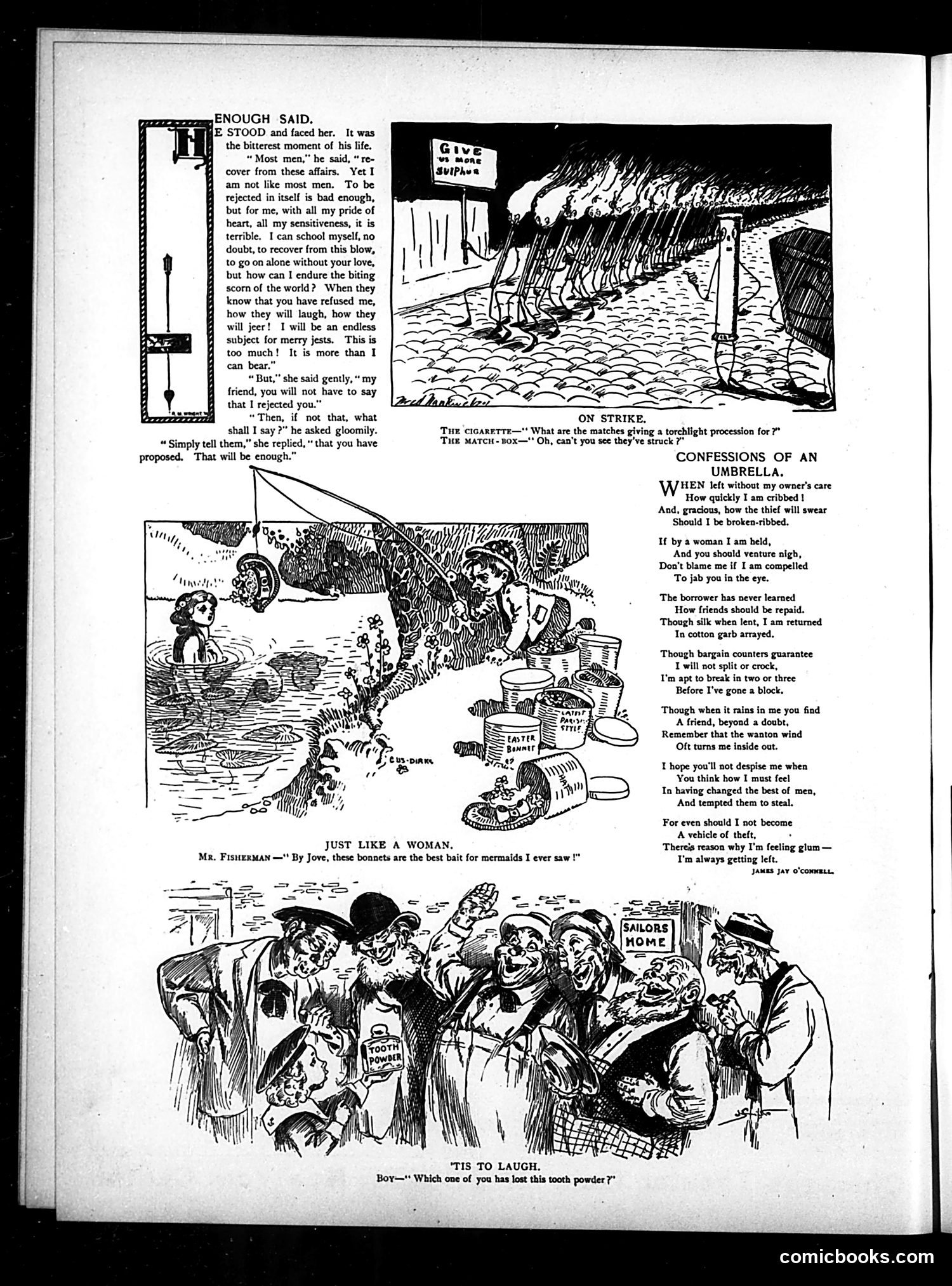
This page contains several satirical pieces typical of early 20th-century American humor: **"Enough Said"**: A romantic rejection joke where a rejected suitor laments public ridicule. The woman's solution—suggesting he claim he *proposed* rather than was rejected—mocks male vanity and the social disgrace of rejection. **"On Strike"**: A visual pun playing on labor strikes. Cigarette matches are shown in a "torchlight procession," with the match-box declaring "they've struck"—conflating labor action terminology with the literal striking of matches. **"Confessions of an Umbrella"**: Personified object humor, where an umbrella laments being borrowed without return, damaged, and stolen. This reflects common social frustrations about lost borrowed items. **"Just Like a Woman"**: A fisherman's comment that bonnets attract mermaids better than bait—a gendered joke suggesting women's frivolous interest in fashion. **"'Tis to Laugh"**: A visual gag about sailors and tooth powder (likely snuff or chewing tobacco). The humor reflects period attitudes toward gender, labor, and social class conventions.
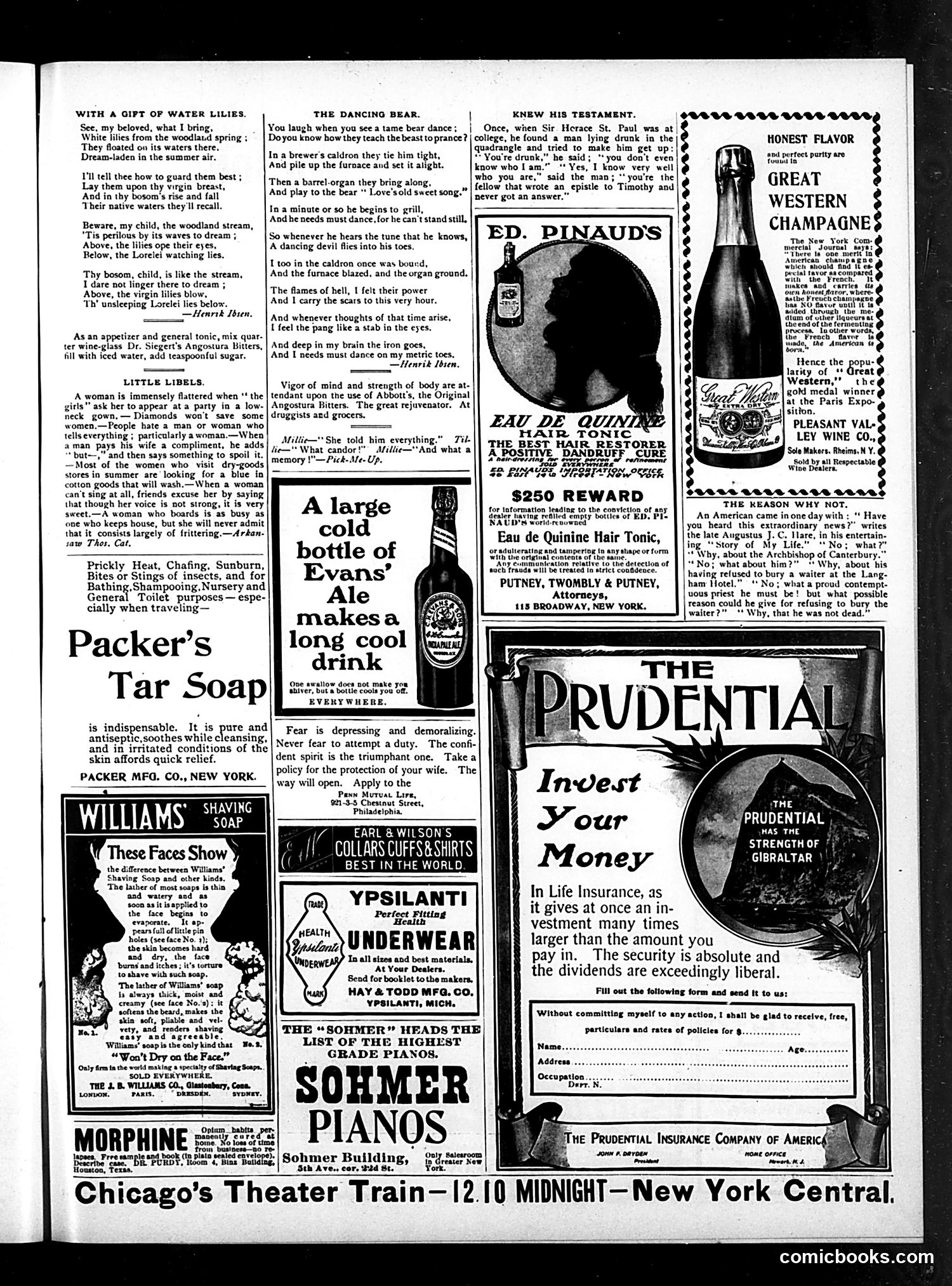
This is primarily an **advertising page** with some literary content rather than political satire. The main elements are: **Literary Content**: Two Henrik Ibsen poems ("With a Gift of Water Lilies" and "The Dancing Bear") appear at top—melancholic, symbolist verse typical of Ibsen's style. **"Little Libels" Section**: Brief, gossipy observations about women's behavior and social pretensions (avoiding certain fabrics, exaggerating compliments, etc.)—typical of Judge's light social commentary mocking Victorian conventions. **Advertisements**: The page is dominated by product ads—Packer's Tar Soap, Williams Shaving Soap, Angostura Bitters, Ypsilanti Underwear, Sohmer Pianos, and others. These ads use before/after imagery and health claims typical of early 20th-century marketing. **No clear political cartoons** are visible. The "Dancing Bear" poem uses the bear as a metaphor for human suffering and trauma, but this is Ibsen's original work, not Judge's satire. This appears to be a general-interest page mixing imported European literature with American consumer advertising.
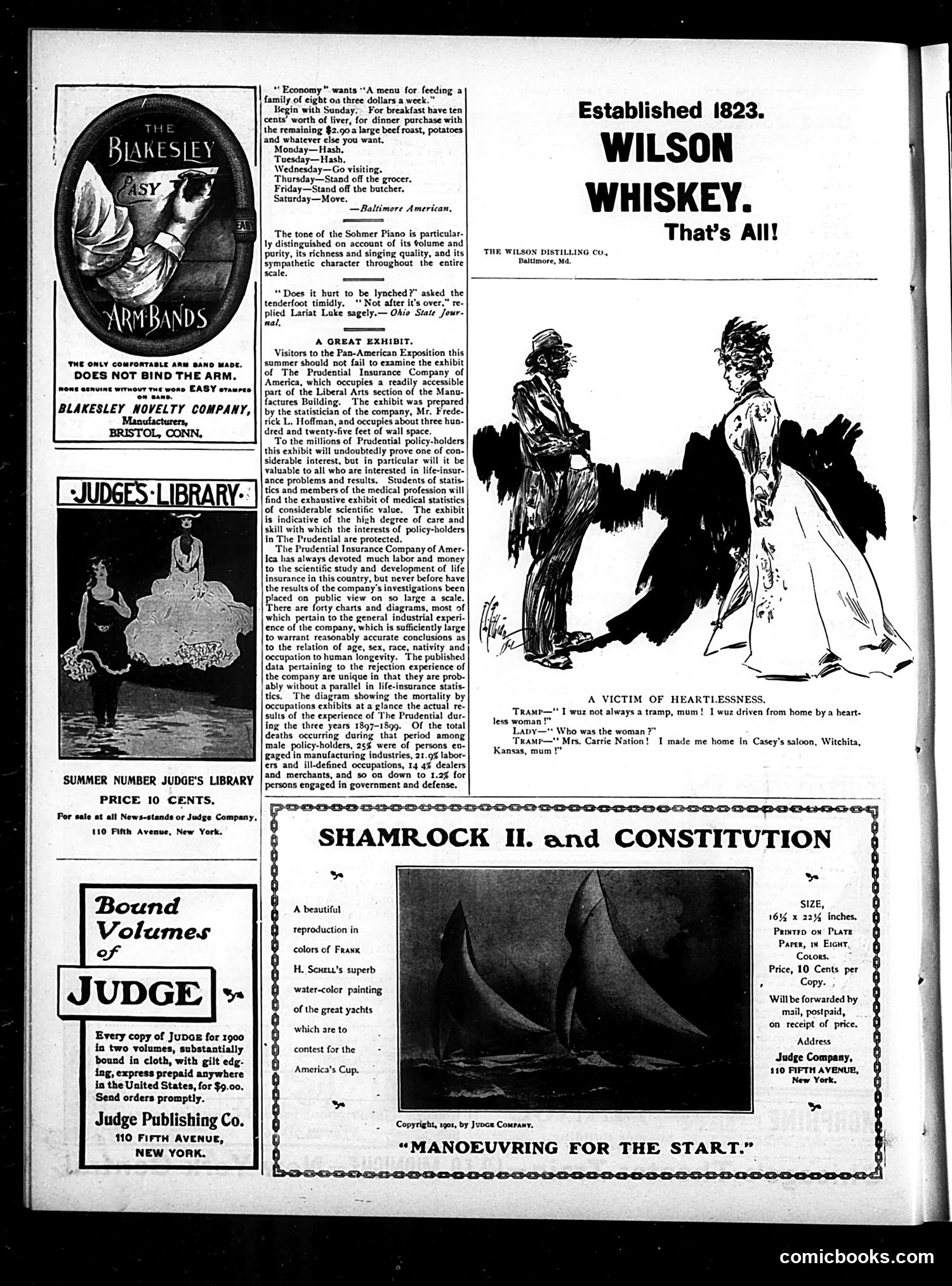
This page features a social commentary cartoon typical of Judge's satirical approach. The main illustration depicts a shabby tramp confronting a well-dressed woman, with the caption revealing his backstory: he was driven from home by a "heartless woman." The dialogue exchange suggests domestic abandonment or betrayal—the tramp claims he "was not always a tramp" but was expelled from Kansas (likely his home) due to a woman's cruelty. The woman's cold, dismissive response ("Who was the woman?") and his bitter reference to "Mrs. Carrie Nation" indicate Judge is likely satirizing social hypocrisy: women advocating for moral reform (Nation was famous for temperance activism) while simultaneously displaying personal heartlessness. The cartoon critiques the disconnect between public moral righteousness and private compassion—a recurring Judge theme mocking Victorian-era sanctimoniousness.
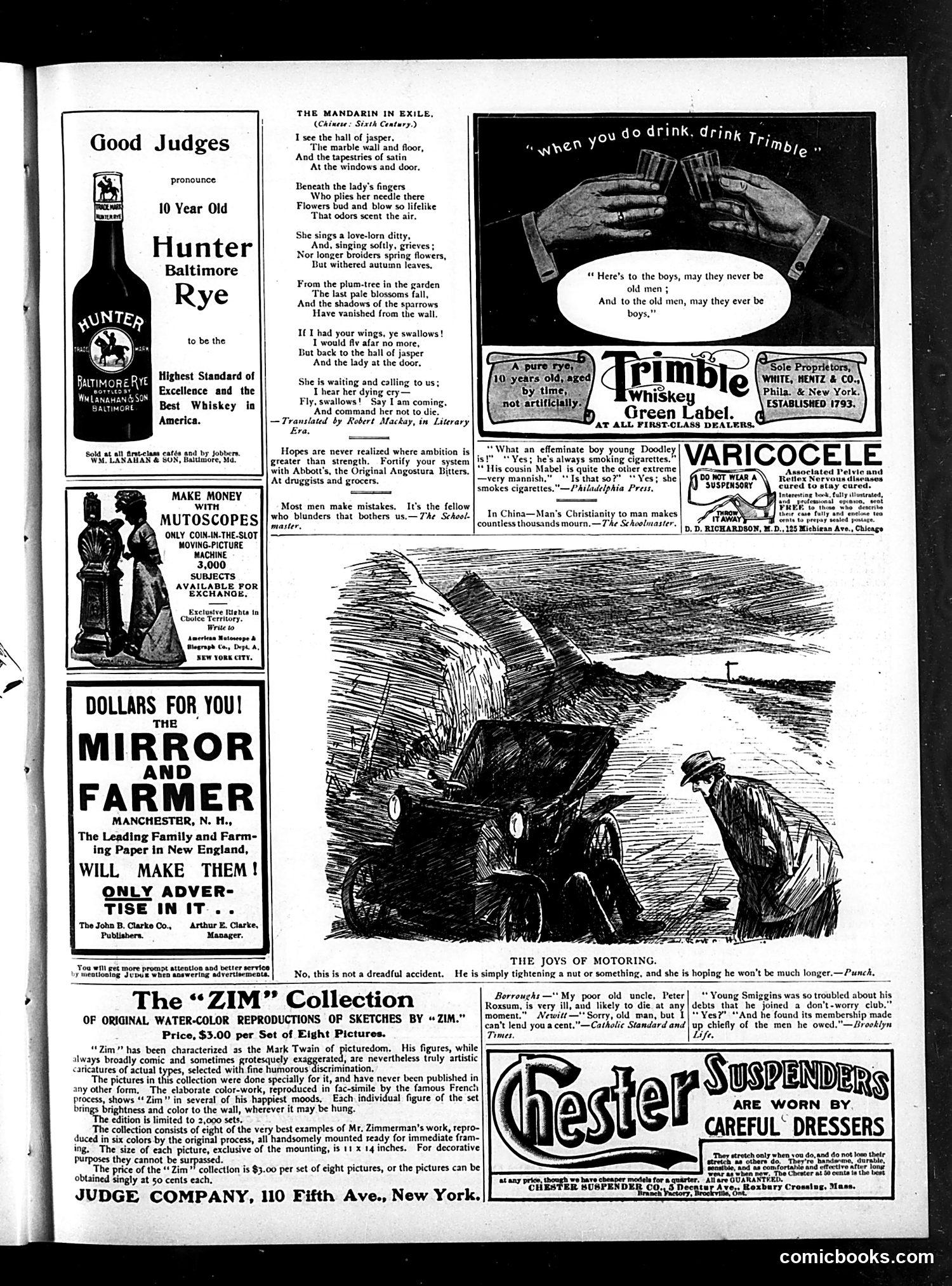
This page primarily features **advertisements and light satirical humor** rather than political cartoons. **Main Content:** - **"The Mandarin in Exile"**: A romantic poem about a Chinese official longing for home and a lady he left behind—presented as exotic, melancholic literature typical of the era's fascination with Asian themes. - **"The Joys of Motoring"**: A brief cartoon joke about early automobiles, where a man repairs his car while his female companion hopes the task won't take long—poking fun at the inconveniences of newfangled motor vehicles. - **Satirical quips**: Short humorous observations on human nature (ambition, mistakes) and a joke about cigarette-smoking youth of both genders being considered either effeminate or too masculine—reflecting early 20th-century anxieties about gender norms. **Advertisements** dominate the layout: whiskey, mutoscopes (early coin-operated film viewers), farming publications, and medical treatments. The page reflects Judge's mix of sophisticated literary content, gentle social satire, and commercial appeals to middle-class readers.
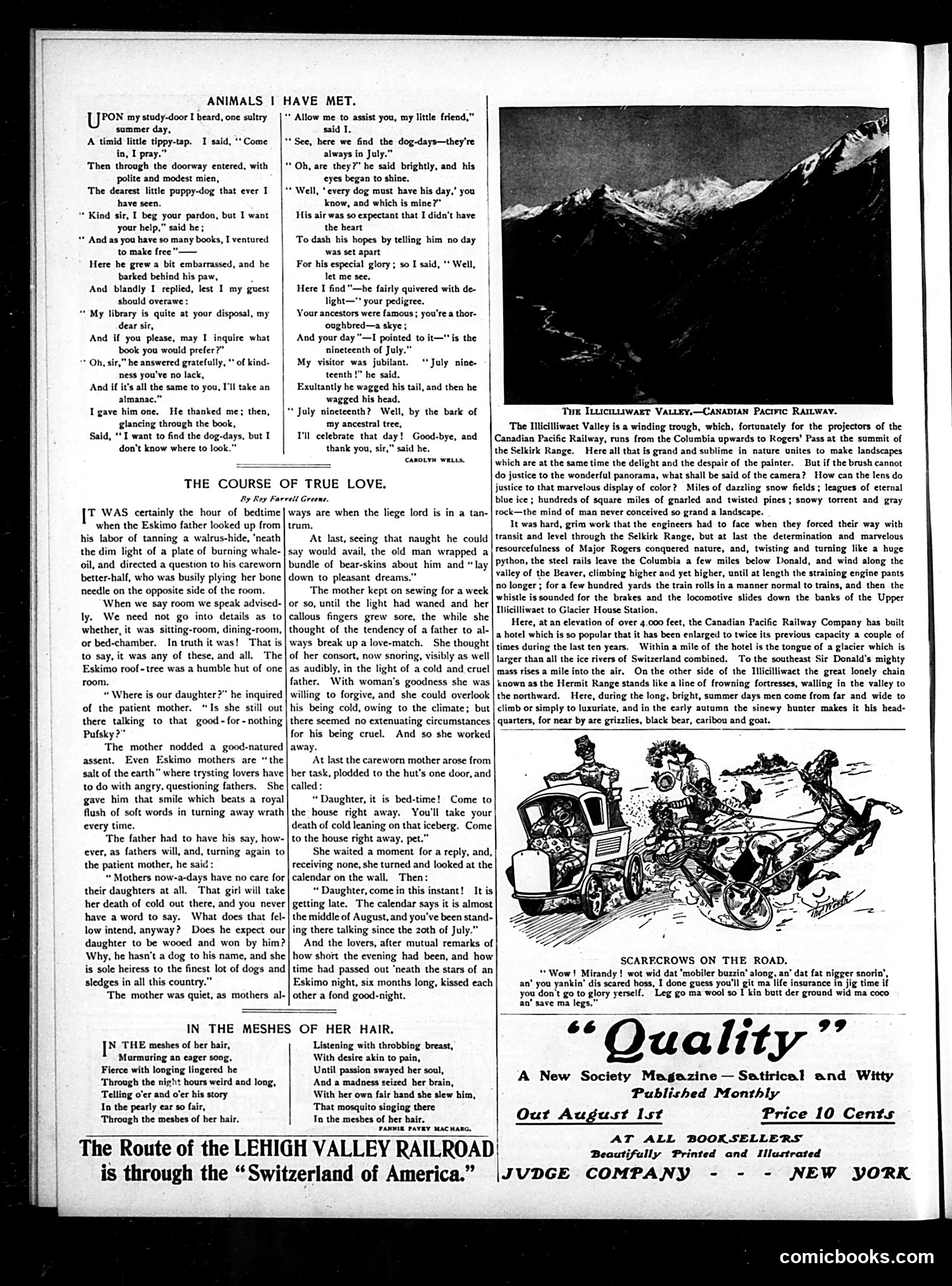
This page contains two distinct pieces: **"Animals I Have Met"** presents a whimsical story where a talking puppy visits a gentleman's study seeking help finding "the dog-days" in an almanac. The humor derives from the pun: the puppy believes the "dog-days" (a real astronomical term for mid-July) are literally *his* special days as a dog. The gentleman humorously plays along, inventing a birthday for the delighted pup. **"The Course of True Love"** depicts an Eskimo father's domestic complaint: his daughter is courting a suitor with no wealth in dogs or sledges—the measure of Inuit prosperity. The satire mocks paternal concern about a son-in-law's financial prospects, universalizing the age-old father-daughter courtship tension across cultures. Both are lighthearted, sentimental pieces typical of *Judge*'s family-friendly humor—playing on linguistic ambiguity and cultural stereotypes for gentle comedy.
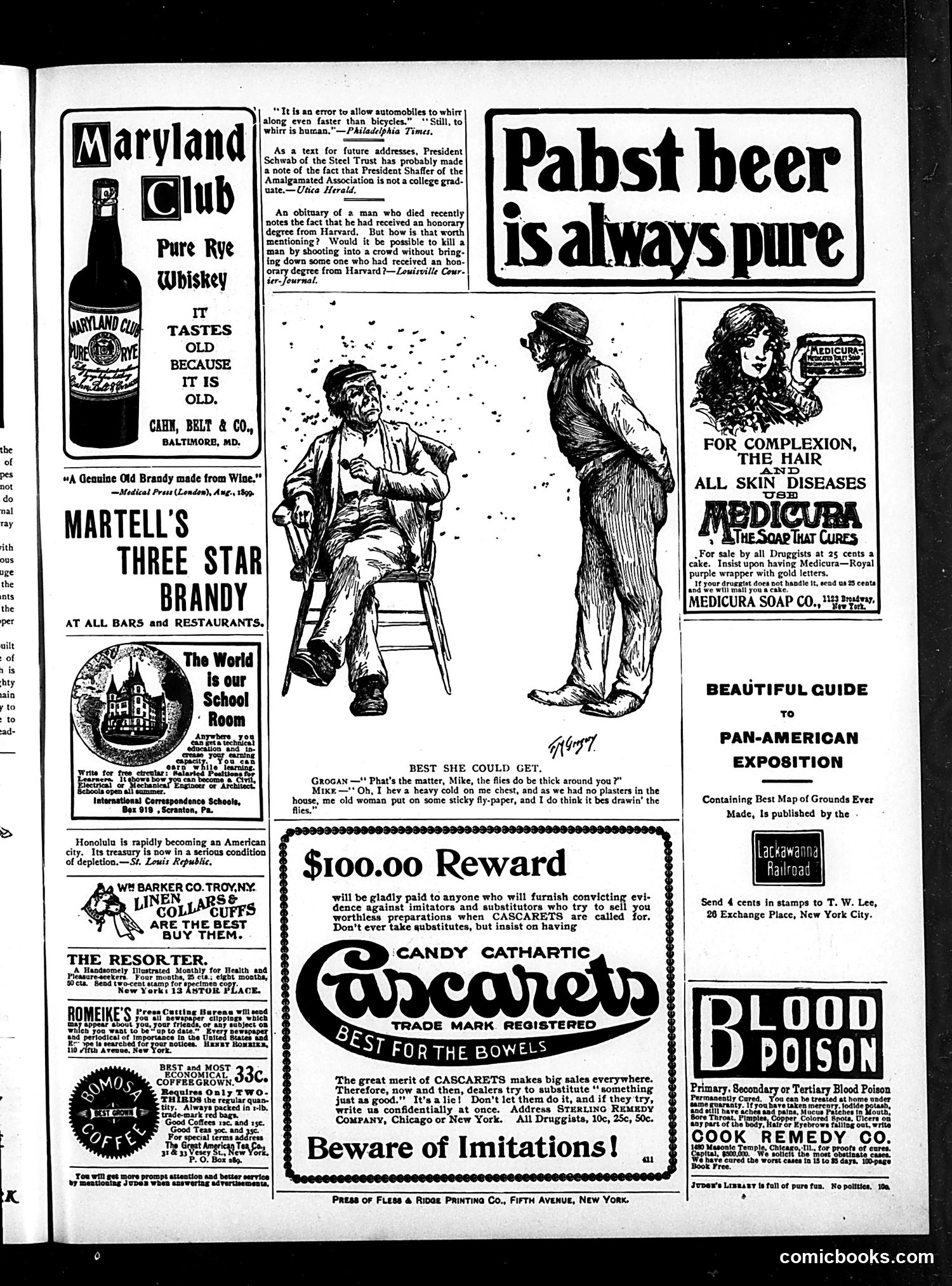
This page is primarily **advertising**, typical of early 1900s magazines. However, it contains one small satirical cartoon titled "BEST SHE COULD GET." ## The Cartoon The cartoon depicts an Irish immigrant man (identifiable by dialect: "Grocan" and "Mixe") discussing his ailments. When asked why flies swarm around him, he explains he has a chest cold and, lacking proper medical plasters, his wife applied sticky fly-paper instead—which he believes is "drawin' the flies." ## The Satire This mocks working-class Irish immigrants' poverty and limited access to healthcare. The joke relies on ethnic stereotyping (thick Irish accent) and the absurdity of using fly-paper as a medical remedy—suggesting both desperation and ignorance. The title "BEST SHE COULD GET" emphasizes their socioeconomic constraints. The surrounding advertisements—for patent medicines (Medicura soap for skin diseases, blood poison cures) and candy laxatives—were common in this era, often making dubious health claims to vulnerable populations.
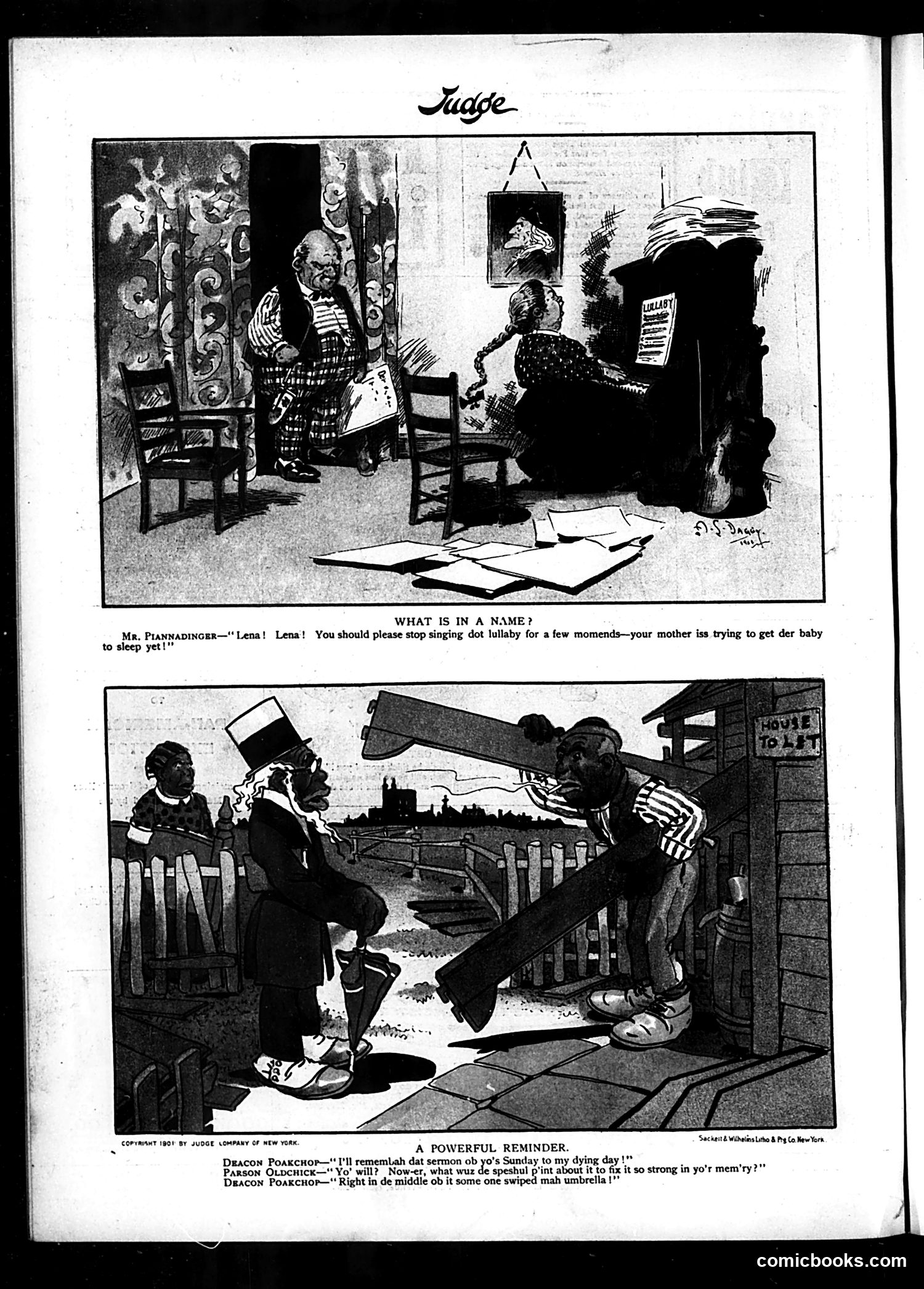
This 1901 page contains two separate satirical cartoons mocking immigrant and African American dialects. **Top cartoon ("What is in a Name?"):** Depicts a German immigrant father (Mr. Piannadinger) complaining that a woman named Lena is singing lullabies while his baby needs sleep. The satire targets German immigrants' distinctive accents and naming patterns, rendered in exaggerated dialect spelling ("dot," "iss," "der"). **Bottom cartoon ("A Powerful Reminder"):** Shows two Black men—Deacon Poaxchop and Parson Oldchick—in dialect-heavy conversation. The joke: the deacon will remember the sermon forever, not because it was spiritually moving, but because someone stole his umbrella during it. The humor relies on racial stereotyping and mocking Black vernacular speech patterns. Both cartoons exemplify Judge magazine's approach: using caricature and exaggerated dialect to ridicule marginalized groups. The satire punches downward at immigrants and African Americans rather than addressing actual social issues.