
Judge, 1901-08-17 · page 14 of 16
Judge — August 17, 1901 — page 14: what you’re looking at
What you’re looking at
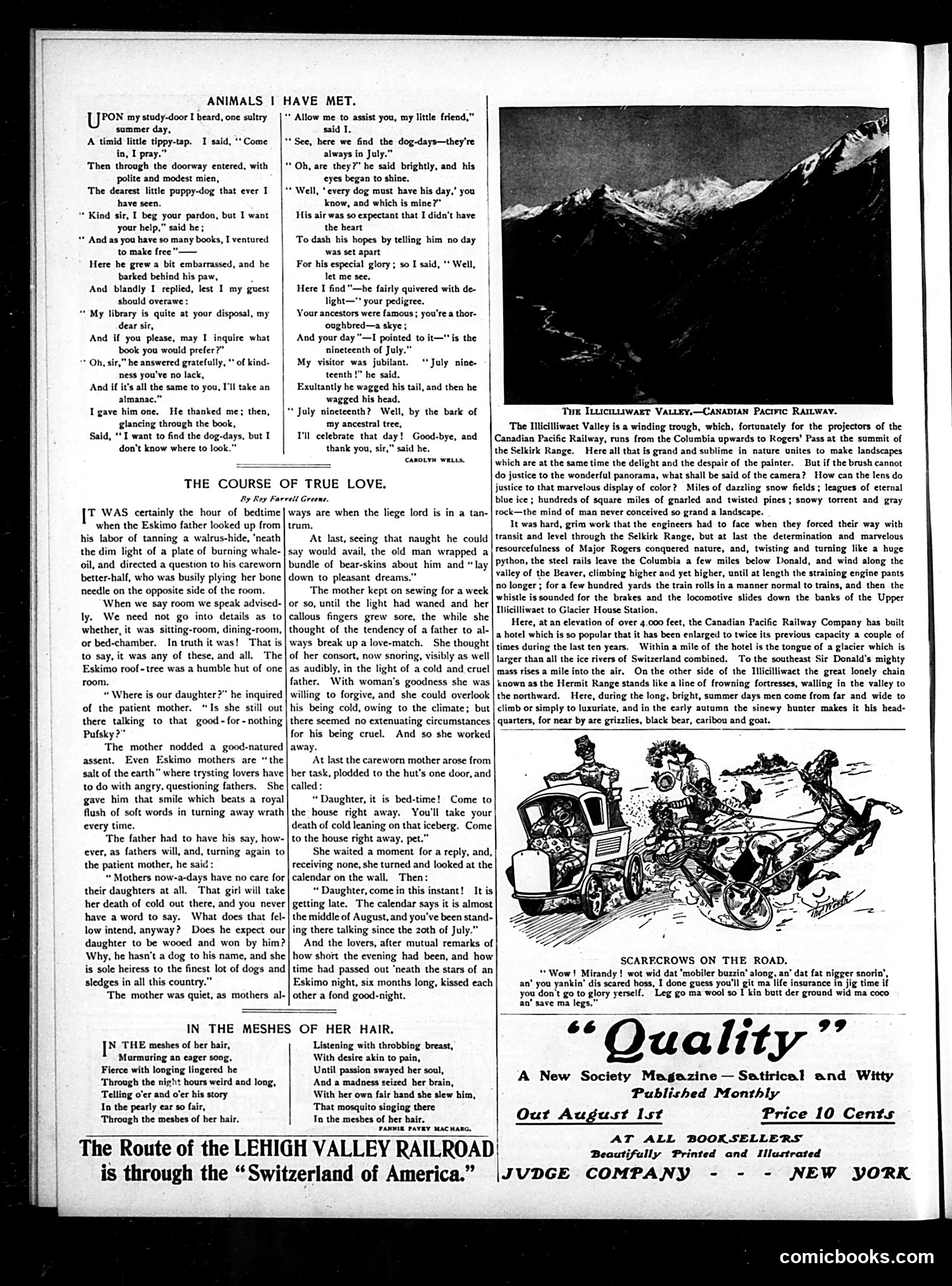
This page contains two distinct pieces: **"Animals I Have Met"** presents a whimsical story where a talking puppy visits a gentleman's study seeking help finding "the dog-days" in an almanac. The humor derives from the pun: the puppy believes the "dog-days" (a real astronomical term for mid-July) are literally *his* special days as a dog. The gentleman humorously plays along, inventing a birthday for the delighted pup. **"The Course of True Love"** depicts an Eskimo father's domestic complaint: his daughter is courting a suitor with no wealth in dogs or sledges—the measure of Inuit prosperity. The satire mocks paternal concern about a son-in-law's financial prospects, universalizing the age-old father-daughter courtship tension across cultures. Both are lighthearted, sentimental pieces typical of *Judge*'s family-friendly humor—playing on linguistic ambiguity and cultural stereotypes for gentle comedy.
📄 Transcribed text from this page (OCR, searchable)
Machine-transcribed from the original scan — historical spelling and the odd misread are preserved.
ANIMALS | [PON my study-door I heard, one sultry summer day, A timid little tippy-tap. in, I pray.” ‘Then through the doorway entered, with polite and modest mien, ‘The dearest little puppy-dog that ever I have seen. " Kind sir, I beg your pardon, but I want your help,” said he; ** And as you have so many books, I ventured to make free" — Here he grew a bit embarrassed, and he barked behind his paw, And blandly I replied, lest I my guest should overaw “My library is quite at your disposal, my dear sir, And if you please, may I inquire what book you would prefer?” ~ Oh, sir,” he answered gratefully, ** of kind- ness you've no lack, And if it's all the same to you, I'll take an almanac.” I said, ** Come I gave him one, He thanked me; then, glancing through the book, Said, “*T want to find the dog-days, but I don't know where to look.” HAVE MET. * Allow me to assist you, my little friend,” said I. “+ See, here we find the dog-days—they're always in July.” “Oh, are they?” he said brightly, and his eyes began to shine. ** Well, ‘every dog must have his day,’ you know, and which is mine?” His air was so expectant that I didn’t have the heart To dash his hopes by telling him no day was set apart For his especial glory; so I said, ** Well, let me see, Here I find ""—he fairly quivered with de- light—"* your pedigree. Your ancestors were famous ; you're a thor- oughbred—a skye; And your day"—I pointed to it—"*is the nineteenth of July.” My visitor was jubilant. teenth !" he sai Exultantly he wagged his tail, and then he wagged his head. ** July nineteenth? Well, by the bark of my ancestral tree, Till celebrate that day! thank you, “July nine- Good-bye, and .”" said he. (caROLY Wats, THE COURSE OF TRUE LOVE. By Roy Far WAS certainly the hour of bedtime when the Eskimo father looked up from his labor of tanning a walrus-hide, ‘neath the dim light of a plate of burning whale- oil, and directed a question to his careworn better-half, who was busily plying her bone needle on the opposite side of the room. When we say room we speak advised- ly. We need not go into details as to whether, it was sitting-room, dining-room, or bed-chamber. In truth it was! That is to say, it was any of these, and all. The Eskimo roof-tree was a humble hut of one room. “ Where is our daughter?” he inquired of the patient mother. ‘Is she still out there talking to that good - for - nothing Pufsky?” The mother nodded a good-natured assent. Even Eskimo mothers are “the salt of the earth” where trysting lovers have to do with angry. questioning fathers. She gave him that smile which beats a royal flush of soft words in turning away wrath every time. The father had to have his say, how- ever, as fathers will, and, turning again to the patient mother, he said: “ Mothers now-a-days have no care for their daughters at all. That girl will take her death of cold out there, and you never have a word to say. What does that fel- low intend, anyway? Does he expect our daughter to be wooed and won by him? Why, he hasn't a dog to his name, and she is sole heiress to the finest lot of dogs and sledges in all this country.” The mother was quiet, as mothers al- It elt Greene, ways are when the liege lord is in a tan- trum, At last, seeing that naught he could say would avail, the old man wrapped a bundle of bear-skins about him and “lay down to pleasant dreams.” The mother kept on sewing for a week or so, until the light had waned and her callous fingers grew sore, the while she thought of the tendency of a father to al- ways break up alove-match. She thought of her consort, now snoring, visibly as well as audibly, in the light of a cold and cruel father. With woman's goodness she was willing to forgive, and she could overlook his being cold, owing to the climate; but there seemed no extenuating circumstances for his being cruel. And so she worked away. At last the careworn mother arose from her task, plodded to the hut’s one door, and called: “Daughter, it is bed-time! Come to the house right away. You'll take your death of cold leaning on that iceberg. Come to the house right away, pet.” She waited a moment for a reply, and, receiving none, she turned and looked at the calendar on the wall. Then: “ Daughter, come in this instant! It is getting late, The calendar says it is almost the middle of August, and you've been stand- ing there talking since the 2oth of July.” And the lovers, after mutual remarks of how short the evening had been, and how time had passed out ‘neath the stars of an Eskimo night, six months long, kissed each other a fond good-night. IN THE MESHES OF HER HAIR. N THE meshes of her Murmuring an eager song, Fierce with longing lingered he ‘Through the night hours weird and long, Telling o'er and o'er his story In the pearly ear so fair, ‘Through the meshes of her hair, Listening with throbbing breast, With desire akin to pain, Until passion swayed her soul, And a madness seized her brain, With her own fair hand she slew him, That mosquito singing there Tn the meshes of her hair. VAMNIE PAVEY MAC HARG, The Route of the LEHIGH VALLEY RAILROAD} is through the “Switzerland of America.” Tue Inictsuwazt VALLEY.—CANADIAN Pactric RAILWAY. ‘The Ilicilliwaet Valley is a winding trough, which, fortunately for the projectors of the Canadian Pacific Railway, runs from the Columbia upwards to Rogers’ Pass at the summit of the Selkirk Range. Here all that is grand and sublime in nature unites to make landscapes which are at the same time the delight and the despair of the painter. But if the brush cannot do justice to the wonderful panorama, what shall be said of the camera? How can the lens do justice to that marvelous display of color? Miles of dazzling snow fields ; leagues of eternal blue ice ; hundreds of square miles of gnarled and twisted pines; snowy torrent and gray rock—the mind of man never conceived so grand a landscape. It was hard, grim work that the engineers had to face when they forced their way with transit and level through the Selkirk Range, but at last the determination and marvelous resourcefulness of Major Rogers conquered nature, and, twisting and turning like a huge python, the steel rails leave the Columbia a few miles below Donald, and wind along the valley of the Beaver, climbing higher and yet higher, until at length the straining engine pants no longer ; for a few hundred yards the train rolls in a manner normal to trains, and then the whistle is sounded for the brakes and the locomotive slides down the banks of the Upper Ilicilliwaet to Glacier House Station. Here, at an elevation of over 4,000 feet, the Canadian Pacific Railway Company has built a hotel which is so popular that it has been enlarged to twice its previous capacity a couple of times during the last ten years. Within a mile of the hotel is the tongue of a glacier which is larger than all the ice rivers of Switzerland combined. To the southeast Sir Donald’s mighty mass rises a mile into the air. On the other side of the Illicilliwaet the great lonely chain known as the Hermit Range stands like a line of frowning fortresses, walling in the valley to the northward. Here, during the long, bright, summer days men come from far and wide to climb or simply to luxuriate, and in the early autumn the sinewy bunter makes it his head- quarters, for near by are grizzlies, black bear, caribou and goat. SCARFCROWS ON THE ROAD. “Wow! Mirandy ! wot wid dat 'mobiler buzzin’ along, you yankin’ dis scared hoss, I done guess you'll git ma you don't go to glory yerself. an’ save ma legs.” “Quality ’’ dat fat nigger snorin’, fe insurance in jig time if ‘Leg go ma wool so I'kin butt der ground wid ma coco A New Society Magazine — Satirical and Witty Published Monthly Out August Ist Price 10 Cents AT ALL BOOKSELLERS Beautifully Printed and Illustrated JUDGE COMPANY NEW YORK comicbooks.com